
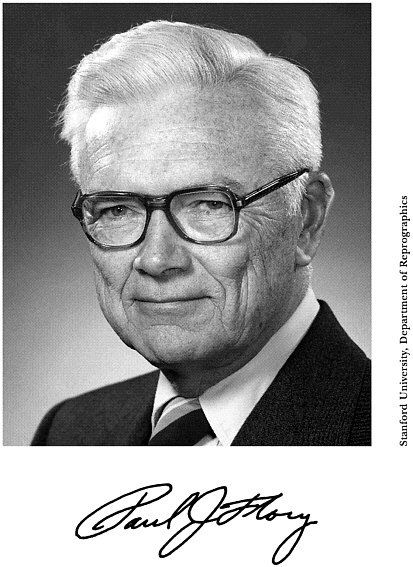
PAUL JOHN FLORY
June 19, 1910–September 8, 1985
BY WILLIAM S. JOHNSON,1 WALTER H. STOCKMAYER, AND HENRY TAUBE
PAUL J.FLORY, who received the 1974 Nobel Prize in chemistry, died unexpectedly of a heart attack on September 8, 1985, at his vacation home on a hilltop in Big Sur, California. The citation of the Nobel award reads: “For his fundamental achievements, both theoretical and experimental, in the physical chemistry of macromolecules.” He occupied a towering position in the chemical community, and was noted not only for his outstanding leadership in macromolecular chemistry but also for his role as a passionate defender of human rights throughout the world.
The importance of his work was clearly recognized during his lifetime. Among the honors he received are four national awards of the American Chemical Society, five section awards of that society, ten honorary degrees, the National Medal of Science, and the Nobel Prize. His activities in the cause of human rights, especially after his Nobel award, were prodigious and universal. He was elected to the National Academy of Sciences in 1953.
EARLY LIFE, EDUCATION, CAREER, AND FAMILY (BY WILLIAM S.JOHNSON)
Paul Flory was a warm and loyal friend to those people who, like himself, had high standards of integrity and were honestly modest about their own accomplishments and potential. These friends in turn greatly admired Paul. On the other hand, Paul was not everyone’s friend. Indeed, he was not reluctant to show his disdain for those whose behavior suggested that they had exalted opinions of themselves, particularly if they were in dominating positions (e.g., administration) where they could influence the lives of others. Paul was a strong and vociferous champion of the oppressed in such situations and a fierce adversary of the offender.
Flory’s puritanical principles could well have been derived from his background. The Flory family traces its roots back to Alsace, then England, later to Pennsylvania, and then to Ohio. Paul appeared to be especially proud of his Huguenot origin. His father, Ezra Flory, was a minister in the Church of the Brethren, a sect somewhat like the Quakers. The family moved frequently as he was appointed to different parishes. Ezra married Emma Brumbaugh, by whom he had two daughters, Margaret and Miriam. After Emma died in childbirth, Ezra married her cousin, Martha Brumbaugh, and they had two boys, James and Paul. The farmland outside of Dayton was given to the Florys by a Presidential grant and is still in the family.
Paul was rather frail as a child but was very precocious. He was always especially attached to his half-sister, Margaret, who was also his sixth-grade teacher. She recognized his potential, and was eager to have him further his education. As he matured Paul worked diligently on developing his physique through activities such as ditch digging, vigorous swimming, and mountain hiking. He became a strong
man with great vitality, which he enjoyed for the better part of his life. He was always adamantly opposed to having regular physical checkups even when he began to be bothered by tiring while swimming, not very long before he died of a massive heart attack.
Although it was during the Great Depression, Paul managed to attend Manchester College in Indiana, graduating in three years and supporting himself by various jobs. It was at Manchester that his interest in science, particularly chemistry, was inspired by Professor Carl W.Holl, who encouraged Paul to enter graduate school at Ohio State University in 1931. During the early period at Ohio State he helped to support himself by digging ditches and working in the Kelvinator factory, and he first pursued a master’s program in organic chemistry under Professor Cecil E.Boord. In his second year, having decided to opt for physical chemistry, he became laboratory assistant to his dissertation adviser, Professor Herrick L.Johnston, whom Paul described as “having boundless zeal for scientific research which made a lasting impression on his students.” On the other hand, a fellow graduate student of that time has recalled that Johnston and Flory “did not see eye to eye.”
Paul was a restless person and hardly ever was satisfied with the status quo. He was always looking for better places or conditions where his scientific interests and those of his colleagues could flourish. After graduate school he joined DuPont in 1934 and four years later, in 1938, he left to join the Basic Research Laboratory at the University of Cincinnati. The urgency of the development of synthetic rubber provoked by World War II brought him back to industrial research at the Esso Laboratories of the Standard Oil Development Company (1940–43) and then in the Research Laboratory of the Goodyear Tire Company (1943–48). In 1948 he accepted a professorship at Cornell University, where
he was fairly content for nine years. Then in 1957 he was lured to the Mellon Institute in Pittsburgh to establish a broad program of basic research. Under his direction this enterprise thrived for several years until top management began to lose interest in the project. In 1961 he accepted a professorship at Stanford University, where he remained until his death in 1985.
Paul enjoyed a rich family life. In 1936 he married Emily Catherine Tabor, who was strongly supportive of all of her husband’s activities. They had three children: Susan, who is now the wife of George S.Springer, a professor in the Department of Aeronautics and Astronautics at Stanford University; Melinda, whose husband, Donald E.Groom, is professor of physics at the University of Utah; and Dr. Paul John Flory, Jr., research associate in the Department of Human Genetics at the Yale University School of Medicine. There are five grandchildren in the family: Elizabeth Springer, Mary Springer, Susanna Groom, Jeremy Groom, and Charles Groom.
SCIENTIFIC WORK (BY WALTER H.STOCKMAYER)
Commencing in 1934 Flory dealt with most of the major problems in the physical chemistry of polymeric substances, among them the kinetics and mechanism of polymerization, molar mass distribution, solution thermodynamics and hydrodynamics, melt viscosity, glass formation, crystallization, chain conformation, rubberlike elasticity, and liquid crystals. The restricted bibliography presented at the end of this memoir necessarily cannot convey fully the content of his more than 300 publications.
The special characteristics of Flory’s work were well stated by his longtime friend and collaborator Thomas G.Fox.
The secret of his success is unparalleled intuition for grasping the physical
essentials of a problem, for visualizing a phenomenon in terms of simple models amenable to straightforward treatment and productive of results that are valid to the degree required by the original statement of the problem. Consequently, Flory’s concepts and results are presented in a way that is instructive, understandable, and directly useful to the reader. This is equally true for those working in basic polymer science and those interested in industrial applications.
DUPONT AND CAROTHERS (1934–1938)
Flory was offered a position at DuPont during the height of the depression, when very few jobs were available in either industry or the academic world. He was especially fortunate in being assigned to work directly under the great Wallace H.Carothers, whose contributions to a firm grounding of the macromolecular concept rivaled those of Hermann Staudinger. Paul chose to investigate the simplest and most established reactions involving bifunctional reagents (e.g., esterification between ethylene glycol and succinic acid). It was becoming clear that such condensation polymers as produced would consist of chain molecules of different length, and the problem that Carothers set Flory was to develop a mathematical theory of this distribution. When this work was started, it was commonly supposed that the normal reactivity of a given kind of functional group would be suppressed if it were on a large molecule: Mere size per se was considered to impart a sluggishness that would bar unlimited chain growth. This was a conclusion based on the then prevalent collision theory of bimolecular chemical kinetics. Flory, in constructing a straightforward statistical treatment of the distribution problem, took the contrary view that reactivity under given conditions of solvent, temperature, pressure, and concentration is essentially a function only of local structure and not of overall molecular size. He argued that increasing size would indeed reduce translational mobility of a molecule, but that this would be compensated by
increasing duration of each contact between reactants. Good experimental information was meager at that time, but in subsequent years he provided with his own hands much of the kinetic data that sustained his view. The resulting distribution formula could not be simpler: The number of chains with x links decreases exponentially with x. This “most probable distribution,” as Flory called it, remains the norm that often describes actual polymeric products. When published in 1936, direct observations of chain length distributions were tedious and inaccurate, but today they are routinely observed by the methods of gel exclusion chromatography.
During his DuPont years Flory made another fundamental contribution to the understanding of polymerization reactions. In a paper reviewing the kinetics of olefin polymerization he pointed out the need for including the step known as chain transfer, whereby an actively growing chain molecule abstracts an atom from another molecule, transferring the seat of activity and ending its growth. The practical importance of chain transfer is in the control of many industrial polymerization processes, including those responsible for all the U.S. synthetic rubber of World War II. The chain transfer reaction is an essential part of most polymerization mechanisms. Shortly after the premature death of Carothers by suicide in 1937, Flory left DuPont and went to Cincinnati.
ACADEME I: CINCINNATI (1938–1940)
While continuing to accumulate experimental results on linear systems, Flory turned his attention to polyesters containing an ingredient bearing three or more functional groups, so-called “three-dimensional” polymers, containing branched structures. One example of this type was already a well-known commercial product, glyptal (made from glycerol and phthalic anhydride), and it was well known that
such systems attain a state of zero fluidity (the gel point) at a stage well short of complete reaction. Carothers had correctly concluded that this state indicated infinite molecular weight, with the chains forming a giant network; but he calculated from simple stoichiometry the number average molecular weight as the appropriate signal. In fact, the gel point is found to occur much earlier, when the number average molecular weight is still modest. Here Flory recognized that the branched polymers would have a size distribution much broader than that of linear polymers, and that the gel point corresponds to a diverging weight average molecular weight. In a series of three papers, characterized by mathematical sophistication far in advance of his previous work, he developed the quantitative theory of the gel point and of the entire molar mass distribution.
ESSO LABORATORIES (1940–1943)
The onset of World War II greatly increased the urgency of development of synthetic rubber and convinced Flory to return to industry. He nevertheless managed to produce some very fundamental results in macromolecular physical chemistry. With John Rehner, Jr., he developed a useful model of rubber networks and its application to the swelling phenomenon. In polyisobutylene solutions he personally measured viscosities over a very wide range of molecular weights, far greater than any earlier examples, and showed their strict adherence to the Mark-Houwink-Sakurada law with a fractional exponent of 0.64. Doubtless his outstanding achievement of those years was the development of the famous Flory-Huggins, or “volume fraction,” formula for the entropy of mixing of polymer solutions. (This result was obtained essentially simultaneously by Maurice L.Huggins in the United States and by A.J.Staverman in Nazi-occupied Holland.) This now classic formula plays a role analo-
gous to that of the van der Waals equation of state for real gases, because although approximate, it conveys the essential physics and leads to reliable qualitative predictions. It remains the norm to which real behavior is customarily compared. He later extended his treatment to polymer solutions of arbitrary complexity.
GOODYEAR RESEARCH LABORATORY (1943–1948)
In these years Flory’s concerns with applied polymer science were at their height. He studied the tensile strength of elastomers in relation to network structural defects, and measured viscosities and glass temperatures of polymer melts. He also began work on the thermodynamics of polymer crystallization, a field that previously was not well defined. His theories predicted the dependence of the degree of crystallinity on temperature, molar mass, chain stiffness, chemical uniformity of the polymer, and elongation under a tensile force. From his equations one can determine the heat and entropy of fusion of the polymer and the thermodynamic interaction parameters with added diluent.
In the spring of 1948 Flory was invited to Cornell University to deliver the George Fisher Baker Non-Resident Lectures, and he found the atmosphere in Ithaca so congenial that he readily accepted an offer to join the faculty there.
ACADEME II: CORNELL (1948–1957)
During the Baker lectureship Flory had started to work on a major project that was finished only in 1953: the composition of his massive Principles of Polymer Chemistry (672 pages), which after almost half a century is still a greatly used text. No other single book has had such a great influence in an ever expanding field.
Also first conceived during the Baker year, one of his
greatest achievements was speedily completed: a viable theory of the so-called excluded volume effect, accounting for the fact that real chain molecules have effective lateral dimensions and therefore cannot intersect themselves, and that furthermore their atoms experience van der Waals interactions with their close neighbors whether these belong to the same chain or to surrounding molecules. Proceeding beyond earlier incomplete discussions by Werner Kuhn, by Huggins, and by Robert Simha, Flory’s “mean field” theory is still in extensive use today. Except in special circumstances (see below) the net effect of the volume exclusion and other interactions does not vanish. In a good solvent, chain molecules experience a net perturbation that increases without limit as the chain is lengthened, and the numerical relation between molecular weight and effective radius (the rootmean-square radius of gyration measurable by light scattering) deviates from the square-root law that must hold for flexible chains if all the interactions could be ignored. Flory’s theory leads to a limiting exponent of 3/5 relating radius to molecular weight, which is not very far from the value 0.5887 yielded by the best modern theories.
Flory’s result was not welcomed at the time by Debye and many other workers, for an “unperturbed” chain following the square-root law would precisely obey the laws of random flights already well understood in the theory of Brownian motion. However, he showed that very often there was a special temperature (called the “theta” temperature by Flory, but the “Flory temperature” by most others) at which the attractive and repulsive interactions would just cancel. This special state could be recognized (as in the analogous case of the Boyle temperature of an imperfect gas) by the vanishing of the osmotic second virial coefficient, also the subject of intensive study by Flory and Krigbaum.
Flory next turned to an interpretation of polymer solution viscosity. Recognizing that the incomplete hydrodynamic shielding featured in the earlier theories of Kirkwood and of Debye could be neglected, he and Fox showed that the increase in viscosity produced by each chain molecule is proportional to the cube of its effective radius, as given by the excluded volume theory, and that the proportionality constant is essentially universal for all flexible chains in all solvents. There was thus made available an especially simple method for extracting, from a vast body of existing data, information about chain conformations, which became one of Flory’s major preoccupations for the rest of his career. Soon after the viscosity breakthrough Flory with coworkers Mandelkern and Scheraga produced a similar treatment of sedimentation velocity in the ultracentrifuge and showed that from both measurements taken together one could extract the molecular weight of the polymer. For some years this method was much used by biochemists, as it required less sample than the other methods available at that time. Another pioneering effort of the Cornell years was the production, during a sabbatical term in Manchester, United Kingdom, of a theory for the thermodynamic properties of stiff chains, which Flory put to further use many years later in his work on liquid crystals. Also, his Goodyear work on polymer crystallization was applied to the phase behavior of fibrous proteins.
MELLON INSTITUTE (1957–1961)
Flory, having served on the Mellon Board of Trustees for several years, strongly urged the board to modify its long-standing program of industrial fellowships and to move heavily into basic research. The board’s response was that Flory was just the man to lead this effort, and so he felt obliged to take up the offer, on condition that the institute’s
considerable financial resources would be firmly dedicated to this goal. After several years, however, the board had failed to follow through, and Flory decided to return to academic life.
ACADEME III: STANFORD (1961–1985)
The circumstances of Paul’s move to Stanford are related by William S.Johnson in the next section. Continuing work started before the move and, with the special help of R.L.Jernigan and later Do Yoon, he developed powerful matrix methods for describing the conformations of chain molecules. He not only mastered the works of M.V. Volkenshtein (Soviet Union), K.Nagai (Japan), and S.Lifson (Israel) but also actually surpassed them and produced significant new results. These are embodied in his second book (1969), Statistical Mechanics of Chain Molecules, and applied to a great variety of polymers, including polypeptides and polynucleotides. Some examples are described in his 1974 Nobel lecture.
Flory also returned to one of his favorite topics: the thermodynamics of polymer solutions. The Flory-Huggins entropy was not abandoned, but much effort was expended on improving the details of the enthalpy of mixing. Compressibility and free-volume effects were introduced, called by Flory the “equation of state” terms. The treatment was also applied with considerable success to non-polymeric liquid mixtures.
Two other areas of earlier interest were also resumed. The theory of anistropic solutions, begun in his 1956 paper, was developed to deal also with mixtures of rigid and flexible chains. The theory of rubber networks, begun in 1943, has been greatly refined. An important source of information on the energetics of chain conformation is the temperature dependence of the elastic force in rubbery
polymers, provided that the excluded volume effect can be neglected. Flory regarded this neglect as justified. In his own words: “Although a chain molecule in the bulk state interferes with itself, it has nothing to gain by expanding, for the decrease in interaction with itself would be compensated by increased interference with its neighbors.” Many years after he made this statement, neutron-scattering studies at Grenoble and Julich confirmed it. By taking advantage of the big difference in neutron-scattering cross-sections between deuterium and hydrogen, it was directly shown that the mean dimensions of a number of different polymers in undiluted amorphous samples are identical to their “unperturbed” dimensions in dilute solution.
Questions concerning the morphology of semi-crystal-line polymers have given rise to an extensive and thorny literature, and the principal matter at issue was not resolved during Flory’s lifetime. When polymers crystallize from dilute solution in thin plates, single crystals can be observed, and it is found that the direction of the elongated chains is perpendicular to the lamellar plane. The chain length typically exceeds the lamellar thickness by a factor of 10 or more, so the chains must therefore fold back and forth many times. When polymers crystallize in the bulk, lamellar crystals also frequently form, and the question is whether the chains usually fold sharply at the crystal surface and reenter the lattice in an adjacent position, or whether they make larger loops in an amorphous region before finding reentry some distance away. This latter “telephone switch-board” model was strongly favored by Flory and Yoon, but the adjacent reentry model also had many strong and able supporters. It has turned out that an intermediate situation is needed to reconcile all the facts, with a figure of roughly 50 percent to 70 percent adjacent reentry taking place.
PERSONAL RECOLLECTIONS (BY WILLIAM S.JOHNSON)
My first contact with Paul was in 1960, the year I moved to Stanford University as head of the chemistry department, where my main assignment was to recruit a number of distinguished scholars. In December I learned accidentally that Paul Flory was resigning his position at Mellon Institute and was interested in returning to academic life. I immediately contacted our provost, Fred Terman, and within 15 minutes had approval to make Flory an offer. When I phoned Paul, whom I had never met, he indicated that it was probably too late to become involved, since he was committed to reach a decision soon regarding three other academic offers. However, always interested in new ventures, he agreed to pay us a quick visit during a very rainy, windy weekend. Upon returning home he wrote characteristically as follows:
Dear Bill:
I want to thank you again for the opportunity afforded me over the weekend to become informed on the outlook for science in general, and chemistry in particular, at Stanford. The time was brief, but I feel we covered the area of preliminary discussions thoroughly and satisfactorily. I have great admiration for the course you are pursuing.
The opportunities for contributing to the physical chemistry program as you have outlined them are indeed challenging, and I beg permission to weigh them carefully and deliberately in relation to other proposals which I am seriously considering at the present time. You may expect to hear from me again around the first of January on whether or not the next step in our negotiations seem advisable at that time.
Expenses for the trip: Chicago, San Francisco, Pittsburgh, came to $298. I shall be glad to supply a breakdown if desired. Incidentally, any adverse prejudice which might have been engendered by the sample of California weather over the weekend was dispelled immediately upon my return to Pittsburgh in the midst of a raging blizzard. The plane was delayed on this
account, driving to my home area was slow and hazardous and, to cap it all, I could not get up the hill a mile from my home. Taxis had mysteriously disappeared. Finally, I sought mercy from the local constabulary, who kindly took me home. The hour was late even on California time. When next I am brought home by police car, my wife will insist upon some other explanation.
My very best regards to Dr. and Mrs. Terman, to Dr. and Mrs. Mason, and especially to you and Barbara.
Sincerely,
Paul
Flory’s acceptance had a profound effect on our program. Henry Taube (then at the University of Chicago), whom we had been trying to attract to Stanford for some time, presently decided in our favor. In a biographical memoir on Flory, Henry wrote,
Flory, with characteristic decisiveness, made up his mind before I did, and his decision made in 1961 to accept an offer from Stanford influenced my own. By then his scientific reputation was widely and firmly established, and by then I had met him and his wife Emily several times. All factors contributed as strong inducements to join him as a colleague.
At that time Flory and Taube were already widely recognized as truly distinguished scientists, and with their help it became relatively easy to attract top scholars like Gene van Tamelen from Wisconsin in 1962 and Harden McConnell from Caltech in 1964. These early appointments were responsible for the spectacular rise of Stanford’s chemistry department from fifteenth position (in 1957) to fifth (in 1964) in the nation, according to the 1966 report of the American Council on Education, “An Assessment of Quality in Graduate Education.” By 1968 all six of the new professorial appointments made since 1960 (note that Carl Djerassi was also among this group) were members of the National
Academy of Sciences. Flory’s coining to Stanford represented the critical mass for this explosive sequence of events.
In the summer of 1961 Paul and his family moved into a lovely house in Portola Valley with a magnificent view of the lower Bay Area and the Santa Clara Mountains. One of his first projects was the installation of an outdoor swimming pool, which he used regularly for the rest of his life. I saw a great deal of Paul in these early days, mainly because he was so very interested in the development of the new chemistry program. He was very generous with his time, and we frequently visited each other’s offices. I enjoyed this relationship immensely, for even while dealing with serious matters, Paul’s fine sense of humor would provide needed relief of tension. With the aim of taking full advantage of his administrative expertise, I established an Executive Committee (comprised of Flory, Associate Head Douglas Skoog, and me) to address such matters as departmental policy issues, salaries, promotions, and teaching loads. In this role he was indispensable.
Paul told me in the early summer of 1964 that he had been offered the Todd professorship (formerly held by Peter Debye) at Cornell University and that he was seriously interested. The Stanford honeymoon was over and Paul was lapsing into his normal state of moderate discontentment about the slow progress that was being made in the resolution of certain problems, in particular the lack of adequate building facilities for chemistry. In view of Flory’s record of changing jobs frequently, Terman took the matter seriously and promised high priority for a new chemistry building. In addition, he quickly convinced a donor to establish the first endowed chair in chemistry and Paul was appointed the Jackson-Wood Professor of Chemistry at the September trustees’ meeting. Despite these reassuring moves Paul came to my office on September 28, 1964, and announced apolo-
getically that he had just about decided to accept the Cornell offer. His friends and colleagues throughout the university were apprised of the situation, and they rallied magnificently, with the result that he changed his mind.
As it turned out Flory remained at Stanford for the rest of his life. When I resigned the headship in 1969, the administration and the department agreed to change over to the more conventional system with a chairman serving a three-year term. Paul was the favorite for the first chairmanship, which he accepted for only two years, because as he argued, he had already served a year as acting head when I was on sabbatical leave in 1966–67. By the time Paul became chairman the Stanford administration was well on its way to a complete changeover to a highly democratic system. Both Sterling and Terman had retired, and Paul was reporting to an associate dean. His relentless campaign for new physical facilities continued, but it was not until 1974, just after it was announced that he was the recipient of the 1974 Nobel Prize in chemistry, that the Board of Trustees approved the expenditure of funds for a new chemistry building.
Flory’s was the first Nobel Prize in chemistry at Stanford, and the day of the announcement was one of tremendous excitement and revelry at the department. Paul was not the sort of person whose ego was inflated by this honor. Nevertheless he was very pleased because the prominence and media interest that the Nobel laureate commanded afforded him the opportunity to be much more effective than before in his work on human rights issues.
Flory’s strong commitment to and reputation as a relentless fighter for the human rights of oppressed scientists abroad is well known. This became one of his most important concerns during the last 10 years of his life. His efforts were strongly supported by Emily, who did background read-
ing for him and accompanied him on visits to dissident scientists in East European countries. Various other activities included being interviewed a number of times on the Voice of America for broadcast to the Soviet Union and Eastern Europe. He served on various committees concerned with human rights, such as the Committee of Concerned Scientists, and he was highly critical of the National Academy of Sciences, the American Chemical Society, and other scientific societies for not taking a strong stand in defending the rights of scientists. In 1980 he was a member of the U.S. delegation to a 35-nation scientific forum in Hamburg, West Germany, that discussed scientific exchange and human rights under the Helsinki Accords. Flory was especially identified with the SOS as a founder, spokesman, and activist. This non-establishment group consisted of about 9,000 scientists throughout the world who voluntarily withdrew their scientific cooperation with the Soviets in response to the imprisonments of Sakharov, Orlov, and Shcharansky. This boycott surely was a most important factor in the relatively favorable developments that have taken place in the last few years. It is a pity that Paul did not live long enough to enjoy some of the recent fruits of his labors. The intensity of his devotion to the cause is illustrated by his offer to the Soviet Union to be a hostage, guaranteeing the “good” behavior of Sakharov’s wife, Yelena Bonner, if she would be allowed to leave the country for badly needed medical treatment.
Even though he had won just about every major award available to a scientist in his field, he still needed reassurance that his colleagues appreciated him. It is too bad that the department waited until 1984 to establish the Flory Lectureship in his honor, because this pleased him very much. Paul delivered the first lecture, which was followed by a dinner celebration that attracted a huge number of his former
collaborators, colleagues, and other friends. Jean-Marie Lehn gave the second lecture in January 1985, but Paul could not attend because urgent matters (see above) called him to Europe. Up until the end Paul was a human dynamo that ran unflaggingly with great efficiency and high output. Becoming emeritus in 1975 had no effect on his activities; indeed, it was about that time that he became heavily involved in his human rights activities, all in addition to his scientific work at IBM as well as Stanford and consulting for industries that he helped establish.
Paul did have his periods of tranquility. He was a delightful host, seemingly completely relaxed, and he obviously greatly enjoyed entertaining his friends. Exercise was Paul’s major tranquilizer. After a vigorous swim he would emerge from his pool with a broad smile on his face and an obvious feeling of well-being. Another of his great pleasures was hiking in the mountains. He and Emily were apparently tireless, and completely at home on the trails. They had a splendid collection of maps, which they were very familiar with and they felt free to go almost anywhere. Neither of them ever did quite understand Barbara’s and my concern for their safety during an experience with them in Yosemite, where Paul and Emily ended up on a steep, unfamiliar trail well after dark. Paul’s pleasure in this environment was almost euphoric. He relished being close to nature and, although a newcomer to the area, he proved to be extraordinarily well informed about the plant and animal life of the vicinity. On another occasion in the early days we hiked with the Florys at Big Sur when they were beginning to fall in love with the area. Eventually Paul bought property there and built a small house, accessible only via dirt roads at a high elevation. It was here that Paul escaped whenever he could to write uninterruptedly, enjoying the isolation with a telephone, hiking, clearing trails, and chop-
ping his own wood. It was here that he died suddenly on September 8, 1985, of a heart attack, while he was getting ready to return to Portola Valley.
PERSONAL RECOLLECTIONS (BY WALTER H.STOCKMAYER)
My first meeting with Flory came some time in 1942, while he was at the Esso Laboratories and I was at Columbia University. After hearing Tom Fox, then a graduate student, describe Flory’s recent theories on gelation of multifunctional systems, I began to switch my own interests to polymer problems and succeeded in developing alternative methods to Flory’s approach. When I wrote to Flory about this, he invited me to visit him and encouraged me to further my work and continue along such lines. Although we never worked in close proximity, he and I kept in fairly close touch by letters or telephone for the rest of his life. I recall particularly several years before his death when he took a whole day out of his busy life to drive me in his Jeep on the long trip from Portola Valley to his vacation house on top of a hill in Big Sur.
An earnest of our friendship was his relatively benign reaction to the few times we disagreed on scientific matters. The first of these dealt with the description of three-dimensional polymers after their critical gel point is passed: His treatment permitted cyclic structures in such networks, while mine forbade them strictly at all stages of reaction. I now know that his result was physically far superior, but it involved a somewhat arbitrary step missing from my perhaps more rigorous but physically less plausible mathematics. A second disagreement came many years later when Kurata and I neglected the conformational consequences of the so-called “pentane effect” between adjacent internal rotations in certain polymer chains. Here we were dead wrong, and Flory of course was right. In both these instances Flory
never criticized me in print. As has already been said, frequently he did not hesitate to point out such disagreements with others in strong language. In my case, however, he didn’t do that; he simply ignored them and omitted all mention of them in his writings.
Finally, I was always impressed by Flory’s ever increasing command of formal mathematics. Recall that at Ohio State he had to take remedial math courses and study on his own to make up for his relatively meager background from Manchester College. Yet he continued to develop what was needed, even relatively late in a theoretician’s career.
PERSONAL RECOLLECTIONS (BY HENRY TAUBE)
I first saw Flory in person when I was a member of the audience in the chemistry department at Cornell where he appeared as a seminar speaker, probably around 1944. I retain a vivid recollection of his talk, and look back on it as one of the best and most instructive scientific lectures I have heard. It was mainly based on his paper “Thermodynamics of High Polymer Solutions,” and in the course of his presentation the power and incisiveness of his intellect, qualities that in part account for his preeminence as a scientist, were made manifest. He had an extraordinary capacity to penetrate to the heart of a scientific problem and to isolate the essential features of even complex systems, making them amenable to rigorous mathematical analysis. I still remember my feeling of exhilaration at the end of the seminar, thinking to myself, “Flory can make scientific sense even out of glue.”
I did not meet Flory on the occasion of this seminar, but I did get to know him rather well in our time together at Stanford, which began with overlapping visits in the recruiting phase of our association with this institution. For most of his time at Stanford we shared space on one floor
of a chemistry building, and our offices were separated only by space shared by our secretaries. Thus, except when either of us was out of town, I saw him almost daily. One strong impression I have is that he worked hard and never seemed to be idle. He spent most of his time in his office, where he developed theory, wrote papers, and dealt with correspondence; apart from this he was usually to be found in the laboratory, talking to his research collaborators.
Despite our physical propinquity and what I believe was a mutual regard and despite the fact that I liked his company, our relationship did not ripen to a relaxed, intimate level. Nevertheless, even through accidental and casual contacts I did learn a great deal about him, and my own impressions of him as a person confirm the laudatory statements that have appeared in earlier memoirs. Paul had a very good sense of humor and often the subject of our conversation would be an anecdote of his that he would relate with great gusto. His own enjoyment of the humor was expressed by a warm, ready smile that brightened an already handsome face, and often by a hearty chuckle. He was a kind and caring man, and his concern for the welfare of others was translated into action. After being awarded the Nobel Prize the tempo of his activities in the cause of human rights increased, and he used the added prestige to try to ameliorate the condition of Soviet scientists who for reasons of conscience had run afoul of the authorities. He involved himself in this cause with the same kind of passion and devotion that he brought to his science throughout his career.
He was of strong character, of high integrity, and his convictions on important issues ran deep and were unwavering. Because of the depth of his feelings he could be severely critical of others who did not agree with him, even on matters that according to my opinion, those of good will
might reasonably hold opposing views. His convictions could run deep even on less important matters and he frequently resorted to expressing them and his disagreement with others in writing. He wrote with passion and flair, and the resulting prose was forceful, even in the versions made public after Emily had the opportunity to edit the originals.
For a short time, while Flory was still on active duty, I was chairman of the department and in the course of discharging these duties he revealed a facet of his personality that would likely not have come to light in our casual contacts. I was astonished to learn that he had no appreciation of the very high esteem in which he was held by his colleagues. In fact, on one occasion he remarked that he felt that his colleagues were not particularly supportive of him. That this kind of misapprehension could persist is ascribable to what I believe to be the case, namely that his circle of intimate friends did not include many departmental colleagues. The origin of it may be that despite his record of distinguished achievement and though all of his actions spelled strength and forcefulness, there was a residue of insecurity in his make-up. Another insight that was revealed to me in the official contacts we had while I was chairman bears on this. Having still retained a vivid recollection of the early seminar of his I had heard, it came as something of a surprise to learn that Paul did not particularly enjoy teaching in a classroom setting. The reports are that in formal courses his lectures tended to be dry. I doubt that he had any interest in trying to make his lectures entertaining, and I believe that he saw no need to do so, sharing with many of us the view that the subject itself speaks to the receptive. At any rate I know that he was often unhappy with the student response to his courses. This helps to explain why Paul, who was a vocal and strong advocate of bringing more of the science of polymeric materials into
the core curriculum in chemistry, failed to respond to invitations to offer concrete proposals on how this might best be done in our department. The responsibility of implementing any proposals that were adopted would likely have devolved on him and would have interfered with activities with which he felt more comfortable.
Throughout his life he enjoyed his work, and he greatly enjoyed and was proud of his family. He enjoyed nature. He had physical stamina and did not shrink from physical exertion. He led a good full life, and I doubt that he was ever bored. His name is boldly inscribed in the annals of science, and he will be remembered by succeeding generations. Those of us who knew him personally remember him in a different way. By the force of his personality this remarkable man made such an impression that we feel he is still among us.
SELECTED BIBLIOGRAPHY
1936 Molecular size distribution in linear condensation polymers. J. Am. Chem. Soc. 58:1877–85.
1937 The mechanism of vinyl polymerizations. J. Am. Chem. Soc. 59:241– 53.
1941 Molecular size distribution in three dimensional polymers. I, II, III. J. Am. Chem. Soc. 63:3083–3100.
1942 Thermodynamics of high polymer solutions. J. Chem. Phys. 10:51– 61.
1943 Molecular weights and intrinsic viscosities of polyisobutylene. J. Am. Chem. Soc. 65:372–82.
1943 With J.Rehner, Jr. Statistical mechanics of cross-linked polymer networks. I, II. J. Chem. Phys. 11:512–26.
1944 Thermodynamics of heterogeneous polymers and their solutions. J. Chem. Phys. 12:425–38.
1949 Thermodynamics of crystallization in high polymers. J. Chem. Phys. 17:223–40.
1949 The configuration of real polymer chains. J. Chem. Phys. 17:303–10.
1950 With W.R.Krigbaum. Statistical mechanics of dilute polymer solutions. J. Chem. Phys. 18:1086–94.
1951 With T.G.Fox, Jr. Treatment of intrinsic viscosities. J. Am. Chem. Soc. 73:1904–1908.
1952 With L.Mandelkern. The frictional coefficient for flexible chain molecules in dilute solution. J. Chem. Phys. 20:212–14.
1953 Molecular configuration of polyelectrolytes. J. Chem. Phys. 21:162– 63.
1953 Principles of Polymer Chemistry. Ithaca, N.Y.: Cornell University Press.
1956 Statistical thermodynamics of semi-flexible chain molecules. Proc. Roy. Soc. Lond. A 234:60–72.
1964 With R.A.Orwoll and A.Vrij. Statistical mechanics of chain molecule liquids. I, II. J. Am. Chem. Soc. 86:3507–20.
1969 Statistical Mechanics of Chain Molecules. New York: Wiley-Interscience.
1970 The thermodynamics of polymer solutions. Discuss. Farad. Soc. 49:7– 29.
1972 With W.K.Olson. Spatial configuration of polynucleotide chains. I, II, III . Biopolymers 11:1–66.
1974 Spatial configuration of macromolecular chains. (Nobel lecture, Stockholm, December 11, 1974).
1976 With U.W.Suter and M.Mutter. Macrocyclic equilibria. I, II, III. J. Am. Chem. Soc. 98:5733–48.
1984 Molecular theory of liquid crystals. Adv. Polym. Sci. 59:1–36.
1985 Molecular theory of rubber elasticity. Polym. J. (Tokyo) 17:1–13.
1985 Selected Works. Eds. L.Mandelkern, J.E.Mark, U.W.Suter, and D.Y.Yoon. Vols. I–III. Stanford: Stanford University Press.
1986 Science in a divided world: Conditions for cooperation. Freedom Issue 89:3–11.


