
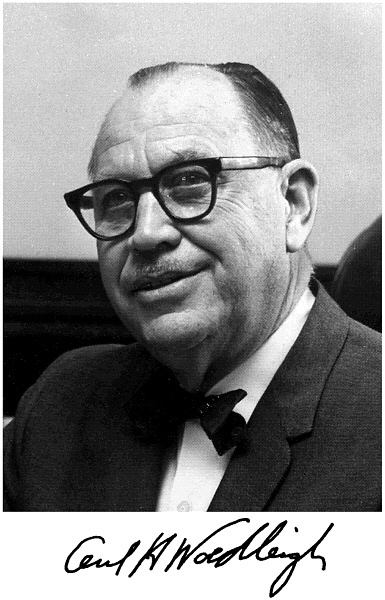
CECIL H.WADLEIGH
October 1, 1907–February 18, 1997
BY WILFORD R.GARDNER
CECIL WADLEIGH WAS A multi-faceted scientist. His youth on a farm taught him that pragmatism was a virtue but also aroused in him an interest in finding new and better agricultural practices and better crop varieties. He was a large man with a dignified demeanor that masked a sly sense of humor. His wit could easily deflate a colleague who showed signs of arrogance, but it was demonstrated in a good-natured rather than mean-spirited way. He could be charmingly persuasive and persistent, especially as an administrator.
Cecil was born in Gilbertsville, Massachusetts, on October 1, 1907, as the only son of Hazen Carl and Lucy (Whitehead) Wadleigh. He lived from 1909 to 1919 on his father’s dairy farm, a not uncommon childhood and youth for agricultural scientists of his generation. His school bus was his father’s milk delivery wagon, an arrangement that allowed him to work two to three hours before school. In the 1920s he moved to his father’s 225-acre fruit and vegetable farm in Milford, Massachusetts. Characteristic of farm families, Cecil’s father expected diligent work “only 99 percent of the time.” Cecil preferred work in the orchards to that on the dairy farm if only because of the more pleasant byproducts. This preference may have influenced Cecil’s later choice of
botany rather than animal husbandry for a major. While still in high school he was assigned to supervise from 10 to 30 hired seasonal workers. Working alongside them engendered a mutual respect between supervisor and employee, which Cecil exhibited in his later years as a science administrator.
In 1925 Cecil graduated from Milford High School, where he excelled in mathematics, physics, chemistry, and biology. He disliked civics and ancient history. Cecil’s description of his schoolteachers is little different from those that would have been given by almost anyone of his generation. He describes them as “peerless but stern and demanding, but they opened up new vistas to a run-of-the-mill farm boy.” School was a pleasant diversion from the heavy schedule of farm work, and this contrast probably helped Cecil choose a career that required less from the back than from the head, but which was no less demanding in terms of time and effort.
In 1930 Cecil received a bachelor of science degree in pomology from the University of Massachusetts. That fall he married Clarice Lucille Bean in Petersburg, New York. This union was to produce in time three daughters and one son. The newlyweds went on to Columbus, Ohio, where Cecil received an master of science degree in horticulture from Ohio State University in 1932. This was followed three years later by a Ph. D. in plant physiology from Rutgers University. These institutions produced many outstanding agricultural scientists during the 1930s in large part due to the strength of their faculties. From 1933 to 1936 Cecil was a research assistant in plant physiology at Rutgers.
From 1936 to 1941 the “new” Dr. Wadleigh was an assistant professor of plant physiology at the University of Arkansas. It was while he was at Arkansas that Wadleigh showed the pragmatic side of his nature by working on a number of scientific problems with rather immediate practical applica-
tion. His first contribution to science was a paper entitled “Better Quality in Sauerkraut” (1953). This study showed that the effect of potassium deficiency on carbohydrate synthesis in the cabbage plant was an impairment of the sauerkraut quality. It pleased Cecil to note that this paper was translated into German and published in a German technical journal. He felt that if anyone appreciated the quality of sauerkraut, it was the Germans. At Arkansas he increased his understanding of plant nutrients on crop quality through further studies on cabbage, chlorosis in corn, boron deficiency, and aspects of metabolism in cotton. The work at Arkansas was ideal preparation for the next phase of Cecil’s career, since most of the work related in one way or another to the uptake of ions by plants.
CECIL’S YEARS AS A MATURE SCIENTIST
In 1941 Cecil joined the staff of the relatively new research facility, the Salinity Laboratory, in Riverside, California. This laboratory was one of seven regional laboratories established in 1938 in the U.S. Department of Agriculture to study agricultural problems common to more than one state. Cooperation between these regional laboratories and the state experiment stations within each region was intended to lead to more speedy and effective solutions to the problems identified by and common to each region. The state experiment station directors of the 11 (later 17) western states chose soil salinity as their most serious crop production problem.
Cecil was appointed senior chemist rather than a plant physiologist. He often expressed bemusement at the proclivity of the federal civil service to try to fit individuals into its own personnel classification scheme rather than adjust the scheme to fit the scientists. The laboratory had permission to hire a senior chemist but not a plant physiologist, and
there was no question about his qualifications as a chemist. At some later period it was decided that everyone at the laboratory should be a soil scientist, so he was accordingly reclassified. He often found joy in pointing out that simply by an act of the government he was a soil scientist. Fortunately, Riverside was far enough from Washington so that no administrative types could get in the way of scientists using their abilities in the best possible way.
Wadleigh’s arrival at the Salinity Laboratory was most fortuitous, both for Cecil and for the laboratory. The laboratory had been established in 1938 and was still seeking to find its scientific niche. This author’s uncle (Willard Gardner) was one of the representatives from Utah on the committee to set scientific priorities for the laboratory. Gardner’s proposal that the fundamental sciences underlying problems of irrigation, drainage, waterlogging, and salinity should have highest priorities. This was not received with any great enthusiasm by his colleagues, who preferred quick but empirical results. By a twist of fate and irony Gardner’s student (M.S.) L.A.Richards had been hired away from Iowa State University to establish the physics program at Riverside in 1938 and by 1941 had developed the tools for which he became world renowned. These methods made possible basic studies on the osmotic and soil water relations of plants at the most fundamental thermodynamic level while generating valuable and immediately useful information for farmers.
Wadleigh first teamed up with Hugh Gauch in a series of studies on the effect of saline substrates on various metabolic steps in plants. In some ways this was a confirmation of the work that Wadleigh was doing at Arkansas, with salinity as an added variable. Cecil called upon the work that he had done previously in ion uptake to understand the effect of such uptake on plants in general.
By 1943 Wadleigh was increasingly focusing his attention on the effect of salinity per se on plant response. There was a vigorous debate among plant and soil scientists about whether the deleterious effect of salinity upon plant growth was specific to each ion that contributed the total osmotic pressure of the soil (or nutrient) solution, or whether the effect was nonspecific and due almost solely to the osmotic effect. A related and no less important question was the combined or additive effect of osmotic stress and soil water stress. Nowhere was the division between the two schools of thought more pronounced and hotly debated than in Riverside. Wadleigh and Richards were on one side of the debate while some of the more important members of the Citrus Experiment Station, also in Riverside, were on the other.1
The laboratory staff was firmly of the opinion that while there might be some specific ion effects (e.g., boron), from a practical point of view the suitability of a water for agricultural use was largely dependent upon its osmotic pressure and hence to a good approximation the concentration of salts. The almost linear relation between soil solution concentration and electrical conductivity of the soil solution, conductivity measurements were soon used as a surrogate for osmotic pressure and/or concentration. Cecil Wadleigh and L.A.Richards largely share the credit for this simplification.
As a result of this thinking the plant research program at the laboratory under Cecil’s supervision moved in two directions. It had been established from experiments at Torrey Pines (now the site of the University of California, San Diego) in the Imperial Valley as well as in Riverside that the relative effect of salinity upon plant growth was independent of climate. Therefore a series of field plot studies of the relative salt tolerance of a large number of field crops, tree crops, vegetables, and ornamentals was initiated. Salt tolerance between varieties of the same species were also initiated.
Cecil Wadleigh had a major role in initiating these studies, but his principal interest was increasingly to center on the more fundamental question of the mechanism of plant stress upon growth. To this end he began the series of green-house studies for which he became best known as a scientist.
Following a series of papers, often in collaboration with other members of the Salinity Laboratory staff, Wadleigh showed definitively that not only was it osmotic stress that was important in determining the effect of soil salinity upon plant growth but also, to a very remarkable first approximation, osmotic stress and soil moisture stress were additive. This, combined with the knowledge that whatever the climate, the relative effect of total stress (osmotic plus moisture) was the same resolved once and for all the debate over the effect of salinity over plant growth. In recent years the concept had received fine-tuning, but as a general approximation it still stands.
A second debate also consumed those working on soil-water-plant relations. This also involved the Salinity Laboratory, but this time the other protagonist was F.J.Veihmeyer of the University of California at Davis. Veihmeyer had carried out a series of very important irrigation experiments in various parts of California. He concluded from these experiments that between the upper limit of available water (i.e., the field capacity) and the lower limit of water in the soil, known as the permanent wilting point, the water was equally available to the plant. That is, as the soil dried out it made no difference to the plant what the soil water content was until the plant failed to recover from temporary wilting even after stress was relieved at night. Wadleigh teamed with L.A.Richards in a landmark paper that reviewed the literature and added new insight and largely laid the issue to rest.2 They showed that once a plant begins to wilt it reduces its rate of growth and continues to do so until it
either dies or is irrigated. Veihmeyer had worked mainly with fruit trees on sandy soils, where the difference between initial wilting and permanent wilting was difficult to assess. He was responsible for the definition of the permanent wilting point, which was useful for a time, but his choice of sunflower as an experimental plant was unfortunate since lower leaves wilt first while higher and younger leaves wilt progressively later. Veihmeyer was to remain unconvinced to his death of the correctness of his view and his earlier work on irrigation is still significant and valuable. However, Richards and Wadleigh were correct in their view of soil water and further experiments by others only served to solidify this view.
Wadleigh also played a major role in contributing to the writing of Handbook 60 entitled “Diagnosis of the Improvement of Saline and Alkali Soils.” This was published by the Bureau of Plant Industry of the U.S. Department of Agriculture in 1947 and was revised and published in hard-cover in 1953. This publication was to become the “bible” of soil salinity for some 25 years and is now a collector’s item.
WADLEIGH’S CAREER AS AN ADMINISTRATOR
In 1951, just prior to publication of his landmark paper with Richards, Cecil Wadleigh once more headed east, this time to Washington, D.C., to accept the position of head physiologist, Division of Sugar Plant Investigations in the Agricultural Research Service of the U.S. Department of Agriculture (USDA). In this position he was responsible for all sugar research in the United States. It was here that he honed his skills as an administrator and perfected his unique style.
In 1955 he moved up to become director of the Soil and Water Conservation Research Division of the Agricul-
tural Research Service. In this capacity he oversaw, among other units, the U.S. Salinity Laboratory. It was on his tour of his domain that this author first met him. I had accepted a new position as a physicist with the Beltsville, Maryland, laboratory of the USDA, but until they had room for me I was sent to Riverside to learn some soil physics with L.A. Richards. Wadleigh came through Riverside about midway during my stay in Riverside. I explained to him that I had concluded that in order to do anything useful I either needed to spend a much longer time in Riverside or else move immediately to Beltsville. Wadleigh showed his ability to make immediate decisions when necessary. Rather that suggesting that he would think about it, he immediately promised that I could stay as long as needed. That state lasted 13 years, and when I left he offered me any location in the United States.
Cecil had an administrative style that could best be described as unique. He could be insistent in getting people to leave a perfectly happy research career and come to work for him in Washington. For example, he persuaded Jan van Schilfgaarde to leave North Carolina. Doral Kemper was called in Australia while on sabbatical from Ft. Collins, Colorado, and he agreed to move to Washington upon his return. Cecil had a way of convincing an individual that they were the only person in the world qualified to carry out a specific task.
Cecil was often called to testify before Congress, which he usually did himself, however, in negotiations with his superiors he often sent an underling. Afterwards he would complain that he would have handled the matter differently. When the subordinate sent would point out that he had had a chance to go himself and had chosen not to, he took this response in good humor, and one understood
that he had sufficient confidence in his surrogate that he was quite prepared to accept the outcome.
Cecil was could be firm when firmness was called for. He once tried to close down a small research facility in the West. It so happened that the director of this facility was related to the local congressman. The word came down from above to Cecil that he was not to touch this facility. He promptly transferred the director to a very undesirable location “in the interests of the federal government.” Sometime later he quietly closed the facility.
Cecil Wadleigh was one of the last of the administrators who had earned their stripes in research before moving to Washington to become an administrator. As such he understood what made scientists tick. He normally left a productive scientist alone to do what he thought best. However, he was not above using this knowledge to achieve his own ends if he felt they came ahead of the scientist’s wishes.
Cecil Wadleigh retired from the Soil and Water Conservation Division in 1970. He served for a year as science advisor in 1971 and retired from that position at the end of 1971. From 1969 to 1971 he gave some 100 invited lectures at universities and technical societies on the general subject of agriculture’s involvement in environmental pollution. This was soon after the publication of Rachel Carson’s book Silent Spring and largely in response to the book. He did not always agree with Rachel Carson and was not bashful about expressing his views whether they agreed with her or not. Whatever the issue he always preserved his integrity, and this quality in him will always be remembered.
In retirement Cecil kept his interest in plant science. He maintained a large collection of named varieties of tall bearded irises and nurtured an orchard of over 100 different dwarf fruit trees. He also developed a competence in cooking,
with an emphasis on Italian, Creole, and rural American cuisine.
HONORS AND AWARDS
|
1935 |
Elected to Sigma Xi |
|
__ |
Elected president of the American Society of Plant Physiologists |
|
1961–63 |
Selected a member of White House Panel on Waterlogging and Salinity Problems in Pakistan by President Kennedy |
|
1962 |
Elected a fellow of the AAAS |
|
1963–70 |
Selected a member of the Committee on Water Resources, Federal Council on Science and Technology, Executive Office of the President |
|
1965 |
Elected a fellow of the American Society of Agronomy |
|
1965–67 |
Selected a member of the U.S. National Committee for the International Hydrological Decade, National Academy of Sciences |
|
1966–67 |
Selected a member of the Committee on Environmental Quality, Federal Council on Science and Technology, Executive Office of the President |
|
1967 |
Presented the Distinguished Service Award, U.S. Department of Agriculture |
|
1969 |
Elected a fellow of the Soil Conservation Society of America |
|
1973 |
Elected to the National Academy of Sciences |
NOTES
SELECTED BIBLIOGRAPHY
1933 Better quality in sauerkraut. Better Crops with Plant Food 18:29–31.
1936 With N.D.Brown and R.Young. Factors affecting the yield of kraut cabbages in Ohio as determined by a survey and cooperative field tests. Ohio State Agric. Exp. Sta. Bull. 566:3–20.
1937 With W.R.Robbins and J.R.Beckenbach. The relation between the chemical nature of the substrate and degree of chlorosis in corn. Soil Sci. 43:153–75.
1938 Metabolism in the cotton plant. Arkansas Agric. Exp. Sta. Bull. 351:35–36.
1939 With J.W.Shive: A microchemical study of the effects of boron deficiency in cotton seedlings. Soil Sci. 47:33–36.
With J.W.Shive. Base content of corn plant as influenced by pH of substrate and form of nitrogen supply. Soil Sci. 47:273–84.
The influence of varying cation proportions upon the growth of cotton plants. Soil Sci. 48:109–20.
With J.W.Shive. Organic acid content of corn plant as influenced by pH and substrate form of nitrogen supplied. Am. J. Bot. 26:244–48.
1942 With H.G.Gauch. Assimilation in bean plant of nitrogen from saline solutions. Am. Soc. Hortic. Sci. Proc. 41:339–64.
With H.C.Gauch. The influence of saline substrates upon the adsorption of nutrients by bean plants. Am. Soc. Hortic. Sci. Proc. 41:365–69.
1943 With H.G.Gauch, and V.Davies. The trend of starch reserves in bean plants before and after irrigation of a saline soil. Am. Soc. Hortic. Sci. Proc. 43:201–209.
1947 With H.G.Gauch and D.G.Strong. Root penetration and moisture extraction in saline soil by crop plants. Soil Sci. 63:343–49.
1948 With H.G.Gauch. Rate of leaf elongation as affected by the intensity of the total soil moisture stress. Plant Physiol. 23:485–95.
1949 Mineral nutrition of plants. Annu. Rev. Biochem. 13:655–78.
With M.Fireman. Salt distribution under furrow and basin irrigated cotton and its effect on water removal. Soil Sci. Soc. Am. Proc. 13:218–23.
With C.A.Bower. Growth and cationic accumulation by four species of plants as influenced by various levels of exchangeable sodium. Soil Sci. Soc. Am. Proc. 13:218–23.
1950 With C.A.Bower. The influence of calcium ion activity in water culture on the intake of cations by bean plants. Plant Physiol. 25:1–12.
1951 With L.A.Richards. Soil moisture and the mineral nutrition of plants. In Mineral Nutrition of Plants, ed. E.Truog, pp. 411–50. University of Wisconsin Press.
With M.Fireman. A statistical study of the relation between the pH and the exchangeable sodium-percent of western soils. Soil Sci. 71:273–85.
1952 With A.D.Ayres and J.W.Brown. Salt tolerance of barley and wheat in soil plots receiving several salinization regimes. Agron. J. 44:307–10.
With J.W.Brown. The chemical status of bean plants afflicted with bicarbonate-induced chlorosis. Bot. Gaz. 113:373–92.
With L A.Richards. Soil water and plant growth. In Soil Physical Conditions and Plant Growth. Agron. 2:73–251.
With A.D.Ayres and C.A.Bower. Effect of saline and alkali soil on growth of sugar beets. Am. Soc. Sugar Beet Technol. Proc., pp. 54–75.
1955 Mineral nutrition of plants as related to microbial activities in soils. Adv. Agron. 75:78–87
1964 Fitting modern agriculture to water supply. In ASA Special Publication No. 4, pp. 8–14. Soil Science Society of America.


