
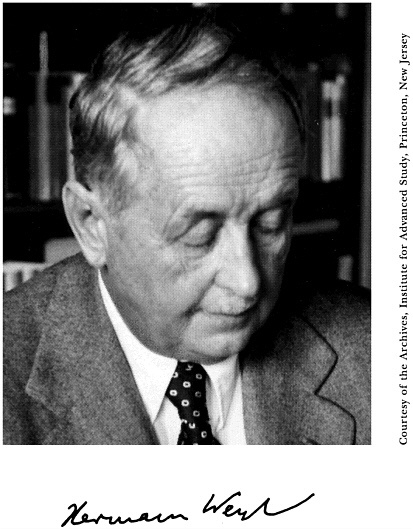
HERMANN WEYL
November 9, 1885–December 9, 1955
BY MICHAEL ATIYAH
HERMANN WEYL WAS one of the greatest mathematicians of the first half of the twentieth century. He made fundamental contributions to most branches of mathematics, and he also took a serious interest in theoretical physics.
It is somewhat unusual to write a biographical memoir nearly 50 years after the death of the subject, and this presents me with both difficulties and opportunities. The difficulties are obvious: I had essentially no personal contact with Weyl, hearing him lecture only once at the international congress in Amsterdam in 1954, when I was a research student. His contemporaries are long since gone and only a few personal reminiscences survive. On the other hand the passage of time makes it easier to assess the long-term significance of Weyl’s work, to see how his ideas have influenced his successors and helped to shape mathematics and physics in the second half of the twentieth century. In fact, the last 50 years have seen a remarkable blossoming of just those areas that Weyl initiated. In retrospect one might almost say that he defined the agenda and provided the proper framework for what followed.
I shall therefore take the liberty of connecting Weyl’s own work with subsequent developments. This means that I
shall say less about certain aspects of Weyl’s work where my own competence runs out or where subsequent work may not have been so productive. In particular I shall omit any account of his important work on singular differential equations, number theory, and convex bodies. I shall also say little about his contributions to the foundations of mathematics. However, the important papers that he wrote in all these areas are included in the selected bibliography.
Hermann Weyl was born in the small town of Elmshorn near Hamburg, the son of Ludwig and Anna Weyl. In 1904 he went to Göttingen University and immediately fell under the spell of the great David Hilbert. As he described it later,
I resolved to study whatever this man had written. At the end of my first year I went home with the “Zahlbericht” under my arm, and during the summer vacation I worked my way through it—without any previous knowledge of elementary number theory or Galois theory. These were the happiest months of my life, whose shine, across years burdened with our common share of doubt and failure, still comforts my soul.
In 1913 he moved to a chair at the Federal Institute of Technology in Zurich, where Einstein was developing his theory of general relativity. Sometime later this aroused Weyl’s interest, and physics became and remained one of his central concerns.
When Hilbert retired in 1930, Weyl moved to Göttingen to take his chair, but the rise of the Nazis persuaded him in 1933 to accept a position at the newly formed Institute for Advanced Study in Princeton, where Einstein also went. Here Weyl found a very congenial working environment where he was able to guide and influence the younger generation of mathematicians, a task for which he was admirably suited.
At the time of his move to Zurich he married Helene
Joseph, a talented translator of Spanish literature. They had two sons. Helene died in 1948, and in 1950 Weyl married Ellen Bär from Zurich.
Weyl published in a great variety of fields and he deliberately eschewed specialization. He explained his attitude as follows:
My own mathematical works are always quite unsystematic, without mode or connection. Expression and shape are almost more to me than knowledge itself. But I believe that, leaving aside my own peculiar nature, there is in mathematics itself, in contrast to the experimental disciplines, a character which is nearer to that of free creative art.
As this quotation (and others) illustrate, Weyl was both a philosopher and a literary stylist. His interest in philosophy led him to become involved in the foundations of mathematics, one of the major interests of the time that saw great battles between the formalists led by Hilbert and the intuitionists under Brouwer. The essential difference was that the intuitionists only accepted as valid those results that could be established constructively in a finite number of steps. Weyl eventually and somewhat reluctantly sided with Brouwer. But his broader philosophical interests meant that he was always aware of the wider implications of his mathematical work and in particular of its relation to physics. He expounded his philosophical views on physics in a widely read book (1918).
His literary, almost poetic, style is highly unusual in a mathematician and only someone of his stature could expect to get away with it. Even the enforced transition from German to English resulting from his move to Princeton did not deter him. In his book on The Classical Groups (1939) his introduction recognizes this transition in typical form by asserting that “the gods have imposed upon my writing the
yoke of a foreign language that was not sung at my cradle.” Later in the text when discussing the rotation group he writes that “only with spinors do we strike that level in the theory of its representations on which Euclid himself, flourishing ruler and compass, so deftly moves in the realm of geometric figures. In some way Euclid’s geometry must be deeply connected with the existence of the spin representation.” Subsequent work on spinors only reinforces the power of these words, written though they were in a foreign tongue.
Despite the diversity of his interests it is analysis and geometry with their application to physics that provide the core of his work, though he could be an algebraist with style as in The Classical Groups and his tendency to unify mathematics makes nonsense of any simplistic divisions. His interest in the spectral properties of differential operators (their eigenvalues or frequencies) was an early love and persisted to the end. In fact, one of his first major achievements was to establish that the leading term in the growth of the eigenvalues (for the Laplace operator in a bounded domain) was given by the volume, a result that was predicted by physicists on the basis of the relation between classical and quantum mechanics. Weyl followed with interest the subsequent refinement of his work that gave more detailed information about the asymptotic behaviour of the eigenvalues, a subject popularized by Marc Kac under the title “Can You Hear the Shape of a Drum?” After Weyl’s death the subject developed much further, leading among other things to the heat equation proof of the Atiyah-Singer index theorem (Atiyah, Bott, and Patodi, 1973) and to the regularized determinants that became a basic tool in quantum field theory.
In his Gibbs lecture to the American Mathematical Society (1950) Weyl set out his views on the eigenvalue problem in the following Delphic utterance:
I feel that these informations about the proper oscillations of a membrane, valuable as they are, are still very incomplete. I have certain conjectures of what a complete analysis of their asymptotic behaviour should aim at but, since for more than 35 years I have made no serious effort to prove them, I think I had better keep them to myself.
Whatever Weyl had in mind it is clear that he would have thoroughly appreciated the developments of recent times, particularly in the way the physics, analysis, and geometry have been interwoven.
Another early work was his now famous book on Riemann surfaces (1913). Here we see Weyl at his majestic best, imposing coherence, elegance, and order on a classical subject and thereby laying proper foundations for its future development. Already with the work of Riemann it was clear that the classical theory of functions of a complex variable could not be confined to the complex plane: branched coverings of the plane were necessary, but it was Weyl who put this into its proper form, getting away from the complex plane by introducing the notion of an abstract surface. Coming when it did in 1913 it was the right book at the right time, providing the model for all subsequent work on higher-dimensional manifolds. With its emphasis on vector spaces (which Weyl was the first to define) it provided the right language for both geometry and algebra. It also prepared the way for the topologists who followed.
Without Weyl’s book on Riemann surfaces it is impossible to imagine Hodge’s theory of harmonic forms (Hodge, 1941), which came 20 years later. Weyl was one of the first to recognize the importance of Hodge’s work and he contributed an essential step for the analytical part of the proof. He described Hodge’s theory as “one of the great landmarks in the history of science in the present century.”
In 1954 at the International Congress of Mathematicians
in Amsterdam Weyl, as chairman of the Fields Medal Committee, gave the speech describing the work of the two medallists: Kunihiko Kodaira and Jean-Pierre Serre. Kodaira had also independently completed Hodge’s work and had gone on to apply it with great skill to prove concrete results in algebraic geometry. Serre had contributed through his work on the newly developed theory of sheaves. Despite his age (he was 69) Weyl gave a detailed and enthusiastic account of all this work, which by combining geometry and analysis in the spirit of his own earlier work was very close to his heart. This is clearly conveyed in his words addressed to Kodaira:
Your work has more than one connection with what I tried to do in my younger years; but you have reached heights of which I never dreamt. Since you came to Princeton in 1949 it has been one of the greatest joys of my life to watch your mathematical development.
Turning to Serre, whose work in homotopy theory he had also described in detail, he said,
I have no such close personal relation to you, Dr. Serre, and your research, but let me say that never before have I witnessed such a brilliant ascension of a star in the mathematical sky as yours. The mathematical community is proud of the work you both have done. It shows that the old gnarled tree of mathematics is still full of sap and life.
As a young member of the large audience on that occasion I was dazzled by Weyl’s performance and inspired by his oratory.
If geometry and analysis were at the core of Weyl’s interests, his urge to organize and synthesize made it perhaps inevitable that he would leave his mark on the theory of groups and their representations. These are the embodiment of symmetry, a topic that Weyl expounded on toward
the end of his life in an elegant and popular book with that title (1952). The theory of continuous groups, developed by the nineteenth-century Norwegian mathematician Sophus Lie had been continued and extensively developed by Elie Cartan. Weyl took up the topic anew and brought his own point of view, with its emphasis on the global aspect of Lie groups. For his predecessors all the essential formulae were local (leading to the infinitesimal form, the Lie algebra), but Weyl emphasized the whole group, a manifold with, in particular, interesting topology. Here we see a link with his approach to Riemann surfaces: Weyl liked to see the big picture, the manifold or group in the round. This global view had many technical advantages and in particular for compact groups (such as the important group of rotations), one could average by integrating over the group. Essentially this made the theory very similar to that of finite groups, which was already well established. One famous consequence of this technique is the Peter-Weyl theorem, which decomposes the space of functions on the group into matrix blocks given by the irreducible representations. Here Weyl, as always, used his knowledge of differential equations in an essential way.
To pass from the compact groups to the usual linear groups of matrices Weyl employed what he described as the “unitarian trick,” a simple but effective idea that has had a fruitful development beyond the narrow confines of pure group theory. In the hands of Simon Donaldson and others it has been a powerful tool in the study of moduli spaces, where it can be viewed as a geometric extension of Weyl’s initial step.
One of the most elegant of Weyl’s theorems was his beautiful explicit formula for the character of the irreducible representations. This formula has kept reappearing in subsequent work. For example, it appears as a fixed-point
formula in the work of Atiyah and Bott (1966) on elliptic operators where it unites two of Weyl’s main interests. It also appears in generalized form (Pressley and Segal, 1986) in the theory of representations of loop groups, infinite-dimensional groups of much interest in current physics.
Weyl was a strong believer in the overall unity of mathematics, not only across sub-disciplines but also across generations. For him the best of the past was not forgotten, but was subsumed and refined by the mathematics of the present. His book The Classical Groups was written to bring out this historical continuity. He had been criticized in his work on representation theory for ignoring the great classical subject of invariant theory that had so preoccupied algebraists in the nineteenth century. The search for invariants, algebraic formulae that had an intrinsic geometric meaning, had ground to a halt when David Hilbert as a young man had proved that there was always a finite set of basic invariants. Weyl as a disciple of Hilbert viewed this as killing the subject as traditionally understood. On the other hand he wanted to show how classical invariant theory should now be viewed in the light of modern algebra. The Classical Groups is his answer, where he skilfully combines old and new in a rich texture that has to be read and re-read many times. It is not a linear book with a beginning, middle, and end. It is more like an elaborate painting that has to be studied from different angles and in different lights. It is the despair of the student and the delight of the professor.
It is a tribute to Weyl’s outlook that invariant theory has recovered from Hilbert’s onslaught and is again a flourishing subject. But now it is firmly in the Weyl mold and has been given a fresh impetus by David Mumford under the heading of geometric invariant theory (Mumford, Fogarty, and F. Kirwan, 1994). This gives a systematic way of studying various important classification problems leading to moduli (or
parameter) spaces, and many of these have turned up naturally in quantum field theory. Again, Weyl would have been delighted.
When theoretical physics was revolutionized by the advent of quantum mechanics in the 1920s, it was fortunate that there were then two outstanding mathematicians who were available to provide the mathematical underpinning and interpretation. John von Neumann put quantum mechanics into its now standard framework of Hilbert spaces and self-adjoint operators while Weyl expounded on the role of symmetry in his influential book on group theory and quantum mechanics (1928). In fact, the representation theory of Lie groups is tailor-made for quantum mechanics and Weyl’s definitive work on representation theory together with his interest in spectral theory made him the ideal exponent of the new physics.
Von Neumann was some years younger than Weyl, but he was a prodigy with a formidable reputation. According to Armand Borel, who heard the story from M.Plancherel that whenever Weyl was going to give a lecture at Zurich, he approached the lecture room with trepidation in case von Neumann was in the audience. He was sure to ask penetrating questions that Weyl would be unable to answer! This fear did not prevent Weyl from arranging for von Neumann to be invited to join him later at the Institute for Advanced Study. As his speech at the Amsterdam congress showed, Weyl was always keen to identify talent and provide encouragement for the younger generation. Raoul Bott recalls (Bott, 1988) how kindly Weyl dealt with him on their first encounter, when Bott explained his latest result, only to find out that Weyl had done it all 25 years before. Bott also points out that Weyl as a person was not the Olym-pian figure that he appeared to be in print. He could be informal, amusing, and friendly.
Quantum mechanics was not Weyl’s first encounter with physics. He had already learned about Einstein’s general relativity, which explained gravity in geometrical terms. Weyl had the idea of extending Einstein’s theory to incorporate electromagnetism, so that Maxwell’s equations would also acquire geometrical significance. Weyl’s idea was to introduce a scale, or gauge, that varied from point to point and whose variation round a closed path in space-time would encapsulate the electromagnetic force. Almost immediately (in fact in an appendix to Weyl’s paper) Einstein criticized the idea on physical grounds. If Weyl was right, then the size of a particle would depend on its past history, whereas experiments showed that all atoms of hydrogen, say, had identical properties. One might have thought that such a telling criticism from someone of Einstein’s standing would have discouraged Weyl and that he might have withdrawn his paper. It is a tribute to his mathematical insight and self-confidence that he went ahead. The idea was too beautiful to discard, and Maxwell’s equations came out like magic. As often happens, a good idea lives to fight another day and only a few years later, with the advent of quantum mechanics, a new physical interpretation was put on Weyl’s calculations. Oscar Klein proposed that Weyl’s gauge should be viewed as a phase and that space-time should be viewed as having a fifth dimension consisting of a very small circle. Mathematically Weyl’s gauge variable gets multiplied by i (the square root of −1) and is periodic. This point of view, called the Kaluza-Klein theory (Theodor Kaluza made the first steps after Weyl) is now generally accepted. Moreover, it is just the first stage in the enlargement of ordinary space-time. To include the other nuclear forces we need even more dimensions and current research centres on a total space-time dimension of 10 or 11.
Independently of these extra dimensions Weyl’s gauge
theory description of Maxwell’s equations is now applied to local symmetry groups other than the circle. This leads to the non-Abelian gauge theories, which are the basis of the standard model of elementary particle physics.
This gauge theory, the infant that was nearly thrown out with the bath water, has grown up into sturdy adulthood. Not only is it the framework of modern physics but it is also one of the most novel and exciting areas in modern mathematics. One notable example is the theory of 4-dimensional manifolds due to Simon Donaldson (Donaldson and Kronheimer, 1990), which emerged from physics but has turned out to be of profound importance to geometry. More recently, an alternative interpretation uses spinors coupled non-linearly to electromagnetism, a twist that would certainly have captured the imagination of Hermann Weyl and justifies his remarks about the geometrical significance of spinors.
The past 25 years have seen the rise of gauge theories— Kaluza-Klein models of high dimensions, string theories, and now M theory, as physicists grapple with the challenge of combining all the basic forces of nature into one all embracing theory. This requires sophisticated mathematics involving Lie groups, manifolds, differential operators, all of which are part of Weyl’s inheritance. There is no doubt that he would have been an enthusiastic supporter and admirer of this fusion of mathematics and physics. No other mathematician could claim to have initiated more of the theories that are now being exploited. His vision has stood the test of time.
MY THANKS are due to Raoul Bott and Armand Borel for personal reminiscences. I have also relied on the obituary articles by Chevalley-Weil and by Newman cited in the references.
REFERENCES
Atiyah, M.F., R.H.Bott, and V.K.Patodi. 1973. On the heat equation and the index theorem . Inventiones Math. 19:279–30.
Atiyah, M.F., and R.H.Bott. 1986. A Lefschetz fixed point formula for elliptic and differential operators. Bull. Am. Math. Soc. 72:245– 50.
Bott, R.H. 1988. On induced representations. The mathematical heritage of Herman Weyl. Proc. Symp. Am. Math. Soc. 48:1–14.
Chevalley, C., and A.Weil. 1957. Hermann Weyl (1885–1955) Enseign. Math. III(3).
Donaldson, S.K., and P.B.Kronheimer. 1990. The Geometry of Four-Manifolds. Oxford.
Hodge, W.V.D. 1941. The theory and applications of harmonic integrals. Cambridge.
Mumford, D., J.Fogarty, and F.Kirwan. 1994. Geometric Invariant Theory. Berlin: Springer-Verlag.
Newmann, M.H.A. 1957. Hermann Weyl. In Biographical Memoirs of Fellows of the Royal Society, vol. 3, pp. 305–28.
Pressley, A., and G.B.Segal. 1986. Loop Groups. Oxford.
SELECTED BIBLIOGRAPHY
1910 Über gewöhnliche Differentialgleichungen mit Singularitäten und die zugehörigen Entwicklungen willkürlicher Funktionen. Math. Ann. 68:220–69.
1912 Henri Poincaré. Math. Naturwis. Blatter. 9:161–63.
1913 Die Idee der Riemannschen Fläche. Leipzig.
1915 Das asymptotische Verteilungsgesetz der Eigenschwingungen eines beliebig gestalteten elastischen Körpers. Rend. Circ. Mat. Palermo 39:1–50.
1916 Über die Gleichverteilung von Zahlen mod. Eins. Math. Ann. 77:313– 52.
Über die Bestimmung einer geschlossenen konvexen Fläche durch ihr Linienelement. Vierteljahrsschr. Naturforsch. Ges. Zür. 61:70– 72.
1918 Gravitation und Elektrizität. Sitzungsber. Königlich Preuss. Akad. Wiss. 26:465–80.
Raum-Zeit-Materie. Berlin.
1921 Über die neue Grundlagenkrise der Mathematik. Math. Z. 10:39–79.
Zur Infinitesimalgeometrie: Einordnung der projektiven und konformen Aufassung. Nachr. K. Ges. Wiss. Göttingen, Math.-physik. Kl.99– 112.
1925–1926 Theorie der Darstellung kontinuierlicher halb-einfacher Gruppen durch lineare Transformationen (Teil I, II, III und Nachtrag). Math. Z. 23, 24
1927 Integralgleichungen und fastperiodische Funktionen. Math. Ann. 97:338–56.
With F.Peter. Die Vollständigkeit der primitiven Darstellungen einer geschlossenen kontinuierlichen Gruppe. Math. Ann. 97:735–55.
1928 Gruppentheorie und Quantenmechanik. Leipzig.
1935 Uber das Pick-Nevanlinnasche Interpolationsproblern und sein infinitesimales Analogon. Ann. Math. 36:230–54.
With R.Brauer. Spinors in n dimensions. Am. J. Math. 57:425–49.
1939 The Classical Groups. Princeton.
1940 The method of orthogonal projection in potential theory. Duke Math. J. 7:411–44.
1943 On Hodge’s theory of harmonic integrals. Ann. Math. 44:1–6.
1944 David Hilbert and his mathematical work. Bull. Am. Math. Soc. 50:612–54.
1944–1945 Fundamental Domains for Lattice Groups in Division Algebras (Part I and II) (I) Festschrift für Andreas Speiser (Orell Füssli, Zürich) (II) Commentarii Mathematici Helvetici 17.
1950 Ramifications, old and new, of the eigenvalue problem. Bull. Am. Math. Soc. 56:115–39.
1952 Symmetry. Princeton.
1957 Address on the Fields Medal awards. Proc. Int. Congr. Math. Amst. 1:161–74.
1968 Hermann Weyl Gesammelte Abhaundlungen. Four volumes edited by K.Chandrasekharan. Springer-Verlag.


