
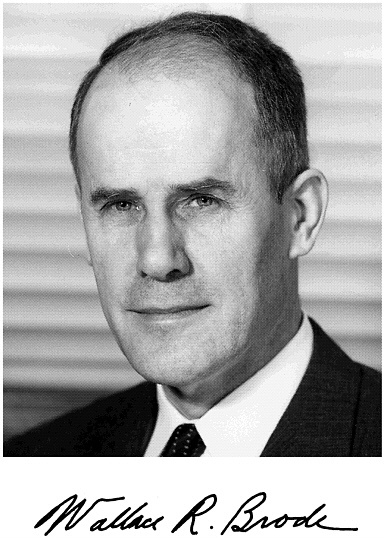
WALLACE REED BRODE
June 12, 1900–August 10, 1974
BY DONALD S.McCLURE
DURING HIS LIFETIME Wallace Brode was known for his broadly based development of applied spectroscopy and for his able administration of numerous science-related organizations. He was equally at home in academe and in government. He used his high intellect and breadth of knowledge to promote the welfare of other people, being truly a scientific statesman.
He was born on June 12, 1900, as one of triplet brothers, each of whom became distinguished as a scientist. Their father, Howard, was a professor of biology, teaching at Whitman College in Walla Walla, a small town in southeastern Washington, where the family was reared. Like other colleges in the Northwest at that time, Whitman had been struggling out of its recent pioneer past in an attempt to become a credible educational institution with slim financial resources but having a dedicated president and faculty.1 Everyone— father, mother, the triplets (Wallace, Robert,2 and Malcolm), and an older son, Stanley—worked for or studied in the college, learning high ideals and hard work. Howard Brode is still honored by a yearly lectureship at Whitman College.
After receiving his B.S. at Whitman, Wallace studied under Roger Adams at the University of Illinois and was awarded
his Ph.D. in 1925 with a thesis entitled “A Study of Optically Active Dyes, Mechanism of Dyeing and Absorption Spectra.” His lifelong interest in dyes and the relation between their color and their constitution began here.
During his graduate school days he demonstrated an ability to handle several jobs at once: He was listed as a junior chemist at the National Bureau of Standards (NBS) in Washington, D.C., where he found better equipment for his thesis project, but was still a student and assistant at the University of Illinois. The position at the NBS was his introduction to the institution where he later became associate director.
In the years 1926–28 he was a Guggenheim fellow and did what budding scientists did then, went to Europe, where he studied at Leipzig (with Arthur Hantzsch), Zurich (with Victor Henri), and Liverpool (with E.C.C.Baly and R.A. Morton). Publications from these visits appeared promptly in the chemical literature. At the same time, however, he had an appointment with the Bureau of Engraving and Printing to travel in Canada and Europe and to report on methods of currency printing in those places. He was complimented for doing an effective job while getting his travel expenses taken care of. He returned to the United States to take up an appointment as assistant professor of chemistry at Ohio State University in the fall of 1928.
During his 20 years at OSU he produced most of the work in spectroscopy for which he is known. His book Chemical Spectroscopy appeared in 1939, the outgrowth of notes for a course in this subject, and in a greatly expanded second edition in 1943, which sold about 10,000 copies.3 It was the first book to cover a broad range of topics in spectroscopy of interest to chemists. His research papers during this period (about 65) deal with the relation between absorption spectra and constitution of organic dyes, optically
active dyes, analytical applications of spectroscopy, and several other subjects. He trained about 40 graduate students during his tenure at OSU, many of whom later assumed major positions in industry and academe.
His course on spectroscopy was well attended, and he must have spent much time and thought on teaching effectively. He persuaded Sargent Scientific Co. to manufacture the ball-and-stick molecular models he designed in 1930, which later became standard teaching aids in chemistry courses everywhere. He designed and built one of the first recording spectrophotometer/spectropolarimeters (1941).
He had a fascination for solar eclipses and observed about six. He was a member of the observing team of a successful expedition in Russian Siberia in June of 1936. This was followed by a grand tour of Russian universities and astronomical observatories. His ability to design and use spectrographic equipment was crucial to the success of these expeditions. His first wife, a physicist at the NBS whom he married in 1926, accompanied him on the Russian expedition. This marriage ended in divorce a few years later.
In late 1940 or early 1941 he was hospitalized for an infection that had to be treated with an antibiotic. His condition worsened until an alert head nurse, Ione (Sunny) Sundstrom, realized that it was the wrong medicine. He was saved and shortly afterward he married Sunny.
During the war he became associated with the Office of Scientific Research and Development and was head of the Paris branch in 1944–45. Intelligence was the function of this branch, and he followed the armed forces as they advanced in order to learn as much as possible about scientific and technical matters in the formerly occupied territory. One example was the manufacture of hydrogen peroxide
in highly concentrated form, the oxidant in the V-2 rockets.
Extending his leave from OSU, he became head of the science department at the Naval Ordnance Test Station, Inyokern, California, 1945–47. He turned down an offer to extend his tenure there but remained as a consultant for some time. While still a professor at OSU in 1947, he accepted a temporary position at the NBS as an associate director, but later that same year he acceded to a request from the Central Intelligence Agency to set up a science advisory branch in that organization. He worked very effectively at this project for most of a year but, realizing that he was losing contact with science and scientists, he felt that he could not continue to attract well-qualified people and asked for a part-time arrangement with the NBS. This was not agreed to, so with three jobs to choose from he made up his mind to resign his rather neglected professorship at OSU and in 1948 became associate director of the NBS.
His acceptance, however, depended on a commitment from the then director, Edward Condon, that he could have a small laboratory where he could continue active research. This research was carried on with the help of George Wyman, John Gould, and later May Inscoe, who worked on the spectroscopy of dye molecules. During the years of this project they discovered some unexpected photochemical changes in the spectra and thus began accidentally a study of photochemistry.
Wallace had under his cognizance the following areas of the NBS: chemistry, metallurgy, mineral products, organic and fibrous materials, optics and metrology, foreign relations, education (the NBS had a graduate school), and editorial and publications.
He was an able administrator and was genuinely interested in the people who staffed these programs. He gave
encouragement to many young people in furthering their professional careers. In addition to the above duties he edited the Journal of the Optical Society of America with the aid of his assistant, Mary Corning.
Honors that came to him during this period were election to the National Academy of Sciences in 1954, an honorary degree from Whitman College, and an honorary degree from Ohio State University. These two educational institutions sought his advice on several occasions, and he actively assisted in several projects for them.
In his new position Wallace became increasingly a public figure, as the activities of the NBS had impacts on society. In one very public fracas Eisenhower’s new secretary of commerce, Sinclair Weeks, actually “fired” the NBS director, Allen V.Astin, when he refused to accept the “judgment of the market place” for a highly promoted battery additive, ADX-2, which NBS research had shown to be worthless. In the uproar that followed, during which Brode and others testified before Congress, the firing was rescinded and Astin served as director for many years afterward. On this and many other occasions Wallace found himself explaining to non-scientists what science is all about. (The hazards of being director of the NBS are also illustrated by the case of Edward Condon, who was hounded by the House Committee on Un-American Activities from March 1948 until he resigned in August 1951. These were the first three years of Brode’s associate directorship.)
During this period the NBS was outgrowing its downtown Washington headquarters, and over Wallace’s strong objections the decision was finally made to move out of town to Gaithersburg, Maryland. He feared that the NBS would lose valuable contacts with other science-based organizations in Washington and that he personally would lose many valuable ties there. Thus in 1958 he resigned his posi-
tion at the NBS. He was the obvious choice for the next job, science advisor to Secretary of State John Foster Dulles and later Christian Herter. Probably the major motivation to place a prominent scientist in this position was the sudden realization that the United States was years behind the Soviet Union in space science (the Soviets had just launched their first Sputniks, while the United States months later launched the much smaller Explorers). One aim of this job was the re-establishment of scientific attaché positions in a number of embassies. He was able to persuade several reputable scientists to accept such posts and to identify major scientific opportunities and concerns within the context of foreign policy.
In this same year, 1958, he assumed several new positions: president of the American Association for the Advancement of Science, member of the Board of Governors of the American Institute of Physics, and member of the President’s Committee on Scientists and Engineers. He was already a director of the American Chemical Society. He also received two honors: the Exceptional Service Medal from the Department of Commerce for his work at the NBS and the Applied Spectroscopy Medal from the Society for Applied Spectroscopy. In a few more years he became the president of the Optical Society of America in 1961, president of Sigma Xi in 1961, and was awarded the Priestley Medal of the American Chemical Society, its highest award, in 1960. He became president of the American Chemical Society in 1969. This list does not include the many committees and boards he joined during his Washington years.
Because he was a public figure he was invited to give talks at special occasions. He was both entertaining and informative. One subject that seemed especially needed in Washington was the distinction between science and pseudo-science. He also published articles on scientific manpower,
developing a national science program, international aspects of science, and science in elementary schools, all of these being subjects of great interest to him.
The 26 years in Washington must have been the best in his busy life. He was a member and officer of the professionally and socially important Cosmos Club where visitors to Washington could be hosted. He and Sunny had a beautiful apartment across the street from the NBS, where many friends were entertained and Wallace could use his musical talents. He could sing parts in Gilbert and Sullivan operettas and also played the flute, as did his brother Robert. These two brothers had great affection for each other and met often in Washington and Berkeley.
Wallace and Sunny made many trips to the American Southwest to indulge their deep interest in American Indian history, culture, and arts. They possessed many unique and beautiful examples of pottery, baskets, and fabrics. Wallace’s knowledge of dyes and dyeing led him to study the natural dyes and pigments used by the Indians.
After leaving the State Department in 1960 he had no major institutional affiliation and was able to write, travel, attend to professional society duties, and consult for industry. As his reputation had grown over the years, he was in great demand as lecturer, counselor, and consultant. He was a highly organized person as his detailed diaries show and he remained heavily engaged in these activities for the rest of his life. He died of cancer at the age of 74.
In the words of one who knew him well, “Wallace was a man of unusual intellect with a rare depth and breadth of knowledge. He could extrapolate from specifics and details to broader concepts, from one discipline to interdisciplinary considerations. He was the epitome of integrity in science and in public service.”
CONTRIBUTIONS TO SCIENCE BY WALLACE BRODE
Brode’s scientific publications can be arranged in the following categories beginning with the most important one: relation between the optical spectrum and the structure of organic dyes; analytical methods; organic synthesis; colors and spectra of some inorganic materials; and chemistry of the fatty acids.
Brode’s studies of the chemistry and spectroscopy of organic dyes began in 1922 when he was a graduate student of Roger Adams at the University of Illinois. Synthetic organic chemistry had been developing rapidly at this time, driven in part by the search for new dyes. A central question was how does the molecular structure of a dye determine its color? Spectrographs of that period, though clumsy and inaccurate, could measure the absorption spectrum responsible for color, but the absorption bands could not be explained by existing theory: Consider that G.N.Lewis had proposed the electron pair bond only in 1916, and Schroedinger’s equation was still to come. In the expectation that useful empirical understanding of the spectra would result, Brode produced a series of carefully executed and extensive studies of the effects of structure on the absorption bands, published from 1926 to 1959.
The azo compounds, related to azobenzene, are the commonest types of dye molecule. They could be prepared easily and in great variety. A typical study was to add substituents such as methyl, halogen, or nitro at various positions on the benzene rings and see how the spectrum changed. Alternatively, one could couple two azobenzenes at the para, meta, or ortho positions and determine from the spectrum how much the two parts interacted. The results showed the importance of the planarity and conjugation of pi-electron systems. Later, with his NBS group he
worked on indigo-type dyes in which the photochemistry or sometimes its absence was the most important aspect. For example, the inhibition of cis-trans isomerization by hydrogen bonding in these dyes was discovered.
In the meantime quantum theory was being discovered and developed and actually applied to large molecules. Some of the earliest thinking was done by G.N.Lewis and Melvin Calvin and by T.Foerster in the 1930s. In the next decade Coulson and Longuet-Higgins and later Dewar were making good sense of the spectra of aromatic molecules. During the 1950s the Pariser-Parr-Pople method was being applied with the help of increasingly capable computers. Brode never caught this wave, and much of his detailed work remains to be interpreted in terms of molecular electronic structure. Nevertheless, he did build a large body of information on dye spectra that has been extensively referenced and has influenced the field down to the present day.
ACKNOWLEDGMENTS
Mary Corning, formerly Wallace Brode’s assistant at the NBS and later at the State Department, and George Wyman, who carried out research in Brode’s NBS laboratory, have provided me with much valuable information for this memoir. Former associates Bourdon Scribner and Eugene Kovach were also helpful. A file of Brode’s papers is held in the library of the National Institute of Standards and Technology (formerly the NBS). The most extensive file of personal and professional papers is the one held at the Library of Congress. A nearly complete publication list is available from SciFinder Scholar (chemical abstracts) and at <www.webofscience.com>.
REFERENCES
1. G.Thomas Edwards, “The Triumph of Tradition: the Emergence of Whitman College, 1859–1924.” Walla Walla, Wash.: Whitman College, 1992.
2. Biographical memoir of Robert B.Brode. Biographical Memoirs, vol. 61, pp. 26–37. Washington, D.C.: National Academy Press, 1992.
3. Wallace R.Brode, Chemical Spectroscopy, 2nd edition. New York: J.Wiley & Sons, 1943.
SELECTED BIBLIOGRAPHY
1924 The determination of hydrogen-ion concentration by a spectro-photometric method and the absorption spectra of certain indicators. J. Am. Chem. Soc. 46:581–96.
1926 The effect of solvents on the absorption spectrum of a simple azo dye. J. Phys. Chem. 30:56–69.
Absorption spectra of benzeneazobenzene. J. Am. Chem. Soc. 48:1984–88.
With R.Adams. Optically active dyes. IV. Asymmetric dyes from m-aminomandelic acid . J. Am. Chem. Soc. 48:2202–2206.
1928 With R.A.Morton. The absorption spectra of solutions of cobalt chloride, cobalt bromide and cobalt iodide in concentrated hydrochloric, hydrobromic and hydriodic acids. Proc. R. Soc. Lond. A 120:21–33.
Relations between the absorption spectrum and chemical constitution of azo dyes. II. Influence of position isomerism on the absorption spectrum of the nitro derivatives of benzeneazophenol, benzeneazo-o-cresol and benzeneazo-m-cresol. Ber. Dtsch. Chem. Ges. 61B:1722–31.
1929 Relation between the absorption spectra and chemical constitution of certain azo dyes. I. The effect of position isomerism on the absorption spectra of methyl derivatives of benzeneazophenol. J. Am. Chem. Soc. 51:1204–13.
1932 With C.E.Boord. Molecular models in the elementary organic laboratory. J. Chem. Educ. 9:1774–82.
1934 With M.L.Ernsberger. The absorption spectra of cobalt compounds.
V. The cobalt-ethylenediamine halogen complexes. J. Am. Chem. Soc. 56:1842–43.
1935 Spectroscopic analysis of steels. Influence of nonhomogeneous samples. Proc. Am. Soc. Test. Mater. 35:47–56.
With J.D.Piper. Relation between the absorption spectra and the chemical constitution of dyes. VII. The separation of chromophores in symmetrical disazo dyes. J. Am. Chem. Soc. 57:135–38.
1940 With D.R.Eberhart. The relation between the absorption spectra and the chemical constitution of dyes. XV. The influence of sulfonic acid groups in aminoazo dyes. J. Org. Chem. 5:157–64.
1941 With M.L.Ernsberger. The relation between the absorption spectra and chemical constitution of dyes. XVII. The absorption spectra of the copper, nickel and cobalt compounds of some simple o-hydroxy and o-amino azo dyes. J. Org. Chem. 6:331–40.
With L.E.Herdle. The relation between the absorption spectra and the chemical constitution of dyes. XIX. Mono- and polyazo dyes with a single auxochrome. Brode, J. Org. Chem. 6:713–21.
1948 With R.J.Morris. The relation between the absorption spectra and the chemical constitution of dyes. XX. Induced noncoplanarity in symmetrical benzidine dyes. J. Am. Chem. Soc. 70:2485–88.
1951 With G.M.Wyman. The relation between the absorption spectra and the chemical constitution of dyes. XXII. Cis-trans isomerism in thioindigo dyes. J. Am. Chem. Soc. 73:1487–93.
Optical rotation of polarized light by chemical compounds. J. Opt. Soc. Am. 41:987–96.
1952 With J.H.Gould and G.M.Wyman. The relation between the absorption spectra and the chemical constitution of dyes. XXV.
Phototropism and cis-trans isomerism in aromatic azo compounds. J. Am. Chem. Soc. 74:4641–46.
1954 With E.G.Pearson and G.M.Wyman. The relation between the absorption spectra and the chemical constitution of dyes. XXVII. Cis-trans isomerism and hydrogen bonding in indigo dyes. J. Am. Chem. Soc. 76:1034–36.
1955 Steric effects in dyes. Roger Adams Symposium, University of Illinois, pp. 8–59. John Wiley & Sons.
With I.L.Seldin, P.E.Spoerri, and G.M.Wyman. Relation between the absorption spectra and the chemical constitution of dyes. XXVIII. The hydration of azo dyes in organic solvents. J. Am. Chem. Soc. 77:2‘762–65.
1958 With M.N.Inscoe, J.H.Gould, and M.E.Corning. Relation between the absorption spectra and chemical constitution of dyes. XXIX. Interaction of direct azo dyes in aqueous solution. Research Paper 2823, 60:65–83.
1959 With M.N.Inscoe and J.H.Gould. The relation between the absorption spectra and the chemical constitution of dyes. XXX. Photo-isomerization of azo dyes in aqueous solution. J. Am. Chem. Soc. 81:5634–37.
1960 National and international science. Chem. Eng. News 38(16):140– 43.
1969 Chemistry in a changing world. Chem. Eng. News 47:80.


