
10
Upper Atmosphere, Ionosphere, and Solar Wind Interaction
PRESENT STATE OF KNOWLEDGE
The Upper Atmosphere
Very little information is available on the upper atmosphere of Mars. The only in situ measurements of atmospheric composition came from neutral mass spectrometers on the two Viking landers in 1976.1 These provided two midlatitude vertical profiles, in the altitude range of about 120 to 200 km, of CO2, CO, N2, O2, and Ar densities, corresponding to solar zenith angles of approximately 44°, during conditions of low solar activity. Through use of the scale heights thus measured, atmospheric temperature profiles were deduced. These temperatures showed quite large variations, with an average value of less than 200 K.
Some indirect and limited information on composition and temperatures has been obtained using airglow and ionospheric information.2 The upper-atmospheric temperatures appear to vary by about 150 K between solar cycle minimum and maximum conditions. Estimates of atomic oxygen densities have been obtained from ion density measurements, to be discussed below, and ultraviolet spectroscopy. CO2 is the major neutral constituent below about 200 km, above which atomic oxygen predominates. However, these conclusions are based on only a couple of measurements made at a particular solar zenith angle and solar cycle condition. Lyman-a airglow observations have provided information on the daytime thermal hydrogen densities, indicating a value on the order of 105 cm–3 at an altitude of 150 km.3 The first observations of a hot atom corona anywhere in the solar system were provided by the Lyman-a measurements of hydrogen at Venus.4 An extended hot oxygen and carbon corona has also been observed at Venus.5,6 Although no corresponding observations are yet available for Mars, theoretical models predict the presence of a similarly hot atom corona.7,8
The z-axis accelerometer carried by the Mars Global Surveyor (MGS) provided a great deal of important information about total densities and temperatures during its extended aerobraking period.9 It made measurements over about 900 orbits between altitudes of approximately 110 to 160 km during solar minimum to moderate conditions. The observed longitude-fixed density variations in the Mars lower thermosphere are thought to be generated by the modulation of thermal tides by the significant Mars topography. The MGS accelerometer witnessed the onset, rise, and decay of a regional dust storm event, and the corresponding responses of the upper-atmosphere densities throughout this “Noachis” dust storm. A three-fold increase in the 130-km densities was observed at 40°N latitude, approximately two to three orbits (a few days) after the Noachis storm was detected by other instruments. A roughly 8-km expansion of the thermosphere was also seen over a few days at onset, with a
subsequent contraction of the thermosphere back to original levels weeks later. Comprehensive thermospheric general circulation models are now in existence (see Figure 10.1), and they are quite successful in accounting for the overall MGS temperature observations.10 However, the dynamical and radiative processes that drive the Mars lower and upper atmospheres on the short time scales corresponding to short-lived dust storms are yet to be explained, and of course no direct information on the winds is available.
Ionosphere and Solar Wind Interaction
The only in situ measurements of the thermal plasma composition, density, and temperature in the ionosphere of Mars were obtained by the retarding potential analyzers carried aboard the two Viking landers11 and by the mass spectrometers mentioned above. The retarding potential analyzers provided two vertical profiles of the densities of the three most abundant ions (O2+, O+, and CO2+) in the altitude region of about 120 to 300 km. The observations confirmed theoretical suggestions that the most abundant ion is O2+; at first this seemed a surprising result because of the practically total absence of neutral molecular oxygen in the upper atmosphere of Mars. This finding demonstrates the importance of ion chemistry in ionospheres. The retarding potential analyzers also provided information on the ion and electron temperatures, but in a limited altitude range and along only two profiles.12 These temperatures were found to be a few thousand degrees, which cannot be explained by extreme ultraviolet
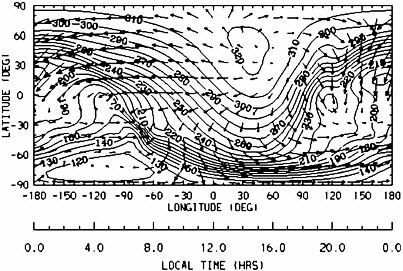
FIGURE 10.1 Results of model calculations of upper-atmosphere temperatures and winds at Mars, in a plot of latitude versus local solar time (LST), for solar maximum and northern summer conditions at ~200-km altitude. The isotherms shown are in 10-K intervals; superimposed arrows represent the magnitude and direction of the neutral winds. The winds diverge from midafternoon and converge after dusk or before dawn. Neutral temperatures reach 321 K (dayside, LST = 16) and decline to 111 K (south polar night). Maximum winds reach 326 m/s across the terminators and near the poles. SOURCE: S.W. Bougher, S. Engel, R.G. Roble, and B. Foster, “Comparative Terrestrial Planet Thermospheres: 3. Solar Cycle Variation of Global Structure and Winds at Solstices,” Journal of Geophysical Research 105:17669-17692, 2000. Copyright 2000 by the American Geophysical Union. Reproduced by permission of AGU.
heating and classical thermal conduction alone, as is the case in the terrestrial midlatitude ionosphere. Similar results were seen at Venus, and it is now believed that a combination of reduced thermal conduction and additional topside heat input is the cause of these enhanced temperatures.13 An example of such a calculation, along with the observed temperatures, is shown in Figure 10.2. The required heat inflow is considerably higher for the electrons, mainly because of their larger thermal conductivity, which leads to rapid drainage of heat to the neutrals at lower altitudes.
Electron density altitude profiles were also obtained by several U.S. and Soviet satellites (e.g., Mariner 9), using the radio occultation technique. Thus, some information exists on both the dayside and near-terminator-nightside electron density values, covering the altitude range of about 120 to 300 km.14,15 No clear presence of an ionopause was seen in this database.
A number of the U.S. and Soviet spacecraft that either flew by or orbited Mars carried magnetometers and some limited plasma instrumentation; they discovered a well-defined bow shock around the planet and provided limited information on the fields and particles inside the bow shock. The Soviet Phobos mission was the first (and so far the only) spacecraft that has orbited Mars and that had a comprehensive fields and particles instrument complement.16 Phobos made important additions to our database on the bow shock location17 and provided new information on extensive wave activities18 and the presence of a magnetic pile-up boundary (also called a magnetic barrier). This latter phenomenon is the result of the slowing down of the shocked interplanetary magnetic field inside the magnetosheath. The Phobos spacecraft, after only a few elliptic orbits, was placed in a circular orbit at about 3 Mars radii (the orbit of the satellite Phobos), so it provided very little spatial and temporal information on the dayside magnetosheath. Also, the Phobos spacecraft, even during the elliptical phase of its orbit, did not get closer than about 850 km to the surface, and therefore no ionospheric information was obtained. This orbit did not
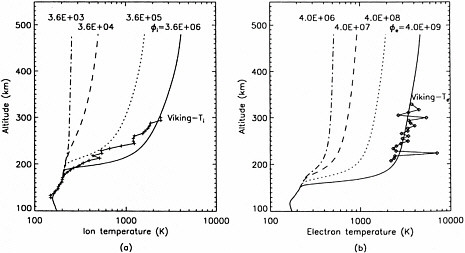
FIGURE 10.2 Calculated and observed (a) ion and (b) electron temperatures in the dayside ionosphere of Mars. The calcula-tions assume different topside heat inflows, as indicated at the tops of the curves. The inflow numbers given are in eV cm–2 sec–1. The heat inflow values necessary to match the temperatures observed by Viking are reasonable, but they are ad hoc values. SOURCE: Y.W. Choi, J. Kim, K.W. Min, A.F. Nagy, and K.I. Oyama, “Effect of the Magnetic Field on the Energetics of Mars’ Ionosphere,” Geophysical Research Letters 25:2753-2756, 1998. Copyright 1998 by the American Geophysical Union. Reproduced by permission of AGU.
allow a definitive conclusion to be drawn about the existence of an intrinsic magnetic field at Mars. These comments should not be construed to imply that Phobos did not provide important new information concerning the plasma environment of Mars—only that much more data will be needed to permit elucidation of the controlling physical processes.
Mars Global Surveyor carried a magnetometer and electron reflectometer package, and during the extended aerobraking phase of the mission it made many low-altitude measurements. One of the most exciting and unexpected results of the MGS mission was the finding that although Mars has no intrinsic magnetic field, relatively strong and widespread remnant crustal magnetization is present (see Chapter 2 in this report). In the context of this section, the lack of an intrinsic magnetic field and the presence of strong, localized crustal magnetic fields have important implications for the interaction of the solar wind with Mars. It means that in most situations, the interaction is with the ionosphere, as is the case for Venus, but asymmetries must be present because of the nonuniform distribution of the crustal fields. The presence of these crustal fields also means that “mini-magnetospheres” are present and some form of intermittent reconnection processes must take place. The MGS magnetometer also provided information on the nature and extent of the magnetic pile-up boundary.19 The electron reflectometer measured superthermal electron fluxes in both the magnetosheath and the ionosphere. It found distinct changes in the shape of the electron spectrum, in the energy range of 10 to 10,000 eV, in these two regions,20 and thus it established, unambiguously and for the first time, the presence of an ionopause, which had been expected but not seen before.
NEAR-TERM OPPORTUNITIES
Nozomi
The Japanese mission Nozomi was specially designed and implemented to address many of the outstanding problems in the areas of upper-atmospheric and plasma sciences associated with Mars (see Table A.1 in Appendix A). However, even this dedicated payload does not address all of the high-priority science that needs to be covered; for example there are no measurements of the upper-atmospheric winds, which are crucial for an understanding of the dynamics of that region.
The spacecraft was launched on July 4, 1998, and was supposed to be placed in orbit around Mars in March of the following year. However, because of a sticking valve problem, the planned trajectory had to be abandoned; after two Earth swingbys, it is expected to be placed in orbit around Mars early in 2004. Nozomi was not designed for such a long interplanetary cruise, and it now faces a number of problems. If successful, the mission will answer a number of outstanding questions (see the next two subsections and Table 12.1, “Outstanding Mars Exploration Science Issues,” in Chapter 12), but it is clear that even then it cannot and will not “close the book” on this field of research. Besides the mission’s lack of certain important measurements, the 5-year delay means that instead of arriving at Mars during solar cycle maximum, it will be placed in orbit during solar cycle minimum, and thus the meaningful investigation of a number of outstanding problems will be seriously jeopardized (e.g., nonthermal escape, which is highly solar-cycle dependent).
Mars Express
The European Space Agency’s Mars Express mission is expected to be launched in June 2003, to take 6 months to reach Mars, and to be put in orbit around the planet. Of its instruments, three have relevance to this section (see Table A.1). They are the Ultraviolet and Infrared Atmospheric Spectrometer (SPICAM), the Energetic Neutral Atoms Analyzer instrument package (called ASPERA), and the Radio Science Experiment (known as MaRS). It is hoped that SPICAM will provide some information on the thermal and hot neutral gas distributions. ASPERA is designed to study the solar wind interaction with Mars, but all three of these science packages will also provide some information on the plasma densities around the planet.
RECOMMENDED SCIENTIFIC PRIORITIES
In the general area of upper-atmosphere, ionosphere, and solar wind interaction studies of Mars, the main priorities for research are these:
-
The dynamics of the upper atmosphere. Absolutely no direct information exists on neutral gas velocities, but it is badly needed in order to obtain a basic understanding of the dynamical processes and coupling to the lower atmosphere.
-
Hot atom abundances and escape fluxes. Pioneer Venus’s ultraviolet spectrometer established the presence of hot oxygen and carbon atoms at Venus, and the earlier Mariner observations indicated the presence of hot hydrogen. There is no information on these hot atoms at Mars, but in light of the similarities with Venus and of theoretical models, it is clear that they must be present. The low escape energy at Mars also implies that hot atom escape fluxes may be important.
-
Ion escape from Mars. Both theory and observations indicate that there are significant ion escape fluxes at Mars. These escape flows, whether due to tailward flow from the ionosphere or to scavenging, are related to the solar wind interaction processes. A meaningful understanding of the escape processes, mentioned under priorities 2 and 3 above, are of great importance in understanding how the martian atmosphere evolved during the last few billion years. If there was life on Mars some time ago, how did an atmosphere that was capable of supporting life evolve into the one that remains today?
-
Mini-magnetospheres and reconnection at Mars. The discovery of remnant crustal magnetic fields at Mars means that small, localized “magnetospheres” are likely to be present. There have been suggestions that such mini-magnetospheres are present around the Moon. These small magnetospheric regions may undergo reconnection with the compressed interplanetary magnetic field in the magnetosheath. These reconnection events must depend on the specific location of the crustal field with respect to the subsolar location and solar wind parameters, such as magnetic field angle.
-
The energetics of the ionosphere. There are major unexplained issues concerning the mechanisms that determine the electron and ion temperatures in the ionospheres of both Venus and Mars. The question is why the electron and ion temperatures are as high as the measurements indicate. There are two possible answers to this question, but no clear resolution.
The five priorities listed above are embraced by recommendations COMPLEX has made in the past (Appendix B: [1.13, 1.14, 4.6]). Two of the secondary recommendations put forward in Chapter 12 are consistent with the priorities outlined here.
ASSESSMENT OF PRIORITIES IN THE MARS EXPLORATION PROGRAM
There are no existing plans in the current U.S. Mars Exploration Program to address any of the scientific priorities outlined in the previous section. The Nozomi mission would address items 2, 3, 4, and 5 to some extent. However, that spacecraft has already lost one of its two transmitters, and while one hopes for its success, the mission was not designed for its current 5-year interplanetary cruise phase. At best, it will provide some initial answers to these areas of research, but much more is needed to meaningfully elucidate these open issues. The instruments aboard Mars Express will address issues listed under items 2 and 3 above, but here again, much will be left unanswered. It is also noted that both spacecraft will arrive at Mars during solar minimum, and as indicated above, data from solar maximum are imperative in order to answer some of the outstanding questions (e.g., regarding nonthermal escape).
The instruments needed for a meaningful attack on the five scientific questions listed above would require no new, basic instrument development, and could be installed as a partial payload complement on an orbiting spacecraft. The neutral winds can be measured by either a “baffled” neutral mass spectrometer or a Fabry-Perot interferometer. The latter instrument, along with a good ultraviolet spectrometer, could address in a meaningful way the hot atom and neutral escape flux questions. The neutral mass spectrometer would also provide neutral composition and temperature information. A plasma instrument complement consisting of a magnetometer, a low-
energy ion mass spectrometer (capable of measuring flow velocities and temperatures), an electron spectrometer, a plasma wave detector, and a Langmuir probe would go a long way toward resolving issues raised in items 3, 4, and 5 above.
REFERENCES
1. A.O. Nier and M.B. McElroy, “Composition and Structure of Mars’ Upper Atmosphere: Results from the Neutral Mass Spectrometers on Viking 1 and 2,” Journal of Geophysical Research 82: 4341-4349, 1977.
2. C.A. Barth, A.I.F. Stewart, S.W. Bougher, D.M. Hunten, S.J. Bauer, and A.F. Nagy,“Aeronomy of the Current Martian Atmosphere,”pp. 1054-1089 in Mars, H.H. Kieffer, B.M. Jakosky, C.W. Snyder, and M.S. Matthews (eds.), University of Arizona Press, Tucson, 1992.
3. D.E. Anderson, “Mariner 6, 7 and 9 Ultraviolet Spectrometer Experiment: Analysis of Hydrogen Lyman Alpha Data,” Journal of Geophysical Research 79: 1513-1518, 1974.
4. C.A. Barth, J.B. Pearce, K.K. Kelly, L. Wallace, and W. G. Fastie, “Ultraviolet Emission Observed Near Venus from Mariner 5,” Science 158: 1675-1678, 1967.
5. A.F. Nagy, T.E. Cravens, J.-H. Yee, and A.I.F. Stewart, “Hot Oxygen Atoms in the Upper Atmosphere of Venus,” Geophysical Research Letters 8: 629-632, 1980.
6. L.J. Paxton, “Pioneer Venus Orbiter Ultraviolet Spectrometer Limb Observations: Analysis and Interpretation of the 166- and 156-nm Data,” Journal of Geophysical Research 90: 5089-5096, 1985.
7. J. Kim, A.F. Nagy, J.L. Fox, and T.E. Cravens, “Solar Cycle Variability of Hot Oxygen Atoms at Mars,” Journal ofGeophysical Research 103: 29339-29342, 1998.
8. A.F. Nagy, M. Liemohn, J.L. Fox, and J. Kim, “Hot Carbon Densities in the Exosphere of Mars,” Journal of Geo-physical Research 106: 21565-21568, 2001.
9. G.M. Keating, S.W. Bougher, R.W. Zurek, R.H. Tolson, G.J. Cancro, S.N. Noll, J.S. Parker, T.J. Schellenberg, R.W. Shane, B.L. Wilkerson, J.R. Murphy, J.L. Hollingsworth, R.M. Haberle, M. Joshi, J.C. Pearl, B.C. Conrath, M.D. Smith, R.T. Clancy, R.C. Blanchard, R.G. Wilmoth, D.F. Rault, T.Z. Martin, D.T. Lyons, P.B. Esposito, M.D. Johnston, C.W. Whetzel, C.G. Justus, and J.M. Babicke,“The Structure of the Upper Atmosphere of Mars,” Science 279: 1672-1676, 1998.
10. S.W. Bougher, R.G. Roble, E.C. Ridley, and R.E. Dickenson, “The Mars Thermosphere: 2. General Circulation with Coupled Dynamics and Composition,” Journal of Geophysical Research 95: 14811-4827, 1990.
11. W.B. Hanson, S. Sanatani, and D.R. Zuccaro, “The Martian Ionosphere as Observed by the Viking Retarding Poten-tial Analyzers,” Journal of Geophysical Research 82: 4351-4363, 1977.
12. W.B. Hanson and G.P. Mantas, “Viking Electron Temperature Measurements: Evidence for a Magnetic Field in the Martian Ionosphere,” Journal of Geophysical Research 93: 7538-7544, 1988.
13. Y.W. Choi, J. Kim, K.W. Min, A.F. Nagy, and K.I. Oyama, “Effect of the Magnetic Field on the Energetics of Mars’ Ionosphere,” Geophysical Research Letters 25: 2753-2756, 1998.
14. M.H.G. Zhang, J.G. Luhmann, and A.J. Kliore, “A Post Pioneer Venus Reassessment of the Martian Dayside Iono-sphere as Observed by Radar Occultation Methods,” Journal of Geophysical Research 95: 14829-14839, 1990.
15. M.G.H. Zhang, J.G. Luhmann, and A.J. Kliore, “An Observational Study of the Nightside Ionospheres of Mars and Venus with Radio Occultation Methods,” Journal of Geophysical Research 95: 17095-17102, 1990.
16. R.Z. Sagdeev and A.V. Zakharov, “Brief History of the Phobos Mission,” Nature 341: 581-584, 1989.
17. W. Riedler, D. Mohlmann, V.N. Oraevsky, K. Schingenschuh, Ye. Yeroshenko, J. Rustenbach, Oe. Aydogar, G. Berghofer, H. Lichtenegger, M. Delva, G. Schelch, K. Pirsch, G. Fremuth, M. Steller, H. Arnold, T. Raditsch, U. Auster, K.H. Fornacon, H.J. Schenk, H. Michaelis, U. Motschmann, T. Roatsch, K. Sauer, R. Schroter, J. Kurths, D. Lenners, J. Linthe, V. Kobzev, V. Styashkin, J. Achache, J. Slavin, J.G. Luhmann, and C.T. Russell, “Magnetic Fields Near Mars: First Results,” Nature 341: 604-607, 1989.
18. R. Grard, A. Pedersen, S. Klimov, S. Savin, A. Skalsky, J.G. Trotignon, and C. Kennel, “First Measurements of Plasma Waves Near Mars,” Nature 341: 607-609, 1989.
19. D. Vignes, C. Mazelle, H. Reme, M.H. Acuña, J.E.P. Connerney, R.P. Lin, D.L. Mitchell, P. Cloutier, D.H. Crider, and N.F. Ness, “Solar Wind Interaction with Mars: Locations and Shapes of the Bow Shock and Magnetic-Pile-Up Boundary from the Observations of the MAG/ER Experiment Onboard Mars Global Surveyor,” Geophysical Re-search Letters 27: 49-52, 2000.
20. D.L. Mitchell, R.P. Lin, H. Reme, D.H. Crider, P.A. Cloutier, J.E.P. Connerney, M.H. Acuña, and N.F. Ness, “Oxy-gen Auger Electrons Observed in Mars’ Ionosphere,” Geophysical Research Letters 27: 1871-1874, 2000.


