
1
Introduction
Mars occupies a special place in the U.S. program of space exploration, and also in the minds of the public, because it is the most Earth-like planet in the solar system and the place where the first detection of extraterrestrial life seems most likely to be made. Another important reason for studying Mars is to be able to compare it with the other terrestrial planets and to learn how the differences among these planets relate to differences in their formation and evolution, stemming from factors such as their distances from the Sun, their initial sizes, and their proximity to Jupiter.
The Mars Surveyor Program, begun in 1996 after a 20-year hiatus in (successful) U.S. Mars missions, was to be an ambitious exploration of the Red Planet, inspired by the success of the modestly supported Pathfinder Lander mission in that year, and also by reports that the martian meteorite designated ALH84001 contains possible evidence of extraterrestrial life. However, with the failures of the Mars Climate Orbiter and Mars Polar Lander missions in 1999, the Surveyor program came to be seen as unworkable, and in the time since those failures the strategy for Mars exploration has been systematically rethought and its more ambitious goals have been scaled back. A new Mars Exploration Program (MEP)—no longer the Mars Surveyor Program—has been developed, building on earlier missions and on the success of an ongoing orbital mission, Mars Global Surveyor (MGS), which has already returned a wealth of data that have revolutionized our understanding of the planet. Missions to Mars will be launched at every launch opportunity, i.e., on approximately 26-month centers.
The new Mars Exploration Program was announced by NASA’s Office of Space Science on October 26, 2000. (The MEP is described in Appendix A of this report.) The task of the present study was to assess the program in the light of recommendations made earlier to NASA by the Committee on Planetary and Lunar Exploration (COMPLEX) and other advisory panels (these recommendations are summarized in Appendix B of this report) and to consider the degree to which recent discoveries suggest a reordering of priorities.
The task of reviewing Mars science is daunting. An exhaustive summary would be far beyond the scope of National Research Council (NRC) reports, and COMPLEX is quick to admit that this report is far from exhaustive. The report first reviews nine topics that comprehensively describe contemporary Mars science (Chapters 2 through 10), working from the interior of the planet outward. Each chapter summarizes recommendations that have been made relative to that topic. Section numbers in square brackets (e.g., [1.10]) reference specific recommendations that appear in Appendix B. Rather than discussing a topic of Mars science, Chapter 11 addresses a technique, and a particularly important one: the collection and return of samples from Mars. Chapter 12 then presents a summary discussion of priorities in the Mars Exploration Program in the light of earlier recommendations and current
realities, and Chapter 13 concludes the report. A key to the labyrinth of acronyms used in space exploration is included as Appendix C.
This study does not treat the satellites of Mars—Phobos and Deimos—as these have not been a quest of the NASA flight program, and their science is rather far removed from that of the terrestrial planets, being more closely aligned with that of the asteroids.
The Mars Exploration Program consists of flight missions, and the task of the present study is to discuss the science and priorities connected with flight missions. However, the exploration of Mars involves many modes of data acquisition and scientific inquiry, and it is important to keep in mind the essential elements of Mars science that stem from Earth-based research. These include not only the analysis of data from flight missions, without which the data themselves would be useless, but also purely ground-based research: telescopic studies, theoretical modeling and analysis, and a variety of studies in terrestrial laboratories. Because this report is directed toward an assessment of the Mars Exploration Program, it rarely addresses the important science carried out in Earth-based studies, but these must be considered an important part of any integrated scientific exploration. Some examples follow:
• Telescopic studies. Continuing telescopic observation of Mars (Figure 1.1) has played a key role in demonstrating that the surface of Mars changes on a relatively short time scale (examples of such changes include seasonal cycles, dust storms, and evolution of the polar caps). Telescopic and spacecraft data are highly synergistic, and each type plays a role in supporting the other. NASA’s Infrared Telescope Facility, a 3-m infrared-optimized telescope on Mauna Kea, is an important facility for planetary science because it can be dedicated to mission support.1 Near-infrared spectra can be used to distinguish between water and CO2 ice clouds,2 and the 4.6-µm CO band can be used to monitor the dust content of the atmosphere. Atmospheric water vapor has been observed remotely3,4,5 and in situ by the Viking6,7 and Pathfinder8 missions. Support for future robotic and possible manned missions to Mars will require a long climatological baseline. The long baseline, partially obtained with ground-based and Hubble Space Telescope data, will also contribute to an understanding of the water cycles between the atmosphere, regolith, and polar caps, as well as providing spatially resolved data on volatile cycles of H2O, CO2, CO, and O3.
• Theoretical models. Models are an essential component of any scientific endeavor. Examples of theoretical planetary studies are those that treat the geodynamics of Mars, its interior structure, atmospheric loss and fractionation,9 and global climate and general circulation models. Climate models, which are currently adapted from terrestrial general circulation models, are becoming increasingly important, yet they will require much additional observational data, particularly of surface-atmosphere energy and gas fluxes, for model validation and verification.10 The geodynamical investigations often study controls on the obliquity of Mars, and the variability of that parameter, which is so crucial to the planet’s climate history and the prospects of life on it.11 Theoretical studies of the interior attempt to model Mars’s core, the composition and viscous behavior of the mantle (the latter controls the tectonics of martian crust), and the magnetic record in the planet.12
• Martian meteorites. Evidence is very strong that the SNCa category of meteorites is cratering debris from Mars. Studies of this small group of meteorites in terrestrial laboratories have provided invaluable, if fragmentary, information about the geochemistry and chronology of the planet (see Chapter 3).13,14 Five of the SNC meteorites being studied were collected from the antarctic ice sheet by teams of searchers supported by NASA, the National Science Foundation, and the Smithsonian Institution (others are finds from deserts, or observed falls). The antarctic meteorite program was instituted in 1976; under this program, teams of experts search areas known to contain a concentration of meteorites for 6 weeks every austral summer. The research and analysis that led to the conclusion that SNC meteorites come from Mars is an excellent example of how support in the basic research of planetary materials has contributed significantly to our understanding of the planet.
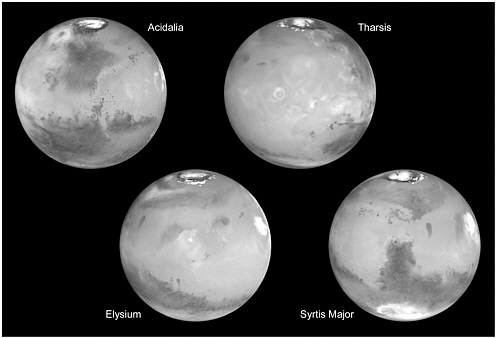
FIGURE 1.1 Hubble Space Telescope’s Wide Field and Planetary Camera 2 took these images of Mars between April 27 and May 6, 1999, when Mars was 87 million kilometers from Earth. Together, the four images show the entire martian surface, upon which features as small as 19 kilometers across are visible. NASA image courtesy of Steven Lee (University of Colorado), James Bell (Cornell University), and Michael Wolff (Space Science Institute).
• Astrobiological research. Studies of Earth’s deep-sea hydrothermal environments, hot springs, the deep subsurface, alkaline or acidic environments, and sea ice have revealed amazing microbial diversity in the form of uncultured organisms from environmental extremes. Some of these habitats are analogous to past and present martian environments where life may have arisen or might continue to exist. The search for living organisms is no longer constrained by a requirement for photosynthesis. Microbial species capable of subsurface growth in the presence of high concentrations of metals, high and low pH, and in either extremely cold or hot conditions are known. Despite discoveries of environmental extremes compatible with life, we have only limited knowledge of microbial diversity, the conditions under which such species live, and how interactions between microbial forms modulate planetary change. Ground-based astrobiology supplies a clear rationale and direction for the selection of landing sites on Mars, allows for the proper design and interpretation of in situ experiments, and provides the basis for life detection and planetary protection. It is imperative to develop sensitive life-detection protocols that will not be confused by terrestrial contamination; we must establish effective means for sterilizing returned samples without compromising their value for nonbiological studies; and through expanded knowledge about potential diversity of the microbial world, we must explore how ancient microbial life might have affected planetary processes on Mars. Through these investigations, we will be positioned to optimize information from Mars in situ and sample-return missions.
• Other laboratory studies. Inputs into theoretical studies, modeling, instrument design, and spacecraft missions are in part derived from terrestrial laboratory studies. In these, basic measurements are made of chemical
reaction rates, absorption cross sections, scattering cross sections, and other parameters that are important to studies of the martian surface and atmosphere and understanding of processes in them.15
COMPLEX stresses that continued support of these and other areas of Earth-based research is essential to a balanced program of Mars research (see Chapter 12 in this report).
REFERENCES
1. M.S. Hanner, K.J. Meech, E. Barker, M.J.S. Belton, R. Binzel, and J. Spencer, The Future Role of the IRTF—Reportto NASA from the NASA IRTF/Keck Management Operations Working Group, 1998.
2. See, for example, D.R. Klassen, J.F. Bell III, R.R. Howell, P.E. Johnson, W. Golisch, C.D. Kaminski, and D. Griep, “Infrared Spectral Imaging of Martian Clouds and Ices,”Icarus138: 36–48, 1999.
3. E.S. Barker, “Martian Atmospheric Water Vapor Observations: 1972–74 Apparition,”Icarus28: 247–268, 1976.
4. B. Rizk, R.M. Haberle, D.M. Hunten, and J.B. Pollack, “Meridional Transport and Water-Reservoirs in Southern Mars During 1988–1989,”Icarus118: 39–50, 1995.
5. A.L. Sprague, D.M. Hunten, R.E. Hill, L.R. Doose, and B. Rizk, “Martian Atmospheric Water Abundances: 1996– 1999,”Bulletin of the American Astronomical Society32: 1093, 2000.
6. C.B. Farmer, D.W. Davies, A.L. Holland, D.D. La Porte, and P.E. Doms, “Mars: Water Vapor Observations from the Viking Orbiters,”Journal of Geophysical Research82: 4225–4248, 1977.
7. B.M. Jakosky, and C.B. Farmer, “The Seasonal and Global Behavior of Water Vapor in the Mars Atmosphere: Complete Global Results of the Viking Atmospheric Water Detector Experiment,”Journal of Geophysical Research 87: 2999–3019, 1982.
8. D.V. Titov, W.J. Markiewicz, N. Thomas, H.U. Keller, R.M. Sablotny, M.G. Tomasko, M.T. Lemmon, and P.H. Smith, “Measurements of the Atmospheric Water Vapor on Mars by the Imager for Mars Pathfinder,”Journal ofGeophysical Research104: 9019–9026, 1999.
9. See, for example, D.M. Hunten, R.O. Pepin, and T.C. Owen,“Elemental Fractionation Patterns in Planetary Atmo-spheres,” in Meteorites and the Early Solar System, J. Kerridge and M.S. Matthews (eds.), University of Arizona Press, Tucson, 1988, pp. 565–591.
10. See, for example, R.H. Haberle, “Early Mars Climate Models,”Journal of Geophysical Research103: 28467–28480, 1998; and S.W. Bougher, S. Engel, R.G. Roble, and B. Foster,“Comparative Planet Thermospheres: 3. Solar Cycle Variation of Global Structure and Winds at Solstices,”Journal of Geophysical Research105: 17669–17692, 2000.
11. See, for example, G. Spada, and L. Alfonsi,“Obliquity Variations Due to Climate Friction on Mars: Darwin Versus Layered Models,”Journal of Geophysical Research103: 28599–28606, 1998; and B.G. Bills, “Obliquity-Oblateness Feedback on Mars,”Journal of Geophysical Research104: 30773–30798, 1999.
12. See, for example, C.L. Johnson, S.C. Solomon, J.W. Head, R.J. Phillips, D.E. Smith, and M.T. Zuber,“Lithospheric Loading by the Northern Polar Cap on Mars,”Icarus144: 313–328, 2000; K.F. Sprenke and L.L. Baker,“Magnetiza-tion, Paleomagnetic Poles, and Polar Wander on Mars,”Icarus147: 26–34, 2000; and P. Defraigne, V. Dehant, and T. Van Hoolst, “Steady-State Convection in Mars’ Mantle,”Planetary and Space Science49: 501–509, 2001.
13. R.C. Wiens, R.H. Becker, and R.O. Pepin,“The Case for Martian Origin of the Shergottites: II. Trapped and Indig-enous Gas Components in EETA 79001 Glass,”Earth and Planetary Science Letters77: 149–158, 1986.
14. H.Y. McSween, “What We Have Learned About Mars from SNC Meteorites,”Meteoritics29: 757–779, 1994.
15. See, for example, D. Kella, P.J. Johnson, H.B. Pedersen, L. Vejby-Christensen, and L.H. Andersen,“The Source of Green Light Emission Determined from a Heavy-Ion Storage Ring Experiment,”Science276: 1530–1533, 1997; and E.S. Hwang, R.A. Bergman, R.A. Copeland, and T.G. Slanger,“Temperature Dependence of the Collisional Removal of O2 (b1?g+, ? = 1 and 2) at 110–260 K, and Atmospheric Applications,”Journal of Chemical Physics110: 18–24, 1999.


