
7
Transforming the Nation’s AQM System to Meet the Challenges of the Coming Decades
INTRODUCTION
The air quality management (AQM) system has been effective in addressing some of the most serious air quality problems confronting the United States in the latter half of the twentieth century. New technologies and fuels, developed largely in response to Clean Air Act (CAA) requirements, have substantially reduced emissions from mobile, stationary, and other sources. As a result, the U.S. population has experienced large reductions in ambient concentrations of lead (Pb), carbon monoxide (CO), sulfur dioxide (SO2), and, in some regions, ozone (O3) and particulate matter (PM10). These reductions in ambient concentrations have come despite substantial economic and population growth in the United States that brought about increases in power generation, vehicle miles traveled, and other activities that are traditionally associated with emissions of air pollutants.
However, significant and perhaps even more difficult challenges are to be met in the coming decades. In this chapter, a number of specific changes to the air quality management (AQM) system are recommended that would improve our ability to meet these challenges effectively. To place these recommendations in an appropriate context, this chapter begins with a brief discussion of some of the air quality challenges that the nation will need to confront in the future and then outlines a set of overarching principles that guided the committee in designing its recommendations (see Figure 7-1).

FIGURE 7-1 To meet the major challenges that will face air quality management (AQM) in the coming decade, the committee identified a set of overarching long-term objectives. Because immediate attainment of these objectives is unrealistic, the comm itteemade five interrelated recommendations to be implemented through specific actions.
THE CHALLENGES AHEAD
Meeting NAAQS for O3 and PM2.5 and Reducing Regional Haze
In 1997, the U.S. Environmental Protection Agency (EPA) promulgated new National Ambient Air Quality Standards (NAAQS) for two criteria pollutants: O3 and PM. These standards were developed because of new scientific data that indicated deleterious health effects from exposure to concentrations of the two pollutants that were below the current NAAQS. Meeting the new standards will require additional reductions in pollutant emissions. Moreover, because O3 and PM are secondary pollutants (produced in the atmosphere from reactions involving primary pollutants), it will be necessary to determine which pollutant emissions to reduce and to devise appropriate monitoring systems to assess progress toward meeting the new standards. All of these tasks will be major challenges for the AQM system in the United States over the next decade.
The standard for O3 has been changed from a maximum 1-hr peak concentration of 120 parts per billion by volume (ppbv) to an 8-hr average concentration of 80 ppbv.1 It has proved to be extremely difficult to attain the previous (1-hr) O3 NAAQS. In the United States, approximately 56 areas composed of 233 counties have yet to attain it after decades of trying to do so (EPA 2003p). It will probably be even more difficult to meet the new O3 8-hr standard (NARSTO 2000). Retrospective analysis of air quality data indicates that there will be many more exceedances of the new 8-hr standard than the previous 1-hr standard. More frequent exceedances will occur in areas already in nonattainment of the 1-hr standard, and new exceedances will occur in areas currently in attainment of the 1-hr standard. Many of these new nonattainment areas will be in rural areas that do not have the major sources of the various air pollutants that produce O3. The decline of the 8-hr averaged O3 concentrations (11%) in the United States has been slower than that of the 1-hr averaged O3 concentrations (18%) over the past two decades (EPA 2002a). Therefore, additional pollution control strategies are likely to be needed to meet the new O3 NAAQS—for example, a further departure from the local emission-control approach demanded in the current state implementation plan (SIP) process and the enhanced development of multistate airshed2 management approaches, such as those embodied by the Ozone Transport Assessment Group (OTAG) and the resulting requirement to submit a revised NOx SIP.
Developing effective strategies to attain the new PM2.5 standard may also prove to be difficult. Atmospheric PM is a complex mixture of solid and liquid particles suspended in air; PM2.5 is a subset of PM in the atmosphere with (aerodynamic) diameters of less than 2.5 × 10⁻⁶ m (or 2.5 μm). Modern instrumentation capable of characterizing individual particles in the atmosphere confirms that PM2.5 within any airshed comprises numerous particles having different sizes, shapes, and chemical components (NARSTO 2003). Some actions are already under way or proposed to reduce these emissions (for example, the existing 2007 heavy-duty on-road diesel requirements and the proposed multipollutant controls on electric utilities). However, for the nation’s AQM system to protect human health from PM2.5 pollution over the long term, the specific characteristics of PM2.5 that negatively affect health need to be identified, the sources of emissions and the atmospheric processes responsible for the ambient concentrations of particles with these characteristics need to be determined, and new control technologies will need to be developed and implemented. These tasks will require a major investment in research (as outlined in NRC 1998b) and close collaboration between the policy-making and scientific and engineering communities in the United States.
Reducing regional haze to improve visibility in scenic areas, such as national parks, is another difficulty that the U.S. AQM system will be confronting for decades to come. As discussed in Chapters 2 and 5, EPA’s regional haze regulations call for states to develop strategies that will bring about interim improvements by 2018 but do not project attainment of the stated goal of returning national parks and wilderness areas to their natural visibility conditions until 2065.
O3, PM2.5, and regional haze share, to some extent, common precursor emissions and chemical pathways for the generation of these pollutants and are all to greater or lesser extents affected by long-range transport. For those reasons, it is critically important that pollution control strategies targeted for mitigation of O3, PM2.5, and regional haze be developed in tandem and on a multistate basis. Such a multipollutant, multistate approach should minimize the possibility that control strategies implemented for one pollutant will inadvertently increase the concentrations of another pollutant3 and should enhance the ability of policy-makers to maximize the cost-effectiveness of their overall air pollution control strategies. The one-pollutant-at-a-time approach that is currently used to develop SIPs may substantially hinder the development of multipollutant control strategies.
Toxic Air Pollutants
The health risks faced by U.S. citizens from exposure to toxic air pollutants remain an important concern, albeit one that is not well quantified. The National Air Toxics Assessment (NATA) estimates that most Americans face cancer and noncancer risks of public health concern from exposure to hazardous air pollutants (HAPs) (EPA 2002e). Moreover, these estimates do not consider the risks associated with exposures to numerous poorly characterized HAPs, or to the large number of chemicals that are not identified as HAPs but that might pose a health hazard. Although some monitoring data suggest that concentrations of commonly measured HAPs are declining and the implementation of planned maximum achievable control technology (MACT) and other regulations is expected to substantially reduce toxic emissions, significant residual risk is predicted to remain (EPA 2000a). Given the multitude of sources of toxic air pollutants in the nation and the variety and complexity of the risks they pose, protection of human health and ecosystems from exposure to HAPs will continue to challenge the AQM system over the coming decades.
Ideally, control strategies for HAPs would be scaled to the degree, severity, and pervasiveness of the risks posed. The difficulty in developing such strategies has been and will probably continue to be a lack of sufficient information on the sources, atmospheric distribution, and effects of most HAPs. Evidence regarding risks for the majority of HAPs, unlike the criteria pollutants, is often indirect (that is, from animal studies rather than human laboratory or epidemiological studies) and extrapolated from effects reported for HAPs at concentrations much higher than typical ambient concentrations. In addition, current efforts to monitor HAPs fall far short of that needed to characterize HAP exposures adequately. There is a clear need to enhance resources for research, data collection, and analysis efforts on HAPs. However, in the past, priority for these resources has generally been given to criteria pollutants.
A large number of potentially toxic pollutants in the atmosphere are unregulated and, in most cases, poorly characterized in terms of environmental concentrations and subsequent health and ecological effects. An illustration of the enormity of this problem is that while 188 compounds are officially designated as HAPs by EPA, an estimate of approximately 300 compounds with varying tendencies to exist in the atmosphere as gases or particles are introduced into commerce each year by U.S. industries.4 A major challenge for the nation’s AQM system over the coming
decades will be the development of a research and regulatory infrastructure capable of protecting human health and welfare from the increasing number of potentially toxic pollutants in the atmosphere in an effective and timely manner while not unnecessarily impeding economic activity and technological progress.
Protecting Human Health and Welfare in the Absence of a Threshold Exposure
There is increasing evidence that for some criteria pollutants and subsets of the population, any exposure is harmful—that is, there is no threshold exposure below which harmful effects cease to occur (Daniels et al. 2000). Under these circumstances, there is a tendency to set air quality goals and standards at ever lower concentrations—concentrations so low, in fact, that they approach what might be considered the irreducible background concentration that is unaffected by human pollutant emissions and thus impervious to even the most aggressive air pollution control efforts. To address this challenge, AQM needs to develop a better understanding of the reducible (human-induced) and irreducible components of pollution in the United States (NARSTO 2000). Achievement of this understanding will require a substantial expansion of monitoring networks into rural and remote regions, as well as in cities (see Chapter 6). Enhanced tools will also be required for exposure assessment and health and ecosystem impact analysis to better characterize risks at low levels of exposure. When scientific understanding is improved, it might be necessary to reconsider how to set standards to protect public health from those pollutants with no established thresholds.
Ensuring Environmental Justice
The CAA Amendments of 1990 make no direct or specific reference to environmental justice. Nevertheless, environmental justice issues clearly can arise in the implementation of the CAA, and for this reason, environmental justice is a goal of the nation’s AQM system (see Chapter 2). Addressing environmental justice in the nation’s AQM system will require actions on a number of levels. First, environmental justice concerns reinforce the need to monitor and model the distribution of HAPs and other pollutants in microenvironments and to use those results to estimate exposures to the populations in those microenvironments. Second, the concept of environmental justice will need to be incorporated in the earliest stages of air quality planning and management. Implementation planning has a critical role in the CAA, and issues of environmental justice often can be addressed most effectively during development of these plans especially if
they begin to address multiple pollutants and hot spots,5 as proposed in the third and fourth recommendations in Recommendations for an Enhanced AQM System later in this chapter. In one instance, the California Air Resources Board (CARB) led in establishing a framework for incorporating environmental justice into its programs consistent with the directives of state law (CARB 2001). Third, new proposals for pollutant reduction (cap-and-trade programs, for example) should be judged in terms of the environmental justice impact and the efficacy of the reduction and should be designed to include sufficient local emission-control requirements to minimize the possibility that hot spots will result, especially in disadvantaged communities. Fourth, Native American tribes should be given help to develop and implement AQM programs for reasons of environmental justice and tribal self-determination.
The recommendations advanced later in this chapter, specifically those that allow AQM to target the most significant exposures and risks, are designed in part to address these issues.
Assessing and Protecting Ecosystem Health
The goal of protecting ecosystems is clearly enunciated in the CAA under the proviso to protect public welfare through the promulgation and implementation of secondary standards. The protection and maintenance of ecosystems is critical not only because of a general desire to protect and preserve forests and undeveloped spaces in the United States but also because ecosystems provide invaluable services (for example, water purification, water supply, forest production, and carbon and nitrogen fixation) that are essential to our economy and the public health (Daily 1997; ESA 1997a; Balmford et al. 2002). Indeed, provisions to mitigate ecosystem impairment in wilderness areas and national parks in the 1977 CAA Amendments and to mitigate the effects of acid rain in Title IV of the 1990 CAA Amendments are proactive steps taken by Congress to protect public welfare in the absence of formally established secondary standards.
Despite the mandate in the CAA to protect welfare, protection of ecosystem health has not received adequate attention in the implementation of
the act (see Chapter 2). Nevertheless, research over the past 30 years suggests that there is a critical need to protect ecosystems from the damaging effects of air pollution. In addition to impairment of visibility, air pollution can have far-reaching effects on ecosystems, including damage to trees and crops; degradation of soil quality (particularly shallow forest soils); acidification of surface waters; and a resulting decrease in the diversity of biota, contamination of fish tissue (for example, by mercury and polychlorinated biphenyls), and eutrophication of coastal waters. Those ecological effects have an impact on humans through decreases in the productivity of forests and crops, increased advisories on consumption of contaminated fish, loss of fisheries in waters located in upland forests and in estuaries, and a deterioration of the quality of recreational activities. A major goal of the nation’s AQM system in the coming decades should be to establish an appropriate research and monitoring program that can quantitatively document the links between air pollution and the structure and function of ecosystems and use that information to establish realistic standards and goals for the protection of ecosystems and implement strategies to attain those standards and goals.
Addressing Multistate, Cross-Border, and Intercontinental Transport
Historically, the primary emphasis of AQM in the United States has been on controlling emissions in and nearby urban and industrial centers where pollutant concentrations are generally the highest; this approach is often referred to as a local pollution control strategy. During the late 1980s and 1990s, it was realized that controlling local emissions alone was insufficient to meet the NAAQS for some air pollutants in some areas. In response, regional planning organizations were created to devise multistate AQM strategies. As discussed in Chapter 3, some of these regional planning organizations were created in response to specific requirements of the 1990 CAA Amendments (for example, the Ozone Transport Commission and the Grand Canyon Visibility Transport Commission), and others were formed on a more ad hoc basis (for example, the Ozone Transport Assessment Group). Whatever the mechanism that led to their formation, these regional planning organizations all shared a common purpose: to fill the gap in the nation’s AQM system that has historically fallen between the responsibilities and regulatory authority vested with state governments and those vested with the federal government. To better fill this gap and thereby facilitate the development and implementation of multistate AQM plans in the future, the recommendations section of this chapter proposes that EPA’s role in addressing regional problems be enhanced.
As more is learned about the atmosphere, it has become more apparent that air quality in a locale (even an urban locale) can be influenced by even
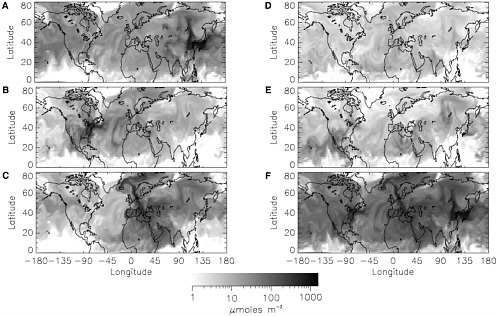
FIGURE 7-2 Contribution to the sulfate column burden for July 15, 1997, at 00UT (vertical integral of the concentration) from different source regions showing intercontinental transport. Data are in micromoles per square meter. Source regions are (A) Asia (anthropogenic), (B) North America (anthropogenic), (C) Europe (anthropogenic), (D) biogenic (dimethyl suflide and hydrogen sulfide from natural sources), (E) volcanoes, and (F) total. Results from the Brookhaven National Laboratory chemical transport and transformation model for sulfate. SOURCES: Data from Benkovitz et al. 2003; and from C.M. Benkovitz, Brookhaven National Laboratory; S.E. Schwartz, Brookhaven National Laboratory; M.P. Jensen, Columbia University; M.A. Miller, Brookhaven National Laboratory; R.C. Easter, Pacific Northwest National Laboratory; and T.S. Bates, Pacific Marine Environmental Laboratory; unpublished material, 2004.
longer range pollutant transport; namely, transport across national boundaries and even between continents. Analyses of data sets gathered from space-based and airborne platforms in combination with sophisticated computer models indicate that air pollutants from Central America, Asia, Africa, and Europe reach North America, and, in turn, pollutants from North America reach Europe (Figure 7-2). The implications for AQM in the United States are 2-fold:
-
International and intercontinental transport of pollutants can significantly degrade air quality in the United States, particularly over the short term. For example, in April and May 1998, large amounts of smoke were observed by the total O3 mapping spectrometer (TOMS) satellite in
-
plumes emanating from fires in Mexico and extending into Florida, Texas, New Mexico, California, and Wisconsin. Along the Gulf Coast of Texas, a public health alert was issued advising residents to stay indoors to avoid the smoke. Similarly, chemical measurements have documented the import of pollutants transported from the Eurasian continent across the Pacific Ocean into the western part of North America (Jaffe et al. 1999; Wilkening et al. 2000). The rapid industrialization of the Asian continent could conceivably exacerbate this phenomenon.
-
Pollutant emissions from North America, Europe, and Asia are probably causing an increase in the so-called background concentrations of pollutants in the northern hemisphere. For example, there is evidence that the background concentration of tropospheric (lower atmospheric) O3 in the northern hemisphere has increased by as much as a factor of 3 in the past 100 years, presumably in response to growing pollutant emissions from throughout the hemisphere, including the United States (Volz and Kley 1988; Staehelin et al. 1994). In addition, the mean summer afternoon concentration in rural areas of the United States (Logan 1988) and Europe (Scheel et al. 1997) have grown by a factor of 4 to 6. As standards for PM and O3 become more stringent and the thresholds for health effects from air pollution are found to be lower or nonexistent, the increasing level of background pollution causes difficulty in separating the effects of local and regional air pollution from global problems.
To address these international aspects of air pollution, the AQM system will need to continue to develop, implement, and utilize sophisticated remote-sensing technology to document and track the phenomena. It will also be necessary for the United States to continue to pursue collaborative projects and enter into agreements and treaties with other nations (especially developing nations) to help minimize the emissions of pollutants that can degrade air quality on continental and intercontinental scales. Examples of past initiatives and treaties undertaken by the United States to mitigate atmospheric problems of international concern include the development and implementation of the Montreal Protocol to address stratospheric O3 depletion, the Convention on the Long-Range Transport of Transboundary Air Pollution (CLTRAP) to mitigate a wide range of air quality problems, and NARSTO to develop a coordinated program of research on the causes of and remedies to ground-level O3 and PM pollution in Canada, Mexico, and the United States.
Adapting the AQM System to Climate Change
The earth’s climate is warming (IPCC 2001). Although uncertainties exist, the general consensus within the scientific community is that this
warming trend will continue or even accelerate in the coming decades (IPCC 2001; NRC 2001b). Some forms of air pollution might be exacerbated by these climate changes. For example, precursor emissions and photochemical reactions that result in the production of O3 tend to increase with warmer temperatures (Carter et al. 1979; Tingey 1981; Chock et al. 1982; Halberstadt 1989; Cardelino and Chameides 1990; Bernard et al. 2001). The AQM system must be flexible and vigilant in the coming decades to ensure that pollution mitigation strategies remain effective and sufficient as our climate changes.
At the same time, air pollution and human-induced climate change have one important common characteristic: they are both fostered by the burning of fossil fuels and other anthropogenic activities. Although some emissions contribute to climate warming (for example, CO2, soot, and upper tropospheric O3), others cool the climate (for example, sulfates formed from sulfur oxide emissions) (IPCC 2001; NRC 2001b; Hansen and Sato 2001). Thus, some efforts to mitigate air pollution may also help to mitigate climate warming (for example, reducing O3 precursor emissions), and others may inadvertently exacerbate climate warming (for example, reducing sulfur oxide emissions). If the current trends in climate continue, the air pollution and climate interactions will need to be considered in designing air pollution control strategies. Multipollutant approaches that include mitigation of climate warming as well as air pollution may be desirable, and some states have already considered implementing such programs (STAPPA/ALAPCO 1999).
PRINCIPLES FOR ENHANCING THE AQM SYSTEM
In the U.S. democratic system, the AQM system is designed and implemented by political decision-makers and is, therefore, greatly influenced by political and economic considerations. However, since its inception, the CAA has recognized that its effectiveness can be substantially enhanced by policies that are informed by and consistent with scientific and technological realities. On the basis of the committee’s analysis of the strengths and limitations of the AQM system (in Chapters 2 through 6), as well as the future challenges described above, the committee has identified a set of overarching scientific and system-design principles that should guide the improvement and development of the nation’s AQM system.
One Atmosphere Approach for Assessing and Controlling Air Pollutants
Air pollutants are constituents of the atmosphere and, as such, can be transported and mix freely in atmosphere and transfer to other environmental media. Air pollutants do not have political and statutory boundaries
and when humans and ecosystems are exposed to air pollution, they are simultaneously exposed to a complex array of contaminants. Moreover, pollutants that affect humans can affect ecosystems, and, perhaps more important, pollutants that appear to affect ecosystems only can also directly or indirectly affect human health and activities, because society depends on ecosystems for essential environmental services.
In large part because of the federal system of government, efforts to mitigate air pollution in the United States are organized along state boundaries and, within states, along county and metropolitan boundaries. Because of limitations in both resources and knowledge and the structure of the NAAQS process, most mitigation efforts focus on pollutants separately. Although such approaches may be expedient, they are often inadequate to characterize the transport, mixing, and reaction of air pollutants and the exposure of people and ecosystems to these pollutants. In the long run, such approaches may limit the ability of an AQM system to protect human health and welfare most effectively. The air pollution challenges facing the nation over the coming decades are complex; they are likely to require mitigation strategies that are consistent with the “principle of one atmosphere.” Such a principle requires understanding the dispersion and interaction of multiple pollutants over multistate or even international airsheds, developing the air pollution control strategies that span multistate airsheds, and understanding and mitigating the impacts on human health and ecosystem condition that arise from simultaneous exposure to multiple pollutants. It will also require better understanding of the range of important emissions from any one set of sources so that facilities and other pollutant emitters have the underlying information needed to develop innovative multipollutant control technologies and pollution prevention practices. Detailed recommendations are provided later in the chapter.
Ultimately, in light of the substantial scientific data documenting the role of air pollution in the effects on water and soil, the AQM system will need to move beyond one atmosphere and address one environment (see Box 7-1). Although complete consideration of the implications of this broader approach was beyond the scope of this committee’s charge, the committee notes that a comprehensive assessment of these issues is needed in the future.
Risk Determined by Actual Exposure
The adverse effects of air pollutants on humans and ecosystems are ultimately determined by the actual exposures and sensitivity of humans and ecosystems to the myriad air pollutants in the atmosphere. However, many of the specific mitigation efforts under way in the United States are guided by standards and goals that target the ambient concentrations or
|
BOX 7-1 Pollutants are transported between the atmosphere and other media (water and soil). Although research on the consequences of air pollutants has traditionally focused on the direct effects on human and plant health, materials and atmospheric visibility studies over the past 30 years have demonstrated that air pollutants can accumulate in soil; contaminate groundwaters, surface waters, and estuaries; and, under certain conditions, be re-emitted back to the atmosphere (for example, mercury and nitrogen oxides). The multimedia effects of air pollutants greatly increase the complexity of AQM. Air pollutants may have an impact on human health through contamination of water supplies and food, in addition to the impact through direct exposure and inhalation. A prime example of such phenomena and the serious environmental effects that can be thus engendered is found in an examination of the reactive nitrogen cycle, where nitrogen compounds generated from food and energy production are believed to have profound effects on air and water quality and on ecosystem function and climate (Ambio Special Issue, March 2002). Persistent organic pollutants (POPs), such as polychlorinated biphenyls (PCBs) and polybrominated diphenylethers (PBDEs), also tend to persist in the environment and can accumulate in human tissue. They can appear as air pollutants, but they can also contaminate water, soils, and the food web (Rodan et al. 1999). Recognition of multimedia effects has blurred the distinction between air and water pollution, and that may require rethinking the approach for setting air pollution standards and for linking air quality policy with other environmental policies. For example, the contamination of groundwater supplies, surface waters, and estuaries by air pollutants has implications for the Safe Drinking Water Act, the Clean Water Act, and state and local environmental management policies, including fish-consumption advisories. At a minimum, the growing awareness of these multimedia challenges calls for renewed efforts, in the CAA and elsewhere, to provide the incentives to all parties to prevent the emission of pollutants before they are created rather than treating them after they have been produced. Beyond that, a comprehensive, multisector strategy for the mitigation of both air and water pollution may ultimately prove necessary to comprehensively protect human and ecosystem health. |
emission-control technologies of a few specific pollutants rather than the actual risks borne by people and ecosystems.
Developing an AQM system that explicitly targets risks would be a challenging task. Pollutant concentrations can vary considerably in time and space, and pollution sources that contribute to exposure may do so to different extents. Of particular concern are the so-called hot spots, where pollutant concentrations are significantly higher than the average ambient concentrations. An additional complication arises when some individuals or groups (such as those with sensitivities due to genetic makeup or preexisting conditions) and certain ecosystems, habitats, or species (such as sen-
sitive crops and estuaries) are more susceptible to the effects of pollutants than the average for that category. Enhanced susceptibility to certain toxicants during certain life stages (for example, in utero, childhood, and old age) is another important concern that has been considered inadequately in the development of regulatory strategies. Some populations, particularly those living or working in and around hot spots, also might be more heavily exposed and thus at greater risk to air pollutants. As discussed in Chapter 2, disadvantaged communities and individuals are often the ones most exposed to pollutants from industrial facilities and transportation. Finally, high exposures can be generated indoors through many sources, including the use and off-gassing of consumer products.
To address these complex and multifaceted exposures and effects, the nation’s AQM system would have to be modified substantially. More comprehensive multipollutant monitoring systems would be required for those pollutants posing the most significant risk, and enhanced efforts would be needed to understand the relationship between ambient pollution and the full range of indoor and outdoor exposures of individuals and ecosystems to pollutants. It would also require systematic efforts to assess both human health and ecosystem impacts, especially in susceptible or more highly exposed populations and ecological settings. Changes in statutory requirements and standard-setting procedures may be necessary as well.
Dynamic AQM in a Constantly Changing Technological Society
The United States is a technological society that is complex and continuously changing. The future trajectory of society is determined by a complex interaction of social, economic, political, and technological forces as well as natural phenomena that occur independently of, and sometimes in response to, human influence (for example, climate change). Moreover, scientific understanding of the causes, consequences, and management options of air pollution and the technology for addressing air pollution are in flux. For those reasons, unforeseen pollutants might someday overshadow air pollutants that are of primary concern today, and air pollution mitigation strategies that are effective today might not apply in the future (for example, as a result of globalization of trade and shifting emissions patterns). The rate of change can cause difficulties: rules and regulations need to provide some level of certainty to regulated parties, but they can also impose substantial inertia on the system, making it difficult to respond to new scientific information and technological developments. If the nation’s AQM system is to apply the best knowledge on a continuing basis, the system must be dynamic—a system that can be adjusted and corrected as new information, scientific understanding, and technological advances become available.
Emphasizing Performance Rather Than the Process
Science advances through iteration. Theory and prediction are used to explain observed phenomena, and observations are used to test theories and predictions. Empirical data and observations of performance ultimately determine the viability of scientific understanding. The AQM system, on the other hand, is inherently regulatory in nature. As a public and political endeavor that imposes requirements and restrictions on parties who would not voluntarily observe them, AQM must attend to a variety of system-design objectives, including fairness, openness, and predictability for regulated parties, stability, legal enforceability, and cost effectiveness along with the overarching goal of improving air quality. In such a system, the promulgation of statutory requirements, rules, and mandated methods and practices can become primary, while the testing of the system’s performance in improving air quality becomes secondary. That development is not entirely surprising, because the system is designed to anticipate predictable attempts by regulated entities to circumvent more flexible regulatory requirements.
An overemphasis on procedures can produce an AQM system that is overly complex and rigid and insufficiently focused on measuring performance. Indeed, participants in the existing AQM system at all levels (the public; stakeholders; and local, state, and federal officials) have expressed concern that the current system is sometimes overly driven by rules and procedures, focusing too much time on paperwork and not enough time on tracking the efficacy of the statutes, rules, and methods that were enforced. Insufficient tracking makes it difficult to identify weaknesses and flaws in the technologies and strategies used to control air pollution, and it makes it difficult to help in the development of technologies and strategies that are more cost-effective and thus capable of attracting broader community support.
A stronger performance-oriented approach would potentially be more effective. It would borrow from the scientific approach that emphasizes reconciling expectations and observations, not process. It would also create accountability for achieving results and allow procedures and methods to be adjusted and corrected as data on impacts indicated. Such a system would give regulated entities greater discretion in developing plans for achieving the goals of the AQM system, while holding them accountable for the results. Scientific tools would be used to monitor the impact of control strategies on emissions, air quality, and relevant human health and welfare outcomes and to monitor the method of hypothesis testing through observations to improve the relevant policies and regulations. Automatic rewards for achieving results and automatic sanctions for failing to achieve them might also be included in this system.
RECOMMENDATIONS FOR AN ENHANCED AQM SYSTEM
Ideally, an enhanced AQM system should build upon the current AQM system in the following key ways:
-
Strive to identify the most significant exposures, risks, and uncertainties. The ideal AQM system would systematically assess the population’s exposure to all pollutants and the relative human health, welfare, and ecological impacts of all pollutants. It would set priorities for pollutants according to those exposures and impacts.
-
Strive to take an integrated multipollutant approach to address the most significant exposures and risks. Foster control strategies that accomplish comprehensive reductions in the most cost-effective manner for all priority pollutants.
-
Strive to take an airshed-based approach. Address and, where appropriate and feasible, control the full range of emissions arising from local, multistate, national, and international sources.
-
Strive to take a performance-oriented approach. (1) Track significant results and impacts (for example, the effectiveness of specific control technologies and policies, air quality improvements, and human health and welfare effects); (2) create accountability for the results; and (3) dynamically adjust and correct the system as data on progress are assessed.
The committee sees the above four ways to AQM enhancement as long-range objectives for the nation’s AQM system. A rapid transformation of the AQM system to one with those characteristics is unrealistic. Although the scientific community has obtained considerable understanding about air pollution in recent decades, knowledge is not extensive enough to rank pollutants comprehensively on the basis of risk. There is insufficient understanding of the mechanisms by which pollutants affect human beings and the environment and of the incidence and distribution of each pollutant in the atmosphere. Finally, the diversity of health and welfare effects associated with different pollutants further complicates a simple ranking of all pollutants. There also is a severe lack in resources and infrastructure as well as knowledge to comprehensively track the performance of the controls and actions instituted by an enhanced AQM system to best inform public and private decision-makers as they face the challenges ahead.
Nevertheless, the AQM system can begin a steady and continuous development toward an approach that more closely approximates the characteristics enumerated above. In that spirit, five sets of recommendations addressing specific aspects of the nation’s AQM system are proposed below. Although each set of recommendations is presented separately, they are interdependent and should be implemented as such. Each recommenda-
tion has associated with it a number of specific actions, and each action is designed to help to attain one or more of the long-term objectives for AQM described above (see Figure 7-1).
Although all the recommendations are important, the first set of recommendations to enhance the technical capacity of the AQM system is important to implementing the others. Without substantial progress on the first recommendation, the actions called for in the remaining four recommendations will be more difficult to accomplish.
Recommendation One
Strengthen the scientific and technical capacity of the AQM system to assess risk and to track progress.
Findings
Over the past 30 years, the nation has developed an extensive system to monitor air quality and a large body of scientific observations concerning the health effects of exposure to air pollution and the impacts of air pollutants on ecosystems. However, because of the continuing challenges to the AQM system, the current system is inadequate to meet the future needs of an enhanced AQM system.
-
Emissions. The nation’s AQM system has not developed a comprehensive program to track emissions and emission trends accurately and, as a result, is unable to verify claimed reductions in pollutant emissions that have accrued as a result of implementation of the CAA (see Chapter 6).
-
Ambient Monitoring. The nation’s air quality monitoring network is dominated by urban sites, limiting its ability to address a number of important issues, such as documenting national air quality trends and assessing the exposure of ecosystems to air pollution (see Chapter 6).
-
Modeling. Substantial progress has been made in the development of air quality models, but their predictive capabilities and their usefulness to air quality policy-makers are limited by the availability and quality of data needed on meteorological conditions and emissions (see Chapter 3).
-
Assessing Exposure. Although health and welfare effects are ultimately the product of exposures of populations and ecosystems to mixes of pollutants from specific sources, the nation’s AQM system has not invested adequate resources in assessing exposure, relying instead on surrogates (for example, attainment of an ambient NAAQS) to achieve benefits (see Chapter 6).
-
Tracking and Assessing Risks and Benefits to Human Health and Welfare. The nation’s AQM system has not developed a method and
-
program to independently document improvements in health and welfare outcomes achieved from improvements in air quality (see Chapter 6).
-
Tracking Implementation Costs. Programs to systematically collect information on the costs of implementation of the CAA have been funded inconsistently and have been limited in their ability to independently validate company estimates of compliance costs (see Chapter 6).
Proposed Actions
The successful transformation of the AQM system will require renewed assessment of, and investment, in the nation’s scientific and technical capacity. Most critical in this regard is the capacity to comprehensively document and monitor pollutant emissions, human and ecosystem exposure, ambient air quality, and human health and welfare outcomes. Because of insufficient resources, transformation of the AQM system should begin with a reappraisal of current resource deployment, identifying opportunities to disinvest in portions of the nation’s monitoring and risk assessment system that are less useful and to reinvest those funds in high-priority improvements. Even with the most creative reinvestment of existing resources, however, an enhanced AQM system will require substantial new resources as well. Any investment of new resources would be modest in comparison to the $27 billion of annual compliance costs for the CAA expected by 2010 (EPA 1999a). Even doubling the approximate $200 million in federal funds currently dedicated to air quality monitoring and research at EPA alone would be less than 1% of the costs expended annually to comply with the CAA. Such resources are even smaller when compared with the costs imposed by the deleterious effects of air pollution on human health and welfare.
On the basis of its review of the current ability of the AQM system to assess risk and monitor progress, the committee identified a set of seven priority recommendations:
Improve Emissions Tracking
EPA should lead a coordinated effort with state, local, and tribal air quality agencies to improve the current system of tracking emissions and their reductions in time and space and estimating overall trends in emission inventories. This undertaking will be challenging because of the large number of emission sources and the changes in their emissions over time. Despite those difficulties, emission inventories should be based on emission measurements whenever possible rather than model calculations. Efforts to achieve that should include the following:
-
Investment in the development of new emissions-monitoring techniques (for example, continuous emission monitors for a wider number of sources) to better characterize actual emissions.
-
Improvement in current and projected mobile-source emission inventories through expansion of the in-use emission measurement program for on-road vehicles and the various categories of off-road mobile sources.
-
Development of better source signatures to facilitate an assessment of the quality of the emission data by source category, using, for example, chemical and isotopic tracers.
-
A systematic program of applying the best available emissions measurement and characterization technologies to develop emission factors for every major class of sources.
-
Investment in more comprehensive efforts to develop, maintain, and regularly update source inventories.
-
Independent efforts, using ambient as well as emissions data, to validate and improve models used in emission inventories.
-
Continuous efforts to track the adequacy of emission inventories by reconciling the inventories with ambient measurements.
-
Incorporation of more formal uncertainty analysis, based on the validation efforts, in the presentation and use of inventories.
The Emission Inventory Improvement Program, initiated by EPA and the State and Territorial Air Pollution Program Administrators and Association of Local Air Pollution Control Officials, is one example of such efforts that should be vigorously implemented and enhanced to more fully address important shortcomings of the current system.
Enhance Air Pollution Monitoring
Increasingly complex air quality challenges require a substantially improved multipollutant air quality monitoring system. An effort should be made to ensure that air quality monitoring systems are capable of meeting the increasingly complex challenges and diverse objectives for monitoring in a risk- and performance-oriented AQM system with maximum efficiency. A detailed list of suggested improvements is included in Chapter 6 and Appendix D. The following needs are among the highest priority needs for optimization of the nation’s monitoring network:
-
A comprehensive review of the various air quality monitoring programs to develop an integrated monitoring strategy that incorporates appropriate measurements of pollutants and their precursors. This review should consider shifting resources. An integrated monitoring strategy should improve the ability of the system to address the objectives that have
-
been often overlooked (attention to emerging air quality problems, especially those relating to HAPs, and exposure of people and sensitive ecosystems; and verification of emission inventories, accountability, and AQM-related atmospheric process studies).
-
New monitoring methods to respond to the changes in air quality and monitoring data needs that have occurred over the past 30 years. A more active program of methods development within EPA and deployment through the redesigned network should be initiated. Novel approaches that allow higher spatial resolution (both horizontally and vertically) will be necessary to address the future challenges in AQM.
-
Increased number and distribution of air quality monitoring stations in rural, agricultural, and remote forest areas, aided by a statistical design that will improve spatial and temporal estimates of exposure. Colocated long-term measurements of air quality, meteorology, atmospheric deposition, and ecosystem response to air pollutants (for example, along pollution gradients).
-
Review of the methods used to determine statistically significant long-term trends in ambient pollutant concentrations to ensure that the results of such analyses are robust.
-
Enhanced accessibility of ambient air quality measurement data to the scientific community and the public.
A recent effort by EPA to work with states, tribes, and local air quality agencies to develop the National Core Monitoring Network (NCore), which is assessing the current system and recommending areas for reduced or increased investment, is a valuable first step in enhancing the monitoring network. To achieve substantial enhancement, however, will require sustained agency commitment to implementing such efforts as NCore and applying substantial additional funds to continue key efforts. It will also require innovative programs, including ones that give incentives to the private sector to develop and implement advanced monitoring technologies.
Improve Modeling
The following key steps would enhance the current models for air quality planning and management:
-
Continued and expanded efforts by EPA to develop shared modeling resources by supporting regional modeling centers to train and work with states and multistate organizations on air quality planning. Ideally, these centers would support multiple state-of-the-science models and data analysis.
-
Thorough evaluations of models required before they are used for attainment demonstrations of SIPs and other planning purposes. Beyond
-
the evaluation of a model’s overall performance in matching observed pollutant concentrations, evaluation of meteorology and emission inputs should be done separately. Thorough evaluation, including improved quanitification of uncertainty, is required, and precursor species (for example, NOx and volatile organic compounds) should be measured along with secondary pollutants and that chemical constituents and microphysical properties of PM be measured along with total mass.
-
Additional short-term campaigns that use government and academic resources from around the country to obtain the detailed measurements needed to develop model inputs and the data needed for model evaluation. Intensive field studies have been conducted in the past decade in Atlanta, Chicago, Denver, Houston, and Los Angeles.
Enhance Exposure Assessment
A more targeted understanding of the pollutants and the sources that are causing adverse health and welfare effects is needed. To obtain that, a substantial increase in efforts will be required to assess exposure, including the following:
-
Development of enhanced techniques for measuring personal and ecosystem exposure.
-
Development and application of techniques to measure the portion of exposure (in humans the “intake fraction”) that is due to different sources.
-
Ultimately, adjustment of regulatory strategies to address the most significant sources of actual exposure in ambient, hot-spot and indoor settings.
Develop and Implement Processes to Assess Human Health and Welfare Effects
In the final analysis, a performance-oriented AQM system must be able to track progress by improving the understanding of risks and documenting the actual benefits of air pollution control measures on the human health and welfare outcomes for which these measures were adopted. Full accounting for the health and ecosystem impacts and benefits of reducing air pollution will require a systematic approach.
For human health effects, EPA should
-
Work with the Centers for Disease Control and Prevention (CDC) to develop a comprehensive suite of health indicators to be measured consistently across the United States and reported on a regular basis. Recent
-
efforts in Congress and at the CDC and EPA have begun to move in that direction (see Chapter 6).
-
Develop and implement tools to track the temporal pattern in attributable risk and population-based burden of disease due to short- and long-term exposure to ambient concentrations of criteria pollutants.
-
Develop and implement methods and markers for tracking population exposure to, and risk from, the range of other air pollutants, including HAPs. To be successful, all efforts for tracking exposure and risk need to be done over time.
For ecosystem health, EPA should
-
Collaborate with other federal agencies (for example, U.S. Department of Agriculture, U.S. Forest Service, U.S. National Oceanic and Atmospheric Administration, and U.S. Geological Survey) on a comprehensive strategy to monitor ecosystem exposure to pollutants and the effects of this exposure on ecosystem structure and function (see detailed recommendations in Chapter 6).
-
Analyze data from such a monitoring network or networks to better understand the structural and functional consequences of exposure of ecosystems to air pollution and to identify useful biological and chemical indicators for detecting ecosystem response to pollutants at various levels of biological organization.
For tracking the full range of environmental outcomes, EPA should
-
Provide long-term support for the activity initiated with the production of its Draft Report on the Environment (2003n) (1) to ensure that EPA is able to produce a series of reports on a biannual or triannual basis, and (2) to provide the scientific and technical basis for environmental indicators that link human and ecological health outcomes with air quality.
Continue to Track Implementation Costs
As noted earlier, cost effectiveness is a desirable feature of an AQM system and is embedded in many of the specific control requirements of the CAA. In that regard, the nation should maintain and improve its ability to track costs by
-
Continuing to support and fund the Pollution Abatement Cost and Expenditures (PACE) Survey on a regular basis to measure the cost of environmental programs for comparison with ex ante estimates and to improve the design of programs.
-
Undertaking detailed and periodic retrospective examinations of a subset of past regulatory programs to compare the actual implementation costs with EPA’s initial projections of these costs.
Invest in Research to Facilitate Evolution to a Multipollutant Approach Targeted at the Most Significant Risks
Substantial investments into research and development will be needed if the nation’s AQM system is to eventually adopt the scientifically rigorous, risk-focused multipollutant paradigm discussed in this chapter. This will involve enhanced research into the full range of exposures and their potential risks, ultimately resulting in a comprehensive understanding of what sources, pollutant mixtures, and exposures place the public at risk. One component of such an investment would be a review of the risks and adequacy of regulatory protections from pollutant exposures indoors. The review would take a comprehensive look at indoor air pollutant sources, exposures, and risks and regulatory responses to address them, including voluntary programs and labeling requirements on consumer products; evaluate the adequacy of such approaches; and, if warranted, make recommendations for improved approaches.
Invest in Enhanced Human and Technical Resources to Support the AQM System
The scientific and technical capacity of the nation to attain a fully risk-focused and performance-oriented AQM system rests on the ability of the public and private institutions that constitute the AQM system to train, develop, and retain an adequate and diverse corps of scientists and engineers to conduct research, develop new technologies, and implement policies with the best-available scientific and technical knowledge. The nation today benefits from having many fine institutions that are training future generations for these tasks, and their efforts should be enhanced by
-
Providing special programs and incentives to attract and train a new corps of air quality specialists, through federally sponsored training initiatives, including those for nascent and established tribal air quality programs.
-
Developing and implementing an environmental extension service to provide both follow-up hands-on training for recent scientific and engineering graduates and a mechanism for more rapid technology and knowledge transfer to local, tribal, and state air quality agencies.
-
Enlisting the assistance from professional societies and associations to facilitate the broad-based training of scientists, engineers, and educators needed to fulfill the wide-ranging goals of an enhanced AQM system.
Recommendation Two
Expand national and multistate performance-oriented control measures to support local, state, and tribal efforts.
Findings
In our federal system of government, the states have been assigned a major role in determining policies needed to achieve air quality objectives and standards. This state role is supported by a philosophic commitment to federalism and a practical recognition that states have substantial administrative capacity, detailed knowledge of local environmental conditions, and understanding of the local political, economic, and social context—all of which equip them to craft policies that can gain local acceptance and be implemented effectively. However, because of the complexity and scale of the nation’s economy and the need to maintain open interstate commerce, control of emissions from the many sectors of the economy sometimes cannot be efficiently regulated at the local or state level. In addition, air pollution does not follow political boundaries, and many of the sources affecting a particular area may be outside a particular jurisdiction facing an air quality problem. For that reason, numerous measures that set nationwide emission standards have been promulgated by Congress and EPA. Examples of effective federally mandated emission-control programs include EPA’s on-road motor vehicle control program, the phase-out of lead in gasoline, and the acid rain control program. With regard to these national emission standards,
-
Emission-control measures promulgated and implemented by EPA have been effective in achieving substantial reductions in emissions of air pollutants on a national level (see Chapters 4, 5, and 6).
-
The existence of federally mandated emission-control measures has eased the burden of state and local authorities who prepare the attainment SIPs (see Chapter 3).
-
In addition to generating air quality benefits, the national emission-control programs have often provided the drive for technological advancements and, in some instances, have established consistent regulatory requirements for an entire emission-source sector (see Chapters 4 and 5).
-
The development of cap and trade has provided the AQM system with a mechanism for achieving substantial emission reductions at reduced costs (see Chapter 5).
-
In many instances, the net emission reductions achieved from the promulgation of emission standards that set a limit on the rate of emissions (as opposed to the total amount of emissions) from a vehicle, product, or facility have been substantially offset by concomitant increases in use, demand, or productivity (see Chapters 4 and 5).
-
Mobile- and stationary-source emission standards often do not apply to a large fraction of older sources that were “grandfathered” at the time the standards were promulgated. In some cases, the emissions from these grandfathered sources make a major contribution to the total pollutant burden in the nation (see Chapters 4 and 5).
-
EPA lacks a sufficient and specific mandate to proactively address multistate airshed aspects of air pollution (see Chapter 3).
Proposed Actions
Expand Use of Federal Emission-Control Measures
Additional federal emission-control limits on a variety of nationally distributed products and unregulated as well as underregulated sources will undoubtedly be needed to cost-effectively attain ambient air quality standards for O3 and PM2.5 and reduce exposure to various HAPs. To take advantage of economies of scale and the opportunity to address air pollution generated across multistate airsheds, EPA should expand its role in establishing and implementing national emission-control measures on specific sectors of the economy so that states can focus their efforts on local emissions. Among the source categories that should be considered for national emission standards are nonroad mobile sources (for example, aircraft, ships, trains, and construction equipment), more dispersed area sources (for example, wastewater treatment facilities and agricultural practices), and building and consumer products (for example, paints and coatings, cleaners, and other consumer products). In this regard, the recent proposal by EPA for stricter emission standards for nonroad engines is a positive step (68 Fed. Reg. 28328 [2003]). Federal limits and, when appropriate, trading programs to implement those limits, should be established whenever feasible.
States, tribes, local agencies, and stakeholders should be actively involved in identifying and developing those enhanced federal measures. The federal role might include issuing periodic requests to all parties for suggestions for sectors of the economy where increased nationwide or multistate emission controls are needed and having regular consultation throughout the process of developing new measures.
An expanded federal role in the promulgation of control measures should not be carried out in a way that prevents or even discourages innovative initiatives at the state and tribal level. Toward that end, the CAA should continue to allow states to adopt innovative programs that may go beyond the requirements of the federal government, and EPA should expand its efforts to give state and local agencies incentives to undertake, in
the context of a revised AQM planning process (see Recommendation Three below), innovative approaches to pollution control.
Place Emphasis on Technology-Neutral Standards for Emissions Control
Whenever practical, the control measures implemented by EPA at the federal and multistate level should be technology-neutral standards—that is, standards that set clear performance goals without specifying a technological solution—and provide flexibility for sources to achieve those goals in the most cost-effective way possible and provide incentives for developing new technologies. These standards can take at least two forms:
-
One form places a cap on the total emissions from a given source or group of sources instead of a limit on the rate of emissions per unit of resource input or product output (for example, a cap on the total NOx emissions from a power plant instead of a limit on the amount of allowable NOx emitted per British thermal unit produced by a power plant). This approach is especially effective when the sources or source owners are a relatively defined group (for example, in the hundreds or thousands), and emissions are easily and accurately monitored. This approach can be applied in many ways that would have to be determined as appropriate.
-
A second form is a technology-promoting rate-based emissions limit, which sets stringent emission-rate standards that can be met by a mix of still-to-be-determined but foreseeable responses, such as fuel change, combustion enhancement, and add-on controls. An example of this approach is the 2007 highway diesel rule, which sets clear and stringent emission-rate standards that cannot be met by in-use technologies. The rule requires lower sulfur fuel to facilitate new technology and allows manufacturers of vehicles and engines to meet the standards through their own mix of combustion and after-treatment approaches. This type of standard is most often suitable when ownership and use of the source is diffuse (for example, in the hundreds of thousands or millions) and may be more amenable to addressing mobile, consumer, and area sources. Although such a standard is still dependent on the rate of activity and the likely growth in that activity, experience has shown that such standards can be set stringently enough to more than offset growth.
In either case, the emission-cap or emission-rate standard should not be permanent. Instead, mechanisms should be incorporated from the beginning to allow caps and standards to be adjusted. For example, as control technologies evolve and the costs of these technologies fall, further tightening of the standards might be deemed acceptable. Moreover, if new scien-
tific understanding so indicates, tightening of the standards may prove to be necessary.
Use Market-Based Approaches Whenever Practical and Effective
Congress and EPA should also look for opportunities to pursue the expanded use of market forces and economic incentives to implement federal and multistate emission-control programs. A common feature of current legislative proposals to control multiple pollutants in the electricity sector is their reliance on market-based approaches. This feature indicates a continuing emphasis on achieving environmental goals in a cost-effective manner.
The recommendations in this report are likely, on balance, to impose new costs on the private and public sectors. Therefore, policy-makers must try to achieve these goals using institutions and incentives that will incur the least possible cost (for example, the use of cap-and-trade systems to control SO2 and NOx emissions). Cap-and-trade programs appear to have saved billions of dollars in capital costs and have realized substantial cost savings compared with conventional regulatory approaches (see Chapter 5). However, cap-and-trade programs have potential pitfalls. Such programs can result in emission trades from one location to another and from one period to another with potentially detrimental consequences, although experience in the acid rain SO2 emissions trading program suggests that it may be possible to design such programs to minimize detrimental consequences. The endorsement of the committee for the expanded use of cap-and-trade programs assumes that future cap-and-trade programs will be designed and implemented to avoid the potential pitfalls. Specific suggestions on how that can be accomplished are presented in Chapter 5.
Reduce Emissions from Existing Facilities and Vehicles
As noted in Chapters 4 and 5, reducing emissions from older stationary and mobile sources is difficult. Retrofits can be expensive, and substantial economic incentives can keep older (and dirtier) facilities and equipment in operation. Nevertheless, as emission standards on new sources become increasingly tight, emissions from unregulated older sources become increasingly important and begin to hinder further progress. Creative approaches to addressing the problem of grandfathered sources should be developed and implemented. The advent of cap-and-trade programs included existing and new stationary sources under the cap, placing requirements on their owners either to reduce emissions further or to pay for excess reductions that have been made at other facilities. As control costs decline and scientific understanding of emission effects increases, continual
reexamination and refinement of the caps can help to ensure that all facilities are participating in efforts to reduce emissions.
For large equipment, such as heavy-duty on-road and nonroad engines, states and EPA have begun to apply a variety of strategies: inspection requirements of in-use engines, financing programs to subsidize replacement programs (especially for public agencies such as school districts and transit agencies), and environmental fines dedicated to support early replacement and implementation of requirements for retrofit (SAE 2003; M.J. Bradley & Associates, Inc. 2002a,b). However, a more comprehensive and systematic effort by EPA and the states to develop heavy-duty vehicle inspection and maintenance programs and to enforce in-use emission requirements, as well as sustained financing from the federal and state level for retrofits and early replacement of older vehicles, will be required if this important source of continuing exposure, especially for inner-city urban populations, is to be brought under control.
Enhance the Ability and Responsibility of EPA to Address Multistate Regional Transport Problems
Throughout the 1980s and 1990s, there has been a growing recognition that many of the air quality problems facing the nation have a large spatial scale and require a coordinated multistate mitigation effort. When the primary origin of the transported emissions is from sources that are not appropriately or adequately regulated through a nationwide policy, a multistate strategy is the only remaining recourse. This problem poses a special difficulty for areas working to attain the NAAQS that are situated downwind of an area that has significant sources of transported pollution. Here the absence of a regional mandate affects the downwind area’s ability to rely on actions in the upwind areas to reduce regional or interstate transported pollution and consequently attain the NAAQS.
The 1990’s saw a series of legislative and voluntary efforts in both the eastern and western United States to attempt to address this important issue. However, constitutionally, interstate environmental rules and regulations must be based on federal authority to be effective. Therefore, Congress should provide EPA with the affirmative authority and responsibility to
-
Assess multistate air quality issues on an ongoing basis.
-
Identify the upwind areas that contribute substantially to SIP nonattainment areas.
-
Adopt appropriate regulatory requirements that expeditiously limit emissions from contributing sources.
In addition to focusing on criteria pollutant transport dynamics, the scope of EPA’s multistate transport responsibilities should include HAPs and the adoption of mitigation measures to address ecosystem and welfare impacts.
Recommendation Three
Transform the SIP process to meet future air quality challenges.
Findings
The SIP process has been an important component of the nation’s AQM system (see Chapter 3). It allows state and local agencies to account for emission controls adopted at the federal and multistate level and then to choose additional local emission-control measures to attain NAAQS. On balance, this division of responsibility should be appropriate. It can also be the basis of a constructive partnership between the federal and state governments that steadily improves air quality on local, multistate, and national scales. In fact, air quality monitoring data confirm that such improvements have occurred in the past two decades.
Nevertheless, important adjustments to the SIP process are needed if the difficult challenges ahead are to be addressed effectively. As discussed in Chapter 3, the major concerns are described below:
-
The SIP process places too much emphasis on the development of a one-time NAAQS “attainment demonstration.” Because of the significant scientific, political, and legal uncertainties inherent in such an exercise, it should not be expected to be an accurate predictor of future air quality.
-
The SIP process has mandated extended amounts of local, state, and federal agency time and resources in an iterative, often frustrating, proposal and review process that focuses primarily on compliance with intermediate process steps and not on the more germane long-term indicators of performance.
-
Each SIP is developed for a single criteria pollutant in isolation from other SIPs developed in the same location for other criteria pollutants, making it difficult for SIPs to pursue multipollutant, source-based strategies.
-
The SIP process does not provide mechanisms to integrate control strategies for noncriteria pollutants (HAPs) that can be emitted from many of the sources that emit criteria pollutants.
-
The SIP process lacks methods for identifying and acting on air pollution hot spots, where populations are exposed to significantly high concentrations of air pollutants from one or multiple sources.
-
In theory, the SIP process contains mechanisms to enable EPA to ensure that all states are making continuous progress toward meeting the NAAQS.6 In practice, EPA’s authority for compliance is limited except in some of the most severe nonattainment areas, and even where it has the authority, it has at times—for lack of resources or other reasons—failed to promulgate the necessary requirements in a timely manner. Although states and other affected persons may file an “action forcing” citizen suit against EPA, that is an expensive and an unwieldy tool for ensuring that EPA attends to its responsibilities in a timely manner.
Addressing these issues will require two basic sets of actions: (1) transform the SIP into a comprehensive air quality management plan (AQMP), and (2) reform the planning and implementation process.
Proposed Actions
Transform the SIP into an AQMP
Looking forward, successful AQM in the United States requires significant changes in the scope and the implementation of the SIP process so that it places greater emphasis on performance and results and facilitates development of multipollutant strategies. The committee recommends that this change be accomplished by mandating that each state prepare an AQMP that integrates all relevant air quality measures and activities into a single, internally consistent plan. This change would involve the ultimate elimination of single-pollutant SIPs and their replacement by a single, comprehensive multipollutant AQMP.
Recognizing that the implementation of this recommendation will require a significant change in standard procedure at the federal, state, and local level, we further recommend that implementation, perhaps with incentives, occur in stages over a defined transition period. Currently, there are examples of local air quality agencies that are attempting to create such plans, most notably, that of the South Coast Air Quality Management District in California (SCAQMD 2000).
Today, SIPs are created to address attainment of the NAAQS for individual criteria pollutants. In the future, the scope of planning process through the AQMP should be expanded in three specific ways:
Integrated Multipollutant Plan: Given the similarity of sources, precursors, and control strategies, the AQMP should encompass all criteria pollutants for which a state has not attained the NAAQS. This approach will be especially important for the many areas that face nonattainment of both O3 and PM NAAQS, because those pollutants share common sources and precursors. Although this change might make development of the plan more complex, the added complexity will likely be offset by the increased efficiency of government and industry in developing and implementing performance-oriented multipollutant control strategies.
Inclusion of HAPs: EPA, states, and local agencies should identify key HAPs that have diverse sources or substantial public health impacts or both, which would merit their inclusion in an integrated multipollutant control strategy (for example, benzene; see Recommendation Four). These HAPs should be included and addressed in the AQMP for each state. This initiative will probably take substantial EPA investment to provide the states with the necessary technical basis and resources. Beyond the existing MACT requirements, the level at which a HAP is to be addressed in an AQMP could vary. In some cases, EPA could require that states only develop an emissions inventory and monitoring program for a HAP or take advantage of multipollutant-control opportunities. In other cases, EPA could require addressing a HAP more comprehensively in the AQMP and require an attainment demonstration and a detailed emission-reduction plan. In the latter case, it would also be necessary for EPA to specify a target for attainment; that decision could be based on a local risk assessment and expressed in terms of an ambient concentration or a concentration at specific hot spots.
Greater Consideration of Hot Spots and Environmental Justice: Although implicit in current SIPs for individual criteria pollutants, the scope of the AQMP should explicitly identify and propose control strategies for air pollution hot spots to reduce exposures experienced disproportionately by some subset of the population and to provide incentives to do so.
Reform Planning and Implementation
Substantial reforms will also be necessary to enhance the technical basis and administrative efficiency of the statewide planning process. These reforms are especially important because of the expanded and integrated scope of the AQMP described above. Specific recommendations are discussed below.
Focus on Tracking and Assessing Performance: Each SIP is now statutorily required to contain an attainment demonstration in which predictive models and related weight-of-evidence analyses are used to “demonstrate” that the relevant nonattainment area will reach attainment by a certain date as a result of the specific pollution control measures proposed in the SIP. Such an exercise provides useful input to policy-makers and should be retained. However, its use in the current SIP process as a one-time assumed-to-be robust prediction of how air quality in an area will evolve over multiple years or decades is inappropriate because of the uncertainties inherent in the modeling exercise (see Chapter 3) and the false sense of confidence that plans implemented on the basis of the model calculations will achieve the anticipated air quality improvements.
Looking forward, a more useful approach would be to retain the attainment demonstration as a planning tool but to place greater emphasis on follow-up measures to track compliance and progress and on actions to be taken if compliance and progress are not satisfactory. The AQMP process should encourage regulatory agencies to concentrate their resources on tracking and assessing the performance of the strategies that have been implemented rather than on preparing detailed documents to justify the effectiveness of strategies in advance of their implementation. For example, the attainment demonstration and the related improved air quality modeling (see Recommendation One) could be used in the beginning of the planning process to guide policy-makers in the development of a provisional emissions ceiling for the area (that is, a budget for the maximum amount of pollutant emissions an area could contain and still be in attainment of the NAAQS). States could then be required to develop and submit (for approval by EPA) a comprehensive and realistic emission-reduction plan that identified the combination of national, multistate, and local actions to be undertaken within the specified period to bring total emissions in the area in line with the provisional emissions ceiling derived from the attainment demonstration. These emission-reduction plans could then serve as a more practical, performance-oriented metric of state and federal agency execution of their respective responsibilities within a more collaborative and dynamic framework (described below).
Institute A Dynamic, Collaborative Review: If attainment demonstrations are imperfect predictions of the future, then it follows that a formal and periodic correcting process of review and reanalysis is needed to identify and implement revisions and adjustments to the plan when progress toward attainment falls below expectations or when conditions change sufficiently to invalidate the underlying assumptions of the plan.7 Given the
large contributions of federal and multistate measures to the success of any SIP, it is essential that this review process be collaborative and include all relevant federal and state agencies. Given the large investments of the public and private sectors in AQM, inclusion of these groups in aspects of the review would also be advisable.
Although some aspects of the current CAA “reasonable further progress” reviews seek to be dynamic, the process is often one-sided (with states reporting to EPA) and focuses more on process and administrative steps than on performance. The committee recommends, therefore, that these new reviews be focused specifically on performance. This process would entail preparation and exchange of progress reviews by the state and EPA. It would also involve the state and EPA in a collaborative review and agreement on where progress has been made, where more progress is needed, and what specific actions need to be enhanced or replaced. The review should have two components:
-
One component would be a review of actual as opposed to modeled emissions in the area to assess compliance with the emission-reduction plan submitted in the AQMP. To the extent that emission trends are not consistent with the emission-reduction plan, the responsible agency (state or federal) would then be required to amend the emission-reduction plan or the implementation of the plan. If EPA determined that a state agency was not fulfilling its responsibilities to meet the emission-reduction plan, then enforcement of effective and timely sanctions and federally imposed air pollution control measures (similar to that envisioned in the current CAA for the federal implementation plan [FIP]) might be appropriate.
-
The other component of the review would focus on air quality trends to determine whether the emission reductions implemented in the plan are resulting in the anticipated improvements in air quality. If they are not, more comprehensive changes in the structure of the plan are probably needed. Such a change should include an analysis of why air quality was not improving as predicted, followed by development of a new attainment-demonstration plan and emission-reduction plan. The current requirement in the CAA to increase the seriousness of the categorization of nonattainment for areas that fail to meet attainment by statutorily required dates is a useful approach and should be retained within the proposed AQMP framework.
Encourage Innovative Strategies: An additional benefit of a dynamic process will be to enable innovations in portions of the emission-reduction plans in the AQMPs. There would be no predetermined and agreed-upon benefit estimates for the innovations, but they could be tried; evaluated at each review; and continued, amended, or discarded as experience dictated.
For example, innovative strategies might be used to address the role of heat islands in creating pollution, strategies without long track records for estimating benefits but with important opportunities for pollution control in certain locations (see Box 7-2). Expanded efforts by EPA and the state, tribal, and local agencies could facilitate the broad exchange of ideas on innovative control strategies via a web-based inventory of such approaches. The opportunity to experiment with innovative strategies should not, however, excuse the failure to achieve the plan’s performance goals.
Retain and Improve Conformity Requirement: In recognition of the strong link between transportation infrastructure, mobile-source emissions, and air quality, Congress mandated in the 1990 CAA Amendments and in subsequent transportation legislation that metropolitan transportation planners in NAAQS nonattainment areas endeavor to ensure conformity between regional transportation plans and programs and the applicable SIP (see Chapter 4). Given the stringency of Tier 2 standards, the contribution from automobile emissions to the total of all pollutant emissions will probably decrease in the coming decade, and the need for conformity between air quality and transportation planning will probably subside. However, the long-term effectiveness of the control technologies used to meet Tier 2 standards has yet to be determined. Although overall reductions are likely, there is uncertainty in the degree to which future growth in VMT will offset a portion of the emission reductions anticipated from implementation of the standards. For those reasons, it would be prudent to retain the conformity requirement, thus enabling regions to monitor the probable impact of transportation investments on air quality and make adjustments in their transportation or air quality plans.
Although the conformity requirement should be retained, improvements should be made to ensure that it is technically sound:
-
Inconsistencies should be substantially reduced in the data, models, and forecasts used in developing the AQMP and in performing the conformity analysis. Currently, a region’s conformity analysis is required to use the most up-to-date planning assumptions available, although the region’s SIP may have been written years earlier; thus, the planning assumptions and, hence, the emission budgets in the SIP might be seriously outdated. In the future, regular revisions of AQMPs along with updating its planning data and assumptions should help to reduce the potential for incompatibilities between the SIP and the conformity analysis.
-
The planning horizons of the transportation planning process and the air quality regulatory process should be better aligned to ensure that the regulatory process is based on firm technical grounds. Currently, SIPs require emission budgets until the NAAQS attainment year, and the attain-
|
BOX 7-2 A variety of experimental and innovative programs could be implemented and assessed in a dynamic, performance-oriented AQM planning process. One such program would attempt to mitigate air pollution in urban areas indirectly by mitigating urban heat islands as described below. Human activities not only affect atmospheric composition, they also result in widespread land-surface changes though such processes as urban sprawl and deforestation. These land-use changes can strongly affect local and regional climate, which in turn, can influence air quality. One recent study (Pielke et al. 2002) asserts that the redistribution of heat in the atmosphere resulting from widespread land-surface changes may have a greater impact on global climate than the impact due to greenhouse gases. The land-use and climate connection that has been most thoroughly studied, and that is probably most relevant to air pollution concerns, is the urban-heat-island effect. It has long been observed that on warm summer days, the average temperature in urban centers is often several degrees higher than that in surrounding areas. This heat-island phenomenon is the result of several factors. First, fuel combustion in factories, houses, and cars produces a great deal of waste heat. Also, most urban landscapes are dominated by dark surfaces, such as roads, parking lots, and rooftops, which strongly absorb incoming solar radiation, and re-release that energy to the local environment. The increased temperatures caused by an urban heat island can substantially exacerbate air pollution within the area (Cardolino and Chameides 1990). The air pollution is caused by a number of factors, including increased demand for cooling energy, which in turn leads to higher power-plant emissions of air pollutants and increased pollutant emissions from temperature-sensitive sources, such as evaporation from motor vehicles and biogenic emissions. In addition, warmer temperatures can directly enhance the formation of secondary pollutants, such as O3. Urban heat islands can also potentially influence local meteorological processes, such as convective storm activity, but those effects are generally not well-understood and could have either positive or negative effects upon air quality. Urban-heat-island mitigation efforts that reduce ambient temperatures by even a few degrees can potentially have an important role in addressing air quality problems. Programs sponsored by EPA and the Department of Energy have been developed to foster mitigation efforts, such as planting trees and replacing dark asphalt and roof shingles with more reflective surfaces. In other parts of the world (particularly Asia), urban-heat-island mitigation strategies are becoming an integral part of planning for sustainable urban development and air quality management. |
-
ment maintenance plans look 10 years forward. Regional transportation plans have a 20-year time horizon. As a result, transportation plans may extend many years beyond the time horizon of the SIP and are governed by the emission budgets set for the period of the SIP. Given the possible consequences of a region failing to demonstrate conformity—for air quality and
-
mobility—and the need for a dynamic regulatory process, these planning horizons should be brought more closely into alignment.
Enhance Public Agency Performance and Accountability: At the core of a successful AQM system is creative and committed public agency performance and the ability to hold public agencies accountable for that performance. Although the CAA contains mechanisms for ensuring accountability, those mechanisms tend to focus more on successful implementation of procedural steps rather than on actual emission reductions and air quality improvement, and a lack of resources has hampered the ability of EPA to fully implement them. To remedy this challenge, the committee recommends several steps:
-
Although the goal of our recommendations is to foster a more collaborative and dynamic performance-oriented AQM system, experience shows that not all states have addressed or will equally address their air quality problems, and science has demonstrated increasingly the multistate nature of the problem (thus requiring all states to participate in control). To address this, the CAA should continue to specify deadlines for the attainment of NAAQS and milestones to assess progress along the way, as well as to retain EPA’s authority to impose sanctions on states that fail to submit and implement adequate implementation plans. At the same time, as discussed in Recommendation Four, those deadlines and requirements for individual pollutants may need to be adjusted to enable the implementation of fully multipollutant AQMPs.
-
EPA should be provided with adequate resources to write necessary implementing regulations when the implementation of such regulations is a necessary component of AQMPs. As part of the dynamic, collaborative AQMPs, states should not be sanctioned for failing to meet a milestone or deadline if they can demonstrate that the failure was caused by the failure of EPA to promulgate necessary implementing regulations for important multistate or national control programs that are beyond the state’s authority.
-
In addition to continued strong requirements and enhanced implementation funding, there is room in a transformed AQMP process for building in incentives. For example, there could be incentives for regions that attain the standards ahead of deadlines or implement particularly creative and effective multipollutant reduction strategies. Such incentives already include easing offset requirements for new development once an area attains a NAAQS, but incentives could also include provisions for reduced oversight or flexibility in implementing some provisions when enhanced or accelerated emission reductions or air quality performance can be shown to have occurred.
-
Existing programs might be combined with economic mechanisms to provide greater enforceability with greater certainty. For example, the CAA
-
could be amended to provide for additional emission fees when states or regions fail to achieve rates of progress set forth in their regional or state implementation plans.
Ensuring a Successful Transition to AQMP
In designing a more comprehensive AQM system in stages, several factors should be kept in mind:
-
As noted in Recommendation One, a substantial enhancement in the resources, methods, and infrastructure used to track progress in terms of emissions and air quality will be needed to maximize the utility of the proposed review process.
-
The development of any plan, and especially a new kind of plan, can take a long time. Special care must be taken to ensure that even as this transition occurs, implementation of recognized and effective control strategies must continue so that the planning does not become a barrier to progress on AQM.
Recommendation Four
Develop an integrated program for criteria pollutants and HAPs.
Findings
The CAA uses two contrasting classification schemes for air pollutants: criteria pollutants and HAPs. As discussed in Chapter 2, there is a difference in how these two classes are defined: criteria pollutants, and not HAPs, are defined as those whose presence “in the ambient air results from numerous or diverse mobile or stationary sources.” Each is managed through a different regulatory framework: criteria pollutants through the setting of NAAQS and through the SIP process and HAPs through the promulgation of MACTs followed by a program to reduce residual risk and through separate efforts to address mobile and area sources. In the past, this two-pronged approach towards criteria pollutants and HAPs has provided a useful framework for addressing and mitigating some of the nation’s most pressing air quality problems. However, as the air quality problems of the coming decades are considered, aspects of this approach appear to be problematic.
First, the system, as currently administered, has resulted in disparate allocation of attention and resources to the different classes:
-
Criteria pollutants have received the major share of the management and enforcement priority and resources, as well as the attention directed
-
toward data collection and research. Although pollution emissions have been reduced substantially, the emphasis on criteria pollutants might or might not be justified on a continuing basis in terms of actual human health and ecosystem risk.
-
A consequence of the current emphasis on criteria pollutants is that resources to study and characterize HAPs are insufficient. Systematic ambient air monitoring of most HAPs has been nearly absent, further hindering the development of appropriate health assessments and control strategies.
-
The list of regulated HAPs has been far too static. There have been no periodic reviews to consider additional compounds for inclusion and to consider the possibility of adding certain HAPs to the criteria pollutant list.8
Second, the system, as currently administered, has hindered the development of management strategies that apply a multipollutant approach to addressing the most significant risks:
-
The classification has become too rigid and inflexible, creating institutional barriers to change as more is learned about individual pollutants. For example, some pollutants listed as HAPs are ubiquitous in the environment and of substantial health concern (such as benzene) and might be treated more appropriately as criteria pollutants.
-
The classification scheme assigns pollutants to regulatory regimes that might or might not be optimal for each pollutant. For example, although mercury is classified as a HAP, it is widely dispersed in the atmosphere, creating diverse exposure, and thus might be more appropriately regulated by a cap-and-trade program (see Chapter 5). On the other hand, many HAPs can create hot spots in specific locations. Mitigation of these types of pollutants might be facilitated by an AQMP regulatory approach with input at the state and local levels.
-
The current regulatory framework—with its diverse systems for controlling the two types of pollutants and its failure to require HAPs to be considered at all in local and state air quality planning—makes it difficult to create an integrated multipollutant management approach for criteria pollutants and HAPs, even when they share sources, and local populations and ecosystems are exposed simultaneously to both.
-
Even among the criteria pollutants, the practice of setting NAAQS for each pollutant separately, with the attendant differences in the timing of standard setting and attainment deadlines, creates a substantial barrier to integrated multipollutant planning at the state and local levels.
Proposed Actions
To address these deficiencies, the nation’s AQM system must begin the transition toward a risk-focused multipollutant approach to AQM. Several recommendations to initiate this transition are presented below.
Develop System to Set HAP Priorities
Many HAPs warrant increased resources for monitoring and research so that the risk HAPs pose to human health and welfare can be more accurately assessed and given the regulatory attention needed to protect human health and welfare. However, the statutory list of HAPs is long and may need to be expanded. It is unrealistic to expect that all HAPs can be monitored on a routine basis or that all HAPs can be placed under an aggressive regulatory framework. To ensure an appropriate allocation of resources and regulatory attention to the most dangerous HAPs, the committee recommends that the current system of setting priorities, embodied in EPA’s urban air toxics program (EPA 2000b), be continued and enhanced. One possible approach (using a three-tier system to set priorities) is described in Box 7-3 for illustrative purposes. Other approaches might involve further elaboration of EPA’s current list of 33 high-priority HAPs and a focus on ensuring that comprehensive strategies to monitor and address the sources of these pollutants are created and integrated into state and local AQMPs.
Establish List of Potential Air Toxicants for Regulatory Attention
Beyond the current list of HAPs, little information on a vast array of unregulated emitted substances is an important problem. Examples of such possible toxicants are substitutes for various toxicants, such as bromopropane, used as a substitute for tetrachloroethylene and flame retardant polybrominated diphenyl ethers; atmospheric transformation products, such as formylcinnamaldehyde; peroxyacyl nitrates; other oxides, such as 1,3-butadiene diepoxide and benzoic acid; vehicular emissions, such as 2-methylnapthalene, diesel exhaust mixture, polychlorinated dibenzodioxins, polychlorinated dibenzofurans, isobutylene, and black carbon; and a number of pesticides.
Especially for high-volume emissions and hot spots, some reasonable level of regulatory response appears appropriate to curtail exposure to unregulated chemicals with suspicious but unproved adverse impacts. The committee recommends that suspicious chemicals emitted above a certain threshold concentration be tracked through a listing process and that a system for further addressing such chemicals be explored (see Box 7-4).
|
BOX 7-3 A number of schemes could be used to aid in setting resource priorities for HAPs on the basis of the relative risks posed to human health and welfare by these pollutants. One example would be a system with three tiers, applied on a national basis or, if a more effective allocation of resources is allowed, on a multistate airshed basis.
Beyond these tiers, the committee recommends that a list of potential air toxicants be established and that these toxicants be subject to some minimal level of regulatory review and consideration (see Box 7-4). |
Possible regulatory approaches include the development of exposure triggers (for example, emission concentrations, volume of use, or high exposures to some urban populations) for suspicious chemicals with sparse test data; some degree of testing and control would be required when the trigger measure was exceeded. Testing might include a minimal battery of tests, such as an expanded version of the current high-production-volume testing program instituted by EPA and the chemical industry. Inclusion on such a list of potential air toxicants might encourage the development of substitutes for those that exhibit initial indications of toxicity. However, a dynamic review of all pollutants, including those not on the current list,
|
BOX 7-4 A well-funded periodic review of air pollutants and their classification as HAPs and criteria pollutants should include an effort to identify new toxicants that pose a threat to human health and welfare. Some newly identified toxicants should be added to the HAPs list, and others should be listed for low-level regulatory oversight, as discussed below. Identifying New HAPs To conserve resources in reviewing the numerous unregulated air pollutants for potential placement on the HAPs list, an EPA-based program could be established that relied on existing hazard evaluations from other agencies and institutions, as well as new hazard evaluations for chemicals that have not received prior adequate evaluation. Special attention should be given to the implementation of these evaluation processes to ensure that they do not become too protracted or resource intensive and that output of chemical evaluations is sufficient. Candidates could be screened by emission concentrations, and screening-level exposure analyses could be performed. New hazard evaluations should focus on those air pollutants that have not been assessed adequately by other institutions and that have a current or future potential for large exposures, such as chemical substitutes for listed HAPs. The evidentiary threshold for listing a chemical as a HAP is that it can be identified as reasonably anticipated to cause toxicity. The number of chemicals undergoing traditional toxicity testing in traditional toxicity studies is diminishing as methods for toxicity screening are evolving. Beyond traditional toxicity tests, EPA should explore adding chemicals to the HAPs list with the use of the full range of analyses. Persistent, bioaccumulative toxins released into the air in relatively small volumes may pose substantial toxic risks (Lunder et al. 2004) and are important candidates for evaluation using non-traditional approaches. With regard to the use of hazard evaluations from other institutions, there are several possible sources for use in identifying HAPs candidates. Examples are chemicals required for reporting in the Toxics Release Inventory Program; chemicals classified in categories 2B, 2A, or 1 by the International Agency for Research on Cancer; chemicals identified as reproductive toxicants of concern by the National Toxicology Program’s Center for Evaluation of Reproductive Health Risks and listed on California’s Proposition 65 list of chemicals known to cause cancer or reproductive toxicity; chemicals identified by EPA as known or likely to cause cancer (old B2 category and above); chemicals regulated on the basis of adverse health effects by the Occupational Safety and Health Administration; chemicals identified as toxic by the National Institute for Occupational Safety and Health; and chemicals described as emitted into the air with a toxicological profile published by the Agency for Toxic Substances and Disease Registry. A screening analysis for addition of chemicals to the HAPs list has recently been provided (Lunder et al. 2004). Identifying Chemicals for Regulatory Oversight There is a vast array of unregulated emitted substances with sparse or no toxicological data to assess hazard potential adequately, and thus they cannot be placed on the HAPs list. Nevertheless, some attempt should be made to identify those chemicals that have sparse toxicological data but have structural similarities |
|
to known HAPs and thus are likely to have adverse impacts. If chemicals so identified are also emitted in large amounts and have the potential for relatively high hot-spot exposures, they should be listed by EPA for enhanced monitoring and effects research and perhaps some low level of regulatory oversight. Because of the interrelated nature of environmental media (air, soil, water, and biota [see Box 7-1]), new chemicals suspected of being toxic or causing exposure but with few data on environmental fate and effects should be examined for inclusion on the HAPs list based on their production and use qualities and their likelihood of release into the air. |
followed by decision-making on controlling exposures to those compounds that pose the most significant risks, is essential to incorporating the as-yet-unlisted chemicals in future AQM strategies.
Institute a Dynamic Review of Pollutant Classification
EPA, as mandated in the CAA, must undertake a periodic review of the classifications given to pollutants. For example, successful mitigation of some criteria pollutants could logically result in their reclassification as HAPs to address remaining exposure and risk issues, and the proliferation of new technologies and products might require that some HAPs be reclassified as criteria pollutants. As new scientific information becomes available, the tier assigned a given HAP might need to be changed. Especially important is the need to identify and regulate pollutants that pose significant risks to human health and welfare but that are not yet listed as HAPs.
Classifying and setting priorities for air toxicants would be facilitated by the development of benchmark air concentrations. The process for developing such values within EPA is resource intensive and protracted, and benchmark concentrations (for example, a reference air concentration of a pollutant likely to cause a harmful effect in humans) are not available for a number of substances on the HAPs list that have sufficient data for guidance level derivations. A tiered system could be adopted for the development of guidance values. The first tier would be the de novo resource-intensive derivations of guidance values. The second tier would be the adoption of values derived by other EPA programs or federal or state agencies. The third tier would be the development of guidance values by expedited techniques. Different levels of review would apply to each of the tiers.
Address Multiple Pollutants in the NAAQS Review and Standard-Setting Process
In current practice, EPA interprets the CAA and its amendments as requiring it to set NAAQS for each criteria pollutant independently from one another. Although the committee does not believe that the science has evolved to a sufficient extent to permit development of multipollutant NAAQS, it would be scientifically prudent to begin to review and develop NAAQS for related pollutants in parallel and simultaneously. Such a practice would facilitate the assessment of the commonality of sources, exposures, and effects among the pollutants, as well as the development of multipollutant AQMPs as recommended in Recommendation Three. Although such a change will require a transition period to be accomplished, it is not unprecedented and should be implemented expeditiously. (Earlier criteria documents address PM and SO2 at the same time, for example.) Thus, we recommend the following:
-
The criteria document and staff paper processes should be modified so that a simultaneous review of multiple interrelated pollutants could be developed in these documents. The interrelated NAAQS could then be considered in concert.
-
Coordinated recommendations should be made to the EPA administrator with respect to modifications of the existing NAAQS so that new or modified NAAQS could be simultaneously promulgated.
-
The implementation plans and attainment deadlines to address these NAAQS should be developed in a coordinated fashion to enable the development of multipollutant AQMPs.
Enhance Assessment of Residual Risk
In the current program to reduce emissions of HAPs from stationary sources, EPA is directed to undertake an assessment of residual risk following implementation of MACT and, on the basis of that assessment, decide whether additional controls are necessary. This program is getting under way somewhat slowly, the first completed assessment (on coke oven emissions) is expected in 2004. There are two key ways in which this process can be enhanced:
-
The assessment of residual risk is challenging and time consuming. Nevertheless, given the importance of these assessments, EPA should move to accelerate this process to address an increased number of assessments in the years to come. To the extent that EPA is challenged to enhance resources to support risk assessments, residual risk assessments should be enhanced.
-
Although the CAA enables EPA to consider the full range of sources of a particular set of emissions in considering residual risk, in practice, EPA has focused primarily on the emissions from the source categories that were the subject of MACT. To better address the full range of pollutant exposures in all settings (especially in hot spots and in areas surrounding major stationary sources), EPA should attempt to include other major sources of the same chemicals as much as possible, so that the contribution of the MACT-regulated source is assessed in the context of its contribution to broader exposures. That assessment might take the form of creating hot-spot scenarios for estimating risk, drawn from actual locations of some of the regulated stationary sources. Targeted monitoring in areas in which relevant industrial activity is heavily concentrated could be useful in this attempt.
Recommendation Five
Enhance protection of ecosystems and other aspects of public welfare.
Findings
The CAA was established to protect both human health and welfare, and in one key aspect, the setting of NAAQS, the CAA mandates the establishment of both primary standards to protect public health and secondary standards to protect welfare (including sensitive ecosystems, forests, crops, materials, historical monuments, visibility, and other resources). Indeed, ecosystems provide invaluable services, such as the supply of high-quality water, soils that support the structure and function of ecosystems, forest and crop production, diverse aquatic habitat, and maintenance of fisheries. A loss or limitation of these services as a result of air pollution can therefore have significant consequences on the economy and quality of life.
However, programs and actions undertaken thus far in response to the CAA have largely focused on the protection of human health, neglecting efforts to protect environmental quality with secondary standards or to take actions to address air pollution impacts on ecosystems and crops.
-
The current practice of using the primary standard to serve as the secondary standard for most criteria pollutants does not appear to be sufficiently protective of sensitive crops and unmanaged ecosystems (see Chapter 2), although in one case EPA did recommend a separate secondary standard that was never implemented (EPA 1996b).
-
Concentration-based standards are inappropriate for some resources at risk, such as soils, groundwater, forests, surface water, and coastal eco-
-
systems from air pollutants, such as sulfur, nitrogen, or mercury. For such resources, a deposition-based standard would be more appropriate (see Chapter 2).
-
EPA should undertake a comprehensive review of the need and use of standards to protect public welfare.
-
The nation’s AQM system has not been able to build a cohesive program capable of reliably reporting the status and trends in exposure and ecosystem conditions across regions and the nation (see Chapter 6).
Proposed Actions
Specific activities are recommended that will help EPA to establish measures and actions to more effectively protect public welfare:
-
Develop and implement networks for comprehensive ecosystem monitoring. Networks for monitoring terrestrial and aquatic ecosystem structure and function are needed to quantify the exposure of natural and managed resources to air pollution and the effects of air pollutants on ecosystems.
-
Establish acceptable exposure levels for natural and managed ecosystems. On an ongoing basis, EPA should evaluate current research on the effects of air pollutants on ecosystems as a means to establish acceptable exposure levels for both natural and managed resources. In setting these acceptable exposure levels, EPA should consider the relevant geographic dimensions and sensitivity of the various resources to determine if acceptable exposure levels vary regionally. The adequacy of resource-specific acceptable exposure levels should be reviewed and revised, if necessary, at least every 10 years.
-
Promulgate secondary standards. From the improved understanding gained from the above two actions, secondary standards should be promulgated where appropriate. In some cases, deposition-based secondary standards may be preferable to concentration-based standards. If acceptable exposure levels vary significantly from one region of the nation to another, consideration should be given to the promulgation of regionally distinct secondary standards.9
-
Design and implement controls. Within the context of EPA’s recommended enhanced responsibility and authority for addressing multistate air
-
pollution problems (see Recommendation 2), the agency should develop regulatory programs and mitigation actions to attain the standards.
-
Track progress toward attainment of secondary standards. The aforementioned monitoring of ecosystem exposure and function should be used to track progress toward attainment of standards and to determine whether the progress results in the expected improvement in ecosystem function.
CONCLUSION
In an advanced technological society such as the United States, air is a resource whose quality must be managed through the control of pollutant emissions. However, these controls can be implemented without abandoning technology or dismantling the economy. Experience over the past three decades of air pollution control in the United States has shown that effective AQM can often be accomplished best by encouraging and embracing new technologies as well as by using market forces within a vibrant economy to control emissions. AQM is also more effective when science and engineering have a central role in identifying critical problems, helping to optimize strategies for mitigation, designing systems to implement these strategies, and finally, tracking the success of these systems.
The nation’s AQM system has had major successes over the past 30 years, but it must work to complete the task already before it (for example, attainment of the NAAQS for PM and O3) and to face substantial new challenges in the future.
In the committee’s view, the AQM system should strive to
-
Target the most significant exposures, risks, and uncertainties.
-
Take an integrated multipollutant approach.
-
Be a performance-oriented system.
-
Take an airshed-based approach.
In this chapter, the committee has proposed a set of five broad and interrelated recommendations for moving the AQM system in the above direction over the next decade or so. Because the nation’s AQM system has been effective in many areas over the past decades, much of the system is good and bears retaining. Thus, the recommendations proposed here are intended to evolve the AQM system incrementally rather than to transform it radically. The recommendations are also not intended to deter the current, on-going AQM activities aimed at improving air quality. Indeed, even as these recommendations are implemented, there can be little doubt that important decisions to safeguard public health and welfare must continue to be made, at times in the face of scientific uncer-
tainty. Moreover, new opportunities and approaches for managing air quality will appear. Even today, looking forward, we can identify several such areas:
-
First, the challenge of moving beyond “one atmosphere” to “one environment” (see Box 7-1). The effects of air pollutants in water and soil (as well as air) and the multimedia implications of control strategies for all media have already been demonstrated (for example, air pollutant emissions from wastewater-treatment and site-remediation facilities and impacts on water from fuel additives for enhanced combustion). The remaining challenging task is to develop multimedia approaches and strategies, a task that was beyond the scope of this committee’s endeavors but one that will require attention in the years ahead.
-
Second, the opportunities presented by rapidly developing and increasingly sophisticated science and technology (Box 7-5). New advances in biotechnology, enhanced analytical and monitoring technologies, and many more such innovations are just beginning to have a part in AQM. These advances offer the prospect of even more targeted and effective air quality strategies in the decades ahead.
-
Third, the enhancement of the AQM system by the public and private sectors. Over a longer time horizon, the nation’s AQM system would be significantly enhanced by empowering the public and private sectors to undertake pollution prevention activities on their own accord rather than by merely controlling air pollutants after they have been produced.
Although specific recommendations for incorporating these new approaches into the nation’s AQM system are not advanced here, the enhancements to the system—with its greater emphasis on performance and its encouragement of innovation—should facilitate their appropriate use in AQM over time.
Implementing this integrated set of recommendations will require the development of a detailed plan and a schedule of steps to be undertaken. Although the committee expects that many of the recommendations can be accomplished within the current CAA, some may require legislative action. A comprehensive analysis will be required to identify recommendations that can be implemented within the existing statutory framework and those that require legislative action—an analysis beyond the charge and expertise of this committee. To ensure timely implementation, the committee urges EPA to convene an implementation task force of experts from the key parties—the states; tribal and local agencies; environmental, industrial, and other stakeholders; and the scientific and technical community—to prepare a detailed implementation plan and an analysis of which, if any, statutory changes may be necessary.
|
BOX 7-5 Resource constraints have resulted in an undersampling of the environment—temporally, spatially, and with regard to chemical speciation. New developments in biotechnology, engineering, nanotechnology, and information technology provide promise for the development of monitoring networks that will overcome some of these deficits (Steinfeld et al. 2001). Advances in instrumentation that could contribute to the enhancement of the AQM system include the following:
Problems exist in the transitions of these technologies from research tools to commercial products that meet the needs of robustness, ease of use, cost, and equivalence to federal reference methods, problems that have only been partly alleviated by the Environmental Technology Verification Program. Use of instruments or procedures that do not satisfy a rigorous vetting process should be encouraged when valuable new insight is provided. For example, visual plume opacity readings have proved to be of great value, even though they do not provide the mass or composition of any specific pollutant, and cross-road sensors (Stedman et al. 1997; Jiminez et al. 2000) have proved their value in identifying high-emitting vehicles, even though their use for regulatory purposes is problematic. Some of the new methods might be introduced in the AQM system for specialized purposes, such as identifying hot spots, processing upset conditions for stationary sources, identifying breakdown in the emission control for mobile sources, and mapping spatially and temporally concentration distributions for ambient pollutants. |
Implementation of the recommendations will also require additional resources. Although these resources are not insignificant, they should not be overwhelming. Even a doubling of the current EPA commitment to air pollution monitoring and research would be only about 1% of the costs incurred annually to comply with the CAA. Such resources are even smaller when compared with the costs imposed by the deleterious effects of air pollution on human health and welfare (see discussion in Chapter 1).
Fundamental changes will also be needed in aspects of the nation’s AQM system to shift the focus to tracking progress. Such a transition will be difficult, but as noted above, it is imperative that actions to further reduce emissions continue even as this transition takes place.
Finally, implementation of these recommendations and meeting the challenges of AQM in the decades to come will require a major commitment from the research and development and scientific communities to provide the human resources and technologies needed to underpin an enhanced AQM system and to achieve clean air in the most expeditious and effective way possible. The committee believes that these communities are ready to respond.


