
7
Alcohol Industry
The alcoholic beverage industry—the brewers, vintners, and producers of distilled spirits—and the distributors and servers of these products—have been an important part of U.S. society from its colonial beginnings. Indeed, it was in the “public houses” where “potables” were served that much of the planning for the American Revolution was accomplished. Part of that tradition, however, has been a general understanding that while alcohol is woven into the fabric of the nation’s collective life, it also has great potential for causing harm, and that producers, distributors, and servers of alcohol bear some of the responsibility for preventing that harm and for promoting safe and responsible drinking. That is at least part of what it meant to be a “publican”—a position of significant status and responsibility in colonial society. That idea survives today in the licensing requirements for drinking establishments, in the existence of a structure of server liability, and in the commitment of the alcohol producers to encourage responsible drinking.
It is clear, we think, that those who produce and distribute alcohol have the opportunity to act in ways that will either ameliorate or exacerbate the problem of underage drinking. We take at face value the industry’s collective commitment to helping society manage and reduce underage drinking. Such a declaration of values and intentions is consistent with a commonsense understanding of the industry’s social and legal responsibility with respect to underage drinking. Yet two important social realities are inescapable: first, that a significant amount of underage drinking occurs in violation of the law and against the stated intentions of the industry, and second,
that the alcohol beverage industry gains financial returns (both revenues and profits) from underage drinking.
Some have taken these facts to suggest that the alcohol industry’s commitment to reducing underage drinking may be equivocal. After all, today’s underage drinkers are tomorrow’s legitimate customers, and the industry has self-evident economic incentives to satisfy the underage demand. Suspicion that some new alcohol products and some alcohol advertising seem to be specifically targeted at the tastes and sensibilities of underage drinkers leads some industry critics to claim that at least some companies are not only being negligent with respect to underage drinking, but may (more culpably) be encouraging it (American Academy of Pediatrics, 1995; Center on Alcohol Marketing and Youth, 2002a; Community Anti-Drug Coalitions of America, n.d.).
In this report we take the industry’s professed motives as its true motives and focus our attention on how the industry’s collective efforts to reduce underage drinking could become both more effective and more credible. In the committee’s judgment, a great deal can and should be done by the alcohol industry to help society prevent and ameliorate some of the harms associated with its otherwise legitimate efforts to produce and market a product valued by the adult population. Specifically, the industry’s commendable investment in programs to reduce underage drinking or promote responsible adult drinking warrant more rigorous evaluation and improved coordination with other efforts. The committee makes several recommendations designed to increase and channel the industry’s prevention efforts. In addition, the committee urges the industry to exercise greater collective self-restraint in its marketing practices in order to reduce underage exposure to alcohol advertising. Although the evidence regarding the causal effects of alcohol advertising on underage consumption is inconclusive, it has been amply documented that there is a large underage market for alcohol, that advertising reaches a substantial underage audience, and that many commercial alcohol messages are particularly appealing to youth. In the committee’s judgment, this evidence warrants more aggressive self-regulatory efforts to reduce youth exposure to advertising. Specific recommendations, drawing on the industry’s best practices, are presented later in the chapter.
THE UNDERAGE MARKET
Efforts to estimate the proportion of alcohol consumed by underage drinkers have been bedeviled by the imprecision of quantity questions in national surveys and by concerns about underreporting, particularly in the National Household Survey of Drug Abuse. The most recent effort, by Foster et al. (2003), estimated that underage drinkers consumed 830.6
million drinks per month, or 19.7 percent of the total alcohol consumed. As discussed in Chapter 2, the estimation procedure used in that study is subject to a number of criticisms, and the committee calculates that the proportion is likely somewhere between 10 and 20 percent.
Based on their quantity estimates, Foster et al. (2003) estimated the expenditures by underage drinkers for beer, spirits, and wine, and concluded that underage drinkers spent $22.5 billion, or 19.4 percent of total consumer expenditures for alcohol. (It is lower than the proportion of consumption because youths are more likely to consume beer, a lower-priced beverage.) As explained in Chapter 2, we think this revenue estimate is a bit high because underage drinkers probably spend less per drink than do adults for a variety of reasons: most important is the fact that most of the drinks consumed by underage youths are off premise, originally purchased in the form of bottles, kegs, or six-packs, rather than from restaurants and bars, and the average price for on-premise sales is probably three or four times as high as off-premise sales. Whatever the precise amount, however, it is highly likely that underage drinking accounts for a significant proportion of the alcohol market, especially for beer.
INDUSTRY PROGRAMS TO REDUCE AND PREVENT UNDERAGE DRINKING
In recognition of the high prevalence of underage and illegal drinking, the alcohol industry has declared its collective support of the 21-year-old minimum drinking age and has undertaken efforts to discourage alcohol use by underage youths. Various industry-sponsored initiatives and programs have been implemented with the stated objectives of reducing underage drinking and promoting responsible or moderate drinking among adults.1 The Beer Institute, the national trade association for the nation’s brewers, reported that the beer industry has “committed hundreds of millions of dollars to create effective anti-underage drinking programs.”2 For example, Anheuser-Busch and its wholesalers have “invested more than $375 million [time period not specified] to implement alcohol awareness programs to fight drunk driving, help retailers spot fake IDs, and encourage parents to talk with their kids about drinking.”
|
1 |
For brief descriptions of some of the industry-sponsored activities, see http://www.centurycouncil.org/under_age/prevention.cfm; http://www.centurycouncil.org/underage_age/retail/cops.htm; http://www.discus.org/industry/underagedrinking.htm; http://www.discus.org/ir/college_education.htm; http://www.beerinstitute.org/alcoholprograms.htm; and http://www.nbwa.org/advocates/respons.htm. |
|
2 |
Quotations included in this section are based on materials submitted to the committee by various industry organizations; they are available in the public access file for this committee at the National Academies. |
Beer producers and wholesalers have produced numerous brochures, booklets, compact disks, videos, and public service announcements aimed at educating youth, parents, potential servers of alcohol to youth, and the general public. Programs for servers of alcohol (e.g., “We I.D.,” “TIPS”) are designed to promote enforcement of laws prohibiting sales to minors and to prevent serving underage and intoxicated persons. Other materials highlight the perils of drinking and driving, promote responsible drinking, or provide advice to parents on helping kids make responsible decisions. The industry also has sponsored activities specific to college campuses. They include the types of activities just noted, as well as support for the social norms approach (i.e., counteracting beliefs that the prevalence of drinking among peers is higher than it really is). Some companies in the beer industry also have sponsored public speakers and participated in community efforts to address underage drinking.
Representatives of the distilled spirits industry reported to the committee a similar commitment to reducing underage drinking. For example, the Distilled Spirits Council of the United States (DISCUS), a national trade association representing producers and marketers of distilled sprits and importers of wines sold in the United States, recently provided funding to a number of colleges to implement alcohol action plans. DISCUS also supports the programs funded by the Century Council,3 a nonprofit entity established in 1991 that reports having invested “more than $120 million” over the last 10 years “in programs that fight against the misuse of their products.” The Century Council defines its core activities as being aimed at four objectives, two of which focus on drunk driving and two of which focus specifically on underage drinking:
-
educate middle-school through college students, their parents, teachers, and adult caregivers about the importance of making responsible decisions regarding beverage alcohol;
-
inform the public about how gender, weight, and number and type of drink affect an individual’s blood alcohol concentration (BAC) and increase awareness of state BAC driving laws;
-
deter minors from buying beverage alcohol through joint programs with law enforcement, retailers, and wholesalers, using point-of-sale materials and public awareness campaigns; and
-
reduce drunk driving through research and promising strategies, tougher state and federal legislation, treatment, and education.
In addition to activities similar to those described above, the Century Council (2001) has produced resource materials (e.g., Promising Practices: Campus Alcohol Strategies) aimed at helping colleges develop effective programs to reduce alcohol abuse. They also have developed and distributed Alcohol 101, a college-level interactive program on alcohol-related problems that is distributed to hundreds of campuses nationwide and Cops in Shops, a program aimed at deterring underage purchases.
Overall, the alcohol industry has apparently invested significant resources in a diverse range of efforts aimed at reducing underage drinking and its associated harms, including media messages, educational programs, and enforcement activities. Some industry members have also entered into partnerships with specific colleges and universities to reduce drinking problems on those campuses, often grounded in social norms marketing approaches (see Chapter 10).
The committee is aware of only one industry-sponsored education program that has been independently evaluated—Alcohol 101. The evaluation (Anderson and Cohen, 2001) used a naturalistic design with purposeful sampling, including attention to regional sampling, and included colleges and universities believed to have done a good job implementing the program. Anderson and Cohen reported that the program is viewed “with a high degree of positive regard” (2001, p. 22), with some campus personnel suggesting modest changes on their campuses, and others reporting positive student engagement. Anderson and Cohen reported, with the most robust implementations, measurable gains in relevant knowledge, willingness to act in emergencies, and intentions to modify drinking to reduce alcohol problems. Nonetheless, they suggested additional in-depth analysis of the campus-based findings involving additional institutions and types of settings and further statistical analyses of existing data.
A recent study by the Center on Alcohol Marketing and Youth (2003) studied “responsibility advertising” by the alcohol industry on television in 2001 and reported that industry spent $23.2 million to air 2,379 responsibility messages (discouraging underage drinking and drunk driving); they contrasted these with $811.2 million on 208,909 product advertisements. With regard to underage drinking in particular, they report that there were 179 product ads for every ad that referred to the legal drinking age. All of the legal-drinking age messages were broadcast by only two alcohol companies—Anheuser Busch ($12.2 million) and Coors ($3.6 million).
Many public health experts in the alcohol prevention field are highly skeptical about the value of the industry’s underage drinking programs and other prevention activities and about the industry’s collective motivation for sponsoring them. The criticism most frequently heard is that the main effect of these programs may be to promote brand identification, if not alcohol use itself. The committee is in no position to assess or ascertain the
actual intentions underlying these programs. However, in the absence of documented evidence of effectiveness from independent evaluation, skepticism about the value of industry-sponsored programs is likely to continue. Based on our own review of the materials submitted by industry representatives, the alcohol prevention literature, and the other materials and testimony submitted to the committee, we believe that industry efforts to prevent and reduce underage drinking, however sincere, should be redirected and strengthened.
Recommendation 7-1: All segments of the alcohol industry that profit from underage drinking, inadvertently or otherwise, should join with other private and public partners to establish and fund an independent nonprofit foundation with the sole mission of reducing and preventing underage drinking.
Other public health leaders have recently urged the alcohol industry to endow an independent foundation to curb excessive drinking by adults as well as underage drinking (National Center on Addiction and Substance Abuse, 2003). However, the committee believes that—at the outset, at least—the mission should be strictly limited to the prevention of underage drinking. If the mission is not limited to underage drinking, which is illegal, the committee is doubtful that agreement could be reached about the foundation’s goals and the scope of its activities. While a very strong social consensus supports strong measures to reduce underage drinking, such a consensus does not yet exist about what it means to reduce “excessive” or otherwise “irresponsible” drinking or about the measures that should be taken to achieve this goal.
The committee believes that a foundation that is focused exclusively on preventing and reducing underage drinking—through activities, programs, and methods that can be carefully defined and specified in the founding charter—would provide an opportunity for the alcohol industry, interested business associations, advocacy organizations, and government to enter into a social contract grounded in, and manifesting, recognition of collective responsibility.4 Primary funding for such a foundation would ideally be
provided by alcohol producers and wholesalers as an offset to income they receive as a result of underage drinking. By contributing to the foundation, they would have an opportunity to acknowledge, without defensiveness, that marketing of alcohol to young adults contributes, however unintentionally, to the web of social influences promoting underage drinking. The foundation also would provide an opportunity for all member organizations to declare and implement a genuine and unequivocal commitment to try to curtail alcohol use by underage youths and to conduct impartial evaluation of the effectiveness of interventions undertaken.
As the committee envisions it, many, if not all, of the existing industry activities in the domain of underage drinking would be redirected to the new foundation. The committee is no position to write the charter for this entity, which will have to be negotiated among all the organizational participants. However, it is clear that the charter would have to ensure that the foundation’s ability to operate is not hampered by the dominance of any single interest group or by the perception that it serves the commercial interests of its funders. A possible funding formula among all the participating industry partners could be developed along the following lines: Each alcohol producer, acting individually or through trade associations or other entities, would help to fund the activities of the foundation in a manner that is commensurate with the amount and proportion of industry revenues attributable to underage consumption. As indicated in Chapter 2, underage drinkers consumed between 10 and 20 percent of all alcohol consumed in 2000, representing about $11 to 22 billion, although the proportion differs substantially among beer, wine, and spirits. A reasonable target for the annual industry contribution to the foundation would be 0.5 percent of gross revenues (about $250-500 million) prorated according to the particular company’s share of the underage market (estimated based on surveys about underage brand use, or, in the absence of such data, based on the particular company’s share of the overall beer, wine, or spirits market).5
Until the proposed foundation has been established, the committee believes that the alcohol industry should take two immediate steps to redirect the resources and activities currently devoted to preventing underage drinking and to move toward the strategy recommended by the committee.
First, industry-sponsored media messages regarding underage drinking should be redirected away from youth audiences and focused instead on changing the attitudes and behavior of parents and other adults—to persuade them not to facilitate or enable underage drinking and to accept responsibility for preventing it. For example, industry-sponsored messages could be designed to alert adults to their legal responsibilities, including potential liability for injuries caused by underage drinkers to whom they give alcohol, or could show a shoulder-tap enforcement sting by undercover youths (see Chapter 9). Although the alcohol industry may not be the most credible source of messages aiming to reduce the demand for alcohol (by either adults or youths), messages aimed specifically at curbing behaviors that violate the restrictions on underage access can hardly be used as pretexts to stimulate demand. Indeed, they might be especially effective because the industry has both credibility and natural channels of communication with its adult customers. Second, industry-funded messages and programs should be delivered directly to young people only if they rest on a scientific foundation, as judged by qualified, independent organizations, or incorporate rigorous evaluation. Programs that have an exclusive focus on providing information have been demonstrated to be ineffective at reducing alcohol use and should be avoided (see Chapter 10).
ADVERTISING AND PROMOTION
In 2001, alcoholic beverage companies spent $1.6 billion on advertising in print media, broadcast media, billboards, and other venues—known as measured media purchases. At least twice that amount was spent on unmeasured promotion, which include sponsorships, product placement payment in entertainment media, point-of-sale advertising, discount promotion, apparel and other items with brand-name logos, and other activities (Federal Trade Commission, 1999, Appendix B; see Figure 7-1 for recent trends). Industry critics assert that some of these marketing activities are intentionally directed toward underage audiences (see, e.g., Center for Science in the Public Interest, 2002; Center on Alcohol Marketing and Youth, 2002a), but even if the companies are not targeting young people, abundant evidence shows that a large proportion of these commercial messages and promotional activities do, in fact, reach underage audiences. The current practice of some companies—advertising on television programs with an audience that is at least 50 percent adult—routinely allows placement of alcohol advertising on programs for which the percentage of underage viewers is higher than the percentage of underage children in the United States (Center for Alcohol Marketing and Youth, 2002b).
The effect on youth drinking of voluminous and pervasive alcohol advertising and promotional activity is one of the most highly contested
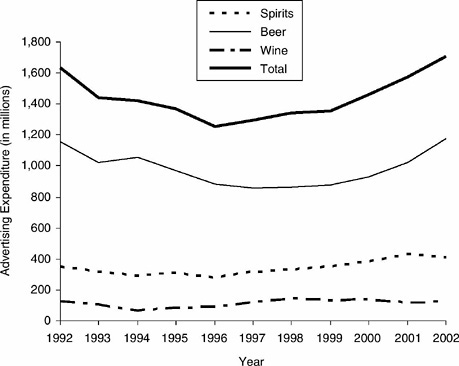
FIGURE 7-1 Measured media advertising expenditures for alcohol products, 1992-2002, in 2002 dollars (adjusted for inflation).
SOURCE: Data from LNA/Mediawatch multimedia service, competitive media reporting (expenditure) and McCann-Erikson world group (media cost-per-thousand composite index).
issues in the alcohol prevention field. The question is complex, both empirically and legally. Before turning to the controversial aspects, however, we present the undisputed points.
Alcohol advertising is designed to highlight the attractions of using alcohol, especially to enhance the enjoyment of social occasions, and to induce or persuade potential consumers to feel favorably toward the promoted product. Even though these messages may not be intentionally targeted at youths under 21, messages aimed at “young adults” (e.g., ages 21-to 25-year-olds) will inevitably reach older teens (e.g., ages 16- to 20-year-olds); moreover, many of those messages will also be attractive to children and teenagers (those under 16). A particularly troubling illustration of the youth-specific attractions of an alcohol marketing campaign concerns so-called “alcopops,” sweet, flavored alcoholic malt beverages. Recent survey data suggest that these products are more popular with teenagers than with adults, in terms of both awareness and use. These concerns recently led
Congress to direct the Federal Trade Commission to study the impact of alcopop advertising on underage consumers (see Consolidated Appropriations Resolution, 2003). In sum, the widespread exposure of youth to alcohol marketing and the attractiveness of alcohol-related messages to them are well documented. The disputed issue, empirically, is whether alcohol advertising contributes, in a causal sense, to the prevalence and intensity of underage drinking. Although many people believe that it does (Community Anti-Drug Coalitions of America, n.d.) and there is some evidence of a correlation between exposure to alcohol advertising and drinking by young people (Atkin and Block, 1981; Atkin et al., 1984), a causal link between alcohol advertising and underage alcohol use has not been clearly established (e.g., Atkin, 1987, 1995; Smart, 1988; Lastovicka, 1995; Grube, 2004). A substantial body of research on the effects of advertising and promotion on alcohol consumption and its consequences, and specifically on underage alcohol consumption, has produced findings that are mixed and inconclusive (Grube, 2004). With some notable exceptions (e.g., Saffer, 1997), experimental and ecological studies have produced little evidence that alcohol advertising affects drinking beliefs, behaviors, or problems among young people.
Recent survey evidence (further described below) shows that young peoples’ awareness of, and affect toward, certain types of commercial messages about alcohol are correlated with their drinking beliefs and behaviors (Austin and Nach-Ferguson, 1995; Grube, 1995; Slater et al., 1997), but because most of these studies are cross-sectional, the evidence is only suggestive. That is, it is possible that advertising affects young people’s drinking beliefs and behaviors or, conversely, that preexisting predispositions to drink increase attention to alcohol advertising. Nonetheless, some research (Grube and Wallack, 1994) suggests that attention to alcohol advertising has a significant effect on drinking beliefs and intentions among school children, even when the reciprocal effects of these beliefs on attention are controlled. These effects, however, are modest and, overall, the evidence is best considered inconclusive.
It is sometimes assumed that, in the absence of compelling evidence of causation, there is no legitimate basis for limiting the exposure of young people to alcohol advertising. This assumption is wrong for three reasons. First, the absence of definitive proof may be caused by the methodological complexity of the inquiry rather than the absence of a contributing effect (e.g., see, Thorson, 1995; Calfee and Scheraga, 1994). Obviously, many social and cultural influences are propelling young people toward alcohol use, and it should come as little surprise that the available scientific tools cannot disentangle advertising from this web of influences. Second, there is a sound commonsense basis for believing, even in the absence of definitive proof, that making alcohol use attractive to young people increases the
likelihood that they will become alcohol consumers as young people rather than waiting until they are adults. It is abundantly clear that young people attend to and are attracted to some alcohol advertisements. Moreover, young people who are drinkers or who are predisposed to drinking are more attracted to these advertisements than other young people (Martin et al., 2002; Casswell and Zhang, 1998; Wyllie et al., 1998a, 1998b; Grube and Wallack, 1994). Third, persistent exposure of young people to messages encouraging drinking by young people (even if they appear to be 21) contradicts and interferes with the implementation of the nation’s goal of discouraging underage drinking. In this respect, the emphasis is less on causation than on contradiction and ambiguity.
The ongoing dispute about whether alcohol advertising causes underage drinking is tied to the legal controversy over whether government-imposed bans or restrictions on alcohol advertising would violate the First Amendment because the constitutionality of any significant limitations on advertising imposed by the government would probably turn on the strength of the evidence on causation. However, this emphasis on the constitutionality of government intervention, and the accompanying preoccupation with proof of causation, overlooks the paramount importance of self-regulation by the alcohol industry. The industry has the prerogative—indeed, the social obligation—to regulate its own practices and to refrain from marketing products or engaging in promotional activities that have a particular appeal to youngsters, irrespective of whether such practices can be proven to “cause” underage drinking.
In an important report on alcohol advertising, the Federal Trade Commission (FTC) (1999, p. 3) emphasized the virtues of self-regulation:
Self-regulation often can be more prompt, flexible, and effective than the government regulation. It can permit application of the accumulated judgment and experience of an industry to issues that are sometimes difficult for the government to define with bright line rules. With respect to advertising practices, self-regulation is an appropriate mechanism because many forms of government intervention raise First Amendment concerns.
The FTC went on to fault the alcohol industry for the weakness of its current self-regulatory efforts, and that was the starting point for this committee’s deliberations. The committee believes that greater self-restraint by the alcohol industry in its marketing practices is an essential component of a sound national strategy for reducing underage drinking.
In sum, the committee regards the empirical dispute about whether advertising causes underage drinking, and whether the existing evidence of causation is strong enough to justify government restriction under the First Amendment, to be an unnecessary distraction from the most important task at hand—strengthening industry self-regulation and promoting corporate
responsibility. In the event that the industry fails to respond satisfactorily to this challenge, the case for some government action might become more compelling.6
Recommendation 7-2: Alcohol companies, advertising companies, and commercial media should refrain from marketing practices (including product design, advertising, and promotional techniques) that have substantial underage appeal and should take reasonable precautions in the time, place, and manner of placement and promotion to reduce youthful exposure to other alcohol advertising and marketing activity.
Use of images or other content uniquely or unusually attractive to children provides highly persuasive evidence of an intention to target an illegal, underage audience. However, by far the more common situation involves advertisements that are not uniquely attractive to children and that have equivalent appeal to children or teenagers and adults. Should alcohol advertisers display or broadcast such messages knowing that they will appeal to young people? Obviously this is not a scientific question, and it highlights the challenge of defining socially responsible advertising behavior. This key issue is whether companies should voluntarily forgo potentially highly successful commercial messages (or display them only in adult-only venues) in order to avoid exposing them to young people who will find them attractive.
In the committee’s opinion, alcohol companies should refrain from displaying commercial messages encouraging alcohol use to audiences known to include a significant number of children or teens when these messages are known to be highly attractive to young people. It is not enough for the company to say: “Because these messages also appeal to adults, who will predominate in the expected audience, we are within our legal rights.”
From the standpoint of industry self-regulation, there are two ways of responding to this situation. The most effective, and the easiest to administer, is to circumscribe the media locations (time and place) in which any alcohol messages can be placed. So, for example, there could be an industry guideline that no alcohol advertisement can be placed in a magazine or television show in which more than a designated percentage of the audience (say, 25 percent) is expected to be under 21. This approach is called a limit on the “placement” of advertising. The second approach focuses on the “content” of the advertising. Thus, the industry code might aim to preclude the use of certain types of images, sounds, or words that have particular appeal to youths. Obviously, formulating and applying a content-based standard is a difficult undertaking. The need to do so will depend in part on whether and to what extent the placement of advertisements is restricted. For example, there would ordinarily be less need for a content restriction if placements were precluded in any media for which more than 10 percent of the audience was expected to be underage than there would be if placements were precluded only if more than 50 percent of the audience was expected to be underage.
In 1998, Congress requested the FTC to assess the adequacy of self-regulatory efforts by the alcohol industry to prevent practices that encourage underage drinking. The FTC’s report, issued in 1999, reviewed existing industry standards and practices, identified deficiencies and best practices, and recommended improvements in relation to advertising placement and content. Four years later, the 2003 appropriations bill directed the FTC to reexamine industry practice regarding liquor-branded “alcopop” advertising and expressed concern that the industry had not fully implemented the commission’s 1999 recommendations. Although the committee believes the 1999 FTC recommendations are too weak in some respects, alcohol producers, wholesalers, and their trade associations should implement those recommendations forthwith, as an expression of good faith and as a signal of their willingness to become active partners in the nation’s campaign to reduce underage drinking.
Recommendation 7-3: The alcohol industry trade associations, as well as individual companies, should strengthen their advertising codes to preclude placement of commercial messages in venues where a significant proportion of the expected audience is underage, to prohibit the use of commercial messages that have substantial underage appeal, and to establish independent external review boards to investigate complaints and enforce the codes.
Advertising Placement
Industry codes for beer and distilled spirits currently allow placement of alcohol advertising in media for which most of the audience is expected to be 21 or older. Because 70 percent of the population is 21 or over, this standard effectively allows placements almost anywhere except young children’s television shows or magazines, and therefore allows alcohol messages to reach large numbers of children and teenagers on a regular basis. A good example is the pervasive beer advertising that accompanies sports broadcasts on weekday evenings and throughout the weekend. In 2001, for example, the alcohol industry spent $492 million dollars on advertising for sports television: Twenty percent of these ads (11,630 ads, with spending totaling more than $48 million) were on sports programs for which, based on expected proportions of the viewing audience, youth were more likely than adults to have seen the ads (Center on Alcohol Marketing and Youth, 2002b). In its 1999 report, the FTC recommended that the industry threshold be moved toward 25 percent, representing the industry’s current best practices, and that companies be required by the codes to measure their compliance against the most reliable, up-to-date audience composition data available.
Since the 1999 FTC report, the wine industry and several individual beer and spirits companies have embraced a 30 percent threshold. These steps should be applauded, but the industry standard should continue to be reduced. In the committee’s view, immediate implementation of an industry standard of 25 percent for television advertising, as suggested by the FTC, would signify meaningful self-restraint in alcohol marketing to reduce youth exposure. Based on data provided by the Center on Alcohol Marketing and Youth (CAMY) at Georgetown University, a 25 percent threshold would have a modest, but significant, effect on the volume of alcohol advertising on television and on the number of young people exposed to it. The current 50 percent voluntary standard for beer and spirits precludes advertising on only 6 percent of the television programs tracked by Nielsen if the denominator for the viewing population encompasses viewers as young as 2 and only 1 percent of the programs if the viewing population base excludes children under 12. A 25 percent threshold would preclude alcohol advertising on 16.4 percent of programs if the base includes children under 12 and 8.2 percent if it excludes children under 12.
Over time, the industry standard should move toward a 15 percent threshold for television advertising,7 a standard currently being considered
by at least one industry member. Some advocacy groups have recommended that the audience proportion threshold be reduced to 10 percent and that it be coupled with a numerical maximum (e.g., 1 million youths) to take account of the size of the audience and the absolute number of young people likely to be exposed to the ads. However, the committee does not regard this as a practical suggestion, at least for the foreseeable future. Such a limit would preclude alcohol advertising on major “adult” viewing events, such as the Super Bowl, and the industry cannot reasonably be expected to embrace such a restrictive approach as a preferred practice.
Although most of the attention regarding alcohol advertising has focused on television, print advertising raises analogous concerns.8 A recent study of alcohol advertising in magazines by Garfield et al. (2003) counted advertisements that appeared from 1997-2001 in 35 of 48 major U.S. magazines that tracked their adolescent readership. Variation was assessed in placement frequency for each alcohol product type according to size of adolescent readership and other variables. Garfield et al. (2003) found that the alcohol industry placed 9,148 advertisements, at a cost of $696 million, during this period, with adolescent readership of the magazines ranging from 1.0 to 7.1 million. Most (82 percent) of these advertisements were for liquor, with fewer placements for beer (13 percent) and wine (5 percent). The finding highlighted by the investigators was that, after adjustment for other magazine characteristics, the advertisement rate ratio for beer and liquor was 1.6 times higher for each additional million adolescent readers. However, the committee believes that the significance of this finding must be assessed in light of the accompanying finding that, for liquor advertising, the rate ratio is even higher (2.6) for every additional million young adult readers (defined as 20-24 because advertising industry data do not distinguish between 20- and 21-year-olds) than it is for increased adolescent readership.
This study calls attention to the basic policy problem in relation to alcohol advertising—increased exposure to the lawful young adult audience often involves increased exposure to older teens. In relation to liquor advertising, increasing young adult exposure was accompanied by increased youth
|
|
Assuming that alcohol advertising dollars would be redeployed to programs with audience compositions below the threshold, a 15 percent threshold (using a base of 12 and older) would reduce youth gross rating points (the industry standard measure of exposure) by 22 percent. |
exposure, but at a lower rate. (By contrast, the advertisement rate ratio for beer advertising was only 1.0 for every additional million young adult readers, as compared with 1.6 for every additional million adolescent readers.) It is possible that a marketing strategy aiming for young adults could identify magazines with high young adult exposure but small youth readership. Indeed, although the numbers are small, Garfield et al. (2003) found that the wine advertisers were able to increase young adult exposure (advertisement rate ratio = 3.0) without increasing youth exposure (advertisement rate ratio = 0.72), and they also report that their findings regarding increased exposure of youth and young adults were statistically independent. In the overall policy context, however, the underlying problem remains—in order to avoid youth exposure, liquor advertisers might have to avoid placements in the magazines with the most promising young adult readership.
Setting a 25 percent threshold would be a useful improvement in the current industry practice, as a demonstration of good faith in the effort to find a formula that reasonably accommodates the industry’s interest in communicating with its young adult consumers and the public’s interest in minimizing underage exposure. According to CAMY, nearly 30 percent of alcohol advertising dollars spent in a sample of 98 magazines were spent in magazines with at least 25 percent adolescent readers. More than half of the money was spent in magazines whose adolescent and young adult (1220) audience exceeded their proportion in the U.S. population (CAMY, 2002a). Based on these data, adoption of a 25 percent threshold, would reflect a meaningful commitment to alter otherwise lawful magazine advertising practices to reduce youth exposure to alcohol advertising.9 As with television advertising, however, the industry should consider eventually moving toward a 15 percent threshold to further reduce the number of youth who are exposed to advertising intended for adults.
Advertising Content
As noted above, under some circumstances, the likelihood that a particular message will appeal to a youthful audience may be so great that the company will be said to have “intended” to target an underage audience
with that advertisement, in violation of the existing codes and in violation of the federal and state laws prohibiting “unfair acts or practices” in advertising. The industry codes each ban the use of images or depictions, such as cartoons, uniquely attractive to youth.10 However, the usual case is that the message is equally appealing to adults and young people. What should be done in these cases?
As suggested above, the answer depends in part on the nature and extent of any restrictions on placements. If placements of alcohol advertising are not permitted unless the expected audience is 85 percent or 90 percent adults, then the companies are presumably not targeting young people, and the message is being designed to be attractive to adults. Under these circumstances and in the absence of other evidence of youth targeting, it seems disingenuous to insist that a particular type of message be banned because it is also attractive to youths in an otherwise overwhelmingly adult audience. However, if the industry’s current 50 percent threshold is maintained—or even if the threshold is reduced as suggested by the committee—the exposure of underage viewers will remain substantial. Under these circumstances, companies may properly be expected to avoid advertising content with strong appeal to young viewers.
Admittedly such a standard is not self-defining and self-executing. The committee joins the FTC in encouraging the companies and their trade associations to embrace and build on best practices to reduce the likelihood that alcohol advertising will have particular appeal to youths. Specifically, the kinds of practices to avoid would include any advertising content (a song, character, or idea) that would be effective in promoting a product that is explicitly meant to be used by children or young teens. Companies would also limit the “spillover” appeal to underage drinkers by targeting their alcohol messages to an audience that is no younger than 25.
Internet Advertising
Many Internet sites sponsored by alcohol companies are easy for children to access. According to the FTC’s 1999 report, there are more than 100 commercial alcohol websites, but only 43 percent of beer sites and 72 percent of spirit sites have some kind of age restriction (either a filter or a warning). Although these data are undoubtedly out of date, no recent review is available. While it appears that most sites now use “virtual bouncers” to check for age of viewers, the effectiveness of this approach is unknown. In keeping with their commitment to prevent underage drinking, alcohol companies should use their best efforts, based on evolving technology, to restrict underage access to their web sites and avoid using games and cartoons that are unusually attractive to children and teenagers.
Product Placement
As discussed in greater detail in the next chapter, the entertainment industry should acknowledge its own responsibility to avoid program content that glorifies, or presents in a favorable way, underage use of alcohol or that exposes young audiences to unsuitable messages relating to alcohol. The committee recognizes that the content of movies, television programs, web-based entertainment, and live theater lies at the heart of the First Amendment and that any governmental regulation is constitutionally precluded. However, these media have a social responsibility to try to avoid or reduce youth exposure to unsuitable alcohol messages.
Obviously, alcohol companies do not have complete control over artistic decisions to display or use their products in films or other entertainment media. However, an identifiable brand is not likely to be prominently displayed without the request or permission of the alcohol company. Moreover, it is a common practice within the industry to seek placements of alcohol products or logos in films, television programs, and music videos. In 1997-1998, eight companies responding to the FTC reported that they made product placements in 233 movies and one or more episodes of 181 different television series. The companies sometimes pay for these placements.
According to the FTC’s 1999 report, alcohol companies avoid product placement in films, programs, or videos that actually show underage drinking, but otherwise do not seem to have a common practice regarding screening films and programs for alcohol-related content and for the likelihood of exposure to underage audiences. The FTC recommended that product placements be restricted to movies that are rated “R” (or NC-17), that they be avoided when an underage person is the primary character, and that the standards for placement of advertising (discussed above) also be applied to
product placement. These recommendations seem sensible and the committee encourages the industry to implement them. At a minimum, product placements should be explicitly disclosed.
Code Enforcement
Among the most important recommendations in the FTC’s 1999 report was its call for the industry to create independent external review boards with responsibility and authority to address complaints from the public or other industry members regarding alleged violations of the codes. In support of this recommendation, the FTC reported favorably on the experience of the National Advertising Division of the Council of Better Business Bureaus (CBBB), which receives and investigates complaints about the truthfulness of advertising, and the National Advertising Review Board, which receives advertiser appeals, and whose members are drawn from both inside and outside the advertising industry. Since the FTC’s 1999 report, Coors is the only company to establish such a review mechanism. The company’s “Advertising Complaint Evaluation” process opens company advertising and marketing materials to review by CBBB’s Advertising Pledge program.
ACCOUNTABILITY
What should be done if the industry codes are not strengthened and the nation’s young people continue to be exposed to such a large volume of messages portraying alcohol use in a favorable light? In the absence of external review mechanisms and in light of constitutional constraints on direct restrictions of advertising, the committee believes that the most fruitful governmental response would be to facilitate public awareness of industry advertising practices and thereby to promote industry accountability through the marketplace.
Recommendation 7-4: Congress should appropriate the necessary funding for the U.S. Department of Health and Human Services to monitor underage exposure to alcohol advertising on a continuing basis and to report periodically to Congress and the public. The report should include information on the underage percentage of the exposed audience and estimated number of underage viewers for print and broadcasting alcohol advertising in national markets and, for television and radio broadcasting, in a selection of large local or regional markets.
In Chapter 12, the committee recommends that a market surveillance mechanism be established to monitor underage use of alcohol according to
brand. Together with the advertising data collected and reported in accord with the recommendation set forth above, this information would enable the public to judge whether a company’s marketing practices are attracting disproportionate numbers of underage consumers, whether wittingly or unwittingly. In such situations, the public will be in a position to bring market pressure to bear on the relevant company. And, of course, if the data suggest intentional targeting, or reckless disregard for the effects of the marketing on underage drinking, regulatory intervention might be undertaken.
THE SPECIAL CASE OF COLLEGES AND UNIVERSITIES
Colleges and universities should ban alcohol advertising and promotion on campus. Currently, 72 percent of colleges and universities prohibit on-campus alcohol advertising and 62 percent prohibit industry sponsorship of athletic events. The Congress (by “sense of the Congress resolution”), the Department of Health and Human Services, DISCUS, and the Wine Institute have urged all colleges and universities to adopt these policies. It should be emphasized, again, that this recommendation is not predicated on the argument that banning the advertising will, in itself, reduce the prevalence and intensity of drinking among underage college students. Instead, the objective is to declare and affirm colleges’ genuine commitment to a policy of discouraging alcohol use among underage students.


