
9
Access
This chapter addresses components of the strategy to reduce access to alcohol by youths under 21. Most developed societies that permit alcohol consumption by adults prescribe a minimum legal drinking age. Laws ban distribution of alcohol to underage persons and usually also proscribe underage purchase and possession of alcohol. As discussed in Chapter 1, these laws rest primarily on an instrumental rationale rather than a moral one—that is, they aim less to condemn immoral behavior than to protect young people from the potentially serious negative consequences of engaging in a behavior for which they may not be developmentally prepared. Their moral force lies mainly in the efforts to hold adults accountable for the harms caused by underage drinkers to whom they give or sell alcohol.
The prescribed minimum age differs substantially among countries; see Table 9-1. Whatever the prescribed minimum age, countries must decide what measures will be used to curtail access by minors through the otherwise lawful channels of distribution. Naturally, this is a daunting challenge, especially in countries like the United States, in which alcohol is widely available to adults through a multitude of outlets.
There is ample evidence that raising the minimum drinking age in the United States reduced drinking and its associated harms among youth. In all likelihood, these effects on underage consumption were mediated in part through the reduced accessibility of alcohol to youths. It is also clear that significant rates of noncompliance impede the effectiveness of the laws that restrict the provision of alcohol to underage youths. The question is what
TABLE 9-1 Minimum Legal Drinking or Purchase Age Across 64 Countries
can be done to increase compliance and, thereby, alcohol’s availability to underage youths. In order to promote compliance with any laws, they must be communicated to, and understood by, the intended audiences (in this case, primarily adults), and there must be a credible threat of enforcement to deter violations by those who have strong incentives to offend—in this case, by selling or giving alcohol to underage drinkers. Maximizing the incentives for voluntary compliance will minimize the need for enforcement.
The effectiveness of laws to restrict access to alcohol by youths can be increased by closing gaps in coverage, promoting compliance, and strengthening enforcement. Although particular methods for increasing effectiveness along these lines have been tried in various jurisdictions, and some data are available regarding their success, others have not been evaluated. The strength of the evidence in support of any particular intervention varies, and in some cases the available evidence is contradictory. However, the committee believes that the preponderance of the available evidence, including recent evidence from studies on the prevention of youth smoking, supports an emphasis on efforts designed to increase the effectiveness of restrictions on youth access to alcohol.
Given that youth usually obtain alcohol—directly or indirectly—from adults, the committee also believes that the focus of these efforts should be on adults. A key component of the committee’s strategy is the proposed
media campaign to help strengthen public commitment to the goal of reducing underage drinking and to promote adult compliance with youth access restrictions (see Chapter 6).
This chapter begins with a discussion of minimum drinking age laws and specific recommendations about the scope of the laws. It then moves to a discussion of how youths obtain alcohol. Given that youths obtain alcohol from a variety of venues, the committee believes that a range of approaches targeting different venues is necessary. The remainder of the chapter reviews various approaches to improving the effectiveness of access restrictions and summarizes the available evidence in four domains: (1) reducing access through commercial sources; (2) reducing access through noncommercial sources; (3) focused efforts to reduce drinking and driving by underage drinkers; and (4) prescribing and enforcing penalties directly against underage consumers.
Given that it is unreasonable to expect a measurable effect on consumption for any one isolated change in the fabric of access restrictions, most evaluations rely on measuring changes in enforcement behavior or in compliance on the assumption that, over time, increased enforcement will result in increased compliance, and that increased compliance (whether or not attributable to increased enforcement) will lead to reduced access, and in turn to reduced consumption. The level of evidence for specific recommendations varies, as discussed through this chapter. The committee has used its judgment in assessing the plausibility of these connections. In some cases, the committee’s general recommendations include specific details that are based on the informed judgment of the committee. As with all aspects of the proposed strategy, particular interventions should be subjected to ongoing research to enable continued refinement of the strategy based on new empirical evidence.
The committee has assessed the potential value of each intervention not in isolation, but rather as part of a comprehensive set of steps that can be taken to curtail alcohol access to minors—mainly by promoting voluntary compliance, in both commercial and noncommercial contexts, but also by establishing and sustaining a credible threat of enforcement. Although there is robust evidence concerning the effects on consumption of increasing the legal minimum drinking age (and the accompanying, but unspecified, efforts to implement it), there is less evidence on the effects on youth consumption of comprehensive multipronged efforts to strengthen implementation of the underage drinking laws on the kind envisioned in this chapter.1
IMPLEMENTING LAWS ON THE MINIMUM DRINKING AGE
Effectiveness
Strategies aimed at reducing youth access to alcohol focus on the nature and scope of the access restrictions and the policies and practices used to implement and enforce them (Holder, 2004; Grube and Nygaard, 2001; Toomey and Wagenaar, 1999). Overall, the purpose of these policies and practices is to raise the “full price” of alcohol by increasing the effort and resources necessary to obtain it or by increasing the threatened consequences for its use. Importantly, such policies and procedures can also communicate community norms—to young people regarding the unacceptability of their drinking and to adults about the unacceptability of providing alcohol to minors (Bonnie, 1986). These aims are analogous to those sought by laws curtailing youth access to tobacco (see Institute of Medicine, 1994a) and restricting nonmedical access to marijuana, cocaine, and other illegal drugs (see National Research Council, 2001).
Limiting youth access to alcohol has been shown to be effective in reducing and preventing underage drinking and drinking-related problems. Studies routinely show that increasing the minimum drinking age significantly decreased the number of fatal traffic crashes, the number of arrests for “driving under the influence” (DUI), and self-reported drinking by young people (Klepp et al., 1996; O’Malley and Wagenaar, 1991; Saffer and Grossman, 1987a, 1987b; Wagenaar, 1981, 1986; Wagenaar and Maybee, 1986; Voas et al., 1999; Yu et al., 1997). Similarly, implementation of zero tolerance laws—which ban underage youths from driving with a blood alcohol content (BAC) above measurable levels (usually 0.01-0.02)—has been shown to significantly reduce underage drinking and driving (Hingson et al., 1994; Voas et al., 1999; Wagenaar et al., 2001; Zwerling and Jones, 1999). Community interventions also provide evidence for the effectiveness of comprehensive approaches to reduce drinking and drinking
|
|
implement, and there is significant variation in the type and intensity of interventions implemented across communities; moreover, the evaluation was not designed to consider the effectiveness of a particular intervention or set of interventions within individual communities. The outcomes evaluation reported to date was also based on a single year of intervention (future evaluation reports will include 2 years of data), which is highly unlikely to affect alcohol use outcomes. Not surprisingly, the evaluation documents increases in enforcement activities, but no significant decreases in youth alcohol use (Wolfson et al., 2003). For the current fiscal year, the Office of Juvenile Justice and Delinquency Prevention (OJJDP) has shifted toward a more prescriptive approach that will require local communities participating in the discretionary grant component to implement identified best and most promising practices (OJJDP, 2003). If continued, this would better enable the evaluation to assess the effectiveness of particular interventions and further refine the program. |
problems, including reducing underage access to alcohol (Holder et al., 1997a, 1997b, 2000; Wagenaar et al., 1999, 2000a; Wagenaar and Perry, 1994).
To some extent, merely declaring that alcohol should not be sold or given to underage youths will curtail access because many adults support the prohibition and are in the habit of complying with the law (Tyler, 1992; Tyler and Huo, 2002). However, these “declarative” effects of the law (Bonnie, 1982) can easily be eroded if youthful drinking is regarded as an unimportant or expected deviance and if no meaningful efforts are taken to enforce the prohibition. For example, bans against selling tobacco to minors became trivialized over decades of inattention until the public, and the government, began to take them seriously in the 1990s (Institute of Medicine, 1994a). Although youth access restrictions to alcohol have never fallen into such complete disregard, they are easily evaded because alcohol is so widely available through so many channels and because the adult world is ambivalent about how forcefully they should be enforced. In this context, the declarative effects of the law cannot be expected to do all the work; deterrence through threatened sanctions, both legal and social, is needed. In this sense, enforcement, and public awareness of enforcement, are essential if restrictions on youth access to alcohol are to be effectively implemented.
It is clear from the available research that the effectiveness of youth access restrictions and other alcohol control policies depends heavily on the intensity of implementation and enforcement and on the degree to which the intended targets are aware of both the policy and its enforcement (Grube and Nygaard, 2001; Hingson et al., 1988a, 1988b; Voas et al., 1998). Another potentially important element in increasing the effectiveness of youth access restrictions or other alcohol control policies is public support. Implementing effective polices will be very difficult if law enforcement officers and community leaders believe that there is little community support for such activities (Wagenaar and Wolfson, 1994, 1995). The strategic use of media can help overcome such resistance and elicit public support for limiting access (Holder and Treno, 1997).
Scope
Alcohol control is primarily a state responsibility under the 21st Amendment to the Constitution. In some states, counties and municipalities are permitted to take steps to control drinking that may be stricter than those required by state law. However, the National Minimum Drinking Age Act, enacted by the Congress in 1984, requires states to adopt a minimum drinking age of 21 for “purchase or public possession” of alcohol as a condition for receiving federal highway funds. As a result, all 50 states and the District of Columbia now set the minimum drinking or purchase age at 21.
A preliminary question concerns designation of the minimum age. Some experts in the field have suggested that the United States would be better off by lowering it (Hanson, 1990). A key argument made in favor of lowering the minimum age is that although the legal purchase age is 21, a majority of young people under this age consume alcohol anyway. Thus, the current age is seen as forcing young people to flout the law, thus undermining its legal authority and credibility. Furthermore, according to this perspective, the current age might actually encourage abusive drinking by young people by making alcohol use a rite of passage to adulthood or a symbol of rebellion and by forcing it to occur in uncontrolled and risky environments.
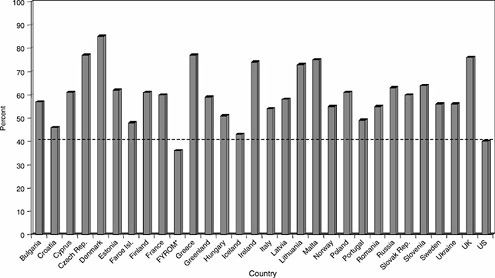
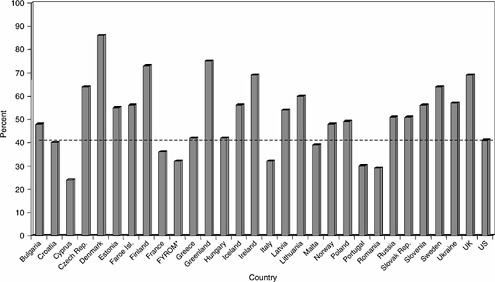
European countries are frequently held up as examples of societies in which young people can drink at an early age and thus learn to consume alcohol responsibly within a controlled and safe environment (e.g., the family). The facts, however, do not support this argument. Research clearly shows that most European countries not only have higher levels of consumption (an expected consequence of the lower drinking age), but also higher levels of problematic drinking (e.g., intoxication) among youth (Grube, 2001). Analyses of data from a 1999 survey of 15-year-old European school children (Hibell et al., 2000) and the 1999 Monitoring the Future U.S. survey of tenth graders (Johnston et al., 2002) show that U.S. students are less likely than young people from most European countries to report alcohol use in the past 30 days; see Figure 9-1. Similarly, U.S. adolescents are less likely than those from a majority of European countries to report becoming intoxicated in the past year; see Figure 9-2. In several countries—the United Kingdom, Ireland, Poland, and Denmark—the proportion of teenagers reporting drinking heavily on at least three occasions in the last month is substantially greater than the proportion of U.S. teenagers who report drinking that much on at least one occasion during the past two weeks (Room, 2004). In short, there is no evidence that the lower drinking ages in Europe are protective. Finally, and most importantly as noted above, raising the minimum drinking age in the United States significantly decreased self-reported drinking, fatal traffic crashes, alcohol-related crashes, and arrests for DUI among young people (Klepp et al., 1996; O’Malley and Wagenaar, 1991; Saffer and Grossman, 1987; Wagenaar, 1981, 1986; Wagenaar and Maybee, 1986; Yu et al., 1997).2 The 21-year-old minimum drinking age may also moderate drinking beyond adolescence (O’Malley and Wagenaar, 1991).
Although every state now sets the legal age at 21, state laws vary greatly in the scope of the restrictions relating to underage purchase, pos-
session, or consumption of alcohol and for the use of false identification to purchase alcohol. In 1993, the President’s Commission on Model State Drug Laws (1993) recommended that states prohibit all of these activities. Moreover, although it is generally illegal to provide alcohol to minors, some states allow parents or guardians to give alcohol to minors or for underage drinking to take place in a private residence or private club. These weaknesses can compromise the effectiveness of minimum age laws.
Recommendation 9-1: The minimum drinking age laws of each state should prohibit
-
purchase or attempted purchase, possession, and consumption of alcoholic beverages by persons under 21;
-
possession of and use of falsified or fraudulent identification to purchase or attempt to purchase alcoholic beverages;
-
provision of any alcohol to minors by adults, except to their own children in their own residences; and
-
underage drinking in private clubs and establishments.
HOW YOUNG PEOPLE OBTAIN ALCOHOL
Young people obtain alcohol from a variety of sources; see Tables 9-2 and 9-3. Parties, friends, and adult purchasers are the most frequent sources of alcohol among college students and older adolescents (Harrison et al., 2000; Preusser et al., 1995; Schwartz et al., 1998; Wagenaar et al., 1996), and younger adolescents also often obtain alcohol from family members. Use of friends under 21 and adult strangers as sources for alcohol appears to increase with age while reports of parents or other family members as sources decrease with age. Thus, in a study in Minnesota (Harrison et al., 2000), 39 percent of drinkers in the sixth grade, 69 percent of drinkers in the ninth grade, and 72 percent of drinkers in the twelfth grade reported getting alcohol from friends within the past 30 days. The comparable figures for family members as sources for alcohol were 49 percent, 29 percent, and 18 percent, respectively. Purchase of alcohol was relatively low in this sample, with only 8 percent, 8 percent, and 9 percent of drinkers at the three grade levels, respectively, reporting buying alcohol from stores. Similarly, another Minnesota survey (Wagenaar et al., 1996) found that 46 percent of ninth graders, 60 percent of twelfth graders, and 68 percent of 18- to 20-year-olds obtained alcohol on their last drinking occasion from a friend over 21, 29 percent, 29 percent, and 10 percent of these age groups, respectively, obtained alcohol from a friend under 21. Only 3 percent, 9 percent, and 14 percent of respondents in each age group, respectively, reported purchasing alcohol; 27 percent, 6 percent, and 11 percent, respectively, obtained alcohol from home.
TABLE 9-2 Sources of Alcohol Used by Underage Drinkers in Minnesota During Past 30 Days (in percent)
|
Source |
Grade 6 |
Grade 9 |
Grade 12 |
|
Friends |
39.3 |
69.3 |
72.3 |
|
Family |
48.7 |
28.8 |
18.2 |
|
Parties |
32.1 |
55.6 |
59.8 |
|
Took from home |
33.1 |
33.2 |
11.8 |
|
Took from friend’s home |
15.9 |
17.7 |
5.0 |
|
Got someone to buy it for me |
14.0 |
35.3 |
52.6 |
|
Bought at store |
8.3 |
7.6 |
8.5 |
|
Bought at bar or restaurant |
8.1 |
4.6 |
7.5 |
|
Took from store |
10.0 |
6.5 |
2.5 |
|
SOURCE: Data from Harrison et al. (2000). |
|||
TABLE 9-3 Sources of Alcohol for Underage Drinkers (in percent)
|
|
Source Person |
||||
|
Study and Measure |
Sample Population |
Purchased |
Person Under 21 |
21 or Older |
Parent |
|
Preusser et al. (1995); ever used |
New York College |
75 |
69 |
73 |
31 |
|
Pennsylvania College |
59 |
64 |
76 |
22 |
|
|
New York High School |
43 |
67 |
44 |
23 |
|
|
Pennsylvania High School |
30 |
55 |
50 |
14 |
|
|
Schwartz et al. (1998); ever used |
Virginia Pediatrician’sOffice |
30 |
— |
— |
— |
|
Virginia College |
44 |
— |
— |
— |
|
|
New York High School |
35 |
— |
— |
— |
|
|
Southeast Substance Abuse Program |
52 |
— |
— |
— |
|
|
Wagenaar et al. (1996); used past 30 days |
9th Graders |
3 |
29 |
46 |
27 |
|
12th Graders |
9 |
29 |
60 |
6 |
|
|
18- to 20-year-olds |
14 |
10 |
68 |
11 |
|
Use of commercial sources appears to be much higher among college students, in urban settings, and where possession and purchase laws are relatively weak or unenforced. Thus, for example, in one survey, 75 percent of college students from New York—where the purchase and possession of alcohol by minors were not illegal at the time of the study and where the use of false identification was punishable by a relatively small fine—reported
ever having tried to purchase alcohol, in comparison with 59 percent of college students in Pennsylvania where the laws regarding purchase, possession, and the use of false identification of alcohol were much stricter (Preusser et al., 1995). Similarly, 43 percent of New York high school students and 30 percent of Pennsylvania high school students reported ever having tried to purchase alcohol.
Ultimately, adults are responsible for young people obtaining alcohol by selling, providing, or otherwise making it available to them. Given the fact that young people use multiple sources for alcohol, efforts to target underage access should not focus exclusively on commercial access to alcohol, but should also address social availability through parents, friends, and strangers (Holder, 1994).
ACCESS TO ALCOHOL THROUGH COMMERCIAL SOURCES
Commercial access to alcohol takes place primarily through on-license and off-license establishments. On-license establishments are permitted to sell alcohol for consumption at the location where the sale is made; they include bars, restaurants, roadhouses, theaters, and similar places of business. Off-license establishments are permitted to sell alcohol for consumption at other locations; they include liquor stores, markets, convenience stores, and similar venues. In addition to on- and off-license establishments, some states allow home delivery and Internet sales of alcohol.
States differ considerably in their regulatory practices, ranging from those with complete state-run retail or wholesale monopolies and distribution systems to those where retail and wholesale alcohol sales and distribution are completely private. To some extent, retail alcohol sales can also be regulated at the local or municipal level through the use of local ordinances, conditional use permits, and zoning. Some states also allow for a “local option” through which municipalities or counties can prohibit or limit alcohol sales. Local ordinances can send a very strong message about what a community considers to be acceptable norms concerning underage drinking.
As noted above, young people under 21 can and do purchase alcohol in commercial settings, notwithstanding the fact that such sales are illegal everywhere. Purchase surveys in the United States show that anywhere from 40 percent to 90 percent of outlets sell to underage buyers, depending on location (e.g., Forster et al., 1994, 1995; Preusser and Williams, 1992; Grube, 1997). In part, these high sales rates result from low and inconsistent levels of enforcement against adults who sell or provide alcohol to minors and from perceptions on the part of law enforcement officers that there is little community support for such prevention efforts (Wagenaar and Wolfson, 1994, 1995).
Compliance Checks
Increasing enforcement against retailers who sell to minors can have a substantial effect on sales of alcohol to young people. Even moderate increases in enforcement can reduce sales of alcohol to minors by as much as 35 percent to 40 percent, especially when combined with media and other community activities (Grube, 1997; Wagenaar et al., 2000a). Effective compliance checks are conducted on an on-going basis, with regular enforcement actions (e.g., two or more times per year) against all outlets, rather than sporadic actions against “problem” outlets (Willingham, n.d.).
Further support for the importance of reducing retail access to alcohol can be obtained from the literature on tobacco control and youth smoking. Most notably, recent research suggests that increasing compliance with age identification for the purchase of tobacco not only reduced tobacco sales to minors and youth smoking, but also reduced underage drinking (Biglan et al., 2000). In a variation of compliance checks, the primary intervention in this research comprised repeated visits to tobacco outlets in which underage youth attempted to purchase tobacco. These young people gave a reminder of the law to clerks who agreed to sell. Clerks who refused to sell received a gift certificate worth $5 to $10, and local media publicized their refusal. This intervention was implemented within the context of a community-wide proclamation against selling to youth, visits to each merchant with information about the proclamation and the law, community-wide publicity about outlet refusals, and feedback to outlets about their rate of sales to young people. Across all communities, the average percent of outlets willing to sell decreased from 57 percent to 22 percent, a 61 percent relative decline. Although the community-based interventions focused on limiting youth access to tobacco products, a 60 percent relative reduction in weekly alcohol use among ninth graders also was achieved (Biglan et al., 2000). Whereas prevalence of weekly alcohol use increased from about 10 percent to 18 percent in the control communities, it remained virtually unchanged in the intervention communities, increasing from about 13 percent to 14 percent. The significant effect on ninth grade alcohol consumption may have been due to the intervention sensitizing clerks not to sell either tobacco or alcohol to minors.
Recommendation 9-2: States should strengthen their compliance check programs in retail outlets, using media campaigns and license revocation to increase deterrence.
-
Communities and states should undertake regular and comprehensive compliance check programs, including notification of retailers concerning the program and follow-up communication to them about the outcome (sale/no sale) for their outlet.
-
Enforcement agencies should issue citations for violations of underage sales laws, with substantial fines and temporary suspension of license for first offenses and increasingly stronger penalties thereafter, leading to permanent revocation of license after three offenses.
-
Communities and states should implement media campaigns in conjunction with compliance check programs detailing the program, its purpose, and outcomes.
States may need to consider the adequacy of funding for their alcohol control agencies including how efficiently resources are utilized, to enable the agencies to undertake the committee’s recommended enforcement efforts. Communities might also consider programs that reward retailers for compliance and remind them of the law, as a complement to law enforcement compliance checks (Biglan et al., 2000).
A model for enforcing compliance with underage alcohol sales laws at the national level can be found in the Synar Amendment, which applies to tobacco. The Synar Amendment, enacted in 1992, requires states to enact and enforce effective laws prohibiting the sale of tobacco products to children under 18 years of age. States failing to comply lose a portion of their block grant funds for substance abuse prevention.
Recommendation 9-3: The federal government should require states to achieve designated rates of retailer compliance with youth access prohibitions as a condition of receiving relevant block grant funding, similar to the Synar Amendment’s requirements for youth tobacco sales.
Specifically, under this requirement, all states, as a prerequisite for receiving funds under one or more block grants (e.g., substance abuse prevention and treatment, enforcing the underage drinking laws), would be expected to:
-
enforce effective laws prohibiting sales of alcohol to persons under 21 years of age in a manner that can reasonably be expected to reduce the availability of alcohol products to individuals under the age of 21;
-
conduct annual random, unannounced inspections of both on- and off-license outlets to ensure compliance with the law;
-
conduct these inspections in such a way as to provide a valid sample of outlets accessible to youth;
-
develop a strategy and a time frame for achieving an inspection failure rate of less than 20 percent of outlets; and
-
submit an annual report detailing (a) the state’s activities to enforce their law, (b) the overall success the state has achieved during the previous year in reducing alcohol availability to youth, (c) how inspections were
-
conducted and the methods used to identify outlets, and (d) plans for enforcing the law in the coming fiscal year.
Responsible Beverage Service and Sales
Responsible beverage service and sales programs implement a combination of outlet policies (e.g., requiring clerks or servers to check identification for all customers appearing to be under the age of 30; requiring all servers to be over 21), manager training (e.g., policy development and enforcement), and server training (e.g., teaching clerks and servers to recognize altered or false identification). Such programs can be implemented at both on-license and off-license establishments and have been shown to be effective in some circumstances. They have been found to reduce the number of intoxicated patrons leaving a bar (e.g., Dresser and Gliksman, 1998; Gliksman et al., 1993; Saltz, 1987, 1989) and to reduce the number of car crashes (e.g., Holder and Wagenaar, 1994).
Few studies have evaluated the effects of responsible beverage service and sales programs on underage drinking. In one study of an off-license program, voluntary clerk and manager training were found to have a negligible effect on sales to minors above and beyond the effects of increased enforcement (Grube, 1997). Similarly, a study in Australia found that, even after training, age identification was rarely checked in bars, although decreases in the number of intoxicated patrons were observed (Lang et al., 1996, 1998). In at least one study, however, training was associated with an increase in self-reported checking of identification by servers (Buka and Birdthistle, 1999), and the apparent changes in behavior persisted among trained servers for as long as 4 years. Another study reported an 11.5 percent decrease in sales to minors and a 46.0 percent decrease in sales to intoxicated patrons following individual manager training and policy development (Toomey et al., 2001). Voluntary programs appear to be less effective than mandatory programs or programs using incentives such as reduced liability (Dresser and Gliksman, 1998).
How responsible beverage service and sales programs are implemented and what elements are included in a particular program may be important determinants of their effectiveness. Policy development and implementation within outlets may be as important, if not more so, than server training (Saltz, 1997). Research indicates, for example, that establishments with firm and clear policies (e.g., checking ID for all patrons who appear under the age of 30) and a system for monitoring staff compliance are less likely to sell alcohol to minors (Wolfson et al., 1996a, 1996b). There are six key elements of successful outlet policies: (1) minimum age of 21 for all servers and sellers; (2) staff awareness of legal responsibility; (3) staff awareness of outlet policies and consequences for violating those policies; (4) identifica-
tion required for all patrons who appear to be under 30;3 (5) guidelines and training as to what constitutes acceptable and valid identification; and (6) retailer-initiated compliance checks and enforcement of consequences for violation of policies.
Recommendation 9-4: States should require all sellers and servers of alcohol to complete state-approved training as a condition of employment.
State alcohol agencies should prescribe responsible beverage service and sales training, including all of the elements described above as a condition of licensing for retail outlets, and could consider using server licensing fees to offset the cost of this training. Aside from state alcoholic beverage control (ABC) regulatory requirements, all managers or owners of retail outlets have a social responsibility to develop and implement alcohol service policies to prevent sales to minors, to train their staff on these policies, and to enforce them. As discussed below, implementation of such a program might also serve as a defense against civil liability.
Dram Shop Liability
Dram shop liability laws allow individuals injured by a minor who is under the influence of alcohol to recover damages from the alcohol retailer who served or sold the alcohol to the minor who caused the injury (Mosher, 1979; Mosher et al., 2002; Sloan et al., 2000). In some states, the retailer can also be liable for the damages the minor causes to himself or herself. Owners and licensees can be held liable for their employees’ actions under most or all dram shop liability laws (Mosher et al., 2002). Many state courts have recognized dram shop liability as a common law cause of action—that is, the courts themselves establish the plaintiff’s right to sue under ordinary principles of common law negligence. The plaintiff must show that the retailer knew or should have known that the person being served was a minor, that the minor in fact consumed the alcohol, and that the consumption was a contributing cause of the harm.
Many courts recognized common law dram shop claims during the 1980s and early 1990s, overruling the traditional rule that the drinker was solely liable for any damage that he or she caused as a result of drinking. State legislatures have become increasingly active in this policy area, estab-
lishing statutory-based claims that typically supersede and extinguish a plaintiff’s right to sue under common law negligence principles. The general legislative trend has been to limit the scope of liability (Mosher, 2002; Holder et al., 1993). California, for example requires that the plaintiff show that the minor was obviously intoxicated at the time of sale (California Business and Professions Code § 25602.1). Other state legislatures have required proof of reckless, rather than negligent, conduct on the part of the retailer or have imposed caps on the amount of damages that can be collected (Mosher et al., 2002). Some states do not recognize dram shop liability at all, either because a court has ruled that common law negligence principles do not impose liability in this situation or because the legislature has overridden a judicial ruling finding retailers liable. Currently, 44 states permit dram shop liability suits (Mothers Against Drunk Driving [MADD], 2002b). However, a simple count does not adequately describe the wide variation in state approaches. Many state laws are so restrictive that they effectively preclude or severely limit plaintiffs’ right to sue (see Mosher et al., 2002).
Dram shop liability laws and common law rights of action are a potentially powerful tool for changing the environment in which alcohol is sold (Mosher, 1979; Holder et al., 1993). Research suggests that the threat of liability may lead to a significant increase in checking age identification and to greater care in service practices (e.g., Sloan et al., 2000). The available studies also suggest that dram shop liability laws can significantly reduce single vehicle nighttime crash deaths, alcohol-related traffic crash deaths, and total traffic crash deaths among minors (Chaloupka et al., 1993; Sloan et al., 1994, 2000). Other research indicates that such laws also reduce alcohol-related traffic crashes, total traffic crashes, homicides, and other unintentional injuries in the general population (Chaloupka et al., 1993; Sloan et al., 1994, 2000). Overall, dram shop liability has been estimated to reduce alcohol-related traffic fatalities among underage drivers by 3 to 4 percent (Chaloupka et al., 1993). The perceived likelihood of being successfully sued under dram shop liability statutes may be important. Thus, two highly publicized successful dram shop liability lawsuits in Texas were found to be related to decreases of 6.5 percent and 5.3 percent, respectively, in single vehicle nighttime crashes, which is a surrogate measure for drinking and driving (Wagenaar and Holder, 1991). These presumably occurred because owners, managers, and servers changed serving practices as a result of the suits and accompanying publicity.
Three states—Maine, New Hampshire, and Rhode Island—have passed key elements of the Model Alcoholic Beverage Retail Licensee Liability Act of 1985 (reprinted in Mosher et al., 2002), developed under a grant from the National Institute on Alcohol Abuse and Alcoholism. The model act includes a “responsible business practices” defense. This provision allows
retailers to avoid liability if they can establish that they took reasonable steps to avoid serving minors and obviously intoxicated adults. Key to the defense is evidence that the retailer trained his or her staff, including both servers and managers, established management policies designed to deter such sales and service, and that the training procedures and policies were fully implemented at the time of the illegal sale or service.4 The model act seeks to establish a positive incentive for retailers to implement prevention policies and enhance the positive public health benefits of dram shop liability policies.
Recommendation 9-5: States should enact or strengthen dram shop liability statutes to authorize negligence-based civil actions against commercial providers of alcohol for serving or selling alcohol to a minor who subsequently causes injury to others, while allowing a defense for sellers who have demonstrated compliance with responsible business practices. States should include in their dram shop statutes key portions of the Model Alcoholic Beverage Retail Licensee Liability Act of 1985, including the responsible business practices defense.
Internet Sales and Home Delivery
Surveys of underage purchase of alcohol over the Internet or through home delivery show that small percentages (10 percent) of young people report obtaining alcohol in this manner (Fletcher et al., 2000); however, increasing use of the Internet may increase the percentage. Although an argument can certainly be made for banning Internet and home delivery sales altogether in light of the likelihood that these methods will be used by underage purchasers, the committee recognizes that some states may not be willing to curtail legitimate access to alcohol through these means and so recommends, instead, tightening access.
Recommendation 9-6: States that allow Internet sales and home delivery of alcohol should regulate these activities to reduce the likelihood of sales to underage purchasers. States should
-
require all packages for delivery containing alcohol to be clearly labeled as such;
-
require persons who deliver alcohol to record the recipient’s age identification information from a valid government-issued document (such as a driver’s license or ID card); and
-
require recipients of home delivery of alcohol to sign a statement verifying receipt of alcohol and attesting that they are of legal age to purchase alcohol.
ACCESS THROUGH NONCOMMERCIAL SOURCES
As noted above, young drinkers most often obtain alcohol from social sources, through friends, acquaintances, family members, and other adults who buy or provide alcohol to them. It is thus important for any effective strategy to reduce social access to alcohol for minors. In this regard, it is essential to communicate strong norms about the unacceptability of adults providing alcohol to minors or facilitating alcohol use by minors. Media campaigns highlighting the responsibility of adults in preventing young people from obtaining alcohol are one means of communicating such norms that should be implemented. Similarly, using media to increase awareness of laws prohibiting adults from providing alcohol to minors and drawing attention to enforcement efforts can further increase the effectiveness of legal approaches to preventing social provision of alcohol to minors and may help establish or reinforce community norms against this behavior. Such media activities are thus an important part of any enforcement activities to reduce provision of alcohol to minors (see Chapter 6).
Third-Party Transactions
Third-party transactions occur when young people ask adults to purchase alcohol for them. Third-party transactions are a common means through which underage drinkers, especially older teens, obtain alcohol (see Tables 9-2 and 9-3 above), partly because young people may believe it is less risky than trying to purchase alcohol themselves. Often, young people wait outside outlets and approach strangers whom they ask to buy alcohol.
“Shoulder tap” interventions are a strategy to directly reduce third-party transactions of alcohol by enforcing laws prohibiting provision of alcohol to minors. Underage decoys who are working with the police wait outside outlets and ask randomly selected passing strangers to buy alcohol (usually beer) for them. A plainclothes police observer is stationed nearby to witness the transaction. If a stranger agrees to make a purchase, he or she is given money to do so by the decoy. The buyer is cited or warned for providing alcohol to a minor when he or she completes the transaction and gives the alcohol to the decoy. Although rigorous evidence for effectiveness is lacking, case studies suggest that such programs can generate a relatively
large number of citations and thus may have a deterrent value (Powell and Willingham, n.d.). Such programs, when accompanied by sufficient media coverage, may also help instill or reinforce community norms against buying alcohol for minors or otherwise providing it to them. Retailers should be involved in shoulder tap operations. In many states, retailers might be held responsible for allowing minors to solicit adults to purchase alcohol within the immediate vicinity of their outlet. In such cases, the retailer has legal responsibility to curb such activities.
Recommendation 9-7: States and localities should implement enforcement programs to deter adults from purchasing alcohol for minors. States and communities should
-
routinely undertake shoulder tap or other prevention programs targeting adults who purchase alcohol for minors, using warnings, rather than citations, for the first offense;
-
enact and enforce laws to hold retailers responsible, as a condition of licensing, for allowing minors to loiter and solicit adults to purchase alcohol for them on outlet property; and
-
use nuisance and loitering ordinances as a means of discouraging youth from congregating outside of alcohol outlets in order to solicit adults to purchase alcohol.
Keg Registration
Keg registration laws require the purchaser of a keg of beer to complete a form that links his or her name to a number on the keg. It is seen primarily as a tool for prosecuting adults who supply alcohol to young people at parties. Keg registration laws have become increasingly popular in local communities in the United States. The committee found only one published study on the effectiveness of these laws in reducing underage drinking problems. In that study of 97 U.S. communities, it was found that requiring keg registration was significantly and negatively correlated with traffic fatality rates (Cohen et al., 2001). Although the effectiveness of keg registration has not yet been convincingly established, the committee believes that the evidence is sufficient to endorse it as a potentially valuable tool for strengthening the enforcement of underage drinking laws at relatively little additional cost.
Recommendation 9-8: States and communities should establish and implement a system requiring registration of beer kegs that records information on the identity of purchasers.
Social Host Liability
Some courts have expanded the dram shop liability principles so that they apply to noncommercial servers, including social hosts, employers, fraternities, and other alcohol providers that are not licensed to sell or serve by the state. Under social host liability laws, adults who provide alcohol to a minor or serve an intoxicated adult can be sued through civil actions for injury caused by that minor or intoxicated adult. Social host liability laws may deter adults from hosting underage parties and purchasing alcohol for or providing alcohol to minors. Currently, 30 states have some form of social host liability law (MADD, 2002b). Many state legislatures have placed strict limits on social host liability and courts have historically been reluctant to impose it absent clear statutory authority. There is some evidence that this trend is changing. State legislatures are more willing to consider at least some form of social host liability for service to minors, and courts in recent years have been more willing to construe statutory limitations narrowly and impose social host liability, relying on common law negligence principles (Mosher et al., 2002).
There is very little research on the effectiveness of social host liability laws and what evidence exists is conflicting. In one study across all 50 states for 1984-1995, the presence of social host liability laws was associated with lower rates of alcohol-related traffic death among adults, but not with such deaths among minors (Whetten-Goldstein et al., 2000), and it was not related to single vehicle nighttime crashes for either group. Surprisingly, the presence of social host liability laws was related to increases in total motor vehicle fatalities among minors in this study. In a second study, however, using self-reported drinking data spanning the 1980s to 1995, social host liability laws were associated with decreases in self-reported heavy drinking and in self-reported drinking and driving by lighter drinkers, but not in self-reported drinking and driving by heavier drinkers (Stout et al., 2000). Separate data were not presented for minors.
The conflicting findings on social host liability laws may reflect the lack of a comprehensive program that ensures that social hosts are aware of their potential liability exposure. The prospect of liability for social hosts could send a powerful normative message to adults that providing alcohol to underage youth is unacceptable. However, that message must be effectively disseminated before it can have a preventive effect, either as a deterrent or as a moral injunction (see Holder and Treno, 1997). Media campaigns to educate the public would have to be an integral part of implementing social host liability laws. As a practical matter, imposing a criminal sanction, especially a jail sentence, on a parent who hosts a drinking party for minors may be more likely to attract media attention than a civil award of damages. For this reason, direct enforcement of the prohibi-
tion may be a more effective way of reinforcing the social norm than the rare and often invisible imposition of social host liability. Nonetheless, states may want to consider enacting or strengthening civil social host liability statutes that allow negligence-based civil actions against noncommercial providers of alcohol for serving or providing alcohol to a minor who subsequently causes injury to others.
Restricting Drinking in Public Places
Allowing the service of alcohol at child- and family-oriented public events may promote underage drinking. One way to control alcohol at public events, in parks, beaches, sports arenas, public recreation facilities, parking lots, and other publicly accessible locations is through the use of conditional use permits. Conditional use permits, used by a city or county, allow local communities to set standards for how and when alcohol will be sold and served. These local ordinances can reduce sales to minors by such means as requiring the use of responsible beverage sales and service practices at public events, limiting advertising, and restricting hours of sale. Conditional use permits allow communities to enforce laws and exact penalties locally. Case studies suggest that they can be used effectively to reduce sales to minors and excessive drinking at public events (Streiker, 2000; Reynolds, n.d.). Little or no rigorous research has been conducted on the effectiveness of conditional use permits. However, cities and counties may want to use conditional use permits to set standards for how and when alcohol will be sold and served at public events.
YOUNG DRINKERS AND DRIVING
Zero Tolerance
Zero tolerance laws specify a lower BAC for underage drivers. Usually this limit is set at the minimum that can be reliably detected by breath testing equipment (i.e., 0.01 to 0.02). Zero tolerance laws commonly invoke administrative penalties, such as automatic confiscation of a driver’s license for driving after consuming even small amounts of alcohol.
Zero tolerance laws have now been enacted in all 50 states. There is strong evidence that zero tolerance laws can reduce underage drinking and driving and crash fatalities. Differences in effectiveness are thought to be related to differences in enforcement and in awareness among young people (Balmforth, 1999; Ferguson et al., 2000; Hingson et al, 1994). Impediments to the enforcement of these laws include requirements that zero tolerance citations be supported by evidential BAC testing, undue costs to police (e.g., paperwork, court appearances), and lack of behavioral cues for stopping
young drivers at very low BACs. The most effective zero tolerance laws are those that allow passive breath testing, are implemented in combination with sobriety checkpoints, involve streamlined administrative procedures, and invoke administrative penalties (e.g., immediate loss of driver’s license). Education and media can significantly increase the effectiveness of zero tolerance laws by increasing awareness of them on the part of young people.
Recommendation 9-9: States should facilitate enforcement of zero tolerance laws in order to increase their deterrent effect. States should:
-
modify existing laws to allow passive breath testing, streamlined administrative procedures, and administrative penalties and
-
implement media campaigns to increase young peoples’ awareness of reduced BAC limits and of enforcement efforts.
Graduated Driver Licensing
Graduated driver licensing places limits on the driving circumstances of new or young drivers, such as restrictions on nighttime driving or driving with young passengers. Graduated driver licensing policies also often include zero tolerance provisions. There is strong evidence that graduated licensing programs are associated with reductions in car crashes (Boase and Tasca, 1998; Langley et al., 1996; Smith, 1986; Ulmer et al., 2000), self-reported drinking and driving (Mann et al., 1997), and alcohol-related crashes (Boase and Tasca, 1998) among young people. Recent evidence, however, suggests that they may have limited effects on alcohol use and alcohol-related crashes, above and beyond that of zero tolerance laws (Shope et al., 2001). Nonetheless, graduated driver licensing may be an important adjunct to zero tolerance laws, for example, by providing cause for stopping young drivers who may be drinking.
Recommendation 9-10: States should enact and enforce graduated driver licensing laws.
Sobriety Check Points and Random Breath Testing
Research strongly suggests that intensive use of sobriety checkpoints or mobile random breath testing can substantially reduce drinking and driving. In the United States, these policies can be implemented only under prescribed circumstances as determined by state laws, often involving pre-notification about when and where they will be instituted. Breath tests at checkpoints can usually be given only if there is probable cause to suspect that a driver has been drinking. Even under these restricted circumstances, there is evidence that sobriety checkpoints can reduce alcohol-related
crashes, injuries, and fatalities (Lacey et al., 1999; Stuster and Blowers, 1995). However, the committee did not find any studies addressing the effects of these programs on drinking or drinking and driving among adolescents. Sobriety checkpoints may be a particularly important component of zero tolerance laws, given the difficultly of detecting young drinking drivers with very low BAC levels. Public awareness and publicity appear to be important factors in the success of sobriety checkpoints.
Recommendation 9-11: States and localities should routinely implement sobriety checkpoints.
POSSESSION AND PURCHASE
Underage Drinking Parties
One major way that underage drinkers gain access to alcohol is at parties. In one study, for example, 32 percent of sixth graders, 56 percent of ninth graders, and 60 percent of twelfth graders reported obtaining alcohol at parties (Harrison et al., 2000). Underage drinking parties frequently involve large groups and are commonly held in a home, an outdoor area, or a hotel room. Law enforcement can respond to noise complaints to investigate such gatherings. Even when it is not possible to cite underage drinkers or the person who supplied the alcohol, awareness of increased police activity in this regard can act as a deterrent and can express community norms to adults regarding the unacceptability of providing alcohol to minors.
Recommendation 9-12: Local police, working with community leaders, should adopt and announce policies for detecting and terminating underage drinking parties, including:
-
routinely responding to complaints from the public about noisy teenage parties and entering the premises when there is probable cause to suspect underage drinking is taking place;
-
routinely checking, as a part of regular weekend patrols, open areas where teenage drinking parties are known to occur; and
-
routinely citing underage drinkers and, if possible, the person who supplied the alcohol when underage drinking is observed at parties.
Cops in Shops
“Cops in Shops” is a voluntary program developed by the Century Council, a prevention organization sponsored by the alcohol industry. In this program, police or ABC agents pose as employees or customers in retail
outlets in order to apprehend underage persons who attempt to buy alcoholic beverages or adults who attempt to purchase alcohol for minors. The program often includes prominent signs that warn that the establishment is participating in the Cops in Shops program. The participating officers can also use the program to review a retailer’s policies and procedures and identify risky practices. Case studies indicate that Cops in Shops programs can generate a large number of citations, both against minors attempting purchase or using false identification and against adults who are purchasing for minors. The effects of the programs on underage drinking are unknown. Media coverage to increase public awareness again seems to be important for the success of these programs. In light of the greater importance of assuring retailer compliance, enforcement programs that focus on purchasers, including “Cops in Shops” programs, should be used only to supplement compliance check enforcement against retailers, not to displace it.
False Identification
The use of false identification for alcohol purchases is significant although there is a great deal of variability from study to study; see Table 9-4. In one survey, for example, only 7 percent of New York state high school students and 14 percent of Virginia college students indicated that they had
TABLE 9-4 Use of False Identification (ID) to Obtain Alcohol by Young People
|
Study and Measure |
Sample Population |
Age |
Used False ID (percent) |
|
Durkin et al. (1996); ever used |
Virginia College |
18-20 |
46 |
|
Preusser et al. (1995); ever used |
Pennsylvania High School |
16-18* |
14 |
|
New York High School |
16-18* |
28 |
|
|
Pennsylvania College |
18-20 |
37 |
|
|
New York College |
18-20 |
59 |
|
|
Schwartz et al. (1998); used in past 2 years |
Virginia Pediatrician’s Office Mean, |
17.2 |
13 |
|
Virginia College Mean, |
8.5 |
14 |
|
|
New York High School Mean, |
17.2 |
7 |
|
|
Southeast Substance Mean, Abuse Programs |
16.9 |
9 |
|
|
*Complete age data not available: age ranges provided for 95 percent of high school students from Pennsylvania and New York combined and 92 percent of college students from the two states combined. |
|||
used false identification to purchase alcohol at least once in the previous 2 years (Schwartz et al., 1998). In another study, however, 28 percent of New York and 14 percent of Pennsylvania high school students and 59 percent and 37 percent of college students from those states, respectively, reported ever using false identification to purchase alcohol (Preusser et al., 1995). In a third study, nearly one-half (46 percent) of Virginia college students reported that they had ever used a false ID to purchase alcohol.
The reported use of false identification appears to be greater in urban areas and in states where enforcement is lax or penalties for purchasing alcohol, possessing alcohol, or using false identification are absent or minimal (Preusser et al., 1995). In Pennsylvania, where fines for using false identification were substantial ($500 fine and driver license suspension) and where purchase, attempted purchase, possession, and transportation of alcohol were prohibited at the time of the study, use of false identification was relatively infrequent. In contrast, in New York, where it was not illegal for a minor to possess or purchase alcohol and where the penalties for using false identification for purchase of alcohol were substantially less ($100 fine), use of false identification for alcohol purchase was more frequent.
Other factors also seem to be related to use of false identification for purchase of alcohol. In a survey of Virginia college students (Durkin et al., 1996), those who were members of fraternities or sororities were more likely to report use of false identification to purchase alcohol than other students (70 and 39 percent, respectively) and African American students were less likely to report use of false identification than students of other ethnicities (10 and 48 percent, respectively). False identification can be easily obtained in the United States through magazine advertisements and mail order or from acquaintances or friends who manufacture it (Schwartz et al., 1998). Use of false identification may increase as it becomes more easily available through the Internet. A recent search on the key words “novelty id,” for example, turned up 21 web sites offering falsified identification or templates for producing false identification. Electronic scanning is potentially an effective tool for verifying the validity of driver’s license IDs. Although it is premature to require universal use of this technology, due in part to resistance among some retailers because of the cost and perceived inconvenience (see National Highway Traffic Safety Administration, 2001), states should facilitate and encourage its use.
Recommendation 9-13: States should strengthen efforts to prevent and detect use of false identification by minors to make alcohol purchases. States should:
-
prohibit the production, sale, distribution, possession, and use of false identification for attempted alcohol purchase;
-
issue driver licenses and state identification cards that can be electronically scanned;
-
allow retailers to confiscate apparently false identification for law enforcement inspection; and
-
implement administrative penalties (e.g., immediate confiscation of a driver’s license and issuance of a citation resulting in a substantial fine) for attempted use of false identification by minors for alcohol purchases.
Penalties
The overriding purpose of prescribing and enforcing penalties against underage youth for possession of or attempted purchase of alcohol, and using a false ID for this purpose, is to serve as a deterrent. The deterrent effect of the penalties is affected by their severity, the probability of their imposition, and the swiftness with which they are imposed (e.g., Ross, 1982). Severe, criminal penalties for minors in possession of alcohol or attempting to purchase alcohol are seldom enforced and thus generate, at best, only a modest deterrent effect (Hafemeister and Jackson, in press), and the limited deterrent effects most likely affects the location of drinking (e.g., drinking in public places, which is more likely to be detected) than its occurrence. Arrest of minors appears to be rare for these offenses (Wagenaar and Wolfson, 1994), in part because of the burden of prosecuting them as criminal violations and the reluctance of law enforcement officials and courts to enforce criminal penalties in such cases (Little and Bishop, 1998; Wolfson et al., 1995). This reluctance stems from a widespread belief that giving a young person a criminal record for drinking or possessing alcohol is excessive and unfair. Moreover, because criminal proceedings are often lengthy and removed in time from the infraction, the punishment is seldom swift or certain (Hafemeister and Jackson, in press).
In the committee’s view, a less severe sanction would be more likely to be enforced and would generate a greater deterrent than an under-enforced criminal penalty. Possession, consumption, and attempted purchase of alcohol by minors, and use of false IDs for this purpose, should be treated as noncriminal infractions punishable by fines, community service, and similar sanctions, and should not lead to a criminal record that may ruin the life chances of a young person. Moreover, alcohol infractions should be handled administratively through citations issued at the time of apprehension, without requiring court appearances. The size of the fines and length of community service should be sufficiently substantial to register social disapproval and to generate a meaningful deterrent effect. Models for designing sanctions for such noncriminal transgressions are available, including youth-
only offenses punishable in juvenile courts and the civil penalties created in some states for possession of marijuana (Bonnie, 1977).
Recommendation 9-14: States should establish administrative procedures and noncriminal penalties, such as fines or community service, for alcohol infractions by minors.
States might also want to consider immediate administrative driver license revocation, not just for driving-related alcohol infractions, but also for consumption, possession, or attempted purchase of alcohol by minors. However, the use of license revocation as a penalty for offenses unrelated to driving raises constitutional concerns and also would be accompanied by higher litigation costs than other penalties (see Hafemeister and Jackson, 2004).
In summary, the committee believes that state access restrictions, and their enforcement, should be strengthened, with existing ambiguities clarified, and loopholes removed. At the same time, however, the penalties for violations by underage drinkers should be reduced, thereby facilitating the use of less costly procedures and more widespread and consistent enforcement. Overall, this approach should be welcomed by parents because it will solidify and clarify the legal prohibitions, while removing the fear of excessive punishment.


