
5
Designing the Strategy
The committee was directed by Congress to “develop a cost-effective strategy to reduce underage drinking.” This charge was admirably direct and simple. Still, to complete the task satisfactorily, the committee had to come to grips with some important issues raised by this mandate.
WHAT CONSTITUTES A “STRATEGY”?
The committee had first to consider what was meant by the idea of a strategy. To some, a strategy means a focused, sustained commitment to a single approach for accomplishing the desired result: for example, the adoption of a national media campaign designed to dissuade young people from drinking, or to restrict underage access to alcohol, or, a program to raise the price of alcohol through excise taxes. In this view, the important strategic decision would be to decide which of a variety of different policy tools or instruments is likely to produce the largest, most reliable effects at the least cost.
In the committee’s view, a strategy is better understood not as a single approach, but rather as a portfolio of approaches or instruments—a multipronged effort to reduce underage drinking that can be refined and adjusted as knowledge and experience accumulate. There are several factors about underage drinking that lead to this view. The first is the heterogeneity of the problem. As shown in Part I, underage drinking encompasses several distinct phenomena that require different preventive approaches. For example,
the actions needed to prevent and reduce frequent drinking by 12-year-olds are different from those that will be useful or necessary in dealing with the intermittent heavy drinking of a much larger group of 17- to 18-year-old young people in high schools: and this problem, in turn, is different from the challenge posed by underage drinking on college campuses or in neighborhood bars by groups of workers that include many underage drinkers in their midst.
The second factor is the interaction among policy instruments. The effectiveness of one instrument often depends on the extent to which other instruments are being used. For example, a new policy prescribing sanctions for underage drinkers and those who sell or give them alcohol might be expected to produce some effects. However, this same policy intervention might be expected to have a stronger effect if accompanied by a media campaign designed not only to inform individuals of the new sanctions, but also to mobilize other community organizations to intervene. Or, a high school could decide to “crack down” on drinking in and around school-sponsored events, but find that its efforts are undermined by parents who are not committed to enforcing the same policies on weekends in their homes. Even a “zero tolerance” policy toward underage drinking, which might be expected to maximize general deterrence, might do so only by injuring the future prospects of those young people who are severely punished. In fact, a policy of penalizing youthful drinkers might be most effective, overall, if it is combined with sustained, focused assistance for youth who have already developed serious drinking problems. To the extent that the effects of one policy can be enhanced by using another tool and to the extent that the negative effects of one policy can be mitigated by using a second instrument, it makes sense to have a strategy based on a portfolio approach.
The third factor is the problem of uncertainty. Even when research suggests that a particular approach is likely to be effective, one cannot be sure how effective it will be in particular situations. It is usually good investment advice to diversify the investment in the face of uncertainty—to avoiding putting “all the eggs in one basket”—and the same applies to public policy. Thus, uncertainty, and the desire to learn from experience, leads to a portfolio approach to the problem.
The fourth factor is the problem of diminishing returns. Even when one knows that a chosen intervention will succeed, the marginal benefits of investing an additional dollar in the intervention are likely to decline at some point. Thus, with, say $1 billion to invest in reducing underage drinking, one could decide to spend it all on a single intervention believed to be effective (e.g., reducing access to alcohol or a youth-oriented media campaign), but the greatest effect is likely to come from combined investments in both approaches.
The fifth factor is the lack of consensus. A portfolio approach gives many actors a chance to contribute. Different communities, institutions, and individuals have different resources and different ideas about which approaches will be useful and effective. In a world in which people disagree about which interventions are best and in which it will be valuable to engage many actors in the effort to deal with the problem, it would be a serious mistake to insist that only one approach be used.
To say that the committee decided to recommend a portfolio of approaches, however, is not to say that comparative judgments concerning the relative effectiveness of different instruments must be avoided or that individual components of the strategy cannot be implemented independently from the others However, we propose a comprehensive strategy that we believe will be cost-effective based on the notion that several instruments will be reinforced by the addition of other instruments as they help to reach a problem that is missed (or created) by a particular policy or as they provide hedges against uncertainty or opportunities to learn. Evidence from youth smoking prevention policy reinforces the notion that a comprehensive, multifaceted approach is likely to be more effective than any single approach (Lantz, 2004).
But the balance among these instruments has to reflect a clear conception of both the nature of the problem and the reasons for selecting the chosen strategy. We present our overall analysis of cost-effectiveness at the end of Chapter 12 after more fully discussing the individual components of the strategy.
WHAT DOES “COST-EFFECTIVE” IMPLY AND REQUIRE?
The committee also considered what Congress meant by a “cost-effective” strategy and what data and analysis are needed to assess cost-effectiveness. We note that such an assessment involves more than the usual question in program evaluation, which focuses simply on whether a particular policy “works” to produce the desired effect (or effects).
Assessing Effectiveness
What did Congress mean by effectiveness? Presumably, one key measure of effectiveness is simply reducing the numbers of youth who drink alcohol at all before they turn 21. To the extent that the law treats all drinking by people under 21 as illegal and to the extent that the goal of any law is to get to as close to complete compliance as possible, the ultimate test of effectiveness would be the degree to which underage drinking stopped altogether. However, given that alcohol use is regarded as entirely appropriate for adults and that this normative stance (and the policies it spawns)
leads to ambivalent attitudes toward underage drinking and to easy opportunities for young people to drink, it is impossible as a practical matter to drive underage drinking to zero. Increasing the rate of abstention cannot be the sole measure of effectiveness.
Thus, it is necessary to develop different standards of effectiveness. In this light, it is important to recognize that some types of underage drinking are especially likely to be associated with harmful consequences, given the age of the drinkers, the characteristics of the drinking, and the contexts in which it occurs. Accordingly, effectiveness can be sensibly measured by reductions in these bad consequences, or in the intensity and dangerousness of underage drinking.
Relevant Outcomes
The committee has identified five goals that are pertinent to evaluating the effectiveness of a comprehensive strategy for preventing and reducing underage drinking.
-
delaying onset (e.g., increasing the average age of first use or of first episode of heavy use);
-
reducing the prevalence of (current) alcohol use;
-
increasing the proportion of youths who are current abstainers and intend to continue to abstain until they meet the legal drinking age;
-
reducing the intensity (frequency and quantity) of drinking (e.g., heavy drinking); and
-
reducing the harmful consequences of alcohol use.
Delaying onset (meaning delaying the first episode of drinking, however measured) is an important outcome goal because of the documented relationship between early onset and adverse consequences, and because the average age of onset has been falling in recent years (see Chapter 2). Rates of prevalence (of use) and abstention are typically regarded as reciprocals of one another; however, in the present context, the committee believes that reducing prevalence and increasing abstention should be regarded as distinct objectives. In most surveys, prevalence of “current use” is operationalized as use within the last 30 days. As so measured, prevalence is not the reciprocal of abstention because individuals who are not abstaining and have no intention of doing so in the future may not have used alcohol within the last 30 days. This situation is particularly pertinent to underage drinking because many nonabstaining youths may not be current users (as measured by 30-day prevalence). As discussed in Chapter 2, young people who drink tend to drink heavily. One of the guiding assumptions of this report is that the most plausible goal for teenagers is to prevent or
reduce drinking altogether, rather than focusing on reducing drinking intensity. Accordingly, rates of prevalence and abstention are particularly important outcomes for children and teens.1
Comparing Outcomes
Assessed independently, the effectiveness of specific policies depends on the aspect of the problem they are designed to address. Some policies aim to discourage initiation by young teens or preteens; others aim to reduce the prevalence of any drinking in a high school population; and others aim to reduce the number of occasions when high school students engage in heavy drinking or when they drive after drinking. For the most part, the current policy evaluation literature does not compare the effectiveness of different policies or interventions. Instead, a given intervention is evaluated in terms of one or more particular outcomes.
Ultimately, however, a sophisticated assessment of cost-effectiveness requires a common metric for comparing the outcomes of policies that address different components of the problem of underage drinking. For example, preventive interventions for disease or injury are often evaluated in terms of such outcomes as deaths prevented, years of potential life lost before age 65, or the quality-adjusted years “saved” by the intervention. Such consequence-based assessments of effectiveness are rarely possible for underage drinking. The dots cannot now be connected in any rigorous way between an incremental reduction in the prevalence, intensity, or age-of-onset of underage drinking and any “ultimate” outcome.
The committee considered what metric would be best for comparing the value of upward shifts in the age of onset, downward shifts in current use (prevalence) of drinking among 15-year-olds, reductions in levels of heavy drinking among high school students, or reductions in the prevalence of driving after drinking among underage drinkers. It seems clear that the most important factor in identifying and ranking outcomes is the harms or negative consequences associated with particular patterns of consumption. Just as different components of the problem might need separate targeting,
so different components of the problem might have different long-term social consequences and therefore be more or less important as targets of public policy intervention.
In looking at harms, one needs to look at the adverse effects of particular underage drinking behavior on the well-being of the drinker and those around him or her—the drinker’s immediate family, friends, neighbors, and strangers whom the drinker encounters. Ultimately, the effectiveness of a policy means having an important effect in reducing any or all of these negative consequences. When direct measures of these adverse consequences are available (such as truancy or fatal automobile crashes), they will be the preferred measures of policy effectiveness. However, because direct measures of these effects are rarely available, measures of prevalence, intensity, and circumstances are used as proxies for the negative consequences (both short-term and long-term). Because adverse effects are most closely correlated with early onset and with heavy drinking, these two indicators are likely to be particularly useful in comparing the effectiveness of different policies.
Assessing Costs
Even if a program is effective on some relevant outcome measure, it still might not be worth implementing if its cost is excessive in relation to the benefits achieved, or if the same benefits can be achieved by a less costly intervention. How, then, does one measure the cost of policies to reduce underage drinking? At first blush, this task may not seem too hard: all one has to do is to determine the costs of developing, implementing, and sustaining the program whose cost-effectiveness is being calculated. However, even leaving aside for a moment the practical difficulties of actually measuring the direct and indirect costs of a program, three important conceptual issues arise in measuring costs.
First, while it might be feasible to estimate the (resource) costs to the government of developing and implementing a particular government-sponsored program, it is far more problematic to assess the program’s total resource costs to the society. After all, government often acts not only directly, but also indirectly by encouraging others to contribute. The encouragement can be through exhortation and the provision of financial incentives (which do not cover the full costs of the effort). Or the encouragement can be through regulation and enforcement efforts that require private organizations and individuals—companies, distributors, tavern owners, parents, or even the companions of underage drinkers—to restrain from activities that encourage underage drinking or to materially contribute their time, energy, and money to prevent or reduce it. Although government is generally applauded for these catalytic roles in leveraging the re-
sources of others, it makes accounting for the full cost of the effort problematic.
Second, the costs of a policy have to include the negative (presumably unwanted) effects of a given policy, as well as the financial or material costs associated with implementing it. In judging the overall cost-effectiveness of a policy, it certainly makes sense to consider these unwanted, adverse effects of a policy as well as the desired, positive effects. And it certainly makes sense to enter these negative effects on the (negative) cost side of the ledger rather than the (positive) effectiveness side. But it is clear, we think, that the negative effects of a policy are costs in a much different sense than the resource costs necessary to carry out the program: they are often highly speculative and can rarely be quantified in monetary terms. Although they are no less important than costs that are easily quantified, they are much harder to account for in a cost-effectiveness analysis.
Third, it is important to recognize that one of the important costs of government policies is the burden that the use of government authority imposes on the freedom of private individuals. Government uses two different assets when it acts. It uses money raised through taxation—to mount media campaigns, provide incentives to states and localities to adopt certain programs that have proven effective in dealing with underage drinking, and so on. These costs can be captured relatively easily through financial cost accounting systems. The government also uses its authority to compel private individuals to take actions that are judged to be in the public’s interest: for example, it penalizes package stores and bars for selling alcohol to underage drinkers, it creates very stiff penalties for those who drink and drive, and so on.
There is a measurable economic cost associated with these uses of state authority: one can estimate how much the state expends on its own efforts to enforce these laws and can try to estimate the economic consequences of these regulatory regimes for those affected by them. But what is missing from the calculation is that the state has reduced some individual liberty. All other things being equal, people in the United States usually prefer a policy that uses less coercive authority—that takes away less personal liberty—than a policy that achieves the same result with more coercive authority. As a result, when looking at alternative strategies for reducing underage drinking, it is important to try to account for the amount of coercive authority that is being used and treat its use as a cost in roughly the same way that the expenditure of public money is treated as a cost.
STANDARDS OF EVIDENCE
The committee has reviewed the pertinent evidence on the effectiveness of the various programs and interventions to prevent or reduce underage
drinking, as well as those to prevent the use of tobacco and illegal drugs, and, when relevant, interventions that have been used to affect other health-related behavior. Occasionally, the available evidence is direct and clear—that an intervention does or does not affect alcohol use or other outcomes. Usually, however, the evidence is more equivocal—studies may be in conflict, the intervention may work for some groups but not others, the intervention lacks any direct evidence but is supported by a strong body of indirect evidence, and so on. It is necessary, under these circumstances, to assess the strength or weight of the evidence. In so doing, we draw on the concept of “standards of evidence,” a phrase that generally refers to the methodological strength of and basis for a conclusion or recommendation.
Much of the research presented in this report describes empirical associations between the presence or absence of a prevention approach and alcohol use or other outcomes. These correlations do not provide conclusive evidence that the approach caused a reduction in alcohol use or other outcomes; they merely index the direction and magnitude of the association. Establishing that a particular intervention caused a given outcome (above and beyond the role of other factors) requires evidence from experimental and quasi-experimental research. As noted in Chapter 1 and further discussed in subsequent chapters, the effects of some policy interventions bearing on underage drinking (e.g., increasing the minimum drinking age to 21) have been assessed with research that presents clear evidence of causation.
Even in the absence of direct causal evidence, correlational evidence, together with other kinds of evidence, may be sufficiently compelling to suggest that an intervention represents a promising approach; we refer to this as suggestive evidence of effectiveness. In other cases, however, the causal connection is less plausible than other explanations for any association that exists, and so the evidence is too weak to support a conclusion or recommendation.
Empirical evidence, even of the associational kind, is not always available. However, this does not mean that a scientific judgment is not possible. In some cases, a conclusion or recommendation may be based on a formal, theoretically based, logical analysis of a phenomenon or empirical evidence in analogous domains. Finally, some conclusions or recommendations derive from the scientific judgment of the committee based on the members’ experience and deliberation.
CONNECTING EVIDENCE AND STRATEGY
Reaching a judgment about whether or not a particular intervention is likely to be effective in relation to a particular outcome is only one step on the way to formulating a judgment about whether such an intervention is
likely to be cost-effective and whether it should be a component of a strategy to prevent or reduce underage drinking. Inevitably, connecting the dots between evidence and policy requires a contextual judgment. How strong does the evidence bearing on effectiveness have to be to justify an intervention of this particular type in light of its likely range of costs? In making these judgments and designing the proposed strategy, the committee has been guided by several general considerations:
-
In dealing with complex social phenomena, such as underage drinking, comprehensive, multipronged strategies usually work best. As we note above, one of the reasons to embrace a portfolio approach is to capture the synergistic effects of coordinated and reinforcing interventions. Moreover, although any one intervention may produce no effect at all or an effect too small to detect, it might make an important contribution to a multipronged strategy.
-
It is necessary to distinguish between what is possible and what is likely. This distinction has two parts. One is between efficacy (what can be achieved in an experimental design?) and effectiveness (what can be achieved in the real world?) The second involves implementation. An intervention may be effective in a real-world context when it is carried out in faithful conformity with the recommended protocol, but not otherwise, or the effects may vary widely in relation to the quality of implementation. Whether a particular intervention should be included in a national strategy must depend on a judgment about implementation—how often would it be deployed effectively and with what cumulative effect—and whether that effect is worth the cost.
-
One must carefully consider the risk that an intervention will produce a harmful effect. Some interventions may have a perverse effect—in the context of underage drinking, perhaps a media campaign or a school-based education program could have a boomerang effect that stimulates alcohol use rather than depressing it. This risk may be especially great if a program with proven effectiveness with a specific group is implemented for another group or is poorly implemented. Moreover, an intervention that is effective overall may have widely varying results for subpopulations, including harmful outcomes for some of them. This possibility raises an important ethical concern in balancing benefits and risks. The committee has been sensitive to any evidence that an intervention presents a risk of harm to any youth subgroup and suggests ways of reducing such risks when they might exist.
-
Specific evidence of effectiveness for refinements of an intervention known to be effective and for which investments have already been made (e.g., limiting access) is not required. Because it is rarely possible, at this time, to quantify either the anticipated benefits or costs of proposed inter-
-
ventions, most of the committee’s recommendations are based on qualitative judgments about likely cost-effectiveness.
UNDERAGE DRINKING AND LEGAL DRINKING
In designing the strategy, the committee also had to consider the extent to which the problem of underage drinking can be separated from the larger context of drinking in the general population. As noted in Chapter 4, the level and patterns of adult drinking importantly affect the level of underage drinking in the society. For example, the level of adult drinking determines how many liquor stores and bars exist in a particular area, how much alcohol is in home drinking cabinets, and, therefore, how conveniently available alcohol is to underage drinkers. The level of adult drinking also has a big effect on the level of advertising for alcohol products and, therefore, on the prevalence of mass media messages that expose young people to images and ideas about the virtues of drinking and also on the credibility of parents and others seeking to discourage it. The fact that the level and patterns of adult drinking shape the level and character of underage drinking in the society creates two important issues and concerns in relation to our charge.
First, given the potential influence of the adult drinking patterns on underage drinking, it is possible that the adult patterns sharply limit how much underage drinking can be reduced without also doing something to affect the adult drinking. The issue is the degree to which the problem of underage drinking can be disentangled or disaggregated from the overall pattern of drinking in the society. One possibility is that the level of underage drinking is nearly always more or less proportional to all drinking in the society: if adult drinking changes, underage drinking changes; if adult drinking does not change, underage drinking does not change very much, even with specific policies that try to discourage underage drinking while leaving adult drinking untouched. The implication of this analysis is that the only effective way to reduce underage drinking is to reduce the level of adult drinking; it would accordingly raise complex questions about the strength of the public commitment to reduce underage drinking. Another possibility is that the two phenomena are at least partly separable, that can have policies that focus explicitly on underage drinking that can be strong enough to produce a separate effect on underage drinking even when the aggregate patterns of adult drinking do not change.
Ultimately, the separability of underage drinking from general drinking patterns is an empirical question. The only way to answer the question definitively is by trying policies that are specific to underage drinking and measure their effects for prevention and reduction. However, as indicated in Chapter 4, the available evidence shows that the level of underage drink-
ing does seem to be strongly linked to the level of adult drinking, and the level of adult drinking—at the very least—probably places clear upper bounds on the effectiveness of any given set of policies to control underage drinking. This evidence highlights the challenge, to which we referred in Chapter 1, of trying to suppress underage drinking in a culture in which drinking is normative behavior.
The relationship between underage drinking and adult drinking is relevant to our charge for a second reason. Since the level of adult drinking might be an important determinant of underage drinking, it is at least logically possible that the most “cost-effective strategy to reduce underage drinking” includes policies that produce their main effects not on underage drinking, but rather on the overall level of drinking in the population. The question to be faced, then, is whether to construe our mandate (to propose a cost-effective strategy to reduce and prevent underage drinking) as including: a review of all policy instruments that could produce an effect on underage drinking, including those that are not directed specifically at underage drinking, such as taxes and other general policies affecting price and availability, or a review only of policy instruments that are specific to underage drinking, such as the enforcement of laws prohibiting underage drinking, or the development of special media campaigns targeted only on underage drinking, or the strict regulation of venues in which underage drinking is most likely to occur.
The committee decided that it would focus on policies specifically aimed at underage drinking, but that it would not close its eyes, categorically, to policies that affect all drinking. Instead, we have carefully reviewed the evidence regarding the effects of general alcohol policies on underage drinking and have included in our proposed strategy one of these general components (raising excise taxes) because a substantial increase can be expected to have a robust impact on underage drinking and can also strengthen the nation’s capacity to implement a strategy aiming to reduce underage drinking.
DO WE REALLY NEED A NEW STRATEGY?
Some people have argued that recent declines in underage drinking negate the need for significant new interventions. As noted in Chapter 2, the prevalence of alcohol use in the past 30 days among high school seniors has declined from a high of about 72 percent in 1979 to about 49 percent in 2002; similarly, the prevalence of heavy drinking within the past 2 weeks has declined from a high of 41 percent in 1981 to about 29 percent in 2002. The proportion of youth fatalities involving alcohol-involved underage drivers has also declined, from 55.8 percent in 1982 to 30.1 percent in 2000, although there has been little change in recent years (National Highway
Traffic Safety Administration, 2002). Nonetheless, most people acknowledge that these prevalence rates for underage alcohol use are still too high and that the adverse consequences of underage drinking are enormous, as discussed in Chapter 3. The 30-day prevalence rates have hovered at approximately 50 percent throughout the 1990s, and the patterns have been similar for rates of heavy use and daily drinking.
Thus, there has not been a steady decline in underage drinking over the past two decades. Instead, the decline in the prevalence of underage drinking was limited to the period from around 1981 to 1992, and the rates have been relatively stable since then. To explain this period, we can identify three things: a parallel decline in use of illegal drugs, a raise from 18 to 21 in the minimum drinking age across the country, and intensive campaigns to discourage drinking and driving and to encourage use of designated drivers. Peak use in the late 1970s and early 1980s may also be partly explained by the overall culture of youth experimentation in the United States in the 1960s and 1970s, and conversely, changes in the youth culture in the 1980s may have contributed to decreased use of alcohol, as well as illegal drugs. Economic conditions during the 1980s, with reduced resources available to youth, may also have contributed to the marked decrease in drinking.
Substantial evidence suggests that changes in the minimum drinking age laws also contributed to the decline in alcohol use during the 1980s. As noted in Chapter 1, between 1970 and 1976, 21 states reduced the minimum drinking age to 18, and another 8 states reduced it to 19 or 20; however, states began to raise the minimum age to 21 in the late 1970s. By 1984, when the Minimum Drinking Age Act was passed, 23 states had such laws in place. All states had minimum drinking age laws in place by 1988. This trend in implementation of minimum drinking age laws mirrors the national trend in declining alcohol prevalence among youth. Furthermore, research demonstrates a clear relationship between increases in the minimum drinking age and reduced rates of drinking (Wagenaar, 1981; Wagenaar and Maybee, 1986; O’Malley and Wagenaar, 1991; Klepp et al., 1996; Yu et al., 1997). Finally, O’Malley and Johnston (1999), while acknowledging the role of minimum drinking age laws, postulate that other initiatives, such as “zero tolerance” laws and national campaigns aimed at discouraging drunk driving, may also have contributed to the reduction. They observe that these campaigns peaked during a time of the decline in drinking.
In the committee’s judgment, the salient lesson in these trend data is that the decline in underage drinking prevalence in the 1980s is largely attributable to specific interventions, including the increase in the minimum drinking age—perhaps supplemented by a secular decline in substance abuse and the grassroots campaign against drunk driving. We believe that de-
creases in prevalence did not continue into the 1990s because the immediate declarative effect of raising the drinking age had been exhausted by 1992 and media attention to drinking had abated.
There have been modest reductions in the 30-day and annual prevalence rates among high school seniors for the past 5 years. However, current rates are not significantly different than they were in 1993 and remain disturbingly high. Nearly half (48.6 percent) of high school seniors report drinking in the past 30 days—the same proportion as 1993, and significantly more than the proportion of youth that report either using marijuana (21.5 percent) or smoking (26.7 percent) in the past 30 days. The proportion of twelfth graders who report heavy drinking in the past 2 weeks declined slightly over the past several years, but was still higher (28.6 percent) in 2002 than it had been in 1993 (27.5 percent).
Thus, rates have remained essentially stable during the past decade despite a variety of efforts to address underage drinking. Many school districts have offered classroom interventions, the alcohol industry has included a “drink responsibly” message in many of its ads and implemented a variety of other programs, various state and national agencies and nonprofit organizations have implemented interventions aimed at reducing use and have developed and disseminated a variety of informational materials, and grassroots community organizations have carried out diverse efforts. Absent some new intervention, there is no reason to expect any further substantial decline. The problem of underage drinking in the United States is endemic and, in the committee’s judgment, is not likely to improve in the absence of a significant new intervention.
THE STRATEGY
In the following chapters, the committee details the major components of a cost-effective strategy to prevent and reduce underage drinking. The premises of the proposed strategy, its blueprint, and its key components are summarized here.
Premises
The committee’s proposed strategy is based on three premises:
-
Because alcohol use among adults is widespread, legally acceptable and deeply embedded in U.S. culture, youths receive mixed messages about the acceptability of underage drinking despite the fact that it is illegal. The proper message is that alcohol use by persons under 21 is both illegal and socially disapproved. A variety of institutions can play a role in establishing and sustaining a normative distinction that will reinforce the legal distinc-
-
tion between underage and adult drinking. Of special importance in this effort are parents, the alcohol industry, schools and other institutions that are responsible for adolescents, the media, and the entertainment industry.
-
Although governments at all levels have an indispensable role to play in creating this boundary and in supporting actions to reduce underage drinking, voluntary initiatives taken by individuals and nongovernmental institutions are also of great importance.
-
Although underage drinking is a national problem, and it must be addressed by the nation, much of the initiative must arise, and much of the work be accomplished, at the community level.
Blueprint
The preeminent goal of the recommended strategy is to animate and sustain a broad commitment to reduce underage drinking. Many actors can play important roles. Retail outlets and bars can reduce opportunities for young people to obtain and use alcohol. Parents and other adults can refrain from conduct that tends to encourage or facilitate underage drinking and use their authority and credibility to guide their children’s choices about alcohol. Others who stand in the position of responsibility vis-à-vis young people—schools, landlords, employers with young employees, military commanders, and other community organization and business leaders—can contribute in a variety of ways to the community effort to prevent underage drinking and its associated harms.
Underage alcohol use, as we have said, is a pervasive problem. It follows, then, that numerous individuals and organizations are in a position to try to do something about it. Figure 5-1 depicts a schematic diagram depicting opportunities for intervention. Opportunities for effectuating a collective commitment can be sorted into three broad domains:
-
Opportunities to reduce the availability of alcohol to underage drinkers (or to avoid practices that tend to increase availability).
-
Opportunities to reduce the occasions and opportunities for underage drinking (or to avoid practices that tend to facilitate drinking opportunities).
-
Opportunities to reduce the demand for alcohol among young people (or to avoid practices that tend to increase demand).
Availability
The major actors in any effort to reduce underage access to alcohol are the people and businesses engaged in the commercial production and distribution of alcohol: producers and importers of alcoholic beverages, whole-
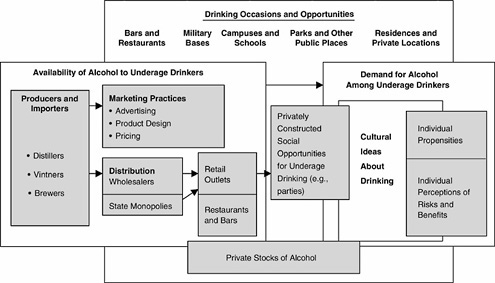
salers, and retail distributors. In some states, some of these actors are government agencies. In principle, state control over distribution provides an opportunity for the state to achieve important social goals other than maximizing sale of alcoholic beverages, including keeping alcohol out of the hands of underage drinkers. It is also worth noting that an important source of supply to underage drinkers is not the commercial sector; instead, it is the diversion of alcohol from stocks kept in private homes to support adult drinking. Efforts to reduce underage access to alcohol are grounded in a legal prohibition, and the committee makes a variety of recommendations to strengthen this legal foundation and to increase the effectiveness of enforcement. However, given the diverse sources of supply to underage drinkers, it must be emphasized that the law cannot carry the weight of this obligation alone; it must be accompanied and reinforced by a genuine commitment to reduce underage drinking among these businesses and among parents.
Occasions
Responsibility for reducing drinking opportunities for young people, a distinctly practical task in everyday life, rests again with both commercial and noncommercial actors. Bars, taverns, public houses, restaurants, and other businesses that create opportunities for people to drink have an important responsibility to ensure that underage drinking does not occur. In addition, parents, schools, landlords, and everyone else with legal control over premises in which young people drink also have an obligation to take appropriate actions. Parents should not sponsor or facilitate underage drinking parties in the home on the assumption that “it will occur anyway” and that parental supervision can reduce the risks. Schools should work with community organizations to prevent drinking parties and to create alternatives. Local governments should develop strategies for preventing public parks and other public facilities from being used for underage drinking. Landlords who rent property to underage tenants should include lease provisions making drinking parties grounds for termination. Colleges and military installations have unique obligations in this context because such a large number of underage people in these settings are among slightly older peers.
Demand
Responsibility for reducing underage “demand” for alcohol and for teaching about acceptable drinking practices is generally thought to rest largely, if not exclusively, with parents and schools—perhaps supplemented by public service media messages funded by the government and private
foundations. In the committee’s view, however, responsibility for reducing underage demand for alcohol is much more widely dispersed. Alcohol producers and advertisers have a special responsibility to resist marketing initiatives whose effects may be to stimulate or reinforce youthful desires to drink. Many alcohol companies have accepted the responsibility to support prevention initiatives designed to counteract the strong commercial forces tending to encourage underage drinking, and the committee makes several recommendations to build on this foundation. Responsibility for reducing underage demand for alcohol also rests with the entertainment media who command so much of the time and attention of the nation’s youth—these media exposures offer opportunities either to stimulate or reinforce youthful demand for alcohol or to reduce it. At a local level, schools, colleges and universities, healthcare providers, and other organizations are in a position to influence the drinking habits of young people; the good will and energies of individuals and community organizations need to be more effectively harnessed. Table 5-1 summarizes the collective responsibilities of the full array of individuals and organizations in a position to reduce underage drinking.
Key Components
Within this broad framework the committee has identified ten core components of the proposed strategy to reduce underage drinking:
-
a national media campaign designed to animate and sustain a broad, deep, societal commitment to reduce underage drinking, to muster support for actions aiming to reduce underage drinking, and to encourage parents and other adults to refrain from conduct tending to encourage or facilitate underage drinking (see Chapter 6);
-
a meaningful commitment by the alcohol industry to contribute to this effort by helping to establish and fund an independent, nonprofit organization to support programs to reduce underage drinking (see Chapter 7);
-
self-restraint in marketing and strengthened self-regulation by the alcohol industry to reduce youth exposure to alcohol advertising (see Chapter 7);
-
a meaningful commitment by the entertainment industry, especially the music recording industry, to avoid images and lyrics that tend to encourage drinking in products that are likely to be heard or viewed by predominately underage audiences (see Chapter 8);
-
stronger restrictions on youth access to alcohol in both commercial and noncommercial settings, and intensified enforcement of these laws by state and local governments (see Chapter 9);
TABLE 5-1 Reducing Underage Drinking: A Collective Responsibility
|
Responsible Party |
Reduce Availability |
Reduce Demand |
Reduce Drinking Occasions |
|
Alcohol producers and importers |
x |
x |
|
|
Wholesalers |
x |
x |
|
|
Retail outlets |
x |
|
x |
|
Restaurants and bars |
x |
|
x |
|
Entertainment media |
|
x |
|
|
Schools |
|
x |
x |
|
Colleges/universities |
x |
x |
x |
|
Youth employers |
|
x |
|
|
Military bases |
x |
x |
x |
|
Landlords |
|
|
x |
|
Community organizations |
x |
x |
x |
|
Parents and other adults |
x |
x |
x |
|
Peers and friends |
x |
x |
x |
-
expansion of educational, counseling, and treatment programs of proven effectiveness in elementary and secondary schools, colleges and universities, and in other settings where natural opportunities arise to discourage underage drinking and assist young people with drinking problems (see Chapter 10);
-
mobilization of communities to design and implement multipronged, comprehensive programs to prevent and reduce underage drinking (see Chapter 11);
-
a commitment by the federal government to implement a national strategy to prevent and reduce underage drinking, to provide stable funding and technical assistance, and to mount the necessary surveys to monitor its effectiveness, and an analogous commitment by state governments to establish and fund the necessary infrastructure to implement state-based components of the strategy, such as enforcing access restrictions (see Chapter 12);
-
increases in federal and state excise taxes on alcohol to help reduce underage consumption, reflect the social costs of drinking, and raise revenue for implementing the proposed strategy (see Chapter 12); and
-
rigorous research and evaluation to assess the effectiveness of current interventions, to help design new ones, and to facilitate refinements of the strategy and its implementation (see Chapter 12).
The committee strongly endorses what it finds are compelling arguments for a multipronged strategy and believes the effectiveness of its pro-
posed strategy for reducing underage drinking will be enhanced if the components are pursued simultaneously. However, we do not view the proposed strategy as an “all or none” proposition. In fact, implementation of the strategy requires the involvement of a range of decision makers from a variety of settings and levels of government, all of whom will be acting on different timetables with different constraints. Action on any one component should not be regarded as contingent on simultaneous action on any or all of the other components of our proposed strategy.


