
1
THE EVOLVING FREIGHT INDUSTRY
The nation’s freight industry moves agricultural products and raw commodities to factories and finished goods to domestic and international markets. A major role is the handling of huge volumes of imported finished goods, much of it in containers. The industry’s weight in the modern economy is only hinted at by its size—hundreds of billions of dollars in revenues and millions of employees (BTS 2002, Appendix A). The various modes carried more than 15 billion tons of merchandise, valued at more than $9.4 trillion, in 1998 (Figure 1-1). Freight transportation has enabled the rise of new logistics and supply chain systems. The new systems have led to explosive growth of world trade in the past decade, from which all consumers have benefited. Cheap and responsive transportation makes it possible to acquire parts and components from geographically diverse sources, manufacture and distribute goods without the need for expensive warehouses, and give customers wider choices of products and services. Overall, these advances have fueled economic growth.
HOW EFFICIENT TRANSPORTATION CREATES ECONOMIC GROWTH
Commerce is an increasingly information-intensive process. Today’s lean production methods and modern supply chain management require companies to forecast customer demand accurately; coordinate multiple suppliers (perhaps thousands); manage distribution of products and services; track and trace items in transit; and otherwise control the flow of materials through the organization, from raw materials to finished goods. These systems can be quite complex, and they all hinge on managing information (Chopra and Meindl 2001).
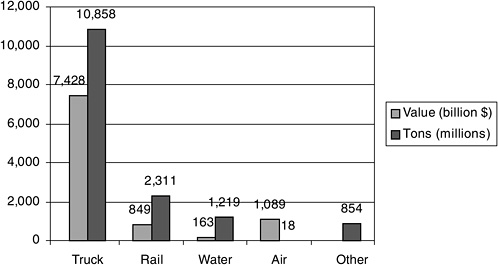
FIGURE 1-1 Value and tonnage of U.S. domestic freight shipments by mode; “other” is mainly pipelines, for which value is not available (FHWA 2000).
SUPPLY CHAIN MANAGEMENT AND WORLD TRADE
Manufacturers, retailers, and other users of transportation have grown accustomed to thinking of their supply chains (networks of manufacturers, wholesalers, distributors, and retailers, which turn raw materials into finished goods and services and deliver them to consumers) as important sources of competitive advantage. Supply chains increasingly are treated as integrated entities, and closer relationships between the organizations throughout the chain can produce competitive advantage, reduce costs, and help attract and maintain a loyal customer base.
Companies manage their supply chains to achieve strategic advantage, which often requires detailed models of the movements of goods and the flow of information between the organization and its suppliers and customers. The process of supply chain management is often called “logistics.”
Today’s supply chains are increasingly multinational, as companies seek the least costly suppliers consistent with efficient production. This shift has driven a remarkable rise in international trade. Merchandise trade worldwide has doubled in the past decade (Figure 1-2). The United States accounts for nearly one-fifth of the world market by value and a corresponding share of the demand for transportation. The Federal Highway Administration of the U.S. Department of Transportation (DOT) forecasts a further doubling by 2020 (FHWA 2002). This growth will offer economic opportunity but will strain the capacity of the nation’s ports, other intermodal freight terminals, and highways.
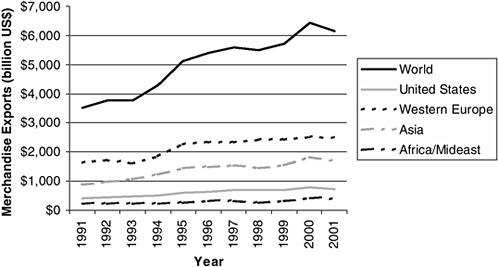
FIGURE 1-2 Merchandise exports by region, 1991–2001. (Source: World Trade Organization.)
The growth in foreign trade is even more striking in comparison with gross domestic product (GDP). Since 1970 U.S. merchandise trade has more than doubled as a proportion of GDP. The world as a whole has also seen healthy increases in this measure (Figure 1-3).
GROWING RELIANCE ON INFORMATION
Information is obviously a vital contributor to supply chain management. An automobile manufacturer, for example, must assemble all the parts and subassemblies for a run of a particular make and model. In doing so, it must coordinate the production schedules of perhaps hundreds of suppliers to ensure that the correct parts and subassemblies flow toward the final assembly plant as needed. With today’s lean inventories, there is little “buffer stock” to make up for a supplier’s shortfall and, often, nowhere to store buffer inventories if they existed. To manage its inventories, the company must forecast in real time its production of that model and communicate with all of its suppliers and transportation providers so that they may speed up or slow down their activities. These information flows are critical to industrial operations and profitability, and any threat to their integrity becomes a real concern.
For larger companies, supply chain management is a component of enterprise resource planning models. These models may include transportation as well as human resources, finance, and other core functions. Specialized logistics
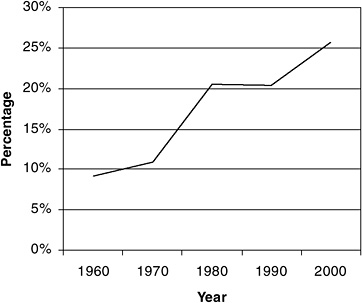
FIGURE 1-3 U.S. trade in goods and services (exports plus imports) as a percentage of GDP, 1960–2000 (Bureau of the Census 2001b).
management companies have proliferated in recent years to serve this need for small and medium-sized companies.
DIFFERENCES AMONG MODES
HIGHWAY FREIGHT
The nation’s highway system is the giant of American transportation, carrying 71 percent of the total tonnage and 80 percent of the total value of U.S. shipments in 1998 (FHWA 2002). More than 550,000 separate trucking establishments carry freight locally, nationally, and internationally, according to the 1997 Economic Census survey of the transportation and warehousing sector. These companies shared total revenue estimated at $342 billion (including local and long-distance trucking and courier services) (Bureau of the Census 2001a).
The companies range from tiny concerns with one or two employees to major national networks with revenues of $2 billion to $3 billion or more (and the biggest of all, UPS, with 2001 revenues of more than $20 billion). In all, their 4.7 million employees were responsible for more than 1 trillion ton-miles of freight movement. Highway freight movement grew robustly in the late 1990s (BTS 2002).
AIR FREIGHT
All of America’s 100 scheduled airlines carry freight to some extent. Scheduled airlines’ revenues for domestic and international freight and express services totaled about $12 billion in 2001, and carriage of mail added another $1 billion. The airlines were responsible for nearly 22 billion revenue ton-miles in 2001. Freight and express specialists were among the few airlines to report consistent profits in recent years.
All of these activities declined substantially between 2000 and 2001, however, reflecting the uncertain security environment and the worldwide economic slump. The decline followed a period of very healthy growth (more than 10 percent per annum for several years).
RAIL FREIGHT
Railroad freight revenues in 2001 totaled $35 billion. The nation’s railroads were responsible for nearly 1.5 trillion ton-miles of freight traffic. Nearly half of the tonnage (46 percent) was coal, which was followed by chemicals and allied products (8.7 percent), farm products (7.9 percent), nonmetallic minerals (7.0 percent), and food and kindred products (5.6 percent), according to the Association of American Railroads (2003).
The railroad industry is in a long-term process of consolidation. The United States has 571 railroads, but only eight are large (Class I railroads that have corporate revenues exceeding $266.7 million). Statistics for this group show a total employment of 178,000 in 1999. In that year the eight companies shared revenues of just over $32 billion. The Association of American Railroads (2003) reports that the top two (Union Pacific and Burlington Northern) accounted for more than two-thirds of that revenue in 2000 ($23 billion).
WATERBORNE FREIGHT
The U.S. maritime shipping industry is diverse and complex. It includes a wide variety of vessel types offering many different kinds of service, calling on hundreds of ports on all of the seacoasts and the Great Lakes, as well as transiting inland waterways.
The volume of container freight moving through the nation’s ports has doubled in the past decade and is expected to continue growing rapidly (BTS 2002; The Economist 1997). More than 15 million containers are in use globally; they account for about 90 percent of the world’s internationally traded cargo by value (The Economist 2002). Virtually all oceangoing vessels that serve U.S. commerce are operated under foreign flags.
Measured by value, the cargo transported by the international liner shipping industry constitutes about two-thirds of the total U.S. foreign waterborne trade. In 2002, the liner shipping industry carried roughly 6 million containers of imported cargo to the United States and approximately 3.3 million containers of export cargo being shipped from more than 202,000 American businesses. The total is roughly $500 billion worth of goods, or more than $1.3 billion worth of goods per day through U.S. ports (World Shipping Council 2002). Some details on the information technology used by the international liner shipping industry are offered in Appendix A.
Data from DOT’s Bureau of Transportation Statistics indicate revenues in 1999 of $24.5 billion for domestic and international freight (coastal waterways, Great Lakes, locks and channels, and inland waterways) (BTS 2002).
REFERENCES
ABBREVIATIONS
BTS Bureau of Transportation Statistics
FHWA Federal Highway Administration
Association of American Railroads. 2003. Fact About Railroads. Policy and Economics Department, Jan. 10. www.aar.org/PubCommon/Documents/AboutTheIndustry/Statistics.pdf.
Bureau of the Census. 2001a. 1997 Economic Census: Transportation and Warehousing. EC97T48S-SM. March. www.census.gov/prod/ec97/97t48-sm.pdf.
Bureau of the Census. 2001b. Statistical Abstract of the United States. Washington, D.C.
BTS. 2002. National Transportation Statistics 2001. BTS02-06. U.S. Department of Transportation, Washington, D.C. www.bts.gov/publications/nts/index.html.
Chopra, S., and P. Meindl. 2001. Supply Chain Management: Strategy Planning and Operation. Prentice Hall, Upper Saddle River, N.J.
The Economist. 1997. Delivering the Goods. Nov. 13. www.economist.com/displayStory.cfm?Story_id=352733.
The Economist. 2002. Container Trade: When Trade and Security Clash. www.economist.com/displaystory.cfm?story_id=1066906.
FHWA. 2002. The Freight Story: A National Perspective on Enhancing Freight Transportation. U.S. Department of Transportation, Washington, D.C.
World Shipping Council. 2002. Partners in America’s Trade. Brochure. Washington, D.C.


