
3
Intellectual Property—When Is It the Best Incentive Mechanism for S&T Data and Information?
Suzanne Scotchmer1
Intellectual property has invaded the academy, especially in the sciences. Along with others, economists have been thinking about this invasion, and the proper roles of the public and private sectors in the conduct of science. In particular, the focus has been on the question of whether the invasion of intellectual property is either inevitable or appropriate. As I tried to focus my thoughts on how to summarize economic thinking on this topic, and reviewed conversations with colleagues, it seemed to me that instead of trying to explain, as a positive matter, how economists view the relationship between the public and private domain, I should comment on the justifications I hear for intellectual property that I view as wrong. So I have unofficially retitled this talk, “Why Intellectual Property: Four Wrong Answers.”
The first wrong answer is “otherwise, we won’t get inventions.” The second is “intellectual property has benefits without costs”; it rewards inventors and, if licensed, does not hurt users. The third wrong answer is that “the private sector is more efficient than the public sector.” The fourth is that, “without intellectual property, even public domain inventions will not be used efficiently”—the Bayh-Dole argument.
Consider the first wrong answer, that otherwise we won’t get inventions. This is wrong as an historical matter, as a factual matter about the modern world, and as a logical matter. As an historical matter, it has never been true that the only way we get inventions is by inciting private actors to make them in return for profit. Many alternative mechanisms have been used. Among the most prolific users of alternative mechanisms have been the French, but also Europeans more generally.
Some examples may be well known to you. In the 1840s, the French simply bought the invention of photography and made it freely available, thus engendering a great many improvements to it. The English, in contrast, made it proprietary, thus inhibiting further research on photography in England. Napoleon needed to feed his vast armies marching on Russia and elsewhere. To find a way to do this, the French offered a prize for a way to preserve food. This led to canning and heat sterilization, still in use today. The French also offered a prize for water turbines. The Germans offered a prize for demonstrating Maxwell’s equations, which led to the inventions of Hertz. And, of course, a very important and well known prize was that given for discovering a way to calculate longitude at sea. That was an English prize.
|
1 |
See N. Gallini and S. Scotchmer, 2002. “Intellectual Property: When is it the best incentive system,” in Innovation, Policy and the Economy, Vol 2, A. Jaffe, J. Lerner, and S. Stem, eds., MIT Press, Massachusetts. Also available at http://socrates.berkeley.edu/~scotch/G_and_S.pdf. |
In short, history informs us that there are many incentive systems other than intellectual property. Some of these are embodied in our own public institutions, such as the National Science Foundation and the National Institutes of Health — a fact that we often forget, and certainly do not emphasize in the current climate where even publicly funded discoveries are subject to intellectual property.
Something that everyone should know is that about half of research and development is funded by public sponsors. If you pull up basic raw data from the Organisation for Economic Cooperation and Development Web site,2 you will find that about one-third of U.S. research and development is federally funded. In other countries, which devote less money to military expenditures, a higher fraction of research and development is funded by the government. In Latin America, it is well over half. In most European countries it is a little under half. The fraction funded by taxpayers is not trivial anywhere in the world. However, the question of public/private domain is not just who funds the research, but whether the discoveries are put in the public domain. Increasingly, even the discoveries that are publicly funded are restricted by intellectual property, e.g., the many discoveries made in national laboratories funded by the Department of Energy.
Wrong answer number two is that “intellectual property rewards inventors, and doesn’t hurt users provided it is licensed.” It is true that intellectual property rewards inventors, and may even be an important engine of growth and of invention. But, as I have just pointed out, there are plenty of alternatives. This is not a definitive answer. And the second part of this statement, that it doesn’t hurt users provided it is licensed, is misleading. It is important to notice that, even if licensed, intellectual property still creates deadweight loss, including for scientific research tools.
A license price is a price like any other. The licensor makes profit by licensing at a proprietary price. Such a price excludes users; else the licensor could probably increase profit by increasing the price. At a higher price, some users will be retained, and the additional profit received from the retained users will outweigh the profit lost from those that refuse the license. Thus, distributing the use of a research tool by licensing instead of putting it in the public domain will reduce its use just as any other monopoly price reduces use. This may seem obvious to you, but wrong answer number two is a common justification. While licensing certainly puts the intellectual property in use, it does not solve the problem of deadweight loss.
The argument about deadweight loss is illustrated by Figure 3-1, which shows the proprietary price. On the horizontal axis, we have arrayed all the users by their willingness to pay. If the proprietor charges a single price, then all the users arrayed to the left, for whom willingness to pay is higher than the price, will take a license. Each is getting some surplus despite the proprietary price, because each is willing to pay more than he actually has to pay. On the other hand, the proprietary license price is excluding all the other users to the right. That is precisely the social burden of intellectual property.
There is one small caveat to this story, namely, that price discrimination can cure the deadweight loss that arises from charging a single price to all users or potential users. If the proprietor could charge each user exactly his willingness to pay, then there is no reason to exclude, because the way to maximize profit is to embrace all the users within a system of discriminatory pricing. Although no user is excluded, the proprietor gets the entire surplus.
I mention the price discrimination caveat because it is a deeply subversive argument. It implies that there is nothing wrong with intellectual property. The argument has appeared in at least one court opinion, ProCD, a Seventh Circuit opinion.3 If you believed that perfect price discrimination was possible or likely in most cases, it would remove the basic reason that intellectual property is a burden on society, namely, deadweight loss, and removes any argument for reining it in. I believe the problem of excluding users is fundamental and basic, so I would not want the argument to be subverted in that way. Price discrimination can be very difficult, at least the perfect price discrimination that underlies this argument. In my view, we should take seriously the deadweight loss due to intellectual property, and take steps to preserve the public domain.
Wrong answer number three is that “the private sector is more efficient than the public sector.” First of all, what does this mean? The public sector does not make inventions. Scientists make inventions. Most public sector
|
2 |
See www.oecd.org/pdf/M00026000/M00026476.pdf for additional information. |
|
3 |
ProCD v. Zeidenberg, 8 F.3d. 1447 (7th Cir. 1996). |
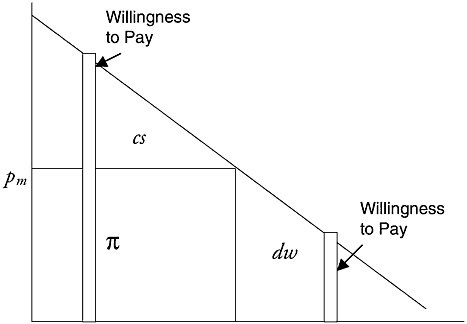
FIGURE 3-1 Deadweight loss illustration, which shows the proprietary price.
research is done by the private sector, that is, by scientists either in industry, the academy, or in national laboratories. The same people do inventions whether they are in the private sector or the public sector. Only about 25 percent of publicly funded research is performed by employees of the government. Most of the rest is contracted out to industry and universities.4
The question is not whether the public sector is more efficient than the private sector. The question is, how do you give incentives not to waste money? How do you give incentives to invest in the right things? There are plenty of incentive mechanisms that mimic the incentives for effort that intellectual property creates, while avoiding deadweight loss.
It is often said in favor of intellectual property that the large reward of an intellectual property right will incite effort, and such effort is of great benefit to society. That is true, but, as I have already pointed out, prizes serve that same function. Every academic knows that under the funding systems of, for example, the National Institutes of Health and the National Science Foundation, you will not get funded the second time if you did not produce the first time. These are prize systems, and they are very good at inciting effort. Whether there is a disparity between the effort that such funding incites, and the effort incited under intellectual property rights, is a nuanced question. The incentives for effort are not different in kind, but only in degree, and the incentives created by both systems can, in fact, be modified.
But wrong answer number three, that the private sector is more efficient, misses the main point, even if true. The main question in my view is not who does the research, but rather the terms for using the output. The issue is proprietary pricing versus public domain. There may well be some reason for concern on the efficiency question, but I do not think that gives us license to ignore the question of access.
Finally we come to wrong answer number four, that “without intellectual property, basic inventions will not be used even if they are in the public domain.” That is part of the argument for the 1980 Bayh-Dole Act, which authorized the patenting of publicly sponsored inventions. The argument makes no sense to many economists. To many economists, if someone makes a useful invention and puts it in the public domain, people will use it. Even
|
4 |
See National Science Board. 2002. Science and Engineering Indicators 2002, National Science Foundation, Arlington, VA. Available at http://www.nsf.gov/sbe/srs/seind02/start.htm. |
if potential users do not know what inventions are available, they have every incentive to find out. In any other realm of property, we would naturally assume that would happen. Why should we ascribe less rationality to potential users of knowledge?
One rejoinder is that basic inventions need collateral investments in order to become commercially viable. In order to get the private sector to make the collateral investments, they need exclusive licenses on an underlying property right.
However, that is not an answer. If improvements need protection not available under the law, then the Bayh-Dole Act is trying to overcome a deficit of intellectual property law. That is a completely different spin on the story. My view is that we should fix the thing that is broken, rather than something else. If collateral improvements need protection, then they should be protected. Protecting collateral improvements or applications is not a reason to allow restrictions on use of the underlying basic research, which was performed at public expense. If the thing that is broken is that there is not sufficient protection for improvements and commercialization, then that is the thing to fix. If fixed, the underlying basic research could be preserved in the public domain to stimulate improvements and commercialization in many parallel paths simultaneously, with no restrictions on use.
Let me conclude by coming back to the question, why intellectual property? I have given four answers that I regard as wrong. Are there any “right” answers? There are, in my view, some right answers, but they are very limited in scope, and they do not apply very convincingly to scientific knowledge or to scientific data. I believe there are two right answers.
The first is that the private sector may have better knowledge of what the private sector needs than a public sponsor would. There is a set of issues not about the efficiency of how research and development gets done, and not about monopoly pricing versus open access, but rather about the right things to invest in. There are many realms of scientific inquiry, especially those that are closely tied to industry and industrial development, that we would not want to put under the jurisdiction of a public sponsor. Under intellectual property rights, the private sector will apply at least a weak test of whether an R&D investment is worth the cost, namely, whether it is likely to turn a profit. In many realms, it is useful to apply that test.
However, this perspective also seems to be a clear rationale for treating basic research differently from follow-on applications. Nobody disagrees that we need genomic data or weather data. Nobody disagrees that we need certain kinds of environmental data. If there is no disagreement, the argument for intellectual property, in my view, is weak. We do not need the commercial sector to use their superior private knowledge or to apply the profit test as to whether the investment in R&D is a good one.
The second justification for intellectual property is that it concentrates costs among the users. There is a clear rationale, for example, for funding computer games through intellectual property, because the people who use them are a narrow population of 12 year olds. But there is no such justification, in my view, for using intellectual property to fund vaccines for infectious diseases, basic scientific knowledge, Census data or weather data that benefit all of us. Whether we know it or not, we are all users. The test of concentrating the costs among the users simply does not apply with very much force for those kinds of scientific discoveries.
In summary, I believe there are two valid tests for whether a particular subject matter should be supported under private incentives and an intellectual property regime rather than supported by public sponsors to be put in the public domain. It seems to me that most scientific research done in universities and national laboratories does not pass these tests. The other four justifications that I have heard for the expansion of intellectual property rights are not, in my view, sound arguments.


