
F
Fusion Reactor Concepts
Although the general scheme of confining a hot and dense plasma within a magnetic bottle is common to all magnetic fusion configurations, the different strategies are worth noting. In this appendix, the tokamak (see Figure F.1), the spherical torus and the spheromak (see Figure F.2), the stellarator (see Figure F.3), and the reversed-field pinch (see Figure F.4) configurations are discussed.
THE TOKAMAK CONFIGURATION
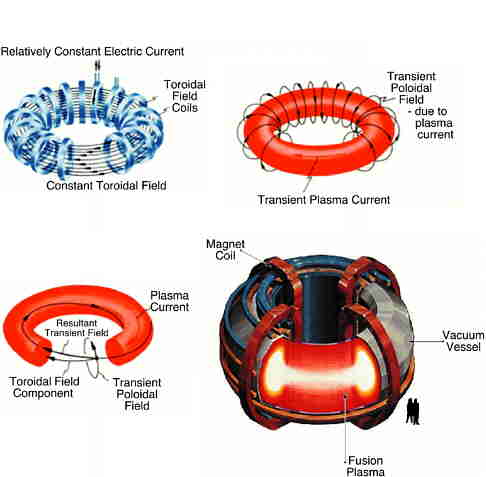
FIGURE F.1 The components of the tokamak confinement configuration, one of the more advanced plasma confinement concepts. It uses a strong toroidal field created by external field coils (top left) to stabilize the plasma while using a poloidal field created by a toroidal plasma current to confine the particles (upper right). The final configuration depends on the interaction of these fields (bottom left) and includes a large vacuum vessel to isolate the hot plasma from the surrounding environment (bottom right; people shown for scale). Courtesy of General Atomics and Princeton Plasma Physics Laboratory.
EXTENSIONS OF THE TOKAMAK—SPHERICAL TORUS AND SPHEROMAK
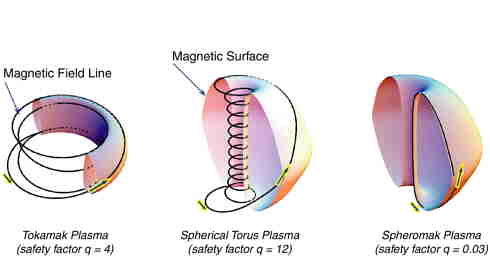
FIGURE F.2 Examples of the magnetic topologies of three related toroidal configurations with increasing curvature and varying stability characteristics. The tokamak (left) uses a strong external toroidal field to provide robust stability against pressure- and current-driven instabilities. The spherical torus (center) uses a weak toroidal field in a compact configuration to allow access to higher β values than those obtained in the tokamak. The spheromak (right) uses internal plasma currents only to provide the confining poloidal field plus a weak toroidal field. A larger safety factor indicates a higher level of protection from current-driven instabilities. Courtesy of M. Peng, Princeton Plasma Physics Laboratory.
THE STELLARATOR
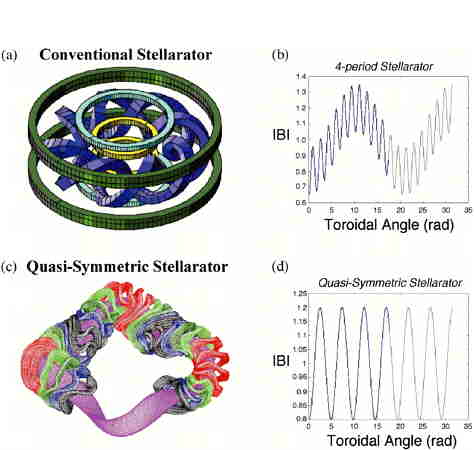
FIGURE F.3 The stellarator concept uses complex three-dimensional coil and magnetic-flux surfaces to create a quasi-symmetric configuration in which the magnetic field appears to be only two-dimensional in the frame of reference of a moving particle in the plasma. The conventional stellarator (a) has relatively simple helical symmetry and multiple harmonics in the field strength along a field line (b), which in turn gives rise to large particle losses. In contrast, the quasi-symmetric stellarator (c) eliminates the harmonics and produces a field line with single harmonic symmetry (d), effectively eliminating toroidal curvature (i.e., the long-period feature in (b)) and dramatically improving particle confinement. Courtesy of D.T. Anderson, University of Wisconsin at Madison.
THE REVERSED-FIELD PINCH
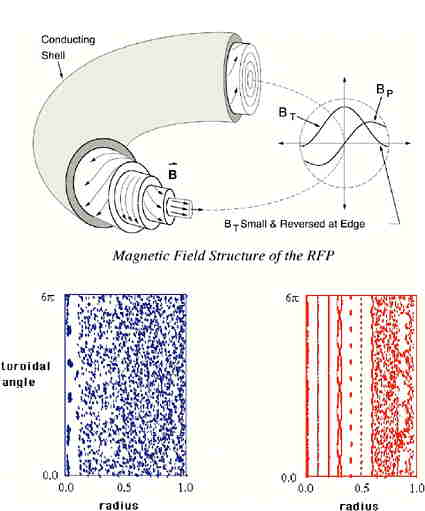
FIGURE F.4 A magnetic confinement concept such as the reversed-field pinch (RFP) (top) is a relatively self-organizing configuration that is subject to turbulent magnetic field structures. The magnetic topology includes a reversal of the toroidal field inside the plasma owing to plasma currents. Under normal inductive current drive, the magnetic field lines can readily become chaotic, as indicated by a puncture plot of the field lines as they traverse a poloidal plane (bottom left). With finer control of the plasma currents, well-defined flux surfaces are restored (bottom right). NOTE: BT, toroidal magnetic field; BP, poloidal magnetic field. Courtesy of S.C. Prager, University of Wisconsin at Madison.


