
1
Minerals Science and Information: The Federal Role
Like food, air, and water, minerals1 are a fundamental ingredient of human life. There is compelling evidence for mining and metallurgy in Spain dating back at least 4,500 years. As the population has increased and our society has developed, the need for minerals has grown and diversified. As minerals have been the basis of breakthroughs in civilization, they are now essential for the present and future technological revolution. Communications and transportation systems, computer networks, and space exploration all rely on the availability and sustainability2 of mineral resources. Individual nations tend to follow a systematic pattern of change in fulfilling their mineral commodity needs. Initially, nations often obtain most of their requirements from within their own boundaries. However, as local supplies become exhausted and lands are used for other purposes, it becomes necessary to obtain minerals from more distant sources, depending on the commodity’s value compared to transportation costs. Many countries in Europe currently import essentially all of their mineral resources, except for those of lowest cost (e.g., construction materials such as rock, sand, and gravel).
U.S. MINERALS PRODUCTION AND CONSUMPTION
The nature and status of mineral resources and mining in the United States have changed dramatically since the U.S. Geological Survey (USGS) was founded in 1879. At the beginning of the 21st century, the United States is one of the largest mineral producers in the world (see Table 1.1). The United States is generously endowed with mineral resources. Spanning diverse geologic terrains, this country hosts an enormous range of mineral deposit types (Ashley, 1991; Tooker, 1991; Brobst, 1991). Metals from aluminum to zinc and nonmetals from construction aggregate to specialty clay minerals are illustrative of this mineral resource endowment. Mining of sand, gravel, or crushed stone for construction aggregate takes place in all 50 states; mining of other commodities is widespread.
Today the United States is one of the world’s largest consumers of many mineral products. The average American born in 2001, with a lifespan of 76.9 years, will need the mining of 3.6 million pounds of minerals, metals, and fuels to maintain his or her standard of living during their lifetime—averaging 47,122 pounds of new mineral and energy resources every year for each American (see Figure 1.1). The value of processed materials of mineral origin produced in the United States in 2000 has been estimated to be $374 billion (USGS, 2002a). However, the $39.4 billion value of the nonfuel minerals mined in this country in 2000 (Smith, 2002) was less than one-half percent of the U.S. gross domestic product. The
TABLE 1.1 Examples of U.S. Minerals Production Relative to Other Large Mineral-Producing Countries
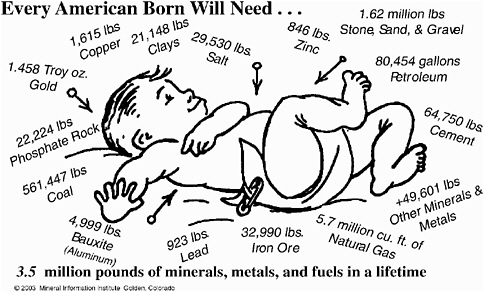
FIGURE 1.1 U.S. per capita lifetime use of new minerals, metals, and fuels.
SOURCE: Mineral Information Institute, Golden, Colorado, 2002. (Available online at http://www.mii.org).
$39.4 billion value of nonfuel minerals comprises $10.2 billion from metals and $29.2 billion from industrial minerals (Smith, 2002) (Sidebar 1.1). The true contribution of mining to the U.S. economy is not fully reflected by these figures. The contribution extends to jobs and related benefits to downstream products such as automobiles, railroads, buildings, and other community facilities.
U.S. production of metals has remained rather constant since 1992. However, in a trend with direct implications for the USGS’s Mineral Resources Program (MRP), industrial minerals production increased by slightly less than 50 percent between 1992 and 2000 (see Figure 1.2). As a comparison, in 1998 there were just over 300 metals mines in the United States, but over 10,000 industrial minerals mines (MacDonald, 2002).
The United States satisfies some of its demand for minerals through imports, including 100 percent of several commodities and significant proportions of other critical minerals (see Figure 1.3).
|
SIDEBAR 1.1 Industrial minerals include any rock, mineral, or other naturally occurring substance of economic value, exclusive of metallic ores, mineral fuels, and gemstones. Major industrial minerals are crushed stone, sand, and gravel, which are lumped together as aggregates. A wide variety of other materials are also mined, such as limestone, building stone, specialty sand, clay, and gypsum for construction; phosphate rock, potash, and sulfur for agriculture; and salt, lime, soda ash, borates, magnesium compounds, sodium, sulfur, rare earth elements, bromine, and iodine for the chemical industries. Industrial minerals also include substances used in pigments, coatings, fillers and extenders, filtering aids, ceramics, glass, refractory raw materials, and other products. Industrial minerals comprise well over half of the mineral value production each year in the United States (USGS, 2002a). However, since few of these materials are sold directly to consumers, the industrial mineral industry is not well known to the American public (William Ford, personal communication, National Stone, Sand and Gravel Association, 2002). Industrial minerals, particularly aggregates, are often ignored in the public discussions on mining. Aggregates are the highest-volume industrial mineral mined in this country. Because of the relatively low value per ton of these minerals, transportation costs often dictate where resources can be obtained. While metals such as gold and copper can be delivered globally, aggregates are usually obtained near the ultimate use site, with the result that aggregate mines are typically in close proximity to urban settings (NRC, 2002a). Therefore, the type of information required for mining and using industrial minerals increasingly depends on the reclamation and varied options for postmining land uses, particularly in large urban settings. The USGS began a 5-year study in 1996 to develop methods for assessing infrastructure resources and to characterize the location, distribution and quality of the infrastructure resources as part of the Colorado Front Range urban corridor between Denver and Fort Collins, Colorado (USGS, 2002b). |
The demand for metals (e.g., copper, zinc) and industrial materials in the United States will remain for the foreseeable future, and information on all aspects of production and consumption is critical for ensuring that these materials are available for the United States as well as other countries. In addition, information is needed on secondary recovery of metals and minerals from recyclable materials.
Extraction of mineral deposits can degrade the environment. The effects of mining are not confined to the United States. Developing nations with mineral wealth often have less experience in dealing with mine wastes, reclamation, and associated environmental issues. As
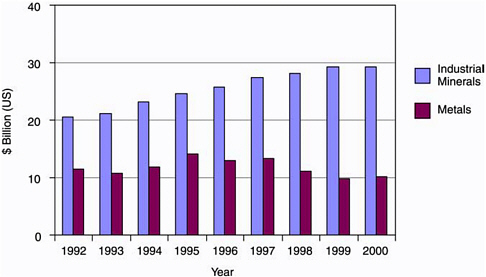
FIGURE 1.2 U.S. production of nonfuel minerals
SOURCES: Data compiled from Smith (1996, 1998, 2000, 2002).
NOTE: Where there were discrepancies between the Minerals Yearbook, data were taken from the latest publication.
American consumers directly or indirectly obtain more of their mineral resources from such countries, there will be an increasing need, in terms of both economics and policy, to ensure that minerals are developed in an environmentally responsible manner and to consider our place in a sustainable global environment.
WHY A FEDERAL MINERALS PROGRAM?
Considering the small contribution of direct domestic mineral production to the overall U.S. economy, it might not be apparent that there is a pressing need for a continued U.S. federal presence in minerals science and information. Mining continues to decline in importance to the economy both as a share of overall economic activity (USGS, 2003) and as a source of employment (ftp://ftp.bls.gov/pub/suppl/empsit.ceseeb1.txt), even though it is important in certain communities or regions of the country. There are no shortages of imported minerals available at prices at or below historical averages.
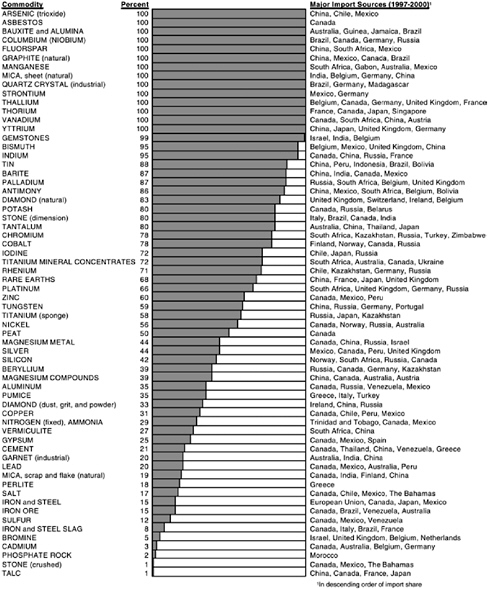
FIGURE 1.3 U.S. dependence on commodities from foreign sources.
SOURCE: USGS (2002a).
There does not seem to be the level of concern about the acquisition of strategic materials as there was in the past, such as during World War II. The United States has the ability to mine some strategic minerals domestically and/or to stockpile them by purchase from foreign entities.
|
SIDEBAR 1.2 The USGS’s MRP creates two types of intellectual products: minerals science and minerals information. Minerals science is based on investigation and analysis and can have more interpretative results. For example, the MRP’s work on geoenvironmental and ore deposit models and on interpretive geological mapping falls within the category of minerals science. Minerals information includes mineral production and consumption statistics and baseline geochemical sampling data. |
Currently, mineral materials are being sold from the National Defense Stockpile. For example, in fiscal year 2002 the Defense Logistics Agency sold $359 million of excess minerals from the stockpile. The USGS advises the Defense Logistics Agency on acquisitions and disposals of mineral materials from the stockpile (McCartan et al., 2003).
Minerals are essential for consumers and important for the individuals, companies, communities, and nations that depend on mineral production as a source of income and, more broadly, for economic development. As a heavy user of minerals from both domestic and international sources, the United States requires quality minerals science and information to make sound policy decisions. Housed within the Department of the Interior, the USGS’s MRP provides domestic and international science and information (see Sidebar 1.2) to other programs and disciplines within the USGS, other agencies within the department, and other departments within the U.S. government. In addition, state agencies, environmental groups, private industry, academia, U.S. citizens, and the international community use information provided by the MRP.
Over time, advances in minerals science and improvements in minerals information contribute to greater availability of minerals, at lower cost and with less environmental damage. Minerals science and information help society respond to the depletion of known mineral deposits and contribute to the substitution of relatively abundant minerals for increasingly scarce ones. Minerals science and information help develop alternative sources of supply for minerals subject to unexpected supply disruptions. The USGS has carried out these functions in the past and is respected nationally and internationally for the quality of its information. It
has the expertise and experience to provide unbiased3 information on domestic and foreign mineral resources in the future.
The MRP has been and remains a significant source of minerals information and, in some cases, was the initial developer of the models used for study of deposits. Ore deposit models summarize the understanding of how mineral deposits form and, in effect, help mineral exploration teams predict where undiscovered mineral resources occur and how to search for them. Geoenvironmental models summarize the basic science surrounding the source, transport, and fate of contaminants caused by the interaction of mineral deposits and the surrounding natural environment. These models help assess potential environmental consequences of developing a mine of a particular type in a specific location and, in the case of abandoned mines, assist in understanding what the baseline environmental quality may have been prior to mining. Baseline geological, geochemical, and geophysical data help mineral exploration teams narrow their searches to the most promising targets. Statistics and information on mineral production and consumption, recycling and the life cycle of materials, international trade, and other aspects of mineral production and use inform investment and production decisions by private industry and public policy decisions by government agencies.
The simple need for minerals science and information does not justify federal government activities in this area. After all, in market economies there are natural and strong incentives for private entities producing and consuming minerals to carry out the scientific research and to collect and disseminate information that is relevant and necessary for informed decision making. Nevertheless, in several specific circumstances, private markets are likely to yield suboptimal outcomes from the perspective of society as a whole—justifying four federal roles in minerals science and information. Three of these roles (informational, advisory, and foundational through basic research) were identified in the 1996 National Research Council (NRC) review of the USGS Mineral Resource Surveys Program (MRSP). The current committee adds a fourth role—international—because the United States is importing more of its mineral needs and because of the global nature of the economy today.
The first role is as an unbiased national source of science and information. Government agencies need information in carrying out their regulatory and administrative responsibilities. In addition, the private sector uses basic geological, geochemical, geophysical, and other forms of minerals information to support its decisions and activities—minerals exploration, mine development, and appropriate environmental protection on mineralized lands. Private-sector sources of the information are often proprietary and unavailable to the public. In other cases the private sector does not collect the information because the costs are prohibitive from the perspective of a single company relative to the benefits it receives, even if from society’s perspective the aggregate benefits would justify the costs. Although state geological surveys play an important role in generating and disseminating information related to mineral resources, the federal government has a unique role in addressing issues of national jurisdiction and significance (NRC, 1996). Other government agencies (e.g., the National Science Foundation, Environmental Protection Agency, and National Aeronautics and Space Administration) fund research but not a significant amount of mineral resources research. In addition, nonmission-driven agencies, such as the National Science Foundation, do not fund mission-driven mineral resources research. Another recent NRC report (2001) concluded that the USGS is an important provider and coordinator of information critical to issues in the natural sciences. The same report recommends that the USGS should provide national leadership in the provision of natural resources information (including energy, minerals, water, and biological resources). Examples of activities within the MRP, which fulfill this role, include mineral assessments and databases.
The second function involves basic research on mineral resources. Basic research would most likely be underfunded if left solely to the private sector, in part because the return on investment in basic research is not necessarily captured by the organization that conducts the research (NRC, 1996, 2002a). Many nations have found that public investments in research on mineral resources, which benefit society at large, are best accomplished through a combination of efforts conducted by universities and government agencies that have national jurisdiction, long-term continuity, large multidisciplinary teams of scientists, and highly specialized facilities (NRC, 1996). The argument is that certain types of information are what economists call public goods, which are likely to be undersupplied by the private sector acting alone (see Sidebar 1.3). Examples of
|
SIDEBAR 1.3 Economists distinguish between private and public goods. Purely private goods have characteristics such that (a) one person’s use of the good necessarily reduces the amount available for other people (if I eat a hamburger, you cannot also eat it) and (b) it is relatively easy to exclude consumers who do not pay for the good (the restaurant where you ate the hamburger will call the authorities if you refuse to pay). Most goods and services that households and businesses purchase—food, clothing, vehicles—are private goods. Economists believe that, because of the characteristics noted above, we can usually rely on private markets to provide such goods in appropriate quantities and at appropriate prices. Purely public goods, in contrast, are such that (a) one person’s use of the good does not reduce in a one-for-one manner the amount available for other people (e.g., once national defense is provided, one person’s benefit from this defense does not diminish the benefit that another person receives) and (b) it is difficult to exclude consumers who would choose not to pay for the good if it were provided in private markets (e.g., if national defense were funded by voluntary contributions, it would be difficult to exclude someone from enjoying the protections of national defense if that person did not pay for it). An implication of these characteristics is that the total benefits to society of the public good are greater than the sum of the benefits accruing to individuals willing to pay for the good—as a result, private markets alone are likely to underprovide public goods from the perspective of society as a whole. Governments often step in to correct the failure of private markets to provide appropriate levels of public goods. Minerals information and basic research are at least partially public goods. The benefit that one person receives by using information on minerals production and consumption does not reduce the benefit that another person might receive from the same information. The same holds true for basic research on, for example, the genesis of mineral deposits. Thus, as long as benefits of the minerals information and basic research are likely to exceed the costs, government should consider facilitating the provision of this information and research by public agencies (such as the USGS) or by universities or other nongovernmental entities. |
MRP activities that fulfill the basic research role include geoenvironmental models and minerals deposit research.
The third role is advisory. Federal agencies within the Department of the Interior and elsewhere in the government need to make public policy decisions related to mineral issues—for example, land management, environmental remediation of abandoned mines, international trade, and foreign policy. A major responsibility of the USGS is to serve as the science
|
SIDEBAR 1.4 Dust and Debris Analysis at the World Trade Center Immediately following the September 11, 2001, attack on the World Trade Center in New York City, several federal agencies requested that dust and debris in the area be evaluated. The USGS, along with several other organizations, sampled and analyzed more than 35 localities near the site and material coating a steel beam in the debris. In addition, the Crustal Characterization and Imaging Team of the USGS (see Chapter 2) used a hyperspectral remote sensing instrument called the Airborne Visible/Infrared Imaging Spectrometer (AVIRIS) to generate mineral distribution maps. The maps, used in conjunction with field tests, showed trace levels of asbestiform minerals in dust samples. This information supported recommendations of the Environmental Protection Agency and New York Department of Public Health that clean up of the area be done with appropriate respiratory protection and dust control measures (Clark et al., 2001; http://pubs.usgs.gov/of/2001/ofr-01-0429/feats-asb.html). Rescue of Quecreek Miners When miners became trapped in the Quecreek Mine in Pennsylvania in July 2002, rescuers searched the Aggregates Industry Atlas CD to locate two nearby aggregate producers, who rushed high-capacity water pumps to the mine and donated time and gear to the rescue effort. The Atlas was a cooperative effort of the USGS and the National Stone, Sand, and Gravel Association. It contains a searchable database of some 6,000 U.S. aggregate mines (Pinsker, 2002). |
arm for the Department of the Interior. In this role the USGS provides objective, nonadvocacy information to a number of the Department of the Interior agencies. If the information were not available from the USGS, similar expertise would have to be developed within the individual agencies (NRC, 2001). Private sources of advice often are available, but the USGS, as a mission-driven agency, serves as a national source of unbiased and impartial advice. In addition, in times of crisis the interdisciplinary expertise of mineral resources geoscientists (e.g., geochemistry, geophysics) can contribute to solutions of a variety of problems (see Sidebar 1.4).
The fourth federal role in minerals science and information is international—undertaking or supporting international activities that are in the national interest. The USGS, which has been operating internationally for more than 100 years, defines its role in the international arena in terms of promoting U.S. national security and policy interests, furthering U.S. pri-
vate aspirations in the global economy, addressing global environmental interests, and improving the utility or effectiveness with which the USGS carries out its fundamental domestic mission (NRC, 2001). Some of the international mineral resources activities are narrowly or directly in the national interest (e.g., facilitating more diversified sources of certain minerals through global mineral resource assessments). Other international activities are in the national interest in a broader or less direct sense—such as using mineral activities to support economic development and poverty alleviation in the poorest regions of the world, many of which are endowed with considerable undeveloped mineral resources, by providing technical assistance in assessments of resources. In addition, as the nation and world consider the reality of global environmental responsibilities and sustainable development, the United States has an opportunity to provide technical advice and assistance to developing nations for mineral development with a balance of environmental protection and economic growth. An example of an MRP activity that fulfils the international role is the global mineral resource assessment.
THE U.S. GEOLOGICAL SURVEY AND THE MINERAL RESOURCES PROGRAM
For 125 years the USGS has provided science, information, and advice on the interplay between Earth materials, processes, and the nation’s resource needs (NRC, 2001). The national and international reputation of the USGS as a premier Earth science organization is based on the quality of its science and on its willingness and capability to evaluate the Earth and its resources in a global context. The USGS is the nation’s principal agency for natural science and natural science information. The USGS conducts research, monitoring, and assessments to contribute to understanding of the natural world—lands, water, mineral, and biological resources. The USGS’s mission is to serve the nation by providing reliable scientific information to describe and understand the Earth; minimize loss of life and property from natural disasters; manage water, biological, energy, and mineral resources; and enhance and protect our quality of life (USGS, 2000).
|
SIDEBAR 1.5 Vision: The USGS is a world leader in the natural sciences through our scientific excellence and responsiveness to society’s need. Mission: The USGS serves the nation by providing reliable scientific information to
Strategic Direction: The USGS will combine and enhance our diverse programs, capabilities, and talents and increase customer involvement to strengthen our scientific leadership and our contribution to the resolution of complex issues. SOURCE: USGS (2000). |
The current USGS strategic plan (USGS, 2000) corresponds to the period 2000 to 2005 and is an update of the first strategic plan (1997 to 2005) (USGS, 1996) and of the revised strategic plan released in 1998 (USGS, 1999a). The USGS modified the plan to more clearly present the bureau’s goals and its strategies for achieving those goals. The plan was developed through feedback from stakeholders. The USGS’s mission and vision statements are stated in the new strategic plan (see Sidebar 1.5). The USGS has organized its strategic plan into two mission goals: (1) hazards and (2) environment and natural resources. The USGS hazards activities are to describe, document, and understand natural hazards and their risks. The environmental and natural resource activities deal with physical, chemical, biological, and geological processes in nature and with the impact of human actions on natural systems. The MRP activities directly support the USGS mission goal on the environment and natural resources. Each of the USGS mission goals has a long-term goal with performance targets. The USGS mission and long-term goals support all five of the Department of the Interior’s strategic goals but are most relevant to the goal of providing science for a changing world.
The MRP is the largest program in the Geologic Division of the USGS, and since abolishment of the Bureau of Mines in 1995, is the only federal mission-driven organization that focuses on mineral issues inte-
grating environmental, resource, and economic factors. The MRP supports about 475 full-time equivalents in five teams (Eastern Mineral Resources Team, Central Mineral Resources Team, Western Mineral Resources Team, Minerals Information Team, and the Crustal Imaging and Characterization Team), one science center (Anchorage, Alaska), and other specialists from across the USGS as needed. The teams are located in three regional centers (Reston, Virginia; Denver, Colorado; and Menlo Park, California) and four field offices (Tucson, Arizona; Reno, Nevada; Spokane, Washington; and Anchorage, Alaska). The programs that the MRP addresses can be grouped into three broad categories: environment and public health, sustainability and societal need, and economy and public policy. Information generated by the MRP is used by government decision makers to formulate national and domestic economic and environmental policy, by land managers to implement stewardship of public lands and resources, and by industry and academia to improve business and conduct research. Unbiased scientific analysis and advice on mineral resources have been a critical part of the responsibility of the USGS since its inception in 1879 (NRC, 2001). Mirroring the interdisciplinary nature of mineral resources, the MRP includes a variety of areas, such as geophysics, geochemistry, and statistics (see Chapter 2). A brief history of mineral resources at the USGS is summarized in Table 1.2.
STUDY AND REPORT
In 1996 the NRC reviewed the USGS’s MRSP plan. The recommendations from the study, Mineral Resources and Society: A Review of the U.S. Geological Survey’s Mineral Resource Surveys Program Plan (see Appendix A), were used by the USGS in redirecting the program. Shortly after the review was completed, the Department of the Interior’s Bureau of Mines was abolished and that agency’s minerals information function was transferred to the USGS. The minerals information function, now called the Minerals Information Team, was incorporated into the new MRP. Six years following its 1996 review of the USGS’s minerals program, the NRC was asked to examine the USGS’s actions with respect to the 1996 NRC recommendations and incorporation of the minerals information function and consider future aspects of the Mineral Resources Program. The NRC was not asked to conduct a comprehensive
TABLE 1.2 History of Mineral Resources in the Federal Government
|
Year |
Event |
|
1833 |
Letter from George Featherstonhaugh to Secretary of War outlining the virtues of expending federal funds to expand the nation’s knowledge of its mineral resources |
|
1866 |
U.S. Treasury establishes the Office of Commissioner of Mining Statistics to report on status of mining in the Western states and territories |
|
1867-1879 |
Four “Great Surveys,” led by Clarence King, Ferdinand Hayden, George Wheeler, and John Wesley Powell, survey the geography, geology, and natural history and resources of the American West |
|
1878 |
National Academy of Sciences recommends that all federal geology programs be consolidated as the USGS within the Department of the Interior |
|
1879 |
Congress creates the USGS within the Department of the Interior |
|
1900 |
Mining and Minerals Resources Division is established within the USGS |
|
1910 |
Bureau of Mines created to address mining safety issues |
|
1917 |
Strategic Minerals Program is started within the USGS |
|
1925 |
Mineral statistics function is transferred from USGS to Bureau of Mines and Bureau of Mines is transferred to the Department of Commerce |
|
1934 |
Bureau of Mines is transferred back to the Department of the Interior |
|
1970s |
Development of ore deposit models started in the late 1970s, peaked in the 1980s and continues today |
|
1977 |
Energy minerals statistics function is transferred from the Bureau of Mines to the Department of Energy |
|
1982 |
Minerals Management Service established in the Department of the Interior |
|
1984 |
Completion of mineral resource assessments on Forest Service lands as part of the Wilderness Act of 1964 (P.L. 88-577); Publication of Professional Paper 1300. |
|
1987 |
National Research Council publishes critique of the program and management of the USGS Office of Mineral Resources (NRC, 1987) |
|
1995-1996 |
Budget for USGS is cut; reduction in force for Geologic Division; minerals information function is transferred to USGS with the abolishment of the Bureau of Mines; and development of MRSP plan |
|
1996 |
National Research Council reviews MRSP |
|
1997-present |
Evolution of present-day MRP |
|
SOURCE: Adapted from NRC (2001) and John DeYoung, USGS, personal communication, 2002. |
|
review of the program or the projects within the program. In July 2002 the NRC appointed a committee to address the Statements of Task set forth in the USGS’s request:
-
Assess the USGS’s response to the 1996 NRC review of the MRSP plan.
-
Evaluate the contributions of the minerals information functions in meeting the goals of the USGS and its partner agencies.
-
Characterize how the customer base for the program has changed since the 1996 review. Who are the appropriate customers?
-
How should the program’s vision and activities evolve to meet the nation’s future needs over the next decade?
The committee consists of 10 members drawn from the mining and minerals industry, environmental consulting, academia, state agencies, and the Geological Survey of Canada. Biographical sketches of the committee members appear in Appendix B. One member was also a member of the 1996 NRC committee. The committee met three times to gather and evaluate information and to prepare its consensus report—in September 2002 in Washington, D.C.; in October 2002 in Denver, Colorado; and in January 2003 in Washington, D.C. The committee was briefed by and received written information from USGS managers and scientists, federal land managers, and mineral resource and environmental experts from industry, nonprofit organizations, academia, and state and federal government agencies (Appendix C). Subgroups of the committee met informally with USGS staff scientists at the three USGS regional centers—Reston, Virginia; Denver, Colorado; and Menlo Park, California. Committee members also relied on information from published literature, technical reports (including previous NRC reports) and their own expertise.
While this report mainly provides advice for the USGS’s MRP, it also contains advice for the USGS as a whole and for the users of MRP information, including Congress, federal and state agencies, the general public, industry, and academia. Chapter 2 reviews the recommendations from the 1996 report, and Chapter 3 profiles changes in the program from 1996 to today, including the customer base, and assesses the program’s response to the 1996 report. Chapter 4 describes and evaluates the Minerals Information Team. Chapter 5 considers how the program’s vision and activities should evolve to meet the nation’s future needs.


