
4
The Minerals Information Team
The Minerals Information Team (MIT), funded by the Mineral Resources Program (MRP), is among the longest-running, systematic information collection, analysis, and dissemination functions within the federal government. This chapter evaluates the minerals information activities of the MRP. Since the transfer of these functions occurred after the 1995 USGS (USGS) Mineral Resource Surveys Program (MRSP) plan (see Chapter 3), these activities were not evaluated in the 1996 National Research Council (NRC) review of the plan.
Although many of the other MRP teams’ products could be described as “minerals information” (see Chapter 2), this chapter deals specifically with information collected and disseminated by the MIT, which focuses on minerals and materials production, consumption, international trade, and other economic data. “Minerals information,” as used in this chapter, does not refer to geological, geochemical, biogeochemical, geophysical, and other scientific data and information that are generated, compiled, and analyzed in the research activities of the MRP.
Recognition of the benefits to the United States from collecting minerals information predates the USGS. President Thomas Jefferson’s 1803 letter to the Lewis and Clark Expedition is often cited as the first recognition of the public good derived from a national policy of collection of minerals information (Smithsonian Institution, 2001). In 1879, at the time of the founding of the USGS, the USGS Mining Statistics Division began collecting and disseminating information about the nation’s min-
eral production and resources (Barsotti et al., 1998). Initially this information was collected only on public lands but was later expanded to include the eastern United States (Rabbitt, 1979, 1980, 1986, 1989). In 1925 the mineral statistics function was transferred from the USGS to the U.S. Bureau of Mines (USBM) and the USBM was transferred to the Department of Commerce, and in 1934 the USBM was moved back to the Department of the Interior (Table 1.2). Increased demand for minerals data resulted in the inclusion of commodity summaries and industry surveys. Data analysis by commodity experts and their statistician assistants was included in these annual updates.
In 1987 responsibility for energy statistics (e.g., oil, natural gas, coal) was transferred from the USBM to the newly formed Department of Energy. In 1993, budget constraints caused the USBM to cease providing detailed mineral trade statistics by country in each yearbook (USBM, 1993). In 1995 the USBM closed and the minerals information function was transferred in a modified form to the USGS as the MIT.
THE MIT TODAY
The MIT collects, analyzes, and disseminates information on domestic and international supplies of and demand for minerals and materials essential to the U.S. economy and national security. MIT activities are guided in part by statutory requirements in laws and executive orders, which assign the Department of the Interior responsibilities linked to national security and emergency preparedness—specifically, to provide data on national defense industrial base capacity and expansion capabilities and to provide guidance to the minerals industry for ensuring continuity of production (see Sidebar 4.1). There are 12 public laws and several executive orders that authorize and, in some cases mandate, that the Department of the Interior collect, evaluate, and analyze information concerning mineral occurrence, production, and use (John DeYoung, USGS, personal communication, 2002). The MIT fits within the MRP five-year plan (Kathleen Johnson, USGS, personal communication, 2002) under the fourth science goal: “Collect, compile, analyze, and disseminate data and develop and maintain national and international databases for timely release of information to all users”.
|
SIDEBAR 4.1 Activities of the MIT are mandated or authorized in part through about 12 public laws and several executive orders (e.g., Organic Act of 1910, P.L. 61-179; Mining and Mineral Policy Act of 1970, P.L. 91-631; National Materials and Minerals Policy, Research, and Development Act of 1980, P.L. 96-479). These require or authorize:
SOURCE: John DeYoung, USGS, personal communication, 2002. |
The MIT is based in Reston, Virginia, with the minerals and materials analysis section in Denver, Colorado. For fiscal year 2002 the annual budget of the MIT was $16.4 million out of a total MRP budget of $55.7 million (Figure 2.3). The MIT employs 180 staff, including mineral commodity and country specialists (metals, industrial minerals, and international minerals), minerals and materials analysts, and various support personnel who engage in data collection, publication, statistical analysis, and electronic data processing (John DeYoung, USGS, personal communication, 2002) (see Figure 4.1).
Data Collection and Coordination
The data collection and coordination section conducts approximately 140 domestic company surveys annually. The MIT collects information on approximately 132 commodities ranging from metals to industrial minerals to gemstones (see Appendix D). Data analysts, statisticians, and computer specialists in this section design and automate survey forms, validate and
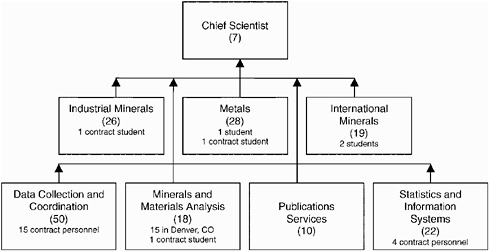
FIGURE 4.1 MIT organizational chart.
NOTE: Of the 180 employees, 22 are contract employees and 3 are student appointments. Staffing numbers are in parentheses and are as of August 26, 2002. These numbers include vacancies. Mineral commodity and country specialists are shown in this figure as industrial minerals, metals and international minerals specialists. SOURCE: Data supplied by the USGS.
enter data, produce statistical tables, archive survey data, and protect proprietary data (John DeYoung, USGS, personal communication, 2002).
The MIT’s process of obtaining information today is much the same as it was under the former USBM, and its products are relied on by many of the same users. The surveys are sent to all known operations that produce, process, or consume the surveyed commodity. More than 36,000 forms are mailed annually to approximately 18,000 companies. The survey frequency is as follows:
|
Monthly |
17,604 |
|
Quarterly |
904 |
|
Semiannually |
126 |
|
Annually |
17,591 |
Company surveys are kept proprietary, which MIT personnel believe is an important factor in producing high response rates (John DeYoung, USGS, personal communication, 2002). The Office of Management and Budget requires that a survey achieve at least a 75 percent re-
turn rate to justify its continuation, although a lower response rate is allowed if the survey received represents at least 75 percent of the volume produced. In most cases, production information is aggregated to protect the proprietary nature of individual mining companies’ production values. To maintain confidentiality if there are fewer than three companies producing a given commodity, the MIT does not provide data for that commodity.
The minerals archival and retrieval system captures incoming survey forms in both digital and microfilm media. Historical data that have been stored on 35- and 16-millimeter microfilm are being converted to digital images and managed using the Kofile visual information system. Conversion of current and historical data to digital media ensures their preservation for historical reference and retrieval. In addition, all digital data are backed up with an array of independent disks and on microfilms preserved by the National Archives.
Mineral Commodity and Country Specialists
Once minerals information and data have been obtained, they are compiled and analyzed by mineral commodity and country specialists. The mineral commodity specialists have a wide variety of academic training and relevant practical experience in the commodities for which they are responsible. They participate in industry-specific meetings and visit active operations periodically. Information from surveys is complemented by the specialists’ various sources, including personal contacts. The specialists prepare chapters and reports for publication (see Table 4.1). Mineral commodity specialists are organized into two groups, Metals and Industrial Minerals. In each case a specialist is responsible for one or more commodities. Country specialists are responsible for data and analysis related to mining and minerals production in a country or set of countries in a particular region of the world. Like the mineral commodity specialists, they have a wide variety of educational and work backgrounds. Unlike the mineral commodity specialists, they are responsible for the entire range of mineral commodities produced in their countries. They are responsible for the accuracy of the data on minerals production, industry structure, international trade, and government policies affecting the minerals sector in their country or region. Country special-
TABLE 4.1 MIT Publications
|
Title |
Periodicity |
Quantity in Series |
Total Published per Year |
|
Minerals Yearbook |
|
|
|
|
Commodities |
Annual |
1 |
1 |
|
Countries |
Annual |
4 |
4 |
|
States |
Annual |
1 |
1 |
|
Mineral Industry Surveys |
|
|
|
|
Commodities |
Annual |
86 |
86 |
|
|
Semiannual |
2 |
4 |
|
|
Quarterly |
8 |
32 |
|
|
Monthly |
22 |
264 |
|
Directories |
Annual |
13 |
13 |
|
States |
Annual |
51 |
51 |
|
Countries |
Annual |
163 |
163 |
|
Metal Industry Indicators |
Monthly |
1 |
12 |
|
Stone, Sand, and Glass (World Wide Web only) |
Monthly |
1 |
12 |
|
Mineral Commodity Summaries |
Annual |
1 |
1 (91 chapters) |
|
Minerals and Materials Information CD-ROM |
Thirdly |
1 |
3 |
|
SOURCE: Data supplied by the USGS. |
|||
ists often have knowledge of the languages of their countries. Not only do mineral commodity and country specialists have primary responsibility for the accuracy of the data on their industries and countries, they also, in effect, become the federal government’s experts on their commodities and countries. They are consulted by professionals in other federal entities, including the Commerce Department, Congress, Federal Reserve Board, Treasury Department, and Environmental Protection Agency. Mineral commodity and country experts also respond to inquiries from state and local governments, private companies, students, and other individuals (Barsotti et al., 1998).
Publication Services
Once the reports are prepared, reviewed within the USGS, and approved for publication, the publications services section coordinates editing, proof reading, and timely publication of the various reports issued by the MIT. Publications are currently disseminated via electronic means (CD-ROM and World Wide Web). Dissemination in printed form by facsimile was terminated in March 2002 and by mail in January 2003. Of particular note are the number of downloads of MIT documents—some 1.8 million in 2002, compared to fewer than 100,000 as recently as 1996 (John DeYoung, USGS, personal communication, 2002).
MIT releases a number of periodic publications (Barsotti et al., 1998). The Minerals Yearbook is an annual report compiled and published in three volumes. These reports are generally published within nine months from when data gathering is completed. Volume I covers more than 90 mineral commodities and derivative industries worldwide, with special emphasis on domestic industries. Volume II is an area report on domestic production and industries by state. Volume III consists of international area reports of about 190 countries grouped into seven regions. Unlike Volumes I and II, the international reports also include data on the production of energy minerals. Because of the lag time between data acquisition and publication of the Minerals Yearbook, they are regarded as summaries of mineral industry events for that given year.
The Mineral Industry Surveys provide timely information about key domestic mineral and metals industries at the mine and processing levels of production. For many of these commodities, data on shipments, imports, and exports are also included. Depending on the commodity, Mineral Industry Surveys are published monthly, quarterly, semiannually, and annually. In general, Mineral Industry Surveys are completed and released to the public within 45 days from the time data gathering has been completed. Because of the relevancy of the data, these reports continue to be of paramount importance to the USGS minerals information mission.
Mineral Commodity Summaries is perhaps the most used annual report emanating from the USGS on mineral industry data. For each of more than 80 mineral commodities, earliest possible world production and resources statistics are combined with the most recent domestic supply, apparent consumption, and price information in a two-page synopsis. Similar data for the previous four years are also included. This report
generally comes out in February with the most current estimated data reflecting previous year-ending statistics. The Mineral Commodity Summaries has the widest distribution of all the USGS minerals information publications.
Metal Industry Indicators is a monthly publication examining the near-term economic health trends of the U.S. metals industry with the focus on primary aluminum, primary copper, and steel, by tracking the changes and trends in the business cycle and how those changes are related to the metals industry. These data complement the economic data—that is, production, shipments, consumption, and prices. Principal users of the Metal Industry Indicators are the federal government, financial institutions, and news organizations. Other users are mining companies, primary metal producers, manufacturers, and trade associations.
The MIT makes available, through the Government Printing Office, several CD-ROM products:
-
Minerals and Materials Information is published three times a year and includes Mineral Commodity Summaries, Mineral Yearbook, and Statistical Compendium in Adobe Acrobat PDF and TextWare formats.
-
Indices to U.S. Bureau of Mines Mineral Resources Records, which contains Minerals Availability System/Mineral Industry Location System (MAS/MILS) records.
-
Economic Analysis Tools for the Minerals Industry.
-
Dictionary of Mining, Mineral, and Related Terms.
In addition to the scheduled reports, mineral commodity and country specialists distill and combine minerals-related information from multiple sources in special studies and reports or papers on issues related to one or more specific mineral commodities or countries. Specialists author or coauthor mineral-commodity-related articles for industry and professional periodicals. USGS mineral statistics are also used and printed in many other annual publications, such as The World Almanac and the National Mining Association’s State Mining Annual—Mineral & Coal Statistics. Approximately 740 minerals information publications, counting special reports, etc., are published annually by the MIT.
Statistics and Information Systems
MIT’s statistics and information systems section collects, processes, and publishes mineral statistics through the following activities:
-
Develop, disseminate, and update statistical standards for the MIT (e.g., survey forms, conversion factors, rounding, significant digits).
-
Conduct and develop statistical methods for sampling surveys, estimation of nonresponse, forecasting, and data analysis methodology.
In addition, this section works to develop and implement management tools for evaluating programs with respect to timeliness and quality of MIT information products, and to provide factual information for management use to improve the accuracy and timeliness of mineral statistics (Mlynarski, 1997; Kenneth Mlynarski, USGS, personal communication, 2002). The section also prepares reports on the status of MIT’s operations. A minerals information system timeliness report is issued monthly. The Office of Management and Budget requires that data collected under the Paperwork Reduction Act be made available to the public promptly. The MIT’s goal is to do so within 45 working days. Statistical process control charts are issued semiannually to identify activities of the statistics and information systems section that require special attention to conform to publication timeliness targets.
The statistics and information systems section manages the design, modification, and printing of electronic survey forms. When necessary, new survey forms are designed or existing forms are modified in accordance with federal regulations and the requirements of program personnel. A survey forms catalog is prepared annually.
A major part of the section’s responsibilities relates to the design and development of the automated minerals information system. This system assists in the management of U.S. import and export data, central mailing and respondent control, all data collected via surveys, and production of all statistical tables for inclusion in the MIT’s various publications.
Survey response summary reports, issued quarterly, track the response rate of about 130 surveys to ensure that the 75 percent response rate required by the Office of Management and Budget is met (Mlynarski, 1997; Kenneth Mlynarski, USGS, personal communication, 2002). If this rate is not met, the section tracks whether the 75 percent goal for the key statistic reported, such as total production or total consumption, is met.
Minerals and Materials Analysis
The minerals and materials analysis section conducts research on material flows, sustainable development, industrial ecology, and other topics. Material flows are the subject of a concurrent NRC study assessing these needs for national material flows accounts (NRC, 2003). Some activity is also currently under way in the collection and maintenance of exploration statistics. The minerals and materials analysis section works primarily on self-generated projects, typically performed in collaboration with other parts of the USGS and other federal agencies. In some respects the minerals and materials analysis section represents MIT’s attempt to maintain an analytical, as compared to data-collecting, capability.
Studies of material flows have been done on arsenic, cadmium, chromium, cobalt, manganese, mercury, salt, sulfur, tungsten, vanadium, and zinc. These studies entailed a description of the one-year tracking of the flow of these commodities from the time they were extracted, through processing, manufacturing, use, and their ultimate destination as a waste or reusable resource in the domestic economy. Losses at the extraction and various processing steps were identified and quantified where possible. Attempts were made to obtain a material balance in the flow for the given year. The reports from these studies of material flows provide a perspective on minerals as the basic raw materials of the economy, how society uses them, and what ultimately happens to them or their derived products. The information gained also provides insight on environmental and sustainability issues associated with these minerals (Barsotti et al., 1998).
PARTNERS AND USERS
The MIT considers its partners to be establishments and government agencies with which it works to collect domestic minerals data. The MIT estimates that more than 18,000 producer and consumer establishments voluntarily participate in data collection by completing some 40,000 canvass forms annually. In addition, the MIT has memoranda of understanding for data collection with 46 of the 50 states.
The MIT considers its users to be those entities that use MIT information and consult with the mineral commodity and country specialists. Use of the term “user” here is consistent with how the term is used in Sidebar
2.2 referring to the rest of the MRP. Much of the work of the MIT focuses on information relevant to mineral economics, and thus the group of entities using MIT information is somewhat different than the user group of MRP science and information. Representative users of MIT information and analysis include the following:
-
Environmental Protection Agency (EPA), which considers MIT data and specialists the starting points for any analysis involving mining. The EPA consults the mineral commodity and country specialists in explaining and interpreting the data. Especially important for EPA analyses are historical data on minerals production. The EPA relies on the integrity of MIT information, which is almost never challenged (Steve Hoffman, EPA, personal communication, 2002).
-
Department of Energy, which used MIT information to create its mineral profiles as part of its Mining Industry of the Future project.
-
Federal Reserve Board, which uses MIT data as inputs to the indexes of industrial production index and capacity utilization.
-
International Trade Commission, which makes extensive use of data on international trade in minerals and on minerals production outside the United States. The International Trade Commission would like to see greater emphasis placed on ensuring that MIT data conform to commonly used classification systems, such as the harmonized tariff schedule (Chris Mapes, International Trade Commission, personal communication, 2002).
Table 4.2 contains a more extensive list of users of MIT information and analyses.
DISCUSSION
The MIT produces high-quality data series on minerals production, consumption, and other market data. Country and mineral commodity specialists provide interpretations and analyses of these data. In addition, the MIT carries out a limited amount of analytical work transcending specific commodities and countries in areas such as recycling, industrial ecology, and material flows.
TABLE 4.2 List of Users of MIT Information and Analysis
|
Federal, State, and Local Governments |
|
Department of Defense |
|
Environmental Protection Agency |
|
Mine Safety and Health Administration |
|
Department of Energy |
|
Department of State |
|
Department of Justice |
|
Department of Commerce (including Bureau of the Census and Bureau of Economic Analysis) |
|
Federal Reserve Board |
|
Office of the U.S. Trade Representative |
|
Defense Intelligence Agency |
|
Central Intelligence Agency |
|
Congressional Budget Office |
|
U.S. Customs Service |
|
Department of the Interior |
|
Department of Agriculture |
|
Department of Treasury |
|
50 States |
|
Domestic Private Entities |
|
Trade press (e.g., American Metal Market, Metals Week, Engineering and Mining Journal) |
|
Trade associations (e.g., American Iron and Steel Institute, National Mining Association, National Stone Association) |
|
Educational institutions, including universities |
|
General public (including requests under the Freedom of Information Act) |
|
International Organizations |
|
World Bank |
|
United Nations |
|
Multilateral development banks |
|
International commodity study groups (e.g., International Copper Study Group) |
|
SOURCE: Data supplied by the USGS. |
A variety of speakers from government agencies, many of them partner agencies of the USGS (e.g., the Federal Reserve Board and the International Trade Commission), spoke to this committee about the continuing value of the MIT’s traditional functions and products. There was wide praise for the availability and usefulness of the statistical data generated by the MIT. These representatives indicated that the data are used in many arenas, ranging from foreign policy to international and domestic commerce. Several of the agency representatives stated that the advice and information provided informally by the mineral commodity and country specialists were just as valuable as the published data.
The committee concludes that the MIT has done a good job of making the transition from the Bureau of Mines to the USGS and, moreover, has performed very well in helping the USGS and its partner agencies meet their goals. This committee has recommendations in three areas aimed at enhancing the already important work of the MIT.
External Review
Many, if not most, of the data series collected by the MIT have been collected for many years by the USGS and previously by the Bureau of Mines without an ongoing and systematic review of the nature and overall scope of the data collected. In an era of declining real (inflation-adjusted) budgets for its activities, the MIT needs to consider carefully which data it collects and needs to assess whether there continues to be a national need for the data it collects. Furthermore, the team’s core competencies of producing data and information products should be examined in light of the many data collection and survey needs in other parts of the USGS.
The committee recommends that the MIT establish a permanent advisory committee consisting of a wide range of users of MIT data and analysis to ensure that its activities are fully updated and of relevance to its users. The advisory committee would meet approximately once a year to review the nature and overall scope of MIT activities, including what data should and should not be collected. The membership of the advisory committee should be rotated so that it has an appropriate balance between new blood and historical memory at each meeting.
An additional benefit of an external advisory committee—beyond optimizing the scope of MIT activities—would be through the role it
could play in helping to explain the value of MIT information and analysis to Congress, the administration, and the public at large.
Information Analysis
The MIT is so active collecting data that qualified mineral commodity specialists, country experts, and researchers in the minerals and materials analysis section are hindered in contributing to basic research and in advising other federal entities on public policy matters. The MIT, as do all statistical agencies, always has to deal with the more purely statistical issues such as survey response rates, format of data delivery, and timeliness of data release. These functions need to be carried out optimally to increase time for research and advisory activities.
One of the important areas in which the MIT should have analytical activities is minerals availability—not just the purely physical (or geological) availability of mineral resources but also the economic and environmental dimensions. There is no foreseeable geological shortage of most minerals, at least on a worldwide basis. Rather, the important availability concerns center on the location-specific issues of costs of production, potential environmental damage associated with mining and mineral processing, and potential social disruptions sometimes caused by mining.
To the extent that resources are known and probably controlled by a mining company, information on location-specific issues will be available to the company. Current efforts by the mining industry and regulators may result in more of this information being made public. Cooperation between the USGS and mining professional societies will result in improved definitions and classifications of resources.
Material flows analyses, which attempt to quantify some of these availability issues, represent one important area for MIT analytical activity. Material flows studies require significant data on production, consumption, waste, recycling, and appropriate substitutes in order to provide an accurate balance calculation and public policy guidance. Another source of material flows inputs comes from the treatment of ground water (e.g., the new EPA arsenic standard) as well as treatment of “produced waters” from oil and gas wells and waste products from terrestrial desalination plants.
Detailed interaction between team members and research scientists could improve data collection and data products for the material flows
studies. Information provided by these material flows studies could be incorporated into the global mineral resource assessment (see Chapters 2 and 5) and could significantly enhance its value.
The committee concludes that the expertise and experience of the MIT mineral commodity specialists, country specialists, and researchers in the minerals and materials analysis section are important resources. The committee recommends that the MIT’s analytical activities and capabilities be strengthened so that mineral commodity specialists, country specialists, and other MIT researchers can conduct more material flows studies and work more directly with the mineral assessment and environmental scientists in their basic research.
Integration
Relocation of the MIT within the MRP of the USGS provides an opportunity for collaboration with other parts of the MRP, which in turn could enable a beneficial broadening of the role of the MIT in satisfying national needs. The MIT is composed of individuals with a wide range of expertise whose primary focus is on past, present, and future minerals production. The databases are organized primarily on metal or mineral commodities. Classification by commodity is usually not compatible with resource identification and assessment of mineral resources used by MRP geologists, which is based on mineral deposit types. Estimating the probability of undiscovered resources existing in any specific region is based on a set of quantitative mineral deposits tonnage and grade models. This type of analysis may easily be transformed into predicted commodity abundances but not vice versa. Given that any interruption of supply due to unexpected political instability or terrorist activities could cause a significant rise in the prices of these commodities, conducting worldwide assessments of mineral resources is an important use of both deposit-type and commodity classifications of resources.
Communication and interaction between mineral deposits geologists within the MRP and the appropriate mineral commodity specialists within the MIT would broaden the horizons of both groups and create an understanding of strategic resources throughout the world that would provide the federal government with additional information necessary for sound public policy decisions. The MIT has considerable expertise in mineral economics and public policy. The geoscientists in the MRP have
considerable expertise in the scientific underpinnings of minerals potential and supply. The MIT needs to take better advantage of the geoscience expertise of the MRP in designing and carrying out MIT projects and should increase its contribution to the MRP’s geoscience activities.
The committee concludes that the MRP produces and maintains a large volume and variety of minerals information, which is not easily used in the estimation of mineral resources. Having increased interaction and partnerships with MRP staff would be one way to leverage the expertise from each group and provide more easily analyzable data. The committee recommends that the MIT work with the MRP resource assessment team to improve the classification and usefulness of its data. This would be a particularly important contribution to the MRP’s global mineral resource assessment project.
SUMMARY
The committee concludes that the MIT has done a good job of making the transition from the Bureau of Mines to the USGS and has performed very well in helping the USGS and its partner agencies meet their goals. This committee has three recommendations it believes will enhance the already important work of the MIT: (1) establish an advisory committee to ensure that MRP activities are fully updated and of relevance to its user base, (2) strengthen MIT’s analytical activities and capabilities so that mineral commodity and country specialists and other MIT researchers can conduct more material flows studies and work more directly with the mineral assessment and environmental scientists in their basic research, and (3) work with the MRP resource assessment team to improve the classification and usefulness of domestic and global mineral resource assessment data.


