
6
Technology and Employment
Sara J. Czaja and Phyllis Moen
DEMOGRAPHIC TRENDS RELATED TO AGING, WORK, AND RETIREMENT
How Many Older Adults Are There?
A number of demographic trends—including the aging of the population; changes in the labor-force participation of younger workers; the aging of the baby boom cohort; and changes in retirement policies, programs, and behavior—are fostering new interest in older workers. By 2010 the number of workers age 55+ will be about 26 million, a 46 percent increase since 2000, and by 2025 this number will increase to approximately 33 million. Although labor-force participation rates are projected to be slightly greater for older women than for older men, the labor-force participation rates for older males are also expected to increase. There will also be an increase in the number of workers over the age of 65 (Fullerton and Toossi, 2001; U.S. General Accounting Office, 2001) (see Figure 6-1).
Recently the trend experienced in the 1970s and early 1980s of workers permanently leaving the work force “early” has reversed (Costa, 1998; Purcell, 2002; Quinn, 2002). The traditional assumption that “retirement” from career jobs is isomorphic with workers′ final exit from the labor force is increasingly obsolete, as people in their 50s, 60s, and 70s move in and out of paid (and unpaid) work. Retirement from one′s full-time, primary career job can no longer be assumed to occur at the time of workers′
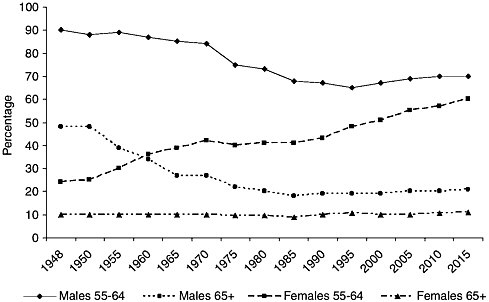
FIGURE 6-1 Labor-force participation rates for older workers, by sex, 1948-2015.
SOURCE: Adapted from U.S. General Accounting Office (2001, p. 9).
eligibility for Social Security benefits or to mean the total cessation of paid employment. Most older workers, according to a variety of studies (e.g., AARP, 2002), say they would prefer to continue to be engaged in some kind of work following their retirement, and a significant number of full-time retirees say they would like to be employed. Many workers view the years approaching retirement as a time for “midcourse corrections” (Moen and Freedman, 2003) rather than a final exit from employment. Instead of full-time leisure, workers and retirees in their 50s, 60s, and 70s (what Moen [2003] calls the “midcourse” years) are increasingly seeking more work options: reduced hours, more time off over the year, special project or contract work, part-time work, and even the opportunity to start second (or third) careers (including unpaid community service). In response, growing numbers of employers are providing a variety of options to bridge the passage from full-time career employment to full-time (complete) retirement (e.g., Watson Wyatt Worldwide, 1999). Programs like these may be especially beneficial for working caregivers who often need to decrease their work hours or have flexible work schedules to meet their caregiving responsibilities. The Cornell Retirement and Well-Being Study (Dentinger and Clarkberg, 2002) found that women caring for their husbands were five times more likely to retire than those without such care
responsibilities. Currently, approximately 15 million American workers are involved in some type of caregiving for an older relative such as a parent or spouse (Family Caregiver Alliance, 2002).
Because of the projected increase in the aged dependency ratio (the ratio of the population age 65 and older to the working-age population age 20-64) (see Figure 6-2) and the average length of retirement, there have also been several changes in retirement policies to create incentives to work longer. For example, the Social Security Act was amended in 1983 to gradually increase the minimum age of full benefits for retirement from 65 to 67. The practice of reducing Social Security benefits when a person has earnings and has reached the normal retirement age has been eliminated, and the delayed retirement benefit for those who first claim benefits after normal retirement age is steadily being increased. In addition, the Age Discrimination in Employment Act was amended in 1986 to eliminate a mandatory retirement age for most occupational groups.
The Americans with Disabilities Act (ADA), which became law in 1990, also has important implications for the employability of older people. The passage of the ADA shifted the focus of disability policy in the United States from eligibility for public income transfers to ending discrimination and removing barriers (employers are to make “reasonable accommodations”) that prevent people with disabilities from obtaining or remaining in paid work (Burkhauser and Daly, 2002). This oc-
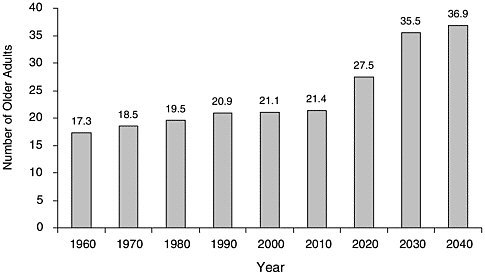
FIGURE 6-2 Past and projected older adults per 100 workers age 20-64.
SOURCE: Board of Trustees, Federal Supplementary Medical Insurance Trust Fund (1997, p. 148).
curred in tandem with technological advances and the growth of jobs in the service sector, both of which widened employment possibilities for those with disabilities.
As the work force ages, the number of people with a disabling health condition will increase. The onset of a disability often triggers an exit from the work force that leads to “total” retirement. Thus, understanding how assistive devices and adaptive technologies can be used to compensate for disabilities is critical to accommodating an aging work force. Disability, according to the ADA definition, includes those with a physical or mental impairment limiting one or more major life activities, with a history of or being seen as having an impairment. As we discuss in this chapter, “accommodations” can encompass a wide variety of changes in work environments.
Employers have also turned their attention toward older workers because of the slowed growth in the number of younger workers. Over the next few years the number of workers age 25-54 years is expected to decrease. This could create labor shortages, especially in skilled and managerial occupations. Some companies are turning to older workers to fill these positions and are providing flexible employment arrangements such as part-time work, telecommuting, and financial benefits to retain or recruit older workers.
Finally, many older people desire or need to continue working for financial or social reasons. In fact, findings from a recent survey (AARP, 2002) indicate that money and healthcare coverage were cited as the major reasons for the desire to continue to work. These findings are consistent with other data that suggest that workers with pension coverage are more likely to retire than workers without pension coverage and that those who would lose health insurance coverage are less likely to retire (Uccello, 1998).
Clearly there is a need to develop strategies to prepare for and accommodate an aging work force. This requires understanding (1) the characteristics of the older workers and the growing population of older adults who do not work; (2) the potential implications of aging for work and work environments; (3) the technological and social characteristics of existing jobs and work environments; and (4) the triggers, dynamics, and processes moving people into and out of employment. When addressing these issues we believe there is considerable value in distinguishing between “older” workers and retirees in their 50s, 60s, and early 70s and those in their late 70s, 80s, and 90s. Unfortunately, most extant studies of abilities and technology use tend to group people as 65+ or 55+. As the baby boomers move into and through their 50s, understanding the differences among the various subgroups within the older adult population will become increasingly important.
Characteristics of the Older Adult Population
In general, older Americans today are healthier, more diverse, and better educated than previous generations (Bass, 1995). Between 1970 and 2000 the percentage of adults aged 65+ who had completed high school increased by about 40 percent, and in 2000 at least 16 percent of people in this age group had at least a bachelor′s degree. Increased levels of education should be beneficial for older workers, as higher levels of education are generally linked to higher income and increased employment opportunities. Occupations requiring a bachelor′s degree are expected to increase by about 22 percent by 2010, and all but two (air traffic controllers and nuclear power reactor operators) of the 50 highest paying occupations will require a college degree (Bureau of Labor Statistics, 2002).
On some indices, today′s older adults are healthier than previous generations. The number of people 65+ reporting very good health and experiencing good physical functioning, such as ability to walk a mile or climb stairs, has increased in recent years. Disability rates among older people are also declining (Federal Interagency Forum on Aging Statistics, 2001). However, the likelihood of developing a disability increases with age, and many older people have at least one chronic condition such as arthritis or hearing and vision impairments (Clinical Geriatrics, 1999) (see Figure 6-3). As discussed by Schaie (this volume), cognitive and memory impairments also increase with age.
Disability among older adults has important implications for workplace and job design. Employers may need to adapt workplaces or provide adaptive equipment or technology (such as low-vision aids) to workers who have functional limitations. Generally, labor-force participation rates are lower and retirement rates are higher for people with chronic conditions. People with disabilities, especially disabled elders and minorities with disabilities, are also less likely to use technology such as computers both at home and at work (Kaye, 2000; U.S. Department of Commerce, 2000) (see Figure 6-4).
Consistent with demographic changes in the U.S. population as a whole, the older population is becoming more ethnically diverse. The greatest growth will be seen among Hispanic persons, followed by non-Hispanic blacks. Work policies, programs, and services will require greater flexibility to accommodate this diverse population. For example, currently individuals from ethnic minority groups are less likely to own or use technologies such as computers. This implies that technology access and training programs need to be targeted for older minority populations. Computer and Internet use also tends to be lower in low-income households, although over the past several years both computers and Internet use have increased steadily across all income categories (U.S. Department of Commerce, 2002). This also points to the importance of
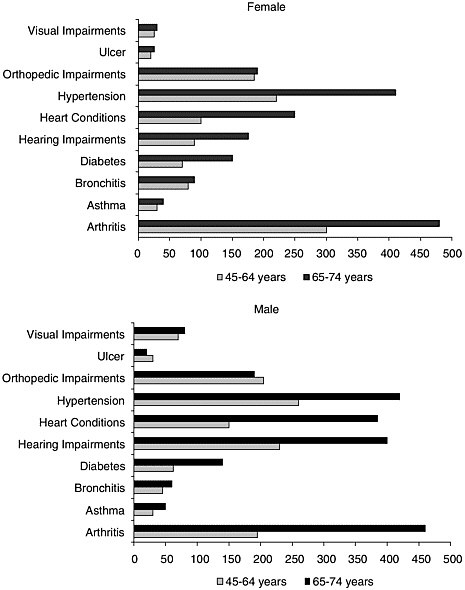
FIGURE 6-3 Chronic illness and the U.S. population (number of persons per 1,000).
SOURCE: Clinical Geriatrics (1999, 8, p. 77).
ensuring that all people have equal access to technology and technology training.
Finally there are more older women than men, and the proportion of the population that is female increases with age (see Chapter 1 in this volume). The higher percentage of older females may have implications
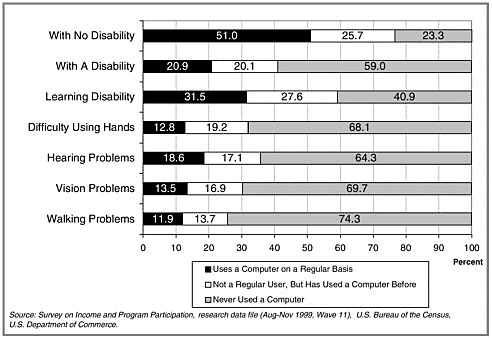
FIGURE 6-4 Personal computer use by disability status, 1999.
SOURCE: U.S. Department of Commerce (2000, p. 66).
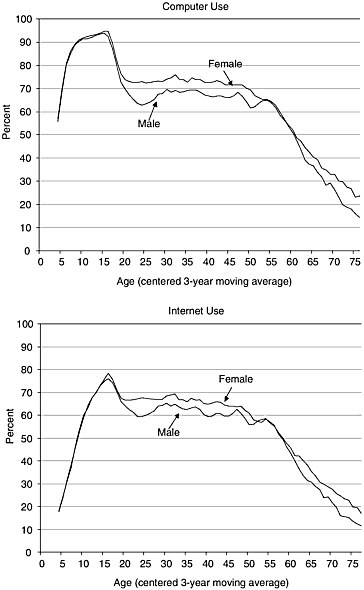
for employment, as in recent years older women have been more likely to continue working or return to work than older men. Because of occupational differences, the use of computers at work is greater among females (~63 percent) than males (~51 percent). This difference is consistent across all ages (U.S. Department of Commerce, 2002). As we discuss below there are gender differences, in general, in computer use such that women aged 60+ are less likely than men to use computers (U.S. Department of Commerce, 2002) (see Figure 6-5). Thus, for the current cohort of older women returning to work, the need for computer training may be somewhat greater than for older males. In sum, health status, gender, race, educational background, cultural traditions, and economic circumstances may all influence employability and the adoption of new technologies that might prolong engagement in paid work.
Age-Related Changes in Abilities
Here we provide a brief summary of age-related changes in abilities that have relevance to work performance. A more detailed discussion of
these topics is provided in Chapters 2 and 3 of this volume. It is important to recognize that aging is associated with substantial variability, and older adults as a group are very heterogeneous. For many indices of performance there are greater differences within the older population than between older and younger age groups. Also, as noted, “older” workers and retirees in their “midcourse” years differ from what we think of as frail elders. Thus, although we can discuss age-related trends in abilities, predictions about an individual′s ability to learn a new skill or perform a particular job should be based on that individual′s functional capacity relative to the demands of that job or that skill rather than on chronological age.
As shown in Table 6-1, there are a number of changes in abilities associated with “normal” aging that have implications for work. Sensory impairments are common in older people (see Schaie, this volume). For example, currently about 17 million people in the United States over the age of 45 suffer from some type of visual impairment that is not corrected by glasses or contact lenses, and the incidence of visual impairment increases with age (Leonard, 2002). This has vast implications for today′s computer-oriented workplace, given that interaction with computer systems is primarily based on visually presented information. Visual decrements may make it more difficult for older people to perceive small icons on toolbars, read e-mail, or locate information on complex screens or web sites. Age-related changes in vision also have implications for the design of written instructions and training manuals and for lighting requirements.
Many older adults also experience some decline in audition that has relevance to work settings. For example, older people may find it difficult to understand synthetic or compressed speech, as this type of speech is typically characterized by some degree of distortion. High-frequency alerting sounds such as beeps or auditory feedback on equipment may also be difficult for older adults to detect. Changes in audition may also make it more difficult for older people to communicate in noisy work environments. As we discuss below, a number of adaptive technologies are available to accommodate sensory impairments.
Aging is also associated with changes in motor skills, including slower response times, declines in ability to maintain continuous movements, disruptions in coordination, loss of flexibility, and greater variability in movement (see Ketcham and Stelmach, in this volume). The incidence of chronic conditions such as arthritis also increases with age (see Figure 6-3). These changes in motor abilities may make it difficult for older people to perform tasks such as assembly work that requires fine manipulation or to use common input devices such as a mouse or keyboard. Alternative input devices such as a light pen or speech recognition may be preferable
TABLE 6-1 Potential Implications of Aging for Work Activities
|
Impairment |
Activity |
|
Visual impairments |
Read text, instructional manuals, computer screens Locate information on complex displays Perform tasks that involve fine visual discriminations (e.g., industrial inspection, microscope work) Lighting requirements |
|
Auditory impairments |
Comprehension of synthetic speech Detection of auditory signals or alerting sounds Speech communication (telephone or face to face) |
|
Changes in motor skills |
Performance of tasks that require small manipulations (e.g., fine assembly work) Use of computer input devices (e.g., mouse, keyboard) |
|
Changes in cognitive abilities |
Learning new skills or procedures Recall of complex operating procedures or instructions Time-sharing; performance of concurrent activities Locating information on complex displays Performance of paced tasks |
|
Declines in strength and endurance |
Reduced ability to perform physically demanding jobs (e.g., manual materials handling, construction) |
for older people. Older adults also tend to have reduced strength and endurance and are generally less willing and able to perform physically demanding jobs.
Age-related changes in cognition also have relevance to work activities, especially in tasks that involve the use of technology. Adoption of new technology requires learning new skills and new ways of performing tasks. Declines in working memory may make it difficult for older people to learn new concepts or skills or to recall complex operational procedures. Declines in attentional capacity may make it difficult for older people to perform concurrent activities or to switch their attention be-
tween competing displays of information. They may also have problems attending to or selecting task targets on complex displays such as overly crowded web sites. Highly paced work or tasks that emphasize speed of performance, such as data entry tasks, may also be unsuitable for older workers.
Aging and Work Performance
The postulated relationships between age-related changes in sensory, motor, and cognitive abilities and work performance discussed above are primarily speculations. Although there is a great deal of information about aging as a process, there are limited empirical data on the practical implications of aging for work activities. The majority of studies regarding the impact of age-related changes in abilities on performance are based on laboratory tasks (e.g., Diehl, Willis, and Schaie, 1995; Salthouse, Hambrick, Lukas, and Dell, 1996; Czaja and Sharit, 2003). Typically, laboratory tasks fail to capture the contextual elements that are present in work environments and may not allow older people to evoke compensatory strategies that are used in real-world settings.
Common beliefs about older workers include that they are physically unable to do their jobs; have a high rate of absenteeism; have a high rate of accidents; are less productive, less motivated, and less receptive to innovations than younger people; and are unable to learn (Peterson and Coberly, 1988). Although these beliefs persist, data to support them are scarce; in fact, most research studies that are available indicate that these stereotypes are inaccurate.
With respect to age and productivity, the available data are limited, especially for technology-based jobs. Several extensive reviews of the literature on aging and work performance have been conducted (e.g., Rhodes, 1983; Waldman and Avolio, 1986; McEvoy and Cascio, 1989; Avolio, Waldman, and McDaniel, 1990), and the general conclusion of these reviews is that there is little evidence to suggest that work performance declines with age. It appears that the relationship between age and work performance is dependent on the type of performance measure, the nature of the job, and other factors such as experience. For example, studies that rely on supervisory ratings of performance may be biased if the rater has negative attitudes about older workers. In addition, many studies have methodological problems such as small samples or restricted age ranges, or they are cross-sectional—which may confound age effects with factors such as experience, education, or exposure to technology. Finally, the number of studies conducted in actual employment settings has been limited. Also much of the research pertaining to aging and work performance has not included a detailed analysis of contextual factors, such as
opportunities for retraining, which have an impact on work ability (Avolio, 1992).
To date, there have only been a handful of studies that have examined the ability of older people to perform computer-based tasks that are common in work settings. Generally, these data suggest that, overall, older adults are willing and able to perform these types of tasks. However, there may be age differences in the performance of some tasks such as data entry where the emphasis is on speed and accuracy of performance (e.g., Czaja and Sharit, 1993, 1998, 1999). Importantly, the data also indicated that, similar to other age groups, there is considerable variability in performance of older people and that, with task experience, performance improves for people of all ages. In addition, the data clearly show that usability issues have an impact on performance and that design interventions such as redesigning the interface, providing on-screen aids, and reconfiguring the timing of the computer mouse can result in performance improvements. Finally, the data indicate that it is important to provide people (especially those with limited technology experience) with training on the use of the technology as well as the task.
With respect to other measures of job behavior, the findings, although limited, are more conclusive. Older workers tend to have lower accident rates than younger workers; however, older workers tend to remain off the job longer if they are injured (Panek, 1997). Absenteeism and turnover rates also appear to be lower for older adults (Martocchio, 1989).
Occupational Trends
Older workers, like younger ones, hold a wide variety of occupations; however, there is some variance according to age. For example, about the same percentage of workers in the age ranges of 40-54, 55-64, and 65+ are employed in white-collar occupations. However, a smaller proportion of workers age 65+ than of younger workers are in physically demanding blue-collar occupations. In the future the percentage of older workers will increase in all occupational categories, with the greatest increase occurring in white-collar occupations such as managers, healthcare professionals, administrative support, and sales (U. S. General Accounting Office, 2001) (see Figure 6-6).
General projections regarding the labor force can also be used to gain some understanding of employment opportunities for older people. In the next few years a gain of about 6.9 million jobs is projected for professional and related occupations such as computer and technical specialists and healthcare practitioners. The second largest growth rate will be seen in the service occupations, such as customer service representatives and healthcare support workers. Other occupations that will experience
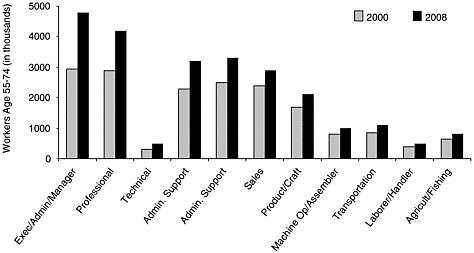
FIGURE 6-6 Projected change in the number of workers age 55+ by occupation, 2000 and 2008.
SOURCE: U.S. General Accounting Office (2001, p. 13).
growth include management and financial occupations, sales, office and administrative support operations, and technology maintenance and repair occupations, especially within the telecommunications industry (Bureau of Labor Statistics, 2002). If the labor-force distribution of older workers remains the same, older people will be in industries that are likely to experience growth. However, this does not necessarily mean that employment opportunities will expand for older workers. A number of factors such as the job and skill requirements of these occupations and receptivity to older workers by employers and organizations influence this equation. Almost two-thirds of the projected job openings in the next 10 years will require on-the-job training (Bureau of Labor Statistics, 2003).
The data also suggest that technology will have a major impact on the future structure of the labor force. Most workers including older workers will need to interact with some type of technology to perform their job. Computer occupations such as computer software engineers, computer support specialists, and network and computer systems administrators will account for 8 out of the 20 fastest growing jobs (Bureau of Labor Statistics, 2003); and the use of computers and other forms of technology is becoming more prevalent in other occupations. In 2001, more than half of the labor force used a computer at work (U.S. Department of Commerce, 2002). This number is expected to increase as developments in technology continue. Furthermore, the number of people who are telecommuting is rapidly increasing. In 1995 at least three million Americans
were telecommuting for purposes of work, and this number is expected to increase by 20 percent per year (Nickerson and Landauer, 1997). Telecommuting may be particularly appropriate for older adults, as they are interested in alternative work schedules and are more likely than younger people to be “mobility impaired.” Telecommuting allows for more flexible work schedules and more autonomy than the traditional workplace and is more amenable to part-time work. On the negative side, exclusive telecommuting from home may result in professional and social isolation. Employees may miss the opportunities for interacting with friends and colleagues and participating in and receiving the benefits of organizational membership. Managers often fear that it will be difficult to monitor people who work at home. To date, little research has been devoted to examining the social, behavioral, and organizational implications of telecommuting.
TECHNOLOGY AND AN AGING WORK FORCE
The Potential Impact of Workplace Technology on Older Workers
Given the widespread use of technology in most occupations, one important issue concerns how the influx of technology will affect employment opportunities for older workers. As discussed above, technology influences the types of jobs that are available, creating new jobs and opportunities for employment for some and eliminating jobs and creating conditions of unemployment for other workers. Technology also changes the way in which jobs are performed and alters job content and job demands. Often, existing job skills and knowledge become obsolete and new knowledge and skills are required. Workers not only have to learn to use technical systems, but they must also learn new ways of performing jobs. This will hold true for future generations of older adults, as technology by its nature is dynamic. For example, there have been dramatic changes in the design of cell phones, portable computers, input devices, and personal organizers over the past several years.
Issues of skill obsolescence and worker retraining are highly significant for older workers, as they are often bypassed for training or retraining opportunities (Griffiths, 1997). They may also be less willing to invest in retraining, as they may have a decreased expectancy of obtaining valued outcomes (such as promotion), or the value of these outcomes may diminish with age (Fossum, Arvey, Paradise, and Robbins, 1986). Today′s older workers are also less likely than younger workers to have had exposure to technology such as computers (e.g., Czaja and Sharit, 1998). Older workers who lack certain skills or training may be seen as redundant and either encouraged or forced to leave the work force. Also, when techno-
logical changes in work reduce the number of workers needed, firms often respond by offering early retirement packages to “eligible” workers (those with a certain number of years′ tenure or of a certain age) to avoid layoffs. For many older workers, the implicit message is to take the incentive package and retire, or else face layoff in the future. Women are less likely to receive such packages; many have moved in and out of the work force and do not satisfy the tenure requirements for eligibility (Han and Moen, 1999a, 1999b, 2001).
Problems with usability may also make it difficult for older workers to successfully interact with technology. Unfortunately, to date designers of most systems have not considered older adults as active users of technology and thus many interfaces are designed without accommodating the needs of this population (Czaja and Lee, 2002). Usability problems relate to screen design, input device design, complex commands and operating procedures, and inadequate training and instructional support. Although the usability of systems has improved substantially, current interfaces still exclude many people, such as those who are older or people with disabilities, from effective interaction with technology (National Research Council, 1997).
On the positive side, because in many cases technology reduces the physical demands of work, employment opportunities for older people may increase with the influx of workplace technologies. As discussed above, computer technology also makes work at home a more likely option and allows for more flexible work schedules. Finally, as we discuss below, advances in technology may also help older adults with disabilities or impairments
Technology to Support Computer Input
As shown in Table 6-2, there are a number of adaptive technologies that may make continued work more viable for older people, especially those with chronic conditions or disabilities. For example, there are a number of technologies available that can help people with blindness or low-vision problems function in the workplace. These technologies include portable Braille computers, speech synthesizers, optical character recognition systems, screen enlargement software, and video (closed circuit TV) magnifiers. Some computer users can be helped by using a screen with glare protection. Increasing the font size of text may also be necessary. This can be accomplished with font enlargement software or with the accessibility options available in operating systems. Conventional lens magnifiers can be used to help people with low vision access text and paper documents. Braille computers, small portable devices with a Braille keyboard, are also available to enable a person who is blind to
TABLE 6-2 Examples of Adaptive Technologies by Disability Type
|
Impairment |
Adaptive Technologies |
|
Visual |
Screen enlargement software Braille input and output systems Speech synthesis Optical character recognition Video magnifiers |
|
Hearing |
Hearing-aid technologies Personal amplification devices Amplified telephone receivers Text telephones |
|
Hand and mobility |
Voice recognition software On-screen keyboard programs Touch screens Eye-gaze programs |
|
Cognitive |
On-line reminder systems Personal organizers and notebooks |
take notes in a meeting. These computers frequently support speech synthesizers or Braille displays for output. Many Braille computers are also equipped with Braille printers or dynamic Braille displays. Braille translation programs are also available. Synthetic speech programs can be installed onto a computer to convert text to speech output, allowing people with visual impairments to review their input as they type. Optical character recognition systems can be directly connected to a computer so that print can be immediately reviewed and edited or converted to speech. Screen-reading software is available that reads aloud information displayed on computer monitors including text, menu selections, and graphical icons (AbilityHub, 2003). Similarly, speech recognition systems allow people to interface with technology such as computers using their voice rather than a mouse or keyboard.
Similar technologies are available for people with other types of impairments. For example, recent advances in hearing-aid technology such as digital hearing aids have improved the effectiveness of hearing aids for persons with sensorineural hearing loss. Personal amplifying devices and amplified telephone receivers can be also used to aid persons with hearing loss. Amplification devices can also be attached to the computer. How-
ever, it is important when using any type of amplification device to provide personal headsets to avoid disturbing others in the workplace. Text telephones, such as the telecommunication device for the deaf (TDD), and software that allows a computer with a modem to emulate a TDD are also available that allow persons with hearing impairments to communicate over phone lines. Computers can also be used as educational tools for individuals who are hearing impaired and aid with learning written language (e.g., grammar, proper use of terms). They can also be used in speech therapy and to aid in the translation of sign language to written or spoken English (AbilityHub, 2003).
Technology to Support Computer Output
There are a number of adaptive devices available to aid persons with movement or mobility impairments. Voice recognition software, on-screen keyboard programs, or touch screens may be beneficial for persons who have limited ability to use traditional input devices such as a mouse or keyboard because of hand or finger limitations. “Sticky keys” allow a user to execute commands with one hand that involve simultaneous key pressing. Eye-gaze systems allow people with severe motor impairments, such as those who have suffered a stroke, to use their eyes to operate their computer. There also are personal organizers and reminder systems to aid people with memory impairments. For example, software is available to aid people in the planning and performance of complex activities. The Planning and Execution Assistant and Training System (PEAT) (AbilityHub, 2003) is a program that provides cueing and planning assistance for people with memory problems. PEAT helps users plan daily tasks and maintain a schedule. The software includes graphic and auditory reminders of when to start and stop tasks and “scripts” that describe hierarchical, multistep activities. As discussed in Dishman, Matthews, and Dunbar-Jacob (in this volume), there are new developments in bio-medical engineering on the horizon that may also help older people or people with disabilities function independently in the workplace. For example, biosensors that detect and communicate information about irregularities in bodily functions may help someone monitor and control a chronic condition such as diabetes. Gluco Watch, a device similar to a wrist watch that provides general glucose readings and necessary doses of insulin, is an example of the new generation of biosensors (Herrera, 2003). In the near future systems like these will become available for people suffering from other types of diseases that require close monitoring. Other systems that actually deliver the needed medication may also become available.
Clearly there are a number of technologies that can improve the ability of older adults to function in work environments. However, the availability of these technologies does not guarantee their success. The degree to which these technologies improve the work life of older persons depends on the usability of these technologies, the availability of these technologies within organizations, the manner in which these technologies are implemented (e.g., training), and the willingness of older people to use these devices.
Acceptance and Use of Technology by Older Adults
A commonly held belief is that older people are resistant to change and have negative attitudes toward the use of technology. However, the available data dispute this stereotype and indicate that, in general, older people are receptive to using technology if they perceive the technology as useful, if the technology is easy to use, and if they are provided with adequate training and support (Czaja, 1997). Although they may experience more anxiety and less “technology efficacy,” older people′s attitudes toward technology and comfort using technology are largely influenced by experience and the nature of their interactions with these systems. Experience with computers generally increases user comfort and confidence.
Although there are a number of settings such as the workplace, the home, healthcare, and service settings where older people are likely to encounter technology, such as computers, use of technology among people over the age of 55 is still low compared with other age groups (see Figure 6-5). Generally, the percentage of people who use a computer at work also steadily declines with age. Use of the Internet among older people is also lower than that of younger age groups (see Figure 6-5). Only 30 percent of people age 50+ were Internet users in 2000; and although the number of Internet users in this age group is increasing at the same rate as the overall population, Internet users age 50+ are still less than half of users aged 16-40 (U.S. Department of Commerce, 2002). The picture may be different for future generations of older adults with respect to computers and the Internet, however. It will be interesting to observe if the relationship between age and technology use will be maintained for new and emerging forms of technology.
Factors that limit the use of computers and other forms of technology by older people include lack of access to the technology, lack of knowledge, and cost (Morrell, Mayhorn, and Bennett, 2000). For example, recent data (U.S. Department of Commerce, 2002) indicate that, although the use of computers and the Internet is growing across all segments of the population, use of computers is lower among low-income households, persons
with lower educational attainment, persons who are unemployed, and minority populations. Generally, the current cohort of older adults has less income, less education, and higher rates of unemployment than younger people. Also, as noted, older adults are often bypassed for retraining opportunities or are less motivated to invest the time and resources needed to acquire new skills. A challenge for work organizations and policy makers is to develop strategies to ensure that older adults are provided with equal access to technology and to the training needed to acquire the skills to interact with these technologies. In the following subsection we discuss the issue of training older adults to interact with new technologies.
Can Older Adults Learn to Use New Technologies?
Given that the majority of older workers will need to interact with some form of technology such as computers, a critical issue is whether they will be able to acquire the skills necessary to successfully interact with these systems. Generally, the literature on aging and skill acquisition indicates that older people have more difficulty acquiring new skills than younger people and that they often achieve lower levels of performance (Park, 1992). This is especially true for tasks that represent unfamiliar domains.
A number of studies (e.g., Elias, Elias, Robbins, and Gage, 1987; Gist, Rosen, and Schwoerer, 1988; Zandri and Charness, 1989; Czaja, Hammond, Blascovich, and Swede, 1989b; Czaja, Hammond, and Joyce, 1989a; Charness, Schumann, and Boritz, 1992; Morrell, Park, Mayhorn, and Echt, 1995; Mead, Spaulding, Sit, Meyer, and Walker, 1997) have examined the ability of older adults to learn to use technology such as computers. These studies span a variety of computer applications and also vary with respect to training strategies such as conceptual versus procedural training (Morrell et al., 1995). The influence of other variables, such as attitude toward computers and computer anxiety, on learning has also been examined. Overall, the results of these studies indicate that older adults are, in fact, able to use technology such as computers for a variety of tasks. However, they are typically slower to acquire new skills than younger adults and generally require more help and “hands-on” practice. Also, when compared with younger adults on performance measures, older adults often achieve lower levels of performance. However, the literature also indicates that training interventions can be successful in terms of improving performance and it points to the importance of matching training strategies with the characteristics of the learner. Clearly, greater attention needs to be given to the design of training and instructional mate-
rials for older learners. The potential use of technology as a training aid also needs to be examined. For example, older people may benefit from multimedia systems or interactive on-line training programs that allow for self-paced learning. However, careful attention needs to be given to the design of such packages. The current cohort of older adults might also need training on basic concepts such as mouse and windows management, in addition to training on the application area of interest. Finally, employers need to ensure that older adults are provided with access to retraining programs and incentives to invest in learning new skills and abilities. Consideration also needs to be given to the scheduling and location of training programs and potential for industry-community partnerships. As noted, issues related to usability and workplace design are also critical to the successful adoption of technology by older people.
The Role of Technology in the Work-Retirement Transition: Rethinking the Role and Contribution of Older Adults
Americans of all ages are coming to realize that they will navigate their way through a series of jobs during their lives. Fewer workers can count on stable, upwardly mobile jobs with a single employer throughout their working life. American men and women at all ages and of all ethnic backgrounds—professionals and managers as well as clerical, service, and production workers—are less likely to hold “secure” jobs, regardless of how many years they have been with their employers. Nevertheless, the lockstep pattern of contemporary life—first education, then paid work, and then retirement—remains the norm throughout Europe and Asia as well as the United States. This is not simply a matter of cultural expectations; the lockstep template both shapes and is shaped by social policies still geared to full-time continuous paid work as the key to economic and occupational success, and is crucial for achieving eligibility for disability benefits, unemployment insurance, and pensions. Age-related role expectations on the part of American employers and workers themselves mean that they are less likely than younger workers to participate in education and training (Hamil-Luker and Uhlenberg, 2002). This vulnerability is not found in some countries. For example, although Canada, Germany, and other countries in the European community have experienced high unemployment rates, they also maintain “safety nets” of unemployment benefits and training options not found in the United States.
Individuals are thus shaping their retirement in unique ways—by changing occupations, starting their own businesses, becoming active as volunteers, going back to school, learning a new craft. All of these strate-
gies can be enhanced by technological applications, such as, for example, distance learning. But most retirement (e.g., the Social Security Act) policies are out of step with the growing heterogeneity of a baby boom workforce population that is moving beyond the conventional career building years, but will not go quietly into old age.
Negotiating the Transition(s) from Work to Retirement: Technology Can Play a Role
Technological advances can have an impact on retirement trends and serve to foster both retention and replacement of older workers. As discussed above, technological applications can also provide accommodations needed to permit older workers or workers with health problems or limitations to continue in their jobs. A key role of information technologies can also be to promote organizational change in the temporal structure of work, making more flexible work schedule options both technically and practically feasible. Thus the new information technologies can play a key role in fostering the view of retirement as not a state but a process, involving a series of work-hour or job changes over a period of years. Technological systems can also be used to provide education and applications related to workers′ choice and decision making—from early planning, to midcourse transitions in and out of the work-force (due to health limitations or for other reasons), to second or third careers, to life in (final) retirement. For example, software programs could be developed to facilitate the retirement planning process by making retirement planning information, tools, and models easily available so that workers can make informed choices about issues such as finances, second careers, (re-)employment, (re-)training, or community service. New employment-type agencies or career planners might specialize in the career development of older workers. Technology transfer in the form of research, education, and applications can help these planners open up the possibilities of life “midcourse corrections.” Also, a large proportion of the 31 percent of doctoral scientists and engineers in the United States in 1997 who were over 55 were employed (94 percent of those 55-59, 80.3 percent of those 60-64, 53.2 percent of those 65-69, and 28.2 percent of those 70-75). This group of older workers is key to the nation′s knowledge development and training; they represent fully one-fourth of the doctoral scientist and engineer work force in the United States. Not only can these workers continue to work productively, but they might also be used to train the upcoming younger workers or become mentors for those who are still in school. These programs can be easily implemented with the technology that is used for videoconferencing or distance learning applications.
The necessary infrastructures that would make these options available have yet to be developed, but it is clear that technological applications—for data acquisition and management as well as for organizational solutions—will be necessary to make these possibilities real in the twenty-first century.
Computer-based tools and programs can also provide workers with privacy and anonymity when they are gathering information and planning for retirement. Workers seldom discuss retirement plans with coworkers. Only about half of prospective retirees in the Cornell Retirement and Well-Being Study (Moen, Erickson, Agarwal, Fields, and Todd, 2000) say they attended employer-sponsored sessions. This might mean that workers are reluctant to discuss retirement out of fear of being “encouraged” to leave their jobs. Software programs can help workers (1) create choices around the work-retirement transition, (2) obtain knowledge of these options, and (3) facilitate their ability to make informed decisions about the choices that are available.
Information technologies also make it feasible for both employers and governments to keep track of the variations in work-hour and career path arrangements as well as the consequences of nontraditional paths for retaining older workers and attracting retirees back into the work force. Tools can be developed to assess the costs and benefits of alternative options for workplace productivity and efficiency and employee equity and life quality. In the Cornell Couples and Careers Study (Moen, 2003) there was limited knowledge among human resource personnel about the number of employees who were working part time or on some form of flextime or about the firm′s policies regarding issues such as phased retirement.
What can we conclude about the changing nature of retirement planning and its implications for retirement behavior? The growing heterogeneity of the work force, in terms of age, gender, and ethnic background, along with the changing social contract linking job security with seniority, underscore the fact that the traditional lockstep career-retirement template is increasingly obsolete. It will be interesting to observe the ways in which these forces play out in the actual work-force exits of contemporary workers. Clearly, using technology to increase the availability of information and planning tools can facilitate the retirement process and encourage older workers to consider a range of possibilities, rather than simply trading full-time work for full-time leisure.
Will private-sector employers accommodate the needs and goals of older workers and retirees by using technological advances to create new ways of doing business? They are more likely to do so if, in fact, the projected labor-force shortage occurs and if they are provided with tax incentives. Moreover, the idea of phased exits may seem compelling to policy
makers who themselves are in or can anticipate their midcourse years and old age. What is required, we believe, is not simply a “retirement track” of jobs of limited and uncertain duration and narrow skill requirements, but also a way of using information and tracking technologies to (1) redesign existing “full-time” jobs in ways that make them more flexible and attractive with a range of work-hour options and (2) redesign existing career paths to include multiple options for exiting and reentering.
In many ways, the aging work force raises challenges that can be seen as variants on the larger theme of “person-job fit,” but at a time when both people and jobs are in transition. Technologies can be used to facilitate the accommodation of the job to the abilities and needs of individuals, to promote older workers′ health and safety, to communicate to workers the range of alternative work arrangements available to them, to prepare (screen and train) people who move into or out of various health impairments to adjust their work to these new circumstances, to prevent the onset of impairments in the first place, and to lessen the work load and work hours of those unwilling or unable to put in the time or effort currently expected of “regular” employment. The issue is therefore how to use technological applications both to accommodate the worker to existing job arrangements and to accommodate existing job arrangements to workers′ shifting needs and preferences.
AREAS OF NEEDED RESEARCH
The topic of aging and work is increasingly important given current demographic trends, but the empirical data regarding the impact of aging on work performance are limited, especially for present-day jobs and those likely to exist in the public sector in the future. There is a critical need for further research in this area.
Overall, we need more information on the relationship between age-related changes in functioning and job performance. Although there are age-related declines in some functions, the changes are gradual and most jobs do not demand constant performance at the level of maximum capacity. The majority of the population of older adults remains healthy and functionally able until very late in life. One important area of needed research is developing a knowledge base that links age-related changes in skills and abilities to specific skill requirements of jobs. For example, currently the relationships among aging, cognition, and work productivity are unclear. A more complete understanding of these relationships would help direct the development of intervention strategies for older workers. This underscores the need to investigate differences in health, abilities, workplace performance, and technology use by cohort and by finer age categories, as well as to follow particular subgroups over time.
Using a human factors engineering framework, the issue becomes one of determining the degree of fit between job demands and the capabilities of older persons. This type of framework would identify specific components of jobs that are limiting for older adults and target areas where workplace interventions could be used to enhance the ability of older people to meet their job requirements. These interventions might include job redesign, workplace and equipment redesign, or the development of innovative training strategies. Where age-related declines exist, many performance decrements can be reduced by changes in design. Studies are needed to identify the locus of the age differences in work performance and how workplace and job design and training and technological interventions can help mitigate them.
We also need sound research-based information about the impact of technology on an aging work force and how technology might be used to promote employment opportunities for older people. In addition we need knowledge about how technology can be used to facilitate career and employment transitions. It is also important to understand how to design technology so that it is useful and usable for older adult populations, especially those with impairments. All too often designers restrict their “vision” of user groups to young, able-bodied populations. Research also needs to be directed toward examining the cost-effectiveness of technological interventions.
Organizations and policy makers also need to turn their attention to issues related to successful retirement and recruitment of older workers. Issues of worker retraining and skill obsolescence are also critical. The work preferences of older people as well as the benefits of alternative work arrangements and financial incentives need to be understood. In addition, the potential benefits and pitfalls of telecommuting for older workers need to be investigated, and we need information on how other factors such as family caregiving impact on work performance.
In general, research attention directed toward those aspects of work that could become more difficult, less productive, or less satisfying with age could make a worthwhile contribution to improving the work life of older adults. Such research would also help to assure the availability of appropriate employment opportunities for older people and broaden the pool of potential employees for public agencies competing for increasingly scarce labor.
Socioeconomic and organizational trends and existing research evidence point to the importance of documenting the processes and predictors of workers′ decision making and planning. The aging of the baby boom generation, along with increases in longevity and ongoing debates over Social Security, savings, and early retirement, make it important to distinguish between retiring from a job and exiting the work force com-
pletely. This is a central policy issue. Identifying factors associated with thoughtful planning, including various technology applications, can help identify what facilitates, motivates, or constrains effective retirement exits that are gradual rather than total. A key research agenda is understanding how plans for retirement reflect the intersections of choice processes (agency), opportunity structures (e.g., social and organizational policies and practices), the changing demography of the work force, and local situational conditions (e.g., such as buyout offers and corporate mergers).
We also need information on the role of coworkers and workplace cultures in worker decision making. Clearly, cultures of particular occupations, professional associations, unions, and firms have implicit as well as explicit rules and routines regarding retirement planning and timing. Research is needed to understand the impact of organizational demographics, customs, and norms about retirement timing on the retirement timing expectations and experiences of individual workers. Currently little is known about the personal or organizational impacts of (1) past experiences of downsizing and early retirement incentives, (2) customary or emerging norms within the organization as to retirement planning and timing, (3) workers accepting phased retirement or buyout options, or (4) the role of information dissemination technologies in shaping these impacts.
CONCLUSIONS
Inequality in the distribution of paid work by age is a recent phenomenon. Contemporary social and corporate policy and research on organizations and occupations have not kept pace with the fact that the nation is experiencing a graying of the work force. We believe that a confluence of forces—demographic, technological, medical, cultural—are producing a new life stage in the middle of adulthood between the early years of career building and old age (Moen, 2003). In fact, an unprecedented proportion of the work force is moving to, and through, the midcourse years and either contemplating or experiencing retirement. Many workers are also considering ways to scale back their “first” careers or to start second or third careers. Technological change may well make its greatest contribution by aiding and encouraging adjustments in human resource and accounting practices to move work-force policies beyond the narrow choice between long hours of work and total retirement.
What is required is a distinction between first and final retirement and an emphasis on the supports, options, and safety nets that will assist older workers to pursue new and more flexible possibilities for social interactions and to build portfolios for retirement that include paid work. We believe the ways to foster this continued attachment to the work force require new social as well as technical inventions that permit temporal as
well as physical accommodations. Such options might move us closer to an age-integrated society (Riley and Riley, 2000), one in which education, employment, and leisure are possibilities throughout the life course.
REFERENCES
AARP. (2002). Staying ahead of the curve: The AARP work and career study. Washington, DC: AARP.
AbilityHub. (2003). Assistive technology solutions. Available: http://www.abilityhub.com [December 3, 2003].
Avolio, B.J. (1992). A levels of analysis perspective of aging and work research. In K.W. Schaie and M.P. Lawton (Eds.), Annual review of gerontology and geriatric (pp. 239-260). New York: Springer-Verlag.
Avolio, B.J., Waldman, D.A., and McDaniel, M.A. (1990). Age and work performance in nonmanagerial jobs: The effects of experience and occupational type. Academy of Management Journal, 33, 407-422.
Bass, S.A. (1995). Older and active: How Americans over 55 are contributing to society. New Haven, CT: Yale University Press.
Board of Trustees, Federal Supplementary Medical Insurance Trust Fund. (1997). The 1997 annual report of the Board of Trustees of the Federal Supplementary Medical Insurance Trust Fund . Washington, DC: U.S. Government Printing Office.
Bureau of Labor Statistics. (2002). Occupational outlook handbook, 2002-2003. (Bulletin #2540). Washington, DC: U.S. Government Printing Office.
Bureau of Labor Statistics. (2003). Occupational outlook handbook. Washington, DC: U.S. Department of Labor.
Burkhauser, R.V., and Daly, M.C. (2002). U.S. disability policy in a changing environment. Journal of Economic Perspectives, 16(1), 213-224.
Charness, N., Schumann, C., and Boritz, G.M. (1992). Training older adults in word processing: Effects of age, training technique, and computer anxiety. International Journal of Technology and Aging, 5(1), 79-106.
Clinical Geriatrics. (1999). Trend Watch: Chronic illness and the aging U. S. population. Clinical Geriatrics, 7, 78.
Costa, D.L. (1998). The evolution of retirement. Chicago: University of Chicago Press.
Czaja, S.J. (1997). Computer technology and the older adult. In M. Helander, T. Landauer, and P.V. Prabhu ( Eds.), Handbook of human-computer interaction (pp. 797-812). Mahwah, NJ : Lawrence Erlbaum.
Czaja, S.J., and Lee, C.C. (2002). Designing computer system for older adults. In J. Jacko, and A. Sears (Eds.), Handbook of human-computer interaction. Mahwah, NJ: Lawrence Erlbaum.
Czaja, S.J., and Sharit, J. (1993). Age differences in the performance of computer-based work. Psychology and Aging, 8(1), 59-67.
Czaja, S.J., and Sharit, J. (1998). Ability-performance relationships as a function of age and task experience for a data entry task. Journal of Experimental Psychology: Applied, 4(4), 332-351.
Czaja, S.J., and Sharit, J. (1999). Age differences in a complex information search and retrieval task. Paper presented at the Annual Meeting of American Psychological Association, Boston.
Czaja, S.J., and Sharit, J. (2003). Practically relevant research: Capturing real world tasks, environments, and outcomes. Gerontologist, 43(1), 9-18.
Czaja, S.J., Hammond, K., and Joyce, J.B. (1989a). Word processing training for older adults. (Report No. Grant 54 AG04647). Bethseda, MD: National Institute on Aging.
Czaja, S.J., Hammond, K., Blascovich, J.J., and Swede, H. (1989b). Age related differences in learning to use a text-editing system. Behaviour and Information Technology, 8(4), 309-319.
Dentinger, E., and Clarkberg, M. (2002). Informal caregiving and retirement timing among men and women: Gender and caregiving relationships in late midlife. Journal of Family Issues, Special Issue: Care and Kinship, 23(7), 857-879.
Diehl, M., Willis, S.L., and Schaie, K.W. (1995). Everyday problem solving in older adults: Observational assessment and cognitive correlates. Psychology and Aging, 10(3), 478-491.
Dishman, E., Matthews, J., and Dunbar Jacob, J. (2004). Everyday health: Technology for adaptive aging. In National Research Council, Technology for adaptive aging (pp. 178-206). Steering Committee for the Workshop on Technology for Adaptive Aging. R.W. Pew and S.B. Van Hemel (Eds.). Board on Behavioral, Cognitive, and Sensory Sciences. Division of Behavioral and Social Sciences and Education. Washington, DC: The National Academies Press.
Elias, P.K., Elias, M.G., Robbins, M.A., and Gage, P. (1987). Acquisiton of word-processing skills by younger, middle-aged, and older adults. Psychology and Aging, (2), 340-348.
Family Caregiver Alliance. (2002). Fact sheet: Selected caregiver statistics Available: http://www.caregiver.org/factsheets/selected_caregiver_statistics.html [June 27, 2003].
Federal Interagency Forum on Aging Statistics. (2001). Older Americans 2000: Key indicators of well-being. Bethesda, MD: NIA/NIH.
Fossum, J.A., Arvey, R.D., Paradise, C.A., and Robbins, N.E. (1986). Modeling the skills obsolescence process: A psychological/economic integration. Academy of Management Review, 11, 362-374.
Fullerton, H.N., and Toossi, M. (2001). Labor force projections to 2010: Steady growth and changing composition. Monthly Labor Review, (November), 21-38.
Gist, M., Rosen, B., and Schwoerer, C. (1988). The influence of training method and trainee age on the acquisition of computer skills. Personnel Psychology, 41(2), 255-265.
Griffiths, A. (1997). Aging, health, and productivity: A challenge for the new millennium. Work and Stress, 11, 197-214.
Hamil-Luker, J., and Uhlenberg, P. (2002). Later life education in the 1990s: Increasing involvement and continuing disparity. Journals of Gerontology Series B: Psychological Sciences and Social Sciences, 57B(6), S324-S331.
Han, S.K., and Moen, P. (1999a). Clocking out: Temporal patterning of retirement. American Journal of Sociology, 105(1), 191-236.
Han, S.K., and Moen, P. (1999b). Work and family over time: A life course approach. Annals of the American Academy of Political and Social Science, 562, 98-110.
Han, S.K., and Moen, P. (2001). Coupled careers: Pathways through work and marriage in the United States. In H-P Blossfeld and S. Drobnic (Eds.), Careers of couples in contemporary societies: From male breadwinner to dual earner families (pp. 201-231). New York: Oxford University Press.
Herrera, S. (2003). I′ve got you under my skin. Available: http://www.redherring.com. [December 3, 2003].
Kaye, H.S. (2000). Computer and internet use among people with disabilities. Washington, DC: National Institute on Disability and Rehabilitation Research, U.S. Department of Education.
Ketcham, C.J., and Stelmach, G.E. (2004). Movement control in the older adult. In National Research Council, Technology for adaptive aging (pp. 64-92). Steering Committee for the Workshop on Technology for Adaptive Aging. R.W. Pew and S.B. Van Hemel (Eds.). Board on Behavioral, Cognitive, and Sensory Sciences. Division of Behavioral and Social Sciences and Education. Washington, DC: The National Academies Press.
Leonard, R. (2002). Statistics on vision impairment: A resource manual. New York: Lighthouse International Foundation.
Martocchio, J.J. (1989). Age-related differences in employee absenteeism: A meta-analysis. Psychology and Aging, 4(4), 409-419.
McEvoy, G.M., and Cascio, W.F. (1989). Cumulative evidence of the relationship between employee age and job performance. Journal of Applied Psychology, 74(1), 11-17.
Mead, S.E., Spaulding, V.A., Sit, R.A., Meyer, B., and Walker, N. (1997). Effects of age and training on World Wide Web navigation strategies. Paper presented at the Human Factors Society 41st Annual Meeting, September 22-26, Albuquerque, NM.
Moen, P., Erickson, W.A., Agarwal, M., Fields, V., and Todd, L. (2000). The Cornell Retirement and Well-Being Study: Final Report. Ithaca, NY: Bronfenbrenner Life Course Center, Cornell University.
Moen, P. (2003). Midcourse: Navigating retirement and a new life stage In J. Mortimer and M.J. Shanahan (Eds.), Handbook of the life course. New York: Plenum.
Moen, P., and Freedman, M. (2003). Midcourse corrections. Unpublished document. Cornell University.
Morrell, R., Mayhorn, C.B., and Bennett, J. (2000). A survey of World Wide Web use in middle-aged and older adults. Human Factors, 42, 175-182.
Morrell, R.W., Park, D.C., Mayhorn, C.B., and Echt, K.V. (1995). Older adults and electronic communciation networks: Learning to use ELDERCOMM. Paper presented at the 103 Annual Convention of the American Psychological Association, New York.
National Research Council. (1997). More than screen deep: Toward every-citizen interfaces to the nation′s information infrastructure. Washington, DC: National Academy Press.
Nickerson, R.S., and Landauer, T.K. (1997). Human-computer interaction: Background and issues. In M.G. Helander, T.K. Landauer, and P.V. Prabhu (Eds.), Handbook of human-computer interaction (2 ed., pp. 3-32). North Holland, Amsterdam: Elsevier Science.
Panek, P. (1997). The older worker. In A.D. Fisk and W.A. Rogers (Eds.), Handbook of human factors and the older adult (pp. 363-394). New York: Academic Press.
Park, D.C. (1992). Applied cognitive aging research. In F.I.M. Craik and T.A. Salthouse (Eds.), The handbook of aging and cognition (pp. 449-493). Mahwah, NJ: Lawrence Erlbaum.
Peterson, D.A., and Coberly, S. (1988). The older worker: Myths and realities. In R. Morris, and S. A. Bass (Eds.), Retirement reconsidered: Economic and social roles for older people (pp. 116-128). New York: Springer-Verlag.
Purcell, P.J. (2002). Older workers: Employment and retirement trends. Washington, DC: Congressional Research Service.
Quinn, J.F. (2002). Retirement trends and patterns among older American workers.. In S.H. Altman and D. Shactman (Eds.), Policies for an aging society (pp. 293-315). Baltimore: Johns Hopkins University Press.
Rhodes, S.R. (1983). Age-related differences in work attitudes and behavior: A review and conceptual analysis. Psychological Bulletin, 93(2), 328-367.
Riley, M.W., and Riley, J.W. (2000). Age integration: Conceptual and historical background. Gerontologist, 40(3), 266-70.
Salthouse, T.A., Hambrick, D.Z., Lukas, K.E., and Dell, T.C. (1996). Determinants of adult age differences on synthetic work performance. Journal of Experimental Psychology, 2(4), 305-329.
Schaie, K.W. (2004). Cognitive aging. In National Research Council, Technology for adaptive aging (pp. 43-63). Steering Committee for the Workshop on Technology for Adaptive Aging. R.W. Pew and S.B. Van Hemel (Eds.). Board on Behavioral, Cognitive, and Sensory Sciences. Division of Behavioral and Social Sciences and Education. Washington, DC: The National Academies Press.
Uccello, C.E. (1998). Factors influencing retirement: Their implications for raising retirement age. Washington, DC: AARP, Washington Public Policy Institute.
U.S. Department of Commerce. (2000). Falling through the net: Toward digital inclusion. Washington, DC: Economic and Statistics Administration, National Telecommunications and Information Administration.
U.S. Department of Commerce. (2002). A nation online: How Americans are expanding their use of the Internet. Washington, DC: U.S. Government Printing Office.
U.S. General Accounting Office. (2001). Older workers: Demographic trends pose challenges for employers and workers. Washington, DC: U.S. General Accounting Office.
Waldman, D.A., and Avolio, B.J. (1986). Meta-analysis of age differences in job performance. Journal of Applied Psychology, 71, 33-38.
Watson Wyatt Worldwide. (1999). Phased retirement: Reshaping the end of work. Bethesda, MD: Watson Wyatt Worldwide.
Zandri, E., and Charness, N. (1989). Training older and younger adults to use software. Educational Gerontology, 15(6), 615-631.


