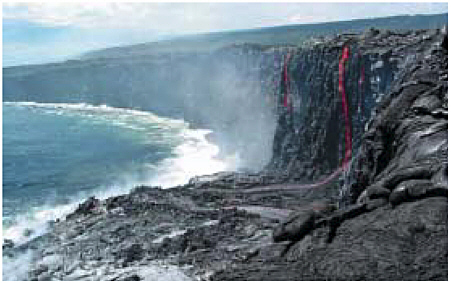
Figure 9
On the Big Island of Hawaii, lava from the Kilauea volcano spills over a cliff and adds to the growing mound of rock below, like wax from a dripping candle. (Photograph by R. Hoblitt, U.S. Geological Survey.)
flying the thousands of miles to the islands from Asia or the Americas, especially if aided by strong winds. Birds, in turn, often carry seeds and other organisms in their guts or stuck to their feathers, beaks, and feet. Insects, spiders, snails, and other small organisms likely rafted to the islands on floating branches or mats of vegetation. And fishes, mollusks, seaweeds, and other marine organisms found new homes on the underwater flanks of the volcanoes after swimming to the islands or being carried there by oceanic currents.
Thus each new Hawaiian island was colonized by a variety of plant and animal species. But because of the islands’ isolation in the middle of the Pacific, only a small fraction of the species from surrounding landmasses likely reached Hawaii. For example, about 2,500 species of bony fishes live in the near-shore waters of the Philippines, but only about 530 occupy Hawaiian waters. Only a single genus of palm, the loulu palm, became established in Hawaii before the arrival of humans, though up to 100 genera of the family occur on other islands in the southwestern Pacific. And only 6 of 174 families of songbirds worldwide are native to Hawaii.
Once a newly introduced species became established in the Hawaiian islands, it could remain part of a widely distributed species found both there and elsewhere. For example, many of the fish species that live in Hawaii receive continued immigrants from surrounding regions and remain genetically linked to species distributed throughout the Pacific.
Alternately, a newly established species in Hawaii could evolve into one or more new species. In some cases, this resulted in just a few new species. For example, several known species of flightless ducks, all now extinct, appear to be descended from a single duck species that colonized the islands, probably from North America. In other cases, the conditions encountered by colonizing species led to an explosive proliferation of new species, as demonstrated by the flies known as drosophilids.
An Adaptive Radiation Has Led to a Dramatic Diversification of the Drosophilids in Hawaii
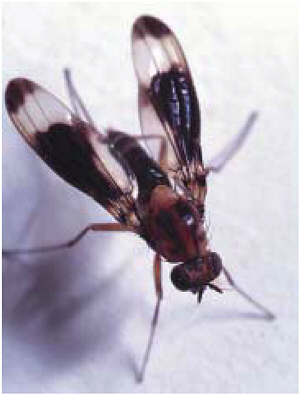
In an area of just 16,700 square kilometers (about 6,500 square miles), the Hawaiian islands have the most diverse collection of drosophilid flies found anywhere in the world (see Figure 10). Different species range in body length from less than 1.5 millimeters (a sixteenth of an inch) to more than 20 millimeters (three-quarters of an inch). Their heads, forelegs, wings, and mouthparts have very different appearances and functions. Hawaiian drosophilids live everywhere from sea-level rainforests to subalpine meadows. Some species produce one egg at a time while others produce hundreds.
The approximately 800 native drosophilid species in Hawaii belong to two genera—Drosophila and Scaptomyza—which in turn are part of the family Drosophilidae. Drosophila and Scaptomyza are two of approximately 10,000 genera in the order Diptera, which includes flies, gnats, and mosquitoes. It is a tremendously diverse and successful group of
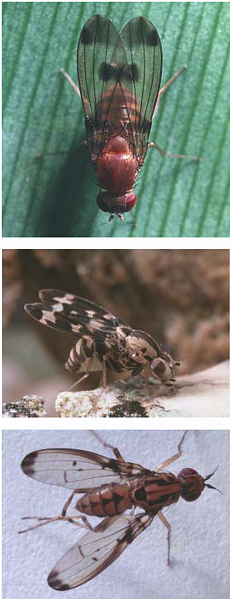
Figure 10
Three species of Hawaiian drosophilids—Drosophila planitibia, D. grimshawi, and D. cilifera—exhibit some of the morphological variety found in the picture-winged group of Hawaiian Drosophila. D. planitibia, with a body size of as much as 8 millimeters (0.3 inches) is almost twice the size of the other two species shown here. (Photographs courtesy of Kevin Kaneshiro.)
organisms: the fly species on earth far out-number all of the vertebrate species combined. But the native insects of the Hawaiian islands include very few separate fly genera, and most of the native fly species are drosophilids.
When biologists began to study the evolutionary history of the Hawaiian drosophilids, they first examined the physical similarities and differences of the species. If two species have very similar appearances, scientists might hypothesize that both are descended from an ancestral species that lived quite recently. If two species are physically quite distinct, scientists could infer that they are more distantly related. Researchers then would seek additional evidence to support or reject these hypotheses. For example, two species can develop similar adaptations if they live in similar environments and therefore can appear to be more closely related than they actually are.
In recent decades, biologists have gained an additional way of examining the relationships among species. Each individual fly has a particular sequence of the chemical units that make up the DNA in its cells. In general, these sequences are more similar among the members of a single species than they are between the members of different species. Similarly, DNA sequences generally are more similar between closely related species than they are between more distantly related species. Genetic sequences accumulate changes over the generations as DNA randomly mutates and is influenced by natural selection or other evolutionary processes. If the DNA sequences of two Drosophila species are more similar, the two species are more likely to be descended from a relatively recent ancestral species, because their DNA has not had much time to diverge. If the DNA sequences are less similar, the two species had more time to accumulate genetic changes, indicating that their common ancestral species lived in the more distant past.
Study of the physical and genetic differences among the hundreds of species of native
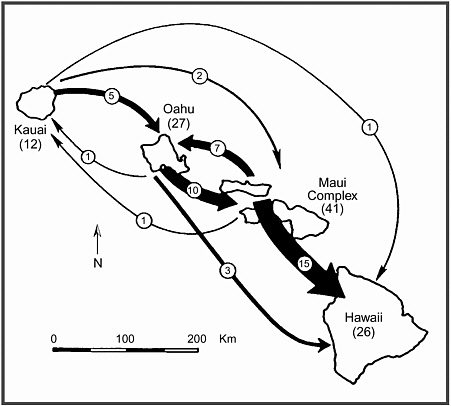
drosophilids in Hawaii has led scientists to a remarkable conclusion. All of the native Drosophila and Scaptomyza species in Hawaii appear to be descended from a single ancestral species that colonized the islands millions of years ago! In fact, all of the approximately 800 species of drosophilids in Hawaii could be descended from a single fertilized fly that somehow reached the islands—perhaps blown there by a storm, or carried to the islands in a scrap of fruit stuck to the feathers of a bird.
Since that time, the descendents of the original colonists have undergone what evolutionary biologists call an adaptive radiation. New species have evolved and have occupied a wide range of ecological niches. Several interacting factors have contributed to this adaptive radiation. An especially important factor for the Hawaiian drosophilids has been what is called the founder effect. Many new populations of drosophilids in Hawaii must have become established in much the same way as did the original population. A few individuals or a single fertilized female must have journeyed or been transported from one area of suitable habitat within an island to another such area, or from one island to another. These founders carried with them just a subset of the total genetic variability within its species. As a result, the physical characteristics and behaviors of the founders could differ from those typical of the parental population. Under such circumstances, a founder population can diverge from the ancestral population and eventually may become a new species.
The great ecological diversity of the Hawaiian islands also plays a role in adaptive radiations. Drosophila species continually expanded into wetter or drier areas, higher or lower elevations, and regions of differing vegetation. The members of a species able to survive in these new areas can acquire new adaptations that set them apart from the original species.
Finally, the lack of competitors in island settings can spur the evolution of new species. In Hawaii, the drosophilids could move to new islands or into ecological niches that on the continents would already have been filled by other species. For example, many Hawaiian drosophilids lay eggs in decaying leaves on the ground, an ecological niche that
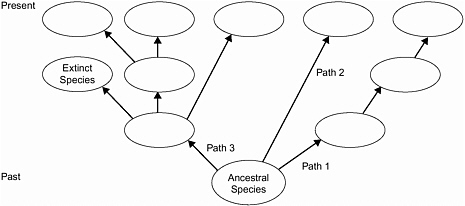
Figure 11
An ancestral species that lived in the past can give rise to multiple species through a variety of different evolutionary pathways. An ancestral species can gradually evolve into a series of what would be considered new species while remaining a single genetically connected population (path 1). Or a species can remain unchanged for a long period of time (path 2). Or an ancestral species can undergo a series of splits, generating new species that in turn become extinct or undergo further speciation (path 3).
is filled by many organisms on the continents but in early Hawaii was almost empty.
As one species diversifies into many, a variety of different evolutionary paths can be taken (see Figure 11). An ancestral species can give rise to a daughter species while remaining relatively unchanged itself. Or a succession of single species can lead from an ancestral species to a single current species. Or an ancestral species can undergo repeated divisions, producing complex networks of evolutionary relationships (Panel 2).
The speciation of drosophilid flies in Hawaii is continuing to occur. For example, a species known as Drosophila silvestris occupies several discrete patches of forest on the Big Island (see Figures 12a and 12b), living in cool, wet forests above 750 meters (2,500 feet) in elevation and laying its eggs in the decaying bark of trees. Males of D. silvestris have a series of hairs on their forelegs that they brush against females during courtship. On the northeastern half of the island (known as the Hilo side), the males have many more of these hairs than do the males on the southwestern side (the Kona side). These two populations are developing physical and behavioral differences that over time might split a single species into separate species.
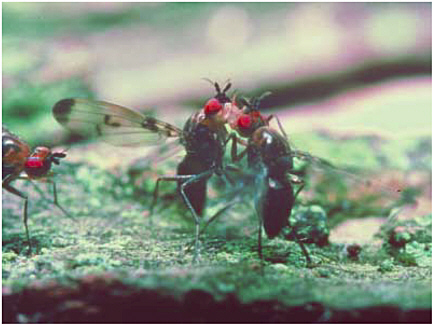
Figure 12a
Two males of the species D. silvestris grapple head to head. (Photograph courtesy of Kevin Kaneshiro.)
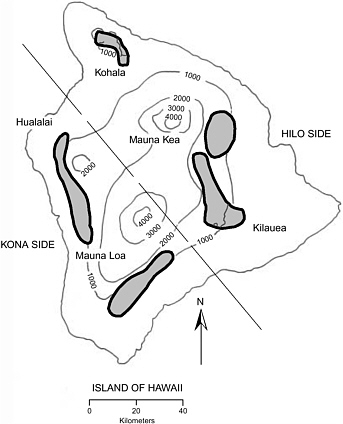
Figure 12b
Map of the Big Island shows five regions inhabited by populations belonging to the species D. silvestris (shaded in gray). The populations on the Hilo side of the island, which are younger than the Kona side populations, are developing differences that over time could lead to the origin of a new species. (Map adapted from Hampton L. Carson, “Sexual Selection: A Driver of Genetic Change in Hawaiian Drosophila,” Journal of Heredity 88:343-352, 1997. The contours are in meters.)