
TEACHING EXERCISE
TRACING THE EVOLUTIONARY ORIGINS OF PICTURE-WINGED DROSOPHILA SPECIES
Teacher’s Manual
In this investigation, students use actual genetic data from 18 species of Hawaiian drosophilid flies to construct an evolutionary diagram that depicts lines of descent for four of the species. They then draw on information about the ages of the Hawaiian islands to develop explanations that might account for the geographical distribution of the species. Finally, they analyze the data in greater detail to reexamine and elaborate on their explanations.
The exercise is designed for students in grades 9 through 12 who are already familiar with basic concepts in evolution and genetics. It can be adapted to occupy two, three, or four class periods.
This investigation provides an opportunity for students to gain experience with the ideas presented in Evolution in Hawaii and in Teaching About Evolution and the Nature of Science (National Academy of Sciences, 1998). It consists of four sections:
-
Teacher’s Manual
-
Data Tables
-
Student Reading
-
Student Worksheet
Components of the Investigation
The investigation is organized according to five activities involved in inquiry-based investigations: engagement, exploration, explanation, elaboration, and evaluation.
In the engagement activity, students read a background document describing the drosophilid flies of Hawaii, their courtship rituals, their descent from a common ancestral species, and the speciation processes that led to their current diversity. The reading concludes with several review questions that can provide the basis for written responses or a classroom discussion.
In the exploration activity, students complete a worksheet to gain experience
with the use of genetic data to construct an evolutionary tree. They then analyze a subset of the data that evolutionary biologists have gathered in recent decades to determine the evolutionary relationships of Hawaiian drosophilid species. By working in small groups, students can acquire a common set of experiences that will help them share their ideas and conclusions. They also can acquire and model the information and skills they will need to analyze larger and more complex data sets.
In the explanation activity, students use the evolutionary tree they have constructed along with information about the history of the Hawaiian islands to develop hypotheses that could explain the current distribution of the four species being studied. By presenting their hypotheses in the form of narratives, they can demonstrate their understanding of important concepts in their own words and focus on understanding the ideas central to the investigation.
In the elaboration activity, students analyze additional data to decide whether their hypotheses need to be modified or whether to clarify and extend their explanations. The elaboration phase can be extended (bringing the total time spent on the exercise to three or four class periods) or minimized (in which case the exercise can be done in two class periods) depending on the time available. This activity also can lead to further investigations for interested students.
The evaluation activity is an ongoing diagnostic process that allows teachers to determine if learners have attained understanding. A rubric is provided to help assess student learning. Summative questions and assignments also are provided to evaluate the extent to which students understand the concepts developed in the investigation.
Alignment with the National Science Education Standards
According to the National Science Education Standards (National Research Council, 1996), science education needs to provide students with three kinds of scientific skills and understanding. Students need to learn the principles and concepts of science. They need to understand and be able to apply the skills and procedures of inquiry that scientists use to investigate the natural world. And they need to understand the nature of science as a particular kind of human endeavor.
This teaching exercise fosters learning in all three of these areas. With regard to the principles and concepts of science, it embodies the following understandings drawn from the National Science Education Standards:
-
Species evolve over time. Evolution is the consequence of the interactions of (1) the potential for a species to increase its numbers, (2) the genetic variability of offspring due to mutation and recombination of genes, (3) a finite supply of the resources required for life, and (4) the ensuing selection by the environment of those offspring better able to survive and leave offspring.
-
The great diversity of organisms is the result of more than 3.5 billion years of evolution that has filled every available niche with life forms.
-
Natural selection and its evolutionary consequences provide a scientific explanation for the fossil record of ancient life forms, as well as for the striking molecular similarities observed among the diverse species of living organisms.
-
The millions of different species of plants, animals, and microorganisms that live on earth today are related by descent from common ancestors.
-
Biological classifications are based on how organisms are related. Organisms are classified into a hierarchy of groups and subgroups based on similarities that reflect their evolutionary relationships. The species is the most fundamental unit of classification.
This activity also provides all students with opportunities to develop abilities of scientific inquiry as described in the National Science Education Standards. Specifically, it enables them to:
-
identify questions that can be answered through scientific investigations;
-
use appropriate tools and techniques to analyze and interpret data;
-
develop descriptions, explanations, predictions, and models using evidence;
-
think critically and logically to make relationships between evidence and explanations;
-
recognize and analyze alternative explanations and predictions; and
-
communicate scientific procedures and explanations.
Finally, this activity provides all students with opportunities to develop understandings about inquiry and the nature of science. Specifically, it incorporates the following concepts:
-
Different kinds of questions suggest different kinds of scientific investigations.
-
Current scientific knowledge and understanding guide scientific investigations.
-
Technology used to gather data enhances accuracy and allows scientists to analyze and quantify results of investigations.
-
Scientific explanations emphasize evidence, have logically consistent arguments, and use scientific principles, models, and theories.
-
Science distinguishes itself from other ways of knowing and from other bodies of knowledge through the use of empirical standards, logical arguments, and skepticism, as scientists strive for the best possible explanations about the natural world.
Background Information for Teachers
A remarkable implication of the theory of evolution is that all of the species that exist on the earth today are descended from common ancestors. In other words, if several species are compared, an evolutionary tree can be drawn that suggests how those species are related by common ancestry.
In this exercise, students gain familiarity with the idea of common ancestry and descent by investigating the evolutionary relationships of 18 species of drosophilid flies that live on the Hawaiian islands. Morphological and genetic data indicate that the approximately 800 species of drosophilid flies in the Hawaiian islands are descended from a single colonizing species that came to the islands millions of years ago. In studying the evolution of the Hawaiian drosophilids, biologists have focused on a group of about 100 species that can be grown in the laboratory and have large wings with distinctive black markings. Known as the picture-winged drosophilids, these species lay their eggs in rotting stems and bark and in bark moistened by the saps, or fluxes, exuded by trees. After the eggs hatch, the larvae feed on bacteria in those substances before pupating and becoming adult flies.
For the drosophilid flies of Hawaii, biologists have a particularly informative marker to trace their evolutionary relationships. During the larval stage of a fly’s life, the salivary glands produce cells containing a special kind of giant chromosome known as a polytene chromosome. If extracted from the salivary cells and stained, these polytene chromosomes exhibit a
hundred or more light and dark bands of varying sizes arrayed along their lengths.
On rare occasions a chromosome within an individual fly will undergo a particular kind of rearrangement. The chromosome breaks at two random points along its length. Usually these breaks are correctly repaired, so that the chromosome sequence is unchanged. But in some cases, the DNA breaks are repaired in a way that causes a section of DNA to be reversed in orientation. In that case, a portion of the chromosome, with its characteristic light and dark bands, appears to have been rotated 180 degrees in the chromosome. These rare chromosomal inversions can be of varying lengths, can occur on any chromosome, can occur within other inversions, and generally have no effect on the behavior or morphology of the fly. Because these inversions occur at random along the chromosomes and are of different sizes, each one is essentially unique.
If this kind of inversion mutation occurs in the sperm or egg cells of a particular fly, that fly can pass the rearranged chromosome to the next generation. Sometimes the inversion will become more and more common with each new generation, until an entire species of flies has the inversion. Therefore, if two species share an identical inversion, they must be descended from a common ancestral species that also had that inversion. If one species has an inversion that is not present in another species then that inversion must have occurred after the two species diverged from a common ancestor.
These inversions can be used to trace the evolution of many of the Hawaiian drosophilid species from common ancestral species. In Hawaii, populations of flies have speciated as they have adapted to new kinds of habitats or have acquired different mating behaviors. Speciation also has often followed founder events, when a single fertilized fly or several flies either traveled or were transported from one island to another island or between habitable but geographically isolated portions of the same island. Successful colonization is more likely when founders from older islands in Hawaii move to younger islands, since younger islands generally contain fewer competing species of drosophilids.
The Big Island of Hawaii is home to 26 distinct species of picture-winged Drosophila flies that have been found to live only on this island. The Big Island is the youngest of the Hawaiian islands, so these species likely formed since the volcanoes of the island emerged above the ocean and became vegetated less than half a million years ago. A major objective of this exercise is to explore the relationships between these “new” species and the species living on the older Hawaiian islands.
|
WHAT STUDENTS NEED TO KNOW To perform this exercise, students will need a basic understanding of chromosome structure, banding patterns, and chromosomal inversions. They also will need to be familiar with the concept of biological species, the basic mechanisms of speciation, the relationship of geographic isolation to speciation, and the construction of phylogenetic trees. They can acquire some of this information from the Student Reading and Student Worksheet in this exercise. More information can be found in Teaching About Evolution and the Nature of Science (National Academy of Sciences, 1998). |
|
Engage In the engagement phase of the investigation, students are introduced to the biology and evolutionary history of the drosophilid flies of Hawaii through a reading and set of review questions. Student Objectives
Materials The materials provided are the Student Reading and Student Worksheet, a map of the major Hawaiian islands showing their ages, a diagram showing the evolutionary relationships among mammalian groups, and a photograph of a polytene chromosome. Teaching Strategies After students have completed the reading, teachers can ask them to answer the following questions, which also appear at the end of the reading. (These questions also can serve as a spring-board to a classroom discussion.)
|
|
Explore In the exploration phase of the investigation, students use actual genetic data to trace evolutionary lines of descent for four species of Hawaiian drosophilid flies. By comparing their findings to information about the geology of the Hawaiian islands, they then conclude that new species tend to appear on younger islands. Student Objectives
Materials Students will work from the data in Table 1. Later, they will compare their evolutionary trees to the dates shown on the map of the Hawaiian islands. Teaching Strategies The students’ objective is to derive evolutionary pathways from the data in Table 1 for four of the species described in that table: Drosophila heteroneura, D. hanaulae, D. substenoptera, and D. primaeva. Students should work in small groups so they can arrive at a consensus about the most reasonable structure of the tree. They should construct a single tree agreed upon by all members of the group so they gain experience with achieving consensus based on empirical evidence and defending their reasoning. Table 1 begins by listing 11 chromosomal inversions found in the species D. heteroneura. Following this are the inversions found in 12 other species of picture-winged Drosophila found in the islands. These are incomplete listings of the inversions, since only the 11 inversions found in D. heteroneura are given in this table. Most picture-winged species have some inversions not found in D. heteroneura. For example, D. setosimentum, which also is found on the Big Island of Hawaii, has a total of 21 inversions, as shown on the top line of Table 2. However, it shares only four of its inversions with D. heteroneura, as shown on the bottom line of Table 1. Note, too, that some species have identical inversions so they need to be distinguished using other physical or behavioral characteristics. Students can perform this exercise without exploring all of the dimensions of the data contained in Tables 1 and 2. At the same time, advanced students can use the data provided in Tables 1 and 2 to extend the exercise in many productive directions. Once the class has used the data in Table 1 to reconstruct the evolutionary relationships among D. heteroneura, D. hanaulae, D. substenoptera, and D. primaeva, they should be able to conclude, by comparing their trees with the geological ages of the islands, that new species tend to appear on younger islands. |
|
Explain In the explanation phase of the investigation, students should describe to each other and to the class the conclusions drawn from the data. They then should construct plausible explanations that can account for the observed data. In developing these explanations, students should explore the limitations of the data in providing complete explanations and consider what additional kinds of evidence might be gathered to support their hypotheses. Student Objectives
Materials Students will continue to rely on the Student Reading, the map of the Hawaiian islands, and the data in Table 1 to provide the raw material for their narratives. Teaching Strategies Constructing a narrative gives students the opportunity to relate easily understood events—such as the journey of an individual fly from one island to another—to data that may seem to have little relevance to the everyday world. Such accounts can make abstract concepts such as speciation concrete and accessible. Putting the conclusions they draw from the data in the form of a story allows students to demonstrate their understanding of important concepts in their own words, emphasizing the understanding of the idea rather than their knowledge of facts or terminology. To initiate this part of the investigation, teachers could assign the following task: Write a narrative describing how the four species of picture-winged flies may have evolved from a common ancestor. The entire class, working together, could write the narrative, with the teacher guiding the class in selecting conclusions consistent with the data. Or the teacher and class could work together to begin the story, with students finishing the story working in groups. Alternately, the students could write the stories individually or in small groups. One way to begin the writing of narratives would be to provide students with all or part of the following sample narrative: About four million years ago on the island of Kauai there lived an inter-breeding population of picture-winged flies. Every member of this population had the four chromosomal inversions i, k, o, and b. About three million years ago a storm on Kauai resulted in a large number of flies being swept off the island and carried over the sea. Most of the flies |
|
perished. By chance, one or several fertilized female flies could have landed on the more recently formed island of Oahu. Also by chance, some of the descendants of these fertilized females eventually acquired several other chromosomal inversions, the ones labeled p, q, s, and d in Table 1. Over many generations these inversions became more common until all of the members of the Oahu population of flies carried them…. The narrative should address these points:
After the narrative or narratives have been written and shared, the following questions could help guide a class discussion:
|
|
Elaborate In the elaboration phase of the investigation, students can deepen and enrich their understanding of the evolution of the drosophilid flies of Hawaii by analyzing additional data and by modifying their narratives to take those data into account. This phase of the investigation is open-ended, in that students can do as much as they wish with the additional data. Typically, completing this phase will require devoting a third or fourth class period to the exercise. Student Objectives
Materials Needed Students will continue to work with the data in Table 1 and with the map of the Hawaiian islands. They also can refer to the data in Table 2. Teaching Strategies One way to demonstrate to students how their narratives need to be modified in light of new data is to lead a guided class discussion, using these questions:
Another possible elaboration would be to add to the earlier phylogenetic tree the species D. silvestris, which is also represented in Table 1. The following questions could lead students to examine these data:
|
Another possible extension of this investigation makes use of the data in Table 2. This table contains inversion data for 10 species of drosophilids, beginning with D. setosimentum. Five of the 10 species in Table 2 are represented in Table 1 as well, while five of the species are different. A possible task is to draw an evolutionary tree for all 10 of the species in Table 2 using the methods developed for the previous data set. This tree then can be compared to the ages of the islands where the species live today. In Table 2, the species D. heteroneura has the fewest inversions, whereas in the previous data set it had the most. Similarly, D. setosimentum had the fewest inversions in the first data set but has the most in the second. How can these results be reconciled? Questions that can guide this extension of the elaboration phase include:
|
|
Evaluate According to the National Science Education Standards: [Students need] to participate in the evaluation of scientific knowledge…. What data do we focus on first? What additional data do we consider? What patterns exist in the data? Are these patterns appropriate for this inquiry? What explanations account for the patterns? Is one explanation better than another? In supporting their explanations, students have drawn on evidence to derive a scientific claim. Students have assessed both the strengths and weaknesses of their claims. Questions that could be used to assess students’ understanding after the investigation has been completed include the following:
Students should be able to describe the methods they used to derive the phylogenetic trees generated during this exercise, how the data were analyzed, and what conclusions or generalizations can be drawn from the data. An advanced level of understanding would involve the ability to describe how the same species can appear in both data tables with quite different inversion data. Students’ work throughout this investigation also can be evaluated on an ongoing basis through the use of a rubric such as the one on the following page. This rubric has been modified from one provided by the International Baccalaureate Organization (IBO) for the assessment of student work in experimental science courses. |
|
Rubric
|
Data Tables
Table 1 Species That Share One or More of the 11 Inversions Found in D. heteroneura of the Big Island of Hawaii
|
SPECIES |
CH X |
CH#3 |
CH#4 |
ISLAND |
|
D. heteroneura* |
i j k o p q r s t |
d |
b |
Hawaii |
|
D. silvestris |
i j k o p q r s t |
d |
b |
Hawaii |
|
D. planitibia |
i j k o p q r s t |
d |
b |
Maui |
|
D. differens |
i j k o p q r s t |
d |
b |
Molokai |
|
D. hanaulae* |
i j k o p q - s t |
d |
b |
Maui |
|
D. obscuripes |
i j k o p q - s |
d |
b |
Maui |
|
D. hemipeza |
I j k o p q - s t |
d |
b |
Oahu |
|
D. oahuensis |
i j k o p q - s t |
d |
b |
Oahu |
|
D. substenoptera* |
i j k o p q - s |
d |
b |
Oahu |
|
D. primaeva* |
i - k o - - - - |
|
b |
Kauai |
|
D. ornata |
i - k o - - - - |
|
b |
Kauai |
|
D. setosifrons |
i j k o - - - - |
d |
b |
Hawaii |
|
D. setosimentum |
i - k o - - - - |
|
b |
Hawaii |
|
NOTE: Each inversion is denoted by a letter. A dash denotes that the species does not have that inversion. Nine of the inversions studied in this data set have occurred on the X chromosome, and one each has occurred on chromosome 3 and on chromosome 4. CH = Chromosome. *The evolutionary relationships of these four species are explored in detail in the exploration phase of the exercise. |
||||
Table 2 Species That Share One or More of the 21 Inversions Found in D. setosimentum of the Big Island of Hawaii
Student Reading
You wouldn’t think that biologists could learn much about evolution by studying the flies that live on the hills and mountainsides of the Hawaiian islands. But these are not ordinary flies.
Approximately 800 species of flies belonging to the genera Drosophila and Scaptomyza live in the forests of Hawaii. Collectively known as drosophilids, these flies differ significantly from the houseflies that buzz around kitchens and garbage piles. Houseflies belong to a different biological family and were brought to Hawaii by human colonizers over the last few hundred years. The drosophilids have lived in Hawaii for millions of years and are the products of a spectacular evolutionary history.
The different drosophilid species in Hawaii vary greatly. Some species are large and others are small. They have differently shaped bodies and contrasting behaviors. Different species lay their eggs in leaves, bark, fungi, fruit, or even spider eggs. One particularly well-studied group of about a hundred species has bold black markings on their wings. These species are known as picture-winged drosophilids.
Many drosophilid species have elaborate sex lives. First the males establish a mating territory called a lek. Then they defend this area from other males of the same species. Males of one species, called Drosophila heteroneura, use their hammer-shaped head as a battering ram to drive other males away (see Figure 1). The males of other species lock legs and wings and wrestle each other into submission until one flees. In another species, males make a buzzing roar with special muscles in their abdomen.
When a female fly visits the lek, the male gets to work. In many species, the males have an elaborate but specific dance that they use to attract females. Others buzz their wings in a special way or place their heads under the female’s wings. One species releases attractant chemicals known as pheromones in the female’s direction.
Even if the male does everything perfectly, his efforts may not pay off. If the female chooses not to mate with that male, she will fly away.
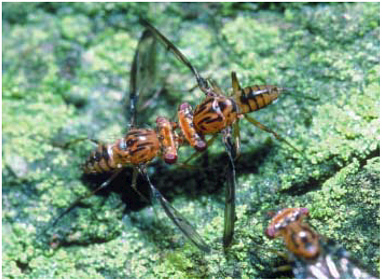
Figure 1
D. heteroneura males use their hammer-shaped heads to defend their territories. (Photograph courtesy of Kevin Kaneshiro.)
The drosophilid species of Hawaii are so different from each other that it is hard to believe they are all descended from a common ancestral species. But the biological evidence is compelling. All of the approximately 800 species of drosophilids on Hawaii are descended from the members of a single species of flies that made their way to the Hawaiian islands many millions of years ago. In fact, all of the Hawaiian drosophilids may be descended from a single fertilized female that reached the Hawaiian islands!
No one will ever know exactly how this fertilized fly traveled to the islands (if it was just one). Maybe it was blown to Hawaii in a storm. Maybe it was carried on a solid object to the islands. But somehow it survived the trip, and when it arrived at the islands it began to produce offspring.
Biologists suspected for a long time that the Hawaiian drosophilids were descended from a single ancestral species because of physical characteristics they share. But one piece of evidence has been particularly persuasive. When drosophilids are in their larval stage, biologists can examine cells from their very large salivary glands. These cells contain a special kind of chromosome called a polytene chromosome. In a polytene chromosome, many copies of a single DNA molecule line up side by side, making the chromosome large enough to see with a microscope. If a stain is added to the salivary tissue, the chromosomes exhibit a characteristic pattern of hundreds of light and dark bands along their lengths. The polytene chromosomes of the Hawaiian drosophilids, along with other genetic data, point toward a common origin for these very different species of flies.
Polytene chromosomes also can be used to trace the evolutionary history of individual drosophilid species. These chromosomes can reveal a particular kind of mutation called an inversion. Inversions are rare events that result in a section of a chromosome becoming reversed with respect to the original sequence. Inversions occur as a consequence of molecular damage and repair processes in the nucleus of the cell. Biologists can recognize these inversions in polytene chromosomes because the pattern of light and dark bands along part of the chromosome is reversed (see Figure 2).
These inversions provide a way of reconstructing evolutionary relationships. For example, if two species of picture-winged drosophilids both have the same inversion, they must be descended from an ancestral species that had that inversion. If one species has an inversion that the other does not, that inversion must have occurred in the time since the two species split from a common ancestor.
For example, think about the original fertilized fly that may have been the ancestor of all the Hawaiian drosophilids. As that fly began to produce offspring, they would have closely resembled the original colonist. Over time, this small population of flies would grow.
Eventually a group of flies must have become separated in some way from the others, either geographically, behaviorally, or ecologically. Females from this isolated population might have laid their eggs in different substances or become adapted to a different habitat. The members of this population

Figure 2
Polytene chromosomes from larvae of drosophilid flies provide a way to detect chromosomal inversions. In the chromosome shown here, the chromosomal segment between the two indicated points is inverted compared to the same chromosome in other species. (Photograph courtesy of Hampton L. Carson, based on an original photograph by Harrison D. Stalker, Washington University, St. Louis.)
might have developed new mating behaviors. At the same time, this population could acquire chromosomal inversions that would distinguish it from the original population of flies.
At some point, the daughter population would have diverged so greatly from the original population that its members generally would not recognize courtship signals or body markings from the original population. As a result, individuals from the isolated population would no longer mate and produce offspring with flies from the original population. If, as time progressed, physical and behavioral traits became sufficiently different between the two populations so that individuals from the two populations could no longer produce viable or fertile offspring, the daughter population would be considered a new species.
This speciation process has occurred many, many times among the drosophilid flies of Hawaii. Sometimes it happened when a small group of flies, or just a fertilized female, was carried, was blown, or flew from one part of an island to another. Other times it occurred when a fly journeyed or was transported from one island to another. Because of their volcanic origins, the Hawaiian islands have different ages, with the younger islands to the southeast. As each new island rose from the waves, small populations of flies or single fertilized females made their way from older islands to newer ones, where their descendants could become increasingly distinct from the ancestral species.
The Hawaiian islands also have many kinds of environments, from lowland rainforests to dry upland forests. Different drosophilid species have evolved adaptations that enable them to thrive in different types of forests.
Also, on the mainland, a new drosophilid species would face competition from other insects already living in an area or from predators. But because the Hawaiian islands are isolated in the middle of the Pacific, new species had far fewer competitors or predators when they appeared. On their island paradise, the drosophilids have flourished.
Biologists call the evolution of many new species from a single ancestral species an adaptive radiation. The adaptive radiation of the Hawaiian drosophilids is one of the most dramatic examples of evolution found anywhere in the world.
Review Questions
-
What characteristics of the Hawaiian islands might have led to the enormous diversity of drosophilid species in the Hawaiian islands?
-
How might the diversity of mating behaviors be related to the diversity of drosophilid species in the Hawaiian islands?
-
What evidence suggests that all of the drosophilid species in the Hawaiian islands have descended from a single fertilized female fly that colonized the islands millions of years ago?
-
How could individual flies spread from island to island?
Student Worksheet
In this investigation of evolution in Hawaii, you will use actual genetic data from 18 species of Hawaiian drosophilid flies to construct an evolutionary tree that depicts evolutionary lines of descent for four of those species. These species belong to a group of about a hundred well-studied species known as the picture-winged drosophilids that have prominent black markings on their wings. Once the tree is complete, you will use it along with information about the geology of the Hawaiian islands to propose a series of events that could explain the current distribution of the four species.
Materials Needed
-
Student Reading
-
Data Tables summarizing chromosomal inversions in 18 species of picture-winged drosophilids
Background
First, you need to gain experience drawing an evolutionary tree and relating that diagram to specific genetic events. As shown in Figure 1, phylogenetic trees depict the evolution of two or more descendant species from a single ancestral species, with lines connecting the ancestral species to the descendant species. In the drosophilid flies of Hawaii, these descendant
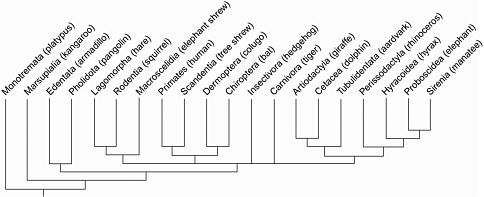
Figure 1
An evolutionary tree of the living groups of mammals demonstrates their relationships, though some of the details of the tree remain controversial or ambiguous. A representative member of each group is shown in parentheses after the group name. In addition to the groups shown here, other mammalian groups have gone extinct. (Diagram adapted from Colin Tudge, The Variety of Life: A Survey and Celebration of All the Creatures That Have Ever Lived. New York: Oxford University Press, 2000.)
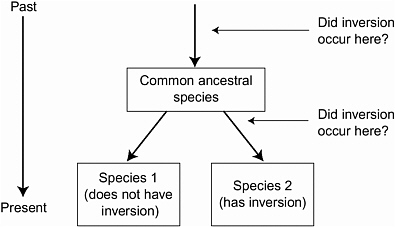
Figure 2
If two species descended from a common ancestral species differ by the presence of a chromosomal inversion, when must the inversion have occurred?
species often can be distinguished by the presence or absence of specific chromosomal inversions.
In Figure 2, one species descended from a common ancestral species has an inversion that the other does not. Where on this diagram must have the inversion have occurred?
This is the kind of analysis you will use to construct a more detailed evolutionary tree in this investigation.
Main Activity
In this part of the investigation, you will use the chromosomal inversion data from Table 1 to construct an evolutionary tree for the following four species: Drosophila heteroneura, D. hanaulae, D. substenoptera, and D. primaeva. You should indicate on the tree where the inversions occurred that can be used to determine the species’ evolutionary relationships.
Once the diagram is complete, compare the evolutionary relationships of the four species with the ages of the Hawaiian island on which they live (see Figure 3). What conclusions can you draw about how new species of flies appear in Hawaii?
The final part of this main activity is to construct a narrative account of how the four species of drosophilid flies might have evolved over time. Your account should address these points:
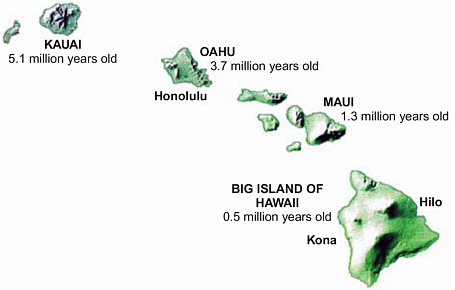
Figure 3
Radiometric dating has produced estimated ages for the major Hawaiian islands. The oldest islands are to the northwest and the youngest islands are to the southeast.
-
How might the flies have traveled from one island to another?
-
How might new species of flies have evolved on the islands where they now live?
-
In what order did the inversions shown in the table occur?
-
Which species might be older and which might be younger?
Elaboration
In the elaboration phase of the investigation, additional data from Table 1 or the data from Table 2 can be analyzed. Using all the data in Table 1 permits the construction of a much larger phylogenetic tree showing the evolutionary relationships among the 13 species of flies described in the table. The data in Table 2 permit the construction of a second tree that reveals an even more complex set of evolutionary relationships among the 18 species of picture-winged flies represented in the two tables.
Questions to consider in light of these additional data include the following:
-
Are the chromosomal inversion data always sufficient to distinguish species?
-
Does the presence of an inversion necessarily mean that one species is younger than another?
-
Can a relatively young species occur on an older island?
-
What are the mechanisms that would enable this to occur?


