
evolution in Hawaii, a scientist might hypothesize that a species on one island is descended from a species on another island. The scientist then would gather evidence to test that hypothesis. If a hypothesis is supported by the evidence, the hypothesis may contribute to more complex explanations, including theories. If the available evidence does not support a hypothesis, that hypothesis can be rejected, modified, or subjected to further testing. For a hypothesis to fall within the realm of science, it must be constructed in such a way that it potentially can be shown to be wrong—otherwise the hypothesis cannot be tested against evidence from the natural world. This demand that a hypothesis be “falsifiable” is one of the defining characteristics of scientific explanations.
A “fact,” in scientific terms, is an observation that has been repeatedly confirmed by the studies of different independent scientists. In other words, it is a phenomenon that has been observed so frequently that its existence is no longer being questioned.
Because theories explain facts, they embody a greater understanding of the natural world than do observations. Without theories to explain and integrate them, facts become collections of unrelated observations. Evolutionary theory is a comprehensive explanation that integrates facts from many different areas of science. It has proven tremendously successful in explaining the basis for observed phenomena and in allowing scientists to make predictions based on existing data.
Scientific Research Has Revealed How the Hawaiian Islands Originated
The study of the origins of the Hawaiian islands provides an excellent example of how science works. For many years the geological history of the islands remained a mystery. The Big Island of Hawaii (which is sometimes called just Hawaii) forms one end of a long straight archipelago of more than 100 islands, atolls, reefs, and shoals that extend to Kure Atoll (see Figure 3), a distance of more than 2,400 kilometers (1,500 miles). Beyond Kure the chain continues underwater in the form of seamounts that rise above the ocean floor but no longer break the surface of the water. What could account for this intriguing geological formation?
In 1963 the Canadian geologist J. Tuzo Wilson proposed a hypothesis to explain the archipelago’s origins. He suggested that the islands formed as the crust of the Pacific Ocean floor moved over a source of heat positioned beneath the crust (see Figure 4). This hot spot, as it came to be known, produced lava that erupted through the crust onto the ocean floor. Eventually these erupting volcanoes grew large enough to rise above sea level and form islands (see Figure 5). As the
|
GLOSSARY OF TERMS USED Fact: In science, an observation that has been repeatedly confirmed. Hypothesis: A testable statement about the natural world that can be used to build more complex inferences and explanations. Theory: In science, a well-substantiated explanation of some aspect of the natural world that can incorporate facts, laws, inferences, and tested hypotheses. (Adapted from Teaching About Evolution and the Nature of Science.) |
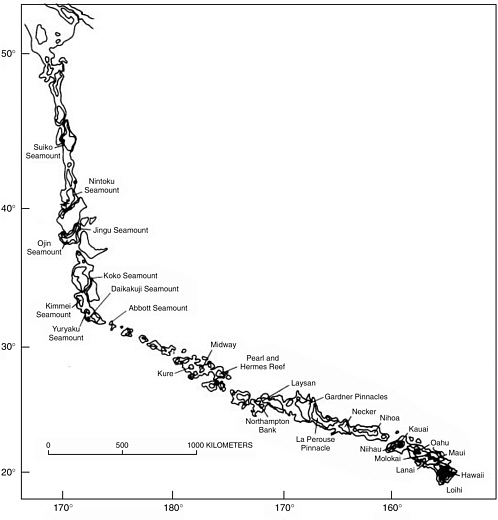
Figure 3
The Hawaiian-Emperor volcanic chain stretches from the Big Island of Hawaii to Kure Atoll and then continues underwater as a series of seamounts. The islands currently above water are shown in solid black, with the populated chain of major islands located between Hawaii and Kauai at the bottom right. The lines that encircle the islands and seamounts indicate the 1-kilometer and 2-kilometer depth contours. (Map adapted from David A. Clague and G. Brent Dalrymple, “The Hawaiian-Emperor Volcanic Chain, Part I. Geologic Evolution,” in R.W. Decker, T.L. Wright, and P.H. Stauffer, eds., Volcanism in Hawaii, U.S. Geological Survey Professional Paper 1350, 1987.)
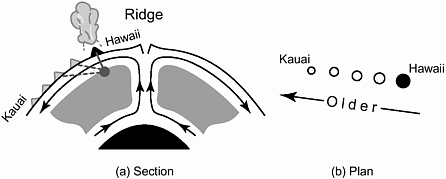
Figure 4
In 1963 J. Tuzo Wilson proposed that the Hawaiian islands formed when the crust of the Pacific Ocean floor moved over a source of heat arising from within the earth. (Diagram adapted from J. Tuzo Wilson, “A Possible Origin of the Hawaiian Islands,” Canadian Journal of Physics 41:863-870, 1962.)
oceanic crust moved over the hot spot, each recently formed volcano was carried away from the hot spot toward the northwest, cutting off its source of lava. Meanwhile, a new island was forming so that over time a chain of islands was produced extending away from the hot spot. As the islands continued to move toward the northwest, away from the hot spot, they were eroded by the wind, rain, and waves and eventually sank below sea level to become seamounts.
Once this hypothesis was proposed, scientists began searching for evidence to test it. For example, the hypothesis predicts that the more northwesterly seamounts and islands should be older than the islands to the southeast. Geologists can measure the age of volcanic rocks by measuring the quantities of argon gas in those rocks. Immediately after lava cools, it contains no argon because the gas is expelled from the molten rock. But volcanic rocks also contain a radioactive
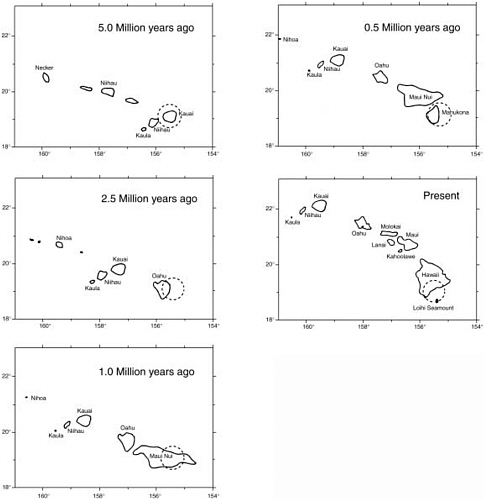
Figure 5
The Hawaiian islands formed as the Pacific Ocean floor moved over an underlying hot spot in the earth, shown here by a dotted circle. The present island of Kauai formed about 5 million years ago; Maui Nui, the landmass now represented by Maui and nearby islands, was in place more than a million years ago; and the Big Island continues to grow today. (Diagram adapted from Hampton L. Carson and David A. Clague, “Geology and Biogeography of the Hawaiian Islands,” in Warren L. Wagner and V.A. Funk, eds., Hawaiian Biogeography: Evolution on a Hot Spot Archipelago. Washington, DC: Smithsonian Institution Press, 1995.)
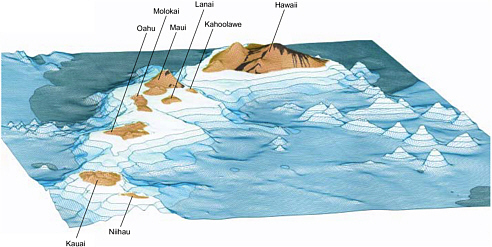
Figure 6
The maximum elevations of the Hawaiian islands gradually diminish from southeast to northwest, with the newest islands being the tallest. (Map reproduced by permission of Dynamic Graphics, Inc., Alameda, CA, USA, producer of EarthVision® software, ©1984-2003 Dynamic Graphics.)
form of the common element potassium. This potassium decays at a known and constant rate into argon, and the argon remains trapped in the rock. To determine the age of a volcanic rock, scientists can measure the amount of argon and the amount of radioactive potassium in the rock. The higher the ratio, the older the rock.
These measurements showed that the Big Island of Hawaii, at the southeastern end of the archipelago, is the youngest of the chain, with an estimated age of less than half a million years (Panel 1). The islands of Maui, Molokai, Lanai, and Kahoolawe, which once were joined in a landmass known as Maui Nui, are the next older. The islands of Oahu and Kauai have greater ages, with the latter being about five million years old. To the northwest, the volcanoes are progressively older, with Suiko Seamount in the northern part of the chain having an age of 65 million years.
This pattern is exactly what had been predicted by the hypothesis that the volcanoes were created by the movement of the crust over a source of heat. In fact, by comparing the ages of the volcanoes with their separations, geologists have concluded that the crust of the Pacific Ocean is moving at a rate of about 10 centimeters (4 inches) per year over the hot spot, or about one meter per decade.
Another source of supporting evidence involved the elevations of the islands and seamounts. As volcanic islands age, they gradually subside and erode. Thus, in Hawaii, the newest islands should be the tallest ones—which again is just what is found (see Figure 6). The highest peak on the Big Island is almost 4,250 meters (14,000
feet), while the island of Kauai rises to only about 1,500 meters (5,000 feet). The older islands beyond Kauai have much lower elevations. An example is Necker Island, which is about 300 miles northwest of Kauai and is twice as old, at about 10 million years. The geological characteristics of the underwater part of Necker Island indicate that it once was more than 1,000 meters (3,000 feet high), but today the highest point on the island is less than 100 meters (300 feet) above sea level. Beyond Kure the tops of the seamounts get progressively lower. Suiko Seamount, once an island, is now 2 kilometers (more than a mile) underwater.
A final source of supporting evidence was the observation that island building is still underway. A new underwater volcano was discovered about 32 kilometers (20 miles) off the shoreline of the Big Island (see Figure 7). Known as the Loihi Seamount, it already rises more than 3,000 meters (9,000 feet) above the floor of the Pacific and is currently within about 1,000 meters (3,000 feet) of the ocean surface. Sometime in the next 100,000 years, it could rise above the waves to produce the newest addition to the Hawaiian islands.
Wilson’s hypothesis about the origins of the Hawaiian islands, now thoroughly tested and accepted, has contributed to a much broader understanding of geological processes known as the theory of plate tectonics. About the same time that Wilson made his hypothesis, he and other geologists were recognizing that the earth’s surface is broken into a number of “plates” of various sizes that can move about in relation to one another. Some plates are expanding outward from volcanic ridges that add new material to the plates’ edges. Some plates are losing material as their edges plunge into the earth’s interior at deep oceanic trenches. Wherever plates meet or slide against each other—at the San Andreas Fault in California, for example—earthquake activity can be particularly intense.
This theory of plate tectonics accounts for many previously unexplained geological features. For example, other hotspots beneath the
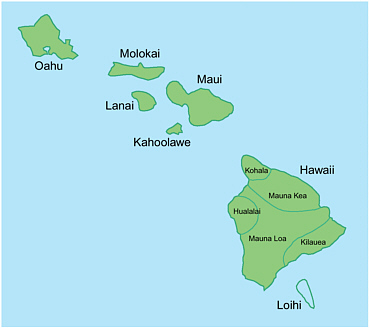
Figure 7
The Loihi Seamount off the coast of the Big Island is now above the hot spot beneath the Pacific Plate and is steadily growing. (Diagram adapted from drawing by Joel E. Robinson, U.S. Geological Survey.)


