
Cost Analysis of Bibliographies or Bibliographic Services
MALCOLM RIGBY and MARIAN K.RIGBY
ABSTRACT. This report represents the tentative results of preliminary work done under a grant from the National Science Foundation for the purpose of establishing under controlled conditions an empirical formula for obtaining estimates of the order of magnitude of the costs involved in preparation of either “one-shot” bibliographies or more extensive or continuing services, regardless of quantity, accuracy, exhaustiveness, subject matter, languages involved, country where prepared, type or frequency of indexes, quality of annotations or reproduction, etc.
As the material produced in this analysis is quite voluminous and the exact figures for a number of the examples are not yet obtained, the tables and the curves on the nomogram should be considered as rough approximations by anyone not wishing to examine the “exhibits” (which will be available to those desiring to verify the cost or the quality of the product). Costs may vary by 200 or 300% from the “normal,” on account of unpredictable factors, but in general they range between 50c and $50 per item in the extreme, and between $1 and $15 per item under “average” conditions.
The explanation of the range in costs of from 1 to 2 orders of magnitude lies not only in the complexity, exhaustiveness, or sophistication involved, but to a large measure in the “entropy” of the system; i.e., in the amount and skill of the work previously done by some library or bibliographer and available for exploitation by others; or, conversely on the amount of effort which is expended by the farsighted in putting material in shape for others to exploit to their advantage or to the advantage of science.
Finally one of the most significant factors, which usually operates in direct opposition to that which would be predicted, is the rising cost with increasing volume or size of a bibliography, for the extra controls, tools, possible mechanization, research, development of codes or class systems for large projects more than offsets any savings due to “streamlining.”
MALCOLM RIGBY and MARIAN K.RIGBY American Meteorological Society, Washington, D.C.
Purpose
The object of this study is to obtain some preliminary empirical data on the costs of various types of bibliographies or bibliographic services. The final product, when supplemented and refined, will be a nomogram or a series of curves giving the approximate cost of a bibliography of any given size or degree of sophistication. The present study will merely provide a rough and general idea of the factors or variables involved, and the relative order of magnitude of the resulting costs. Finally it will permit an analysis of the proportion of the cost of each type of bibliography that would be chargeable to any given step in its preparation.
Factors involved in variable costs
It is easily recognized by any experienced research worker that bibliographies vary as much in quality and usefulness as do any other professional services. What is not always recognized is the magnitude of the variation in unit cost as the exhaustiveness, language coverage, type of annotation, comprehensiveness of indexing or even size (volume) of the project increases. No one would question the fact that accuracy of entries, type of reproduction or country of preparation would make a considerable difference in unit cost, but the actual amount of this difference would be sheer guesswork without some quantitative data based on an actual comparison involving duplication of work at home and abroad.
Method of approach
It seemed advisable to eliminate as many as possible of the intangible variables (e.g., experience, diligence, availability of material, supervision, overhead, and unpredicted demands for irrelevant services which greatly increase the cost of a small project). This was done by preparing a series of bibliographies of approximate “unit” size, under uniform and controlled supervision, and with personnel of average and known experience and performance, and with uniform conditions and facilities for work. A unit was established as 100 items, and reproduction was set at 100 copies to eliminate the factor of reduction in cost with increasing number of copies printed. In some cases 200 or more items were included to make the work comparable in exhaustiveness with another similar work, but the basic unit cost would not change much between 100 and 200 items.
Bibliographies on the same subject, “Noctilucent clouds,” were prepared by expert bibliographers simultaneously in the United States, England, Belgium, and Japan, to see what difference in cost would be involved and what difference in quality, if any, would be realized. The results can be seen in the “exhibits” by anyone interested.
Finally the analysis of various factors entering into the costs and other pertinent data were made possible by developing an analysis form (see Appendix 1) which would take into account the portion of the total cost which could be assigned to each step in the process of preparation of the bibliography. In some cases one or more of the processes (organizing, searching, cataloging, arranging, classifying, indexing, annotating or translating abstracts, editing, typing and proofing, duplicating and printing, overhead, etc.) would be missing or not pertinent, in which case the space is left blank. The results of the analysis are shown on Table 1.
TABLE 1 Unit cost of various types of bibliography of a given size
|
Typea |
Characteristic |
102(100) |
103(1000) |
104(10,000) |
105(100,000) |
106(1,000,000) |
|
I |
Simple copying |
$0.55 |
$0.60 |
$0.70 |
$0.60 |
$0.60 |
|
II |
Arrange and copy |
.85 |
1.30 |
1.80 |
1.50 |
1.30 |
|
III |
Search and arrange |
1.80 |
2.50 |
3.60 |
2.60 |
2.00 |
|
IV |
Index in addition |
2.30 |
4.00 |
5.00 |
4.00 |
3.00 |
|
V |
Abstract and index |
8.00 |
10.00 |
15.00 |
13.00 |
10.00 |
|
VI |
Translate abstracts |
5.00 |
9.00 |
12.00 |
18.00 |
20.00 |
|
VII |
Mechanize abstracts |
50.00 |
25.00 |
22.00 |
20.00 |
15.00 |
|
VIII |
Reference and bibliographic |
10.00 |
15.00 |
18.00 |
15.00 |
12.00 |
|
a Types I to IV are unannotated; V to VIII are annotated (abstracted). |
||||||
It is hoped that this form can be used to accumulate further data on a variety of projects not yet studied. In some cases the figures may be considered confidential, yet the “unit cost” could be entered in the revised cost analysis table and could affect the curves on the nomogram, thus making them more meaningful.
Types of bibliographies
Figure 1 shows eight curves representing the eight basic types of bibliographies designated below and indicating the approximate cost per item for the range from 102 to 106 items (or items per year), under conditions considered normal in the United States. Costs for the first eight types are based on results of work done on this project, projected from known costs for the basic unit of 100 items to 1000, 10,000 or more items from approximate costs of known projects on
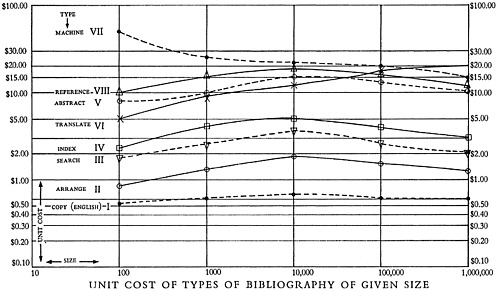
which the author has direct knowledge, or for projects with which he is acquainted. Supporting evidence for these figures is contained in the appended “exhibits,” which will be available to anyone desiring to verify the approximate figures or the quality of the work done for a given price.
As this is a “first approximation,” a great deal of smoothing was necessary. Further study and refinement will reveal interesting deviations from these “order-of-magnitude” curves. Variations of 100% or even 200% due to local factors should be considered normal. Eventually enough data may be available, if uniform analyses are made for dozens of bibliographies of each type, to establish the “Standard Deviation” of some of the values, and certainly some of the curves will need to be relocated. Anomalous increases will occur where increasing complexity due to increasing volume necessitates introduction of new systems of control and development of new tools, codes, class systems, mechanization, searching and procurement methods, and methods of reproduction.
TABLE 2 Total cost of various types of bibliographies of designated size
|
Type |
Characteristic |
102 |
103 |
104 |
105 |
106a |
|
I |
Copy |
$55.00 |
$600.00 |
$7,000 |
$60,000 |
Nonsense |
|
II |
Arrange |
85.00 |
1,300 |
18,000 |
150,000 |
Nonsense |
|
III |
Search |
180.00 |
2,500 |
36,000 |
260,000 |
$2,000,000 |
|
IV |
Index |
230.00 |
4,000 |
50,000 |
400,000 |
$3,000,000 |
|
V |
Abstract |
800.00 |
10,000 |
150,000 |
1,300,000 |
$10,000,000 |
|
VI |
Translate |
500.00 |
9,000 |
120,000 |
1,800,000 |
$20,000,000 |
|
VII |
Mechanize |
5000.00 |
25,000 |
220,000 |
2,000,000 |
$15,000,000 |
|
VIII |
Reference |
1000.00 |
15,000 |
180,000 |
1,500,000 |
$12,000,000 |
|
a These figures for a Sputnik type of over-all abstracting service should probably be doubled to allow for inflation while the project is being discussed, explored, coordinated, approved, financed, activated, and mechanized or put into operation (about 3 to 6 years). |
||||||
The eight basic types represented by the eight curves on the cost prediction nomogram (Fig. 1) are as follows:
-
Straight copying from already prepared lists or cards.
-
Copying onto cards, arranging and recopying (no searching).
-
Searching material from various sources and arranging.
-
Searching, arranging, and simple indexing.
-
Searching, arranging, indexing, and abstracting.
-
Selecting, translating foreign abstracts, and indexing.
-
Searching, arranging, abstracting, and indexing by machine.
-
Searching, arranging, abstracting, etc., plus reference and bibliographic service on demand from profession.
Subtypes, as shown in the cost analysis form (Appendix 1), take into consideration first, the three types of language complexity: (1) straight English, (2)
mixed languages (e.g., English, French, German, Italian, Spanish), and (3) difficult languages such as Russian, Hungarian, Finnish, and Japanese, which require employment of specialized and expensive personnel.
Secondly, the degree of comprehensiveness or exhaustiveness was considered. It is obvious that it would cost many times more to prepare a very exhaustive bibliography on any given subject than merely to gather together the easily available material.
Thirdly, the variable labor costs and other factors (such as skilled personnel, well-organized analytical catalogs in libraries of countries like England, France, Germany, Holland, Belgium, and Japan, compared with those of the United States, where such analytical catalogs are rare), cheaper reproduction costs, etc., make it about 50% cheaper to do the work abroad if proper arrangements can be made. However, there is some disadvantage in operating by “remote control” and there is also the matter of indicating to the user the availability of the material in local libraries where it may be easily obtained.
Supporting evidence
The cost prediction nomogram (Fig. 1) and Table 1 and the computed total cost data (Table 2) are based on seven controlled projects (Exhibits 1 through 7) performed under this NSF Grant, and analysis of more or less complete information obtained from Meteorological Abstracts projects and from other services doing similar bibliographic work. Copies of the seven controlled bibliographies will be available at the Conference for the benefit of anyone wishing to check the type, quality, or cost of each or all. Detailed breakdowns of the cost figures appear in this paper following Appendix 1.
Exhibit 1 consists of a simple listing of the authors, titles, and serial citations for 100 selected references to articles on Antarctic Meteorology, all in the English language, with no attempt to check, arrange, index, or edit the material copied (Type I, Fig. 1). Duplication (100 copies) was by mimeograph, with a simple title page. Total cost was $55.05 or $0.55 per item. In some cases, and in some countries, the total cost might be half; in other cases 50% higher.
Exhibit 2 is similar to Exhibit 1 except that foreign language material on Antarctic meteorology was included, and the references were copied onto cards, arranged, numbered, and mimeographed (100 copies). No cataloging, annotating, indexing, or editing was involved. Costs amounted to $81 for 100 or $0.81 per item. This is considered as a variation of Type II and is included on the cost prediction nomogram.
Exhibit 3 (an example of Type III) involved detailed searching for references
to articles on noctilucent (stratospheric) clouds from 1885 to date, and included many German, Scandinavian, and Russian articles. Most items were checked against the original source, and in no case was there an extensive list of references or card file available for copying Work was done in Washington, D.C. Total cost was $172.50 for 102 items or $1.70 each.
Exhibit 4 is exactly the same type (III) and subject as Exhibit 3, except that the work was done in Brussels, Belgium, by Dr. Vandenplas, an experienced bibliographer who had available in his institution fairly complete and detailed analytical files of references to specialized subjects in meteorology or astronomy. He compiled 195 references for $105 or a total unit cost, including reproduction of 100 copies (in USA), of $0.54 per item. The material was arranged chronologically, but the references were not checked or edited to any extent.
Exhibit 5 is like Exhibits 4 and 3 (Type III), but the work was done in Japan by Dr. H.Arakawa, also an experienced meteorologist and bibliographer. He turned up 156 items in a fairly exhaustive search. Total cost was $105.30 or $0.67 per item. In this case as well as in the one done in Belgium, costs would have been somewhat less if the reproduction had been done in the country of the compiler, for mimeographing is about half as expensive per page in other countries as in the USA. However, this was not possible, since it was desirable to have uniform editing and reproduction.
Exhibit 6 on noctilucent clouds also is of Type III. The work was done in England, searching was fairly exhaustive and included a number of Russian articles and much German, Scandinavian, and other language material. Editing was not as carefully done, but entries were fairly complete. Cost for 224 items was $124.00, or $0.51 per item. Source material in the British Meteorological Office is fairly well organized by subject, because of 50 years of careful analytical work by one man, Dr. C.E.P.Brooks, who was the world’s leading documentation expert in meteorology for a quarter of a century. However, some additional material was ferreted out, to make the list exhaustive.
Exhibit 7 (Type IV) is an exhaustive, briefly annotated bibliography of 193 items on works of Dr. C.E.P.Brooks. Most of these works are in English. Cost was about $450 or $2.33 per item, but duplication has not yet been completed. An index was provided.
Conclusions
The results of this study of unit costs of several different types of bibliographies prepared, under controlled conditions, in the United States and abroad and of a number of more comprehensive bibliographies and abstracting or indexing
services reveal the fact that costs can vary by two orders of magnitude (50c to $50 per item) in extreme cases and by one order of magnitude ($1 to $15. per item) in the normal run of indexing or abstracting service.
The variations in cost are due to the factors that are listed and to other unpredictable factors which may be revealed by further study:
-
Amount of bibliographic work done previously by someone else, or some library or bibliographic service.
-
Exhaustiveness of coverage.
-
Amount and type of annotation or quality of abstracting.
-
Amount of foreign language material, especially if in difficult languages.
-
Amount of arrangement or rearrangement necessary.
-
Thoroughness of classification and indexing.
-
Country where work is done (availability and cost of labor).
-
Quality and accuracy of bibliographic entries or citations.
-
Type, quality, and volume of reproduction.
-
Whether or not abstracts are furnished free or by author.
Another important element is the amount of service rendered in addition to the visible product: Development of new methods, tools, reference service, special bibliographies, interagency or international cooperation, printed cards or microcard service to libraries, etc.
The cost prediction nomogram (Fig. 1) and Tables 1 and 2 show the relative order of magnitude of the unit cost, or the total cost of any given type or size of project. These costs will rise with passage of time because of increased labor and printing costs.
APPENDIX 1 American Meteorological Society, International Conference on Scientific Information, bibliographic cost project
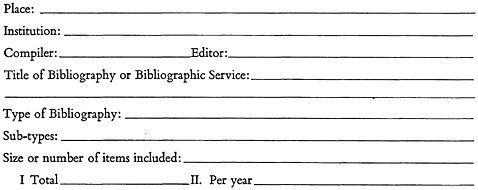
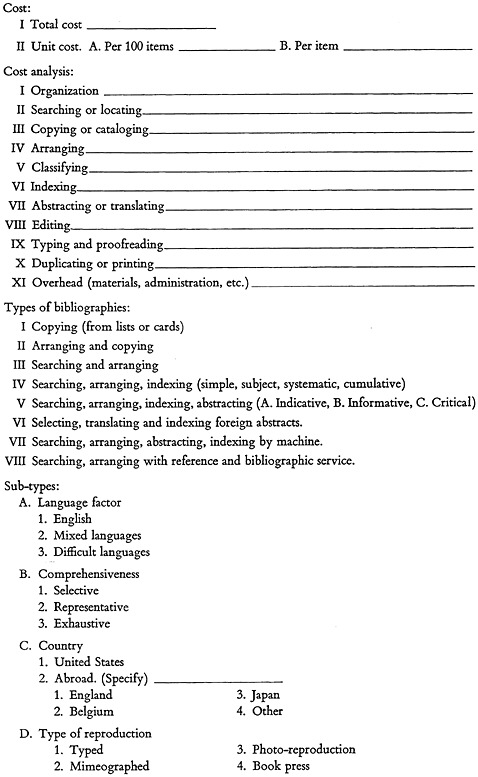
Exhibit 1 Simple copying of English language material: A selective bibliography of English language publications on Antarctic meteorology
This bibliography is one of the simplest types of bibliographies, involving the locating of a published bibliography on the subject wanted, selecting 100 English language items, copying these items, drafting a suitable title page and duplicating it by mimeographing process. Little editing was done. No knowledge of foreign languages, cataloging, abstracting, or indexing was involved.
Costs involved were:
|
I |
Organization |
$ 5.00 |
|
II |
Locating and copying |
21.00 |
|
III |
Editing |
3.75 |
|
IV |
Typing and proofreading |
9.50 |
|
V |
Duplicating |
10.80 |
|
VI |
Overhead |
5.00 |
|
|
Total cost |
$55.05 |
Exhibit 2 Copying English and foreign language references: A selective, multilingual bibliography on Antarctic meteorology
This bibliography, also one of the simpler types, involved the location of a bibliography on Antarctic meteorology containing foreign as well as English language references, the selection of the 100 items desired, the copying of these items on cards, numbering and typing the bibliography, and mimeographing. Some knowledge of foreign languages was needed, since French, Spanish, German, and Russian entries were included. No cataloging, abstracting, or indexing and little editing were done.
Costs involved were:
|
I |
Organization |
$ 5.00 |
|
II |
Locating and copying |
51.00 |
|
III |
Typing and proofreading |
8.50 |
|
IV |
Editing |
2.50 |
|
V |
Duplicating |
9.00 |
|
VI |
Overhead |
7.50 |
|
|
Total cost |
$83.50 |
Exhibit 3 Searching, copying, and arranging multilingual references from various sources; work done in the USA: A bibliography on noctilucent and nacreous clouds
(by MARIAN K.RIGBY)
This bibliography was more complex, though unannotated or indexed. The material had to be searched or located, in most cases cataloged and cards made. Languages involved, besides English, were Italian, German, Russian, French, Norwegian, and
Hungarian. The 100 odd cards were alphabetically arranged, then typed, and finally mimeographed. A great deal of time was required in searching and cataloging, since few of the items had been previously included in any catalog. This also was quite exhaustive.
Costs involved were:
|
I |
Organization |
$12.50 |
|
II |
Searching or locating |
40.00 |
|
III |
Copying or cataloging |
64.50 |
|
IV |
Arranging |
4.50 |
|
V |
Editing |
12.00 |
|
VI |
Duplicating |
30.00 |
|
VII |
Overhead |
9.00 |
|
|
Total cost |
$172.50 |
Exhibit 4 Searching, copying, and arranging multilingual references from various sources; work done in Belgium: Noctilucent and nacreous clouds
(by DR. A.VANDENPLAS)
This bibliography is similar to the previous one, but it was compiled and typed in Belgium. It is arranged chronologically, but not indexed, classified, or annotated. It was compiled from previously cataloged cards and contains 195 items.
Costs involved were:
|
I |
Organization |
$10.00 |
|
II |
Searching, locating, copying, and arranging |
32.40 |
|
III |
Editing |
3.00 |
|
IV |
Duplicating |
53.70 |
|
V |
Overhead |
6.00 |
|
|
Total cost |
$105.10 |
Exhibit 5 Searching, copying, and arranging multilingual references from various sources; work done in Japan: Noctilucent and nacreous clouds
(by DR. H.ARAKAWA)
Compiled in Japan, this bibliography of 156 items also resembles the one done in the United States. It is arranged chronologically and was fairly exhaustive, but it is unannotated, classified, or indexed, and required little editing. Mimeographing was done in the United States.
Costs involved were:
|
I |
Organization |
$10.00 |
|
II |
Searching, locating, copying, and arranging |
38.30 |
|
III |
Editing |
3.00 |
|
IV |
Duplicating |
48.00 |
|
V |
Overhead |
6.00 |
|
|
Total cost |
$105.30 |
Exhibit 6 Exhaustive searching, copying, and arranging multilingual references from various sources; work done in England: A bibliography on noctilucent and nacreous clouds (by R.BAKER)
This bibliography, of 224 items, on noctilucent and nacreous clouds, was compiled in England and is the most exhaustive of the four. It is arranged chronologically, is unannotated, unclassified, and is not indexed. It required a good deal of editing.
Costs involved were:
|
I |
Organization |
$10.00 |
|
II |
Searching, locating, copying, and arranging |
(50.00) (est.) |
|
III |
Editing |
9.00 |
|
IV |
Duplicating |
49.00 |
|
V |
Overhead |
6.00 |
|
|
Total cost |
$124.00 |
Exhibit 7 Exhaustive searching, annotating, arranging, and indexing mostly English language material: A bibliography of the works of Charles Ernest Pelham Brooks
This is an exhaustive bibliography, is completely annotated, arranged chronologically, indexed by subject and geographically. Before his death, Dr. Brooks edited it himself, and in many cases provided the abstract and classification.
Costs involved were approximately $450.00.


