
7
Firearms and Suicide
While much attention surrounding the debate over firearms has focused on criminal violence in general, and homicide in particular, suicide is the most common cause of firearm-related death in the United States (National Center for Health Statistics, 2003; see Table 3-3). Do guns increase the lethality or frequency of suicide attempts? A large body of literature links the availability of firearms to the fraction of suicides committed with a gun. Yet, a central policy question is whether changes in the availability of firearms lead to changes in the overall risk of suicide.
Despite the clear associations between firearms and gun suicide, answering this broader question is difficult. Box 7-1 sketches out a conceptual framework describing various mechanisms by which firearms may be associated with rates of suicide. The fundamental issue is the degree to which a suicidal person would simply switch to using other methods if firearms were less available. On one hand, if substitutes were easily enough available, then gun restrictions might change the typical method of suicide yet have no effect on the overall risk of suicide at all. On the other hand, there are at least two mechanisms by which guns might directly cause an increase in the risk of completed suicide. First, guns may provide a uniquely efficient method of self-destruction so that access to a gun could lead to a higher rate of completed suicide. It is often stated, for example, that easy access to firearms could increase the rate of completed suicide among persons with transient suicidal feelings because such access might increase the likelihood of an attempt with a lethal outcome. Second, the induction hypothesis proposes that the le-
|
BOX 7-1 Why might firearms access be associated with rates of suicide? Direct Causality: Firearms might directly increase the risk of suicide. The instrumentality hypothesis proposes that if guns were inherently more lethal than other methods, then access to a gun could lead to a higher rate of completed suicide. The method selection or induction hypothesis proposes that firearms might be preferred over other methods because their quickness and effectiveness might decrease some of the other “costs” of a suicide attempt. Spurious Correlation: Firearms might be associated with suicide but have no direct effect. Instead, there may be unmeasured confounders associated with both access to firearms and the propensity to commit suicide. In this case, if substitutes were easily enough available, gun access restrictions might reduce the incidence of gun suicide yet have no effect on the overall risk of suicide. Two examples highlight this possibility:
|
thality of a gun might itself increase the likelihood of a suicide attempt among gun owners: persons who would prefer the efficiency of a gun would be less likely to make an attempt if a gun were not available. Ultimately, it is an empirical question whether access restrictions lead to substantial reductions in the rates of suicide.
In this chapter we review studies of the relationship between household gun ownership and the risk of suicide.1 We review both studies that assess the relationships at aggregated geographic levels and those that look at the relationship between access and suicide at the level of the individual or household. Many studies conducted at aggregate levels rely on proxy measures of gun ownership; because these are so widely used, we devote special attention to discussing the pros and cons of using proxies for household gun ownership in ecological studies. Many individual-level studies of suicide use retrospective, case-control study designs; because the strengths and limitations of such a study design may be unfamiliar to some readers, we also discuss this methodology in some detail, with an explanation of the measures of association used in case-control studies presented in an appendix to the chapter. We then summarize the handful of studies that have evaluated the effects of specific gun laws on suicide. The final section presents the committee’s conclusions.
ECOLOGICAL STUDIES OF GUN OWNERSHIP AND THE OVERALL RISK OF SUICIDE
The great majority of research on suicide and gun ownership has been “ecological,” in which the unit of observation is the community rather than the individual, comparing measures of household gun ownership rates to the rates of completed suicide. In some cases, the comparisons are allowed to vary over time; in all cases, comparisons are made across several geographic regions. Ecological studies of gun ownership and suicide in the United States are summarized in Table 7-1.
Cross-Sectional Associations
Almost all ecological studies using cross-sectional data, both within the United States and across countries, have found that both gun suicide rates and the fraction of suicides committed with a gun are higher in geographic areas with a higher prevalence of household gun ownership. This association has been reported by investigators across the spectrum of the gun control debate. It has been found across cities, states, regions, and nations (Kleck and Patterson, 1993; Azrael et al., 2004; Killias, 2001), and it contrasts with the more variable association between gun ownership rates and the fraction of homicides committed with a gun.
However, the most important policy question is not whether gun access increases the risk of gun suicide, but whether gun access increases the overall risk of suicide. Many cross-sectional studies have reported a positive, bivariate association between gun ownership rates and overall suicide rates across cities, states, and regions of the United States, but the relationship is much smaller and less precise than the association between gun ownership rates and gun suicide rates. The association between gun ownership and overall suicide also appears to be sensitive to the details of the measures and the statistical models being used.
U.S. Studies
Several ecological studies by Birckmayer and Hemenway (2001) and by Miller et al. (2002a, 2002c) have focused on age-specific suicide rates by region and state. Their gun ownership measures include survey estimates of handgun and overall gun ownership from the GSS and, as a proxy measure, the fraction of suicides committed with a firearm. Before controlling for other social variables, Birckmayer and Hemenway find a positive association between regional GSS-reported rates of gun ownership and age-specific rates of suicide in every age group. After controlling for divorce, education, unemployment, urbanization, poverty, and alcohol consumption, they find a modest positive association between gun ownership and suicide risk for youth ages 15 to 24 (b = .35, 95% confidence interval .05 to .65) and for adults age 65 and over (b = .62, 95% C.I. .40-.84), but not for working-age adults between ages 25 and 64. Subsequent studies from the same research group use other model specifications, with varying results. For example, Miller et al. (2002a) do not incorporate control variables; they find a positive association between gun ownership and overall suicide rates in all age groups (incidence rate ratio 1.14; 95% CI 1.01-1.24) and a negative association between gun ownership and nongun suicide (IRR .87, 95% CI .77-.97) that is more pronounced for persons 45 years and older, suggesting greater substitution among methods in older age groups.
Duggan (2003) undertook a similar age-specific analysis, using subscriptions to the gun magazine Guns & Ammo as his proxy for gun ownership. Like Miller et al., Duggan did not include other covariates in his regression models and, like Miller et al., he found a positive and significant bivariate association between gun ownership and suicide across states. But Duggan also found a significant positive association between gun magazine subscription and nongun suicide for youth ages 10 to 19. The association between the gun proxy and nongun suicide shifts from positive to negative between ages 20 and 69 and becomes negative and statistically significant for persons over age 69. He concludes that the positive association between gun magazine subscriptions and nongun suicide among youth is evidence
TABLE 7-1 Ecological Studies of Associations Between Firearms Prevalence and Suicide in the United States
|
Source |
Unit of Analysis |
Gun Measure |
Subjects; Strata |
|
Duggan (2003) |
50 states 1996 |
Proxy: Guns & Ammo |
10 yr. age groups |
|
Hemenway and Miller (2002) |
9 regions 1988-1997 |
Survey: GSS (household handgun ownership) |
|
|
Miller et al. (2002b) |
9 regions 50 states 1988-1997 |
Survey: GSS, BRFSS Proxy: Cook index, FS/S (adult only) |
Children 5-14 |
|
Miller et al. (2002c) |
9 regions 50 states 1988-1997 |
Survey: GSS, BRFSS Proxy: Cook index, FS/S |
Adult women |
|
Miller et al. (2002a) |
9 regions 50 states 1988-1997 |
Survey: GSS, BRFSS Proxy: Cook index, FS/S |
10-yr. age groups |
|
Birckmayer and Hemenway (2001) |
9 regions 1979-1994 |
GSS |
10-yr age groups |
|
Azrael et al. (2004) |
9 regions 50 states 1994-1998 |
Survey: GSS, BRFSS, HICRC Proxies: FS/S, UFDR, Guns & Ammo, NRA membership |
|
|
Control Variables |
Results: Guns and Gun Suicides |
Results: Guns and Nongun Suicides |
Results: Guns and Overall Suicides |
|
None |
all ages + |
10-19: + 20-69:0 70+: – |
all ages + |
|
Major depression, suicidal thoughts, and urbanization, OR education, OR unemployment, OR alcohol consumption |
+ |
– |
+ |
|
Poverty, education, urbanization |
+ |
0 |
+ |
|
Poverty, urbanization |
+ |
BRFSS:+ Others: 0 |
+ |
|
None |
all ages + |
<45:0 45+: – |
all ages + |
|
Divorce, education, unemployment, urbanization |
15-24: + 25-44:0 45-84: + |
0 |
15-24: + 25-64:0 65+: + |
|
None |
+ |
n/a |
n/a |
|
Source |
Unit of Analysis |
Gun Measure |
Subjects; Strata |
|
Kaplan and Geling (1998) |
9 regions 1989-1991 |
Survey: GSS |
Sex × race |
|
Kleck and Patterson (1993) |
170 U.S. cities |
OLS proxy: gun crimes IV proxy: gun sport |
|
|
Sloan et al. (1990) |
2 cities 1985-1987 |
Registry: handguns Proxies: Cook index Strictness of gun laws |
Two age groups, race, sex |
|
Lester (1989) |
48 states 1980 |
Proxy: gun magazines |
|
|
Lester (1988a) |
6 (of 7) Australian states |
Survey-household gun ownership |
|
|
Lester (1988b) |
9 regions 1970 |
Survey Proxy: gun laws |
|
|
Lester (1987a) |
48 states 1970 |
Proxies: gun laws, UFDR Proxy: Cook index |
|
|
Duggan (2003) |
50 states |
Proxy: guns ammo sales rate |
All ages |
|
Control Variables |
Results: Guns and Gun Suicides |
Results: Guns and Nongun Suicides |
Results: Guns and Overall Suicides |
|
None |
+ |
Male: Female: 0 |
n/a |
|
Community traits: race, sex, age unemployment rate, poverty, income, home ownership, college enrollment, transience, population change, divorce, place of worship, etc. |
+ |
0 |
OLS: + IV: 0 |
|
None |
+ |
– |
0 |
|
None |
+ |
0 |
+ |
|
None |
0 |
– |
0 |
|
% black, median age, % urban, divorce rate |
+ |
0 |
0 |
|
None |
+ |
UFDR:– Other: 0 |
0 |
|
State, year fixed effects |
0 |
0 |
0 |
for an omitted variable, because any plausible causal effect of gun ownership should be independent of, or negatively associated with, the nongun suicide rate. There are several other possible explanations for Duggan’s results; most obviously, it may be that Guns & Ammo subscribers are not representative of all gun owners; his arguments about confounding would also have been strengthened by the inclusion of some observable covariates. All the same, both Miller’s and Duggan’s results support the view that different gun proxies may yield different results, and all of the age-stratified studies suggest that instrumentality effects, substitution, and omitted variables may be playing different roles at different ages.
The most comprehensive effort to control for confounding factors was published a decade ago. Kleck and Patterson (1993) undertook a cross-sectional study of the effect of firearms prevalence on crime rates and firearm-related fatalities in 170 U.S. cities. Although the study did not consider differences by age, the models included a set of 38 control variables previously identified as predictors of violence rates. Like other investigators, these authors found that higher levels of the proxy for gun owner-
|
Control Variables |
Results: Guns and Gun Suicides |
Results: Guns and Nongun Suicides |
Results: Guns and Overall Suicides |
|
State, year fixed effects FLFP, divorce, alcohol consumption family & cohort size |
Not stated |
Not stated |
+ |
|
Regional fixed effects |
+ |
Not stated |
Not stated |
|
None |
Handgun + All guns: 0 |
n/a |
All guns: 0 Handgun: + |
ship predicted higher rates of suicide (b = .132, p < .05). Kleck and Patterson also found evidence that there might be a different association between suicide risk and sporting gun ownership and suicide risk and defensive gun ownership. In particular, they found no significant effect of sporting gun ownership on the risk of suicide.
International Studies
Like the U.S. studies, the existing cross-national surveys have looked for an association between rates of household gun ownership, overall suicide rates, and the fraction of suicides committed with a gun. And, like the U.S. studies, cross-national studies have found a consistent association between gun ownership and the fraction of suicides committed with a gun across countries; but in contrast to the U.S. studies, the cross-national surveys do not reveal a consistent association between gun ownership and overall suicide rates.
Although gun ownership rates in the United States are much higher than in most other developed countries, the rates of suicide in the United States rank in the middle. Killias (1993), Killias (2001), and Johnson et al. (2000) found that reported rates of household gun ownership were strongly correlated with the fraction of suicides committed with a gun in each country (Spearman’s rho = .79 to .92, p < .001). But the cross-country correlations between household gun ownership and overall rates of suicide have proven to be smaller and statistically imprecise (Spearman’s rho .25, p = .27) (Killias, 2001). Likewise, in an often-cited study, Sloan et al. (1990) compared the rates of gun and nongun suicides in Seattle, Washington, with suicide rates in Vancouver, British Columbia, between 1985 and 1987; they found higher rates of gun ownership are associated with higher rates of gun suicide, lower rates of nongun suicide, and no significant difference in the overall suicide rate between the two cities (relative risk .97, 95% CI .87 to 1.09).
Associations Between Gun Ownership and Suicide Rates Across Time
The fraction of suicides in the United States that are committed with a firearm has increased from just over 35 percent in the 1920s to about 60 percent in the 1990s. Four studies have attempted to link this change in the fraction of gun suicides with changes in gun ownership across time.
Three of these four studies have found positive associations between proxies for gun ownership and the fraction of suicides committed with a gun, but only one study, focusing on youth suicide, found an association between gun ownership and overall suicide rates. Clarke and Jones (1989), examined the national prevalence of household gun ownership reported in polls by Gallup and the National Opinion Research Center between 1959 and 1984, comparing these reports with aggregate U.S. suicide rates over the same period. This study found a positive association between the fraction of households owning a handgun and the fraction of suicides committed with a gun (b = .68, p = .001), but no association between household gun ownership and overall risk of suicide (b = .04, p = .85). Azrael et al. (2004) also report a strong linear association between individual and household rates of gun ownership within regions and the fraction of suicides committed with a gun between 1980 and 1998, with cross-sectional beta coefficients ranging from .55 (for individual handgun ownership) to 1.02 (for household gun ownership of any kind), and an inter-temporal coefficient between FS/S and household gun ownership of .905 (s.e. = .355). They did not report the association between gun ownership and overall risk of suicide. Mathur and Freeman (2002) used state-level per capita gun dealership rates to predict adolescent suicide rates from 1970 to 1997. After controlling for state and year fixed effects and number of other observed
covariates (e.g., divorce rates, per capital alcohol consumption, female labor force participation, family size, and cohort size), Mathur and Freeman found that increases in gun dealerships per capita predicted increases in the overall youth suicide rate. Finally, Duggan (2003) used two decades of gun magazine sales with controls for state and year fixed effects to explain the trends in suicide rates across all age groups. Duggan found no association between magazine subscription rates and either gun suicide or overall suicide rates across time (b = .046, s.e. = .064, and b = .004, s.e. = .051, respectively).
Assessment of Ecological Studies
Overall, the body of ecological studies has firmly established that firearms access is positively associated with gun suicide, but the association between firearm access and overall suicide is less certain.
In particular, gun suicide rates are strongly correlated with gun prevalence across space and possibly across time, in the United States and across countries. Likewise, many ecological studies do report a cross-sectional association between gun ownership rates and overall suicide rates in the United States. However, gun ownership rates do not seem to explain overall suicide trends across countries or across time in the United States. Moreover, the results seem to vary according to the firearm measure used, the age group being studied, and the covariates included.
To further improve our understanding of the effects of firearms on suicide, researchers need to be increasingly sensitive to the possibility of confounding factors and substitution. Moreover, these ecological studies introduce two additional problems that must be considered. First, the analyses are conducted at the aggregate level, rather than at the individual level, and second, direct measures of access to firearms are often not available, thus forcing researchers to rely on proxies. We consider each of these issues in turn.
Substitution and Confounders
As with all empirical analyses, researchers and policy makers must be sensitive to unobserved confounders when attempting to draw causal inferences (see Box 7-1). To what extent would suicidal persons substitute other methods if firearms were less available? Unmeasured and confounding factors associated with both suicide risk and gun ownership might lead to a spurious association between guns and suicide. For example, if persons who are prone to own guns because of their mistrust of others were also at greater risk for suicide, whether or not they owned guns, there could be a noncausal statistical association between gun ownership and suicide. Likewise, high levels of “social capital” might be associated with lower rates of
defensive gun ownership and lower suicide rates (Hemenway et al., 2001). Neighborhood levels of gun ownership could even conceivably be affected by neighborhood suicide rates: suicide rates might contribute to a community’s perceived level of violence, whether people are aware of making such a link or not.
This concern is not unique to ecological studies, but has been generally ignored in this literature. There have been few systematic efforts to explore or model possible confounders of the association between gun ownership and suicide risk. Two studies by Hemenway and associates are suggestive. First, Hemenway et al. (2001) investigated the hypothesis that persons who live in communities with higher levels of mutual trust may be at lower risk of suicide (because of increased social support), and lower risk of gun ownership and less likely to own firearms (because of decreased motivation for defensive gun ownership). They found that, across U.S. states, lower levels of mutual trust and civic engagement, as reported on the General Social Survey and on the Needham Lifestyle Survey, were associated with a higher fraction of suicides committed with a gun. This study did not examine the association between social capital, firearm ownership, and overall suicide rates. Hemenway and Miller (2000) investigated the hypothesis that regions with higher rates of firearm ownership were characterized by higher rates of major depression, which is known to be an important independent risk factor for suicide. They found that the cross-sectional, regional association between firearm ownership and suicide rates was not explained by differences in the regional prevalence of major depression and serious suicidal thoughts.
Proxy Measures of Ownership
Research linking firearms to suicide (and violence more generally) is limited by the lack of detailed information on firearms ownership (see Chapter 2). The existing surveys cannot be used to link ownership to outcomes of interest and, for that matter, cannot generally be used to draw inferences about ownership in more precise geographic areas (e.g., counties) that are often of interest in ecological studies. The GSS, which collects individual and household information on firearms ownership over time, is representative of the nine census regions and the nation as whole. Other surveys—the Behavioral Risk Factor Surveillance System (BRFSS) and the Harvard Injury Control Research Center Survey (HICRC)—collect information on gun ownership prevalence rates representative of individual states in certain years.2
TABLE 7-2 Correlation Coefficient Between a Proxy and Gun Ownership Rates
As a result of these limitations, many ecological studies evaluating the relationship between firearms and suicide (and homicide) rely on proxies of ownership, rather than direct measures. Proxies have included the fraction of homicides committed with a firearm (FH/H), the fraction of suicides committed with a firearm (FS/S), subscription rates to Guns & Ammo (G&A), and other similar measures.3
The primary advantage of these proxies, as opposed to survey information, is that they can be readily computed at state, county, and other finer geographic levels. The disadvantage is that the proxy is not the variable of interest; ownership is. Thus, except in very particular circumstances, proxy measures result in biased estimates of the relationships of interest.
Several studies have explicitly evaluated different proxy measures of ownership. These assessments generally involve computing a correlation coefficient between the proxy and self-reported ownership measures from the GSS or other surveys.4 Azrael et al. (2004), for example, systematically assess a number of commonly used proxies. Their basic results using the GSS and other ownership surveys are displayed in Table 7-2. The fraction of suicides committed with a firearm has the highest correlation among all of the measures considered, ranging from 0.81 in the state level data to 0.93 when using ownership data from the nine census regions. The fraction of homicides committed with a firearm has the lowest correlations, and G&A subscription rates lie between the two.
Given this evidence, Azrael et al. conclude that “FS/S is a superior proxy measure for cross-section analysis, easily computed from available data for state and large local jurisdictions and valid against survey based estimates” (p. 50). They also find, using similar methods, that FS/S is a useful proxy for measuring intertemporal variation in ownership. This finding appears to share some consensus. Many other researchers have also accepted FS/S as the best and in fact a nearly ideal proxy for studying the cross-sectional relationship between firearms and violence. One notable exception is Duggan (2003), who argues that the FS/S is a poor proxy for studying suicide, even in cross-sectional analyses.
After reviewing the existing evidence, the committee urges more caution in using FS/S as a proxy for gun ownership. As Duggan points out, the most obvious statistical problems concern the circularity of using FS/S as a proxy in a study of suicide, but the properties of FS/S in other kinds of studies (e.g., homicide) have also not yet been well described.
There are three basic problems with the existing analysis of proxies of firearms access. First, there is the problem of the accuracy of self-reported measures of firearm access, the standard against which the proxies are being compared. The effects of nonresponse and erroneous response in the surveys of firearms ownership, and random sampling errors more generally, have not been investigated. Certainly, response errors alone—as described both in Chapters 2 and 5—may result in biased estimates of the true prevalence of gun ownership. Moreover, if persons who are at risk for attempting suicide are less likely to participate in a household survey than other persons, then household surveys may not reflect the true relationship between gun ownership and method choice among persons who are actually at risk of attempting suicide. Existing research does not yet shed much light on these possible biases.
Second, there is the problem of aggregation bias in the correlation analysis. The primary reason for using a proxy is that more direct gun ownership data may not be available at the appropriate level of aggregation. But even if the proxy is highly correlated with observed ownership rates at one geographic level, it need not be correlated with gun ownership in smaller areas or in subgroups of the population. To explore this possibility, the committee reexamined the correlation between FS/S and gun ownership levels using the individual GSS survey responses aggregated to the 100 primary sampling units rather than the 9 census regions. In this case, we estimated the correlation between the percentage of suicides committed with a firearm and ownership levels to be 0.646 for firearms of any type and 0.639 for handguns, substantially less than the correlations reported by Azrael et al. (2004).
A similar problem is presented in Figure 7-1, which displays the relationship between FS/S and household gun ownership by age and gender.
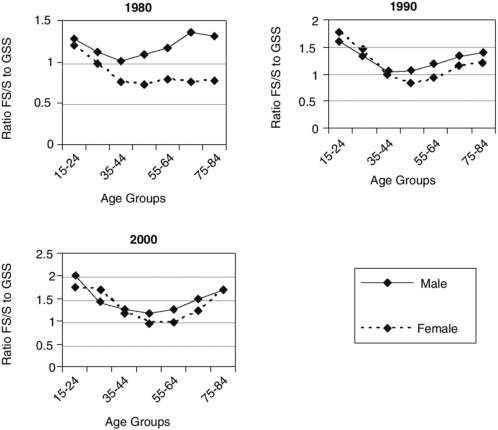
FIGURE 7-1 Changing relationship of fraction of suicides using a firearm (FS/S) to household gun ownership (GSS) in the US by age and sex.
This figure shows that the relationship between FS/S and household gun ownership (as reported in the GSS) varies by age and gender and appears to have changed between 1980 and 2000; for example, the difference in patterns of association between males and females has diminished substantially. Such changes suggest that the relationship between FS/S and other measures of gun ownership may be influenced by a number of social, political, and cultural factors that are not yet understood.
Third, even if the estimated correlation coefficients are valid, it is not clear how this confirms (or refutes) the utility of such a proxy as a measure of gun ownership. To the contrary, except in very specific circumstances, regressions with proxies result in biased estimators.5 Under the best cir-
cumstances, proxies reveal the sign but not the magnitude of the relationship of interest (Krasker and Pratt, 1986; Maddala, 1992). Azrael et al. (2004) attempt to provide some insight into this scale problem by running a simple linear regression of the form:

where PREV is the true ownership rate, FS/S is the observed proxy, β0 and β1 are unknown coefficients, and U is a mean zero unobserved random variable, conditional on FS/S. The estimated slope coefficient is near unity, suggesting that a one-unit increase in FS/S implies a one-unit increase in the expected prevalence rate. The authors take this result, coupled with the strong cross-sectional correlation coefficients, as evidence supporting the idea that the FS/S proxy leads to (nearly) unbiased estimators of both the sign and the magnitude of the relationships of interest.
This logic, however, could be misleading. In the classical omitted variable model described by Wooldridge (2000:284-286), a unit coefficient on β1 is sufficient. In other models, however, unbiased estimators may not exist. It is difficult to assess whether these conditions result in an unbiased estimator since Azrael et al. (2004) do not clearly describe the model they have in mind.6 This problem becomes particularly important when FS/S is being used as a proxy in the study of suicide, and it seems to be an important source of misunderstanding. For example, Miller et al. (2002a, 2002c) assess the potential biases created by the FS/S proxy in the study of suicide, using statistical simulations. These authors claim to demonstrate that FS/S is not, by construction, correlated with the overall suicide rate, so that FS/ S may be appropriately used as a measure of gun ownership in such a study. However, they do not explicitly describe their statistical model, and their description of the Monte Carlo simulation does not provide enough information to understand much about what was done. Furthermore, it is not
|
BOX 7-2 There is not enough information available from the published Monte Carlo design (Miller et al., 2002a, 2002b) to enable someone to replicate it. However, the committee did a Monte Carlo experiment that implied quite different results. The Monte Carlo simulates a study of the relation between the suicide rate and FS/S as a proxy for gun ownership. Let Z1, Z2, and Z3 denote unobserved independent standard normal variables, and let FS = 10 + Z1; NFS = 6 + Z2; FS/S = FS/(FS + NFS); POP = 50 + Z3; and RATE = (FS +NFS)/POP, where FS is the number of firearm suicides, NFS is the number of nonfirearm suicides, POP is the population size, and RATE is the total suicide rate for the population. With 1,000 replications, this design gave a mean value of FS/S in the neighborhood of 0.6 (similar to the fraction of suicides currently committed with a firearm in the United States). The correlation coefficient of FS/S and RATE was –0.29. The linear regression of RATE on FS/S gave a slope coefficient of –0.18 with a t-statistic of 9.6. So, according to this simulation, there is a negative association between the suicide rate and FS/S. In other words, if FS/S is a good proxy for ownership, gun owners are less likely than nonowners to commit suicide. |
obvious why the simulation is at all relevant: the basic finding that proxies create biases is an analytical result that cannot be resolved by a simulation. It is very easy to create other plausible simulations that lead to substantial correlations between FS/S and suicide and, more importantly, substantial biases in the estimated relations of interest.
In Box 7-2, for example, we present the results of a simulation conducted by the committee. In this Monte Carlo simulation, we study the relation between the suicide rate and FS/S as a proxy for gun ownership, but we derive very different results than those reported by Miller et al. (2002a, 2002c). In particular, we find a negative association between the suicide rate and FS/S: in this simulation, if FS/S is a good proxy for ownership, gun owners are less likely than nonowners to commit suicide.
This exercise illustrates at least two things: (1) the design of the Monte Carlo simulation matters and (2) having suicide-related variables on both sides of the regression can produce perverse results. In the end, the biases created by proxy measures are application specific. Duggan (2003), for example, highlights the potential problems caused by using FS/S as an explanatory variable in a model whose dependent variable is also suicide-related. As demonstrated in the simulation above, unobserved factors associated with
the measure of gun and nongun suicide (e.g., measurement error) may lead to purely spurious correlations between suicide and FS/S. Since suicide, S, is on both sides of the estimated equation, the implicit model is often a complicated, nonlinear relation between S and FS, not the linear model that is assumed in the literature. These issues may or may not be problematic when using FS/S to estimate the relationship between gun ownership and homicide.
Another important issue is how the proxy affects inference from specific models that may include other explanatory variables. This depends, among other things, on how true firearms prevalence and FS/S are related to the other observed and unobserved explanatory variables. These issues are complicated, and most of them have not been recognized, much less investigated, in the suicide and firearms literature.
Ecological Bias
All empirical studies face difficulties with making causal inferences, but ecological studies face special sources of bias in dealing with exposures and confounders. These difficulties arise because of the aggregation of observations and because the data on exposures, confounders, and outcomes are from different sources. At the most basic level, the data on firearms ownership in these studies may not come from the persons who committed suicide. Thus, ecological studies cannot establish whether there is a relation between gun ownership by an individual or household and suicide by that individual or member of the household. This may seem like a small problem in the case of gun suicide; after all, the victims of a gun suicide have undeniably achieved access to a gun. But community-level rates of gun ownership may not reflect the rates of gun ownership among highly suicidal persons. If, for example, the relationship between gun access and gun suicide varies by age and sex or by psychiatric disorder, then the aggregate association may reflect differences in the prevalence of suicidal states among persons of different age and sex or psychiatric disorder in the population, rather than differences in access to firearms. The geographical level of aggregation in state-level or regional ecological studies may be so high that there is no way of knowing whether the gun homicides or gun suicides occurred in the same areas with high levels of gun ownership.
Thus, even if FS/S is found to be a valid proxy for state-level gun prevalence, something that is not yet established, ecological studies may lead to biased inferences. The proxy is not a substitute for good data on household-level ownership or even ownership at a smaller level of aggregation by age, sex, or geography. Rather, better individual-level studies exploring the relationship between gun ownership and suicide may be needed in order to further understanding of the overall relationship between firearms and the risk of suicide.
INDIVIDUAL-LEVEL STUDIES OF THE ASSOCIATION BETWEEN FIREARMS AND SUICIDE
Most individual-level studies use case-control or response-based study designs to study rare events, such as completed suicide. However, the strengths and weaknesses of this study design are not well understood by investigators outside the public health community, and in order to clarify the controversy surrounding some of these studies, it may be helpful to describe the most important features of the case-control study design. Studies of the rates and determinants of illness or behaviors can be classified as retrospective or prospective. Prospective studies usually select people on the basis of exposure and determine how many persons with the exposure, compared with persons without exposure, develop a certain outcome. In contrast, retrospective studies usually start by choosing persons according to whether an illness or behavior has already developed and seek to find the phenomena that might be associated with the development of the outcome. Intuitively, it makes sense that if one is studying a rare outcome, then a prospective design is inefficient because it may take a very large sample or a very long time to accumulate enough occurrences. In this case, the case-control sampling design is beneficial because it oversamples the behavior or outcome of interest.
To investigate suicide, for example, a case-control study might select as cases those persons who have committed suicide, and then randomly select as controls a certain predetermined number of subjects from the same population who did not commit suicide. The study design would seek to establish an association between the outcome (suicide) and an exposure (such as firearms or depression) by noting the proportions of cases and controls that have been exposed to the possible risk factor.
There are a number of important advantages to the case-control method that explain its common use in epidemiology. Because the outcomes have already happened, case-control studies require no costly follow-up waiting for the outcome to develop. Because case-control studies oversample the outcome of interest, they also require smaller samples sizes than prospective studies of comparable power; for this reason, the case-control sampling scheme is often the only feasible way to collect the information of interest. For example, although suicide is the most common cause of firearm-related deaths in the United States, the overall suicide rate is approximately 11 suicides per 100,000 persons per year. Very few prospectively collected data sets would be large enough to draw precise inferences about completed suicide.
Feasible and efficient as the case-control design may seem, it also suffers from important limitations arising from the nonrandom selection of cases or controls and from misclassification of the outcome or exposure.
For example, case-control studies are particularly susceptible to recall bias—a bias resulting from differential recall among case respondents compared with control respondents. The likelihood of recall bias may be directly influenced by the respondent’s motivation to explain the illness (or outcome) itself. In a study of suicide, the victim’s past history of depression might be more salient to the relatives of a person who has committed suicide compared with the relatives of a control subject, so that case-control studies of completed suicide might overstate the risk of psychopathology or of gun ownership among persons who have committed suicide, compared with controls.
Furthermore, relatives may follow a “stopping rule”: once the family has found a “sufficient” explanation for the occurrence of the suicide—whether it is a gun in the home or psychopathology—they may be less likely to admit the presence of other, less socially acceptable risk factors; such ascertainment bias can lead to the underreporting of co-morbidity among risk factors and could explain reports of a greater frequency of gun ownership among suicides with no reported history of psychopathology. In the case of gun suicides, ascertainment bias may also arise because the outcome itself provides evidence of access to a gun. For example, family members are not always aware that firearms are kept in the home. If a subject has killed himself with a gun, family members would not be able to deny the gun’s existence, even if they have first learned of its existence because the suicide has occurred. In contrast, the relatives of a living control subject may not know with certainty whether a gun is present in the household (Ludwig et al., 1998). Family awareness of suicidal risks could lead them to take steps to prevent the suicide of family members known to be at risk. In this case, the absence of firearms would be a sign of appropriate family responsiveness, and a nonexperimental study design would be unable to distinguish the protective effects of gun removal from the protective effects of other steps that the family may have undertaken at the same time.
Other limitations of case-control studies include nonrandom selection of cases or controls; it is often difficult to design a sample selection procedure that ensures that controls are, in fact, representative of the same population from which the cases were drawn. Even if the data are accurate and the sampling scheme is well defined, case-control studies, like other nonexperimental study designs, have a limited ability to distinguish causal from noncausal connections. In the case of firearms, individuals who own guns might have unobserved attributes that are associated with increased suicide risk, or, just as important, some individuals may seek to purchase guns because of a specific plan to commit suicide. These possibilities have very different implications from the point of view of preventive intervention.
Finally, the parameter reported in many case-control studies, termed the odds ratio, is often not the parameter of interest for policy. Presumably, policy makers are interested in the expected number of lives saved or lost because of firearms or other factors. The odds ratio, which is roughly the suicide probability with firearms divided by the suicide probability without firearms, can translate into many or few lives, depending on the suicide probabilities that are involved. Thus, a large odds ratio does not necessarily translate into a large number of lives, and a small odds ratio does not necessarily translate into a small number of lives. To see the problem, consider two populations, one in which the suicide probability conditional on owning a firearm is 0.02 per person per year and the suicide probability conditional on not owning a firearm is 0.01 per person per year, and another in which these two probabilities are 0.0002 and 0.0001, respectively. The odds ratio and the relative risk are the same in both scenarios, but if guns are causal, then removal of guns from the population might avert 0.01 deaths per person per year in the first scenario, but only 0.0001 deaths per person per year in the second. Policy makers would usually like to know the attributable risk, which can be defined as the difference between the incidence of the outcome among the exposed and the incidence of the outcome among the unexposed. For the odds ratio or relative risk to inform policy, it must therefore be considered in light of additional information. The appendix to this chapter provides a detailed discussion of the measures of association in case-control designs, illustrating the strengths and weaknesses of the odds ratio as a measure of association and explaining the information needed to estimate attributable risk.
Psychological Autopsy Studies
A number of studies have now been published that compare the prevalence of firearms in the homes of suicide victims with the prevalence of firearms in the homes of living controls; these studies, most of which make use of a “psychological autopsy” case-control design, are summarized in Table 7-3. Psychological autopsy studies are retrospective studies using interviews with relatives, neighbors, coworkers, or other close contacts of a deceased person (or of a living control subject) seeking to reconstruct the presence or absence of behavioral or psychological risk factors that may have predisposed the death. All of the studies that the committee reviewed have found a positive association between household gun ownership and suicide risk, although the magnitude of the estimated association varies. Although more recent studies have used better data collection strategies and more appropriate study samples (e.g., Conwell et al., 2002; Beautrais et al., 1996), the earlier studies suffer from methodological problems—ranging from sample selection problems to measurement bias, small samples, and
TABLE 7-3 Psychological Autopsy Studies of Firearm Prevalence and Suicide
|
Source |
Cases N |
Controls n |
|
Conwell et al. (2002) |
Older adult suicides N = 86 |
Community controls n = 86 |
|
Shah et al. (2000) |
Adolescent gun suicides N = 36 |
School-selected controls n = 36 |
|
Brent et al. (1999) |
Adolescent suicides N = 140a |
Community controls n = 131 |
|
Bailey et al. (1997) |
Female homicides and suicides in the home N = 123 suicides; 143 homicidesa |
Community controls n = 266 pairs |
|
Beautrais et al. (1996) |
Suicides N = 197 |
Community controls n = 1,028 normal controls |
|
Brent et al. (1994) |
Adolescent suicides with affective disorder N = 63a |
Community controls with affective disorder n = 23 |
|
Gun Measure |
Covariates, Matching Factors |
Result: Gun Access and Overall Suicide Risk |
|
Firearm in home |
Education, living situation, psychiatric illness |
+: any gun, handgun 0: long gun |
|
|
Matching: age, race, sex, county of residence |
|
|
Firearm in the home |
Previous mental health problems, alcohol use, conduct disorder |
n/a: no information about overall suicide |
|
|
Matching: age, sex, school |
(although gun is + associated with risk of gun suicide) |
|
Firearm in the home |
Psychiatric diagnosis, family history, life stressors, history of abuse |
+: any gun |
|
|
Matching by sex; age, race, county of origin, socioeconomic status |
|
|
Firearm in the home |
Mental illness; history of domestic violence; alcohol use, alcohol problems, prior arrest; illicit drug use; home security |
+: any gun |
|
|
Matching: neighborhood, sex, race, age |
|
|
Firearm in the home |
Age, gender, ethnicity, psychiatric diagnosis |
0: gun not associated with overall risk of suicide (although gun is associated with risk of gun suicide) |
|
Firearm in the home |
Psychiatric diagnosis, family history, stressful life events, past treatment Matching: age, sex, county of origin, socioeconomic status |
+: any gun, handgun 0: not long gun |
|
Source |
Cases N |
Controls n |
|
Bukstein et al. (1993) |
Adolescent suicides with substance abuse N = 23a |
Community controls with substance abuse n = 12 |
|
Brent et al. (1993a) |
Adolescent suicides N = 67a |
Community controls n = 67 |
|
Brent et al. (1993b) |
Adolescent suicides N = 67a |
Community controls without psychiatric disorder n = 38 |
|
Kellermann et al. (1992) |
Suicides in the home N = 438b |
Community controls n = 438 |
|
Brent et al. (1991) |
Adolescent suicides N = 47a |
Inpatient controls n = 94 47 attempters, 47 never-suicidal |
|
Brent et al. (1988) |
Adolescent suicides N = 27 |
Inpatient controls n = 56 |
|
aOverlapping samples, western Pennsylvania. |
||
failure to control for possible confounders—which raise doubts about the reliability and interpretation of the findings that have been reported to date.
By far the largest psychological autopsy studies of guns and suicide, homicide, and unintentional injury have been conducted by Kellerman et al. (1992, 1993, 1998; Bailey et al., 1997). Their 1992 study of firearms and suicide is representative of their approach. Cases occurred in King County, Washington, and Shelby County, Tennessee, and were selected for study if the suicide took place in or near the home of the victim, regardless of method of suicide used; out of 803 suicides occurring during the study period, 565 occurred in the home and 238 occurred elsewhere. Cases were matched with living controls of the same race, sex, and age range and residing in the same neighborhood; the team sought to interview proxy respondents for both cases and controls, but 50 percent of the control interviews were conducted with the (living) subjects themselves. The structured interviews screened for substance abuse, domestic violence, legal problems, current medications, and history of depression, as well as the presence or absence of a gun in the home, but the protocols did not make formal psychiatric diagnoses. The odds ratio associated with firearms ranked fifth among the seven variables that were included in the final conditional-logistic regression analysis; the seven measures, along with their adjusted odds ratios, included psychotropic medication prescribed (35.9), previous hospitalization due to drinking (16.4), active use of illicit drugs (10.0), lives alone (5.3), gun kept in household (4.8), failure to graduate from high school (4.1), and drinks alcohol (2.3). The adjusted odds ratio for gun access had a 95 percent confidence interval of 2.7 to 8.5. Guns were a stronger risk factor for suicide among the 63 case subjects with no history of depression or mental illness (odds ratio 32.8; 95 percent confidence interval 4.6 to 232.8). According to the proxy informants, only 3 percent of suicides in the sample had purchased a gun within two weeks before death.
This team’s focus on suicide in the home would have been appropriate for a study of unintentional injuries. However, the element of intention leads to an important difference between a study of “suicide and guns in the home” (which would be the usual policy question) and a study of “guns and suicide in the home” (which is what the research group elected to study), because it is likely that decisions about method and location of suicide are made together. This means that a study of gun access in a study restricted to suicides that take place in the home may be no more informative than a study of bridge access in a study restricted to suicides that take place from a bridge.
The possibly biased sample selection strategy, as well as other problems in the execution of the study and reporting of results, provoked a storm of attacks on the research team, the federal funding agency, and the medical journal in which the reports were published. It is difficult to determine the
degree of bias that was actually introduced in these studies by the sample selection strategy. However, one does learn that 58 percent of suicides taking place in the victim’s home occurred by firearm, as did 46 percent of suicides not in the home. An informal calculation using assumptions that are favorable to the investigators suggests that omission of suicides taking place outside of the home may have led to an overstatement of the true relative risk by about 20 percent.7 There are other problems with the execution of this study that may have actually led to biases of larger magnitude. For example, after eliminating the suicides that occurred outside the home, the investigators collected complete data for only 360 of 565 eligible cases, so that the final results were based on only 64 percent of the sample of suicides in the home and only 40 percent of the total suicide sample.
Several psychological autopsy studies have now focused on the risk of suicide among adolescents. There are three important reasons for selecting adolescents as a population for special scrutiny. First, suicide is the third leading cause of death among adolescents; if reducing access to firearms were a feasible way to reduce adolescent suicide, this would have great public health importance. Second, it is likely that “impulsive” suicides are more common among the young, so that studies of youth suicide may generalize to the type of suicide for which preventive efforts seem most promising. And third, studies of adolescent suicide are less susceptible to problems of reverse causality: because adolescents under the age of 18 are not allowed to pur-
chase long guns or handguns in any state, an association between household gun ownership and adolescent suicide cannot be attributed to the adolescent’s suicidal plan. Six overlapping studies have been published by Brent and colleagues based on cases of adolescent suicide occurring in western Pennsylvania. The most recent report includes all of the adolescent suicides that have been investigated by this research team and can serve as a summary of the studies to date. Subjects were a consecutive series of 140 adolescent suicide victims from western Pennsylvania and 131 community controls who were matched to the group of suicide victims on age, race, gender, county of origin, and socioeconomic status. Family members were interviewed using a structured protocol concerning the circumstances of the suicide, stressors, and current and past psychopathology; parents were also interviewed regarding family history of psychopathology and availability of a firearm (Brent et al., 1999). Like Kellerman and his colleagues, this research group found an association between family gun ownership and the risk of suicide, with an odds ratio of 3.0 (with a 95 percent confidence interval = 1.3-6.8) for older adolescents and 7.3 (with a 95 percent confidence interval = 1.3-40.8) for younger adolescents. They found that firearms in the home appeared to be a stronger risk factor among subjects with no diagnosable psychiatric disorder.
The results that have been reported from these U.S. studies contrast with a large case-control study from New Zealand, reported by Beautrais and colleagues in 1996. This study compared a consecutive series of 197 persons of all ages who died by suicide, 302 individuals who made medically serious but nonlethal suicide attempts, and 1,028 randomly selected community controls. Suicide attempts by gunshot accounted for 13.3 percent of suicides and only 1.3 percent of serious but nonlethal suicide attempts. Access to a firearm was strongly associated with an increased risk that gunshot would be chosen as the method of suicide or suicide attempt (odds ratio = 107.9; 95 percent confidence interval 24.8 to 469.5), but this access was associated with a much smaller, and statistically nonsignificant increase in the overall risk of suicide (odds ratio = 1.4; 95 percent confidence interval = 0.96 to 1.99).
How can one reconcile the very different estimates from the United States and New Zealand? The Beautrais and Kellerman confidence intervals do not overlap, but of course one interpretation of the overall literature is that the estimate lies somewhere in the range between Beautrais, Brent, and Kellerman, with possible differences in effect size by age group and country. The U.S. and New Zealand studies together seem to suggest an odds ratio that may be above one, but is not much larger than two, if one thinks effects in the two countries are likely to be similar. However, the effects in the two countries may differ for reasons that we do not yet understand.
One possibility is that the cultural correlates of gun ownership are different in New Zealand and in the United States, and that, in one or both
countries, some of the association between household gun ownership and the risk of suicide is explained by an unobserved characteristic of the families or social networks of suicidal persons. This interpretation is supported by two individual-level studies based on the National Longitudinal Study on Adolescent Health (called AddHealth), which found that adolescents who reported that they had access to a gun in their homes also reported higher rates of nonlethal suicidal thoughts and behaviors (Resnick et al., 1997; Borowsky, et al., 2001). These results may reflect reporting bias on the part of the adolescents (if suicidal adolescents are more likely to admit, or even brag about, the presence of a gun), familial transmission of a mood disorder (if a single heritable trait increases the likelihood that a parent will own a gun, and that an adolescent will experience suicidal thoughts), or correlates of particular parenting styles or family constellations (if parents who are more likely to own a gun are also more likely to have a distant or rejecting relationship with an adolescent child). However, they indicate that the association between household gun ownership and risk of suicide may be due to factors beyond the relative lethality of firearms.
Risk of Suicide Among Recent Gun Purchasers
Another way to clarify the causal relationship between suicidal intention and gun ownership is to study the risk of suicide among recent gun purchasers. Two record linkage studies have done this by using state gun registration systems to compare the risk of suicide among gun purchasers with the risk of suicide in a general population. Both of these studies suggest that a small but significant fraction of gun suicides are committed within days to weeks after the purchase of a handgun, and both also indicate that gun purchasers have an elevated risk of suicide for many years after the purchase of the gun. The first study, by Cummings et al. (1997a), linked the membership list of a large health maintenance organization (HMO) in Washington State with state handgun registration records and state death certificates. Cases were HMO members who died of suicide or homicide between 1980 and 1992; for each case subject, five control subjects matched by age, sex, and zip code were randomly selected from the HMO membership list. For each case and control subject, family members were identified, and computerized records of handgun purchasers in Washington State were searched for the first occurrence of a handgun purchase from 1940 until the case’s date of death. About 52.7 percent of the suicides were committed with a gun; 24.6 percent of persons who committed suicide had a history of a handgun purchase by themselves or a family member, compared with 15.1 percent of controls, with an adjusted relative risk of 1.9 (95 percent confidence interval 1.4 to 2.5). About 3.1 percent of suicide victims or their family members had purchased a first handgun within a
year of the suicide, compared with 0.7 percent of controls. After the first year, the relative risk of suicide persisted, but at a much lower level; the median interval from first handgun purchase to suicide with a gun was 10.7 years.
The second study, by Wintemute et al. (1999), reported similar findings in a population-based study of individuals purchasing handguns in California in 1991. This study did not investigate the risk of suicide among the family members of gun purchasers, but the changes in suicide risk over time were presented in more detail. Age and sex-standardized mortality ratios for handgun purchasers were compared with the mortality of the general adult population of California. The risk of suicide in the first week after purchase was 57 times the risk of suicide in the general population, and the risk within the first year was 4.31 times the risk of suicide of the general population. The rates of suicide by firearm within the first six years after handgun purchase are presented graphically in Figure 7-2.
Taken together, these two studies provide strong evidence that some guns are indeed purchased for the purpose of carrying out a planned suicide, but this seems to represent only a small fraction of completed suicides: handguns purchased within the past year were used in about 5 percent of suicides in California, and about 3 percent of suicides in the Washington HMO. However, the focus on legal handgun purchases provides only a lower-bound estimate of the fraction of gun purchases that have occurred
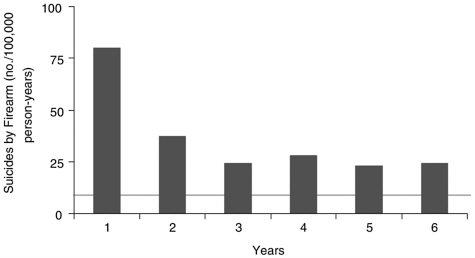
FIGURE 7-2 Rates of suicide by firearm during the six years after purchase among persons who purchased in California in 1991.
NOTE: The horizontal line indicates the age- sex-adjusted average annual rate of suicide by firearms in California for 1991-1995 (10.7 per 100,000 persons per year).
SOURCE: Adapted from Wintemute et al. (1999).
for the purpose of suicide, and both studies concern the purchase of handguns in states with gun registration laws, so they do not indicate how many guns might be purchased for the purpose of suicide if gun registration did not occur. The most important limitation is that these studies do not indicate whether handgun purchasers would have substituted other methods of suicide if a gun were not available, and do not measure other factors, such as history of substance abuse, psychiatric illness, criminal activity, or domestic violence, which might explain or modify a link between gun ownership and propensity for suicide.
Assessment of Individual-Level Studies
All of the individual-level studies reviewed here have found a strong association between gun access and the likelihood that a suicide, if it occurs, will take place by means of a gun. There is also strong evidence that some guns are specifically purchased for the purpose of suicide, suggesting that some individuals definitely prefer a firearm to commit suicide, if suicide is their intention. But such reverse causality does not entirely explain the link between gun access and overall risk of suicide, because several studies have found that adolescents (who are not eligible to purchase guns) are at higher risk of suicide if they live in a home with a gun.
It is not yet clear if the individuals who used a gun to commit suicide would have committed suicide by another method if a gun had not been available. Overall, the U.S. studies have consistently found that household gun ownership is associated with a higher overall risk of suicide, but the estimate of such an association was significantly smaller in a study from New Zealand. Although reverse causality cannot explain the association between guns and risk of suicide for adolescents, it remains possible that some other heritable or environmental family trait links the likelihood of gun ownership and suicide. For example, several studies have found that adolescents with access to firearms in their homes are also more likely to report thoughts of suicide, suggesting that it may be some unobserved characteristic of gun-owning families in the United States that places such adolescents at higher risk.
Next Steps
Despite these concerns with the existing literature, it is the committee’s view that individual level studies in general, and case-control studies in particular, have been underutilized in this literature. All empirical research in this area must be cognizant of the potential for substitution and confounders, but individual-level study designs allow researchers to avoid the biases introduced by aggregation and proxy measures of ownership and are
particularly well suited to the exploration of “third variables” that could explain the link between firearms and suicide in the United States.
WHAT DIFFERENCE COULD A GUN LAW MAKE?
While suicide has rarely been the basis for public support of the passage of specific gun laws, suicide prevention may be the unintended by-product of such laws. For example, federal ownership standards that have been set by the Brady Handgun Violence Prevention Act might reduce the risk of gun suicide among several high-risk groups, including persons with a history of violent behavior, substance abuse, and severe mental disorder. Gun storage laws might reduce the risk of suicide among children and adolescents; gun buy-backs might reduce the stock of infrequently used guns that might be used for suicide, and cooling off periods could reduce the use of guns in suicides motivated by transient suicidal states. But gun policies could also increase the risk of suicide. For example, mental health advocates have opposed the creation of registries of persons with a history of mental illness, arguing that the stigma of appearing in a state-sponsored registry could lead some persons to refuse needed mental health treatment, thus increasing rather than decreasing the risk of a lethal outcome.
Tables 7-4, 7-5, and 7-6 summarize studies of the effects of specific gun laws. Several cross-sectional and time-series studies do report a decline in firearm suicides in response to gun control legislation, but so far there is little evidence for an effect on the overall risk of suicide.
Cross-Sectional Studies of Gun Laws and Suicide
We identified 14 cross-sectional studies of the association between strictness of gun control laws and rates of suicide; these studies are summarized in Table 7-4. Overall, most studies found that stricter gun laws were associated with lower gun suicide rates. For example, 8 out of 9 studies found that states or cities with stricter gun control laws have lower rates of gun suicide. These studies have used a variety of methods for classifying the types and strictness of gun laws; it is worth noting that many of them compare the same geographic areas over the same time intervals, so they should not be regarded as independent samples. In general, laws restricting the buying and selling of firearms have been associated with lower rates of firearm suicide, but laws governing the right to carry firearms seem to have no association.
Lower gun suicide rates have sometimes been associated with higher nongun suicide rates, and the findings regarding overall suicide rates have been less consistent: 5 out of 11 studies found an association between stricter gun laws and overall rates of suicide, another 5 studies found no significant association, and 1 study produced mixed results.
Time Series Studies of Gun Laws and Suicide
A number of studies have described the trends in gun suicides in one or two local or national jurisdictions before and after the passage of a gun control law. Studies using one or two jurisdictions are summarized in Table 7-5; most of these studies have also been reviewed in previous chapters. These studies present conflicting findings about the association between gun laws and suicide, depending on the model specification and time period under study. For example, several reports by Rich et al. (1990), Carrington and Moyer (1994), Leenaars and Lester (1999), and Lester (2000) reach different conclusions about the trends in gun suicide and overall suicide and homicide in Canada before and after the passage of restrictive gun control laws in 1977, compared with trends in the United States over the same period of time.
Another notable example in this literature is the study by Loftin et al. (1991) evaluating the District of Columbia’s Firearms Control Regulations Act of 1975. This study has been prominently cited as showing a significant decline in gun suicides following the institution of a ban on handguns. However, overall suicides, not gun suicides, are the policy question of interest, and the investigators did not report whether there were significant differences in the estimates of the trend in overall suicide rates. Other concerns about the Loftin study were raised in Chapter 5 in relation to homicide, and they are likely to apply to the results pertaining to suicide as well.
The overall problem with the interrupted time-series study design is that simple comparisons cannot distinguish the effects of passage of a gun law from the effects of a myriad of other factors that may be changing over the same period of time. We identified four studies, summarized in Table 7-6, that improve on this research design by using “difference-of-differences” methods across many jurisdictions to evaluate the effect of gun policies on suicide rates. These studies compare the differences in outcomes before and after the introduction of a new policy in the various jurisdictions in which such policies have been introduced, with the differences in the outcomes over the same period of time among otherwise similar jurisdictions that have not been exposed to a change in policy. By making comparisons within the same jurisdiction at multiple points of time and across many jurisdictions at any single point in time, investigators hope to control for unobserved characteristics of the jurisdiction that do not change over time and for unobserved time trends that may be shared across jurisdictions. As with the simpler interrupted time-series design, the validity of the results depends on many assumptions about how and when the law was implemented, how long it might take for the law to have a discernible effect on the use of firearms, how long such an effect might last, and about the presence or absence of other factors that might affect the suicide rate during the time when the gun law came into effect.
TABLE 7-4 Cross-Sectional Studies of Gun Laws and Suicide
|
Source |
Units of Analysis |
Gun Law |
|
Kleck and Patterson (1993) |
170 large cities, 1979-1981 |
10 types of law, or aggregate index |
|
Yang and Lester (1991) |
48 states, 1980 |
Strictness of state gun control laws (update of Sommers, 1984) |
|
Boor and Bair (1990) |
50 states, DC 1985 |
Three types of gun laws |
|
Lester (1988c) |
9 regions, 1970 |
Strictness of handgun control laws |
|
Lester (1987a) |
48 states, 1970 |
Strictness of handgun control laws |
|
Lester and Murrell (1986) |
48 states, 1960, 1970 |
Strictness of handgun control laws 1964-1970 |
|
Sommers (1984) |
|
Nine types of laws |
|
Medoff and Maggadino (1983) |
50 states, 1970 |
(a) type of law (b) strictness ofenforcement |
|
DeZee (1983) |
States 1978 |
Individual and aggregated gun laws |
|
Controls and Strata |
Results Gun Suicide |
Results: Nongun Suicide |
Results: Overall Suicide |
|
% black, % male, median age, unemployment rate, poverty, income, home ownership, college enrollment, transience, population change, divorce, church membership, etc. |
Index: decrease Permit: decrease Mental: decrease |
Index: 0 Permit: 0 Mental: 0 Dealer decrease Other: 0 |
Index: 0 Mental: 0 Dealer decrease Other 0 |
|
Gun ownership: various proxies |
Dealer: decrease Other: 0 |
|
|
|
Unemployment, divorce |
Decrease |
Increase |
Decrease |
|
% male, % 35-64, % black, % urban, population density; % population change, divorce rate, crime rate, unemployment rate |
n/a |
n/a |
Decrease |
|
% black, median age, % urban, divorce rate |
0 |
0 |
0 |
|
Gun ownership: Wright survey None |
Decrease |
0 |
0 |
|
None |
Decrease |
“Other” increase |
Overall: decrease male: decrease female: 0 |
|
Divorce rate, unemployment rate |
Wait: decrease Mental: decrease |
n/a |
n/a |
|
White male suicide rates only: age, median income, unemployment rate, occupational prestige, % catholic, region |
n/a |
n/a |
Decrease |
|
% unemployed, % male, % youth, % white collar, % blue collar, % foreign born |
n/a |
n/a |
0 |
TABLE 7-5 Interrupted-Time-Series Studies of Gun Laws and Suicide
|
Source |
Areas Compared |
Time Periods Compared |
Gun Law |
|
Lester (2000) |
Canada |
1970-1996 |
1978 Bill C-51 |
|
Carrington (1999) |
Canada |
1969-1976; 1978-1985 |
1978 Bill C-51 |
|
Leenaars and Lester (1999) |
Canada |
1969-1976; 1978-1985 |
1978 Bill C-51 |
|
Cantor and Slater (1995) |
Queensland (Australia) |
1990-1991; 1992-1993 |
1992 Weapons Act |
|
Carrington and Moyer (1994) |
Ontario |
1965-1977 1979-1989 |
1978 Bill C-51 |
|
Lester and Leenaars (1993) |
Canada |
1969-1976; 1978-1985 |
1978 Bill C-51 |
|
Controls and Strata |
Results Gun Suicide |
Results: Nongun Suicide |
Results: Overall Suicide |
|
None |
Seller: decrease Buyer: decrease Carry: 0 |
n/a increase Buyer: increase Carry: 0 |
|
|
None |
n/a |
n/a |
Decrease |
|
% unemployed, median education, % interstate migrants, % college grads, % white collar, median income, % foreign born, % young adult, log of population |
n/a |
n/a |
0 |
|
Per capita income, median education, % male, police per capita, % nonwhite, population density, licensed hunters |
Decrease |
n/a |
0 |
|
Change in Gun Suicide After Gun Law |
Change in Nongun Suicide Law After Gun |
Change in Overall Suicide After Gun Law |
|
Decrease |
Increase |
Increase |
|
Trend flattens for males |
No change in trend for males |
Trend flattens for males |
|
Trend varies by age, sex |
Trend varies by age, sex |
Trend varies by age, sex |
|
Trend varies by urban/rural, sex |
Trend varies by urban/rural, sex |
Trend varies by urban/rural, sex |
|
Not significant |
Trend downward |
Trend downward |
|
Decrease |
Not significant |
Not significant |
In the first quasi-experimental study to examine effects of gun policy on adult suicide, Ludwig and Cook (2000) evaluated the impact of the 1994 Brady act in 32 “treatment” states that were directly affected by the act, compared with 19 “control” jurisdictions that had equivalent legislation already in place. The authors found a reduction in firearm suicides among persons age 55 and older of 0.92 per 100,000 (with a 95 percent confidence interval = –1.43 to –.042), representing about a 6 percent decline in firearm suicide in this age group. This decrease, however, was accompanied by an offsetting increase in nongun suicide, so that the net effect on overall suicide rates was not significant (–.54 per 100,000; with a 95 percent confidence interval = –1.27 to 0.19). Using a similar methodology, Reuter and Mouzos (2003) found no significant effect study of a large scale Australian gun buy-back program on total suicide rates.
|
Change in Gun Suicide After Gun Law |
Change in Nongun Suicide After Gun Law |
Change in Overall Suicide After Gun Law |
|
Decrease (SA males) |
Increase (S.A. males) |
No difference |
|
No change |
Not stated |
Decrease (not qualified) |
|
(a) Decrease |
(a) Not significant |
(a) Decrease (not quantified) |
|
(b) Not significant |
(b) Not stated |
(b) Not stated |
|
Decrease |
Increase-jumping |
Not significant |
|
Decrease |
Not significant |
Decrease |
Two other studies have evaluated the effects of safe storage laws on child and adolescent suicide (see Chapter 8). Cummings et al. (1997a) evaluated the possible effect of state safe storage gun laws on child mortality due to firearms; they found an insignificant decline in gun suicides (rate ratio 0.81, with a 95 percent confidence interval = 0.66-1.01) and overall suicides (rate ratio 0.95, with a 95 percent confidence interval = 0.75-1.20) for children under age 15 in states that had instituted such a law. In a similar study, Lott and Whitley (2000) investigated the effects of safe storage laws introduced in various states between 1979 and 1996. They compared gun and nongun suicides among children in the age group most likely to be affected by the law, as well as gun suicides in the next older age group, which should have been unaffected by the law. Their models also controlled for state and year fixed effects and 36 other demographic variables. They, too, found some reduction in gun suicides among children in states with stricter gun storage laws, but no reduction of overall suicide rates.
TABLE 7-6 Quasi-Experimental Studies of Gun Laws and Suicide
|
Source |
Areas and Time Period Compared |
Gun Law |
Population |
|
Reuter and Mouzos |
Australian states, 1979-1998 |
1996 gun buy-back |
Whole population |
|
Ludwig and Cook (2001) |
50 states + DC 1985-1997 |
1994 Brady act |
21-54 years 55+ |
|
Lott and Whitley (2000) |
50 states + DC 1979-1996 |
Safe storage laws Other gun laws |
Children and adolescents 0-19 |
|
Cummings, Grossman, Rivara, and Koepsell (1997a) |
50 states + DC 1979-1994 |
Safe storage laws |
Children under 15 |
SUMMARY AND RECOMMENDATIONS
The committee draws the following conclusions on the basis of the present evidence:
-
States, regions, and countries with higher rates of household gun ownership have higher rates of gun suicide. There is also cross-sectional, ecological association between gun ownership and overall risk of suicide, but this association is more modest than the association between gun ownership and gun suicide; it is less consistently observed across time, place, and persons; and the causal relation remains unclear.
-
The risk of suicide is highest immediately after the purchase of a handgun, suggesting that some firearms are specifically purchased for the purpose of committing suicide.
-
Some gun control policies may reduce the number of gun suicides, but they have not yet been shown to reduce the overall risk of suicide in any population.
|
Change in Gun Suicide After Gun Law |
Change in Nongun Suicide After Gun Law |
Change in Overall Suicide After Gun Law |
|
Continuation of of decreasing trend |
Continuation of increasing trend |
Increase |
|
No significant difference |
No significant difference |
No significant difference |
|
Decrease |
No significant difference |
No significant difference |
|
Mixed: Decrease with higher age limits |
Not stated |
No significant difference |
|
mixed (see text) |
Not stated |
No significant differences |
|
No significant difference |
No significant difference |
No significant difference |
There are several substantive differences between the research literature linking guns and crime and the research literature linking guns and suicide. First, there is a cross-sectional association between rates of household gun ownership and the number and fraction of suicides committed with a gun that appears to be much more consistent than, for example, the cross-sectional association between gun ownership and gun homicide. There also appears to be a cross-sectional association between rates of household gun ownership and overall rates of suicide, reported by investigators on both sides of the gun policy debate. However, the association is small, the findings seem to vary by age and gender, and results have been sensitive to model specifications, covariates, and measures used; furthermore, the association is not found in comparisons across countries. In the absence of a simple association between household gun ownership and crime rates within the United States, the literature on guns and crime has been forced to attend to some of the methodological problems of omitted variables and endogenous relationships inherent in studying complex social processes. The presence of a simple bivariate association between gun ownership and suicide may have prevented suicide investigators from pursuing study designs hav-
ing a better hope of justifying a causal inference. The issue of substitution has been almost entirely ignored in the literature of guns and suicide.
Some of the problems in the suicide literature may also be attributable to the intellectual traditions of the injury prevention field, which has been strongly shaped by successes in the prevention of car crashes and other unintentional injuries. An unintentional injury prevention model can lead to misunderstandings when it is applied to the study of intentional injury; the investigation of intentional injury should take account of the complexities of preference, motivation, constraint, and social interaction among the individuals involved.
In addition to better addressing these fundamental problems associated with drawing causal inferences, this chapter has highlighted a number of other data and methodological obstacles. What sort of data and what sort of studies would be needed in order to improve the understanding of the association between firearms and suicide? Although some knowledge may be gained from further ecological studies, the most important priorities appear, to the committee, to be improved data systems, improved individual-level studies of the association between gun ownership and suicide, and a more systematic analysis of the effect of firearms laws and related interventions on the risk of suicide.
Proxy Measures of Gun Ownership
The association between gun ownership and gun suicide has led to recommendations for the use of the fraction of suicides committed with a firearm (FS/S) as a proxy for household gun ownership when direct measures are unavailable. This means that a better understanding of the relationship between firearms and suicide may also make a technical contribution to the study of firearms and crime. However, investigators should be aware of the biases that can be introduced by any proxy measures, and they are warned that particularly serious artifacts can be introduced if FS/S is used as a proxy for gun ownership when suicide is also the outcome of interest.
Data Systems
The absence of information about gun ownership has been a major stumbling block for ecological and individual-level studies of suicide as well as for studies of homicide and other gun-related crime. In order to better understand these associations, it would be useful to collect individual-level information about gun ownership in studies of suicidal behavior, as well as information about suicidal behavior in studies of legal and illegal gun use. Indeed, because FS/S should not be used as a proxy measure for gun owner-
ship in ecological studies of suicide, the further understanding of the association between firearms and suicide will be particularly dependent on the availability of direct information about gun ownership. Potentially valuable state-level information could be made available through the regular inclusion of gun ownership questions in the Behavioral Risk Factor Surveillance System, and a better understanding of the possible linkage between household gun ownership and adolescent risk-taking might come from the regular inclusion of household gun ownership questions, in addition to the existing adolescent gun use questions, in the Youth Risk Behavior Surveillance System.
At the moment, the U.S. vital statistics system is the only source of nationally representative information about lethal self-injuries. This system sets important limitations on present knowledge. The proposed National Violent Death Reporting System, now being piloted in six states with funding from the Centers for Disease Control and Prevention, could provide more information about demographic background, intent, circumstances, precipitants, method of injury, and source of the firearm (in the case of gun suicides) than is presently available. In this regard, it may be a much more significant improvement for the study of suicide than for the study of homicide, for which similar national data systems are already available.
But there are potential problems that should be considered in the planning of such a system, which might affect the overall usefulness of the final result (see Chapter 2 for further details). Data systems that collect information about a series of cases (such as the recording of injuries or deaths) cannot be used without an appropriate comparison group to make valid inferences about the association between exposures and outcomes. Will the data be collected in a way that would permit such comparisons? This might be accomplished by using the injury surveillance system in the way that cancer registries are now used, as a source of cases for case-control or record-linkage studies of the risk factors for the designated outcome. Will the data system collect sufficiently complete and reliable information about relevant exposures? It would be helpful to develop the NVDRS system with several specific research questions in mind, to ensure that the system will actually be usable, and will actually be used.
Improved Individual-Level Studies
The committee recommends further individual-level studies of the link between firearms and both lethal and nonlethal suicidal behavior. It would be useful to have an ongoing, longitudinal study that determines both predictors of gun ownership and other known risk factors for suicidal thoughts, nonlethal suicidal behaviors, and completed suicide. Added detail about method choice and correlates of gun ownership would help to clarify
the possible link between household gun ownership and intentional injury. In light of findings from previous case-control studies, sources of ascertainment bias, factors influencing impulsivity, and confounding and modifying factors other than psychiatric diagnosis should receive special attention. Several strategies might be used to overcome sources of reporting bias in psychological autopsy study designs. Administrative and medical records may be used to supplement individual interviews, and questionnaire designs and computer-assisted interview strategies developed to investigate sensitive topics, such as illegal drug use and adolescent sexual behavior, may serve as models.
Further Policy Studies
Suicide prevention has rarely been the basis for public support of the passage of specific gun laws, but effects on suicide rates could be an unintended by-product of such laws, and the effects of different firearms policy interventions on suicide remain poorly understood. Thus, the committee recommends further studies of the link between firearms policy and suicide.
APPENDIX
MEASURES OF ASSOCIATION IN CASE-CONTROL STUDIES
The odds ratio is the principal measure of association in a case-control study. One of the most useful features of the odds ratio, and the reason for its use in case-control study designs, is that it can be estimated from a response-based sampling design, even if the incidence of the exposure and outcome in the underlying population remain unknown.
Likelihood of Suicide and Gun Ownership
Suppose, for example, that one wishes to learn how the likelihood of suicide varies with gun ownership in a population of 1,000,000 persons for whom there were the following number of suicides among gun owners and nongun owners in the course of one year:
|
|
Suicide = yes |
Suicide = no |
Total |
|
Gun owner |
A = 60 |
B = 399,940 |
A + B = 400,000 |
|
Not gun owner |
C = 40 |
D = 599,960 |
C + D = 600.000 |
|
Total |
A + C = 100 |
B + D = 999,900 |
1,000,000 |
In this population, the incidence of suicide among gun owners is A/ (A+B), or 60 per 400,000 per year, and the incidence of suicide among
nongun owners is C/(C+D), or 40 per 600,000 per year. To compare these two probabilities, we could calculate the relative risk, which can be defined as the incidence of the outcome in the exposed group divided by the incidence of the outcome in the unexposed group, namely:

In our example, the relative risk of suicide among gun owners compared with nongun owners would be (60/400,000)/(40/600,000), which equals 2.25.
However, another relative measure of association is the odds ratio. The odds in favor of a particular event are defined as the frequency with which the event occurs, divided by the frequency with which it does not occur. In our sample population, the odds of suicide among gun owners were 60/ 399,940, and the odds of suicide among nongun owners were 40/599,960. The odds ratio can then be defined as the odds in favor of the outcome in the exposed group, divided by the odds in favor of the outcome in the

In our example, the odds ratio of suicide for gun owners relative to nongun owners would be (60/399,940) / (40/599,960), which is about 2.2502. As the outcome becomes more rare, (B) approaches (A + B) and (D) approaches (C + D), and the odds ratio approaches the risk ratio. As a rule of thumb, the odds ratio can be used as a direct approximation for the risk ratio whenever the incidence of the outcome falls below about 10 percent. This “rare outcome assumption” holds true in most studies of completed suicide. Although the rare outcome assumption is not required for the odds ratio to be a valid measure of association in its own right (Miettinen, 1976; Hennekens and Buring, 1987), the odds ratio does diverge from the risk ratio as the outcome becomes more common.
Of what use is this estimate? Why not just calculate the risk ratio directly? It turns out that the odds ratio has several attractive mathematical properties, but the most important property is that the ratio that we have just calculated as (a/b)/(c/d), is equivalent to (a/c)/(b/d). In our example, the odds ratio we calculated is therefore exactly equal to the ratio of gun owners to nonowners among the suicide victims (60/40) divided by the ratio of gun owners to nonowners among population members who have not committed suicide: (399,940/599,960). This sleight of hand means that the odds ratio of exposure, given the outcome, which is the measure of
association obtained from a case-control study, can be used to estimate the odds ratio of the outcome, given exposure, which is usually the question of interest.
To see how this works, suppose that we now conduct a case-control study in the population in order to estimate the association between gun ownership and suicide. We might do this by selecting all 100 suicides that occurred during the study year, and by drawing a random sample of 100 control subjects who did not commit suicide during the study year. The results of the case-control study might be as follows:
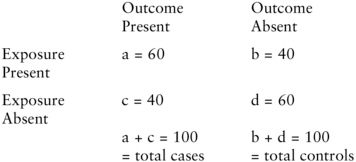
Even though the control group in the case-control study now contains only 100 subjects, we have selected these subjects so that they are representative of the frequency of exposure to firearms in the population of nonsuicides from which the control sample was drawn. So the odds ratio for our case-control study is:

Prospective studies can measure the frequency of the outcome among persons with different levels of exposure; retrospective case-control studies measure the frequency of exposure among persons with different levels of the outcome. But the symmetry of the odds ratio allows us to estimate the risk of the outcome, given exposure, from information about the odds of exposure, given the outcome.
Attributable Risk
In fact, by themselves, neither the odds ratio nor the risk ratio can assist policy makers who need to compare the number of occurrences that could be altered through intervention with the costs of the intervention. Policy makers would prefer to know the attributable risk, which can be defined as the difference between the incidence of the outcome among the exposed and the incidence of the outcome among the unexposed:

To see the problem with the odds ratio and the relative risk, consider two populations, one in which the suicide probability conditional on owning a firearm is 0.02 per person per year and that conditional on not owning a firearm is 0.01 per person per year, and another in which these two probabilities are 0.0002 and 0.0001, respectively. The odds ratio and the relative risk are the same in both scenarios, but if guns are causal, then removal of guns from the population might avert 0.01 deaths per person per year in the first scenario, but only 0.0001 deaths per person per year in the second.
In a case-control study, this limitation can be overcome by using information from other sources. When a case-control study is population based—that is, when all or a known fraction of cases in a particularly community are identified and a random sample of unaffected individuals are selected as controls—or when information about the incidence of outcome and exposure are available from other sources, it is possible to calculate the incidence rates and attributable risk from the information derived from the study (see, for example, Manski and Lerman, 1977; Hsieh et al., 1985).
In our example, suppose that we already know that the cases represent all of the suicides occurring in the population in a given year, and suppose that we know the size of the population. We know, from the case-control study itself, that 40 percent of control households in random sample own firearms, and the study has revealed an odds ratio of (about) 2.25 to 1. The “rare outcome” assumption is satisfied, which simplifies the calculations; we can treat the odds ratio as a risk ratio and calculate incidence rates and attributable risks as follows:
The total incidence of suicide in the population is equal to the incidence of suicide among gun owners, times the probability of being a gun owner, plus the incidence of suicide among nongun owners, times the probability of not being a gun owner, i.e.:

A, B, C, and D are the unobserved “true” frequencies of events in the population. But from the risk ratio of 2.25 we also know that:
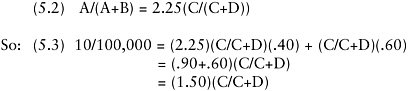
Therefore, the probability of suicide among nongun owners = C/(C+D) = (10/100,000)/(1.50) ≈ 6.67 per 100,000 persons per year; and the probability of suicide among gun owners = (2.25)(C/C+D) = 15 per 100,000 persons per year.
The attributable risk is the difference between the probability of suicide among gun owners, and the probability of suicide among nongun owners: 15–6.67 ≈ 8.33 suicides per 100,000 attributable to gun ownership. The interpretation of this attributable risk depends on the actual causal mechanism linking exposure and outcome. In our example, there would be about 8.33 suicides per 100,000 that might be preventable by restricting access to guns, if guns were to play a causal role in the risk of suicide.


