
1
Introduction
|
A two-year-old is diagnosed with an inner ear infection and prescribed an antibiotic. Her mother understands that her daughter should take the prescribed medication twice a day. After carefully studying the label on the bottle and deciding that it doesn’t tell how to take the medicine, she fills a teaspoon and pours the antibiotic into her daughter’s painful ear (Parker et al., 2003). |
Health consumers face numerous challenges as they seek health information, including the complexity of the health systems, the rising burden of chronic disease, the need to engage as partners in their care, and the proliferation of consumer information available from numerous and diverse sources. Individuals are asked to assume new roles in seeking information, advocating for their rights and privacy, understanding responsibilities, measuring and monitoring their own health and that of their community, and making decisions about insurance and options for care. Underlying these complex demands are the varying and sometimes inadequate levels of, first, consumer knowledge and, second, skills for using and applying a wide range of health information.
In their work, health care educators and providers make assumptions about an individual’s ability to comprehend health information. However over 300 studies have shown that health information cannot be understood by most of the people for whom it was intended, suggesting that the assumptions regarding the recipient’s level of health literacy made by the
creators of this information are often incorrect. Over the past decade, concerns related to literacy skills and health provided a wake-up call to many in the health fields. Health literacy, a newly emerging field of inquiry and practice, focuses on literacy concerns within the context of health. The committee defines health literacy as “the degree to which individuals have the capacity to obtain, process, and understand basic health information and services needed to make appropriate health decisions” (Ratzan and Parker, 2000), and views health literacy as a shared function of social and individual factors. This chapter will provide an overview of health literacy and this report in a broad societal context; please refer to Chapter 2 for an in-depth discussion of the definition and conceptual basis of health literacy.
SOCIAL AND ECONOMIC FACTORS AND HEALTH
Epidemiologists have been able to document links between socioeconomic status and health, and links between educational attainment and health. A 1998 report from the U.S. Department of Health and Human Services offered evidence from accumulated studies that health, morbidity, and mortality are related to income and education factors (Pamuk et al., 1998). For example, life expectancy is related to family income. So too are death rates from cancer and heart disease, incidences of diabetes and hypertension, and use of health services. Similarly, death rates for chronic disease, communicable diseases, and injuries as reported in 1998 were inversely related to education: those with lower education achievement are more likely to die of a chronic disease than are those with higher education achievement. In essence, the lower your income or educational achievement, the worse your health.
Some researchers have suggested that education provides a key to understanding these relationships. Grossman and Kaestner (1997) asserted that “Years of formal schooling completed is the most important correlate of good health.” House and colleagues (1994) noted that “A causal impact of education on health is highly plausible.” However, research has not yet fully examined other aspects or measures of education beyond years in school such as knowledge and skills. Literacy is one set of skills related to education. National literacy assessments indicate that literacy is a set of measurable skills (Kirsch, 2001) that includes reading, writing, listening, speaking, and arithmetical skills. Chapter 3 discusses the research that exists on the relationship between literacy and health.
Culture and ethnicity also influence health, and Chapter 4 of this report includes a discussion of their relationship with health literacy. Culture and ethnicity are often blended into categories of race which may not represent scientifically sound classifications. As discussed in a recent Institute of Medicine (IOM) report, Speaking of Health (IOM, 2002), race is not a meaning-
ful biological classification system for human populations, and even ethnicity can be interpreted too rigidly. This IOM report drew on current anthropological thinking to suggest that both individuals and populations should be assessed in terms of the influences on their lives and cultural histories, or “experiential identity.” This experiential identity may include influences from multiple cultures and languages, sometimes within the same family, but more often from life experiences. People’s knowledge and understanding of their health, and their health literacy, are based on a composite of these life experiences. In this report, the terms race and ethnicity will be used in the discussions of population studies.
LIVING IN A SOCIETY WITH HIGH LITERACY DEMANDS
Every day, millions of adults must make decisions and take actions on issues that protect not only their own well-being, but also that of their family members and communities. These actions are not confined to traditional health-care settings such as doctors and dentists’ offices, hospitals, and clinics. They take place in homes, at work, in schools, and in community forums across the country. Health-related activities are part of the daily life of adults, whether they are sick or well.
At home, parents may have to calculate a child’s weight and age to determine the correct dosage of an over-the-counter medicine. People are also expected to follow directions from health-care providers, presented verbally or in writing, during recovery from an illness or the management of a chronic disease. At work, employees may need to determine correct workstation placement or safe use of toxic chemicals. Safety warnings are posted in the community, and at work, and are discussed in newspapers and on television. Many health-related decisions are made in the marketplace. When reading nutritional information on food labels, for example, consumers are expected to understand that calculation of sugar content must include the sugar listed on the snack food label as well as the fructose and corn syrup. In the pharmacy, consumers must differentiate between a cough syrup that is an expectorant and one that is a suppressor.
|
Examples of language taken from actual product and warning labels
|
In medical care settings, health-care providers expect patients to provide accurate health histories and descriptions of their symptoms, as well as listen to and comprehend verbal instructions (Roter et al., 1998).
|
Sometimes the doctors and pharmacy use the type of words that are sometimes hard. I mean sometimes there’s some word that, it’s there, but you don’t know what it means. They are using those fine words, those college words, that are hard for people like me to understand and read (Rudd and DeJong, 2000). |
Adults need to meet the demands of bureaucracies and institutions to access health programs and services. For example, adults are asked to fill out insurance forms, understand their rights and responsibilities, provide medical history, and provide informed consent for medical procedures. The documents required for some of these activities often contain legal and scientific terms unfamiliar to many individuals.
Signs and directions posted for employees and visitors outside and within institutions are often inadequate. As Baker and colleagues noted in a study based on patient focus groups at two public hospitals, many of the patients did not benefit from signs indicating that the nephrology unit was straight ahead. The nephrologists, however, most likely knew where to go (Baker et al., 1996; Rudd, 2002).
An inability to speak English at all or an ability to speak with only limited proficiency presents additional obstacles to understanding health information and accessing health care. These obstacles are compounded when written translations and trained translators are not available (Carrasquillo et al., 1999; Flores et al., 2003; IOM, 2003a; Sarver and Baker, 2000).
|
When I started six months ago, it was a new job and it was transporting patients. So we got a dispatcher. We had to call back to the floor and get the orders where to take the patients. I went looking for about 30 minutes. The patient and I were lost (Rudd and DeJong, 2000). |
The presentation of health information is often unnecessarily complex. Findings from three decades of early medical and public health studies examining the reading level of print materials developed for patient education and for procedures and processes in the health-care setting (Rudd et al., 2000) established that most health materials fall into reading level ranges requiring high school, college, or graduate degrees. Overall, the
literacy demands of health materials exceeded the reading abilities of the average American adult.
In addition, the language typically used by those working in health and medicine is filled with scientific jargon. This increases the difficulty for the average consumer. References are made to biological systems (e.g., endocrine) and anatomy (e.g., atrial valve) as well as to groupings of diseases and disorders (e.g., renal, cardiovascular, neurological, respiratory) that are not typically used in everyday conversation. Furthermore, they are scientific terms not typically taught in the K-12 school system. For example, many people do not know that they have bronchi or where they are located; yet those with asthma will be presented with the very critical information that this chronic disease involves inflammation of the bronchi and that a particular type of medicine helps. A person’s ability to understand health, medical issues, and directions is related to the clarity of the communication.
After being diagnosed with recurrent aphthous stomatitis involving the epithelium of the buccal mucosa, Winston did what he thought was necessary.
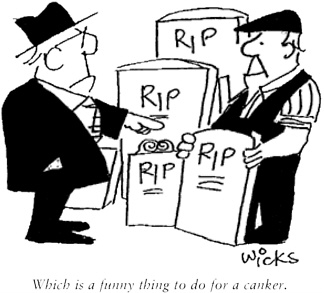
SOURCE: Canadian Public Health Association, Plain Language Service. Reprinted with permission.
Of course, literacy demands differ by setting and by circumstance. The types of health information a person is exposed to changes as a person’s life changes. Sociological and anthropological research has documented that literacy practices are inextricably intertwined and shaped by life circumstances (Barton and Hamilton, 1998; Purcell-Gates et al., 2000; Street,
2001). For example, a woman is more likely to receive information about hormone replacement therapy after menopause rather than when she is a teenager. Purcell-Gates documented how literacy demands changed in the lives of adult education students because of life events such as a new living situation or a change in a family member’s health. For example, the adults in this study reported that new health literacy demands arose with the birth of their children. They were required to fill out health history forms, maintain vaccination records, and keep track of their children’s appointments with health-care workers. They needed to read and understand dosage instructions on over-the-counter and prescription medications for their infants. They were required to install car seats by following printed directions. Those with school-aged children needed to read and sign materials sent home from school related, for example, to lunch programs or field trips.
Changes in their own or a family member’s health were often reported as initiating a change in literacy practice. A commonly reported change was the beginning of, or increase in, reading associated with medicines: print on medicine bottles, prescriptions, and directions from doctors. Many reported a need to read the print on food containers for the first time as part of the vigilance required in managing a chronic illness like diabetes. Following a health change that necessitated repeated doctor visits, people found and read medical reference books, and began to use personal calendars and appointment books (Purcell-Gates et al., 2000).
Demands on an individual’s literacy skills can create a barrier to the use and understanding of health tools and information. In many ways, literacy serves as a social determinant of health when a mismatch exists between the skills of the individual and the literacy skill demands of the health context. Poor communication, whether it be based on faulty assumptions, inappropriate language, incomplete disclosures, or hidden confusion, does a disservice to clients as well as to health-care professionals. When words get in the way, the communication process fails, leading to confusion, loss of dignity, and unhealthful outcomes.
Another result of this failure of communication is that limited health literacy is often undetected, in part because individuals with limited literacy skills may feel ashamed. People may not be at ease acknowledging reading difficulties or vocabulary limitations. Consequently, they may feel shame or mask these difficulties in order to maintain dignity (Baker et al., 1996; Parikh et al., 1996).
Identifying the extent of limited health literacy is also problematic because individuals tend not to tell their health-care providers about literacy problems that they encounter in the increasingly complex health system, including trouble understanding both printed materials and the meaning of discussions with providers. Also of concern is the possibility
that people may perceive their skills to be adequate when they are not. For example, data from the 1992 National Adult Literacy Survey (NALS) show that among those scoring in the lowest level on the prose literacy scale, only 29 percent reported they did not read well and only 34 percent reported they did not write well. The majority of those performing at this level perceive their reading and writing skills to be adequate. Among those in the next highest level the results were even more surprising, as only 3 percent said they couldn’t read well and 6 percent said they couldn’t write well (Kirsch et al., 1993; see Chapter 2 for more information on the NALS).
To Err Is Human: Building a Safer Health System is a widely publicized IOM study on the quality of health care that examined factors to medical errors (IOM, 2000). One study cited in this report found that 10 percent of adverse drug events were linked to errors in the use of the drug as a result of communication failure (Leape et al., 1993). The report noted that management of complex drug therapies, especially in elderly patients, is extremely difficult and requires special attention to the ability of the patient to understand and remember the amount and timing of dose, as well as behavioral modifications required by the regimen (e.g., dietary restrictions) (IOM, 2000). The ability of patients and consumers to manage their own health and medical care can be improved through better provider–patient communication and greater inclusion of the patient in treatment decisions, as discussed in Chapter 6 (Hausman, 2001; Hayes-Bautista, 1976; Hulka et al., 1975, 1976; Miller, 1975; Snyder et al., 1976).
HEALTH LITERACY AS A PUBLIC CONCERN
In its report Healthy People 2010, the U.S. Department of Health and Human Services included improved consumer health literacy as Objective 11-2, and identified health literacy as an important component of health communication, medical product safety, and oral health (HHS, 2000). The importance of health literacy has also been recognized globally. The World Health Organization has included health literacy as a key factor in health promotion (WHO, 2000), and the U.S. Agency for International Development (U.S. AID) has recognized health literacy as an important contributor in the move towards a healthier society (U.S. Agency for International Development, 2001). Much of the pioneering work in health literacy arose from the fields of health education and health communication in the 1970s and 1980s (Rudd et al., 2000).
Health literacy is intimately linked to many issues of critical importance to the nation and to our health policies. The public health mandate of protecting the health of the nation relies on communication strategies for issues as different as obesity and bioterrorism. Health literacy is of concern to people addressing worker health and safety, product labeling, environ-
mental health, patient rights and responsibilities, quality of care, or access to information, insurance, and services (Hausman, 2001; Hayes-Bautista, 1976; Hulka et al., 1975, 1976; Rudd et al., 2003; Snyder et al., 1976).
Crossing the Quality Chasm: A New Health System for the 21st Century (IOM, 2001) proposed a reorganization of the complex health system practices that decrease patient safety. The report stressed that the “patient-centered” approach should be implemented to ensure that patients have a full understanding of all of their options (IOM, 2001). Limited health literacy is often unreported by patients, unappreciated by policy makers and health-care workers, and unappreciated by the general public. Without improvements in health literacy, the promise of many scientific advances to improve health outcomes will be diminished. Consequently, the IOM has identified improving health literacy as one of two cross-cutting issues in health care needing attention in its recent report, Priority Areas for National Action: Transforming Healthcare Quality (IOM, 2003b). This report called for increased attention to culturally and socially sensitive communication to improve the overall quality of health care and the health of minority and lower-income patients.
CHARGE TO THE COMMITTEE
Although a greater appreciation for the potential consequences of limited health literacy has been developing over recent years, the health field has lacked a comprehensive yet concise summary of what is known about health literacy and what needs to be done. Watters (2003) suggests that an interdisciplinary literacy model that addresses health, literacy, and culture could successfully guide development, diffusion, and adoption of appropriate information.
In 2002 the IOM convened the Committee on Health Literacy for a project sponsored by the American Association of Family Physicians Foundation, the California HealthCare Foundation, the Commonwealth fund, the Kellogg Foundation, the Metlife Foundation, the National Cancer Institute, the Pfizer Corporation, and the Robert Wood Johnson Foundation. Committee membership included individuals with expertise in public health, primary medical care, health communication, sociology, nursing, anthropology, adult literacy education, and K-12 education. As reflected by the composition of the committee, many academic fields can inform health literacy inquiries, and have contributed to our understanding of the area. The committee was carefully selected to ensure that it possessed appropriate expertise for assessing past efforts to promote health literacy and for providing options to overcome the obstacles to health literacy in future endeavors. Furthermore, the committee represents a balance of intellectual perspectives and experiences, ranging from practical experience in promot-
ing health literacy to research and theoretical experience in the closely related fields such as anthropology, psychology, and education. The chair brought to the study experience with health-care systems and population health determinants as well as with committee processes. For further information regarding the backgrounds of the members of the committee, the reader is directed to the short biographies presented in Appendix D. The committee was asked to assess the problem of health literacy and come to consensus on the next steps, addressing the following charge:
-
Define the scope of the problem of health literacy. The intent is to clarify the root problems that underlie health illiteracy. This would include identifying affected populations and estimating the costs for society. Develop a set of basic indicators of health literacy to allow assessment of the extent of the problem at the individual, community, and national levels.
-
Identify the obstacles to a creating a health-literate public. These are likely to include the complexity of the health-care system, the many and often-contradictory health messages, rapidly advancing technologies, limits within public education to promote literacy of adults as well as children, etc.
-
Assess the approaches that have been attempted to increase health literacy both in the United States and abroad. Identify the gaps in research and programs that need to be addressed. The focus should be on public health interventions attempting to increase health literacy of the public as well as on improving health provider/primary care interactions. Identify activities that could improve health literacy with special attention to Medicaid and Medicare patients.
-
Identify goals for health literacy efforts and suggest approaches for overcoming obstacles to health literacy in order to reach these goals. Approaches might include research or policy initiatives, interventions, or collaborations that would promote health literacy.
SCOPE OF THE REPORT
This report explores what is known about the epidemiology of limited health literacy and promising approaches for increasing health literacy. It offers a conceptual framework for thinking about how society, culture, and the health and education systems contribute to the problem and to possible solutions. Throughout, the report seeks to put a human face on the problem of limited health literacy. Each chapter aims to provide new directions and blend knowledge from divergent areas of inquiry. Overarching recommendations are presented at the end of the report.
Chapter 2 clarifies the concept of health literacy by discussing its definition and delineating literacy and functional literacy within the context of
health. A conceptual model of health literacy is presented with a visual framework that makes clear that health literacy is a function of the interaction between individuals and the health contexts to which they are exposed. In addition, the committee outlines limitations to the conceptualization and measures of health literacy. By these means, the strengths and weaknesses of existing measures of literacy and health literacy are examined, with a view toward continued development of health literacy assessment, including population indicators and measures of health literacy within health systems.
Although the charge to the committee included the development of a set of basic indicators of health literacy, the committee determined that to do so within the context and limitations of the current knowledge and available measures would be premature and inappropriate. Development of population-level public health indicators cannot precede the development of adequate individual-level measures. The committee limited its findings and recommendations to suggestions that could promote the development of improved measures and new basic indicators of health literacy, rather than developing the indicators themselves. The committee hopes that future research will enable the development of these indicators.
Chapter 3 reviews the extent and associations of limited health literacy as currently measured, exploring the broad social effect of disparities between health literacy needs and demands. This chapter provides insight into the relationship of the health consumer and health literacy. Current research related to the associations of limited health literacy is summarized, both in terms of individual health behaviors and outcomes, and in terms of the financial, legal, and regulatory consequences in health contexts. This chapter contains extensive tables on the epidemiology of health literacy skills in various populations and the characteristics and associations of limited health literacy.
Chapter 4 explores the web of culture and health literacy, and how these encompass patient perspectives and quality of care, with attention to clinical uncertainty, patient safety, and the building of health literacy into standard health care. The interrelationships among culture, language and meaning, and health literacy measures are discussed as well as culturally based approaches to improving health literacy.
Chapter 5 explores health literacy within the context of educational systems and seeks to understand the roles that K-12, university, adult, and health professional education systems can take to improve health literacy. In particular, the chapter addresses difficulties encountered by educators in the K-12 system, and explores possible approaches to improving health literacy by integrating health into curricula.
Chapter 6 discusses health literacy within the context of the health-care system, including providers, insurers, administrators, national agencies that
guide health policy, and others. Current issues facing health care are discussed as they relate to health literacy. The chapter also reviews various types of approaches that may help to address the problem of limited health literacy when applied in health care settings.
Chapter 7 presents the committee’s vision for a health literate society.
REFERENCES
Baker DW, Parker RM, Williams MV, Pitkin K, Parikh NS, Coates W, Imara M. 1996. The health care experience of patients with low literacy. Archives of Family Medicine. 5(6): 329–334.
Barton D, Hamilton M. 1998. Local Literacies: Reading and Writing in One Community. New York: Routledge.
Carrasquillo O, Orav EJ, Brennan TA, Burstin HR. 1999. Impact of language barriers on patient satisfaction in an emergency department. Journal of General Internal Medicine. 14(2): 82–87.
Flores G, Laws MB, Mayo SJ, Zuckerman B, Abreu M, Medina L, Hardt EJ. 2003. Errors in medical interpretation and their potential clinical consequences in pediatric encounters. Pediatrics. 111(1): 6–14.
Grossman M, Kaestner R. 1997. The effects of education on health. In: The Social Benefits of Education. Behermean R, Stacey N, Editors. Ann Arbor, MI: University of Michigan Press. Pp. 69–123.
Hausman A. 2001. Taking your medicine: Relational steps to improving patient compliance. Health Marketing Quarterly. 19(2): 49–71.
Hayes-Bautista DE. 1976. Modifying the treatment: Patient compliance, patient control and medical care. Social Science & Medicine. 10(5): 233–238.
HHS (U.S. Department of Health and Human Services). 2000. Healthy People 2010: Understanding and Improving Health. Washington, DC: U.S. Department of Health and Human Services.
House JS, Lepkowski JM, Kinney AM, Mero RP, Kessler RC, Herzog AR. 1994. The social stratification of aging and health. Journal of Health & Social Behavior. 35: 213–234.
Hulka BS, Kupper LL, Cassel JC, Mayo F. 1975. Doctor-patient communication and outcomes among diabetic patients. Journal of Community Health. 1(1): 15–27.
Hulka BS, Cassel JC, Kupper LL, Burdette JA. 1976. Communication, compliance, and concordance between physicians and patients with prescribed medications. American Journal of Public Health. 66(9): 847–853.
IOM (Institute of Medicine). 2000. To Err Is Human: Building a Safer Health System. Washington, DC: National Academy Press.
IOM. 2001. Crossing the Quality Chasm: A New Health System for the 21st Century. Washington, DC: National Academy Press.
IOM. 2002. Speaking of Health: Assessing Health Communication Strategies for Diverse Populations. Washington, DC: The National Academies Press.
IOM. 2003a. Unequal Treatment: Confronting Racial and Ethnic Disparities in Health Care. Smedley BD, Stith AY, Nelson AR, Editors. Washington, DC: The National Academies Press.
IOM. 2003b. Priority Areas for National Action: Transforming Healthcare Quality. Adams K, Corrigan JM, Editors. Washington, DC: The National Academies Press.
Kirsch IS. 2001. The International Adult Literacy Survey (IALS): Understanding What Was Measured. Princeton, NJ: Educational Testing Service.
Kirsch IS, Jungeblut A, Jenkins L, Kolstad A. 1993. Adult Literacy in America: A First Look at the Results of the National Adult Literacy Survey (NALS). Washington, DC: National Center for Education Statistics, U.S. Department of Education.
Leape LL, Lawthers AG, Brennan TA, Johnson WG. 1993. Preventing medical injury. Quality Review Bulletin. 19(5): 144–149.
Miller WD. 1975. Drug usage: Compliance of patients with instructions on medication. Journal of the American Osteopathic Association. 75(4): 401–404.
Pamuk E, Makuc D, Heck K, Rueben C, Lochner K. 1998. Socioeconomic Status and Health Chartbook. Health, United States, 1998. Hyattsville, MD: National Center for Health Statistics.
Parikh NS, Parker RM, Nurss JR, Baker DW, Williams MV. 1996. Shame and health literacy: The unspoken connection. Patient Education and Counseling. 27(1): 33–39.
Parker RM, Ratzan SC, Lurie N. 2003. Health literacy: A policy challenge for advancing high-quality health care. Health Affairs. 22(4): 147.
Purcell-Gates V, Degener S, Jacobson E, Soler M. 2000. Affecting Change in Literacy Practices of Adult Learners: Impact of Two Dimensions of Instruction. NCSALL Report No. 17. Boston, MA: National Center for the Study of Adult Learning and Literacy.
Ratzan SC, Parker RM. 2000. Introduction. In: National Library of Medicine Current Bibliographies in Medicine: Health Literacy. Selden CR, Zorn M, Ratzan SC, Parker RM, Editors. NLM Pub. No. CBM 2000-1. Bethesda, MD: National Institutes of Health, U.S. Department of Health and Human Services.
Roter DL, Rudd RE, Comings J. 1998. Patient literacy: A barrier to quality of care. Journal of General Internal Medicine. 13(12): 850–851.
Rudd, R. 2002. Health and Literacy: Recalibrating the Norm. Paper presented at the American Public Health Association Annual Conference, Philadelphia, PA.
Rudd R, Moeykens BA, Colton TC. 2000. Health and literacy: A review of medical and public health literature. In: Annual Review of Adult Learning and Literacy. Comings J, Garners B, Smith C, Editors. New York: Jossey-Bass.
Rudd RE, DeJong W. 2000. In Plain Language: The Need for Effective Communication in Medicine and Public Health [Video] . Cambridge, MA: Harvard University.
Rudd RE, Comings JP, Hyde J. 2003. Leave no one behind: Improving health and risk communication through attention to literacy. Journal of Health Communication, Special Supplement on Bioterrorism. 8(Supplement 1): 104–115.
Sarver J, Baker DW. 2000. Effect of language barriers on follow-up appointments after an emergency department visit. Journal of General Internal Medicine. 15(4): 256–264.
Snyder D, Lynch JJ, Gruss L. 1976. Doctor-patient communications in a private family practice. Journal of Family Practice. 3(3): 271–276.
Street B. 2001. Literacy and Development: Ethnographic Perspectives. New York: Routledge.
U.S. Agency for International Development. 2001. DRAFT “Communication activity authorization document.”
Watters EK. 2003. Literacy for health: An interdisciplinary model. Journal of Transcultural Nursing. 14(1): 48–54.
WHO (World Health Organization). 2000. Health Promotion. Report by the Secretariat. World Health Organization.


