
3
Threats to Atlantic Salmon in Maine
INTRODUCTION
The current state of Atlantic salmon in Maine appears to be the product of the cumulative effects of centuries of anthropogenic and environmental impacts. At present, the threats to Atlantic salmon in Maine are many and diverse. The challenge is not to identify them—that is relatively easy to do—the challenge is to make sense of all the threats and to rank them. The committee has attempted to do that in a risk-analysis model described in Chapter 4. In this chapter, we discuss the major factors that have adversely affected wild salmon in Maine since human contact.
Others have evaluated factors that adversely affect Atlantic salmon in eastern North America. For example, Cairns (2001) summarized a group effort to evaluate the possible factors contributing to the decline of salmon from 1984 to 1999. The document attempted to “catalogue all potential causes with any reasonable claim to credibility” and “systematically assess the plausibility of each hypothesized factor.” Sixty-three factors (“hypotheses for the decline”) were identified. They covered all stages of salmon life history and all aspects of their natural environments; they included human activities and structures, such as aquaculture, fishing, dams, and pollution. The conclusions were drawn from expert judgment, based on the literature and on a great deal of personal insight and experience. The plausibility analysis used a weighted scoring system and cov-
ered salmon originating from rivers in Quebec, the Canadian Maritime Provinces, and New England. Cairns’s (2001) assessment was done before a workshop was held to develop research strategies. The deliberations and conclusions of that workshop were summarized by O’Neil et al. (2000). A separate report covers the potential causes of low salmon returns to Newfoundland and Labrador (Dempson and Reddin 2000).
The group of experts whose efforts were described by Cairns (2001) gave each factor a numerical score between 0 and 1 for its magnitude (proportion of habitat affected times degree to which the factor constrains survival or reproductive output) and its trend (positive numbers for increasing mortality or constraint on reproductive output and negative numbers for the reverse). Those two numbers were multiplied and the product was plotted. Five factors were ranked highest in the following order: (1) post-fishery marine mortality is higher than that assumed by fishery models (thus, the degree to which fishing reduces pre-fishery abundance is overstated); (2) smolt survival is reduced due to fish predation; (3) predation by birds and mammals is high at sea; (4) altered ocean conditions alter migration routes; and (5) bird and seal predation in rivers and estuaries affects smolts and adults. Limited spawning habitat ranked 57th and barriers to spawning migration ranked 60th out of the 63 factors. The low ranking does not mean that the factors are unimportant; it means only that their effects on salmon have not changed in a way that explains the recent declines in salmon populations. Two predictions arising from climate-change projections were listed but not scored.
The highest-ranked factor and two of the next three highest ranked were in the marine environment. The second highest-ranked factor overall was in the estuarine environment. The highest ranked factor in freshwater was ranked seventh overall. This analysis was done for all of eastern North America. Although most of the factors apply in Maine, they are not necessarily of the same rank there.
The primary causes cited by the U.S. Fish and Wildlife Service and the National Marine Fisheries Service (50 CFR 17, 224) to support listing Atlantic salmon as endangered under the Endangered Species Act (ESA) are (1) “Documented returns of adult Atlantic salmon within the DPS [distinct population segment] range are low relative to conservation escapement goals,” and (2) “densities of young-of-the-year salmon and parr remain low relative to the potential carrying capacity. These depressed juvenile abundances, where not supplemented by stocking, are a direct result of low adult returns in recent years.”
The services concluded that the threats contributing to the danger of extinction of Atlantic salmon in Maine posed by low adult return and depressed juvenile abundance are (1) predation or disease—potential for
disease outbreaks in wild and in hatchery brood stocks; (2) inadequacy of existing protective mechanisms—insufficient protection against threat posed by agricultural water withdrawals, disease, and aquaculture; and (3) other natural or artificial factors affecting its continued existence—existing aquacultural practices and low marine survival rates.
This committee had somewhat different imperatives from those of the services because its charge leads it to take a broader focus than only the listed populations in the eight DPS rivers and the ESA’s specific mandates. It is important to distinguish between those threats leading to endangerment of Atlantic salmon in the DPS rivers and the measures needed for recovery (in terms of regulations) of salmon throughout Maine. Following its charge, the committee considered the threats and evaluated recovery and restoration options for salmon in Maine rivers in general, not only in the DPS rivers. In general, threats on the listed rivers are similar to those on all Maine rivers, although there are some differences. For example, the complex problems associated with the presence of dams are not considered significant threats on the DPS rivers, yet the committee regards dams as a serious problem for successful restoration of salmon on a statewide scale because the larger drainages have greater potential to support large salmon populations.
As discussed above, the list of potential threats is broad, complicating the task of conservation planners. While a recovery plan called for under the ESA is being developed, conservation efforts are being carried forward under the Atlantic Salmon Conservation Plan for Seven Maine Rivers (Maine Atlantic Salmon Task Force 1997). The task force plan establishes conservation goals in terms of returning adults for seven of the DPS rivers (excluding Cove Brook), identifies threats, poses conservation measures, sets time tables and establishes responsibilities for implementation, and estimates implementation costs.
The factors judged by this committee to be the most important threats to the continued survival of Atlantic salmon in Maine are described below. Most of the threats identified by the committee are also considered by the Maine Atlantic Salmon Task Force (1997). The primary limitation of the existing plan is the lack of priority-setting for conservation actions. Following the recommendation in the final listing rule, the committee recommends that recovery planners develop a priority setting process for recovery actions with the use of information acquired after the adoption of the 1997 conservation plan. The recovery plan should focus resources and efforts to abate the most consequential threats. Because of different environmental conditions and land uses in the various watersheds affected, these actions will need to be adapted for specific watershed application.
A HISTORY OF THREATS TO ATLANTIC SALMON IN MAINE
Centuries of human activities and environmental change have in various ways influenced Atlantic salmon populations in Maine. Until the more recent population declines, the effects of these changes were different in the Kennebec, Penobscot, and Down East rivers. Tracing the patterns and trends of anthropogenic activities and environmental change in the region may provide insight into cumulative effects on Atlantic salmon and their habitat in Maine, helping to identify factors behind their pattern of persistent but regionally varied decline.
Geologic History
The advance and retreat of continental ice sheets during the Pleistocene epoch (10,000 to about 1.5 million years ago) had a dominant influence on the landforms, stream networks, and soils of Maine (Marvinney and Thompson 2000). Glaciers shaped mountains and valleys and the resulting stream and river networks; left sand and gravel deposits; and carved out hundreds of lakes, ponds, and depressions that are now wetlands. The dominant soil types are a direct result of glaciation; a cold, wet climate; and forest succession over the past 10,000 years. In general, soils are well drained, acidic, and relatively unfertile. The properties of the soils and watersheds generally yield high quality freshwater streams and rivers with good salmon habitat.
Changes in Climate and Ocean Conditions
For as long as information about the earth’s and New England’s climates has been available, the information tells a story of continual climate change. It is certain that climates will continue to change. The precise nature and magnitude of future changes is not predictable at present. However, as described in Chapter 2, there is evidence that Maine’s climate has been warmer over the past half century than it was over the previous century. In addition, salmon in Maine seem to be at or near the southwestern limit of their range in North America. Thus, any prolonged or large warming of Maine’s climate would probably make the survival of Atlantic salmon in Maine more difficult by warming the water in Maine’s streams and changing their historical flow patterns. As an example, Table 3-1 shows that the number of ice days on the Narraguagus River has decreased in the past three decades, and the snow melt has occurred earlier. In addition, changes in the hydrologic regime not directly related
TABLE 3-1 Snow-Water Equivalent (SWE) (Amherst, Maine), Channel Ice Effects, and Median February and May Stream Flow (Narraguagus River), 1970–2000
|
Year |
March 1 SWE (in.) |
March 15 SWE (in.) |
April 1 SWE (in.) |
Ice Effect (no. of days) |
Feb. 1 Median Q (ft3/sec) |
May 1Median Q (ft3/sec) |
|
1970 |
5 |
5 |
4.5 |
60 |
300 |
600 |
|
1980 |
4 |
4.5 |
3.5 |
60 |
330 |
570 |
|
1990 |
3 |
3.5 |
2 |
55 |
350 |
520 |
|
2000 |
2.5 |
3 |
1.5 |
45 |
380 |
490 |
|
SOURCE: Dudley and Hodgkins 2002. |
||||||
to temperature could also complicate the rehabilitation of wild Atlantic salmon populations.
The committee judges that some degree of climate warming or change in the hydrologic regime could be tolerated if most of the other problems affecting Maine’s salmon are reduced. In addition, some methods are available to mitigate such climate changes. They include making sure that streams are protected by riparian vegetation and that their watersheds are managed so that flow volumes and seasonality are maintained. However, if climate warming is large and prolonged, eventually Maine’s environment may not be within the natural range of Atlantic salmon.
Climate change also involves ocean conditions. The oceans represent a large black box into which many salmon venture and few return. The oceans are known to be highly variable, beginning with variations in atmospheric forcing from wind and temperature (see Dickson et al. [1996] and Dickson [1997] for a focus on the northwestern Atlantic and Dickson and [Turrell] 2000 for a discussion of the North Atlantic Oscillation [NAO] and European salmon). These forcings are linked to changes in the earth’s climate system (Hurrell and van Loon 1997), which itself responds to feedback from the underlying ocean and to interactions between system components associated with the various ocean basins (Bigg 2000). Atmospheric forcing affects the large ocean current systems that transport heat and plankton, thereby affecting the physical and biological conditions experienced by fish (Colebrook 1991, Drinkwater 2000, Frank et al. 1996, Pickart et al. 1999, Reid and Planque 2000). The responses of fish populations to such changes are complicated, and the understanding of them is still small, especially in the high seas where biological data (in particular) are
scarce. Still, the evidence for large-scale impacts that can be traced to population changes is strong (Hare et al. 1999, Mantua et al. 1997) even if the mechanisms remain elusive.
Variation in the ocean environment has emerged as a primary explanation for the changing abundance of salmon, because data on return rates permit an accounting of losses between freshwater and the ocean (Cairns 2001). Return rates clearly have been declining in many areas, including in all of Maine’s rivers (Reddin et al. 2000). However, most return-rate data do not distinguish between losses occurring shortly after emigration to the sea and those occurring on the high seas. That makes it difficult to evaluate causes: those near land are easier to identify, and those at sea operate over a much longer period and may be harder to detect. Quantification is difficult in either case. The strong similarity of patterns along both sides of the Atlantic suggests a common cause of salmon losses in the ocean, probably modified by local processes. That idea is based on the improbability of different river and estuarine conditions co-varying to the degree needed to produce the coherent population responses observed if the dominant causes were continental or coastal in origin (see Friedland 1998). Among North American populations, salmon abundance patterns in Labrador and Newfoundland correlate with each other and not with patterns to the south, and those to the south (Quebec, Gulf of St. Lawrence, Nova Scotia, Bay of Fundy, and Maine) correlate with each other (Reddin et al. 2000). Although justifying and promoting the need to investigate ocean conditions, the authors are cautious about using the same arguments to deny other influences.
Identifying the causes of salmon losses in the ocean is difficult, especially since the international closure of the high-seas fisheries has eliminated a major source of data on the movements of salmon that might be correlated with remotely sensed data and augmented with increased research measurements. Friedland et al. (1993) showed that warmer temperatures in spring favored post-smolt survival of salmon in the northeastern Atlantic. They subsequently defined a spring habitat index (area of habitat between 7 and 13 ºC) for two stock complexes (from Norway and Scotland) and showed a close correlation between the first principal component of that habitat and landings. The relationship is consistent with what is known about the migration of post-smolts in these stocks; therefore, its insight, although untested for its predictive ability, is promising. However, both data sets occupy a single cycle with a well-defined peak, and other modes of influence would not be surprising.
In addition, marine biotic assemblages have changed, partly in response to human exploitation of them and perhaps partly as a result of natural environmental changes. These changes mean that salmon in the
ocean experience changing kinds and amount of food as well as changing kinds and degree of predation.
NATURAL PREDATION AND COMPETITION
Maine’s Atlantic salmon confront documented predation and competition from other species both in Maine’s rivers and in the estuarine environment. Natural predation and competition may also be factors in the natural mortality of migrating and overwintering salmon in the ocean environment, but that has not been well studied. Nonnative species that prey on salmon and compete with them are a potentially important anthropogenic threat to Atlantic salmon in Maine’s rivers and estuaries.
Fish Predators and Competitors in Maine’s Rivers
In addition to Atlantic salmon, Maine’s rivers support populations of many other fish species. Some are prey of salmon, but others are competitors and predators. The list of fishes in Table 3-2 is for the Sheepscot River (Meister 1982), but it is fairly representative of other Maine coastal rivers, with a few notable exceptions.
Meister did not provide information on the relative abundances of those fishes, but it is clear from the table that the river supports a diverse fish assemblage, many of whose members are strongly piscivorous. In particular, the introduced brown trout, and largemouth and smallmouth bass and the native striped bass, chain pickerel, and lake trout are voracious fish eaters. Many of the other species also take fish, especially the larger individuals of the species. Other coastal rivers have similar assemblages. For example, the Machias River (Fletcher et al. 1982) lacks brown and lake trout and largemouth bass but supports rainbow trout (Oncorhynchus mykiss), bluefish (Pomatomus saltatrix), and Atlantic mackerel (Scomber scombrus), the latter two being in estuaries. In the Narraguagus and Pleasant rivers, non-anadromous Atlantic salmon also are listed among the fauna (Baum and Jordan 1982). Changes have probably occurred in these assemblages over the past 20 years, especially in regard to nonnative species.
In addition to preying on young salmon, many of the species compete with them, and many eat their eggs. Salmon evolved in environments that had predators and competitors but not the introduced species and not under today’s conditions, when salmon populations are seriously depleted.
Compounding the problems faced by young Atlantic salmon in Maine rivers is the stocking of streams with various competitive and predatory
TABLE 3-2 The Fishes of the Sheepscot River
|
Sea lamprey (Petromyzon marinus) Shortnose sturgeon (Acipenser brevirostrum) Atlantic sturgeon (Acipenser oxyrhynchus) American eel (Anguilla rostrata) Blueback herring (Alosa aestivalis) Hickory shad (Alosa mediocris) Alewife (Alosa pseudoharengus) American shad (Alosa sapidissima) Atlantic salmon (Salmo salar) Brown trout (Salmo trutta)a Brook trout (Salvelinus fontinalis) Lake trout (Salvelinus namaycush) Rainbow smelt (Osmerus mordax) Chain pickerel (Esox niger) Golden shiner (Notemigonus crysoleucas) Common shiner (Notropis cornutus) Blacknose dace (Rhinichthys atratulus) Fallfish (Semotilus corporalis) White sucker (Catastomus commersoni) Brown bullhead (Ictalurus nebulosus) Atlantic tomcod (Microgadus tomcod) Banded killifish (Fundulus diaphanus) Mummichog (Fundulus heteroclitus) Brook stickleback (Culaea inconstans) Threespine stickleback (Gasterosteus oculeatus) Ninespine stickleback (Pungitius pungitius) White perch (Morone americana) Striped bass (Morone saxatilis) Pumpkinseed (Lepomis gibbosus) Smallmouth bass (Micropterus dolomieui)a Largemouth bass (Micropterus salmoides)a Yellow perch (Perca flavescens) |
|
aNot native to Maine. SOURCE: Adapted from Meister 1982. |
species, native and nonnative, that has been and is occurring. Among the species stocked are such predators as striped bass, smallmouth bass, and various species of trout, including brown trout. At least three agencies in Maine are stocking fish (most of which are piscivorous): The Maine Atlantic Salmon Commission, the Maine Department of Inland Fisheries and Wildlife, and the U.S. Fish and Wildlife Service.
Predators at Sea and in Estuaries
Due to the protection now afforded certain predator groups (birds and seals), predation on Atlantic salmon in estuarine areas in Maine is probably higher than it was during the period of higher return rates in the 1970s. After a period of virtual elimination by people, cormorants became reestablished on the Maine coast in the 1920s. Since then, their numbers have increased, and attempts have been made to control the population. Cormorants were added to federal bird protection laws in 1972, and the number of breeding pairs in Maine increased more than 80% but may now be relatively stable (Krohn et al. 1995). Double-crested cormorants (Phalcrocorax auritus) are a significant predator on smolts at the time they are leaving the rivers (Baum 1997). Studies conducted in the 1960s and 1970s showed high rates of predation (e.g., 55 Carlin tags from salmon smolts in the stomach of a single bird [Baum 1997]). These rates are attributed partly to less-adept predator-avoidance skills on the part of hatchery-bred fish (Hockett 1994). Despite this conspicuous threat to smolts, the overall loss of hatchery-reared fish to cormorants in the Penobscot River was estimated at less than 7% by Blackwell (1996), and the rate seems to be much lower for wild smolts (for which there are few documented instances of consumption by cormorants [Baum 1997]). The loss might be higher in the smaller salmon rivers with shallow water and pools closer to the coastal rookeries, but the committee has seen no evidence that the overall return rate of salmon to those various rivers is significantly less than the return rate to the Penobscot.
Similar facts and arguments can be developed for another conspicuous predator in the coastal marine environment: seals (mainly harbor seals, Phoca vitulina, and the larger gray seals, Halichoerus grypus). Seals are protected by the Marine Mammal Protection Act of 1972, and their populations in Maine have increased since the law was enacted. The frequency of seal bites on surviving salmon returning to the Penobscot River on spawning runs increased from less than 0.5% to greater than 3% from the early 1980s to the mid-1990s. (Data extend back earlier than 1980, but with much smaller sample sizes and perhaps less focus on this question. The 3% figure is lower than that shown by Baum [1997] and is meant to reflect questions raised by that author about possible observer bias in the data.) There are no data with which to estimate the number of salmon consumed. One would need to know the relative rates of encounters, unsuccessful pursuits, nonfatal “near-misses” (bite marks detected on the survivors), and successful pursuits. From such a model, one might propose that the rate of encounters in the smaller estuaries in Down East Maine is higher than that in the Penobscot due to more confined spaces, possibly denser concentrations of seals, and possibly lower concentra-
tions of alternative natural prey in the smaller systems. The possibility that seals have a significant impact on returning salmon cannot be dismissed. However, as with bird predation, the committee has seen no indication that salmon in the smaller rivers experience a higher predation rate than in the Penobscot.
It remains unclear whether seals significantly affect the abundance of outmigrating smolts. Seals are opportunistic feeders, so they could be a serious threat under certain circumstances. A beach-seine study in the Narraguagus estuary showed that smolts composed less than 1% of the similarly sized small pelagic fish (J. Kocik, NMFS, unpublished material, 2001). Some of these fish are known prey of harbor seals, the most abundant pinniped species along the Maine coast. The abundance of other forage species might make it less likely that seal predation has a significant impact on smolts.
Predation is a major factor determining the abundance of many animals in the sea. For salmon, this seems to occur both in a focused time and area (as in the case of an estuary at the time of outmigration) or as a gradual process over the 1–2 years of at-sea migration and growth. The transition from freshwater to saltwater imposes additional physiological challenges for anadromous fishes, and some of the mortality in the marine environment may be the result of additional stresses experienced during the riverine phase. It is not clear in the Kocik study how much of the estuarine mortality is due to predation, but no single source emerges as a likely candidate. When salmon populations are low, perhaps the impact is significant. The question is important for distinguishing between factors that might threaten the populations when they are small and those, if any, that might be responsible for the populations’ current condition.
ABORIGINAL, COMMERCIAL, AND RECREATIONAL SALMON FISHERIES IN MAINE
Atlantic salmon have long been valued for sport and for food. Native Americans used them for subsistence, at least to some degree, as did early European settlers. They have been commercially fished by the United States, Canada, and Greenland. Sport fishing for salmon has been important in Canada and New England since the mid-nineteenth century. Fishing was by hook and line and nets both in rivers and at sea (Baum 1997). Commercial fishing for salmon in Maine was eliminated in 1948. All directed fishing—including catch-and-release angling—for anadromous Atlantic salmon in Maine and its offshore waters was prohibited by 2000. Some Atlantic salmon were caught in the Greenland fishery, but that was eliminated or very nearly eliminated in 2002.
Fishing in the Past: Pre-1800s
Although the history of human use of salmon prior to European settlement is murky and poorly documented, salmon—particularly adult salmon—may have been targeted by humans since the first aboriginal occupations of Maine several thousand years ago. The history of the subsistence, cultural, and commercial importance of salmon to Native Americans in Maine appears to be relatively poorly documented and subject to dispute. The archaeological record shows a succession of aboriginal occupations of the Maine area following the Ice Age, starting with Paleoindians between 11 and 10 thousand years ago. Archaic Indians came second and, by the time of the Middle Archaic period (7500–6000 BP), Maine had a substantial Indian population that is thought to have hunted white-tailed deer and to have fished for a variety of species along rivers and stream and lake inlets or outlets. Bourque (1995) suggests that they fished seasonal runs of shad, alewives, salmon, and eels.
Late Archaic (6000–3000 B.P.) human populations were larger than earlier and more dispersed. Late Archaic coastal archaeological sites have shell middens containing animal and fish remains. These remains have been protected from acid soils by mollusk shells that render middens slightly alkaline (Bourque 1995). Late Archaic peoples have been divided into three somewhat distinct cultures: Laurentian Tradition, Small Stemmed Point Tradition (SSPT), and the Moorehead Phase. Analysis of the contents of a refuse pit in Penobscot Bay has produced clam, sea urchin, cod, swordfish, deer, and duck remains. Cod and deer bones were found in the tidal falls on the Sheepscot River estuary. Cod and swordfish appear to have been important in the diets of people in the Moorehead Phase. The Susquehanna Tradition replaced the Moorehead Phase around 3800 B.P., occupying the same coastal sites but having a more shore-based diet consisting of deer, moose, shallow-water fish, shellfish, and seals. Around 2500 B.P., Maine Indians occupied most coastal shell middens and showed a renewed dependence on fish and marine mammals, such as gray and harbor seals; moose and deer; and shallow-water fishes such as flounder, sturgeon, and cod (Bourque 1995).
Historical accounts of Maine Indians may reflect earlier contacts with Europeans, including effects of the devastating diseases introduced as early as the fifteenth century. There is some disagreement as to whether early descriptions by Champlain and others represent traditional cultures (Bourque 1995) or whether archaeological reconstruction is the more reliable source for assessing aboriginal use of salmon in New England during pre- and post-contact periods (Carlson 1993).
Common folklore and some historical accounts suggest that Atlantic salmon were abundant at the time of European colonization and that
salmon runs were a valuable resource for Native Americans in New England (Carlson 1993). In historical records and accounts from the seventeenth and eighteenth centuries, Carlson finds ambiguities in the use of the term salmon (e.g., salmon could be used to refer to shad); salmon is less prominent in descriptive accounts, possibly indicating that salmon were relatively less abundant than cod, shad, bass, and some other species. In addition, salmon may have been difficult to catch at variable run times of short duration (Carlson 1988). The authors may have been encouraged to “put a brighter picture on life in New England to folks back in the old country than was necessarily the case” (Carlson 1988), implying that they may have inflated statements about salmon abundance.
Archaeologists have identified a critical role for anadromous salmon in the development of Pacific Northwest aboriginal cultures on Canada’s west coast. There may be a tendency to extrapolate this finding to New England, according to Carlson (1988). However, her archaeological research on bone remains from over 75 sites in New England found only four possible reports of salmon vertebrae, all of which could have been from trout (Carlson 1993). The absence of salmon bones in the archaeological record could reflect a scarcity of fish or difficulty in catching them. Alternatively, salmon bones may not be preserved in the archaeological record. Carlson concludes that there is no basis for the loss of salmon remains, therefore salmon were probably not fished either for cultural or biological reasons. She considers the biological explanation (that salmon were relatively rare) to be the most probable because the archaeological record contains ample evidence that Native Americans had the capacity to harvest salmon (Carlson 1988, 1993).
Carlson (1988) argues further that “the generally disappointing results of the modern salmon enhancement programs in New England may be due more to the fact that salmon is not naturally abundant in these waters than to historical and modern dams and pollution.” According to Carlson’s hypothesis, salmon did not migrate from Europe to North America until relatively recently (A.D. 900–1300). The presence of salmon in New England’s rivers was a consequence of the Little Ice Age between 1550 and 1800 when cooler water may have temporarily extended the southern range of salmon, a pattern that reversed after 1800 (Carlson 1993).
Carlson acknowledges that cultural factors may have influenced the consumption of salmon by Native Americans. Archaeological remains suggest that aboriginal culture in New England, unlike the Pacific Northwest, was based on marine fish exploitation rather than anadromous fish exploitation (Carlson 1988). Salmon runs in New England occur in the spring and summer when other resources are abundant, and “there is little evidence in the ethnohistorical accounts for New England of exten-
sive fish storage and preservation technology” (Carlson 1988). In short, there may well have been salmon in New England’s rivers that were not targeted by Native people.
There may be a problem with using the archaeological record as the basis for assessing the use and abundance of Atlantic salmon in Maine in the past. Faunal remains survive best in New England soils when shellfish are present to neutralize soil acidity. Shellfish would be primarily associated with marine and estuarine sites. Given that most salmon interceptions would have happened in riverine environments, it is possible that salmon remains have been particularly poorly preserved in the archaeological record.
1800s to Present
Most of the commercial landings in Maine came from upper Penobscot Bay and the tidal mouth of the Penobscot River. The majority of the catch was clearly of Penobscot River origin, although a cluster of weirs at the mouth of the Ducktrap River in the late 1800s indicates a sizeable run in that (DPS) river as well (Baum 1997). Anadromous fish were plentiful in the Penobscot, but there are only fragmentary data specific to salmon prior to 1867. Although there are gaps in the record, the period from 1867 to 1890 seems to have sustained catches of more than 75,000(lb) per year. The reported harvest in 1880 was 110,016 lb (10,016 fish).
Although the salmon landings of the late nineteenth century appear to have been high, legislative actions in the mid-1800s directed at protecting and restoring the runs of fish in inland waters demonstrate that the stocks were already in an obvious decline. A 3-year period from 1888 to 1890 recorded harvests of over 145,000 lbs per year. Whether this was the result of extraordinary runs or of large runs coupled with extraordinary fishing effort is not clear, but the following 5 years witnessed a decline in landings, suggesting a decrease in the stock. By 1895, commercial fishing effort declined by about 20%, but the catch declined by 50% and never fully recovered to pre-1888 levels. From 1895 to 1914, the harvest averaged about 50,000 lb per year, with a noticeable dip from 1907 through 1909. Except for a few years surrounding the Great Depression, harvests never rebounded. The two world wars, and declining stocks, water quality, and human interest probably all contributed to the variable but inexorably downward trend in salmon landings after 1910. The commercial fishery in the region was closed after 1948, when fewer than 500 lb were landed.
The long-distance migrations of Maine salmon to their overwintering areas was discovered relatively recently, dating to the capture of a tagged
Narraguagus fish at approximately 67 ºN off the west coast of Greenland in 1963 (Baum 1997). Before 1963, the known extent of migration was the Atlantic coast of Nova Scotia. Tag returns from the escalating high-seas fisheries in the 1960s through early 1980s identified the northern extent of overwintering areas and provided estimates of the take of Maine-origin salmon in distant waters. The estimates vary widely, from 1,534 fish per year (1967–1989) to over 7,000 per year (1980–1992). The best estimate, made for the 1987–1992 seasons, suggests a catch of 2,896 Maine salmon/ yr (Baum 1997). As late as 1997, commercial fishing off Canada and Greenland took 144 metric tons of adult salmon, equivalent to about 27,000 multi-sea-winter (MSW) fish (Nightingale 2000).
Despite uncertainty in the estimates, high-seas landings are large compared with the Penobscot returns of the periods (about 3,000 fish per year), even after adjustment for age. High-seas landings were mostly 1SW fish (about 95%), whereas most river returns are 2SW fish (70–90%). Baum (1997) estimated that the 1SW take should be reduced by 12% to estimate the impact on returning fish. Empirical evidence of the declining stocks in the overwintering areas is evident based on landings data since 1986. The high-seas fisheries for salmon were gradually reduced through regulations and international treaties, beginning with partial closures in Canada in 1985 and culminating in virtual elimination of sanctioned fisheries in regions affecting North American stocks after 1992. Despite this ban, returning salmon (and return rates) have continued to decline in Maine (see Figure 2-3) and in most North American rivers (MASC 2002, WWF 2001), as well as in many of the rivers of Europe and Scandinavia (e.g., Hutchinson and Mills 2000, Reddin et al. 2000, WWF 2001). Possible explanations are discussed in sections that follow.
Recreational angling for salmon has also taken its toll. Baum (1997) reports 16,864 salmon caught and killed by recreational anglers between 1935 and 1994, the latest year for which any kill was reported. Recreational kills peaked at 1,396 in 1980. Many salmon were caught before then, but Baum (1997) estimates that 80% of all recreational catches of salmon occurred after 1950. Until 1985, very few fish were released alive. Beginning in that year, 392 were released, and the number of fish released exceeded the number retained every year from 1989 until 1995, when no angled fish were reported kept (Baum 1997). Since 2000, all recreational angling for salmon in Maine, even catch-and-release angling, has been prohibited.
Fishing Today
Even though catch-and-release angling for Atlantic salmon is now prohibited in Maine, some unknown number of salmon are killed by
anglers each year, a consequence of catching them (mainly as parr or smolts) by accident while fishing for other species; retaining them by mistake, thinking they are something else (mainly brown trout or landlocked Atlantic salmon); or illegally targeting them (poaching). Not all fish caught and released, either by commercial or recreational fishing, survive (Muoneke and Childress 1994, Policansky 2002). Wilkie et al. (1996, 1997) reported hooking mortalities as high as 40% for Atlantic salmon at water temperatures of 22ºC (but zero at 6ºC).
Recreational angling for salmon continues in some areas of Canada today, although no-take (catch-and-release) angling is much more widespread than it was even when New Brunswick instituted a no-take policy in 1984 (Nightingale 2000). Take of salmon by First Nation peoples in Canada does continue, although much less than formerly (Nightingale 2000). Canadian recreational angling probably involves few if any Maine salmon.
Almost all commercial fishing for Atlantic salmon in the waters off North America has ceased, but some continuing catches likely take some Maine salmon. Approximately 2 metric tons (t) per year are taken by the French islands of St. Pierre and Miquelon off the coast of the Canadian province of Newfoundland (Chase n.d.), although NASCO (2003a) reported a catch of 3.6 t in 2002, with almost one-third of that total being taken by recreational anglers. In Greenland, allowable commercial catches of salmon were as high as 924 t per year in the late 1980s and early 1990s, but decreased thereafter (NASCO 2003b). Reported landings declined from 966 t in 1987 to 237 t in 1992 and less than 100 t per year thereafter (ICES 2002). In 2002, an agreement was negotiated between the North Atlantic Salmon Fund and its partners, and the Greenland Association of Hunters and Fishers (KNAPK), to suspend the commercial part of the salmon fishery, similar to the agreement that covered the years 1998–2000. Fishing for internal subsistence consumption is allowed. The total taken for that purpose has been estimated at 20 t per year (NASCO 2003a, b). The agreement is for a total of five years, and is automatically renewed annually unless one of the parties gives notice in advance of the fishing season of their intention to withdraw. In addition to the foregoing, bycatch of Atlantic salmon occurs in other fisheries; its extent is not fully known. Ocean fishing for other species probably affects the availability of food for salmon and the amount and kind of predation on them.
FORESTRY, FARMING, AND FRESHWATER HABITAT QUALITY
Anthropogenic disturbance has occurred for centuries in New England’s forests. Before European settlement, Native Americans used fire to alter wildlife habitat and enhance or maintain the productivity of
wild foods and medicinal plants (Cronon 1983, Russell 1980). The commercial exploitation of Maine’s land-based natural resources has taken place over the past three centuries. European settlers and their descendents made sweeping changes to forests, wetlands, streams, rivers, and the atmosphere. Since the mid-1700s, Maine’s environment has been altered by timber harvesting, clearing for agriculture, farm abandonment, industrial development, and more recently, residential land use. These changes can affect water quality and hence interact with aspects of salmon physiology described in Chapter 2.
Estimates of Maine’s forest area between 1600 and 1995 were recently compiled and analyzed by Irland (1998). He estimates that Maine (land area of 19,253,300 acres) was 92.1% forest in 1600. The forested area decreased dramatically when the combined effects of forest clearing for agriculture, industrial logging and milling, and subsequent forest fires reduced coverage to 53.2% by 1872. Forests regenerated on abandoned agricultural land and cutover areas, reversing this trend. The most recent (1995) U.S. Department of Agriculture Forest Service estimate places Maine’s forest cover at 17,689,100 acres or 89.6% (Griffith and Alerich 1996), but the composition is much different from that of a few centuries ago.
In Maine, virgin white pine forests were the first to be cut, followed by an increasing proportion of red spruce. Maine led the nation in lumber production in 1850 (Irland 1999). After that, a suite of factors influenced the industrial use of Maine’s forests. They include but are not limited to migration of the industry to the Adirondacks (New York), the Alleghany Plateau (Pennsylvania), and northern Lake States (Michigan, Minnesota, Wisconsin); railroad links between the Midwest and East Coast; industrialization during and after the Civil War; expanding markets in the Midwest; technological change (steam mills and logging railroads); the California Gold Rush; and the steady depletion of Maine’s forests relative to other areas of the United States.
The declining fortunes of Maine’s timber barons changed dramatically when “the development of wood pulp paper in the 1880s produced a spectacular change in the region’s paper industry, and the industry moved north to find wood” (Irland 1999, p. 278). At a time when much of New England was cleared for agriculture, only Maine had abundant supplies of small diameter softwood pulp (Whitney 1994) close to major urban markets, such as Boston and New York. The Maine forest industry readily transitioned from large, high-value saw timber to smaller, low-value pulpwood used for the manufacture of paper (Irland 1999, Whitney 1994). Between the 1890s and World War I, the ownership of industrial forests in Maine was radically reshuffled as major firms, such as International Paper Company, St. Regis, Great Northern, Champion, and others,
were formed (Irland 1999, p. 79). Large conglomerates, such as the International Paper Company (established 1898) and Great Northern Paper Company (established 1899), located in Maine so that they could simultaneously obtain an enormous supply of high quality raw material (red spruce) and access large, lucrative markets. A second wave of logging then began to supply pulp mills as well as sawmills capable of efficiently using smaller logs. Even before major companies began operations, Maine led the nation in the production of wood pulp by the 1890s. Maine’s lumber production peaked in 1909, exceeding even the enormous volumes of the mid-1800s. Logging and related activities were widespread in Maine through the nineteenth and much of the twentieth centuries.
Forests in Maine: 1900–1990
At this point along the timeline for Maine’s forests, it is important to make a clear distinction between exploitive logging and sustainable forestry. Simply put, exploitive logging operations “cut the best and leave the rest,” with the best being defined by species, size, quality, accessibility, and market demand at a given place and time. In this case, the landowner or mill is only interested in maximizing the short-term profits from cutting. This is not necessarily done by clearcutting large areas, although, again, they are often perceived to be the same thing. More often, exploitive logging is referred to by foresters as “high grading” wherein only the largest, most valuable trees are cut. Smaller, poorly formed, damaged, or diseased trees are left.
The principles and practices of forestry were transplanted from Europe to North American beginning in about 1900 as the antidote to exploitive logging. Forestry is the art and science of managing forests for multiple benefits and values (e.g., wood, water, biological diversity, wildlife, fisheries, recreation, and aesthetics) over the long term. Foresters usually face the complex task of balancing multiple conflicting demands for natural resources in a financially (in relation to the firm) and economically (in relation to societal values) sound manner. Although they are often used interchangeably, logging (also lumbering and timbering) and forestry, far from being synonymous, define a broad spectrum of motives, standards, and effects. Like most of the history of forests in the United States and Canada, the history of forests and forestry in Maine tracks the gradual transition from exploitive logging to sustainable forestry during the twentieth century. This is important because the overall condition of a forest ecosystem (e.g., water quality, and aquatic habitat) is directly affected by when, where, and how trees are cut.
Maine is unique in the region for the proportional area (about 85%) and sheer size of its forest, the dominance of spruce and fir, land owner-
ship patterns, and low population density. Relative to other parts of New England, Maine was least affected by the conversion of forests to agricultural land in the 1800s. Before and after World War I, and even during the Great Depression, forest products companies assembled large landholdings through purchases from families long engaged in logging and milling, tanning, and iron production. Even with more land, the legacy of repeated logging (young forests with small trees) meant that the 1920s were “years of hard scratching for wood to keep mills turning” in many areas (Irland 1999, p. 80). The Depression reduced demand for wood and other manufactured goods and allowed more time for forests to recover. The mobilization and supply efforts for World War II caused many foresters, firms, and public agencies to relax or abandon standards in order to “get the wood out.” Many areas were damaged as severely as they were during the 1800s. The pulp and paper industry grew dramatically between 1940 and 1970 across the United States (primarily in the Southeast). Maine lagged behind other regions until corporations, such as Georgia-Pacific and Scott, purchased land, refitted and expanded mills, and, along with companies like International Paper, changed the nature of field operations in the 1960s and 1970s.
The overall changes in forestry operations, standards of practice, and associated environmental impacts reflect and will continue to reflect changes in science and technology, population and markets, and competition (regional, national, and global). Little changed in the forests until hand tools, horses, and log drives were supplanted by chainsaws, bulldozers, skidders, and trucks after World War II. (Logging railroads were used in some parts of Maine but not as extensively as in the Adirondacks, Lake States, and Pacific Northwest.) Mechanized logging equipment (feller-bunchers, forwarders, and cut-to-length systems mounted on tracks or low ground pressure tires) and large trucks (up to 80 tons when loaded) have replaced chainsaws and skidders in many areas since the mid-1980s. Forest-cutting practice acts and increased enforcement efforts substantially reduced logging and road construction impacts.
Milling technologies and water and air pollution control measures changed even more dramatically during the twentieth century. The unregulated discharge of noxious and toxic compounds was first curtailed in the 1970s with the passage of the Clean Water and Clean Air Acts. Further improvements in pollution prevention (during storage, processing, manufacturing, and transport) and pollution control along with more stringent environmental laws and regulations have dramatically reduced total pollutant discharge and toxicity in recent years. Waste materials, such as sawmill slabs, edgings, chips, and bark, are being converted to such products as landscape mulch or used to generate steam and electricity instead of being burned, pushed into mountainous piles, or dumped
directly into rivers. Similarly, pulping chemicals are being recycled or converted to other products rather than being discharged into rivers.
It is beyond the scope of this study to quantify the net effect of a century of changes in logging, transportation, milling, and environmental regulation on aquatic ecosystems and Atlantic salmon in Maine. However, by all accounts, acute disturbance from log drives and the toxic effects of point-source discharges have been replaced by the chronic effects of road networks (sedimentation and barriers to fish passage), other forms of non-point-source pollution (e.g., fuel spills), and regional air pollution. When evaluated with general metrics, such as biochemical oxygen demand, temperature, dissolved oxygen, turbidity, and specific conductance, water quality has improved.
Contemporary Forestry
Foresters use single-tree or small-group selection or small-patch cuts (less than 1 acre) to mimic canopy gaps or small openings during timber harvesting operations (Barten et al. 1998, Smith et al. 1997). Clearcutting, sometimes with prescribed fire, complete overstory removal (so named when regeneration is already present in the understory), or shelterwood cuts (two or three stages about 5 to 15 years apart to prepare seed trees, establish regeneration, then remove the seed trees) are used to mimic “stand replacement events,” such as hurricanes or fires (Oliver and Larson 1990, Smith et al. 1997). Diverse forest ecosystems are more resistant to rapid, undesirable changes and are more compatible with other forest uses than industrial tree farms.
Of Maine’s 17.7 million acres of forest, approximately 7.3 million acres are owned by forest-products companies (Irland 1999, MFS 1999). During the 1990s, timber harvesting increased from about 400,000 to more than 500,000 acres per year. The increase in area harvested reflects a shift away from clearcutting toward selection and shelterwood systems (MFS 1999, 2000), because a larger area must be selectively cut to yield the same amount of timber as one from a clearcut. In 1999, clearcutting was used on only 3.5% of the area harvested (18,754 acres). Virtually all clearcuts (99%) were less than the 75-acre limit mandated by the Forest Practices Act of 1989; 83% were prescribed by landowners with more than 100,000 acres.
Farming
During the late nineteenth century, large areas of forest were converted to farms. By 1920, a wide swath from York to Hancock County was a “hay and dairy region,” while most of Washington County remained “forest and hay.” (See Figure 3-1 for a map of the counties of Maine and
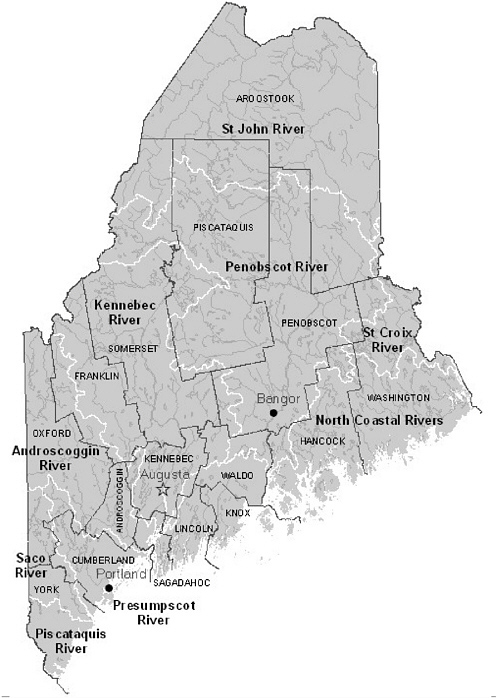
the boundaries of watershed areas.) Table 3-3 highlights the differences in forest clearing for agriculture between Washington County and the other coastal counties between 1880 and 1995 (Irland 1998). Some of the land in the 1880 survey was recently cut and, therefore, classified as open. Most, however, was agricultural land that was abandoned for a variety of reasons.
Legacies of Logging, Milling, and Farming
About 22% of Maine is secondary forest land that regenerated after farm abandonment (Irland 1998). Almost all of the remaining 78% is primary forest (cut, perhaps repeatedly, but never cleared for farming). A very small area of virgin forest (never cut) might still survive in inaccessible areas (Foster 1999, Foster and O’Keefe 2000). It is reasonable to assume that most forested land in Maine has been subject to one or more cycles of logging. By 1920, most of the forest left in the Penobscot, Kennebec, and Androscoggin watersheds had been altered by one or more cycles of logging. By contrast, a larger proportion of the Down East region still had areas of virgin timber greater than 25,000 acres (Whitney 1994). A suite of factors related to the lower impacts of farming and logging in
TABLE 3-3 Forest Area for Selected Counties in Maine in 1880 and 1995
|
County |
Total Area (km2) |
1880 Forest Area (km2) |
1880 % Forest |
1995 Forest Area (km2) |
1995 % Forest |
% Change 1880 to 1995 |
|
Androscoggin, Kennebec, and Penobscot watersheds and estuaries |
||||||
|
Androscoggin |
1,218 |
425 |
35 |
850 |
70 |
100 |
|
Kennebec |
2,247 |
661 |
29 |
1,653 |
74 |
150 |
|
Knox |
947 |
353 |
37 |
706 |
75 |
100 |
|
Oxford |
5,382 |
2,949 |
55 |
4,915 |
91 |
67 |
|
Penobscot |
8,796 |
7,013 |
80 |
7,793 |
89 |
11 |
|
Piscataquis |
10,273 |
8,477 |
83 |
9,972 |
97 |
18 |
|
Sagadahoc |
658 |
250 |
38 |
499 |
76 |
100 |
|
Somerset |
10,171 |
5,800 |
57 |
9,668 |
95 |
67 |
|
Waldo |
1,890 |
538 |
28 |
1,537 |
81 |
186 |
|
Down East watersheds and estuaries |
||||||
|
Washington |
6,653 |
5,110 |
77 |
6,012 |
90 |
18 |
|
SOURCE: Data from Irland 1998. |
||||||
Down East Maine may have contributed to the continued survival of wild Atlantic salmon in the rivers such as the Narraguagus, Pleasant, Machias, East Machias, and Dennys.
Early logging operations were associated with a variety of environmental impacts. Large, stream-side trees were the first to be felled by loggers, removing trees whose roots supported stream banks and that would have eventually become large woody debris. The loss of both functions inevitably reduced stream channel stability and increased bed and bank erosion. During and after spring ice breakup, log drives on streams swollen with melting snow and early season rains carried enormous volumes of wood to downstream mills. Dams were used on many headwater lakes to store water, raise levels, and regulate outflow. On smaller streams, “splash” dams were built to store water (and energy) for the drive. These splash dams were deliberately breeched by releasing blocks, removing a key log, or setting off a well-placed charge of black powder, sending a torrent of water and logs downstream (Irland 1999, Verry 1986, Williams 1976). The log and pulpwood drives must have had a devastating impact on stream-channel stability and aquatic habitat quality in some stream and river reaches. At the mills, booms that were used to capture and store logs also fouled the water and riverbeds with tannins, loose bark, and “sinkers.” In addition, mill waste and sawdust were commonly discarded directly into rivers. Before conversion to steam power, all the mill equipment was powered by water. Eventually, many large mills with high dams also generated hydroelectric power. Augusta, Bangor, Bath, Ellsworth, Orono, Old Town, Skowhegan, and Waterville all had large mill complexes in the 1800s. Bangor alone had 410 saws (Holbrook 1938). The huge salmon runs in 1888–1891 may have been related to short-term reductions in logging, log drives, and milling and the corresponding improvements in water quality and habitat conditions through the 1880s. Beginning in the 1700s, large, high-quality white pine and red spruce logs close to streams and rivers were cut for the manufacture of lumber. Smaller, inferior trees were left behind and species such as balsam fir and red spruce filled openings in the forest. In the 1890s and early 1900s, these trees would be exploited once again. For more than a century, water quality had been degraded by waste products (principally sawdust) from mills and residues from log drives and booms. Small dams constructed for log drives and large dams for booms (log storage in streams and rivers) and water power at mills blocked and degraded salmon habitat (Judd 1997). Water pollution from logging and milling, barriers to fish passage, and degradation of aquatic habitat increased in direct proportion to soaring industrial production and population growth. The brief window of ecological opportunity for Atlantic salmon in Maine’s streams and rivers of the late 1800s was closed.
The statistics summarized in Table 3-3 describe the state of the land, and they indicate the biophysical conditions encountered by Atlantic salmon for more than a century in the Kennebec, Penobscot, and Down East watersheds. Timber harvesting changes the water balance, energy balance, and rates of soil erosion and biogeochemical cycling in a watershed (Likens et al. 1977). The magnitude and persistence of changes in the quantity, quality, and timing of stream flow depends on the proportion of the watershed that is treated and the proportion of the biomass removed (Bosch and Hewlett 1982; Hornbeck et al. 1993, 1997; Reinhart et al. 1963; Verry 1986). Even when every tree in the watershed is logged, the treatment effect decreases rapidly from the first-year maximum back to an equilibrium condition when the leaf area of the new vegetation approaches that of the mature stand. Although the tree seedlings and saplings are small, their high densities (e.g., up to 100,000 white pine seedlings per acre) and rapid growth rates usually restore watershed functioning in 5 to 10 years. A light thinning or timber stand improvement cut that removes a small percentage of the biomass may have no measurable effect on the quantity, timing, or quality of stream flow. The residual trees quickly and completely make use of the temporary surplus of light, water, and nutrients.
Changes in soil erosion and biogeochemical cycling rates, and attendant degradation of water quality, are closely linked to water and energy balance changes. In most forest soils, water moves through the soil surface at a rapid rate (known as infiltration capacity) because the soil is rich in organic matter, contains large pores, and is protected by leaf litter. Overland flow does not occur unless the soil mantle is saturated. Unless a logging operation exposes and compacts the soil surface, initiating raindrop splash and overland flow, detached soil particles and organic matter (now sediment) will not be lifted and carried to streams, lakes, or wetlands. When overland flow and soil erosion occurs, nutrients that are adsorbed to the surface of sediment particles (especially clay and silt particles with charged surfaces) will be carried downstream.
Forest soils are unsaturated most of the time because of their high permeability. When some or all of the forest vegetation is removed, soilwater content increases with a consequent increase in the rate of subsurface flow. Tree removal also reduces nutrient uptake, increases dry deposition (dust and aerosols from the atmosphere that would have been deposited on the forest canopy), and stimulates microbial decomposition of organic matter due to higher soil temperature and water content. This increases the concentrations of nutrients, dissolved organic carbon, and trace metals that, when combined with the increased subsurface flow, results in greater loading to streams, lakes, and wetlands.
Recent reviews of paired watershed experiments show that vegetation must be removed from about 25% of the watershed to produce a
significant increase in stream flow. The soil water content and stream flow increases are the necessary precondition for increased sediment yield and nutrient loading (non-point-source pollution) in receiving waters. Because logging was dispersed over large areas, it is unlikely that Washington County reached this threshold at the peak of forest clearing around 1880 (Table 3-3). Except for the two large northern counties, Piscataquis and Penobscot, the forest cover in other areas of the Kennebec and Penobscot drainages ranged from 28% to 55%, with a mean of about 40%. Because a large proportion of the land was converted to agriculture rather than naturally regenerating as forest, the changes in stream flow, and associated increases in nutrient and sediment loading, were probably much more severe. Mean annual erosion rates from active agricultural land range from 2 to 5 tons/acre, while forests rarely generate more than 0.1 ton/acre (Patric 1976). So while aquatic ecosystems in the Down East watersheds, such as the Narraguagus, Pleasant, Machias, East Machias, and Dennys rivers, may have been somewhat affected by logging and log drives, the Penobscot and Kennebec watersheds were subject to significant and sustained changes.
DAMS
Dams are a major cause of salmon declines worldwide. Dams have two major effects on anadromous fishes, such as salmon. They prevent or impede fish passage up- and downriver, and they change or destroy habitat (American Rivers et al. 1999, Heinz Center 2002, NRC 1996a, NWPPC 2000). The first effect, especially the blocking of upstream migration of adults, has long been recognized, even in the writings of Atkins (1874) and Kendall (1935).
Although fish-passage facilities can alleviate the difficulties that adults have in upstream migration, the effects of dams on the downstream migration of smolts has been recognized only recently, and they are more difficult to reverse. The slow-moving pools behind dams confuse smolts during migration, increase the energetic costs of their movement, and can increase predation on them. The dams can injure smolts or block their passage. Athough smolts do swim, their travel time to the estuary also can be greatly increased as a result of dams, as has been shown on the Columbia River system in the Pacific Northwest (NMFS 2000b). Although the western dams are larger than those in Maine, effects documented in the West are likely to occur to some degree on dammed streams in Maine.
The second effect needs wider recognition. By creating pools behind them, dams change habitat by eliminating flowing water and riffles. They flood riparian habitats, and they change the patterns of sedimentation
and erosion. Dams usually cause changes in water temperatures and chemistry, and reservoirs behind dams are often stratified, while undammed rivers usually are not (American Rivers et al. 1999, Heinz Center 2002). In addition, the large woody debris, gravel, and sediment that were formerly carried down the river and that provided spawning and rearing habitat, as well as cues that helped adults to return home to their natal streams, are now stopped by dams. As a result, these altered habitats are less suitable for spawning and juvenile rearing. Rivers behind dams become pools, more like lakes than rivers. Most anadromous salmonids are not adapted to such habitats. Other species of vertebrates and invertebrates that can thrive in lakes proliferate and thereby change the prey resources available to salmon, as well as the number and kinds of their competitors and predators.
Dams on Maine’s Salmon Rivers and Their Legacy
Maine’s rivers and streams have many hundreds of dams (Figure 3-2). Not all dams are necessarily large and completely impervious barriers to fish, especially in Maine. Even the relatively large wood and concrete Edwards Dam on the Kennebec River, which was removed in 1999, had previously been breached by high flows. Thus, the upstream habitat had been available (at least to the next dam) for adult salmon for periods up to 12 months. Other Maine dams are smaller, and many are made entirely of wood. Those often allow some passage during periods of moderate-to-high flow, thus allowing some downstream passage of small fish. Many are not maintained and have deteriorated to varying degrees. Many dams in Maine are breached, overwashed, or even washed out during periods of high flows. Therefore, simple inspection of maps that illustrate dam placement is not sufficient to assess the availability of habitat to migratory fishes or the quality of that habitat in Maine.
The effects of dams on salmon in New England rivers are sobering. Kendall (1935), citing Atkins (1874) but adding newer information, provided the summaries below, starting from the southwest. (Rivers with no mention of dams or records of salmon abundances are omitted except for the eight DPS rivers.)
-
Housatonic River—Salmon disappeared from this river many years ago. There is a record of plenty about 1750; about 1868 one of seven or eight pounds was reported to have been caught below the dam at Stratford.
-
Connecticut River—This magnificent stream was formerly one of the best of New England rivers in which salmon are said to have been
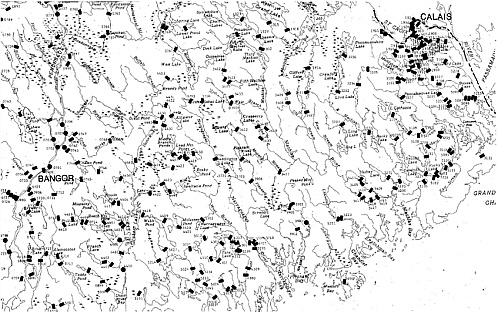
FIGURE 3-2 Existing and former dams in Down East Maine, including part of the Penobscot River. The rest of Maine looks similar. A black rectangle (■) indicates one nongenerating dam, and a black circle (●) indicates one hydroelectric/power dam. The numeral beside each dam site corresponds with data provided in the Inventory of Existing and Former Dams in Maine. SOURCE: Elder 1987a,b.
-
plentiful up to 1797, after which they disappeared, owing to a dam just below the mouth of Miller’s River.
-
Thames River—Salmon formerly inhabited the Thames and some of its tributaries until dams effectively prevented ascent. There are no records of salmon since 1822.
-
Merrimack River—The Merrimack was once one of the best salmon rivers in the United States, but for years after the erection of dams at Lowell, Lawrence, and Manchester no salmon were able to pass them.
-
Piscataqua River—Formerly salmon were very abundant, breeding in the Salmon Falls branch and to some extent in the Cocheco. The rivers have been obstructed by dams for over 200 years.
-
Presumpscot River—This was once one of the finest salmon rivers for its size in the state of Maine, but was early obstructed by dams and only a few salmon have since been taken.
-
Royal River—Salmon were common in the river up to 1800, and some occurred later. The last salmon seen here was taken in 1853. For years, owing to the dams at Yarmouth, no fish could ascend the river, and in later years besides the dams, excessive pollution has effected occlusion of fish of any kind in that vicinity.
-
Androscoggin River—The Androscoggin and its tributaries were naturally adapted to salmon and were frequented by them until dams prevented ascent.
-
Kennebec River—In its original condition, the Kennebec was scarcely surpassed by any salmon river in the country. The salmon fisheries of the Kennebec were in flourishing condition in 1873, when the dams at Augusta were completed. For a few years they continued plenty, and then rapidly declined until they almost disappeared.
-
Sheepscot River—The Sheepscot was formerly frequented by salmon in great numbers, but the stream was obstructed many years ago. However, occasional salmon have been observed and taken in recent years below the dam at Alna.
-
Medomac River—Obstructed for many years, the only salmon taken in recent years have been caught near the mouth of the river. It has been over 100 years since any considerable numbers were taken. In those early days they used to be dipped below the dam at the head of tidewater.
-
Penobscot River—At the present time [1935] the Penobscot is the only New England river affording any extent of commercial salmon fishery. Atkins [1874] wrote that besides being the largest between the Saint John and the Connecticut, it is distinguished by the manner in which it discharges its waters into the sea, namely, through a large bay or estuary, narrow at its head, where it receives the waters of the river, but widening gradually to its junction with the open ocean. The works of man have interfered less with the migration of salmon in the Penobscot than in any
-
other large river south of the Saint John. Owing to its great volume and other favorable circumstances, dams, quite impassable by salmon, have never been in existence many years at a time. The four points on the lower part of the river at which dams have been built are Veazie, Ayer’s Falls, Great Works, and Oldtown.
-
Union River—Once a productive salmon river, it has not yielded a single salmon for over seventy years. Formidable dams at Ellsworth, within three miles of tide water, effectually obstruct the ascent of fish.
-
Narraguagus River—Salmon were plentiful here 90 or 100 years ago and the river afforded a productive salmon fishery. A few salmon even now appear at Cherryfield.
-
Machias River—It is stated that in olden times salmon were extremely abundant in this river. Something over 80 years ago, it is said, a fisherman with a dip net could take 60 salmon in a day at the lower falls. As in other streams, dams have practically effected extermination so far as that river is concerned, although a few appear at times below the dam.
-
East Machias River—While in former times Machias River was regarded as the better salmon river, at present and for a long time the East Machias is and has been the better stream. Salmon are now and then taken, and apparently they breed to some extent in Chace’s Stream, the outlet of Gardner’s Lake. Several salmon were caught with a dip net at East Machias in the latter part of June 1876 (S.B.H. 1876).
-
Orange River—It does not appear that salmon ever very numerously frequented this stream, although before dams obstructed it, some entered it for breeding.
-
Dennys River—Atkins [1874] wrote that in its primitive state salmon abounded in this river. In Notes from Dennysville, Robert T. Morris (1900), under the date of July 1, 1909 [sic], wrote: “As a salmon stream the name of the river is Dennys. Sawmillafecit1—Until very recently, the river was full of salmon. But these things are all spoken of in the past tense, because the lumber company has a sawmill at the head of tide water, and the artificial fishway will not allow breeding fish to pass.”
-
St. Croix River—The St. Croix by its eastern and western branches respectively discharges the waters of two extensive lake systems, and salmon, once abundant, ascended nearly to the headwaters of both branches. Obstruction and pollution, augmented by poaching, have practically eliminated salmon from the river, excepting the few which yearly, at least up to recent times, appeared in the pool at Calais or Milltown.
The dams on the Penobscot were the subject of acrimonious debate beginning in 1825 (Judd 1997). The mill owners argued the dams provided a much greater community benefit than anadromous fish. On smaller rivers with smaller mills, dams, and communities, moral arguments and traditional rights held more sway than in the large cities where “Dams were an exercise of class prerogative, perpetrated by ‘gentlemen lawyers’ in league with the mill owners” (Judd 1997). On the Machias River in about 1850—“where fisheries were rebounding under patient care”—as well as the Pleasant and Narraguagus rivers, communities were concerned about poaching and other conditions that were detrimental to the alewives, shad, and Atlantic salmon runs. They urged state and local officials to be more diligent in protecting the resource (Judd 1997). A recent agreement has been reached to remove the Veazie Dam above Bangor and the Great Works Dam in Old Town, significantly improving Penobscot habitat and access to it (Richardson 2003).
HAZARDS OF CHEMICAL CONTAMINANTS IN RIVERS AND STREAMS
Synthetic chemicals that could cause detrimental effects on salmon originate from residential, industrial, and agricultural activities. An important question is how quickly sick and dying fish disappear in nature. The answer is probably quickly, so it is difficult to know the extent of potential damage. This section briefly reviews a few key concepts in toxicology, highlights some examples that specifically concern salmon, and comments on progress in this area. More extensive treatment can be found in publications by the National Research Council (NRC 1999, 2000) and the Society of Environmental Toxicology and Chemistry (SETAC; DiGiulio and Tillitt 1999); also see e-Hormone 2003.
Ecological toxicologists investigate impacts at ecosystem, population, individual, and suborganismal levels of organization. Basic mechanisms of toxicity at the suborganismal level include damage to cell activities and cell death. The distinguishing feature of endocrine-disrupting chemicals (EDCs), also known as hormonally active agents (HAAs), is that they tend to exert their actions by mimicking hormones or by blocking the action of hormones; that is, they operate through specific receptors. EDCs may also alter metabolism of hormones and receptors. Hormones of the neuroendocrine system coordinate growth and development, metabolism, physiological adaptation to a changing environment, reproduction, behavior, and, importantly to salmon, the parr-smolt transformation. A generalization with many exceptions is that the end point in toxicology tends to be mortality, whereas many actions of EDCs are sublethal.
There are important research findings that concern Atlantic salmon. For example, the lowest returns of Atlantic salmon to 16 rivers in eastern Canada over the period 1975–85 coincided with spraying Matacil 1.8D, an insecticide used in forestry (Fairchild et al. 1999). The culprit was 4-nonylphenol (4-NP), a nonionic detergent metabolite, and the spray was reformulated as Matacil 1.8F, without 4-NP. In retrospect, 4-NP was probably having estrogen-like effects in juvenile salmon. As an additional example, milt production and reproductive hormones of mature male parr are reduced by exposure to atrazine under experimental conditions (Moore and Waring 1998). Atrazine is an herbicide that inhibits photosynthesis in atrazine-sensitive plants used on food crops and in non-crop areas across the United States (EPA 2002a). Atrazine is persistent and mobile. As a final example of research on this topic, Atlantic salmon from a stream contaminated with polychlorinated biphenyls (PCBs) were found to have greater expression of the gene coding for the detoxifying enzyme cytochrome P4501A (CYP1A) than were salmon from a nearby stream with no known contamination (Rees et al. 2003). The gills and kidney, both interfaces involved in osmoregulation, showed induction levels of two and five orders of magnitude. Induction of CYP1A in fishes in remote ocean areas has been suggested as an indicator for chemical contaminants (Stegeman et al. 2001).
The Toxic Substances Hydrology Program of the U.S. Geological Survey used new analytical methods to measure pharmaceuticals, hormones, and other organic wastewater contaminants in 139 streams in the United States (Kolpin et al. 2002). 4-NP was found in half the samples at concentrations adequate to affect reproduction in mature male parr (discussed above). Hexazinone, found in the herbicide Velpar, is used for controlling weeds in blueberry stands. Hexazinone is toxic to juvenile Pacific salmonids, although at fairly high concentrations (276 liter, Wan et al, 1988). The potential for ecotoxicity of hexazinone to Atlantic salmon in Maine merits investigation.
There are a number of sites in Maine listed as Superfund sites by the U.S. Environmental Protection Agency, with 13 sites on the National Priorities List, and 58 sites on CERCLIS—a list of potential and confirmed hazardous waste sites. Six sites have been cleaned up. The sites were used by clothing mills, paper companies, and the military, for example. They tend to be near streams and rivers and some are being cleaned up, although funding was cut in 2003. For example, the Sebasticook is a tributary of the Kennebec River and the former site of the Eastland Woolen Mill, which declared bankruptcy in 1996 and is now a Superfund site. The groundwater in the area was heavily contaminated with chlorobenzene compounds used in the dyeing of wool cloth. The mill dumped the chemicals directly into the Sebasticook or into a tail-race that led to the Sebasti-
cook. Another example is the Eastern Surplus site in Meddybemps, near Meddybemps Lake and the Dennys River, formerly used for storing military surplus from 1946 through 1976 and placed on the National Priorities List in 1996. The Agency for Toxic Substances and Disease Registry (ATSDR) began investigations in the 1980s that found chemical contaminants, such as organic compounds (e.g., benzene, PCBs, DDE) and metals (e.g., mercury, chromium, arsenic, and lead). Fish collected in 1997 included brook trout; and pesticides, PCBs, and metals were found above comparison values in the fish fillets. The Passamaquoddy Tribe lives downstream of the site; however, because of lack of data, ATSDR had to classify “the current and future exposures at the site as posing indeterminate public health hazard” (ATSDR 2003). No additional monitoring is planned. The Penobscot Nation is advocating the cleanup of the sites owned or previously owned by paper companies. The Great Northern Paper Company filed for bankruptcy in January 2003. Some polluted sites it owned are near the Millinocket Stream, which empties into the West Branch of the Penobscot River upstream of the Penobscot Indian Reservation. Monitoring water quality in streams throughout Maine would contribute substantially to habitat assessment and management. Efforts like those of Maine’s Board of Pesticides Control to monitor pesticides (Jackson 2002, 2003) should be continued and strengthened. Where possible, they should be coordinated with streamflow, water-quality, and biological assessments conducted by the U.S. Geological Survey, the Maine Atlantic Salmon Commission, the University of Maine, and others.
HATCHERIES
Stocking of hatchery fish has long been a major component of fishery management programs. With the increasingly widespread decline of fish populations, managers have turned to hatcheries to rehabilitate depressed populations. A fundamental premise of these programs is that use of hatchery programs, when properly designed and implemented, provides one tool for rebuilding wild populations of salmon. Although the evidence available in Maine does not allow an evaluation of that premise—Atlantic salmon populations there had not been rebuilt as of 2002—it seems clear that success will not be achieved without the use of the best available techniques, if then. In addition, careful research and monitoring are needed to increase the likelihood that hatchery stocking will help to achieve the goal of recovering wild fish populations. When salmon populations are as low as they are now in many of Maine’s streams, hatcheries might offer the only possibility of avoiding extinctions in the short term while longer-term solutions are implemented.
Three caveats are important (Miller and Kapuscinski 2002). First, with-
out proper adherence to genetic, evolutionary, and ecological principles, integration of hatchery and naturally reproducing salmon could lead to adverse consequences for naturally reproducing fish, thus undermining other rehabilitation efforts. Second, the use of hatcheries to rebuild depressed populations is still an unproven technology; therefore, it should be conducted with a commitment to the concept of adaptive management. Adaptive management requires explicit design and implementation of actions or programs as experiments, regular monitoring to obtain reliable data and track progress toward program goals and objectives, systematic evaluation of outcomes of actions, and most crucially, adoption of adaptive changes (mid-course corrections), on the basis of conclusions drawn from such evaluations (Lee 1995, NRC 1996a, Walters 1986). Finally, hatcheries should be viewed as only one part of a more comprehensive strategy to remedy factors, such as lack of habitat and poor habitat quality, that cause decline or impede recovery. Hatchery use should be limited to specific situations where its advantages outweigh its disadvantages. In general, the committee favors the discontinuation of hatchery supplementation for wild salmon when the populations are recovered to a specified degree, as discussed below.
History and Status of Hatcheries for Atlantic Salmon in Maine
Enormous numbers of Atlantic salmon have been produced and stocked in Maine waters for well over a century. In spite of these efforts, salmon runs have continued to decline. Failure to monitor hatchery fish after their release and to compare them with wild populations whose natal streams did not receive hatchery-stocked fish makes it impossible to determine the effect of the stocking program on the continuing decline in salmon abundance. At best, stocking might have retarded the decline; at worst, stocking might have accelerated it.
Overfishing of migratory fish species was recognized as a problem in U.S. waters as early as 1762, concerns being raised about striped bass and sturgeon in the Exeter River of New Hampshire. By 1790, destruction of alewife spawning runs due to dam construction was recognized as a problem (Bowen 1970). By the mid-1800s, some of the southern New England Atlantic salmon runs had been destroyed, and others were declining because of pollution, and commercial fishing (Moring 2000a). The decline stimulated a long period of translocations of Atlantic salmon among widely separated watersheds, and importation of nonnative eggs for hatchery programs began soon thereafter.
By 1870, the Canadian Samuel Wilmot was selling Atlantic salmon eggs, probably from Lake Ontario, to various states in the United States
(Atkins 1874, Milner 1874). Atkins bought 8,000 salmon eggs from the Canadian government in 1871 and stocked the Sheepscot River with about 1,500 fingerlings (Atkins 1874).
The Craig Brook Hatchery in Maine, the first public salmon hatchery in the United States, was established in 1871 (Moring 2000b) to rehabilitate depressed runs of wild Atlantic salmon throughout their range in New England. The U.S. Fish and Fisheries Commission and Maine established another hatchery at Bucksport in 1872. That hatchery produced 876,000 fish derived from Penobscot River stock in its first year of operation for stocking in various states, including Maine (Baird 1876). Additional details associated with early attempts to spawn and stock Atlantic salmon in New England can be found in Baum (1997) and Stickney (1996a,b).
Genetic sources shifted between Maine and Canada from the early history of hatchery use. The Bureau of Fisheries (the successor to the U.S. Fish and Fisheries Commission) obtained salmon eggs from the Miramichi River in New Brunswick and from the Gaspé region of Quebec, between 1920 and 1937, as a result of altercations between the bureau and commercial fishermen who were collecting adults from the Penobscot (Baum 1997). Several reports described key shifts in the life stage stocked and the increasing numbers of hatchery fish stocked throughout the history of Maine’s stocking programs (Baum 1997, Smiley 1884). Baum showed the annual take of Atlantic salmon eggs from Maine and Canadian rivers from 1871 through 1995 (see Appendix F).
Both parr and fry were stocked during most years, beginning in 1873, according to Baum (1997), although Moring et al. (1995) indicated that parr stocking began in 1890. Fry and parr stocking continued until the late 1920s, after which annual parr stocking continued until 1958. Fry stocking was conducted only during some years between 1928 and 1941, after which no fry were stocked again until 1972 (Baum 1997). Fry were stocked in alternate years from 1979 to 1986 and annually thereafter (Baum 1997). Modest numbers of smolts were stocked from 1945 to 1947. Smolt stocking began again in 1962 and continued through at least 1995 (Baum 1997).
Current River-Specific Stocking of Fish: A Supportive Breeding Approach
River-specific management was instituted in 1991 for six of the DPS rivers (Sheepscot, Narraguagus, Pleasant, Machias, East Machias, and Dennys) listed under the ESA, a major shift in the strategy of hatchery production in Maine. The other two DPS rivers (Ducktrap and Cove Brook) are not being stocked. Non-DPS rivers still receive hatchery-raised fish from other sources. The Saco River, for example, is being stocked with Penobscot fish (MASC 2001).
The river-specific stocking in the six listed rivers also involves a type of captive brood-stock program, referred to in this chapter as “supportive breeding” (Ryman and Laikre 1991), that intends to increase the population size without introducing exogenous genes into the managed population. Supportive breeding involves bringing a fraction of the wild population into captivity to increase survival of early-life stages in the protective captive environment, followed by release of the offspring into the natural habitat, where they will mix with wild salmon. Starting in 1992, parr were captured in each of the six rivers and maintained at the Craig Brook hatchery until reaching adulthood (Beland et al. 1997; Craig Brook hatchery officials, personal communication, 2001). Initial parr collections for the Pleasant River were held at North Attleboro National Fish Hatchery, but later collections were maintained at Craig Brook Hatchery. The captive adults were used as brood stock, and their offspring were released, primarily as sac fry, back into the streams of parental origin on the premise that if released at about the time fry normally begin searching for food, they would adapt better to their native stream habitat, thus improving survival and future adult return and spawning in the wild. Starting in 2001, managers have aimed at spawning each captive adult only once, preferably at age 4, when the fecundity of females should be high enough to meet production targets for the target DPS river (Buckley 2002a,b). The rationale is to reduce common ancestry of parents and to equalize their reproductive contributions to the next generation, minimizing the loss of genetic variation during the captive breeding phase. Hatchery managers, however, had to include some adults from older age classes in the matings, because fewer females than expected were mature at age 4. Rather than producing mature gametes every year, many of the captive adult brood stock appear to do so only in alternate years, as is the normal pattern in the wild.
Each year since 1995, additional collections of parr have been obtained and reared to adulthood. Sufficient numbers are collected to ensure survival to spawning of at least 50 pairs from each of the six streams (Beland et al. 1997). As soon as two year-classes (cohorts) of adults became available, brood fish from different cohorts were crossed to produce the next generation. The range of crosses was expanded to incorporate additional cohorts in the breeding design for subsequent years. After captive brood stock from one cohort have contributed progeny over a few years, the survivors are released back into their natal streams.
Little is known about survival rates of released swim-up fry to the parr stage, although studies are under way with tagged fry to determine both survival rates and the degree to which hatchery-spawned fish are recaptured as parr to contribute to future cohorts of captive spawners. An experiment conducted in the Connecticut River (no natural population of
Atlantic salmon) was designed to investigate stocked fry survival up through the smolt stage (Orciari et al. 1994). Eggs were obtained from the Penobscot River and fry were stocked in 1982, 1984, and 1985. Stocking Penobscot fry at mean densities of 125/100 square meters (m2) resulted in mean densities of 34 age-0 parr, 10 fall age-1 parr, and 3.6 smolts/100 m2 averaged over the 3 years. The study also included stocking fry from an Icelandic strain in 1983, yielding poor survival. The transferability of the results of this study to the restoration program for wild populations in Maine rivers is limited for two reasons. First, both groups of nonnative fry had a relatively low chance of being adequately pre-adapted to environmental conditions in the Connecticut River, whereas river-specific fry produced in the Craig Brook hatchery and released into their own rivers of origin have a higher chance of being adequately adapted. Second, the crucial information needed to evaluate effectiveness of fry stocking is the number of adult returns that contribute to the next generation, but such data are not yet available from this study. Still, for all Maine rivers, 79% of adult returns in 2001 had been stocked as smolts (USASAC 2002). Despite this overall result, there is a need for reliable tests of the relative survival of stocked fry and smolts estimated from matched trials in selected rivers. There also is a need to quantify the fitness of the parr from the hatchery program and compare it with the fitness of wild parr (that is, their presumed fitness had they been left in the river). The hatchery program in Maine rivers has the capability to perform these important comparisons, a capability that emphasizes its value for doing crucial experiments.
Moring et al. (1995) suggested that restoration and rehabilitation of salmon in Maine will not be possible without the use of hatchery-reared fish. However, the establishment of large numbers of stocked fish has not led to the establishment of large runs of fish. In fact, the populations have declined precipitously since the 1970s and have reached historical lows in many streams. At best, stocking may have slowed the decline. More important, nobody can determine whether hatchery stocking has had any effects at all, because controlled, matched trials have never been done.
AQUACULTURE
The potential effects of net-pen salmon aquaculture (salmon farms) on the wild salmon of Maine have been much debated, but little direct evidence from Maine is available. This section evaluates information from Maine and elsewhere, as well as methods to reduce adverse effects of salmon farming. The problem is intensified because one of the DPS rivers, Dennys, empties into Cobscook Bay, which is one of the most concentrated areas for the Maine salmon aquaculture industry. Cobscook Bay also adjoins Passamaquoddy Bay, the focal center of the East Coast Cana-
dian salmon aquaculture industry. Thus, transboundary issues are important as well.
History and Status of Net-Pen Salmon Aquaculture in Maine
Commercial salmon aquaculture is the latest addition to the long list of items that some have pointed to as threats to wild salmon in Maine. Although the industry is being criticized, it has also been experiencing important internal problems, one of which is historically low prices for the product. In 2001, infectious salmon anemia (ISA), which had been present in New Brunswick, Canada, fish farms for several years (Getchell 1997), appeared in Maine (Veneman 2001). By early 2002, all the farms in Cobscook Bay were forced to destroy their fish and begin sanitizing equipment in an attempt to eradicate the disease. The general economic downturn, coupled with ISA, resulted in substantial layoffs of employees and a worsening of the socioeconomic situation in Down East Maine. The federal government has promised $16.4 million over 2 years to help fight the disease and to provide compensation to the industry for some of the financial loss incurred as a result of destruction of the fish. The Canadian federal government also has subsidized the costs of its aquaculture industry. The following information relates to the development of the industry before the appearance of ISA.
According to the Maine Aquaculture Innovation Center (2003), laws governing leasing of public marine waters by the private sector were promulgated in 1973, although the first net-pen operation was established in 1970. That operation, and others, produced steelhead trout (Oncorhynchus mykiss) and coho salmon (O. kisutch), which were species of choice into the 1980s, a decade that saw rapid expansion of what had been a fledgling industry. The Atlantic salmon aquaculture industry began to develop in the mid-1980s in Cobscook Bay, connected to Passamaquoddy Bay, where the Canadians had established their New Brunswick industry (Conkling 2000). Falling prices for farm salmon led to consolidation of the industry in Maine and to the purchase of many of the farms and hatcheries by feed companies, including multinational corporations.
The Maine industry provides about 800 jobs on the farms, in the hatcheries, and in the processing plants (many of them in Washington County [Alden 1997]). The industry has a production valued at approximately $60 million (Wilson 2000) and produces approximately 13,000 metric tons of Atlantic salmon annually (ICES 2002) and a small amount of steelhead. Seventeen companies hold leases in Maine, 12 of which are in salmon and/or steelhead production, on 42 leased sites covering a total of nearly 300 hectares (ha) (DMR 2001, see Maine Aquaculture Innovation
Center 2003). If production increases in Maine, additional farm sites in the protected waters along Maine’s coast will be needed. The current sites apparently do not have room for additional production.
Production is concentrated in Washington and Hancock counties—referred to as Down East Maine—an area that includes five of the eight DPS rivers. ESA provisions could potentially affect aquaculture in the area. Siting criteria for the farms include suitable water temperatures and tidal flushing rates (see Brooks et al. 1998). Regulations allow a maximum of 60 ha (150 acres) of leased water per company, with 40 contiguous ha (100 contiguous acres) maximum per site. Five-year goals (1997–2002) included (1) tripling the contribution of aquaculture to the state’s economy to $192 million, (2) doubling employment to 1,620, (3) actively farming 1,000 acres of subtidal habitat, (4) leasing 30 acres for testing the potential for new species, and (5) establishing 10 new aquaculture firms or aquaculture support firms. Table 3-4 lists current leases and sizes of the areas leased.
The original source of fish used to stock commercial net pens in Maine apparently came from Scotland and Ireland, although the ultimate source was probably Norway. According to representatives of the company Atlantic Salmon of Maine, who spoke with members of the committee, brood stock resulting from those European fish (proprietary name Landcatch) were crossed with St. John River, Canada, fish to produce first-generation hybrids. The hybrids were subsequently crossed with Penobscot fish to produce second generation derivatives, which are the source of brood stock currently used to produce fish for stocking the net-pens. Baum (1998) estimated that there is a European genetic influence in 30–50% of the production fish in Maine.
The inclusion of European strains of salmon in the Maine industry has been controversial. These strains have superior characteristics (for example, growth rate) that are desired by the industry, but concern arises from the potential effects that escapes of such genetically foreign fish might have on the wild Atlantic salmon populations of Maine. On May 28, 2003, the U.S. District Court in Maine banned the use of European strains in the decision for U.S. Public Interest Research Group vs. Atlantic Salmon of Maine and Stolt Sea Farm (Civil Nos. 00-151-B-C, 00-149-B-C).2 Moreover, the Agricultural Research Service (USDA) has been directed by Congress to develop a National Cold Water Marine Aquaculture Center in Maine, in part, to address genetic issues related to Atlantic salmon aquaculture.
TABLE 3-4 Atlantic Salmon Net-Pen Lease-Site Locations and Sizes in Maine Waters as of June 2001
|
Lease Location |
Size of Lease (hectares) |
Lease Duration |
Lease Holder |
|
Hancock County |
14.0 |
03/2000–03/2010 |
Acadia Aquaculture, Inc. |
|
Washington Country |
10.0 |
09/1997–09/2007 |
Atlantic Salmon of Maine |
|
Washington County |
8.0 |
01/1997–01/2007 |
Atlantic Salmon of Maine |
|
Washington County |
8.0 |
04/1995–04/2005 |
Atlantic Salmon of Maine |
|
Washington County |
4.0 |
09/1994–09/2004 |
Atlantic Salmon of Maine |
|
Washington County |
16.0 |
04/1992–04/2002 |
Atlantic Salmon of Maine |
|
Washington County |
8.0 |
11/1993–11/2003 |
Atlantic Salmon of Maine |
|
Washington County |
4.0 |
12/1996–12/2006 |
Atlantic Salmon of Maine |
|
Washington County |
11.4 |
04/2000–04/2010 |
Birch Point Fisheries |
|
Washington County |
18.0 |
12/1996–12/2006 |
Connor’s Aquaculturea |
|
Washington County |
0.5 |
09/1997–09/2007 |
Connor’s Aquaculturef |
|
Washington County |
3.4 |
07/2000–07/2010 |
Connor’s Aquaculturef |
|
Washington County |
10.0 |
12/1996–12/2006 |
Connor’s Aquaculturef |
|
Washington County |
11.0 |
03/1998–03/2008 |
Connor’s Aquacultureb |
|
Washington County |
12.0 |
05/1997–05/2007 |
Connor’s Aquaculture |
|
Washington County |
4.0 |
06/1998–06/2008 |
D.E. Salmonc |
|
Washington County |
4.0 |
10/1995–10/2005 |
D.E. Salmonc |
|
Washington County |
4.0 |
03/1993–03/2003 |
D.E. Salmona |
|
Hancock County |
6.0 |
03/1999–03/2009 |
Island Aquacultured |
|
Hancock County |
7.5 |
06/1994–06/2004 |
Island Aquaculturee |
|
Hancock County |
7.2 |
06/1999–06/2009 |
Island Aquaculturef |
|
Washington County |
4.0 |
07/1996–06/2006 |
International Aqua Foodsg |
|
Washington County |
4.0 |
07/1995–07/2005 |
International Aqua Foodsh |
|
Washington County |
8.8 |
09/1997–09/2007 |
International Aqua Foodsi |
|
Washington County |
11.8 |
03/1992–03/2002 |
International Aqua Foods |
|
Washington County |
10.6 |
12/1996–12/2006 |
International Aqua Foodsj |
|
Washington County |
9.9 |
04/2000–04/2010 |
L.R. Enterprises |
|
Washington County |
9.9 |
04/2000–04/2010 |
L.R. Enterprisesc |
|
Washington County |
6.0 |
12/1996–12/2006 |
L.R. Enterprisesa |
|
Washington County |
4.0 |
07/1997–07/2007 |
Maine Coast Nordicj |
|
Washington County |
2.5 |
12/1997–12/2007 |
Maine Coast Nordici |
Genetically engineered salmon are not being produced in Maine. In the United States, the Food and Drug Administration (FDA) has claimed lead regulatory authority over commercial uses of transgenic animals, including fish (OSTP/CEQ 2001) on the basis of its authority to regulate new animal drugs under the Food Drug and Cosmetic Act (FDCA) (21 USC §§ 371-379d and § 321[g]). The Trade Secrets Act (18 USC 1905 and 301[j] of the act) requires FDA to keep secret the investigations, review, and approval of commercial applications and premarket notifications for
|
Lease Location |
Size of Lease (hectares) |
Lease Duration |
Lease Holder |
|
Washington County |
2.8 |
09/1993–09/2003 |
Maine Coast Nordic |
|
Washington County |
4.0 |
03/1992–03/2002 |
Maine Coast Nordic |
|
Washington County |
4.0 |
05/1992–04/2002 |
Maine Coast Nordic |
|
Washington County |
3.3 |
01/1999–01/2009 |
Maine Salmonk |
|
Washington County |
8.0 |
07/1994–07/2004 |
Stolt Sea Farmj |
|
Washington County |
4.0 |
06/1997–06/2007 |
Stolt Sea Farma |
|
Washington County |
4.0 |
06/1998–06/2008 |
Stolt Sea Farma |
|
Washington County |
6.0 |
12/1997–12/2007 |
Treats Island Fisheriesl |
|
Washington County |
4.1 |
09/1997–09/2007 |
Treats Island Fisheriesm |
|
Washington County |
4.0 |
05/1997–05/2007 |
Treats Island Fisheriesn |
|
Washington County |
2.0 |
01/1998–01/2008 |
Treats Island Fisheriesa |
|
Hancock County |
10.0 |
03/1993–03/2003 |
Trumpet Island Salmon Farmo |
|
aLease includes rainbow trout. bLease includes rainbow trout, Atlantic halibut, soft-shell clams, and scallops. cLease includes sea urchins and giant sea scallops. dLease includes Atlantic cod, Atlantic halibut, haddock, and blue mussels. eLease includes and Donaldson trout (Donaldson strain of rainbow trout). fLease includes Atlantic cod, Donaldson sea trout, and haddock. gLease includes rainbow trout, Atlantic halibut, abalone, blue mussels, European oysters, American oysters, bay scallops, hard- and soft-shell clams, seaweed, red algae, and fan worms. hLease includes Donaldson trout, Atlantic cod, haddock, and Atlantic halibut. iLease includes rainbow trout, and Atlantic halibut. jLease includes Atlantic cod, Atlantic halibut, and haddock. kLease includes rainbow trout, Atlantic halibut, sea scallops, American oysters, and European oysters. lLease includes rainbow trout, Atlantic halibut, flounder, pollock, sea scallops, and clams. mLease includes rainbow trout, Atlantic halibut, haddock, sea scallops, and clams. nLease includes rainbow trout, Atlantic halibut, and red algae-nori. oLease includes rainbow trout and blue mussels. SOURCE: DMR 2001. |
|||
new animal drugs, including the existence and content of an application unless the applicant chooses to disclose the information. The existence of one first-stage application to FDA for approval of a growth-enhanced genetically engineered salmon line has been publicly disclosed by the applicant (OSTP/CEQ 2001). Under the ESA, 16 USC § 1536(a)(2), any possible approval of genetically engineered salmon for use in commercial aquaculture would be a federal action requiring a determination of whether those salmon jeopardize the continued existence of a threatened
or endangered species (OSTP/CEQ 2001). Thus, before FDA approves the pending application for commercial use of genetically engineered Atlantic salmon, the National Marine Fisheries Service (NMFS) and the Fish and Wildlife Service (FWS) would have to determine whether approval would harm federally listed salmon populations, including the listed DPS populations in Maine. However, FDA may require that NMFS and FWS keep secret their written biological opinion due to FDA’s lead authority and its need to comply with the Trade Secrets Act.
Possible Threats to Recovery of Wild Salmon
Interactions between farm and wild Atlantic salmon can be classified as ecological and genetic. Ecological interactions can involve the transfer of diseases (including parasites); predation; or competition for space, food, or mates between wild and escaped farm fish. Depending on the direction and strength of these interactions, growth and survival of both wild and farm fish can be affected. Interactions also can involve modification of the timing and pattern of natural migrations and complex interactions during spawning that can affect survival of fish of either origin. Genetic interactions result from exchange of genetic material (hybridization) and the alteration of selection pressures caused by interactions between wild and farm fish (reviewed in Hindar et al. 1991, Verspoor 1998). Ecological and genetic interactions are not mutually exclusive. Rather, ecological interactions can alter selection pressures and the probability of hybridization, and genetic interactions through hybridization can influence the likelihood of ecological interactions in subsequent generations.
Disease Transmission
The transmission of parasites and diseases between farm and wild fish can flow in both directions. In this section, the concern is about the potential impacts on wild populations. The high density of fish in netpens provides the opportunity for rapid spread of diseases within the facility, no matter what the origin, particularly when the fish are stressed. Although documented cases of the spread of diseases and parasites from farm to wild fish are not common, mainly due to a lack of investigation, they are known to occur (Brackett 1991). Most of the cases involve the transmission or introduction of new diseases or parasites. For example, evidence strongly indicates that the planting of infected Atlantic salmon smolts from Sweden by Norwegian hatcheries resulted in the introduction of the freshwater parasite Gyrodactylus salaris, and its subsequent spread was facilitated by the movement of smolts among aquaculture sites along the Norwegian coast (Johnsen and Jensen 1986, 1991). The
parasite has been responsible for the near extirpation of Atlantic salmon in about 40 Norwegian river systems. Similarly, the importation of Atlantic salmon smolts from Scotland in the mid-1980s to meet aquaculture needs was almost certainly responsible for an introduction of furunculosis (Aeromonas salmonicida) to Norway and its subsequent spread. It has been difficult to determine fully the effects of furunculosis on wild fish in Norway, but the effect was clearly negative and significant (Johnsen and Jensen 1994).
A final example relating to the dangers of the importation and movement of fish is the introduction of the salmonid viral pathogen IHN (infectious hematopoietic necrosis) to Japan from a shipment of infected sockeye (Oncorhynchus nerka) salmon eggs from a hatchery in Alaska, subsequently causing epizootic mortality in Japanese chum (O. keta) salmon and in two species of landlocked salmon that are only in Japan (McDaniel et al. 1994). Accidental disease and parasite introductions are now better controlled, but clearly problems still remain.
Net-pen aquaculture can also biologically increase disease pathogens and parasites. In Europe, farm salmon appear to be increasing the production of sea lice (Caligus elongates and Lepeophtherius salmonis). The resulting sea-lice epidemics have affected wild salmonid populations (Atlantic salmon and brown trout) in Ireland, Scotland, and Norway (Bjorn and Finstad 1998, 2002; Bjorn et al. 2001; Finstad et al. 2000; Heuch and Mo 2001; Tully et al. 1999). Wild smolts passing lice-infested net pens appear to be highly susceptible, and their mortality can be high.
In Maine, sea lice and bacterial infections, such as furunculosis, have been the source of disease epizootics in salmon farms for many years. Hitra disease, caused by Vibrio salmonicida, apparently first became a serious problem in Maine in 1993 (Griffiths 1994). Vaccines have been developed against some diseases and are routinely used by at least some producers. There is concern that ISA may have been transmitted from cage-cultured to wild Atlantic salmon in New Brunswick (Atlantic Salmon Federation 1999). Little research or monitoring has been done on the degree to which diseases and parasites spread from farms to wild salmon in Maine, and consequently little is known.
Behavioral Interactions
Although farm salmon can escape as fry, parr, and smolts into freshwater, most escapes occur in the marine environments as smolts, postsmolts, and adults. Escapees can then move from one habitat to the other and interact directly or indirectly with wild salmon. As farm escapees begin to mature, they tend to migrate into rivers in the vicinity of the site of escape (Hansen and Jonsson 1991, Whoriskey and Carr 2001, Youngson
et al. 1997). In Maine, farm escapees have been found in the St. Croix, Penobscot, Dennys, East Machias, and Narraguagus rivers (Baum 1998, USASAC 1996, 1997, 2002). As of 2001, only three of the eight DPS rivers have fish traps that allow direct assessment and exclusion of farm escapees from the runs. The number of farm escapees in the salmon runs of two of these rivers, Dennys and Narraguagus, ranged from 2 to 65 and 0 to 8 fish, representing 44% to 100% and 0 to 22%, respectively, of the runs during 1993–2001. In the St. Croix River, there were 58 farm escapees, constituting 75% of the fish captured during brood stock collections in 2001.
In freshwater, the entry of escaped farm spawners can potentially influence natural migration and spawning, and behavioral interactions can affect mating selectivity and interbreeding, which control genetic interactions and population performance. Escaped farm salmon can spawn successfully in the rivers they enter (Clifford et al. 1998; Lura and Sægrov 1991; Webb et al. 1991, 1993), although their breeding performance at times is inferior to that of wild salmon (Fleming et al. 1996, 2000). There is little evidence to date of farm salmon directly disrupting spawning by wild salmon (Fleming et al. 1996, 2000, but see Garant et al. 2003). Although farm and wild males sometimes compete for spawning females, there is little indication that the competition affects fertilization rates or the performance of females. Occasionally, farm males exhibit inappropriate spawning behaviors that result in reduced fertilization success of a female’s eggs when no wild males are involved in the spawning event (Fleming et al. 1996). The most likely negative ecological interaction during the breeding season will be the destruction of early nests by later spawning females (Lura and Sægrov 1991, Webb et al. 1991). In that case, the farm and wild females spawning time, which can vary considerably among populations (Fleming 1996, Fleming et al. 1996, Lura and Sægrov 1993), will be a critical determinant of the impact.
Although interactions between farm and wild fish during breeding may have minimal immediate ecological effects on wild populations (depending on relative spawning times), genetic (gene flow) and subsequent ecological interactions are important to the next generation. Successful breeding and interbreeding by farm salmon will produce the next generation of pure farm and hybrid (farm and wild) offspring that will compete directly with wild offspring. These latter genetic and ecological interactions may profoundly affect the productivity of wild populations.
Interactions among wild, farm, and hybrid juveniles in freshwater are likely to involve one of two main factors: (1) escape from freshwater rearing stations and hatcheries, and (2) successful spawning and production of offspring by farm salmon. The possibility that juvenile farm salmon escape between the fry and smolt stages from hatcheries into rivers has
generally been ignored (but see Stokesbury and LaCroix 1997). However, at least two hatcheries supply smolts to the sea cages located within the Maine drainages containing native salmon populations where there is some evidence of juvenile escapees (USASAC 2000, 2001, 2002). Between the fry and smolt stages, competition for food and space can be altered by the introduction of conspecific organisms with a distinct developmental and size advantage. Farm juveniles typically outgrow wild juveniles, even in nature (Einum and Fleming 1997, Fleming et al. 2000; McGinnity et al 1997, 2003), reflecting the directed domestication selection for growth that farm fish have undergone (Gjedrem et al. 1991, Glebe 1998). Although the mortality of farm juveniles may be higher, particularly during the first few months of life in the river, their interactions with wild fish can lead to competitive displacement of the latter (Fleming et al. 2000; McGinnity et al. 1997, 2003). That result probably reflects differences in growth rate and related differences in behavior, such as aggression, dominance, and risktaking (Einum and Fleming 1997, Fleming and Einum 1997, Fleming et al. 2002, Johnsson et al. 2001). Such interactions can ultimately depress the productivity of the wild population (Fleming et al. 2000).
Genetic Interactions
Farm salmon differ genetically from wild salmon, because the broodstock used to propagate the fish destined for growing cages have origins different from the wild fish (Clifford et al. 1998, Gjedrem et al. 1991, King et al. 1999). The difference is accentuated in Maine because many of the farm strains have incorporated strains of European origin (NRC 2002a). Additional causes of genetic differences are founder effects and genetic drift (Mjølnerød et al. 1997, Norris et al. 1999) and response to the aquaculture environment through intentional and unintentional domestication selection (Fleming and Einum 1997, Fleming et al. 2002, Johnsson et al. 2001). Farming generates rapid genetic change, resulting in large enough differences between farm and wild fish that Atlantic salmon might be considered one species with two biologies (Gross 1998).
When farm salmon interbreed with wild salmon, the resulting off-spring (hybrids) can lose fitness, relative to wild fish in the natural environment, due to disruption of local adaptation and of co-adapted gene complexes (outbreeding depression); similar fitness; or even temporarily superior fitness due to hybrid vigor (see hatchery discussion). Information about releases of salmonids shows that the effects are frequently negative (Hindar et al. 1991), and samples taken in 1994–1998 show that genetic infiltration of farm fish into wild Maine populations has been minimal (King et al. 1999). In Europe, where introgression from farm to wild fish has had a longer history than in North America, hybrids are
generally behaviorally intermediate between wild and farm juveniles (Einum and Fleming 1997; McGinnity et al. 1997, 2003). Hybrids’ growth performance as fry and parr in nature is superior, but their survival in nature is poorer than that of wild juveniles (Einum and Fleming 1997; Fleming et al. 2000; McGinnity et al. 1997, 2003).
Other Potential Interactions
The following environmental effects could potentially develop as a consequence of aquaculture (derived from Stickney 2002, Waknitz et al. 2002), some or all of which might affect wild salmon directly or indirectly. The committee is unaware of information gathered in Maine to determine whether the following factors are important.
-
Alteration of predator-prey interactions induced by the presence of large numbers of farm fish, attracting and concentrating predators (Bailey 1998).
-
Degradation of water quality through nutrient enrichment in surrounding waters.
-
Concentration of cage sites affecting migratory behavior and homing success of wild salmon returning to rivers.
-
Benthic pollution (heavy metals) and biological deposits (fish feces and uneaten feed) from farm operations that alter community ecology in the benthos may also affect other trophic levels.
-
Effects of therapeutic compounds at net-pen farms on nontarget organisms, including migrating wild salmon.
-
Toxic effects of algal blooms, enhanced by the dissolved inorganic wastes in the water column around net-pen farms.
ACIDIFICATION OF STREAMS AND RELATED PROBLEMS
Acidity in streams, mainly due to acid precipitation, has caused concern for the fate of Atlantic salmon in northeastern North America (Cairns 2001). There is widespread acceptance that acid precipitation is acidifying rivers in Scandanavia, Canada, and Maine. Salmon population declines have coincided with pH reductions to 5.0–5.5 (e.g., see Leivestad and Muniz 1976). Some of Nova Scotia’s rivers have been seriously affected (Stoddard et al. 1999, Watt and Hinks 1999). Maine’s rivers do not appear to show as much acidification, but there is cause for concern there as well. The toxicity of acidity generally manifests itself below a pH of 5.4 (DFO 2000). Fry mortality becomes important at a pH of 5.0; smolts begin to be affected at 5.0, and parr and smolt mortality approaches 100% as pH
approaches 4.6 (DFO 2000). Eggs and alevins become affected below a pH of 4.8. Low pH has been blamed for the extirpation of salmon from at least 14 Nova Scotia rivers (DFO 2000). The buffering capacity of rivers varies, and although acid deposition has decreased over the past 20 years, not all rivers have recovered equally well (DFO 2000, Watt and Hinks 1999).
The hazard of acid pH in freshwater systems to Atlantic salmon specifically is well documented. The hazard is exacerbated in the smolt stage because of the challenge they face in transitioning to seawater. The delicacy of the gills of the Atlantic salmon and their important roles in many physiological processes has been noted. The gills are particularly vulnerable to acidic pH and aluminum. Fry-stage (about 1 gram) Atlantic salmon exposed to pH 5.6 in the presence of 107 micrograms per liter (mg/L) of labile monomeric aluminum for 30 days displayed swelling and fusion of the feathery-like lamellae of their gills, whereas in the absence of the aluminum the damage was reduced (Smith and Haines 1995). Smolt-stage Atlantic salmon exposed to pH 5.6 with and without aluminum (158 mg/ L) for 16 or 23 days displayed structural and proliferative damage to chloride cells, which are specialized for ion exchange (Jagoe and Haines 1997). Atlantic salmon respond to acidic conditions by feeding and growing less (Farmer et al. 1989, Saunders et al. 1983b); reduced growth may account for lower survival in the marine environment (Friedland et al. 1993). Both endocrine and osmoregulatory physiology are disturbed by acid pH, leading to some mortality (Brown et al. 1990, Haya et al. 1985, Magee et al. 2001, Saunders et al. 1983b, Staurnes et al. 1996).
Haines et al. (1990) measured pH and aluminum in rivers and tributaries in eastern Maine clearly showing acidic conditions concurrent with elevated aluminum that could impair osmoregulation and survival in juveniles, parr, and smolts. A recent study illustrates the detrimental impact of even short episodes of acid pH on smolt physiology and survival. Episodic exposure, concomitant with elevated labile aluminum, is a more realistic event in river systems in Maine. Magee et al. (2003) exposed Atlantic salmon smolts to pulses of a pH reduction from 6.0 to 6.6 (control) to pH 5.2 for 48 hours weekly (episodic) for 4 weeks. They also maintained a group that was exposed chronically to pH 4.4–6.1 (chronic). When smolts were transferred to seawater, even the episodic exposure, with a 30-hour recovery, led to 35% mortality, compared with 0% in control smolts and 100% in chonically exposed smolts. The episodically exposed smolts that survived seawater lost weight in seawater. Magee et al. (2001) had previously observed using ultrasonic telemetry that migratory behavior of acid-exposed smolts could make them more vulnerable to predation than behavior of other smolts, because they wandered in and out of the freshwater and seawater interface, where many predators linger, rather than heading out to sea.
Liming (CaCO3) rivers to neutralize the pH is an immediately available remedy already tested and recommended (e.g., DFO 2000). Liming has the advantage of being amenable to the adaptive management approach. Liming is known to eliminate osmoregulatory disturbances and increase survival of salmon eggs, fry, and smolts (Farmer et al. 1989, Rosseland and Skogheim 1986, Rosseland et al. 1984). Acidification is known to harm salmon populations and is likely a culprit in the poor survival and low returns of salmon in Maine. Liming could be a quick and effective remedy whose efficacy would be clear within years.
RESEARCH AND MONITORING
Research and monitoring are needed to understand the status and trends of populations of wild salmon in Maine and to understand the effects and effectiveness of management and other human actions on salmon. The committee has pointed out knowledge gaps that make managing salmon more difficult. Yet research itself can affect the fish. As the Maine Atlantic Salmon Task Force (1997) pointed out, “Despite careful handling, fish may die from trauma when fisheries biologists capture salmon to collect necessary growth and population data.”
In most cases, the number of fish killed by research is so small that it is not a serious consideration, but in several Maine rivers there are so few wild salmon that killing even one parr or smolt could affect the population. In addition, some kinds of handling and sampling seem likely to entail greater risks than others. The committee has concerns in particular about research that requires fish to be anesthetized, samples of blood or scales to be taken from very small fish, and the fish to be caught and held for long periods in strong currents, as might occur in a rotary-screw trap for smolts during high flows. The value of any information obtained needs to be weighed carefully against the possibility of the death of any wild fish subjected to handling, especially where wild populations are very small.
GOVERNANCE
Salmon recovery will depend, to a significant degree, on changing those human activities that are threatening the survival of salmon. The principal human activities that directly or indirectly threaten salmon include dams and hydropower projects, salmon aquaculture operations, fisheries, hatcheries, forestry, roads, land development and use, research and monitoring, among others. Understanding the regulations, incentives, and other forces that shape the nature and extent of these human activi-
ties is a prerequisite for designing effective policies that will alleviate the threats they pose to the survival of salmon.
There are three general mechanisms that govern human activities related to the survival of Atlantic salmon: government, markets, and nongovernmental institutions (NGOs) and arrangements, which together constitute a system of governance (Juda 1999).3 These mechanisms dynamically interact through complex interrelationships, which has been described by Hennessey (1994) as an ecology of governance. Individually and collectively, they influence human interactions with natural environments at various temporal and spatial scales. The governance ecology related to the survival of Atlantic salmon in Maine is comparable in complexity and importance to the natural ecology of Atlantic salmon in Maine.
Government regulations and requirements, at local, regional, national, or international levels, affect the human activities listed above. Governments establish and enforce rules that regulate the use of environmental resources and affect the way goods and services are produced.4 The government also produces goods and services that cannot be efficiently organized by the market. For example, governments fund and conduct research on fisheries and other environmental and natural resources. These and other government activities may have a profound influence on how environmental and natural resources are used and on the potential for recovery or rehabilitation of degraded environments and endangered species.
Markets generate prices, which structure the incentives faced by business firms and households, and in turn affect humans’ choices on how to use environmental and natural resources. Markets for electric power, wood products, food, and land have been major drivers of the nature and extent of the human activities that threaten salmon in Maine. Markets often fail to reflect the full value of nature’s services in their prices. For example, wild Atlantic salmon in the water have unpriced values, i.e. values that are not reflected in market prices. Unpriced resource values (e.g., fish in public water bodies and many other ecosystem goods and services) artificially deflate the cost of using such resources. The salmon resource is devalued currently and over time, and markets tend to dis-
count the resource benefits to future generations (NRC 1996a). In these circumstances, human users do not face the full social and environmental cost of fishing, habitat destruction, waste disposal, and so forth, which encourages excessive use and results in depleted fish stocks, too little essential habitat, and too much pollution. These and other failures of markets form the basic rationale for government regulation of human activities.
Since government and markets do not always adequately represent individual values, those individuals with sufficient resources to do so often form and participate in NGOs and arrangements.5 Even people who may be well supported by government may form NGOs to protect that support or to produce more support for their interests. Perhaps the most visible manifestation of these is the voluntary NGOs that are often active in public debates on environmental and natural resource policy. Less visible forms of these values and institutions are the social norms and customs embraced by members of communities, which include such informal rules on the treatment of fish, wildlife, land, and forests as, for example, the local cultures of resource use in northern New England described by Judd (1997). The social forces generated by NGOs and arrangements influence the patterns of use for these resources. They are dependent on the values people attach to their community and neighborhoods, traditions, and long-standing social networks.
The following sections briefly describe the current status of the three governance mechanisms (government, markets, NGOs and arrangements) that influence the human activities related to the survival of Atlantic salmon in Maine. As with other sections in this chapter, this section ideally would begin with a history of governance that explains how government, markets and NGOs and arrangements over time have influenced—both restrained and encouraged—the human activities that have affected the survival of Atlantic salmon in Maine. Unfortunately, the limited time and resources available to the committee has made such historical reconstruction infeasible. Instead, we begin with a description of the existing state of governance as it relates to Atlantic salmon in Maine.
Government Organizations and Programs
There are six levels of government organizations and programs that influence the human activities related to the survival of Atlantic salmon in Maine: local, tribal, state, federal, regional, and international.
Local Town Governments
Local town governments have agencies with the authority to regulate, or otherwise influence, aquaculture, fisheries, forestry, roads, agriculture, land use, and boating within their borders.6 Some town agencies conduct inspections of aquaculture leases and are involved in the leasing process concerning leased areas in the town. Local government agencies also have conservation commissions and fisheries constables who regulate use of local area resources (for example, town agencies such as conservation commissions that regulate forestry). Towns and cities in the state of Maine have municipal agencies, such as the Department of Public Works and others, that maintain, design, and construct roads and bridges within their jurisdictions. Local agencies, such as the board of health, are responsible for monitoring conditions in which crops are maintained and harvested, and charged with monitoring the treatment and care of animal facilities. Local municipalities (e.g., Conservation Commission, Building Department) undertake the role of the Maine Land Use Regulatory Commission (LURC) in organized areas. Some local coastal towns have departments, such as a Harbormaster or Department of Natural Resources, that enforce local, state, and federal laws pertaining to boating.
In the unorganized areas of Maine (for which there is no local government), state agencies (such as LURC and the Maine Department of Environmental Protection) regulate land use, forestry, and several other human activities. Most of these unorganized areas are in the northern inland portion of the state; however, a few unorganized areas exist near the coast in Hancock and Washington counties, the Downeast region of the state.7
Native American Tribal Government
Native American Tribes in Maine include the Passamaquoddy Tribe in Washington County, the Penobscot Indian Nation based at Indian Island on the Penobscot River, the Houlton Band of Maliseets, and the Aroostook Band. The Maine Indian Tribal-State Commission (MITSC), an independent commission made up of tribal and state representatives, has exclusive authority to establish regulations that govern fishing within any section of a river for which both sides are within the reservation or trust
lands (lands owned by the U.S. and held in trust for the tribe). (More information on tribal government in Maine is contained in Appendix B.)
State Government
There are at least 12 state government agencies involved in regulating, or otherwise influencing, the human activities that affect the survival of Atlantic salmon. (These agencies, and the activities that they influence, are listed in Table 3-5; and brief descriptions of each agency’s roles and responsibilities related to these activities are given in Appendix B.)
The Maine Atlantic Salmon Commission (MASC) is one of the most important state agencies related to the restoration of Atlantic salmon in
TABLE 3-5 State Agencies Related to Salmon Conservation in Maine
|
Human Activities That Impact Atlantic Salmon |
Dams |
Salmon Aquaculture |
Fisheries |
Forestry |
|
Maine State Departments and Agencies |
3 |
5 |
5 |
2 |
|
Atlantic Salmon Commission |
|
|
|
X |
|
Department of Inland Fisheries & Wildlife |
||||
|
Bureau of Resource Management |
|
X |
X |
|
|
Bureau of Fish Warden Service |
|
|
X |
|
|
Department of Marine Resources |
||||
|
Bureau of Resource Management |
|
X |
X |
|
|
Bureau of Marine Patrol |
|
X |
X |
|
|
Department of Environmental Protection |
||||
|
Bureau of Land & Water Quality (Salmon Rivers) |
X |
X |
|
|
|
Department of Conservation |
||||
|
Land Use Regulatory Commission |
X |
|
|
X |
|
Maine Forest Service |
|
|
|
X |
|
Public Utilities Commission |
X |
|
|
|
|
Department of Agriculture |
|
X |
|
|
|
Department of Transportation |
||||
|
State Planning Office |
||||
|
SOURCE: Compiled from agency information, including Web sites. |
||||
Maine. Established in 1999, the MASC is charged with restoration and management of Atlantic salmon throughout its original range in Maine and is involved with all aspects of Atlantic salmon management in coastal and eastern Maine, the MASC has the sole authority to introduce Atlantic salmon to inland waters. Other than commercial aquaculture facilities, the commission has the sole authority to limit or prohibit the taking of Atlantic salmon, may issue licenses for the taking of Atlantic salmon, and may adopt rules establishing the time, place, and manner of Atlantic salmon fishing in all waters of the state.
The MASC manages the Atlantic Salmon Conservation Plan (ASCP) for Seven Maine Rivers. The commission conducts routine monitoring of the abundance and status of salmon in most of Maine’s Atlantic salmon
|
Roads |
Agriculture |
Land Use |
Recreational Boating |
Monitoring and Research |
Planning and Coordination |
|
2 |
2 |
2 |
4 |
5 |
3 |
|
|
|
|
|
X |
X |
|
|
|
|
X |
X |
|
|
|
|
|
X |
|
|
|
|
|
|
X |
X |
|
|
|
|
|
X |
|
|
|
|
|
X |
|
X |
|
|
X |
X |
X |
|
|
X |
|
|
X |
|
|
|
|
|
X |
|
|
|
|
|
|
|
|
|
|
X |
X |
watersheds. In addition, the commission supplies brood stock to federal hatcheries, conducts electrofishing surveys to evaluate juvenile fish production in salmon rivers and measures the success of fry stocking programs. The MASC also helps coordinate and support nongovernmental groups of volunteers that have an interest in the restoration and management of Atlantic salmon. For example, in 2001, the MASC provided local watershed councils organizational support and funds to address specific restoration and habitat protection projects.
Ten other state government agencies play prominent roles in regulating fisheries, forestry, agriculture, dams, aquaculture, roads, land use, and recreational boating. (For a full list of state agencies and a description of their responsibilities, see Appendix B.) Prominent among the state agencies are the following:
-
The Department of Inland Fisheries and Wildlife (DIFW) establishes and enforces rules and regulations that govern fishing, propagation and stocking of fish, the registration of watercraft and all terrain vehicles, and the issuing of licenses (e.g., hunting, fishing, trapping, guide) and permits. The DIFW also enforces the rules adopted by the MASC.
-
The Department of Marine Resources (DMR) regulates marine aquaculture operations, marine fisheries, recreational boating and operates programs for research and monitoring of living marine and resources. For salmon aquaculture, DMR issues permits for aquaculture sites, enforces the Aquaculture Lease Law, administers the Finfish Aquaculture Monitoring Program (FAMP), and monitors for toxic contaminants under and in net-pens. For fisheries, the DMR issues fishing licenses, enforces saltwater fishing laws and regulations, and operates research and habitat conservation programs.
-
The Department of Environmental Protection (DEP) governs a wide range of human activities, including hydropower and dams, natural resource protection, shoreline zoning, site development, erosion and sedimentation control, wastewater discharge, and others. With respect to hydropower projects, the DEP, in cooperation with the Land Use Regulatory Commission (LURC), issues permits for the construction, reconstruction, or the structural alteration of a hydropower project; and enforces state laws concerning unapproved hydropower projects. With respect to salmon aquaculture, the DEP tests water for effluent quality from aquaculture sites, and issues permits as part of the Maine Pollution Discharge Elimination System (MPDES). In addition, the DEP issues permits for activities on land adjacent to any freshwater wetland, great pond, river, stream, or brook that could wash harmful material into these resources.
-
LURC regulates land use in the state’s townships, plantations, and
-
unorganized areas, and cooperates with the DEP to regulate hydropower projects.
-
The Maine Public Utilities Commission (MPUC) enforces all state laws that apply to public utilities, such as hydropower dams. The MPUC shares these responsibilities with the DEP and the LURC, the two agencies that issue permits for the construction, reconstruction, or the structural alteration of a hydropower project; and enforces state laws concerning unapproved hydropower projects.
-
The Department of Transportation (DOT) designs, builds, and maintains many of the roads, highways, and bridges in the state and is the main oversight agency for projects involving roads, railroads, and associated facilities. The DOT restores habitat by addressing non-point-source pollution associated with transportation facilities located in salmon watersheds.
In addition, the State Planning Office is charged with coordinating the development of the State’s economy and energy resources with the conservation of its natural resources (including Atlantic salmon and its habitat); providing technical assistance to the governor, legislature, and local and regional planning groups.
Federal Government
There are at least 11 federal government agencies that regulate, or otherwise influence, the human activities related to the survival of Atlantic salmon in Maine. (These agencies, and the activities in Maine that they influence, are shown in Table 3-6; and brief descriptions of each agency’s roles and responsibilities related to these activities are given in Appendix B.)
Two of the most relevant federal agencies are the U.S. Fish and Wildlife Service (FWS) and the National Marine Fisheries Service (NMFS). As explained above, these two agencies, which share responsibility for administration of the Endangered Species Act (ESA), listed Atlantic salmon as an endangered distinct population segment in November, 2000. The FWS implements ESA programs and regulations for terrestrial and freshwater species, while NMFS implements programs and regulations for marine and anadromous species.
The FWS operates programs to protect and restore fish and wildlife resources and their habitats, including the National Fish Hatchery System, which in Maine consists of two fish hatcheries (Craig Brook and Green Lake).
NMFS also operates programs for the protection, conservation, and
TABLE 3-6 Federal Agencies
|
Human Activities that Impact Atlantic Salmon |
Dams |
Salmon Aquaculture |
Fisheries |
Forestry |
|
Federal Governmental Agencies |
4 |
7 |
3 |
2 |
|
Fish & Wildlife Service |
X |
X |
X |
X |
|
National Marine Fisheries Service |
|
X |
X |
|
|
Environmental Protection Agency |
X |
X |
|
|
|
Food & Drug Administration |
|
X |
|
|
|
Department of Agriculture (APHIS, NRCS, USFS) |
|
X |
|
X |
|
Army Corps of Engineers |
X |
X |
|
|
|
Federal Energy Regulatory Commission |
X |
|
|
|
|
Coast Guard |
|
X |
X |
|
|
Federal Highway Administration |
|
|||
|
SOURCE: Compiled from agency information, including Web sites. |
||||
recovery of species protected under the ESA. In addition, NMFS implements the 1988 marine fishery management plan for Atlantic salmon, which applies in federal marine waters. This management plan established explicit U.S. management authority over all Atlantic salmon of U.S. origin to complement state management programs in coastal and inland waters and established federal management authority over salmon of U.S. origin on the high seas. The plan prohibits commercial fishing for Atlantic salmon, directed or incidental, in federal waters (3–200 miles) and prohibits the possession of Atlantic salmon taken from federal waters.
In 2001, the Northeast Fisheries Science Center of the National Marine Fisheries Service opened a field station in Orono, Maine, not far from the University of Maine campus and the Maine Atlantic Salmon Commission. This office serves as home base for several federal researchers and managers who work on anadromous fish in Maine, primarily Atlantic salmon. The move brought researchers closer to their research subjects, but perhaps more important, it brought federal officials closer to local stakeholders, political leaders, agencies, councils, media, and researchers.
Nine other federal government agencies significantly influence fisheries, forestry, agriculture, dams, aquaculture, roads, land use, and recreational boating in the state of Maine. A brief description of some of the other prominent federal agencies follows:
|
Roads |
Agriculture |
Land Use |
Recreational Boating |
Monitoring and Research |
Planning and Coordination |
|
3 |
3 |
3 |
1 |
6 |
0 |
|
X |
|
X |
|
X |
|
|
|
|
|
|
X |
|
|
|
X |
X |
|
X |
|
|
|
X |
|
|
X |
|
|
|
X |
|
|
X |
|
|
X |
|
X |
|
|
|
|
|
|
|
|
X |
|
|
|
|
|
X |
|
|
|
X |
|
||||
-
The U.S. Environmental Protection Agency (EPA) works with the Maine Department of Environmental Protection, its primary state partner related to Atlantic salmon. EPA has funded a $1.9 million cooperative agreement with the Gulf of Maine Council in its efforts to protect and sustain regionally significant Gulf of Maine coastal and marine habitats. EPA indirectly and directly affects Atlantic salmon farming and agriculture operations by, for example, approving and regulating the use of pesticides around and monitoring the effluent quality from aquaculture facilities.
-
The U.S. Army Corps of Engineers (USACE) regulates activities in navigable waterways, including dredging and filling of waterways, and issues permits for dams and dikes placed in interstate waterways. USACE also enforces regulations that require the installation of suitable culverts and bridges, designed to withstand and prevent restriction of high flows and maintain existing low flows, for roads that cross bodies of water.
-
The USDA has several programs that affect Atlantic salmon in Maine. Its Animal and Plant Health Inspection Service serves aquaculture, especially those aspects involving disease, pest prevention, and wildlife damage management, and has become involved in facilitating the importation and exportation of aquaculture products. USDA’s Natural Resources Conservation Service operates a voluntary program for indi-
-
viduals who want to develop and improve wildlife habitat primarily on private land by providing both technical assistance and up to 75% cost-share assistance to establish and improve fish and wildlife habitat. The Natural Resources Conservation Service also assists local authorities to rehabilitate or remove aging dams by providing 65% of the total cost of a rehabilitation project. Other relevant programs of the USDA include the Small Watershed Program, the Forestry Incentives Program, and the Stewardship Incentive Program. The Forest Service also manages the White Mountain National Forest, which includes part of the drainages of the Androscoggin and Saco rivers. Those rivers have some potential for salmon rehabilitation. (For more information on these and other activities of the USDA, see Appendix B.)
-
The Federal Energy Regulatory Commission (FERC) authorizes construction of existing hydropower facilities. FERC issues licenses for a period of up to 50 years and is expected to equally consider developmental and environmental values, including hydroelectric development and fish and wildlife resources (including their spawning grounds and habitat). Small hydro plants that are 5 megawatts or less that use an existing dam, or that utilize a natural water feature for headwater, and existing projects that propose to increase capacity are exempt from FERC licensing.
-
The U.S. Coast Guard enforces fisheries laws at sea, such as the Magnuson-Stevens Fisheries Conservation and Management Act, in conjunction with the NMFS. As part of its mission to manage waterways, the Coast Guard participates in aquaculture leasing permit processes and ensures that offshore structures are not hazards to navigation.
Regional Intergovernmental Organizations
The New England Fishery Management Council, with jurisdiction extending from Maine to southern New England, develops management plans that are approved and implemented by the Secretary of Commerce and are implemented by the NMFS. The council developed the Fishery Management Plan for Atlantic salmon, which was implemented by NMFS on March 17, 1988, and explicitly established U.S. management authority over all Atlantic salmon of U.S. origin. The plan prohibits any commercial fishery for Atlantic salmon, directed or incidental, in federal waters (3–200 miles) and prohibits the possession of Atlantic salmon from federal waters.
The Atlantic States Marine Fisheries Commission was formed in 1942 by 15 Atlantic coast states (Maine through Florida, including Pennsylvania) to assist in managing and conserving the states’ shared coastal fishery resources. While the Commission’s Interstate Fisheries Management
Program aims to promote the cooperative management of marine, estuarine, and anadromous fisheries in state waters of the East Coast through interstate fishery management plans, it currently does not have a fishery management plan for Atlantic salmon.
International
The principal international organization governing Atlantic salmon is the North Atlantic Salmon Conservation Organization (NASCO).8 NASCO, established in 1984, aims to contribute to the conservation, restoration, enhancement and rational management of salmon stocks. NASCO was organized by the Convention for the Conservation of Salmon in the North Atlantic Ocean. The North American Commission of NASCO requires each of its members, which include Canada and the United States, to implement measures to minimize the bycatch of Atlantic salmon that originate in the rivers of other members. NASCO has developed guidelines on containment of farm salmon, which governs farm site selection, equipment used, and procedures, for each member country to follow.
The St. Croix International Waterway Commission (SCIWC) is an international body established by the Maine and New Brunswick legislatures to manage the St. Croix boundary river corridor (SCIWC 2003). The SCIWC operates the St. Croix’s native Atlantic salmon program for research, management, and restoration in this watershed.
The Gulf of Maine Council on the Marine Environment is an international body that promotes and facilitates cross-border cooperation among government, academic, and private groups. The council’s action plan for the protection and conservation of coastal and marine habitats in the Gulf of Maine guides state, provincial, and federal policy and budgeting decisions affecting the Gulf’s coastal and marine environments.
Nongovernmental Organizations and Institutions
There are several NGOs that are actively engaged in efforts to restore and conserve Atlantic salmon in Maine. These organizations include river and angling conservation groups, Native American, and industry organizations. The Maine Atlantic Salmon Commission lists nearly 50 of these groups and organizations (MASC 2003). (MASC’s list of the NGOs is reproduced in Appendix B). These groups and organizations rely heavily
on volunteers and external funding to execute their Atlantic salmon conservation. A few selected examples of these efforts follow.9
-
Members of the Narraguagus River Watershed Council donated funds and labor to stabilize erosion sites in the Cherryfield reach of the river. Their project was supplemented with funds from the MASC and Maine Department of Environmental Protection. On the Machias River, the River Watershed Council secured landowner permission and coordinated the efforts of volunteers to plant a riparian buffer along a 300-foot section of Dan Hill Brook in Whitneyville.
-
In the Ducktrap River Watershed, the Coastal Mountains Land Trust completed three land-conservation projects in 2000. A conservation easement donated by MBNA (a private company) protects 1,467 feet of frontage on the river and 8 acres of steep forested riparian land. A 3.5-acre property with 640 feet of frontage on Black Brook, a primary tributary to the river, was purchased. A second property on Black Brook was placed under a donated conservation easement that protects 66.3 acres and 1,460 feet of frontage. As a result, more than 70% of the riparian buffer of the Ducktrap River is in permanent conservation management and ownership. Funds for accomplishing these permanent conservation protections for Atlantic salmon habitat have been provided by a broad group of local donors, several private foundations, and state and federal agencies.
-
Private companies are taking measures to restore and conserve Atlantic salmon. International Paper, a forest products company, provides support to River Watershed Councils and state agencies to identify water quality problems and takes corrective measures when problems are identified. In addition, the company has implemented the Riparian Management Guidelines, originally developed by Champion International, now part of International Paper, for its lands in Down East Maine. According to the company, these measures exceed state regulations. These and many other examples of nongovernmental efforts provide convincing evidence that many people in Maine value the survival of Atlantic salmon. However, the values of those people do not fully match those reflected in actions driven by formal government and market forces.
Markets
Market conditions in general are expected to influence a number of the human activities related to the survival of salmon. For example, if
market prices for electricity rise substantially in response to increased demand, there will be greater pressure to construct new hydropower facilities and re-license existing facilities in Maine. Additionally, world market conditions for seafood, forest products, and blueberries will determine, in part, the level of salmon aquaculture, forestry, and blueberry farming in the state. Declining demand in these markets would likely weaken efforts to expand these sectors, which could benefit salmon conservation. On the other hand, declining demand might also reduce the willingness of these producers to invest in salmon conservation efforts, since soft markets would weaken their financial position.
Maine will likely experience increased demand for land, forest resources, and marine and freshwater areas containing valuable salmon habitat. As in other coastal states, Maine will probably experience increased residential development of land along the coast and rivers that contain valuable salmon habitat. This will increase the pressure to expand Maine’s road network, an activity that requires bridge construction or culverts over salmon streams.
The available information on these (and their ancillary) markets, which are powerful drivers of the human activities that affect the survival of salmon, is not sufficient to determine whether the way they are regulated is consistent with salmon recovery. It is unclear at this time whether additional controls on market forces are needed to prevent these threats to salmon from growing stronger over time.
Comanagement
The committee has not been able to document the historical development of this complex ecology of governance or the nature and extent of the relationship between that development and the overall decline of wild Atlantic salmon in Maine. It has been unable to determine if the differential pattern of decline that it identified in the DPS rivers as opposed to the other Maine salmon rivers is related to differences in governance processes between the Down East and other areas. Finally, it has been unable to evaluate the extent to which government agencies and other institutions described in this chapter are capable of learning and adapting to new information and changing circumstances. There is a need for much information to address these matters successfully. However, the committee suggests that experience from elsewhere can usefully be applied in Maine. Much of that experience and the specific kinds of information that would be needed for Maine have been discussed in Burger et al. (2001) and NRC (2002e). Issues related to conflict among interest groups and lack of support for conservation initiatives have also been implicated in resource decline and failed attempts at rehabilitation elsewhere. In
order to address this problem, some recommend a shift toward comanagement. Comanagement is a generic term used to describe the various ways in which resource users can meaningfully share management-related powers with state agencies. Within comanagement initiatives, government agencies can delegate some or all of their management rights to local authorities, which then comanage with local interested groups (Jentoft and McCay 1995). Both decision-making power and accountability for the consequences of those decisions are shared. Power sharing is often spread among several levels of government as well as nongovernment constituencies.
Comanagement is often recommended for contexts where the ecology of governance is very complex and where the challenges are great and the room for error small, as appears to be the situation with wild Atlantic salmon in Maine. More specifically, comanagement is one strategy for dealing with situations with a heterogeneous group of users with “uneven powers, conflicting interests, unequal bargaining powers and different stakeholder values and rationalities,” contexts where deliberation can be cumbersome and where it is difficult to achieve consensus (Hara 2003, Jentoft 2000). Effective comanagement has the potential to develop a heightened sense of acceptance and compliance toward management rules, because rules that reflect the experiences and solutions proposed by users and result from dialogue rather than unilateral imposition by distant agents mean that those affected are less able to rationalize rule violation by treating management regimes as “theirs” versus “ours” (Pinkerton and Weinstein 1995). Compliance also requires, however, that the rules appear to be working. Scientific uncertainty can make it difficult to set and achieve management goals (Holling 1978, Walters 1986), and science is only as good as the data to which it has access. Some evidence suggests that various forms of comanagement can enhance science-based decision making. Thus, scientists are more likely to secure good data and rapid feedback on the ecological effects of management initiatives when resource users are committed to the management process and active participants within it (Felt et al. 1997, Walters et al. 1993). Where comanagement regimes are grounded in local community management traditions and local knowledge, they can benefit from “rules of thumb” developed from past experience and enforced through established social and cultural means (Berkes 1999).
Depending on the context, there can be significant challenges associated with moving toward successful comanagement. For example, it requires a legal framework for both autonomous and shared decision making, as in the case of the “Boldt decision,” which required comanagement of salmonid fishes by American Indian treaty tribes and state government agencies (Pinkerton 1994). Like other management regimes, comanage-
ment must include mechanisms for limiting access, resolving conflicting uses, ensuring habitat protection, and ensuring adequate enforcement. It must also promote legitimacy among resource users, as well as compliance and a willingness to exchange information with biologists monitoring the resource (Pinkerton 1994). Where comanagement is deemed to be desirable and needed and where it is possible and feasible to move in this direction, other requirements for successful comanagement also include the presence of appropriate local and government institutions, trust between actors, legal protection of local rights, and economic incentives for local communities to conserve the resource (Berkes 1997). As indicated by the ecology of governance for Atlantic salmon in Maine, there has been a history of delegation of responsibility and resources to lower levels of government and to NGOs related to salmon and their environments. The current management frameworks need to be investigated to see what has worked and what has not worked and whether it would be feasible and appropriate to increase the level of comanagement related to salmon and their habitats.


