
1
Introduction
Weather has broad and significant effects on the roadway environment. Snow, rain, fog, ice, freezing rain, and other weather conditions can impair the ability of drivers to operate their vehicles safely, significantly reduce roadway capacity, and dramatically increase travel times. Multiple roadway activities, from roadway maintenance and construction to shipping, transit, and police operations, are directly affected by inclement weather. There are substantial costs in loss of life, injuries, and property damage due to weather-related accidents. State and local transportation agencies responsible for maintaining the nation’s roadways incur significant costs both directly in responding to phenomena such as ice and snow that impede road operations and indirectly through lost tax revenue if commerce is interrupted. Businesses may be disrupted, especially if they rely on “just in time” arrival of materials and finished goods. There can also be adverse environmental impacts if road treatment chemicals migrate from the road surface to the surrounding environment. Its omnipresence and influence on surface transportation makes weather information a necessity to most roadway users; according to a recent U.S. Department of Transportation survey, “Nearly all drivers surveyed want appropriate, relevant weather conditions included with their traffic information” (USDOT, 2000).
Some road weather information is available to users currently; for instance, there have been important research and development efforts to create better decision support tools for road managers, particularly with regard to snow and ice control activities. Nonetheless a disconnect remains between current research and operations, and additional research could yield important safety and economic improvements for roadway users. Meteorology, roadway technology, and vehicle systems have evolved to the point where users could be provided with better road weather information through modern information technologies. The combination of these technologies has the potential to significantly increase the efficiency of roadway
operations, road capacity, and road safety. This report provides a roadmap for moving these concepts to reality.
METEOROLOGICAL CONDITIONS THAT INFLUENCE THE ROADWAY ENVIRONMENT
Nearly all weather conditions affect the roadway environment in some way, typically by affecting visibility, surface traction, or maneuverability of vehicles. Winter weather conditions, including snow accumulation, freezing rain, icy surfaces, and blowing snow, have received the most attention by the transportation community because they can significantly impair the operability of the roadway system over a large region (Figure 1-1). In 2001 110,072 crashes occurred on snowy or slushy roads; consequently, over 1,100 people were killed and nearly 95,000 people were injured. An additional 183,377 crashes occurred in 2001 during snowfall or sleet; nearly
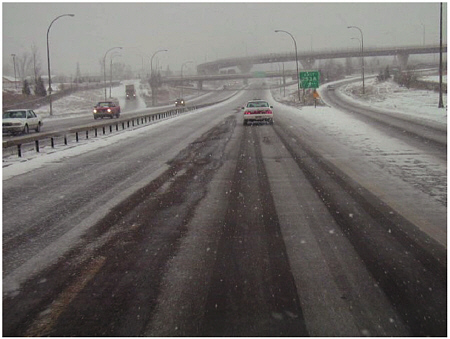
FIGURE 1-1 Traffic on a snowy day. SOURCE: Curt Pape, Minnesota Department of Transportation.
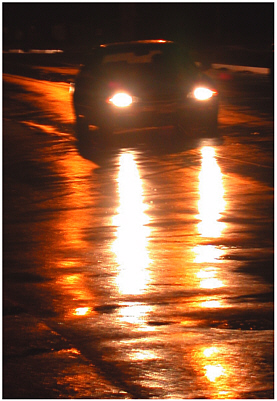
FIGURE 1-2 Car traveling on a rainy night.
SOURCE: Amanda Staudt, National Research Council.
790 people were killed and 62,000 people were injured as a result (Goodwin, 2003b). Such conditions occur routinely in the northern states and occasionally in the mid and southern tier states, where their occasional nature makes them more hazardous due to less experienced drivers and lack of adequate winter road maintenance equipment. Roadway maintenance personnel typically respond to winter weather conditions through a combination of plowing and chemical treatments intended to lower the freezing point of water, but challenges still remain in terms of determining the optimal response strategy for a particular winter storm.
Although the impact of winter storms on the roadway system can be quite dramatic, more fatal accidents are attributed to rainy conditions than to any other inclement meteorological condition (Figure 1-2). Over 1.1 million crashes in 2001 occurred on wet pavement, resulting in nearly 5,400 deaths and 511,000 injuries. An additional 688,304 crashes in 2001 occurred when it was raining, resulting in over 3,200 deaths and nearly
309,000 injuries (Goodwin, 2003b). This is not because rain is more dangerous than other phenomena but rather because rain is more common and is not as much a deterrent to road travel as snow or freezing rain. Safety risks include lane submersion, mechanical loss of vehicle maneuverability and control, visibility reduction, and distraction by hail or debris carried by winds. Convective weather, although often on a smaller spatial scale, can present additional hazards, such as lightning, strong winds, and hail. Hail is particularly damaging to vehicles and can seriously distract and stress drivers.
Another common way that weather affects the roadway environment is by causing reductions in visibility due to fog, solar glare, blowing dust or snow, precipitation (and associated vehicle spray), and smoke. In 2001 fog was associated with 43,792 crashes; over 670 people were killed and more than 19,000 people were injured in these crashes (Goodwin, 2003b). Reduction in visibility below a quarter mile poses a threat to driver safety by hampering the ability to see and be seen within a safe reaction distance. When encountered unexpectedly while traveling at high speed, such hazardous conditions can cause serious driver disorientation and lead to dramatic multivehicle accidents. Decreased visibility also can retard traffic flow as drivers properly reduce their speed, thereby reducing the carrying capacity of roadways; however, different drivers will reduce their speed differently in reaction to a sudden reduction in visibility, leading to large speed differentials and increased potential for accidents (OFCM, 2002b).
Winds greater than 25 mph can inhibit the maneuverability and stability of high-profile vehicles, including recreational vehicles, trucks, and buses (OFCM, 2002b). Stronger winds can even topple high-profile vehicles, particularly when they are traveling empty. Wind also reduces visibility through blowing snow, dust, or sand. Conversely, just the right amount of very light wind is required for radiation fog to occur on clear nights. The forecasting of wind extremes, strong and light, is therefore critically important for road safety. Currently, there are a few specific efforts under way to forecast high winds and either alert drivers of high-profile vehicles or close wind-prone stretches of road.
Severe weather conditions, such as hurricanes, tornadoes, and flash floods, claim the lives of many drivers each year and cause numerous problems for traffic managers, law enforcement officials, and emergency managers (Figure 1-3). Hurricanes and flash floods can create a broad range of logistical challenges when large numbers of residents need to be evacuated from impacted areas in a short time. Such severe events also can make roads and bridges impassable and impair communication capabilities.
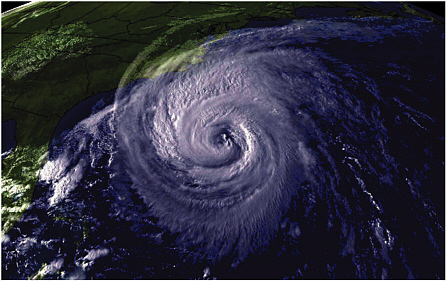
FIGURE 1-3 Hurricane Isabel begins to affect the U.S. mainland on September 17, 2003. The hurricane led to evacuations in North Carolina and Virginia and caused severe flooding as far north as eastern Pennsylvania. The federal government in Washington, D.C., was closed for two days largely because of concerns about the safety of commuters on the surface transportation system. SOURCE: NOAA.
ESTIMATED IMPACT AND COST
Adverse weather and the ensuing degradation of road conditions are associated with over 1.5 million vehicular accidents per year. These events result in approximately 800,000 injuries and 7,000 fatalities each year (see Table 1-1). Although weather may not be the only cause of these automobile accidents, inclement weather most likely is a contributing and exacerbating factor. The injuries, loss of life, and property damage from weather-related crashes cost an average of $42 billion annually (Lombardo, 2000). In some cases weather-related crashes can involve large numbers of vehicles and cause long stretches of roadways to be closed (Figure 1-4).
Any deviation from ideal driving conditions poses a potential threat to the maximum operability of the afflicted road. For example, during heavy rain or wet pavement conditions, drivers may decrease their speed by 25 percent (Figure 1-5), causing a drop in road capacity of 10 percent. In a snow event, they may reduce their velocity by nearly 40 percent, which can
TABLE 1-1 Total Deaths 1989–1999 Due to Traffic Accidents Associated with Adverse Weather
|
Vehicle Type |
Total Deaths |
Adverse Weather Present |
Percentage of Total |
|
Passenger cars |
312,620 |
42,585 |
13.6 |
|
Light trucks |
190,271 |
26,221 |
13.8 |
|
Heavy trucks |
56,278 |
9,346 |
16.6 |
|
Motorcycles |
28,537 |
969 |
3.4 |
|
Buses |
3,617 |
622 |
17.2 |
|
Total |
591,323 |
79,743 |
13.5 |
|
SOURCE: Lombardo (2000). |
|||
result in a 25 to 30 percent reduction in capacity. When visibility is less than 300 m, drivers may reduce their speed by 15 to 40 percent.
Drivers endure over 500 million hours of delay annually on the nation’s highways and principal arterial roads due to fog, snow, and ice (OFCM, 2002b). This conservative estimate does not account for considerable delay due to rain and wet pavement. Because highways are the lynchpin between various modes of transportation, local delays can actually initiate impedi-
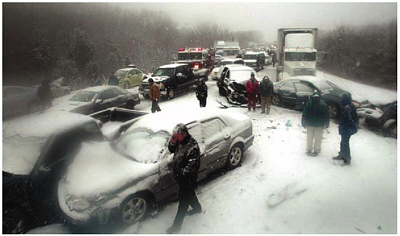
FIGURE 1-4 A pile-up of 100 vehicles during a storm on March 6, 2003, on Interstate 95 just outside Boston, Massachusetts. Ten miles of the interstate were closed while the vehicles were cleared from the road. SOURCE: Boston Globe.
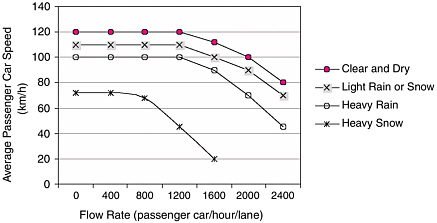
FIGURE 1-5 Speed flow curves for different weather conditions, assuming a free flow speed of 120 km per hour. SOURCE: Adapted from OFCM (2002b).
ments throughout the interconnected transportation networks. Such events can cause bottlenecks, interrupt delivery cycles, and create imbalances in supply and demand that lead to higher costs for businesses and ultimately for consumers. Given that the number of vehicle miles traveled is projected to increase substantially over the next 40 years (Figure 1-6) without a concurrent increase in highway capacity, adverse weather and weather-related road conditions will increase the strain on the roadway system.
Significant weather-related costs are also incurred by state and local agencies that maintain and operate the nation’s roadways. For example, state and local agencies spend more than $2 billion annually on snow and ice control operations and over $5 billion annually for infrastructure repair due to ice and snow damage. The average expenditure for winter road maintenance in 1999 was over $22.7 million per state or approximately 12 percent of their maintenance budgets (FHWA, 2003). Although very few cost-benefit analyses of preventative techniques (e.g., anti-icing) or improved road weather information have been conducted, preliminary findings suggest the end justifies the means. For instance, Stowe (2001) reports a benefit/ cost ratio of over two and a net benefit of over $1 million based on an analysis for a proposed automatic anti-icing system for a portion of a Washington State interstate. Another study that evaluated the use of anti-icing procedures by state highway agencies in nine states concluded that states
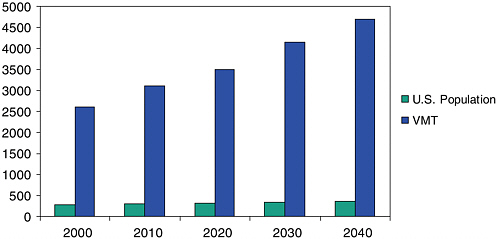
FIGURE 1-6 Projected U.S. population (in millions of people) and in vehicle miles traveled (in billions of miles). SOURCE: U.S. Census Bureau, 2000; TRB, 1994.
can reduce their snow and ice control budget by 10 to 20 percent (Boselly, 2001). Finally, in Kamloops, British Columbia, during the winter of 1996, the Insurance Corporation of British Columbia began exploring the use of anti-icing, de-icing, and pre-wetting practices during snowy or icy conditions as a supplement to the traditional use of salt and sand. As a result, winter maintenance costs were down nearly $15,000 (ICBC, 2000). Further use from 1997 through 2000 resulted in a 40 percent overall reduction in insurance claims related to snowy or icy conditions, a savings of over $4.3 million.
CHALLENGES IN ADDRESSING THE ROAD WEATHER PROBLEM
The fatalities, injuries, property damage, and economic costs associated with inclement weather present a significant road weather problem that is exacerbated by increasing traffic densities due to increasing population, vehicle ownership, and average annual miles traveled. This problem presents a number of challenges, both on a research level and when putting research advances into practice. The subject matter is highly interdisciplinary, spanning meteorology, technology, roadway construction and main-
tenance, traffic and emergency management, vehicle design and mechanical condition, and human behavioral factors that affect how drivers receive and process information. Developing new capabilities to deal with the road weather problem will require researchers who do not usually interact to collectively focus their attention on this problem. Moving the results of the research into an operational environment necessitates building relationships between researchers and a wide community of users. Many of these connections are only beginning to be made.
The roadway environment is very complex from a meteorological perspective, requiring knowledge of atmospheric conditions and the processes that influence them on scales much smaller than regularly considered in operational frameworks. Road weather conditions are influenced greatly by the immediate environment, including local terrain, built structures, and land cover. Hazardous conditions, such as fog or a frosty road surface, often develop in response to local conditions even when the weather forecast calls for clear skies; for example, pavement temperature will be colder at night in open areas compared to areas protected by nearby trees. These issues require accurate and timely meteorological data in order to effectively support the dynamic operation of the roadway.
Overlaid on the meteorological complexities is the need to consider the numerous factors associated with surface transportation. First, there are the challenges of the multifaceted roadway infrastructure; for instance, many different materials and methods are used to construct the roadway surface, all of which respond differently to various weather conditions. Second, there are several techniques for communicating weather information to drivers, who internalize and react to the information in ways that are not well understood. Third, the numerous vehicles that interact with the roadway infrastructure have different operating characteristics and weights, while drivers have differing diving skill. Finally, transportation personnel who build, maintain, and operate the roadway system employ a variety of approaches, which can alter the driving experience. Creating a more safe and efficient roadway environment requires consideration of all these factors under inclement weather conditions.
To address these challenges, the Federal Highway Administration requested the National Research Council to examine the research opportunities and required services needed to support improved weather-related information for the nation’s roadways (see Appendix A for Statement of Task). The National Research Council formed the Committee on Weather Research for Surface Transportation: The Roadway Environment. The committee prepared this report after carefully investigating the current state of
knowledge regarding road weather conditions. Following the discussion in this chapter of the affects weather has on the roadway environment, the committee’s vision for the road weather system of the future is presented in Chapter 2. A review of the current activities and technologies relevant to the meteorological and transportation communities is provided in Chapter 3, including current observational and modeling capabilities of both weather and the roadway environment, forecasting capabilities, operational activities, and tools. Chapter 4 builds on the previous chapter by presenting the committee’s recommendations for achieving the vision of the future operational road weather system based on identified gaps and new areas of needed research. In Chapter 5 the committee outlines a recommended coordinated national program to guide road weather research and transition scientific and technological advances into operations. The committee hopes that this report provides a useful framework to engage the transportation and weather communities and relevant stakeholders in the development of a strategic plan to guide road weather research.


