

Below is the uncorrected machine-read text of this chapter, intended to provide our own search engines and external engines with highly rich, chapter-representative searchable text of each book. Because it is UNCORRECTED material, please consider the following text as a useful but insufficient proxy for the authoritative book pages.
Kuiper Belt Objects n 1977, twin spacecraft lifted off planets in orbit around other stars. The first exploratory voyage to an I from the same launch pad at the Kennedy Space Center in Florida, only a few months apart. These Many of these extrasolar planets reside in large disks of material orbiting young stars, which scientists believe unexplored region always turns up new and unexpected findings. As the first spacecraft specifically targeted to spacecraft, Voyager 1 and Voyager 2, resemble our solar system in its youth. study this distant part of the solar sys- were Earthâs first emissaries to the If current theory holds, objects in tem, the Kuiper Belt-Pluto Explorer outer solar system. The information these extrasolar disks are similar in will undoubtedly lead to a new that they returned about the giant composition to objects in the Kuiper understanding of the KBOs and, per- planets and their moons revolution- Belt. Most KBOs are thought to have haps, inform us about the role played ized our understanding of the solar undergone relatively little change by KBOs in the origin and evolution system. Voyager stands as one of the since their formation in the solar neb- of other parts of the solar system. greatest missions of planetary discov- ula some 4.6 billion years ago. If that Collisions, for example, are a ubiq- ery in the space age. For all the is the case, they would be relics of the uitous process in planetary formation Voyager programâs success, however, building blocks from which the planets and in shaping planetary environ- Voyager 1 and 2 left the reconnais- were formed. Thus, analyzing the ments. But next to nothing is known sance of the outer solar system incom- structure and composition of these about the 4.6 billion-year-old colli- plete. To date, no missions have objects will provide new insights into sional history of the Kuiper Belt. A explored the ninth planet, Pluto, and the early history of planetary systems comparison of the density of craters its satellite, Charon. and help scientists understand the on Pluto, its moon Charon, and sever- At the time of the Voyager mis- processes that formed Earth and other al KBOs will provide our first hard sions, Pluto was thought to be less planets. data on the history of impacts in the important than other planetary bodies, Studies of the surface composi- extreme outer solar system. such as Neptune and Saturnâs moon tions of KBOs undertaken with Earth- If indeed KBO material is as Titan, which were also easier to reach. based telescopes suggest that these ancient and relatively unaltered as sci- In 1992, however, scientists found the objects likely contain organic matter entists believe, characterizing the first direct evidence for the existence and volatile materials such as water. composition will provide an impor- of the Kuiper Beltâa region of icy This is an exciting discovery because tant reference for comparison with the surface materials on other related bod- ies, including the Centaurs, the nuclei of comets, and certain near-Earth asteroids. Such observations may pro- vide information on whether comets are fragments of large KBOs or are themselves primordial bodies. Kuiper Belt-Pluto Explorer data will also allow researchers to compare the surface compositions of KBOs with Pluto, Charon, and Tritonâa satellite of Neptune suspected of being a captured KBO. This may allow us to determine how primitive material in the outer solar system is changed over the course of planetary evolution. Even the most detailed map of Plutoâs surface, assembled from observations made with the Hubble Space Telescope, reveals little about the most distant planet from the Sun. Telescopic observations to date The nature of the surface features remains unknown. indicate that KBOs have diverse and sometimes unexpected characteris- planetary debris on the edge of the researchers believe that the water and ticsâmost display wide color varia- solar system. The discovery of the carbon-rich materials essential for the tions from object to object, some Kuiper Belt refocused attention on development of life on Earth are not have rapid rotation rates, a few exist Pluto. Instead of an afterthought, indigenous to our planet. In other in loosely bound double systems, Pluto became the largest and most words, these life-giving materials were and Pluto even has a tenuous atmos- important member of an entirely delivered to the primordial Earth dur- phere. Because of the incredible unexplored type of bodyâthe Kuiper ing impacts with objects originating variety in color, size, composition, Belt objects (KBOs). elsewhere in the solar system. A likely and orbit among KBOs, the value of Another exciting discovery came source of the impactors, and thus of the Kuiper Belt-Pluto Explorer mis- within a few years of the detection of the building blocks of life, may have sion increases as it observes more the first KBOâthe identification of been the Kuiper Belt. KBOs and, thus, samples more of the 12 New Frontiers in Solar System Exploration
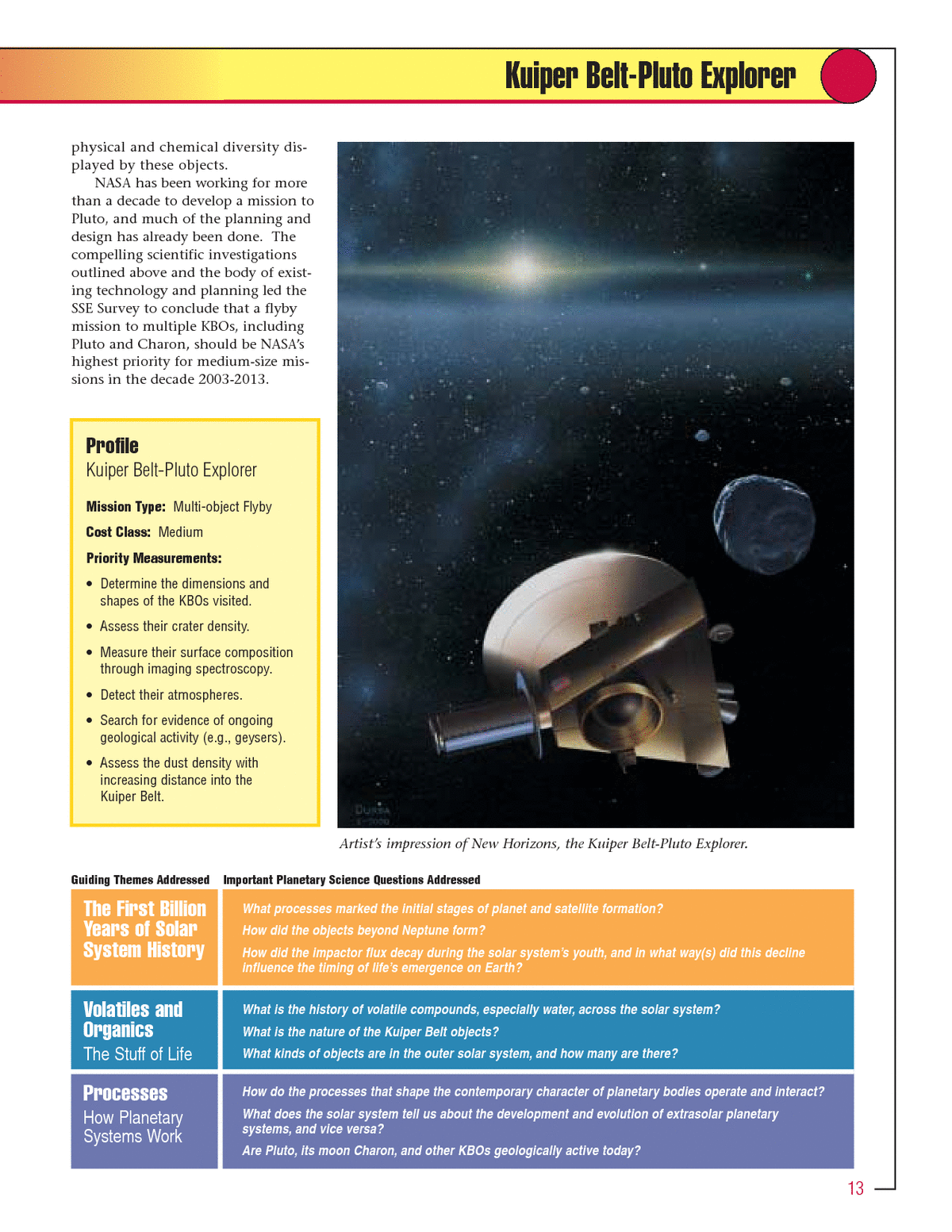
Kuiper Belt-Pluto Explorer physical and chemical diversity dis- played by these objects. NASA has been working for more than a decade to develop a mission to Pluto, and much of the planning and design has already been done. The compelling scientific investigations outlined above and the body of exist- ing technology and planning led the SSE Survey to conclude that a flyby mission to multiple KBOs, including Pluto and Charon, should be NASAâs highest priority for medium-size mis- sions in the decade 2003-2013. Profile Kuiper Belt-Pluto Explorer Mission Type: Multi-object Flyby Cost Class: Medium Priority Measurements: ⢠Determine the dimensions and shapes of the KBOs visited. ⢠Assess their crater density. ⢠Measure their surface composition through imaging spectroscopy. ⢠Detect their atmospheres. ⢠Search for evidence of ongoing geological activity (e.g., geysers). ⢠Assess the dust density with increasing distance into the Kuiper Belt. Artistâs impression of New Horizons, the Kuiper Belt-Pluto Explorer. Guiding Themes Addressed Important Planetary Science Questions Addressed The First Billion What processes marked the initial stages of planet and satellite formation? Years of Solar How did the objects beyond Neptune form? System History How did the impactor flux decay during the solar systemâs youth, and in what way(s) did this decline influence the timing of lifeâs emergence on Earth? Volatiles and What is the history of volatile compounds, especially water, across the solar system? Organics What is the nature of the Kuiper Belt objects? The Stuff of Life What kinds of objects are in the outer solar system, and how many are there? Processes How do the processes that shape the contemporary character of planetary bodies operate and interact? How Planetary What does the solar system tell us about the development and evolution of extrasolar planetary systems, and vice versa? Systems Work Are Pluto, its moon Charon, and other KBOs geologically active today? 13
