
CHAPTER 8
Race and Ethnicity Measurement
MEASUREMENT OF RACE HAS BEEN A CRITICAL PART of census-taking from the first census in 1790; measurement of ethnicity and national origin in one or another form goes back to the 1850 census. Today, census data on race and ethnicity (Hispanic origin) are used to assess the compliance of legislative redistricting plans with the Voting Rights Act and to enforce equal opportunity employment laws, among other applications. These data also facilitate research on such diverse topics as income, disability, and migration flows.
Classification by race has become an increasingly complex enterprise as the composition of the U.S. population has changed and the notions of race and ethnicity have shifted in meaning. Racial classification has been used differently throughout U.S. history, at times to discriminate and at other times to measure and strive to end discrimination. Hence, even basic definitions and approaches to measurement are controversial. Restricting racial identity to a single racial category has become increasingly difficult as the population with parents from different racial groups increases in size; changing immigration patterns have also posed challenges for classifying—and even self-identifying—by race.
In the past, federal standards for collection of racial and ethnic data limited the flexibility of federal statistical and program agencies to collect data reflecting the changing racial and ethnic composition of the U.S. population. The 2000 census marked a radical departure from past practices in the collection of racial data. Specifically, the 2000 census is the first major implementation of revised guidelines for the collection of racial and ethnic data issued by the U.S. Office of Management and Budget (OMB). These guidelines instruct federal agencies collecting data on race and ethnicity to allow respondents to “mark one or more races to indicate what this person considers himself/herself to be,” thus relaxing the past practice of limiting racial classification of individuals in the United States to one and only one of a few mutually exclusive racial categories.1 The full implications of this change are yet to be understood.
This chapter provides additional background on the manner in which race and ethnicity data were collected in the 2000 census. After presenting a brief history of the collection of race and ethnicity data (8-A), we discuss the standardization of the federal collection of race and ethnicity data and changes therein, as embodied in the OMB guidelines (8-B). We discuss differences between the 1990 and 2000 census questions on race and Hispanic origin, the implications of those differences, and the results (8-C). After examining the quality of the race and ethnicity data collected in 2000, comparisons are made, when possible, with the quality of those data from the 1990 census. Finally, we discuss the implications of the findings for the collection of racial and ethnic data in future censuses (8-D).
8–A HISTORICAL OVERVIEW
Since its inception in 1790, every United States census has included questions on race. The federal collection of data on race and ethnicity has its origins in the balance of power between the North and the South when the United States was first established. The original text of Article 1, Section 2, of the Constitution tied the allocation of representatives in Congress to population counts; the
weight applied to each person differed by civil status. Specifically, for the purpose of reapportionment, each free person was to count as a whole person, each slave was to count as three-fifths of a person, and Indians not taxed were to be excluded. The first census in 1790 required enumerators to classify people as white (identifying separately white males above and below the age of 16 and white females), free blacks, and slaves. In context, because there were no enslaved whites, this classification by civil status effectively replicated what would have been the classification by race of whites and blacks (Indians not taxed were not counted). The decennial census has continued to collect racial data—even after the differential civil status articulated in Article 1, Section 2, of the Constitution was stricken by the Fourteenth Amendment—with the specific question and categories shifting every 10 years.
Over the past 200 years there has been tremendous variation in the collection of race and ethnicity data in the census; Table 8.1 lists the racial categories in the census by year from 1850 to 2000.2 In fact, the race and ethnicity items have rarely remained the same from one census to the next. As new populations have entered the United States, the number of census items related to race, ethnicity, and ancestry has fluctuated. Items on ethnicity and national origin were first included in the census of 1850, as part of an effort to distinguish recent European immigrants from the native-born white population. These items related to nativity, parental birthplace, immigration, citizenship status, language status, and time of arrival in the United States. Although ethnicity questions initially reflected a desire to distinguish among different groups of immigrants with European origins, the saliency of those groups shifted as they were assimilated into an increasingly heterogeneous white racial group.
In order to account for non-European immigrants, beginning with the 1910 census, the race question has included an “other” category allowing the enumerator (later a household member) to write in a race not otherwise on the list. Subsequent to passage of the 1965 Immigration and Nationality Act (which abolished the national origins system of the National Origins Act of 1924, as well as the Asiatic barred zone of the Immigration Act of 1917), additional
Table 8.1 Census Race Categories, 1850–2000
|
Year |
White |
Black |
Native Peoples |
Asian |
Hawaiian and Other Pacific Islanders |
Other |
|
1850 |
— |
Black, mulatto |
— |
— |
— |
— |
|
1860 |
— |
Black, mulatto |
Indian |
— |
— |
— |
|
1870 |
White |
Black, mulatto |
Indian |
Chinese |
— |
— |
|
1880 |
White |
Black, mulatto |
Indian |
Chinese |
— |
— |
|
1890 |
White |
Black, mulatto, quadroon, octoroon |
Indian |
Chinese, Japanese |
— |
— |
|
1900 |
White |
Black |
Indian |
Chinese, Japanese |
— |
— |
|
1910 |
White |
Black, mulatto |
Indian |
Chinese, Japanese |
— |
Other (+ write in) |
|
1920 |
White |
Black, mulatto |
Indian |
Chinese, Japanese, Filipino, Hindu, Korean |
— |
Other (+ write in) |
|
1930 |
White |
Negro |
Indian |
Chinese, Japanese, Filipino, Hindu, Korean |
— |
(Other races, spell out in full) |
|
1940 |
White |
Negro |
Indian |
Chinese, Japanese, Filipino, Hindu, Korean |
— |
(Other races, spell out in full) |
|
1950 |
White |
Negro |
American Indian |
Chinese, Japanese, Filipino |
— |
(Other race—spell out) |
|
1960 |
White |
Negro |
American Indian |
Chinese, Japanese, Filipino |
Hawaiian, Part Hawaiian |
— |
|
1970 |
White |
Negro or black |
Indian (American) |
Chinese, Japanese, Filipino, Korean |
Hawaiian |
Other (print race) |
|
1980 |
White |
Black or negro |
Indian (American), Eskimo, Aleut |
Chinese, Japanese, Filipino, Korean, Vietnamese, Asian Indian |
Hawaiian, Guamanian, Samoan |
Other (specify) |
|
1990 |
White |
Black or negro |
Indian (American), Eskimo, Aleut |
Chinese, Japanese, Filipino, Korean, Vietnamese, Asian Indian |
Hawaiian, Guamanian, Samoan, Other Asian or Pacific Islander |
Other race (Print race) |
|
2000 |
White |
Black, African American, or Negro |
American Indian or Alaska Native |
Chinese, Japanese, Filipino, Korean, Vietnamese, Asian Indian, Other Asian |
Native Hawaiian, Guamanian or Chamorro, Samoan, Other Pacific Islander |
Some other race (Print race) |
|
SOURCE: National Research Council (1995b: Table 7.1). |
||||||
Asian categories were included to account for changing immigration flows from that region. Racial categories, once introduced, have not remained sacrosanct: Mexican was used only once, in the 1930 census; none of the mixed black-white designations (i.e., mulatto, quadroon, octoroon) have reappeared since the 1920 census; and part Hawaiian made its sole appearance in the 1960 census.
As the ethnic groups from Europe were assimilated as whites, other ethnic differentiation became increasingly salient. The Hispanic origin question was first introduced in the 1970 census at the behest of Daniel Patrick Moynihan, then a domestic policy adviser in the Nixon White House (Farley, 2001). Because production of the census questionnaires had already begun, the question was included on only 5 percent of the 1970 census forms. Later, in 1974, Congress passed Public Law 94-311, which formally required the collection and publication of Hispanic-origin data.
The introduction of the Hispanic-origin question roughly coincided with another fundamental change in the collection of race and ethnicity data in the U.S. census. Prior to the 1960 census, the enumerator determined the racial classification of each person. The transition in the 1960 and 1970 censuses to census designs centered on mailed questionnaires necessitated a corresponding move from enumerator-reporting of race by observation to mainly self-reporting. In 1960, census short forms were delivered by the U.S. Postal Service to residences in areas of the country covering about 82 percent of the population. Recipients were asked to fill out the forms and be prepared to return them to the enumerators. The best estimate is that 60 percent of households had the forms filled out and waiting before the enumerator arrived. If the form was not filled out, or if a household had not received a form, or if a household resided in the remaining areas of the country covering about 18 percent of the population, then race was identified by the enumerator. The 1970 census was the first in which racial identity was meant to be entirely self-reported in mailback areas (to the extent that a member of the household is responsible for reporting his or her own race and the race of others in the household) instead of observer-reported. In practice, the extent of household reporting has varied with mailback response; in some cases of follow-up by census enumerators, nonrespondents may have their race reported by a neighbor or landlord or by enumerator observation. Also, the extent of mailback areas
has varied in censuses from 1970 to 2000 (see Section 4-A.1 and Box 4.1).
More recent censuses have had opportunities for individuals to report variations in racial and ethnic identity not otherwise captured by the standard categories: the census allows and codes write-ins for the race, ethnicity, and ancestry items. On the short form in the 2000 census, an individual could write in a tribal affiliation if identifying as an American Indian or Alaska Native, an “other” Spanish/Hispanic/Latino group, a specific “other” Asian group, a specific “other” Pacific Islander group, or some other race (not listed elsewhere).
Although the categories and questions about race have shifted across the years, until 2000 there was one constant: each person was classified as a member of one, and only one, racial category. In the more than 200 years that the United States has collected data on race, the 2000 census is the first that has allowed people to identify themselves as belonging to more than a single racial category.
8–B STANDARDIZING FEDERAL COLLECTION: THE OMB GUIDELINES
Despite this long history of collecting data on race and ethnicity in the census, as well as in household surveys and program agency administrative records, there was no coordination among federal agencies collecting such data until the OMB released Statistical Policy Directive 15 in 1977.3 This directive was meant to standardize the federal collection of data on race and ethnicity by dictating minimum standards for collection and reporting. As originally formulated, the directive required that data be collected and reported for a minimum of four major racial groups (white, black, Asian and Pacific Islander, and American Indian or Alaskan Native) and two ethnicities (Hispanic origin and non-Hispanic origin). More detailed categories were permitted, insofar as the categories could be aggregated into the specified minimum set of categories. Directive 15 formally codified what had been implicit in questions
on race throughout the history of the census: the underlying conception of race, as implemented by the U.S. government, was inherently categorical with mutually exclusive categories.
The distinction between race and ethnicity, however, was not immediately apparent from the directive’s guidelines. Although a preference was expressed for a two-question format that would allow each racial category to be cross-classified by Hispanic origin, a single combined race and ethnicity question was permitted. This flexibility allowed for the collection of irreconcilable race and ethnicity data. Whereas the two-question format allowed each individual to select both race and ethnicity, the one-question format allowed an individual to indicate only one of five categories—each of the four races and the one ethnicity (Hispanic). In the first formulation, race and ethnicity are two distinct dimensions: Hispanics could be of any race. The second formulation required mutually exclusive identification with either a race or Hispanic ethnicity. In the second formulation, Hispanics did not belong to any racial group—Hispanics were treated as a distinct group, not allowing for overlapping ethnic identity with classification into a racial category. The racial and ethnic populations classified under these two schemes differ significantly. This blurring of the concepts of race and ethnicity is indicative of the lack of a coherent theoretical structure underlying U.S. attempts to measure race and ethnicity.
Beyond the inconsistencies present in Directive 15 from the outset, the directive also failed to anticipate the changing racial and ethnic landscape of the United States. The changes in race and ethnic data collected in each census prior to the implementation of Directive 15 are indicative of changes across time in both the population and the context of measurement. Hence, it is not surprising that in recent decades the federal standards for the measurement of race and ethnicity and the reality of racial and ethnic identities in the U.S. population became increasingly mismatched.
Directive 15 guided the collection of race and ethnicity data in both the 1980 and the 1990 censuses, as well as numerous other federal data collection efforts. By 1993 enough questions had been raised about the relevance of the 1977 standards that Representative Thomas Sawyer (D-Ohio), who headed the House subcommittee with jurisdiction over the census, arranged to discuss these issues at hearings about the 2000 census. One of the key issues of discussion
at the hearings was the measurement and classification of multiracial individuals. How were the children of interracial marriages to identify themselves if the standards remained unchanged? Shortly thereafter, the OMB announced that the racial categories in Directive 15 were of decreasing value, and therefore it would undertake a complete review of the 1977 standards.
OMB established the Interagency Committee for the Review of the Racial and Ethnic Standards in March 1994 to review and evaluate the standards, consider changes, and make recommendations to OMB for revisions.4 The decision to review the standards spurred the Bureau of Labor Statistics and the Census Bureau to field three surveys in order to examine alternative formulations of the race and ethnicity questions. In addition to including alternative race and ethnicity questions on the Census Bureau’s 1996 National Content Survey, additional options were explored in the Bureau of Labor Statistics’ 1995 Supplement on Race and Ethnicity to the Current Population Survey (CPS) and the Census Bureau’s 1996 Race and Ethnicity Targeted Test (RAETT).
In the 1996 National Content Survey (NCS), the Census Bureau tested three changes to the race and ethnicity questions as presented in the 1990 census: (1) adding a multiracial response category, (2) placing the Hispanic-origin question immediately before the race question, and (3) combining both changes. A “mark one or more” option was not tested in the NCS. The CPS supplement also examined the effects of the inclusion of a single “multiracial” category in the list of racial categories. In addition, it tested the inclusion of Hispanic origin as a “race” category and usage of alternate names for some of the racial and ethnic categories. In their analysis of the CPS supplement, Tucker and Kojetin (1996:5) report that, when specifically asked about their preferences, “a substantial majority of Hispanics … preferred to identify themselves as Hispanic in the race question, rather than in the separate ethnicity question.” However, the combined question format led to significantly lower reports of Hispanic origin than the two-question format. Like the NCS, the CPS supplement did not examine the effect on reporting Hispanic-origin of combining the race and Hispanic origin question
when respondents are allowed to mark one or more categories.
Of the three tests of alternative race and ethnicity questions prior to the revision of Directive 15, the Census Bureau’s Race and Ethnic Targeted Test was the only one to test the “mark one or more” format. The RAETT also tested a combined race and ethnicity question, allowing respondents to mark one or more categories, and found that there was no decline in reporting of Hispanic origin in comparison to the two-question format. Moreover, in comparison to the nonresponse rates to both the race and ethnicity questions, nonresponse was significantly reduced by use of the combined format (Hirschman et al., 2000). Along with public discussion, the results of these experiments with alternative formats for the race and ethnicity questions informed the deliberations and conclusions of the interagency committee.
Responding to recommendations announced by the interagency committee in July 1997, the OMB issued “Standards for Maintaining, Collecting, and Presenting Federal Data on Race and Ethnicity” on October 30, 1997. (The revised guidelines no longer carry the designation “Statistical Policy Directive 15,” as they were not released as part of an OMB directive, circular, or bulletin.) The minimum number of racial categories for reporting was changed from four to five; the Asian or Pacific Islander category was divided into an Asian category and a Native Hawaiian or Other Pacific Islander category, while the other three categories (white, black, and American Indian) remained unchanged. No other ethnic groups were added to the minimum standards, although several labels were modified and the definition of American Indians expanded to include Central and South American Indians. OMB also reiterated its preference for race to be self-identified and for the retention of distinct race and Hispanic-origin questions, although a single, combined question would still be permitted. Finally, respondents were to be allowed to self-identify with more than one racial group. Tabulations are required for the total number of individuals identifying with more than one group, as well as any combinations permitted given data quality and confidentiality concerns. The 2000 census adopted the revised standards, with the exception that OMB allowed the census to continue to include an “other” category for those respondents who did not identify with any of the racial groups otherwise listed in the question. The revised standards were to be implemented in all federal data collection efforts by 2003.
8–C RACE AND ETHNICITY DATA IN 1990 AND 2000
8–C.1 Questions and Results
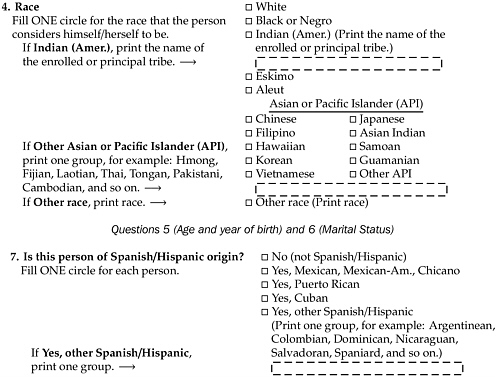
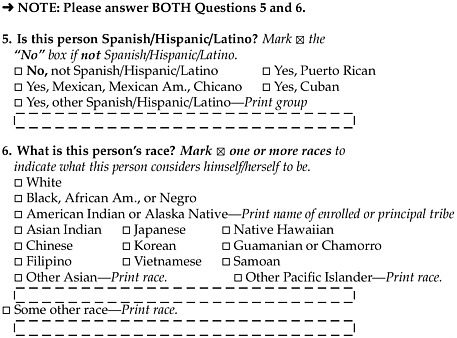
The 2000 census is the first major federal data collection effort to adopt and implement the revised standards. To reiterate, in accord with the revised OMB guidelines, there are three major differences between the 1990 and 2000 race and ethnicity questions. First, respondents were instructed to “mark one or more” instead of “fill one circle” for the race question. Second, the Asian and Pacific Islander category was split into two distinct categories. Third, the Hispanic origin question was moved in 2000 to immediately precede the race question, whereas in 1990 it followed the race question with other questions on age, year of birth, and marital status placed in between. This last change was meant to encourage higher response rates to the race questions among Hispanics. Figures 8.1 and 8.2 illustrate the relevant sections of the 1990 and 2000 census forms, respectively. Altogether, these changes render the 1990 and 2000 data on race and ethnicity less than strictly comparable.
In 1990, in a total population of 248,709,873 people, the census indicated that 80.3 percent of the U.S. population was white, 12.1 percent black, 0.8 percent American Indian, Eskimo or Aleut, 2.9 percent Asian or Pacific Islander, and 3.9 percent other race. Whereas in the 1990 census the U.S. population was classified entirely into five mutually exclusive racial categories, cross-classified by one ethnicity (Hispanic, non-Hispanic), the 2000 census does not allow us to replicate that classification scheme. Because individuals were allowed to mark more than one race, the racial categories are no longer mutually exclusive. In 2000, in a total population of 281,421,906 people, published estimates indicated that 2.4 percent of the population marked two or more races, while 97.6 percent marked a single racial category: 75.1 percent of the U.S. population reported white alone, 12.3 percent black or African American alone, 0.9 percent American Indian and Alaska Native alone, 3.6 percent Asian alone, 0.1 percent Native Hawaiian or Other Pacific Islander alone, and 5.5 percent some other race alone.
Correction of a recently discovered error in the processing of race on 2000 census forms obtained from enumerators resulted in a 14.7 percent decrease in the population reporting two or more races, from
2.4 percent to 2.1 percent of the total population.5 Changes for single race groups were minimal: from 75.1 percent to 75.4 percent white alone, from 12.3 percent to 12.4 percent black alone, no change at 0.9 percent for American Indian and Alaska Native alone, no change at 0.1 percent for Native Hawaiian or Other Pacific Islander alone, and from 5.5 percent to 5.4 percent for some other race alone.
Based on the published estimates, two or more race respondents in 2000 accounted, as one would expect from the increase in multiracial marriages, for higher percentages of children than older people—over 8 percent of children ages 0–4 were reported as multiracial in 2000 compared with only 1 percent of people age 70 and older. The West had the highest percentage of multiracial people (4 percent), and the Midwest the lowest percentage (1.5 percent). Nearly one-third (32.6 percent) of the multiracial population identified themselves as Hispanics (2,224,082 of 6,826,228 individuals marking two or more races also indicated that they were of Hispanic origin).
The proportion of individuals reporting that they were of Hispanic origin increased by approximately one-third between 1990 and 2000. For individuals of all races, 9.0 percent reported Hispanic origin in 1990 and 12.5 percent reported Hispanic origin in 2000. In both 1990 and 2000, almost 97 percent of individuals reporting “other race” or “some other race” were Hispanics. In addition, 6.3 percent of Hispanics made up nearly one-third of those people checking more than one race in 2000 (most of whom checked “white” and “Some Other Race”). These results appear to be consistent with those from the 1996 RAETT (discussed above), which indicate that many Hispanics (almost 50 percent) think of their ethnicity as a race.
8–C.2 Quality of Race and Ethnicity Data in the 2000 Census
Self-identification of race, Hispanic origin, and ancestry questions means that responses are based on self-perception and therefore are subjective, but at the same time, by definition, whatever response is recorded is an accurate response. This means that the concept of accuracy is meaningless for self-reported race and ethnicity data. However, we do have two metrics by which we can
assess the quality of these data. The first is by examining item imputation rates (i.e., the percentage of the population for whom data were missing and subsequently had values assigned or imputed). The second is by examining consistency in self-reports of race and ethnicity (i.e., the extent to which the responses to race and ethnicity questions were the same or different across multiple responses for the same individuals). Even when the respondent is the same, however, consistency of reporting of race and ethnicity may be affected by the context in which the reporting occurs (see below). When measured even over short time intervals, consistency of reporting may also be affected by changes in what is salient to the respondent. (See del Pinal, 2003, which summarizes several studies of race and ethnicity reporting in the 2000 census.)
Item Imputation Rates
To what extent are race and ethnicity data missing and therefore require imputation? If a respondent fails to provide answers to a question in the census, special procedures are used to impute (or allocate) the response. The Hispanic-origin item continues to have the highest imputation rate of any of the basic items collected from everyone. However, the imputation rate for the Hispanic-origin item was substantially lower for the 2000 census (5.4 percent for household members) than the 1990 census (10.5 percent; see Section 7-B.1). This significant improvement is undoubtedly due in no small part to placing the question to precede the race question in 2000 rather than to follow both the race question and several other questions (age, year of birth, and marital status) in 1990.
In contrast, the imputation rate for the race item approximately doubled between 1990 and 2000: it was 5.1 percent in 2000 compared with 2.6 percent in 1990. Although it is not yet clear what accounts for the increase in the imputation rate for the race item, some portion of this change is undoubtedly due to the changing ethnic composition of the population. Hispanics were more likely than non-Hispanics to be nonrespondents to race, and the share of the population that is Hispanic increased significantly between 1990 and 2000, from 9.0 to 12.5 percent.
Imputation Rates Across Geographic Areas
Imputation varied greatly across smaller geographic areas. Although some counties required no imputation for one or the other of the race and ethnicity items, there are others with imputation rates for these items far above the national average. For example, among counties in the 48 contiguous states, the imputation rate for race was as high as 16.7 percent in Costilla County, Colorado, and, similarly, the imputation rate for Hispanic origin reached 35 percent in Concho County, Texas. Figures 8.3 and 8.4 illustrate the variation in imputation rates for the Hispanic-origin and race items both across and within county population categories. County-level variation in imputation rates is not strictly related to population size.
To emphasize the extent to which these imputation rates vary across and within various geographical boundaries, we examined the tract-level imputation rates for three of the largest counties in the nation: Los Angeles County, California; Cook County, Illinois; and Harris County, Texas. These counties make up part of the Los Angeles, Chicago, and Houston Primary Metropolitan Statistical Areas, respectively. For each of these areas, plots of the mean imputation rates (tract-level) for Hispanic origin and race are shown in Figures 8.5 and 8.6. Inspection of the figures shows that there is significant variation of imputation rates among tracts (within counties) in each of the selected areas. This variation at lower levels of geographic aggregation indicates that small-area estimates for race and ethnic groups may be quite problematic.
Measures of Inconsistency
Consistency in the reporting of race is a complicated issue. Research demonstrates that context affects both self-reports and classification by others of an individual’s race. Analysis of data from the National Longitudinal Study of Adolescent Health indicates that there is differential reporting of race by students when they are in school and when they are at home (Harris, 2003). In the same paper, Harris shows that there is significant variation by race and gender in observer identification of other people’s race. As suggested by Waters (1990), self-identification for many people is based on context, and people have multiple identities that may differ by context. The
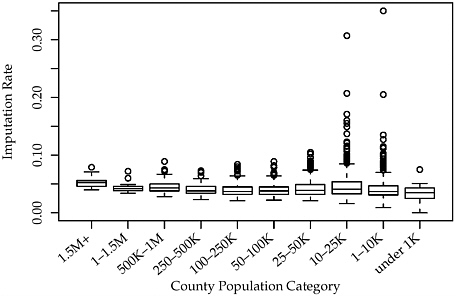
Figure 8.3 Imputation Rates for Hispanic Origin by Population (County Level)
NOTES: In this boxplot, each box is bounded by the first and third quartiles (25th and 75th percentiles) of the distribution of data values for the category. The center line of the box is the median value; the “whisker” lines extend from the ends of the box to the most extreme data points within 1.5 times the interquartile range. Points outside the whiskers may be considered outliers for the distribution. The data are for all counties in the 48 contiguous states, excluding zero population counties. Imputation rates are based on total population, including household members and group quarters residents. Population categories are in millions (M) or thousands (K).
SOURCE: Summary File 1, accessed from the Census Bureau’s Web site, http://factfinder.census.gov.
same may also be true for observer-identification. The political context for the current census categories—whether there are positive, neutral, or negative effects to identifying with a certain group—is only one context for identification. The auspices and purposes of collecting race and ethnicity data provide another context for self-identification. For example, a person may respond differently to the same wording of a question on race when asked in the census and when asked in a job application form.
We can assess consistency by comparing reports from the census enumeration with those from the 2000 Accuracy and Coverage
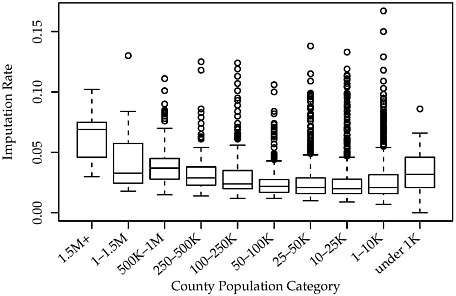
Figure 8.4 Imputation Rates for Race by Population (County Level)
NOTE: See Notes to Figure 8.3.
SOURCE: Summary File 1, accessed from the Census Bureau’s Web site, http://factfinder.census.gov.
Evaluation (A.C.E.) survey (see Chapter 6). A sample survey was conducted in selected blocks (generating the P-sample), the data from which were then matched to the set of census enumerations from the sample blocks (the census E-sample). The A.C.E. collected race and ethnicity information using different data collection procedures and likely different respondents for people who matched to the census E-sample. There are therefore many factors that may have contributed to the inconsistency of reports.
Reports of ethnicity were substantially more consistent in the two samples than reports of race. Comparison of matched cases when ethnicity was not imputed in either sample found a high rate of consistent reporting overall—98.4 percent of cases were in agreement on Hispanic or not Hispanic origin between the two samples. Consistency of race reporting was not as high—only 91.5 percent of cases were in agreement between the two samples. Consistency
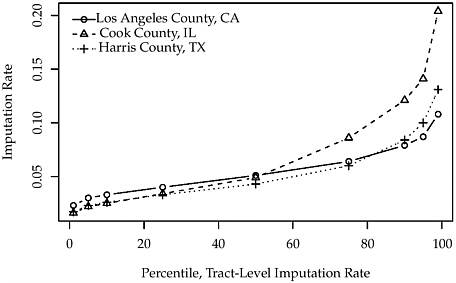
Figure 8.5 Imputation Rates for Hispanic Origin in Census Tracts of Selected Counties
NOTE: Points on each line are the cumulative percentage imputation rates for census tracts at the 1st, 5th, 10th, 25th, 50th, 75th, 90th, 95th, and 99th percentiles of the distribution of tract-level imputation rates within a county.
SOURCE: Summary File 1, accessed from the Census Bureau’s Web site, http://factfinder.census.gov.
rates as percentages of the reported census (E-sample) race category were quite high for whites (94 percent), blacks (93 percent), and Asians (89 percent); considerably lower for Some Other Race (72 percent), Native Hawaiian and Other Pacific Islander (60 percent), and American Indian and Alaska Native (56 percent); and very low for Two or More Races, for which only 35 percent of the census E-sample responses agreed with the P-sample response. This significant inconsistency in multirace reporting indicates that membership in the multiracial population is highly unstable and therefore that the multiracial population identified on Census Day is only one of many multiracial populations that might have been enumerated (Harris, 2003).
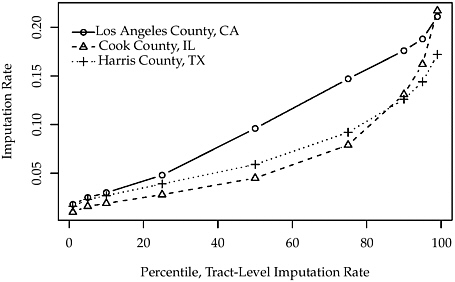
Figure 8.6 Imputation Rates for Race in Census Tracts of Selected Counties
NOTE: See note to Figure 8.5.
SOURCE: Summary File 1, accessed from the Census Bureau’s Web site, http://factfinder.census.gov.
Examination of the characteristics of cases with different race categories reported compared with those with the same category reported reveal some interesting differences. Non-Hispanics were much more likely than Hispanics to have the same race reported in the two samples. Fully 45 percent of Hispanics have different races reported. Again, this indicates there may be a mismatch between the race and ethnicity classification scheme and the manner in which Hispanics understand themselves to fit into the scheme. Age also played a role; among Hispanics and non-Hispanics, younger people were less likely to have the same race reported than older people. Renters were more likely to have different races reported than owners. By region, Westerners were the most likely and Midwesterners the least likely to have different races reported in the two samples.
8–D FUTURE REQUIREMENTS
Race is consequential—racial classification can create a social reality that has real and enduring consequences. It can affect access to resources, the distribution of wealth and employment, interpersonal relationships, and place and type of residence. OMB provides federal statistical and program administration agencies with classification standards for maintaining, collecting, and reporting data on race and ethnicity. These data, in turn, are used by multiple entities for diverse purposes—statistical purposes, program administration, business planning, research, and civil rights enforcement, to name just a few. The way the federal government chooses to measure race and ethnicity has profound implications.
The research program surrounding the revision of Directive 15 and accompanying the 2000 census is only a beginning. We still do not have a deep understanding of the way that individuals classify themselves and how others classify them. The changes to Directive 15 did not produce a coherent organizing concept on which to base the federal system of racial and ethnic classification (see Harris, 2003, for discussion and argument for a particular organizing concept). We recognize that it could be difficult to gain acceptance of one concept, given the different uses of federal data on race and ethnicity, such as identifying members of groups that are victims of historical and current racial discrimination as defined in specific statutes in contrast to studying social behavior of self-defined ethnic groups. Nevertheless, continued lack of a coherent foundation is likely to lead to further instability in both the response to and content of questions on race and ethnicity.
Because race and ethnicity are social constructs (see Harris, 2003), definitions of racial and ethnic categories change over time and differ over cultures. Consequently, there can be considerable ambiguity in their definition at any one moment. Such ambiguity was evident in the 2000 census results, as well as in comparison data sources. Many factors are known to affect race and ethnicity reporting, including who responds, the setting for response, question wording and placement, and whether and what kinds of examples are given for race categories to prompt reporting. Imputation is also a factor—5 percent of household members did not report race in 2000, and the same percentage did not report ethnicity (fewer than 1 percent failed
to report both).
A continued distinction between race and Hispanic origin may already reflect an outdated mode of thought about race and ethnicity. After reallocation to other categories based on written responses to the “some other race” category, 97 percent of those remaining in the category are Hispanic. In turn, they make up about half of all individuals indicating that they are of Hispanic origin, suggesting that a large portion of that population considers Hispanicity to be conceptually coherent with groups classified as races. Analysis of the 1996 RAETT indicated that the combined race/ethnicity question, which allowed multiple categories to be checked, did not result in a reduction of the proportion of the population indicating Hispanic origin. This result is in contrast to findings from the 1996 NCS and the 1995 CPS supplement on race and ethnicity, both of which indicated that a combined race and ethnicity question would reduce the proportion of the population reporting Hispanic origin. However, unlike the RAETT, neither the NCS nor the CPS supplement tested a combined question with a “check one or more” option. Given that OMB has adopted the “check one or more” format, it may therefore be appropriate to continue to explore the implications of making a combined race and Hispanic-origin question the standard format for future censuses.
Many of the available analyses suggest that race and ethnicity (particularly race) are fluid concepts, for which reporting may be affected by what appear to be minor changes in context, format, and procedures. Users need to be aware of the high levels of inconsistent reporting for some race groups in their analyses. The Census Bureau needs to continually conduct testing and research on race and ethnicity to evaluate data quality and plan refinements in question design for future censuses.
The Bureau tested minor changes in the race and ethnicity questions in a national mailout survey in 2003 (Martin et al., 2003). The major change in the test was to eliminate the “Some Other Race” category for one of the experimental samples. This change would bring the census race question into line with the OMB guidelines and make the census race data comparable with data from other surveys and other agencies.
Because it is likely that concepts of race and ethnicity will continue to change, the Census Bureau should consider tests of more
striking modifications of the standard race and ethnicity questions. For example, tests could be conducted of asking people to write in their race(s) rather than check a box, of including Hispanic as a racial category and dropping a separate question on ethnicity, or of asking people to report not only their self-perception, but also their perception of how others would report them. Such tests, while not necessarily representing feasible options for the 2010 census, could shed considerable light on the meaning of race and ethnicity in the United States today, which would be useful for census planning and for public enlightenment.
Finding 8.1: People who marked more than one race category in the 2000 census (the first to allow this reporting option) accounted for over 2 percent of the total population and as much as 8 percent of children ages 0 to 4, suggesting that the multirace population will grow in numbers. Nearly one-third of multirace respondents were of Hispanic origin, as were 97 percent of people checking only “some other race.” Together, multirace and some other race Hispanic respondents accounted for about one-half of all Hispanics, indicating the ambiguities confronting measurement of race for the Hispanic group. Consistency of reporting of Hispanic origin (as measured by responses of E-sample households compared with matching P-sample households) was very high (98 percent); consistency of race reporting was also high for non-Hispanic whites, blacks, and Asians, but quite low for multirace respondents, and only moderately high for other groups. Both missing data rates and distributions for ethnicity and race are sensitive to differences in question format, order, and wording.
Recommendation 8.1: The Census Bureau should support—both internally and externally, in cooperation with other statistical agencies—ongoing, intensive, and innovative research and testing on race and ethnicity reporting. Particular attention should be given to testing formats that increase consistency of reporting and to methods for establishing comparability between old and new definitions and measures.


