
4
Environmental Influences on Salmon
Columbia River basin salmon are among the world’s most intensively studied fish species. Quantitative and qualitative data regarding salmon species and their habitat have been gathered and evaluated for many decades. This information has increased understanding of Pacific salmon and their complex life histories. Given their responsibilities to help protect salmon, water management agencies in the Pacific Northwest have drawn heavily on this information and have consulted with fisheries scientists in designing strategies for preserving and enhancing salmon habitat and populations. Despite the extent of data and scientific knowledge regarding Pacific salmon, more precise understanding of salmon is inhibited by the complexities of salmon’s diverse anadromous (which refers to organisms that spend most of their adult lives in saltwater and then migrate to fresh water and lake to reproduce) life histories and the vast scale of the biomes they traverse during their life spans.
In addition to the biological complexities of salmon species, within the impounded Columbia River they have been affected by an array of environmental conditions and changes, such as increasing water temperatures and changes to other water quality parameters, changes to water velocity through reservoirs, habitat degradation, changing turbidity, shifting seasonal patterns and volumes of river flows, passage effects at dams, and changes in predators and predation rates. Scientists and water managers have considered these issues when formulating fish passage strategies such as flow augmentation, construction of smolt (young salmon, generally two to three years in age) bypass systems, spill programs, smolt transportation programs, and the construction and upgrade of fish ladders. Collectively, these devices and strategies are designed to work in concert to increase survival rates of salmon migrating through the dammed river and
contribute to the productivity of anadromous fish populations. NOAA (National Oceanographic and Atmospheric Administration) Fisheries (formerly the National Marine Fisheries Service, or NMFS), the federal fishery agency responsible for the recovery of anadromous salmonid populations listed pursuant to the Endangered Species Act, embraces these strategies and calls for their continued improvement and use in fostering salmon recovery (NMFS, 2000). Even so, it is not known whether these actions alone can reverse or stall long-term declines in salmon populations. Much of the research identified in the 2000 Biological Opinion from the NMFS focuses on improving the implementation of these strategies and gaining a clearer understanding of the outcomes of management actions that are often confounded by environmental complexities. Furthermore, conditions in tributaries and in estuarine and marine habitats have pronounced effects on salmon productivity, as do harvest and hatchery programs. Large salmon returns in 2001 to 2003, for example, were viewed by many scientists as a function of favorable ocean conditions (NPCC, 2003), but ecological and biological complexities inhibit perfect understanding of cause and effect in such events. In any event, a 100-year snapshot of Columbia River salmon portrays long-term declines and provides a backdrop against which short-term events should be evaluated. This chapter reviews environmental variables that affect Columbia River salmon and examines competing hypotheses and models constructed to explain the relative importance of these variables.
COLUMBIA RIVER SALMON
Three species of anadromous salmonids commonly migrate through the middle and upper reaches (above Bonneville Dam) of the Columbia and Snake rivers in the State of Washington: Chinook (Oncorhynchus tshawytscha), steelhead (Oncorhynchus mykiss), and sockeye (Oncorhynchus nerka) all commonly migrate to spawning destinations well upstream from Bonneville Dam. Remnant wild and hatchery populations of coho salmon (O. kisutch) are also found in select locales in the upper Columbia basin. All these species have some population units that are listed as endangered or threatened under the Endangered Species Act (see Table 1-1). Additionally, chum salmon (O. keta), which
are also federally listed, and a vestigial population of pink salmon (O. gorbuscha), inhabit waters downstream from Bonneville Dam.
Requirements for each stage of salmon life history can be generalized for all of the anadromous species. Spawning fish, returning from the ocean, require freshwater instream habitat with temperatures that ensure survival until they spawn. Spawning salmon seek species-specific gravels, water depths, and velocities to build redds (nests) in which they deposit their eggs. Egg survival depends on low sedimentation rates, adequate delivery of dissolved oxygen, and appropriate river temperatures to support egg development. Once the eggs hatch, some of the young fish (fry) maintain locations in the river to develop, while some fry grow while migrating downstream. During the post-fry stage (juvenile), these fish remain in the river from several months to more than two years, depending on the species or life history type. Growth is crucial during this phase, which supports the physiological transformation required for emigrating from fresh water, into brackish water, and then into saltwater. This transformation phase is called smoltification and during it the fish undergo a complex physiological process that prepares them for adaptation to seawater as they migrate downstream (as their names suggest, spring migrants experience smoltification during spring months, and summer migrating ocean-type Chinook go through smoltification mainly in July and August).
Chinook Salmon
Fishery managers traditionally divide Columbia River Chinook salmon into spring, summer, and fall runs. After spending much of their lives in the Pacific Ocean, spring Chinook salmon adults that spawned in high, cold tributaries in Idaho, Oregon, and Washington return to the Columbia River mouth from February through mid-May. Through olfactory homing instincts, they travel upstream and reach their natal tributary streams in June, move to spawning sites in August, and largely complete spawning by early September. Summer Chinook salmon, which use the Columbia River upstream from the mouth of the Snake River, enter the river mostly in May and June and spawn in September and early October in natal streams such as the Wenatchee
and Methow rivers. In the Snake River, summer Chinook salmon make up a later component of the spring Chinook salmon migration, spawning in late August and early September. Fall Chinook salmon enter the Columbia River in July and August and spawn in late October and November in the mainstem river (a small number also spawn in the Snake River between Lewiston and Hells Canyon Dam). Fall Chinook salmon today make up the largest segment of Chinook salmon runs.
Hatchery and naturally produced fall Chinook salmon that use the lower Columbia River area are known as “tule” fall Chinook salmon. Relatively dark in color, they arrive in the river in September and October, then spawn in late fall. Fall Chinook salmon that spawn upstream from McNary Dam in both the Snake and Columbia rivers are known as “upriver brights.”1 They enter the Columbia River in August and spawn mostly upstream from McNary Dam. Upstream from Bonneville Dam, the (numerically) most important spawning area—a long, damless stretch of river known as “The Hanford Reach”—lies between Priest Rapids Dam and the head of McNary Dam pool.
The shoreline-oriented behavior of subyearling fall Chinook salmon in flowing river segments, and their relatively slow rearing migration in the Snake and Columbia rivers, which occurs in early and midsummer, makes them potentially vulnerable to high water temperatures. Construction of mainstem hydroelectric projects, and the consequent slower river velocities, extended the passage period for subyearling (juvenile fish less than one year old) fall Chinook in the Hanford Reach (Chapman et al., 1994; Park, 1969). Reservoirs like McNary and Lower Granite pools, however, may serve as surrogates for estuarine rearing (Chapman et al., 1994). Fall run Chinook usually migrate to the ocean during their first spring and summer in fresh water. Most yearling spring Chinook salmon migrate in April and May and reach the estuary in early June of their second year in fresh water, thus evading the warmest Columbia River waters of early and midsummer. Fall run and spring run Chinook are often called ocean and streamtypes, respectively. Returns of spring Chinook and Snake River “summer” Chinook are dominated by hatchery-reared fish. Returns of fall Chinooks (upriver brights) are pri-
marily wild fish.
Steelhead
Columbia River steelhead are categorized according to two broad modes of behavior. Winter steelhead remain at sea until late fall or winter, then enter the Columbia River and tributaries as far upstream as Fifteen Mile Creek at The Dalles, which enters the Bonneville Dam pool. They spawn in late winter and early spring, and fry emerge from redds in late spring to July. Juveniles spend two winters in fresh water before migrating to sea in March to early June. Summer steelhead, by contrast, which use some tributaries downstream from Bonneville Dam (e.g., Kalama River) and virtually all suitable streams upstream from Bonneville, enter the Columbia River from May to early September. Adults spend the winter in the mainstem of the Columbia and Snake rivers and in large tributaries and spawn mostly in the period from March to May. Like winter steelhead, fry emerge from redds in late spring to midsummer and spend at least two winters in fresh water before migrating to sea as smolts. The smolts move seaward in spring. Returns of steelhead at the Columbia River estuary are dominated by hatchery-reared fish.
Sockeye Salmon
Sockeye salmon require a lake for juvenile rearing. Sockeye were once found in the upper Columbia River lake and tributary systems of the upper Columbia River upstream from Grand Coulee, in Suttle and Wallowa lakes in Oregon, in the chain of Okanogan River lakes and Lake Wenatchee, and in the Stanley basin lakes of the upper Salmon River in Idaho. They spawn in fall upstream from the two lakes, and fry move downstream soon after emergence from redds, rearing in the lake environment for mostly one but sometimes two years. As smolts they emigrate in April and May. Sockeye currently inhabit only Osoyoos Lake in Canada, Lake Wenatchee in Washington, and Redfish Lake in Idaho. Sockeye salmon return to the Columbia River estuary mostly in May and June. The bulk of these returns are wild fish.
Coho Salmon
Coho salmon in the Columbia River mostly spawn (and juveniles rear) in tributaries downstream from The Dalles Dam. Hatchery-produced coho predominate. Wild coho formerly used a number of other tributaries, including some upstream from McNary Dam, like the Yakima, Methow, and Grande Ronde rivers. Most coho smolts move seaward in the spring.
Variations in Migratory Patterns
These different salmon and steelhead species and subspecies migrate downstream and upstream through the Columbia River system at different times of year. The greatest risks to the survival of migrating fish occur during periods when Columbia River temperatures are highest and during low-flow periods and in low-flow years. Species and life stages of listed fish that transit the Columbia River mainstem in summer months (June to August) include:
-
Subyearling fall Chinook from the Snake River;
-
Late-migrating steelhead (smolts);
-
Snake River adult sockeye salmon (adults);
-
. Snake River summer Chinook (adults);
-
Snake and Columbia river steelhead (adults);
-
Snake River fall Chinook (adults); and
-
Bull trout.
This report contains several references to the risks of survival of Columbia River salmonid stocks during critical periods. References to fish in the system during these periods do not apply to all salmon and steelhead species and subspecies but rather focus on the species listed here that transit the system during the critical June-August period.
STATUS OF SALMON AND STEELHEAD STOCKS
Historical perspectives of trends in Columbia River salmon abundance are essential to understanding the relative abundance
of recent and current salmon runs as well as long-term fishery trends. Many sources of data contribute to scientific knowledge of historical changes in the abundance of the Columbia’s anadromous salmon and steelhead. Because of their abundance (and their size) in the Columbia River, Chinook salmon have long attracted the attention of fishery scientists and have been intensively monitored and tracked over time. Fish counts at Bonneville, McNary, Priest Rapids, and Lower Granite dams for the period 1977 to 2002 (Figures 4-1, 4-2, and 4-3, for adult Chinook, adult steelhead, and adult sockeye, respectively) provide an overall picture of changes in the status of salmon populations over time.
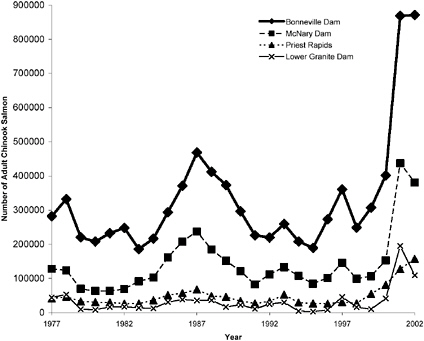
FIGURE 4-1 Counts of adult Chinook salmon at Bonneville, McNary, Priest Rapids, and Lower Granite dams on the Columbia River (1977 to 2002). SOURCE: Fish Passage Center (available online at http://www.fpc.org/adult_history/adultsites.html, last accessed November 17, 2003).
Returns of Chinook from 2001 to 2003 greatly exceeded the 1993 to 2002 average returns (Figure 4-1) and generated a great deal of excitement in the Pacific Northwest. These record returns have generally been attributed to favorable ocean conditions. The Northwest Power and Conservation Council, for instance, asserted that “good ocean conditions are creating strong adult returns” and noted that “ocean conditions will change” (available online at http://nwppc.org/news/2003_11/3.pdf, last accessed December 2, 2003). It bears noting that the 2001 to 2003 returns of fall Chinook salmon, like in-river runs since the mid-1990s, also benefited from increased restrictions on ocean fishing. In addition to recent, comparatively large Chinook runs, steelhead returns also rose sharply relative to figures since the mid-1970s (Figure 4-2). Sockeye also experienced an increase in returns in the late 1990s (Figure 4-3).
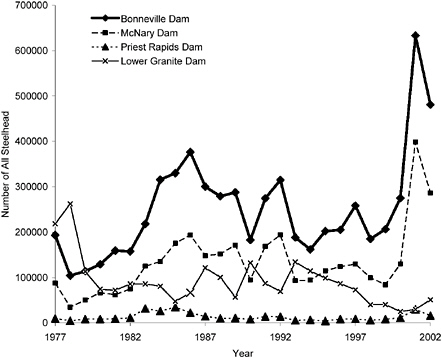
FIGURE 4-2 Counts of all adult steelhead at Bonneville, McNary, Priest Rapids, and Lower Granite dams on the Columbia River (1977 to 2002). SOURCE: Fish Passage Center (available online at http://www.fpc.org/adult_history/adultsites.html, last accessed November 17, 2003).
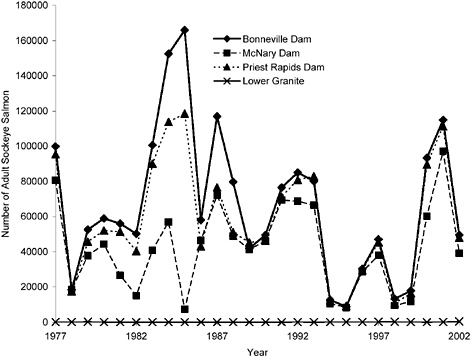
FIGURE 4-3 Counts of adult sockeye salmon at Bonneville, McNary, Priest Rapids, and Lower Granite dams on the Columbia River (1977 to 2002). SOURCE: Fish Passage Center (available online at http://www.fpc.org/adult_history/adultsites.html, last accessed November 17, 2003).
Redd counts from Idaho’s Salmon River basin provide additional information regarding temporal trends of spring/summer Chinook salmon listed by the Endangered Species Act.2 Redd counts in 1957, the first year of systematic surveys, were inflated by completion of The Dalles Dam in the lower Columbia River (Figure 4-4). The reservoir behind the dam flooded the Celilo Falls, which was an important Indian fishing site. As a result of the loss of this important fishing site and an attendant reduction of harvests, Columbia and Snake river escapements of salmon and steelhead increased sharply. Later, as Indian fishers shifted to gillnets, fishing and harvest rates increased.
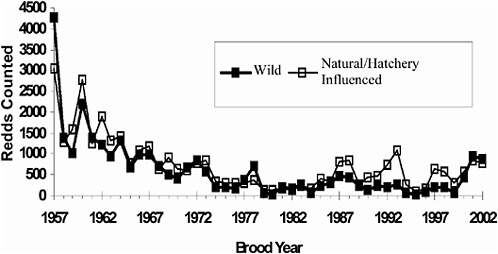
FIGURE 4-4 Number of combined spring and summer Chinook redds (thousands) counted in Salmon River drainage, wild and natural/hatchery-influenced trend areas, 1957-2002. SOURCE: Fish Passage Center (available online at http://www.fpc.org/adult_history/adultsites.html, last accessed March 24, 2004).
Figures 4-5 and 4-6 present a longer time frame of reference of salmon abundance and its changes, and they reflect a steady decline in the spring Chinook catch since the early 1940s (there are, however, some departures from this long-term trend, such as increases in landings in the mid-1980s). The harvest rate in the Columbia River between the river mouth and the upper limit of commercial fishing near the site of McNary Dam ranged from 40 to 85 percent before the 1960s, declined until 1974, and thereafter averaged less than 10 percent (Chapman et al., 1995). Numerical harvest in the post-Bonneville Dam era peaked in the 1950s, declined to 1974, and then remained negligible. Declines in salmonid stocks, and the variations in declines across stocks, have been described as follows:
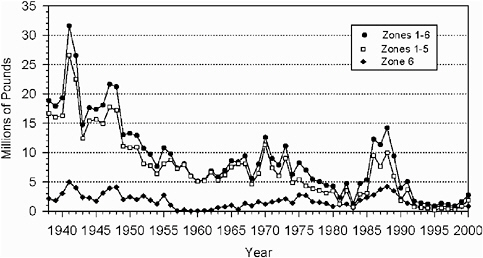
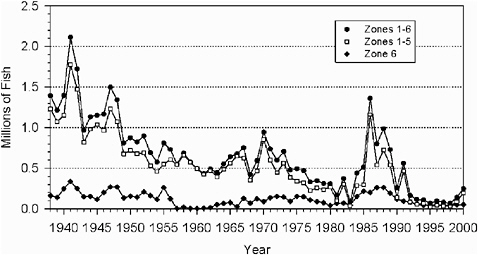
The Columbia has numerous kinds and runs of salmon and not all runs have declined at the same pace. There are yearly variations. There are temporary recoveries for some species and runs, but overall the decline has been pervasive and general. The catches on the Columbia are one measure of the decline. From 1880 to 1930 the catch was 33.9 million pounds a year. From 1931 to 1948 it declined to 23.8 million. From 1949 to 1973 the yearly average fell to 10.9 million pounds. In 1993 the catch was 1.4 million pounds. (White, 1995, p. 97)
Populations of the basin’s anadromous fish stocks are currently estimated to be generally less than 10 percent of their typical historical levels (Chapman, 1986; Kaczynski and Palmisano, 1993; NPPC, 1986).
In addition to historic declines, another important change is an increasing proportion of hatchery-reared fish in the salmon population. The majority of spring Chinook salmon, summer Chinook salmon, and steelhead counts in recent years showed that most of these fish originated from hatcheries. Only about one-fourth or less of spring/summer Chinook salmon and steelhead that returned to the Snake and upper Columbia rivers in the past two decades have been of wild origin; thus, about 75 percent of the spring/summer adult Chinook salmon that return to the Snake River are produced in hatcheries. The proportion of wild fish in the salmon population is an issue important to long-term survival of the species, as pointed out by a previous National Research Council committee that reviewed Columbia River salmon populations and management: “The long-term survival of salmon depends crucially on a diverse and rich store of genetic variation. … Management must recognize and protect the genetic diversity within each salmon species. … It is not enough to focus only on the abundance of salmon” (NRC, 1996).
In summary, salmon populations of the Columbia River have decreased dramatically since the 1800s, albeit with annual variations in abundance. Although returns of Chinook salmon and steelhead increased sharply from 2001 to 2003 relative to the 1975 to 2000 numbers, they remained but a small fraction of former abundance. Furthermore, fish of hatchery origin from a few stocks constituted most of the runs of spring and summer Chinook salmon and summer steelhead. Genetic diversity within
these salmon runs has thus declined, which may have reduced the potential for these species to adapt to environmental changes, such as warmer water temperatures (Brannon et al., 2002).
RESEARCH, MODELING, AND ALTERNATIVE HYPOTHESES
Flow Augmentation
The Federal Columbia River Power System consists of a vast network of storage reservoirs and run-of-river dams, connected in some areas by undammed river segments. Prior to 1983, water in the system was primarily managed to accommodate and balance a variety of demands that included flood control, hydropower, recreation, irrigation, and other extractive demands. In 1983, as part of the Northwest Power Planning Council’s Fish and Wildlife Program, a flow augmentation strategy was developed. The program provided for an allotment of water directed specifically at increasing instream flows during the period that smolts migrate seaward. The amount and timing of these releases, known as the Water Budget, was determined annually. The Water Budget has subsequently evolved into a more extensive and complex water management strategy intended to increase instream water velocities, reduce travel times, and increase survival rates of smolts as they migrate seaward through the impounded Columbia and Snake rivers (spring migrants smolt during the spring months, and summer-migrating ocean-type Chinook migrate primarily in July and August). This water management strategy is referred to as flow augmentation (NMFS, 2000). Releases today are made after considering requests from the Fish Passage Center in Portland, which represents fisheries agencies and tribal groups. Implementation of this strategy has reshaped the pre-1983 annual hydrograph, resulting in more pronounced peaks during the spring and summer smolt migration periods. The demand for instream flows is an important priority and is a prominent action and feature in the 2000 Biological Opinion of the NMFS. Not surprisingly, this new demand has impacted other water management needs throughout the system, and has necessitated a new balance among system users.
Rationale for Flow Augmentation
Flow augmentation is the directed release of water from storage reservoirs to increase instream flows, which are intended to help reestablish suitable migratory conditions for smolts that migrate seaward through the impounded Snake and Columbia rivers; flow augmentation from Dworshak Reservoir on the Clearwater River in Idaho is also used to add cold water to the Lower Snake River. Flow augmentation from the Columbia River is provided from several large storage reservoirs. These include Grand Coulee reservoir (Franklin D. Roosevelt Lake) and a complex of storage reservoirs in Canada and Montana. In the Snake River basin, Dworshak reservoir, Brownlee reservoir, and the Hells Canyon complex—all in Idaho—augment flows (Figure 4-7). The rationale for flow augmentation is founded on two premises:
-
Increased discharge results in higher water velocity through reservoirs which, in turn, increases the migration speed of smolts in the impoundments of the Lower Snake and Columbia rivers, ultimately resulting in increased smolt survival through this migratory corridor.
-
Increased discharge lowers water temperature, improving migratory and rearing conditions for both juvenile and adult salmonids, particularly during the summer.
Smolt Survival
Cada et al. (1997) reviewed literature from within and outside the Columbia River basin, addressing the influence of water velocity on the survival rates of juvenile salmon and steelhead. Most of the studies reviewed identified a positive relationship between outmigration flows and survival but noted substantial uncertainty regarding many of the estimates. In many cases the relationships described did not consider interactions with factors other than water velocity. Other factors examined in the review included predation, water quality, and physiological state of the smolts at the time of migration. Despite limited data, Cada et al. found that a general relationship of increasing smolt survival with increasing flow in the Columbia River basin was a reasonable conclusion.
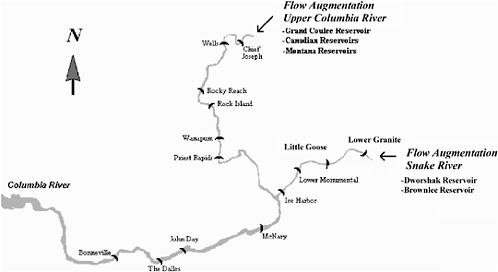
FIGURE 4-7 Dams and impoundments on the Snake and Columbia rivers, through the reaches where anadromous fish passage is accommodated. Sources of flow augmentation water are indicated. SOURCE: Reprinted from Giorgi et al. (2002).
The migration speed of salmon smolts dictates their exposure time to hazards in reservoirs. For example, predatory fish and birds are responsible for a substantial amount of smolt mortality incurred within the impounded Columbia River. Northern pikeminnow, smallmouth bass, channel catfish, and walleye all prey heavily on smolts. It has been estimated that the predacious northern pike minnow consumed 78 percent of the smolts that were lost to predatory fish in John Day reservoir from 1983 to 1986 (Rieman et al., 1991). In the 1990s a control program (in the form of a bounty fishery) that targets these species was implemented (Young, 1997a and 1997b). Birds also consume large numbers of smolts at various locations throughout the Columbia River. An expanding Caspian tern population and double-creasted cormorants are effective smolt predators in some areas downstream of Bonneville Dam. Gulls also prey upon smolts in the tailraces (outflows below dams) of Columbia River dams
(Collis et al., 2002). Rugerrone (1986) estimated that in 1982, gulls foraging in the tailrace of Wanapum Dam consumed 2 percent of the smolts passing the dam. In an effort to reduce smolt mortality, a variety of actions have been directed at displacing, harassing, or excluding predatory birds from problem areas.
Historical Background
Shortly after the construction of several Snake River dams, federal biologists documented that dams and associated reservoirs delayed the migration of smolts. For example, Ebel and Raymond (1976) and Bentley and Raymond (1976) estimated that after dam emplacement, travel times of yearling Chinook salmon and steelhead increased at least twofold over preimpoundment conditions. The first explicit depiction of a flow-smolt survival relationship was presented by Sims and Ossiander (1981). Building on previous studies (e.g., Raymond, 1979; Sims et al., 1976, 1977, 1978), Sims and Ossiander (1981) constructed a series of graphs depicting that annual indices of smolt migration speed and survival were positively correlated with annual indices of flow and spill volumes during migratory periods (1973 to 1979). Although it was not possible to separate reservoir effects (associated with migration speed) from passage effects attending spill passage, this was the first evidence establishing the flow-travel time-survival relationship. Furthermore, these findings were the foundation that led to the development of both the flow augmentation and spill programs in place today. Both spill and migration speed were defined as agents affecting smolt survival. Shortly thereafter (in 1983), the “Water Budget” was established by the Northwest Power Planning Council. Under that program, a specific volume of water in Snake River storage reservoirs was dedicated to flush smolts seaward. The Fish Passage Center (previously known as the Water Budget Center) in Portland provides fish passage technical advice regarding spill, flow, and fish facilities operations to fish and wildlife managers was established to track the delivery of water and the response of smolts to the water management action (see http://www.fpc.org/, last accessed March 13, 2004). That original water management strategy expanded over the ensuing two decades to the current flow augmentation program described in
the 2000 Biological Opinion from the NMFS.
Throughout the 1980s smolt travel time was consistently monitored. In the early 1990s, studies concluded that variability in smolt travel times was best explained as a function of a combination of flows, water temperatures, and release dates (the latter of which is a surrogate for the level of smolt physiological development; Berggren and Filardo, 1993). It was reported, however, that average river flow explained most of the observed variability in smolt travel time for most stocks investigated (ibid.). These findings reinforced the strategy to provide flushing flows to increase migration rates.
During the same period, federal scientists investigated the migration of ocean-type subyearling Chinook salmon through the John Day Pool (Giorgi et al., 1994). Their characterization of migratory behavior in John Day Reservoir differed from that described by Berggren and Filardo (1993). They did not identify a consistent relationship between smolt travel time and any of the three predictor variables (flow, water temperature, or release date), but rather characterized the migratory patterns as a complicated mix of rearing and migratory behavior, often punctuated by extensive upstream excursions.
Williams and Matthews (1995) questioned the foundation of the Sims and Ossiander (1981) flow-survival relationships by asserting that the 1970s-era data reflected operating conditions that no longer existed in the contemporary hydrosystem. They suggested that the high smolt mortality rates witnessed during low-flow years in that era was in part associated with slow rates of migration through the system, but was exacerbated by turbine and powerhouse operations. Furthermore, they concluded that the Sims and Ossiander flow-survival relationship does not accurately predict the survival of spring-migrating smolts under contemporary hydrosystem operations and the smolt bypass systems in place at dams. The research community generally recognized the need for statistically robust survival estimates acquired in the contemporary setting, since the flow-survival debate was intensifying as more water was being shifted toward flow augmentation. But sampling limitations associated with the need to handle and inspect large numbers of freeze-branded smolts prevented the use of new analytical methods reported by Burnham et al. (1987).
Over recent decades, technological improvements have al-
lowed for more accurate smolt survival estimates. The advent of the passive integrated transponder (PIT) tag, and associated detection systems that could be retrofitted to existing smolt bypass systems, fostered the transition to a new era and quality of smolt survival and travel time estimates for the Columbia-Snake river system (Prentice et al., 1990). Since 1994, smolt survival estimates have been obtained through segments of the Federal Columbia River Hydro System by the NMFS/NOAA Fisheries. The bulk of the data for use in flow-survival assessments are from the Lower Snake and, to a lesser extent, portions of the lower Columbia. There is a paucity of data available for the middle reach of the Columbia River upstream from McNary Dam. Even now, with widespread use of PIT tags, opportunities to provide robust smolt survival estimates through the middle reach of the Columbia River are limited because of the small number of PIT detection systems there.
Contemporary Investigations
Translating river flows, or smolt migration rates, into smolt survival rates is the critical issue underpinning the rationale for providing flow augmentation and quantifying any associated benefits. A great deal of research since 1994 has been directed toward a better understanding of these complex relationships. During the 1990s, research increasingly focused on identifying a more complex suite of factors that influenced migration speed through the hydrological system. The collective research indicated that the species responded differently to various factors through different segments of the river. In both the Snake and Columbia rivers, yearling Chinook salmon migration speed was correlated with both flow (water velocity) and the level of smolt development (Beeman et al., 1991; Giorgi et al., 1997; Muir et al., 1994). River discharge (flow) was determined to be the factor that explained the majority of variability in migration speed for steelhead (Buettner and Brimmer, 2000; Giorgi et al., 1997) and sockeye salmon (Giorgi et al., 1997).
The modern era of smolt survival studies continued in the Snake River and in portions of the lower Columbia River, since an extensive network of PIT detections systems is located there (most flow-survival studies have been conducted in the Snake
River, and results from the Snake are generally felt to reflect processes that occur elsewhere in the system). Scientists from NOAA Fisheries generally design and conduct those studies, but the agency relies on the broad-based PIT-tagging program overseen by the Columbia Basin Fish and Wildlife Authority (CBFWA, a coalition of tribes, and state and federal wildlife management agencies) to provide tagged fish for monitoring. Smith et al. (2002) used multiple regression methods to assess the effects of a variety of factors on smolt migration rate and survival for 1995-1999. Using a mixture of PIT-tagged yearling Chinook salmon and steelhead smolts from the Snake Basin, they found that travel time from Lower Granite Dam to McNary Dam was strongly correlated with flow volume, with the physiological development of the smolts a contributing factor, particularly for Chinook salmon. However, they could not identify a substantive or consistent relationship between smolt travel time and smolt survival through that same river segment. The authors concluded that survival benefits from increased flow were minimal at best, and that any benefits may be expressed downstream from McNary Dam, beyond their observation zone. These findings were consistent with those expressed in an earlier “White Paper” (NMFS, 2000), which assessed flow, migration speed, and smolt survival.
Drought conditions in 2001 created one of the lowest runoff years on record for the Columbia River, which presented an opportunity to monitor smolt survival under low-flow conditions. Consistent with the findings of Smith et al. (2002), Zabel et al. (2002) found no flow-survival relationship for yearling spring and summer Chinook salmon (1993 to 2001). The Zabel et al. group found that smolt travel time was correlated to river discharge volume, but no relationship between migration speed and survival was evident. Survival was depressed in 2001 relative to many other recent years; however, low flows were not the only factor implicated in low survival rates through the hydrosystem, as spill was minimal or nonexistent at most dams that smolts encountered. Both conditions likely contributed to poor survival. Furthermore, water temperature has been implicated as a principal factor affecting smolt survival, particularly in low-flow water years, when seasonal water temperature increases earlier and to higher levels (Anderson, 2003).
Zabel et al. (2002) suggested that even in the absence of a
flow or migration rate-survival relationship, other benefits may be provided by the swifter migration made possible by increased flow levels. They speculated that higher flows may improve estuary and Columbia River plume conditions and associated survival through those zones but offered no empirical evidence for such. In contrast to yearling Chinook salmon, steelhead survival figures dramatically decreased in 2001 compared to figures for the 1990s. Three factors were implicated as causing this dramatic increase in mortality of Snake River steelhead. First, spill was negligible at most of the dams the steelhead encountered. This mechanism is distinct from migration speed-related processes. Second, of all the salmon species, steelhead migration speed appears to be the most sensitive to flow and associated water velocity (Berggren and Filardo, 1993; Giorgi et al., 1997). Lastly, water temperatures warmed sooner in 2001 than in the preceding three years (see http://www.cbr.washington.edu/dart/dart.html, last accessed February 28, 2004). This pattern was evident in both the lower Snake and Columbia rivers. Water temperatures exceeded 12.5°C early (by the first week in May at Lower Monumental Dam) in the steelhead migration. This, coupled with slow migration speed, can compromise steelhead migratory processes. Increasing water temperature can disrupt the migratory behavior of steelhead and foster reversion to the fresh water parr (a young salmon during its first two years of life, when it lives in fresh water) state. It is plausible that if migration rates are slowed (as witnessed in 2001; see Zabel et al., 2002), steelhead smolts may have been exposed to seasonally increasing water temperatures that exceeded the threshold to support smoltification and thus they remained in the mainstem.
The Fish Passage Center also monitors smolt migration throughout the system and provides estimates of smolt survival through the hydrosystem. The center’s characterization of flow–survival dynamics differs from that of investigators from NOAA Fisheries. The center expressed its conclusions in a paper submitted to the (previous) Northwest Power Planning Council (FPC, 2002), stating that for juvenile steelhead and Chinook salmon spring migrants
-
water travel time and survival relationship exists for spring migrating Chinook salmon and steelhead of Snake River and mid-Columbia River origin;
-
water travel time and fish travel time relationship exists for spring migrating Chinook salmon and steelhead; and
-
it is difficult to define a flow-survival relationship because survival is the combined result of many interacting variables and the method for estimating survival does not lend itself to identifying each environmental or biotic variable individually.
Snake River Fall Chinook Salmon
For fall Chinook salmon in the Snake River, flow, water temperature, and turbidity are correlated with migration speed and survival (Smith et al., 2003). Over the course of summer migration, river discharges decrease, temperatures increase, and turbidities decrease. Thus, predictor variables were typically correlated among themselves. In the middle reach of the Columbia River, the size of subyearling Chinook salmon was found to be the best predictor of migration speed between Rock Island and McNary dams (Giorgi et al., 1997).
John Day Project (McNary tailrace to John Day tailrace)
Smith et al. (2002) also examined survival dynamics of fall Chinook salmon from the tailrace of McNary Dam to the tailrace of John Day Dam. Fall Chinook salmon were collected, PIT tagged, and released at McNary Dam. The population was primarily composed of mid-Columbia River stocks, such as the wild population from Hanford reach. They found that during the summer (1998 to 2001) correlations were not significant between annual survival and the average river condition variables measured at McNary Dam, but the correlation with temperature was considerably higher than for flow and turbidity.
Northwest Power and Conservation Council’s Independent Science Advisory Board Studies
In an effort to shed some light on this complex and often contradictory mass of information, the (previous) Northwest Power Planning Council called on its Independent Science Advisory Board (ISAB) to review, update, and clarify the effective-
ness of flow augmentation. The ISAB challenged the results from the prevailing flow/smolt survival model that spurred post-1983 formulation of smolt-migration water policy, concluding that “the prevailing flow-augmentation paradigm, which asserts that in-river survival will be proportionately enhanced by any amount of added water, is no longer supportable. It does not agree with information now available” (ISAB, 2003). Support for this recent conclusion was based largely on datasets acquired in the lower Snake River from the Lower Granite Project to McNary Dam on the Columbia River. They relied heavily on survival estimates and analyses from NOAA Fisheries to characterize the spring period and information from the U.S. Fish and Wildlife Service and from the Fish Passage Center to describe a survival model for the summer period (the models described in this section are primarily based on regression analyses. Also see http://www.nwcouncil.org/fw/science.htm, last accessed March 15, 2004, for more information on ISAB models and studies.)
Flow-survival. The ISAB presented a “broken-stick” flow-survival model to describe the NMFS-generated PIT survival data it reviewed (ISAB, 2003). That is, the board identified a “breakpoint” near 100,000 cfs for yearling Chinook and steelhead in the Snake River during the spring. According to this report, when flows exceed that threshold, no flow-survival relationship is apparent. The value of flow augmentation is thus questionable above those levels. Below that breakpoint, a flow-survival relationship is evident. However, the report did not derive algorithms to describe the two legs of the generalized model but rather depicted the model graphically. The intent is apparently not to offer this as a predictive tool but rather as a visual framework to introduce the new hypothesis.
Survival dynamics below the breakpoints. With respect to the lower survival rates observed below the breakpoints presented in the 2003 ISAB report, the board hypothesized that specific hydropower operations in the form of daily load-following cycles create hydraulic dynamics that affect survival, rather than average daily flow discharged through the complex of reservoirs and dams (“load following” refers to adjustments in power production to meet changes in power demand or “loads”). They noted that the frequency and intensity of load following substan-
tially increase when river discharge falls below the breakpoints. They suggest that diminishing or eliminating load following will improve smolt survival more than merely providing higher average daily flows. According to the board’s hypothesis, the hydrological effects of load-following power generation disrupt migration cues, which ultimately results in lower smolt survival during migration.
Fall Chinook salmon summer model. The emphasis in this model is also on the Snake River. In formulating the summer model, weekly survival estimates for ocean-type subyearling Chinook migrating from release sites upstream to the tailrace of Lower Granite Dam, as estimated by the Fish Passage Center for the years 1999 and 2000, were employed. As was the case for the spring model, the summer model is described only in generic terms, with “breakpoints” between two legs near 40,000 and 50,000 cfs. The ISAB report offered new hypotheses for describing smolt survival patterns observed in the Snake River. But it cannot be certain that a “broken-stick” model accurately explains survival patterns in the mainstem Columbia River, as no direct evidence to support such in that river segment was provided. Analyses of flow-travel time relationships have been published and cited by the ISAB for the middle reach of the Columbia River, but no definitive flow-survival analyses were ever published. The paucity of robust, consistent survival indices for the Columbia River thus limits meaningful survival analyses with respect to prevailing environmental conditions.
The ISAB report received immediate attention. The CBFWA staff drafted a 34-page technical memorandum commenting on the ISAB assertions and hypotheses (CBFWA, February 26, 2003), which contained a cover letter stating:
In conclusion, we believe that the ISAB report supports the biological rationale for the minimum flow objectives contained in the NMFS Biological Opinion. The ISAB report presents additional hypotheses for future study that are of some interest, although there is little data at the present time to support these hypotheses. The ISAB does suggest some operational changes in river operation that may offer benefits when Biological Opinion flow objectives cannot be met, which warrant further study and consideration.
The CBFWA group challenged, however, the ISAB characterization of the flow augmentation, noting:
We do not agree with the ISAB’s characterization of the flow augmentation paradigm, which they state, “asserts that in-river smolt survival will be proportionately enhanced by any amount of added water.” Establishing reservoir draft limits and augmenting base flows with additional water are only the tools whereby the objective of providing migration flows is accomplished.
The CBFWA group questioned whether altering load-following operations can adequately reduce the smolt mortality associated with the descending arm of the relationship described by the ISAB flow-survival model. The technical staff’s report provided a diverse set of estimates and relationships to support their positions. A well-designed, well-executed field study might shed additional light on this issue. The ISAB called for such a study in which smolt survival would be estimated under different load-following release schedules, but no formal proposal has apparently been submitted to solicit funds for such a study.
Delayed Effects Associated with Migratory Delay
There is another important dimension of the relationships between migration speed and rates of juvenile salmon survival. Extended migration travel times may cause delayed effects that could impair survival of smolts in the Columbia River estuary and after seawater entry. This hypothesis asserts that preimpoundment timing of seawater entry was synchronized with a “biological window.” Extended migration travel times associated with impoundments and reduced velocities have disrupted the natural timing of ocean entry, potentially placing smolts at a disadvantage. This theoretical window has two aspects: the ecological/environmental condition of estuarine and marine waters, and the physiological condition of smolts at seawater entry.
In the late 1990s the concept of extra mortality first arose during the Plan for Analyzing and Testing Hypotheses regional
modeling process. Briefly, during life cycle model analyses, total mortality exceeded that either estimated or assumed for the various individual life freshwater stages. From this modeling exercise emerged the theory that some extra or delayed effect associated with certain lifestage experiences resulted in the unexplainably low rates of salmon survival from egg through adult return. Various hypotheses, such as passage through dams and shifts in climate, were offered to explain the key driving mechanisms. Extinction risk analyses conducted in the 2000 NMFS Biological Opinion were particularly sensitive to the existence, magnitude, and persistence of this hypothetical effect.
Recent research offers additional information. Congleton et al. (2002), for example, studied changes in the condition of yearling Chinook salmon migrating from Lower Granite Dam to Bonneville Dam (1998 to 2002). In all years, body lipid and protein masses decreased significantly and with increasing travel time. The relevance of this finding is that it implies that slower migration forces juveniles to tap caloric reserves beyond normal levels. Such a tax on body reserves could thus compromise smolt performance in seawater. Although survival rates of returning adult have not yet been demonstrated to be linked to this smolt condition, these investigations suggest that salmon physiology is being compromised.
Transportation of Smolts and Delayed Effects
To expedite juvenile migration travel times through the hydropower system, smolts can be transported at dam sites that are equipped with smolt bypass/collector systems and transportation facilities. These sites include three dams on the lower Snake River (Lower Granite, Little Goose, and Lower Monumental) and McNary Dam on the Columbia River. Fish can be intercepted at these dams and transported via barge or occasionally truck to release sites downstream from Bonneville Dam. These smolts avoid in-river hazards. Even so, there is ample evidence that delayed effects on salmon attend this passage option (e.g., Giorgi et al., 2002). The magnitude and variability of these delayed effects have been identified as additional critical uncertainties within flow-survival relationships (NMFS, 2000). If the delayed effects to salmon resulting from transport around dams are
not too severe, these types of transportation could be beneficial. If the effects of transport are pronounced, however, the passage strategy can put endangered stocks at risk. NOAA Fisheries is currently engaged in a multiyear research effort to help reduce mortality rates for key salmon populations in the Snake-Columbia river system associated with this type of transport.
WATER TEMPERATURE AND FLOW MANAGEMENT
Water temperature is an important factor in the life history of Pacific salmon, as it affects the rate of embryo development, juvenile growth rates, metabolic processes, and the timing of life history events such as spawning and migration (Brannon et al., 2002). In cold, high- elevation tributaries, newly emerged salmon fry must grow through the summer to obtain sufficient size to survive the lengthy downstream migration and the estuary and nearshore marine environment, then migrate to sea as yearlings. Farther downstream in the mainstem Columbia River, emergent ocean-type fry find more moderate temperatures and sufficient growth opportunities in the first spring and summer of their lives to reach sizes adequate for estuarine and marine survival during their first year or before their first year in seawater. Water temperature regimes have changed in the Columbia River (see Chapter 3), largely because of human activities. Some salmon populations have shown some ability to adapt to altered river thermal regimes. Fall Chinook salmon, for example, recently began spawning in a formerly unused site in a Snake River tributary, the Clearwater River, because water releases from Dworshak Dam3 warmed the Clearwater River during winter, providing a suitable environment for spawning and incubation. Similarly, releases of relatively warm water from Columbia River storage reservoirs (most importantly Grand Coulee and Chief Joseph), and operation of hydro dams downstream, have increased temperature units (TU)4 in spawning areas between the head of McNary Dam pool and Chief Joseph Dam. Adult sockeye salmon and American shad have gradually shifted the peak
of upstream migration forward about 10 days, responding to rising Columbia River water temperature (Quinn and Adams, 1996). More adult summer steelhead have tended to move later in the year, after river temperatures have peaked (Robards and Quinn, 2002). Although some adult migration and spawning times have shifted in response to lower late-spring and summer flows and warmer river temperatures, physiological responses of adult and juvenile salmon and steelhead to temperature very likely have not (Bell, 1973; Ordal and Pacha, 1963; Reiser and Bjornn, 1979a, b). High water temperatures delay the upstream migration of adult salmonids (Bjornn and Peery, 1992; Hallock et al., 1970; Major and Mighell, 1966). For example, Chinook salmon slow their movement when water temperatures approach 21°C or above (Bell, 1991; McCullough, 1999), a level already common in the Columbia River in summer (see Figure 3.8). Steelhead appear to delay migration when water temperatures exceed 21° to 22°C (Bjornn and Peery, 1992).
Clearly-defined thresholds that affect salmon behavior are difficult to identify. For example, not all Chinook salmon completely stop moving when water temperatures exceed 21°C. Fish counts at Ice Harbor Dam on the Snake River between 1962 and 1992 showed that some fish continued to move when water temperature exceeded 23.3°C (Hillman et al., 2000). Increases in summer water temperatures in the mainstem Columbia River have led to more use of cool tributary refugia (e.g., Deschutes and Wind rivers) by fall Chinook (Goniea, 2002) and steelhead (High, 2002). Higher prespawning mortality rates and depletion of energy reserves can be expected in adult fish exposed to elevated water temperature during upstream migration (McCullough, 1999; Sauter et al., 2001). There do not appear to be any analyses, however, that support precise and reliable predictions of survival changes as related to water temperature.
Within the Columbia and lower Snake rivers, summer water temperatures now reach levels that clearly impose risks to juvenile salmonids. During the summer, subyearling Chinook salmon rear and migrate downstream when river temperatures exceed 20°C (Giorgi and Schlecte, 1997). Temperature tolerance for juvenile fall Chinook has been reported to range from 5.5°C to 20°C (Groves, 1993). The young fish use more energy at high temperature, requiring either higher daily rations (that may not be available) or the consumption of stored energy.
Growth tends to decrease as water temperature approaches 19° to 20°C, which in turn can reduce the size of subyearlings at seawater entry. Disease incidence also increases with rising temperatures.
Water temperature is also an important factor affecting predation-related juvenile salmon mortality rates. For example, Vigg and Burley (1991) developed a model which suggests that a decrease in water temperature from 21.5°C to 17°C could reduce the number of prey consumed by a northern pikeminnow from seven to four per day. This suggests that water temperature regulation measures that reduced Snake River water temperatures could indirectly and locally enhance survival prospects of juvenile fall Chinook. High water temperatures during the latter part of the spring migration of smolts pose physiological threats, especially to steelhead. As previously explained, the smoltification process involves a change in physical appearance as parr become leaner and turn a silvery color. During this process, smolts become physiologically more tolerant of saltwater. Smoltification continues during the seaward migration (Beeman et al., 1995; Zaugg, 1987). Higher temperatures during downstream migration, however, can impede the smoltification process such that fish are prevented from reaching the sea.
An appropriate temperature threshold, above which smoltification is inhibited, appears to lie between 12° to 13°C (Adams et al., 1973; Zaugg et al., 1972; Zaugg and Wagner, 1973). It is not known whether actively migrating steelhead smolts that encounter temperatures greater than 14°C in the lower Columbia River, for example, would revert to parr status (for a more extensive review of temperature effects on smoltification, see http://www.deq.state.id.us/water/suface_water/temperature/ContractorReview_EPA_DraftGuidance.pdf, last accessed January 5, 2004). In 2001, when river flows were low and water temperatures high, survival rates of steelhead were extraordinarily low, as previously noted. And, as also noted earlier, it seems likely that the apparent “mortality” rates that year were due in part to reversion of smolts to parr status and a consequent cessation of seaward movement.
Restoration and Mitigation Measures
Flow Augmentation
In 2002, Giorgi et al. reviewed the status of flow augmentation evaluations published to date. The authors emphasized that establishing general relationships between flows and either migration speed or survival provides a rationale for entertaining flow augmentation as a strategy to improve survival. However, an evaluation of the biological benefits of providing additional water in any particular year has many facets and requires a more focused analysis. Few such detailed evaluations have been conducted. Even the 2000 NMFS Biological Opinion offered no assessment of benefits or risks associated with flow augmentation; rather, it specified volumetric (in millions of acre-feet) standards dedicated to flow augmentation and prescribed seasonal flow (in thousands of cubic feet per second, or kcfs) targets. However, no quantitative analysis describing the change in water velocity, smolt speed, or survival improvement was presented that can be attributed to the additional water provided by flow augmentation. Some studies that attempted to focus specifically on evaluating the effects of flow augmentation water delivery are discussed briefly below.
A study in the late 1990s commented on the effectiveness of flow augmentation in changing water velocity and meeting the flow targets specified in the 2000 Biological Opinion (Dreher, 1998). It was found that the volumes of water in storage reservoirs currently earmarked for flow augmentation in the Snake River (1) provide only small incremental increases in average water velocity through the hydrosystem and (2) are insufficient to meet flow targets in all years. This analysis, however, was not intended to specifically evaluate flow augmentation strategies and thus offered no insight with respect to fish responses.
The topic of summer flow augmentation has received increased attention in recent years. For example, Connor et al. (1998) conducted a study that had implications for summer flow augmentation in the Snake River. Using PIT-tagged juvenile fall Chinook that reared upstream from Lower Granite Dam, they regressed tag detection rates at the dam (survival indices) against flow and temperature separately. They found that over four years, the detection rate was positively correlated to mean sum-
mer flow and negatively correlated with maximum water temperature. They acknowledged that the predictor variables were highly correlated, limiting specific inferences regarding the effects of the individual variables. They also noted water temperatures at Lower Granite Dam dropped approximately 5° to 6°C during the period of flow augmentation from Dworshak Dam and the Hell’s Canyon Complex in 1993 and 1994. They concluded that summer flow augmentation, especially cooler water released from Dworshak Reservoir, could improve survival of juvenile fall Chinook, at least to arrival at Lower Granite Dam. Connor et al. (2003) further analyzed this stock of fall Chinook salmon using PIT tag-based data for the years 1998 to 2000. Survival rates decreased as temperatures warmed and as flows decreased through the course of the summer. It was concluded that flow augmentation increased survival rates of Snake River fall Chinook salmon to the first dam they encounter.
Giorgi and Schlecte (1997) evaluated the effectiveness of flow augmentation in the Snake River for the years 1991-1995. They estimated the volume and temporal distribution of flow augmentation water delivered to the Snake River and evaluated the biological consequences to stocks listed by the Endangered Species Act. They then estimated incremental changes in water velocity and temperature that were attributable to the water delivered as flow augmentation. Using several smolt passage models, the incremental change in smolt migration speed for yearling Chinook salmon, steelhead, and fall Chinook salmon that may have resulted from flow augmentation water was estimated. It was concluded that Snake River flow augmentation increased water velocity through Lower Granite Pool an average of 3 to 13 percent during the spring. The increase was more pronounced during summers, with an increase of 5 to 38 percent change in water velocity attributable to augmentation water. Correspondingly, the change in smolt travel time predicted by the different passage models varied considerably. For example, decreases in travel time for yearling Chinook ranged from 5 to 16 percent over five years, or 0 to 5 percent depending on the passage model applied.
Temperature Manipulation
Several investigations have focused on the effectiveness of Snake River flow augmentation in reducing summer water temperature in the Lower Snake River, specifically considering the use of Dworshak Reservoir as a cold water source for decreasing water temperature in August and early September (Bennett et al., 1997; Karr et al., 1992, 1998). Karr et al. (1992) first presented results which indicated that strategic releases of outflow from Dworshak Reservoir could reduce water temperature in the Snake, at least to the vicinity of Lower Granite Dam.
Bennett et al. (1997) modeled water temperature and monitored empirical data for 1991 to 1993. They established that the Corps of Engineers model (COLTEMP) provided reliable predictions of changes in water temperature associated with flow augmentation releases upstream. The reduction in Snake River water temperature associated with cold water releases from Dworshak Reservoir was greatest at Lower Granite Dam and diminished as water moved downstream to Ice Harbor Dam. Depending on the year and base flow characteristics, the change in temperature at Lower Granite Dam typically ranged from 1° to 4°F. However, the model predicted differences as great as 6° to 8°F, which extended for a period of several weeks. Here again, prediction depended on base flows and the volume released for flow augmentation. At Ice Harbor Dam the decrease in temperature was typically small, on the order of 1 to 2F. It was also reported that the cold water released upstream tended to sink toward the bottom of the reservoirs and mixed at the dams (Bennett et al., 1997). This suggests that deep cool water may be available as a refuge but that cooling of the entire water column cannot be achieved. Also, the extent of cooling decreases in the lower reaches of the river. Biological information has not yet been integrated with this or similar evaluations.
Benefits and Risks to Other Species
Water releases from storage reservoirs to increase mainstem flows or to reduce water temperatures alter conditions both in the storage reservoirs and in tributaries connecting with the Columbia and Snake rivers. These processes in turn have effects on
resident and anadromous fish inhabiting those waters, which introduces an additional, complex facet of flow augmentation. Risks associated with flow augmentation were addressed by the Independent Science Advisory Board’s publication Return to the River, which expressed concerns regarding risks associated with summer flow augmentation, in particular (ISAB, 1996):
Underscoring these substantial uncertainties in flow augmentation rationale is the fact that summer drawdowns in upstream storage reservoirs, for example Hungry Horse Reservoir in Montana, to accomplish summer smolt flushing in the lower Columbia River has direct and potentially negative implications for nutrient mass balance and food web productivity in Flathead Lake, located downstream from Hungry Horse.
The issue involves balancing expected benefits to anadromous fish with ecosystem functions and potential risks to other species. There is clearly a complex array of water management activities in the Columbia River basin today, and arriving at an appropriate balance among competing and complementary strategies is a venture that contains many considerations and uncertainties.
Flow Management and the Estuary
The ISAB (1996) stressed the importance of the estuary as a key regulator of overall survival and annual variation in abundance of salmon. The estuary (and nearshore Columbia plume and its interface with seawater) provides a physiological transition zone, potential refuge from predators, and forage (Simenstad et al., 1982). Rapid growth of juvenile salmon in this transition zone is important, as increased size lessens vulnerability to predation in this environment. For example, in the lower Sacramento River, the primary floodplain area provides better rearing and migration habitat for juvenile Chinook salmon than provided by adjacent river channels (Sommer et al., 2001). Anthropogenic effects on estuarine and plume dynamics derive from estuarine alterations such as diking and filling, and from flow and water quality alterations upstream (e.g., reductions in turbidity;
Junge and Oakley, 1966).
The Columbia River estuary has changed greatly since the early 1800s. Total volume of the estuary has declined by about 12 percent since 1868, and diking and filling have converted 40 percent of the original floodplain to various human uses (Sherwood et al., 1990). The annual spring freshet has been greatly diminished, thereby reducing organic and sediment inputs. The standing crop of organisms that feed on macrodetritus is only about one-twelfth as great as it once was (ibid.). The Northwest Power Planning Council’s ISAB (1996) assumed that a reduction in the food web supported by phytoplankton macrodetritus has negatively affected salmon. Changes in food web production have resulted in a more favorable environment for herring, smelt, and shad. Estuarine degradation and potential mitigation are further discussed in Bottom et al. (2002), Jay and Naik (2000), and Kukulka and Jay (2003). Hatchery-produced salmon and steelhead now pass through the estuary in large quantities, in temporal patterns dissimilar to historical patterns of the passage of wild fish. Effects of these large releases on estuarine ecology are not fully understood and quantified. Nonetheless, they are likely to negatively affect wild anadromous fish because of the diminished ecological opportunities offered by a smaller estuary that has experienced pronounced hydrologic and related changes.
Tributary and Riparian Issues
Potential exists to increase salmon stocks in the Columbia River system by restoring or rehabilitating riparian vegetation that has been altered by overgrazing, timbering, mining, and clearing for agriculture (Maloney et al., 1999; Meehan, 1991). For example, approximately 88 percent of the original presettlement forests occupying the floodplain of the Willamette River (a major tributary of the Columbia) have been removed (NRC, 2002a). A pristine riparian zone, unaltered by human activities, enhanced salmon spawning and rearing by )1) shading the stream and maintaining low water temperatures, (2) contributing coarse woody debris to provide cover and in-stream habitat heterogeneity, (3) filtering sediment and pollutants from runoff waters, and (4) producing many forms of organic matter to support stream productivity (Clinton et al., 2002; McIntosh et al.,
1994; Naiman et al., 1992). Returning adult salmon themselves contribute to riparian zone and stream productivity by transporting marine-derived nutrients to their spawning grounds (Schindler et al., 2003).
SUMMARY
Columbia River salmon are anadromous and are affected by environmental conditions and variability not only within the Columbia River basin but also by conditions in the northern Pacific Ocean. Columbia River basin salmon have been in a general state of decline for decades, with these declines being driven by a variety of environmental changes. There have been departures from this long-term trend, the most recent being an increase in the returns of (mainly hatchery-reared) Chinook salmon in 2002 and 2003. This increase has generally been attributed to favorable ocean conditions. Although a positive development, these increased numbers still fall well short of what was once the world’s premier salmon fishery. Despite some recent increases in returns, there is little disagreement on general long-term declining trends, which have resulted in many wild salmon species being listed as threatened or endangered under the Endangered Species Act.
This report reviews the implications for salmon survival of a specific and relatively (compared to the magnitude of the Columbia River) small range of proposed water withdrawals that would further reduce river flows. Precise and credible forecasts of specific biological or ecological outcomes of these withdrawals (or almost any given range of specific proposed diversions) are beyond current scientific capabilities and knowledge. But as pointed out in Chapter 3, impacts of water withdrawals from the Columbia River on salmon survival rates vary according to seasonality of withdrawals. During periods of high base flows, and assuming that future seasonality of water withdrawals does not change, the upper end of the magnitude of water permit applications being considered in this report (1.3 million acre-feet) will have only minimal effects during periods of low water demand and low withdrawal rates. However, during the summer months of high water demand, the upper range of the prospective withdrawals considered in this report would decrease flows in the
Columbia River considerably, especially if these additional withdrawals were diverted during lower-than-average flows during July and August. Moreover, cumulative effects of individual withdrawals eventually result in important thresholds being crossed and with resulting deleterious effects on salmon. Trends such as likely future climate warming across the Columbia River basin; potential additional withdrawals from the Columbia Basin Project, upper basin states, provinces, and tribal reservations; degraded water quality, and periodic poor ocean conditions for salmon all point to additional risks in maintaining viable Columbia River salmon populations. The coincidence of more than one or all these unfavorable trends could have serious negative consequences for Columbia River salmonids. Given the current setting and likely future trends, additional withdrawals from the Columbia River during the summer months of high water demand and during low-flow years will pose substantial additional risks to salmon survival. These risks vary across salmon stocks, with stocks that inhabit the Columbia mainstem during low-flow periods exposed to greater risks. These greater risks to salmon survival should be carefully considered in decisions regarding potential future Columbia River withdrawals during low flows.
Selecting the “best” model of salmon-environmental relationships was neither part of this study nor critical to its completion. Analyses and models presented by several expert scientists during open public meetings in the course of this study were used as background information for considering the degree to which additional water diversions, as well as changes to the river’s thermal regime, may pose increased risks to the survival of endangered fish species. This information, along with the large body of scientific evaluations of Columbia River salmon and their habitat, portrays a complex and only partially understood picture of the relative influences of many different environmental variables on salmon survival rates. Efforts to identify whether water velocity, temperature, or some other variable(s) are among the more important factors affecting juvenile salmon survival rates, or identifying critical thresholds associated with these variables, are therefore problematic. Within the body of scientific literature reviewed as part of this study, the relative importance of various environmental variables on smolt survival is not clearly established. When river flows become critically low or water temperatures excessively high, how-
ever, pronounced changes in salmon migratory behavior and lower survival rates are expected.
The issue of water use permitting decisions is controversial, as these decisions have important environmental, economic, and social implications. Instituting water use permit and extraction policies that vary according to season and river flows will require greater flexibility in these institutions than currently exists. This greater flexibility will be necessary, however, if risks to salmon survival are to be better managed and if salmon management is to move toward more adaptive regimes than used in the past. In addition to greater institutional flexibility, additional cooperation across the entire Columbia River basin appears necessary to better manage risks to salmon. For example, if the State of Washington and its water users exercise caution and restraint in considering the issue of additional water withdrawal permits for low-flow periods, the benefits of any measures will be decreased or negated if other entities in the basin do not adhere to similar practices. The following chapter reviews efforts at cooperation across the Columbia River basin and identifies some of the limits of and lessons from these efforts and what they bode for future cooperative regimes across the basin.


