
Advancing Women in Academic Medicine
Janet Bickel, M.A.
Association of American Medical Colleges
The Association of American Medical Colleges, or AAMC, endeavors to link the various women in science and the women in medicine organizations. We maintain a list of about 30 organizations, and our goal is to have all those Web sites linked with ours.
The representation of women in academic medicine from 1977 to 2001 is illustrative of Dr. Carola Eisenberg’s talk about “how women saved American medicine” (Figure 3). Imagine our medical school classes and our faculties without the steady increase in the number of women applying to medical school and the number of women physicians becoming full-time faculty at our medical schools.
Because the AAMC does not have much data on medical students or faculty research emphases, I examined our graduation questionnaire, which has been administered to all medical school seniors since 1978. Responses to the only question that asks students to predict their level of research involvement show that interest for both men and women has declined by a third in the last decade (Table 2). This is a big concern for us, that both men and women see themselves as less likely to be significantly involved in research during their careers. The gap between men and women is about the same as it was a decade ago.
The rest of the AAMC data on medical students shows that women are no less interested in science; it’s just that they have so many other responsibilities and draws in life. Also, they don’t have the mentors and they don’t get the one-on-one encouragement aimed at many men to enter science.
The AAMC data on faculty for 2001 show that the distribution of male faculty is fairly even across faculty ranks (Figure 4). Women are more heavily represented in the junior faculty ranks, half as assistant professors. The percentage of women in the instructor rank is over twice that of men.
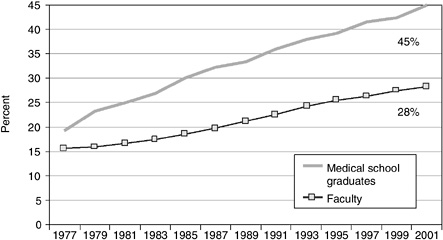
FIGURE 3 Representation of women in academic medicine, 1977-2001.
SOURCE: Association of American Medical Colleges.
TABLE 2 Percentage of Medical School Seniors Expecting to …
|
|
1990 |
1995 |
2001 |
|
… be significantly involved in research during their career |
|||
|
Women |
12 |
9 |
9 |
|
Men |
16 |
14 |
13 |
|
… become full-time faculty during their career |
|||
|
Women |
27 |
— |
28 |
|
Men |
30 |
— |
29 |
|
SOURCE: Association of American Medical Colleges. |
|||
In 1992 AAMC president Jordan Cohen established a task force on increasing women’s leadership. Dr. Diane Wara, who will speak later in this meeting, chaired that task force, and Dr. Page Morahan served as an adviser. The task force looked at four years of school-supplied data, interviews with department chairs, and new research from industry and higher education on women’s advancement. Here are the key findings.
-
Women make up 14 percent of tenured faculty, 12 percent of full professors, and 8 percent of department chairs.
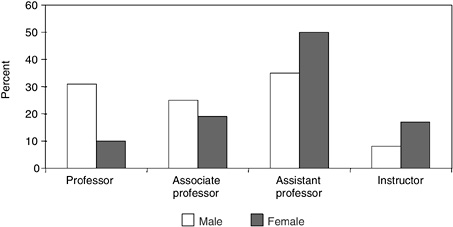
FIGURE 4 Medical college faculty by rank and gender, 2001.
SOURCE: Association of American Medical Colleges.
-
Few schools, hospitals, and professional societies have a “critical mass” of women leaders.
-
The pool of women from which to recruit academic leaders remains shallow.
Based on these findings, the task force came to the following conclusions:
-
The current wastage of the potential of women is of growing importance.
-
Only those institutions able to recruit and retain women will maintain the best house staff and faculty.
-
The long-term success of academic health centers is inextricably linked to the development of women physicians.
Recent research on women’s careers has found that women face many more challenges than men in obtaining career-advancing mentoring. Related to this, many men have difficulty effectively mentoring women. Isolation reduces women’s capacity for risk-taking, often translating into a reluctance to pursue professional goals or a protective response such as perfectionism. Finally, without being conscious of their “mental models” of gender, both men and women still tend to devalue women’s work and to allow women a narrower band of assertive behavior.
The task force developed the following recommendations:
-
Emphasize faculty diversity in departmental reviews, evaluating department chairs on their development of women faculty. This recommendation could be carried out by tracking the number of women recruited, promoted, and retained.
-
Target the professional development needs of women within the context of helping all faculty make the most of their faculty appointments, including guidance for men to become more effective mentors of women. The first step toward implementation might be to compare the costs of faculty development with the costs of faculty turnover.
-
Assess the gender-related effects of institutional practices such as regarding “academic success” as largely an independent act and rewarding unrestricted availability to work (i.e., neglect of personal life). Implementation might start with creation of an institutional committee to examine practices and policies for their unintended effects on women’s advancement.
-
Enhance the effectiveness of search committees to attract women candidates, including assessment of group process and of how candidates’ qualifications are defined and evaluated. One might begin by educating search committees on the pitfalls and opportunities in recruiting women.
-
Lend financial support to institutional Women in Medicine programs and the AAMC Women Liaison Officers and regularly monitor the representation of women in the senior ranks. A first step might be to conduct a salary equity study and a morale survey.
The most comprehensive analysis conducted to date of initiatives to develop women medical school faculty found that exemplary schools focus on improvements not specific to women: heightening department chairs’ focus on faculty development needs, preparing educational materials on promotion and tenure procedures, improving parental leave policies, allowing temporary stops on the tenure probationary clock and a less than full-time interval without permanent penalty, and conducting exit interviews with departing faculty.8 These schools regularly evaluate their initiatives by comparing the recruitment, retention, and promotion of women and men faculty and by conducting faculty satisfaction and salary equity studies. Surveying faculty about their career development experiences and their perceptions of the environment, comparing the responses of men and women, and presenting the results to faculty and administrators are particularly useful strategies. Such periodic surveys also build a rich data source about why people are leaving and what’s keeping the valued faculty at the institution.
The AAMC stands ready to help the societies and the medical schools work to implement these strategies and these recommendations. When all else fails, we
can start making the business case, rather than just the ethical case, for why this work is important. It is likely to mean a better bottom line. Those institutions, according to AAMC President Jordan Cohen, that fail to seize the advantages offered by elevating talented women to positions of power are destined to be eclipsed by those who do.
Participant (Dr. Herbert Pardes): Do you have information on the relative interests of women versus men in going into science in their freshman year or their incoming years before college? I’m looking for what kind of change takes place within the medical schools.
Ms. Bickel: I’ll check to see whether the AAMC‘s Matriculating Student Questionnaire contains that item that I showed you. All we know at this point is that women are more likely than men to lose their research intentions during medical school.
Participant: Do you think your findings are relevant to an individual institution?
Ms. Bickel: Absolutely. We believe the recommendations are just as relevant for individual medical schools as they are for societies. The principles are the same whether adopted by a department chair or a dean or the president of a society.
And like Dr. Morahan, I highly recommend Deborah Myerson’s book on tempered radicals and thinking in terms of the challenges and opportunities of being a change agent and when it is possible and when it is not possible to be effective in situations. How do you build coalitions, whether you’re the only woman or the only racial minority in a large area? How do you go about making the changes that you believe would benefit the organization and that you particularly value? Obviously, we need the support of meetings like this to inspire each other as well. Isolation is death when it comes to this kind of work.


