
International Aspects of Creating a State System for Countering the Illegal Circulation of Radioactive Materials in the Russian Federation
Vladimir M. Kutsenko*
Department for the Protection of Information and Nuclear Materials and Facilities, Ministry for Atomic Energy
I have been assigned the task of making specific recommendations for a program of joint activities in counterterrorism. These recommendations are based on practical measures we are taking in the Russian Federation to combat the potential for nuclear and radiological terrorism. Coming from a federal executive agency, our recommendations are of a purely practical nature in accordance with the purview of the Russian Ministry for Atomic Energy (Minatom).
We hope that the following five proposals correspond to the fundamental goal of the conference organizers by focusing specifically on what we should do and how we should do it.
-
On the initiative of Minatom in cooperation with the Russian Ministry of Internal Affairs (MVD), Federal Security Service (FSB), and Ministry of Foreign Affairs (MID), and with the involvement of other interested ministries and agencies, we have developed a draft of a provisional statute on a state system for countering the illegal circulation of radioactive materials within the Russian Federation and across its borders. This draft is being circulated for revision and approval by all relevant entities.
-
The draft statute includes the fundamental conceptual elements necessary for organizing the struggle against the illegal circulation of radioactive materials and for creating a state system linking and organizing the activities of the basic law enforcement and customs agencies, ministries, and departments dealing with the nuclear sector, and other interested organizations. The draft also defines the basic responsibilities and functions of these ministries, departments, and organizations, which primarily lie in preventing the possible criminal use of nuclear materials and radioactive substances.
-
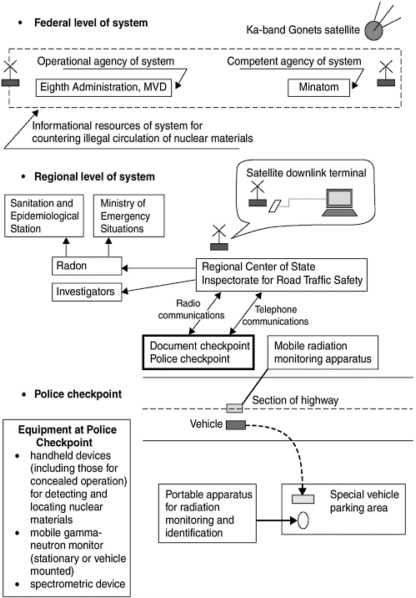
To facilitate further consideration of matters related to cooperation among the structural components of the system, plans for the first stage of the project call for creating a model district in the Moscow region as an element of the system for countering the illegal circulation of radioactive materials. A possible structure for such a model district is presented in Figure 1.
-
A fundamental component in the creation of a state system for countering the illegal circulation of radioactive materials is the development of devices for their detection, location, and identification and the provision of such instruments to the structural components of the system. Taking into account the special requirements inherent in the use of such devices, Minatom has created and tested models appropriate for stationary and mobile use. They may be categorized by intended use as follows: (a) handheld gamma and gamma-neutron monitors and similar devices for concealed installation for the detection and location of radioactive materials and (b) portable spectrometric devices for the identification of radioactive materials.
-
The draft statute pays special attention to the question of creating a well-developed information system on matters related to combating the illegal circulation of radioactive materials, including a number of central and agency-specific databases. In creating such systems, Russia also deems it expedient to propose that the international community examine the question of joining forces and coordinating the activities of all interested countries.
The main goal of creating a model district and subsequently implementing other elements of the draft plan is to facilitate the development of a federal system of preventive measures for combating nuclear and radiological terrorism. In this regard, Minatom proceeds from the belief that the problem cannot be resolved through a division of efforts by the various agencies but rather requires federal coordination.
International cooperation in countering nuclear and radiological terrorism is an objective necessity. In this area, there are problems demanding the unification of international efforts and the coordination of activities. In our opinion, these fundamental problems include
-
addressing matters related to the detection of nuclear materials
-
equipping law enforcement agencies with the necessary technical means and providing general and technical training for their personnel
-
dealing with organizational, legal, and other aspects of incident response
In dealing with all these problems as well as other matters, we feel it is necessary to create a joint working group operating under conditions of confidentiality.
We note that any form of terrorism presents a special threat to cities, with even greater consequences in national capitals. In this regard, creating a model
district in the Moscow region in 2003–2004 and obtaining practical results from its operation will make it possible to formulate a concept (system model) for protecting capital cities, especially those of United Nations Security Council member states, from the threat of nuclear and radiological terrorism.
At the same time, existing technical means for monitoring shipments of explosives, other hazardous cargo, weapons, and so forth, could be brought to bear in the creation of such a system. Work on addressing problematic questions in the model district could add substantial programmatic and practical impetus to efforts to deal with this urgent current problem.
Proposals to the International Atomic Energy Agency (IAEA) of an international program for countering and suppressing the illegal circulation of radioactive materials as a preventive measure in the struggle against nuclear and radiological terrorism could serve as a basis for cooperation. My preliminary estimate is that the establishment of monitoring devices in a model district will cost the equivalent of $250,000.
It should also be noted that all matters connected with the creation of this system are of a confidential nature and should not serve as instructions to terrorists in how to circumvent it.


