
Urban Security and September 11, 2001, in New York City: Projection of Threats onto a City as a Target and Measures to Avert Them or Minimize Their Impact
George Bugliarello
Polytechnic University
Cities encompass a growing portion of the world’s population—today, more than 40 percent and in the United States almost 80 percent. They are sites of concentrated economic and social activities and government operations and have extensive infrastructures. In the very nature of the activities they host, in their structures, and in their monuments, they also constitute powerful symbols that embody the pride of a nation. Cities, especially large ones, are particularly vulnerable because all their systems are interdependent, and the vulnerability of one system leads to that of other systems. For these reasons, historically, cities have been prime targets of terrorist attacks, exemplified by the bomb exploded in the World Trade Center in New York City in 1993; the attack and destruction eight years later on September 11, 2001, of the World Trade Center in New York City; the attack on the Pentagon in Washington, D.C., also on September 11, 2001; and the attacks in the Tokyo subway, in Tel Aviv, in New Delhi, and in a Moscow theater production of Nord-Ost.
Thus far, most attacks have been predominantly low-tech ones, executed with simple means. However, many other kinds of attack are possible, exemplified by the attacks with sarin in Tokyo and with anthrax in the United States and by the airplanes of September 11, 2001 (which were hijacked, however, with simple means). Cities have also been, historically, sites of major incidents of social violence—riots and street brawls, as well as civil internal wars and external warfare. A brief and by no means complete listing of what happened in the decade 1989–1999 is contained in Table 1.
An important characteristic of cities is that not only can they be targets of attacks, but they can be potential suppliers of what terrorists need to carry out their attacks (Box 1). They possess a large number of biological and chemical laboratories and stores, as well as, in many cases, biological and chemical indus-
TABLE 1 Cities with Major Incidents of Social Violence (1989–1999)1
|
Civil or Internal War or Urban Terrorism |
Riots or Street Protests by the Civilian Population |
External Warfare |
|
Baku Beijing Bogotá Buenos Aires Cairo Colombo Kabul Karachi Kinshasa Lahore Lima London Madrid Manchester Mogadishu Monrovia Moscow New York Oklahoma City Paris Phnom Penh Port au Prince Tbilisi Tokyo |
Belgrade Bombay Calcutta Dhaka Jakarta Los Angeles Rangoon |
Baghdad Belgrade Grozny |
tries; they can provide radiation sources in hospitals, laboratories, and instructional nuclear reactors; they have fuel depots, gas pipelines, liquefied natural gas storage, electronics stores, computer labs in universities that can give access to cyberterrorists, and vehicles that can be used in a terrorist attack—trucks, tankers, bulldozers, armored bank vehicles, as well as just cars. Cities are also large potential suppliers of human resources for terrorism and—in libraries, universities, and other institutions—of the information terrorists may need to plan and carry out their attacks. They can be significant sources of funding through banks and businesses and through associations and religious institutions that can organize fundraising drives.
The threats that can be aimed at a city are the well-known ones of chemical attacks (explosives and poisons); biological, radiological, and nuclear attacks; and cyber-, electromagnetic, and psychological attacks. These threats find the city a target-rich environment, housing a complex interacting system of people, buildings, infrastructures (utilities, roads, railroads, ports, airports), hospitals, schools, churches, businesses, government, military bases, and also of patterns of work, business, home life, leisure, and shopping activities that, all together, define a city’s way of life. A potential target that has grown very rapidly is the
|
BOX 1
|
so-called telecom hotels, facilities housing the devices that connect networks. Table 2 shows a recent accounting of their number in some American cities.
Each threat to a city can target one or more of these interacting systems or activities (Figure 1). Explosives can be targeted at people or structures; electromagnetic pulses can be directed at elements of the infrastructure, such as airports or utilities, which in turn can affect the functioning of hospitals, schools, and other institutions; and psychological threats can be aimed at people and organi-
TABLE 2 A Growing Potential Target: Cities with the Largest Number of Telecom Hotels2
|
City |
Number of Telecom Hotels, 2001 |
|
New York |
64 |
|
Los Angeles |
46 |
|
Dallas |
37 |
|
Atlanta |
36 |
|
Seattle |
30 |
|
Chicago |
72 |
|
San Francisco |
25 |
|
Miami |
24 |
|
Phoenix |
23 |
|
Austin |
19 |
|
San Diego |
17 |
|
Portland |
17 |
|
Washington, D.C. |
16 |
|
Denver |
16 |
|
Las Vegas |
14 |
|
San Jose |
13 |
|
Pittsburgh |
13 |
|
Philadelphia |
13 |
|
Jacksonville |
13 |
|
Minneapolis |
12 |
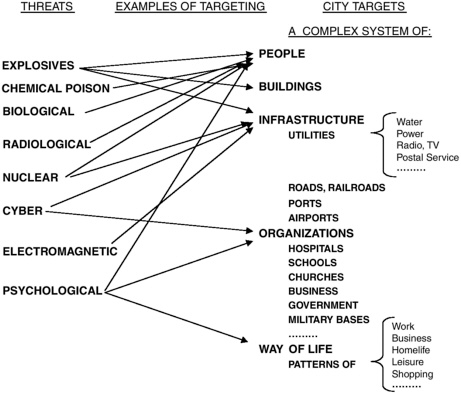
FIGURE 1 Cities’ threats and targets.
zations to affect the way of life of the city’s inhabitants. In protecting cities from terrorist threats, we frequently tend to focus more on the physical protection of people, structures, and organizations than on the powerful impacts of psychological threats.
In general, the threats can reach the targets with a variety of modalities of delivery. Countermeasures may address directly the threats, the modalities of their delivery, and the strengthening and resilience of the target (Figure 2). The countermeasures directly addressing the threats at their origin or in their transit toward the city, for example, in a ship, plane, or train, are basically the same whether an urban or nonurban attack is considered. However, many of the countermeasures against the modalities of delivery within the city and many of the countermeasures for protecting targets are peculiar to the urban environment. Modalities of delivery may range from cars in basement garages to the arrival of weapons of mass destruction in shipping containers, from the penetration of heating, ventilation, and air conditioning systems to attacks on subway stations. Means for counteracting them include sensors, reconfiguration of traffic patterns, as well as, of course, inspections and checkpoints. Countermeasures to increase the resilience of targets in an urban environment include hardening of
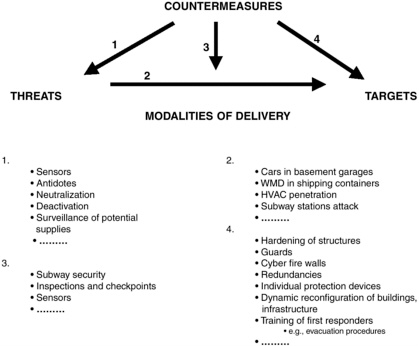
FIGURE 2 Countermeasures.
structures to explosives, fire, chemical, and biological attacks; cyber firewalls; redundancies; dynamic reconfiguration of buildings and infrastructure; and training of first responders in procedures to evacuate tall buildings.
Given the complexity of the system of targets in a city shown in Figure 1, an overarching need is a comprehensive system view of a city that explicitly addresses the interdependence of components and overall vulnerabilities. It is fair to say that, at this moment, such a view is by and large lacking. Integration of responses, starting with the issue of how persons in charge can coordinate the response to an attack in an integrated fashion, is also a critical need. There are increasingly, however, technological tools being developed, such as ad hoc computer platforms, that can help an incident commander in the integrated management of all the resources available.
PRINCIPLES AND OBSERVATIONS
From the aforementioned, 10 principles and observations emerge:
-
Given the nature of the city as a system of interacting systems, the importance of the weakest link is of overriding significance. Examples are cybersecurity vulnerabilities, dependence on the Internet, and the vulnerability of crowds
-
piling up against control points. Addressing these interacting systems and assessing and correcting the vulnerabilities of their weakest links are of vital importance and require advance modeling and simulations.
-
Sociotechnological interface factors often represent a weak link in the system of defense of cities. Failures of protective systems may be as much failures of social organization or human nature, as of a purely technical nature.
-
The intimidation and terrorizing of a population can be carried out by purely psychological means and deserves major attention.
-
Not everybody or everything can be protected in a city, making it essential to identify the critical components of infrastructures and organizations and give priority to their protection.
-
In designing the protection of a city, starting with that of its critical components, it is important to distinguish among what can be done now, what could be done in a relatively short time, and what will require a much longer time. Each of these time horizons needs to be addressed. Thus, immediate protection of a building may require guards and checkpoints, but in a longer time frame redesign of the building and development of sophisticated sensors may improve the efficacy of the protection and become more desirable.
-
The issue of centralization versus decentralization is complex. In some cases, decentralization is important for certain critical systems, as it is for major network nodes and telecom hotels, to reduce the vulnerability of the overall system. In other cases, however, the demands of the situation are not so simple. Thus, first responder systems need to be centralized to provide an organized response to an incident, but at the same time, they need to be decentralized in some fashion to reduce their vulnerability and make the response organization resilient even to direct attack and destruction of its command post.
-
Piggybacking on other systems, that is, the ability to use existing systems to which new functions may be added, becomes important given the magnitude of the task in providing a defense for a city. For instance, existing networks of air quality monitors can be enhanced with sensors for chemical and biological substances, and cellular phones can become elements of an incident information system.
-
Mobilization of private resources can contribute facilities and personnel and carry out important functions in response to terrorist threats or attacks. There are, in cities, very significant resources outside the government systems, such as medical departments of companies and private engineering firms or construction firms.
-
In water systems, the major vulnerability to chemical, biological, and radiological agents is usually more in the pipes than in the reservoirs. This fact may need to be taken into account in order to identify the critical vulnerability and deploy scarce resources in the defense of cities.
-
Preparation for and response to terrorist attacks places large demands on training. For instance, the operators of subway systems need to be trained to
-
understand the fundamental difference between the actions required in a fire and those required in a biological or poison attack. In a fire, the imperative is to attempt to vent the fire as much as possible to the exterior of the subway. In a biological or chemical attack, the imperative is to contain chemical and biological agents within the subway, so as not to vent them outside to the street level where they could cause a very high number of casualties, beyond the people trapped in the subway.
SOME SEPTEMBER 11, 2001, LESSONS IN NEW YORK CITY
The events of September 11, 2001, in New York City can provide a useful reminder of the technological challenges that a city faces when confronted by a terrorist attack. I offer a series of observations and assessments as a means to stimulate further discussion. Some of the weaknesses discussed here have been or are in the process of being remedied.
-
The security checkpoints at the airports where the terrorists boarded the planes to attack the World Trade Center in New York and the Pentagon in Washington, D.C., were not effective. It is not totally clear why, but one of the contributing factors was that the box cutters used by some of the hijackers were not, at the time, prohibited as passenger carry-on items.
-
In New York City, a lack of interoperability prevented the fire department and the police department from communicating effectively with each other. This was due to different frequencies and to incompatible devices, as well as, possibly, to sociological factors. Consequently, for instance, the police department had information on the conditions of the buildings attacked, as watched from helicopters, that could not be made available to the fire department.
-
The incident commander of the fire department could not reach firefighterson high floors in the World Trade Center towers because of the inadequacy of the department’s radio communications. This is a significant technological challenge.
-
The city’s emergency center was located in the World Trade Center—the most vulnerable target for the attack. The fire and police department command posts were located at opposite ends of the incident scene. Also, site and traffic control became difficult because of the large number of volunteers that tried to converge on the incident site and the lack of rapid assessment of the dimensions of the incident. All these incident management challenges are technologically relatively easy to address.
-
More complex was the lack of immediate availability of building plans to the first responders. Timely availability of those plans would, in general, greatly facilitate the first responders’ task of developing a response strategy and deploying their forces.
-
Uncertainty about the possibility of further terrorist action might have led to an overreaction. This was prudent in light of what was known at the time, but
-
lack of sufficient intelligence led to reactions that affected a large portion of the metropolitan area. The availability of intelligence and a broad citywide system model are major technological challenges that need to be addressed.
-
The occupants of the World Trade Center buildings received conflicting guidance as to what action they should be taking. Escape routes inside the buildings were bottlenecked. Even more serious, blocked escapes to the roof above the floors that were hit by the aircrafts would have prevented evacuation from the roof, even if means had been available to do so. Evacuation from high floors when internal escape is impossible and the inability of helicopters, in general, to evacuate from the roofs of tall buildings in the presence of strong wind or fire are major technological challenges. Another challenge is providing inexpensive personal devices, such as simple masks and fireproof clothing, which would enhance the chance of a person to escape. (Some of these masks are commercially available.)
-
There was a concentration of telecommunications network equipment at the target. Colocation of wire and wireless communications equipment at a target does not provide alternatives when their common site is destroyed.
-
Structural steel elements in the two World Trade Center buildings had inadequate fireproofing, for reasons still to be fully understood. This would not have prevented the collapse of the structures but conceivably could have helped to slow it. The incident also showed the vulnerability of ultralight structures such as those of the World Trade Center towers. In the Pentagon, the resistance of structures that had recently been reinforced with strong cross-member connection showed the importance of structural design in limiting the damage.
-
It was not possible to quickly assess the structural condition of the World Trade Center buildings—both those directly impacted and those surrounding them. This was a crucial factor in the indecision about evacuation of the towers and in determination of the actions that should have been taken for the other buildings not directly impacted. A technological challenge is to provide sensors that can determine the structural conditions of a building in order to alleviate the cumbersome and less effective means of optically observing possible structural movements with human operators around the clock, as had to be done at the World Trade Center.
-
In the area of remediation, debris clearing in New York City was done in an exemplary fashion. It highlighted the technological and sociopolitical challenges presented by the magnitude of the debris, in coordinating the clearing actions, finding a site for the debris, and transporting the debris to outlying areas (outside Manhattan). A major technological challenge, of course, is remediation of the possible health effects of the incident. As yet, the long-term effects of the attack on the World Trade Center are not fully known.
-
The issue of planning and public approval for the reconstruction phase after the attack has presented significant legal and social challenges.
In addition, other needs emerge from the experience of September 11, 2001. Some of them are mainly technical, while others are of a more sociotechnological nature. A partial list in no particular order might include
-
secure communications networks for first responders
-
ad hoc networks to enable all the emergency responders to communicate with each other and possibly with victims immediately after an incident
-
self-healing grids for telecommunications and other utilities networks
-
in-building repeaters optimally positioned for incident communication
-
portable rapid sensors of biochemical and radiological threats
-
supplemental technological means for guards where feasible or desirable
-
robots for investigation and action (robots may be purely electromechanical or may also include human involvement)
-
standard paradigms and programs for assessing overall vulnerabilities and risks of a city to various terrorist threats, singly or in combination
-
virtual reality simulators to train emergency managers and first responders and to better visualize the interlocking vulnerabilities of the systems that make up the city
-
data banks about previous incidents, pertinent science and technology information and resources, and so forth
-
a better understanding of the behavioral patterns of decision makers, first responders, and the population at large when under stress
-
a better understanding of the psychology and behavior of terrorists
-
new design concepts for structures, networks, and supply systems
-
improved interfaces between operations organizations and science and technology resources
THE ROLE OF POLYTECHNIC UNIVERSITY
Universities can be a significant component of the resources that a city can utilize in addressing threats to its security. Polytechnic University in New York is a case in point. The university has its Brooklyn campus located at Metrotech (an urban knowledge park)3 two miles from the World Trade Center. In the wake of the September 11, 2001, attacks, it developed an Urban Security Initiative (USI) with the mission of addressing pressing urban security problems through the engineering, scientific, management, and educational capabilities of the university and collaborating institutions, industries, and public entities. The initiative is favored because Metrotech is also the site of the headquarters of the city’s fire department; the Department of Information Technology, a major energy utility; and technological centers of major financial institutions.
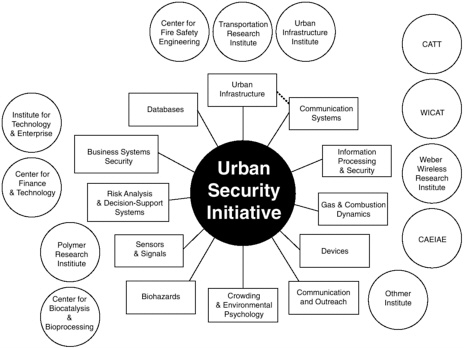
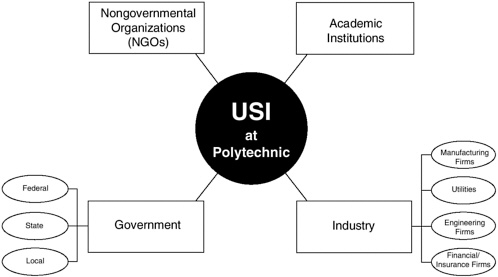
The USI’s current focus is on fire and emergency communications and operations, cybersecurity, biochemical sensors, and urban infrastructural systems, particularly water and energy utilities and transportation systems. These topics, and other emerging ones, are addressed through research and development, education and training, and conferences and symposia. USI is endeavoring to develop a repository of information on urban security issues and technologies. The scope of the initiative as a catalyzer of the expertise of Polytechnic University is shown in Figure 3, and the overall conception of its interaction with other organizations and institutions is shown in Figure 4.
CONCLUSION
The issue of urban security is immense and complex. This paper has attempted to provide an overview of some of its principal elements and characteristics, complemented by observations about the events of September 11, 2001, in New York City. The problems that cities face in confronting terrorism demand special attention and present major scientific and sociotechnological challenges.
NOTES
|
1. |
Mitchell, 1999, http://www.ees.lanl.gov/EES5/Urban_Security/pdfs/cities_tatlissues.pdf. |
|
2. |
Evans-Crowley, J., E. J. Malechi, and A. McIntee. 2002. Planning Responses to Telecom Hotels: What Accounts for Increased Regulation of Colocation. Journal of Urban Technology 9:3 (December). |
|
3. |
Bugliarello, G. 2002. Urban Knowledge Parks in Toward a New Agenda: Business, Social and Urban Development Impacts, Proceedings of the XIX IASP World Conference on Science and Technology Parks, International Association of Science Parks. |


