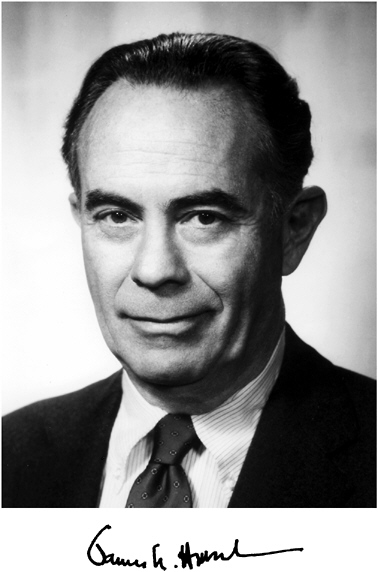
WILLIAM REDINGTON HEWLETT
May 20, 1913–January 12, 2001
BY ROBERT J. SCULLY AND MARLAN O. SCULLY
WILLIAM REDINGTON HEWLETT passed away on January 12, 2001, endowing that day with a national significance. The Silicon Valley miracle was in large part fostered by William Hewlett and David Packard. Indeed, the ideas and ideals of the Hewlett-Packard Corporation set a high standard for the industry. During his life Hewlett was recognized by his profession, his country, and his peers as the hero that he was. He was president of the (now) Institute of Electrical and Electronic Engineers in 1954 and was elected to membership in the National Academy of Engineering in 1965 and the National Academy of Sciences in 1977. President Reagan awarded him the National Medal of Science in 1983, and he was awarded the prestigious “Degree of Uncommon Man” by Stanford University in 1987.
Hewlett-Packard was and is a testament to the success of the free enterprise system and the American dream. The simple, honorable ideals and intensely productive practices they employed propelled a business started in a garage during the Depression to stardom. William and his lifelong friend and partner, David Packard, owned and ran a unique company dedicated to the premise that profits were based on the well-being of its most important assets: its employees. It
was in the dark days of the Depression, in a small Palo Alto, California, garage where the country witnessed the birth of an era. How William Hewlett and David Packard started that era is a fascinating story in the annals of engineering science.
William was born on May 20, 1913, in the intellectual Mecca of Ann Arbor, Michigan. His father, Albion W. Hewlett, was a doctor who taught medicine at the University of Michigan. When Will was three, his dad moved the family back to their native California, where he taught at Stanford University. Despite having dyslexia, Will attended a prep school, where he excelled in math and the sciences. But he had problems with everything else. Many dyslexics have problems adapting and developing in society, but Hewlett dealt with this reading disability in his usual engineer fashion. He adapted by learning to memorize and repeat subject matter over and over to himself. Life’s future obstacles would be dealt with in a similar fashion; they were intriguing challenges begging a solution. Will would prove to be a solution master.
At an early age he began his engineering career the way many others in his profession do: by blowing up things. His preferred method was stuffing doorknobs full of explosive. Years later he stated that a doorknob was hollow and compact, and you could put it to good use as a bomb. Despite this not so docile hobby, Will was a good and well-behaved kid. Compared with his adult life, he preferred to keep to himself as a young man. He wasn’t nearly as socially active as his partner, Dave Packard. Dyslexia does not do wonders for a person’s self-esteem, and it is likely that he spent much of his energy growing out of his disability.
But grow out of it he did, developing a love for the outdoors as an avid mountain climber with a penchant for camping. To Will there was a bright new world, including
the Sierra Nevadas waiting to be discovered. At age 12, Will’s father died of a brain tumor. Deeply troubled by his father’s death, he sought the refuge of the school science lab and the looming mountains. To help the family cope with the tragedy Will was moved with his sister Louise to France for a year. While there he was tutored by his mother and grandmother.
High school would not prove him to be an outstanding student. Nevertheless he had his sights set on attending Stanford University. The principal initially refused to recommend him to the university, until she learned his father had been Albion Hewlett. The surprised principal exclaimed, “He was the best student I ever had.” The letter of recommendation to follow would allow Hewlett to open the doors to a new world of technology. An ROTC cadet at the college, he became a reservist officer in the army, with a specialization in ordnance. He received a B.A. from Stanford in 1934. Two years later he was awarded the degree of Electrical Engineer and three years after that he achieved his M.S. in Electrical Engineering, this time from the Massachusetts Institute of Technology. Hewlett wasted no time; immediately after graduation he formed his own company.
Will had become close friends with David Packard while an undergraduate at Stanford. They had many things in common, apart from the social scene. Both liked to blow up things. Both had an avid love of outdoor activities. Hunting, fishing, skiing, and mountain climbing were the early trademarks of the future fathers of the Silicon Valley. And both had a burning desire to discover, develop, and invent.
So it was that Hewlett-Packard came into being in 1939 in their garage with an investment capitol of $538. The Depression didn’t make things easy for the new company, but it did push the two partners to perform. Hewlett recalled, “In the beginning we did anything to bring in a
nickel. We had a bowling lane foul line indicator. We had a thing that would make a urinal flush automatically as soon as a guy came in front of it. We had a shock machine to make people lose weight.”
Over the next two years Hewlett-Packard inventions would become more practical. One of their notable early achievements was the development of an audio frequency oscillator. Those were the days when electronics was a new field: half science and half art. The resistance-tuned oscillator was a new idea that hadn’t come to fruition because of inherent stability problems. Hewlett came up with an ingenious solution. He invented a variable frequency oscillator that was stabilized by a small light bulb. This simple addition to the circuit made the device into an inexpensive, reliable instrument.
They called their oscillator the 200A, and it was used to calibrate the sophisticated sound systems of the large studios. They called it 200A because calling it, say 1A, would reflect inexperience to potential customers. Walt Disney purchased eight of them for use in the film Fantasia. The success of these and other devices like it helped set the stage for Hewlett-Packard’s future and present missions in regard to research and development. Although pioneers in the field of new research, many of the technologies they would field would be testing and calibrating equipment for technological equipment already in existence.
The spring of 1941 would see the young company thrust into World War II before Pearl Harbor. Will was called to active duty. Hewlett had no problem adapting to the rigors of military discipline; in fact, even in time of war he found the army to be too lax for his liking! Decades after the war he would recall his military service for biographers in that chronological, duty-station manner that is a trademark of former servicemen. It’s a reflection of the veteran’s former
integrity, motivation, and even optimism when he sees his service time in such a manner; he is a small cog in a big wheel, equal and generic but nonetheless important and useful.
Hewlett originally worked in the Aviation Ordnance Department. It wasn’t a good use of his technical skills but rather a result of his ROTC training. Here his buddy Dave would look out for him, as he would continue to do many times in the coming years. Dave Packard was making contacts left and right in the defense sector, and his technological breakthroughs in the young company were earning him friends in high places. As such, he wrote Colonel Colton of the Signal Corps, explaining the benefits of having Hewlett transferred.
Hewlett was transferred to the Signal Corps at Fort Monmouth. Here he would put his electrical engineering skills to good use. But not for long; that summer Hewlett-Packard would go from a partnership to becoming a corporation. The difference this made for Hewlett was that the government now recognized him as an essential employee. He was released back to Palo Alto for a couple of months, only to be called back to Washington after Pearl Harbor.
Again he worked for Colonel Colton. For most of the war he worked for him in Washington, learning among other things the bureaucratic ways there. Hewlett was unaccustomed to working less than 12 hours a day, but he was forced to as the bureaucrats in Washington insisted on locking the safe at six o’clock each night. This meant Will had to hand over his documents and call it a day. Although Will found this frustrating, his new wife, Flora Lamson, a biochemist whom he married in 1939, was delighted. Flora was a loyal wife who accepted the fact that a man like William spent most of his time away from home. But she would be
quite busy herself, eventually taking care of their five children, Eleanor, Walter, William, James, and Mary.
Hewlett had more energy and ambition than the army required, but he was still well liked. He had that slightly rugged athletic-looking face that is popular in the military. World War II would go out with a bang for Hewlett. He would be transferred to a staff job, working for General Wharton in the new products division. He was sent to the Philippines toward the end of the war, where he helped with assimilating new technologies into the frontline units of the military.
At about the time of the surrender he was given an intelligence assignment that would take him to Japan. He was part of a team that would take a quick look at what the Japanese had been doing. Hewlett suspected that part of the purpose was to discover what they had been doing with the atomic bomb, but he wasn’t told that. Will took an interest in a man named Yagi, who was the civilian head of research and development. Yagi was helpful and knew the right directions in which to steer the investigators.
Yagi was a very frustrated man. He explained an example of his situation to Hewlett, who recalled that the Japanese government had announced the development of a “death ray.” Yagi knew it was nonsense, but he had to appear to work on developing one anyway.
Hewlett found the Japanese electronics to be underdeveloped and primitive. Contrary to popular opinion, there was little if any cooperation between the Japanese army and navy or between the government and the civilian research and development community. Hewlett made the observation that the Japanese navy had been around the world for 10 years prior to the war; they knew what was out there and what the country was getting into. On the other hand the army had spent the previous 10 years occupying Manchuria
in China, where they met ill-equipped, untrained forces. Will noted the result was that the army believed it could defeat the world. It was a fitting discovery for the lieutenant colonel on which to end a military career. Mr. Hewlett returned to Palo Alto in 1945.
If Hewlett did not get shell shock in combat, he certainly got a shock when he came home. The company was no longer garage based, but had become a thriving industry of over 200 employees. It was growing at 100 percent per year. But any shock he had would soon turn to gratification, as he was named vice-president of the burgeoning company. And if David hadn’t done enough in securing that for him, William could always look at his old friend’s past pay stubs. David thought it unfair to stay home and make more money than his buddy who went off to war, so he kept his salary at a level lower than that of Will’s service pay.
Sound like today’s corporate executives? Things were different then. They were different because men like Hewlett made them different. The country’s greatest generation came of age during the Depression and left its youth behind on the battlefields of World War II. They were free to work at adult jobs in their youth, blow up things, and generally find their niche in life as they saw fit. From his defeat of dyslexia to his unusual role in the war, Hewlett saw humanity as a raw resource of power that could only grow when left alone and encouraged from the sidelines. As such he brought a unique style of management to his company.
Will set the foundation of one of the world’s greatest and most effective philosophies. Like his designs, it is simple and straightforward. It is no more complicated than the level of enthusiasm and encouragement that develops with compassion, trust, and loyalty. Today it is backed by enthu-
siastic and loyal employees who extend the frontiers of technology while adding economic wealth to the nation.
Will was a leader of engineers and the soon-to-be Silicon Valley was becoming their Mecca. All of the United States’ eastern institutions loved him, and after the war, from MIT to Bell Labs, a western migration of the country’s technological think tanks began. They came for the free and open environment that was as enticing to them as a trophy buck is to a hunter. Once the engineers got settled in their new home they lit up the “developmental skies” with their fireworks. Free from micromanagement and given great personal empowerment and discretion, Silicon Valley personnel cooperated greatly with each other, turning the wheels of invention as never before. Hewlett-Packard employees in particular were loyal and dedicated men and women who took their work home with them; they slept with it, they worked it on napkins, they discussed it on the golf course and at dinner.
From his early work on electronic oscillators to the development of the H-P pocket calculator, Hewlett was a problem-solving pathfinder. He didn’t manage by directive; his style was “management by walking around.” Paul Ely recalls Hewlett’s visits to his microwave lab with pleasure, in his words: “Hewlett knew more about more things than any person I ever met.”
As Hewlett-Packard prospered the Silicon Valley prospered around them. But the Hewlett-Packard Way never adjusted or deviated in any way from those original principles of employee empowerment and management and subordinate teamwork. The ideals set forth were so pure and special that they spoke, and continue to speak, for themselves. Will employed them as a “code,” one that transcended written guidelines and needed not a great deal of training to grasp.
One major difference exists between the Hewlett-Packard Way of then and many of those that try to emulate it today. Today’s highly technological and highly complicated businesses feel that ideals and mores must change and advance right alongside technology. True, technology must adapt and reinvent itself to continue to be productive. But the definition of ethical behavior must not be constantly changing. To do so is superficial and can’t foster the lifelong nurturing necessary in developing a truly loyal and honest workforce.
William did not intend the Hewlett-Packard Way to be conveyed by some public relations types. No illustration of the Hewlett-Packard Way is better given than by that of Will himself. In the mid-1960s the company was well into its noted reputation for making quality printers. But a quality problem arose with one of their models, which exposed the company to warranty problems in the tens of millions of dollars. A frazzled Rick Belluzzo was required to describe the situation to the board, including Hewlett.
As Belluzzo described the printer holocaust that was losing large sums of money, he couldn’t tell whether Hewlett was even paying attention. The dreadful proceedings dragged on and on, until Will finally asked, “Rick, what have you learned from this experience?” They talked about the mistake and found out where they went wrong, to which Will said, “Make sure your number one responsibility is to take care of our customers.”
Such is the HP Way. Rather than belittling people for their mistakes, management works with them to solve the problem and bring out the best in themselves. Finger pointing and politics can find no place in this. It is a strong, brotherly concept requiring no great deal of explanation. It is, in the words of our founding fathers, “a truth that is self-evident.”
As the company expanded to become the backbone of the Silicon Valley, Will seems to have realized that while the HP Way was not subject to change, his role in the world was. He was now one of the richest men in the world (and to think his partner, Dave, had deliberately kept his salary below that of his service pay). Will would extend the HP Way beyond profits and productivity to enter into the world of development through philanthropy. Flora was an active supporter with Will in this until her unfortunate death. Will would go on to marry Rosemary Bradford, helping to raise his five new stepchildren. And his interests in supporting the community would skyrocket.
As such Will was keenly interested in the fields of medicine and education. He even served as the director of the Drug Abuse Council in Washington, D.C., from 1972 to 1978. He was on the board of numerous colleges and hospitals and was the recipient of numerous titles and honorary degrees. In 1995 he donated $70 million to the Public Policy Institute of California, a group that studies the economic, social, and political issues facing California.
This last action would be his final major endeavor. It was opposite in scale to his opening of the “HP Garage,” but equal in vision. The Silicon Valley had brought enormous growth and prosperity to southern California, but with it came the traditional challenges of overpopulation, massive immigration, destruction of the once plentiful forests and so on. William contributed to the conglomerate he had laid the foundation for with an open heart of compassion, sympathy, and understanding—with the hope that the next Silicon Valley would be a more perfect organization, not just a group of for-profit companies, but a society. A society of people from all walks of life that would live and work together with dignity and respect. It was a step toward re-
storing the spirit William remembered in the California of half a century ago, so much of which has been lost.
It was as if William sensed his time was up when he made that donation. In the late 1990s he was stricken with a series of debilitating strokes that left him in a wheelchair. However, the HP Way is alive and in full force. On that day of January 12, 2001, William Hewlett’s influence did not end. His enduring and legendary contributions continue to enrich us all.
EDUCATION
|
1934 |
B.A., Stanford University |
|
1936 |
M.S., Electrical Engineering, Massachusetts Institute of Technology |
|
1939 |
Degree of Electrical Engineer, Stanford University |
PROFESSIONAL EXPERIENCE
|
1941-45 |
United States Army, on the staff of the army’s chief signal officer and later transferred to the New Development Division, serving in Washington, D.C., the Philippines, and Japan. He attained the rank of lieutenant colonel. |
|
At Hewlett-Packard Company: |
|
|
1939-47 |
Cofounder and partner |
|
1947-57 |
Vice-president and director |
|
1957-64 |
Executive vice-president and director |
|
1964-68 |
President and director |
|
1977-78 |
President, chief executive committee, chief executive officer and director |
|
1978-83 |
Chairman of the Executive Committee and director |
|
1983-87 |
Vice-chairman, Board of Directors |
|
1987 |
Director emeritus, Board of Directors |
SERVICE
|
1956-58 |
Palo Alto Stanford Hospital Center, president of the board (director, 1958-62) |
|
1958-68 |
Trustee, Mills College, Oakland, California |
|
1962-72 |
Trustee, The RAND Corp. |
|
1963-68 |
Trustee, California Academy of Sciences |
|
1963-74 |
Trustee, Stanford University, Stanford, California |
|
1965-68 |
Member, President’s General Advisory Committee on Foreign Assistance Programs, Washington, D.C. |
|
1965-74 |
Director, FMC Corp. |
|
1966-69 |
Member, President’s Science Advisory Committee |
|
1966-83 |
Director, Chrysler Corp. |
|
1966-94 |
Chairman, William and Flora Hewlett Foundation |
|
1968-90 |
Trustee, California Academy of Sciences (honorary) |
|
1969-70 |
Member, San Francisco Regional Panel of the Commission on White House Fellows (chairman, 1970) |
|
1969-77 |
Director, Overseas Development Council |
|
1969-80 |
Director, Chase Manhattan Bank |
|
1969-81 |
Member, San Francisco Bay Area Council |
|
1971-90 |
Trustee, Carnegie Institution of Washington (trustee emeritus, 1990) |
|
1972-74 |
Consultant, The RAND Corp. |
|
1972-74 |
Director, Drug Abuse Council, Washington, D.C. |
|
1972-78 |
Director, Kaiser Foundation Hospital and Health Plan Board |
|
1974-85 |
Director, Utah International, Inc. |
|
1980-81 |
Coordinator, Chapter on “Research in Industry,” National Academy of Sciences Five-Year Outlook Report |
|
1980-86 |
Chairman, Carnegie Institution of Washington, Board of Trustees |
|
1982-83 |
Member, National Academy of Sciences Panel on Advanced Technology Competition |
|
1986-88 |
Director, University Corporation for Atmospheric Research Foundation |
|
1986-92 |
Member, International Advisory Council, Wells Fargo Bank |
|
1986-2001 |
Director, National Academies Corporation |
|
1987-88 |
Member, Advisory Council on Education and New Technologies, the Technology Center of Silicon Valley |
|
1987-2001 |
Director, Monterey Bay Aquarium Research Institute |
PROFESSIONAL RECOGNITION
|
1969 |
California Manufacturer of the Year, California Manufacturers’ Association |
|
1970 |
Business Statesman of the Year, Harvard Business School of Northern California |
|
1971 |
Medal of Achievement, WEMA (Western Electronic Manufacturers Association) |
|
1973 |
Founders Medal, the Institute of Electrical and Electronics Engineers (IEEE), to Hewlett and Packard Industrialist of the Year to Hewlett and Packard, California Museum of Science and Industry and California Museum Foundation |
|
1975 |
SAMA (Scientific Apparatus Makers Association) Award to Hewlett and Packard |
|
1976 |
Vermilye Medal to Hewlett and Packard, the Franklin Institute, Philadelphia Corporate Leadership Award, Massachusetts Institute of Technology |
|
1977 |
Medal of Honor, City of Boeblingen, West Germany Herbert Hoover Medal for Distinguished Service, Stanford University Alumni Association |
|
1984 |
Henry Heald Award, Illinois Institute of Technology |
|
1985 |
National Medal of Science, U.S. National Science Committee and former President Reagan |
|
1987 |
Santa Clara County Business Hall of Fame Laureate Award, Junior Achievement World Affairs Council Award, World Affairs Council of Northern California Degree of Uncommon Man, Stanford University Commander’s Cross of the Order of Merit of the Federal Republic of Germany |
|
1988 |
National Business Hall of Fame Laureate Award, Junior Achievement |
|
1990 |
John M. Fluke, Sr., Memorial Pioneer Award, Electronics Test Magazine |
|
1991 |
Silicon Valley Engineering Hall of Fame Award, Silicon Valley Engineering Council |
HONORARY DEGREES
|
1966 |
LL.D., University of California, Berkeley |
|
1976 |
LL.D., Yale University |
|
1978 |
D.Sc., Kenyon College D.Sc., Polytechnic Institute of New York |
|
1980 |
Eng.D., University of Notre Dame Eng.D., Utah State University |
|
1983 |
Eng.D., Dartmouth College LL.D., Mills College |
|
1985 |
L.H.D., Johns Hopkins University Doctor of Public Policy, RAND Graduate Institute |
|
1989 |
Doctor of Electronic Science, University of Bologna, Italy |
|
1991 |
Doctor of Humanities, Santa Clara University |
SELECTED BIBLIOGRAPHY
1936 A History of the Amplification of Wave-filters. Massachusetts Institute of Technology Report.
1939 With F. Terman, R. Buss, and F. C. Cahil. Some applications of negative feedback with particular reference to laboratory equipment. Inst. Radio Eng. Proc. 27(Oct.):649.
1940 With F. Terman, C. W. Palmer, and W. Y. Pan. Calculation and design of resistance-coupled amplifiers using pentode tubes. Trans. Am. Inst. Eng. 59:879.
1942 Variable frequency oscillation generator. U.S. Patent 2,268,872.
1948 With W. J. Warren. An analysis of the intermodulation method of distortion measurement. Inst. Radio Eng. Proc. 36(Apr.):457.
Evaluation—distributed amplification. Inst. Radio Eng. Proc. 36(8):956-69.
1950 With E. L. Ginzton, J. Jasberg, and J. Noe. Distributed amplifiers: Practical considerations and experimental results. Inst. Radio Eng. Proc. 38(Jul.):718.
1951 Voltage attenuator. U.S. Patent 2,539,352.
With D. Packard. Timing apparatus. U.S. Patent 2,558,249.
1952 Modified Wien-Bridge Oscillator. U.S. Patent 2,583,649.
Modified Wien-Bridge Oscillator. U.S. Patent 2,583,943.
1953 With H. M. Zeidler. High-frequency generator. U.S. Patent 2,652,511.
Evaluation of Institute of Radio Engineers professional group plan. Inst. Radio Eng. Proc. 141(Aug.):964.
1955 With H. E. Overacker. Adjustable coupling device and monitoring means therefor. U.S. Patent 2,724,799.
1959 Broad band waveguide directional coupler. U.S. Patent 2,871,452.
1961 With J. M. Cage. Direct current amplifier and modulator therefor. U.S. Patent 3,014,135.
1966 With W. B. Wholey. Fixed coaxial line attenuator with dielectricmounted resistive film. U.S. Patent 3,227,975.
With H. T. Friis. High-frequency impedance bridge utilizing an impedance standard that operates at a low frequency. U.S. Patent 3,260,936.
1967 Ohmmeter utilizing field effect transistor as a constant current source. U.S. Patent 3,328,685.
1971 With G. Justice. Distance measuring apparatus. U.S. Patent 3,619,058.
1983 Introduction. In Inventions of Opportunity: Matching Technology with Market Needs. Palo Alto, Calif.: Hewlett-Packard Company.