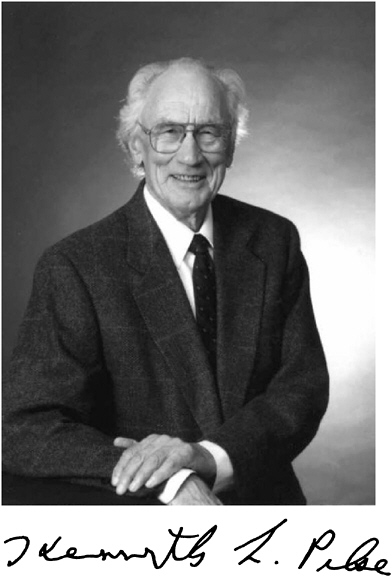
SANFORD LOUIS PALAY
September 23, 1918–August 5, 2002
BY ALAN PETERS, JACK ROSENBLUTH, GEORGE PAPPAS, LAWRENCE KRUGER, AND ENRICO MUGNAINI
SANFORD LOUIS PALAY, a member of the National Academy of Sciences since 1977, died on August 5, 2002, at the age of 83. He was buried in the Sleepy Hollow cemetery in Concord, Massachusetts. With his death modern neurocytology lost one of its founders. From the beginning of fine structural studies of the nervous system the high quality of electron micrographs produced by Sanford Palay set standards that others would strive to emulate, and he contributed much toward the interpretation of electron micrographs of the nervous system and the advancement of knowledge on the principles of organization of the nervous system. It must be remembered that prior to fine structural studies, stains had been developed that could be used selectively to show specific components of the nervous system in light microscopic preparations. In electron micrographs all of the diverse neuronal and glial components are seen, but much of the continuity of cell bodies and processes is lost in the extremely narrow plane of the ultrathin section. Therefore, one of the earliest challenges toward which Sanford
Based on a memorium published in the Journal of Neurocytology, vol. 31, 2002. With permission of the publishers, Kluwer Academic Publishers.
Palay made many contributions was to determine which profiles belonged to which parts of cells and which criteria could be used to selectively identify the myriad profiles encountered in electron micrographs.
Sandy was born in Cleveland, Ohio, of Russian Jewish immigrant parents. In 1940 he received his bachelor’s degree in English from Oberlin College, a place for which he had such fond memories that he donated his collection of neuroscience journals and histological slides to the college. In 1940 he entered the School of Medicine at Western Reserve University (now Case Western Reserve), with the intention of becoming a bacteriologist. In the spring of his first year at medical school he applied for a fellowship that would allow him to do research in the summer break. He chose to work in the laboratory of Ernst and Berta Scharrer, where he was given the project of trying to stain dropletladen cells in the meninges of the toad. In 1944 he published the results of this investigation. The Scharrers taught Sandy a great deal about scientific investigation, about neuroanatomy, and about cytology, and eventually Sandy went on to work on neurosecretion (1945,1), which was Ernst Scharrer’s prime interest (1945,2). Sandy continued to work with the Scharrers throughout his time in medical school, and he developed a close relationship with Ernst Scharrer, who was to have a great influence in guiding Sandy’s scientific career.
After completing his M.D. degree in 1943 Sandy spent a year as an intern at New Haven Hospital, where in the evenings he continued his research in the Department of Anatomy at Yale University. He worked on tracing the neurosecretory pathway from the preoptic nucleus to the neurohypophysis in catfish, using material that he had brought from Cleveland. At the end of the internship Sandy returned to Western Reserve University as a resident in medi-
cine, with appointments as a teaching fellow in medicine and a research fellow in anatomy. This allowed him to continue his association with the Scharrers, and he took part in a study on chemical sense and taste in gourami and sea robins (1947). It was Ernst Scharrer who suggested that Sandy ought to meet and work with Albert Claude, who was at the Rockefeller Institute, pursuing his pioneering studies on the biochemistry of cellular components. Sandy applied and was awarded a postdoctoral fellowship to work with Claude, but when his residency in Cleveland came to an end in 1946, he was called up to serve with the Army Medical Corps as a member of the forces in occupied Japan. As a result of that service Sandy began his lifelong interest in Japanese art and culture, leading him to collect Japanese art and to cultivate many bonsai specimens. He returned to Japan in 1978 for an extended period as a visiting professor at the University of Osaka.
After leaving the Army in 1948 Sandy joined Albert Claude as a fellow at the Rockefeller Institute and spent the year examining the chromosomes of the salivary gland by electron microscopy. Formvar replicas were used (1949), because at that time there were no suitable techniques available for preparing thin sections. It was at the Rockefeller Institute that Sandy met George Palade, who had recently become a refugee from Romania, which had been occupied by the Russians and fallen under a Communist regime.
After a year, in 1949, he returned to Yale, where he was first appointed instructor and then assistant professor of anatomy. He continued his work on neurosecretion, and it was under his direction that Milton Brightman and Steven Wissig completed their doctoral theses on the relationship between neurosecretion and lactation in rats and on thyroid secretion also in rat.
By 1952 important technical advances had been made in preparing tissue for electron microscopy. As Sandy pointed out in one of his later publications (1992,1), “Palade had introduced his Veronal buffered osmium tetroxide for optimal fixation of tissues. Borysko, Swerdlow and colleagues had introduced a satisfactory method for embedding tissue in butyl methacrylate, and Harrison Latta had invented a way to break plate glass into useful knives for thin sectioning.” So when George Palade invited Sandy to return to the Rockefeller Institute to work with him for six months and to learn the new techniques, Sandy enthusiastically accepted the offer. It was at this time that he began his definitive studies on the fine structure of the nervous system, and his first success in achieving good fixation of neurons was obtained by injecting osmic acid into the fourth ventricle of the rat, since here the motor cells of the abducens nucleus are close to the surface, as are the cells of the overlying cerebellum. The outcome was that in 1955 he and George Palade were able to publish a pioneering article in the first volume of the Journal of Biophysical and Biochemical Cytology (now the Journal of Cell Biology) on “The Fine Structure of Neurons.” This article described the Nissl substance and the mitochondria of nerve cells, as well as long filaments that were subsequently recognized as neurofilaments. This study was soon followed by the one of which Sandy was most proud, the first description of the fine structure of synapses in the mammalian nervous system (1956). Sandy recounted (1992) how one Saturday early in August of 1953, when he was alone in the laboratory, he was using the electron microscope to examine thin sections of the abducens nucleus, and on the surfaces of dendrites and cell bodies he encountered clublike profiles that were filled with mitochondria and contained vesicles that were aggregated against the presynaptic membrane. Earlier that summer George
Pappas had shown Sandy electron micrographs showing the fine structure of a contractile vacuole in Amoeba proteus surrounded by clusters of small vesicles (30-40 nm diameter). Sandy remembered the close similarity between vesicles surrounding the Amoeba contractile vacuole and those in the presynaptic terminals on the soma of the motor neurons. Also the pre- and postsynaptic membranes were thickened and appeared denser, indicating a zone of intimate adherence, and most importantly these membranes were separated by a thin intercellular space, thus directly confirming Cajal’s inference about the synaptic junctions between nerve cells. He later reminisced: “I became very excited, and having no one with whom to share this great news directly, I telephoned George Pappas at home to convey my exhilaration. Fortunately, he was there, or I would have burst. I was extraordinarily privileged to be the first one to see the synaptic junction, and I recognized my good fortune” (1992). Recollections of this period are available in a videotaped interview of Sandy Palay by Lawrence Kruger in the summer of 2001. The tape is deposited in the history archives of the Society for Neuroscience. The discovery of characteristic vesicles at the mammalian synapses was reported in a joint paper with Palade at a meeting of the American Association of Anatomists (1954). In the same year E. D. P. DeRobertis and H. S. Bennett also reported the finding of vesicles in nerve terminals of frog sympathetic ganglia and earthworm nerve cord at the meeting of the Federation of Societies for Experimental Biology meeting (Submicroscopic vesicular components of the synapse. Fed. Proc. 13[1954]:13:35).
Sandy returned to Yale, and in 1955 he was promoted to associate professor. While continuing to work on the brain fine structure, he began a study on intestinal villi and the pathway of fat absorption with his graduate student L. J.
Karlin, and that study was brought to completion a few years later (1959,1,2). Sandy stayed in New Haven only one year because his prominence as a neurocytologist gained him the position of chief of the Section on Neurocytology at the National Institutes of Health in Bethesda, Maryland. He was given an electron microscopy laboratory in the basement of Building 9. His new instrument turned out to have serious problems, but it was finally replaced with a later model that did function properly. His associates there included Jack Rosenbluth, Mary Grillo, Milton Brightman, David Wolf, Spencer Gordon, Jr., Sam McGee Russell, and the research assistant Catherine Crigler. Three years later, in 1960, he was promoted to chief of the Laboratory on Neuroanatomical Sciences at NIH. Sandy became interested in the tendency of astrocytes to swell after immersion fixation. Dispute with Sarah Luse and Ed Dempsy over the meaning of this artifact provided part of the impetus to develop perfusion fixation. Sandy had a strong intuition regarding what was true structure and what was artifact (myelin splits, swollen astrocytes, large extracellular spaces in the central nervous system), and this led him to develop and perfect the buffered osmic acid perfusion fixation method for rats, while continuing to work on synapses (1958,1), neuroglia (1958,2), and neurosecretion (1958,3). A major improvement occurred when the laboratory switched from methacrylate to Araldite embedding, which helped improve the appearance of compact myelin and resulted in a paper on the nerve cell bodies and their myelin sheaths in the eighth nerve ganglion of the goldfish (1961). Sandy’s interest in myelin had also been spurred by a visit from Harry Webster, who brought spectacular electron micrographs of myelinated peripheral nerve fibers. There were engaging lunchtime meetings with Eric Kandel and W. Alden Spencer, who both had two-year appointments in the NIH neurophysiology labo-
ratory. At this time in Bethesda Sandy bought a Mercedes convertible that he drove for many years.
In 1961 Sandy relinquished his position at NIH when Don Fawcett invited him to become the Bullard Professor of Neuroanatomy at Harvard Medical School. Sandy was a dominant figure in neurocytology, producing high-quality electron micrographs and lucid descriptions of structures that set standards for others to try to emulate. Soon after his arrival at Harvard he and his colleagues published an important article on the perfusion fixation with osmic acid they had developed at NIH (1962). Until then fixation of nervous tissues for electron microscopy was mostly achieved by immersing pieces of central nervous system in buffered osmic acid solutions. The resulting preservation was never very good. Using the perfusion technique with buffered osmium tetroxide, which produced black and often brittle brains, Sandy and his collaborators obtained superior preservation. This enabled them to begin to better analyze the morphological features of various components of the central and peripheral nervous systems, and accumulate a large portfolio of electron micrographs illustrating the fine structure and principles of organization of the central nervous system, especially the cerebellar cortex. Sandy was deeply impressed by how images from Golgi-impregnated material could be used to analyze electron micrographs and became very fond of the Golgi method, of which there were few practitioners in the United States. Visitors to Sandy’s laboratory were regularly treated with a show of his impressive illustrations from the cerebellar cortex and emerged greatly inspired, and many returned for extended periods of collaboration.
Sandy was insistent on the value of artificial respiration of the animal prior to perfusion fixation with osmium tetroxide, as it had been shown that this improved the preserva-
tion of ultrastructure, especially that of the glial cells. Subsequently, as glutaraldehyde was introduced as a fixative and as aldehydes began to be purified, he and his trainees adopted the perfusion fixation of the nervous system by buffered aldehydes. Putting these techniques to good use, he and his wife, Victoria (“Vickie”) Chan-Palay, completed detailed studies of the cerebellum. The results were published in a series of articles and culminated in the publication of the definitive description of the components of the cerebellum in their book Cerebellar Cortex: Cytology and Organization (1974). This book, which led to a better understanding of the neuronal circuits in the cerebellum, was cited among the Fifty Best Books of 1974 at the International Book Fair in Frankfurt.
As well as cooperating in science, Sandy and Vickie raised two caring daughters, Victoria (from Vickie’s previous marriage) and Rebecca. They were a great comfort to Sandy in his waning years, and visits by his grandchildren, his daughter Victoria’s two children, were always a particular joy to him.
By the late 1960s a wide range of structures in the central and peripheral nervous systems had been examined by electron microscopy, and it was becoming possible to make generalized descriptions of the various neuronal and neuroglial components of the nervous system. Sandy and Alan Peters talked about producing a book describing and illustrating the fine structural features of components of the nervous system when Alan Peters worked with Sandy on the lateral geniculate nucleus of the cat in 1963-64, but they concluded that the time was not yet ripe to undertake that project. The basic reason was that one important component of the nerve cell, the axon hillock and the axon initial segment that were the most plausible candidates for the spike initiation site, had not been recognized in electron
micrographs. However, over the course of the next two years it became evident that the initial axon segment is consistently characterized by bundles of microtubules linked by cross-bridges and electron dense undercoating of the plasma membrane, and this led to another landmark publication in the Journal of Cell Biology (1968). Consequently in 1968 it was decided to go ahead and write the book, and Sandy and Alan Peters, who was then at Boston University, asked Harry Webster, who was at the Massachusetts General Hospital, to join them and to undertake the description of the peripheral nervous system. The hope was that such a book would serve as a guide to help others in the analysis of electron micrographs and promote the understanding of the principles of organization of the entire nervous system. The first edition of The Fine Structure of the Nervous System was published in 1970 as a rather thin book of some 200 pages, but by the third edition in 1991 it had grown to about 500 pages, with over 130 plates, many of which continue to be reproduced in various text books.
Sandy’s great strength and charm was that he always had time for others and he was never prepared to accept second best. No doubt this latter aspect of his make-up led him to accept the position of editor in chief of the Journal of Comparative Neurology, when Max Cowan stepped down from that position in 1980. Sandy’s attention to detail and his goal to strive for high standards of both text and illustrations resulted in the journal’s receipt of increasing numbers of first-rate articles and ultimately becoming a weekly publication. Sandy examined each article submitted to the journal, and after reading the reviews he always wrote a carefully constructed letter to the corresponding author outlining which changes might be necessary to improve the article before publication. Even after retiring from Harvard in 1989 Sandy continued as editor in chief, running the
journal from his home in Concord; after he stepped down as editor in chief in 1993 he continued to play a role as editor in chief emeritus. In 1991 he wrote an in-depth article on the founding of the journal (1991,2).
Sandy’s ability to evaluate scientific work in the neurosciences put him in great demand as a member of editorial boards, and so in addition to the Journal of Comparative Neurology Sandy served on several other editorial boards, including the board of the Journal of Neurocytology. A number of his friends and colleagues contributed an issue of the Journal of Neurocytology in honor of his retirement from Harvard (October 1990). Sandy was also a member of the editorial boards of a number of other journals, including the Journal of Cell Biology, Brain Research, Experimental Neurology, Anatomy and Embryology, Neuroscience, and Experimental Brain Research.
Sandy’s achievements in neuroanatomy were recognized by several important awards and honors, and among these we can cite the Lashley Award by the American Philosophical Society; his election to the American Academy of Arts and Sciences in 1963; to the National Academy of Sciences in 1977; and to the American Philosophical Society in 1997; his election as president of the American Association of Anatomists, an association that awarded him its Henry Gray Award for his contributions to anatomy; the Ralph Gerard Award for Contributions to Neuroscience by the Society for Neuroscience; and numerous invited lectureships. His retirement as Bullard Professor of Neuroanatomy from Harvard in 1989 by no means diminished Sandy’s interest in science. As stated above, he continued for several years as the editor in chief of the Journal of Comparative Neurology, and in 1994 Boston College gave him an appointment as Distinguished Scholar in Residence in the Department of Biology. He enjoyed this appointment and often went to
Boston College, where he offered a graduate course in the history of neuroscience. Even when his health started to decline Sandy continued to teach this course, with the students coming to his home in Concord.
When one went to visit him at home, or later in the hospital, Sandy always had scientific journals beside his chair and was invariably ready to engage in a discussion of recent findings that he had read about and to put those findings in the context of earlier knowledge. Sandy had a deep and comprehensive understanding of the history of neuroscience, and he loved to peruse older publications. One regret is that he did not write more about this subject, for there are few with his depth of knowledge, insight, and love of the history of neuroscience (see 1987) and the close links between brain science and philosophy.
An aspect of Sandy’s multifaceted personality that endeared him to many of his friends was his keen intellectual interest in the physical world, human nature, literature, music, and the fine arts. Sandy was also an accomplished pianist, and it was a source of great regret to him that toward the end of his life he was no longer able to play the classical pieces that he loved. Although Sandy was endowed with a reserved temperament, when visiting with him one felt in contact with a person of culture in the broadest sense of the word. In all probability this is the image that he would like us to remember. He will never be forgotten by those who knew him.
SELECTED BIBLIOGRAPHY
1944 The histology of the meninges of the toad (Bufo). Anat. Rec. 88:257-70.
1945 Neurosecretion. VII. The preopticohypophysial pathway in fishes. J. Comp. Neurol. 82:129-43.
With E. Scharrer and R. G. Nigles. Neurosecretion. VIII. The Nissl substance in secreting nerve cells. Anat. Rec. 92:23-29.
1947 With E. Scharrer and S. W. Smith. Chemical sense and taste in the fishes, Prionotus and Trichogaster. J. Comp. Neurol. 86:183-98.
1949 With A. Claude. An electron microscopic study of salivary gland chromosomes by the replica method. J. Exp. Med. 89:431-38.
1954 With G. E. Palade. Electron microscopic observations of interneuronal and neuromuscular synapses. Anat. Rec. 118:335.
1955 With G. E. Palade. The fine structure of neurons. J. Biophys. Biochem. Cytol. 1:69-88.
1956 Synapses in the central nervous system. J. Biophys. Biochem. Cytol. 2(Suppl.):193-202.
1958 The morphology of synapses in the central nervous system. Exp. Cell Res. 5(Suppl.):275-93.
An electron microscopic study of neuroglia. In Biology of Neuroglia, ed. W. F. Windle, pp. 24-38. Springfield: Thomas.
The morphology of secretion In Frontiers in Cytology, ed. S. L. Palay, pp. 305-42. New Haven: Yale University Press.
1959 With L. J. Karlin. An electron microscopic study of the intestinal villus. I. The fasting animal. J. Biophys. Biochem. Cytol. 5:363-72.
With L. J. Karlin. An electron microscopic study of the intestinal villus. II. The pathway of fat absorption. J. Biophys. Biochem. Cytol. 5:373-84.
1962 With S. M. McGee-Russell, S. Gordon, and M. A. Grillo. Fixation of neural tissues for electron microscopy by perfusion with solutions of osmium tetroxide. J. Cell Biol. 12:385-410.
1966 With A. Peters. The morphology of laminae A and A1 of the dorsal nucleus of the lateral geniculate body of the cat. J. Anat.(Lond.) 100:451-86.
1968 With C. Sotelo, A. Peters, and P. Orkand. The axon hillock and the initial segment. J. Cell Biol. 38:193-201.
1970 With A. Peters and H. D. Webster. The Fine Structure of the Nervous System: The Cells and Their Processes. New York: Hoeber-Harper.
1974 With V. Chan-Palay. Cerebellar Cortex: Cytology and Organization. New York: Springer-Verlag.
1987 A century of neuroanatomy in America. In The American Association of Anatomists, 1888–1987, ed. J. E. Pauly, pp. 134-47. Baltimore: Williams and Wilkins.
1991 With A. Peters and H. D. Webster. The Fine Structure of the Nervous System: The Neurons and Their Supporting Cells. 3rd ed. New York: Oxford University Press.
The founding of the Journal of Comparative Neurology. J. Comp. Neurol. 314:1-8.
1992 A concatenation of accidents. In The Neurosciences: Pathways of Discovery II, eds. F. E. Samson and G. Adelman, pp. 191-212. Boston: Birkhäuser.
With V. Chan-Palay, E. Mugnaini, and E. Voogd. Cerebellum. In Elsevier’s Encyclopedia of Neuroscience, eds. G. Adelman and B. J. Smith, pp. 321-28. Amsterdam: Elsevier.
1996 With A. Peters. The morphology of synapses. J. Neurocytol. 25:701-16.