
2
Creation and Annihilation of Magnetic Fields
Magnetic fields exist throughout the universe, ranging from less than a micro-gauss in galactic clusters to 1012 gauss or more in the magnetospheres of neutron stars.1 There is increasing evidence that these magnetic fields profoundly affect the fundamental dynamics of the universe through angular momentum transport during star formation, in the accretion of material onto stars and black holes, in the formation of jets, and in the creation of suprathermal gases responsible for much of the x-ray emission from a variety of astrophysical sources. Magnetic fields that are generated in astronomical bodies such as galaxies, stars, and planets produce forces that compete with convection and with rotational and gravitational forces. Within our own solar system the magnetic fields shed by the Sun interact with the fields surrounding Earth to produce the complex dynamics of the magnetosphere.
Because of the broad importance of magnetic fields in large-scale plasma dynamics, developing a first-principles understanding of the physical mechanisms that control the generation and dissipation of magnetic fields is an essential scientific goal. Magnetic fields are generated by the convective motions of conducting materials—plasma in most of the universe and conducting liquids in the case of planetary objects. The twisting and folding of the magnetic field by the motion of the conducting material lead to amplification of the field in a process known as the dynamo. Ultimately the growth of the magnetic field by the dynamo is limited by the field’s back reaction on the fluid convection and by the dissipation of the magnetic energy. Thus, knowledge of the mechanisms by which magnetic fields are dissipated is essential to describing the overall amplification/saturation process of the magnetic fields.
The release of magnetic energy is often observed to occur in bursts, in essentially explosive processes that produce intense plasma heating, high-speed flows, and fast particles. Solar and stellar flares and magnetospheric substorms are examples of such explosive phenomena. Magnetic reconnection, in which oppositely directed magnetic field components rapidly merge to release the stored magnetic energy, has been identified as the dominant mechanism for dissipating magnetic energy. The description of the reconnection process is complicated by the need to describe correctly the small-scale spatial regions where the magnetic field lines change their topology. Surprisingly, kinetic effects at these very small scales have been found to strongly influence the release of magnetic energy over very large spatial scales.
This chapter briefly reviews the theoretical explanations that have been put forward for the creation of cosmic magnetic fields (the dynamo) and their annihilation (magnetic reconnection) and examines the operation of these processes in both solar and planetary settings.
MAGNETIC FIELD CREATION: DYNAMO THEORY
Many astrophysical bodies, including galaxies, stars, and planets, have an internally generated magnetic field. Although these bodies differ significantly in many aspects, they all possess within their interiors an electrically conducting fluid that is dominated by the Coriolis force because of their rapid rotation. In the case of the planets, the release of thermal and gravitational energy leads to convection in the planetary cores. In the case of stars and the Sun, convection is driven by heat from thermonuclear fusion. In many astronomical bodies the mean fields generated by the dynamo periodically reverse in time. A prominent example is the 22-year periodicity of the magnetic field of the Sun. To answer the question of the origin of magnetic fields, it is necessary to understand how magnetic fields are generated and maintained in rapidly rotating, convective fluids. This understanding is the goal of dynamo theory.
The dynamo process can be simply described as follows: a moving electrically conducting fluid stretches, twists, and folds the magnetic field. Dynamo action occurs if a small-amplitude seed magnetic field is sustained and amplified by the flow. The magnetic field increases in strength until the resultant magnetic forces are sufficient to feed back on the flow field. Dynamos can be quite complicated, and fundamental questions can be posed. How does a given flow generate a magnetic field? How does the generated magnetic field act to modify the flow? What energy source sustains the flow? While the first two questions can be studied within the context of magnetohydrodynamics, the answer to the last question depends on the specific physical system being studied. Finally, magnetic reconnection (in the generic sense of a mechanism that alters magnetic field topology) is an intrinsic part of any dynamo mechanism. The various magnetic field components that are generated by plasma flows must ultimately decouple and condense into a large-scale field (usually the dipole field in astronomical objects). The connectivity of field lines must change for this condensation to take place, which requires reconnection. What, therefore, are the processes that control magnetic reconnection in environments where dynamo action is important (e.g., the convection zone in the Sun or in the interior of planetary bodies)? In a self-consistent dynamo model, all these questions are related and so must be studied together.
Kinematic dynamo theory studies the generation of a magnetic field by a given flow. The importance of flow is described by the (nondimensional) magnetic Reynolds number Rm, defined as the ratio of magnetic diffusion time to the flow convection time. Dynamo action occurs if the growth rate of magnetic field perturbations is positive, that is, if the amplitude of an initially small perturbation increases with time. From kinematic theory the necessary condition for dynamo action is typically Rm ≥ 10. The physical significance of this condition is that the electromotive force associated with the flow has to overcome the magnetic dissipation in the fluid in order for a dynamo to occur. Another important result of kinematic dynamo studies is the demonstration that an axisymmetric magnetic field cannot be generated by an axisymmetric flow. This result implies that dynamo action must be three-dimensional.
When the magnetic Reynolds number Rm is large (i.e., indicates a faster flow, or less electrical resistivity in the fluid), the field lines are “frozen” in to the flow and are thus stretched, twisted, and bent (Figure 2.1). In order for the net flux to increase, the field lines must reconnect (alter their topology). Because magnetic diffusion is weak, field line reconnection takes place in regions of small spatial scale. Overall, the dynamo process generates new magnetic field lines and the magnetic flux increases with time. A major mystery is the source of magnetic diffusion required to change the field topology, which greatly exceeds that resulting from classical collisional processes.
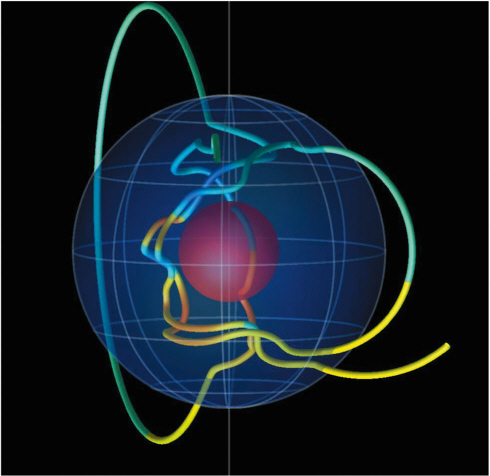
FIGURE 2.1 The stretching and twisting of a magnetic field line by fluid motion in Earth’s outer core. Dynamo action occurs in the spherical shell between the outer blue surface, which represents the core-mantle boundary, and the red inner sphere, which represents the inner core. The yellow (blue) line segments in the figure indicate that the field line has a positive (negative) radial component. The field line is stretched in longitudinal directions by (zonal) differential rotations in the fluid core (the so-called ω-effect in dynamo theory) and is twisted in meridional directions by the cyclonic upwelling/ downwelling flows (the so-called α-effect). Image courtesy of J. Bloxham (Harvard University). Reprinted, with permission, from W. Kuang and J. Bloxham, A numerical dynamo model in an Earth-like dynamical regime, Nature 389, 371-374, 1997. Copyright 1997, Macmillan Publishers Ltd.
For a given flow, there exists a critical value of Rm, at which the growth rate of the magnetic field perturbation is the largest. As Rm increases further, the growth rate of the large-scale magnetic fields decreases to zero, implying that a finite magnetic diffusivity (finite conductivity) of the fluid is necessary for dynamo action. This type of dynamo is often called a slow dynamo, to which class most models of Earth’s dynamo belong.2 However, kinematic dynamo studies also show that, for some three-dimensional chaotic flows, the growth rate of the large-scale magnetic field remains positive for large Rm. That is, dynamo action exists in the limit of vanishing magnetic diffusivity. This type of dynamo action is called a fast dynamo. For both cases it is essential that self-generation of the magnetic field occurs at spatial scales comparable in size to the entire region in which convection is taking place (e.g., the dipole field of the Sun or planets). That this is possible in the case of the fast dynamo has not been demonstrated.
While kinematic dynamo theory can well explain how a given flow generates a magnetic field, it does not take into account the influence of the generated magnetic field on the flow. The magnetic field lines do not passively follow the flow. They behave more or less like elastic threads. Therefore, in the process of stretching and bending the magnetic field lines, the flow also experiences a reaction force from the magnetic field. This magnetic force is called the Lorentz force and is proportional to the current density and the magnetic field in the fluid. The importance of the reaction forces can be assessed by comparing them to the leading-order forces (such as the Coriolis force in a rapidly rotating fluid like Earth’s fluid core) in the fluid momentum equation.
CREATION OF MAGNETIC FIELDS IN THE SUN
Solar magnetic energy is continually being created, annihilated, and ejected. The physics underlying these opposing processes is known only in the most general terms, and detailed understanding faces significant theoretical and observational challenges. For example, although the Sun is the nearest star and the only star whose surface features can be resolved, much of the important action takes place on scales too small to be seen with existing telescopes. Telescopes detect the existence of the small-scale magnetic fields and motions but lack sufficient resolution to determine precisely what is happening. That important step must await the exploitation of adaptive optics on a telescope of large aperture.
The explosive dynamics observed in the atmosphere of the Sun originates in the gentle overturning of the gas in the convection zone, which occupies the outer 2/7 of the solar radius (1 solar radius = 7 × 10⁵ km). The thermal energy in the central regions of the Sun diffuses outward as thermal black body radiation, with the temperature decreasing from 1.5 × 10⁷ K in the central core to 2 × 10⁶ K at the boundary between the radiative interior and the convection zone. Here, convective mixing takes over from radiative transport and delivers heat to the Sun’s photosphere or visible surface. In addition to transporting thermal energy, the convection of the hot ionized (and hence electrically conducting) gas transports magnetic fields as well. The magnetic fields carried in the convection are stretched and contorted, with substantial increase in the magnetic energy. The magnetic fields are buoyant because they provide pressure without significant weight, and so they tend to bulge upward through the visible surface into the tenuous atmosphere above. Thus, they form the conspicuous bipolar magnetic regions that spawn sunspots, coronal mass ejections, and flares.
The hydrodynamics of the rotation of the Sun is described by the Navier-Stokes momentum equation, the equation for conservation of mass, the heat flow equation, and the ideal gas law. This model should reproduce the observed nonuniform rotation of the Sun and the meridional circulation, because both must be driven by the convection or they would have died out long ago as a consequence of the magnetic stresses. So far, however, this theoretical goal has not been achieved. Helioseismology has succeeded in mapping the internal rotation of the Sun, with the remarkable and unanticipated discovery that the
radiative interior rotates approximately rigidly with a period of about 28 days, while the rotation of the convective zone varies with latitude but only weakly with depth. Thus, the observed surface rotation approximately projects downward to the base of the convective zone. The convective zone rotates with a period of 25 days at the equator, creating a strong forward shear where it meets the radiative zone. The rate of rotation decreases with increasing latitude, providing a period in the neighborhood of 35 days in the polar regions and creating a strong backward shear where the convective zone meets the radiative zone. Understanding how the differential rotation revealed by helioseismology arises represents a significant theoretical challenge.
The strong shear layer at the interface between the convective and radiative zones is known as the tachocline.3 Rotational shear in this region plays a major role in the operation of the solar dynamo. The generation of the solar magnetic field involves the production of an azimuthal field from an initial poloidal field and the subsequent regeneration and amplification of the poloidal field from this azimuthal field by cyclonic convection. The nonuniform toroidal rotation shears the poloidal field, producing an azimuthal magnetic field. An individual cyclonic convective cell creates an upward bulge (an Ω loop) in the azimuthal field, which it rotates into the meridional plane (Figure 2.2). The result of the generation of many such loops, after smoothing by diffusion, is the development of a mean magnetic field in the meridional plane, thereby supplementing the original poloidal field. These processes are described by the magnetohydrodynamic dynamo equations, first written down 50 years ago.
The solutions of the magnetohydrodynamic dynamo equations in the convective zone of the Sun are periodic with a time scale of around 22 years, resembling the observed periodicity of the Sun’s magnetic field.4 However, there is still much to be understood. For example, the inferred “turbulent” diffusion of the magnetic field in the convective zone, which is essential in establishing the proper scale and period of the solar magnetic field, is not understood. In addition, the magnetic fields extending through the visible surface of the Sun actually consist of unresolved, widely spaced, very intense (1500 gauss) flux bundles (fibrils) with diameters around 100 km. Measurements from the TRACE satellite suggest that these magnetic fields form a dense and dynamic layer of magnetic loops in the corona, dubbed a “magnetic carpet.”
Outstanding Questions About the Creation of Solar Magnetic Fields
-
What is the physical mechanism for the diffusion of strong magnetic fields in the Sun?
-
Why does the magnetic field at the surface of the Sun take the form of bundles of flux or fibrils?
-
What produces the differential rotation as a function of radius and latitude that helioseismology has revealed in the Sun’s interior?
-
What causes the approximate 22-year magnetic cycle and why do its strength and period vary over the centuries?
PLANETARY DYNAMOS
Like the Sun, many planets self-generate, or at one time self-generated, magnetic fields. The existence of a terrestrial magnetic field was established some four centuries ago, although it was mistakenly attributed to a mass of permanently magnetized material in Earth’s interior. In the past few decades, NASA space missions have discovered internal magnetic fields at five other planets—Mercury, Jupiter, Saturn, Uranus, and Neptune—and at the jovian moon Ganymede. Moreover, the recent discovery of a strong crustal magnetic field at the surface of Mars by the Mars Global Surveyor suggests that that planet, too, once possessed a strong internal magnetic field. The general principles of dynamo action in rotating, convecting, electrically conducting fluids are much the same in the Sun and the planets. However, the specific
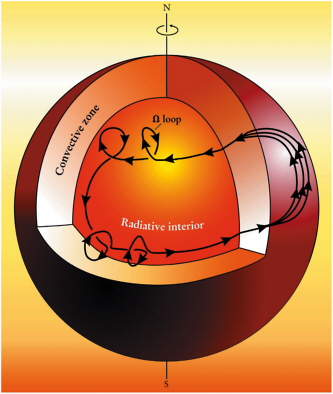
FIGURE 2.2 Schematic illustrating the interplay of rotational and cyclonic-convective forces in the operation of the solar dynamo. Strong toroidal or azimuthal fields are generated from an existing poloidal field in the tachocline, a region of strong shear at the base of the convection zone. Cyclonic convection pushes a bulge in the azimuthal field and rotates it into the meridional plane. Image courtesy of E. Plotkin (American Institute of Physics). Reprinted, with permission, from E.N. Parker, The physics of the Sun and the gateway to the stars, Physics Today 53(6), 26-31, June 2000. Copyright 2000, American Institute of Physics.
conditions are sufficiently different that planetary dynamos are a subject unto themselves. While the magnetic fields of the Sun are generated near its surface, in the terrestrial planets the dynamo is confined to the planetary core, which is shielded from the atmosphere by the crust and mantle. The giant planets approach more closely the solar case, with the convection zone extending to the planetary surface.
Observational and theoretical studies of planetary magnetic fields began with the study of the geomagnetic field. Applications associated with the geomagnetic field date back to the first century A.D. (e.g., the invention of the compass). But the first serious study of the origin of the geomagnetic field appeared much later, following William Gilbert’s proposal in De Magnete (1600) that Earth is a great magnet. Later Karl
Friedrich Gauss provided the mathematical tools to separate the internal magnetic field from the external magnetic field. They are still used in today’s analyses of the geomagnetic and planetary magnetic fields. In the 1940s, Walter Elsasser initiated the development of hydromagnetic dynamo theory, which is the basis for our understanding of the geomagnetic field and of internally generated planetary fields.
The development of planetary dynamos is closely correlated with the thermal evolution of the planets. A simple picture is that, at the accretion of the planets, tremendous gravitational energy was transferred into thermal energy, resulting in the formation of molten, electrically conducting planetary cores. As the planets cool off (e.g., the secular cooling of Earth), heat is released from the planetary interiors. Convection in the planetary cores facilitates the fast cooling rate, and the convective flows drive the internal dynamo. Other possible energy sources for the dynamo have also been proposed, such as radiogenic heat and tidal force; the latter source is still being considered in geodynamo studies.
The best-studied convection-driven planetary dynamo is that of Earth. Earth possesses a large fluid outer core, with a radius of approximately 3200 km, which is about half Earth’s mean radius, and a solid inner core with a radius of 1100 km. The molten alloy in Earth’s outer core is iron-rich (and thus electrically conducting), with smaller amounts of lighter constituents (e.g., oxygen, sulfur). In the secular cooling process, the inner core grows outward because of the freezing of the liquid iron at the inner-core boundary. The lighter constituents and latent heat are thus released into the outer core, producing strong buoyancy forces that drive the convection that is necessary for the geodynamo.
Mercury is the only other terrestrial planet to possess a strong intrinsic magnetic field today. Mercury’s field, the existence of which was revealed by Mariner 10 observations in the mid-1970s, is generally thought to be generated by dynamo action in a fluid outer core. However, questions remain about whether the present-day existence of a partially molten core is consistent with Mercury’s thermal history, and alternatives to a hydromagnetic dynamo have been proposed. In the case of Mars, which today possesses no, or only a very weak, intrinsic field, theoretical studies suggest that the cooling rate (and thus the buoyancy force) was sufficient to drive an internal dynamo only during the first 100 million to 150 million years of the planet’s history. Mars’s remanent crustal magnetic field has been mapped by the Mars Global Surveyor. The imprints of the internal field in the crust reveal the history of the martian dynamo and may provide evidence of variations in the thermal processes that occurred in the martian mantle. Venus, like Mars, has no apparent intrinsic field, but unlike the case with Mars there is insufficient evidence about a possible crustal field to support conclusions about the existence of an internal dynamo at an earlier stage in Venus’s evolution.
The dynamos of the outer planets operate in planetary interiors quite different from those of the terrestrial planets. While convection in these planets may extend to the surface, dynamo action occurs in metallic hydrogen (Jupiter and Saturn) or ionic (Uranus and Neptune) cores. Most of the internal field and perhaps the surface flow could in principle be measured, thus permitting more direct observation of the dynamo action.
The recent numerical modeling of planetary dynamos has been very successful and is rapidly becoming the main tool for studying in detail the nonlinear dynamics of dynamo action. Although the mathematical models are very simple compared to the actual planetary cores, they can produce solutions that agree qualitatively with observations. In particular, geodynamo modeling has shown that a predominantly dipolar magnetic field exists at the core-mantle boundary.5 The westward drift of the modeled geomagnetic field is comparable to that inferred from geomagnetic observations. Numerical simulations also demonstrate repeated reversals of the polarity of the magnetic field, a phenomenon that is well known from the paleomagnetic records.
Despite much progress in studies of planetary dynamos, many long-standing fundamental problems remain unanswered, while the results of numerical dynamo modeling have given rise to new questions. The dominance of the Coriolis force is invoked to explain the nearly axisymmetric dipolar geomagnetic field—
that is, to account for the fact that the magnetic dipole axis is very close to the rotation axis. This explanation cannot be generalized to dynamo action in all rapidly rotating fluids. For example, observations have revealed a very different magnetic field geometry at Uranus and Neptune: The field structures of both planets have no obvious correlation with the rotation axis, suggesting that other physical processes in the dynamo must be important in determining the morphology of the magnetic field. Recent studies have focused mainly on the effect of the geometry of the fluid core on the generated magnetic field. However, the strength of the driving force could also be important.
Although numerical geodynamo modeling has been a great success, the relative roles of the dominant forces inside Earth’s core are still not well understood. In Earth’s core (as a rapidly rotating fluid with a strong field dynamo), the Coriolis force, the buoyancy force (the driving force for convection), and the Lorentz force are the leading-order forces in the momentum balance of the flow. Fluid inertia and viscous stress are very small and are neglected in the leading-order approximation. However, numerical modeling shows that variations of these higher-order effects could lead to very different dynamical processes inside the core, although the generated magnetic fields are similar at the core-mantle boundary. Further study of the dominant forces acting in Earth’s core (and in general, in a rapidly rotating fluid) is therefore necessary. Observations of other physical quantities of Earth, such as the gravity field and surface deformation, may help in identifying the dynamical processes that are most active in the core.
Outstanding Questions About Planetary Dynamos
-
What is the dependence of the dynamo on the properties of the planetary interior—in particular, on the various dissipative parameters of the conducting fluids?
-
Besides the Coriolis force, what are the physical processes in the dynamo that determine the configuration (including the alignment) of planetary magnetic fields?
-
What are the turbulent flow structures in planetary cores?
MAGNETIC FIELD ANNIHILATION: RECONNECTION THEORY
A variety of phenomena in the universe are powered by the sudden release of magnetic energy and its conversion into heat and high-velocity plasma flows. Understanding such phenomena, and therefore the mechanism by which magnetic energy is released, has occupied space physicists, astrophysicists, and plasma physicists for nearly five decades. Energy release rates calculated on the basis of classical ohmic or resistive dissipation are orders of magnitude too small to explain the observed time scales on which stored magnetic energy is released in events such as solar flares. A more efficient mechanism for magnetic energy release is therefore required. (Ohmic dissipation rates can be characterized by the resistive dissipation time τr = 4πL2/ηc2, which is the time required for the energy in a system with scale size L with resistivity η to dissipate a significant fraction of the magnetic energy.)
Scientists very early on proposed magnetic reconnection as the mechanism by which magnetic energy could be released on a much shorter time scale than is possible through simple resistive dissipation.6 The reconnection process is illustrated in Figure 2.3, which shows the results of a kinetic simulation (particle ions and fluid electrons). In the top panel oppositely directed magnetic field lines “reconnect” to form a topological x-line configuration. The resulting bent field lines attempt to straighten out and in doing so drive high-speed flows outward from the x-line as shown in the second panel. The outward flows produce a pressure drop in the vicinity of the x-line that draws in regions of reversed magnetic field toward the x-line. The entire process is therefore self-sustaining. The characteristic velocity associated with the outward flows is the Alfvén velocity, vA = B/(4πρρ)1/2, where B is the magnetic field strength and ρ is the plasma mass
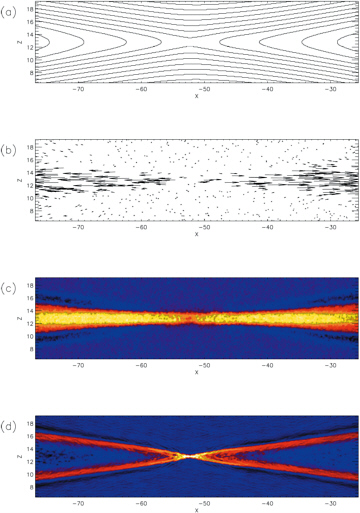
FIGURE 2.3 The reconnection of oppositely directed magnetic field components occurs within a spatially limited region known as the dissipation or diffusion region. Shown are the results of a hybrid simulation (particle ions and fluid electrons) of this region. In panel (a) oppositely directed magnetic fields “reconnect” to form a magnetic x-line configuration. The bent fields to the left and right of the x-line act like oppositely directed “slingshots” that expand outward to release their energy, driving the high-speed outflows shown in panel (b). The out-of-plane currents of ions and electrons in (c) and (d) sustain the magnetic configuration in (a). The distinct scale lengths of the ion and electron currents indicate that the motion of the two species has decoupled. In recent theoretical models the decoupling of electron and ion motion in the dissipation region is essential to achieving the fast reconnection observed in nature. Reprinted, with permission, from M.A. Shay et al., The scaling of collisionless, magnetic reconnection for large systems, Geophysical Research Letters 26(14), 2163-2166, 1999. Copyright 1999, American Geophysical Union.
density. Thus, a new time scale, the Alfvén time τA = L/vA, is important in magnetic reconnection. This time scale is shorter than the measured energy release times.
The rate of magnetic reconnection depends ultimately on the mechanism by which oppositely directed field lines reconnect. In an ideal plasma with no dissipation, the magnetic field is “frozen” in the plasma. That means that no topological change in the magnetic field is possible. Dissipation must therefore play a role in facilitating the reconnection process. In order for the intrinsically weak dissipative process to compete with Alfvénic flows, the dissipation must occur at small spatial scales. The scientific challenge has therefore been to develop models of the very localized dissipation or diffusion region that develops around the x-line to facilitate the topological change in magnetic field required for reconnection to occur.
P.A. Sweet and E.N. Parker, who developed the earliest model of the dissipation region, explored the dynamics of the thin current layer separating two macroscopic regions of an oppositely directed magnetic field. The resultant energy release time is given by the hybrid of the resistive and Alfvén times, (τAτr)1/2. Based on classical resistivity, this release time remains far too long to explain the observations. The narrow dissipation region of the Sweet-Parker model acts as an effective nozzle that severely limits the inflow velocity into the x-line. Enhanced resistivity, resulting from the turbulence associated with instabilities generated by the intense currents produced in the dissipation region, has often been invoked to shorten the energy release times. However, a solid theoretical foundation for such “anomalous resistivity” has been lacking.
H.E. Petschek and subsequent authors proposed that, if slow shocks formed at the boundary between the inflow and outflow regions, the length of the dissipation region could be shortened, allowing the outflow region to open up and therefore enhancing the rate of reconnection. One effect of the slow shocks would be to accelerate the inflowing plasma up to the Alfvén velocity of the outflow. Theoretical energy release times as short as the Alfvén time multiplied by logarithmic factors of the resistivity rendered reconnection rates fast enough to explain the observations even with very small values of classical resistivity. Simulations, however, have supported the Sweet-Parker rather than the Petschek picture. Simulations with a simple, constant but low resistivity produced dissipation regions with a macroscopic extent along the outflow, consistent with the Sweet-Parker model and therefore with slow reconnection. Models with enhanced resistivity in regions of high current were required to produce fast Petschek reconnection.
The Sweet-Parker and Petschek models address the problem of reconnection in terms of magnetohydrodynamic (MHD) theory. Recent research has emphasized the importance of kinetic (non-MHD) effects in facilitating reconnection and has employed numerical simulations and analytical theory to explore such effects.7 The inclusion of kinetic effects has proven essential to understanding magnetic reconnection in Earth’s and planetary magnetospheres, where classical collisions are negligible. The kinetic model has also arguably proven essential to efforts to understand reconnection in the solar atmosphere and possibly in the broader astrophysical context as well.
The results of the hybrid (particle ions and fluid electrons) simulation of reconnection shown in Figure 2.3 illustrate the multiscale structure of the dissipation region. At large scales, electrons and ions move together toward the x-line, where the change in magnetic topology occurs. Close to the x-line the ions decouple from the magnetic field and from the electrons, while even closer the electrons also decouple from the magnetic field. As a consequence, the out-of-plane ion and electron currents shown in panels (c) and (d) of Figure 2.3 have distinct spatial scales. Because of their greater mass, the unmagnetized ions occupy a much larger region than that occupied by the unmagnetized electrons. The key point is that the dynamics of the dissipation region where ions are unmagnetized is controlled by a class of dispersive waves (whistler or kinetic Alfvén waves) rather than by the usual magnetohydrodynamic Alfvén waves. Outside the small region close to the x-line, the resulting flow patterns closely mirror those of the Petschek model (no evidence for a macroscale Sweet-Parker current sheet), and the rates of reconnection
are a substantial fraction of the Alfvén speed. It is the very high speed electron flows generated by these dispersive waves close to the x-line that remarkably facilitate fast energy release in a macroscopic system.
Such fast rates of reconnection appear to be consistent with solar, magnetospheric, and laboratory observations. The generation of dispersive waves at small scales is apparently the key to understanding fast reconnection as observed in nature. The benchmarking of this kinetic model with observations has been challenging for two reasons. First, it has only been in the past couple of years that the essentials of the kinetic models have emerged. Second, the small scale size of the dissipation region (of the order of tens of meters in the solar atmosphere and tens of kilometers in the magnetosphere) makes the acquisition of data very difficult. Nonetheless, data from recent satellite missions are for the first time beginning to document and confirm the essence of the kinetic reconnection model. More direct comparison between observations and theoretical models will be required to demonstrate that the theory correctly describes processes occurring in nature and the laboratory.
The explosive release of energy associated with reconnection is consistent with inflow rates into the x-line at a significant fraction (0.01-0.1) of the Alfvén speed. What triggers the reconnection process, however, has been a subject of great debate. In laboratory tokamak experiments, for example, there are unresolved questions concerning the onset of the “sawtooth crash,” in which energy is expelled from the core of the confined plasma as a result of reconnection. The onset condition for solar flares and coronal mass ejections is similarly poorly understood. Is the trigger linked to kinetic effects associated with the structure of the dissipation region, or is it a consequence of the global configuration of the system? If the latter explanation is correct, then why do all of the observable systems exhibit trigger phenomena? Further discussion of this issue appears in Chapter 5.
In the interest of clarity the committee has up to this point focused exclusively on a picture of reconnection expected for a two-dimensional system. There is, however, substantial observational evidence that the release of magnetic energy in nature either takes place in intrinsically three-dimensional magnetic configurations or develops three-dimensional structure as a result of the reconnection process. The data from the TRACE observations of the solar corona provide graphic evidence for the release of energy in three-dimensional loops. High-speed flows measured in Earth’s magnetotail, which are believed to be driven by magnetic reconnection, are spatially localized in the plane perpendicular to the flow, indicating that reconnection does not occur at extended x-lines but rather in spatially localized regions. Intrinsically three-dimensional reconnection is therefore a topic of great importance, but one of which current understanding remains limited.
MAGNETIC RECONNECTION IN THE SUN’S CORONA
Magnetic field annihilation in the solar atmosphere typically proceeds in an explosive manner, producing flare energy releases over a broad range from 1032 to 1033 ergs down to the threshold for detection at about 1024 ergs. The energy release takes place on time scales of tens of seconds to minutes, corresponding to speeds of magnetic field annihilation as fast as 0.01 to 0.1 vA. For the characteristic temperature and spatial scales of loops and arcades in the corona, the ratio of the resistive and Alfvén time ranges from 108 to 1014. The characteristic time for the release of magnetic energy by reconnection in the Sweet-Parker model greatly exceeds the Alfvén time and is much longer than that inferred from observations.
The failure of the MHD model to explain the solar observations might be a consequence of the failure of the MHD equations to correctly describe dissipative phenomena in the highly conducting corona. The low values of resistivity lead to current layers with characteristic transverse scale lengths of ~L(τA/τr)1/2, which may be as small as the cyclotron radius of the ambient ions (~50 cm in the solar corona). The magnetohydrodynamic formulation of the dynamics is not valid at such scales and motivates the explora-
tion of reconnection using kinetic models. In this low-collisionality regime the current density may also be sufficient to drive the electron conduction velocities above the ion thermal velocity, where strong excitation of plasma turbulence is possible. Scattering of electrons by the associated electric field fluctuations may greatly increase the effective resistivity and produce the “anomalous resistivity” that has been widely invoked in the literature. Whether such anomalous resistivity could also play a role in the production of such large numbers of energetic electrons (see Chapter 6) is not known. Exploration of these issues is ongoing.
Magnetic reconnection and the associated release of energy are believed to underlie other phenomena in the corona. For example, magnetic reconnection may be the ultimate source of heat in coronal holes (micro-flares), and so the origin of the solar wind, as well as the heat source for the x-ray-emitting corona (nano-flares), confined in the bipolar magnetic fields of both the ordinary and the ephemeral active regions. It is important to realize, however, that the form the energy release from reconnection takes is not limited to explosive solar-flare-type events. Indeed, the dominant process for coronal heating may be more gradually dissipative, or may arise from waves excited from outflows from reconnective events. A major scientific challenge is to understand the small-scale dynamics of the formation and internal structure of the current sheets arising from the essentially three-dimensional magnetic interactions that drive such reconnective energy release. Both theoretical studies and observations pushed to the highest resolution that technology can provide are essential for addressing the issues.
Outstanding Questions About Reconnection in the Solar Corona
-
What controls the onset of solar flares and coronal mass ejections (see Chapter 5)?
-
What is the lower limit on explosive flares in the corona?
-
What physical mechanisms are responsible for particle energization during solar flares (see Chapter 6)?
-
What are the dominant processes responsible for heating the corona?
MAGNETIC RECONNECTION IN EARTH’S MAGNETOSPHERE
Magnetic reconnection occurs in two general regions of geospace: at the magnetopause, the boundary that separates Earth’s magnetosphere from the solar wind (or, more precisely, from the shocked and heated solar wind plasma of the magnetosheath); and in the magnetotail, the extended magnetic structure on Earth’s nightside that stretches far beyond the Moon’s orbit (see Figure 2.4). Reconnection at the magnetopause “opens” the geomagnetic field through the merging of a portion of the terrestrial field with the magnetic field entrained in the solar wind flow—the interplanetary magnetic field (IMF)—resulting in field lines that have one foot on Earth and the other on the Sun or in interplanetary space. Nightside reconnection closes Earth’s field again through the merging of these open field lines. Magnetic reconnection is the principal mechanism by which energy, mass, and momentum are transferred from the solar wind to the magnetosphere and by which magnetic energy stored in the magnetotail is released in explosive events known as magnetospheric substorms. It thus plays a prominent role in the dynamics of Earth’s magnetosphere.
Magnetopause Reconnection
Reconnection with the IMF is generally always occurring to some extent at the magnetopause, so that the magnetosphere is rarely completely closed. Where reconnection occurs on the magnetopause and how efficiently it effects the transfer of energy, mass, and momentum to the magnetosphere depend on the
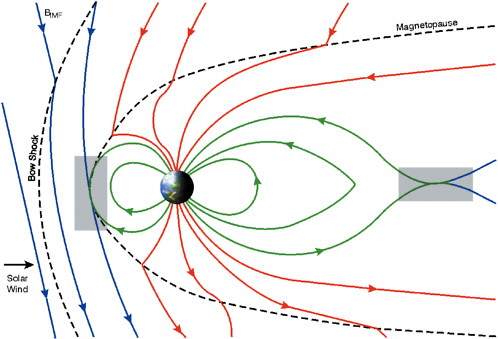
FIGURE 2.4 Southward-oriented interplanetary magnetic field (IMF) lines (blue) merge or reconnect with Earth’s closed field lines (green) at the subsolar point. The merged or “open” flux tubes (red), with one end in Earth’s ionosphere and the other end in the solar wind, are carried downstream by the solar wind flow and eventually reconnect in the distant tail. Merging results from the breaking of the frozen-in-flux condition, which occurs at an x-line in the diffusion or dissipation region (grey boxes). Merging of closed field lines in the near-Earth region of the magnetotail (not shown here) is associated with the onset of the substorm expansion phase. Reconnection at the dayside magnetopause is the primary mechanism for the transfer of mass, momentum, and energy from the solar wind to the magnetosphere, which occurs most efficiently when the IMF is oriented southward. In the tail, merging plays a role in the dissipation of energy stored in the magnetotail lobes as a result of dayside reconnection. (The drawing is not to scale.)
orientation of the interplanetary field relative to the geomagnetic field. In the simplest picture of magnetopause reconnection, the IMF is strongly southward—that is, it has an out-of-the-ecliptic component that is anti-parallel to Earth’s northward-directed field at the subsolar magnetopause—and merges with the geomagnetic field across an extended portion of the dayside magnetopause, producing open field lines that are swept back into the magnetotail by the solar wind flow as shown in Figure 2.4.
Spacecraft and ground-based observations indicate that the onset of magnetopause reconnection is closely associated with the formation of large-scale, organized plasma flows in the ionosphere. These flows
represent the motion of the ionospheric footpoints of the magnetic field lines that are undergoing reconnection at the magnetopause and later in the magnetotail and indicate how magnetic flux is replenished at the dayside magnetopause. As open field lines formed during magnetopause reconnection are transported into the tail by the solar wind flow, their footpoints move across the polar cap, from the dayside to the nightside. Subsequent reconnection in the magnetotail causes these open field lines to again become closed. They then contract toward Earth and flow around the flanks toward the dayside, where they resupply the dayside with magnetic flux. These flow signatures are now well reproduced by global magnetohydrodynamic models of the magnetosphere.
Satellite crossings of the magnetopause have yielded a wealth of data that document many of the phenomena predicted to result from reconnection, thus confirming both the occurrence of reconnection and its important role in the dynamics of the magnetosphere. These observations include direct measurement of plasma outflows from the reconnection site and magnetic field measurements that have verified predictions regarding the magnitudes and directions of these flows. Pairs of satellites flying on either side of the magnetic x-line have measured the expected oppositely directed outflows. High-time-resolution data from recent satellite observations has permitted the first exploration of the small-scale kinetic structure that has been predicted by theory to facilitate reconnection in the nearly collisionless environment of Earth’s magnetosphere. Finally, direct measurement of the mixture of hot plasma from Earth’s magnetosphere and the colder but denser plasma from the shocked solar wind on a single magnetic field line confirms that open field lines form as a result of magnetopause reconnection.
Because the IMF is generally not oriented directly southward but has a finite east-west component, the notion of oppositely directed field lines reconnecting at the subsolar magnetopause is an oversimplification. The location of magnetic reconnection at the magnetopause varies, depending on the direction of the IMF. Identifying the location of reconnection and understanding the physical processes that determine where reconnection takes place on the magnetopause continue to spark intense discussion in the scientific literature. The central issue is whether reconnection occurs primarily where Earth’s field and the IMF are anti-parallel or whether reconnection can occur in regions where the magnetic field rotates through a finite angle (less than 180 degrees) across the magnetopause. In the latter case, called component reconnection, the magnetic field can be separated into a component that undergoes reconnection (within a defined plane) and a passive component perpendicular to the plane of reconnection. Component reconnection is generically the most common form of reconnection in the solar corona, astrophysical, and laboratory plasmas. For a given orientation of the IMF, there are always locations on the magnetopause where the IMF and magnetospheric magnetic field are oppositely directed. In the case of a nearly east-west-directed IMF, for example, the locations of anti-parallel fields are on the flanks of the magnetopause. There is some evidence from analyses of spacecraft observations that magnetic reconnection is favored in locations where the magnetosheath and magnetospheric magnetic fields are nearly anti-parallel and tracks these regions as the IMF direction changes in time.
Magnetotail Reconnection
The addition of magnetic flux in the tail lobes as a result of reconnection at the dayside magnetopause compresses and thins the magnetotail, producing an extended magnetotail current sheet. Threading through this current sheet is a small component of the magnetic field. This normal magnetic field inhibits magnetic reconnection (which would usually be expected to develop rapidly in a simple one-dimensional model) and therefore facilitates the buildup of flux and energy in the tail lobes. The pileup of magnetic flux in the tail can continue for long periods of time (up to several hours) during extended periods of magnetopause
reconnection. Eventually, the formation of a magnetic x-line in the near-Earth region of the magnetotail leads to the onset of reconnection in the tail. Reconnection in this region either can be spatially and temporally localized or can organize into a large-scale event (a substorm). In the latter case reconnection proceeds until a significant fraction of the open flux that has built up in the tail reconnects. Field lines on the earthward side of this near-Earth x-line again become closed. At the same time, the field lines on the tailward side form disconnected magnetic flux tubes (see discussion in Chapter 5) that convect in an anti-sunward direction down the tail, disposing of the excess magnetic flux. Associated with this anti-sunward convection is the transport of plasma away from Earth, effectively reducing the plasma content of the closed field portion of the magnetotail. Through this process, the magnetosphere completes the cycle of loading and unloading of magnetic flux in the lobes initiated by reconnection at the magnetopause.
The development of a large-scale reconnection event that releases a substantial amount of the magnetic flux built up in the magnetotail is referred to as a substorm. The trigger mechanism for substorms remains uncertain and a number of competing theories have been proposed. Irrespective of the mechanism for the onset (see Chapter 5), satellite observations support the formation of a magnetic x-line (or lines) at distances of around 20 to 30 Earth radii—and in some cases as close as 15 Earth radii—anti-sunward from Earth. The transport and pileup of magnetic flux earthward of the x-line lead to a reconfiguration of the tail magnetic field and therefore the release of the magnetic stress associated with the stretching of the field lines by the solar wind flow. Anti-sunward of the reconnection region, the one or more reconnection sites combine to create plasmoids, large-scale traveling plasma structures entrained in magnetic flux ropes.
Magnetic reconnection in the tail current sheet does not necessarily develop as a long-term, large-scale phenomenon that releases a significant fraction of the energy stored in the lobes. Rather reconnection can be bursty and spatially localized. The flow signatures of such localized reconnection events, as measured by satellites, have been termed “bursty bulk flows.” The earthward-directed flows from these bursts of reconnection transport flux toward Earth. While each individual event is small, the net transport from many such events is a major source of flux transport in the magnetotail. The physical processes that lead to such localized reconnection events and that limit their amplitude are not well understood.
Of all of the planetary bodies, it is only at Earth that reconnection has been extensively studied. The preceding discussion has therefore focused on the terrestrial case because of the relative abundance of data. However, it should at least be noted in conclusion that the Mariner 10 probe to Mercury and the Galileo probe to Jupiter have provided evidence for the occurrence of reconnection at those planets as well. Mariner 10 data have been interpreted as evidence for the occurrence of substorms in Mercury’s tiny magnetosphere, while Galileo has observed the signature of what is likely to be the reconnection of stretched field lines in Jupiter’s magnetodisk.
Outstanding Questions About Reconnection in Earth’s Magnetosphere
-
What are the relative roles of component reconnection and anti-parallel reconnection at the magnetopause? What determines the location of magnetic reconnection?
-
Do coherent kinetic effects or turbulent scattering break the frozen-in condition during reconnection in the collisionless magnetosphere?
-
What controls the onset of substorms (large-scale reconnection events in the magnetotail)?
-
What controls the rate of magnetic reconnection and its spatial scale? Is reconnection steady or bursty?
THE ROLE OF LABORATORY EXPERIMENTS
The development of both ground- and space-based techniques for studying the dynamo and reconnection in the local cosmos combined with the development of theoretical/computational models has led to unprecedented progress in the understanding of both of these fundamentally important processes. Nevertheless, understanding naturally occurring dynamos and reconnection processes is complicated because of, for example, the complexity of the geometries, the inhomogeneity of important parameters, and the multiplicity of spatial scales involved. In recent years dedicated laboratory experiments have begun to play an increasingly important role in unraveling some of the important issues on these topics. Laboratory experiments have the advantage over naturally occurring phenomena that parameters can be varied to test ideas about the scaling of phenomena. Laboratory experiments on magnetic reconnection in particular have been constructed at national laboratories and university sites in both the United States and abroad. These experiments are now able to explore magnetic reconnection in both the collisional and collisionless regimes, test ideas about the scaling of the size of the dissipation region with parameters, explore the differences between reconnection with and without a guide field, and study the development of turbulence and its impact on the rate of reconnection. Theoretical modeling has in particular served to catalyze the interaction between laboratory experiments and satellite and other observations by providing testable ideas about the dominant processes that control reconnection. Several laboratory liquid metal dynamo experiments have also been constructed. Flows generated by propellers have been shown to reduce the rate of decay of seed magnetic fields, providing hope that the construction of larger-scale experiments (with larger Reynolds number) will demonstrate self-generation. An experiment that self-generates a seed magnetic field as a result of externally supplied flows would provide a wealth of data for benchmarking theoretical models.
CONCLUDING REMARKS
The generation of magnetic fields and their subsequent conversion into plasma kinetic energy have abundant examples throughout the universe. Thus, the creation and annihilation of magnetic fields take place over an enormous range of plasma densities and temperatures. However, in most cases similar physical processes are expected to control the essential dynamics. Solar physics and space physics are in a unique position to advance our understanding of these phenomena because of the accessibility of the Sun and the heliosphere to experimentation.
In the case of the Sun, high-resolution optical measurements can be used to investigate the small-scale fibril structure of the magnetic field and the role of magnetic reconnection in the development of flares and coronal mass ejections. Throughout the heliosphere, and especially at the planets, direct measurements of magnetic and electric fields, plasmas, and energetic particles can be used to test theories of the creation and annihilation of magnetic fields. Thus, the heliosphere is at once the setting for direct investigation of specific processes important to solar system plasmas and a laboratory for the investigation of magnetic-field phenomena important to the broader astrophysical plasma physics program.


