
8
A Perspective from a Water Company
Floyd Wicks
American Water Company of California
INTRODUCTION
In the United States the water industry is quite fragmented. There are 60,000 water utilities throughout the country, half of which are privately owned, and many serve very small communities. About 33 million people are served by the investor-owned water industry in this country, representing one out of seven people population-wise. The American Water Company of California (AWC) is a member of the National Association of Water Companies (NAWC), which is located in Washington, D.C. There are 42 states represented by this NAWC group. There are 330 investor-owned water utility members of NAWC.
In total, the NAWC member companies represent about $3 billion in revenues annually and around 15,000 employees. Of that, AWC has about 520 employees and $0.2 billion of annual revenues, relatively small by comparison. However, it is the third largest publicly traded company in the United States, because some of the larger companies have been purchased by foreign companies. It is traded on the New York Stock Exchange, provides water service to 75 cities in California and two Arizona communities, and was incorporated in 1929. Water utilities, public or private, in the United States all must meet the regulations for contaminants as determined by the states and U.S. Environmental Protection Agency (EPA).
Water Quality Issues: Historical Perspectives
Prior to 1974, U.S. Public Health Service Standards were met by the water utility industry, but they were voluntary. They were not mandated by federal or state agencies. Of course, if they were not met, consequences would result. In 1974, the Safe Drinking Water Act made that compliance mandatory.
In 1975, interim primary drinking water regulations were promulgated. Trihalomethanes are chlorinated organic compounds that can cause problems and were introduced in 1979. They have been around a lot longer, but a certain maximum contaminant level had not been set.
Growth in Regulated Contaminants
There are two major amendments to the Safe Drinking Water Act (SDWA), one in 1986 and one in 1996. Figure 8.1 shows that the impact of the 1986 amendment was dramatic.
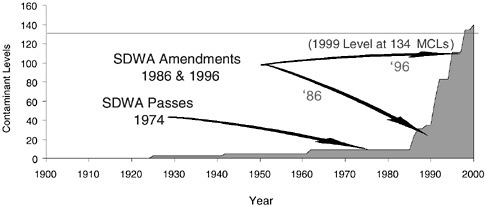
FIGURE 8.1 Growth in regulated contaminants.
Up to that time the number of contaminants was reasonable, but then in 1986, Congress actually mandated that EPA add 25 new contaminants every three years, regardless of the cost to remove these constituents from water. The 1996 amendment added more to the equation.
The 1996 amendment incorporated a cost-benefit rationale. In California there are a number of lawsuits against water utilities for providing water that is contaminated. The question is to what degree the contaminants are present. Even though all standards have been met since they were put in place, some customers have been prompted by attorneys to file lawsuits against the AWC and other water utilities in California.
Impact on American Water Company
The AWC has the distinction of serving in many parts of the state and has 300 production wells of its own. It pumps from contaminated groundwater sources, and treatment facilities remove those constituents. However, there are 22 lawsuits against the company. A number of county water systems and other private water companies have been sued as well.
The issue brought to court by the company was whether the court or the Public Utilities Commission (PUC) should regulate these standards. What level of treatment should be provided to make sure that people have a safe, good feeling about drinking their tap water?
The AWC has spent in excess of $7 million to date to defend itself against these lawsuits. The PUC conducted an investigation into the lawsuits, and AWC had to go back into its records for 25 years to provide the PUC with all the analyses of water distribution and treatment plant samples, in excess of 2 million samples. In those samples, contaminants were outside the range of the maximum contaminant level only 16 times. Therefore, the PUC found AWC to be in compliance with the law. In the Hartwell decision, the Supreme Court upheld the jurisdiction of the PUC over private utilities. The decision left all the public agencies in the lawsuit, but pulled the private agencies out. Only if plaintiffs can prove that EPA standards were violated can private companies be sued in court.
The fairness of imposing these kinds of costs on utilities and their customers has to be assessed, and the legislators, not the courts, should be urged to address these issues of responsibility. The companies are all also responsible when it comes to providing good-quality, sustainable water at affordable prices.
Number of Regulated Contaminants Versus Research Investment
Figure 8.2, although outdated, shows the number of contaminants increasing and the research investment trailing downward rather than upward. Our legislators should be asked to authorize more investment in the research side of the water utility industry. The other alternative is to label the product to caution that it may be harmful to your health (see Figure 8.3).
INVESTMENT
More than 2 million people, mostly children, die every year due to water-related diseases. More than 6,000 people die each day from waterborne disease or lack of water; put into perspective, half of that number died in the September 11, 2001, tragedy in New York.
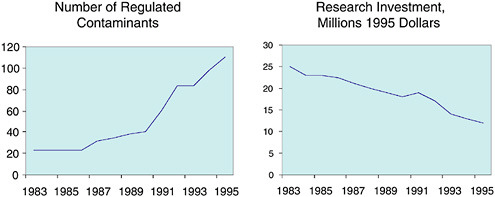
FIGURE 8.2 Number of regulated contaminants versus EPA research investment.
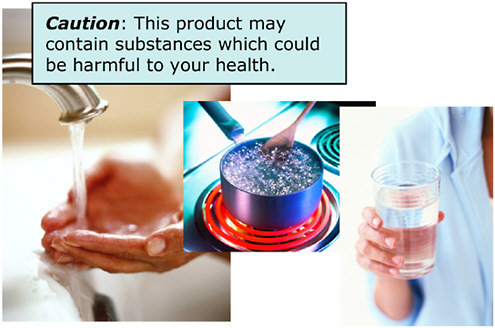
FIGURE 8.3 Labeling the water supply.
So the question regarding water quality is whether the contaminant list should be expanded when less than 0.5 percent of all the water delivered to a home is actually ingested. More than 99.5 percent is used elsewhere, either for flushing toilets, irrigating lawns, or washing cars. Why should all of that water have to be treated to such a high standard? Should a different way to treat water that ends up in your kitchen tap be considered? Perhaps “point-of-use” filtration or other chemical means to satisfy that concern could be performed.
WATER DISTRIBUTION PROBLEMS
In terms of California’s water supply, there is great production in the northern part of the state, but poor distribution. About 75 percent of available water in California is in the northern third of the state, yet 75 percent of the actual demand is in the southern two-thirds. Approximately 50 percent of all water in California gets redirected one way or the other.
Water comes to Southern California from a great distance: 600 miles of the state aqueduct system from Lake Oroville in the northern part of the state down to Los Angeles and further down to San Diego. From the Colorado River there are 242 miles of aqueduct.
States’ Activities
In Colorado, a 100 year supply is required for a new development in an attempt to have sustainable water for the future. A way around the requirement is drilling in some areas of Colorado to depths of more than 1,000 feet to get water that has been there for thousands of years, knowing that the recharge is not there. This may not be considered sustainable water for development unless in the interim the opportunity is there to pump back down into the aquifer for future use. However, this is not part of the current legislation in Colorado. A 100-year supply is also required in Nevada. In California the recent Kuehl legislation requires a 20-year sustainable supply.
Long-Term Challenges (2050)
In the year 2050, there will be 3 billion more people than there are today, with most expected to settle in semiarid regions. Using current farming technology, there will be 60 percent more water required just to grow the crops to feed 3 billion more people. This is a tremendous pressure on the resource. However, most of the soils today that are suited for agriculture are already in use.
OPTIONS
One option is demand-side management; in other words, the more water people use, the more they pay for that water. Another option is for people to change their diets. Virtual water could also be used; simply take the water, clean it, and put it back below ground for future use.
Desalination
Approximately 97 percent of the water in the earth is in the oceans. Of the remaining 3 percent, only a third is drink-
able water. The rest of it is tied up in glaciers or in areas that are just not able to be tapped.
About 70 percent of the world’s population lives within 50 miles of an ocean, so desalination could have advantages, including a sustainable supply. Desalination should be considered drought proof, which is justification for the higher cost to treat the water. The cost is about $900 per acre-foot; an acre-foot is about 326,000 gallons. For $900, that is a reasonable cost.
The Metropolitan Water District (MWD) recently built a reservoir to store water in Riverside that cost in excess of $2 billion. There is a great storage reservoir in the ocean. Why would a reservoir be built inland when there is a population center so close to the ocean? Given the cost avoided by not building reservoirs, the cost of $900 an acre-foot is inexpensive for a drought-proof source such as the ocean.
There are currently five sites under investigation in California alone for putting desalination into play. AWC has signed a contract with Poseidon Resources, the company that is building a 25-million-gallon-a-day plant in Tampa right now. The plant that AWC signed up to be part of is going to be about a 100-million-gallon-a-day treatment plant in Southern California. Of that, about 80,000 acre-feet, or 20 percent of the volume of water purchased from the MWD, will be replaced annually. The AWC’s portion of the treatment plant would be a capacity of about 20,000 acre-feet per year, which is projected to be on-line in about five years. There are others in Orange County that are looking at tapping into that plant’s capacity as well.
Education
American Water really wants to be a part of the bigger picture in California. In the early 1990s the organization was redesigned. An in-house university was created to reshape the organization into a more forward-thinking team.
The employees and customers are the beneficiaries. Employees are provided with the option of seven different “tracks” of learning. There is a water quality track that leads to certification by the State of California in either treatment or water distribution. The employees can actually get continuing education units they can transfer to the local university. This is a tremendous program and an interesting part of the water company’s business now. It not only trains people but develops them.
SUMMARY
In summary, desalination is really nothing new. Clouds contain water that is desalinated ocean water. Lake water is desalinated from those clouds. The environmental cycle provides water to everyone on Earth at zero cost per acre-foot. People have made the water supply imperfect and now have to spend $900 per acre-foot to clean it up and put it back on the land.
DISCUSSION
Bottled Water
Parry Norling, of RAND (now with the Chemical Heritage Foundation), asked how bottled water would compare to the American Water Company’s water if it was analyzed for some of the contaminants.
Mr. Wicks responded that if tap water is put into a bottle and put in a refrigerator, the chlorine taste that people find objectionable would be dissipated. The water is also healthier because it has been disinfected. Bottled water was taken directly off the shelves in various stores and tested primarily for bacteria because it has similar constituents for total dissolved solids (TDS), calcium, and magnesium. In many cases, a fairly substantial background count of bacteria was found. Considering that water is on the shelf at room temperature, it is alarming to find any bacteria at all.
Eli Greenbaum, of Oak Ridge National Laboratory, stated that if bacteria can be detected easily in bottled water, there should be a reduced carbon source in there as well. He wondered if Mr. Wicks has examined that.
Mr. Wicks answered that he has not, but that it sounds like a good idea. However, he is not familiar with it.
Tim Shaw, of the University of South Carolina, answered that plasticizers in a plastic bottle can leach out at a pretty high rate.
Mr. Wicks added that most of the bottles are made from polyvinyl chloride (PVC) materials. His customers use about 560 gallons a day, which is a lot of water, for which they pay about a $1.30 per day. Compared to bottled water in the store, this water is really cheap.
An unidentified speaker stated that he thinks most bottles are now polyethylene terephthalate (PET) rather than PVC. In that case, there is no plasticizer (often dioctylphthalate) to leach out. There might be, although unlikely, lower-molecular-weight cyclic esters that potentially can leach out.
Desalination
Debbie Elcock, of Argonne National Laboratory, wondered if Mr. Wicks had any thoughts in terms of desalination or had any information about looking at the front end for pollution prevention and life cycle cost. She also asked if Mr. Wicks knows what the by-products are and what usually happens with them.
Mr. Wicks responded that the location with which he is involved is right at a power plant site. There are no transmission costs involved due to the proximity to the plant. The load is basically constant once the plant is on-line. There is not a lot of peaking in this kind of a treatment plant. It is envisioned that the peaking would be provided to customers by the various groundwater basins. The plant runs year-round, and when the demands are low, the excess water goes
into the groundwater basins below the ground where it does not evaporate and is simply pumped back out when needed.
Additionally, Mr. Wicks stated that the by-products of desalination certainly are a concern to environmentalists and to the American Water Company. By locating the process near a power plant, water from the ocean is being used for cooling. A tremendous stream of water is pulled out of the ocean, probably in excess of 500 million gallons per day.
When the tap is taken off that line to go directly to the treatment plant and the process involves removal of the salts and everything else in the water, it is a reverse osmosis process. The water can be taken down to 200 parts per million of TDS, but the rest of it has to go back into the receiving stream. The waste is discharged back into the ocean from the power plant; however, on the basis of volume, the amount is incidental. The volume is far less damaging to the environment than building another dam or the other alternatives that are required to add to the water supply. Another dam cannot be built in California.
Indoor Water Demand
David Layton, of Lawrence Livermore National Laboratory, noted that the minimum demand usually seemed to be in January, which represents primarily indoor water use. To assure customers that they are being providing a secure and reliable water supply, it would seem important, from a company standpoint, to meet that indoor demand.
Mr. Wicks responded that his customers use on average 0.6 acre-foot annually. In some areas they use a lot more water because of the desert, but that averages about a full acre-foot per customer. The wintertime demand is certainly something to consider.
Cost of Water
Bruce Macler, of the U.S. Environmental Protection Agency, was interested in the definition of water—whether it should be considered a product or a service. He pointed out that if it is a product, then product liability comes into play; otherwise it does not. Dr. Macler said that if you have a service, then the SDWA may not really apply. He wanted to know how to protect the public if water is a service rather than a product.
Mr. Wicks responded that AWC does not charge for water, only for delivery. Water is a natural resource that is modified to some extent to meet certain standards and delivered through a series of pipes and reservoirs. He tells people that they are charged for service and it had better be the best service available. Given this fact, the water company is regulated by the utilities commission, so it does not earn on the labor that goes into providing that service. The only way a private water utility makes money for its shareholders is through the investment in pipelines, reservoirs, and wells. When the water comes out of a tap it must meet certain minimum standards as set by the EPA, and the water company is successful at that but is still getting sued.
An unidentified speaker was interested in knowing the actual cost of producing an acre-foot of water in California from the available sources of supply.
Mr. Wicks answered that the service costs roughly $2.50 per 1,000 gallons. Multiplying that by 326 (the number of thousand gallons in an acre-foot), the cost to the customer is approximately $1,000 an acre-foot.
The water company has no authority to tax people. The city wants to take the company over because it says the bills are the highest in 10 surrounding cities. However, revenue that comes in from the individual taxpayer in those cities with municipal water systems is not considered in the analysis of water bills. If only the water bill is examined, the company is second highest in terms of actual cost of water, but if all the other sources of revenue for those other cities with municipal water systems are examined, the company is second lowest.
Contamination
Mark Matsumoto, of the University of California at Riverside, asked why the problems are treated if very little water is for direct human consumption.
Mr. Wicks stated that there are a lot of experiments under way, such as the Irvine Ranch Water District that has portions of its water system piped in two different ways. One is for water that goes inside the building; the other is for irrigation water outdoors and is reclaimed water used in a separate pipeline. He said that this is very expensive to do. In Barstow, every customer uses 1 acre-foot of water, most of which is outside and cheaper. The current standard concentration for arsenic is 10 parts per billion (ppb) though it used to be 50 ppb, and decreasing it to 2 ppb was considered. At 2 ppb, every well in Barstow would need treatment, and it would have been cheaper to put 100 miles of pipeline in to parallel every pipeline in the streets in Barstow and then simply provide treatment for the small amount of water that goes into a home. The final number came in at 10 ppb, and only 2 out of more than 20 wells reflected concentrations greater than that.
Don Phipps, of the Orange County Water District, made a comment about microbial contamination. He said that if you follow water and other sources, the organisms that live in some of these waters can actually survive under incredibly oligotrophic conditions or low parts-per-billion concentrations of carbon. However, the microbes present are not necessarily harmful. Mr. Phipps mentioned that bottled water is also not sterile or particle free. He said that in fact, no commercial product other than certified particle-free water would be particle free. No commercial water system is going to produce a water of that quality.
Mr. Wicks agreed with Mr. Phipps’s comments and replied that his company has to send out a consumer confidence report every year. He said that in some samples, bac-
terial contamination will be found. For example, the company had a situation in the greater metropolitan area with part of its water coming from the Metropolitan Water District, which changed its disinfection to chloramines. Free chlorine was going in from the company’s wells, and part of the system ended up without chlorine, leading to bacterial problems. Planning activities are going on underground, yet nobody knows exactly what the cause is.
Dr. Macler explained that the problem is that the Food and Drug Administration does not have the resources to ensure that standards are being met. It is behind EPA in terms of regulations actually on the books. He pointed out that the requirement is for pathogenic microorganisms, not bacteria or other microorganisms that are nonpathogens. Pasteurized milk and water have organisms in them that will grow but are not considered pathogenic.


