
7
The Human and Economic Burden of Malaria
INTRODUCTION
The cost of malaria can be measured in lives lost, in time spent ill with fever, and in economic terms. Money spent on preventing and treating malaria, the indirect costs of lost wages, time home from school, and time spent caring for sick children, adds up at the personal level. In the public sector, large fractions of health sector budgets are spent on malaria control and treatment. And at the macroeconomic level, a heavy national burden of malaria dampens economic development, sometimes subtly, but pervasively. All of these effects are recognized and accepted widely, but their magnitude has been poorly documented.
Studies of the effects of malaria have most often been motivated by a desire to understand the costs of the disease to individuals and society, and frequently to justify public expenditures to diminish the burden. This type of work has only grown in importance, as competition for resources is ever more explicit, both within the spectrum of malaria activities (research vs. control, prevention vs. treatment) and between malaria and other diseases.
THE HEALTH BURDEN OF MALARIA IN AFRICA
|
In Africa, most people are born, live, and die without leaving a trace in the official record. Don de Savigny, Tanzania Essential Health Interventions Project |
Estimates of Deaths from Malaria
Deaths are not well counted in much of the world, and the situation is worst where people are poorest—which is where malaria takes its greatest toll. This has begun to change—Snow and colleagues (2003) date recognition of the importance of reliable estimates to the World Health Organization’s (WHO’s) Global Burden of Disease program of the early 1990s—but the figures available are still approximate.
Some 50 years ago, Leonard Bruce-Chwatt estimated the annual African death toll from malaria at one million. The figure was an extrapolation to the continent based on the civil registration of deaths in Lagos in 1950 (Bruce-Chwatt, 1952). Other numbers have been produced since then—between 0.5 million and 2 million deaths per year—using a variety of more and less evidence-based methods (Sturchler, 1989; Greenwood, 1990; WHO, 1996; Schwartlander, 1997). The most plausible current estimates come from Snow and colleagues, and their work on the Burden of Malaria in Africa (BOMA) project (Snow et al., 2003), which builds on the MARA (Mapping Malaria Risk in Africa) risk mapping, as well as mining of a wide range of other data sources. Their best estimate is 1,144,572 deaths attributable directly to malaria in Africa in the year 2000 (Table 7-1).
WHO’s most recent estimate of malaria deaths is similar—a worldwide total of 1,124,000 deaths due directly to malaria in 2001, of which about 970,000 would have been in Africa (WHO, 2002). The estimate also includes about 90,000 malaria deaths in Southeast Asia, 56,000 in the Eastern Mediterranean region, 11,000 in the Western Pacific, and about 1,000 in the Americas. While in the same overall range, the estimates do differ in their distribution among age groups: Snow and colleagues figures suggest that about 65 percent of deaths among children under 5, and the corresponding figure from WHO is much higher at 86 percent.
Estimates of Malaria Cases
There are no direct counts of the number of cases of malaria that occur each year. A very wide range of estimates has been made, using a variety of definitions. The lack of precision is problematic for this report, because an estimate of how many courses of malaria treatment are used is needed to estimate how much a global ACT subsidy will cost. The number of cases and the number of treatments are not the same but are related.
Malaria cases may be overestimated because few cases are definitively diagnosed before treatment (whether prescribed or self-selected), so quite a large number of fevers that are not malaria may be counted as such. The number also may be underestimated because people may get no treatment, either through choice or economic default, and in any case, episodes of malaria are not kept track of formally anywhere.
TABLE 7-1 Estimated Malaria-Specific Mortality during 2000, best estimate and IQR range
|
|
0-4 years |
5-14 years |
15+ years |
Total |
|
Southern Africa malaria risk (Class 4) |
266 [164–430] |
482 [297–779] |
1,129 [695–1,824] |
1,877 [1,156–3,033] |
|
Rest of Africa—low stable/ epidemic risk (Classes 2+3) |
57,688 |
32,588 |
49,079 |
139,355 |
|
Rest of Africa—stable endemic risk (Class 4) |
684,364 [541,330–1,068,723] |
182,113 [76,072–319,274] |
136,863 [84,399–214,419] |
1,003,340 [701,801–1,1602,415] |
|
Total |
742,318 [541,494–1,069,153] |
214,701 [76,369–320,053] |
187,071 [85,094–216,253] |
1,144,572 [702,957–1,605,448] |
|
IQR = Interquartile range, which represents the range of values from the 25th percentile to the 75th percentile, essentially the range of the middle 50% of the data. Because it uses the middle 50%, the IQR is not affected by extreme values. Classification of areas: Class 1: no human settlement, or unsuitable climate for malaria transmission. Class 2: populations exposed to marginal risks of malaria transmission, uncommon in an average year. Class 3: populations exposed to acute seasonal transmission with a tendency toward epidemics. Class 4: populations exposed to stable, endemic malaria transmission. In southern Africa (Namibia, Swaziland, South Africa, Botswana, Zimbabwe) Class 4 areas, malaria still poses a risk but its extent and transmission potential are determined by aggressive vector control. SOURCE: Snow et al. (2003). |
||||
Snow and colleagues, using the general pattern of risk and population as they used to estimate deaths for the Disease Control Priorities Project, also estimated the number of malaria episodes likely to occur in Africa in a year (the year 2000). In this case, they used the BOMA database to search for prospective studies of the incidence of fever (i.e., axillary or rectal body temperature ≥ 37.5°) since the 1980s.1 Studies were included if they met the following criteria:
-
They were cross-sectional studies with at least two rounds of observations on a single cohort to reflect seasonal differences in risk.
-
Subjects were recruited randomly from the community, and not from a clinic population.
-
For cohorts involved in randomized trials, only the control arm participants (i.e., those not receiving a study intervention) were included.
-
Clinical episodes were defined by quantified parasite levels (although levels differed among studies, ranging from 1,000 to 10,000 parasites/µl blood).
Definitions and methods of detection differed among the studies, and it was not possible to standardize them; some lack of comparability and imprecision had to be accepted.
The results are summarized in Table 7-2, ending with a median estimate of 213,549,000 episodes per year in Africa (with the estimate ranging from 134,322,000 to 324,617,000). Among young children in stable endemic areas, data from 28 studies led to a median estimate of 1,424 episodes per 1,000 children each year (i.e., nearly 1.5 episodes per child). The
TABLE 7-2 Estimated Number [IQR] of Clinical Attacks (thousands) of Malaria during 2000
|
|
0-4 years |
5-14 years |
15+ years |
Total |
|
Southern Africa malaria risk (Class 4) |
60 [20–265] |
109 [36–479] |
255 [84–1,122] |
424 [140–1,866] |
|
Rest of Africa—low stable/epidemic risk (Classes 2+3) |
4,007 [2,752–4,756] |
6,310 [4,333–7,488] |
6,291 [4,320–7,466] |
16,608 [11,405–19,710] |
|
Rest of Africa—stable endemic risk (Class 4) |
104,452 [61,468–158,952] |
67,658 [44,145–112,610] |
24,407 [16,880–31,479] |
196,517 [122,493–303,041] |
|
Totals |
108,519 [64,240–163,982] |
74,077 [48,514–120,577] |
30,953 [21,284–40,067] |
213,549 [134,322–324,617] |
|
SOURCE: Snow et al. (2003). |
||||
19 studies that included older children led to an estimate of 587 per 1,000 (on average, about one episode every other year). The median estimate for non-pregnant adults (based on only seven studies) was 107 per 1,000 people each year. Rates in low-transmission and fringe areas were correspondingly lower.
The Effect of Antimalarial Drug Resistance on the Burden of Malaria
Given the fragmentary statistics on malaria morbidity and mortality, it may seem presumptuous to attempt an assessment of how the spread of resistance to chloroquine and sulfadoxine-pyrimethamine (SP) has affected these measures over the past decades. There is, in fact, little direct information on how the number of cases of malaria has changed in the most endemic areas. What has been documented, however, are stark bellwethers of worsening conditions: a well-documented instance is the malaria epidemic of 1999-2000 in KwaZulu Natal, South Africa, which was a direct result of failing antimalarial drugs—SP had a failure rate of 88 percent. Other factors—increased vector resistance to the pyrethroid insecticides that were introduced in 1996, and the reinvasion of the highly anthropophilic Anopholes funestus vector—further exacerbated this epidemic (Muheki et al., 2003). The introduction of ACTs (and other control measures) brought the epidemic under control. And the question of changes in mortality has been addressed by thorough reviews of the data that do exist, in two major efforts. The first, the long view across the 20th century, used a variety of historical records from the BOMA project (Snow et al., 2001). The other case is an examination of trends in the 1980s and 1990s on a finer scale, contrasting East and West Africa (Korenromp et al., 2003), using the relatively uniform data reported in African Demographic Surveillance Systems (DSS).
Trends Through the 20th Century
The BOMA project provides the best opportunity to chart malaria’s past in Africa, and how drug resistance has affected its course over the final decades of the 20th century. The BOMA project began in 1998 with the aim of assembling in a single database all available evidence on morbidity, disability, and mortality associated with falciparum malaria in Africa, starting as far back as possible. The data come not only from the usual electronic databases, but from hand searches of early, unindexed papers in English and French tropical medicine journals, and a mass of unpublished material from local and regional conference proceedings, libraries, and Ministries of Health records (Snow et al., 2001).
In 2001, Snow and colleagues selected as much information as possible
from the BOMA database to inform an analysis of malaria mortality in Africa from 1900 through the 1990s (Snow et al., 2001). They took mortality reports from areas with documented, stable endemic transmission, where the prevalence of parasitemia in children was at least 30 percent, and which had recorded both all-cause mortality and malaria-specific mortality. Thirty-nine studies in 13 countries of sub-Saharan Africa 2 met the criteria, spanning the period from 1912 to 1995. A year-by-year analysis was not possible with these scattered, sparse data. Instead, the time span was divided into three periods, corresponding approximately to changes of probable significance to malaria control. The period before 1960 represents a time of limited access to primary health care and hence, to effective antimalarial drugs. From 1960 until 1990, after the beginning of independence for most countries, health care expanded across Africa and chloroquine became widely available, both from health services and as self-medication. The 1990s saw the widespread emergence of chloroquine resistance in many parts of Africa.
The picture painted by these data suggests a continuing downward trend in total child mortality over the three periods, but a downward and then ascending course for malaria-specific mortality, with the lowest rates in the middle period, and similar rates pre-1960 and post-1990 (Figure 7-1). With a 34 percent decline in overall mortality from before 1960 into the 1990s, and the fall and rise of malaria death rates into the 1990s, the proportion of all deaths due to malaria first fell from 18 percent pre-1960 to 12 percent in 1960-1990 but rose to 30 percent during the 1990s. Snow and colleagues (2001) cite data from Tanzania, Senegal, and Kenya comprising more detailed time series, which are consistent with the findings overall.
The data used to describe these trends, are by their nature, limited and not entirely comparable. The pre-1960 data are mainly from colonial Anglophone Africa, where malaria deaths were tracked through civil notification systems operating in defined populations. The pre-1960 systems probably missed a greater proportion of deaths than the later prospective surveillance studies, which have high rates of ascertainment of the fact of death. However, identification of deaths from “malaria” may actually have been more accurate in the earlier period because deaths often were followed up by a medical officer to determine their cause. The later surveillance systems rely on assigning cause of death retrospectively, mainly through verbal autopsies.
The declines in childhood mortality during the second half of the 20th
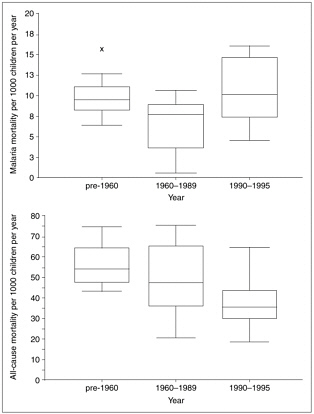
FIGURE 7-1 Malaria mortality and all cause mortality per 1000 children under 5 years in three time periods: pre-1960, 1960–1989, and 1990–1995. Central thick lines represent median estimates, box height represents 25%–75% quartile range, and extensions represent upper and lower confidence intervals.
SOURCES: Trape and Marsh, 2001; Snow, Trape, and Marsh, 2001.
century are well documented and accepted. The biggest declines have been in deaths from diarrheal disease, widely attributed to the development and dissemination of oral rehydration therapy, largely through WHO-sponsored programs. Declines also occurred in deaths from pneumonia and other infectious diseases. The declines are not uniform, and there are even places where trends are reversing in overall child mortality, but by and large, the trends have been positive. Malaria appears to be an exception.
How can the observed trends in malaria mortality among African children be explained? The positive effects on total mortality are a plausible result of expanded basic health services, including vaccinations, the widespread adoption of oral rehydration therapy, expanded access to antibiotics, and at least in places, improved sanitation and general living condi-
tions. In the mid-20th century, chloroquine would have counted among new beneficial drugs, even in the absence of a major campaign against malaria. The rise in malaria-specific mortality coincides with the spread of chloroquine-resistant strains of falciparum malaria. Although it is virtually impossible to demonstrate a causal link, in the absence of any other compelling reason, chloroquine resistance is the most plausible explanation for the increase.
Trends in the 1980s and 1990s
Resistance to chloroquine first became apparent in Africa in the late 1970s, more than a decade after its appearance in Asia. By 1990, resistant strains had been reported from all the endemic countries in Africa (Trape, 2001). The spread of drug resistance was implicated in the previous section as responsible for reversing the improvement in childhood mortality from malaria. The inference was made because mortality patterns in large population groups coincided with the general patterns of drug resistance, but the measurements of drug resistance were not available to make the link definitive.
There are data—albeit limited—that address the question more directly, although again, not definitively. Trape (2001) identified population-and hospital-based studies that recorded annual malaria mortality in Africa, based on continuous monitoring. He chose for analysis all those that spanned a period during which chloroquine resistance was known to be emerging in that area. Some of the hospital-based studies also had information on the prevalence of severe malaria over time. The remainder of this section is based on Trape’s report.
Population-Based Studies
Three studies tracked childhood malaria mortality in populations over the period in which chloroquine resistance emerged, from the mid-1980s to the mid-1990s. All were in Senegal, in different climatic areas: Mlomp area (rain forest), Niakhar area (Sahel), and Bandafassi area (savanna). In all three areas, the malaria mortality rates increased from the early to the later periods (Table 7-3). They more than doubled in all three sites and in Mlomp, increased 10-fold. Over the same period, standardized clinical protocols for assessing drug failures were carried out at least twice. In all cases, the degree of resistance intensified.
In one other place, Bagamoyo, on the Tanzania coast, deaths were investigated in 1984-1985, and again in 1992-1994 (i.e., not continuous, as in Senegal), bounding a period of increasing chloroquine resistance. Overall child mortality remained the same, but the proportion attributed to malaria was twofold higher in the later period.
TABLE 7-3 Childhood Malaria Mortality in Three Sites in Senegal
|
|
Year first CQ therapy failures reported |
|||
|
Mlomp (hypoendemic) |
1985-1989 |
1990-1992 |
1993-1995 |
1990 |
|
<5 malaria death rate (per 1,000) |
0.5 |
3.4 |
5.5 |
|
|
Resistance from standardized surveys |
|
RII/RIII: 36% (1991) |
RII/RIII: 46% (1995) |
|
|
Niakhar (mesoendemic) |
1984-1991 |
1992-1995 |
|
1992 |
|
<10 malaria death rate (per 1,000) |
4.0 |
8.2 |
|
|
|
Resistance from standardized surveys |
|
RII/RIII: 10% (1993) |
RII/RIII: 29% (1996) |
|
|
Bandafassi (holoendemic) |
1984-1992 |
1993-1995 |
|
1993 |
|
<5 malaria death rate (per 1,000) |
4.2 |
11.4 |
|
|
|
Resistance from standardized surveys |
|
RII/RIII: 6% (1994); RII/RIII: 16% (1995) |
|
|
|
SOURCE: Trape, 2001. |
||||
Hospital-Based Evidence
Data from hospitals in several countries offer another glimpse at trends in malaria incidence and death, with definite limitations. A hospital population consists only of those who decide—often through a complex decision-making process—to seek care there. Trends in the proportion of people with malaria who go to a hospital may relate to changes in incentives for hospital-based versus other sites of care (e.g., the population may know that hospitals are out of drugs at a particular time, a competing provider may be more attractive, or money for the hospital is unavailable in a given season or year) and changes in the incidence of other diseases, as well as to changes in the epidemiology of malaria. Hospitals also have advantages because of their range of expertise and technologies, and their record keeping.
Malawi. Malawi has national records for hospital admissions and deaths. From 1978 through 1983, the incidence of admissions for malaria
for children under 5 years of age more than doubled. Throughout the period, about 5 percent of those children died (Khoromana et al., 1986). The spread of chloroquine resistance in Malawi during this time was well documented.
Tanzania. The mission hospitals in Tanzania recorded steep increases in the proportion of admissions for malaria from 1968 through 1985. In the 1970s, about 10 percent of admissions were for malaria, and by the mid-1980s, had risen to 23 percent (Kilama and Kihamia, 1991). This also coincides with the rapid increase in chloroquine-resistant malaria in Tanzania.
Congo. In the hospital that was the main referral center in Kinshasa, the proportion of overall pediatric admissions for malaria increased each year, from 29.5 percent in 1982, to 56.4 percent in 1986, and the proportion of deaths increased from 4.8 to 15.3 percent over the same period (Greenberg et al., 1989). Again, this was the period during which chloroquine resistance emerged and spread quickly in Kinshasa.
Malaria admissions and deaths at the four hospitals in Brazzaville were studied for the years 1983-1989, during which (in 1985) chloroquine resistance was first detected there. From 1983 through 1986, pediatric admissions for malaria increased from 22 to 54 percent of all pediatric admissions, and then remained stable. Deaths from cerebral malaria more than doubled from the first to the second half of the study period (Carme et al., 1992).
Nigeria. A similar pattern was seen in the pediatric emergency room of Calabar Hospital in Nigeria, where the number of cases of malaria-related convulsions doubled during the years 1986 through 1988. In 81 percent of these cases, chloroquine was ineffective (Asindi et al., 1993).
Other Types of Evidence from Hospital-Based Studies
Various other studies, including one of trends in severe anemia in Kenya, and another of changes in hospital case fatality rates for malaria after a switch from chloroquine to SP, provide corroborating evidence that chloroquine resistance has led to increases in severe malaria and malaria deaths (Trape, 2001).
THE ECONOMIC BURDEN OF MALARIA
|
It has long been recognized that a malarious community is an impoverished community. T. H. Weller, Nobel Laureate in Medicine, 1958 |
|
We remain woefully ignorant of the social and economic effect of malaria in those countries of the world where it is prevalent. Andreano and Helminiak, 1988 … from the preventive point of view this [the cost of malaria] is perhaps the most important question before us; because, obviously, it governs the question of the expenditure which may be demanded for the anti-malarial campaign. Ronald Ross, 1911 |
The human costs of malaria are high, in lives that are lost and many more that are diminished. The immediate monetary costs of treating and trying to prevent disease are obvious and large, for governments and families. Those costs are far from the whole economic story, though. Malaria’s presence has—subtly, and overtly—influenced the nature of economic activities that define levels of development, and ultimately health and wellbeing in the broadest sense. For centuries, malaria’s pervasive effects have been recognized, and people have tried to estimate the costs in economic terms (Box 7-1).
Ideally, to understand the influence of malaria, one would start with a top-down approach, deriving dollar figures that represent the aggregate economic effects of malaria in a nation or region—the macroeconomic approach—and then working from the ground up, uncovering the detailed chains of causation leading to various streams of cost—the microeconomic approach. Such a coherent economic picture of the whole and its parts is not what exists today, however. The information is richer in quantity and quality than it was in 1991, when the Institute of Medicine last reported on this topic (IOM, 1991), but the knowledge base remains small compared with the size of the problem.
In fact, it is not only results that are lacking but the methods for generating them. In a recent review of approaches to evaluating the economic burden of malaria, Malaney (2003) observes:
… the state of the art for costing a disease like malaria has not progressed to the point where a dominant paradigm can be said to exist. Rather there are competing schools of thought, each of which directly addresses some piece of the puzzle at the expense of leaving some other aspect of the problem for a competing methodology.
|
BOX 7-1 In 1911, Sir Ronald Ross proposed to calculate the economic loss to the community based on malaria mortality and morbidity and “the local values of human life and labour at various ages and in various social classes.” But even then, Ross wrote that “many such estimates” had already been attempted (Najera and Hempel, 1996). He cited as previous work the calculations of Dr. Bolton, who estimated that hospital, and other direct expenses for malaria were about 2.6 rupeesa per capita in the island-nation of Mauritius, a total of about one million rupees for the entire population of about 383,000. This figure excluded the indirect costs of illness (Najera and Hempel, 1996). Ross also quoted an estimate from Howard that malaria cost “surely not less than $100,000,000 per year” for the United States in 1909 (Najera and Hempel, 1996). Sinton examined the costs of malaria “nationally, socially and economically” in India in the 1930s, based on a national malaria survey. He found malaria responsible for at least one million deaths directly, and at least two million if indirect effects were included, based on between 100 million and 200 million cases, with a case fatality rate of 1 percent (Najera and Hempel, 1996). He also was among the earliest to explicitly document areas where malaria prevented expansion of agriculture, with concomitant forgone income (IOM, 1991). Najera and Hempel (1996) observed: The development of health statistics during the 19th century, the economic motivations of the European colonial enterprise, the obvious recognition of malaria as a serious obstacle and the need of important investments for its control, lead to early efforts to define the malaria problem as a burden on society, measurable first in economic terms, such as lost productivity, and later including more general social values, such as learning ability and impact on education. Perhaps even more obvious than the continual, insidious costs of endemic malaria, the high human and financial costs associated with malaria epidemics have been recognized since antiquity. Organized malaria control was one of the earliest activities of emerging public health services in endemic countries as it became clear that certain human activities, such as rice cultivation, triggered malaria epidemics (Najera and Hempel, 1996). |
Understanding the economic effects of malaria has practical significance for prioritizing overall health spending, and at the program level, for identifying the mix of interventions most likely to benefit people, both in human and economic terms. Not knowing the current costs of malaria—what they represent, and how they are distributed—makes these decisions less certain. And having no baseline hampers an assessment of economic benefits derived from new programs.
Recent Estimates of the Costs of Malaria
The remainder of this chapter describes recent work on defining the economic costs of malaria. The macroeconomic effects—more elusive but unquestionably greater than the aggregate of currently measured microeconomic effects—include economic losses to nations from lack of foreign investment, drains of human capital, and other large-scale effects that hamper overall economic development. The microeconomic costs most often measured include the direct expense, to both government and individuals, of preventing and treating the disease, and the indirect costs of being sick with malaria.
The Effects of Malaria at the Macroeconomic Level
Malaria and poverty occupy common ground. Where the burden of malaria is highest, economic prosperity is lowest. Both are concentrated today in tropical and subtropical zones. Quantifying the relationship between malaria and country-level economics has posed an analytical challenge, first addressed just a few years ago. Analyses approached with several different datasets representing malaria and economic indices confirmed a strong relationship, although the magnitude of effect has varied. A recent review by one of the leaders in the field, Jeffrey Sachs, estimates that the average per-capita gross domestic product (GDP) of malaria-endemic countries in 1995, at about $US1,500 (adjusted for purchasing power parity3), was roughly one-fifth the average across the nonmalarious world (Sachs and Malaney, 2002). Annual economic growth in malarious countries between 1965 and 1990 averaged 0.4% of per-capita GDP, compared with 2.3% in the rest of the world, after controlling for the other standard growth determinants used in macroeconomic models. Over the long run, this decrement suggests that malaria could reduce GDP by nearly one-half in highly endemic countries.
These analyses do not constitute proof that malaria is a cause of low incomes and poor economic growth, but that the disease must be considered at least a legitimate contributor, and possibly the major contributor. It is true at the microeconomic level that poverty can lead to a heavier burden of malaria, and that malaria can deepen poverty, if a lack of money equals an inability to protect oneself against malaria or to properly treat it. Relationships at the macroeconomic level are real, but—possibly because the
chains of causation are obscured—easier to dismiss (Sachs and Malaney, 2002). Some of the ways in which malaria may hinder economic development are discussed in the sections that follow. An empirical study of the effect of reducing the numbers of malaria cases and related deaths in Vietnam (Box 7-2) found a generalized positive effect on household living standards (as measured by expenditures), which was greatest for areas with the greatest malaria reductions, and less so for areas with lesser malaria improvement (Laxminarayan, 2003).
Some Pathways Through Which Malaria May Hinder Economic Development
Demographic Effects
The deaths of one million children each year in sub-Saharan Africa affects demographic patterns, directly and indirectly. The direct effects are obvious. Indirectly, they lead to high fertility and large family sizes. Whether to ensure surviving heirs or caretakers for old age, the relationship between high infant and child mortality, and high fertility, is strong. Many children per family means fewer resources—including education, and health care—for each one. Girls often are given lowest priority for education, which adds fuel to the high fertility cycle. Employment choices are limited for women with many children; poorer health resulting from multiple pregnancies also detracts from women’s capacity to work. Over the long term, these conditions lead to high costs at the national and family level.
Effects on Human Capital
Infants and children carry the greatest burden of malaria morbidity and mortality. Those who survive may have lasting effects on their physical and mental—hence, economic—potential. The physical and cognitive effects are recognized, though poorly quantified. Even without direct effects of the disease, however, children with malaria lose out by missing school. In the few studies that have examined the relationship, upward of 10 percent (up to 50 percent) of school days lost to illness in sub-Saharan Africa are due to malaria (Sachs and Malaney, 2002). Across a population, this means higher failure rates, higher dropout rates, and poorer achievement. The total decrement in human capital development due to malaria is, however, unknown.
Trade and Foreign Direct Investment
The failure of malarious countries to attract foreign investment has undoubtedly had a major influence on economic development. As with
|
BOX 7-2 During the 1990s the government of Vietnam invested in malaria control mainly through insecticide, re-treatment of bednets, and by providing effective treatment for clinical episodes. The result was a dramatic overall decline in cases of malaria, but varying in magnitude among areas. Laxminarayan (2003) recognized this as a “natural experiment,” to see whether the malaria declines in each province could be related to subsequent improvements in living standards for the province as a whole (not only among the households that had experienced malaria recently). Specifically, he related changes in malaria incidence at the provincial level to changes in household living standards in that province over a 6-year period (controlling for other household characteristics). The “panel approach” design was meant to minimize the effect of unobserved variables on the results. Household living standards were based on a measure of household consumption, extracted from the Vietnam Living Standards Surveys (VLSS) for 1992-93 and 1997-98. The 1992-93 survey included 4,800 households and 23,839 individuals, and the later survey 6,000 households and 28,518 individuals, sampled from across the country. The study was based on the roughly 4,300 households and 18,000 individuals surveyed in both periods. Province-level data were used for the numbers of malaria cases, malaria deaths, and population size. Between the two periods, malaria incidence declined by 68 percent averaged over the country, and malaria mortality declined, on average, by 91 percent across the country, varying by province. Incidence in the earlier period ranged from roughly 1 percent to 16 percent among geographic regions. In the later period, malaria had been virtually eliminated in some areas, and was down to about 5 percent in the Central Highlands, the area with the highest incidence earlier. This trend reinforces that the study was not simply capturing the benefits of saving money not spent directly on malaria, since most households were unlikely to experience even a single episode in a given year. Results For all households in the sample, a 10 percent decrease in malaria cases at the provincial level resulted in a 0.3 percent increase in consumption (p<0.001).a Poorer households were likely to benefit more, so a convergence in the consump |
other macroeconomic effects, it is impossible to estimate the size of the effect, but examples of the problems malaria brings to projects are well known. At an aluminum smelter built recently in Mozambique by a British corporation (Billiton) which invested US$1.4 billion, the first 2 years of operation saw 13 malaria-related deaths among expatriate employees and 7,000 cases of malaria (Sachs and Malaney, 2002). The tourist trade also can be a casualty of endemic malaria. In general, malaria confines both the domestic and foreign workforce, which constrains development.
|
tion data was noted. In terms of household health expenditures, a 10 percent decrease in malaria cases translated to a 0.63 percent decrease (average US$0.16 per household). Poorer households did not see significant savings, consistent with their lower use of health services to begin with. Wealthier households had the greatest declines in health expenditures. Discussion The 1990s were a period of increasing prosperity in Vietnam, but by and large, the rapid gains against malaria can be attributed to government programs. Between 1991 and 1998, the number of people sleeping under insecticide-treated bednets increased from 300,000 to about 10.8 million. In the clinics, artemisininbased antimalarials replaced failing chloroquine and SP. These measures cost the central and local governments a total of US$28 million between 1991 and 1997. Were these investments worthwhile? There were about 850,000 fewer cases of malaria annually in 1997-98 than in 1992-93. At a cost to the government of about US$11 for a clinic visit plus drugs (1998 costs) to treat an episode, the direct costs saved were about US$9.5 million, which is about twice the amount spent on malaria control each year. To this is added about US$14 million in reduced out-of-pocket health care costs to households. The study was designed to look beyond these direct expenditures, however, at the generalized effect of freeing people from malaria. Accordingly, the 60 percent decline in malaria cases was associated with a 1.8 percent increase in annual household consumption. Applied nationwide, this amounts to a US$12.60 benefit to each household, for an aggregate benefit of US$183 million each year. The study demonstrates that households in areas with the greatest declines in malaria benefited to a greater extent than households where the decline was smaller. Looking only at the direct costs of preventing and treating malaria appears to grossly underestimate the overall effect of the disease, and the extent to which controlling it benefits people. Even if some of the benefit observed in this study resulted from other factors that were not measured, a large share is almost certainly due to the generalized effects of malaria control. |
Microeconomic Studies of the Effect of Malaria4
Most microeconomic studies of malaria use the “human capital” approach, which involves tallying the apparent costs of malaria borne privately by individuals and their families, by various levels of government,
and by other providers of services (e.g., nongovernmental organizations of various kinds, organizations financing malaria programs). Other methods to get at the costs of malaria are possible, including the “willingness-to-pay” approach, an example of which is described later in this section.
In the human capital approach, the immediate costs of treating or preventing an episode of illness consist of the “direct” costs—money spent for malaria prevention and treatment, including, for example, the cost of bednets and mosquito repellents in the first instance, and of consulting a health provider, buying drugs, and paying for transportation, in the second. Indirect costs represent loss of income (or productive labor, even if the benefits are not monetized, e.g., lost agricultural production because of an inability to plant or harvest crops) due to illness. Indirect costs also include periods of being too sick to work, time spent caring for others who are sick, and time spent seeking care. Some drawbacks of the method, as used, are discussed after a review of the findings of recent studies.
Direct Costs
Household Expenditures on Prevention Households and health services are the usual focus in studies of spending on the prevention and treatment of malaria. Households purchase prevention items such as mosquito coils, sprays and repellents, and bednets (with or without insecticide treatment), although these items also are desired for nuisance insect control and not just malaria prevention. Expenditures for these items have been studied in a few places, and range, per month, from US$0.05 per person in rural Malawi (Ettling et al., 1994) to US$2.10 per person in urban Cameroon (equivalent to a range of US$0.24 to US$15 per household) (Desfontaine et al., 1989). These average values mask tremendous variation across time and populations. Not surprisingly, studies have shown that expenditures are strongly correlated with income, and that the lowest income households spend the least. In one study in Malawi, 4 percent of very low-income households spent any money at all on malaria prevention, compared with 16 percent of other households (Ettling et al., 1994).
Household Expenditures on Treatment Malaria treatment can incur expenditures for consultation fees, drugs, transportation to health facilities, and, in some cases, the cost of staying at the facility, for patient and family member. A few studies document the monthly expenditures for treatment, ranging from US$0.41 (all of Malawi) (Ettling et al., 1994) to US$3.88 per person (urban Cameroon) (equivalent to a range of US$1.88 to US$26 per household) (Desfontaine et al., 1989). What evidence exists suggests that expenditures consume a much larger proportion of income in poorer households. In Malawi in the early 1990s, the direct costs of malaria treatment
amounted to 28 percent of household income for very low-income households, and 2 percent for the rest (Ettling et al., 1994).
Government Expenditures on Prevention and Treatment Little information exists on levels of public spending for malaria prevention and treatment. Health care budgets, of course, are not developed for specific diseases, and no specific studies of overall public spending for malaria appear to have been done. There are, however, indicators of how much malaria costs, at least in relative terms. About 20-40 percent of all outpatient visits in sub-Saharan Africa are for “fever,” a substantial (but varying) fraction of which is malaria. And 0.5 to 50 percent of all inpatients in different settings have been found to have malaria. The total resources consumed are substantial, even if they are not easily quantified.
Indirect Costs
When people are too sick to work, or their work capacity is reduced by illness, there are economic consequences: wage earners are paid less; agriculturists may produce less (particularly if illness coincides with the harvest); sick children themselves cannot work (even some very young children work) and may cause parents to lose work time. Deaths from malaria also have clear economic consequences. The death of an adult has obvious economic consequences, leaving families without needed resources. The death of a child involves a different set of economic losses. Illness and death from malaria diminish the stock of “human capital” in many ways. Conly (1975) conducted what is considered a classic study of the effect of malaria on agricultural settlers in Paraguay, finding major effects on the productivity of families (Box 7-3).
Studies of the indirect costs of illness vary in their methods, and in what is included as time lost. Although some include only time spent seeking treatment, most include some period of morbidity; some also include the costs of mortality (lifetime lost income) (Table 7-4). The value placed on lost time also varies among studies (as it does in life), but in all cases, simplifying assumptions are made to try to capture average experience, generally by age group. In the relatively few studies that attempted to calculate indirect costs of malaria, the cost for each episode ranges from US$0.68 for children under 10 years of age in Malawi (Ettling et al., 1994) to US$23 for an adult in Ethiopia (Cropper et al., 1999).
Total Direct and Indirect Costs
A few researchers have estimated “total” costs of malaria. One of the earliest studies, published in 1966, estimated the total cost of malaria in
|
BOX 7-3 In the early 1970s, Conly spent 22 months in the field observing and recording data on malaria (and health more generally), work of all kinds, and finances among farmers in Paraguay in newly-settled areas (Conly, 1975). She divided the families into three groups: “little malaria,” “moderate-incidence,” and “much malaria.” The divisions, to a great extent, reflected immune status, with the “much malaria” families being the most recently arrived from nonmalarious areas, and thus most vulnerable immunologically in all age groups. Conly found immediate effects of malaria on the work a family was able to do, as well as more far-reaching effects. During the period of illness, agricultural labor input declined, crops were neglected, and work done was less efficient than when people were well. In many cases, families were able to make up the lost work, and harvests did not suffer. But she also demonstrated that the threat of malaria caused families to shift from more labor-intensive (and valuable) crops to less labor-intensive ones, to minimize the risk of loss in case malaria kept family members from working at key times, particularly during the harvest. Conly describes the effects on “much malaria” families during their first year of farming: These farmers, even after making use of all available hands, skilled or not, were unable to do enough even to protect their immediate returns. It was not merely a matter of letting the condition of the farm deteriorate in a way that would mean much catching up later on: it was a question of losing crops that had been planted, of not being able to stop the weeds from stunting and choking the growing crops, of being unable to strip off the tobacco leaves at the right moment or get the burst of pods of cotton in before the rain. … In the intervals between bouts of illness these farmers—and their wives, children, parents and other relatives as well—worked long hours, but their yields at harvest time … were 36 percent lower than they should have been. By the second year, they began to adapt their farming in various ways and no doubt, also acquired some immunity to malaria, which would have protected at least some individuals from the debilitating episodes of the first year. This study has the strength of collecting data continuously over nearly two years. Most subsequent work has been based on shorter periods, and on individuals’ recall of illness episodes and their consequences. |
Pakistan (Khan, 1966), based on approximately 4.2 million people experiencing malaria per year, of whom 2.5 million were assumed to be workers. The costs included direct costs of treatment for everyone plus lost workdays (valued at an average daily wage rate) for the workers. This totaled to 81 million rupees, which was about 0.75 percent of GNP.
Two studies have estimated total household direct and indirect costs. In Malawi, the total annual household cost was estimated at about US$40,
which was 7 percent of household income (Ettling et al., 1994). Total household costs were estimated at 9-18 percent of annual income for small farmers in Kenya, and 7-13 percent in Nigeria (Leighton and Foster, 1993).
One multicountry study has attempted an Africa-wide estimate of direct plus indirect costs of malaria based on extrapolations from four case studies of areas in Burkina Faso, Chad, Congo, and Rwanda. The totals reported were US$1,064 million overall, which translates to US$3.15 per capita and 0.6 percent of total sub-Saharan Africa GDP (in 1987, inflated to 1999 U.S. dollars) (Shepard et al., 1991). Two of the country case studies estimated household plus government costs (including the direct costs of treatment, but not prevention; and including indirect mortality costs). The national cost per capita was estimated at US$1.55 in Burkina Faso (Sauerborn et al., 1991), and US$3.87 in Rwanda (Ettling and Shepard, 1991), figures that were roughly equivalent to 3.5 days of individual production.
Drawbacks of the Human Capital Method for Estimating Costs of Malaria
The studies reported here vary widely in the details of the methodology, their sources of data, and in their perspectives. Comprehensive studies of this type are difficult to conceive and to carry out, given inherent limits on data available in the places most affected, general difficulties in carrying out research in such places, and a lack of funding for such studies. Even when done well, however, the methods often require assumptions about such things as employment levels (which affect whether wages are actually lost), the value of leisure time, and substitutability of work by other families. Some of the aspects not generally captured by the human capital method relate to coping strategies adopted by families, which affect their economic well-being in ways not usually measured through direct and indirect costs usually measured.
Coping Strategies with Effects Not Captured by the Human Capital Method
In addition to paying for malaria prevention and treatment with cash-on-hand, and losing wages and other productive labor, families cope with malaria in ways that diminish their overall economic wellbeing. They respond not only to actual episodes of illness, but to the risk of illness with “anticipatory” coping strategies. These are often ignored in quantitative analyses because they may be hidden, and are at best, difficult to quantify.
Families faced with paying extraordinary costs for malaria treatment may:
TABLE 7-4 Calculations of Productivity Costs of Morbidity from a Malaria Episode Using the Wage Rate Method
|
Authors |
Country |
Method of Valuing Time |
|
Atkins (1995) |
The Gambia |
Marginal value of work time on crops cultivated by women |
|
Asenso-Okeyre et al (1997) |
Ghana |
Average agricultural wage differential by age and gender |
|
Bruce-Chwatt (1963) |
Nigeria (psychiatric patients, Lagos) |
– |
|
Cropper et al. (1999) |
Ethiopia |
50% or 100% of the average daily wage |
|
Ettling et al. (1991) |
Rwanda |
85% of average rural wage |
|
Ettling et al. (1994) |
Malawi |
Mean per capita income from household survey |
|
Gazin et al. (1988) |
Burkina Faso (factory) |
– |
|
Guiguemde et al. (1997) |
Burkina Faso |
Mean annual income per worker by occupational group and age |
|
Leighton and Foster (1993) |
Kenya |
Weighted average wage rate in agricultural, service and industrial sectors |
|
Leighton and Foster (1993) |
Nigeria |
Weighted average wage rate in agricultural, service and industrial sectors |
|
Miller (1958) |
West African men |
– |
|
Nur and Mahran (1988) |
Gezira, Sudan |
– |
|
Sauerborn et al. (1991) |
Burkina Faso |
Market value of average output per person for main produce in each of three seasons |
|
SOURCE: Chima et al., 2003. |
||
|
Time Lost per Episode by Sick Adult |
Time Lost per Episode by Carrier or Sick Child |
Average Indirect Cost per Episode (1999 US$) |
|
– |
2.16 h per day per child for 4 days plus time lost seeking treatment |
– |
|
5 days |
5 days |
57.63 |
|
2.6 days (untreated) |
– |
– |
|
18 days (total of 21 days lost, taking account of labor substitution) |
2 days (total of 12 days lost, taking account of labor substitution) children |
$6–23 for adults & teenagers; $3–12 for (including net effects of labor substitution) |
|
1 day for each hospitalized day plus 3 additional days |
1 day for each hospitalized day plus 1 additional day |
– |
|
2.7 days |
1.2 days |
$1.54 for patients over 10 years of age; $0.68 for patients age 10 and under |
|
3.5 days |
– |
– |
|
4 days (all ages; 73% were <5) |
1.2 days |
$4.21 |
|
2–4 days (plus allowance for lower productivity for 2 days) |
2–4 days |
– |
|
1–3 days (plus allowance for lower productivity for 2 days) |
2–4 days |
– |
|
4.2 days per episode |
– |
– |
|
6 days of disability, plus 5 at 50% productivity |
|
– – |
|
Mild illness 1 day; severe 5 days |
1/3 of adult illness time |
$0.73 |
-
deplete savings;
-
sell assets important to the household asset base, e.g., livestock;
-
receive cash gifts from family and friends; or
-
take out loans, which can lead to serious debt.
When a family member is sick with malaria, other family or community members may compensate for the loss of work time. Where unemployment or underemployment is common, the loss may be fully compensated without difficulty, so the economic loss might be less than otherwise estimated. This is particularly true in agricultural and other nonwage communal settings, but can even be the case for wage laborers whose family members substitute for them. On the other hand, the family of a small-scale farmer who falls ill may not be able to complete the work he would have done. In any case where children are substituting for adult laborers, they also may lose time from school, which is rarely quantified.
The anticipatory coping strategies are more subtle, but can have major economic consequences. In a labor market where illness is common, these may include limiting staff specialization or maintaining labor reserves to ensure a sufficient workforce, both of which reduce overall average productivity.
Families may limit their investments to maintain cash for malaria emergencies, or invest in assets that can be easily turned into cash. Families also may modify their farming practices, to avoid crops that require intensive work during the high-transmission seasons. Another family coping strategy is having larger numbers of children to ensure that a reasonable number will survive, with all of the obvious and subtle economic consequences entailed.
Malaney (Malaney, 2003) observes that the human capital approach “strains under the weight of a disease that affects entire societies on an effectively permanent basis,” a context for which these methods were not originally designed. But she also proposes ways of beginning to broaden the human capital approach to integrate these effects.
The Willingness-to-Pay Approach to Disease Valuation
Individuals and families regularly make decisions with economic consequences, like deciding to seek treatment for disease as opposed to watching and waiting, deciding whether or not to buy a bednet to prevent malaria, and deciding to plant one crop versus another with different labor requirements and different economic yield when harvested. Clearly, economic realities constrain these decisions, although some are forced upon families, such as a child in convulsions, who must be given attention.
The willingness-to-pay approach attempts to estimate the costs of dis-
ease by determining the value people would place on avoiding it. The assumption is that this approach would incorporate the burden of treatment and prevention, of lost productivity, lost leisure time, and the value of not having to cope with malaria in other ways. But the way in which this valuation happens is subject to individual interpretation, and assumes that people’s economic choices are rational and related to costs and other consequences. Nonetheless, the amount people are willing to pay to avoid disease—if captured in a reliable way—is a useful measure of how important the disease is, and can help make it a priority for public policy.
Studies of this type are very difficult to carry out reliably. The study described here is one of the few examples in malaria.
The Tigray Study
Malaria is endemic to the Tigray region of northern Ethiopia, with seasonal transmission throughout the rainy season (June through September), peaking toward the end of it (October and November). Malaria is a visible health problem to those who live there. The government encourages community control measures (mainly limiting mosquito breeding sites). It also carries out spraying, and trains community health workers to recognize and treat malaria.
Cropper and her colleagues studied the monetary value that households in Tigray place on preventing malaria through a “willingness-to-pay” scenario. They also made conventional “cost of illness” estimates for malaria (direct and indirect costs), in order to compare those figures with how much people were willing to pay to prevent malaria. If accurate, the amount that people are willing to pay to prevent malaria would capture the value placed on the economic losses as well as the pain and suffering caused by malaria, within the financial means of real families.
Study Design
The survey took place in January 1997 in the Tembien sector of Tigray region, where most people live by subsistence agriculture, plus some income from livestock. One person in each participating household (selection of survey households is described below) was interviewed with a three-part questionnaire. The first and third parts were the same everywhere: first, a “cost-of-illness” section with questions about the household’s current health status, knowledge of malaria, and expenditures on malaria prevention and treatment, mainly in the previous 2 years. The other constant section asked about socioeconomic characteristics of the household and its members, including education, income, assets, occupation, and housing construction. The middle section measured willingness to pay, with questions that varied
in order to build a coherent story. To do this, respondents were introduced to one of two scenarios: one regarding a hypothetical malaria vaccine that would prevent the disease entirely for one year, and the other, about bednets. For each scenario, a respondent was asked whether they would buy the intervention (the vaccine or the bednet) at a given price, and how many they would buy, recognizing that a dose of vaccine would protect one person, and a single bednet could be used for one or more people. The price each respondent was given for the intervention was one of five, assigned randomly, so that estimates could be made about the effect of price on willingness to pay.
Eighteen study villages were chosen (to represent a range of malaria incidence), and randomly assigned either the vaccine (12 villages) or the bednet (six villages) scenario. The target was to interview one respondent in 50 households chosen in each village (although it was not possible to select random samples of households because of a lack of records, the sampling method appears to have been unbiased). Of the intended 900 interviews, 889 were completed but 41 were dropped from the sample because the respondent was not familiar with malaria. This left 569 in the vaccine sample (about 114 for each of the five price levels) and 279 in the bednet sample (about 56 for each price level).
Results
Malaria and the Cost of Illness Malaria was common. More than half of the respondents (58 percent) reported having malaria in the previous 2 years; in half of the households, another adult (besides the respondent) had had malaria, and in half, a child or teenager had had malaria. Using the detailed information collected on these episodes, the costs of malaria per episode and per household were calculated (Table 7-5). Direct costs to the household included out-of-pocket expenditures to see a health practitioner, buy medicines, and pay for transportation, amounting to about US$1.60 for an adult episode, and about half that for a child. Indirect costs of illness are based on productive time lost by patients themselves, other family members caring for patients, and family members substituting for patients at their work. The average adult loss per episode was 21 days. Dollar values were assigned to the days lost, for adults, equivalent to the average daily wage for a healthy, unskilled worker. Under the “high productivity” assumption this amounted to US$24 for an adult, and under the “low productivity” assumption, half that amount. The rates for teenagers were half the adult rates, and for children, one quarter.
Willingness to Pay to Prevent Malaria As would be expected, for both the hypothetical vaccine and bednets, the lower the price offered to respon-
TABLE 7-5 Cost of Malaria to Households in Tigray, Ethiopia
|
|
|
Direct Costs (1997 US$) |
Indirect Costs |
|
Total Annual Costs (1997 US$) |
|||
|
Age Group |
Consulta |
Medicineb |
Transport |
Total Direct |
Workdays Lostc |
Average Cost (1997 US$)d |
High Prod |
Low Prod |
|
Adults |
1.30 |
.20 |
.10 |
1.60 |
21 |
7-24 |
|
|
|
Teenagers |
.80 |
.20 |
.04 |
1.10 |
26 |
7-23 |
|
|
|
Children |
.60 |
.20 |
.02 |
.82 |
12 |
4-12 |
|
|
|
Household |
|
|
|
|
|
|
31 |
9 |
|
aOut-of-pocket costs to see a practitioner. bOut-of pocket costs of medicines. cAverage number of days of productivity loss per episode. dAverage cost of illness per episode, using high- and low-productivity assumptions. SOURCE: Cropper et al. (1999). |
||||||||
dents, the more said they would buy, and the number they would buy was greater the lower the price (keeping in mind that each respondent was offered the intervention at one specific price). For vaccines, at the lowest price offered (US$0.80), three-quarters of households would buy at least one dose, but at the highest price (US$32), only 10 would buy at least one. For bednets, at the lowest price (US$1.30), about 80 percent of households would acquire at least one, and at the highest price (US$16), about 40 percent.
These results were compared with the cost-of-illness figures using three different models (see original paper for details), with similar results: people appear to be willing to pay about three times the annual cost of illness for total malaria prevention (the vaccine). For partial prevention (bednets), willingness to pay was less, about 72 percent of the value for vaccines.
Comments
People living in malarious areas are willing to spend dearly—according to this study, about 15 percent of their annual household income—to prevent malaria. This is two to three times the expected annual economic losses per household from malaria (and this does not count the amount spent by government). The amount itself does not necessarily have an economic basis, but it makes clear that people view malaria as much more than simply the sum of its obvious economic consequences, which themselves are substantial.
Summing Up
The “true” economic costs of malaria are undeniably large, but just how large is not known. Admittedly, the information base is small, which accounts for part of the problem, but the methods themselves are not as well developed as needed. Adding up all of the effects from the best microeconomic studies using the human capital method, the totals do not begin to approach the magnitude of effect seen with top-down macroeconomic approaches. The human capital method, as practiced, underestimates costs in ways that are identifiable, as well as some that have yet to be defined. With macroeconomic methods, it is impossible to know whether other factors, inadequately controlled for, are inflating the numbers.
Understanding both the magnitude of malaria’s economic effects as well as its operative pathways will accomplish two goals. It will better place malaria in its appropriate economic context and it will improve strategies by which to combat it.
REFERENCES
Asenso-Okyere WK, and Dzator JA. 1997. Household cost of seeking malaria care. A retrospective study of two districts in Ghana. Social Science and Medicine 45(5):659-667.
Asindi AA, Ekanem EE, Ibia EO, Nwangwa MA. 1993. Upsurge of malaria-related convulsions in a paediatric emergency room in Nigeria. Consequence of emergence of chloroquine-resistant Plasmodium falciparum. Tropical and Geographical Medicine 45(3):110-113.
Bruce-Chwatt LJ. 1952. Malaria in African infants and children in southern Nigeria. Annals of Tropical Medicine and Parasitology 46:173-200.
Bruce-Chwatt LJ. 1963. A longitudinal survey of natural malaria infection in a group of West African adults, Parts I & II. West African Medical Journal 12:141-173, 199-217.
Carme B, Yombi B, Bouquety JC, Plassard H, Nzingoula S, Senga J, Akani I. 1992. Child morbidity and mortality due to cerebral malaria in Brazzaville, Congo. A retrospective and prospective hospital-based study, 1983-1989. Tropical Medicine and Parasitology 43(3):173-176.
Chima RI, Goodman CA, Mills A. 2003. The economic impact of malaria in Africa: A critical review of the evidence. Health Policy 63(1):17-36.
Conly, G. 1975. The Impact of Malaria on Economic Development: A Case Study. Washington, DC: Pan American Health Organization.
Cropper ML, Haile MLJA, Poulos C, Whittington D. 1999. The Value of Preventing Malaria in Tembien, Ethiopia, Working Paper. Washington, DC: The World Bank.
Desfontaine M, Gelas H, Goghomu A, Kouka-Bemba D, Carnevale P. 1989. Evaluation of practices and costs of vector control at the family level in central Africa, I. Yaounde City (March 1988). [French]. Bulletin de la Societe de Pathologie Exotique et de Ses Filiales 82(4):558-565.
Ettling M, McFarland DA, Schultz LJ, Chitsulo L. 1994. Economic impact of malaria in Malawian households. Tropical Medicine and Parasitology 45(1):74-79.
Ettling MB, Shepard DS. 1991. Economic cost of malaria in Rwanda. Tropical Medicine and Parasitology 42(3):214-218.
Gallup JL, Sachs JD. 2001. The economic burden of malaria. American Journal of Tropical Medicine and Hygiene 64(1-2 Suppl):85-96.
Gazin P, Freier C, Turk P, Gineste B, Carnevale P. 1988. [Malaria in employees of an African industrial enterprise (Bobo Dioulasso, Burkina Faso)]. [French]. Annales de la Societe Belge de Medecine Tropicale 68(4):285-292.
Gomes M. 1993. Economic and demographic research on malaria: A review of the evidence. Social Science and Medicine 37(9):1093-1108.
Greenberg AE, Ntumbanzondo M, Ntula N, Mawa L, Howell J, Davachi F. 1989. Hospital-based surveillance of malaria-related paediatric morbidity and mortality in Kinshasa, Zaire. Bulletin of the World Health Organization 67(2):189-196.
Greenwood BM. 1990. Populations at risk. Parasitology Today 6(6):188.
Guiguemde TR, Coulibaly N, Coulibaly SO, Quedraogo JB, Gbary AR. 1997. A precise method to estimate the cost of malaria: The application to a rural area in Burkina Faso (West Africa). [French]. Tropical Medicine and International Health 2(7):646-653.
IOM (Institute of Medicine). 1991. Malaria: Obstacles and Opportunities. Oakes SC, Mitchell VS, Pearson GW, Carpenter CCJ, eds. Washington, DC: National Academy Press.
Khan MJ. 1966. Estimate of economic loss due to malaria in West Pakistan. Pakistan Journal of Health 16:187-193.
Khoromana CH, Campbell CC, Wirima JJ, Heymann DL. 1986. In vivo efficacy of chloroquine treatment for Plasmodium falciparum in Malawian children under five years of age. American Journal of Tropical Medicine and Hygiene 35(3):465-471.
Kilama WL, Kihamia CM. 1991. Malaria. In: Mwaluko GMP, Kilama WL, Mandara MP, Muru M, Macpherson CNL, eds. Health and Diseases in Tanzania. London: Harper Collins Academic.
Korenromp EL, Williams BG, Gouws E, Dye C, Snow RW. 2003. Measurement of trends in childhood malaria mortality in Africa: An assessment of progress toward targets based on verbal autopsy. The Lancet Infectious Diseases 3(6):349-358.
Laxminarayan R. 2004. Does reducing malaria improve household living standards? Tropical Medicine and International Health 9(2):267-272.
Leighton C, Foster R. 1993. Economic Impacts of Malaria in Kenya and Nigeria. Bethesda, MD: Abt Associates.
Malaney P. 2003. Micro-Economic Approaches to Evaluating the Burden of Malaria. CID Working Paper No. 99 ed. Boston: Center for International Development at Harvard University.
Miller MJ. 1958. Observations of the natural history of malaria in the semi-resistant West African. Transactions of the Royal Society of Tropical Medicine and Hygiene 52(2):152-168.
Muheki C, Barnes K, McIntyre D. 2003. Economic Evaluation of Recent Malaria Control Interventions in KwaZulu Natal, South Africa: SEACAT Evaluation. Cape Town: SEACAT.
Najera JA, Hempel J. 1996. The Burden of Malaria. CTD/MAL/96.10th ed. Geneva: World Health Organization.
Sachs J, Malaney P. 2002. The economic and social burden of malaria. Nature 415(6872):680-685.
Sauerborn R, Shepard DS, Ettling MB, Brinkmann U, Nougtara A, Diesfeld HJ. 1991. Estimating the direct and indirect economic costs of malaria in a rural district of Burkina Faso. Tropical Medicine and Parasitology 42(3):219-223.
Schwartlander B. 1997. Global burden of disease [letter]. Lancet 350(9071):141-142.
Shepard DS, Ettling MB, Brinkmann U, Sauerborn R. 1991. The economic cost of malaria in Africa. Tropical Medicine and Parasitology 42(3):199-203.
Snow RW, Trape JF, Marsh K. 2001. The past, present and future of childhood malaria mortality in Africa. Trends in Parasitology 17(12):593-597.
Snow RW, Craig MH, Newton CRJC, Steketee RW. 2003. The Public Health Burden of Plasmodium Falciparum Malaria in Africa: Deriving the Numbers. Bethesda, MD: Disease Control Priorities Project.
Sturchler D. 1989. Estimates of malaria incidence: Reply. Parasitology Today 5(12):384.
Trape JF. 2001. The public health impact of chloroquine resistance in Africa. American Journal of Tropical Medicine and Hygiene 64(1-2 Suppl):12-17.
WHO (World Health Organization). 1996. Investing in Health Research and Development: Report of the Ad Hoc Committee on Health Research Relating to Future Intervention Options. TDR/Gen/96.1. Geneva: World Health Organization.
WHO. 2002. World Health Report 2002. Geneva: World Health Organization.


