
4
Teaching and Learning About Spatial Thinking
4.1 INTRODUCTION
Spatial thinking is powerful and pervasive, underpinning everyday life, work, and science (Chapter 3). It plays a role in activities ranging from understanding metaphors, becoming good at wayfinding, and interpreting works of art, to engaging in molecular modeling, generating geometry proofs, and interpreting astronomical data. Spatial thinking comes in many guises (Chapter 2). It can rely on any of the senses; it can take place entirely in the mind or it can be supported by tools that are simple—a pencil and paper—or complex—a GIS program (Chapters 7 and 8). Spatial thinking can be a basis for sophisticated expertise—as in the calculations of a world-class orienteer—or for everyday judgments—as in the rough-and-ready estimates of the amount of paint needed to cover the walls of a room.
Although everyone can and does think spatially, people do so in different ways and with varying degrees of confidence and success in different situations. Some people are good at spatial reasoning, and others struggle; the results of giving travel directions exemplify the difference in levels of success. In giving directions, strategies vary: directions can be given as turns, as landmarks, or as a sketch map. Some people are good at spatial thinking only in a limited domain of knowledge and literally cannot find their way out of the proverbial paper bag, whereas others seem able to tackle a wide range of spatial problems (see, for example, discussions of spatial agnosia and spatial amnesia; Amorim, 1999).
In this chapter, the committee explores the nature of and explanations for differences in the process of spatial thinking and discusses ways to incorporate spatial thinking into the K–12 curriculum. How can we account for differences in the ability to think spatially? What does it mean to be good at spatial thinking? How can one learn to become a better spatial thinker? Answers to these questions are crucial to the challenge of teaching and supporting spatial thinking in American schools. If, for example, the capacity to think spatially is innate and immutable, then presumably educational programs would be of no value. If, on the other hand, one can learn to think spatially, then what types of learning experiences are helpful? Are they helpful to everybody in the same way in the same context, or should different people be helped in different ways in different contexts?
Section 4.2 asks: What do we mean by being good at spatial thinking? Experts think more deeply and remember in more detail within their domain of expertise, but not necessarily outside of that domain. Given the domain specificity of expertise, what does it mean to achieve expertise in spatial thinking? Section 4.2 describes the processes involved in generating spatial representations and explains ways in which those processes can facilitate and limit thinking. Our conclusions are that similar processes underpin some aspects of spatial thinking in all domains, whether thinking about tectonic plates, troop movements in the Civil War, or weather. Of equal importance, we believe that practicing spatial thinking pays off. Some features of practice and expertise at spatial thinking in one domain do transfer to other domains (for example, knowing what it takes to construct a spatial representation). Yet many features do not transfer and, therefore, spatial thinking needs to be practiced in specific contexts where it is appropriate.
Section 4.3 turns to the development of expertise in spatial thinking, showing how expertise is a function of time and how it involves the use of spatial representations. Given an objective of infusing and integrating diverse spatial thinking activities throughout the K–12 curriculum, Section 4.4 addresses the question: To what extent is learning to think spatially transferable from one context or from one domain to another? Section 4.5 presents a position statement on fostering expertise in spatial thinking. Section 4.6 presents the committee’s conclusions regarding the teaching and learning of spatial thinking and derives two educational principles that should inform the development of curricula to foster spatial literacy.
4.2 EXPERTISE DIFFERENCES IN SPATIAL THINKING: THE EFFECTS OF EXPERIENCE
4.2.1 The Nature of Expertise
In everyday life and in cognitive science, we equate superior performance in a domain of activity—sport or classical music or nuclear physics—with expertise. Experts in an intellectual knowledge domain think fluently and deeply within their domain of expertise (as in the case of Marie Tharp with respect to marine geosciences and Walter Christaller with respect to human geography [Chapter 3]), but experts do not necessarily think with comparable fluency or depth outside of those domains. Expertise is not an automatic result of high intelligence. Instead experts have acquired extensive understanding of the spatial knowledge, spatial ways of thinking and acting, and spatial capabilities within their domains. The knowledge and skills shape what they attend to and notice, how they organize new information, and how they solve problems.
Fluent and deep expert thinking occurs in every knowledge domain, and reasoning with spatial representations often serves as a central feature of expertise in a range of areas: electronic circuit design (Biswas et al., 1995; Cheng, 2002), reading X-rays (Manning and Leach, 2002), air traffic control (Ackerman and Cianciolo, 2002), architecture (Salthouse et al., 1990), video gaming (Greenfield et al., 1994; Sims and Mayer, 2002), and driving a taxi (Maguire et al., 1997).
Experts often acknowledge the role of spatial representations and imagery. Shepard (1988) compiled autobiographical accounts from notable figures in the sciences, arts, and literature in which these experts attributed the emergence of their original ideas at least in part to the use of spatial imagery. For example, Einstein described developing the concept of special relativity in part through thought experiments in which he imagined the properties of space and time while he was traveling at different speeds. Kekulé described developing the molecular model of the structure of benzene in part as a consequence of dreaming about a snake coiled in a circle, biting its own tail.
We do not know the extent to which experts are correct in believing that their scientific discoveries emerged from using spatial representations of actual or hypothetical events: the images may have simply allowed them to describe and explain their discoveries, which may have emerged
without using spatial representations. Expert and nonexpert learners, however, often use spatial models strategically to help remember and understand when reading new information (Cariglia-Bull and Pressley, 1990) and when using diagrams to understand technical texts (Hegarty and Just, 1993; Simon, 2001).
4.2.2 Domain-Specific Expertise: The Case of Chess
Chess has been a major task in cognitive analyses of expertise. de Groot (1978) conducted pioneering studies comparing the chess playing of grand masters with that of lesser ranked but highly competitive players. He wanted to identify the cognitive skills and strategies that enabled grand masters to outscore their opponents. His hypothesis was that masters would show greater breadth of search (by thinking through a greater number of possible moves) and greater depth of search (by thinking through more “if I do this, and my opponent does that …” possibilities). To test this hypothesis, he asked masters and non-masters to think aloud while they selected moves. Neither masters nor skilled opponents thought exhaustively through all possibilities, though both groups did show impressive breadth and depth of searches. Yet somehow, masters selected “better” moves than did their opponents.
Chase and Simon (1973) hypothesized that the difference between masters and non-masters involved spatial pattern learning; masters “see” the arrangements of chess pieces in larger and more meaningful chunks and are faster at recognizing different board patterns. As a test of this hypothesis, they created configurations of pieces on schematic chessboards, and asked masters and non-masters to study the configurations in order to identify them in a later recognition test. Some patterns were realistic and fitted the rules of chess, whereas others were determined by randomly assigning identical sets of pieces to positions on the board. Masters and non-masters showed similar levels of memory for randomly determined boards, whereas masters significantly outperformed non-masters in remembering meaningful patterns. Expertise in chess helps players recognize meaningful spatial patterns and remember them easily and well. Highly skilled players excel at thinking through moves, reflecting their deep and easily accessed knowledge of the spatial patterns of games. Differences between players reflect depth of knowledge of spatial patterns in the domain of chess.
Expertise in chess (like expertise in the sciences, mathematics, humanities, and arts) is, therefore, specific to a domain. Experts generally are not more intelligent, nor do they think more deeply (Ericsson and Charness, 1994). The fluent reasoning and problem solving that characterize expertise result from the build-up of a store of domain-specific knowledge (Bransford et al., 1999).
Given this position about expertise in general, what does it mean to have expertise in spatial thinking? In what ways might expertise in spatial thinking be domain specific and in what ways might it cut across all domains where spatial thinking is useful? Because spatial imagery, a form of human memory, is the realm of spatial thinking best understood by cognitive psychologists, we begin by discussing spatial imagery and memory.
4.2.3 The Role of Memory in Expertise
People remember and think about spatial information in many forms. Perceptual images, for example, preserve many of the features of the original input modality, such that imagining visual experiences results in activation of the visual cortex, or auditory experiences of the auditory cortex, and so forth (Barsalou et al., 2003). Experts and novices use perceptually rich images to help them think about the kinematics and dynamics of physical systems such as springs (Clement, 2003) and interlocking gears (Schwartz and Black, 1996). Spatial thinking that taps perceptual images is embodied in the sense that images of a thinker’s physical actions, such as physically pulling a
spring or turning a gear wheel, make it easier to imagine the resulting spring forces and gear movements.
People are versatile in their ability to generate and use images. They can call to mind the physical appearance of static objects or dynamic events they have directly experienced through vision, audition, and touch (Kosslyn and Koenig, 1992). They can generate spatial images from nonspatial forms of input such as reading text (Franklin and Tversky, 1990), listening to conversation, or ideas they have imagined on their own (Finke, 1989). Although imagery often results from visual input and is often described in visual terms, spatial images are not necessarily visual; they are accessible to persons who lack life experience seeing (de-Beni and Cornoldi, 1988; Cornoldi and Vecchi, 2003; Farah, 1989). Children younger than about 7 years of age do not tend to use imagery strategically to help them learn new information, but even pre-school age children can generate and process images based on perceptual input. Kosslyn et al. (1990) showed that children in kindergarten can look at a visual stimulus and then generate an image of it later in order to make decisions about what they saw. Ray and Rieser (2003) showed that children 3–4 years of age can listen to short stories and generate spatial representations of the story in order to judge the relative locations of objects described in the story.
Psychologists distinguish memory in terms of its structures and the types of knowledge that are represented. A classic model of memory (Baddeley, 1986) includes three major structural types: sensory storage, short-term or working memory, and long-term memory (although a unitary view of memory is a viable alternative; see Cowan, 1997). Memory is highly selective, and much of what is perceived is forgotten or reconstructed as a result of organizing schema (for a classic treatment of this issue, see Bartlett, 1932).
Three features of the memory system can help us to understand how and why spatial thinking does and does not work: the automaticity of overlearning, the use of strategies to reduce memory demands, and the capacity of multiple working memory subsystems to operate in parallel.
The first feature is that calling to mind overlearned materials is more automatic than recalling less familiar materials, thus placing a smaller demand on working memory. The idea of automaticity might explain why attempts to use spatial aids such as maps or graphics to understand historical events sometimes interferes with learning instead of facilitating it. If the content and form of the map or graph are relatively unfamiliar, then too much working memory capacity is required to process both the unfamiliar form and the intended content of the representation.
A second feature is the skillful use of strategies to reduce demands on long-term memory. For example, chunking numbers by combining them into larger units, each of which is meaningful, is an effective memory strategy. It is easier to remember a list of numbers in this form [526 924 018 682] rather than this form [526924018682]. Even more effective is a way to chunk information so that it relates to things (or meaningful chunks) one already knows well. It is more difficult, therefore, to remember this list of arbitrarily defined chunks [219 171 918 194 119 45] than this list of meaningful chunks [the start and end years of the United States participation in the two World Wars are 1917–1918 and 1941–1945].
Most of the research on the use of memory strategies is aimed at understanding memory for verbal materials. We need to find out about analogous memory strategies for spatial information—what are efficient ways to “chunk” the information in graphics to make it easier to remember? What are efficient ways of chunking new graphics so they can be related to graphics that have already been learned?
Perceptual learning processes can lead to the rapid and accurate identification of the patterns that are central to expertise (Fahle and Poggio, 2000; Gibson, 1969; Gibson and Pick, 2000). Examples include pilots learning to judge air and ground speed (Haber, 1987); machinists and architects learning to “see” the three-dimensional shape of a solid object or house from top, side, and front views (Garling and Evans, 1991); radiologists learning to spot tumors on X-rays (Lesgold,
1988); and meteorologists learning to see patterns on satellite images (Lowe, 2001). Just as Chase and Simon indicated that chess masters rapidly distinguished meaningful chess configurations from random patterns, work on perceptual learning shows analogous results for a wide variety of materials. These range from increasing sensitivity to smaller and smaller gaps between simple lines with practice (Fahle et al., 1995), to comprehending variations in elevation when reading topographic maps (Pick et al., 1995), to discriminating relevant from irrelevant information in mathematics problems (Littlefield and Rieser, 1993; Schwartz and Bransford, 1998). These findings apply directly to the tools (e.g., models, graphics, maps) for learning about spatial patterns that are used in schools (Rieser, 2002).
The third feature of working memory is its structural differentiation. Working memory consists of multiple subsystems, some of which operate in parallel and do not interfere with others. So, for example, Brooks (1968) showed that effectiveness at solving a spatial problem is reduced more by a simultaneous spatial task than by a verbal task. Baddeley (1986) argued that there are three storage systems in working memory. One serves central executive functions such as reasoning and decision making. The other two store different types of information—the articulatory loop for verbal information and the visuospatial sketch-pad for spatial information. A broad range of research has built on these observations. Thus, for example, in the case of readers elaborating on their understanding of verbal information, spatial representations can be more helpful than additional verbal information because they result in less mutual interference.
4.2.4 The Processing of Spatial Information
Kosslyn (1978) distinguished four stages in the cognitive processing of spatial information:
-
generating a representation, either by recalling an object or event from long-term memory or by creating an image from words or ideas;
-
maintaining a representation in working memory in order to use it for reasoning or problem solving;
-
scanning a representation that is maintained in working memory, in order to focus attention on some of its parts; and
-
transforming a representation, for example, by rotating it to a new viewing perspective, shrinking it, or imagining its shape if it were transformed by being folded or compressed.
Each of these stages requires cognitive effort and uses some of the resources and capacity of working memory (Kosslyn et al., 1990). Shepard and his colleagues (Shepard and Metzler, 1971; Shepard and Cooper, 1986) pioneered studies of the relationship between spatial imagery and the cognitive effort involved in mental rotation. Shepard and Metzler (1971) showed adults representations of pairs of novel three-dimensional objects in various orientations (Figure 4.1). On a given trial, the two objects were either the same (sometimes they were oriented in the same direction and sometimes their orientations differed relative to each other) or they were different, representing mirror images of each other. Subjects were asked to say whether the two were the same or different and decision times were recorded. The results showed consistent patterns—response times for correctly judging two shapes as the same increased linearly with increasing angular differences in orientation. The response time increase applied to stimuli differing in orientation in the two-dimensional picture plane and stimuli differing in orientation in three-dimensional depth (that is, rotated through the picture plane).
Practice does make it easier to create and to transform spatial representations. Familiarity and practice imagining specific types of objects and events sharply improves the ease of cognitive processing of spatial representations. For example, Lohman and Nichols (1990) asked adults to
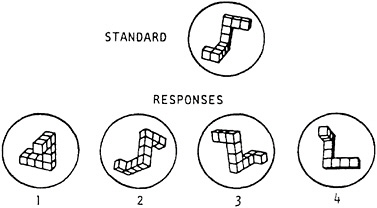
FIGURE 4.1 A sample mental rotation task. SOURCE: Shepard and Metzler, 1971. Reprinted with permission from Mental Rotation of Three-Dimensional Objects, Science 171:701–703. Copyright 1971 American Association for the Advancement of Science.
perform about 1,000 mental rotation trials of the Shepard and Metzler type. Although some people completed the trials rapidly and accurately from the beginning, others were slow and labored in responding. Practice clearly helped, however; after more than 1,000 trials, every subject’s speed increased, and the average speed of the whole group improved by two standard deviations. However, people find it more difficult to generate spatial representations and to mentally rotate representations of novel and complex objects than of familiar and simple objects.
The question of what is learned during practice is crucial in terms of transfer of learning from one context to another and in terms of designing educational programs. During intense practice in judging pairs of shapes as same or different, for example, one has the opportunity to learn what particular shapes look like in different orientations; thus, part of the learning is pattern learning. However, there are two other possibilities: practice might result in improvements in the speed of mentally rotating those particular shapes involved in the practice, or practice might result in an improvement in the skill of mentally rotating shapes in general. Insofar as practice results in improvement in a general mental rotation skill, then benefits of practice gained with one set of shapes should transfer and show up as benefits when people are asked to judge novel shapes. On the other hand, if practice results in building specific pattern knowledge of particular shapes from different orientations, then practice with one set of shapes should transfer only to highly similar shapes with little or no transfer to different shapes.
Laboratory research has resolved this issue for short periods of practice at mental rotation ranging up to several hours in duration. The benefit of extended practice results in pattern learning that contributes to gains in mental rotation speed (Bethell-Fox and Shepard, 1988; Lohman and Nichols, 1990; Tarr and Pinker, 1989). Some evidence indicates that practice increases the speed of mentally rotating those specific shapes involved in practice (Sims and Mayer, 2002). There is little or no evidence that mental rotation practice leads to a domain general skill because improvements do not transfer to novel shapes.
Studies are limited, however, in terms of the amount of practice and the variety of shapes practiced. As a consequence, we do not know the degree to which extended periods of practice and the degree to which practice with a larger set of shapes might result in improvement in either
generalized mental rotation or other stages of image processing. Thus, for example, we do not know whether the expertise of an architect at visualizing buildings from different perspectives and in various configurations would transfer to skill at visualizing molecular structures or geological structures.
The research most relevant to this question focused on video game experts (Greenfield et al., 1994; Sims and Mayer, 2002). Sims and Mayer compared college students highly skilled at Tetris with those who were not so skilled. Tetris is a computer game in which success depends on rotating shapes so that later-appearing shapes interlock cleanly with earlier-appearing shapes. The game begins with a blank screen; one of seven shapes appears at the top of the screen and descends toward the bottom. During its descent the goal is to rotate and translate the shape, so that when it reaches the bottom of the screen it is in position to fit nicely with the shapes that follow in a continuous series. Speed is a critical factor; players have to anticipate how much to rotate shapes to fit them together.
Experts are rapid and accurate in deciding how much to rotate shapes to optimize fit. Sims and Mayer (2002) wanted to find out whether high levels of skill at mentally rotating Tetris shapes would transfer to rotating other shapes in the Tetris context. Results show a limited amount of near transfer: experts were better able than novices to play a Tetris-like game in rotating shapes that—although not identical to the shapes used in Tetris—were very similar to them. However, there was no evidence for far transfer. That is, experts did not show the same advantage in rotating shapes that were unlike those used in Tetris (even when those shapes were familiar from another context such as capital letters).
Based on laboratory studies, pattern learning and spatial transformations such as mental rotation are relatively domain specific. Learning to recognize and classify types of spatial patterns that characterize one field of expertise does not transfer when trying to learn other types of spatial patterns from another field. The benefits of practicing transformations of spatial patterns that characterize one field of study do not seem to transfer to other fields.
4.2.5 A Model of the Acquisition of Expertise in Spatial Thinking
A model of the acquisition of expertise in spatial thinking involves at least four components:
-
Domain-specific long-term memory of patterns: in order to learn to identify patterns in a knowledge domain more rapidly and accurately, one needs to study those particular shapes. There is little or no benefit from studying one set of shapes in perceiving another set of shapes.
-
However, perceptual learning of patterns goes hand in hand with the meta-cognitive knowledge that (a) patterns can be multiply classified and (b) studying patterns and practicing pattern identification makes those patterns come faster and more readily to mind when they are relevant to a task.
-
Domain-specific mental transformations of patterns in working memory: in order to learn to imagine how molecular structures will appear when rotated or expanded, one needs to practice mentally transforming those structures and highly similar ones. In order to learn to imagine the cross sections resulting from folds and structural events theorized within plate tectonics, one needs to practice those mental transformations for those types of patterns.
-
However, practice in mental transformation goes hand in hand with the meta-cognitive knowledge that such practice (a) pays off and (b) makes it easier to think and reason within that domain.
This position on the acquisition of expertise in spatial thinking has two possible sets of implications for the design of K–12 programs to foster spatial thinking. One approach builds on the first
and third components of the expertise acquisition model. Expertise consists of domain-specific knowledge; therefore, this is also true for areas of expertise specifically involving spatial thinking to greater and lesser degrees. If you want to think fluently and well about particular types of patterns, you have to put in time studying those patterns. Practice at constructing spatial representations reduces the drain on working memory when constructing spatial representations of objects and situations like others in the domain of study, but practice at spatial representations in one domain transfers minimally to representations in other domains. Practice at mental spatial operations shows a similar degree of domain specificity. However, there is limited “near transfer,” and practice discriminating or mentally rotating one set of shapes does benefit discriminating and mentally rotating highly similar shapes. Unfortunately, we do not know the metric that defines degrees of similarity.
The other approach builds on the second and fourth components of the expertise acquisition model and is based on the concept of “learning to learn.” With expertise comes the ability to “know what it takes to learn.” Students can learn that practice at spatial thinking really helps—it helps them to call spatial patterns to mind more rapidly and accurately, and it helps them to imagine transformations in those patterns more rapidly and accurately. They can also understand that the benefits of pattern learning are specific to the types of pattern learned and that the benefits of practicing mental transformation are specific to the types of patterns involved in the practice.
Expertise in spatial thinking is strongly linked to a particular knowledge domain. Through practice and experience, experts build the domain knowledge base and skills that allow them to think fluently and deeply. Central to expertise is pattern learning; skill in creating representations, especially spatial representations; and the ability to transform information. Although much of expertise is internal or cognitive, it also draws on external supports in the form of tools and representations (especially spatial representations).
Learners who have had more versus less experience in a domain, in using certain kinds of representations, or in reasoning about domain-specific problems approach new spatial learning tasks differently. Differences in domain-specific expertise are, however, not the only way of characterizing distinctions among learners. Appendix C addresses other ways in which differences among learners are relevant for spatial thinking. It discusses the notion of learner differences in general and then considers the links between three learner characteristics—chronological age, developmental level, and biological sex and cultural gender—and the process of spatial thinking.
4.2.6 The Role of Expertise in Spatial Thinking
As with all cognitive competencies, there are significant differences among people as to how, how quickly, and how well they can do something. Spatial thinking is no exception. Within domains of knowledge, there are experts and novices (see Section 3.6). Differences between experts and novices can be accounted for by training and experience (see Section 5.6). Across domains of knowledge, there are disciplines, such as geoscience, within which spatial thinking is emphasized and taught, and those, such as philosophy, within which it plays a hidden and relatively minor role. Across groups, there are also significant variations in how people approach spatial thinking. Across age, for example, children and adults do not think spatially in the same way. These differences can be accounted for by maturation, education, and experience (see Appendix C).
If, for the moment, we ignore the effects of domain, we can use the expert-novice distinction to understand some of the major differences in the ways in which people think spatially. A key goal, especially in science, is to learn to extract functional information from spatial structures and to understand how and why something works. In learning to do this, we must master three component tasks of spatial thinking.
The first step is extracting spatial structures. This process of pattern description involves identifying relations between the components of a spatial representation and understanding them in terms of the parts and wholes that give rise to patterns and coherent wholes. The second step is performing spatial transformations. Translations in space or scale transformations (changes in viewing distance) are easier than rotations or changes of perspective (changes in viewing angle or azimuth). Imagining the motions of different parts in relation to each other—running the object—can be very difficult. The third step, drawing functional inferences, is central to the process of scientific thinking. It requires establishing temporal sequences and cause-and-effect relations.
The difficulty of each of these steps increases with increasing dimensionality: spatial structures in two-space are easier to understand than those in three-space. In scientific applications, difficulty also increases as a function of data quality and quantity. Missing data require extrapolation and interpolation. Data error leads to uncertainty and increasing difficulty. Partial and incomplete data require an even more skilled use of extrapolation and interpolation, as well as more complex inference processes.
People use representations, whether in the mind or external, to comprehend and remember a set of concepts as well as to make inferences and discoveries about those concepts. Understanding the spatial relations and structure of a diagrammed system is relatively straightforward for most learners, because a diagram shows the parts in their spatial relations, using diagrammatic space to map real space. Most people can grasp the essential parts and their spatial relations from a diagram, such as a bicycle pump or a heart. What is much harder to understand is the meaning, interpretation, function, and causal chain that the diagram is meant to convey. While a novice can understand the spatial structure of a bicycle pump or heart from a diagram, only those with some expertise can grasp the functional and causal relations among the parts—that is, understand how the pump or the heart works (Heiser and Tversky, 2002).
For most scientific and engineering contexts, diagrams are meant to convey not just the structure of a system but also its behavior or the causal chain of its parts or the function of its operations. Yet, these are exactly the aspects of diagrams that students of all ages find difficult. Diagrams show structure, but they do not “show” function or behavior or causal relations. Language can compensate by stating this information directly. However, diagrams can also be enriched with extrapictorial devices, notably lines, arrows, boxes, and brackets, to convey abstract information. For example, when asked to describe a diagram of a bicycle pump, students describe the structural relations among the parts. When arrows are added to the diagram that denote the sequence of actions of the pump, students describe the causal, functional actions of the pump (Heiser and Tversky, 2002). Still, even the addition of arrows may not be sufficient to convey the functional information. For understanding bicycle pumps and car brakes, diagrams were sufficient for undergraduates with high mechanical ability but not for those of low ability; for those of low mechanical ability, language compensated (Heiser and Tversky, 2002).
In many educational settings, diagrams are taken for granted. These studies suggest that teaching how to reason from diagrams could reap significant benefits. Such teaching would be needed in a number of domains: geography, arithmetic and mathematics, biology, geology, chemistry, physics, engineering, and so forth. Diagrams are common in history and in the humanities as well. Across the curriculum, students need exercises in interpreting the spatial entities and spatial relations of diagrams, making inferences as well as making discoveries. Constructing diagrams is an integral part of this instruction, especially in groups. Junior high school dyads working together produced diagrams of, for example, plant ecology, that were more abstract and contained less irrelevant pictorial information than those produced by individuals.
4.3 THE CHALLENGE OF DEVELOPING EXPERTISE IN SPATIAL THINKING
Scientific phenomena that have physical representations in space, such as DNA replication, weather patterns, ocean floor spreading, and trajectories of airplanes, lend themselves immediately to spatial thinking. However, the physical manifestation of explanatory scientific concepts such as entropy, heat flow, and fusion is often hidden from direct inspection. Relevant phenomena can be microscopic or obscured by other information as in the case of molecules, folds of Earth, plate movement, and chemical reactions.
Expertise in science takes time and practice to develop. The challenge for educators is to provide the instructional time, the appropriately designed materials and activities (especially representations), and the supportive environment that will allow students to build expertise in particular school subjects and, at the same time, develop expertise in spatial thinking. Therefore, to learn about complex systems in science, students need three things: (1) knowledge of a wide range of scientific concepts, (2) skills in generating and interpreting spatial representations of information, and (3) opportunities to practice spatial thinking skills in challenging but well-supported projects.
Concepts and representations make sense to experts because they have had numerous opportunities to use them over extended periods. Considerable instructional time is required for those concepts and representations to become useful to students. Given the scarcity of such time, however, students frequently end up as perennial novices, always facing a new set of topics and a new assortment of representations that they are expected to connect and employ in dealing with another set of challenging questions.
4.3.1 Developing Expertise Through the Acquisition of Knowledge
Chapter 3 presents examples of experts in geoscience, geography, and astronomy using spatial thinking in the process of scientific discovery and explanation. To achieve insights, experts link varied data sources, use their knowledge of processes such as volcanism or evolution, and incorporate their understanding of principles such as thermal equilibrium or biodiversity. Successful researchers reorganize, combine, prioritize, compare, question, and discuss their ideas over extended periods. Experts develop proficiency in their fields over years and often find the methods they use to assess complex displays of data difficult to explain and, therefore, teach to others. Skilled programmers, for example, can inspect a 300-line program and rapidly identify bugs, whereas novices can look at the same 300 lines essentially forever without finding the problem (Soloway and Spohrer, 1989).
Experts specialize in particular aspects of their field. They need time and experience not only to understand the representations used in new aspects of the field, but also to learn the domain-specific principles and ideas to interpret and critique this information. Experts reformulate representations of complex information such as plate movements or crystal configurations and engage in discipline-specific disputes about appropriate ways to reduce data to formats that are maximally open to inspection (cf. work on the human genome, molecular pathways, and electron microscope materials). Each year Science magazine recognizes researchers who create visualizations that are acclaimed by their peers (Bradford et al., 2003). To those outside a particular scientific domain, however, the representations can perplex and confuse as much as inform. Some representations, such as patterns of earthquakes superimposed on the outlines of continents, communicate information that would be difficult to capture in words, whereas others, such as the methods for representing the structure of crystals, can confuse even experts (Chapter 3) as well as nonexperts. Even ingenious representations, such as modern algebraic systems, have sometimes thwarted as well as hastened scientific discovery (e.g., diSessa, 2000).
Experts in one application of spatial thinking, such as architecture, may not find those skills useful in another application of spatial thinking, such as interpreting weather maps, because the representations and their underlying scientific principles are different. Clement (1998), for example, asked expert mathematicians to interpret visual displays of the behavior of springs varying in diameter and flexibility. The mathematicians behaved similarly to students encountering the material about springs for the first time (Clement, 1998). Lewis and Linn (1994) reported similar results when they asked expert chemists and physicists to explain everyday phenomena that exemplify principles that they understand well. One expert, for example, preferred aluminum foil over wool as an insulator because it is a common practice to wrap cold drinks in aluminum. Expertise is, therefore, domain specific. Expertise takes significant time to develop in depth.
4.3.2 Developing Expertise Through the Understanding of Representations
Educators often devise new representations to help novices. Tests of these representations in contexts as diverse as weather maps (Edelson et al., 1999), molecular models (Linn and Hsi, 2000; Wiser and Carey, 1983), and the rock cycle (Kali et al., 2003) have proven humbling. Students cannot readily interpret diagrams and representations (Hegarty et al., 1999), and when they attempt to use them, they often become more, rather than less confused. Students have interpreted representations of heat that use color intensity as implying that heat has mass, for example. Most commonly colored weather maps show only the predicted weather on land rather than showing the weather patterns as extending over the oceans. The maps also show weather only over the United States rather than extending into both Canada and Mexico. Such representations can deter students from thinking about the weather as large-scale, complex systems influenced by differential surface temperatures over land and water (Edelson et al., 1999).
4.3.3 Developing Expertise Through Challenging Projects
Interpretations of the superficial features of spatial information can persuade students that scientific phenomena follow different principles from those endorsed by experts. For example, novice observers of geological features such as rock outcrops, streams, or basins may impute formation processes that consider only surface features (Liben et al., 2002). Novice observers of patterns—the flight of flocks of birds or the flow of traffic—impute more causality to individuals and their actions than is justified (Resnick, 1994). Observers typically believe, for example, that a lead bird has special status, or that all traffic jams are caused by accidents, rather than recognizing the systemic nature of emergent phenomena (Resnick, 1994). Understanding can be improved by instructional programs that enable students to build models of these phenomena by embedding “instructions” in individual birds or cars and then observing the emergence of patterns.
Students pay attention to perceptual information that is salient but not necessarily relevant (Hegarty, 1992; Lowe, 2003; Morrison et al., 2002). To overcome distracting perceptual cues—when they are inevitable—students need supports including ways to structure information and opportunities to reflect in order to make connections among ideas (Reiser et al., 2001; Davis, 2003a,b; Linn and Hsi, 2000). Curriculum designers have identified ways to direct attention to important information using everything from overlays to simplified versions of the materials to translating the information into less complex representations.
To enable students to develop expertise in spatial thinking, it makes sense to engage them in extended projects that are challenging. In science, however, most students flounder when asked to undertake complex, multistage projects where they must manage and sequence multiple tasks: design methods for collecting data; devise representations for information; and combine principles, experimental results, and representations of results (Edelson, 1999; Feldman et al., 2000; Reiser et
al., 2001). In addition to basic knowledge about and practice in spatial thinking, students need guidance and support in working through first projects, and appropriate guidance can have significant impacts on student learning. In helping students to research Galapagos finches, Reiser and Tabak (http://www.letus.org/bguile/finches/finch_overview.html) created data tables to represent results, and the tables helped students to reach more compelling conclusions. In studying how students interpret weather maps, Edelson (1999) found that the map colors did not convey information effectively without substantial support. This support included simplification of the displays, presenting outlines of continents, and designing activities to communicate interactions between land and sea and the impact of such interactions on wind, temperature, and the day-night cycle. Hoadley (2004), in collaboration with Cuthbert et al. (2002), asked students to design a desert house that was cool during the day and warm at night. Many students failed to connect the day-night cycle to their designs and/or combined design elements without considering how they interacted.
Students are slow to learn how to monitor their own progress, frequently misjudging their abilities and progress. They cannot easily make links between representations and observed phenomena. For example, in the GenScope project, students used software to explore topics in genetics illustrated by a fictitious dragon species. Students were expected to transfer understanding from the dragon software to the case of worms studied using paper and pencil materials. The first study, however, failed to demonstrate any significant impact from the software use (Lobato, 2003). In a replication, the researchers added a “Dragon Investigations” module based on paper-and-pencil activities. It encouraged students to reflect on parallels between dragons and worms, and to monitor their performance. This approach was more successful.
Students need support—scaffolding and guidance—to allow them to bring their fragmented knowledge to bear on a compelling problem. Central to the support process is the use of static or animated representations, although studies have revealed a series of barriers to understanding such representations.
4.4 THE TRANSFER OF SPATIAL THINKING ACROSS SUBJECTS IN THE CURRICULUM
Central to all of these instructional design efforts to meet the many challenges of fostering spatial literacy is a basic question: To what extent is student learning of spatial knowledge, spatial ways of thinking and acting, and spatial capabilities specific to a particular domain of knowledge? If, for example, the learning of spatial thinking is inherently domain specific, then the instructional challenge is different than it would be if learning in one domain readily transfers to and supports learning in another—and very different—domain. We turn next to this fundamental question of transfer. Can well-learned spatial thinking skills transfer to reasoning about and solving new problems in a different area?
De Corte (2003, p. 142) has noted that “the concept [of transfer] has been very controversial, conceptually as well as empirically.” That learning frequently does not transfer to situations in which it is relevant is a puzzle to researchers and a concern for educators. Knowledge and skills that have been well learned, as indexed by performance at the end of instruction, often fail to transfer to new times and contexts in which they would be helpful. Box 4.1, based on De Corte’s work, contrasts a traditional view of transfer with a modern reconceptualization.
Before we discuss the roles that spatial imagery and spatial representations may play in fostering transfer of spatial thinking, we must distinguish between the ideas of “near” and “far” transfer. The former refers to the transfer of what has been learned to tasks and settings that resemble the original learning situations perceptually and in terms of their obvious themes. Far transfer refers to situations in which what has been learned is successfully applied to situations where there is less perceptual similarity (see the discussion of Tetris, in Section 4.2.4).
|
BOX 4.1 Proposals to reconceptualize the transfer construct are making an important contribution toward advancing theory and research. An analysis of the literature shows that traditionally transfer was very narrowly conceived as the independent and immediate application of knowledge and skills acquired in one situation to another. Accordingly, narrow criteria of successful transfer were adopted. Bransford and Schwartz (1999) called this narrow definition the direct-application theory of transfer. In this framework, the key question is, Can people apply something they learned directly and independently to a new setting? A typical characteristic of this approach to transfer is that the final transfer task (i.e., the experimental task that is used to test whether transfer has taken place) takes the form of sequestered problem solving. That is, while solving the transfer task, subjects do not get opportunities to invoke support from other resources, such as texts or colleagues, or to try things out, receive feedback, or revise their work. As an alternative to this view, Bransford and Schwartz proposed a broader perspective emphasizing preparation for future learning (PFL) as the major aspect of transfer. Under this framework, the focus in assessing transfer is on subjects’ abilities to learn in novel, resource-rich contexts. This view is much more in line with the now-prevailing notion of learning as an active and constructive process, but emphasizes, in addition, the active nature of transfer itself. Indeed, in this approach a novel context is not conceived as just “given”; using one’s prior knowledge and the available resources, one can modify the situation and its perception. For instance, confronted with a fellow learner’s perspective about a problem situation, one can revise one’s own perception of the problem. In this respect, Bransford and Schwartz also emphasized the important role of metacognitive (or self-regulatory) skills. Such active control of the transfer situation is lacking in the direct-application model. Another benefit of the PFL model of transfer is that it suggests affective and motivational qualities, in addition to cognitive skills, are candidates for transfer. The PFL approach is convergent with a redefinition of transfer by Hatano and Greeno (1999), who criticized traditional models of transfer for both treating knowledge as a static property of an individual and adopting inappropriately narrow criteria of successful transfer. They considered the conceptualization of transfer as the direct application of acquired elements from one situation to another as incompatible with current perspectives on the contextualized or situated nature of knowledge. That is, the direct-application theory is static, in the sense that it neglects how aspects of thinking that arise from interactions among people, and between people and other material and informational systems, might affect performance in the transfer situation. Hatano and Greeno proposed replacing the term transfer with the term productivity, to refer to the generality of learning (i.e., the degree to which learning in some situation has effects on task-related activities in a variety of other situations). The latter situations can, in accordance with the PFL perspective, involve hints or other kinds of support that facilitate the recall of relevant prior knowledge. Hatano and Greeno rightly claimed that in everyday learning environments, people rarely need to use previously acquired knowledge and skills without also having access to external support (De Corte, 2003). |
The committee makes two generalizations about links between instruction and transfer: the role of learning general principles and the value of learning multiple examples. First, instruction that explains general principles supports far transfer better than does instruction that is more specific and focused. Judd (1908), for example, asked fifth- and sixth-grade students to throw darts at a target under water, initially with the target submerged 12 inches under the surface. He found that practice with feedback was effective at helping students hit the target when it was submerged at the 12-inch learning level, but did not help them to hit the target when its depth was varied. Instruction explaining the underlying principles of light refraction led to much better transfer to throwing darts at new depths.
Wertheimer (1959) compared two methods of instructing students to find the area of a parallelogram, one that emphasized structural relationships in parallelograms and one that involved a
fixed solution routine (dropping a perpendicular line and applying a formula). On problems that involved finding the area of standard parallelograms that varied in base, height, and the degree to which the corner angles differed from 90 degrees, both groups performed well. On novel problems, where the shapes were atypical but amenable to the same solution logic, the method that emphasized understanding structural relationships produced far better transfer. Similar findings have been obtained with a wide range of tasks, such as solving binomial probability problems (Mayer and Greeno, 1972), debugging computer programs (Klahr and Carver, 1988), and even determining the sex of chicks (Biederman and Shiffrar, 1987).
The second generalization is that using multiple examples during initial learning and/or varying the conditions of practice also facilitates far transfer. This applies to the benefits of varying the conditions of practice when learning motor skills (e.g., Catalano and Kleiner, 1984; Shea and Morgan, 1979), the benefits of using multiple examples when teaching students how to solve complex problems (e.g., Gick and Holyoak, 1983; Homa and Cultice, 1984), and the benefits of varying the outlines of an advanced-organizer text (that is, material read before some to-be-learned text) as opposed to rereading the to-be-learned article itself (Mannes and Kintsch, 1987).
Given these two generalizations, spatial representations might be expected to foster far transfer in problem solving by leading learners to induce general principles and relationships among the problems being studied. For example, a geology instructor could take students on a field trip to several local outcrops in the Appalachian Mountains and then use spatial representations to provide comparable information about parts of the Appalachians further north or south where the style of rock deformation differs. By comparing and contrasting these multiple examples (some from direct experience, other learned only through spatial representations), students could construct an understanding of the general properties of folded or faulted mountains and the underlying deformation processes. To the extent that generating schematic-spatial representations of information requires learners to generate their own ideas about general principles and about relationships that cut across different specific problems, instruction emphasizing the role of spatial representations should foster transfer to new problems.
There is nothing to suggest that the transfer of information by means of or even about spatial thinking is any easier or more difficult than transfer in any other medium or domain. However, spatial representations can aid in transfer and spatial representations can play major roles in learning, remembering, and problem solving (see Appendix D).
4.5 THE FOSTERING OF EXPERTISE IN SPATIAL THINKING
Expertise in any area of knowledge is hard won, and expertise in spatial thinking is no exception to this generalization. Developing expertise takes time, commitment, and opportunity to learn the spatial knowledge, spatial ways of thinking and acting, and spatial capabilities that are characteristics of any domain of knowledge.
There are components of cognitive processing that enter into learning to think spatially just as they enter other kinds of cognitive mastery (e.g., quantitative thinking, verbal reasoning). Even though they are not themselves “spatial” in nature, they must also be taken into account because they are relevant to how successful one is in solving spatial problems. Working memory, for example, allows a person to keep pieces of problems in mind simultaneously and, thereby, makes it possible to see relations. When we visualize rotating an object to fit into some opening, we depend on working memory to hold both pieces in mind at once. Thus, skill in spatial thinking cannot be seen as isolated from other cognitive skills.
Expertise in spatial thinking draws on both general spatial skills and spatial skills that are particular to parts of a domain of knowledge. It is unlikely that there will be instant transfer of some skill to a problem in another domain of knowledge, yet some components of existing spatial skills
can be drawn upon to tackle the new problem. Thus, it might be necessary to develop expertise in particular contexts before one can see the connections to some more general spatial skill (e.g., one might become expert at seeing things in three dimensions in biology, but still need considerable practice to learn to apply the skill to seeing new kinds of forms, shapes, and positions in chemistry or geology).
The benefits of practicing spatial thinking initially tend to be domain specific, and as is the case for other forms of expertise, learning to think spatially is best conducted in the context of the types of materials one is seeking to learn and understand. Thus, practicing spatial skills is most effective if it is contextualized within a domain of knowledge.
Structured, systematic practice greatly improves the speed and accuracy with which people can generate spatial representations and transform spatial information. Thus, it is important to identify the types and forms of spatial representations and transformations that are critical for different learning goals and encourage students to practice them (see Appendix D).
Spatial representations can help students in learning and problem solving. The evidence suggests that we should (1) have students generate their own spatial representations; (2) use spatial representations to provide multiple and, where possible, interlocking and complementary representations of situations, especially where the phenomena are not readily available to direct sensory perception; (3) use a wide variety of spatial representations; (4) use spatial representations to convey a variety of kinds of thinking (e.g., data about how something is structured now, how it could or should appear in the future or did appear in the past); and (5) learn where—and which types of—spatial representations can be useful. The evidence also suggests that we should not (1) force students to use a spatial approach to a problem when another approach is equally or better suited; (2) overload students’ cognitive capabilities by exposing then to a novel spatial representation while simultaneously asking them to reason about a complex situation; or (3) assume that animations are necessarily better than sequences of static representations (see Appendix D).
Expertise in spatial thinking varies among different groups. There are different average levels of skills or expertise associated with different groups (e.g., younger and older children). There is also, however, significant variation within any given group on any given spatial skill. This means that one cannot automatically infer what any given learner brings to the task. Thus, from an instructional standpoint, it will be necessary to have tasks with multiple levels of achievement and multiple strategies for achieving them.
The distributions of performance on spatial tasks shows a great deal of overlap for boys and girls and some average differences too. Boys and girls show differences on average performance of some spatial skills, where boys outperform girls on some skills and girls outperform boys on others. Thus, it is important not to “discount” the spatial learning capabilities of either boys or girls—practice and learning significantly boost the performance of both boys and girls (see Appendix C).
People vary in how rapidly they can create and transform spatial representations, and their levels of spatial thinking skill can help or hinder their learning across the broad range of sciences. Students with higher levels of initial skill will find learning that involves spatial thinking easier than those with lower levels of initial skill. For students with critically low levels of skill in spatial thinking, the use of tools for spatial thinking, such as graphics and figures, may actually interfere with, not facilitate, learning.
Effective learning depends on having sufficient levels of general and particular spatial thinking skills. Thus, it is important to assess the strengths and limitations that individual learners bring to their learning goals.
4.6 CONCLUSION
The three key conclusions from this chapter are that spatial thinking can be taught; that learning to think spatially must take place within domain contexts; and that while transfer from one specific domain of knowledge to another is neither automatic nor easy, it is possible with appropriately structured programs and curricula. On the basis of these conclusions, the committee derives two educational principles: first, instruction should be infused across and throughout the curriculum; second, instruction should create skills that promote a lifelong interest in spatial thinking. These two principles lead in turn to ideals for the design of a K–12 curriculum that would promote and support spatial thinking. Chapter 5 explores the extent to which such curricula ideals are met by current standards-based curricula in sciences and mathematics.


