
Executive Summary
THE DOUBLE HELIX: A CLASSIC EXAMPLE OF SPATIAL THINKING
We wish to suggest a structure for the salt of deoxyribose nucleic acid (D.N.A.). This structure has novel features which are of considerable biological interest. (Watson and Crick, 1953, p. 737)
Those two deceptively low-key sentences are the introduction to a short (two-page) paper that marks one of the greatest achievements of twentieth century science. James Watson and Francis Crick described the molecular structure of the gene, work that is seen as the cornerstone of molecular biology and is still, 52 years later, “of considerable … interest.”
The committee’s interest in this discovery is considerable but different. We see Watson and Crick’s paper as exemplifying the power of a way of thinking, spatial thinking. We suggest that spatial thinking is at the heart of many great discoveries in science, that it underpins many of the activities of the modern workforce, and that it pervades the everyday activities of modern life.
The challenge faced by Watson and Crick and their many competitors in the race to understand the molecular structure of the gene was to provide a three-dimensional model that met certain criteria including compatibility with (1) “the usual chemical assumptions,” (2) experimental data, and (3) two-dimensional X-ray images. Watson and Crick (1953, p. 737) rejected, for example, the structural model proposed by Pauling and Corey in part because “… some of the van der Waals distances appear too small.” Fraser’s model was not even commented upon because it was “… rather ill-defined” (Watson and Crick, 1953, p. 737).
Their solution is the now-famous double helix, comprising two intertwined, complementary, and displaced phosphate-sugar chains. Both right-handed helices are coiled around the same axis and are connected to each other by bonds of the bases on the inside of the chains. Sugar residues are perpendicular to the attached bases. Watson and Crick assumed an angle, 36 degrees, between residues on the chain and this led to a structure that repeats after 10 residues or 34 A. They also specified a distance, 10 A, of a phosphorus atom from the fiber axis. They noted that
(t)he previously published X-ray data on deoxyribose nucleic acid are insufficient for a rigorous test of our structure. So far as we can tell, it is roughly compatible with the experimental data, but it must be regarded as unproved until it has been checked against more exact results. Some of these are given in the following communications. We were not aware of the details of the results presented there when we devised our structure, which rests mainly though not entirely on published experimental data and stereochemical arguments. (Watson and Crick, 1953, p. 737)
As we know, the structure is indeed compatible with experimental data and it stands as proven. The power of their reasoning, based on experimental data and stereochemical arguments, is remarkable.
Here, the committee emphasizes the explicitly spatial nature of their solution. They developed a three-dimensional structure that is scaled in both distance and angular terms. They specified the “handedness” of the structure (right handed) and showed how it was repeated at a fixed spatial interval. However, it is more than simply a structural description. In passing, they coyly and correctly noted:
It has not escaped our notice that the specific pairing we have postulated immediately suggests a possible copying mechanism for the genetic material. (Watson and Crick, 1953, p. 737)
Although their original figure (Figure ES. 1) is described as “purely diagrammatic,” physical models (see Figure ES. 2) demonstrated the power of their biological, chemical, and spatial intuitions.

FIGURE ES.1 Diagram of the DNA structure. The two ribbons symbolize the two phosphate-sugar chains, and the horizontal rods the pairs of bases holding the chains together. The vertical line marks the fiber axis. Reprinted by permission from Nature, Watson and Crick, 1953, p. 737; Macmillan Publishers Ltd.
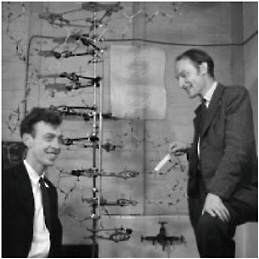
FIGURE ES.2 James Watson (left) and Francis Crick (right) with their DNA model. (From A. Barrington Brown/Science Photo Library.) Reprinted with permission from Photo Researchers, Inc.
The novel feature of the structure is the manner in which the two chains are held together by the purine and pyrimidine bases. The planes of the bases are perpendicular to the fibre axis. They are joined together in pairs, a single base from one chain being hydrogen-bonded to a single base for the other chain, so that the two lie side by side with identical z-co-ordinates. One of the pair must be a purine and the other a pyrimidine for bonding to occur. (Watson and Crick, 1953, p. 737)
The three-dimensional structure is complex—two parallel but displaced spiraling chains; simple—the base bonds hold it together and fix angular distances; and beautiful—its elegance and explanatory power. It is the result of a brilliant exercise of imaginative visualization that is constrained by empirical data, expressed by two-dimensional images, and guided by deep scientific knowledge and incisive spatial intuition.
THE PROCESS OF SPATIAL THINKING
Watson and Crick’s achievement is an intellectual tour de force, but the committee views the process of spatial thinking as a universal mode of thinking, one that is accessible to everyone to different degrees in different contexts. Spatial thinking is based on a constructive amalgam of three elements: concepts of space, tools of representation, and processes of reasoning. It depends on understanding the meaning of space and using the properties of space as a vehicle for structuring problems, for finding answers, and for expressing solutions. By visualizing relationships within spatial structures, we can perceive, remember, and analyze the static and, via transformations, the dynamic properties of objects and the relationships between objects. We can use representations in a variety of modes and media (graphic [text, image, and video], tactile, auditory, and kinesthetic) to describe, explain, and communicate about the structure, operation, and function of those objects and their relationships.
TEACHING AND LEARNING ABOUT SPATIAL THINKING
Spatial thinking can be learned, and it can and should be taught at all levels in the education system. With advances in computational systems (hardware and software), spatial thinking can now be supported in ways that enhance the speed, accuracy, and flexibility of its operation and open up the process to increasing numbers of people, working collaboratively and at higher levels of performance. Because of these newly available computational technologies, support for spatial thinking is more readily possible today and in the immediate future, but concomitantly, more challenging cognitive skills are necessary to take advantage of the rapidly changing support systems.
To think spatially entails knowing about (1) space—for example, different ways of calculating distance (e.g., in miles, in travel time, in travel cost), the basis of coordinate systems (e.g., Cartesian versus polar coordinates), and the nature of spaces (e.g., in terms of the number of dimensions [two versus three]); (2) representation—for example, the relationships among views (e.g., plans versus elevations of buildings, orthogonal versus perspective maps), the effect of projections (e.g., Mercator versus equal-area map projections), and the principles of graphic design (e.g., the roles of legibility, visual contrast, and figure-ground organization in the readability of graphs and maps); and (3) reasoning—for example, the different ways of thinking about shortest distances (e.g., as the crow flies versus route distance in a rectangular street grid), the ability to extrapolate and interpolate (e.g., projecting a functional relationship on a graph into the future, estimating the slope of a hillside from a map of contour lines), and making decisions (e.g., given traffic reports on a radio, selecting a detour).
Therefore we need to invest in a systematic educational program to foster spatial literacy by enhancing levels of spatial thinking in K–12 students. Our goal must be to foster a generation of
students (1) who have the habit of mind of thinking spatially, (2) who can practice spatial thinking in an informed way, and (3) who adopt a critical stance to spatial thinking.
THE FOSTERING OF SPATIAL LITERACY
Literacy is a normative statement of what members of a culture should know and be able to do with that knowledge. The Workforce Investment Act of 1998 (Public Law 105-220) stated that “… (t)he term literacy means an individual’s ability to read, write, and speak in English, compute, and solve problems, at levels of proficiency necessary to function on the job, in the family of the individual, and in society” (Title II, Section 203, Number 12).
Spatially literate students who have developed appropriate levels of spatial knowledge and skills in spatial ways of thinking and acting, together with sets of spatial capabilities, have the following characteristics:
-
They have the habit of mind of thinking spatially—they know where, when, how, and why to think spatially.
-
They practice spatial thinking in an informed way—they have a broad and deep knowledge of spatial concepts and spatial representations, a command over spatial reasoning using a variety of spatial ways of thinking and acting, and well-developed spatial capabilities for using supporting tools and technologies.
-
They adopt a critical stance to spatial thinking—they can evaluate the quality of spatial data based on its source and its likely accuracy and reliability; can use spatial data to construct, articulate, and defend a line of reasoning or point of view in solving problems and answering questions; and can evaluate the validity of arguments based on spatial information.
THE CHARGE TO THE COMMITTEE
The title of the proposal that led to the formation of the committee was Support for Thinking Spatially: The Incorporation of Geographic Information Science Across the K–12 Curriculum. The original charge contained two questions:
-
How might current versions of GIS (geographic information system) be incorporated into existing standards-based instruction in all knowledge domains across the school curriculum?
-
How can cognitive developmental and educational theory be used to develop new versions of GIS that are age appropriate in their design and to implement new GIS curricula that are age appropriate in their scope and sequence?
The first question was intended to generate recommendations for levels of technology (hardware and software), system support (e.g., software, hardware, teaching materials), curriculum scope and sequence (e.g., the role of necessary precursors), and pre-service and in-service training. The second question was intended to generate recommendations based on an assessment of theoretical and empirical approaches, in psychology and education, relevant to the development of knowledge and skills that underpin the use of GIS.
However, the committee recognized that these two questions could not be answered without first addressing the educational role of spatial thinking itself. New and better support tools for education—such as GIS—may well be necessary and appropriate but to what purpose and in what contexts? The answer might seem obvious from the proposal title: to support spatial thinking across the K–12 curriculum. However, such a response raises some more fundamental questions: Why—and where—do we need to support spatial thinking across the K–12 curriculum? Why should we
invest in better GIS or other support tools? What is the role of spatial thinking in everyday life, the workplace, and science?
After coming to appreciate the fundamental importance of spatial thinking and realizing that it was not just undersupported but underappreciated, undervalued, and therefore underinstructed, the committee came to a new understanding of the charge. The two original questions about the current role and future development of GIS as a support system could be satisfactorily answered only after we addressed two additional questions, one about the societal and educational need for spatial thinking and the other about the ways in which we learn to think spatially. Therefore, the committee developed an understanding of two additional questions:
-
What are the nature and character of spatial thinking: what is it, why do we need to know about it, and what do we need to know about it?
-
How does the capacity for spatial thinking develop and how might it be fostered systematically by education and training?
This led to a more coherent and comprehensive set of recommendations. With this reorganization of the task, Part I of this report, “The Nature and Functions of Spatial Thinking” (Chapters 2 through 6) led to Recommendation 1. Part II of the report, “Support for Spatial Thinking” (Chapters 7 through 9) led to Recommendations 2–6.
PART I:
THE NATURE AND FUNCTIONS OF SPATIAL THINKING
The committee arrived at a position on the educational necessity for teaching and learning about spatial thinking:
-
Spatial thinking is a collection of cognitive skills. The skills consist of declarative and perceptual forms of knowledge and some cognitive operations that can be used to transform, combine, or otherwise operate on this knowledge. The key to spatial thinking is a constructive amalgam of three elements: concepts of space, tools of representation, and processes of reasoning (see Chapter 1.2).
-
Spatial thinking is integral to everyday life. People, natural objects, human-made objects, and human-made structures exist somewhere in space, and the interactions of people and things must be understood in terms of locations, distances, directions, shapes, and patterns (see Chapter 2).
-
Spatial thinking is powerful. It solves problems by managing, transforming, and analyzing data, especially complex and large data sets, and by communicating the results of those processes to one’s self and to others (see Chapter 2).
-
Spatial thinking is integral to the everyday work of scientists and engineers, and it has underpinned many scientific and technical breakthroughs (see Chapter 3).
-
Spatial thinking is a skill that can—and should—be learned by everyone, but there are significant individual and group differences in levels of performance (see Chapters 2 and 4 and Appendix C).
-
Spatial thinking develops uniquely in individuals, depending on their experience, education, and inclination (see Chapter 4 and Appendix C).
-
Expertise in spatial thinking draws on both general spatial skills that cross many domains of knowledge and spatial skills that are a particular domain of knowledge (see Chapter 4).
-
Expertise in spatial thinking develops in the context of specific disciplines and becomes transformed and refined through training and extensive practice (see Chapters 3 and 4).
-
While transfer of spatial thinking skills from one domain of knowledge to another is neither
-
automatic nor easy, appropriately designed curricula that encourage infusion across school subjects can facilitate transfer (see Chapter 4).
-
Spatial thinking is currently not systematically instructed in the K–12 curriculum despite its fundamental importance and despite its significant role in the sets of national standards for science, mathematics, geography, and so forth (see Chapter 5). There is a major blind spot in the American educational system.
-
Support systems leverage the power of the human capacity to think and to solve problems (see Chapter 6.1).
-
Spatial thinking is a complex, powerful, and challenging process and support systems provide an interactive environment within which spatial thinking can take place by helping students to spatialize data sets, visualize working and final results, and perform analytic functions (see Chapter 6.6).
-
Given the increasing need for lifelong learning skills in a technologically changing world, students need opportunities to learn a range of low- and high-tech support systems for spatial thinking (see Chapter 6).
-
Implementing any support system in the K–12 context requires coordinated programs for material, logistical, instructional, curriculum, and community support (see Chapter 6.4).
Therefore, the committee views spatial thinking as a basic and essential skill that can be learned, that can be taught formally to all students, and that can be supported by appropriately designed tools, technologies, and curricula. With appropriate instruction and commensurate levels of low- and high-tech support, spatial thinking can become an invaluable lifelong habit of mind.
However, the problem with respect to teaching and learning about spatial thinking is far deeper than simply a lack of adequate supporting tools. Tools are means to an end: tools are therefore necessary but not sufficient. Schools teach what society values. Society values that for which there is a clear and explicit need and therefore educational rationale. Thus, two of the most valued school subjects are mathematics and science. As Chapter 5 makes clear, however, underpinning success in mathematics and science is the capacity to think spatially. Also, as Chapter 3 makes clear, spatial thinking underpins many tasks in everyday life, the workplace, and science. Ironically, those underpinnings are not yet matched by either a deep scientific understanding of the process of spatial thinking or a broadly accepted educational rationale for learning how to think spatially.
Chapters 3 and 5 provide a powerful educational rationale for teaching spatial thinking. Chapter 2 offers a first attempt to describe and understand the process of spatial thinking, and Chapter 4 and Appendix C summarize what is known about the learning and teaching of spatial thinking, leading to a position statement on the fostering of expertise in spatial thinking (see Chapter 4.5).
Chapter 5 demonstrates that there is no systematic and comprehensive attempt to teach about spatial thinking as part of the national Science and Mathematics Standards. Nowadays, school curricula are designed to meet content standards for specific disciplines, originating at either the national or the state level, that express what students should know and be able to do at various points throughout their school careers. Schools, and increasingly society at large, measure their success against benchmarks using standards-based assessments. As the educational saying goes, “We assess what we value and we value what we assess.”
There are neither content standards nor valid and reliable assessments dedicated solely to spatial thinking. Without such standards and assessments, spatial thinking will remain locked in a curious educational twilight zone: extensively relied on across the K–12 curriculum but not explicitly and systematically instructed in any part of the curriculum. No matter how well designed support tools for spatial thinking might be, they will not be effective without societal recognition of the importance of spatial thinking and without an educational commitment to teaching spatial thinking to all students in all grades.
However, spatial thinking itself is not a content-based discipline in the way that physics, biology, and economics are disciplines: it is not a stand-alone subject in its own right. Spatial thinking is a way of thinking that permeates those disciplines and, the committee would argue, virtually all other subject matter disciplines. Instruction in spatial thinking should play an equivalent role to that of the “writing across the curriculum” approach. Standards for spatial thinking, therefore, should be general guidelines for what students need to know about concepts of space, tools of representation, and processes of reasoning in order to be able to solve problems. These general guidelines must be integrated into the particular content knowledge expectations for various subject matter disciplines. The guidelines should, therefore, be infused across the curriculum in as many disciplines as possible. Spatial thinking is the lever to enable students to achieve a deeper and more insightful understanding of subjects across the curriculum.
Spatial thinking is not an add-on to an already crowded school curriculum, but rather a missing link across that curriculum. Integration and infusion of spatial thinking can help to achieve existing curricular objectives. Spatial thinking is another lever to enable students to achieve a deeper and more insightful understanding of subjects across the curriculum.
Instruction in spatial thinking would help to foster a new generation of spatially literate students who are proficient in terms of spatial knowledge, spatial ways of thinking and acting, and spatial capabilities (see Chapter 1.4.1). With this proficiency, students will have established the habit of mind of thinking spatially, seeing opportunities for approaching problems by using their knowledge of concepts of space. They will be able to practice spatial thinking in an informed way, drawing on their knowledge of tools of representation. They will adopt a critical stance to spatial thinking, using the appropriate processes of spatial reasoning (see Chapter 1.4.2). Chapter 11 shows eighth-grade students practicing spatial thinking in a remarkably sophisticated way with the support of a tool, GIS, and with the guidance of an enlightened teacher.
The first recommendation is designed to help to achieve the goal of spatial literacy for all American students.
Recommendation 1
Through the support of federal funding agencies (i.e., the National Science Foundation [NSF], the National Institutes of Health, and the Department of Education), there should be a systematic research program into the nature, characteristics, and operations of spatial thinking. The recent NSF competition for “Science of Learning Centers” provides one program model for developing knowledge about spatial thinking.
The findings of this research program would be expected to highlight the importance of spatial thinking across the K–12 curriculum as well as to encourage the development of spatial thinking standards and curriculum materials to train K–12 students in spatial thinking.
The ultimate goal should be to foster a new generation of spatially literate students who have the habit of mind of thinking spatially, can practice spatial thinking in an informed way, and can adopt a critical stance to spatial thinking. Meeting this long-term goal will require careful articulation of the links between spatial thinking standards and existing disciplinary-based content standards. It will necessitate the development of innovative teaching methods and programs to train teachers, together with new ways to assess levels of spatial thinking and the performance of educational support programs. There should be a national commitment to the systemic educational efforts necessary to meet the goal of spatial literacy.
PART II:
SUPPORT FOR SPATIAL THINKING
The committee arrived at a position on the educational challenges of providing systems for supporting spatial thinking in K–12 education:
-
Spatial thinking can be supported and facilitated by the development of a coherent suite of supporting tools, ranging from low to high technology in nature, that can (1) address a range of types of problems, (2) use a range of types and amounts of data, and (3) require different levels of skill and experience (see Chapter 6).
-
Support systems for spatial thinking must meet three requirements to be successful: they must (1) allow for the spatialization of data, (2) facilitate the visualization of working and final results, and (3) perform a range of functions (transformations, operations, and analyses) (see Chapter 6).
-
The success of a support system in the K–12 context is a function of its design (see the ten criteria in Chapter 6) and its implementation across the curriculum (see the five support needs in Chapter 6).
-
Geographic information science has significant but as yet unrealized potential for supporting spatial thinking across a range of subjects in the K–12 curriculum (see Chapters 7, 8, and 9).
-
However, there are significant design and implementation challenges to be met before GIS can play a significant role alongside other tools for teaching standards-based spatial thinking across the curriculum. GIS should be redesigned to accommodate the full range of learners and school contexts, to be more developmentally and educationally appropriate, to be easier to teach and to learn, and to accommodate the current levels of computing equipment (see Chapters 8 and 9).
-
GIS must be supported by a systematic implementation program that incorporates teacher training, curriculum development, and material support (see Chapters 8 and 9).
The committee sees GIS as exemplifying both the theoretical power of a high-tech system for supporting spatial thinking and the practical design and implementation problems that must be faced in the K–12 context:
-
The power of GIS lies in its ability to support the scientific research process and to provide policy-related answers to significant real-world problems arising in a range of disciplinary contexts.
-
The appeal of GIS lies in its direct connection to significant workforce opportunities in the information technology (IT) sector.
-
The potential of GIS lies in its ability to accommodate the full range of learners and to be adapted to a range of educational settings.
-
The practical problems of adapting GIS to the K–12 environment are equally striking. As an expert-based, “industrial strength” technology, it is, in one sense, too powerful for most K–12 needs. It is challenging and inviting, yet intimidating and difficult to learn. While the design issues can be addressed, the implementation challenges are immense. All of the essential implementation supports—for materials, logistics, instruction, curriculum, and in the community—are either weak or nonexistent.
Therefore, while GIS can make a significant impact on teaching and learning about spatial thinking, it must be situated in a context wherein there is a systematic, standards-based approach to teaching spatial thinking, along with a suite of supporting tools available to do so. Taken alone, GIS is not the answer to the problem of teaching spatial thinking in American schools; however, it can play a significant role in an answer. For GIS to be able to play that significant role, the committee identified a set of recommendations:
Recommendation 2
There should be a coordinated effort among GIS designers, psychologists, and educators to redesign GIS to accommodate the needs of the K–12 education community. Among the many design issues that must be addressed are
-
broadening the accessibility of GIS to the full range of learners (e.g., adding alternative sensory input and output modes);
-
strengthening the capacity to spatialize nonspatial data;
-
overcoming the visualization limitations (e.g., with respect to time and to full three-dimensional capacity);
-
providing graded versions of GIS that are age and/or experience appropriate (e.g., that are easy to learn, cumulative, and flexible);
-
redesigning interfaces to be more intuitive and to provide help and guidance (e.g., providing reflective wizards);
-
making the software customizable (e.g., adopting an open system architecture; making it possible for teachers to hide or expose functionality as needed); and
-
making the software “teacher friendly” in terms of ease of installation, maintenance, and use.
The committee recognizes that many of these design challenges are not specific to the K–12 context and that their solution may not occur with that context in mind. Should this be the case, then someone must take responsibility for adapting the solutions to the particular needs of K–12 teachers and students. Teachers and students should not be expected to adapt to a “one-size-fits-all” GIS that does not reflect their special needs.
The committee identified three mechanisms that led to the development of GIS software: the academic model, the commercial model, and the collaborative model. These three models offer distinct options for the redesign of GIS software for the K–12 context. All three mechanisms appear to have merit, as well as potential pitfalls. The choice among them, therefore, should be made by the appropriate funding agencies.
Based on the levels of investment being made by commercial vendors and on experience from many GIS development projects, it would be reasonable to assume that a suitable GIS could be developed over a period of three years. Therefore, the committee makes the following recommendations.
Recommendation 3
To coordinate the development of GIS software, a “Federation of GIS Education Partners” should be established. The federation should consist of GIS developer and user partners, drawn from academia, government, the private sector, and the K–12 user community.
To be successful, the following should be considered in the design of a GIS educational software federation:
-
The federation should be a grass-roots, community-driven effort.
-
The governance basis of the federation should be to ensure that the priorities of the broader community are honored. However, some centralized management would be necessary for making major decisions on behalf of the federation’s constituents, for representing the federation’s interests, and for conducting day-to-day operations. The instrument of centralized management should be used sparingly.
-
The federation should be flexible. Thus, the initial rules and procedures should not be overspecified.
-
The federation should manage the tensions that may arise from constituents with differing expectations (e.g., software companies, teachers).
Recommendation 4
Working in collaboration, GIS system designers, educational IT specialists, and teachers should develop guidelines for a model GIS-enabled school.
The guidelines should address software and hardware needs (including schedules for upgrades), local and global network design and access requirements, classroom layouts for different modes of instruction, and levels of technical support for hardware and software.
Recommendation 5
Working in collaboration, representatives of colleges of education and GIS educators should
-
establish guidelines for pre- and in-service teacher training programs for teaching spatial thinking using GIS; and
-
develop a model standards-based curriculum for teaching about GIS.
Recommendation 6
With funding from either a government agency (e.g., the National Science Foundation, the Department of Education) or a private philanthropy, a research program should be developed to determine whether or not an understanding of GIS improves academic achievement across the curriculum. Without credible assessment of results, the value of GIS and other support systems for spatial thinking cannot be evaluated.
This set of recommendations (2-6) contains overlaps and critical interdependencies. Thus, for example, the GIS redesign process must inform the development of guidelines for GIS-enabled schools. The model curriculum must be linked to assessment procedures and to the research program on the impact of GIS on academic achievement.
IN CONCLUSION
The premise for this report is the need for systemic educational change. Fundamental to that change is a national commitment to the goal of spatial literacy. Spatial thinking must be recognized as a fundamental and necessary part of the process of K–12 education. The committee does not view spatial thinking as one more piece to be added on to an already overburdened curricular structure. Instead, it sees spatial thinking as an integrator and a facilitator for problem solving across the curriculum. Spatial thinking does not and should not stand alone, but equally well, without explicit attention to it, we cannot meet our responsibility for equipping the next generation of students for life and work in the twenty-first century.


