
4
NASA Exploration Systems and Architectures
OVERVIEW OF OFFICE OF EXPLORATION SYSTEMS (CODE T)
Rear Admiral Craig E. Steidle (Ret.), the associate administrator of NASA’s Office of Exploration Systems, presented an overview1 of key elements of the recently announced Nation’s Vision for Space Exploration. He is the first to hold this position, since the office was created only in January 2004. The Office of Exploration Systems (Code T) was “established to set priorities and direct the identification, development, and validation of exploration systems and related technologies.”2 The Nation’s Vision for Space Exploration, announced by the President on January 14, 2004, included 18 elements, several of which are outside the responsibilities of the Office of Exploration Systems. The key objectives of the Nation’s Vision for Space Exploration3 were described as follows:
-
Implement a sustained and affordable human and robotic program
-
Extend human presence across the solar system and beyond
-
Develop supporting innovative technologies, knowledge, and infrastructures
-
Promote international and commercial participation in exploration.
Steidle noted that perhaps the greatest challenge would be the program’s sustainability throughout several administrations and Congresses. Major milestones have been established to guide planning for implementation of the exploration, including initial flight testing of a crew exploration vehicle, launch of the first lunar robotic orbiter, and the first human mission to the Moon in over 30 years, among others.
Steidle emphasized that the Office of Exploration Systems plans to use findings from the 1986 President’s Blue Ribbon Commission on Defense Management,4 which looked at lessons learned from major Department of Defense acquisitions and how they served as drivers in formulating the Exploration systems program. The lessons learned included bringing operators and technologists together to leverage cost-performance trades, applying technology to lower the cost of systems, maturing technology prior to
|
1 |
Craig Steidle, NASA Headquarters. “Office of Exploration Systems: Program Overview,” briefing to the steering committee on February 23, 2004. |
|
2 |
NASA press release: NASA Announces New Headquarters Management Alignment, January 15, 2004. |
|
3 |
George W. Bush, “A Renewed Spirit of Discovery: The President’s Vision for U.S. Space Exploration,” presented to the nation at NASA Headquarters, Washington, D.C. on January 14, 2004. Available online at <http://www.whitehouse.gov/space/renewed_spirit.html>. Accessed on May 5, 2004. |
|
4 |
The President’s Blue Ribbon Commission on Defense Management (also referred to as the Packer Commission) was chaired by David Packer. The final report is entitled Quest for Excellence: Final Report to the President from the President’s Blue Ribbon Commission on Defense Management, Washington, D.C., Government Printing Office, June 1986. |
embarking on engineering and systems development, and developing partnerships with industry to identify innovative solutions. He also noted an additional important finding of the more recent Young report, conducted by the Defense Science Board/Air Force Scientific Advisory Board, which said that definition and control of requirements are dominant drivers of cost, schedule, and risk in space systems development programs.5
He described a strategy-to-task-to-technology process (see Figure 3-1) that uses modeling and simulation throughout the life cycle process. Initially the modeling and simulation will focus technology investment on critical operational environments and guide critical trade studies to enable the preparation of system requirements documents. Later in the process, the modeling and simulation will focus on the investment plan to achieve affordable system design and development.
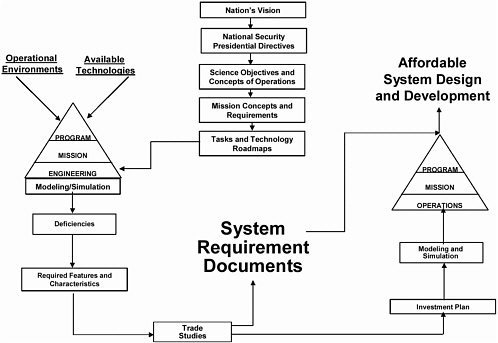
FIGURE 3-1: Strategy-to-task-to-technology process. SOURCE: Craig Steidle, NASA Headquarters, “Office of Exploration Systems: Program Overview,” briefing to the steering committee on February 23, 2004.
Steidle noted that the Office of Exploration Systems is reliant on other NASA program offices for significant activities that are critical to achieving the complete vision. The Office of Space Science plans several lunar and Mars precursor projects that intend to accomplish important science objectives and gain engineering data needed to support design decisions for human spaceflight to both destinations. Additionally, one role of the Office of Biological and Physical Research will be to conduct life science research to help understand and mitigate the health hazards associated with human spaceflight to deep space destinations.
Steidle expects to bring his past Department of Defense acquisition experience in spiral development6 to bear on the acquisition of hardware elements necessary to achieve the exploration vision. A Project Constellation timeline has been established to reflect the initial spiral phase to achieve the first flight of the unmanned crew exploration vehicle (CEV) in the 2011 time frame and the second spiral phase to achieve the first manned CEV flight in the 2014 time frame. Follow-on spirals will be needed to achieve crewed flights to Mars in the far-term.
Steidle presented the new Office of Exploration Systems, which consists of three divisions: the business operations division, the requirements division, and the development programs division. The business operations division will focus on acquisition strategy and business management, program assessment, resource management, and information management and dissemination. The requirements division will be responsible for requirements formulation, systems integration, and exploration analysis. The development programs division has responsibility for human and robotic technology, exploration transportation systems (Project Constellation), and nuclear systems development (Project Prometheus). The divisions will coordinate their work with a hand-off from requirements to development. Level 0 and Level 1 requirements are formulated within the requirements division with the help of an embryonic project team, and later the project teams are transitioned and discipline engineers added to carry projects through remaining development cycles.
Steidle stressed the need to provide competitive incentives and opportunities to come up with the technology development necessary for the new vision. Centennial Challenges is a feature of the new Exploration Vision that will use cash awards to stimulate innovation and competition in technical areas of interest to civil space and aeronautics. Specifically, the Centennial Challenges is a low risk program designed to (1) encourage innovation in ways that standard federal procurement cannot, (2) enrich NASA research by reaching new communities, (3) help address technology pitfalls, (4) promote returns that outweigh the investment, and (5) educate, inspire, and motivate the public.
Steidle also discussed the major objectives in the Office of Exploration Systems for the remainder of 2004 and its current status. Included in these objectives are a study of lessons learned from the Orbital Space Plane and Next Generation Launch Technology Program, developing relationships with industry by setting aside special days for interaction with industry representatives, and completing a preliminary requirements analysis, among other things.7
Discussion with Steidle continued after the presentation. Brad Parkinson mentioned that in systems technology, surprises occur and sometimes requirements cannot be met because of immature technology. Steidle said that once the requirements are established, any modifications to the plan must be approved by NASA’s Deputy Administrator after following a strict process to petition for change, backed up with a strong justification. Darrell Branscome mentioned that the workshop’s focus was technology as a transformer and asked Steidle to comment on the role of technology in the program. Steidle mentioned that there is an important role for technology to play as it fills gaps in the plan. The current budget provides $300 million for technology development. Steidle would like industry to assist in fulfilling these technology requirements. He hopes to begin an open dialogue with industry to develop the necessary relationships. The technology maturation process in place will have milestones throughout its tenure, providing off-ramps for unsuccessful technology.
Discussion continued on the Centennial Challenges effort. Steidle mentioned that the effort begins with $20 million per year in fiscal year 2005. The program is still defining areas for the solicitation. Molly Macauley asked as to why previous Department of Defense managers were chosen to lead two of the three divisions within the Office of Exploration Systems. Steidle replied that NASA wanted proven leaders who had experience with system-of-systems and large-systems work; had managed large, ambitious programs; and had experience with congressional briefings and the budget process. This combination was most likely to be found within the Department of Defense. The slots needed to be filled quickly, and NASA did not specifically solicit industry for candidates.
Eric Rice asked about the future of the Small Business Innovative Research (SBIR) program, whose management was moved to the new Office of Exploration Systems. Steidle acknowledged that the management had been shifted to his office and that those programs would remain. He mentioned the possibility of redirecting those efforts in the future, but said all of the current projects would continue. He wants to make sure that the technology programs are not liquidated to support other missions.
The Moon was mentioned as a testbed by Charles Trimble, who asked if it was also considered a place to be explored. NASA already has certain requirements, including geology mapping and communications systems, that need to be demonstrated for exploration. Steidle wants to demonstrate those capabilities and will evaluate the Moon as a testbed for exploration technologies.
Charles Walker asked how spiral development would affect the relationship between NASA headquarters and the field centers. Steidle mentioned that no specific field centers are associated with Code T; however, the nodes of expertise at each center are essential,
and Code T will be linked to those nodes. The centers will be able to respond to broad agency announcements and contract with Code T as appropriate. Offices have been set up at five centers and are ready to facilitate this relationship.
Joanne Gabrynowicz asked about the influx of defense expertise at NASA and wondered if there had been any discussion about whether NASA would remain a civil agency. Steidle confirmed that the agency would remain civil and public in nature. Dava Newman commented on the failure to mention universities in the Code T presentation. Steidle admitted that he doesn’t yet know what is available in the academic community and that no programmatic decisions have been made. He is open to ideas but doesn’t know yet how they will be used. David Hardy asked a similar question about coordinating efforts between NASA and the DOD space community. Steidle said that DARPA and NASA are starting a new partnership and that cooperation on lift technologies was ongoing. These partnerships could be expanded as appropriate.
OVERVIEW OF ADVANCED SYSTEMS, TECHNOLOGIES, RESEARCH, AND ANALYSIS FOR FUTURE SPACEFLIGHT CAPABILITIES
John C. Mankins, director of human and robotic technology in the Development Programs Division of the NASA Office of Exploration Systems, presented an overview of the Advanced Systems, Technologies, Research, and Analysis (ASTRA) framework. Mankins briefly reviewed the goals and objectives of the nation’s new vision for space exploration, including the key role that innovation and technology would play in achieving this vision. As background, he noted that past U.S. achievements in space had led to the development of technologies that have widespread applications to problems on Earth. He further noted that in preparation for future human exploration, we must advance our ability to live and work safely in space and, at the same time, develop the technologies to extend our reach to the Moon, Mars, and beyond. The new technologies required for further space exploration also will benefit our nation’s other space activities and may lead to applications that could be used to address problems on Earth.
The President’s announcement stated that NASA would develop the innovative technologies, knowledge, and infrastructure to explore space and support decisions about the destinations for human exploration. Mankins expected that preparing for exploration and research would accelerate the development of technologies that are important to the economy and national security. The space missions in this exploration plan require advanced systems and capabilities that will accelerate the development of many critical technologies, including those for power, computing, nanotechnology, biotechnology, communications, networking, robotics, and materials. The President’s announcement points out that these technologies will underpin and advance the U.S. economy and help ensure national security. NASA plans to work with other government agencies and the private sector to develop space systems that can address civil and commercial needs. NASA will also pursue opportunities for international participation to support U.S. space
exploration goals. Mankins reviewed the NASA vision, mission, and goals that are outlined in the 2003 NASA Strategic Plan.8
Mankins noted that the most significant transformational space systems and concepts emerged in the first two decades of the space age, including expendable launch vehicles, intercontinental ballistic missiles, the deep space network, geostationary communications satellites, the first- and second-generation global positioning systems (GPS), the space shuttles, and Viking, among others.9 More recent transformational systems include the third-generation GPS, science observatories such as the Hubble Space Telescope, the Gamma Ray Observatory, the Advanced X-ray Astronomical Facility, the Space Infrared Telescope Facility, the International Space Station, and Mars landers, including Sojourner, Opportunity, and Spirit. He noted that further transformational systems and concepts might include optical communications, nuclear space propulsion and power, and deep space outposts.
Mankins mentioned a number of selected issues and questions that he is focusing on in his new set of responsibilities, including close coordination with and engagement of the research and development community as requirements are formulated, concepts are defined, and new systems and infrastructures are developed.9 He also noted that previous studies had identified a number of technical challenges that the technology investment plan would address—for example, low-mass, deployable modular thermal systems; redundant and self-reconfigurable modular electronics; high-strength, low-mass materials for modular structural systems; highly mobile, dexterous, self-sufficient robotics; affordable, space-maintainable and evolvable extravehicular activity (EVA) systems; cryogenic fluid/propellant storage, management, and transfer; medical care beyond low Earth orbit; and others.
For the remainder of the presentation, Mankins focused on his current approach for human and robotic technology planning—a framework called Advanced Systems, Technologies, Research, and Analysis (ASTRA). ASTRA is a collection of 10- to 25-year road maps, priorities, gap analysis results, and metrics for the development of future spaceflight capabilities for human and robotic exploration.9 This stepping-stone approach is intended to
-
Establish technology investment planning systems that enable focused choices,
-
Work from clear concepts of operations for technology,
-
Create a forecast of future events,
-
Use a comprehensive taxonomy as a basis for gap analyses and partnering, and
-
Establish an annual process for assessing results and updating planning.
The planned strategic technology and systems model focuses on the NASA technology readiness level (TRL) definitions. Generally, at the lower TRLs (i.e., basic research), many diverse, competing technologies are funded at low levels. As the competition continues, various technologies that have advanced up the TRL scale are
selected for continued support with a more moderate level of funding. Over time, as higher technology readiness levels are achieved and technologies are matured, the number of competing technologies is reduced to one or two. Funding of each concept increases considerably as the technology is matured through system-level ground and flight demonstrations to support decisions to proceed with system development.
Within the ASTRA framework, Mankins expects to use the national space exploration vision,10 including science goals and requirements, to guide the technology systems analysis for supporting the formulation of the human and robotic technology plan. This plan will, in addition to NASA investments, also reflect investments by other organizations. The investment portfolio will include a balance of general and focused technology, in-house and external peer-reviewed competitions, and interim technology testbeds and demonstrations.
ASTRA also incorporates a set of ground rules and processes for the integration of technology information and a strategy-to-task approach.11 Standardized terminology and common frameworks permit a systematic evaluation of spaceflight technology research and development. The framework supports the Advanced Technology Life-cycle Analysis System (ATLAS) methodology by forming the basis of a Technology Tool Box (TTB), which is a database of technology-related inputs for the ATLAS model. Both ASTRA and ATLAS are mechanisms for efficiently applying multidisciplinary expert knowledge to the challenge of improving spaceflight capabilities.
ASTRA involves both a five-level hierarchical approach and an organizational structure focused on self-sufficient space systems; space utilities and power; habitation, bioastronautics, and EVA; assembly, maintenance, and servicing in space; surface exploration and expeditions; space transportation; in-space instruments and sensors; and information and communications.
Mankins concluded his presentation by observing that the new vision for human and robotic exploration represents a long-term, strategic focus for the nation’s civil space activities. Successful implementation and pursuit of the new vision will require advances in diverse technology areas. He stated that a resilient, adaptive process would be necessary to plan and execute these investments.
Molly Macauley inquired about examples of transformation and rapid innovation achieved outside space programs and asked if the effort planned to leverage other technology developments. Mankins, who has commissioned a series of workshops on transformational systems concepts in space, answered by saying that was exactly what was being done—bringing emerging technologies from outside the space sector or from outside NASA. He said NASA was trying to prevent the program from becoming insular and trying to leverage different disciplines and systems concepts. The workshops are being held mainly at NASA centers and universities. Code T is also sponsoring several industry days to solicit industry for ideas and participation in new areas. Macauley suggested that NASA needs to move beyond its interaction with the “usual suspects and venues.” Eric Rice mentioned that, in formulating the original idea for a space station
program, NASA held workshops around the country, getting input from individuals, organizations, and companies in all locales. He suggested that a similar set of workshops could be productive here.
In response to a question about the future of NASA’s Small Business Innovative Research (SBIR) program, Mankins replied that SBIRs were being made more relevant to the technology needs of government. Decisions on SBIRs would not be driven by commercializing space, he said.
Charles Walker asked what specific mechanisms other than the Centennial Challenge Mankins and Code T had in mind to identify and bring new innovations into the program. Mankins stated that the process was still in development in Code T but that it would include many opportunities for competition. These opportunities will be oriented to accomplishment and will be applicable to all TRLs.
Branscome asked what lessons could be learned from Steidle’s Joint Strike Fighter experience. Steidle stated that the technology selection process involved a gap analysis. Specific technologies and affordability were concerns. There was a need for new manufacturing capabilities, business models, design methods, integrated subsystems, and health management and prognostics. The technology selection process worked well for the Joint Strike Fighter; its first success was the bunker-busting bomb.
Donna Shirley asked about incorporating nontraditional systems concepts in the process. Space elevators were an example. She suggested that there did not seem to be any opportunity for major innovation in the overall systems concepts being discussed that day. Mankins said the problem was that big, new ideas do not integrate well into NASA or elsewhere because there is no mechanism to take in system-level ideas and often no support. Some mechanism needs to be devised for far-term work, he concluded, but the greater responsibility of Code T is to make things happen successfully in the present. Pulling big, new ideas in has not worked well in the past. The NASA Institute for Advanced Concepts and the Revolutionary Aerospace Systems Concepts, both programs within NASA’s former Aerospace Technology Enterprise (Code R), provide a mechanism to pull in new ideas. Mankins mentioned that Code T plans to better synthesize the ideas discovered through these two programs with technology investments and systems.
RECENT ARCHITECTURE STUDIES AND TECHNOLOGY DRIVERS AT NASA
James Geffre, NASA Johnson Space Center, provided an overview of recent studies on space system architecture and necessary technologies for both lunar and martian exploration that have been performed by the Advanced Development Office. He mentioned early in the presentation that not enough emphasis is placed on how to implement an architecture to suit a wide range of future missions and goals. Major challenges in light of the new exploration vision will include safety, performance/flexibility, risk, and cost effectiveness.
Geffre also suggested that NASA needs to develop an “interstate highway” for space that employs reusable, efficient space transportation systems. Future missions will also need propellant on demand and more robust capabilities. The mission strategy should establish building blocks and use a modular spiral development approach.
Four possibly transformational conceptual elements of spaceflight were presented:12
-
Lunar elevators would be a reusable, space-based chemical propulsion transport system for payloads from low Earth orbit (LEO) to the Moon or beyond. The elevators would refuel at their destination and never need to return to Earth. One advantage would be mass-efficient lunar exploration with a one-person vehicle.
-
Solar-electric-propelled freighters would integrate high-performance, efficient electric propulsion into a vehicle to propel payloads from LEO to high-energy orbit. Advantages include the potential reduction in beyond-LEO transportation costs and required launch vehicle capacity.
-
Cryogenic propellant depots would provide an on-orbit reserve of cryogenic chemical or electric propulsion propellant, decoupling the launch of propellant from that of hardware.
-
Orbital maneuvering vehicles are autonomous orbital maneuvering, rendezvous, and docking vehicles that can transfer propellant launch packages to tankers, move payloads, and safely de-orbit hardware.
The team looked at a variety of missions and architectures and concluded that human lunar return is one of the most important to study because its trade space of implementation options includes technology elements of other missions. The team also attempted to include options in its analysis that would answer questions such as, Where should in-space staging be done? Where should the primary vehicle be located? Do vehicles stay in orbit all the time, or do they return to Earth after every mission? NASA is investigating this entire trade space and also considering mass as a metric in the design. Geffre did point out that mass and cost are usually interconnected in such a trade space. One example of this interconnection was a comparison between the mass of Apollo (approximately 130 tons) and the mass of these new architectures (on the order of 150 to 200 tons). One important difference between the old and new designs is that a larger fraction of the mass in the new architectures is reusable (that is, is not a propellant).
The team also looked at payload capabilities for use by other government entities, including other NASA enterprises and DOD. The studies emphasized the cost-benefit of not having to launch propellant each time a vehicle is launched. Additional autonomous activity was also considered in the scenarios studied. Geffre said that Mars architecture studies have been ongoing for last 15 years; however, the team is using a newer set of transformational space infrastructures. The goal of this architecture is to improve performance and affordability relative to what is achievable with more traditional approaches.
Geffre ended his presentation by mentioning briefly key capabilities and technology needs that have been identified during these mission and architecture studies. They fall into five areas: (1) advanced space transportation, (2) Earth-to-orbit transportation, (3)
planetary habitation, (4) advanced extravehicular activity, and (5) cross-cutting capabilities.13
During the discussion period, Donna Shirley mentioned that the architecture studies presented here looked like the same types of studies that have been done for the last 20 years. She thought that the outcomes of the studies would all be the same if the technologies one is looking at are the same. Shirley asked if NASA was looking at architecture studies for a variety of scenarios, some—e.g., the space elevator—more transformational than others. Geffre said that the team had not yet looked at space elevators or other radically transforming capabilities, but there was a need to do so and to infuse new ideas into NASA.
Joseph Guerci asked how the team budgets for technologies that would one day succeed. Geffre said that the team does not wait until all technologies are available before using their predicted performance metrics in system studies. The new transformational space infrastructures would instead allow NASA to choose and carry out the most ambitious of the missions based on projections of when the enabling technologies are expected to be ready. If certain technologies are unavailable, mission designers can then fall back on more traditional technologies. An incremental set of capabilities is funded as more resources become available.


