
3
Historical and Recent Arctic-Yukon-Kuskokwim Research
This chapter is organized broadly into background information and outstanding questions on the physical environment of Arctic-Yukon-Kuskokwim (AYK) salmon; their population structure and life cycle; their ecological interactions throughout the life cycle; and the human dimension including population trends and resource use, legal and policy analysis, and restoration opportunities. It ends with a discussion of the importance of including traditional ecological knowledge in research on AYK salmon, along with strategies for achieving that goal. We have attempted to identify questions of most interest to scientists and stakeholders. Many of these questions emerged from site visits to AYK communities in 2003 and 2004 and from the workshop held in Anchorage in November 2003.
INFLUENCE AND CONSEQUENCES OF CHANGES IN THE PHYSICAL ENVIRONMENT
Regional Background
Since the 1960s and increasingly in the 1990s and 2000s, dramatic climatic changes have been occurring throughout the range of AYK salmon (BESIS 1997, Hunt et al. 1999, Schumacher and Alexander 1999, SEARCH SSC 2001, Schumacher et al. 2003). Marked changes in the wintertime climate of Alaska and the Bering Sea that occurred in 1976-1977 illustrate the magnitude and nature of some of these changes.
Among the effects documented are a step-like increase of nearly 2°C in air temperature (S.A. Bowling, Geophysical Institute, University of Alaska Fairbanks, personal communication, 1995), an approximate 5% reduction in sea-ice extent (Niebauer 1998), and a decrease in sea-ice thickness (Wadhams 1995). Many local residents around the Bering Sea also noted changes in ice thickness and strength (Huntington 2000). Permafrost temperatures measured in boreholes in northern Alaska are 2-4°C warmer than they were 50-100 years ago (Lachenbruch and Marshall 1986). Discontinuous permafrost (i.e., permafrost that is patchily distributed over the landscape) has warmed considerably and is thawing in some locations (Osterkamp 1994). In addition to the warming trend of air temperatures, marked changes have occurred in atmospheric pressure patterns, circulation, cloudiness, precipitation, and evaporation. Some North American regions are experiencing an increase in runoff (due to increased rain) of major rivers and changes in the time of river-ice breakup and the onset of the summer peak in river flow. In addition, south coastal Alaska glaciers have decreased because of melting, which has increased freshwater discharge rates nearly 15% (Arendt et al. 2002, Royer in press). Multiple air temperature signals exist in the climate record. One signal is a trend to warmer temperatures in recent decades, while many of the other natural patterns have alternating warm/cold periods, such as Arctic Oscillation (AO) and El Niño-Southern Oscillation (ENSO) (NRC 2001, 2003). The environment of AYK salmon is changing, possibly due to warming and associated climate variations that are occurring throughout the Bering Sea and Alaska.
This section emphasizes seasonal and longer fluctuations in the air, land, and sea environments. However, we recognize that episodic events can also influence salmon populations. Floods, as extreme hydrological events, can affect water quality and may scour gravels and deposit fine-grained sediment, thereby damaging spawning beds and/or flushing young fish out of the river (Brabets et al. 2000). Three major floods have occurred in the Yukon River basin since 1949 (Brabers et al. 2000): in 1964 (June/July, due to melt of large snow pack), in 1967 (12-18 August, in the middle and lower Tanana River basin with a magnitude estimated to be twice the 100-year flood discharge), and in 1994 (15-27 August, in the upper Koyukuk River basin). At the other extreme are droughts, which can inhibit upstream migration as well as affect eggs after spawning through increased water temperature, decreased concentration of dissolved oxygen, and even dewatering of the redds. Extended droughts also influence groundwater levels that, in turn, decrease the base flow of
streams and springs that are critical salmon habitats. Notable droughts have occurred since 1949 (Brabets et al. 2000): in 1950-1957 (most of the upper Yukon River basin and upper Tanana River basin), in 1969-1970 (western portion of the Yukon River basin, including the Koyukuk River), in 1973-1980 (the most severe period in terms of low flow and length, primarily lower Yukon, Koyukuk, and Tanana rivers), and in 1996-1999 (deficit flows observed at several locations in some of these years on the upper Yukon including Eagle, Nenana, Stevens Village, and above the White River). In general, it appears that spawning habitat in the AYK region has been modified by humans in only a few limited locations, mostly from the effects of placer mining (Knudsen 2003). Other extreme events—for example, volcanic eruptions and earthquakes—can also have a major impact on salmon habitat.
Climate and Climate Change
Before delving into the impacts climate change may have on AYK salmon populations, we sought to understand what climate change means and to identify factors that cause changes. This allows us to define both the spatial and the temporal scales of climate change and the pathways through which climate change influences biota, and AYK salmon in particular. As defined in a recent National Research Council (NRC) report (2001), “Climate is defined as the average state of the atmosphere and the underlying land and oceans, on time scales of seasons and longer.” This definition is broader than many people consider when they think of climate—that is, the atmosphere only—but it is essential when considering the life and times of salmon. Salmon spawn and develop from egg to smolt stages in the riverine environment before going to sea; therefore, the changing state of all three domains (atmosphere, land, and sea) is crucial to salmon.
From a global perspective, the climate is a response to solar and geothermal heating (Woods 1984). Present-day climate on earth is controlled by solar fluxes that in turn affect the temperatures of the ocean and the atmosphere, the hydrologic cycle, and the winds. The major source of heat in the earth’s global heat budget is incoming solar radiation, much of it in the visible wavelengths. Solar energy drives the atmosphere through differential heating that results from changes of heat per unit area with latitude—that is, there are higher rates of heating at low latitudes than at high latitudes. Greater input of solar (shortwave)
radiation occurs at low latitudes, and this excess heat is transported poleward where it is reradiated as infrared (long-wave) energy (NRC 2001). The poleward transport of heat occurs through both oceanic and atmospheric circulation. There is a net heat loss at latitudes above about 38° (Trenberth et al. 1996). This differential heating is augmented by the tilt of the earth’s axis of rotation (the cause of seasonal climate change). It is acted upon by the earth’s rotation to create global pressure differences, and hence wind patterns, which in turn are influenced by regional features—for example, air-sea heat and moisture fluxes. Local features, such as mountain topography, in turn influence the regional atmospheric fields. The winds in these atmospheric systems in turn drive the surface ocean currents, which also transport heat and salt (freshwater). Thus, the two systems are coupled and work together to control the global heat and water budgets. Without the poleward heat transport, the high latitude temperatures would be much lower. Therefore, any processes that affect this transport, either in the ocean or in the atmosphere, will influence the climate. For example, if gases (commonly called “greenhouse” gases, which include CO2 and CH4) that trap energy by absorbing the outgoing long-wave radiation increase, then the result will be changes in atmospheric features and global warming.
Changes in cloud cover cause fluctuations in net surface solar radiation and outgoing long-wave radiation. Over the coastal waters where AYK salmon smolts enter the marine environment, latitudinal changes in net radiation could cause differences in smolt and juvenile habitat. Variations in this radiation (mainly the photosynthetically active radiation, or PAR) are a crucial aspect of time-varying forcing for climate and ecosystem change (Foukal 2003). Stabeno et al. 2004 examined net shortwave radiation (NSWR) in the eastern Bering Sea (Figure 3-1). The effect of latitude is evident: the northernmost station received about 21% less energy (W·m−2). The two series from nearly the same latitude appear in phase and of similar magnitude. There are, however, some years (1995, 1999) when they are different by >10 W·m−2, potentially a large enough difference to result in differences in primary/secondary production processes. These within-year differences are likely due to regional differences in cloud cover. The latitudinal differences imply a shorter, more intense period of production over more northern portions of the shelf than exists over the southeastern shelf. This may account for the observed differences in the dominant pathway of carbon cycling on the Bering Sea shelf (pelagic versus benthic); the northern shelf is predomi nantly a benthic system (McRoy 1993), whereas the southeastern shelf
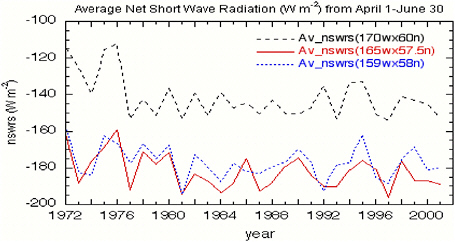
FIGURE 3-1 Daily averaged net shortwave radiation (NSWR) from the National Center for Atmospheric Research/National Center for Environmental Prediction (NCAR/NCEP) reanalysis data: April-June 30 (1972-2001). Minus sign signifies downward flux into the ocean. Source: Stabeno et al. 2004. Reprinted with permission; copyright 2004, John Wiley & Sons.
may be either pelagic or benthic, depending on the timing of spring blooms (Walsh and McRoy 1986).
The phasing of these two signals could be important to biota in the Gulf of Alaska, North Pacific, and Bering Sea. The sea-surface temperature pattern that the Pacific Decadal Oscillation (PDO) describes has a warm coastal northern North Pacific and cooler central North Pacific. This pattern reverses on interdecadal time scales (20-30 years). At a time when the PDO has a warm phase in the coastal waters, the occurrence of an ENSO event could be especially severe since this also increases the nearshore water temperatures in the Northeast Pacific.
The impact of humans on the earth and its climate is marked. How much of the present climate change is natural and how much is human-induced global warming remains a subject of debate. Most scientists agree, however, that the increasing trend in global temperature is due to greater concentrations of human-generated greenhouse gases (AGU Report 1999, IPCC 2001, Levitus et al. 2001), and a crucial point for AYK salmon is that the warming may be amplified in polar regions (Moritz et al. 2002). A recent American Geophysical Union (AGU 2003) position statement on human impacts on climate states, “human activities are increasingly altering Earth’s climate, and natural influences alone do not
explain the increase in global near-surface temperature in the latter half of the 20th century.” The statement further notes that human impacts include air pollution and airborne particle and land alteration in addition to the more commonly recognized increase of atmospheric greenhouse gases. Human impacts interact with natural cycles, likely changing amplitudes and phases and making them less predictable.
Pathways from the Physical Environment to Biota
Because much of the variability in salmon survival appears to occur within a few months after smolt migration from freshwater to the sea (Pearcy 1992, Downton and Miller 1998, Beamish and Mahnken 2001) and because focusing on this stage may provide predictive modeling (Logerwell et al. 2003), our main focus in this section is the marine environment. To enhance our understanding of the marine ecosystem that the AYK smolts inhabit, we must elucidate processes and mechanisms that transfer changes in atmospheric climate through the ocean to biota.
Francis et al. (1998) developed pathways for the Northeast Pacific to identify key elements of ecosystem dynamics. That model was modified by Schumacher et al. (2003) for the eastern Bering Sea to include additional physical features such as sea ice, cloud cover, and precipitation. Our flow model (Figure 3-2) borrows from the latter schematic. Within each of the upper three boxes in the Pathways Model (Figure 3-2) are phenomena and features of the abiotic environment. Depending on location, the general contents of the boxes become more specific. While the Ocean box (Figure 3-2) incorporates both the nearshore zone (depth <10 m) and estuaries, there are processes in these regions that do not exist or are not important in the oceanic domain. In the nearshore zone, littoral drift (which is a form of horizontal current generated by breaking surface waves) is a dominant feature causing erosion and buildup of sediment features. Estuarine circulation, which incorporates horizontal flow and vertical mixing or entrainment of water, is a dominant mechanism generating both horizontal and vertical flow fields within an estuary, but typically it is not a major factor in oceanic circulation. Within the estuary, salinity decreases from oceanic values to near zero. The salinity gradient may influence salmon smolts when they first reach the estuary and also will influence returning adults.
Feedback exists between all boxes in Figure 3-2, as suggested by the two-way arrows. For example, water temperature can influence
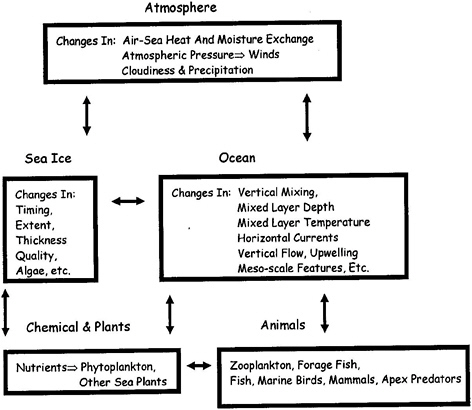
FIGURE 3-2 Schematic showing pathways through which air-sea interactions flow through the marine ecosystem. Within each box are features and/or processes that affect exchange within and between boxes. The Sea Ice box is seasonal; without ice, the arrows lead to the next box. Source: Schumacher et al. 2003. Reprinted with permission; copyright 2003, Elsevier.
AYK salmon both through its impact on the nutrient-phytoplankton-zooplankton sequence (bottom-up), which supplies prey, or by changing the zoogeographical boundaries for predators (top-down) and/or for the salmon themselves. How does phytoplankton influence atmospheric features? Variations within the phytoplankton community can induce intraseasonal fluctuations in sea surface temperature (SST) through regulation of solar radiation penetration due to absorption by chlorophyll and other optically active organic components (Gildor et al. 2003). Variations in SST in turn might affect the flux of heat and moisture into the atmosphere, thereby changing atmospheric features. In the Animals box, for simplicity, we show only a limited set of trophic levels. Humans are
the predator that likely has the greatest impact on AYK salmon, but not explicitly shown as “the” apex predator.
For a terrestrial analog to the marine pathways model, the Ocean box would become the River/Terrestrial box and the Sea Ice box would be eliminated. Within the River/Terrestrial box important features would include time of ice cover, ice thickness and breakup, time/magnitude of the freshet, time/magnitude of increased sediment load due to human- or storm-induced erosion, changes in river morphology, and permafrost. Permafrost is defined as any subsurface earth material that remains at or below 0°C continuously for 2 years or more (Nelson 2003), and it represents a complex, integrated response to the energy balance at the earth’s surface (Williams and Smith 1989). Permafrost regions in the Yukon River drainage basin are shrinking due to warming. As this occurs, the frozen soil is transformed into zones that are biogeochemically active. Water flowing through and across these zones is hypothesized to increase the flux of solutes to tributaries and the main stem, ultimately changing the water chemistry of the Yukon River (Schuster et al. 2002). The Chemical & Plants box would include changes in plant communities that are occurring as warming affects the ecosystem. Potential chemical pollutants associated with development of mines and other activities also would be included in this box. Neither of the pathway models includes disease and/or parasites, but to the degree these factors are influenced by the physical (including chemical and geological) environment, they must be considered.
Hunt et al. (2002) wove the elements of the marine pathways model together in creating the oscillating control hypothesis (OCH) for the southeastern Bering Sea shelf. As summarized by Stabeno et al. 2004, the OCH relies on a cascade of changes in a given year’s abiotic and biotic features, including sea ice extent/timing, wind-generated turbulence, water column temperature, and timing/magnitude of primary production. In turn, these features impact changes in the abundance of higher trophic levels. The sequence of changes, known as a regime shift, is initiated by atmospheric changes on both interannual and decadal timescales. Changes in the abundance of Bering Sea salmon coincide with regime shifts associated with the PDO (Hare and Mantua 2000). Salmon smolts and juveniles from the Kuskokwim River, and to a lesser degree those from the Yukon River and Norton Sound, likely occur in the waters where dynamics of the OCH apply.
In essence, the OCH recognizes that late retreat of sea ice with the attendant low temperatures in the water column and early, short phyto-
plankton blooms are hallmarks of cold regimes. The associated impacts on biota include reduced survival of fish eggs and diminished abundance of zooplankton prey. Under this set of conditions, recruitment of pollock and other fishes will be nominal or weak. Bottom-up processes dictate the flow of energy through the ecosystem during a cold regime. Low water temperatures also can directly affect distributions of some forage fish species. The OCH allows that pinnipeds and piscivorous seabirds may thrive, even under cold conditions, if the population centers of forage fish change, resulting in their becoming more available as prey. During years when sea ice either is not present or retreats before there is sufficient NSWR to initiate a bloom, the spring bloom occurs later than during the cold regime, and water column temperatures are higher. Under this set of conditions, the spring bloom is prolonged and zooplankton production is expected to be high, resulting in readily available prey for larval and juvenile fish, and resultant strong year-classes of pollock and other piscivorous fishes.
The OCH accounts for top-down forcing through both cannibalism and other piscivorous fish, which is well recognized in the eastern Being Sea (Livingston and Methot 1998, Livingston et al. 1999). When there is a sequence of warm regime years, recruitment is above average, and the populations of adult predatory fish eventually will increase to a point where the control of future year-class strength is mainly a top-down process. As predation becomes greater, the abundance of young pollock and forage fish declines, and zooplankton become available for other populations (jellyfish, salmon, and baleen whales). In addition, with fewer fishes, declines in populations and/or productivity of pinnipeds and piscivorous seabirds would be expected (Hunt and Stabeno 2002).
Features of the Environment of AYK Salmon
We begin our discussion of the AYK salmon environments with a discussion of the coupling of the ocean and atmosphere. Patterns in the atmosphere tend to be on hemispheric spatial scales and have temporal variability from years to decades. Variability of atmospheric patterns has profound impacts on marine ecosystems, particularly salmon (Mantua et al. 1997, Downton and Miller 1998, Hare and Mantua 2000, Hollowed et al. 2001), although the mechanisms that link atmosphere-ocean change to biological change are seldom clear.
Important climate signals are evident in atmospheric features of the Bering Sea and continental Alaska, including the AO, ENSO (as mentioned earlier), and the Aleutian low (AL). An oceanic feature closely related to the atmosphere but manifest as a pattern in SST is the PDO. These climate patterns are particularly well-studied for winter. Interest and awareness is growing, however, in climate variations and their importance during warm seasons. While these signals may not be as large as those during winter, they can stand out above background atmospheric conditions (Trenberth et al. 1998), and they can influence the upper ocean and its biota. For example, the unusually high SSTs in the eastern Bering Sea (summer 1997) were ascribed mainly to atmospheric anomalies that occurred concurrently with a strong El Niño (Overland et al. 2001). Marked changes in biota occurred that summer (Vance et al. 1998).
The PDO is the leading mode of SST variability in the North Pacific (north of 20°N) and has a dominant timescale of 20-30 years. Although important, the PDO explains only ~21% of the total variance of the monthly SST and is centered primarily on the central North Pacific rather than the Gulf of Alaska and Bering Sea. Signals with other periods, such as decadal, contribute to a lesser extent at times. The ENSO has widespread influence on global climate variability at timescales of 2-7 years. Often, a brief (on the order of months) general warming of the high-latitude North Pacific surface water takes place simultaneously with the ENSO, and a delayed subsurface oceanic warm signal has also been reported (Royer in press). The ENSO has, at times, a small influence (accounting for ~7% of the annual change in sea ice coverage) (Niebauer 1998) on the marine climate of the Bering Sea via atmospheric teleconnections (Niebauer et al. 1999, Hollowed et al. 2001, Overland et al. 2001). Further, the midlatitude decadal variability in the atmosphere can be explained without the ENSO processes (Barnett et al. 1999).
The AO represents the leading empirical orthogonal function of the winter sea level pressure (SLP) fields north of 20°N (Wallace 2000). The accompanying time/space patterns in surface air temperature (SAT) closely resemble those in SLP. While the AO is the mode that contains the greatest amount of energy, it accounts for <21% of the total variance in the SLP field. The strongest signal in the AO time series (Figure 3-3) is interannual, but it also contains decadal scale signals, having changed sign in 1976 and again in 1989 (Overland et al. 1999). One way the AO influences the AYK salmon’s environment is through its effect on the
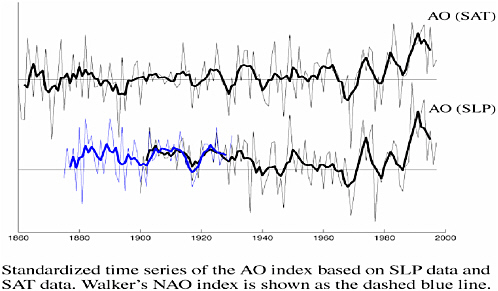
FIGURE 3-3 Time series showing the Arctic oscillation (AO) as surface air temperature (SAT) (upper) and as sea level pressure (SLP) (lower). Applying a running mean to the data (bold line) reveals a decadal signal that is not correlated with sunspots. The warming trend that is marked after the 1960s is likely a result of human-induced global warming. Source: Wallace 2000. Reprinted with permission by the author.
AL, which is the monthly or seasonal mean location of the center of low SLP resulting from storm passage typically along the Aleutian Island chain (Schumacher et al. as cited in Allen et al. 1983). The magnitude and position of the AL is a primary factor determining surface winds (advection and mixing of the upper ocean and production/advection of ice), heat fluxes (mixing and ice formation), and precipitation over the Bering Sea, North Pacific Ocean, and Alaska. Indices of atmospheric and oceanic features have been used together with indices of biota to identify abrupt or regime shifts in the ecosystem at decadal timescales (Mantua et al. 1997, Francis et al. 1998, Hollowed et al. 2001). Two regime shifts occurred in the past 30 years: winter 1976-1977, when the PDO and the AO both shifted, and after the winter of 1988-1989, when only the AO shifted (Sugimoto and Tadokoro 1998, Beamish et al. 1999, Hare and Mantua 2000). Some evidence exists that a third shift occurred after the winter of 1998-1999 (Schwing and Moore 2000, Peterson et al. 2002, Peterson and Schwing 2003). These regime shifts often are clearer in biological than in physical time series; salmon production in both Alaska and the Northwest fluctuates with these regime shifts. Several atmospheric and oceanic phenomena influence the habitat for AYK salmon, and the responses in biota are complex. For example, the phas-
ing of these PDOs and ENSOs could be important to biota in the Gulf of Alaska, North Pacific, and Bering Sea. At a time when the PDO has a warm phase in nearshore waters, the occurrence of an ENSO event could be especially severe. Because of this, the impact of climate change on AYK salmon is unlikely to be systematic and repetitive; the response likely varies from one regime shift to another.
Changes in sea ice (Figure 3-4), the signature feature of the eastern Bering Sea, are driven mainly by changes in atmospheric phenomena. A synopsis of recent information (Niebauer et al. 1999, Stabeno et al. 2001, Hunt et al. 2002) provides the salient features of seasonal sea ice cover. Sea ice begins to form on the leeward side of coastlines in late fall. Frigid northerly winds blow the ice southward, with some formation in leads. Significant interannual variation in the timing of ice advance/ retreat and percent coverage occurs; when the AL is farthest east and high pressure is strong over Siberia, ice coverage is greatest. While there is some indication of longer period signals, the most striking signal is interannual (Figure 3-4). Potentially important to AYK salmon smolts as they enter this marine region is the strong difference (~2 months) in
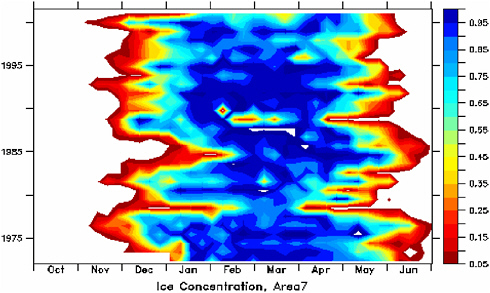
FIGURE 3-4 A time series of percent sea ice cover in the region bounded by 60.5-61°N and extending from the coast to ~176°W. The most complete coverage by sea ice occurred in winter 1976-1977. Source: S. Salo, PMEL/NOAA, unpublished material, 2001.
the time of ice melting. Melting has been 1-2 weeks earlier during 1990-1998 (the period after the second AO regime shift) than in 1978-1989 (the period after the first regime shift), and it is associated with changes in atmospheric temperature and circulation (Stabeno and Overland 2001). How this influences the primary/secondary production sequence that provides essential food for the smolts is not known; however, it could lead to a potential mismatch. The earlier melt does imply that water temperatures will be higher than when melting is later. Higher temperatures may lead to higher smolt growth and thus higher survival (Hunt et al. 2002).
A connection exists among climate change, transport (currents) of (Wespestad et al. 2000, Zheng et al. 2001, Wilderbuer et al. 2002). Transport itself does not lead to mortality but moves the early life history stages to regions of higher or lower survival due to prey limitation and/or predation pressures. Circulation (in this case a semipermanent eddy) also has been linked to alterations of salmon migration routes off southeast Alaska (Hamilton and Mysak 1986).
Circulation in the marine environment of AYK salmon is known (Schumacher and Stabeno 1998, Stabeno et al. 1999) to the degree that schematics can be constructed (Figure 3-5). The coastal flow indicated by arrows along the Alaskan Peninsula and the west coast of Alaska is typically weak (2-4 cm·s−1) in summer but persistent (Schumacher and Kinder 1983, Schumacher and Stabeno 1998). This coastal current is partially driven by baroclinic forcing (from runoff along the coast) and south of ~62°N is preferentially located in the vicinity of the 50-m iso-bath. As noted by Kachel et al. (2002), the coastal current flows parallel to the inner front, which is a transition zone (10 to >100 km wide) that separates the typically mixed coastal waters from the strongly two layered (in the presence of a buoyancy flux—for example, summer) from middle shelf domain (50 m < z < 100 m) waters (Schumacher and Stabeno 1998, Kachel et al. 2002). Recent information reveals that in 1998 the magnitude of the coastal current approximately doubled over historical values (P.J. Stabeno, NOAA/PMEL, personal communications, 2003). The impact on AYK salmon smolts by the coastal current and its interannual variation are not known. Further, little or no oceanographic research has been conducted in nearshore coastal waters, particularly in the regions off the Kuskokwim and Yukon Rivers.
The continental shelf shoals going northward so that off Norton Sound, the water column is generally <35 m deep, and tidal currents are much weaker than over the southeastern shelf; an analog to the inner and front does not exist over the northern portion of the shelf. In Norton
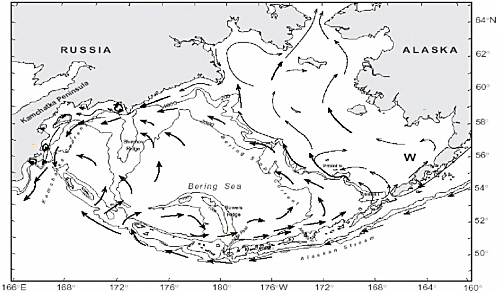
FIGURE 3-5 Schematic showing general circulation in the Bering Sea. This schematic does not show the nearshore currents or the bidirectional flow that occurs seasonally and at depth between the Beaufort and Chukchi Seas. Source: Stabeno et al. 1999.
Sound, oceanographic studies conducted between 1976 and 1978 show that the relatively shoal water column is two layered throughout the summer (Muench et al. 1981). The high bottom layer salinities result from brine ejection during sea-ice formation, and the low-salinity upper layer values result from freshwater addition from various rivers. During these oceanographic observations, there was no indication that the Yukon River entered the Sound east of Stuart Island; yet, characteristics of bottom sediments in the eastern Sound suggest a Yukon River source (Drake et al. 1980). Changes in the position and volume of the Yukon River plume could have a profound impact on the geophysical environment of Norton Sound. The changes that are expected to occur due to global warming (less ice and greater runoff) might dramatically alter the Sound’s present thermohaline structure, which could affect salmon.
Water temperature strongly influences all life history stages of salmon. Changes in air temperature and wind-driven mixing (turbulence) are the factors that determine the mixed-layer temperature (MLT) and the depth of the mixed layer. MLT directly influences physiological rates and can alter predator distributions. Ishida et al. (2002) suggest that MLT influences distributions and densities of chum and sockeye salmon,
affecting their survival and hence their abundance and growth in the central Bering Sea.
Likely Changes in AYK Habitat Due to Continued Warming
Over the last century, the average temperature in Anchorage has increased by ~2°C, and over the last 41 years of available data, precipitation has increased by ~10% in many parts of the state (EPA 1998). In the mid-1980s, measurements in boreholes indicated a 2-4°C increase over the preceding 100 years (Lachenbruch and Marshall 1986), and warming accelerated this change by ~3°C between the mid-1980s and 2002 (Nelson 2003). As the warming continues, the Yukon River drainage area is being affected. Nelson (2003) notes that large areas of central Alaska have experienced as much as 2.5 m of subsidence over the past 2 centuries and that such topographic changes have produced extensive hydrological and ecological impacts, with large areas of birch forest converted to fens and bogs (Jorgenson et al. 2001).
Many forecasts of future conditions have been made with global climate models. The following changes were presented by the U.S. Environmental Protection Agency (EPA 1998) and are based on projections made by the Intergovernmental Panel on Climate Change and results from the United Kingdom Hadley Centre’s climate model (HadCM2, a model that accounts for both greenhouse gases and aerosols): by the year 2100, temperatures in Alaska could increase by 3°C in spring, summer, and fall (with a range of 1-5°C), and by 6°C in winter (with a range of 2-9°C). Precipitation is estimated to increase slightly in fall and winter (with a range of 0-10%) and by 10% in spring and summer (with a range of 5-15%). These changes in precipitation will increase the vertical and possibly the horizontal stratification of the ocean, increasing the baroclinic transports; they would affect stream flow and temperature as well. Other climate models will show different results depending on the formulation and extent of the mathematics used to represent processes that dictate flow of energy through the coupled atmosphere-sea-land system.
In the mid-1990s, a group of scientists well versed in atmospheric and oceanic phenomena of the North Pacific and the Bering Sea outlined the most likely impacts of global warming on this region (US GLOBEC 1996, Schumacher and Alexander 1999). They based their forecasts on projections from global climate model simulations (Hall et al. 1994) that indicate secular warming of the atmosphere over the North Pacific, especially at higher latitudes. A summary of those results, together with
other suggested changes, is presented in Table 3-1. While it was challenging enough to predict these changes in the physical environment, to then extrapolate to how such changes would affect biota was beyond their corporate knowledge. Too many unknowns exist regarding what changes in the physical/chemical environment were most important to a given species, and it was often evident that our knowledge of most species is sorely lacking. For example, even for species as well studied as salmon, there are gaping holes in our knowledge of the distribution and factors dictating survival as smolts enter the marine environment and through their first year in the sea.
Research Questions
The following questions arise from our present lack of knowledge and analyses of the critical questions. They provide topics for research regarding the impact of climate change on AYK salmon. A necessary adjunct to the list below is to determine the year-to-year variation for each item.
-
Where and when do smolts enter the marine environment; what factors dictate when smolts arrive; what is the form of their outmigration (en masse or more extended through time); how sensitive is the out-migration to changes in the environment (temperature, salinity, and ice)?
-
How does their initial distribution change with time; what role do currents play; where in the water column are the smolts, and how does this vary through light/dark periods and as they mature; does storm-generated turbulence affect predator/prey relations?
-
What biophysical processes dominate the survival of smolts and the juvenile fish through their first winter at sea?
Can a reliable index of survival of young-year be developed to provide recruitment forecasts for managers (giving the op portunity to adjust fishing pressure for each upcoming year class) similar to the herring fishery in the Baltic Sea (Axenrot and Hansson 2003) and perhaps Oregon coho (Logerwell et al. 2003)?
-
How are the variations in the large atmospheric-oceanic patterns (AO and PDO) manifest (wind speed, air temperature, and moisture fluxes) in the time/space domains relevant to salmon survival, mainly of smolts and juveniles (summer/fall in the coastal waters from Kuskokwim Bay to Norton Sound), in spawning/riverine life history stages (Kus-
TABLE 3-1 Hypothesized Changes in Physical Habitat of AYK Salmon Due to Global Warming
|
I. |
Atmospheric climate |
|
|
|
Storm intensity |
Decrease |
|
|
Storm frequency |
Increase |
|
|
Surface air temperature and humidity |
Increase |
|
|
Sea level pressure |
Lower in North Bering |
|
|
Southerly wind component |
Increase |
|
|
Wind stress curl |
Decrease |
|
|
precipitation, rain |
Increase/shift north |
|
|
Snowfall |
Decrease |
|
|
Freshwater runoff |
Increase |
|
II. |
Oceanic climate |
|
|
|
Sea ice extent, thickness, and brine flux |
Decrease |
|
|
Volume of Alaskan Stream inflow |
Decrease |
|
|
Bering Slope and Kamchatka Current flow |
Decrease |
|
|
Sea surface temperature |
Increase |
|
|
Cold pool extent/temperature |
Decrease/increase |
|
|
Nutrient flux onto shelf |
Decrease |
|
|
Sea level |
Increase |
|
|
Coastal current |
Unknown |
|
III. |
Terrestrial climate |
|
|
|
Permafrost/erosion |
Decrease/increase |
|
|
River/lake ice |
Less |
|
|
Freeze up/breakup |
Later/earlier |
|
|
Geochemical state |
Unknown |
|
Sources: BESIS 1997, Schumacher and Alexander 1999. |
||
-
kokwim/Yukon River basins over appropriate time span), and perhaps to adults (Bering Sea/North Pacific all seasons)?
-
Will there be changes in the predator/prey patterns with changes in climate?
POPULATION STRUCTURE AND LIFE CYCLE OF AYK SALMON
Population Genetics of AYK Salmon
It is important to identify the various salmon stocks in the AYK region because they might have similar or different responses to abiotic factors and fishing. Genetic analysis is a promising method for distin-
guishing among these salmon stocks. Utter and Allendorf (2003) provided a thorough review of information on the population genetics of AYK salmon and the potential role of population genetics in the management of AYK salmon populations. Available data derive from nuclear markers (allozymes and microsatellites) and mitochondrial DNA haplotypes. The allozyme database for chum salmon is the most detailed database available, but it can distinguish only three major AYK population groups: (1) northwestern Alaska summer chum salmon, which includes all coastal western Alaska rivers, the lower Yukon, and the lower Kuskokwim; (2) Yukon fall chum salmon; and (3) upper Kuskokwim chum salmon. Allozyme data do not work for separating U.S. and Canadian fall chum salmon in the Yukon River. For Chinook salmon, lower and upper river populations can be distinguished in the Yukon River but not in the Kuskokwim River. Coho salmon data are limited but indicate differences between lower and upper and Yukon, AYK coastal, and Bristol Bay populations. AYK pink and sockeye salmon data are insufficient to estimate population structures.
Fishing and Genetics of AYK Salmon
Ricker and Wickett (1980) attributed the decrease in size of coho salmon in British Columbia to evolutionary change caused by fishing. Similar claims were made as early as 1952 for freshwater trout (Cooper 1953). Ricker and Wickett’s argument was that fishing acts through directional selection to produce fish with smaller size at age or at maturity by removing those fish that grow quickly or attain large size by the age of maturity. Left in the population are fish that became reproductively mature at smaller sizes. Because these fish are subject to lower fishing mortality, they live longer, reproduce more, and have a greater influence on the subsequent genetic composition of the species. This paper and the ideas it contained was met with skepticism by fisheries scientists, many of whom thought evolutionary change required more time than the span over which fisheries operated to cause genetic change.
The idea that fishing could be an agent of evolution relies on two important assumptions: (1) a genetic basis to phenotypic variations in the population exists, such as in growth rates, size or age at maturity, and run timing; and (2) fishing acts to cause differential reproduction in different genotypes (Policansky 1993a), potentially within as little as two or three generations (Policansky 1993b). Even fishing that does not selectively take different phenotypes (fish of a particular size or age or fish that mi-
grate at different times) can affect genotype frequencies and thus cause evolution by favoring one life history pattern over another (Policansky 1993b). For example, high fishing mortality can change a fish population with many year classes or long life spans into one with only a few year classes and shorter life spans because the overall probability of surviving more than 1 or 2 years can become vanishingly small (Murphy 1968). In such a case, a genotype that reproduced early would be favored.
Experimental-breeding studies on the Atlantic silverside (Menidia menidia) reveal that growth is heritable (Conover and Present 1990, Conover 2000), while studies of salmonids also indicate mixed heritability of several traits (Policansky 1993a,b). Although simple in concept, identifying evolutionary change can be difficult. Factors such as compensatory growth, a “fishing-up effect” (in which cumulative mortality of slow-growing older fish hides selectivity effects), migration, and environmental changes can obscure real evolutionary change (Policansky 1993a).
In recent decades, these ideas have been gradually embraced. A series of papers demonstrated rapid evolutionary change in Trinidadian guppies (Poecilia reticulata) in the face of predators (Reznick et al. 2001, 2002; Bronikowski et al. 2002; O’Steen et al. 2002), often in less than a decade. Magurran (2001) reported that predation resulted not only in size changes but also in fundamental changes in sexual behaviors. Silliman’s experimental “fishing” of Talapia in the laboratory pointed to evolutionary change as a direct result of fishing (Silliman 1975). The first publications that supported similar rapid evolution in salmon appeared recently (Hendry et al. 2000, Hendry 2001). Whereas previous studies indicated that evolutionary change required 30 generations or more (Unwin et al. 2000), these papers revealed that sockeye salmon can become reproductively isolated and show changes in genetic frequency in fewer than 13 generations. In many studies the predation is not by humans, but others have directly linked fishing to evolutionary change (Haugen and Vollestad 2001). Other important traits of Pacific salmon, including run timing, are heritable and thus clearly are subject to the selective effects of some kinds of fishing (Geiger et al. 1997, Hebert et al. 1998, McGregor et al. 1998).
When different local populations mix in the ocean or as they return to their natal spawning habitats, they will be subject to common mortality factors, even though the local populations exhibit different vulnerabilities. Abundant, growing (productive) populations will be able to
withstand fishing mortality better than less-productive or depleted populations, which can be extirpated by this same fishing effort. Unless the population mixture is known, in addition to their respective vulnerabilities to fishing mortality, we cannot tailor management regulations to ameliorate excess mortality on vulnerable populations.
Fishing affects populations not only directly through selection on various traits but also indirectly through changes in the ecosystem (Policansky and Magnuson 1998, Conover 2000, Heino and Godø 2002). Species are differentially affected by harvest through changing the abundance of predators or prey or through habitat disturbance. Results from these disturbances have been difficult to predict and are not well studied for the AYK region. Before discussing the limited information available from this region, a brief review of the general knowledge of population structure of Pacific salmonids is helpful.
Metapopulation Structure
All five North American species of Pacific salmon are found in the AYK region1, although more is known about chum in this region than the other species. In other regions, these five species are thought to form metapopulations where local populations are largely isolated in a stepping-stone type model due to the high degree of natal homing and subsequent reproductive isolation (Rieman and Dunham 2000, Jones in press). Local populations are adapted to local conditions as a “home-stream colony” typified by small local breeding units that are isolated from local populations in other streams or reaches of streams (Moulton 1939; Thompson 1959, 1965; NRC 1996). Each local population is vulnerable to extinction from natural or anthropogenic causes, and suitable habitats where fish have been extirpated must be recolonized through straying from other viable local populations (Policansky and Magnuson 1998).
The Takotna River provides one of the few documented examples of how long this process can take (Gilk and Molyneaux 2004). The local Chinook salmon population was extirpated, probably by fishing and habitat alteration by miners who used the Takotna River to access the Innoko mining district, in the early part of the twentieth century. Salmon finally returned in the 1980s to repopulate this habitat.
The evolutionary advantage of a metapopulation lies in its overall resiliency to extinction. Early modeling work by Levins (1969, 1970) demonstrated that persistence was greater for a metapopulation than for a patchily distributed population of similar size. This has since been confirmed. Healthy populations can act as sources that reinforce the viability of marginal populations within the metapopulation (Pulliam 1988, Pulliam and Danielson 1991, Fogarty 1998, Policansky and Magnuson 1998). This biological and environmental variation has recently been called “biocomplexity” and has been linked to the sustainability of fisheries (Hilborn et al. 2004).
The ability of a metapopulation to sustain the species can be compromised when sufficient habitat is lost so that the exchange of migrants is hampered by distance and when the overall population becomes too small to contain sufficient genetic variation to meet new environmental challenges. Arguably, this is happening along the coasts of California to Washington and Canada for coho and other salmon (NRC 1996) and in Maine for Atlantic salmon (Salmo salar) (NRC 2004a). However, salmon populations in Alaska are less depleted and have been subject to much less habitat destruction. In the AYK region, habitat remains largely intact.
In the AYK region, we know most about the genetic structure of chum and Chinook salmon because of their importance to commercial fisheries and declining abundance. Salmon in northwest Alaska, which includes all AYK and Bristol Bay populations, are distinguishable from all other North American and Asian populations based on an analysis of 20 allozyme loci from 356 chum salmon populations (Seeb et al. 2004). Within the northwest Alaska region, three finer-scale groups of chum salmon can be distinguished: (1) northwest Alaska summer (includes Kotzebue Sound, Norton Sound, Yukon River summer, Kuskokwim Bay, lower Kuskokwim River, and Bristol Bay), (2) Yukon River fall, and (3) upper Kuskokwim River. Further analysis and more sampling are bound to reveal even more differences among local populations. Northwest Alaska chum salmon populations are caught in the southeastern Bering Sea pollock fishery as a mixed stock. Similarly, they are subject to mixed stock fishing as they return to their natal streams to spawn. As a mixed stock, different local populations respond differently to this fishing mortality, and the effect on local populations and their persistence is unknown.
Twenty-nine populations of Chinook salmon have been identified in the southeastern Alaska and AYK region. Southern and eastern popu-
lations have diverged considerably in contrast to those fish in the AYK region (Utter and Allendorf 2003). Populations have differentiated in the upper and lower Yukon River but not in the Kuskokwim River. As is true for chum, Chinook are subject to mixed-stock fishing as they return to spawn in their natal streams. As with chum, virtually nothing is known about the effects of fishing mortality on these mixed stocks.
Even less is known about the other three salmon species of the AYK region (coho, pink, and sockeye). Only a few studies have been done that included coho populations from the AYK region. In these studies, Alaskan populations group together and separate from those of Puget Sound and Georgia Strait (Beacham et al. 2001). There is also evidence of extinction of the western group and subsequent repopulation on geologic time scales, thereby explaining the more limited differentiation in coho. Even so, coho in the AYK region are now sufficiently distinct to be managed separately. Pink salmon have a different structure than the other four species in that they are less spatially separated but are more temporally separated. Data from even-year spawners separate northwestern Alaska from Aleutian Island and Asian populations. Unfortunately, insufficient data are available to analyze population structure in odd-year spawners. Finally, genetic information on sockeye salmon in the AYK region is even more limited, and certainly insufficient to determine population structure.
Throughout their range, efforts are being made to restore lost salmon populations and to revitalize those populations in decline. In the southern part of the U.S. range of Pacific salmon, severe habitat degradation has limited the effectiveness of restoration attempts. Unlike the situation in Canada or the coast of Washington to California, the AYK region has experienced little habitat loss. Nonetheless, the region’s salmon populations are in decline. Because these salmon populations have been relatively less affected by habitat degradation than others, they also have received far less attention. In contrast to Pacific Northwest salmon, AYK salmon declines are relatively recent in origin (Lackey 2003) and consequently have not received the same attention.
Research Questions
A discussion of potential research topics in population genetics discussed at the AYK Sustainable Salmon Initiative workshop in Anchorage emphasized the need to develop genetic baselines that provide finer stock
structure than current allozyme databases. For example, the Gene Conservation Laboratory, Division of Commercial Fisheries, Alaska Department of Fish and Game (ADF&G), is interested in developing single nucleotide polymorphism (SNP) markers to distinguish AYK salmon stocks. There are many potential research and fishery management applications once databases that can distinguish AYK salmon populations are available. However, not all genetic variation is necessarily evolutionarily significant (Lewontin 1974, Spidle et al. 2004).
Without analysis of stock structure for most species, an analysis of fishing effects on separate stocks in a mixed-stock fishery is impossible. The first step in understanding the effects of fishing on the genetics of a species is to distinguish the interbreeding units that constitute local populations. The next step is to estimate the abundance, vital rates, and migration rates to distinguish source and sink groups and to establish the “health” of each local population. On the basis of this knowledge, the proportion of catch and the genetic composition can be analyzed to determine whether fishing mortality is having a disproportionate effect on vulnerable local populations. Thus, once populations are identified as experiencing excessive mortality, sufficient knowledge would exist to enact in-season regulations to eliminate this excess mortality. Within this conceptual framework the following research questions are of greatest concern:
-
Can genetically distinct breeding populations of the five species of salmon in the AYK region be identified? Only a refined analysis of chum and increased sampling of Chinook salmon might be needed, while more extensive analysis throughout the range for coho, pink, and sockeye salmon must be undertaken.
-
For the major breeding populations, can the relative abundance and vital rates of the population be used to predict future viability? Little is known about the baseline measures of population viability even in the salmon that have been distinguished as separate breeding populations. The fecundity, survival, escapement, and straying rates among these populations must be known if their future viability is to be predicted.
-
Are there identifiable trends in fishing mortality within a given stock from current or recent sampling?
-
Can simulation models be used, based on estimated vital rates of local populations, to assess the impact of fishing mortality on population viability?
-
Can gear- or time-specific mortality on separate stocks within the mixed-stock stream fisheries be measured?
-
Can gear- or time-specific mortality on separate stocks within the mixed-stock ocean fisheries be measured?
ECOLOGICAL INTERACTIONS OF AYK SALMON
Because of their life history, salmon are enmeshed in food webs across multiple habitats, from freshwater streams to the open ocean of the North Pacific and back again. This section, organized by habitat, summarizes ecological interactions that impinge on salmon and emphasizes ongoing research on AYK populations. Direct effects of humans, such as fishing and boat traffic, are not included in this section, but several indirect effects are considered, including changes in populations of exploited species that interact with salmon. Direct effects of humans are covered in the next section. Much of the research on salmon emphasizes single-species questions. How many individuals are present? Where are they going? What are their survival and fecundity rates? In contrast, a community/ecosystem perspective addresses the interactions of salmon with their food, consumers, and organisms that structure their habitat. This perspective may contribute to understanding why numbers of salmon have changed and help project their future numbers.
Ecological Interactions in Freshwater
Habitat
In-stream habitat concerns the places where salmon return to spawn. Oncorhynchus spp. in general use gravel as a spawning sub strate, after digging a shallow depression that exceeds adult body length in diameter. Eggs develop successfully where water is oxygenated, free of excessive silt, and within a low temperature range (0-14°C, but development proceeds slowly at <8°C). Pink and sockeye salmon tend to spawn in riffles. Sockeye select sites near lakes where the young rear, and occasionally sockeye spawn on beaches. Chum prefer to spawn above turbulent areas. Chinook are reported to spawn in streams and rivers of a variety of depths and flow characteristics. Coho appear to be even less particular.
In many areas within the range of Pacific salmon—for instance, Washington, Oregon, and California—salmon populations have declined after the loss of spawning habitat due to timber extraction and development and hydroelectric projects that block fish passage (NRC 1996). However, in the AYK region, freshwater habitat has not been markedly affected by human activities. Rivers are naturally dynamic, as witnessed by changes in channel boundaries that have left discernable patterns in the landscape. In the lower parts of many rivers, old spruce trees indicate where the channel has not traveled for at least 150 years. In the upper parts of many rivers, channel intrusions are defined by bedrock dating back to preglaciation eras. All diversions of channel or river perturbations have been from natural causes. In short, AYK rivers have not been dramatically affected by human activities, with some local exceptions. Habitat loss to date includes a few rivers around Fairbanks and Nome where placer or other mining activities took place. There is a dam at Whitehorse, Yukon Territory, on the main stem of the Yukon River, approximately 3,060 km from its mouth. Interestingly, those changes occurred primarily at the beginning of the twentieth century, well before the recent AYK salmon declines. Changes in habitat also may accompany shifts in climate—for instance, through accelerated erosion of banks that have lost permafrost. Fishing and boating activities may concurrently influence water quality, including the amount of silt and detritus. However, essentially no data on water quality exist, although efforts to begin watershed monitoring are under way at Unalakleet.
Members of local communities have made many observations that should be included in developing research plans. For example, the committee was told of ecological observations by Alaska Natives that included northerly shifts of vegetation patterns, affecting caribou migrations; and changes in the timing of natural indicators, such as emergence of black flies and the shedding of cottonwood seeds as indicators of the imminent arrival of Chinook salmon. These are exactly the kinds of observations and connections that should be integrated into the framing of hypotheses and the setting of research agendas. Many people who live along AYK rivers report a recent increase in beaver populations. Some Alaska Native elders are concerned about the increasing beaver populations and the resultant increase in beaver urine, which they feel is killing salmon eggs and fry. Beavers are well-known ecosystem engineers that have the capacity to alter freshwater habitat by flooding shallow streams (e.g., Collen and Gibson 2001). This change could reduce the amount of
spawning habitat for some salmon species, while increasing it for others. It is unclear if beaver dams could impede fish passage—most salmon have the capacity to leap at least 1 m vertically. Coho rearing in cool spring-fed systems often cluster in the warm water flowing out of beaver dams, where temperatures improve their bioenergetic capacity for growth. Coho also use off-channel habitats provided by beaver dams, where they feed on the variety of aquatic invertebrates adapted to this environment (Sandercock 1991).
A critical change in habitat may be due to the loss of salmon themselves. Salmon deliver large amounts of marine-derived nutrients to freshwater areas of low productivity. On the basis of research elsewhere, it is likely that several years of low returns lead to lower productivity of algae and invertebrates, eventually influencing food supplies for young salmon as they develop in rivers (Zhang et al. 2003). Salmon also create a substantial disturbance in streams as they build redds (Hendry et al. 2004; J.W. Moore, Univ. of Washington, unpublished material, 2003).
One of the challenges in future decades will be the maintenance of habitat. Development projects such as power, roads, and large-scale mining are on the horizon. It will be necessary to maintain habitat during the process of identifying other factors that influence salmon populations. Any recent variance in salmon populations is not likely the result of instream habitat loss or degradation.
Feeding Interactions
The feeding ecology of the five species of AYK salmon in freshwater and estuarine habitats influences the growth, survival, and abundance of salmon. Briefly, pink and chum salmon migrate almost immediately to sea and therefore have shorter periods of interaction in freshwater than do the other three species, although the amount of foraging in freshwater probably also depends on how far upriver a salmon is spawned. Sockeye spend more time rearing in and around lakes than do other species. The following paragraphs elaborate on the ecological interactions that occur in freshwater. The bottom line is that the ecology of Pacific salmon predisposes them to be influenced by changes in food, particularly for subpopulations that spend longer periods in freshwater. However, little specific information about freshwater residence and feeding exists for AYK salmon.
Pink and Chum Salmon
Pink and chum salmon in short coastal streams migrate rapidly from freshwater and do little feeding there. As with all salmonids, subpopulations in different locations vary in life history attributes. Smolts spawned far from the ocean certainly feed during out-migration, primarily on aquatic invertebrates. The most commonly documented prey in freshwater are larval and pupal dipterans, which is not surprising because they are abundant in most salmon streams and are small enough to be eaten by fry, which are only 25-35 mm long. Up to 100 chironomids have been found in the stomach of a single pink salmon (Salo 1991). Other common prey include mayfly and stonefly nymphs, copepods, cladocerans, water bugs (hemipterans), and terrestrial insects (Salo 1991). On the basis of this information, competition for food among smolts migrating downstream might influence growth and survival. Similarly, year-to-year variations in feeding conditions during the downstream migration might result in year-to-year variations in growth and survival.
Estuarine residence time can last for weeks or months (Salo 1991), but again, subpopulations show substantial variability. Chum salmon exiting the Yukon River move immediately out of the estuary, perhaps indicating that food supply is low there. Estuarine diets generally consist of copepods and terrestrial insects. Pink and chum salmon often form mixed-species schools early in the marine life history (Heard 1991) and presumably do so when they co-occur in estuaries. Although the information on the use of estuarine or brackish habitats in the AYK region is scant, what is known about the ecology of pink and chum salmon elsewhere suggests these habitats may provide an important feeding area. The spatial extent and physical characteristics of these habitats and per capita resource abundance can be expected to influence critical early marine growth and survival.
Sockeye Salmon
Sockeye differ from chum and pink salmon based on their longer freshwater residence and rearing in lakes. Upon emerging from the gravel, sockeye fry feed on small aquatic insects and, in lake outlet streams, zooplankton. Once they enter their nursery lakes, fry initially
feed close to the shore on cladoceran and copepod zooplankton and terrestrial and aquatic insects. Larger fish move offshore and specialize to a greater extent on zooplankton. On a broad scale, smolt production from sockeye rearing lakes is linearly related to euphotic volume, strongly supporting a role for primary production in determining smolt production. Indeed, competition for food has been documented for some sockeye subpopulations: density-dependent growth occurs in some lakes but not in others (Burgner 1991). Additional evidence for food limitation comes from the observation that lake fertilization experiments typically boost salmon growth and survival. In Alaskan lakes, turbid tributaries from melting glaciers may reduce the compensation depth and decrease euphotic volume and smolt production. In other cases, smolt production may be limited by the availability of spawning habitat rather than per capita food availability. Lake Becharof, Alaska, and other lake systems where growth is density independent may be examples.
Competition from other species also may influence sockeye salmon dynamics. According to Burgner (1991), interspecific competition is most likely early in freshwater life, when fry feed in the littoral areas of lakes where potential competitors are most abundant. Once they move offshore, sockeye typically greatly outnumber potential competitors and intraspecific competition is likely to be more important than interspecific competition. However, some studies have demonstrated that interspecific competition in the pelagic habitat can reduce the growth of sockeye. O’Neill and Hyatt (1987) have shown convincingly that the presence of threespine stickleback may reduce the growth rate of sockeye. Also, in Siberian sockeye lakes, threespine stickleback can slow the growth of sockeye sufficiently to delay smolting and increase mortality (Burgner 1991). Such competition is likely only in those systems where per capita prey abundance is low enough to generate density-dependent growth of sockeye (Burgner 1991). When prey are sufficiently abundant, the presence of potential competitors actually may benefit sockeye by providing alternative prey for predators.
Sockeye growth in freshwater is influenced not simply by the amount of food but also by food quality (large herbivorous zooplankton) (Sweetman 2001) and by environmental temperatures (Brett 1995, Mueter et al. 2002). Farther north, or at higher elevations, low temperatures may limit growth when food is sufficiently abundant. This pattern is probably typical of Alaska sockeye lakes (Burgner 1991). On short time scales, diel migration by sockeye alters both the temperature and the
food available, and therefore growth rates. On longer time scales, growth rates influence whether sockeye spend 1 or 2 years rearing in freshwater; in the 2-year case, they incur an extra year of competition and freshwater mortality.
Coho Salmon
Coho salmon rearing in streams are drift feeders, holding station in the stream and capturing terrestrial and aquatic invertebrates as they are swept downstream by the current. Coho are often territorial (Puckett and Dill 1985) and select faster, deeper water as they grow (Everest and Chapman 1972). They may also consume salmon eggs and, in their second summer, small fish, particularly salmon fry. Food supply likely is influenced by riparian vegetation, which supports terrestrial invertebrates that fall into the stream and provides inputs of leaves that support populations of detritivorous stream invertebrates, and by in-stream primary production of epilithic algae, which supports grazing stream invertebrates that are particularly available to drift feeders and also provide food for detritivores. Coho also depend on spawning adult salmon for eggs, benthic invertebrates dislodged by adults, decomposing flesh that is consumed directly, and nutrients that stimulate primary production and microbial processes (Wipfli et al. 2003). The salmon fry that emerge in spring are important prey for coho yearlings and smolts. The abundance of coastal coho is also closely correlated with the quantity of large wood in the stream channel (Fausch and Northcote 1992). This large wood serves a variety of functions. It retains spawning gravel, fosters the creation of pool habitat, which coho salmon favor for feeding, and provides cover from predators. Such habitats allow fish to obtain favorable trade-offs between growth rate and predation risk.
Because of the long stream residence of coho, they are particularly sensitive to variation in water temperature and stream discharge. Stream temperatures in coho streams in the AYK region are typically cool, especially since coho spawn and rear in spring-fed systems in the interior, so warming is unlikely to be a concern for rearing fish. Both high and low flows may be detrimental to coho: low flows tend to reduce food supply and increase predation risk, whereas severe floods may scour eggs from the gravel or hamper early feeding. In some cool systems, low summer flows also may have a positive influence by increasing water temperature
and promoting coho growth. Food and protection from predators are increasingly recognized as essential to successful overwintering in British Columbia, but it is unclear how much feeding occurs by overwintering coho in AYK streams.
Chinook Salmon
Chinook salmon share many aspects of foraging ecology with juvenile coho. Both species can be characterized as drift-feeding stream salmon, and many of the differences in juvenile ecology between the two species may be more a consequence of differences in the spawning habitats used by their parents than intrinsic differences in juvenile behavior. In the AYK region, both Chinook and coho do spawn in the same coastal streams, although coho spawn later than Chinook. In these systems, it would not be surprising to see the two species making similar use of rearing habitat. In interior streams, Chinook and coho segregate by stream types: Chinook spawn in the middle reaches of clearwater runoff rivers while coho spawn later in spring-fed systems. In clearwater runoff systems in the interior, juvenile Chinook are most abundant in the middle reaches of the river where they forage near woody debris on the outside of meander bends. However, juveniles will migrate upstream into small tributaries and downstream into larger rivers to find rearing habitat. Their affinity for woody debris mirrors that of coho and they are rarely found where it is absent (M. Bradford, Fisheries and Oceans Canada, personal communication, 2004), unless there is some other form of cover, such as surface ripple, cobble, or turbidity.
Impact of Disease
Ichthyophonus is a parasitic protist found in fishes around the world. However, in the AYK region, the disease it causes has been identified only in Chinook salmon. Chinook in the advanced stages of the disease are less valuable to subsistence and commercial fishers. The disease was first identified in 1985 but undoubtedly has been present longer, because symptoms of the disease have been observed over time by fishers along the river. Systematic studies have been carried out from 1999 to 2003 by R. Kocan and colleagues. Over this period, the incidence of
Ichthyophonus in Chinook salmon entering the Yukon River was 20-32%. Incidence of the disease on the spawning grounds is lower than at the mouth and midrange of the river, possibly indicating that diseased fish died before spawning, especially given that the incidence is higher in females than in males. No other disease has been identified as being as prevalent in the region.
Systematic studies of Ichthyophonus in Yukon salmon have not been under way long enough to observe the incidence of the disease over both high and low returns of salmon. Thus, the apparent impact of the disease on the variability of returns is difficult to assess. Likewise, the underlying factors of the disease are not understood. Salmon are believed to contract Ichthyophonus from ingested food. Limited sampling of herring in the Bering Sea reveals no Ichthyophonus, but sampling in the Gulf of Alaska has shown the disease to be present in herring there. Environmental and other forcing factors causing changes in the incidence of the disease in North Pacific fish are not understood.
Impact of Freshwater Predation
Anadromy may have evolved as a consequence of differences in size-dependent predation rates and foraging opportunities between the marine and freshwater environments (Gross 1987). Freshwater habitats are relatively safe for small fish. From this perspective, the anadromous life histories of salmon reflect the result of evolutionary adaptations that optimize the temporal sequence in which these fish exploit the suite of foraging and predation-risk trade-offs provided by freshwater and marine habitats. The nature of the trade-offs that these habitats make available may provide the ultimate explanation for the abundance of salmon and their migratory lifestyle.
Nevertheless, predation in freshwater habitats can be substantial enough to influence population dynamics. Existing studies show that predation can reduce abundance, contribute toward year-to-year variability in abundance, and regulate population size. In addition, indirect effects of predation, such as predator avoidance behavior, might influence population size. To support these conclusions, it is necessary to piece together insights from a range of different studies because we lack the general insights that might be provided by in-depth long-term studies of the role of predation in the dynamics of single populations. The lack of such in-depth, long-term work is not surprising, because studies of popu-
lation dynamics are very demanding, even in small stream systems, and predation rates can be very hard to measure. It is sobering that the two most comprehensive studies of salmonid population dynamics, a study of brown trout (Salmo trutta) (Elliott 1994) and a study of steelhead (Oncorhynchus mykiss) (Ward 1996), made no effort to determine the contribution of predation to the total mortality rate. Predation in freshwater can reduce the abundance of Pacific salmon at every life history stage. However, the intensity of predation can vary greatly from place to place and from year to year, as can the species of predator involved. A species that is an important predator in one system may consume very few salmon in another.
In freshwater, the main predators on adults are bears (ursus arctos). Predators on eggs include sculpin (Cottus spp.), rainbow trout, coho salmon, Chinook salmon, Arctic char (Salvelinus alpinus), Dolly Varden char (S. malma), Arctic grayling (Thymallus arcticus), and a diving bird called the water ouzel (Cinclus mexicanus). Possibly, most egg predators simply eat dislodged eggs that would have died anyway. Predators on alevins (still in gravel) include leeches (Piscicola salmositica) and brown bears. Fry are eaten by coho yearlings, cutthroat trout (Oncorhynchus clarki), Dolly Varden char, and sculpins. Migrating smolts are a profitable prey, small enough to be vulnerable to most piscivorous fish and birds and often abundant enough to attract concentrations of predators. Predators include Bonaparte’s gulls (Larus philadelphia), Arctic terns (Sterna paradisaea), glaucous-winged gulls (Larus glaucescens), short-billed gulls (Larus canus), Arctic char, and lake trout (Salvelinus namaycush) (Nelson 1966, Hartman and Burgner 1972, Moriarity 1977, Meacham and Clark 1979). Estimating mortality rates of salmon is extremely difficult, but large proportions (50-95%) of annual production must be lost to predators each year (Semko 1954; but see Volovik and Gritsenko 1970, Hunter 1959, Major and Mighell 1969, Rogers et al. 1972).
Mechanisms responsible for annual variability in predation include risk dilution by alternative prey—for example, predation rates on chum salmon fry may be reduced when pink salmon fry are abundant (Salo 1991). Annual fluctuations in predator abundance are another possible cause of variable predation rates—for example, fluctuations in the abundance of juvenile coho salmon, often an important predator in freshwater, would result in varying predation rates on their prey. Annual variability in environmental conditions also may affect predation rates—for exam-
ple, high turbidity and high flows may reduce the travel time of migrating smolts and make them less vulnerable to predators. This process might explain the positive relationship between stream discharge survival rates of Chinook salmon migrating through the Sacramento River delta in California (Healey 1991). Annual variability in temperature may be important because warmer water may accelerate the metabolic rates of predators and increase their food consumption rates. Warmer temperaures also may allow predators adapted to warm water to penetrate into the normally cooler habitats occupied by salmon.
Clearly, many salmon are eaten in freshwater. However, no population level study has been able to measure the contribution of freshwater predation to population dynamics. Theory provides the only guide to the role of predation. Theoretical studies show that predators can regulate the size of salmon populations, and as a result there can be more than one stable population size (Peterman 1987). Predators regulate the population at the lower equilibrium while some other density-dependent factor regulates population size at the higher equilibrium. In the terminology of population ecology, populations at this lower predator-regulated equilibrium are said to be in a “predator pit.” This predator pit can exist only where there is a positive relationship between the proportion of the prey population killed by predators and prey abundance, and where the predation rate is sufficiently high to prevent an increase in population size to some higher level. Peterman (1987) used circumstantial evidence to make a convincing case that pink salmon populations in British Columbia have been caught in predator pits and Burgner (1991) used data from the little Togiak River in Bristol Bay (Ruggerone and Rogers 1984) to argue that some sockeye salmon stocks also may be regulated at low abundance by predators. Density-dependent predation also may generate annual variability in abundance. For example, a number of authors have suggested that the pronounced 4-year cycle in the abundance of sockeye salmon returning to the Adams River, British Columbia, is the consequence of predation taking a higher proportion of fish in years with weak runs (Ricker 1950, Ward and Larkin 1964, Larkin 1971).
Until now, one implicit assumption of this review has been that predation will reduce the number of salmon. This is true in the immediate sense that predation on returning adults will reduce the abundance of returning adults, but this assumption does not always hold when considering the effect that predation at one life stage will have on the abundance of fish at another life stage or at the same life stage in the next
generation. In fact, as every fisheries ecologist knows, density-dependent mortality may result in a situation whereby a reduction in the abundance of salmon at one life stage will increase abundance in the next generation. This concept is reflected in the term “overescapement,” which recognizes the possibility that large escapements of spawning adults may produce fewer progeny than smaller escapements. The concept of overescapement is associated with human harvest but also could be used to consider the impacts of other predators. Thinking along these lines shows that it would be possible for predation not to decrease abundance during at least part of the life cycle.
This brings us to the effect of predator removal on population dynamics. Predator removal programs dot the history of salmon management, and their goal invariably has been to increase the abundance of salmon by reducing losses to predators. During the first half of the nineteenth century, bounty programs were established in Alaska to increase salmon abundance by reducing the abundance of eagles, hair seals (harbor seals, ringed seals, ribbon seals, and bearded seals), and char (Meacham and Clark 1979). For a period, the Bureau of Fisheries also provided ammunition to its agents and the public to shoot gulls and terns; eggs in tern colonies also were destroyed (Hubbs 1940). In general, the effectiveness of these programs has not been evaluated. For example, although the federal bounty program on char in Bristol Bay between 1920 and 1940 is thought to have resulted in the removal of millions of char (as well as nontarget species such as rainbow trout and salmon), there was no evaluation of the effects of this removal, and the program ended when its value was questioned (Hubbs 1940, DeLacy and Morton 1943). There are a few interesting studies in which the effects of predator removal were better documented. One such study is ADF&G’s capture and confinement project to reduce Arctic char predation on sockeye salmon smolts in the Wood River Lakes, Bristol Bay, Alaska (Meacham and Clark 1979). During 1977, Fish and Game biologists confined 5,588 char during the smolt migration and estimated that this “saved” about 900,000 sockeye salmon smolt from predation. There was another well-documented predator removal program in Cultis Lake, British Columbia (Foerster 1968). In this study, researchers removed a total of 10,000 northern pikeminnow (Ptychocheilus oregonensis), 2,300 cutthroat trout (Oncorhynchus clarkii), 935 Dolly Varden char, and 730 juvenile coho salmon over a 4-year period. They estimated that this removal reduced northern pikeminnow and char to a tenth of their former abundance.
During this period of predator removal, there was a marked increase in smolt production, with freshwater survival increasing by approximately 300% and also an increase in the size of the smolts compared with prepredator removal years with smolt runs of similar size. Predator removal still plays an important part in salmon management—for example, in the Columbia River there is a predator control program for northern pikeminnow aimed at reducing predation on salmon smolts. In 2004, the Bonneville Power Authority funded Northern Pikeminnow Management Sport Reward Program is offering $4-6 dollars for each fish over 9 inches long, and since 1990 this program has resulted in the removal of more than 2 million fish from the Columbia River system. It has been estimated that this removal has reduced predation on salmon smolts by 25% (Northern Pikeminnow Management Program 2004). Predator removal programs should be viewed with caution, because food web interactions may render them ineffective or actually reverse the intended effect.
Some residents of the AYK region have suggested that changes in predator abundance might have contributed to recent declines in salmon or, even after human fishing pressure was relaxed, could prevent recovery of populations. Explicit examples include beluga whales at river mouths and piscivorous fish and birds that experience less hunting than before.
The direct effects of predation play an important role in population dynamics, but the indirect effects of predation are also important. The way that predation risk interacts with foraging opportunities to influence an animal’s behavior is known to have profound consequences for growth and mortality. For instance, lake-rearing sockeye tend to reduce foraging in the presence of predators. Then, reduced growth rates probably result in increased duration of freshwater residence, increased intercohort competition, and a reduction in smolt production. Thus, predators may reduce smolt production both by consuming rearing fish and by altering prey behavior in a way that reduces their growth rate and intensifies competition for food.
Ecological Interactions in the Ocean
During their marine life-history phase, salmon are critically dependent on the magnitude and distribution of ocean productivity, particu-
larly relative to how much food is needed by all organisms at their trophic level. The picture is complicated because trophic level varies with size, given that salmon can capture and consume larger prey as they grow. Consequently, foraging success may vary with events that alter ocean productivity as well as through exploitation competition.
One hypothesis for the decline of western Alaskan (AYK and Bristol Bay) salmon runs in the late 1990s is that climate negatively affected the ocean survival of salmon through changes in benthic and pelagic food webs (Kruse 1998). (See the section Restoration in this chapter for a discussion of potential impacts of hatchery salmon.) In 1997-1998, unusual changes in marine nutrients, primary production (coccolithophore blooms), and energy transfer through eastern Bering Sea food chains may have resulted in poor feeding conditions that reduced the growth and survival of juvenile salmon. Late runs and smaller than average body sizes of salmon returning to western Alaska in 1997-1998 indicated that adult salmon also may have been affected by these unusual conditions. Perhaps high sea temperatures along adult migration routes in the eastern Bering Sea or other factors, such as increased parasitism, predation, competition, and disease, caused the death of many adult salmon. Kruse (1998) suggested that analyses of relations between climate indices and return-per-spawner data, as well as process-oriented field studies of plankton dynamics and early ocean life history of salmon, were needed to understand which salmon life history stage was affected.
Brodeur et al. (2003) reviewed U.S. research on the food habits, feeding selectivity, daily ration, and food consumption studies of juvenile salmon during their first year at sea. Juvenile salmon are visual feeders and tend to select relatively large, pigmented (visually obvious) prey. The feeding habits of juvenile salmon are highly opportunistic, which means that they can eat almost anything that is readily available. For example, finding visually appealing pieces of plastic or other foreign objects in juvenile salmon stomachs is not unusual. Diel food consumption studies show that juvenile salmon in marine waters feed during day-light hours, often with peak feeding at dawn and dusk. Juvenile salmon often consume prey found only in the near-surface (neustonic) layer, and they aggregate in areas where water currents (for example, tide rips) concentrate neustonic prey. In turbid nearshore waters where visibility is limited, they may consume terrestrial insects or other items drifting on the surface. There are inter- and intraspecific differences in type and size of prey consumed by juvenile salmon. For example, coho and Chinook
salmon tend to eat larger prey (crab megalopae and juvenile fish) than pink, chum, and sockeye salmon, which seem to prefer copepods, euphausids, and larval fish. As juvenile salmon grow, all species tend to eat larger and more evasive prey.
Interannual, seasonal, and spatial differences in prey availability can lead to major differences in diet composition and amount of food consumed by juvenile salmon. Food limitations for juvenile salmon are more likely to occur in nearshore (littoral) habitats, where space is limited and fish are more concentrated than in offshore (neritic) habitats. In the eastern Bering Sea, the initial growth of juvenile salmon may be poor because of limited food and visibility in turbid river plumes and nearshore waters (Straty and Jaenicke 1980). The influence of food abundance on juvenile salmon growth and survival varies depending on the size and age structure of the juvenile salmon population and the dynamics of the zooplankton population (Straty 1974). Marine field and computer modeling research in other regions has indicated that juvenile salmon are not food limited in neritic habitats—for example, they may consume less than 1% of the total production of available prey. Better information on consumption rates relative to available food resources is needed to estimate the carrying capacity of juvenile salmon in littoral and neritic habitats (Cooney 1984, Cooney and Brodeur 1998, Brodeur et al. 2003).
Broad syntheses of information on the ocean food and feeding habits of immature and maturing salmon in offshore waters of the North Pacific Ocean and Bering Sea are reported by species in the International North Pacific Fisheries Commission (INPFC) Bulletin series (coho salmon, Godfrey et al. 1975; sockeye salmon, French et al. 1976; chum salmon, Neave et al. 1976; Chinook salmon, Major et al. 1978; pink salmon, Takagi et al. 1981). This information was reviewed and updated by Burgner (1991) for sockeye salmon, by Healey (1991) for Chinook salmon, by Heard (1991) for pink salmon, by Salo (1991) for chum salmon, and by Sandercock (1991) for coho salmon. The results of field-oriented process studies and computer modeling research over the past decade indicate that food and nutrients are a major link between climate and the growth and survival of immature and maturing salmon in the Bering Sea and North Pacific Ocean. Maturing salmon in the Bering Sea in summer feed at rates close to their physiological maxima, and any reduction in daily ration can cause a significant decrease in growth over a time period as short as 2 months (Davis et al. 1998). When prey are
abundant, salmon growth is limited by metabolic rates at high temperatures and by consumption rates at low temperatures. In summer, salmon may be able to regulate metabolic rates by making vertical descents from the surface to cooler subsurface waters (Walker et al. 2000). In winter, low lipid levels measured in immature salmon caught in the North Pacific Ocean suggest that fish are close to starvation (Nomura et al. 2000). When maturing pink salmon are abundant, immature salmon may switch their diets from high- to low-energy prey (Tadokoro et al. 1996). Reductions in summer growth of immature salmon in offshore waters and decreased survival are correlated with pink salmon abundance (Ruggerone et al. 2003). Increases in production of hatchery fish (next section) at a time when ocean productivity is decreasing may magnify the effect of food competition on salmon growth and fertility (Volobuev 2000).
Impacts of Hatcheries
Oceanic interactions among salmon in the Bering Sea and the Gulf of Alaska are complicated by the release of billions of hatchery fish that probably compete for food with wild salmon. In 2003, for example, nearly 1.5 billion salmon were released by two state, 29 private nonprofit corporations, and two federal hatcheries in Alaska (Farrington 2004). All of the hatcheries were in the Gulf of Alaska, southeast Alaska, or on rivers that flowed into one of those areas. The releases included 962,470,000 pink, 435,570,000 chum, 23,100,000 coho, and 9,300,000 Chinook salmon. Of the 173,344,000 salmon taken in Alaska in 2003, 42% (73,000,000) were of hatchery origin. In addition, many millions of salmon are released into the ocean by hatcheries in British Columbia, Washington, Oregon, and California as well as in Japan and probably elsewhere in Asia. An unknown number of those fish feed in the same areas that salmon of AYK origin feed in, and there is increasing evidence of competition among them for food (Volobuev 2000).
Impacts of Predation
Predation by marine mammals, fish, and seabirds is a major cause of early ocean mortality of juvenile salmon. Research on marine predators of juvenile salmon in North America and Asia was reviewed by the
North Pacific Anadromous Fish Commission (Beamish et al. 2003, Brodeur et al. 2003, Karpenko 2003, Mayama and Ishida 2003). Pearcy (1992) reviewed information on predation during estuarine, coastal, and oceanic life history phases of salmon in the subarctic Pacific; identified the early ocean stage as the most “critical” period; and concluded that future research to evaluate “important predators in the ocean, how their predation rates vary in time and space, and how they are related to size, duration of ocean life, and behavior of juvenile salmonids” should be given a high priority.
Meacham and Clark (1979) identified many important predators of juvenile salmon in Alaska—several seals, beluga whales (Delphinapterus leucas), eagles (Haliaeetus leucocephalus), gulls, and terns. Despite large populations of fish-eating sea birds in the eastern Bering Sea region, stomach content analyses of the birds have not shown significant predation on juvenile salmon (J. Sanger, Fish and Wildlife Service, personal communication, as cited by Rogers 1988). Fiscus (1980) reviewed information on 34 potential marine mammal predators of salmon in the North Pacific and contiguous seas, including 15 species known to prey on salmon. Predation on free-swimming salmon (when they are not caught in nets or other fishing gear) by six marine mammal species—harbor seal (Phoca vitulina), Steller sea lion (Eumatopias jubatus), California sea lion (Zalophus californianus), beluga whale, harbor porpoise (Phocoena phocoena), northern fur seal (Callorhinus ursinus), and killer whale (Orcinus orca)—is well known (Fiscus 1980, Pitcher 1981). Of these, beluga whales may be the major marine-mammal predator of juvenile and adult salmon in the eastern Bering Sea. In Bristol Bay, beluga whales congregate in some inner bays and use their sonar capabilities to feed on sockeye salmon smolts, until they begin to feed on adult sockeye returns in late June (Frost et al. 1984). Beluga whales are also distributed in the Norton Sound/Yukon Delta region (Lowry et al. 1999), but to our knowledge beluga predation on salmon in this region has not been investigated. Observations of predation by other species of marine mammals may occur primarily when salmon are caught in nets or other types of fishing gear. Sinclair and Zeppelin (2002) identified older (immature or adult) salmon as one of the more frequent prey of Steller sea lions in summer and winter.
At least 50 species of juvenile and small (<20 cm long) fish, but few large fish, are associated with juvenile salmon in coastal surface waters of the southeastern Bering Sea (Isakson et al. 1986). Salmon are
cannibalistic, and many studies have documented adult salmon feeding on juvenile salmon in marine areas where their distribution, migratory routes, and run timing overlap. Spatial and temporal differences in the habitat preferences, ocean distributions, and migration routes of salmon at different maturity stages may serve to reduce cannibalism as well as size-selective predation by other predators. In the marine waters of southeastern Alaska (May-October), Orsi et al. (2000) observed predation on juvenile salmon by only 4 of 19 species of potential fish predators—none of the adult walleye pollock (Theragra chalcogramma) or adult herring (Clupea pallasii)—identified as major juvenile salmon predators in Prince William Sound (PWS), Alaska (Willette et al. 1999). The primary predators of juvenile salmon in this region were age 1+ sablefish (Anoplopoma fimbria) and adult coho salmon (Orsi et al. 2000).
Predation by salmon sharks (Lamna ditropis) on milling adult salmon in coastal marine waters, bays, and estuaries is commonly observed. Studies of diets and movements of salmon sharks in Alaska’s PWS by Auke Bay Laboratory scientists in 1998-2001 indicated that salmon sharks are attracted to adult salmon returning to hatcheries and rivers in PWS, consuming 12% of pink salmon runs and 29% of chum salmon runs to Port Gravina in 2000 (L. Hulbert, Auke Bay Laboratory, personal communication, 2004). Salmon sharks are also well-known predators of immature, maturing, and adult salmon migrating in offshore waters of the Bering Sea and North Pacific Ocean, including the Gulf of Alaska (Nagasawa 1998). Japanese high-seas driftnet catch data indicate that salmon sharks migrate to offshore areas where salmon are most abundant—for example, salmon sharks are abundant in North Pacific waters south of 48°N in late April and May, when salmon are also abundant in these waters. Nagasawa estimated that salmon sharks (age 5; 595,000 fish in 1989) in the subarctic North Pacific consume 73-146 million salmon (113-226 thousand metric tons [t]) per year, which is equivalent to 12.6-25.2% of the total annual run of Asian and North American salmon in 1989. Some other well-known fish predators of immature, maturing, and adult salmon in the Bering Sea and North Pacific Ocean are Arctic lamprey (Lampetra japonica), Pacific lamprey (Lampetra tridentata), spiny dogfish (Squalus acanthias), lancetfish (Alepisaurus ferox), and daggertooth (Anotopterus spp.). Although wounds inflicted by lampreys and daggertooths are not always fatal, they may reduce the reproductive potential of salmon (Savinykh and Glebov 2003).
Many marine predators of juvenile salmon have been identified in other regions (Fresh 1996); however, relatively few studies have attempted to quantify the effects of marine predation on juvenile salmon survival (Brodeur et al. 2003). Parker (1965, 1968) is often cited as the standard (quantitative) reference to support the hypothesis that brood year strength of salmon is established by marine predation soon after ocean entry (Beamish et al. 2003). Parker estimated that 55-77% of pink salmon fry died during their first 40 days in the ocean (mortality, 2-4% per day), and mortality was 0.4-0.8% per day during their remaining sea life (approximately 144 days). Early ocean predation may be higher on pink salmon than on chum salmon, because pink fry are smaller than chum fry at ocean entry (Parker 1971). However, Pearcy (1992) estimated similar mortality for Oregon coho salmon smolts, which are much larger than pink salmon fry (2-8% per day, first 30-40 days at sea; 0.2-1.0% per day, remaining 450 days at sea). During years when climate change (for example, El Niño) causes a shift in the distribution of marine predators or a decline in the abundance of their nonsalmonid prey, these rates can be much higher at both juvenile and adult stages. In PWS, herring and walleye pollock are the dominant fish predators of juvenile pink salmon; the estimated consumption by nine fish and avian predator groups was approximately 50% of the annual PWS juvenile pink salmon production; and predation pressure was less in littoral than in neritic habitats (Willette et al. 2001). Scheel and Hough (1997) estimated that seabirds foraging near a hatchery in PWS ate 1-2% of hatchery releases of juvenile pink salmon. Beamish and Neville (2001) estimated an annual variation of 1.4-100% in predation mortality by spiny dogfish on juvenile coho and Chinook salmon hatchery releases in the Strait of Georgia. Piscivorous birds (primarily Caspian terns, Sterna caspia) nesting on islands in the Columbia River estuary annually consume large numbers of outmigrating juvenile salmonids (Roby et al. 2002).
To our knowledge, no ongoing research in the AYK directly focuses on quantifying marine predation of AYK salmon. Data from ongoing marine field research on salmon (for example, the Bering-Aleutian Salmon International Survey [BASIS] and the National Marine Fisheries Service [NMFS], Auke Bay Laboratory, Ocean Carrying Capacity [OCC] Program), invertebrates (especially squid), seabirds, marine mammals, and other species of fish could be used to fill some information gaps. A thorough investigation of marine predation mortality of AYK salmon will require coordinated ecosystem research and monitor-
ing that is beyond the scope of any current marine salmon research programs. Research on other (nonsalmon) species and marine ecosystem research supported by the North Pacific Research Board, National Oceanographic and Atmospheric Administration (NOAA), and other agencies and organizations may serve to fill at least some information gaps.
Biological and Physical Challenges During Migration
Adults
For salmon that spawn in coastal areas, the upriver spawning migration is unlikely to be particularly demanding; however, fish that spawn in the upstream areas of the Yukon and the Kuskokwim Rivers must swim long distances. Little or no food is taken in freshwater, so the energy costs of migration may make up a considerable fraction of their total energy budget. In this situation, factors that increase the energetic cost of migration may have significant impacts on mortality during the upstream migration and also on spawning success. Factors that will influence the cost of the upriver migration include stream discharge and its effect on water depth and water velocity, water temperature, and the availability of structures that influence water velocity and turbulence, such as the roughness of the stream bed, large wood, and the structure of the stream bank.
High flows might increase migratory costs of chum, coho, and Chinook salmon spawning in the upper Yukon River by increasing the velocity of water they have to swim against. However, upstream migrants take advantage of the slower water near the stream bed and banks; as a result, the relationship between stream discharge and the velocity against which fish swim will depend on the bathymetry of the channel. Increased flow is most likely to increase migratory costs where the channel is confined, as at Hell’s Gate Canyon on the Fraser River, British Columbia.
The effect of stream temperature on migratory costs is likely to be more important than the effects of stream discharge, because migrating fish can do nothing to avoid the higher metabolic costs of swimming at higher temperatures. In fact, the influence of stream discharge on stream temperature may have a greater impact on the energetics of migration
than the influence of discharge on swimming speed. Given the large effects of changing temperatures on metabolic rate and swimming costs, it may be well worth investigating the possibility that annual variability in stream temperature affects the mortality rates of adult migrants in AYK. Research on the Fraser River, British Columbia, suggests high stream temperatures can lead to high mortality rates of adult migrants (Clarke et al. 1995), and the Yukon River and its major tributaries, though glacial in origin, can approach 20°C during the summer months.
These considerations of migratory energetics also focus attention on the role of large wood on channel morphology and current velocity. The abundance of large wood in the Yukon River and its major tributaries undoubtedly influences channel morphology and the depth and velocity characteristics of the reaches through which salmon migrate. The way this affects the energy expenditure of upstream migrants is unknown but may be worth investigating. Increased logging in the AYK region can be expected to change the pattern of large wood recruitment to these rivers in the future. Salmon make use of resting areas on the upstream migration and large wood may help form such areas. The influence of riparian vegetation on bank stabilization and channel morphology is a closely related issue. The wave drag hypothesis (Hughes 2004) suggests that large salmon like Chinook need water that is both slow and deep to minimize migratory costs; these areas occur along complex cut banks where friction slows flow. Complex banks also generate turbulence, which creates small-scale flow reductions and reversals, areas that fish can exploit to reduce migratory costs (Hinch and Rand 2000, Liao et al. 2003).
Smolts
The influence of stream discharge on the energetics of smolt migration is likely to be important for long-distance migrants. For these fish, high flows will provide more rapid transport to the marine environment because, in large rivers, traveling smolts position themselves in the middle of the river and near the surface, where water velocity is highest.
Water temperature during smolt migration is also likely to be important. Low temperatures are likely to be advantageous when prey availability is low, because this reduces metabolic costs and increases energy reserves at migration’s end. During periods of migration when
feeding and growth are more important, higher temperatures may be an advantage.
In all systems, stream discharge, water temperature, and turbidity are likely to have major implications for predation risk. In general, low flows, high temperatures, and clear water are likely to increase the risk of predation by making it easier for aquatic and avian predators to see smolts and by increasing the metabolic rate of aquatic predators. The Yukon River and its major tributaries are turbid systems; however, it is possible that reductions in the input of glacial silt in the future will reduce turbidity and make outmigrating smolts more vulnerable to predation.
Research Questions
The broad research question deals with partitioning the effects of environmental variability on salmon populations into marine and freshwater areas. In other words, are the fluctuations in salmon populations related more closely to changes in the marine environment, in the freshwater environment, sometimes one and sometimes the other, or both most of the time?
Habitat
-
Has the loss of marine-derived nutrients due to recent low salmon returns reduced the productive capacity of salmon habitat?
-
What are the cumulative impacts of small changes in habitat from mining, motorized boat disturbance, or changes in water level due to climate change (subsidence from higher temperatures, increased precipitation)?
-
What proportion of habitat has been modified by beavers and how do salmon respond?
Disease
-
Given the significant incidence of Ichthyophonus in Chinook salmon, and the possible impact of the parasite on migrating/spawning
-
populations, how have the incidence and impact of the parasite played a role in the variability of returns? Annually monitoring the incidence of the parasite would be valuable in assessing variability of occurrence. If there is considerable variability, then a further assessment of its impact on spawning populations would be valuable. Because Chinook in the advanced stages of Ichthyophonus infestation are less valuable to subsistence and commercial fishers, other species might be taken as substitutes for them. These same data on disease would suggest how many harvested fish might be replaced with other fish.
Competition
-
How common is density-dependent growth and survival in freshwater?
-
In the ocean, do hatchery fish reduce food availability (and therefore growth and survival) of AYK salmon?
Predation
-
What is the role of predation in the population dynamics of Pacific salmon in the AYK region? For any particular stock, such an understanding probably would provide much deeper insights into the factors regulating abundance and determining year-to-year variability in abundance. In cases in which predators regulate abundance, these insights also might provide the basis for scientifically based manipulations of predation risk to restore abundance to a higher equilibrium level. Existing studies demonstrate that it is possible to estimate predation rates for various life history stages, although it is more difficult in some cases than in others. For example, it might be relatively straightforward to estimate predation rates on pink salmon fry in the Nome River, but it would be vastly harder to estimate the mortality of smolts from a stock of Chinook in the Yukon River drainage during their migration to the ocean. Incorporating measurements on life history stage-specific mortality rates to determine the role of predation in population and dynamics is likely to be much harder than simply measuring mortality rates for a single stage and a single year. Such studies would need to cover multiple years to get a picture of the way predation rates varied with population size.
Such studies not only should have a sound theoretical basis, they also should aim to strengthen and extend current theory. To do this they need to be extremely well planned and executed and should involve leading researchers. These studies could be conducted on key stocks that represent the important species, life history types, and habitats. The backbone of these studies might be a program to provide accurate long-term data on the abundance, size, age composition, and sex ratio of adults returning to spawn as well as data on the abundance, size, and age composition of smolts leaving the system. More detailed projects on the sources of marine and freshwater mortality in these systems, including predation, could then be built into these projects. Selection of systems for these long-term studies will require thought, but criteria such as importance of the stock for human use, accessibility, and tractability are likely to be key elements to success. Partnerships involving local communities, ADF&G, federal agencies, and universities are likely to be required, paying special attention to how to maintain long-term support for the project in a world where short-term funding is the rule.
-
What are the roles of particular predators in regulating the abundance of particular stocks? For example, there is some thought that predation by beluga whales on sockeye smolts is responsible for currently low production in the Kvichak River, once the most productive sockeye salmon system in the world. ADF&G estimates adult returns and smolt emigration from that system, which simplifies the collection of the data needed to determine the proportion of the run taken by beluga whales. Together with theoretical modeling of population dynamics, such studies may serve to support or disprove the beluga hypothesis.
-
When stocks of considerable local importance experience prolonged reduction in productivity, are predators regulating the population at a low equilibrium? For example, the depressed chum and pink stocks in the Nome River on the Seward Peninsula may warrant such an investigation. The Nome River is a small, accessible system relatively amenable to study, and it has historically provided abundant fish in an area where other salmon resources are relatively scarce. In situations like this, relatively short-term predator-impact-assessment projects coupled with modeling work could provide insight into what is responsible for the low abundance. Insights from these studies could provide the foundation for management by manipulation of predation risk.
-
How do anthropogenic factors alter predation mortality of AYK salmon (for example, climate change, hatchery releases, and large-scale marine fisheries)? Some specific examples follow.
-
Were declines in AYK salmon runs in the late 1990s due to climate-induced changes in distribution, abundance, forage base, and feeding behavior of any major marine predators of juvenile salmon in the Bering Sea (for example, beluga whales feeding on juvenile salmon within or near coccolithophore blooms)?
-
Did changes in predator removals by marine fisheries in the 1990s result in an increase in the abundance of coastal and offshore marine salmon predators of AYK salmon (for example, reduction in predator removals by large-scale Asian high-seas driftnet fisheries after the U.N. moratorium on large-scale high-seas driftnet fishing, effective after December 1992)?
-
Were declines in AYK salmon runs in the late 1990s due to large-scale releases of hatchery salmon that attracted more apex predators (for example, salmon sharks attracted to maturing Japanese hatchery chum or PWS pink salmon) to the oceanic regions where AYK salmon migrate?
To adequately address these and other questions about predation mortality of AYK salmon, better information is needed on the distribution, life history, ecology, and population dynamics of the major marine predators of salmon and their trophic community structure in the Bering Sea and North Pacific Ocean. A thorough review of the food habits literature and ongoing research on potential marine predators of AYK salmon in the oceanic regions where they migrate would be useful and could be used by AYK SSI to develop a database of information on potential predation mortality of AYK salmon at various life history stages. To estimate predation mortality, information is needed on predator abundance, distribution, size and number of individuals, condition or health of predators, and environmental variables that may affect predation. Essential components of a successful research program include both field and computer modeling research. Willette et al. (2001) suggested that future research to understand the mechanisms influencing the mortality of salmon should emphasize the following: (1) field studies to develop better methods of measuring salmon (and predator) densities at sea, (2) partitioning estimates of salmon survival between juvenile and oceanic life history stages, (3) the use of releases of marked or tagged fish to validate computer models, and (4) using computer models to understand mortality processes.
HUMAN DIMENSIONS
Commercial and Subsistence Fishing Gear Across the AYK Region
Norton Sound
In the Norton Sound region, types of gear used for subsistence salmon fishing include beach seines, drift and set gill nets, and rod and reel, although seines and short-set gill nets were used historically as well (Thomas 1982, Magdanz and Ollana 1984, Georgette and Utermohle 2000). The type of gear used varies depending on species harvested, location, and river conditions when salmon are available. Fishing gear for subsistence salmon fishing is regulated in terms of type of gear and its length, where the gear can be deployed, and duration of use.
Yukon
Historically, fishing gear used for subsistence salmon fishing in the lower Yukon River drainage included dip nets, traps with fences, and drift and set gill nets made of willow or spruce root, sinew, baleen, or seal skin (Pete 1991). Seining with nets also was practiced in shallow streams. Fish wheels came into use in the early nineteenth century, along the middle and upper reaches of the Yukon River. Through time, the type of gear used and fishing method varied by species, season, water level, dispersion of salmon, density of the run, and river current (Wolfe 1979).
Imported manufactured materials, such as linen, were introduced in the late 1890s and used for making gill nets, and by 1920 were the pre-dominant materials used for nets. By the early 1960s, net webbing made with nylon or nylon-based filament began to replace linen, and net length and depth increased, making them more versatile for fishing in deeper and swifter water and during high water conditions (Pete 1991).
Drift and set gill nets used are used for both Chinook and small salmon subsistence fishing. The length of the net varies, depending on species targeted, fishing area, season, and river conditions, with drift nets 120-600 ft long and set nets typically shorter (Pete 1991). The allowable gear (length, depth, mesh size, number of units) used in salmon fishing is set by regulation, which has become increasingly restrictive since the
early 1960s. The amount of time gear may be fished has been regulated as well, although this varies throughout the drainage (Andrews et al. 2002).
Along the middle Yukon River from about Holy Cross to Galena, three types of gear are used—drift gill net, set gill net, and fish wheel—with each gear type used under particular river conditions. Farther up-river, from Ruby to the U.S.-Canada border, and along the Koyukuk, Tanana, and Porcupine Rivers, fish wheels and set gill nets are the primary gear, since the use of drift gill nets is ineffective in most areas. In some areas of the drainage, families sometimes use rod and reel for tak ing salmon, particularly Chinook salmon, when large quantities are not sought and fresh food is desired.
Salmon are caught in set gill nets and fish wheels with the use of one gear type or another depending on the quantity sought, range of species desired, availability of good eddy sites, and ability to check nets or wheels (Wheeler 1987, Case and Halpin 1990). Some fishing families used both set gill nets and fish wheels for Chinook salmon. Roughly one-half of the Chinook salmon caught in 1987 were taken in fish wheels and the other half were taken in nets. In contrast, more than 90% of chum and coho salmon were taken in fish wheels (Case and Halpin 1990).
Subsistence salmon fishing regulations restrict harvest activities in terms of eligibility, gear, and fishing times. Quantity is not limited and individual permits and licenses have not been required. In general, subsistence salmon fishing is least restricted before and after the commercial salmon fishing season. However, once the commercial salmon fishing season begins, subsistence salmon fishing is further restricted in terms of fishing times (Andrews et al. 2002). Actual fishing times vary among fishing districts and fluctuate based on salmon abundance, projected salmon returns, and commercial fishing quotas. In areas where no commercial fisheries exist, subsistence salmon fishing is allowed either 5 or 7 days per week.
Kuskokwim River
Historically, fishing gear used for subsistence salmon fishing in the Kuskokwim River drainage included spears, dip nets, gill nets, weirs, and traps (Oswalt 1980, Charnley 1984, Stokes 1985, Coffing 1991). Spears and harpoon darts were used in swift clear water tributaries of the Kuskokwim; traps and weirs were placed in clear water tributaries, such as
the South Fork of the upper Kuskokwim drainage, and also in the main river, where large dip nets were sometimes used. Fish-wheels came into use in the early nineteenth century, along the middle and upper reaches of the Kuskokwim River.
Traditionally, gill nets were constructed of a coarse fiber twine made from willow bark (Coffing 1991) and other materials, such as seal skin (as reported in 1844 by Zagoskin [Michael 1967]), and moose or caribou sinew (Oswalt 1980, Stokes 1985). Linen twine was used for making gill nets beginning in the 1920s, when residents along the lower Kuskokwim River were able to obtain commercially made linen webbing from local stores in Bethel (Coffing 1991). Kuskokwim residents working in Bristol Bay canneries sometimes brought back 4.5- to 5.5-inch stretch mesh nets used in the Bristol Bay fishery and modified them for use in the Kuskokwim River (Coffing 1991). Gill nets were used both for set net and drift net fishing. Along the main stem of the middle and upper Kuskokwim River, fish wheels were introduced and were commonplace in the early 1920s, continuing to the present day. In the 1960s, nets made from synthetic fibers, such as nylon, came into use along the lower Kuskokwim. Most nets were 25 fathoms or less in length until the 1980s.
Since the 1980s, typical subsistence salmon fishing gear has included the use of drift gill nets, set gill nets, fish wheels, and rod and reel in the Kuskokwim drainage. In the lower Kuskokwim River and Kuskokwim Bay, fishing with drift gill nets is the predominant method for salmon fishing; however, some families use set nets. Gill nets, used for subsistence salmon fishing, vary in length and mesh size depending on fishing location, species harvested, and river conditions during the run (Coffing 1991).
In the middle reaches of the Kuskokwim, three types of gear are used—drift gill net, set gill net, and fish wheel—owing to the feasibility of using each type of gear under particular river conditions. In the farthest upriver areas, fish wheels and set gill nets are the primary gear, as the use of drift gill nets is not effective. In one area of the upper Kuskokwim drainage, rod and reel are used also for taking Chinook salmon, because other gear is not effective. Throughout the drainage, families sometimes use rod and reel for taking salmon, particularly Chinook salmon, when large quantities are not sought and fresh food is desired.
Along the lower Kuskokwim, salmon are caught in set gill nets ranging from 10 to 270 ft long, with the length depending on the specific characteristics of the river channel, sandbar, or riverbank where it was placed (Coffing 1991). Drift gill nets, usually 300 ft long, were used in
the main stem of the Kuskokwim River. Most fishing families used both types of gear for Chinook salmon fishing. Other salmon species were taken with the same type of gear, although with a reduced mesh size. Along the middle Kuskokwim, residents fish for salmon with fish wheels as well as with drift and set gill nets. Nets are generally 150-200 ft long, with mesh size varying depending on the salmon species targeted (Charnley 1984).
For subsistence salmon fishing regulations on the Kuskokwim, see the previous section on the Yukon River.
Changes in Commercial Fishing Gear and Catch2
Throughout the AYK salmon management region south of Kotzebue Sound—composed of the Kuskokwim, Lower Yukon, Upper Yukon, and Norton Sound River systems—fishing gear has become more efficient since the late 1970s. Wooden boats have been replaced by aluminum boats with greater horsepower; lighter nylon netting (which is easier for fishermen to manage) is now used throughout the region; and set nets have been replaced in some locations by drift nets. There is a ripple effect to subsistence fisheries—boats, motors, and nets from commercial fishing are also used for subsistence fishing, and cash earned from commercial fishing helps to pay for gas and boat repairs for both commercial and subsistence activities (Buklis 1999). Between 1980 and 1996, the herring fishery also influenced incomes and gear used in the salmon fishery, particularly in the Kuskokwim Bay, the Lower Kuskokwim, and Norton Sound. Income from herring helped support salmon fishing. Some boats used for herring were also used for salmon, and larger herring fishing boats were sometimes used as salmon tenders (tenders are large boats contracted by processors to collect fish from commercial boats in open-water fishing areas as opposed to off-loading directly on the docks). Openings for commercial salmon fishing have been shortened in some areas as a result of increased efficiency and reduced run size. This section describes gear changes for each region and changes in fish catch and value for the region as a whole. The overlap in gear and personnel engaged in commercial and subsistence fishing can make ob-
taining unambiguous information about commercial and subsistence landings more difficult.
Yukon River Commercial Fishery
In the 1970s, many commercial fishing boats in the Yukon River were wooden and 18-20 ft long, with limited capacity for holding fish. At that time, outboards were generally 35-50 horsepower. During the1980s, the fleet changed to mostly aluminum boats, 20-26 ft long and with greater capacity, and the size of outboards increased to 70-200 horsepower. While cotton twine gill nets were used through the 1970s, use of multifilament gill net web increased during the 1980s. In addition, commercial fishermen in the lower Yukon River switched from using predominantly set net gear to drift gill net gear in the early 1980s, which is believed to be more efficient at capturing salmon. The length of net gear has remained constant since statehood at 150 fathoms (900 ft) for set gill nets and at 50 fathoms for drift gill net gear. Even upriver fish wheel gear changed in the 1980s from the smaller wheels and less effective gear to the use of larger and more easily adjustable wheels that could capture more fish and raise and lower baskets to match changes in water level. Higher prices paid across the board for salmon provided much of the funds to upgrade gear in the 1980s.
Greater efficiency in the fleet caused Yukon River commercial catch per unit effort (CPUE) to increase from the 1970s to the 1980s. With increased efficiency and CPUE, management of the fishery began to regulate mesh size (for targeting specific species at specific times) and to reduce the length of commercial fishing time (also referred to as commercial openings). Fishing time in the Lower Yukon changed from two 48-hour periods per week during most of the 1970s; to two 36-hour periods per week starting in the late 1970s; to two 24-hour periods in 1983; to generally two 12-hour periods beginning in 1987; to generally two 6-, 9-, or 12-hour periods in the 1990s. Fishing time was eventually decreased in the Upper Yukon (Subdistricts 4-A, 5-B and 5-C) as a result of increased fishing effort beginning in 1990. Openings were reduced from two 48-hour periods per week since 1974 to two or three 12- or 18-hour periods per week through the 1990s. Some upriver districts (Subdistricts 4-B and 4-C and District 6) with very low commercial fishing effort were not required to reduce openings.
At present, there is only a small market for salmon in the Upper Yukon and very low fishing effort. Overall, commercial fishing time
since 1998 has substantially decreased in the Yukon River primarily because of lower run sizes as well as declining salmon markets. The number of tenders collecting fish from commercial fishermen has also changed. From the early 1980s to mid-1990s, the number of tenders (particularly in the Lower Yukon) increased, which increased efficiency in offloading catches. With declining markets, the number of tenders since1998 has decreased substantially.
Kuskokwim River
Similar to the Yukon, commercial gear used by Kuskokwim fishermen changed in the 1980s from wood to aluminum boats with greater horsepower. These boats are safer in rough weather, and they can hold all the fish that fishermen can catch in one fishing period. In the current century (from 2000 on), fishing periods have become shorter, catch per period has declined, and value per pound has dropped. As a result, many fishers have shifted back to smaller boats (primarily riveted aluminum) as they are more economical to operate.
Commercial fishing is allowed with set or drift gill nets. The use of set gill nets is insignificant in the commercial fishery. Mesh sizes for the commercial fishery in Districts 1 and 2 were reduced to 6 inches after June 25 each season from 1971 to 1984. Since 1985, commercial regulations have limited gill net length to 50 fathoms (300 ft), mesh size to 6 inches, and depth to 45 meshes for all districts. The directed commercial king (Chinook) salmon fishery in the Kuskokwim River was discontinued in 1987. Most of the king salmon harvested in recent years are taken by subsistence fishers.
There are enough boats and nets in the commercial fishery that the fleet would have exceeded the allowable harvest in the river on any given day from the mid-1980s through the mid-1990s provided unrestricted fishing time. Since the late1970s, fishing time slightly decreased from two or three 8-hour periods per week to two or three 6-hour periods per week. The number of periods per week was based on run assessment. During the 1990s, later openings of the fishery further reduced targeted fishing for king salmon and management was restricted to chum salmon. Since the mid-1990s, the commercial salmon fishery has been characterized by generally weak returns, low effort, low harvest, poor prices, and collapsing markets.
The number of tenders also increased during the 1980s, but because of a substantial weakening of market conditions (Naylor et al. 2003), tenders have been almost nonexistent in the Kuskokwim River since 2001. During the 2003 season, two companies without buying stations in the river sent tenders into the river to buy fish during several periods of the season. These fish were then transported out of the district for processing. During the past 2 years, there has been no commercial chum fishery in the Kuskokwim River during June and July, mainly because there is no buyer. During the coho salmon fishing period, fishers have primarily offloaded at one dock location in Bethel or at one or two large tenders operated as dock-type stations. Fishing effort has substantially decreased due to reduced processing capacity and lower prices. Management has changed to a market-driven approach in an attempt to match processing capacity with lower fishing effort. Generally, fishing periods have been more numerous but shorter than they were historically.
Board of Fisheries (BOF) action before the 2000 season divided District 1 into two subdistricts. Fishers were primarily restricted to fishing in one of the two subdistricts. These regulations provided for the implementation of more frequent fishing periods of lower harvest potential. Processor capacity has been a significant factor in setting the duration of commercial fishing periods. BOF action during the 2003 season provided ADF&G authority to establish closed periods before, during, and after commercial fishing periods to ensure that subsistence fishers had reasonable fishing opportunities.
Norton Sound and the Nome Subdistrict
In the 1960s, when commercial salmon fishing started in Norton Sound, boats were wooden and 15-20 ft long. Now boats are aluminum, 20-28 ft long, and powered by larger outboards. Although boats have gotten bigger, the commercial fishery is a set-net fishery, and therefore a larger boat with greater horsepower is needed so that fishermen can go out in rough weather. Nets typically are set at the 6 p.m. opening time and then often not checked again until morning. If runs are strong, fishermen check their nets several times during the day. Others have non-fishing jobs and do not check their nets until after work.
The net gear per permit holder has stayed at 100 fathoms. (In 1985, regulations changed to allow a total of 200 fathoms [1,200 ft] per boat in
aggregate if two permit holders were fishing together). Nets have become easier to manage with the lighter nylon netting. Mesh restrictions were introduced in the 1980s to target specific species at specific times. In 1980, for example, gillnets of 4.5-inch mesh (or smaller) were mandated in certain locations and periods by emergency order. In 1986, ADF&G began restricting mesh size to 6 inches or less between July 1 and July 15 to protect Chinook salmon and target the fishery on chum and coho salmon.
Until recently, the region has generally maintained two 48-hour commercial fishing periods per week, with the exception of the Nome subdistrict. In the 1960s, the season was open from June 15 through August 31; at this time, the fishery was largely self-regulated by a limited market. In the 1980s, the opening date was pushed back to sometime between June 8 and June 15, and the ending dates were August 31 and September 7 depending on the location (for example, Norton Bay, Shaktoolik, and Unalakleet [subdistricts 4, 5, and 6] could remain open until September 7, and Moses Point [subdistrict 3] would open and close by emergency order only). Often, buyers terminated their operations a week or two before the ending date. Reductions in fishing time in the 1990s were the result of weaker chum and Chinook runs. For Chinook salmon, commercial openings were reduced to 24 hours. (Chums often lacked a market so there was no regulation.) In recent years, weak Chinook and chum runs have necessitated keeping the commercial fishery closed.
The management situation is quite different in the Nome subdistrict.3 In the 1960s commercial fishing was open 7 days a week. The market was limited to local sales. In the early 1970s, as outside buyers entered the area, commercial fishing time was restricted. There were increasing restrictions in the 1980s and 1990s. In 1999, the Nome subdistrict went to a Tier II chum fishery, which limits who can fish for subsistence.4 A permit system for subsistence fishing first went into effect in 1974 to track subsistence catch more carefully. In 2001, BOF closed commercial chum fishing in the Nome subdistrict, with the stipulation
that the fishery may not reopen until the abundance of chum salmon has reached a harvestable surplus large enough to meet subsistence needs for 4 consecutive years. (It is worth noting, however, that there has not been a chum-directed commercial fishery open in the Nome subdistrict since the 1980s.) Some of the subsistence fisheries for chum were also closed in 2001 (Cripple and Penny rivers).
Commercial Catch and Value for the Region
Until the mid-1990s, commercial fishing effort in the AYK region was relatively stable. During the past 5 years, however, fishing effort (number of permits fished and average pounds landed) has declined for most fisheries (Table 3-2). Salmon prices have declined for all species except Yukon Chinooks, and average gross earnings have declined precipitously in all commercial fishing areas. Without a viable commercial market for salmon in the AYK region, it is unlikely that commercial fishing effort will rebound to the level experienced in the 1980s and early 1990s anytime soon. However, commercial fishing gear still will be used for subsistence fishing within regulatory limits (mesh size, opening times), provided that subsistence fishermen have the cash to fuel and repair their boats.
Sportfishing
Sportfishing or recreational angling is “fishing primarily for recreation or enjoyment as opposed to fishing whose main purpose is the production of food or other products” (Policansky 2002). Sportfishing is defined in Alaska statutes as follows: “‘sport fishing’ means the taking of or attempting to take for personal use, and not for sale or barter, any freshwater, marine, or anadromous fish by hook and line held in the hand or by hook and line with the line attached to a pole or rod which is held in the hand or closely attended, or by other means defined by the Board of Fisheries” (Alaska Statute 16.05.940 [29]). State regulations allow the use of a hook and line attached to a rod or pole for taking salmon in the subsistence fishery in the Kuskokwim drainage downriver of and including the Tatlawiksuk River drainage (near Stony River) (5 AAC 01.270).
People often enjoy subsistence or commercial fishing, and recreational anglers often eat their catch, which makes it somewhat difficult to
TABLE 3-2 Arctic, Yukon, Kuskokwim Salmon Fisheries. Permits Issued, Permits Fished, Pounds Landed, and Estimated Gross Earnings Averaged for the 1987-1997 and the 1998-2002 Periods
|
Fishery |
Time Period |
Ave. Permits Issued |
Ave. Permits Fished |
Ave. Gross Earnings |
Ave. Pounds Landed |
Price on Board ($/lb) |
|
Kuskokwim |
'87-'97 |
832 |
789 |
$5,382,961 |
10,119,733 |
$0.53 |
|
Gill Net |
'98-'02 |
823 |
571 |
$951,159 |
3,035,801 |
$0.31 |
|
Norton Sound |
'87-'97 |
201 |
121 |
$468,017 |
1,350,003 |
$0.35 |
|
Gill Net |
'98-'02 |
192 |
58 |
$130,894 |
591,314 |
$0.22 |
|
Kotzebue |
'87-'97 |
217 |
126 |
$613,147 |
1,628,051 |
$0.38 |
|
Gill Net |
'98-'02 |
193 |
47 |
$164,720 |
967,519 |
$0.17 |
|
Lower Yukon |
'87-'97 |
707 |
665 |
$7,043,806 |
5,343,975 |
$1.32 |
|
Gill Net |
'98-'02 |
703 |
475 |
$1,839,551 |
666,689 |
$2.76 |
|
Upper Yukon |
'87-'97 |
72 |
34 |
$162,349 |
104,810 |
$1.55 |
|
Gill Net |
'98-'02 |
72 |
6 |
$6,609 |
6,537 |
$1.01 |
|
Upper Yukon |
'87-'97 |
162 |
103 |
$731,663 |
664,282 |
$1.10 |
|
Fish Wheel |
'98-'02 |
160 |
12 |
$18,384 |
22,941 |
$0.80 |
|
Source: CFEC 1998, 2003. |
||||||
classify an activity unambiguously as recreational fishing. For the purposes of this report, we define it as fishing by people who have bought an Alaska sportfishing license. In the AYK region, sportfishing usually is conducted with rod and reel. Known and potential effects of sportfishing include fishing mortality caused by taking fish (including mortalities following catch-and-release angling), disturbance of the habitat, and pollulution of the habitat. Information on the significance of those effects in the AYK region is sparse. For example, the committee heard anecdotes that boats can disturb redds in shallow water, although no data are available. Also, some burned and unburned petroleum hydrocarbons, as well as other compounds, enter the water as a result of boat transport of anglers, although the amounts and their effects are unknown.
Alaska sportfishing regulations are complex and diverse; often, they vary by species and by stream. For example, in the Yukon River, 2003 regulations included a limit of three Chinook salmon over 20 inches per day, of which only two could be over 28 inches, with a limit of 10 per day for fish smaller than 20 inches. For “other salmon,” the
daily limit was 10 fish with no size limit. Regulations were similar for the northwestern region, which includes Norton Sound, but the limit for chum salmon was three per day, except in an area around Nome, which was closed to fishing for chum salmon. Regulations were similar for the Kuskokwim drainage (except that the limit of “other salmon” was five per day) and on the Aniak River. There, the limit for all salmon was three per day, of which no more than two could be Chinook salmon. The limit for Chinook salmon was two fish more than 20 inches per day and per year, and such fish, but no others, are required to be recorded and reported. The limit for sockeye, pink, and coho salmon was three fish per day but subject to the aggregate limit of three salmon of any type per day. The retention or possession of chum salmon was prohibited. In addition, above Doestock Creek, only unbaited, single-hook artificial lures may be used in the Aniak River. (Current Alaska sportfishing regulations can be accessed at the ADF&G web site.5)
Alaska sportfishing regulations also specify possession limits, “the maximum number of unpreserved fish a person may have in his possession” [5 AAC 75.995 (20)]. Preserved fish is fish “prepared in such a manner, and in an existing state of preservation, as to be fit for human consumption after a 15-day period, and does not include unfrozen fish temporarily stored in coolers that contain dry ice or fish that are lightly salted” [5 AAC 75.995 (21)]. Thus, if a sport angler had a generator and a freezer at a field camp, the possession limit could be legally increased.
The complexity of the ADF&G sportfishing regulations makes them difficult for anglers to understand and obey. Indeed, complex regulations also are difficult to enforce. The degree of compliance with and enforcement of sportfishing regulations in general and in the AYK region in particular is not well known. Anecdotal evidence suggests that guides in the AYK region help enforce regulations, which makes sense because it is in their interest to conserve their fisheries. In general, better management information exists about guided anglers than about nonguided ones, because Alaska law requires guides to register with ADF&G, and they must work for a registered fishing-service business, although the degree of compliance with and enforcement of this law also is not well known.
The above sample of Alaska sportfishing regulations information is provided to show that information on the aggregate effect of sportfishing on salmon populations in the AYK region is neither well known nor easy
|
5 |
See http://www.adfg.state.ak.us for more information. |
to obtain. Although the number of people who buy Alaska sportfishing licenses each year is known, it is not known where each angler fished. Consequently, distribution of fishing effort across the region is currently impossible to estimate accurately. Better information (reporting) on sportfishing catches would help address this knowledge gap.
We have considered that commercial and subsistence fishing influence each other; in other words, they compete for the same fish. Sportfishing should be considered similarly. Clearly, if sport-caught fish are retained, then those fish are not available to commercial or subsistence fishers. However, if sport-fish are released alive, then how are subsistence and commercial fishing affected?
In most (although not all) cases, sportfishing occurs after commercial fishing and therefore has no direct influence on commercial catch. Also, sportfishers do not take many fish in the AYK region. Even if all anglers took their limits, the number would be small compared with the commercial catch. Although hard information is lacking, most anglers keep fewer salmon than allowed, and the retention of other species either is prohibited (for example, rainbow trout) or probably is inconsequential (for example, grayling).
How then does catch and release (C&R) influence AYK fishers? One difficulty with C&R is that it runs counter to many Alaska Natives’ view of appropriate treatment of food (Wolfe 1988, Lyman 2002). In addition, not all fish survive C&R, and, even if they do, reproductive success could be impaired (Policansky 2002). However, in the cold waters of the AYK region, survival after C&R is likely to be high—greater than 90%—and because these salmon usually are caught close to their spawning grounds, where they soon will die anyway, C&R probably does not have a measurable effect on the population unless the population affected is small. As an example of concern about the effects of C&R on a small and dwindling population, in 2000, Maine prohibited all angling for Atlantic salmon (Salmo salar), specifically including C&R (Maine Atlantic Salmon Commission 2001). However, C&R can have other effects. During C&R angling, anglers step on or boat over redds and thus disturb and kill eggs. In addition, allowing C&R for salmon while restricting or prohibiting commercial and subsistence fishing can create a perception of unfairness. People who observe anglers engaging in C&R might be more confident about engaging in subsistence fishing, despite regulations. Although a considerable literature has developed on C&R fishing in North America and elsewhere (Pitcher and Hollingworth 2002, Lucy and Studholme 2002), many aspects of its direct and indirect
effects remain unstudied, especially in remote areas where subsistence fishing is important, as in western Alaska.
Influence of Ocean Fishing
Ocean mortality has both natural and anthropogenic causes, with fishing being the most observable cause of anthropogenic mortality. The effects of ocean harvests by directed salmon fisheries or incidental catches by fisheries targeting other marine species (bycatch) occur directly on immature and maturing salmon, but the removal of salmon can have other indirect effects on salmon populations and on their ecosystem through a variety of ecological interactions.
Historical Trends in Ocean Fishing and Interceptions of AYK Salmon
Brodeur et al. (2003) briefly reviewed the history of salmon fishing and trends in commercial salmon catches in Alaska. Pacific salmon have been fished by Alaska Natives for millennia in streams and along a coastal band that was accessible from small vessels. Fishing in more oceanic waters required sturdier vessels. Ocean fishing for salmon increased after development of the gasoline engine and refrigeration in the early 1900s. The federal government managed the coastal Alaskan salmon fisheries from 1867 through 1959, although they were virtually unregulated (Cooley 1963). Since the establishment of the U.S. 200-mile zone, ocean fisheries within 3 miles of shore have been managed by the state of Alaska, and fisheries from 3 to 200 miles offshore are managed by the federal government (NMFS). Commercial gears for catching salmon in the ocean have included traps, beach seines, purse seines, drag seines, drift gill nets, and set gill nets, among others. Commercial fishing for salmon in Alaska began in the 1880s, and catches peaked in 1936 at 290,000 t. The decline from that peak to a level below 100,000 t in the 1950s through the early 1970s was largely due to overfishing and unfavorable climate conditions (Brodeur et al. 2003). Conservation measures, favorable climate conditions, and reductions in the Japanese highseas salmon driftnet fisheries, among other factors, resulted in an increasing trend in commercial salmon catches that continued from the late 1970s through the mid-1990s (peak in 1995 at 412,000 t). Since the late
1990s, poor runs of salmon in many areas of western Alaska combined with low prices due to the glut of farmed salmon on world markets have resulted in an economic disaster for commercial salmon fisheries in western Alaska. There was some improvement in 2003. For example, the 2003 Yukon River Chinook salmon and fall chum salmon runs were the strongest in recent years and supported small commercial harvests (NPAFC 2003). In Norton Sound, however, the combination of poor salmon runs and lack of fish buyers in 2003 resulted in the second lowest commercial harvest on record. Runs of chum salmon to eastern Siberia (Anadyr River) have also experienced unexpected and dramatic declines, resulting in a decrease in commercial harvests from an average of 2,000-3,000 t to 72 t in 2002 and to 349.5 t in 2003 (NPAFC 2003).
Interceptions of AYK salmon by commercial salmon fisheries in other regions of Alaska have been a longstanding concern, particularly interceptions by the South Unimak Island (False Pass) and Shumagin Island fisheries (also called South Peninsula June fisheries) and in nonterminal areas by the South Alaska Peninsula Post-June fisheries (Eggers et al. 1991; Shaul et al. 2004a,b). These fisheries are collectively called the Area M fisheries. Shaul (2003) reviewed the history of the South Peninsula June fisheries, which began in 1911. These fisheries target maturing sockeye salmon but also have a large incidental harvest of chum salmon, which are caught along their migration routes from the Gulf of Alaska to the Bering Sea in June. Harvests of chum salmon by the June fishery averaged 186,000 fish in 1960 to 1969, 306,000 fish in 1970 to 1979, and 566,000 fish in 1980 to 1987, including a record harvest of 1.1 million fish in 1982 (Eggers et al. 1991). From 1994-2003, harvests by the June fishery have averaged 4,370 Chinook, 1,133,297 sockeye, 2,234 coho, 485,308 pink, and 324,163 chum salmon (Shaul et al. 2004a). To protect AYK chum salmon stocks, harvest caps were the primary method used by ADF&G during the June fisheries (400,000 fish in 1986, 500,000 fish in 1988 to 1989, 600,000 fish in 1990 to 1991, 700,000 fish in 1992 to 1997, and a “floating cap” of 350,000 to 650,000 fish in 1998 to 2000) (Shaul 2003). Since 2001, when BOF designated Kvichak (Bristol Bay) sockeye salmon and several AYK chum stocks as stocks of concern, the South Peninsula June fisheries were limited to no more than nine fishing days for seine and drift gill net gear (with no harvest limits). In nonterminal areas the Post-June (July-October) South Alaska Peninsula fishery also intercepts adult salmon returning to other regions and, at times, large numbers of immature salmon (Chinook,
sockeye, coho, and chum salmon that become gilled in purse seine web) (Shaul et al. 2004b). From 1994 to 2003, annual harvests by the South Peninsula Post-June fishery have averaged 1,847 Chinook, 535,073 sockeye, 200,058 coho, 5,486,201 pink, and 679,770 chum salmon (Shaul et al. 2004b). In 2004, the BOF rescinded a 60,000 cap on coho salmon that had been in effect since 1998 to limit interceptions of AYK salmon by the Post-June fisheries in late July. Tagging studies have shown that chum salmon from many populations in Asia and North America, including AYK, are intercepted by the June fisheries (Eggers et al. 1991). Recent genetic studies of chum salmon in the Shumagin Islands fisheries indicate that AYK stocks are the largest contributors in early June (as high as 69% in early June test fisheries) and decline through June and July to about 5% (Seeb et al. 2004).
Historically, the ocean fisheries of greatest concern to AYK stakeholders were the Japanese high-seas salmon driftnet fisheries. Harris (1987) reviewed the history of these fisheries and the international agreements that regulated them. The high-seas driftnet fishery for salmon started when the Soviet Union began restricting access to salmon along the Kamchatka Peninsula in the early 1930s, forcing the Japanese to fish elsewhere, including the Bering Sea. World War II curtailed these activities, but after the war’s end, the Japanese began anew to expand the activities of their fishing fleet. Both Canada and the United States were concerned that the Japanese were taking North American salmon in this ocean-intercept fishery. This concern led to the 1952 International Convention for the High Seas Fisheries of the North Pacific Ocean, which established the INPFC and restricted the Japanese to fishing west of 175°W in the North Pacific Ocean and Bering Sea (Jackson and Royce 1986). This restriction and others imposed by the Soviet Union led to a contentious situation as the Japanese continued to expand their high-seas intercept fishery for salmon. The Japanese high-seas driftnet fishery was contentious, in part because it caught immature and maturing salmon of unknown origin. The major goal of INPFC research was to determine the origin of fish taken on the high seas.
Estimates of interceptions of western Alaska salmon by the Japanese salmon driftnet (mothership) fisheries (1956-1975) were reviewed by Fredin et al. (1977). The major North American salmon stocks intercepted by these fisheries were from western Alaska. The effect of these fisheries on returns of salmon to the AYK region was substantial. For example, Yukon River (immature age 1.2 fish) was estimated to be the
major stock contributing to Chinook salmon catches by the Japanese mothership fishery in the Bering Sea (Myers et al. 1987), averaging 36% of the total catch during 1975-1977 and 42% during 1978-1981 (Rogers 1987).
In 1976, the Magnuson Fishery Conservation and Management Act extended U.S. jurisdiction offshore to 200 miles and exerted limitations on ocean fisheries with the implicit goal of excluding all non-U.S. vessels from the fisheries. Following the lead of the United States, the Soviet Union declared a 200-mile fishery conservation zone in 1977 that further restricted the Japanese fishery. New agreements by INPFC in 1978 eliminated the fishing sector southeast of 56°N 175°E, and research emphasis in the North Pacific Anadromous Fish Commission (NPAFC) shifted to estimating interceptions of North American salmon by the land-based driftnet fisheries operating southwest of 46°N 175°W (Myers et al. 1993). An exceptionally large catch of 864,000 Chinook salmon by the Japanese mothership and land-based driftnet salmon fisheries in the Bering Sea and North Pacific Ocean in 1980 included an estimated 229,000 Yukon and 196,000 Kuskokwim Chinook salmon (Rogers 1987). By the late 1980s, further restrictions by USSR-Japan and INPFC agreements had led to substantial reductions in the Japanese high-seas salmon fisheries.
As the Japanese high-seas salmon driftnet fisheries were further reduced, new Asian pelagic squid driftnet fisheries developed rapidly in the North Pacific Ocean in the early 1980s. The squid driftnet fisheries legally intercepted salmon as part of their bycatch, but substantial illegal directed salmon fishing also occurred. Estimates of legal catches by the 1990 Japanese squid driftnet fishery calculated by two methods were 210,000 fish (plus 21,000 fish that dropped out of the driftnets during retrieval) and 164,000 fish (17,000 dropouts) (Pella et al. 1993). Illegal high-seas catches by non-salmon-producing (Asian) nations in 1988 were estimated to be at least 10,000 t (5.5 million salmon) (Pella et al. 1993). In 1989, the United Nations’ General Assembly adopted a resolution that called for a ban on all large-scale high-seas driftnet fishing unless effective conservation and management measures were taken. In 1991, the high-seas driftnet fishing nations and other nations agreed to a global moratorium on all large-scale pelagic high-seas driftnet fishing, effective at the end of 1992. The last year of operation of the legal high-seas salmon driftnet fisheries was 1991, and the last year of operation of the legal high-seas squid driftnet fisheries was 1992.
In 1993, a new international treaty—Convention for the Conservation of Anadromous Stocks in the North Pacific Ocean—established NPAFC6. This treaty established the world’s largest marine conservation area for salmon (all international waters north of 33°N in the North Pacific Ocean and Bering Sea). Throughout this vast area, all directed fishing for six species of Pacific salmon, as well as steelhead trout, is prohibited, and incidental catches of salmon by fisheries targeting other species must be minimized. These conservation measures and fishery regulations are strictly practiced and enforced by the governments that have signed the treaty (Canada, Japan, Russia, Republic of Korea, and the United States). The salmon conservation and management authority of NPAFC does not extend into the 200-mile zones of member nations. For example, within the Russian 200-mile zone, a large-scale Japanese salmon driftnet fishery still operates legally as well as a Russian salmon driftnet fishery that developed during the 1990s. And within the U.S. 200-mile zone, U.S. groundfish trawl and mixed-stock salmon fisheries are known to intercept Canadian, Russian, and Japanese salmon as well as fish from all salmon-producing regions of North America (Seeb et al. 2004). Illegal high-seas driftnet fishing and enforcement activities are reported annually to NPAFC, and these reports indicate that illegal highseas driftnet fishing for salmon is currently at an all-time low. With respect to other types of high-seas fishing gear and fisheries, information on salmon bycatch and illegal directed fishing for salmon is largely anecdotal.
The effect of groundfish trawl fisheries operating in the Bering Sea and Gulf of Alaska on returns of Chinook and chum salmon to the AYK region has been a major concern since 1977, when the NMFS scientific observer program began to provide estimates of salmon bycatch by foreign vessels operating in the U.S. 200-mile zone (French et al. 1982). Compared with interceptions by the former Japanese high-seas salmon driftnet fisheries, however, the estimated interceptions of Yukon River and Kuskokwim River Chinook salmon by foreign and joint-venture groundfish trawl fisheries in the Bering Sea and Aleutian Islands region of the U.S. 200-mile zone in 1977-1985 were relatively low (15,200 fish in 1977, 13,600 fish in 1978, 43,500 fish in 1979, 40,000 fish in 1980, 11,200 fish in 1981, 5,300 fish in 1982, 3,600 fish in 1983, 3,900 fish in 1984, 3,400 fish in 1985, and 2,000 fish in 1986) (Myers and Rogers 1988). The foreign and joint-venture fisheries in the U.S. 200-mile zone
|
6 |
See http://www.npafc.org for more information. |
were rapidly phased out as the U.S. groundfish fishing industry reached full capacity. Since then, there have been only a few attempts to quantify the stock composition of salmon bycatch, which is largely chum and Chinook salmon (Berger 2003). Estimates of the stock composition of chum salmon in incidental catches by U.S. trawl fisheries in the Bering Sea in 1994 indicated that 39-55% originated in Asia; 20-35% originated in western Alaska; and 21-23% originated in southeastern Alaska, British Columbia, or Washington (Wilmot et al. 1998). In 1995, 11% of the chum bycatch by the U.S. Bering Sea trawl fishery was sampled, and an estimated 13-51% originated in Asia; 33-53% originated in western Alaska; and 9-46% originated in southeastern Alaska, British Columbia, or Washington (Wilmot et al. 1998). A substantial bycatch of chum and Chinook salmon also occurs in U.S. trawl fisheries in the Gulf of Alaska (Berger 2003), although there are no estimates of the stock composition of the salmon bycatch in this region. Witherell et al. (2002) reviewed available information on salmon bycatch in U.S. groundfish fisheries from 1990 to 2001 and estimated that an annual bycatch of 30,000 immature Chinook salmon in the Bering Sea groundfish fisheries equates to an adult equivalent bycatch (fish that would have returned to spawn had they not been intercepted) of 14,581 western Alaska Chinook salmon or a 2.7% reduction in western Alaska Chinook salmon runs (catch and escapement). Witherell et al. (2002) discussed problems with estimating salmon bycatch in the U.S. groundfish trawl fisheries, including the lack of recent estimates of stock composition, and recommended that a high priority be given to salmon stock composition research.
There are also commercial trawl fishing fleets operating inside the Russian 200-mile zone in the Bering Sea, Commander Islands, and western North Pacific Ocean that may intercept at least some AYK salmon. Russia does not have a scientific observer program to quantify salmon bycatch by these fleets. Russian estimates based on research trawl data have indicated that salmon bycatch by these trawl fisheries is low (Radchenko and Glebov 1998).
Effects of Ocean Fishing on Salmon Populations and on Their Ecosystem
It is difficult to determine the historic effects of ocean fishing on ecosystem functioning. Catches were used as a surrogate for abundance and this “is a poor substitute for total biomass,” especially when used to
assess carrying capacity (Myers et al. 2000). Were this not true, we also would face the constraint that the historical catch records are too short to distinguish between climate effects and overfishing. Finney et al. (2000, 2002) used lake-sediment cores as a proxy for salmon production. Their results show that climate change and fishing have contributed to decadal-scale fluctuations in Alaskan salmon populations. These cores contained measurable amounts of marine-derived nitrogen whose abundance indicated the long-term changes in salmon populations over 2,000 years or more. Over the past decade there has been an increasing awareness of the importance to freshwater and terrestrial ecosystems of marine-derived nutrients from the carcasses of spawned-out salmon (Willson et al. 1998, Bilby et al. 2001, Naiman et al. 2002). Although there were historic variations in salmon abundance that could be attributed to climate variability, recent declines demonstrate the effects of fishing and subsequent feedback loop where the loss of marine-derived nitrogen further limits stream productivity.
Fisheries effects are compounded by historic environmental fluctuations that occur with interannual, decadal, and longer-term effects on growth and production (Myers et al. 2000). The Bering Sea ecosystem has experienced dramatic change, especially since 1997 (Loughlin and Ohtani 1999 as cited by Seeb et al. 2004). Canadian researchers hypothesized that changes in climate, called regime shifts, affected the abundance of salmon in synchrony over large areas. Regime shifts are reported in 1977, 1989, and 1998 (Beamish et al. 2003, see section Influence and Consequences of Changes in the Physical Environment in this chapter). Regime shifts are characterized by changes in ocean temperature, sea level heights, river flows, and temperatures. The Pacific Northwest region and Alaska appear to have production regimes that are inverse and potentially linked to wind stress (Hare et al. 1999, Brodeur et al. 2003). Fishing also decreases the total abundance (biomass) of the harvested stocks, affecting community structure (Pauly et al. 1998, 2002). As fish are removed, the forage for piscivores is diminished and higher trophic levels are affected. For example, Beamish et al. (2003) state that coho are predators of pink salmon and they prefer pink over chum. Coho and Chinook are largely piscivores even as juveniles (Healy 1991, Sandercock 1991). Although trophic structure is altered directly in this way, it is also altered indirectly through the change in competitive interactions. There are few published studies of competitive interactions among salmon species, particularly for the AYK region. One study by Ruggerone and his colleagues (2003) evaluated the interactions between
Asian pink salmon and Bristol Bay sockeye. A high abundance of adult Asian pink salmon in odd-numbered years was correlated with decreased growth of immature sockeye salmon during their second and third years at sea. Adult returns from sockeye salmon smolts migrating to sea in even-numbered years were 22% less abundant than smolts migrating in odd-numbered years (Ruggerone et al. 2003).
The vulnerability of salmon species to harvest in the ocean varies by the length of their residency in marine waters, and this varies by the life history (see Chapter 2). For example, marine residency is shortest for pink salmon and longest for Chinook salmon. Vulnerability to harvest also depends on the ocean distribution and migration route of each species. As discussed in Chapter 2, ocean distribution and migration routes are specific to the species and to each local population, and they also depend on sexual maturity, age, and size among other factors.
Salmon species abundance varies spatially and temporally in oceanic waters. Although species abundance is documented in landings, the data on abundance from catch statistics can be misleading. Fisheries tend to concentrate on large populations and ignore smaller ones (NRC 1996). This leads to inflated and misleading statistics on CPUE as fisheries fall back to concentrate on abundant populations when species are in decline. When species decline, they do not do so uniformly. The species are formed from local populations whose vital rates vary temporally and spatially from each other. As salmon species expand and contract, they do so by forming and losing local populations. Because the vital rates vary within a species according to the nature of their local populations, fishing affects these local populations differentially depending on the mixture of species and the local populations within them. Fishing of mixed stocks has detrimental effects on those local populations that can least resist fishing mortality. Without the ability to identify these vulnerable local populations, they can be extirpated with fishing mortalities that cause no harm to other local populations within the mixed group.
Accurate stock identification is essential to managing mixed-stock fisheries. Despite its importance, we have limited information about AYK salmon stock structure, and our knowledge of population structure in other regions of North America is likewise limited (Utter and Allendorf 2003, see section Fishing and Genetics of AYK Salmon in this chapter). Research using genetics began in the mid-1980s to determine the origins of chum salmon caught in the high-seas driftnet fishery for flying squid. Further study with genetic markers shows that the Bering Sea is an important rearing area for immature chum salmon from North America (Seeb et al. 2004). This recent study revealed that the migration
routes are more widespread than previously thought. Using genetic baselines from 356 stocks of chum salmon, scientists found that Alaskan chum salmon were using migration corridors along the Kamchatka coast. Hence, Alaskan salmon are vulnerable to fisheries and bycatch from a greater spatial area than previously considered. Such bycatch is a concern because of the low returning abundance of chum salmon to the Yukon/Kuskokwim Rivers since 1997 (Shotwell et al. in press). Harvest in both rivers combined dropped from 1.94 million fish to 0.32 million fish from 1997 to 2001.
Little has been known about population structure for coho salmon throughout western Alaskan waters (NRC 1996). A recent study in the Yukon River (Olsen et al. 2004) has shown that there is little population structure for chum salmon originating from the Yukon River, while there is substantial evidence of small-scale population structure in coho salmon. These results are supported by other studies showing that chum salmon organize at a greater spatial scale than do coho salmon (Myers et al. 2000). In a test fishery on the high seas, chum salmon were taken and compared by using genetic stock identification (Winans et al. 1998). In the Bering Sea, 45% of the chum salmon were of Japanese origin, 38% Russian, and 15% Alaskan, while in the North Pacific Ocean the mixture was 15% Japanese, 62% Russian, and 22% Alaskan. Regional markers also have been demonstrated in chum for Canada and U.S. sourced fish. However, without the ability to distinguish local populations (or ecologically significant units), fishery managers cannot correctly regulate the impacts of fishing mortality or the persistence of local populations. This is a fundamental problem in the current management of AYK salmon.
Within the problem of mixed-stock fisheries also exists the issue of wild and hatchery mixtures within a species (see section High-Seas Competition in this chapter). This is an especially acute problem with the potential loss of wild stocks and their replacement by hatchery-reared fish (Myers et al. 2004). Hatchery-reared fish may have a different response to harvest and fishing mortality that can have unintended consequences for the survival of wild stocks if the mixing of these two contingents is unknown. Brodeur and colleagues (2003) reviewed briefly the methods used to distinguish hatchery and wild stocks of juvenile salmon during their first marine year and stated there is considerable overlap in the spatial distribution between them.
Among the direct effects of fishing, scientists have observed long-term declines in size and age at first maturity as well as in overall size at age (Helle and Hoffmann 1995, 1998; see section High-Seas Competition in this chapter). This is due both to climate change and to selective
effects of fishing (see section Fishing and Genetics of AYK Salmon in this chapter). Ricker and Wickett (1980) explained the decades-long decrease in size at age as a result of increased fishing mortality of faster-growing fish with sufficient intensity to sustain directional natural selection. Of further consequence is the fact that slower growing smaller fish have lower fecundity when fecundity is a function of body length.
Ongoing Research in the Region
Ongoing research in the region is aimed largely at the development of methods for accurate identification of salmon stocks in mixed-stock ocean catches. This involves collaborative efforts among government and university scientists in Alaska (for example, NMFS, ADF&G, and University of Alaska Fairbanks), as well with Canadian, Japanese, Russian, and Korean scientists, coordinated in part by the NPAFC. The NPAFC/BASIS research program with some financial support from the North Pacific Research Board (NPRB) is conducting genetic and salmon-tagging studies to learn more about stock-specific migration patterns and run timing of salmon in the Bering Sea and North Pacific Ocean. In addition, NMFS/Auke Bay Laboratory scientists have used genetic baselines to estimate the stock composition of salmon in illegal high-seas salmon catches.
There is also ongoing NMFS, Alaska Fisheries Science Center (Resource Assessment and Conservation Engineering Division), and industry research to develop a salmon-excluder device that would reduce salmon bycatch in pollock trawls. The NPRB has funded some of this research (NPRB 2004). Initial tests of a device to allow escapement of salmon resulted in a salmon “escape rate of 12% with minimal (2%) pollock loss” (Rose 2004).
BASIS/NPAFC research is providing new information on ocean distribution of AYK salmon. Genetic stock identification research, funded in part by NPRB, will provide information on the stock composition of salmon in the Russian 200-mile zone. Russia (KamchatNIRO) has ongoing scale-pattern analysis research to estimate stock composition of salmon in the Russian 200-mile zone.
Questions of Greatest Concern to Stakeholders
The issue of greatest concern to the region’s stakeholders is whether ocean-intercept fisheries are contributing to the decline of AYK
salmon runs, although some participants in the committee’s site visits expressed the view that high-seas fisheries and habitat issues were beyond their immediate reach and first wanted to look for local solutions. A few stakeholders presented testimony on problems of ocean interceptions by AYK commercial fisheries (for example, interceptions of Yukon River Chinook salmon in Norton Sound commercial fisheries and interceptions of Kuskokwim River salmon in Kuskokwim and Goodnews Bays). Stakeholders most often identified interceptions by Area M and groundfish trawls in the U.S. 200-mile zone as a problem. Few stakeholders identified the ocean-intercept fisheries in distant waters (for example, inside the Russian 200-mile zone) as a problem. However, new knowledge that brings to light extensive migrations of AYK salmon underscores the potential impact of these fisheries on AYK stock survival (Seeb et al. 2004).
Understanding the effects of high-seas and ocean fishing on salmon stocks of the AYK region requires accurately identifying these stocks. Several techniques exist that have been used to identify salmon with their natal region, including physical tags, natural tags (scale patterns, parasites, and otolith trace elements), and genetics. Among these techniques, genetics is fast becoming the technique of choice. Recent advances in genetic-identification techniques have led to a burgeoning growth of knowledge of salmon population structure in the Bering Sea and North Pacific Ocean. An extensive genetic baseline has been developed for chum salmon, and scientists are developing baselines for the other species.
Aside from genetics, some Norton Sound stakeholders suggested using physical tags in a mark-recapture experiment to estimate interceptions of AYK salmon by nonterminal fisheries by using releases of large numbers of marked salmon from a central incubation facility to estimate interceptions of North Sound salmon in local and distant-water commercial fisheries (T. Smith, P. Rob, and P. Velsko, unpublished proposal to the Fishery Disaster Relief Program for Norton Sound Alaska 2002). Smith et al. suggested that this type of information could provide a scientific basis for regulatory measures to reduce interceptions as well as for assessing bycatch-reduction methods for stocks of concern.
Natal tags such as otolith trace elements have not been used in the AYK region, but they would provide a finer-scale measure of movements and natal origins than do current genetic techniques elsewhere; see Dorval 2004 for fine-scale application in Chesapeake Bay. They are an especially valued tag when there is gene flow sufficient to overwhelm
genetic isolation but insufficient to negate selective pressures from adaptation to local streams.
Research Questions
-
What are the genetic baselines for all five species?
-
How can the baselines, when completed, be used to identify the stock composition of bycatch in the Bering Sea trawl fisheries?
-
What are the stock mixtures in the Area M intercept fishery? What is the relationship between run timing and stocks of different natal origins? Those questions can be addressed through the use of genetic markers.
-
How do salmon of different stocks and origins move, and how are they intercepted by non-terminal fisheries? To what degree can natural tags supplement genetic studies?
Along with the development of genetic tools and their applications to various ocean fisheries, a comprehensive plan to reduce ocean interceptions of AYK salmon could be developed. Past experience indicates that successful bycatch-reduction plans involve partnerships among scientists, fishing industry representatives, resource managers, subsistence user groups, and policy makers (National Fisheries Conservation Center 1994). The plan should be based on sound scientific methods, and research should include iterative processes of experimental design, field applications, and statistical data analyses. An important final step, which often fails to occur, is the integration of research results into resource management and regulatory processes.
A plan to reduce AYK salmon interceptions by ocean fisheries could include (but should not be limited to) the following objectives:
-
Identify ocean fisheries with significant interceptions of AYK salmon.
-
Develop observer programs, if necessary, to count the bycatch and collect associated data and biological samples.
-
Determine age, maturity, and stock composition of salmon in ocean-intercept fisheries, estimate interceptions, and evaluate how interceptions may affect returns (catch and escapement) in current and subsequent years.
-
Estimate and evaluate non-catch mortality (for example, dropouts from gill nets).
-
Characterize temporal and spatial variation in ocean interceptions of AYK salmon stocks.
-
Improve assessments of status and condition of AYK stocks affected by ocean-intercept fisheries.
-
Develop and evaluate gear and gear modifications to reduce AYK salmon bycatch.
-
Identify and evaluate non-gear (for example, fish behavior) and fishing (for example, tow trawl gear at less than 5 knots) methods to reduce interceptions.
-
Evaluate biological, sociological, and economic impacts of management options to reduce interceptions of AYK salmon.
-
Develop educational outreach programs on bycatch reduction for fishing industry and AYK stakeholders.
-
Identify and evaluate new or developing fisheries that may cause significant ocean fishing mortality of AYK salmon.
-
Evaluate the indirect effects of ocean interceptions on salmon populations and the ecosystem (for example, effects on size and age at return; effects on marine-derived nutrients in AYK rivers)
Human Demography in the AYK Region
Salmon have been a major food source to indigenous and rural residents of the AYK region throughout history. In addition, the commercial value of salmon has been an important component of the economy for many communities in the region, particularly in the latter twentieth century, although it has waned in the past decade. Salmon also were an important source of food for nonindigenous peoples, as populations swelled in communities such as Nome and Fairbanks during the early twentieth century associated with gold exploration and mining. Salmon, too, provided sustenance for thousands of dogs used for transporting mail, freight, and passengers throughout the region during the first third of the twentieth century.
Understanding the fluctuation of the human population within the AYK region should provide insight into the variability in salmon populations. Changes in human population and its distribution within the region, as well as variability in salmon harvest and use by the human population, serve in examining the human population during the past 100 years.
Human Population and Its Distribution
The AYK regions from Nome along the eastern Bering Sea coast in the north to Kuskokwim Bay in the south, including the drainages of the Yukon and Kuskokwim Rivers, have been described in numerous historical records beginning with Russian exploration in the late eighteenth century. Subsequently, in the nineteenth century, Russian traders and explorers continued to document the indigenous people and their distribution in the region within which the Russians engaged in commerce, primarily associated with the trading of fur pelts (Michael 1967). Later in the nineteenth century, after the United States purchased Alaska, descriptions of the indigenous and immigrant populations are primarily in government reports of military and scientific expeditions and in U.S. census reports, with the populations of settlements in Alaska recorded officially for the first time for the 1880 U.S. census (Petroff 1884). Since that time, the decennial census of the United States has been the primary source for human population estimates of communities in Alaska. Since about 1980, Alaska often has provided annual estimates for many communities between the decennial censuses (ADLWD 2004, ADCED 2004).
Historical records from the eighteenth, nineteenth, and early twentieth centuries are important for the information they provide about critical events affecting the indigenous population, migration of people into the region, and distribution of the indigenous and nonindigenous populations. For example, while the influx of Russians was relatively small and associated with the early fur trade, their report of the 1838 smallpox epidemic in the AYK region describes the devastation to and reduction of the indigenous population extending from Fort St. Michael (near present-day St. Michael along Norton Sound south of Nome) to areas south of Kuskokwim Bay, specifically, Nushagak along Bristol Bay (Michael 1967). The widespread influenza and measles epidemic of 1900 is reported to have affected the people of the Yukon and Kuskokwim drainage the most severely (Wolfe 1982). Again, in 1918, a flu epidemic hit the region. Each of these epidemics resulted in a redistribution of the human population as survivors of communities often joined others and remnant communities coalesced into larger settlements (Pete 1984, Andrews 1989). Thus, the indigenous population of the Yukon and Kuskokwim changed little between 1880 and 1940, largely due to these disease outbreaks (Andrews 1989). Some sources estimate the indigenous population did not reach precontact levels until about 1960. After this
time, rapid and major growth occurred in many communities as improved health care, village settlement, and reduced mobility all contributed to reduced mortality.
Before 1940, the decennial U.S. census was relatively incomplete, although it did provide a snapshot of the indigenous population and of its distribution throughout the region. Many settlements existed that were not recorded. In turn, lack of consistency existed in documenting the number of people in the same community from one census to the next (Nelson 1882, Ray 1975, Burch 1980, Pete 1984, Pierce 1984, Andrews 1989).
Overall, the village population in the regions tripled from 1950 to 2000 in the Yukon and Kuskokwim drainages and doubled in the Norton Sound area, while the urban, Greater Fairbanks area increased fourfold (Wolfe 2003, ADCED 2004), primarily from in-migration from outside Alaska but also from communities within the Yukon drainage. While the rural AYK population was 66% of the Greater Fairbanks population in 1950, it fell to 45% of the urban area by the year 2000.
Population Changes Across the AYK Region
Every 10 years, the federal government estimates the human population of communities in the AYK region. During the intervening years, the state of Alaska estimates population and other key socioeconomic indicators through its Census and Geographic Information Network (ADCED 2004, ADLWD 2004). The Institute of Social and Economic Research (ISER 2004) has conducted analyses of the Alaska Native population based on the 1980, 1990, and 2000 federal censuses as part of their Special Economics Studies Program; the Alaska Department of Labor and Workforce Development (2004) has also conducted population analyses based on the same census data. These analyses have used federal census divisions for analytical units, and while these delineations do not match the AYK region, they do point to important trends in distribution of the village population in terms of changes in annual regional growth rates, net migration, growth rates by age, mortality and fertility, infant mortality, and projected population changes by 2010 (Goldsmith and Howe 2003) and 2018 (ADLWD 2004).
In addition, ISER has several studies under way pertinent to human population distribution and economy in rural areas of Alaska, including studies to track rural settlement patterns, describe the rural economy and
urban-rural relations, and on modeling the structure of Alaska’s economy (ISER 2004).
Norton Sound
The population of the Norton Sound region from Wales to Stebbins, at roughly 7,000 in the 2000 census, was nearly two-thirds less than reported 100 years earlier in the 1900 census. While Nome remains the largest community in the region, it too has only one-third of its 1900 population. Since 1940, it has accounted for about one-half of the regional population in each 10-year census (ADCED 2004).
During 1950-2000, the population of the Norton Sound region doubled from about 3,600 people to more than 7,000; both the regional center of Nome and the village populations doubled (ADCED 2004, Wolfe 2003). While most of this growth occurred in the regional center of Nome from 1950 to 1990, Nome’s population remained virtually un-changed during the next 10 years. In contrast, most population growth (in overall numbers and percentage) in the region occurred from 1970 to 2000 in three communities: St. Michael, Stebbins, and Unalakleet—all situated along southern Norton Sound (ADCED 2004). The population of these communities has nearly doubled in 30 years; the remainder of the region grew by a factor of about 1.5.
Yukon
The human population in the Yukon drainage has increased fourfold since 1950. Most of this increase is accounted for in numbers by the Greater Fairbanks area, with a population of 82,840 in 2000, accounting for about 85% of the Yukon drainage population (ADCED 2004). While the overall village population has tripled during this period, the population was less than 15,000 in 2000.
However, not all village populations tripled during 1950-2000. For example, many village populations declined during 1960-1970, particularly those in the upper portions of the drainage (such as Alatna, Beaver, Bettles, Birch Creek, Chalykyitsik, Koyukuk, Holy Cross, Shageluk, and Tanana); others have declined since 1980 (such as Fort Yukon, Galena, and Rampart).
In contrast, most of the increase in village population has occurred in communities now exceeding 500 people, which have doubled in size since 1960. These communities are situated primarily along the lower Yukon River and sea coast near the mouth of the Yukon (including Alakanuk, Chevak, Emmonak, Hooper Bay, Mountain Village, Pilot Station, and St. Marys). Collectively, these communities accounted for roughly 40% of the village population of the Yukon drainage in Alaska in 2000 (ADCED 2004).
Kuskokwim
The total population of communities in the Kuskokwim drainage also has increased fourfold since 1950. Much of this increase is accounted for by Bethel, which increased eightfold from 651 people to 5,471 by the year 2000. In 1950, Bethel accounted for 15% of the population of the Kuskokwim drainage, whereas in 2000 it accounted for 33% of the population (ADCED 2004). As with the Yukon drainage, the overall village population of the Kuskokwim drainage tripled from 1950 to 2000, with a population of 11,086 in 39 communities compared with Bethel’s population of 5,471.
Again, not all village populations have tripled during 1950-2000. For example, many villages have decreased in population since 1990 (such as Goodnews Bay, Lower Kalskag, Mekoryuk, and McGrath). Most communities in the middle and upper portion of the Kuskokwim drainage have remained about the same size since 1970 or 1980.
As with the Yukon drainage, most of the increase in the population of the Kuskokwim drainage occurred in communities now exceeding 500 people, which have doubled in size since 1960 or 1970. Similarly, most communities are situated primarily along the lower river and sea coast along or near Kuskokwim Bay (including Akiachak, Kasigluk, Kipnuk, Kwethluk, Toksook Bay, and Quinhagak). Collectively, these communities accounted for roughly one-third of the village population of the Kuskokwim drainage in Alaska, excluding the town of Bethel.
Uses of Salmon
ADF&G continues to monitor the harvest of salmon for subsistence, commercial, and sport uses in the AYK region. These monitoring
efforts continue to provide information that can be compiled for showing overall harvest and harvest by community, permit holder or licensee, and household, in the case of subsistence harvests. This information is added annually to the databases the agency developed in the 1990s.
Both ADF&G and the federal Office of Subsistence Management of the Fish and Wildlife Service (FWS 2004) conduct or contract for studies of subsistence harvest patterns, including salmon fishing, by residents of the AYK region. These studies often supplement the more ethnographic baseline studies conducted in many communities during the 1980s and 1990s in that they address specific topics related to wild resource use in more depth.
Studies such as these provide much of the data useful for analyzing changes in population and distribution and the impact of humans on salmon abundance in the AYK. Numerous studies since 1980 have demonstrated the level and significance of wild food, including salmon, to the economy and culture of the communities in the AYK region (Oswalt 1967, Wolfe 1981, Wolfe and Walker 1987, Wolfe and Utermohle 2000, Scott et al. 2001, ADF&G 2004). Alaska Natives of Athabaskan, Yup’ik, and Inupiat ancestry are the indigenous occupants of the region, and they accounted for roughly 90% of the village population in the AYK region in 2000 (ADCED 2004). In contrast, Alaska Natives in the urban Greater Fairbanks area made up about 10% of the population. Similarly, the pattern of use of salmon and other wild food for domestic purposes has been directly related to the cultural composition of communities (Wolfe and Walker 1987, Wolfe 2003). For example, wild food harvests in AYK villages were about 2 lb per person per day, based on surveys during the 1980s and 1990s, more than 25 times the estimate for Fairbanks (21 lb per capita per year), where residents rely on imported foods (Wolfe and Utermohle 2000, Wolfe 2003).
The subsistence salmon fishery of the Yukon and Kuskokwim drainages is one of the largest in the state, both in magnitude and on a per capita basis. In 1999, the combined and Yukon salmon fisheries accounted for 45% of all salmon taken in the state for subsistence (Andrews et al. 2002). In some villages of the Yukon, the harvest of salmon itself has ranged from as much as 2/3 lb per person per day to 11/4 lb in the early 1980s, although declining to 1/2 to 2/3 lb in the same communities by 1999 (Andrews et al. 2002, ADF&G 2002).
Similarly, the mixed subsistence-cash economy of villages in the AYK region has a strong cultural and historical basis but also is related to the higher costs of imported goods in remote communities and limited
cash income opportunities. Mean per capita incomes in the AYK villages were about one-half those in Fairbanks (about $10,000 per person compared with about $20,000 per person) based on the 2000 U.S. census (Wolfe 2003). Subsistence salmon harvests and commercial fishing have been a major component of the economy for families in many communities in the region. The relationship between subsistence and commercial fisheries is strong (Wolfe 1984, 1998; Wheeler 1987; Andrews 1989; Coffing 1991). In many communities of both the lower Yukon drainage and lower Kuskokwim drainage, at least one household member held a limited-entry permit for commercial salmon fishing during the 1980s (Wolfe 1981, Coffing 1991). The commercial fisheries have neither displaced nor replaced subsistence fisheries within communities with commercial fisheries. Subsistence salmon fisheries continue to be of major importance to villages, not only as a source of food and livelihood, but also for cultural continuity and maintaining strong family relationships.
The significance of salmon fishing in AYK communities is evident also in the level of participation by households and the extent of sharing regardless of the amount of salmon caught (ADF&G 2002). Since the late 1980s, for example, more than 2,100 households within the Yukon and Kuskokwim drainages harvested salmon for subsistence in 1999 (ADF&G 2001).
Salmon harvests for subsistence and commercial uses have been documented since the early twentieth century. Many reports include the species harvested, locations, and variability in the salmon run over many years. The method of documenting the harvest, the frequency of documentation, and the extent of coverage throughout the region are not always consistent. However, general trends can be elicited, providing a longer-term perspective on salmon fishing patterns and harvests than official ADF&G records.
Beginning in 1918 and intermittently into the 1930s, estimates of salmon harvests by villages in the Yukon and Kuskokwim drainages were obtained by government scientists who traveled in the region to ascertain the status of the fisheries (Bower 1919-1946, Gilbert and O’Malley 1921). These estimates included salmon taken for use as dog food and for trade (for both human consumption and dog food). Salmon harvests for the few commercial operations near the mouth of the Yukon and Kuskokwim Rivers were reported also, although these operations were intermittent. Later, in the 1940s and 1950s, documentation by the federal government of salmon harvests in the region was sporadic. In 1961, the state of Alaska began to document subsistence salmon harvests
in the AYK region. Still, the methodology varied from year to year; not all communities were surveyed, and estimates were not always generated for each species of salmon harvested (Walker et al. 1989). By the late 1980s, the state revised and improved the methodologies for estimating salmon harvests in the AYK region (Walker et al. 1989, Georgette and Utermohle 2000, Borba and Hamner 2001, ADF&G 2002).
Trends in the salmon fisheries are most precise since 1989 when the method for recording subsistence salmon catches in the AYK region reached a point that recording and estimating harvests became consistent, statistically sound, and comprehensive (at most, all communities were surveyed). In addition, the method for estimating the number of salmon taken in the sport fishery was also improved during this time (ADF&G sources). These harvest estimates, combined with the commercial harvest data recorded on tickets for all fish sales/purchases, produced the most comprehensive and accurate report of harvest to date (CFEC and ADF&G sources).
Before 1990, the most precise harvest information is that reported for the commercial salmon fisheries in the early twentieth century and after the onset of limited-entry salmon fishing in the mid-1970s. Subsistence salmon harvests, while reported, remain to be evaluated and analyzed for the purpose of generating a reliable estimate of total harvest by species and by weight. In this way, a more reliable estimate of total salmon taken annually could be generated and analyzed. It remains uncertain whether the annual and per capita harvests for subsistence purposes since the late 1980s exceed those of the early twentieth century, and if so, to what degree.
Research Questions
In meetings and workshops in the AYK region as part of this review, residents stated that the continued harvest and use of salmon was of paramount importance for sustenance, livelihood, community sustainability, and cultural continuity. Research that would be most beneficial to these communities would address the following questions:
-
What level of harvest can be sustained during the short term (5, 10, 15 years)? Recognizing that salmon populations generally have been declining in the past decade or more and that harvests have been restricted and curtailed in many instances, what amount of harvest, if
-
any, can be expected in each region, for each species, during the rebuilding of salmon stocks?
-
What level of harvest can be sustained over the long term (20 to 40 years)? What role can salmon play in the livelihood of families and communities during the next two generations? Salmon have been a major contributor to the economic and cultural continuity of many communities in the AYK region during the past 100 years. Major changes in community economies have become necessary with continued declines in salmon abundance. However, estimated future salmon abundance is important for community self-determination.
-
What are the upper- versus lower-drainage issues given differences in human population growth and movement of fish through the life cycle?
-
What changes have occurred in the number, distribution, and way of life of the human population of the AYK region in the past 100 years?
-
What changes have occurred in the harvest and use of salmon by the human population in the AYK region?
-
What geographic variability, if any, is evident in these changes?
-
Is there any relationship between the reduction/increase in subsistence salmon harvests with commercial salmon harvests over time?
-
What are the predicted increases in human population and its distribution in the AYK region in the next 20 and 40 years, and what are some predictable outcomes of salmon harvest and use?
Answering these questions requires analyzing existing information from human population censuses and salmon harvest estimates. A retrospective analysis, for example, of the per capita harvest (number and dressed weight in pounds) of different salmon species will help indicate the nature of change in harvest and use of salmon in the AYK region. Existing information on population and harvests will serve as the basis for generating one or more drainage-wide population and harvest estimates for a retrospective analysis.
We are not aware of any syntheses of ethnographic information, traditional knowledge, and other descriptions of distribution of the human population before 1940 relative to salmon fisheries in the Yukon, Kuskokwim, and Norton Sound areas. Salmon was not a key food source for all communities in the AYK region, and not all communities historically used all species of salmon. In other cases, there were com-
munities that harvested salmon from areas where salmon are no longer taken. A complete picture of the geographic distribution of historically used harvest areas, the seasons they were used, and the species harvested will help reveal changes in the impact of human populations on salmon.
Modeling the projected growth of the human population and its distribution in the AYK region is likely to provide insight on some issues that may emerge relative to salmon harvest and use. These models can aid communities in evaluating the reliability of salmon as a source of food and livelihood in generations to come.
-
Another question that needs to be addressed is, what are the impacts of subsistence, commercial, and recreational fishing on salmon? These impacts may be in terms of population dynamics, but also they could be extended to consider, for instance, the role of mesh sizes and fishing seasons in altering the genetic structure of populations or the role of motorized boats in reducing the survival of eggs on spawning grounds.
LEGAL AND POLICY CONSIDERATIONS
The committee heard in testimony widespread concern for protecting salmon habitat and salmon stocks. Some villages had made consistent efforts over decades to protect the regions they use for subsistence, having claimed land under the federal Alaska National Interest Lands Conservation Act (ANILCA), written protective measures into coastal zone management plans, purchased inholdings, and established restrictive use policies of regional lands, all for the expressed purpose of protecting subsistence resources.
The committee also heard from agency personnel that ensuring long-term protection of salmon stocks was the top priority in fisheries management for the region. The committee heard several times that the first priority of the agencies is to get sufficient salmon up the river for conservation needs; the second priority is to meet customary and traditional uses of fish for subsistence purposes; and the third priority is to provide for commercial and sports fishers. There appears to be a confluence of state and federal agency priorities with those of the AYK regional community users.
Under state law (Alaska Statute Sec. 16.05.258), subsistence uses are priority uses. All other “consumptive” uses of a fisheries stock or wildlife population must be eliminated before subsistence fishing or hunting of that stock or population is closed. This statute does not imply
that subsistence fisheries or hunting resources cannot be regulated (for example, by season, by gear type) while all other uses are allowed, but it does mean that the subsistence resource cannot be closed before nonsubsistence activities or limited to a restricted set of Alaska residents. A variety of state and federal subsistence laws apply to Alaska’s fishery resources. The Yukon River, for example, runs through both state and federal lands and therefore is subject to dual management by the U.S. Fish and Wildlife Service and by ADF&G. Such dual management can create difficulties in the balance of conservation, subsistence, and commercial or sport fish agendas. Only Alaska residents qualify for subsistence resource use according to state law (FWS 2003b).
ANILCA applies to federally managed land and waters (rivers adjacent to federal land) and protects a rural subsistence priority in times of shortage. The Federal Subsistence Board does not directly manage commercial fisheries or sport fisheries, but it can close federal or state waters to these fisheries to protect subsistence opportunities. It can also adopt regulations closing federal waters to everyone except eligible rural Alaska residents (FWS 2003b). Thus, unlike the state law that provides subsistence opportunities to all Alaskans, ANILCA provides subsistence preference to rural Alaskans. This subsistence preference was deemed inconsistent with state law (Shapiro 1997). A chronology of Alaska subsistence laws is presented in Appendix A.
Dual state and federal management of subsistence salmon fisheries is complicated further by forces external to the AYK region. For example, the lack of information about the spawning destination of fish taken in intercept fisheries (such as in Area M) and in the lower sections of the Yukon and Kuskokwim Rivers makes for a challenging management environment. For instance, at the same time that this committee was deliberating the information needs to address the decline of salmon in the AYK region, the Alaska Board of Fisheries took action to expand the intercept salmon fisheries in Area M. This decision, of course, raises local concerns within the AYK region that expansion of the intercept fishery will influence stocks in the AYK region, including salmon identified as stocks of concern.
Other federal laws, such as the Endangered Species Act, are not applicable in this region because no salmon species are listed or have been proposed for listing there.
Some of the information needed to address these issues is biological in nature. A research strategy to address these information needs appears elsewhere in this report. However, the committee also concludes that a need exists for clarifying the confluence of law, policy, and regulation in
addressing stock conservation, addressing customary and traditional subsistence harvest, and protecting habitat. Given the interjurisdictional nature of the law and of responsibilities, independent research such as that by Bader (1998) would be helpful in identifying legal and policy alternatives for the region’s populace, for the resource managers of the region, and for the managers beyond the geographic region whose policies affect AYK regional stocks. With respect to the changing policy and regulation vis a vis subsistence, the database constructed by Andrews et al. (2002) provides a useful beginning for expanded legal research/analysis on state and federal responsibilities for protecting subsistence priority.
The committee judges that successful rebuilding of salmon stocks in the region and protecting them for the long term requires a stronger base of scientific information than now exists as well as, and especially in the interim, a thoughtful and conservative policy and regulatory approach. Quality research and analysis of legal, policy, and regulatory alternative approaches and the clarification of responsibilities could be helpful in reaching those mutual goals.
Research Questions
-
How are laws translated into regulatory policy, and to what degree do those policies achieve the stated purposes of those laws, with respect to protecting subsistence use, conserving salmon populations, and protecting habitat?
-
How do state and federal responsibilities interact? Under what circumstances do those interactions enhance or hinder achieving policy goals?
-
Are there politically acceptable alternatives that could achieve those legal goals more effectively?
RESTORATION
Background on Fish Restoration Successes and Failures
The committee is reluctant to recommend specific restoration options, except at small scales and locally, because it remains uncertain what the major factors affecting salmon populations are. It is not even certain that the low runs of AYK salmon in the 1990s and early 2000s
represent a long-term decline; it seems equally likely that they reflect regional fluctuations in abundance, perhaps related to environmental fluctuations. Salmon runs in many other parts of Alaska have been high during the period.
For example, if a change in ocean carrying capacity has led to a decline in ocean productivity for salmon and hence smaller salmon runs, then restoration activities in streams or reduction in fishing effort are unlikely to be effective. On the other hand, if excess fishing or habitat degradation in freshwater areas have depleted spawning populations or decreased the productivity of streams as rearing areas for salmon, then stream-based restoration activities or a reduction of fishing effort would be more likely to succeed.
For this reason, the committee urges that the AYK SSI’s main focus, at least initially, be on funding, conducting, and coordinating research and analyses that can help to better identify the role of major factors affecting salmon abundance in the AYK region and on partitioning their effects into the marine and freshwater environments.
Much of the knowledge about salmon developed for Canada, Europe, and the Lower 48 of the United States (NRC 1996, 2004a) is not applicable directly to restoring AYK salmon. Indeed, despite that knowledge, the degree of success that restoration efforts in those places have had is not enormously encouraging, and the most successful efforts have involved habitat restoration, which is not obviously a major issue in the AYK region. Below we discuss some issues that seem relevant to restoration efforts.
Hatchery Production Within the AYK Region
Within the AYK region, no large hatcheries exist. In Canada’s Yukon Territory, a small mitigation hatchery was built when the Yukon River was dammed at Whitehorse for electrical production. Chinook salmon are collected at the dam and used for broodstock in the hatchery located above the dam. All fish produced (about 250,000 per year) are released into the Yukon system above the hydroelectric dam—at Wolf Creek, Michie Creek, McClintock River, and Byng Creek. Released fish are marked, and when they return to the fishway, they account for 33-50% of the Chinook returning to the fishway (less than 1,000 total return per year of the 30,000 crossing the U.S.-Canada border).
In addition to the hatchery in Whitehorse, in-stream incubation/rearing systems are used for Chinook in the Yukon Territory on the Klondike and Mayo rivers, and McIntyre Creek. In the U.S. section of the Yukon River drainage, periodic small-scale use of incubation boxes has occurred periodically, especially in conjunction with schools, but no substantial effort continues.
ADF&G, supported by the Yukon River Drainage Fisheries Association, has a policy to oppose large-scale enhancement hatcheries (designed to create new runs of fish) in the Yukon system. Projects to restore wild stocks and their habitat are supported.
In the late 1980s and through much of the 1990s, a small hatchery on the main stem of the Noatak River north of Kotzebue produced chum salmon. That hatchery is no longer in operation.
Production Beyond the AYK Region
Salmon from the AYK region face competition for food with hatchery fish in the Bering Sea and Gulf of Alaska, as do all wild salmon from both the North American and the Asian sides of the northern Pacific. Hatchery releases of all species of salmon from Alaska and Asia amount to several billion fish per year. Thus, biological competition between AYK salmon and hatchery salmon occurs primarily in the ocean and not within the AYK region. Among commercial salmon fishers, market competition exists. Most market competition covers pen-reared operations worldwide and sea ranching operations. Because subsistence fisheries are often subsidized by commercial fishing operations in the AYK region, this market competition is a concern to both subsistence and commercial fishers.
Because industrial scale gold mining occurred in the Yukon Territories for nearly all of the twentieth century, substantial salmon habitat was lost or significantly altered. Under their joint management efforts, both the United States and Canada supported the restoration of habitat for Yukon River salmon. The in-stream incubation and rearing boxes are part of that effort. Research should be undertaken to establish whether this effort is supportive of these joint goals or whether other cost-effective methods of restoration can be identified. Because one-half of all Chinook salmon harvested in the U.S. Yukon system are spawned in Canada, this is important to both partners.
High-Seas Competition
Competition between AYK salmon and hatchery salmon at the early ocean life stage appears minimal, because AYK salmon juveniles (ocean age .0) are distributed in waters over the eastern Bering Sea shelf, where they intermingle primarily with other wild stocks of western Alaskan origin. Stock identification research by a variety of methods (tags, fin clips, parasites, otolith marks, scale patterns, and genetics), however, reveals extensive overlap in the ocean distributions of immature (ocean age .1 and older) and maturing Asian and North American hatchery and wild salmon in areas east of 170°E longitude in the central and eastern Bering Sea, Aleutian Islands, and North Pacific Ocean (see INPFC and NPAFC bulletin, technical report, and document series). Because of broad seasonal changes in high-seas salmon distributions, the greatest potential for competition between AYK salmon and Asian hatchery salmon occurs in winter, spring, and early summer in the North Pacific Ocean and in summer and fall in the Bering Sea. The distributions of AYK salmon and North American hatchery salmon overlap most extensively in the Gulf of Alaska, which is a major feeding area throughout the year for all species of western, central, and southeastern Alaska salmon, as well as northward migrating stocks of U.S West Coast (Washington, Oregon, Idaho, and California) and British Columbia salmon.
Competition between AYK salmon and hatchery salmon most likely is intense when hatchery releases are large and variations in climate result in poor ocean rearing conditions (Francis and Hare 1994, Gargett 1997, Beamish et al. 1999, Hilborn and Eggers 2000, Volobuev 2000, Levin et al. 2001, Ruggerone et al. 2003). Considerable direct and indirect evidence exists for inter- and intraspecific food competition and density-dependent ocean growth and survival of immature and maturing salmon in the Bering Sea and North Pacific Ocean (Kaeriyama 1989, Ishida et al. 1993, Bigler et al. 1996, Tadokoro et al. 1996, Davis et al. 1998, Helle and Hoffman 1998, Azumaya and Ishida 2000, Walker et al. 2000, Watanabe 2000, Levin et al. 2001, Ruggerone et al. 2003). Direct field research on competition specifically between AYK salmon and hatchery salmon is complicated by the lack of adequate tools to identify the origin of individual fish in mixed-stock samples. Thermal otolith marks are a fast, easy, and relatively inexpensive way to identify hatchery fish (Hagen et al. 1995, Carlson et al. 2000). An increase in the number of duplicate marks released by Asian and North American hatch-
eries, however, has made it impossible to determine the origins of many otolith-marked hatchery fish in Gulf of Alaska samples. NPAFC is attempting to coordinate hatchery salmon otolith marking programs in Asia and North America to reduce or eliminate duplicate marks.
In-Stream Incubation Boxes and Small Hatcheries as an Aid to Enhancement
The committee heard much interest and concern about the use of either small hatcheries or in-stream incubation boxes to restore and enhance salmon stocks in the AYK region. Other studies, including those conducted by the NRC (1996, 2004a), have looked closely at hatcheries. The conclusions from those reports have been consistent, each noting that hatcheries produce fish that compete with, and often outcompete, wild salmon stocks, whose populations can experience adverse genetic effects. We agree that the risks of large-scale hatchery production, especially in the absence of information about the carrying capacity of the ocean to support the growth of additional young salmon, outweigh the benefits. However, carefully controlled studies of in-stream incubation boxes do not appear to entail significant risk. They could lead to valuable information, as well as perhaps enhancing salmon runs locally.
The committee recognizes that stocks in this region are near the northern extreme of the species. With limited data in hand, we believe that marine-derived nutrients are critically important to these streams. Ensuring that adequate fish reach the spawning beds is relevant not only for spawning but also for nutrient supply to other aquatic and terrestrial ecosystems. Research on selected streams, especially those of the northernmost coastal region and of the most upstream regions of the larger rivers, might show that temporary enhancement of those streams would improve the productivity of those streams by jump-starting the nutrient cycle. The committee cautions, however, against human intervention in the long-term selection of parents for the next generation, judging that natural selection of mating pairs on the spawning grounds is an important factor in maintaining both the genetic diversity and the genetic strength of the stocks. A research plan should be developed to investigate the roles of climate change and marine-derived nutrients on AYK salmon stocks and later to study the use of artificial enhancement intervention.
Research Questions
-
How can information needs be prioritized to improve the likely effectiveness of restoration efforts? We have noted the difficulty of advising on a restoration plan for AYK salmon given the lack of confidence about why their numbers declined in the 1990s and early 2000s. If all the research questions in this report were answered, then a restoration plan could be suggested with greater confidence than we have now, but answering all of them would take enormous sums of money and a long time. That is why a prioritization exercise could be helpful. As mentioned earlier, one of the most important general things to do is to partition environmental and human effects on salmon population sizes into freshwater and marine components.
-
At a more specific level, analysis of the existing hatchery and in-stream incubation boxes above Whitehorse on the Yukon and of the recent hatchery experience on the Noatak would provide an important start to this research. What do the data in these locations show? Do controls exist? Did the Noatak hatchery influence relative run strengths of salmon there? Did hatchery and stream boxes on the upper Yukon tributaries influence run strength?
INCORPORATING TRADITIONAL KNOWLEDGE AND COMMUNITY INPUT INTO RESEARCH
Traditional knowledge and indigenous researchers must be involved at all levels of research within their traditional homelands and on the resources they depend on. Because indigenous people have such an extensive, historical, and indivisible affinity to the land they call home and a fundamental interest in the outcome of all research, they have a much greater need to be involved.
Incorporating traditional knowledge into science to answer research questions has not been done to any large extent. However, methods for collecting traditional knowledge have been developed and much information has been collected.
As long as people and land continue to be inextricably linked, traditional knowledge will continue to expand. However, the state of experiential land-based traditional learning is in jeopardy in many parts of
Alaska because the linkage between aboriginal people, the environment, and ancestors is weakening. (The connection to the natural environment and land-based traditional learning and retention of the Native language—especially Yup’ik—and culture are currently stronger in the downriver parts of the AYK region than in most other Alaska communities, but the factors that have affected these features operate there as well as elsewhere in Alaska.) Multiple causes have driven these changes, which probably began with the forced removal of indigenous people from the land by mandatory attendance in school and the reduction in size and contiguity of aboriginal homeland through state and federal actions such as statehood, the Alaska Native Claims Settlement Act, and ANILCA. Regulatory management regimes also might have had an effect. These acts of state and federal sovereignty served to assert their claim of ownership of Alaska’s land, reduce tribal members’ status as members of sovereign nations to state-chartered corporate stockholders, and divide the landscape into small checkerboard plots with every other plot owned by different individuals. Finally, these governmental moves served to remove or restrict access to the resources on the land. The primary reason for declining traditional knowledge, closely linked to the land and tribal status changes, is a rapid change from a traditional, land-based lifestyle to a lifestyle detached from the natural environment more dependent on others—for example, grocery stores and governmental programs.
Indigenous people have shared traditional knowledge within their own societies and with explorers (new arrivals also) since “the beginning of time.” In North America, this behavior was demonstrated when the American Indians helped the Europeans survive in the new continent. This attitude of cooperation continues today where Alaska Natives provide valuable information to researchers on weather, habitat, and ecological changes and wildlife extinctions.
One problem with the current state of knowledge is that most research conducted regarding or including traditional knowledge has been collected, interpreted, and written down from the perspectives of researchers who are not familiar with traditional knowledge. The research techniques might be the current approach for conducting laboratory type research but do not work well with subject matter that is often implicit in nature and contained in people.
Anthropologists have long been involved in the collection and interpretation of traditional knowledge. Although traditional knowledge has been incorporated into nearly all fields of research, it is through an-
thropology that we find the most in-depth discussions, study, and acceptance of this concept.
ADF&G has been involved in compiling traditional knowledge since the 1980s. Most studies have been conducted through the ADF&G Subsistence Division, focusing primarily on human use of harvested wild resources.
To some extent ADF&G has studied community and individual use of salmon in every village on the Yukon River. From the lower Yukon to the Alaska/Canada border, they have documented the use of salmon for dog and human food and identified current usage patterns as well as traditional and changing harvest methods. Additionally, many theses and dissertations have been written, including a variety of salmon traditional knowledge topics.
Wildlife researchers have been less inclined to bridge the gap between traditional knowledge and traditional science. They find it difficult to incorporate intergenerational information that has been passed down in a verbally implicit format, because their research system originates from a university-based, scientific-method approach.
While numerous traditional knowledge projects are conducted each year, a key thematic problem with the process is that it is difficult for people educated in traditional knowledge to convey their knowledge to those desiring it in a short period of time or within a few lines of text (NRC 2002). Those organizations that require this information should hire permanent staff capable of bridging the gap between the traditional and their specific field of interest. Often, individuals who have not learned ecological or anthropological information in an experiential and verbal manner but have gained their knowledge from institutions are ill-equipped to translate or relate the various fields.
Traditional knowledge can provide valuable insight into nearly all fields of scientific endeavor. Clearly, it is an invaluable tool that contributes to the success of scientific research. Traditional knowledge opens a window on a time before the Industrial Revolution became part of everyday life in Alaska. Unfortunately, we continue to lose the eyes (and minds) and knowledge of elders who experienced life before a new lifestyle (post-Industrial Revolution) so radically changed their lives. At present, few remaining elders exist in Alaska who can remember a time when they depended entirely on (and were an integral part of) their natural environment. Therefore, in many cases we are collecting secondhand information, as documented by less vividly detailed results of
current traditional knowledge research projects. While scientists have been standing behind podiums debating the validity and merits of plaiting traditional ecological and traditional scientific knowledge, thousands of volumes of irreplaceable data are forever lost to the grave. This should instill a sense of urgency for the collection and integration of these data before they slip forever into an undocumented past. Most scientific investigations already have limited historical data. The problem of focusing on a single species is illustrated in discussions in this chapter of predator-prey relationships in the AYK region.
The most promising development for incorporating traditional knowledge into traditional science has been occurring within the indigenous community. Each year more indigenous researchers graduate college and work in various fields that incorporate their traditional knowledge and their ability to translate it into terms that others can easily understand. Many professional indigenous people working in research-based fields have pursued higher education and research positions because of the appeals of their elders and community leaders who want more informed decision making in areas that affect their lives. The elders’ experiences with academic and government researchers have usually left them feeling uninvolved. Often their information is collected, translated, and placed in a report or book. However, the reasons they participated and the results they hoped for often are not forthcoming.
Just as a wildlife biologist, cultural anthropologist, or other scientist would not trust the results of someone not in their field, it is equally troubling to a traditional knowledge holder to have someone seen as an outsider conduct interviews, make conclusions, and write reports that suggest they are a traditional ecological knowledge expert.
To generate the best results in any research project one must begin with the most capable researchers. In the area of weaving traditional knowledge and traditional science, one must find a researcher capable of understanding the dynamics of both sides and incorporating the most applicable and useful components of each to answer the question at hand. Finding researchers with these qualifications is not an easy task. However, we must nurture the concept and make it as easy as possible for these types of researchers to become involved. Most of the few researchers who fit this description find themselves in a difficult situation. It is difficult to find work within the indigenous community, but that is where they are needed the most. Traditional knowledge is the very essence of the people who hold that knowledge, and it is often critical to resolving agency questions and problems.
The AYK SSI is itself an excellent example of integrating local communities and Western science. As described in Chapter 1, the SSI is composed of Alaska Native organizations as well as others. Members of those Native organizations, often members of local communities, are playing a major role in developing research questions, making funding recommendations, and engaging Western scientists. They were part of the decision to request help from the National Research Council. Thus, the motivation for the development of the AYK SSI’s Research and Restoration plan is tied to Native culture and the sustainability of salmon. It differs from programs that are generated in the science community and presented to (or even imposed on) local communities. By the same token, the research that the SSI funds will share some of those features.
Research Questions
-
How can the loss of vanishing and valuable information be prevented? Organizations like the Arctic Council, Council of Athabascan Tribal Governments, the Alaska Native Knowledge Network, and many others having been striving to conserve traditional knowledge for years. However, while those projects are important, their value and effect will not be completely realized until they are fully integrated into the relevant fields.
-
How can traditional knowledge and traditional science be integrated? Traditional knowledge and Western science are woven together best by someone who has grown up with a traditional indigenous upbringing and then gained an understanding of the scientific method through formal training. This method is better than relying on an outsider to meet, learn about, and build relationships with an indigenous community or to have someone raised within an indigenous community attempting to apply the scientific method without the proper training. It is much easier—challenging though it might be—for a nonscientist to learn the methods of science than it is for someone from outside the Alaska Native culture to learn the Natives’ way of knowing. It is necessary to identify and encourage indigenous and collaborative research projects that weave traditional science and traditional knowledge with Western science, including the consolidation of salmon research into a library, including geographic information system data.
-
How can local communities be involved in scientific research? Information should flow bi-directionally. The entire population
-
from elders to schoolchildren should be represented where appropriate. One possibility would be the involvement of school students in marine science activities, as for example is being done at Little Diomede, Alaska (K. Frost, ADF&G, personal communication, August 2001). The committee was impressed by the enthusiasm shown about being involved by students at places it visited, in particular at Unalakleet, where it met in the school’s facilities. In addition, asking this question leads to additional more detailed questions, such as the following: What communities are associated with which spawning and rearing areas for AYK Chinook stocks? What communities are associated with which spawning and rearing areas for AYK summer chum stocks? What communities are associated with spawning and rearing areas for AYK fall chum stocks? This last question also requires a list of spawning and rearing areas and communities, which also are basic research questions. What types of local habitat manipulation by communities would improve the survival of eggs, fry, and smolts in their associated spawning and rearing areas (such as live boxes, beaver dam management, woody debris, and predator fish management)? What monitoring program can be implemented to measure the success of egg, fry, and smolt survival at this local level? What types of genetic or biological markers can be used to identify fish from these local stocks?


