
4
Methods of Nonmarket Valuation
INTRODUCTION
This chapter outlines the major methods that are currently available for estimating economic (monetary) values for aquatic and related terrestrial ecosystem services. Within the chapter is a review of the economic approach to valuation, which is based on a total economic value framework. In addition to presenting the valuation approaches, the chapter discusses the applicability of each method to valuing ecosystem services. It is important to note that the chapter does not instruct the reader on how to apply each of the methods, but rather provides a rich listing of references that can be used to develop a greater understanding of any of the methods. Based on this review, the chapter includes a summary of its conclusions and recommendations.
The substance of this chapter differs from the various books and chapters that provide overviews of nonmarket valuation methods (e.g., Braden and Kolstad, 1991; Champ et al., 2003; Herriges and Kling, 1999; Mäler and Vincent, 2003; Mitchell and Carson, 1989; Ward and Beal, 2000) because these prior contributions were designed to summarize the state of the art in the literature or to teach novices how to apply the various methods. This chapter also differs from government reports that provide guidance for implementing nonmarket valuation methods (EPA, 2000a; NOAA, 1993). The purpose of this chapter is to carefully lay out the basic valuation approaches and explain their linkages to valuing aquatic ecosystems. This is done within the context of the committees’ implicit objective (see Box ES-1) of assessing the literature in order to facilitate original studies that will develop a closer link between aquatic ecosystem functions, services, and value estimates.
ECONOMIC APPROACH TO VALUATION
Economic Valuation Concepts
As discussed in Chapter 2, the concept of economic valuation adopted in this report is very broad. That is, the committee was concerned with how to estimate the impacts of changes in ecosystem services on the welfare, or utility (satisfaction or enjoyment), of individuals. If ecosystem changes result in individuals feeling “worse off,” then one would like to have some measure of the loss of economic value to these individuals. Alternatively, if the changes make people “better off,” one would like to estimate the resulting value gain.
The basic concepts that economists use to measure such gains and losses are economic values measured as a monetary payment or a monetary compensation. The essence of this approach is to estimate values as subtractions from or additions to income that leave people equally economically satisfied with or without a change in the services provided by an aquatic ecosystem. For example, suppose a lake was contaminated with polychlorinated biphenyls (PCBs) discharged by a nearby factory. In such a case, the logical valuation concept is an estimate of the monetary compensation that is required to bring the affected people back to the same level of satisfaction they enjoyed prior to the contamination event. Such a measure of value, when aggregated over all affected people, could be used to assign a damage payment to the factory responsible for the pollution. Funds collected from the polluter would not typically be paid directly to the affected people, but would be used for restoration projects that would return services to the lake.
Another type of application would be a project to enhance a freshwater wetland to improve sportfishing opportunities. In this example, one group of people consists of the direct beneficiaries, people who fish recreationally. Valuation would be used to estimate the “maximum” that anglers would pay for this improvement in fishing. Although no money would actually be collected from the anglers, each angler’s expression of his or her maximum willingness to pay represents how much the angler is prepared to compensate the rest of society for the increased individual enjoyment gained from the improved recreational fishing. Maximum willingness to pay is aggregated for all anglers who benefit to determine whether the benefits of the wetland project exceed the costs, which facilitates an assessment of whether public funds should be spent on the project.
These two examples provided several insights:
-
Values arise from the preferences of individual people; thus, values are estimated for individuals or households and then aggregated to obtain the values that society places on changes in aquatic ecosystems.
-
Valuation methods are used to estimate the gains or losses that people may experience as a result of changes in aquatic ecosystems in order to inform policy discussions and decisions.
-
Different types of changes in aquatic ecosystems affect different groups of people, which, as discussed in more detail below, may influence the choice of valuation methods used.
-
There are two basic concepts of value (noted elsewhere in this report), willingness to accept (WTA) (compensation) and willingness to pay (WTP).1
Whether WTA or WTP is conceptually the appropriate measure of value for changes in aquatic ecosystems depends on the presumed endowment of property rights. In the case of PCB contamination, the presumed property right of society was to a lake that is free of PCBs. This implies that the conceptually appropriate
|
1 |
For further discussion of measurements of WTP and WTA, see Chapter 2. |
value measure that would restore people to their original level of satisfaction is WTA compensation. In contrast, in the freshwater wetland restoration example, the presumed property right is in the existing fishing conditions and the appropriate value measure is WTP to obtain the improvement in fishing conditions. Unfortunately, economists have had difficulty in measuring WTA (Boyce et al., 1992; Brown and Gregory, 1999; Coursey et al., 1987; Hanemann, 1991) and most empirical work for policy applications involve measures of WTP. This issue arises for a variety of reasons, such as survey respondents not being familiar with WTA questions and because most respondents have incomplete knowledge of relative prices. Thus, most of the following discussion focuses on the use of valuation methods to estimate WTP.
Why Valuation Is Required
Chapter 2 discusses the importance of economic valuation as input into decision-making and, in particular, for aiding the assessment of policy choices or trade-offs concerning various management options for aquatic ecosystems. As Chapter 3 has illustrated, given the complex structure and functioning of aquatic and related terrestrial ecosystems, these systems often yield a vast array of continually changing goods and services. The quality and quantity of these services are in turn affected by changes to ecosystem structure and functioning. Thus, alternative policy and management options can have profoundly different implications for the supply of aquatic ecosystem services, and it is the task of economic valuation to provide estimates to decision-makers of the aggregate value of gains or losses arising from each policy alternative.
Valuation is especially important because many services provided by aquatic ecosystems have attributes of public goods. Public goods are are nonrival and nonexcludable in consumption, which prevents markets from efficiently operating to allocate the services. An example would be wetland filtration of groundwater. As long as the quantity of groundwater is not limiting, everyone who has a well in the area can enjoy the benefits of unlimited potable groundwater. However, in the absence of any market for the provision of water through wetland filtration, there is no observed price to reveal how much each household or individual is willing to pay for the benefits of this service. Although everyone is free to use the aquifer, no one is responsible for protecting it from contamination. This is not an action that could be undertaken by a company and provided for a fee (price) because no individual has ownership of the wetland filtration process or the aquifer. However, nonmarket values can be estimated to assess whether the benefits of collective action—perhaps through a state environmental agency or the U.S. Environmental Protection Agency (EPA)—exceed the cost of the proposed actions to protect the wetland, and consequently the wetland filtration process and the quality of the water in the aquifer for drinking purposes.
It is also the case that some aquatic ecosystem services indirectly contribute
to other services that are provided through a market, but the value of this ecological service itself is not traded or exchanged in a market. For example, an estuarine marshland may provide an important “input” into a commercial coastal fishery by serving as the breeding ground and nursery habitat for fry (juvenile fish). Although disruption or conversion of marshland may affect the biological productivity of the marsh, and thus its commercial fishery, a market does not exist for the commercial fishery to pay to maintain the habitat service of the marshland. The problem is also one of transaction costs. It is costly for participants in the commercial fishery to get together to negotiate with marshland owners and there may be many owners of for which protection agreements must be sought. Estimation of the implicit (nonmarket) value to the fishery of marsh habitat can be used to understand whether laws and rules to protect the breeding and nursery functions of the marsh.
Aquatic ecosystem services that do not have market prices are excluded from explicit consideration in cost-benefit analyses and other economic assessments, and are therefore likely to not get full consideration in policy decisions. As noted in Chapter 2, Executive Order 13258, which supersedes Executive Orders 128662 and EO 12291,3 requires government agencies to demonstrate that the benefits of regulations outweigh the costs. (All of the benefit-cost discussion occurs in Executive Order 12866 and federal agencies still reference this order.) This mandate is followed by the EPA (2000a) Guidelines for Preparing Economic Analyses, which emphasizes the importance of valuation to decision-making on the environment. Thus, if monetary values of ecosystem services are not estimated, many of the major benefits of aquatic ecosystems will be excluded in benefit-cost computations. The likely outcome of such an omission would be too little protection for aquatic ecosystems, and as a consequence the services that people directly and indirectly enjoy would be undersupplied. Valuation, therefore, can help to ensure that ecosystem services that are not traded in markets and do not have market prices receive explicit treatment in economic assessments. The goal is not to create values for aquatic ecosystems. Rather, the purpose of valuation is to formally estimate the “nonmarket” values that people already hold with respect to aquatic ecosystems. Such information on nonmarket values will in turn assist in assessments of whether to protect certain types of aquatic ecosystems, to enhance the provision of selected ecosystem services, and to restore damaged ecosystems.
Finally, economic values are often used in litigation involving damage to aquatic ecosystems from pollution or other human actions. For evidence to be credible, including ecosystem modeling and economic values, it must pass a Daubert test,4 the essential points of which are whether the following apply:
-
the theories and techniques employed by the scientific expert have been
|
2 |
Executive Order 12866. October 4, 1993. Federal Register 58 (190). |
|
3 |
Executive Order 12291. February 19, 1981. Federal Register 46(33). |
|
4 |
For further information about the Daubert test, see http://www.daubertontheweb.com/Chapter_2.htm. |
-
tested;
-
they have been subjected to peer review and publication;
-
the techniques employed by the expert have a known error rate;
-
they are subject to standards governing their application; and
-
the theories and techniques employed by the expert enjoy widespread acceptance.
All of the nonmarket valuation methods discussed in this chapter meet these conditions in general. A key issue, and thus theme of this chapter is which of the methods are applicable to valuing the services of aquatic and related terrestrial ecosystems and under what conditions and circumstances? Issues raised throughout this chapter suggest areas in need of original research between ecologists and economists that will ultimately provide better aquatic ecosystem value estimates to support policy evaluations and decision-making that are defensible.
The Total Economic Value Framework
As discussed in Chapter 2, the total economic value (TEV) framework is based on the presumption that individuals can hold multiple values for ecosystems and is developed for categorizing these various multiple benefits. Although any taxonomy of values is somewhat arbitrary and may differ from one use to another, the TEV framework is necessary to ensure that some components of value are not omitted in empirical analyses and that double counting of values does not occur when multiple valuation methods are employed. For example, Table 3-2 presents several categorizations of ecosystem services. In any empirical application it is necessary to map these services to how they affect humans and then select an appropriate valuation method. This chapter presents information that helps with the selection of a valuation approach, while Chapter 5 discusses the mapping of changes in ecosystem to effects upon humans through a series of case studies. The TEV approach presents a road map that facilitates this mapping of ecosystem services to effects and the selection of valuation methods.
Valuation Under Uncertainty
Estimation of use and nonuse values (see Chapter 2 for a detailed discussion of use and nonuse values; see also Table 2-1) is often associated with uncertainty. For example, current efforts to restore portions of the Florida Everglades (see also Chapter 5 and Box 3-6) do not imply that the original services of this wetland area can be restored with certainty. It is also impossible to predict with certainty the changes in service provided by aquatic ecosystems due to global warming. These situations are not unique when aquatic ecosystem services are
valued. In addition, individuals may be uncertain about their future demand for the services provided by restoration of the Everglades or the services affected by global warming. For example, someone living in New York may be unsure if they will ever visit the Everglades, which affects how they might value the improvements in opportunities to watch birds in the Everglades. Someone who lives in the Rocky Mountain states may be unsure about whether they will ever visit the Outer Banks in North Carolina, which affects the value they place on losing this coastal area to erosion.
These uncertainties can affect the estimation of use and nonuse values from an ex ante (“beforehand”) perspective. The economist’s concept of TEV for ex ante valuation under uncertainty, from either the supply or the demand side, is option price (Bishop, 1983; Freeman, 1985; Larson and Flacco, 1992; Smith, 1983; Weisbrod, 1964).5 The notion of option price follows that of TEV, whereas option value is simply the concept of TEV when uncertainty is present and includes all use and nonuse values an individual holds for a change in an aquatic ecosystem. Option price is the amount of money that an individual will pay or must be compensated to be indifferent between the status quo condition of the ecosystem and the new, proposed condition. Option prices can be estimated for removing the uncertainty or for simply changing probabilities; reducing the probability of an uncertain event (beach erosion); or increasing the probability of a desirable event (e.g., increased quality of bird watching). Option prices are also estimated for conditions where probabilities do not change, but the quantity or quality associated with a probability changes.
The following section of the chapter focuses on the micro-sense of uncertainty in the estimation of individual, or perhaps household, values, whereas Chapter 6 takes a broader perspective of uncertainty that includes how values estimated in the presence of uncertainty are used to inform policy decisions. The discussion in Chapter 6 includes concepts such as “quasi-option value” and its relationship to option values.
CLASSIFICATION OF VALUATION APPROACHES
Since economists often employ a variety of methods to estimate the various use and nonuse values depicted in Table 2-1, another common classification is by measurement approaches. As shown in Table 4-1, this type of categorization is usually organized according to two criteria:
|
5 |
Another component of value, option value, is commonly referred to as a nonuse value in the literature (see Chapter 6 for further information). Option value arises from the difference between valuation under conditions of certainty and uncertainty and is a numerical calculation, not a value held by people. The literature cited above makes this distinction and does not mistakenly include option value as a component of TEV. |
TABLE 4-1 Classification of Valuation Approaches
|
|
Revealed Preferences |
Stated Preferences |
|
Direct |
Competitive market prices Simulated market prices |
Contingent valuation, open-ended response format |
|
Indirect |
Household production function models |
Contingent valuation, discrete-choice and interval response formats |
|
|
Time allocation |
|
|
Random utility and travel cost |
||
|
Averting behavior |
Contingent behavior |
|
|
Hedonics |
Conjoint analysis (attribute based) |
|
|
Production function models |
||
|
Referendum votes |
|
|
|
SOURCE: Adapted from Freeman (1993a). |
||
-
whether the valuation method is to be based on observed economic behavior, from which individual preferences can be inferred, or whether the valuation method is to be based on responses to survey questions that reveal stated preferences by individuals, and
-
whether monetary estimates of values are observed directly or inferred through some indirect method of data analysis.
Because of the public good nature of many of the services described previously, market prices do not exist. Simulated markets are typically used as a benchmark to judge the validity of value estimates derived from indirect methods, but simulated markets are rarely used to develop policy-relevant estimates of value. The open-ended format is not commonly used in contingent valuation studies due to problems with zero bids and protest responses (Bateman et al., 2002; Boyle, 2003). Indirect methods are the most commonly used approaches to valuing aquatic ecosystem services, and the discussion below focuses on these approaches.
Household Production Function Methods
Household production function (HPF) approaches involve modeling consumer behavior, based on the assumption of a substitutional or complementary relationship between an ecosystem service and one or more marketed commodities. The combination of the environmental service and the marketed commodities, through a household production process, results in the “production” of a utility-yielding good or service (Bockstael and McConnell, 1983; Freeman, 1993a; Mäler, 1974; Smith, 1991, 1997). Examples of these approaches include time allocation models for collecting water, travel-cost methods for estimating the demand for visits to a recreation site, averting behavior models that are frequently used to measure the health impacts of pollution, and hedonic property value or wage models.
The inspiration for HPF approaches is the “full income” framework for determining household resource allocation and consumption decisions as developed by Becker (1965), although the HPF model can be applied to a valuation problem without assuming a single, “full income” constraint. The HPF provides a framework for examining interactions between purchases of marketed goods and the availability of nonmarket environmental services, which are combined by the household through a set of technical relationships to “produce” a utility-yielding final good or service. For example, in the documented presence of contaminated drinking water a household would be expected to invest time and purchased inputs (e.g., an averting technology, bottled water) to provide a desired service, namely potable water. This is the essence of the averting behavior approach, and in the above example the household is attempting to avoid exposure to a degraded drinking water system.
Appendix B, using travel-cost models, averting behavior approaches, and hedonic price methods, illustrates that the assumptions underlying the “household production function” will vary depending on the environmental problem and the valuation approach. Nevertheless, the common theme in all applications of the HPF approach is the derivation of derived demand for the environmental asset in question. Thus, information on the value of environmental quality can be extracted from information on the household’s purchases of marketed goods. The following section illustrates the HPF framework with three examples applied to aquatic ecosystems: (1) random utility or travel-cost models, (2) averting behavior models, and (3) hedonic models.
Random Utility and Travel-Cost Models
The modern variants of travel-cost models are known as random utility models (RUMs). Random utility models arise from the empirical assumption that people know their preferences (utility) with certainty, but there are elements of these preferences that are not accessible to the empirical observer (Herriges and Kling, 1999; Parsons, 2003a). Thus, parameters of peoples’ preferences can be recovered statistically up to a random error component. This econometric approach is used to estimate modern travel-cost models. The most common application of this modeling framework has been valuing recreational fishing in freshwater lakes and rivers and marine waters.
Travel-cost studies attempt to infer nonmarket values of ecological services by using the travel and time costs that an individual incurs to visit a recreation site (Bockstael, 1995). Out-of-pocket travel costs and the opportunity cost travel time are used as the implicit price of visiting a site, perhaps a lake to fish or swim. Traditional travel-cost studies utilized the implicit price of travel and the number of times each individual in a sample visited a site to estimate the demand for visits to the site. If the site is a lake and the recreation activity is fishing, this approach yields an in situ value for fishing at the site, only part of which is attributable to the aquatic ecosystem services. The values of ecosystem
services are fixed for any given lake at a specific point in time and cannot be identified statistically.
In the case of qualitative differences in the ecological attributes and thus the recreational potential of different sites, random utility models have been employed to value changes in the desirable ecological characteristics that make each site attractive for recreation. The advantage of the RUM approach over traditional travel-cost studies is that, by assuming each recreational site option is mutually exclusive, it is possible to determine how ecological characteristics or attributes of each site affect the decision of an individual to select one particular site for recreation. Thus, the RUM approach is uniquely designed to estimate values for attributes of recreation sites, which for fishing include the quantity and quality of the aquatic ecosystem services. The RUM approach looks at peoples’ choices of recreation sites among the menu of available sites and determines the implied values people hold for site attributes by making choices between sites that vary in terms of the cost of visiting the sites and their component attributes, which include aquatic ecosystem characteristics. All other factors being equal, the basic premise of the travel-cost approach is that people will choose the site with the lowest travel cost. When two sites have equal travel costs, people will choose the site with higher quality. If one site has more desirable species of fish, say native trout, then that site will be chosen. Alternatively, if one site has degraded water quality that results in a fish consumption advisory, this site would not be chosen. RUMs use information on these revealed choices to estimate the values people place on aquatic ecosystem services that support recreational opportunities. That is, people will travel further to improve the quality of their visit to an aquatic ecosystem. This behavior allows the empirical investigator to infer the value that individuals place on an improvement or degradation in an aquatic ecosystem.
Another aspect of RUMs is that they can be designed to allow the number of participants to increase (or decrease) as an ecosystem is enhanced (or diminished). The individual actually faces three choices: (1) whether to participate in an activity (e.g., sportfishing), (2) where to go fishing on any particular occasion, and (3) how often to participate in fishing. This is important because both the average value per visit per person, the number of visits an individual makes, and the number of affected people determine aggregate, societal values. While travel-cost models and their modern RUM variants are based on the conceptual framework of household production technology, the production is generally assumed to be undertaken on an individual basis and values are estimated for individuals, not households.
A common concern of human interactions with ecosystems is the potential for the extinction of species through pollution, destruction of habitat, and over-use by humans. All of these factors come into play for the Atlantic salmon in Maine rivers. The rivers in Maine have been heavily dammed to provide hydroelectric power, which diminishes and destroys salmon habitat. There is a long history of pollution by the timber industry and communities, which diminishes water quality for salmon. There has also been substantial fishing pressure,
both commercial and recreational, on Atlantic salmon. Morey et al. (1993) employed a RUM to estimate the values that recreational anglers place on salmon fishing. They used a model in which anglers choose among eight salmon fishing rivers in Maine and the Canadian provinces of New Brunswick, Nova Scotia, and Quebec. This area includes all of the major salmon fishing rivers in the northeastern United States and eastern Canada readily accessible to U.S. citizens by car. The authors estimated values for a scenario that asked what the loss per angler would be if salmon numbers fell to the point that anglers are no longer able to fish the Penobscot River in Maine. The Penobscot River is the major salmon fishing river in Maine and this scenario would estimate losses if the river was closed to fishing, for example, because Atlantic salmon in the Penobscot River were listed as endangered so that fishing would be prohibited. The annual loss per angler of not being able to fish the Penobscot River, but still being able to fish one of the other seven sites in the model was about $800. They also estimated a model that asked what would happen if restoration of salmon to the Penobscot River increased the salmon population so that catch rates doubled. The annual benefit per angler was about $650 per year. The first scenario estimates the value for loss of an ecosystem service, and no specific information from ecologists was needed to estimate this value. The second scenario estimates a value from an improvement in ecosystem services. To develop the estimate for the latter scenario, Morey et al. (1993) included angler catch rates in their model and sportfishing as an indicator of the quality of the ecosystem services enjoyed by people.
Two important considerations arise here. First, in order to simulate a doubling of catch rates on the Penobscot River it is necessary for other fishing sites to have catch rates that approximate a doubling of the catch rate for the Penobscot. This means that value predictions are within the range of quality over which anglers have exhibited revealed behavior. This provides observations of revealed choice for this change in quality. Second, absent from the model was a link between salmon populations in the Penobscot River and catch rates. To make the latter scenario realistic for policy analyses it would be necessary to model the relationship between catch rates and population to know what population of salmon is necessary in the Penobscot River to support this doubling of service. Although there is nothing technically wrong with the value estimates reported, there is no direct ecosystem link to indicate how a biological intervention would affect catch rate and the subsequent catch rate could be used to estimate a policy-relevant value. At present, the values reported are simply illustrative. This also leads to the question of what has to be undertaken from an ecological perspective to enhance the population of Atlantic salmon in the river.
Another interesting RUM application is also a sportfishing study. In this study, researchers looked at the effect of fish consumption advisories on choices of sportfishing site (Jakus et al., 1997; see also Jakus et al., 1998). Here the ecosystem service is the effect on human health from consumption of fish. However, this service has been diminished by pollution at some sites, which has been signaled to anglers through consumption advisories (i.e., official warnings
not to fish). This study considered fishing on 22 reservoirs in Tennessee, 6 of which had consumption advisories against fishing. Only reservoirs that were within 200 miles of an angler’s residence were considered possible fishing sites in the model. Jakus and colleagues found that removing fish consumption advisories from the two reservoirs within 200 miles of residents of central Tennessee had a value of $22 per angler per year. Likewise, removing the advisories from six reservoirs within 200 miles of residents of east Tennessee would have a value of $47 per angler per year. These are estimates of the damages from pollution as signaled by fish consumption advisories. From a policy perspective, to compute aggregate losses it is necessary to know whether ecological restoration will allow removal of the advisories and when this might occur. Thus, the losses of $22 and $47 per angler per year will continue to accumulate each year that the advisories remain in place.
Other studies that have used RUMs to estimate values for aquatic ecosystem services include the following:
-
effects of river and reservoir water levels on recreation in the Columbia River basin (Cameron et al., 1996);
-
fishing in the Great Lakes (Phaneuf et al., 1998);
-
fishing in freshwater lakes (Montgomery and Needleman, 1997);
-
river fishing (Morey and Waldman, 1998);
-
fishing and viewing wildlife in wetlands (Creel and Loomis, 1992);
-
fishing in coastal estuaries (Greene et al., 1997);
-
swimming in lakes (Needleman, and Kealy, 1995);
-
beach use (Haab and Hicks, 1997);
-
boating on lakes (Siderelis et al., 1995); and
-
effects of climate change on fishing (Pendleton and Mendlesohn, 1998).
The largest majority of RUMs have valued recreational fishing in lakes (Parsons, 2003b), but as the above examples indicate, there have been applications to other types of aquatic ecosystems and services. Even some terrestrial applications may have relevance to aquatic ecosystem services valuation. For example, one of the early RUM applications was to downhill skiing (Morey, 1981). As ski areas continue to draw more surface water to make snow, there are likely to be increasing impacts on nearby aquatic ecosystems. Thus, policies that affect how much surface water can be used to make snow will have an effect on the value people place on downhill skiing.
The most common use of RUMs is to estimate the in situ value of visiting a recreational site that is related to an aquatic ecosystem. The typical effects of ecosystem services valued in RUMs are changes in fish catch rates, the presence of fish consumption advisories, and degradation of surface waters due to eutrophication from nonpoint pollution. Rarely are other dimensions of ecological services of aquatic ecosystems valued. The key element of applications of
RUMs to aquatic ecosystems is that there must be a service that affects the sites people choose to visit. This could include fish catch rates, fish consumption advisories, or waters levels, as demonstrated in the studies cited above. This is by no means an exhaustive list of services, just the obvious services that have been commonly used in developing RUMs.
RUMs have typically been applied to single-day recreation trips and have not examined multiple-day trips. The reason for ignoring multiple-day trips is that these may be multiple-site, multiple-length, and multiple-purpose trips, which makes it extremely difficult to estimate values for ecosystem services at specific sites. Ignoring multiple-day trips serves to underestimate the aggregate value that people who engage in recreation place on aquatic ecosystem services. Estimates for day trips can be affected by several key elements of any application. The first is the researcher’s choice of the measurement of travel cost including the opportunity cost of travel time. A subjective decision by an analyst to include or exclude elements from the measurement of travel cost will increase or decrease the measurement of travel cost and affect value estimates.
The second factor of particular concern for applications to aquatic ecosystems is the degree to which aquatic ecosystem services are correlated with each other and with other physical attributes of a site. This multicollinearity makes it difficult to identify aquatic ecosystem attributes that people value and omitting relevant ecosystem attributes may lead to biased estimates. For example, if the environmental variable of concern is binary and represents the presence of native trout and native trout occur in beautiful mountain streams, then the value estimate for native trout may also capture a value for scenic beauty. On the other hand, if a fish consumption advisory is place on an industrial river and is modeled as a binary variable in the RUM, then the value of removing the fish consumption advisory may also capture the value of fishing at a nonindustrial location.
A third key element affecting the quality of an application is the lack of consistent data on attributes that measure the same given attribute across all the sites in the choice set. Most of the RUMs employ the small set of attributes that are available for all sites. A related issue is the distinction between objective and subjective measures of site attributes—what matters is not how the attributes are measured by the experts but how they are perceived by the individual making the choice of recreation sites. It is much harder to obtain data on perceptions of site attributes.
Averting Behavior Models
Averting behavior models have been increasingly used as an indirect method to evaluate the willingness of individuals to pay for improved health or to avoid undesirable health consequences (Dickie, 2003). In terms of aquatic ecosystems there are only two notable averting behavior applications: (1) a study of averting behavior in the presence of a waterborne disease giardiasis
(Harrington et al., 1989) and (2) groundwater contamination by the solvent tricholoroethylene (TCE) (Abdalla et al., 1992).
Averting behavior models are based on the presumption that people will change their behavior and invest money to avoid an undesirable health outcome. Thus, averting behavior analyzes the rate of substitution between changes in behavior and expenditures on and changes in environmental quality in order to infer the value of certain nonmarketed environmental attributes (see Appendix B). For example, in the presence of water pollution, a household may install a filter on the primary tap in the house to remove or reduce the pollutant. This involves a capital expenditure by the household and changes in behavior because potable water can now be safely obtained only from the primary tap, not from other taps in the house. Rather than producing a fishing trip or other type of recreational experience, as is the household production that underlies the estimation of a RUM, the household production here is protection from an undesirable outcome that is commonly health-related (Bartik, 1988; Courant and Porter, 1981; Cropper, 1981).
The giardiasis study by Harrington et al. (1989) is one of the best known averting behavior applications and one of the few applied to water. This study differs conceptually from the replacement cost studies for public water supplies discussed in Chapter 5, which are not based on individual preferences. The approach here is to measure people’s actual averting expenditures to estimate a household value for avoiding an undesirable situation (i.e., contaminated drinking water exposure). The model was applied to estimate the losses due to an outbreak of waterborne giardiasis in Luzerne County, Pennsylvania, that took place from 1983 to 1984. The outbreak occurred as a result of microbial contamination of the reservoir supplying drinking water to households in that county. Such contamination is typically caused by the ingestion of cysts of the enteric protozoan parasite Giardia lamblia, which is often found in animal (and sometimes human) feces deposited in upland watersheds that are subsequently transported to reservoirs used a source of drinking water. During the nine-month period of the Luzerne County outbreak, households were advised to boil their drinking water, but many also bought bottled water at supermarkets or collected free water supplied by some public facilities. The authors’ “best estimate” of the average costs of these actions taken to avoid contaminated water ranged from $485 to $1,540 per household, or $1.13 to $3.59 per person per day for the duration of the outbreak.
In another averting behavior study conducted in Pennsylvania, Abdalla et al. (1992) investigated behavior by the Borough of Perkaise in response to TCE in well water. Of the households in the borough, 43 percent indicated that they were aware of TCE in their water and 44 percent undertook actions to avoid exposure. The averting actions included purchasing bottled water, installing a home water treatment system, obtaining water from an uncontaminated source, and boiling water. Each of these actions required households to change their behavior and make out-of-pocket expenditures. The investigators found that households were more likely to undertake averting behavior if their perceived
risk of consuming water with TCE was higher, if they knew more about TCE, or if they had children the household had between the ages of 3 and 17. Of the households that averted, those with children less than three years of age spent more on averting activities than did other households. The average daily expenditure per household undertaking averting behaviors was about $0.06 during the 88 weeks that the TCE contamination persisted.
For an averting behavior study on water quality to be successful, four conditions are necessary:
-
households must be aware of compromised water quality;
-
households must believe that the compromised water quality will adversely affect the health of at least one household member;
-
there must be activities that a household can undertake to avoid or reduce exposure to the compromised water; and
-
households must be able to make expenditures that result in optimal protection.
The fourth element is rarely met however, so that total expenditures generally underestimate value and marginal expenditures should cautiously be interpreted as a measure of marginal willingness to pay.
Thus, an averting behavior study provides an estimate of the value households place on improving water quality. However, averting behavior studies rarely provide estimates of economic values of ecosystem services as defined in Chapter 2 and discussed at the beginning of this chapter. Averting expenditures generally are not the same as subtractions to income that leave people equally satisfied from an economic perspective as they would be if water quality were not improved. Averting behavior can underestimate or overestimate this value. An averting-behavior study would underestimate the economic value of clean water because averting behavior studies do not include the inconvenience of having to undertake the averting behavior. Economic value can also be underestimated if households cannot fully remove the diminished water quality. For example, onsite reverse-osmosis treatment systems do not fully remove arsenic in drinking water (EPA, 2000b; Sargent-Michaud and Boyle, 2002). Averting behavior overestimates economic values when joint production is present, which could arise when contamination is present and the natural taste of the water is undesirable. Averting behavior would be undertaken to avoid the contamination and to obtain potable (more palatable) water. In this case, averting expenditures overstate what would be spent just to avoid the contamination.
Although averting behavior studies will generally provide a lower or upper bound on the damages to compromised drinking water, they are not likely to be useful in measuring other economic values of aquatic ecosystem services. Certainly, potable water is an important service of aquatic ecosystems to humans. Protected water for human consumption will have additional benefits of the clean water for other living organisms. As with RUMs, modeling is needed to understand how actions taken to protect or improve aquatic ecosystems will
affect potable water.
Hedonic Methods
Hedonic methods analyze how the different characteristics of a marketed good, including environmental quality, might affect the price people pay for the good or factor. This type of analysis provides estimates of the implicit prices paid for each characteristic. The most common application of hedonic methods in environmental economics is to real estate sales (Palmquist, 1991, 2003; Taylor, 2003). For example, the hedonic price function for residential property sales might decompose sale prices into implicit prices for the characteristics of the lot (e.g., acreage), characteristics of the house (e.g., structural attributes such as square footage of living area), and neighborhood and environmental quality characteristics. In terms of aquatic ecosystems, properties with lake frontage sell for more than similar properties that do not have lake frontage. Among properties with lake frontage, those located on lakes with good water quality would be expected to sell for more than those located on lakes with poor water quality. In this regard, a hedonic analysis is simply a statistical procedure for disentangling estimates of the premium people pay for lake frontage or for higher water quality, which is the revealed value for these ecological services.
There are two stages in the estimation of a hedonic model (Bartik, 1987; Epple, 1987). The first stage, which is commonly undertaken, simply decomposes sale prices of properties to estimate the implicit prices of property characteristics as described above. The implicit price estimates provide the marginal prices that people would pay for a small change in each characteristic. For example, if the attribute of interest was feet of frontage that the property had on a lake, the first-stage analysis provides the implicit price of a 1-foot increase in frontage. What if the policy question was how much value 100 feet of frontage would add to a property? However, the marginal price cannot provide this value estimate. The second-stage analysis uses either restrictions on the underlying utility function to derive value estimates (Chattopadhayay, 1999) or implicit price estimates from a number of different lakefront markets (Palmquist, 1984).
The application of a hedonic analysis requires a large number of property sales where characteristics of the properties vary. For example, data from a single lake might be used to estimate a first-stage equation for lake frontage if the amount of frontage varies for different properties on the lake. However, data from one lake probably cannot be used to estimate the value of water quality because all properties on a lake likely experience the same level of water quality. To estimate an implicit price for water quality it is necessary to have sales from a number of different lakes that differ in ambient water quality.
In order to operationalize a hedonic model to estimate values for aquatic ecosystem services, it must be assumed that buyers and sellers of properties have knowledge of the services and have access to the same information. For example, one problem in examining the effects of water pollution on property
prices is that the use of water quality indices developed by natural scientists to measure pollutants, such as dissolved oxygen, nitrogen, and phosphorus, may not provide relevant information. As such, the physical measures of quality are not observable to homeowners, test results may not be generally available or easily obtained, and diminished water quality may not directly impair the enjoyment that households derive from waterfront homes (Leggett and Bockstael, 2000).
Consider groundwater contamination as an example. The water that comes through a household tap may appear clean and taste fine but, if contaminated (e.g., by arsenic), may not be safe to drink. A hedonic model can be operational only if buyers and sellers are aware of arsenic levels in tap water and what levels are considered safe. Such information would be available if the public were generally aware of arsenic contamination, if sellers were required to reveal test results, or if buyers were advised to have the water tested if test results were not provided by the seller. In this example, since there is no obvious clue to the public that water quality is compromised, public information is necessary to prompt buyers and sellers to react to potential contamination. Another example is eutrophication of lakes. Although buyers and sellers cannot directly observe elements of the water chemistry that is compromised, they can certainly observe the physical manifestations of eutrophication. Thus, a summary measure of eutrophication (e.g., Secchi disk measurement of water clarity; see more below) may more be more closely aligned with buyer and seller perceptions than actual measures of water chemistry. This means that Secchi disk measurements may do a better job of explaining changes in sale prices of properties than measurements of dissolved oxygen, which implies a more accurate estimate of the implicit price placed on eutrophication by homeowners.
As noted above, most hedonic studies just estimate the first-stage, hedonic price function. Several of these studies have estimated implicit prices for water and coastal quality in the Chesapeake Bay area (Feitelson, 1992; Leggett and Bockstael, 2000; Parsons, 1992). Leggett and Bockstael (2000) showed that the concentration of fecal coliforms (a commonly used bacterial indicator of the potential presence of waterborne pathogens; see also NRC, 2004) in water has a significant effect on property values along the bay. They found that a change in fecal coliform counts of 100 colony forming units (CFUs) of water per 100 mL would affect sale prices of properties by about 1.5 percent, with the dollar amount ranging from about $5,000 to nearly $10,000. The average sale prices of properties in the study were $378,000 dollars, and the fecal contamination index ranged from 10 to 1,762, with a mean of 108 CFUs.
Parsons (1992) used a repeated-sale analysis to observe price changes on houses sold before and after the State of Maryland imposed building restrictions in critical coastal areas of the Chesapeake Bay. Prices for waterfront properties increased by 46-62 percent due to the restrictions, between 13 and 27 percent for houses nearby but not on the waterfront, and between 4 and 11 percent for houses as far as 3 miles away. Parsons noted however, that the price increases may be due to the increasing scarcity of near-coastal land as a result of the state
restrictions. The Parsons study is interesting for two reasons. First, although a water quality attribute does not directly enter the hedonic price function, the benefits of the building restrictions include protection of aquatic and related coastal ecosystems along the coast. However, the second interesting feature is a complication of many hedonic studies—that environmental attributes may be highly correlated. Thus, it may be impossible to statistically disentangle the implicit price for the protection of aquatic ecosystems along the coast and other benefits of building restrictions.
Other applications of hedonic models to estimate implicit prices for aquatic ecosystems include the following:
-
effects of water clarity on sale prices of lakefront properties (Michael et al., 2000; Steinnes, 1992; Wilson and Carpenter, 1999);
-
effect of the potential for surface water contamination on farmer purchases of herbicides (Beach and Carlson, 1993);
-
proximity of properties to hazardous waste sites that pollute groundwater (Kiel, 1995);
-
extent of aquatic area proximate to properties (Paterson and Boyle, 2002);
-
proximity of properties to wetlands (Doss and Taff, 1996; Mahan et al. 2000);
-
effects of various measures of lake water quality (e.g., summer turbidity, chlorophyll concentrations, suspended solids, dissolved oxygen) on sale prices (Brasheres, 1985);
-
effect of minimum lake frontage on sale prices of property to preserve lake amenities (Spalatro and Provencher, 2001);
-
effect of coastal beach pollution on property prices (Wilman, 1984); and
-
effect of pH levels in streams on property sale prices (Epp and Al-Ani, 1979).
A notable consideration of these studies is that the services of aquatic ecosystems have been included in the first-stage hedonic price equations in three ways. The first is a measure of ecosystem quality as it affects the desirability of human use. The second is simply proximity to the aquatic ecosystem, and the third, which has been made possible with enhanced geographic information system (GIS) databases, measures the physical size of an aquatic ecosystem. All of the listed studies assessed surface water, with a primary focus on water quality in lakes. Furthermore, the Beach and Carlson (1993) study was the only hedonic analysis that considered an aquatic ecosystem that was not based on sales of residential properties.
Only one study has estimated the second-stage demand for an aquatic ecosystem service. Boyle et al. (1999) estimated the demand for water clarity in
lakes using the multiple-market method. Clarity is measured by the depth at which a Secchi disk6 disappears from sight as it is lowered into the water. Given an initial clarity reading of 3.78 meters, an increase in clarity to 5.15 meters results in a one-time value estimate of about $4,000 per household. Conversely, a decline of clarity from 3.78 meters to 2.41 meters results in a loss of value of at least $25,000 per household.
While hedonic models provide a useful method of estimating values for aquatic ecosystem services, the collinearity of attributes in hedonic price equation is a serious issue. In the Michael et al. (2000) study, Secchi disk measurements were used as a summary measure of lake eutrophication that is observable to property owners. Other lake attributes are highly correlated with reduced Secchi disk measurements, such as lake area and lake depths, and small shallow lakes are more likely than larger lakes to be eutrophic. Eutrophic lakes are also typically warmer than oligotrophic lakes for swimming and support warm-water species of sportfish, including bass and perch, that are typically less desirable than trout and salmon. Thus, although the Secchi disk measurements are a summary measure of water quality, it is likely that estimated implicit prices include the effects of other lake attributes on sale prices.
For a hedonic study to be operational there are two important conditions: (1) the effects of aquatic ecosystems must be observable to property owners, and (2) there should be minimal correlation between aquatic ecosystem services that affect sale price of properties and other attributes that affect sale prices. A key feature in the modeling of aquatic ecosystem services is that the variable included in the hedonic price equation to reflect the ecosystem service being valued must be observable to property owners. As noted above, measured elements of water chemistry such as dissolved oxygen and chlorophyll levels may be less important than a summary measure such as Secchi disk readings. However, the question remains of whether homeowners’ subjective perceptions of clarity are a better measure of service quality than physical Secchi disk measures. Poor et al. (2001) demonstrated that Secchi disk measurements of water clarity do a better job of explaining differences in sale prices than did property owners subjective ratings of water clarity. Thus, while aquatic ecosystem characteristics must be observable to homeowners, some type of objective measure of the characteristics is likely to be better than self-reports of the quantity or quality of services by homeowners. Finally, as long as aquatic ecosystem services are correlated with other attributes of property, hedonic analyses are likely to overestimate implicit prices and values.
|
6 |
A Secchi disk is most commonly an 8-inch metal disk painted with alternating black and white quadrants and is used to see how far a person can see into the water (see http://www.mlswa.org/secchi.htm for further information). |
Production Function Methods
Production function (PF) approaches, also called “valuing the environment as input,” assume that an environmental good or service essentially serves as a factor input into the production of a marketed good that yields utility. Thus, changes in the availability of the environmental good or service can affect the costs and supply of the marketed good, the returns to other factor inputs, or both. Applying PF approaches therefore requires modeling the behavior of producers and their response to changes in environmental quality that influence production (see Appendix C for further information about the general PF approach). Dose-response and change-in-productivity models, which have been used for some time, can be considered special cases of the PF approach in which the production responses to environmental quality changes are greatly simplified.
However, more sophisticated PF approaches are being increasingly employed for a diverse range of environmental quality impacts and ecosystem services, including the effects of flood control, habitat-fishery linkages, storm protection functions, pollution mitigation, and water purification. A two-step procedure is generally invoked (Barbier, 1994). First, the physical effects of changes in a biological resource or ecological service on an economic activity are determined. Second, the impact of these environmental changes is valued in terms of the corresponding change in the marketed output of the relevant activity. In other words, the biological resource or ecological service is treated as an “input” into the economic activity, and like any other input, its value can be equated with its impact on the productivity of any marketed output.
For some ecological services that are difficult to measure, an estimate of ecosystem area may be included in the production function of marketed output as a proxy for the ecological service input. For example, in models of coastal habitat-fishery linkages, allowing wetland area to be a determinant of fish catch is thought to “capture” some element of the economic contribution of this important ecological support function (Barbier and Strand, 1998; Barbier et al., 2002; Ellis and Fisher, 1987; Freeman, 1991; Lynne et al., 1981). That is, if the impacts of the change in the wetland area input can be estimated, it may be possible to indicate how these impacts influence the marginal costs of production. As shown in Figure 4-1, for example, an increase in wetland area increases the abundance of crabs and thus lowers the cost of catch. The value of the wetlands support for the fishery—which in this case is equivalent to the value of increments to wetland area—can then be imputed from the resulting changes in consumer and producer value.
For the PF approach to be applied effectively, it is important that the underlying ecological and economic relationships are well understood. When production is measurable and either there is a market price for this output or one can be imputed, determining the marginal value of the ecological service is relatively straightforward. If the output of the affected economic activity cannot be measured directly, then either a marketed substitute has to be found or possible complementarity or substitutability between the ecological service and one or more
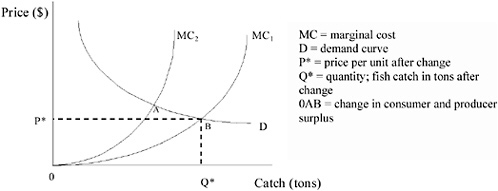
FIGURE 4-1 The economic value effects of increased wetland area on an optimally managed fishery. For optimally managed fishery a change in wetland area that serves as a breeding ground and nursery results in a shift in the marginal cost curve (MC) of the fishery. The welfare impact is the change in consumer and producer surplus (represented by area 0AB). SOURCE: Adapted from Freeman (1991).
of the other (marketed) inputs has to be explicitly specified. All of these applications require detailed knowledge of the physical effects on production of changes in the ecological service. However, applications that assume complementarity or substitutability between the service and other inputs are particularly stringent in terms of the information required on physical relationships in production. Clearly, cooperation is required between economists, ecologists, and other researchers to determine the precise nature of these relationships.
In addition, as pointed out by Freeman (1991), market conditions and regulatory policies for the marketed output will influence the values imputed to the environmental input. For instance, in the previous example of coastal wetlands supporting an offshore crab fishery, the fishery may be subject to open-access conditions. Under these conditions, profits in the fishery would be dissipated, and price would be equated to average and not marginal costs. As a consequence, producer values are zero and only consumer values determine the value of increased wetland area (see Figure 4-2).
A further issue is whether a static or dynamic model of the relationship between the ecological service and the economic activity is required. As discussed in Appendix B, this usually depends on whether or not it is more appropriate to characterize this relationship as affecting production of the economic activity over time. Figures 4-1 and 4-2 represent PF models that are essentially static. The value of changes in the environmental input is determined through producer and consumer value measures of any corresponding changes in the one-period market equilibrium for the output of crabs. In dynamic approaches, the ecologi-
cal service is considered to affect an intertemporal, or “bioeconomic,” production relationship. For example, a coastal wetland that serves as a breeding and nursery habitat for fisheries could be modeled as part of the growth function of the fish stock, and any value impacts of a change in this habitat support function can be determined in terms of changes in the long-run equilibrium conditions of the fishery or in the harvesting path to this equilibrium (see Appendix B). Figure 4-3 shows that the long-run supply curve for an open-access fishery is typically backward-bending (Clark, 1976). Since coastal wetland habitat affects the biological growth of the fishery, a decline in wetland area will shift back the long-run supply curve of the fishery and thus reduce long-run harvest levels. The corresponding losses can be measured by the fall in economic value, which will be greater if the demand curve is more inelastic (i.e., steeper).
A number of recent studies have used PF models to estimate the economic benefits of coastal wetland-fishery linkages. Much of this literature owes its development to the approach of Lynne et al. (1981) who suggested that the support provided by the marshlands of southern Florida for the Gulf Coast fisheries could be modeled by assuming that marshland area supports biological growth of the fishery. For the blue crab fishery in western Florida salt marshes, the authors estimated that each acre of marshland increased productivity of the fishery by 2.3 pounds per year. Others have applied the Lynne et al. approach to additional Gulf Coast fisheries in western Florida (Bell, 1997) and in southern Louisiana (Farber and Costanza, 1987). Using data from the Lynne et al. (1981) case study, Ellis and Fisher (1987) determined the impacts of changes in the
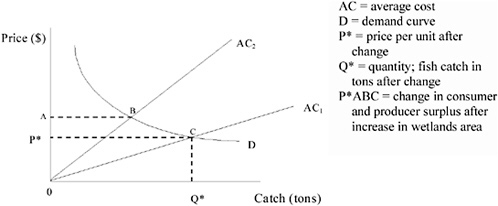
FIGURE 4-2 The economic value effects of increased wetland area on an open-access fishery. For an open-access fishery, a change in wetland area that serves as a breeding ground and nursery results in a shift in the average cost curve, AC, of the fishery. The welfare impact is the change in consumer surplus (area P*ABC). SOURCE: Adapted from Freeman (1991).
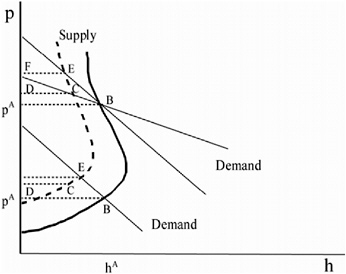
FIGURE 4-3 Wetland loss and the long-run market equilibrium of an open-access fishery. The effect of a fall in wetland area is to shift the long-run equilibrium supply curve of an open access fishery to the left. The result is a decline in fish harvest hA. The loss in consumer value will be greater if the demand curve is more inelastic (area PABEF) than elastic (area PABCD). SOURCE: Adapted from Barbier et al. (2002).
Florida Gulf Coast marshlands on the supply-and-demand relationships of the commercial blue crab fishery. They demonstrated that an increase in wetland area increases the abundance of crabs and thus lowers the cost of catch. The value of the wetlands’ support for the fishery—which in this case is equivalent to the value of increments to wetland area—can then be imputed. Freeman (1991) has extended Ellis and Fisher’s approach to show how the values imputed to wetlands are influenced by market conditions and regulatory policies that affect harvesting decisions in the fishery. In assuming an open-access crab fishery supported by Louisiana coastal wetland habitat, the value of an increase in wetland acreage from 25,000 to 100,000 acres could range from $47,898 to $269,436. If the fishery is optimally managed, the increase in coastal wetland is valued from $116,464 to $248,009.
More “dynamic,” or long-term, approaches to analyzing habitat-fishery linkages have also been developed (e.g., see Barbier and Strand, 1998; Barbier et al., 2002; Kahn and Kemp, 1985; McConnell and Strand, 1989). For example, in their case study of valuing mangrove-shrimp fishery linkages in the coastal regions of Campeche, Mexico, Barbier and Strand (1998) analyzed the effects of a change in mangrove area in terms of influencing the long-term equilibrium of an open-access fishery (i.e., one in which there are no restrictions on additional fishermen entering to harvest the resource). Their results indicate that the economic losses associated with mangrove deforestation appear to vary with long-term management of the open-access fishery. During the first two years of the simulation (1980-1981), which were characterized by much lower levels of fishing effort and higher harvests, a 1 km2 decline in mangrove area was esti-
mated to reduce annual shrimp harvests by around 18.6 tons, or a loss of about $153,300 per year. In contrast, during the last two years of the analysis (e.g., 1989-1990), which saw much higher levels of effort and lower harvests in the fishery, a marginal decline in mangrove area resulted in annual harvest losses of 8.4 tons, or $86,345 each year.
Kahn and Kemp (1985) and McConnell and Strand (1989) considered the impacts of water quality on fisheries in the Chesapeake Bay. Kahn and Kemp related the environmental carrying capacity of fish populations to the level of subaquatic vegetation, which is in turn affected by the runoff of agricultural chemicals, discharges from waste treatment plants, and soil erosion. Based on this analysis, the authors were able to determine marginal and total damage functions for various finfish and shellfish species in the bay.
Swallow (1994) modeled the impacts of developing “high-quality” and “normal-quality” freshwater pocosin (peat-bog) estuarine wetlands on the Pamlico Sound, North Carolina, shrimp fishery. Drainage of the pocosin wetlands for forestry and agricultural uses irreversibly alters the local hydrological system by eliminating the vegetative and peat-bog structure that inhibits water flow, causing a decline in the salinity of the estuarine shrimp nursery areas. The result is a decline in the juvenile shrimp stock necessary to replenish the Pamlico Sound fishery each year. Through his production function model linking development to salinity changes in the pocosin and fishery declines, Swallow estimated that the greatest losses to the shrimp fishery are estimated as $3.37 per acre per year for developing agriculture that affects high-quality wetlands near the southwestern shore of the sound. However, losses in other areas of the estuary with normal-quality wetlands are much lower. Based on these estimates, Swallow was able to determine the net opportunity cost of development of different-quality wetlands in the sound. The efficient policy would be to halt agricultural development when the marginal value of development net of the offshore fishery impacts fell to an annualized $1.12 per acre ($14 in present value). For the pocosin wetlands of the sound, this implies that 9,800 of the 11,009 acres of normal-quality southeastern wetlands could be safely developed, but all 1,209 high-quality southwestern wetlands should be preserved.
As these preceding examples illustrate, most uses of the production function approach have been concerned with valuing single ecosystem services. However, there have been a number of recent attempts to extend this approach to the ecosystem level through integrated economic-ecological modeling. The PF approach has the advantage of capturing more fully the ecosystem functioning and dynamics underlying the provision of key services and can be used to value multiple services arising from aquatic ecosystems.
For example, Wu et al. (2003) examined the effectiveness of alternative salmon habitat restoration strategies in the John Day River Basin, Oregon, through employment of integrated biological, hydrologic, and economic models. The purpose of the modeling was to shed light on two sets of unknown factors affecting salmon restoration investments: (1) the effects of uncertain environmental factors, such as weather and ocean conditions; and (2) the limited infor-
mation on the potential ecological and hydrological threshold effects that can affect the potential payoffs on restoration investments. In an ideal salmon habitat, stream temperature must be below a certain threshold level. When water temperature exceeds this level, reducing temperature by one or two degrees will have no impact on fish survival. Other ecological factors, such as streamside vegetation, soil sedimentation, and species interaction, should also be modeled to examine trade-offs between different conservation benefits through investments targeted at one benefit (e.g., salmon habitat restoration). For example, Wu and colleagues demonstrated that for cold water-adapted fish species (e.g., rainbow trout, Chinook salmon), provided water temperature is maintained below its critical threshold, the number of fish increases as the vegetative use index improves. However, for speckled dace, the number of fish per kilometer of stream decreases as vegetative use improves and temperature decreases. In their fully integrated model, the authors were able to show the trade-offs of different salmon restoration investments in terms of the decline of speckled dace and the estimated marginal social value of increased numbers of cold-water fish species. This is a trade off between quantity in one aspect of the ecosystem and quality in another aspect. A three-degree drop in stream temperature, from 26°C to 23°C, will result in an estimated social benefit of $22,129 from increases in cold-water sportfish species, but a reduction of 506 speckled dace per kilometer of stream.
Carpenter et al. (1999) demonstrated how an integrated ecological-economic model of eutrophication of small shallow lakes can demonstrate the value impacts of irreversible ecological change (see also Chapter 5). Tschirhart and Finhoff (2001) developed a general equilibrium ecosystem with a regulated open-access fishery to analyze simulations of an eight-species Alaskan marine ecosystem that is affected by fish harvesting. Fishing impacts the commercial fish population as well as the populations of other species, including Steller sea lions, an endangered species. Settle and Shogren (2002) developed an integrated ecological-economic model to analyze the impacts of the introduction of exotic lake trout into Yellowstone Lake, which pose a risk to the native cutthroat trout. The authors demonstrated that an integrated model leads to different policy results than treating the ecological and economic systems separately. Under the best case scenario, the U.S. Park Service eliminates lake trout immediately and without cost, while under the worst-case scenario lake trout are left alone. An integrated model has little effect on the worst-case scenario, because the likely outcome is elimination of cutthroat trout. However, under the best-case scenario without feedbacks, the steady-state population of cutthroat trout is about 2.7 million. With feedbacks, the steady-state population is about 3.4 million. The integrated model predicts that the maximum optimal fixed budget for lake trout control is $169,000.
Other applications of production function models to estimate the value of services of aquatic ecosystems include the following:
-
habitat-fishery linkages (Barbier, 2000 and 2003; Batie and Wilson, 1978; Bell, 1989; Costanza et al., 1989; Danielson and Leitch, 1986; Hammack
-
and Brown, 1974; Sathirathai and Barbier, 2001);
-
coastal erosion control and storm protection (Costanza and Farber, 1987; Costanza et al. 1989; Sathirathai and Barbier, 2001);
-
groundwater recharge of wetlands (Acharya 2000; Acharya and Barbier 2000, 2002);
-
water quality-fishery linkages (Kahn, 1987; Loomis, 1988; Wu et al., 2000); and
-
general equilibrium modeling of integrated ecological-economic systems (Tschirhart, 2000).
Stated-Preference Methods
Stated-preference methods have been commonly used to value aquatic ecosystem services. There are two variants of stated-preference methods, contingent valuation (e.g., Bateman et al., 2002; Boyle, 2003; Mitchell and Carson, 1989) and conjoint analysis (e.g., Holmes and Adamowicz, 2003; Louviere, 1988; Louviere et al., 2000). Contingent valuation was developed by economists and is the more commonly used approach, whereas conjoint analysis was developed in the marketing literature (Green and Srinivasan, 1978). Contingent valuation attempts to measure the value people place on a particular environmental item taken as a specific bundle of attributes; conjoint analysis aims to develop valuation functions for the component attributes viewed both separately and in alternative potential combinations.
Contingent valuation is used to estimate values for applications, such as aquatic ecosystem services, where neither explicit nor implicit market prices exist. The first known application of contingent valuation was by Davis (1964) for hunters and other visitors to the woods of Maine. About 10 years later, the third application of contingent valuation (Hammack and Brown, 1974) estimated the value of waterfowl and wetlands. Through the 1980s and 1990s, the quality and extent of contingent valuation studies appear to have increased steadily.
While conjoint analysis was developed in the marketing literature to estimate prices for new products or modifications of existing products, it is conceptually similar to contingent valuation, and economists have come to recognize that it is another stated-preference approach to estimating economic value when market prices are unavailable. The first known environmental application was by Rae (1983) to value air quality in national parks. The number of environmental applications of conjoint analysis increased throughout the 1990s.
Both contingent valuation and conjoint analysis use survey questions to elicit statements of value from people with two key distinctions. First, contingent valuation studies generally pose written or verbal descriptions of the environmental change to be valued, while conjoint analysis poses the change in terms of changes in the attributes of the item to be valued. Consider a wetland restoration project as an example—the Macquarie Marshes in New South Wales, Australia (Morrison et al., 1999; also discussed below). A contingent valuation
survey would contain a description of the wetland in its current condition and the wetland after restoration, whereas a conjoint survey would describe the wetland in terms of key attributes. These might be acres of wetland, number of species of breeding birds, and frequency with which birds breed. A contingent valuation study may contain this same information, but it would not be presented to estimate component values for each of these attributes. In terms of valuation, the contingent valuation study provides an estimate of the value of change in the marsh due to restoration, while the conjoint study provides a similar estimate and also estimates the amount of value contributed by each attribute. Thus, like a hedonic model, the attribute-based approach of conjoint analysis provides implicit prices for key attributes of the aquatic ecosystem.
The second key difference between these stated-preference methods involves the response formats. Contingent valuation studies typically ask respondents to state their value directly or to indicate a range in which the value resides (Welsh and Poe, 1998). In the latter case, econometric procedures are used to estimate the latent value based on the monetary intervals that respondents indicate. In conjoint analysis, survey respondents would be given alternatives to consider (e.g., three marsh restoration programs) and asked to choose the preferred alternative or to rank the alternatives (Boyle et al., 2001). Again, econometric procedures are used to estimate values from the choices or ranks.
Of the many contingent valuation studies that have been conducted, perhaps the two most well known involve aquatic ecosystems. In one of the earliest large-scale, contingent valuation studies, Mitchell and Carson (1981) estimated total national values for inland waters that are swimmable, fishable, and drinkable. They found that people who use freshwater for recreation were willing to pay $237 annually to obtain swimmable, fishable, and drinkable freshwater, while the comparable estimate for nonusers was $111.
The second study examined the value that a national sample would place on protecting Prince William Sound from an oil spill of the magnitude of the Exxon Valdez spill (Carson et al., 1992). In this study, a national survey was also conducted and total values were estimated, although the estimates were assumed to be primarily nonuse values because most people in the nationwide sample would never actually visit Price William Sound. The median value estimated was about $33 per household for a one-time payment to protect Prince William Sound from a large-scale oil spill.
Many contingent valuation studies have investigated values for aquatic ecosystem services. So many, in fact, that several meta-analyses of these studies have been conducted, including protection of groundwater from contamination (Boyle et al., 1994); wetland values (Woodward and Wui, 2001); and sportfishing (Boyle et al.,1998a,b).
The primary application of the contingent valuation groundwater studies is protection from nitrate contamination resulting from agricultural practices. A particularly interesting attribute of the wetland meta-analysis is that the authors attempted to determine how values for wetlands vary with the services they provide. Lastly, the vast majority of sportfishing contingent valuation studies have
investigated values of a single-day fishing trip—some focusing on individual species and others addressing some type of contamination.
The use of conjoint analysis is relatively new for nonmarket valuation and very few conjoint studies of aquatic ecosystems services have been undertaken. The best example is the aforementioned study of the Macquarie Marshes by Morrison et al. (1999). This study found that households in the area of New South Wales, Australia (near the marshes), would pay about $150 (Australian dollars) per year to restore the marshes to part of their original area. This change included increasing the number of species of marsh birds and the frequency at which they breed (Morrison and Boyle, 2001). Other examples include waterfowl hunting (Gan and Luzar, 1993) and salmon fishing (Roe et al., 1996).
The use of conjoint analysis in other types of applications in the literature is growing, and conjoint analysis is likely to become more prominent in the valuation of aquatic ecosystems in the future because of its ability to estimate values for multiple services. Most aquatic ecosystems provide multiple services (see also Chapter 3), and the ability to estimate marginal values for specific services is important for policy analyses.
To implement a stated-preference study two key conditions are necessary: (1) the information must be available to describe the change in an aquatic ecosystem in terms of services that people care about, in order to place a value on those services; and (2) the change in the aquatic ecosystem must be explained in the survey instrument in such a way that people will understand and not reject the valuation scenario. However, achieving these two conditions is easier said than done. Identifying the services that people care about with respect to a resource is not always a simple task because aquatic ecosystems such as wetlands provide a wide variety of services. People may care about wetland birds and animals and have no difficulty linking these to wetlands; however, potential respondents may have greater difficulty linking a wetland policy to changes in flood risk or the cost of potable water. Even if respondents identify and consider all relevant services, they may misinterpret policy descriptions or misperceive the impact of policy described in a questionnaire (Johnston et al., 1995; Lupi et al., 2002).
It is now common for valuation research to use qualitative methods to identify valued services and develop stated-choice questionnaires. Valuation questionnaires pose a cognitive problem to respondents, and the design of the questionnaire may facilitate or detract from respondents’ solutions to the problem (Sudman et al., 1996; Tourangeau et al., 2000). Focus groups and individual interviews are both effective in understanding ecosystem services and the valuation problem from respondents’ points-of-view (Johnston et al., 1995; Kaplowitz and Hoehn, 2001). Draft questionnaires may be tested and refined through individual pretest interviews, followed by careful debriefing by interviewers especially trained to identify questionnaire miscues (Kaplowitz et al., 2003).
The development of a questionnaire can be problematic with regard to
obtaining the information necessary to explain the change in an aquatic ecosystem in lay terms. In the case of potential groundwater contamination, it may be difficult to develop the probability that an aquifer will become contaminated and even more difficult to inform individual survey respondents of the likelihood that their wells will become contaminated. Poe and Bishop (1999) demonstrated that this type of respondent-specific information is crucial to the development of valid value estimates. There are also cases in which respondents might reject a valuation scenario outright. Using Lake Onondaga in Syracuse, New York, as an example, the long-term contamination of this site and the severity of the contamination might lead survey respondents to reject any scenario that elicited values for cleaning up pollution damages.
Having noted and provided some examples of the limitations of stated-preference methods however, the vast number of stated-preference methods in the literature is testimony to the wide array of aquatic ecosystem applications in which contingent valuation and conjoint analysis can be employed. Nevertheless, it is also important to note that much of the criticism of stated-preference methods has arisen because they are not based on actual behavior (e.g., Diamond and Hausman, 1994; Hanemann, 1994; Portney, 1994). The debate has centered mainly on the validity of employing contingent valuation techniques to estimate nonuse values (NOAA, 1993). In contrast, the validity of conjoint estimates of value is a relatively unexplored area of research. However, there is a basic concern regarding the accuracy of stated-preference estimates of value. Do stated-preference methods result in overestimates of value? Studies conducted in controlled experimental settings suggest that both contingent valuation and conjoint methods may overestimate values (Boyle, 2003; Cummings and Taylor, 1998, 1999). Although this concern exists, the absolute magnitude of overestimation has not been established, nor has if been established that this error is any greater that the errors identified for stated-preference methods elsewhere in this chapter.
Another issue that has not received enough attention in the stated-preference literature concerns the accuracy of this approach and what level of accuracy is acceptable. Whereas stated-preference methods have been criticized because experimental design features affect value estimates, context effects have been largely ignored in revealed-preference studies. Some of the features that are problematic in stated-preference studies (e.g., information, sequencing, starting prices) also perturb markets (Randall and Hoehn, 1996). In fact, this is essentially the substance of the marketing literature. Thus, although stated-preference methods have been much maligned, revealed-preference methods have not received the comparable scrutiny that they should receive. This dichotomy of evaluation perspectives occurs simply because stated-preference methods are based on behavioral intentions, while revealed-preference methods are based on actual behavior.
The bottom line is that some real biases have been identified in contingent valuation studies, and many of these same biases carry over to conjoint studies. These biases imply that careful study design and interpretation of value esti-
mates are required, but these biases do not appear to be specific to aquatic ecosystem applications.
Pooling Revealed-Preference and Stated-Preference Data
A number of recent valuation studies have used both revealed-preference and stated-preference data to estimate values. These analyses have pooled travel-cost data with stated-preference data that asks respondents to reveal intended visitation under specific environmental conditions (Adamowicz et al., 1994; Cameron, 1992). Pooling involves taking data from different valuation methods and using the combined data, typically from two valuation methods, to estimate a single model of preferences. Travel-cost data provide information on people’s actual choice to inform the model estimation, but respondents may not have experienced the new environmental condition to be valued. These studies have used a hypothetical scenario to elicit statements of behavior, not willingness to pay, if the new condition occurred. These stated behaviors are added to the travel-cost data to estimate the preference model. This type of stated-preference data is sometimes referred to as “behavioral intentions.” Some studies have framed the behavioral intention questions similar to contingent valuation questions, and visitation—not a dollar value—is the requested response (Cameron, 1992). Other studies have framed the behavioral intention question in a conjoint framework, asking people to indicate what type of trip they would take given the levels of different trip attributes (Adamowicz et al., 1994). The advantage of data pooling is the consistency imposed by actual choices, and the stated-preference data allow for environmental conditions where revealed behavior does not exist.
Cameron et al. (1996) used data pooling to investigate the values people place on recreation in the rivers and reservoirs in the Columbia River Basin. Data pooling was necessary because the policy question required values for water levels that were not represented in the current management regime. They found that the average consumer value for a flow management that enhanced recreation was about $72 per person for the months of July and August. If, however, the management strategy changed to facilitating fish passage for migration and spawning, the consumer value estimate fell to $40.
Almost all of the data-pooling studies to date have been conducted in the context of valuing sportfishing on freshwater lakes and rivers. The primary motivation has been to develop values where long-term contamination precludes the use of revealed-preference data to estimate values for ecosystem losses or improvements. The committee feels that these types of valuation studies will become more prevalent in the future. The issues discussed for the travel-cost method and stated-preference methods still persist in these analyses. In addition, another important issue arises that can substantially affect value estimates. That is, the empirical investigator must decide what weight to place on the stated-preference data and the revealed-preference data in the model estimation.
The existing literature has largely ignored this important issue.
Benefit Transfers
It is impossible to discuss economic valuation methods without also discussing benefit transfers. A benefit transfer is the process of taking an existing value estimate and transferring it to a new application that is different from the original one (Boyle and Bergstrom, 1992). There are two types of benefit transfers, value transfers and function transfers. A value transfer takes a single point estimate, or an average of point estimates from multiple studies, to transfer to a new policy application. A function transfers uses an estimated equation to predict a customized value for a new policy application. Benefit transfers are commonly used in policy analyses because off-the-shelf value estimates are rarely a perfect fit for specific policy questions. The EPA, recognizing the practical need to conduct benefit transfer, has developed the only peer-reviewed guidelines for conduct of these analyses (EPA, 2000a).
However, the committee does not advocate the use of benefit transfers for many types of aquatic ecosystem service valuation applications. First, with the exception of a few types of applications (e.g., travel-cost and contingent valuation estimates of sportfishing values), there are not a lot of studies that have investigated values of aquatic ecosystem services. Second, most nonmarket valuation studies have been undertaken by economists in the abstract from specific information that links the resulting estimates of values to specific changes in aquatic ecosystem services and functions. Finally, studies that have investigated the validity of benefit transfers in valuing ecosystem services have demonstrated that this approach is not highly accurate (Desvouges et al., 1998; Kirchhoff et al., 1997; Vandenberg et al., 2001). Because benefit transfers involve reusing existing data, a benefit transfer does not provide an error bound for the value in the new application after the transfer. For these reasons, benefit transfer is generally considered a “second best” valuation method by economists. The three studies cited above not only investigate the accuracy of benefit transfer, but also provide an idea of how large the error might be in using a benefit transfer to value aquatic ecosystem services.
As stated previously, the purpose of this chapter is to lay out carefully the currently available basic nonmarket valuation approaches, whereas the purpose of the report as a whole is to facilitate original research and studies that will develop a closer link between aquatic ecosystem functions, services, and value estimates that ultimately lead to improved environmental decision-making. The committee recommends that although benefit transfer is in common use, it should be employed with discretion and caution. Future research should focus on enhancing the reliability of off-the-shelf value estimates that are available for use in benefit transfer applied to valuing the services of aquatic ecosystems.
Replacement Cost and Cost of Treatment
In circumstances where an ecological service is unique to a specific ecosystem and is difficult to value by any of the above methods, and there are no reliable existing value estimates elsewhere to apply the benefit transfer approach, analysts have sometimes resorted to using the cost of replacing the service or treating the damages arising from loss of the service as a valuation approach.
Such an approach to approximating the benefits of a service by the cost of providing it is not used exclusively in environmental valuation. For example, in the health economics literature this approach is referred to as “cost of illness” (Dickie, 2003). This involves adding up the costs of treating a patient for an illness as the measure of benefit. Such an approach is not preference-based and is not a measure of economic value. If the treatment is not fully successful, then the patient might be willing to pay even more to avoid or treat an illness. On the other hand, market disturbances, often caused by government policies, might create conditions where more service is provided than an individual is actually willing to pay for. This information should be on the cost side of the benefit-cost ledger, not counted as a benefit.
Because of the lack of data for many ecological services arising from aquatic ecosystems, valuation studies may consider resorting to a similar replacement cost or cost of treatment approach. For example, the presence of a wetland may reduce the cost of municipal water treatment for drinking water because the wetland system filters and removes pollutants. It is therefore tempting to use the cost of an alternative treatment method, such as the building and operation of an industrial water treatment plant, to represent the value of the wetland’s natural water treatment service. As with the health example, this is not a preference-based approach, and does not measure value; it is the cost of providing the aquatic ecosystem service that people value.
In general, economists consider that the replacement cost approach to estimating the value of a service should be used with great caution if at all. However, Shabman and Batie (1978) suggest that this method can serve as a last resort “proxy” valuation estimation for an ecological service if the following conditions are met: (1) the alternative considered provides the same services; (2) the alternative used for cost comparison should be the least-cost alternative; and (3) there should be substantial evidence that the service would be demanded by society if it were provided by that least-cost alternative. In the absence of any information on benefits, when a decision has to be made to take some action, then treatment costs become a way of looking for a cost-effective policy action.
Chapter 5 (see also Chapter 6) provides a case study discussion of the provision of clean drinking water to New York City by the Catskills watershed, in which the decision to restore the watershed was based on a comparison of the cost of replacing the water purification services of the watershed with a new drinking water filtration system. Thus, this application of the replacement cost method appears to fulfill the criteria of appropriate use of this method for valuation as suggested by Shabman and Batie (1978).
Summary of Valuation Approaches and Methods: Pros and Cons
Thus far, this chapter has discussed a variety of environmental valuation methods and provided some examples of their application to aquatic ecosystem services. Table 4-2 summarizes this discussion of nonmarket valuation method and approaches and their applicability to key aquatic ecosystem services. The last column in Table 4-2 is perhaps the most important link in moving from this chapter to Chapter 5 because it identifies ways that aquatic ecosystem services have been included in empirical valuation studies to date.
For revealed-preference methods, the key issue is whether ecosystem services affect peoples’ behavior. If a service of an aquatic ecosystem does not affect peoples’ choices, there are three alternative means of addressing this in a valuation analysis.
-
The service that does not affect site choice may affect a service that does affect site choice. In this case, ecological modeling is needed to establish the link between services, which is the essence of the production function approach.
-
Another valuation approach may be needed. For example, if a wetland provides filtration to yield potable groundwater, then a RUM is not the approach to capture this value. The value of potable groundwater might be better estimated using a hedonic model or a stated-preference study.
-
If currently available methods of economic valuation or ecological knowledge are not capable of modeling the ecosystem service relationship of interest, then consideration of the service has to be acknowledged outside the empirical benefit analysis.
Although the above conditions apply to all revealed-preference methods discussed in this chapter, they are best illustrated in conjunction with the production function approach. As discussed earlier, the production function approach is reliant on actual market behavior or value estimates from revealed-preference or stated-preference studies. This approach is important because many changes in important functions and service of aquatic ecosystems do not directly affect humans (e.g., water quality and habitat changes that influence coastal and riparian fisheries; eutrophication; biological invasions). The production function approach is therefore a means of identifying values for these indirect relationships. However, to date, the applicability of production function approaches has been limited to a few types of aquatic ecosystem services, such as habitat effects on fisheries, coastal erosion, lake habitat quality, and the resilience of aquatic systems to invasive species. There are two reasons for this. First, for this approach to be applied effectively, it is important that the underlying ecological and economic relationships are well understood. Unfortunately, our knowledge of the ecological functions underlying many key aquatic ecosystem services is not fully developed (see Chapter 3). Second, effective applica-
TABLE 4-2 Integrating Nonmarket Valuation Methods of Aquatic Ecosystem Applications
|
Valuation Methods |
Types of Values Estimated |
Common Types of Applications |
Ecosystem Services |
|
Travel cost |
Use |
Recreational fishing |
Site visitation Fish catch rates Fish consumption advisories |
|
Averting behavior |
Use |
Human health |
Waterborne disease Toxic contamination |
|
Hedonics |
Use |
Residential property |
Proximity (distance) to aquatic ecosystems Water clarity Various measures of water chemistry (e.g., pH, dissolved oxygen) Area of aquatic ecosystems proximate to a property |
|
Production function |
Use |
Commercial and recreational fishing; Hydrological functions; Residential property; Ecological-economic modeling of the effects of invasions |
Habitat-fishery linkages Water quality-fishery linkages Habitat restoration Groundwater recharge by wetlands Biological invasions Eutrophication Storm protection |
|
Stated preferences |
Use and nonuse |
Recreation, Human health and any other activity, including passive use, that affects peoples’ economic values |
Groundwater protection Wetland values Sportfishing Waterfowl hunting |
|
Benefit transfer |
Use and nonuse |
Recreation and passive use |
Sportfishing |
tion of production function approaches also requires detailed knowledge of the physical effects on production of changes in the ecological service. Threshold effects and other nonlinearities in the underlying hydrology and ecology of aquatic systems, and the need to consider trade-offs between two or more environmental benefits generated by ecological services, complicate this task. Recent progress in developing dynamic production function approaches to modeling ecosystem services, such as habitat-fishery linkages and integrated ecological-economic analysis to incorporate multiple services and environmental benefit trade-offs, have illustrated that the production function approach may have a wider application to valuing the services of aquatic ecosystems as our knowledge of the ecological, hydrological, and economic features of these systems improves.
In comparison to revealed-preference methods, stated-preference methods exhibit the following advantages, they are: (1) the only methods available for estimating nonuse values; (2) employed when environmental conditions have not or cannot be experienced so that revealed-preference data are not available; and (3) used to estimate values for ecosystem services that do not affect peoples’ behavior.
The first advantage is quite obvious, nonuse values by definition do not have a behavioral link that would allow a revealed-preference method to be employed. People do not have to exhibit any type of use behavior or monetary transaction to hold nonuse values. More importantly, a second advantage of stated-preference approaches is that they can be employed in situations where people may not have experienced the new environmental condition. For example, Lake Onondoga in New York has experienced sufficient long-term contamination to preclude uses such as fishing and swimming. Thus, it would be impossible to estimate travel-cost models for these activities. However, it might be possible to develop a stated-preference survey to elicit values if it were possible to improve water quality in the lake. Finally, there may be ecosystem services that serve important ecological functions (see Tables 3-2 and 3-3), but do not affect peoples’ use of aquatic ecosystems in a directly observable manner. If the ecological link were explained to people it might be possible to use a stated-preference study to elicit values for such services. For example, people might not understand the role that wetlands play in the purification of groundwater recharge from surface waters. It would be possible, however, to design a stated-preference study to elicit values for the protection of wetlands to protect water purification services.
Despite these advantages of stated-preference methods, the above discussion highlights a number of concerns and problems identified in the literature, including issues of identifying the relevant ecological services, questionnaire development, overestimation of values, and issues of accuracy. However, in some instances, criticisms of stated-preference methods have arisen simply because they are based on behavioral intentions, and they have been scrutinized more carefully than revealed-preference methods, which are based on actual behavior. As the committee has sought to indicate in this chapter and summa-
rized in Table 4-2, both revealed- and stated-preference methods have their advantages and disadvantages, and the choice of method will depend largely on what aquatic ecosystem service is being valued, as well as the policy or management issue that requires valuation.
Lastly, it is important to recognize that each of the economic valuation methods reviewed in this chapter can result in an overestimate or underestimate of individual values for a specific application. Before any empirical study is used in a policy application it is important for the analyst to consider whether the point estimate(s) used underestimate or overestimate the “true” value (see Chapters 6 and 7 for further information).
APPLICABILITY OF METHODS TO VALUING ECOSYSTEM SERVICES
Given the wide variety of economic methods that are currently available to value aquatic ecosystem services, it may be useful to examine how various methods could be used to value a range of services provided by a single but vitally important aquatic ecosystem. One such ecosystem that has generated several valuation studies of key ecological services is the Great Lakes. The following section reviews these Great Lake studies as an illustration of many of the nonmarket valuation methods and approaches described in this chapter.
Valuation Case Study: The Great Lakes
The Great Lakes ecosystem covers 94,000 square miles (see also Box 3-2). Collectively, the tributaries to the five Great Lakes drain a territory of 201,000 square miles. Key native species include black bear, bald eagle, wolves, moose, lake trout, and sturgeon, and the lakes surround major migratory flyways for waterfowl, songbirds, and raptors. Thirty-three million people live within the ecosystem and tourism is a major industry year-round. Recreational fishing is annually a multibillion-dollar activity in the regional economy.
In the last 50 years, regional economic changes and pollution control have restored much of the natural beauty of the Great Lakes. However, restoring the ecosystem functions of the Great Lakes remains a priority. Invasive species, such as zebra mussels and lamprey, and exotic fish, such as ruffe and goby, continue to displace and threaten native species. Significant efforts are under way to strengthen populations of Lake Superior walleye, native clams, brook trout, and sturgeon populations.
The ecosystem is also challenged by its industrial history. There are more than 30 areas of concern (AOCs) within the Great Lakes that are burdened with tons of toxic materials (International Joint Commission, 2003). These areas tend to be old industrial areas, harbors, and shipping points. While the mean concentrations tend to be low, these toxic contaminants are typically ingested by small
organisms that are in turn successively eaten by other larger organisms. At each stage of the food web, these concentrations become more elevated. The results are excessive (toxic) concentrations of metals and PCBs in fish, waterfowl, and birds of prey. For example, fish consumption advisories for recreational anglers remain in effect in many popular fishing areas across the region.
Like its biological features, the physical character of the Great Lakes ecosystem changes over time. Water levels and volumes have steadily increased over thousands of years (Lewis, 1999), but water levels over the course of decades fluctuate by several feet (Boutin, 2000). The rocky, high shorelines on Lake Superior are fairly stable from a human perspective, but the softer, aggregate and sandy shorelines are susceptible to short-term flooding and long-term erosion. Living in a dynamic ecosystem poses economic risks for managing longer-term investments such as housing, harbor structures, bridges, and roads.
The following three sets of studies address these management issues. The first examines the economic benefits of controlling an exotic species that preys on native fish. The second examines the damages from PCB concentrations in Wisconsin’s Fox River, one of the ecosystem’s 31 areas of concern. The third explores the economic consequences of ecosystem changes over time.
Controlling an Exotic Species: Sea Lamprey Invasion
Sea lampreys are nonnative, eel-like fish that prey on lake trout, sturgeon, salmon, and other large fish in the Great Lakes. Lampreys attach themselves to prey and feed on the bodily liquids of the host fish. The host fish usually dies from infection after the lamprey feeds and detaches. Lamprey were first observed in Lake Ontario in the 1800s and arrived in Lake Michigan by the 1930s (Peeters, 1998).
Lake trout are particularly susceptible to lamprey predation. By the 1950s, lampreys had almost eliminated the self-sustaining lake trout populations in Lake Michigan and Lake Huron (Peeters, 1998). Since the 1950s, vigorous control programs have reduced lamprey populations by 90 percent and led to the restoration of lake trout in Lake Michigan (Great Lakes Fishery Commission, 2002).
However, the lamprey population remains high in Lake Huron. The St. Mary’s River is the major uncontrolled spawning area on Lake Huron. The size and volume of the St. Mary’s made past control efforts ineffective. Recent improvements in control technology promise much better results at lower costs (Gaden, 1997). An analysis was completed to determine whether the control costs were in line with the recreational fishing benefits of lake trout restoration. The Michigan angling demand model is a statewide travel-cost model of anglers’ choices (Hoehn et al., 1996). The model divides the 30-week, non-winter fishing season into 60 fishing choice occasions. Within each occasion, anglers choose whether to go fishing and, if they do, whether they take a day trip or a multiple-day trip. Anglers also choose one of 12 different fishing types,
such as cold-water Great Lakes fishing, and fishing location by destination county. Destinations vary in quality by catch rate and other features relevant to fishing choices. In all, the model incorporates 850 distinct choices on each choice occasion.
The model was estimated using a repeated logit statistical framework and data on anglers’ choices (Hoehn et al., 1996). The data were obtained from a sample of more than 2,000 Michigan anglers. Sampled anglers were selected randomly from the general population to ensure that the data represented the broad spectrum of Michigan anglers. The sampled anglers were contacted initially at the beginning of the fishing season and then interviewed again (at least) several times over its course. The serial interview approach was used to minimize errors that arise when anglers try to remember a long series of trips. Anglers were also provided with fishing logs to keep track of their trips. Anglers who took frequent trips were interviewed more frequently.
The model estimated the probability of choosing a particular fishing location and type of fishing trip. Trip choices were a function of the distance and travel cost to the location and the quality of fishing. The model was used to estimate benefits for policies that might change fishing quality at a particular site and aggregation of sites, such as inland regions and lakes. For example, an initial analysis indicated that a 10 percent improvement in Lake Michigan and Lake Huron salmon and trout catch rates would result in angler benefits of $3.3 million per year (Lupi and Hoehn, 1998). The analysis considered three alternative ways of controlling lamprey in the St. Mary’s River: (1) annual lampricide treatment, (2) annual lampricide and a one-time release of sterile males, and (3) annual lampricide and sterile male release every five years. Treatment costs were several times higher with the third treatment relative to the first, while the trout population and catch rates were only 30 percent higher. Trout populations and catch rates were forecast to increase by 30 to 45 percent in northern Lake Huron and 3 to 7 percent in the central and southern portions of the lake.
The Michigan travel-cost model was used to calculate the benefits of permanent programs of lamprey control using the three different treatments. As the trout population recovers, the third program of continuing lampricide and sterile male releases results in the greatest annual benefits, while the lampricide-only program has the lowest level of annual benefits. However, costs increased with each sterile male release. Although costs increased with treatment, benefits also varied with the geography of catch rate impacts.
Catch rate increases were greatest in the northern region where fewer anglers live and the least in southern Lake Huron nearer the urban areas of Macomb and Wayne Counties in Michigan. As a result, the improvements in catch rates were forecast to occur in areas relatively distant from users. Annual benefits were calculated to be almost twice as large as in the forecast case if the catch rate increase was equal to the same mean but evenly distributed across the entire lake. The result showed that use values decline as the improvement in services was more distant from the users.
The economic outcome of each control alternative was evaluated by exam-
ining net benefits. Net benefits were calculated as the present value of benefits minus the present value of costs. Net benefits were positive for each alternative. Using discount rates (see Chapters 2 and 6 for further information) between 3 and 4 percent, net benefits were greatest for annual lampricide and a one-time release of sterile males to quickly reduce the breeding population of lamprey. Net benefits for the first and third alternatives were about the same, meaning that the benefits of continuing sterile male release after the first treatment were just about offset by the costs.
Fox River Damage from PCBs
The Fox River enters Green Bay, Wisconsin, on the northwestern shoreline of Lake Michigan. It is the lake’s largest tributary. Water, waterpower, and nearby forests supported the early development of the paper industry. By the 1950s, the local paper industry focused on the production of carbonless copy paper. A by-product of its production was the discharge of thousands of pounds of PCBs annually. An estimated 700,000 pounds of PCBs entered the Fox River before PCB use was stopped nationally in 1971. About 20 percent of the PCBs have been deposited in Green Bay and Lake Michigan (Wisconsin DNR, 2001).
Although the human health effects of PCBs are difficult to quantify and measure, the EPA has determined that PCBs cause a range of adverse health effects in animals and that there is “supportive evidence potential carcinogenic and non-carcinogenic effects” in humans (EPA, 2003). To avoid potential adverse health effects in humans, the State of Wisconsin advises anglers to limit their consumption of fish and to prepare fish for consumption so as to avoid fatty tissue that biomagnifies PCBs (Wisconsin DNR, 2001). The primary human use damages are the limitations on eating fish and the increased health risks for anglers and others who choose to eat the fish. Nonuse damages include the impacts on ecosystem functions and other native organisms.
The Wisconsin Department of Natural Resource is conducting a series of studies to estimate economic damages resulting from PCB contamination (Bishop et al., 2000; Breffle et al., 1999; Stratus, 1997). Initial studies focused on injuries to ecosystem functions and services through systematic data collection and analysis (Stratus, 1997). In many cases, it was possible to detect a type of injury but not to quantify its impact on a particular ecosystem service. For instance, PCBs were suspected of injury to fish populations, but it was not possible to quantitatively translate population injuries into estimates of changes in catch rates for sport and subsistence anglers.
The uncertainties regarding service flow injuries led several investigators to two types of damage estimation studies. The first study (Breffle et al., 1999) combined the travel-cost method with stated-preference analysis to estimate use values for anglers. Fishing services to anglers were impaired as a result of both fish consumption advisories (FCAs) and the elevated health risk of eating local fish that FCAs imply. Previous research demonstrated that fishing behaviors
change and fishing benefits are reduced by FCAs. The second study (Bishop et al., 2000) used stated-preference analysis to estimate the total values of damages for households in the region. Total value was the sum of both use value damages for anglers and nonuse damages for all households in the study area.
Pollution Damages to Recreational Fishing
Breffle et al. (1999) designed a study to estimate the damages to anglers due to FCAs that applied to the Fox River and Green Bay as a result of past PCB releases. Damage estimates were derived from the loss of enjoyment of fishing in an area covered by an FCA and the loss of well-being as a result of fishing at another site, perhaps not covered by an FCA. The study held the number of days of fishing constant at the current, estimated level and did not attempt to estimate damages due to the reduction in the amount of overall fishing.
The analysis estimated the economic demand for fishing as a function of travel cost, whether an FCA was in force at a given site, and other fishing site quality variables. The FCA effect on demand allowed researchers to estimate the shift in fishing demand and the change in consumer value due to presence of the FCA. The reduction in value served as the measure of damages to angling use services.
Data for estimating the demand model were obtained through telephone and mail surveys. The telephone survey used random sample methods to contact a total of 3,190 anglers in northeastern Wisconsin. Respondents were asked to think back over the 1998 angling season and recall their fishing activities. Based on respondents’ recollections, the interviewers obtained data on total days spent fishing during 1998, number of days spent fishing in the study area, and attitudes about actions to improve fishing. The mail survey asked respondents to make stated-preference choices across fishing sites that varied in quality. The combined data set allowed researchers to estimate a random utility model of fishing demand conditional on the presence or absence of FCAs in the study area.
The analysis estimated that the 48,600 anglers in the study area fished a total of 641,000 days in 1998. The mean value of damages was $4.17 per trip (1998 dollars). The present value of fishing use damages was estimated to be $148 million for a baseline scenario in which natural processes required 100 years to reduce PCBs to levels where FCAs are unnecessary. Restoration efforts that reduced recovery time to 40 years reduced damages to $123 million, resulting in benefits of $25 million. Restoration efforts that reduced recovery time to 20 years reduced damages to $106 million, resulting in cleanup benefits of $42 million.
Total Value of Lost Ecosystem Services
Bishop et al. (2000) investigated the total value of ecosystem services lost due to PCB contamination of the Fox River and Green Bay. That study examined the monetary value of damages as well as the in-kind restoration programs that residents might view as alternatives to removing and containing PCBs. Alternative restoration choices included projects to remove PCB-laden sediments, restore wetlands, enhance recreation, and reduce nonpoint source pollution.
Stated preferences for the restoration alternatives were elicited in a random sample, mail-based survey of 470 households in the study area. The survey questionnaire presented PCB removal as one of several projects to improve natural resources in northeast Wisconsin. The questionnaire also presented six alternative pairs of natural resource programs. Each program within a pair offered different levels of PCB removal, wetland restoration, recreation enhancement, pollution control, and annual tax cost per household.
Respondents were asked to consider each pair and identify their preferred program for each pair. Factorial design methods were used to vary the plans and costs across respondents in the sample. A probit-type discrete choice statistical model was used to estimate the influence of restoration and tax cost on the probability of acceptance. The probit model parameters were then used to calculate willingness to pay a tax cost as a function of the quality of restoration.
The estimates showed that wetlands restoration, improvements in recreational facilities and nonpoint pollution control were poor substitutes for removing and safely containing the PCB-laden sediments. Setting the wetland, recreation, and pollution projects at their maximum levels made up for only 40 years of PCB damages. Natural processes alone were expected to take more than 100 years to reduce PCBs to safe levels.
The present value of PCB damages was estimated to be $610 million (1999 dollars). A restoration that reduced PCBs to safe levels in 40 years resulted in benefits of $248 million by reducing PCB damages to $362 million over the 40-year cleanup interval. An intensive restoration that reduced PCBs to safe levels in 20 years resulted in benefits of $356 million by reducing damages to $254 million over the 20-year cleanup interval.
The final step in the analysis compared the estimated total ecosystem damages with fishing use damages for the 11 percent of households that included at least one angler. This comparison found that estimated total values were 8 to 28 percent greater than use values alone, suggesting that nonuse value was about 8 to 28 percent of use value in angler households.
Lakeshore Erosion
Shoreline erosion offers a short-term laboratory for examining the economic consequences of aquatic ecosystem change. As noted previously, shoreline is
valued by property owners for its views, for its proximity to water, and as a location for residential and commercial structures and development. Erosion rates of one to three feet per year do not appreciably affect the amount of shoreline for views, and proximity views and are passed on to the adjacent parcels.
However, erosion does pose a risk of loss of residential and commercial structures, and reducing the risk of loss involves a number of trade-offs. Structures degrade from use and changes in technology in a manner analogous to automobiles and machinery. Locating newly constructed structures far enough away from the existing shoreline so that a building is dilapidated and obsolete before it is threatened by erosion can minimize the risk of erosion to the structure. Increasing the distance to the shore, however, reduces amenities such as panoramic views and increases the time required to get to the beach. Thus, there is a trade-off between the value of these amenities and the economic risk of erosion.
Erosion may be offset for existing structures by physical protection. Rock and concrete armoring protects the shoreline to some extent. However, wave action will eventually undercut such protection. Eroded beaches may sometimes be maintained by dredging offshore sand deposits and using them to replace eroded material. These types of physical protection measures, however, may have impacts on shoreline and coastal ecosystem functions. For instance, armor may reduce erosion of the shoreline, while also reducing sand and sediment flows along the shoreline. Reduced material flows may increase erosion or reduce beach accretion in nearby, unprotected shoreline areas (USACE, 2000).
Economic processes may moderate the risk of erosion to manmade structures by spreading out its consequences over time. In this regard, markets in real property tend to be forward-looking. If there are significant risks from erosion over time, these may be gradually entered into the prices of properties as the risks increase. Buyers are likely to pay more for lower-risk properties and less for higher-risk properties. Property owners may sell a property before the erosion discount becomes higher than the value they place on being near the shore. The annual incremental discount associated with erosion risk might be viewed as part of the cost of a shoreline property, similar to the ordinary costs of depreciation and obsolescence.
Two studies use hedonic methods to examine the impact of erosion risk on the values of shoreline, residential properties. The first examined shoreline property values on Lake Erie (Kriesel et al., 1993), and the second combined data for homes on both Lake Erie and Lake Michigan (Heinz, 2000).
Both studies estimated hedonic regressions where the dependent variable was the logarithm of the sales prices of an individual residential property and the independent variables were the physical characteristics of the property. Physical characteristics included features such as floor area of the structure, parcel size, number of rooms, number of bathrooms, and erosion risk. Erosion risk was measured by the estimated number of years until the shoreline reached the leading, shoreward edge of a structure. The Lake Erie study analyzed data for approximately 300 structures. The combined study used data for 139 structures
from the Lake Erie study and data obtained in a mail survey for about 150 Lake Michigan residences.
The results of the two hedonic analyses show that residential property markets are, indeed, forward looking. The major share of erosion’s economic cost is incurred long before the actual loss of a residential structure. One way to illustrate this impact uses the estimated hedonic coefficients to calculate the percentage change in property values as years to erosion loss decline. As time to loss declines by 1 year, the property value of a home with a loss in 100 years is discounted by about one-tenth of a percent of its value. At 60 years, a home has lost an accumulated 20 percent of its value due to erosion risk and loses further value at the rate of about 0.6 percent per year. At 20 years, the cumulative discount is 40 percent of the value at 100 years, and the annual discount rate is about 2 percent. At 10 years, the residence is discounted by 60 percent relative to a structure with a risk of 100 years to loss, and the annual rate of loss is 5 percent. At 5 years to loss, a residential structure has lost more than 70 percent of its value relative to the same structure with 100 years to loss.
The analyses show that the cost of erosion is incurred gradually over a long period of time. More than 60 percent of the value of a residence is lost before a residence is within 10 years of the date of its estimated loss. The annual cost of erosion is about $1,400 for a $500,000 residence with an erosion risk of 100 years. For the same structure, the annual cost is about $2,500 at 50 years, $10,400 at 10 years, and $18,400 at 5 years.
Valuation Case Study: Conclusions
The above studies from the Great Lakes ecosystem illustrate both the strengths and the weaknesses of different valuation methods and approaches. First, the studies show that valuation is a useful tool for assessing a wide range of ecological services and key policy issues concerning management of the Great Lakes, including control of a damaging biological invasion, water pollution by toxic waste, pollution damages to recreational fishing, and the impacts of shoreline erosion. As the extended case study demonstrates, a variety of nonmarket valuation methods are available for assessing these ecosystem management concerns, and if applied correctly, they can yield reliable estimates of the value of key aquatic services. If valuation methods can be applied successfully to a complex and geographically extensive aquatic ecosystem such as the Great Lakes, then nonmarket valuation can also be implemented for equally important aquatic ecosystems elsewhere.
Second, the studies illustrate some of the limitations of revealed- and stated-preference valuation methods discussed earlier in the chapter. For example, the applicability of revealed-preferences methods of valuation depends on whether the ecological service affects peoples’ behavior, and whether both the changed environmental condition and the resulting modification in human behavior can be directly or indirectly observed. Thus, for example, the effect of the lamprey
invasion could be assessed only in terms of the impact on the recreational fishing benefits of lake trout restoration, which in turn was assessed through the application of a travel-cost model to calculate the possible benefits of alternative lamprey control programs. Clearly, such a valuation estimate can capture only one of many possible complex ecological and economic impacts of the lamprey invasion, although in this instance assessing this recreational benefit was sufficient to determine that the net benefits of lamprey control were positive for all treatments and to identify the preferred treatment method. Similarly, various studies of the health impacts of PCB contamination in the Fox River indicate that the lack of ecological data meant that it was not always possible to quantify how damages to fish populations translate into estimates of changes in catch rates for sport and subsistence anglers, thus limiting reliance on the travel-cost method alone as a method of valuing such impacts. Instead, researchers had to rely either on combined travel-cost and stated-preference methods or on stated-preference methods alone to estimate the total values for households in the region. Although the latter study attempted to separate the households’ estimates of use values compared to nonuse values in their overall valuation of the benefits of PCB removal, some of the concerns about the validity of employing contingent valuation techniques to estimate nonuse values may be applicable in this case (NOAA, 1993).
ISSUES
In describing and discussing currently available nonmarket valuation methods and their applicability to aquatic ecosystem services, a number of key issues have emerged, these include assessing ecological disturbance and threshold effects, limitations to ex ante and ex post valuation, partial versus general equilibrium approaches, and the problem of scope. The following section discusses each of these issues in turn.
Ecological Disturbance and Threshold Effects
Severe disturbance of an aquatic ecosystem may lead to an abrupt, and possibly very substantial disruption in the supply of one or more ecological services (see Chapter 3 for further information). This “break” in supply is often referred to as a threshold effect. The problem for economic valuation is that before the threshold is reached, the marginal benefits associated with a particular ecological service may either be fairly constant or change in a fairly predictable manner with the provision of that service. However, once the threshold is reached, not only may there be a large “jump” in the value of an ecological service, but how the supply of the service changes may be less predictable. Such ecosystem threshold effects pose a considerable challenge, especially for ex ante economic valuation using revealed-preference methods—that is, when one
wants to estimate the value of an ecological service that takes into account any potential threshold effects. Since such severe and abrupt changes have not been experienced, peoples’ choices in response to them have not been observed. This means that stated-preference methods are the only tool for measuring such values, but there are two complications that warrant discussion.
The first is that there is likely to be considerable uncertainty surrounding both the magnitude and the timing of any threshold effect associated with ecosystem disturbance. Thus, the ecological information may not be available to accurately develop a scenario to describe the ecosystem change in a stated-preference survey. In such a case, a stated-preference survey might be designed to value a variety of plausible ecosystem changes so that it is possible to describe the sensitivity of value estimates to likely outcomes.
The second complication may be that survey respondents will simply reject the valuation scenario as implausible or unbelievable. A large-scale oil spill is one example when survey respondents may reject the valuation scenario out of hand and state that the responsible company should pay for damages, not the general public. Carson et al. (1992) avoided this problem by asking survey respondents to value a public program to prevent an oil spill of the magnitude of the Exxon Valdez. Thus, substantial creativity and design effort may be required to develop plausible stated-preference valuation scenarios for large-scale disturbances to aquatic ecosystems that have threshold effects.
Threshold effects can also occur in peoples’ preferences. Over some range of change in ecosystem services, marginal values may be quite small, but change dramatically when a drastic change occurs (e.g., listing of an aquatic species as endangered). This suggests that threshold changes in an aquatic ecosystem may stimulate threshold changes in preferences. This issue further complicates the valuation of threshold changes because stated-preference valuation methods must be designed to convey the threshold change and motivate people to think how their values would change with the different set of relative prices that would be present after the ecosystem threshold change occurs.
Limitations of Ex Ante and Ex Post Valuation
The limitations of ex ante valuation using stated-preference methods and real choices are not limited to large-scale, threshold effects. There are many common instances in which people may not have experienced an ecological improvement or degradation and revealed-preference valuation methods are not applicable. Although stated-preference methods are applicable to such changes, it may be difficult for individuals to value trade-offs implied by changes they have not personally experienced. Thus, while stated-preferences are very helpful for ex ante valuation, they are not a complete or infallible solution. There will be circumstances in which nonmarket valuation methods cannot develop accurate value estimates in an ex ante setting.
In the ex post situation, the change has been observed but does not always
translate to the revealed choices. For example, the market price of fish may reflect a change in the underlying ecological service, such as the loss of coastal nursery grounds, and thus, there appears to be no value assigned to this ecosystem service. Again, stated-preference methods are the alternative, but they may not be applicable in all situations.
Partial Versus General Equilibrium Approaches
Most valuation methods and valuation studies represent a partial equilibrium approach to a particular policy question. However, as is clear from Chapter 3, the ecological functioning and dynamics that result in most aquatic ecosystem services suggest that to more fully capture the affects of ecosystem changes on the provision of these services, a more general equilibrium approach may be required. A series of independent value estimates for different ecosystem services, when added together, could substantially understate or overstate the full value of changes in all services. The key issue is whether there is substitute or complementary relationships between the services (Hoehn and Loomis, 1993).
As discussed above, there have been a number of recent attempts to use such an approach, or integrated economic-ecological modeling, to value various services of aquatic ecosystems. In essence, these approaches represent the extension of the production function approach to a full ecosystem level.
Scope
Insensitivity to scope is a major issue in contingent valuation studies of nonuse values of ecosystem services. This issue was raised by the National Oceanic and Atmospheric Administration Panel on Contingent Valuation (1993), which stated that this problem demonstrates “inconsistency with rational choice.” Insensitivity to scope is exhibited by value estimates’ being insensitive to the magnitude of the ecosystems change being valued. For example, if values estimated for restoring 100 and 1,000 acres of wetlands were statistically identical, this would indicate lack of sensitivity to scope. The inconsistency with rational choice arises because it is expected that people would pay more for the larger restoration project, all other factors being equal. The basis for the NOAA panel’s concern was a study by Boyle et al. (1994) who found that estimates of nonuse values were not sensitive to whether 2,000, 20,000, or 200,000 bird deaths were prevented in waste oil holding ponds. While this study was criticized in a variety of public fora, Ahearn et al. (2004) reported a similar result in another study of grassland bird numbers. Notably, this latter study generally followed the NOAA panel’s (1993) guidelines for the design of a credible contingent valuation study of nonuse values.
Insensitivity to scope is a major issue for valuing aquatic ecosystems ser-
vices because stated-preference methods, which include contingent valuation, are likely to be important in estimating many component values in a TEV framework. There are many instances in which there is no visible behavior that supports the use of revealed-preference methods, although two important caveats should be considered.
First, the NOAA panel focused on the use of contingent valuation to estimate nonuse values. There will be many cases in which stated-preference methods are needed to estimate use values for aquatic ecosystem services. Sensitivity to scope has been demonstrated clearly in the estimation of use values in the literature, and some of these studies are applications to aquatic ecosystems (e.g., Boyle et al., 1993). In fact, Carson (1997) provides a list of contingent valuation studies that have demonstrated scope effects when use values are involved, and the vast majority of these studies have implications for valuing aquatic ecosystem services. Moreover, Carson et al. (1996) show that contingent valuation estimates are comparable to similar revealed-preference estimates—thereby, demonstrating the convergent validity of the stated-preference and revealed-preference estimates. Thus, the literature supports the use of contingent valuation for estimating use values for aquatic ecosystem services.
The second caveat applies to the use of contingent valuation to estimate nonuse values. Although the NOAA panel stated that contingent valuation can provide useful information on nonuse values, the ability of contingent valuation methods to demonstrate scope effects has not been shown clearly in the literature. This a major concern for valuing aquatic ecosystems because nonuse values would be expected to be an important and large component of any total economic value assessment. In this regard, attribute-based, conjoint analysis provides a promising option. This approach presents the description of the aquatic ecosystem to be valued in component services and clearly informs survey respondents that there are different levels of these services. Respondents are then asked to select alternatives that differ in terms of the component services. This relative context has been shown to demonstrate scope effects (Boyle et al., 2001). The key difference is that contingent valuation has used a between-subjects design where independent samples are asked to value each of the different levels of the ecosystem. Conjoint analysis uses a within-subjects design where each respondent sees multiple levels of the ecosystem. Although a between-subjects design is appealing from an experimental design perspective, this is not the way real-world decisions are made. People make revealed choices where they observe ecosystem goods and services with different levels of attributes, and whereas conjoint analysis mimics this choice framework, contingent valuation does not. A question then arises as to what standard contingent valuation should be held. A between-subjects design to test for scope holds contingent valuation to a higher standard than market decisions are based upon (Randall and Hoehn, 1996), whereas the within-subject design of conjoint analysis mimics the relative choices that occur in markets. These results imply that conjoint analysis may be the better method to employ in estimating nonuse values for aquatic ecosystem services.
SUMMARY: CONCLUSIONS AND RECOMMENDATIONS
This chapter demonstrated that there is a variety of nonmarket valuation approaches that can be applied to valuing aquatic and related terrestrial ecosystem services.
For revealed-preference methods, the types of applications are limited to a set number of specific aquatic ecosystem services. However, both the range and the number of services that can potentially be valued are increasing with the development of new methods, such as dynamic production function approaches, general equilibrium modeling of integrated ecological-economic systems, conjoint analysis, and combined revealed- and stated-preference approaches.
Stated-preference methods can be applied more widely, and certain values can be estimated only through the application of such techniques. On the other hand, the credibility of estimated values for ecosystem services derived from stated-preference methods has often been criticized in the literature. For example, contingent valuation methods have come under such scrutiny that it led to the NOAA panel guidelines of “good practice” for these methods.
Benefit transfers and replacement cost/cost of treatment methods are increasingly being used in environmental valuation, although their application to aquatic ecosystem services is still limited. Economists generally consider benefit transfers to be a “second-best” valuation method and have devised guidelines governing their use. In contrast, replacement cost and cost of treatment methods should be used with great caution if at all. Although economists have attempted to design strict guidelines for using replacement cost as a last resort “proxy” valuation estimation for an ecological service, in practice estimates employing the replacement cost or cost of treatment approach rarely conform to the conditions outlined by such guidelines.
Although the focus of this chapter has been on presenting the array of valuation methods and approaches currently available for estimating monetary values of aquatic and related terrestrial ecosystem services, it is important to remember that the purpose of such valuation is to aid decision-making and the effective management of these ecosystems. Building on this critical point, at least three basic questions arise for any method that is chosen to value aquatic ecosystem services:
-
Are the services that have been valued those that are the most important for supporting environmental decision-making and policy analyses involving benefit-cost analysis, regulatory impact analysis, legal judgments, and so on?
-
Can the services of the aquatic ecosystem that are valued be linked in some substantial way to changes in the functioning of the system?
-
Are there important services provided by aquatic ecosystems that have not yet been valued so that they are not being given full consideration in policy decisions that affect the quantity and quality of these systems?
In many ways, the answers to these questions are the most important criteria for
judging the overall validity of the valuation method chosen.
It is clear that economists and ecologists should work together to develop valid estimates of the values of various aquatic ecosystem services that are useful to inform policy decision-making. The committee’s assessment of the literature is that this has not been done adequately in the past and most valuation studies appear to have been designed and implemented without any such collaboration. Chapter 5 helps to begin to build this bridge.
The range of ecosystem services that have been valued to date are very limited, and effective treatment of aquatic ecosystem services in benefit-cost analyses requires that more services be subject to valuation. Chapter 3 begins to develop this broad perspective of aquatic ecosystem services.
Nonuse values require special consideration; these may be the largest component of total economic value for aquatic ecosystem services. Unfortunately, nonuse values can be estimated only with stated-preference methods, and this is the application in which these methods have been soundly criticized. This is a clear mandate for improved valuation study designs and more validity research.
There is a variety of nonmarket valuation methods that are available and have been presented in this chapter. However, no single method can be considered the best at all times and for all types of aquatic ecosystem valuation applications. In each application it is necessary to consider what method(s) is the most appropriate.
In presenting the various nonmarket valuation methods available for estimating monetary values of aquatic and related terrestrial ecosystem services, this chapter has also sought to provide some guidance on the appropriateness of the various methods available for a range of different services. Based on this review of the current literature and the preceding conclusions, the committee makes the following recommendations:
-
There should be greater funding for economists and ecologists to work together to develop estimates of the monetary value of the services of aquatic and related terrestrial ecosystems that are important in policymaking.
-
Specific attention should be given to funding research at the “cutting edge” of the valuation field, such as dynamic production function approaches, general equilibrium modeling of integrated ecological-economic systems, conjoint analysis, and combined stated-preference and revealed-preference methods.
-
Specific attention should be given to funding research on improved valuation study designs and validity tests for stated-preference methods applied to determine the nonuse values associated with aquatic and related terrestrial ecosystem services.
-
Benefit transfers should be considered a “second-best” method of ecosystem services valuation and should be used with caution, and only if appropriate guidelines are followed.
-
The replacement cost method and estimates of the cost of treatment are not valid approaches to determining benefits and should not be employed to value aquatic ecosystem services. In the absence of any information on benefits,
-
and under strict guidelines, treatment costs could help determine cost-effective policy action.
REFERENCES
Abdalla, C.A., B.A. Roach, and D.J. Epp. 1992. Valuing environmental groundwater changes using averting expenditures: An application to groundwater contamination. Land Economics 68:163-169.
Acharya, G. 2000. Approaches to valuing the hidden hydrological services of wetland ecosystems. Ecological Economics 35:63-74.
Acharya, G., and E.B. Barbier. 2000. Valuing groundwater recharge through agricultural production in the Hadejia-Jama’are wetlands in northern Nigeria. Agricultural Economics 22:247-259.
Acharya, G., and E.B. Barbier. 2002. Using domestic water analysis to value groundwater recharge in the Hadejia-Jama’are floodplain in Northern Nigeria. American Journal of Agricultural Economics 84(2):415-426.
Adamowicz, W.L., J. Louviere, and M. Williams. 1994. Combining revealed and stated preference methods for valuing environmental amenities. Journal of Environmental Economics and Management 26:271-292.
Ahearn, M., K.J. Boyle, and D. Hellerstein. 2004. Designing a contingent-valuation study to estimate the benefits of the conservation reserve program on grassland bird populations. In The Contingent-Valuation Handbook, J. Kahn, D. Bjornstad, and A. Alberini (eds.). Cheltenhan, U.K.: Edward Elger.
Barbier, E.B. 1994. Valuing environmental functions: Tropical wetlands. Land Economics 70(2):155-173.
Barbier, E.B. 2000. Valuing the environment as input: Applications to mangrove-fishery linkages. Ecological Economics 35:47-61.
Barbier, E.B. 2003. Habitat-fishery linkages and mangrove loss in Thailand. Contemporary Economic Policy 21(1):59-77.
Barbier, E.B., and I. Strand. 1998. Valuing mangrove-fishery linkages: A case study of Campeche, Mexico. Environmental and Resource Economics 12:151-166.
Barbier, E.B., M. Acreman, and D. Knowler. 1997. Economic Valuation of Wetlands: A Guide for Policy Makers and Planners. Geneva, Switzerland: Ramsar Convention Bureau.
Barbier, E.B., I. Strand, and S. Sathirathai. 2002. Do open access conditions affect the valuation of an externality? Estimating the welfare effects of mangrove-fishery linkages. Environmental and Resource Economics 21(4):343-367.
Bartik, T.J. 1987. The estimation of demand parameters in hedonic price models. Journal of Political Economy 95: 81-88.
Bartik, T.J. 1988. Evaluating the benefits of non-marginal reductions in pollution using information on defensive expenditures. Journal of Environmental Economics and Management 15: 111-27.
Bateman, I.J., R.C. Carson, B. Day, M. Hanemann, N. Hanley, T. Hett, M.J. Lee, G. Loomes, S. Mourato, E. Özdemirolu, D. Pearce, R. Sugden, and J. Swanson. 2002. Economic Valuation with Stated Preference Techniques: A Manual. Cheltneham, U.K.: Edward Elger.
Batie, S.S., and J.R. Wilson. 1978. Economic values attributable to Virginia’s coastal wetlands as inputs in oyster production. Southern Journal of Agricultural Econom-
ics 10(1):111-118.
Beach, E.D., and G.A. Carlson. 1993. A hedonic analysis of herbicides: Do user safety and water quality matter? American Journal of Agricultural Economics 75(3):612-623.
Becker, G. 1965. A theory of the allocation of time. Economic Journal 75:493-517.
Bell, F.W. 1989. Application of Wetland Valuation Theory to Florida Fisheries. Report No. 95, Florida Sea Grant Program. Tallahassee: Florida State University.
Bell, F.W. 1997. The economic value of saltwater marsh supporting marine recreational fishing in the Southeastern United States. Ecological Economics 21(3):243-254.
Bishop, R.C. 1983. Option value: An exposition and extension. Land Economics 59(1):1-15.
Bishop, R.C., and M.P. Welsh. 1992. Existence values in benefit-cost analysis and damage assessment. Land Economics 68(4):405-417.
Bishop, R.C., K.J. Boyle, and M.P. Welsh. 1987. Toward total economic value of Great Lakes fishery resources. Transactions of the American Fisheries Society 116 (3):339-345.
Bishop, R.C., W.S. Breffle, J.K. Lazo, R.D. Rowe, and S.M. Wytinck. 2000. Restoration Scaling Based on Total Value Equivalency: Green Bay Natural Resource Damage Assessment. Boulder, Colo.: Stratus Consulting Inc.
Bockstael, N.E. 1995. Travel cost models. In The Handbook of Environmental Economics, D.W. Bromley (ed.). Cambridge, Mass.: Blackwell Publishers.
Bockstael, N.E., and K.E. McConnell. 1983. Welfare measurement in the household production function framework. American Economic Review 73(4):806-814.
Boutin, C. 2000. Great Lakes Water levels. Ann Arbor, Mich.: Great Lakes Environmental Research Laboratory, National Oceanic and Atmospheric Administration.
Boyce, R.R., T.C. Brown, G.D. McClelland, G.L. Peterson, and W.D. Schulze. 1992. An experimental examination of intrinsic environmental values as a source of the WTA-WTP disparity. American Economic Review 82:1366-1373.
Boyle, K.J. 2003. Contingent valuation in practice. Chapter 5 in A Primer on Nonmarket Valuation, P. Champ, K. J. Boyle and T.C. Brown (eds.). Boston, Mass.: Kluwer.
Boyle, K.J., and J.C. Bergstrom. 1992. Benefit transfer studies: Myths, pragmatism and idealism. Water Resources Research 28(3):657-663.
Boyle, K.J., and R.C. Bishop. 1987. Valuing wildlife in benefit-cost analyses: A case study involving endangered species. Water Resources Research 23(May):943-950.
Boyle, K.J., R. Bishop, J. Caudill, J. Charbonneau, D. Larson, M.A. Markowski, R.E. Unsworth, and R.W. Paterson. 1998a. A Database of Sportfishing Values. Washington, D.C.: U.S. Department of the Interior, Fish and Wildlife Service Economics Division.
Boyle, K.J., R. Bishop, J. Caudill, J. Charbonneau, D. Larson, M.A. Markowski, R.E. Unsworth, and R.W. Paterson. 1998b. A Meta Analysis of Sportfishing Values. Washington, D.C.: U.S. Department of the Interior, Fish and Wildlife Service.
Boyle, K.J., M.P. Welsh, and R.C. Bishop. 1993. The role of question order and respondent experience in contingent-valuation studies. Journal of Environmental Economics and Management 25(1):S80-S99.
Boyle, K.J., W.H. Desvousges, F.R. Johnson, R.W. Dunford, and S.P. Hudson. 1994. An investigation of part-whole biases in contingent-valuation studies. Journal of Environmental Economics and Management 27:64-83.
Boyle, K.J., G.L. Poe, and J.C. Bergstrom. 1994. What do we know about groundwater values? Preliminary implications from a meta analysis of contingent-valuation studies. American Journal of Agricultural Economics 76:1055-1061.
Boyle, K.J., T.P. Holmes, M.F. Teisl, and Brian Roe. 2001. A comparison of conjoint analysis response formats. American Journal of Agricultural Economics 83(2):441-454.
Boyle, K.J., J. Poor, and L.O. Taylor. 1999. Estimating the demand for protecting freshwater lakes from eutrophication. American Journal of Agricultural Economics 81(5):1118-1122.
Boyle, K.J., T. P. Holmes, M. F. Teisl, and B. Roe. 2001. A comparison of conjoint analysis response formats. American Journal of Agricultural Economics 83:441-454.
Boyle, K.J., M.D. Morrison, and L.O. Taylor. 2002. Provision rules and the incentive compatibility of choice surveys. Unpublished paper, Department of Economics, Georgia State University.
Braden, J.B., and C.D. Kolstad (eds.). 1991. Measuring the Demand for Environmental Quality. North Holland: Amsterdam
Brasheres, E.N. 1985. Estimating the instream value of lake water quality in southeast Michigan. Ph.D. Dissertation, University of Michigan.
Breffle, W.S., E.R. Morey, R.D. Rowe, D.M. Waldman, and S.M. Wytinck. 1999. Recreational fishing damages from fish consumption advisories in the waters of Green Bay. Boulder, Colo.: Stratus Consulting Inc.
Brown, T.C., and R. Gregory. 1999. Why the WTA-WTP disparity matters. Ecological Economics 28:323-335.
Cameron, T.A. 1992. Combining contingent valuation and travel cost data for the valuation of nonmarket goods. Land Economics 68:302-317.
Cameron, T.A., W.D. Shaw, S.E. Ragland, J.M. Callaway, and S. Keefe. 1996. Using actual and contingent behavior data with different levels of time aggregation to model recreational demand. Journal of Agricultural and Resource Economics 21(1):130-149.
Carpenter, S.R., D. Ludwig, and W.A. Brock. 1999. Management of eutrophication for lakes subject to potentially irreversible change. Ecological Applications 9(3):751-771.
Carson, R.T. 1997. Contingent valuation survey and test for insensitivity to scope. In Determining the Value of Non-marketed Goods: Economics, Psychological, and Policy Relevant Aspects of Contingent Valuation Methods, R. Kopp, J., W.W. Pommerehne, and N. Schwarz (eds.). Boston, Mass.: Kluwer.
Carson, R.T., R.C. Mitchell, W.M. Hanemann, R.J. Kopp, S. Presser, and P.A. Ruud. 1992. A Contingent Valuation Study of Lost Passive Use Values Resulting from the Exxon Valdez Oil Spill. Report to the Attorney General of the State of Alaska.
Carson, R.T., N.E. Flores, K.M. Martin, and J.L. Wright. 1996. Contingent valuation and revealed preference methodologies: Comparing the estimates for quasi-public goods. Land Economics 72(1):80-99.
Champ, P., K. J. Boyle, and T.C. Brown (eds.). 2003. A Primer on Nonmarket Valuation. Boston, Mass.: Kluwer.
Chattopadhyay, S. 1999. Estimating the demand for air quality: New evidence based on the Chicago housing markets. Land Economics 75(1):22-38.
Clark, C. 1976. Mathematical Bioeconomics. New York: John Wiley and Sons.
Courant, P.N., and R.C. Porter. 1981. Averting expenditure and the cost of pollution. Journal of Environmental Economics and Management 8(4):321-329.
Coursey, D.L., J.L. Hovis, and W.D. Schulze. 1987. The disparity between willingness to accept and willingness to pay measures of value. Quarterly Journal of Economics 102:679-690.
Costanza, R., and S.C. Farber. 1987. The economic value of wetlands systems. Journal of Environmental Management 24:41-51.
Costanza, R., S.C. Farber, and J. Maxwell. 1989. Valuation and management of wetland ecosystems. Ecological Economics 1:335-361.
Creel, M.D., and J.B. Loomis. 1990. Theoretical and empirical advantages of truncated count data estimators for analysis of deer hunting in California. American Journal of Agricultural Economics 72(2):434-441.
Cropper, M.L. 1981. Measuring the benefits from reduced morbidity. American Economic Review 71:235-40.
Cummings, R.G., and L.O. Taylor. 1998. Does realism matter in contingent valuation surveys? Land Economics 74(2):203-215.
Cummings, R.G., and L.O. Taylor. 1999. Unbiased value estimates for environmental goods: A cheap talk design for the contingent valuation method. American Economic Review 89 (3):649-665.
Danielson, L.E., and J.A. Leitch. 1986. Private vs. public economics of prairie wetland allocation. Journal of Environmental Economics and Management 13(1):81-92.
Davis, R.K. 1964. The value of big game hunting in a private forest. Transactions of the 29th North American Wildlife and Natural Resources Conference. Washington, D.C.: Wildlife Management Institute.
Desvousges, W.H., F.R. Johnson, and H.S. Banzhaf. 1998. Environmental Policy Analysis with Limited Information: Principles and Applications to the Transfer Method. Cheltenham, U.K.: Edward Elgar.
Diamond, P.A., and J.A. Hausman. 1994. Contingent valuation: Is some number better than no number. Economic Perspectives 8(4):45-64.
Dickie, M. 2003. Defensive behavior and damage cost methods. Chapter 11 in A Primer on Nonmarket Valuation, P. Champ, K.J. Boyle, and T.C. Brown (eds.). Boston, Mass.: Kluwer.
Doss, C.R., and S.J. Taff. 1996. The influence of wetland type and wetland proximity on residential property values. Journal of Agricultural and Resource Economics 21(1):120-129.
Ellis, G.M., and A.C. Fisher. 1987. Valuing the environment as input. Journal of Environmental Management 25:149-156.
EPA (U.S. Environmental Protection Agency). 2000a. Guidelines for Preparing Economic Analyses. EPA 240-R-00-003. Washington, D.C.: U.S. Environmental Protection Agency.
EPA. 2000b. Technologies and Costs for Removal of Arsenic from Drinking Water. Washington, D.C.: Office of Groundwater and Drinking Water, Standards and Risk Management Division, Targeting and Analysis Branch.
EPA. 2003. Health Effects of PCBs, Available on-line at http://www.epa.gov/opptintr/pcb/effects.html. Accessed August 2003.
Epp, D., and K.S. Al-Ani. 1979. The effect of water quality on rural nonfarm residential property values. American Journal of Agricultural Economics 61(3):529-534.
Epple, D. 1987. Hedonic prices and implicit markets: Estimating demand and supply functions for differentiated products. Journal of Political Economy 95:59-80.
Farber, S., and R. Costanza. 1987. The economic value of wetlands systems. Journal of Environmental Management 24:41-51.
Feitelson, E. 1992. Consumer preferences and willingness-to-pay for water-related residences in non-urban settings: A vignette analysis. Regional Studies 26(1):49-68.
Freeman, A.M., III. 1985. Supply uncertainty, option price and option value. Land Economics 61(2):176-81.
Freeman, A.M., III. 1991. Valuing environmental resources under alternative management regimes. Ecological Economics 3:247-256.
Freeman, A.M. III. 1993a. The Measurement of Environmental and Resource Values: Theory and Methods. Washington, D.C.: Resources for the Future.
Freeman, A.M. III. 1993b. Nonuse values in natural resource damage assessment. In Valuing Natural Assets: The Economics of Natural Resource Damage Assessment, R. J. Kopp, and V.K. Smith (eds.). Washington, D.C.: Resources for the Future.
Gaden, M. 1997. Lake Huron Committee Endorses Plan to Control St. Marys River Sea Lampreys. Ann Arbor, Mich.: Lake Huron Committee, Great Lakes Fisheries Commission.
Gan, C., and E.J. Luzar. 1993. A conjoint analysis of waterfowl hunting in Louisiana. Journal of Agricultural and Applied Economics 25:36-45.
Great Lakes Fishery Commission. 2002. Sea Lampreys: A Great Lakes Invader 2002. Available on-line at http://www.glfc.org/lampcon.asp. Accessed on October 16, 2002.
Green, P.E., and V. Srinivasan. 1978. Conjoint analysis in consumer research: Issues and outlook. Journal of Consumer Research 5:103-123.
Greene, G., C.B. Moss, and T.H. Spreen. 1997. Demand for recreational fishing in Tampa Bay, Florida: A random utility approach. Marine Resource Economics 12:293-305.
Haab, T.C., and R.L. Hicks. 1997. Accounting for choice set endogeneity in random utility models of recreation demand. Journal of Environmental Economics and Management 34(2): 127-47.
Hammack, J., and G.M. Brown, Jr. 1974. Waterfowl and Wetlands: Towards Bioeconomic Analysis. Washington, D.C.: Resources for the Future.
Hanemann, W.M. 1991. Willingness to pay and willingness to accept: How much can they differ? American Economic Review 91:635-647.
Hanemann, W.M. 1994. Valuing the environment through contingent valuation. Economic Perspectives 8(4):19-44.
Harrington, W., A.J. Krupnick, and W.O. Spofford, Jr. 1989. The economic losses of a waterborne disease outbreak. Journal of Urban Economics 25(1):116-137.
Hausman, J.A. 1993. Contingent Valuation: A Critical Assessment. Amsterdam: North Holland.
Heinz (H. John Heinz III Center for Science, Economics, and the Environment). 2000. Evaluation of Erosion Hazards. EMC-97-CO-0375. Washington, D.C.: Federal Emergency Management Agency.
Herriges, J.A., and C.L. Kling (eds.). 1999. Valuing Recreation and the Environment: Revealed Preference Methods in Theory and Practice. Aldershot, U.K.: Edward Elgar.
Hoehn, J.P., and J.B. Loomis. 1993. Substitution effects in the valuation of multiple environmental programs. Journal of Environmental Economics and Management 25(1, Part 1):5-75.
Hoehn, J.P., T. Tomasi, F. Lupi, and H.Z. Chen. 1996. An Economic Model for Valuing Recreational Angling Resources in Michigan. Report to the Michigan Department of Natural Resources and the Michigan Department of Environmental Quality. East Lansing: Michigan State University.
Holmes, T., and W. Adamowicz. 2003. Attribbute-based methods. Chapter 6 in A Primer on Nonmarket Valuation, P. Champ, K.J. Boyle, and T.C. Brown (eds.). Boston, Mass.: Kluwer.
International Joint Commission. 2003. Status of Restoration Activities in Great Lakes
Areas of Concern. Washington, D.C.: International Joint Commission.
Jakus, P.M., D. Dadakas, and J.M. Fly. 1998. Fish consumption advisories: Incorporating angler-specific knowledge, habits, and catch rates in a site choice model. American Journal of Agricultural Economics 80(5):1019-1024.
Jakus, P.M., M. Downing, M.S. Bevelhimer, and J. Mark Fly. 1997. Do fish consumption advisories affect reservoir anglers’ site choice? Agricultural and Resource Economics Review 26(2):198-204.
Johnston, R.J., T.F. Weaver, L.A. Smith, and S.K. Swallow. 1995. Contingent valuation focus groups: Insights from ethnographic interview techniques. Agricultural and Resource Economics Review 24(1):56-69.
Kahn, J.R. 1987. Measuring the economic damages associated with terrestrial pollution of marine ecosystems. Marine Resource Economics 4(3):193-209.
Kahn, J.R., and W.M. Kemp. 1985. Economic losses associated with the degradation of an ecosystem: The case of submerged aquatic vegetation in Chesapeake Bay. Journal of Environmental Economics and Management 12:246-263.
Kaplowitz, M.D., and J.P. Hoehn. 2001. Do focus groups and personal interviews reveal the same information for natural resource valuation? Ecological Economics 36:137-147.
Kaplowitz, M.D., F. Lupi, and J.P. Hoehn. 2003. Multiple-methods for developing and evaluating a stated preference survey for valuing wetland ecosystems. In Questionnaire Development, Evaluation and Testing Methods, S. Presser, J. Rothgeb, J. Martin, E. Singer, and M. Couper (eds.). New York: John Wiley and Sons.
Kiel, K.A. 1995. Measuring the impact of the discovery and cleaning of identified hazardous waste sites on housing values. Land Economics 71(4):428-35.
Kirchhoff, S., B.G. Colby, and J.T. LaFrance. 1997. Evaluating the performance of benefit transfer: An empirical inquiry. Journal of Environmental Economics and Management 33 (1):75-93.
Kriesel, W., A. Randall, and F. Lichtkoppler. 1993. Estimating the benefits of shore erosion protection in Ohio’s Lake Erie housing market. Water Resources Research 29(4):795-801.
Krutilla, J.V. 1967. Conservation reconsidered. American Economic Review 57:777-786.
Larson, D.M., and P.R. Flacco. 1992. Measuring option prices from market behavior. Journal of Environmental Economics and Management 22(2):178-198.
Leggett, C.G., and N.E. Bockstael. 2000. Evidence of the effects of water quality on residential land prices. Journal of Environmental Economics and Management 39:121-144.
Lewis, C.F.M. 1999. Holocene lake levels and climate, lakes Winnipeg, Erie, and Ontario. Pp. 6-19 in Proceedings of the Great Lakes Paleo-Levels Workshop: The Last 4000 Years in C.E. Sellinger and F. H. Quinn (eds.). Ann Arbor, Mich.: National Oceanic and Atmospheric Administration, Great Lakes Environmental Research Laboratory.
Louviere, J.B. 1988. Analyzing Individual Decision Making: Metric Conjoint Analysis. Sage University Series on Quantitative Applications in the Social Sciences, Series No. 67. Newbury Park, Calif.: Sage Publications, Inc.
Louviere, J.B., D. Hensher, and J. Swait. 2000. Stated Choice Methods—Analysis and Application. Cambridge, U.K.: Cambridge University Press.
Loomis, J.B. 1988. The bioeconomic effects of timber harvesting on recreational and commercial salmon and steelhead fishing: A case study of the Siuslaw National For-
est. Marine Resource Economics 5(1):43-60.
Lupi, F., and J.P. Hoehn. 1998. A Partial Benefit-Cost Analysis of Sea Lamprey Treatment Options on the St. Marys River. East Lansing, Mich.: Michigan State University for the Great Lakes Fishery Commission.
Lupi, F., M.D. Kaplowitz, and J.P. Hoehn. 2002. The economic equivalency of drained and restored wetlands in Michigan. American Journal of Agricultural Economics 84(5): 1355-1361.
Lynne, G.D., P.Conroy, and F.J. Prochaska. 1981. Economic value of marsh areas for marine production processes. Journal of Environmental Economics and Management 8: 175-186.
Madriaga, B., and K.E. McConnell. 1987. Some issues in measuring existence value. Water Resources Research 23:936-942.
Mahan, B., S. Polasky, and R. Adams. 2000. Valuing urban wetlands: A property price approach. Land Economics 76(1):100-113.
Mäler, K-G. 1974. Environmental Economics: A Theoretical Inquiry. Baltimore, Md.: Johns Hopkins University Press.
Mäler, K-G., and J. R Vincent (eds.). 2003. Handbook of Environmental Economics, Volume 2—Valuing Environmental Changes. North-Holland: Amsterdam.
McConnell, K.E., and I.E. Strand. 1989. Benefits from commercial fisheries when demand and supply depend on water quality. Journal of Environmental Economics and Management 17:284-292.
Michael, H.J., K.J. Boyle, and R. Bouchard. 2000. Does the measurement of environmental quality affect implicit prices estimated from hedonic models? Land Economics 76(2): 283-298.
Mitchell, R.C., and R.T. Carson. 1981. An Experiment in Determining Willingness to Pay for National Water Quality Improvements. Unpublished report. Washington, D.C.: Resources for the Future.
Mitchell, R.C., and R.T. Carson. 1989. Using Surveys to Value Public Goods: The Contingent Valuation Method. Washington, D.C.: Resources for the Future.
Montgomery, M., and M.S. Needelman. 1997. The welfare effects of toxic contamination in freshwater fish. Land Economics 73(2):211-223.
Morey, E. 1981. The demand for site-specific recreational activities: A characteristics approach. Journal of Environmental Economics and Management 8:345-371.
Morey, E.R., and D.M. Waldman. 1998. Measurement error in recreation demand models: The joint estimation of participation, site choice and site characteristics. Journal of Environmental Economics and Management 35(3):262-276.
Morey, E., R.D. Rowe, and M. Watson. 1993. A repeated nested-logit model of atlantic salmon fishing. American Journal of Agricultural Economics 75:578-592.
Morrison, M., and K.J. Boyle. 2001. Comparative reliability of rank and choice data in stated preference models. Paper presented at the European Association of Environmental and Resource Economics 2001 Conference, Southampton, U.K., June 2001.
Morrison, M., J. Bennett, and R. Blamey. 1999. Valuing improved wetland quality using choice modelling. Water Resources Research 35:2805-2814.
Needleman, M., and M.J. Kealy. 1995. Recreational swimming benefits of New Hampshire Lake water quality policies: An application of a repeated discrete choice model. Agricultural and Resource Economics Review 24:78-87.
NRC (National Research Council). 2004. Indicators for Waterborne Pathogens. Washington, D.C.: The National Academies Press.
NOAA (NOAA Panel on Contingent Valuation). 1993. Natural Resource Damage Assessment under the Oil Pollution Act of 1990. Federal Register 58(10): 4601-4614.
Palmquist, R.B. 1984. Estimating the demand for the characteristics of housing. The Review of Economics and Statistics 66 (3): 394-404.
Palmquist, R.B. 1991. Hedonic methods. Pp. 77-120 in Measuring the Demand for Environmental Quality, J.B. Braden and C.D. Kolstad (eds.). Amsterdam: North Holland.
Palmquist, R.B. 2003. Property value models. In Handbook of Environmental Economics, K-G Mäler, and J.R. Vincent (eds.). North Holland: Elsevier.
Parsons, G.R. 1992. The effect of coastal land use restrictions on housing prices: A repeat sales analysis. Journal of Environmental Economics and Management 22:25-37.
Parsons, G.R. 2003a. The travel cost model. Chapter 9 in A Primer on Nonmarket Valuation, P. Champ, K.J. Boyle, and T.C. Brown (eds.). Boston, Mass.: Kluwer.
Parsons, G.R. 2003b. A Bibliography of Revealed Preference Random Utility Models in Recreation Demand. Available on-line at http://www.ocean.udel.edu/cms/gparsons/index.html. Accessed on June 14, 2004.
Paterson, R.W., and K.J. Boyle. 2002. Out of sight, out of mind: Using GIS to incorporate topography in hedonic property value models. Land Economics 78(3):417-425.
Peeters, P. 1998. Into Lake Michigan’s Waters. Wisconsin Natural Resources Magazine.
Pendleton, L.H., and R. Mendlesohn. 1998. Estimating the economic impact of climate change on the freshwater sport fisheries of the northeastern U.S. Land Economics 74(4):483-496.
Phaneuf, G.J., C.L. Kling, and J.A. Herriges. 1998. Valuing water quality improvements using revealed preference methods when corner solutions are present. American Journal of Agricultural Economics 80(5):1025-1031.
Poe, G.L., and R.C. Bishop. 1999. Valuing the incremental benefits of groundwater protection when exposure levels are known. Environmental and Resource Economics 13(3):341-367.
Poor, J., K.J. Boyle, L.O. Taylor, and R. Bouchard. 2001. Objective versus subjective measure of environmental quality in hedonic property-value models. Land Economics 77(4):482-493.
Portney, P.R. 1994. The contingent valuation debate: Why economists should care. The Journal of Economic Perspectives 8(4): 3-18.
Rae, D.A. 1983. The value to visitors of improving visibility at Mesa Verde and Great Smoky National parks. In Managing Air Quality and Scenic Resources at National Parks and Wilderness Areas, R.D. Rowe and L.G. Chestnut (eds.). Boulder, Colo.: Westview Press.
Randall, A. 1991. Total and nonuse values. Chapter 10 in Measuring the Demand for Environmental Quality, Braden, J.B., and C.D. Kolstad (eds.). Amsterdam: North Holland.
Randall, A., and J.P. Hoehn. 1996. Embedding in market demand systems. Journal of Environmental Economics and Management 30(3):369-380.
Roe, B., K.J. Boyle, and M.F. Teisl. 1996. Using conjoint analysis to derive estimates of compensating variation. Journal of Environmental Economics and Management 31:145-159.
Sargent-Michaud, J., and K.J. Boyle. 2002. Cost comparisons for arsenic contamination avoidance alternatives for Maine households on private wells. Staff Paper REP 506. Orono, Me.: Maine Agriculture and Forest Experiment Station, University of Maine.
Sathirathai, S., and E.B. Barbier. 2001. Valuing mangrove conservation, southern Thailand. Contemporary Economic Policy 19(2):109-122.
Settle, C., and J.F. Shogren. 2002. Modeling native-exotic species within Yellowstone
Lake. American Journal of Agricultural Economics 84(5):1323-1328.
Shabman, L.A., and S.S. Batie. 1978. Economic value of natural coastal wetlands: A critique. Coastal Zone Management Journal 4(3):231-247.
Siderelis, C., G. Brothers, and P. Rea. 1995. A boating choice model for the valuation of lake access. Journal of Leisure Research 27(3):264-282.
Smith, V.K. 1983. Option value: A conceptual overview. Southern Economics Journal 49(3): 654-668.
Smith, V.K. 1987. Nonuse values in benefit cost analysis. Southern Economic Journal 54(1):19-26.
Smith, V.K. 1991. Household production and environmental benefit estimation. Chapter 3 in Measuring the Demand for Environmental Quality, J. B. Braden and C. Kolstad (eds.). Amsterdam: North Holland.
Smith, V.K. 1997. Pricing what is priceless: A status report on non-market valuation of environmental resources. Pp. 156-204 in The International Yearbook of Environmental and Resource Economics 1997/1998, H. Folmer and T. Tietenberg (eds.). Cheltenham, U.K.: Edward Elgar.
Spalatro, F., and B. Provencher. 2001. An analysis of minimum frontage zoning to preserve lakefront amenities. Land Economics 77(4):469-481.
Steinnes, D.N. 1992. Measuring the economic value of water quality: The case of lake-shore land. Annals of Regional Science 26:171-176.
Stratus (Stratus Consulting Inc). 1997. Assessment Plan: Lower Fox River/Green Bay NRDA. Prepared for the U.S. Fish and Wildlife Service, Fort Snelling, Minn. Boulder, Colo.
Sudman, S., N.M. Bradburn, and N. Schwartz. 1996. Thinking about Answers: The Application of Cognitive Processes to Survey Methodology. San Francisco, Calif.: Jossey-Bass Publishers.
Swallow, S.K. 1994. Renewable and nonrenewable resource theory applied to coastal agriculture, forest, wetland and fishery Linkages. Marine Resource Economics 9:291-310.
Taylor, L. 2003. The hedonic method. Chapter 10 A Primer on Nonmarket Valuation, P. Champ, K.J. Boyle, and T.C. Brown (eds.). Boston, Mass.: Kluwer.
Tourangeau, R., L.J. Ripps, and K. Rasinski. 2000. The Psychology of Survey Response. Cambridge, U.K.: Cambridge University Press.
Tschirhart, J. 2000. General equilibrium of an ecosystem. Journal of Theoretical Biology 203:13-32.
Tschirhart, J., and D. P. Finhoff. 2001. Harvesting in an eight-species ecosystem. Journal of Environmental Economics and Management. Available on-line at: http://uwadmnweb.uwyo.edu/econfinance/Tschirhart/hvstall.pdf. Accessed October 6, 2004.
USACE (U.S. Army Corps of Engineers). 2000. Shore Protection Structures, Lake Michigan Potential Damages Study. Detroit, Mich.: Detroit District Office.
Vandenberg, T.P., G.L. Poe, and J.R. Powell. 2001. Assessing the accuracy of benefits transfers: Evidence from a multi-site contingent valuation study of ground water quality. Chapter 6 in The Economic Value of Water Quality, J.C. Bergstrom, K.J. Boyle, and G.L. Poe (eds.). Cheltenham, U.K: Edward Elger.
Ward, F.A., and D. Beal. 2000. Valuing Nature with Travel Cost Models. Cheltenham, U.K.: Edward Elger.
Weisbrod, B.A. 1964. Collective-consumption services of individual-consumption goods. Quarterly Journal of Economics 78:471-77.
Welsh, M.P., and G.L. Poe. 1998. Elicitation effects in contingent valuation: Compari-
sons to a multiple bounded discrete choice approach. Journal of Environmental Economics and Management 36:170-185.
Wilman, E. 1984. The External Costs of Coastal Beach Pollution: A Hedonic Approach. Washington, D.C.: Resources for the Future.
Wilson, M.A., and S.R. Carpenter. 1999. Economic valuation of freshwater ecosystems services in the United States: 1971-1997. Ecological Applications 9:772-783.
Wisconsin DNR (Wisconsin Department of Natural Resources). 2002. Lower Fox River State of Wisconsin, April 30 2001. Available on-line at http://www.dnr.state.wi.us/org/water/wm/lowerfox/background.html. Accessed on December 2003.
Woodward, R.T., and Y.-S. Wui. 2001. The economic value of wetland services: A meta-analysis. Ecological Economics 37:257-270.
Wu, J., R.M. Adams, and W.G. Boggess. 2000. Cumulative effects and optimal targeting of conservation efforts: Steelhead trout habitat enhancement in Oregon. American Journal of Agricultural Economics 82(2):400-413.
Wu, J., K. Skelton-Groth, W.G. Boggess, and R.M. Adams. 2003. Pacific salmon restoration: Trade-offs between economic efficiency and political acceptance. Contemporary Economic Policy 21(1):78-89.


