
1
Introduction
The biota and physical structures of ecosystems provide a wide variety of marketable goods—fish and lumber being two familiar examples. Moreover, society is increasingly recognizing the myriad life support functions, the observable manifestations of ecosystem processes that ecosystems provide and without which human civilizations could not thrive (Daily, 1997; Naeem et al., 1999). These include water purification, recharging of groundwater, nutrient recycling, decomposition of wastes, regulation of climate, and maintenance of biodiversity. Derived from the physical, biological, and chemical processes at work in natural ecosystems, these functions are seldom experienced directly by users of the resource. Rather, it is the services provided by the ecosystems—services that create value for human users, such as flood risk reduction and water supply—together with the ecosystem goods, that are the subject of this report.
Despite the importance of ecosystem functions and services, they are often overlooked or taken for granted and their value implicitly set at zero in decisions concerning conservation or restoration (Bingham et al., 1995; Heal, 2000; Postel and Carpenter, 1997). Choices between the conservation and restoration of ecosystems and the continuation and expansion of human activities have to be made however in the recognition of conflicts between the expansion of certain human activities and the continued provision of valued ecosystem goods and services. In making these choices, the economic values of ecosystem goods and services should be assessed and compared with the economic values of activities that may compromise them. Although factors other than economic values may ultimately enter into the choices, these values are important inputs to the environmental policy decision-making process.
Aquatic ecosystems include freshwater, marine, and estuarine surface waterbodies. These incorporate lakes, rivers, streams, coastal waters, estuaries, and wetlands, together with their associated flora and fauna. Each of these entities is connected to a greater ecological and hydrological landscape that includes adjacent riparian areas, upland terrestrial ecosystems, and underlying groundwater aquifers. As discussed in detail in Chapter 3, the term “aquatic ecosystems” used in this report includes related terrestrial ecosystems and underlying aquifers.
Historically, the United States had an abundance of aquatic ecosystems. However, many of these systems have been lost altogether, or the species of plants and animals they support have been diminished in kind and number. For example, between the time of European settlement and about 1950, it is estimated that more than half of the nation’s wetlands were converted for agricultural or other land uses (Heinz Center, 2002; NRC, 2001). An additional 10
percent of the wetlands remaining in 1950 have since been converted to another use (see also Table 1-1). In addition, less than 2 percent of the nation’s 3.1 million miles of rivers and stream remain free flowing for longer than 125 miles and include more than 75,000 dams larger than 6 feet and 2.5 million smaller dams (TNC, 1998). Within the United States, more than 60 percent of freshwater mussels and crayfish are considered rare or imperiled and 35 percent or more of fish and aquatic amphibian species are at some risk of extinction (Abell et al., 2000). Thus, the number and amount of intact functional aquatic ecosystems have been substantially reduced in recent decades. This relative scarceness has called increasing attention to the need to better understand the functionality and value of the remaining ecosystems to society.
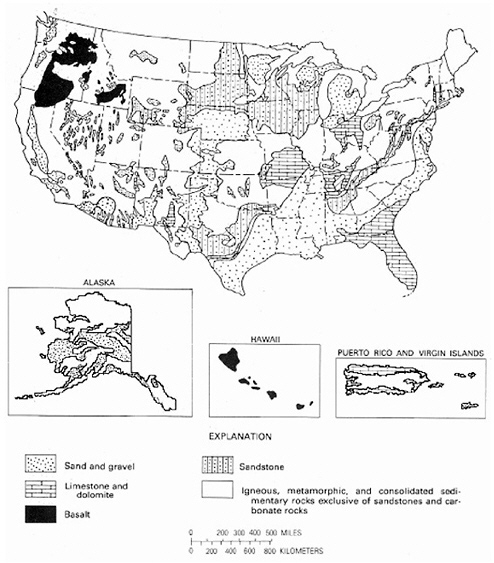
Despite the large losses and changes in these systems, aquatic ecosystems remain broadly and heterogeneously distributed across the nation. At a glance, there are almost 4 million miles of rivers and streams, 59,000 miles of ocean shoreline waters, and 5,500 miles of Great Lakes shoreline in the United States (EPA, 2002). There are 87,000 square miles of estuaries, while lakes, reservoirs, and ponds account for more than 40 million acres. As of 1997, the lower 48 states contained about 165,000 square miles (105.5 million acres) of wetlands of all types—an area about the size of California (Dahl, 2000). Figure 1-1 shows major rivers and streams. Figure 1-2 shows major aquifers in the United States classified by major features that affect the occurrence and availability of groundwater. A variety of federal programs report on the extent, status, and related trends of aquatic ecosystems located throughout the United States. Although it is beyond the scope of this report to review systematically or even summarize all such programs, a few of the largest and most important programs are described briefly in Chapter 3.
TABLE 1-1 Recent Wetland Losses in the United States
|
Period |
Losses Due to Agriculture |
Losses Due to Non-Agriculturea |
Total Acreage Lostb (Annual Average Loss) |
|
Mid-1970s to mid-1980s (10 years) |
137,540 acres per year (54% of loss) |
117,230 acres per year (46% of loss) |
2,547,700 acres (254,770 acres per year) |
|
1986 to 1997 (11 years) |
15,222 acres per year (26% of loss) |
43,324 acres per year (76% of loss) |
644,000 acres (58,545 acres per year) |
|
SOURCE: Adapted from Dahl (2000); Dahl and Johnson (1991); NRC (2001). a Non-agricultural losses include those from silviculture, urban, and rural development uses. b Total acreage lost was determined by multiplying the annual acreage loss by the total number of years in that time period. |
|||
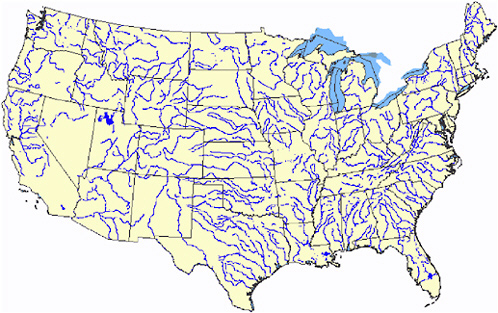
FIGURE 1-1 Major rivers and streams of the conterminous United States. SOURCE: Generated from the National Atlas of the United States (available on-line at http://www.nationalatlas.gov).
As noted above, aquatic ecosystems collectively perform numerous interrelated functions and provide a wide range of services. In addition, many aquatic ecosystems support the economic livelihood of local communities through commercial fishing and by serving the recreational sector. To illustrate the importance of these activities, recreational fishing alone generated an estimated $116 billion in total economic output the United States in 2001 (American Sportsfishing Association, 2002). The continuance or growth of these types of economic activities is directly related to the extent and health of these natural ecosystems. However, human activities and rapid population growth (often preferentially in or near aquatic ecosystems), along with historical and ongoing industrial, commercial, and residential development, have led to increased pollution, adverse modification, and destruction of remaining (especially pristine) aquatic ecosystems (Baron et al., 2003; Carpenter et al., 1998; Howarth et al., 2000; NRC, 1992). At the same time, increased human demand for water has reduced the amount available to support these ecosystems (Heinz Center, 2002; Jackson et al., 2001).
In the case of commercial and recreational fishing, pollution of aquatic ecosystems has adversely affected annual fish catch. For example, coastal areas and estuaries provide important nurseries for many species of commercially valuable fish and shellfish and have been adversely affected by nutrient pollution and habitat loss (Beck et al., 2001, 2003). Moreover, increasing demand for the services of aquatic ecosystems has resulted in a huge increase in the raising of fish (aquaculture) worldwide, which itself is having substantive effects on natural aquatic ecosystems (Naylor, 2001). This has occurred despite an increase in federal, state, and local regulations intended to restore and protect these natural resources. In this regard, many of the regulatory efforts to control pollution stem from the Clean Water Act (CWA),1 which originally focused on controlling point source pollution and limiting the destruction of wetlands.
Initially, certain large point sources of pollution were exempted from this federal act, such as concentrated or confined animal feeding operations (CAFOs), which have been responsible for pollution of a number of important aquatic ecosystems. However, CAFOs have recently been required to meet tighter discharge standards (EPA, 2003a) under the CWA. At present, nonpoint source (NPS) pollution is widely considered the leading remaining cause of water quality problems throughout much of the United States. The sources of NPS pollution to aquatic ecosystems are varied and range from runoff of fertilizers and pesticides applied to farm fields to atmospheric deposition of rainfall polluted from automobile emissions (Carpenter et al., 1998; Howarth et al., 2002).
This chapter serves as an introduction to the extent and importance of aquatic and related terrestrial ecosystems throughout the United States. It provides a statement of the problem of attempting to assess and value the services of aquatic and related ecosystems, summarizes the origin and scope of the study, and describes the perspective of the committee and this report. Chapter 2 provides an overview of the different sources and meanings of “value” in the policy process with a focus on economic valuation and the role it can play in improving environmental decision-making. Chapter 3 reviews some existing definitions of aquatic and related terrestrial ecosystems; describes their associated structures and functions; and introduces their translation to ecosystem goods and services. Chapter 4 provides a review of key existing methods of nonmarket valuation for aquatic ecosystems and issues related to their development and successful application. Chapter 5 focuses on translating ecosystem functions into services using an extensive series of case studies that compare and contrast such efforts in or-
der to develop “lessons learned” that can be applied in future ecosystem valuation activities. Chapter 6 assesses judgment and uncertainty associated with ecosystem valuation and suggests how analysts and decision-makers can and should respond. Lastly, Chapter 7 synthesizes the current knowledge regarding ecosystem services valuation and builds on the preceding chapters in order to provide guidelines for policymakers and planners concerned with the management, protection, and restoration of aquatic ecosystems. It also identifies what the committee feels are overarching recommendations for improving the valuation of ecosystem services and related research needs.
STATEMENT OF THE PROBLEM
Some believe that environmental amenities and services lie outside the scope of economic analyses, arguing that the need to protect environmental assets is self-evident and not properly the subject of economic analyses (see Chapter 2 for further discussion). However, wherever there is scarcity and the need to choose between alternatives, the question of relative values is unavoidable. It may be costly to protect, conserve, and restore aquatic ecosystems, and the costs are borne by giving up benefits in other parts of the economy, now or in the future. When ecosystem protection projects and policies are proposed, it is appropriate to ask whether they achieve the stated goals in a cost-effective and efficient manner, whether the costs are commensurate with the benefits received, what society’s costs are if protection is not provided, and whether costs and benefits are properly allocated across the present population and across generations.
Economic valuation requires that ecosystems be described in terms of the goods and services they provide to humans or other beneficiaries. Goods and services, in turn, must be quantified and measured on a common (though not necessarily monetary) scale if improvements to one ecosystem are to be compared to improvements to another. Although the issues that this raises apply to all types of ecosystems, the use of such information has started to come into particularly sharp focus for aquatic ecosystems and especially for wetlands (NRC, 2001).
Studying ecosystem services presents several challenges that are discussed throughout this report. The most fundamental challenge lies in providing an explicit description of the links between the structure and function of natural systems and the benefits (i.e., goods and services) derived by humanity. This problem is complicated by the fact that humans are an integral part of the system; by incomplete knowledge of how ecosystems function; and by the fact that ecosystem services tend to be specific to locations and situations, thus making it difficult to develop generic principles or identify generic characteristics.
The challenges to both ecologists and economists implicit in valuing ecosystem services are summarized in Figure 1-3. Human actions affect the structure, functions, and goods and services of ecosystems. Ecosystem conditions are
also affected by various biophysical parameters (not shown in figure). The translation from ecosystem structure and functions to ecosystem goods and services is given by an ecological production function, and the translation from ecosystem goods and services to value is given by an economic valuation function. There may be occasions in which the structure of the ecosystem is valued directly by humans, without the intermediation of functions, goods, or services. For example, people may value the existence of redwood forests in their own right rather than because of any functions, goods, or services that they might provide; a possibility indicated in Figure 1-3 by the direct connection from ecosystem structure to values (also given by an economic valuation function). Estimating the value of ecosystem services requires uncovering both the ecological production function and the economic valuation function. As Chapters 3, 4, and 5 illustrate, uncovering each of these functions is difficult. Furthermore, because aquatic ecosystems are complex, the production of goods and services can be complicated and indirect; this in turn makes the translation from ecosystem structure and function to ecosystem goods and services difficult. The lack of markets and market prices and of other direct behavioral links to underlying values makes the translation from quantities of goods and services to value difficult as well.
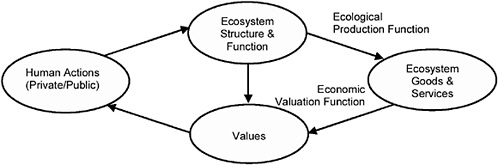
FIGURE 1-3 Components of ecosystem valuation: ecosystem structure and function, goods and services, human actions (policies), and values (see Figure 7-1 for an expanded version of this figure).
Although valuing ecosystem services does not require knowledge of the function that maps human actions into ecosystem conditions, evaluating whether certain actions are in society’s best interest does require this knowledge. For example, knowing whether to allow housing development in a watershed or timber harvesting in a forest patch requires predictions of how these actions will perturb ecosystems. This perturbation will change the production and value of ecosystem goods and services, and can then be compared to the direct economic value generated by the action (e.g., housing values, value of timber harvest) to see whether or not the action generates positive net benefits.
Where an ecosystem’s goods and services can be identified and measured, it will often be possible to assign values to them by employing existing economic valuation methods. Chapter 4 provides a summary of key existing nonmarket valuation methods for (primarily aquatic) ecosystem services. Some ecosystem goods and services cannot be valued because they are not quantifiable or because available methods are not appropriate or reliable. In other cases, the cost of valuing a particular service may rule out the use of a formal method. Available economic valuation methods are complex and demanding. The results of applying these methods may be subject to judgment and uncertainty and must be interpreted with caution. Still, the general sense of a very large literature on the development and application of various methods is that they are relatively well evolved and capable of providing useful information in support of improved ecosystem valuation. There is little to be gained from a comprehensive National Academies review of these valuation methods. Indeed, the literature contains numerous authoritative reviews and critiques, and some federal agencies have published their own assessments and guidelines, which are cited and discussed briefly in Chapter 4. Thus, an important question for this committee was not how to use any particular valuation method, but how to address ecosystem services for which no existing valuation method has been identified, and how to integrate economic and ecological analysis to obtain economic values of ecosystem conservation. Similarly, while not repeating existing reviews or assessments of valuation methods, this report addresses the decision-making consequences of judgment and uncertainty, including the implications for the selection of methods in specific applications.
Probably the greatest challenge for successful valuation of ecosystem services is to integrate studies of the ecological production function with studies of the economic valuation function. After all, an understanding of the goods and services provided by a particular ecological resource, the interactions among them, and their sustainable levels can come only from ecological research and models. To integrate economic and ecological studies, the definitions of ecosystem goods and services must match across studies. In other words, the quantities of goods and services must be defined in a similar manner for both ecological studies and economic valuation studies. Failure to do so means that the results of ecological studies cannot be carried over into economic valuation studies. Attempts to value ecosystem services without this key link will either fail to have ecological underpinnings or fail to be relevant as valuation studies.
Although there has been great progress in ecology in improving our understanding of aquatic ecosystem structure and function and in economics in developing and applying nonmarket valuation techniques, there remains a gap between the two. There are few examples of studies that have successfully translated knowledge about ecosystems into a form where economic valuation can be applied in a meaningful way. Several factors contribute to this continued lack of integration. First, some ecologists and economists hold vastly different views on the current “state of the world” and the direction in which it is headed. More recently, however, there has been mutual recognition among at least some ecologists and economists that addressing issues such as conserving ecosystems and biodiversity requires the input of both disciplines to be successful. A second reason for the lack of integration is that ecology and economics are separate disciplines, one in natural science and the other in social science. The traditional academic organization and the reward structure for scientists often make collaboration across disciplinary boundaries difficult even when the desire to do so exists (e.g., Bingham et al., 1995). Third, the ecosystem services paradigm is relatively new, as are attempts to value ecosystem services. Building the necessary working relationships and integrating methods across disciplines will take time.
Integrated studies of the value of ecosystem goods and services are now emerging. Chapter 5 reviews several such studies, beginning with situations in which the focus is on valuing a single ecosystem service, progressing to attempts to value multiple ecosystem services, and ending by reviewing analyses that attempt to encompass all services produced by an ecosystem. In some cases, it may be possible to generate relatively precise estimates of value; in other cases, all that may be possible is a rough categorization (“a lot” versus “a little”). Whether this is sufficient information depends on the circumstances. In some instances, a rough estimate may be sufficient to decide that one option is preferable to another, whereas tougher decisions will require more refined information. This progression from situations with good to poor information also demonstrates what types of information will often be lacking and the consequences of those gaps. Indeed, part of the value of going through an ecosystem services evaluation is to point out the gaps in existing information and show what research is needed to fill these gaps.
It is clear that more categories of human endeavor will in the future be evaluated to some extent in terms of environmental effects and impacts on quality of life. The emerging desire to measure the environmental costs of human activities, or to assess the benefits of environmental protection and restoration, has challenged the state of the art in environmental evaluation in both the ecological and the social sciences. From an ecological perspective, the challenge is to interpret basic research on ecosystem functions so that service-level information can be communicated to economists. For economics and related social sciences, the challenge is to identify the values of both tangible and intangible goods and services associated with ecosystems and to address the problem of decision-making in the presence of partial valuation. The combined challenge is
to develop and apply methods to assess the values of human-induced changes in ecosystem functions and services.
STUDY ORIGIN AND SCOPE
This study was conceived in 1997 at a strategic planning session of the Water Science and Technology Board (WSTB) of the National Research Council (NRC). Initially, the NRC organized and hosted a planning workshop to assess the feasibility of and need for an NRC study of the functions and associated economic values of aquatic ecosystems. Fourteen key experts involved or interested in the management, protection, and restoration of aquatic ecosystems—including representatives of the study sponsors, the U.S. Army Corps of Engineers (USACE), U.S. Environmental Protection Agency (EPA), and U.S. Department of Agriculture (USDA)—participated in the workshop that was held early in November 1999 in Washington, D.C. All participants agreed that an NRC study of valuation methods used to assess aquatic ecosystem services, rather than functions, was feasible and timely and would make a significant contribution toward advancing the understanding and appropriate use of economic valuation methods in environmental decision-making. However, it is important to note that the NRC has released several reports in the last decade that are somewhat related to this study. These are listed and briefly summarized in as-cending chronological order in Appendix A. Furthermore, there has been a general increase in interest in the area of economic valuation of ecosystem services and its role in environmental policy and decision-making since the committee was formed in early 2002 (discussed below). For example, the EPA’s Science Advisory Board (SAB) recently established a panel to review EPA’s draft Environmental Economics Research Strategy (EPA, 2003b).2
The WSTB developed a full study proposal and while several minor changes were made to the proposal in response to the sponsoring (and nonsponsoring) agencies, one significant change was made. As a compromise to the USACE’s desire to expand the scope of the study to include all ecosystems, it was decided and subsequently agreed by the NRC and all study sponsors to expand the study proposal to include “related terrestrial ecosystems.” The original basis for this change in language and study focus was the key 1983 water resources planning report Economic and Environmental Principles and Guidelines for Water and Related Land Resources Implementation Studies (WRC, 1983). The implications of linking “related terrestrial ecosystems” to aquatic ecosystems are discussed more fully in Chapter 3.
The committee’s statement of task (see Box ES-1) was to evaluate methods
|
2 |
The panel consists of members of the existing SAB Environmental Economics Advisory Committee to which several experts were added (including several members of this NRC committee) to form the Advisory Panel on the Environmental Economics Research Strategy (see http://www.epa.gov/sab/pdf/apeers_bios_for-web.pdf and http://es.epa.gov/ncer/events/news/2003/06_23_03a.html for further information). |
for assessing the economic value of the goods and services provided by aquatic and related terrestrial ecosystems. More specifically, it asks “What lessons can be learned from a comparative review of past attempts to value ecosystem services—particularly, are there significant differences between eastern and western U.S. perspectives on these issues?” As is evident throughout this report, the committee made extensive use of case studies in ecosystem services valuation (especially in Chapter 5) to help develop many of its conclusions and recommendations and respond to this and other elements of the statement of task. Although the case studies are drawn primarily from throughout the United States, including eastern and western areas, the committee decided early in its deliberations that it would not make geographic distinctions in developing implications and lessons learned from the case studies.
This report is about placing values on the goods and services that ecosystems provide to human societies, with its principal focus on the goods and services provided by aquatic and related terrestrial ecosystems. Furthermore, the report focuses on freshwater and estuarine systems, eschewing extensive consideration of marine and groundwater systems. This reflects an intentional effort to focus on management and valuation issues confronting state and federal agencies for these ecosystems. However, because the principles and practices of valuing ecosystem goods and services are rarely sensitive to whether the underlying ecosystem is aquatic or terrestrial, the report’s various conclusions and recommendations are likely to be directly or at least indirectly applicable to the valuation of the goods and services provided by any ecosystem.
PERSPECTIVE OF THIS REPORT
Several elements are fundamental to the perspective taken by the committee as it developed this report. The first is that ecosystems provide goods and services, sometimes very important ones, to society (see for example, Daily, 1997; de Groot et al., 2002; Ewel, 2002; Peterson and Lubchenco, 2002; Postel and Carpenter, 1997). The second element is that in many cases these goods and services can be quantified and an economic value can be placed on them. In large part, the remaining chapters discuss how to do this. A third element is that economic valuation can often be useful in support of environmental policy decision-making. Although the economic value of an ecosystem may not capture all of the reasons it is valued and conserved, economic valuation captures some of these reasons—perhaps most of them under certain circumstances. This valuation, in turn, becomes a necessary input to decisions about environmental conservation, particularly in situations where there is an apparent conflict between conservation or restoration and a conventional idea of economic progress, as indicated by gross national or state product measured at market prices.
In many cases, some reviewed in the following chapters, careful valuation shows that conservation is economically beneficial, whereas the destruction or modification of natural systems is economically harmful. Finally, the concept of
economic value is very inclusive, much more so than is recognized and appreciated outside the economics profession. Consequently, many of what noneconomists typically consider to be noneconomic values are in fact captured (at least to some extent) by economists’ estimates of value—especially by what is called “existence value.”
The reason economic valuation is more comprehensive than generally recognized is that economists recognize two basic types of value, use and nonuse values (see Chapters 2 and 4 for a more complete discussion). In brief, use values are those that derive from using a good or service provided by an ecosystem, such as using a lake for fishing or swimming, lake water for drinking or irrigation, or an estuary for boating. On the other hand, an example of a type of nonuse value is an existence value; a person may value the existence of a species even though he or she will never make any use of this species or of any of its members. Existence values, although often difficult and controversial to measure, are legitimate and indeed important economic values since people are willing to pay (see more below) for the continued existence of species or landscapes. Existence values also affect the way people behave, and anything that changes behavior has economic consequences. For example, even if people are not able to pay directly for the preservation of a species, the value they place on it might affect other aspects of their behavior, such as how they vote or their choice of products in the market. Values that lead to behavior changes are therefore economic values, even though their origins may lie in ethical, aesthetic, or religious beliefs (see Chapter 2 for further information). However, there could be occasions on which people value ecosystems, but this value is not reflected in any change in their behavior and is never revealed. For example, they might for some reason wish to keep their valuation secret. In such a case, economic methods of measuring values would fail to reflect a person’s valuation.
Valuation studies may be conducted in many different contexts, and the context can affect some aspects of the study. A study may be conducted as part of a policy analysis, as in the case of the restoration of the New York Catskills watershed, or in the context of environmental litigation related to the Exxon Valdez oil spill (see Chapter 5). Alternatively, a valuation study may be conducted in the context of a NRDA (natural resource damage assessment) required by the federal Comprehensive Environmental Response, Compensation, and Liability Act (CERCLA).3 As can be seen in the case studies developed in later chapters, the context can have an impact on the way a valuation study is framed (see Chapters 2 and 6) and on the way it is developed.
|
3 |
In response to growing public concern over health and environmental risks posed by hazardous waste sites, Congress enacted CERCLA, commonly known as the Superfund program, in 1980 to identify and clean up such sites. Superfund is administered by EPA in cooperation with individual sites throughout the United States; further information can be found at http://www.epa.gov/superfund/action/law/cercla.htm. |
SUMMARY AND CONCLUSIONS
Aquatic and related terrestrial ecosystems are broadly distributed across the nation, perform numerous interrelated functions, and provide a wide range of important goods and services. In addition, many aquatic ecosystems enhance the economic livelihood of local communities by supporting commercial fishing, supporting agriculture, and serving the recreational sector. The continuance or growth of these types of economic activities is directly related to the extent and health of these natural ecosystems. However, human activities, rapid population growth, and industrial, commercial, and residential development have all led to increased pollution, adverse modification, and destruction of remaining aquatic ecosystems—despite an increase in federal, state, and local regulations intended to protect, conserve, and restore these natural resources. Increased human demand for water has simultaneously reduced the amount available to support these ecosystems.
Despite growing recognition of the importance of ecosystem functions and services, they are often taken for granted and overlooked in environmental decision-making. Thus, choices between the conservation and restoration of some ecosystems and the continuation and expansion of human activities in others have to be made with an enhanced recognition of this potential for conflict. In making these choices, the economic values of these ecosystem goods and services to society have to be known, so that they can be compared with the economic values of activities that may compromise them and improvements to one ecosystem can be compared to those in another.
The fundamental challenge of valuing ecosystem services lies in providing an explicit description and adequate assessment of links between the structures and functions of natural systems and the benefits (i.e., goods and services) derived by humanity and is summarized in Figure 1-3. Ecosystems are complex however, making the translation from ecosystem function to ecosystem goods and services (i.e., the ecological production function) difficult. Similarly, the lack of markets and market prices and of other direct behavioral links to underlying values makes the translation from quantities of goods and services to value (i.e., the economic valuation function) quite difficult.
Probably the greatest challenge for successful valuation of ecosystem services is to integrate studies of the ecological production function with studies of the economic valuation function. To do this, the definitions of ecosystem goods and services must match across studies. Failure to do this means that the results of ecological studies cannot be carried over into economic valuation studies. Attempts to value ecosystem services without this key link will either fail to have ecological underpinnings or fail to make be relevant as valuation studies.
Where an ecosystem’s services and goods can be identified and measured, it will often be possible to assign values to them by employing existing economic (primarily nonmarket) valuation methods. Some ecosystem goods and services cannot be valued because they are not quantifiable or because available methods are not appropriate or reliable; in other cases, the cost of valuing a particular
service may rule out the use of a formal method. Economic valuation methods are complex and demanding, and the results of applying these methods may be subject to judgment, uncertainty, and bias and must be interpreted with caution. However, based on an assessment of a very large literature on the development and application of various economic valuation methods, the committee concludes that they are relatively mature and capable of providing useful information in support of improved environmental decision-making.
Although there has been great progress in ecology in better understanding ecosystem structure and functions, and in economics in developing and applying nonmarket valuation techniques, there remains a gap between the two. The challenge from an ecological perspective is to interpret basic research on ecosystem functions so that service-level information can be communicated to economists. The challenge for economics and related social sciences is to identify the values of both tangible and intangible goods and services associated with ecosystems while addressing the problem of decision-making in the presence of partial valuation. The combined challenge is to develop and apply methods to assess the values of human-induced changes in ecosystem functions and services.
Lastly, this report is primarily concerned with valuing the goods and services that aquatic and related terrestrial ecosystems provide to human societies. However, because the principles and practices of valuing ecosystem goods and services are rarely sensitive to whether the underlying ecosystem is strictly aquatic or terrestrial, many of its conclusions and recommendations are likely to be directly or at least indirectly applicable to the valuation of goods and services provided by any ecosystem.
REFERENCES
Abell, R.A., D.M. Olson, D.M. Dinerstein, P.T. Hurley, J.T. Diggs, W. Eichbaum, S.Walters, W. Wettengel, T. Allnutt, C.J. Loucks, and P. Hedao. 2000. Freshwater Ecoregions of North America: A Conservation Assessment. Washington, D.C.: Island Press.
ASA (American Sportsfishing Association). 2002. Sportsfishing in America: Values of Our Traditional Pastime. Alexandria, VA: American Sportsfishing Association.
Baron, J.S., N.L. Poff, P.L. Angermeier, C.N. Dahm, P.H. Glecik, N.G. Hairston, Jr., R.B. Jackson, C.A. Johnston, B.D. Richter, and A.D. Steinman. 2003. Sustaining healthy freshwater ecosystems. Issues in Ecology No. 10. Washington, D.C.: Ecological Society of America.
Beck, M.W., K.L. Heck, Jr., K. W. Able, D.L. Childers, D.B. Eggleston, B.M. Gillanders, B. Halpern, C. G. Hays, K. Hoshino, T.J. Minello, R.J. Orth, P.F. Sheridan, and M. M. Weinstein. 2001. The identification, conservation and management of estuarine and marine nurseries for fish and invertebrates. Bioscience 51:633-641.
Beck, M.W., K.L. Heck, Jr., K.W. Able, D.L. Childers, D.B. Eggleston, B.M. Gillanders, B. Halpern, C.G. Hays, K. Hoshino, T.J. Minello, R.J. Orth, P.F. Sheridan, and M.P. Weinstein. 2003. The role of nearshore ecosystems as fish and shellfish nurseries. Issues in Ecology 11. Washington, D.C.: Ecological Society of America.
Bingham, G., R. Bishop, M. Brody, D. Bromley, E. Clark, W. Cooper, R. Costanza, T. Hale, G. Hayden, S. Kellert, R. Norgaard, B. Norton, J. Payne, C. Russell, and G. Suter. 1995. Issues in ecosystem valuation. Ecological Economics 14(2):67-125.
Carpenter, S., N. Caraco, D.L. Correll, R.W. Howarth, A.N. Sharpley, and V.H. Smith. 1998. Nonpoint pollution of surface waters with phosphorus and nitrogen. Ecological Applications 8:559-568.
Dahl, T.E. 2000. Status and Trends of Wetlands in the Conterminous United States 1986 to 1997. Washington, D.C.: U.S. Department of the Interior, Fish and Wildlife Service.
Dahl, T.E. and C.E. Johnson. 1991. Wetlands, Status and Trends in the Conterminous United States, mid 1970’s to mid-1980’s. Washington, D.C.: U.S. Department of the Interior, Fish and Wildlife Service.
Daily, G.C. 1997. Introduction: What are ecosystem services? Pp. 1-10 in G.C. Daily (ed.) Nature’s Services: Societal Dependence on Natural Ecosystems. Washington, D.C.: Island Press.
De Groot, R.S., M.A. Wilson, and R.M.J. Boumans. 2002. A typology for the classification, description and valuation of ecosystem functions, goods and services. Ecological Economics 41:393-408.
EPA (U.S. Environmental Protection Agency). 2001. National Coastal Condition Report. EPA-620/R-01/005. Washington, DC: U.S. EPA, Office of Research and Development/Office of Water. Also available on-line at http://www.epa/gov/owow/oceans/NCCR/index. Accessed October 2002.
EPA. 2002. 2000 National Water Quality Inventory. EPA-841-R-2-001. Washington, D.C.: Office of Water.
EPA. 2003a. National Pollutant Discharge Elimination System Permit. Available online at http://www.mass.gov/czm/envpermitnpdes.htm. Accessed October 11, 2004.
EPA. 2003b. Science Advisory Board, Economics Advisory Committee, Advisory Panel on the Environmental Economics Research Strategy; Request for Nominations. Federal Register 68(120):37151-37152
Ewel, K.C. 2002. Water quality improvement by wetlands. Pp. 329-344 in G.C. Daily (ed.) Nature’s Services: Societal Dependence on Natural Ecosystems. Washington, D.C.: Island Press.
Heal, G. 2000. Nature and the Marketplace. Washington D.C.: Island Press.
Heath, R.C. 1984. Ground-water Regions of the United States. Geological Survey Water-Supply Paper 2242. Washington, D.C.: U.S. Government Printing Office.
Heinz Center (The H. John Heinz III Center for Science, Economics and the Environment). 2002. The State of the Nation’s Ecosystems: Measuring the Lands, Waters, and Living Resources of the United States. Cambridge, UK: Cambridge University Press.s
Howarth, R., D. Anderson, J. Cloern, C. Elfring, C. Hopkinson, B. LaPointe, T. Malone, N. Marcus, K. McGlathery, A. Sharpley, and D. Walker. 2002. Nutrient pollution of coastal rivers, bays, and seas. Issues in Ecology No. 7. Washington, D.C.: Ecological Society of America.
Jackson, R., S. Carpenter, C. Dahm, D. McKnight, R. Naiman, S. Postel, and S. Running. 2001. Water in a changing world. Issues in Ecology No. 9. Washington, D.C.: Ecological Society of America.
Naeem, S., F.S. Chapin III, R. Costanza, P.R. Ehrlich, F.B. Golley, D.U. Hooper, J.H. Lawton, R.V. O’Neill, H.A. Mooney, O.E. Sala, A.J. Symstad, and D. Tilman. 1999. Biodiversity and ecosystem functioning: Maintaining natural life support
processes. Issues in Ecology No. 4. Washington, D.C.: Ecological Society of America.
Naylor, R., R. Goldburg, J. Primavera, N. Kautsky, M. Beveridge, J. Clay, C. Folke, J. Lubchenco, H. Mooney, and M. Troell. 2001. Effects of aquaculture on world fish supplies. Issues in Ecology No. 8. Washington, D.C.: Ecological Society of America.
NRC (National Research Council). 1992. Restoration of Aquatic Ecosystems: Science, Technology, and Public Policy. Washington, D.C.: National Academy Press.
NRC. 2001. Compensating for Wetland Losses Under the Clean Water Act. Washington, D.C.: National Academy Press.
Peterson, C.H., and J. Lubchenco. 2002. Marine ecosystem services. Pp. 177-194 in G.C. Daily (ed.) Nature’s Services: Societal Dependence on Natural Ecosystems. Washington, D.C.: Island Press.
Postel, S.L., and S. Carpenter. 1997. Freshwater ecosystem service. Pp. 195-214 in G.C. Daily (ed.) Nature’s Services: Societal Dependence on Natural Ecosystems. Washington, D.C.: Island Press.
TNC (The Nature Conservancy). 1998. Rivers of Life: Critical Watersheds for Protecting Freshwater Biodiversity. L.L. Master, S.R. Flack, and B.A. Stein (eds.). Arlington, Va.: The Nature Conservancy.
WRC (Water Resources Council). 1983. Economic and Environmental Principles and Guidelines for Water and Related Land Resources Implementation Studies. Washington, D.C.: Government Printing Office.


