
7
Ecosystem Valuation: Synthesis and Future Directions
The committee’s statement of task (see Box ES-1) identifies a number of specific questions regarding economic methods for valuing the services of aquatic and related terrestrial ecosystems. Chapter 2 sets the stage for the subsequent chapters with a general discussion of the meaning and sources of value, with a decided emphasis on the economic approach to valuation. Chapter 3 then discusses the relationship between ecosystem services and the more widely studied ecosystem functions; it addresses the types and measurement of ecosystem services and the extent of our current understanding of these services. Chapter 4 reviews the principal and currently available nonmarket economic valuation methods. These two chapters assess what is currently known about the underlying ecology (Chapter 3) and the economics (Chapter 4) necessary for conducting ecosystem services valuation. Existing efforts in ecology and economics are then discussed through an examination of multiple case studies in Chapter 5. That chapter also provides an extensive discussion of implications and lessons to be learned from past attempts to value a variety of ecosystem services. Uncertainty and judgments that arise when conducting an ecosystem valuation study and affect the measurement of values are discussed in Chapter 6.
The purpose of this final chapter is to synthesize the current knowledge regarding ecosystem valuation in a way that will be useful to resource managers and policymakers as they seek to incorporate the value of ecosystem services into their decisions. The chapter begins with a list of premises that underlie the committee’s view of ecosystem valuation. This is followed by a synthesis of the major conclusions that emerge from the preceding six chapters. The committee then presents a checklist or set of guidelines for use by resource managers or policymakers when conducting or evaluating ecosystem valuation studies. This checklist identifies a number of factors to consider and questions to ask in improving the design and use of such studies. Finally, this chapter provides what the committee feels are the most pressing recommendations for improving the estimation of ecosystem values. As noted previously, although the focus throughout this report is on those services provided by aquatic and related terrestrial ecosystems, the various conclusions and recommendations provided in this report and final chapter are likely to be directly or at least indirectly applicable to valuation of the services provided by any ecosystem.
GENERAL PREMISES
There are several general premises that the committee feels accurately reflect the current state of knowledge about the value and valuation of aquatic ecosystem services. These premises frame the more detailed discussion of major conclusions that follows. The key links embodied in these premises are illustrated in Figure 7-1, which is a more detailed version of Figure 1-3.
-
Ecosystem structure along with regulatory and habitat/production functions produce ecosystem goods and services that are valued by humans. Examples include production of consumable resources (e.g., water, food, medicine, timber), provision of habitat for plants and animals, regulation of the environment (e.g., hydrologic and nutrient cycles, climate stabilization, waste accumulation), and support for nonconsumptive uses (e.g., recreation, aesthetics).
-
In addition, many people value the existence of aquatic ecosystems for their own sake, or for the role they play in ensuring the preservation of plant and animal species whose existence is important to them. This value can stem from a belief that these species or ecosystems have intrinsic value or from the benefits that humans get from their existence, even when that existence is not directly providing goods or services used by human populations. In some cases, this “nonuse” value may be the primary source of an ecosystem’s value to humans.
-
The total economic value of ecosystem services is the sum of the use values derived directly from use of the ecosystem and the nonuse value derived from its existence. Use value can be decomposed further into consumptive uses (e.g., fish harvests) and nonconsumptive uses (e.g., recreation).
-
Human actions affect the structure, functions, and goods and services of ecosystems. These impacts can occur not only from the direct, intentional use of the ecosystem (e.g., for harvesting resources), but also from the unintentional, indirect impacts of other activities (e.g., upstream agriculture). Human actions are, in turn, directly affected by public policy and resource management decisions.
-
Understanding the links between human systems and ecosystems requires the integration of economics and ecology. Economics can be used to better understand the human behavior that impacts ecosystems, while ecology aids in understanding the physical system that is both impacted and valued by humans.
-
Nearly all policy and management decisions imply changes relative to some baseline and most changes imply trade-offs (i.e., more of one good or service but less of another). Protection of an ecosystem through a ban on or reduction of a certain type of activity implies an increase in ecosystem services but a reduction in other services provided by the restricted activity. Likewise, allowing an activity that is deemed detrimental implies a reduction in some ecosystem services but an increase in the services generated by the allowed activity.
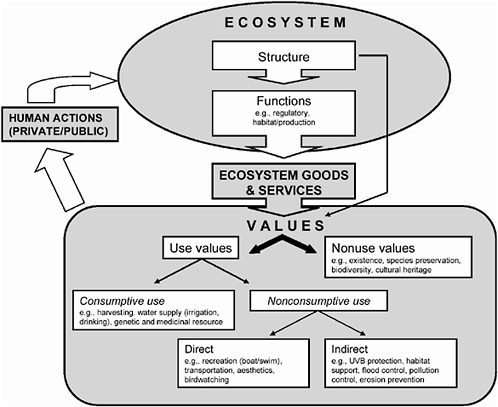
FIGURE 7-1 Connections between ecosystem structure and function, services, policies, and values.
-
Information about these trade-offs—that is, about the value of what has been increased (what is being gained) as well as the value of what has been decreased (what is being forgone or given up)—can lead to better decisions about ecosystem protection. Since decisions involve choices, whenever these choices reflect how “valuable” the alternatives are, information about those values will be an important input into the choice among alternatives.
-
Because aquatic ecosystems are complex, dynamic, variable, interconnected, and often nonlinear, our understanding of the services they provide, as well as how they are affected by human actions, is imperfect and linkages are difficult to quantify. Likewise, information about how people
-
value ecosystem services is imperfect. Difficulties in generating precise estimates of the value of ecosystem services may arise from insufficient ecological knowledge or data, lack of precision in economic methods or insufficient economic data, or lack of integration of ecological and economic analysis.
-
Nonetheless, the current state of both ecological and economic analysis and modeling in many cases allows for estimation of the values people place on changes in ecosystem services, particularly when focused on a single service or a small subset of total services. Use of the (imperfect) information about these values is preferable to not incorporating any information about ecosystem values into decision-making (i.e., ignoring them), since the latter effectively assigns a value of zero to all ecosystem services.
-
There is a much greater danger of underestimating the value of ecosystem goods and services than over-estimating their value. Underestimation stems primarily from the failure to include in the value estimates all of the affected goods and services and/or all of the sources of value, or from use of a valuation method that provides only a lower bound estimate of value. In many cases, this reflects the limitations of the available economic valuation methods. Over-estimation, on the other hand, can stem from double-counting or from possible biases in valuation methods. However, it is likely that in most applications the errors from omission of relevant components of value will exceed the errors from over-estimation of the components that are included.
SYNTHESIS OF MAJOR CONCLUSIONS
The preceding general premises collectively imply that ecosystem valuation can play an important role in policy evaluation and policy and resource management decisions. The following section provides a synthesis of the major conclusions regarding ecosystem valuation that emerge from the previous chapters. It is important to note that this is not intended to replicate or simply restate individual chapter summaries or the conclusions and recommendations of the individual chapters; rather, it is intended to integrate and summarize the broad themes that emerge from these chapters. The synthesis is organized around these three sets of related questions:
-
What is meant by the value of ecosystem services? What components of value are being measured?
-
Why is it important to quantify the value of ecosystem services (i.e., to undertake valuation)? How will the values that are estimated (i.e., the results of the valuation exercise) be used?
-
How should these values be measured? What methods are available for quantifying values, and what are their advantages and disadvantages?
What Is Being Measured?
There is growing recognition of the crucial role that ecosystems play in supporting human, animal, plant, and microbial populations. There are several published inventories or classification schemes for the goods and services provided by aquatic ecosystems (see Chapter 3). Commonly recognized services include water purification, flood control, waste decomposition, animal and plant habitat, transportation, recreation, hydroelectricity, soil fertilization, and support of biodiversity. However, the complexity of ecosystems remains a barrier to quantifying the links from ecosystem structure and functions to the goods and services that humans value. In addition, although there is now widespread recognition that ecosystem services are “valuable,” simply recognizing them as valuable may be insufficient as a guide to environmental policy choice. What is required is some way of comparing these services to other things that are also considered valuable. Without this, the value of ecosystem goods and services will not be given proper weight in policy decisions.
The concept of value, however, has many interpretations. Some notions of value are biocentric; others are anthropocentric. Some are based on usefulness (instrumental value) through contributions to human well-being (utilitarian values); others are based on inherent or intrinsic value and rights. There is a large and growing literature, much of it in the field of philosophy, devoted to defining the nature and sources of such value. To the extent that they represent dimensions that are important to people (and hence affect how they view alternative choices), all types of value can play an important role in environmental decision-making.
Given the committee’s charge, this report focuses on the economic concept of value, which is generally defined in terms of the satisfaction of human wants, making it an anthropocentric and utilitarian approach. The economic definition of value postulates a potential substitutability between environmental goods or services and other goods or services that people value. It does not capture intrinsic values that stem from moral premises, although it does capture the value people place on the existence of a species or ecosystem for its own sake. For this reason, the economic concept is not an all-inclusive concept of value. Nonetheless, it is broadly defined to include not only the value derived from direct use of an ecosystem service (use value), but also nonuse values such as existence and bequest values. It thus includes the value of protection “for protection’s sake,” which is viewed as desirable by many humans. Economic value should not be confused with the much narrower concept of market or commercial value, which reflects only payments made or received through market transactions. In general, economic value includes many components that have no commercial or market basis, including the values individuals place on preservation of ecosystems or species, even when that preservation has no apparent use value.
Economic valuation is then the process of quantifying the economic value of a particular change in the level of a good or service. A benefit of the use of
economic valuation is that it provides a process that is grounded in economic theory and information that can be used to evaluate the trade-offs that inevitably arise in environmental policy choices. By using a common metric (normally monetary) to value changes, it allows a comparison of possible changes and hence facilitates a choice among them. The use of a monetary metric (e.g., dollar equivalent) for quantifying values is based on the assumption that individuals are willing to trade the change being valued for more or less of something else that can be represented by or bought with the metric (i.e., dollars). It thus assumes that the good being valued is in principle substitutable or replaceable by other goods and services.
The economic approach to valuation does not, however, imply a unique measure of the value of a change. The economic value of a change can be defined in two alternative ways: (1) as the amount an individual or group is willing to pay to secure the change (willingness to pay) or (2) as the amount they would have to be compensated to forgo the change (willingness to accept [compensation]). These alternative measures imply different allocations of property rights and have different implications for the role of the income of those affected individuals and groups. In particular, willingness to pay is limited by ability to pay. Although contexts exist in which these two measures can be expected to yield similar values, it is nevertheless the case that without close substitutes for the service that is changing, the two can be expected to yield substantially different values. For unique ecosystems, such as the Florida Everglades, close substitutes are not available and hence the two measures can be expected to differ substantially. Usually, the willingness-to-accept measure, which is not constrained by income, yields a greater value for an improvement than does the willingness-to-pay measure. Economic theory suggests that willingness to accept is appropriate for valuing the removal of a service to which people have a right, whereas willingness to pay is appropriate for valuing the provision of a new service or more of an existing service in a situation where there is no right to receive this service, although in practice most economic valuation exercises use methodologies that measure only willingness to pay. Nonetheless, because willingness to pay provides a lower bound for willingness to accept, it is a sufficient measure for cases in which willingness-to-pay estimates exceed the value of alternatives.
Policy decisions made today and the human actions that they affect can impact an aquatic ecosystem not only now but also far into the future. The temporal dimension of policy impacts stems both from the potential effect on behavior (e.g., inducing long-term behavioral changes or irreversible decisions) and from the dynamic nature of aquatic ecosystems. As a result, the changes that result from a contemporary policy choice and the valuation of those changes must include not only current impacts but future impacts as well. In addition, aggregate value estimates require an aggregation of values over time. This is done typically through the use of discounting and the calculation of net present values. Much of the controversy surrounding the use of discounting stems from a misunderstanding of the distinction between two alternative forms of discounting:
utility discounting and consumption discounting. In particular, even when it is desirable to weigh the well-being of all generations equally (implying a zero utility discount rate), it would still be appropriate to use a positive or negative discount rate for the benefits or costs associated with changes in ecosystem services, if the general availability of these services is expected to change over time. It is important to note, however, that because they are conducted at the present time, all valuation exercises measure the values or preferences of the current generation. To the extent that the preferences of future generations differ, those differences would not be captured in the value estimates.
Why Conduct Ecosystem Valuations?
Why or when might it be important to have an estimate of the value of a change in ecosystem goods or services? As concluded above, such estimates can inform and improve environmental policy and management decisions. Again, simply stating that something has value is insufficient as a basis for policy choice. Rather, it is necessary to have a ranking of alternatives, and estimates of the values of the changes implied by different options can contribute to such a ranking. However, the specific role that valuation plays and its contribution to such processes depends on the specific way in which it will be used (i.e., on the “policy frame”). In particular, the nature of the ecosystem valuation exercise (i.e., how it is conducted and how it is used) will depend on the specific context or problem. One can distinguish between different types of valuation exercises, each of which potentially implies a different type of valuation question, different information needs, different scopes (i.e., types of ecosystem services), and different spatial and temporal scales.
One possible context in which economic valuation plays a key role is in the measurement of damages from ecosystem degradation that has already occurred as a result of some human action. This is a measure of the value of the ecosystem services that have been diminished or lost. Perhaps the most common example of this is natural resource damage assessment (NRDA), which is used to determine the amount of compensation a party responsible for the damages must pay. In this context, a point estimate of damages (rather than a distribution of possible damages) is needed. In addition, it is necessary to have a measure of total damages. A partial measure based on a subset of ecosystem services is not sufficient, since as noted previously, not valuing some services is equivalent to assigning those services a zero value.
Rather than valuing a change in ecosystem services that has already occurred, one might instead be interested in valuing a change that could occur. Such a change would typically be linked to a specific policy under consideration. Economic valuation has been used in an attempt to place an estimate on the value of all ecosystem services, not as part of a specific policy evaluation, but rather as a means to demonstrate the importance of these services. However, as noted above, economic valuation is designed to estimate the value of a
change in the provision of services, and the techniques are normally most reliable when applied to relatively small (marginal) changes. Hence, application to very large changes (e.g., “with” and “without” scenarios) often implies an inappropriate use of the techniques.
Some valuation studies do focus on changes in ecosystem services, but still not in the context of a specific policy evaluation. For example, studies can estimate the value of a hypothetical change in an ecosystem services (such as a 10 percent increase in commercial fish catch rate). Most economic valuation exercises to date have been of this type. Such analyses do not require a linkage of ecological and economic models, however, because the ecological processes or responses that might generate the hypothetical change are not part of the analysis. Although greatly simplifying the analysis, the use of hypothetical scenarios makes it difficult to link the value estimates with predicted policy impacts.
Ecosystem valuation is most useful as an input into environmental decision-making when the valuation exercise is framed in the context of the specific policy question or decision under consideration; however, this presents several challenges. Such an analysis should have the following components: (1) a way of estimating the changes in ecosystem structure and functions that would result from implementation of the policy, (2) a way of estimating the changes in ecosystem services that result from the changes in structure and function, and (3) a way of estimating the value of these changes in ecosystem services (see Figure 7-1). This requires an integration of ecological and economic methods and models. The physical impacts of the policy should first be determined, and this should then be translated into a value (e.g., a willingness to pay or willingness to accept compensation for that change). Without this linkage, either it will not be possible to evaluate a specific policy (e.g., it will only be possible to consider hypothetical changes in ecosystem services) or else the subjects of the valuation exercise (e.g., the people whose values are elicited) must implicitly supply their own subjective ecological model (i.e., their own beliefs about the likely effect of the policy on the ecosystem). Thus, the values that are elicited will depend on what these individuals think the link between the policy and ecosystem services will or should be.
In the context of aquatic ecosystems, the impact of a given policy on ecosystem services is particularly difficult to estimate, because these ecosystems are complex, dynamic, variable, interconnected and often nonlinear. In addition, linking changes in ecosystem services to values is also difficult, because many of these services are not traded in markets and a large part of the value may stem from nonuse value. However, this task may be easier when applied on a very local scale rather than a regional or global scale, and when it is focused on a subset of services rather than trying to incorporate an exhaustive list of ecosystem services.
Whether the results of a more narrowly focused analysis are sufficient will depend on the specific environmental policy context and the decision criteria that will be used to choose among policy alternatives. Different criteria require
different types of information about values. Two contexts in which valuation plays a large role are benefit-cost analysis and cost-effectiveness analysis.
Many federal statutes and regulations require benefit-cost analyses as part of regulatory policy analysis or allow a consideration (as opposed to a comparison) of benefits and costs. In either case, information about the values of changes in ecosystem services needs to be included in the measures of such benefits and costs. In some cases, a partial measure of benefits (i.e., estimating the value of changes in some subset of services) may be sufficient. If a partial measure of benefits exceeds costs, then it is not necessary to have a measure of total benefits because the additional information (i.e., values associated with the additional ecosystem services) would not change the results of the benefit-cost analysis. However, if focusing on only a subset of services yields a benefit measure that is less than cost, it is necessary to consider the value of other services not previously included to see whether inclusion of these benefits changes the results of the analysis.
Economic valuation can also be an important input into environmental policy choice when a particular service (such as water purification) must be provided and one way to provide it is through protection, preservation, or restoration of ecosystem services. In this context, the valuation exercise may simply be part of a cost-effectiveness analysis designed to determine the least-cost means of providing the required good. In such cases, the valuation exercise would only require estimation of the replacement cost—the cost of the next-best alternative means of providing the required service (e.g., the cost of a new water filtration plant instead of increased watershed protection; see also Chapters 5 and 6). In this case, the willingness to pay for the ecosystem service is the amount saved by not having to provide the good or service through alternative means. It is important to emphasize that this does not give a measure of the overall value of the ecosystem service, since it reflects only the costs saved by providing the service through ecosystem protection or restoration rather than through an alternative means. In such a context, the value of the ecosystem service is not the cost savings but rather the willingness to pay (or accept compensation) for the improvement in water quality resulting from the protection or restoration of the ecosystem service.
How to Value Ecosystem Services?
Given a decision on what is to be valued and why, the third and last major question to be addressed is how to conduct the economic valuation. The ability to generate useful information about the value of ecosystem services varies widely across cases for at least two reasons. First, knowledge of the link from ecosystem structure and functions to the provision of ecosystem services varies. Some ecosystems, as well as some types of aquatic services, are better understood than others. Second, some types of values (such as nonuse values) are more difficult to estimate than others. For some ecosystem services, such as
commercial fish harvests or flood control, the valuation exercise is rather straightforward and uncontroversial. For others, the translation of physical changes in structure or function into values is much more difficult and, in some cases, controversial.
A variety of existing methods can be applied to measuring the economic value of ecosystem services. Some of these methods are based on observed behavior (revealed-preference measures), while others are based on survey responses (stated-preference measures).
Stated-preference methods do not seek to infer values from behavior. Rather, they seek to elicit information about values through survey responses. The two primary types of stated-preferences methods are contingent valuation and conjoint analysis. Contingent valuation was developed to estimate values for goods or services for which neither explicit nor implicit prices exist. Conjoint analysis is conceptually similar to contingent valuation, although it focuses on individual attributes and asks respondents for rankings of alternatives rather than direct statements relating to value. In either case, statistical methods are used to estimate economic values from the stated choices or ranks. Since valuation questionnaires often pose a cognitive problem for respondents, the use of focus groups, individual interviews, and pre-tests can help to ensure that the questionnaires and responses reflect the intended purpose. Although stated-preference methods have come under substantial criticism because they are not based on actual behavior, inclusion of these types of quality control mechanisms in a study design would reduce potential biases and should help in their acceptance and use in environmental decision-making.
Revealed-preference methods, on the other hand, use observed behavior to measure or infer economic values. The main revealed-preference methods that have been used to value ecosystem services are travel-cost, averting behavior, hedonic, and production function models. The travel-cost approaches can capture only the value of ecosystem services that stem from use of a particular site, for example, for recreational fishing. To the extent that an ecosystem change affects recreational fishing at one or more locations (e.g., through a change in fish quantity or quality), the value of the impact on recreational fishing can be estimated using the travel-cost approach. However, the effect of this change on other ecosystem services would not be included in the value estimates derived from the travel-cost method.
Averting behavior models are best suited for valuing ecosystem services related to human health or the provision of related services such as clean water. The premise is that people will change their behavior and invest money to avoid undesirable health outcomes. If degradation of an ecosystem leads to a reduction in the provision of a service such as clean water, the expenditure that individuals would be willing to undertake to avoid the related health impacts—for example, investing in filtration treatment technologies or purchasing alternative water sources—provides a measure of the value of what is lost as a result of the degradation. Application of this valuation approach is currently limited to cases in which the ecosystem service directly impacts individuals, they are aware of
any degradation of the ecosystem and its impact on the services provided, and activities can be undertaken to avoid or reduce the negative impacts resulting from the degradation.
The basic premise of the hedonic approach to ecosystem valuation is that the ecosystem services realized by living in a particular location are one attribute that contribute to the value of a house in that location and thus affect its price. Information about how the variation in services across locations (e.g., differences in observable water quality) affects housing prices can be used to infer the value that individuals place on changes in the level of these ecosystem services. Once again, however, the resulting measure of value is only a partial measure, since it captures only the component of value realized as a result of living at a particular location.
All of the above revealed-preference methods have been applied to the valuation of some component or subset of aquatic ecosystem services. In general, however, these applications have not relied on the direct linking of ecological and economic models discussed above. In some cases, the application was to an observed environmental degradation (such as a fish consumption advisory or a water contamination episode). In others, the value of a hypothetical change in ecosystem services was estimated using information about values derived from observed variations in ecosystem services across space or time. As noted above, decoupling the economic and ecological modeling greatly simplifies the valuation exercise. However, such analyses do not provide value estimates that can readily be used directly in policy evaluation and decision-making. What is needed for this purpose is a modeling framework that links the policy to changes in ecosystem structure and functions, which in turn affects the ecosystem services that people value.
The last revealed-preference approach, the production function approach, applies integrated ecological and economic modeling in contexts in which one or more ecosystem services support or protect the production of valued final goods and services. The biological resource or ecological service is treated as an “input” into the economic activity, and like any other input, its value can be equated with the value of its marginal productivity. Although the production function approach is best illustrated in the case where the final output is marketed, as in studying the impact of habitat and water quality on commercial fisheries, it can be used equally well where the final output is not marketed—as would be the case in valuing the impact of habitat and water quality on recreational or subsistence fisheries. Most applications of the production function approach in the past have been for marketed final output. In such cases, the translation of changes in the quantities of outputs (e.g., changes in commercial harvests) into values is greatly simplified because market prices can be used as measures of value, at least for small changes. The more challenging aspect of these studies is determining policy recommendations for managing the aquatic ecosystems supporting the key ecosystem service or services of interest and, in turn, translating the change in ecosystem services into a change in the availability or cost of producing the marketed good or service. Complicating factors
include threshold effects and other nonlinearities in the underlying hydrology and ecology of aquatic ecosystems, and the need to consider trade-offs between two or more environmental benefits generated by ecological services. More recent efforts have attempted to expand the integrated ecological-economic modeling underlying production function approaches to account for some of these important effects and trade-offs and to extend the approach to value “multiple” rather than “single” services provided by aquatic ecosystems.
To summarize, in many past applications to aquatic ecosystem services, revealed-preference methods have been restricted to valuing a relatively limited set of services and primarily use values. Even within the category of use values, revealed-preference approaches have been restricted to valuing certain types of ecosystem services and values, such as commercial harvests, recreation, storm protection, habitat-fishery linkages, and erosion control. In contrast, stated-preference methods have been more widely applied to all the different values listed in Figure 7-1. Furthermore, only stated-preference methods can measure certain components of value, such as existence value or other nonuse values, which may comprise a large component of the value of a change in an aquatic ecosystem. Thus, only stated-preference methods are capable of measuring the total economic value of a change (both use and nonuse values).
As noted previously, the credibility of the estimated values derived from stated-preference methods has come under greater scrutiny in academic, policy, and litigation arenas, due mainly to concerns over eliciting values from individuals’ responses to surveys. In addition, although stated-preference methods have an advantage in capturing the total value of a change in the overall state of an aquatic ecosystem or in a number of interlinked ecosystem services, such methods are not concerned with how such changes arise from disturbances to the underlying regulatory functions, habitat/production functions, and structure of the ecosystem. By focusing on the values arising from single uses and services of an aquatic ecosystem, revealed-preference methods have also tended to ignore the “interconnectedness” between the functioning aquatic ecosystem and the different values that arise through ecosystem services. However, as Chapters 3-5 of this report have emphasized, this interconnectedness may matter more than previously thought in valuing the different services of aquatic ecosystems, and the challenge to economists and ecologists is to collaborate on developing more integrated ecological-economic modeling of the importance of ecosystem functioning, structure, and habitat/production functions for various ecosystem services of value to humankind.
Regardless of the methods used, there are some issues that should be considered in the design of any ecosystem valuation study. First, unless correct questions are asked at the outset, the information generated by the ecological models may not be very useful if it is not in a form suitable for the application of economic valuation methods (e.g., if it simply lists affected ecosystem services but does not quantify the resulting changes in those services). For their part, economists may apply valuation methods to ecosystem valuation scenarios not built on solid ecological foundations.
Second, as noted above, typically ecological and economic information suitable for estimating reasonably precise values for ecosystem services exists for only a relatively narrow range of services. Limiting the scope of analysis to this subset implies that valuation can be conducted with a relatively high degree of confidence with existing methods. However, limiting the scope of services considered can also lead to problems. For example, a valuation study that analyzes only a subset of ecosystem services may not be sufficient to answer some policy questions. In addition, focusing on impacts of a narrow set of services may fail to capture the interconnectedness of processes within an ecosystem and important feedback effects.
A third key issue is selection of the spatial scale for the valuation exercise. Spatial scale has two important dimensions: (1) the spatial boundaries used to define the relevant ecosystem and (2) the spatial delineation of the relevant group of people whose values will be included in the study. Being too narrow in defining the spatial scale of the ecosystem may mean ignoring important linkages and spillover effects on the production of ecosystem services or in the value of those services. In addition to the physical interconnectedness, there may also be interconnections on the valuation side due, for example, to possible complementarity or substitutability among services either within or across ecosystems.
The appropriate spatial scale for defining whose values to include in an ecosystem valuation study depends on the policy context and the decision-maker’s objectives. For example, benefit-cost analysis of federal environmental policies will generally consider the values of all individuals within the United States, even though some individuals in other countries may also be affected by and value the ecosystem change. Likewise, regional analyses might include only the values of individuals within the region. However, narrowing the included population in this way could lead to policy choices (e.g., regarding land development practices) that pass a benefit-cost test at the regional or local level but not at a broader level. This situation is more likely when a substantial component of the value of ecosystem services consists of nonuse values (e.g., existence values) held by individuals outside the region.
A fourth key issue is selection of the appropriate temporal scale for the valuation exercise, which allows for consideration of future impacts of current policy choices. As noted previously, when impacts occur over time, a comparison and aggregation of present and future values is necessary, which is typically done through the use of discounting. In addition, even when present impacts can be predicted fairly accurately, it may be very difficult to predict the value of future impacts, either because the factors determining the link between policy and future ecosystem structure and function are not well understood (e.g., due to complex dynamics) or because the factors affecting the value of ecosystem services (such as income or the availability of substitutes) cannot be predicted with accuracy. Knowing that ecosystem conditions may change or that values may shift places a premium on the ability to learn and adapt through time and to avoid outcomes that cannot be reversed easily. The estimates of values associ-
ated with a particular policy change need to reflect the value of any opportunities for learning and adaptation provided by the policy.
Fifth, it is important to distinguish between the estimation of marginal and average values. Marginal values and average values can differ substantially. Evaluating changes typically requires focusing on marginal rather than average values. Most economic valuation techniques (in particular, revealed-preference methods) are well suited to valuing small changes (marginal values) but are more problematic for large changes for at least two reasons. First, marginal values reflect the level of scarcity of a particular good or service, and to the extent that large changes in ecosystems affect scarcity, they can be expected to change marginal values. These changes and the changes in implicit or explicit prices that can result are not captured by the valuation techniques. Second, in terms of ecological impacts, aquatic ecosystems can exhibit threshold effects and large changes can push the system over a threshold, causing regime shifts (e.g., from an oligotrophic to a eutrophic state). These effects would not be captured by the value of small changes that would not be sufficient to trigger such threshold effects.
The preceding discussion suggests that when valuing ecosystem services, extrapolation—across space (e.g., from one ecosystem to another), over time, or over scale (e.g., from small to large changes)—can introduce significant errors in the process and outcome. Nonetheless, some extrapolation may be necessary because of limitations in data, incomplete knowledge of underlying system structures and functions, or limits on resources for conducting the valuation study. In fact, it is likely that many valuation exercises will by necessity rely on benefit transfer methods, which take values estimated in one context and apply them in another context. Such methods should be used cautiously, with a full recognition and acknowledgement of the potential implications of the extrapolation that these methods require.
Because of limitations in data and knowledge (both ecological and economic), estimation of the value of ecosystem services will necessarily involve uncertainty. In addition, economic valuation inevitably involves some degree of subjectivity or professional judgment in framing the valuation problem.
Although unavoidable, uncertainty and the need to exercise professional judgment are not debilitating to ecosystem services valuation. Methods such as sensitivity analysis and Monte Carlo simulation allow an assessment of the likelihood or probability that the benefits of the policy will exceed its costs, or the conditions under which this would be true. However, this approach does not incorporate individual attitudes toward bearing the risks that stem from uncertainty. An approach that is more consistent with economic theory defines the benefit of a policy change (for example, the willingness to pay for the change) given that the impacts of that change are uncertain. Such a measure incorporates individuals’ willingness to take or accept risks, but it is difficult to estimate and has rarely been used in practice. Possible decision criteria or management strategies that explicitly recognize the uncertainty inherent in many decisions regarding ecosystem services are maximin rules, adaptive management, the pre-
cautionary principle, and the safe minimum standard. In responding to uncertainty, it is important to recognize the possibility of learning over time and the potential value of flexibility, but not to let incomplete information bias environmental policy decisions in favor of the status quo.
GUIDELINES/CHECKLIST FOR VALUATION OF ECOSYSTEM SERVICES
The preceding synthesis of the report’s major conclusions regarding ecosystem valuation suggests that a number of issues or factors enter into the appropriate design of a study of the value of a change in aquatic ecosystem services. The context of the study and the way in which the resulting values will be used play a key role in determining the type of value estimate that is needed. In addition, the type of information that is required to answer the valuation question and the amount of information that is available about key economic and ecological relationships are important considerations. This strongly suggests that the valuation exercise will be very context specific and that a single, “one-size-fitsall” or “cookbook” approach cannot be used. Instead, the resource manager or decision-maker who is conducting a study or evaluating the results of a valuation study should assess how well the study is designed in the context of the specific problem it seeks to address. The following is a checklist to aid in that assessment. It identifies questions that should be discussed openly (and in some cases debated) and satisfactorily resolved in the course of the valuation exercise.
The Policy Frame
-
What is the purpose of the valuation exercise?
-
What is the policy decision to be made?
-
What decision criteria will be used and what role will the results of the valuation exercise play?
-
How will the valuation results be used?
-
What information is needed to answer the policy question?
-
-
What is the scope of the valuation exercise?
-
What ecosystem services will be valued?
-
Is it necessary to value only one or a few ecosystem services, or is it necessary to value all services?
-
-
What is the appropriate geographic scale of the valuation exercise?
-
Is it a local, regional, or national analysis?
-
What is the relevant population to include in the value estimates (i.e., whose values to include)?
-
-
How is the valuation question framed?
-
Is it seeking to measure willingness to pay or willingness to accept as a measure of value? Is the question framed in terms of losses or gains?
-
What effect is framing likely to have on the valuation estimates? Is it likely to introduce systematic biases? What effect would alternative frames likely have on the value estimates?
-
What are the advantages and the limitations of the frame that is chosen?
-
Is the frame responsive to stakeholder needs and will it generate information useful to stakeholders?
The Underlying Ecology
-
How well understood is the ecosystem of interest?
-
Are the important dynamics understood and reflected in the analysis?
-
Does the ecosystem exhibit important nonlinearities or threshold effects?
-
If the analysis covers multiple ecosystems (e.g., an analysis of a national wetlands policy), how similar or heterogeneous are the included ecosystems?
-
How do important sources of heterogeneity link to important variations in value?
-
Are the interlinkages between different ecological services well understood?
-
Are the complexities of the ecosystem adequately captured by the valuation method? If not, what are the implications for the valuation exercise?
-
-
How precisely can the changes in ecological services that are likely to result from the policy be predicted?
-
Is the level of precision sufficient given the nature and purpose of the valuation exercise?
-
If not, how will the underlying ecosystem effects of the policy be characterized (e.g., as hypothetical changes in services)?
-
From Ecology to Economic Valuation
-
Is the study designed so that the output from the ecological models can be used as an input to the economic models?
-
Does the ecological model give outputs in terms of things that people value?
-
-
With cost-effectiveness analysis (use of replacement cost), are the alternatives providing the same goods or services with the same reliability?
-
Given the services to be valued, what existing valuation methods are available?
-
Which seem most appropriate?
-
To what extent is integrated ecological-economic modeling required to capture multiple services and their values, and the “interconnectedness” between the structure and functioning of aquatic ecosystem and the services of value generated?
-
For any given method, which services are captured in the estimated values and which are not?
-
Whose values are captured by the method?
-
Is the measure a “true” measure or an underestimate (e.g., a lower bound) or overestimate of the true value?
-
Under what conditions can it serve as a reasonable proxy for true values?
-
Are those conditions met?
-
-
Do the values reflect the relevant scarcities?
-
Are there close substitutes for the ecological services being valued (i.e., other means of providing the service)?
-
Does the valuation technique adequately reflect the uniqueness of the ecosystem service or the availability of substitutes?
-
Will the values capture important nonlinearities or possible threshold effects?
-
-
-
What are the data needs?
-
Are original values to be generated, or are estimates of value generated from previous studies being used (“benefit transfer”)?
-
If benefit transfer is to be used, how transfeerable are the available estimates to the ecosystem services of interest?
-
-
If original estimates are to be generated, what is the appropriate sample to be used in gathering data?
-
What is the likely effect of the sample choice on the valuation estimates?
-
Have the quality of the data been evaluated adequately?
-
-
-
How is aggregation handled?
-
Do benefits/values extend over time?
-
Is discounting used to aggregate over time?
-
If so, what discount rate is used?
-
What are the implications for intergenerational resource allocation using alternative decision rules?
-
-
How are individual values aggregated across individuals?
-
How are values aggregated across services?
-
-
If estimates derived by different methods are combined, is there the potential for double counting? What steps have been taken to avoid double counting?
Uncertainty
-
What are the primary sources of scientific uncertainty affecting the valuation estimates?
-
What are the possible scenarios or outcomes?
-
Can probabilities be estimated and with what degree of confidence?
-
-
What methods (such as sensitivity analysis and Monte Carlo simulation) will be used to address uncertainty?
-
Can the results of the valuation exercise be used to calculate not only point estimates but also estimates of the range of values?
-
Do the value estimates capture risk aversion?
-
-
If benefits or values extend over time, are there important irreversibilities?
-
Is it likely that significant learning will occur?
-
Is the value of being able to respond to new information (flexibility) adequately reflected in the valuation estimates?
-
OVERARCHING RECOMMENDATIONS
The committee recognizes that there are policy contexts in which decisions regarding ecosystem protection, preservation, or restoration will not consider the trade-offs implied by these decisions. For example, decisions may be based on rights-based decision rules, either explicitly or implicitly, where the protection of certain rights is the primary policy goal. In such contexts, valuation of ecosystem services will not play an essential role. However, when policymakers are concerned about trade-offs, then the valuation of services provided by ecosystems can inform the policy debate and lead to improved decision-making. Based on the information provided in this report, the committee has identified a number of overarching recommendations regarding the valuation of ecosystem services in such contexts. These recommendations are based on and in some cases build upon the more specific recommendations presented in the body and summaries of the six previous chapters. Two types of overarching recommendations are included: (1) recommendations for conducting ecosystem valuation and (2) research needs, which imply recommendations regarding future research funding.
Overarching Recommendations for Conducting Ecosystem Valuation
-
Where possible, policymakers should seek to value ecological impacts using economic valuation approaches as a means of evaluating the trade-offs involved in environmental policy choices. If the benefits and costs of an environmental policy are evaluated, it is imperative that the benefits and costs associated with changes in ecosystem services be included as well. Without this, ecosystem impacts may not be adequately acknowledged and included (i.e., they will be implicitly given a value of zero). This does not imply that economic values are the only source of value or that decisions should be based solely on a comparison of benefits and costs; other forms of value and other considerations will undoubtedly be important as well. Rather, it implies that an assessment of benefits and costs should be part of the information available to policymakers in choosing among alternatives.
-
To provide meaningful input to decision-makers, it is imperative that the valuation exercise be framed properly. In particular, it should seek to value the changes in ecosystem services attributable to the policy change, rather than the value of an entire ecosystem.
-
A valuation exercise should recognize and delineate explicitly the sources of value from the ecosystem and identify which sources are and which are not captured in the economic approach to valuation. It should acknowledge the implications of excluding sources of value that are not captured by this approach.
-
For policy evaluation, it is necessary to go beyond a listing and qualitative description of the affected ecological services. Where possible, ecological impacts should be quantified. Care should be taken to ensure that the quantification reflects the complexities, nonlinearities, and dynamic nature of the ecosystem.
-
Economists and ecologists should work together from the beginning to ensure that the ecological and economic models can be appropriately linked (i.e., the output from ecological modeling is in a form that can be used as an input into economic analysis). This requires that ecosystem impacts be expressed in terms of changes in the ecosystem goods and services that people value.
-
The valuation exercise should seek to value those goods and services that are most important for supporting the particular policy decision. In addition, the valuation exercise should identify the subset of services for which the economic approach to valuation can be applied with relative confidence, as well as those services or sources of value that are important but for which impacts are less easily quantified and valued. For these, it is imperative to identify the sources of uncertainty relating to the understanding of the relevant ecology, the relevant economics, or the integration of the two.
-
Economic valuation of ecosystem changes should be based on the comprehensive definition embodied in the total economic value (TEV; see Chapters 2 and 4) framework. Both use and nonuse values should be included.
-
The scope of the valuation exercise should consider all relevant impacts and stakeholders (although in some cases considering only a subset may be sufficient). The geographic and temporal scale of the analysis should be consistent with the scale of the impacts.
-
Extrapolations across space (from one ecosystem to another), time (from present impacts to future impacts), or scale (from small changes to large changes) should be scrutinized carefully to avoid extrapolation errors.
Overarching Research Needs
Although much is known about the services provided by aquatic ecosystems and methods for valuing changes in these services exist, the committee believes that there are still major gaps in knowledge that limit our ability to incorporate adequately the value of ecosystem services into policy evaluations. Drawing from the preceding major conclusions and overarching recommendations provided above, the committee has identified the following research needs. The committee believes that funding to address these needs is necessary if progress toward improving the use of ecosystem valuation in policy decisions is to be made, and it recommends that such funding be a high priority.
-
Improved documentation of the potential of various aquatic ecosystems to provide goods and services and the effect of changes in ecosystem structure and functions on this provision
-
Increased understanding of the effect of changes in human actions on ecosystem structure and functions
-
Increased interdisciplinary training and collaborative interaction among economists and ecologists
-
Development of a more explicit and detailed mapping between ecosystem services as typically conceived by ecologists and the services that people value (and hence to which economic valuation approaches or methods can be applied)
-
Development of case studies that show how these links can be established and templates that can be used more generally
-
Expansion of the range of ecosystem services that are valued using economic valuation techniques
-
Improvements in study designs and validity tests for stated-preference methods, particularly when used to estimate nonuse values
-
Development of “cutting-edge” valuation methods, such as dynamic production function approaches and general equilibrium modeling of integrated ecological-economic systems
-
Improved understanding of the spatial and temporal thresholds for various ecosystems, and development of methods to assess and incorporate into valuation the uncertainties arising from the complex dynamic and nonlinear behavior of many ecosystems
-
Improvements in the methods for assessing and incorporating uncertainty and irreversibility into valuation studies


