
B
Characteristics of Rural Populations1
Rural America encompasses a wide range of regional differences. Over the last 50 years, many rural areas have become more densely settled by acquiring new residents and sources of employment, or suburbanized by increases in commuting to jobs in urban areas. Other regions remain stagnant or in steady decline, having been unable to transition from what was once a largely agricultural settlement. Finally, some are simply more remote and less populated. Degree of rurality versus urbanization is defined on a continuum.
DEFINING RURAL AMERICA
In general, a rural area is considered a place of low population density. The three most common definitions of rural areas are provided by the Department of Commerce, Bureau of the Census; the White House Office of Management and Budget (OMB); and the Department of Agriculture (USDA) Economic Research Service (ERS). Table B-1 provides an overview of each agency’s methodology.
The Census Bureau has the longest-standing definition of rural as open country and settlements of less than 2,500 residents, excluding suburbs of urbanized areas with 50,000 or more population. For the 2000 census, revised tabulating procedures extended the classification of urban-like suburbs to include small towns (“urbanized areas”).2 This transferred a number of people to urban status who had previously been classified as rural, especially in the Northeast. In 2000, the rural population was measured at 59.0 million, or 21 percent of the total population.
OMB expands the Census Bureau’s definition to a county-based approach to measure the extent to which a large city’s (central city) economic influence extends beyond its limits. The level of intercounty job commuting is the principal means of determination. The terms “metropolitan,” “micropolitan,” and “noncore” are used to describe the areas of measurement. A metropolitan area is defined as a county with a central city and its adjoining counties that together have more than 50,000 people, regardless of the size of the largest central city (FR, 2000). Micropolitan areas are defined as counties that have a town of at least 10,000 population; outlying counties are included if commuting to the central county is 25 percent or higher. Noncore counties are those not near an urbanized area of 10,000 or more. Most recently, the 2004 Omnibus Appropriations Bill broadened the definition of rural to include any incorporated city or town of 20,000 persons or less rather than using the OMB definition in order to broaden eligibility for participation in USDA’s Rural Broadband Grant and Loan Program.
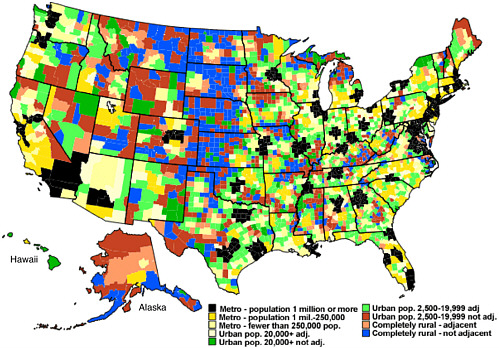
The ERS has developed two other types of measurements for population comparisons—the rural–urban continuum codes and the urban influence codes. The rural–urban continuum codes (see Figure B-1) are used to distinguish metropolitan counties by size and nonmetropolitan counties by their degree of urbanization and adjacency to metropolitan areas. Metropolitan areas can measure more than 1 million or less than 250,000, and nonmetropolitan codes range from +20,000, adjacent to a metropolitan area, to completely rural, or <2,500 not adjacent.
TABLE B-1 Methodologies Used to Define Rural Areas
|
|
Bureau of the Census Population Density |
OMB Metropolitan, Micropolitan,a and Noncoreb Statistical Areas |
|
Methodology |
Population density measured in units smaller than the county level. |
Metropolitan and micropolitan areas measured at the county level. |
|
Application |
More detailed measurement and analysis of the local community. |
Assesses the extent to which a large city’s economic influence extends beyond its limit. |
|
Urban/Metro Definition |
Urbanized areas (UAs) include a central city and surrounding densely settled areas of at least 2,500 population that together have a population of 50,000 or more and a population density exceeding 1,000 per square mile. Urban clusters include freestanding towns of 20,000–49,000, 10,000–19,000, 2,500–9,999. Definitions applied in year 2000. |
Core-based statistical areas (CBSAs) include metropolitan and micropolitan areas. Each metropolitan CBSA must have at least one UA of 50,000 population or more. Micropolitan CBSAs must have at least one urban cluster of 10,000–49,999. Nonmetropolitan areas can include micropolitan areas and noncore areas (what is thought of as rural). Definitions applied in year 2000. |
|
IOM Determinations of Rural for This Report |
Rural areas are considered those with 2,500 or less population. |
Noncore nonmetropolitan areas outside metropolitan CBSAs. |
|
Economic Research Service Rural–Urban Continuum Codes |
Economic Research Service Urban Influence Codes |
|
Rural–urban continuum codes measured by county. |
County-based measurements that are more subdivided than the continuum codes. |
|
Evaluates urbanization and adjacency to metro areas using a nine-tiered system. |
Evaluates status according to micropolitan and noncore status using a 12-tiered system. |
|
Metro counties –counties in metro areas of 1 million or more, –counties in metro areas of 250,000–1 million, and –counties in metro areas of fewer than 250,000. |
Metro counties –counties in large metro area of 1 million or more, and –counties in small metro areas of <1 million. |
|
Nonmetropolitan counties –urban population of 20,000+, adjacent to metro area, –urban population of 20,000+, not adjacent to metro area, –urban population of 2,500–19,999, adjacent to metro area, –urban population of 2,500–19,999, not adjacent to metro area, –completely rural or less than 2,500 urban population, adjacent to metro area, and –completely rural or less than 2,500, not adjacent to metro area. Definitions applied in year 2003. |
Nonmetropolitan counties –micropolitan counties adjacent to large metro areas, –noncore counties adjacent to large metro areas, –micropolitan counties adjacent to small metro areas, –noncore counties adjacent to small metro areas, –noncore counties adjacent to small metro areas with own town, –micropolitan counties not adjacent to a metro area, –noncore counties adjacent to a micropolitan area with own town, –noncore counties adjacent to a micropolitan area with no own town, or micropolitan area with own town, and –noncore counties not adjacent to a metro or micropolitan area with no own town. Definitions applied in year 2003. |
|
Can be considered codes 8 and 9. |
Can be considered codes 11 and 12. |
|
|
Bureau of the Census Population Density |
OMB Metropolitan, Micropolitan,a and Noncoreb Statistical Areas |
|
Rural Population Percentages |
Rural population = 59 million, 21 percent of total population. |
Noncore nonmetropolitan population = 22.1 million, 8 percent of total population. |
|
Frontier Population |
Not applicable |
Not applicable |
|
a Micropolitan is defined using OMB’s designation of urban clusters (counties that have a town of at least 10,000). Outlying counties are included if commuting to the central county is 25 percent or higher. Any nonmetropolitan area with an urban cluster becomes the central county of a micropolitan area. b Noncore counties are not near an urban cluster of 10,000 or more. |
||
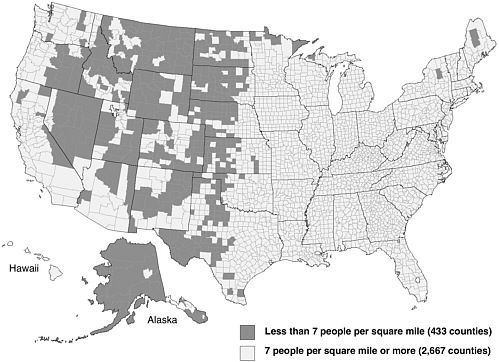
“Frontier areas,” a term used mainly by rural health and agriculture officials, are considered the most thinly settled counties, with population densities of fewer than seven households per square mile. Figure B-2 provides an overview of frontier areas. About 383 counties have frontier-level density and are near a small metropolitan area or cluster of 10,000–49,999.
POPULATION CHANGE
During the period of economic prosperity from 1990 to 2000, 30 percent of all nonmetropolitan counties experienced population growth of 13.1 percent or more (Beale and Cromartie, 2004). The growth was due to two dynamics: (1) increases in commuting to jobs in suburban/urban/metro areas by many long-term rural residents in terms of both frequency and distance of commutes; and (2) increases in the numbers of urban residents moving to the country and small-town locations to have lower housing costs or to live in less congestion. While population growth generally strengthens the local economy, it also increases demand for health services. As discussed in other parts of this report, most rural areas lack an adequate health care
|
Economic Research Service Rural–Urban Continuum |
Economic Research Service Codes Urban Influence Codes |
|
Nonmetropolitan rural population (codes 8 and 9) = 5.2 million, 1.8 percent of total population. |
Nonmetropolitan rural population (codes 11 and 12) = 3.2 million, 8.1 percent of total population. |
|
Although the rural–urban continuum codes and urban influence codes do not include parameters for frontier areas, the USDA ERS uses the following definition for measurements: frontier areas = 7 households per square mile. |
|
|
Frontier population = 2.9 million,c 1.0 percent of total population. |
|
|
c Calculations are based on the county’s average density per square mile, and in some cases the county may contain a small town. Methods for measuring solely those living in frontier areas of <7 households per square mile (rather than averages of county statistics) are being developed at this time. SOURCE: ERS, 2003a; FR, 2000. |
|
infrastructure to meet the needs of their current population, let alone their projected future population assuming current growth trends continue.
A significant geographic trend is the decline in population in nonmetropolitan counties of the Great Plains from the Canadian border to south Texas, with a continuing high dependence on agriculture. These areas have experienced prolonged outmigration of young adults, resulting in higher proportions of older people and increasing problems with access to medical services. About 313 counties have no urban settlement of 10,000 or more and are not adjacent to a county having such a place. The population density averages 4.2 persons per square mile. These residents experience the core of the rural medical access problems related to scale of settlement discussed in this report. Some hospitals and pharmacies have closed, and residents are more distant from physicians, with less choice of providers.
Persistent decline is also found in parts of the lower South where there is a significant population of African Americans or there has been a major drop in coal mining jobs. The populations in parts of the Allegheny and Cumberland Plateaus have declined as well because of sustained losses in the manufacturing sector.
AGE DISTRIBUTION
The age distribution and level of rurality of a county influence the health status and health care needs of its population (Gamm et al., 2002; NCHS, 2001). Since the 1960s, the age structure of the population in a geographic area has tended to become older as urbanization has decreased (Beale and Cromartie, 2004; CMS, 2004). This upward urban–rural gradient for those aged 65+ is present in all regions (but steepest in the Midwest and South) and is due to changes in migration patterns—that is, retired persons migrating into rural areas, coupled with a half-century of younger persons migrating out of rural areas.3 According to the ERS, 315 rural counties experienced a rise in their older population (aged 60+) by 15 percent or more as a result of net migration alone during the 1990s (NCHS, 2001). By 2000, this amounted to 24+ percent of the population seeking rural counties as retirement destinations (see Figure B-3). Aside from migration, the overall growth in the older population from 1990 to 2000 was 7.4 percent (Personal communication, C. Beale, June 1, 2004). The growth rate of the older rural population is expected to be quite high over the next 20 years as the baby boomers move into retirement age.4
This increasing age trend has significant implications for health care needs. As noted in this report, older people have a higher incidence of chronic conditions, and many have multiple such conditions (Anderson and Horvath, 2002). Residents in rural areas experience higher rates of limitations in daily activities5 as a result of their chronic conditions—activity limitation levels are about 20 percent in rural individuals compared with 13 percent for their urban counterparts (NCHS, 2001). Effective management of chronic conditions requires ongoing access to a multidisciplinary team of providers, including primary care providers, specialists, pharmacists, health educators, and social workers. As discussed in Chapter 4, many rural communities struggle to attract and retain an adequate health professions workforce to meet the needs of their population.
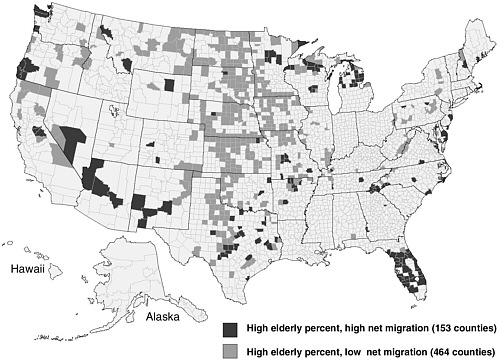
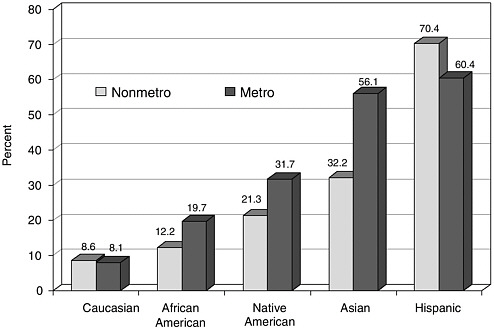
FIGURE B-4 USDA Economic Research Service: Population grouth rates by race and ethnicity, nonmetro and metro areas, 1990–2000.
SOURCE: Compiled by ERS from 1990 and 2000 Census data, U.S. Census Bureau.
Although the overall trend in most rural communities has been toward a higher age distribution, certain rural areas did experience a rebound of younger people in the 1990s (PRB, 1999). This may mean that raising families in these areas has growing appeal. Rural communities experiencing these trends will need to ensure an adequate supply of primary care, obstetric, pediatric, and emergency services.
RACIAL AND ETHNIC TRENDS
Minority groups are also a growing proportion of rural and small town populations, particularly among children and younger, working-age adults. Figure B-4 provides an overview of the population growth rates by race and ethnicity in metropolitan and rural areas from 1990 to 2000. For the 2000 census, 10.2 million rural residents identified themselves as belonging to racial or ethnic groups—a 30 percent increase over the last decade (Census, 2003b). In particular, 16 percent belong to one of three primary groups—African American, American Indian/Alaska Native, or Hispanic—while 2 percent belong to the Asian/Hawaiian/Pacific Islander group or some other
group, or consider themselves multiracial. Of the primary groups, 43 percent live in 356 counties where they constitute one-third or more of the population.
African Americans are well distributed across the South’s lowland districts from southern Maryland through Louisiana. Although the 1990s brought gains in education and income, many difficulties persist for African American residents, who are predominately lower-income (e.g., lack of transportation, lack of affordable health care, poor housing). Native Americans are clustered in the northern High Plains, the Four Corners region in the Southwest, and Alaska. Counties in the first two regions contain reservations on which Native Americans are exercising greater economic and political control; however, poverty and unemployment remain high. For Alaska Natives, low population density and isolation from major population centers severely limit economic development prospects and increase health care delivery costs. High population concentrations of rural Hispanics remain in counties along the Rio Grande Valley, from the headwaters in southern Colorado to the Gulf of Mexico; however, about 50 percent now live outside the Southwest. Growing geographic dispersion has increased rural racial/ethnic diversity in all regions, particularly the Midwest and Southeast.
Generally, rural counties with high minority populations show signs of economic disadvantage. Minorities often live in isolated communities or neighborhoods where poverty is high, opportunity is low, and economic benefits from education and training are limited. Many who acquire education or technical skills must apply them elsewhere. Because of their socioeconomic status, minority groups tend to rely heavily on safety net services supported by federal and state programs, and resources for these programs are often inadequate (Rosenblatt, 2000).
While minority groups have many commonalities, some groups have distinct health care needs. By the end of the 1990s, Hispanics accounted for over 25 percent of the population growth in rural counties, with their population ranging from 8 percent in the Midwest to 18–29 percent in other rural regions (ERS, 2004). A large percentage of rural Hispanics work in agriculture as relatively low-paid, seasonal or part-time farm laborers, and many are uninsured (Ricketts, 1999). Hispanics also tend to have higher fertility levels, lower median ages, and larger household sizes (with more children and fewer elderly) (Beale and Cromartie, 2004). Rural communities with large populations of Hispanics need to ensure the availability of safety net programs that provide primary care and obstetric and pediatric services, and can address language and literacy barriers.
INCOME AND EMPLOYMENT
Income level and type of employment determine socioeconomic status and have a significant influence on the health status of rural residents. The predominance of lower-wage jobs, limited availability of year-round work, and less education in rural regions leave individuals and communities at an economic disadvantage, and frequently without health insurance or income to spend on health care. Thus, they are less likely to receive the health care they need to prevent and/or manage health conditions. The result is poorer outcomes and often higher long-term health care expenditures (IOM, 2002).
Rural areas are falling behind in the new economy. Job growth in rural counties fell below that in urban areas in 1995 and has been substantially lower (at 1 percent) ever since (Zhang and Bowman, 1998). Today, only a small portion of the rural population, 5.7 percent, is directly employed in agriculture—once the livelihood of rural America. Industries that are important to the rural economy include the public sector, supplying 22 percent of earnings; consumer services (e.g., retail and personal services, private health and education services), also supplying 22 percent; manufacturing at 19 percent; and producer services (related to agriculture and fisheries) at 11.5 percent (ERS, 2003c). Bureau of Economic Analysis data also indicate significant growth in the finance, insurance, and real estate sector and the construction sector (ERS, 2002). As of third quarter 2003, the seasonally adjusted unemployment rate for rural areas was 6 percent—a rate that urban areas have reached with unemployment rising regularly since 2000 (ERS, 2003a).
Estimates of the median nonmetropolitan household income from 1996 to 2001 average $34,135, nearly one-fourth below the average for metro areas of $45,938 (Census, 2003a).6 For the same period, the poverty rate grew by 20 percent over that in the 1990s in 444 nonmetropolitan counties7 (e.g., the poverty rate is annual income <$16,895 for a family of two adults and two minor children).8 In 2000, a total of 494 counties had poverty levels of
20 percent or more; of these, 422 were in rural areas and 72 in urban. Consistent poverty over four consecutive censuses from 1970 to 2000 was most prevalent in 386 counties—340 in rural areas and 46 in urban (Personal communication, C. Beale, June 2, 2004). For both urban and rural areas, the most extensive poverty was among 43 percent of female-headed single-parent households with children under 18. Poverty was less frequent among older adults (13 percent) than among children (17 percent).
Lower-income individuals consistently have a higher incidence of health problems. Among families earning less than $20,000 in income in 2001, 25 percent reported some limitation in “usual activities” stemming from health problems, compared with just 6.3 percent among persons in families with more than $55,000 in income (NCHS, 2001). Because the demographics of income and employment have close ties to the demographics of ethnic and racial groups, individuals in these conditions are similarly and disproportionately dependent on publicly provided health care safety net services.
Even lower-income individuals who are working often lack health insurance (IOM, 2004). As the cost of health insurance continues to increase, more and more employers, especially small and medium-sized ones, choose to provide no or only minimal health insurance benefits to their employees. Methods must be found to assist small and medium-sized employers in obtaining affordable health insurance. In addition, employers need to become more engaged in providing their employees with resources for health/ wellness education and disease management programs, perhaps through partnerships with other local community organizations to share resources.
EDUCATION AND LITERACY
Sizable gains in higher levels of education are being realized in rural areas: 77 percent of rural residents have graduated high school or acquired a General Educational Development (GED) credential,9 and rural school children are performing about as well as county central city children on standardized tests (Ricketts, 1999); however, both rural and central city children still lag behind suburban children on most indicators. Rural schools have some advantages—smaller sizes; more cooperative relationships among teachers, parents, and community organizations; and lower student–teacher
ratios. However, they also have several disadvantages—fewer advanced course offerings, less attention to college preparation, lower college graduation rates, inadequate physical and educational resources, and higher dropout rates (Marshall, 2004).
Weaknesses in the school curriculum have been an impediment to attracting families with young children to move to or remain in rural communities despite the lower cost of living. Rural high schools offer fewer vocational educational programs than their nonrural counterparts. Rural schools focus on common basic programs (e.g., accountant/bookkeeping and secretary/administrative assistant) and traditional rural programs (e.g., the building trades, welding, and agriscience) (NCES, 2002). They are less likely to offer programs in health and life science occupations, computers and electronics, or paralegal training, all of which are essential for building not only the health care infrastructure, but also the local economy and community resources. To move forward, rural schools must place greater emphasis on preparing students for the knowledge-based economy by enhancing math and science curricula in both grade school and high school, providing advanced placement classes, expanding vocational training programs, and preparing students for college. Enhanced math and science preparation is critical to preparing rural students to pursue careers in the health professions.
The major gap between rural and urban areas today is in college education (see Table B-2): 15.5 percent of rural adults have a 4-year college degree, compared with 26.6 percent of metro adults. About 41 percent of rural residents have completed 1 or more years of schooling beyond high school, indicating an initial interest in and motivation for higher education.
Demographic and geographic characteristics10 strongly influence college attainment in rural areas, while the status of the local economy affects whether those with a college degree remain in the community given the smaller proportion of jobs that require advanced education.11 Rural communities need to fully leverage the availability of local colleges and universities by enhancing their role in bridging the gaps in educational opportuni-
TABLE B-2 USDA Economic Research Service: Educational Attainment, 2000
|
Characteristic |
Less Than High School |
High School Graduate |
Some College |
College Graduate |
||||
|
Geographic Status |
Na |
Mb |
N |
M |
N |
M |
N |
M |
|
African American |
31.9 |
19.0 |
40.2 |
34.8 |
20.2 |
28.4 |
07.9 |
17.9 |
|
Hispanic |
51.8 |
42.2 |
27.3 |
27.6 |
15.1 |
18.5 |
05.9 |
11.6 |
|
Native American |
27.7 |
18.8 |
38.9 |
32.7 |
25.0 |
32.6 |
08.4 |
16.0 |
|
Caucasianc |
16.7 |
10.0 |
40.8 |
31.7 |
25.1 |
26.8 |
17.4 |
31.5 |
|
a N = nonmetropolitan. b M = metropolitan. c Non-Hispanic white population. SOURCE: Calculated by C. Beale at ERS using data from the 2000 census of the population. |
||||||||
ties for rural students and in lifelong learning for adults. For example, a community college could offer associate degrees in nursing and computer science, and the two departments could develop a partnership to establish an education and support center for local providers implementing health information and communications applications, and for local residents who would like to learn how to use self-care monitoring devices and/or participate in online disease management programs.
Local colleges could also partner with local community libraries to provide residents with a resource for general adult literacy programs, health literacy programs (e.g., locating and understanding health information), and means of overcoming language barriers. A 1993 study by the Rural Clearinghouse for Lifelong Learning and Development found that rural residents account for 42 percent of the functionally illiterate in the United States (based on self-reports on grade level completion).12 Those at the lowest
literacy levels had an eighth-grade education or less, and were more likely to be older (over age 65), disabled, or a member of a minority group (e.g., African American, Native American, Hispanic, Asian or Pacific Islander). Improving local resources to help those with low literacy skills is critical to supporting individuals’ ability to understand their health conditions and their role in their treatment plans.
THE DIGITAL DIVIDE
Individuals and communities can no longer grow with the new knowledge-based economy unless they have access to modern high-speed telecommunications networks, computer systems, and the Internet to facilitate their personal and business needs. The knowledge-based economy is changing the way businesses operate and the skills required of the labor force. Likewise, knowledge-based systems are transforming the ways in which individuals can manage their personal needs, including health care.
Nationally, however, a digital divide exists between rural regions and urban communities (Bell et al., 2004). This divide is exacerbated by higher rural infrastructure costs and lower average wages, which generally limit the penetration of new information technologies. Rural areas have less access than urban to digital subscriber line (DSL) and cable modem services, which provide the greater bandwidth needed for many health care applications (see Chapter 6) (Allen, 2001). This aspect of the digital divide is one of the greatest challenges for rural telehealth and other rural commerce.
Internet penetration rates have historically been lower in rural areas (52 percent of the population) than urban (67 percent) or suburban areas (66 percent), but have continued to increase in all geographic areas over time (Bell et al., 2004). The lower penetration rates coincide with the demographic patterns of rural areas—lower-income people, older people, and minorities exhibit lower rates of Internet usage.13 Internet users in rural areas keep pace with those in other areas: 45 percent of rural Internet users access the Internet daily, versus 40 percent for urban and 46 percent for
suburban. Compared with their suburban and urban counterparts, rural users are less likely to bank, buy a product, or make a travel reservation online, but they are more likely to look for religious/spiritual information online.
Chapter 6 provides recommendations for increasing rural access to information and telecommunications technology. To encourage their use of the Internet for health purposes, many rural residents will need guidance and assistance in learning how to use computers and disease management databases, search for information appropriate to their level of education, and use other applications. It is imperative that rural communities develop these resources for their populations—perhaps in the form of community telecenters that might be associated with public libraries and local colleges. Understanding and being able to use the Internet for health communications and information retrieval will have a significant impact on access to and the quality of health care services for rural residents, and more important, is necessary for self-care and disease management in the knowledge-based economy.
HEALTH INSURANCE
Against a background of federal and state initiatives to extend health insurance, the proportion of people under 65 without health insurance grew over the period 1987–2002, from 13.7 percent in 1987 to 17.2 percent in 2002 (IOM, 2004). Moreover, despite a favorable economic climate in the 1990s, the uninsured population grew by more than 6 million during the decade. Even at the height of this prosperous period, the number of uninsured dropped by less than a million. In 2000, the uninsured rate began to grow again, and by 2003 there were 43.3 million uninsured people under age 65 (IOM, 2004).
Location is an important factor in rural uninsurance rates. A 2003 report by the Kaiser Commission on Medicaid and the Uninsured notes that (using 1998 data) 24 percent of individuals living in rural, nonadjacent counties are uninsured, compared with 18 percent for urban areas (Ziller et al., 2003). Although they are 50 percent more likely to have Medicaid coverage than residents in urban counties, it is not enough to compensate for the lower private coverage. Two-thirds of the uninsured are low-income families (less than 200 percent of the federal poverty level), and 30 percent are children (Ziller et al., 2003). The result is added pressure on the local health care services in these most rural counties to act as safety net providers. Differences in uninsurance rates between urban counties and those ru-
ral counties adjacent to urban counties, as well as between urban and larger nonadjacent counties, were found not to be statistically significant. Health insurance disparities associated with rural residence were found to be related to the structure of employment—specifically smaller employers, lower wages, and greater prevalence of self-employment.
REFERENCES
Allen KC. 2001. Advanced Telecommunications in Rural America. [Online]. Available: http://www.its.bldrdoc.gov/tpr/2000/its_t/adv_tele/adv_tele.html [accessed July 7, 2004].
Anderson G, Horvath J. 2002. Chronic Conditions: Making the Case for Ongoing Care. Baltimore, MD: Johns Hopkins University and The Robert Wood Johnson Foundation.
Beale C, Cromartie J. 2004 (February). Profile of the Rural Population. Commissioned Paper for the IOM Committee on the Future of Rural Health Care. Washington, DC.
Bell P, Reddy P, Raine L. 2004. Rural Areas and the Internet. Washington, DC: Pew Internet and American Life Project.
Census (Bureau of the Census). 2003a. Income in the United States, 2002: Current Population Reports. Washington, DC: U.S. Bureau of the Census.
Census. 2003b. 2000 Census of Population and Housing: Summary Social, Economic, and Housing Characteristics. [Online]. Available: http://www.census.gov/census2000/pubs/phc-2.html [accessed June 29, 2004].
CMS (Centers for Medicare and Medicaid Services). 2004. Fact Sheet: Rural Health Clinics. [Online]. Available: http://www.cms.hhs.gov/medlearn/rhcfactsheet.pdf [accessed June 30, 2004].
ERS (Economic Research Service). 2002. Rural America. Washington, DC: Economic Research Service. P. 16.
ERS. 2003a. Measuring Rurality: Urban-Rural Continuum Codes. [Online]. Available: http://www.ers.usda.gov/Briefing/Rurality/RuralUrbCon/ [accessed November 4, 2004].
ERS. 2003b. Rural Employment and Unemployment. [Online]. Available: http://www.ers.usda.gov/Briefing/LaborAndEducation/employunemploy/ [accessed March 24, 2004].
ERS. 2003c. Rural Industry: Which Industries Are Most Important to Rural America? [Online]. Available: http://ers.usda.gov/Briefing/Industry/importantindust/ [accessed June 29, 2003].
ERS. 2004. Rural Hispanics: Employment and Residential Trends. [Online]. Available: http://www.ers.usda.gov/Amberwaves/June04/Features/RuralHispanic.htm [accessed June 25, 2004].
FR (Federal Register). 2000. Standards for Defining Metropolitan and Micropolitan Statistical Areas. Washington, DC: Office of Management and Budget.
Gamm L, Hutchison L, Bellamy G, Dabney B. 2002. Rural healthy people 2010: Identifying rural health priorities and models for practice. Journal of Rural Health 18(1):9–14.
IOM (Institute of Medicine). 2002. Care Without Coverage: Too Little Too Late. Washington, DC: The National Academies Press.
IOM. 2004. Insuring America’s Health: Principles and Recommendations. Washington, DC: The National Academies Press.
Marshall R. 2004. Rural Policy in a New Century. [Online]. Available: http://www.kc.frb.org/PUBLICAT/beyond/RC00Mars.pdf [accessed May 24, 2004].
NCES (National Center for Education Statistics). 2002. Issue Brief: Vocational Education Offerings in Rural High Schools. [Online]. Available: http://nces.ed.gov/pubs2002/2002120.pdf [accessed May 24, 2004].
NCHS (National Center for Health Statistics). 2001. Health, United States, 2001 with Urban and Rural Health Chartbook. Washington, DC: U.S. Department of Health and Human Services.
OMB (Office of Management and Budget). 2000 (December 27). Standards for Defining Metropolitan and Micropolitan Statistical Areas. [Online]. Available: http://www.census.gov/population/www/estimates/00-32997.pdf
PRB (Population Reference Bureau). 1999. The Rural Rebound. [Online]. Available: http://www.prb.org/Content/NavigationMenu/PRB/AboutPRB/Reports_on_America/ReportonAmericaRuralRebound.pdf [accessed May 2004].
Ricketts TC. 1999. Rural Health in the United States. New York: Oxford University Press.
Ricketts TC. 2000. The changing nature of rural health care. Annual Review of Public Health 21(1):639–657.
Rosenblatt R. 2000. The health of rural people and the communities and environments in which they live. In: Geyman JP, Norris TE, Hart GL, eds. Textbook of Rural Medicine. New York: McGraw-Hill. Pp. 3–14.
Zhang W, Bowman A, Mueller K. 1998. Rural/Urban Definitions: Alternatives and Numbers by State. Omaha, NE: Nebraska Center for Rural Health Research, University of Nebraska Medical Center.
Ziller E, Coburn A. 2003. Health Insurance Coverage of the Rural and Urban Near Elderly. Portland, ME: Maine Rural Health Research Center, University of Southern Maine.


