
1
Background on CLIVAR and the U.S. CLIVAR Project Office
As studies on global climate variability and change continue to evolve and a greater appreciation of the effects of climate variations on society and the environment has developed, the demand for faster, more comprehensive, and accurate predictions of climate variations is greater than ever before. Consequently, efforts have increased to coordinate climate research intra-nationally and internationally. The World Climate Research Programme (WCRP), established in 1980, serves as a focal point for research on Earth’s physical climate system; its objectives are to increase fundamental scientific understanding, to determine to what extent climate can be predicted, and to ascertain the extent of human influence on climate. These objectives are pursued via several wide-ranging regional and disciplinary core projects (Box 1.1). Among them is Climate Variability and Predictability (CLIVAR), a program with both international and U.S. components that was established to improve understanding of and skill in predicting climate variability on seasonal to centennial time scales.
|
BOX 1.1 The wide-ranging, multi-disciplinary science strategy of the WCRP is reflected in its core projects:
|
SCIENCE AND RESEARCH GOALS OF INTERNATIONAL AND U.S. CLIVAR
International CLIVAR
Planning of International CLIVAR began in 1993. The project commenced in 1995, and it is anticipated to continue beyond 2010. CLIVAR was established based on the success of the Tropical Ocean Global Atmosphere (TOGA) project and the progress of the World Ocean Circulation Experiment (WOCE) for advancing scientific understanding of the ocean and atmosphere-ocean interactions. It also was based on the research needs expressed in the Intergovernmental Panel on Climate Change (IPCC) scientific assessment reports. CLIVAR was conceptualized as a follow-on project for continuing the study of ocean dynamics and coupled ocean-atmosphere dynamics as they relate to climate (WCRP, 1995). As defined by the CLIVAR Science Plan, the objectives of CLIVAR are to:
-
describe and understand the physical processes responsible for climate variability and predictability on seasonal, interannual, decadal, and centennial time-scales through the collection and analysis of observations and the development and application of models of the coupled climate system in cooperation with other relevant climate-research and observing programs;
-
extend the record of climate variability over the time-scales of interest through the assembly of quality-controlled paleoclimatic and instrumental data sets;
-
extend the range and accuracy of seasonal to interannual climate prediction through the development of global coupled predictive models; and
-
understand and predict the response of the climate system to increases of radiatively active gases and aerosols and to compare these predictions to the observed climate record in order to detect the anthropogenic modification of the natural climate signal.
These objectives are compartmentalized into three main threads of research based on the various timescales and catalysts of climate change:
-
Global Ocean-Atmosphere-Land System (GOALS), which focuses on seasonal to interannual climate variability and predictability of the global ocean-atmosphere-land system;
-
Decadal to Centennial Climate Variability (DecCen), which focuses on the mechanisms of climate variability and predictability on decadal to centennial time scales with a special emphasis on the role of the oceans in the global coupled climate system; and
-
Anthropogenic Climate Change (ACC), which focuses on the response of the climate system to anthropogenic climate change.
Through these areas of research, the International CLIVAR Project aims to help understand the physical processes that are responsible for climate variability on all time scales through the collection and analysis of observations by using coupled climate system models in cooperation with other climate research and observing programs. Focus also is given to extending existing climate records by using quality controlled paleoclimate and instrumental data sets.
The International CLIVAR Project Office
The planning, oversight, and coordination of International CLIVAR are the responsibility of the CLIVAR Scientific Steering Group (SSG), which is appointed by and reports to the Joint Scientific Committee of the WCRP. To facilitate its work, the SSG has many subcommittees and panels which
address various aspects of the CLIVAR program (Figure 1.1). The SSG is supported by a permanent International CLIVAR Project Office (ICPO) consisting of nine full- and part-time staff, which equates to 6.5 full-time equivalent staff per year. The specific tasks of the ICPO include (1) developing the CLIVAR Implementation Plan and its subcomponents; (2) developing a data management system for CLIVAR; (3) supervising the international coordination and execution of the Implementation Plan; (4) establishing CLIVAR working groups and panels and organizing annual meetings for these groups; (5) publishing meetings reports and other relevant material; (6) representing the CLIVAR program at scientific conferences and other international fora via scientific presentations and exhibitions; (7) distributing information and recommendations to international, national, and regional sponsors and funders of CLIVAR-related research; and (8) distributing relevant scientific information to the CLIVAR community.
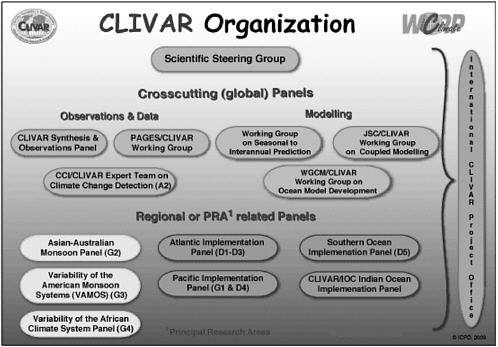
FIGURE 1.1 Organizational structure of International CLIVAR. SOURCE: International CLIVAR Project Office
U.S. CLIVAR
Planning for the U.S. CLIVAR program was initiated through the GOALS and Natural Climate Variability on DecCen Time Scales panels of the National Research Council (NRC, 1995; 1998). In 1998, program managers from the Department of Energy (DOE), National Aeronautics and Space Administration (NASA), National Oceanic and Atmospheric Administration (NOAA), and National Science Foundation (NSF) began meeting as an Interagency Group (IAG) to coordinate and promote national interest in CLIVAR. The IAG appointed a Scientific Steering Committee (SSC) to provide scientific guidance, recommend priorities and the evolution of U.S. CLIVAR activities, and maintain balance among the various elements of the program (WCRP, 1998). For more information about the IAG and SSC, including their membership, terms of reference, and interaction, see Appendix B. Based on the U.S. inputs to international plans and national research interests, the SSC developed a position paper for
the International CLIVAR Conference in 1998 that outlined the aspects of CLIVAR of interest to the United States. In a subsequent plan describing the implementation of U.S. CLIVAR, the program objectives are presented, reflecting the U.S. science community’s judgment of the important issues as well as the readiness and means for the United States to contribute to the overall CLIVAR program. The U.S. CLIVAR objectives are outlined as (WCRP, 2000):
-
identifying and understanding the major patterns of climate variability on seasonal, decadal, and longer time scales and evaluating their predictability;
-
expanding our capacity in short term (seasonal to interannual) climate predictability and searching for ways to predict decadal variability;
-
better documenting the record of rapid climate changes and the mechanisms for these events, and evaluating the potential for abrupt climate changes in the future;
-
evaluating and enhancing the models used to project climate change due to human activity, including anthropogenically induced changes in atmospheric composition; and
-
detecting and describing any global climate changes that may occur.
The U.S. CLIVAR program primarily is focused on studying and improving understanding of regional and global natural climate variability. In general, this is done by improving the instrumental record and observing system; applying and experimenting with models; conducting empirical studies of the climate record from instruments, long-term records, and model simulations; and coordinating regional and process field studies.
The U.S. CLIVAR program has several regional and disciplinary implementation panels and working groups (Figure 1.2), each of which has its own terms of reference for conducting research and advising the SSC about its respective sector.
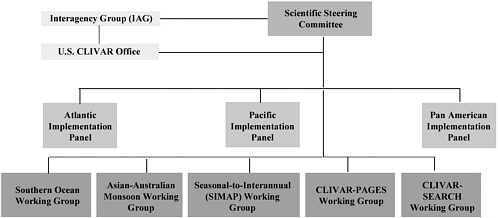
FIGURE 1.2 Organizational structure of U.S. CLIVAR. SOURCE: U.S. CLIVAR Project Office.
The U.S. CLIVAR Project Office
In early 2000, NASA, NOAA, and NSF established a U.S. CLIVAR Project Office (USCPO) to facilitate the functioning of the U.S. CLIVAR program and its relationship with International CLIVAR activities (see Appendix B for information about the relationship of the USCPO with the SSC and IAG).
For the majority of its existence, the USCPO consisted only of one full-time staff person. An additional person joined the USCPO part-time in 2002, but only for about 10 months. Then, in early 2004, another person joined the USCPO part-time. With its current staff consisting of only one full-time and one part-time personor the equivalent of 1.8 people per yearthe USCPO is considerably smaller than the ICPO. The USCPO also receives some additional support from the University Corporation for Atmospheric Research-Joint Office for Science Support (UCAR-JOSS), which provides employment, logistical (e.g., for meetings), and contractual (e.g., hotel bookings) assistance.
Despite its small size, the USCPO is the coordinating entity that maintains the U.S. CLIVAR infrastructure overall. NASA, NOAA, and NSF support and oversee the USCPO to ensure that it is adequately fulfilling its intended purpose. The core functions of the USCPO were defined at its inception by the agencies, and they were conveyed as part of the appointment letter to the director when he was hired. Although the USCPO’s efforts vary based on the needs of the U.S. CLIVAR program, the terms of reference under which it operates are defined generally as follows:
-
U.S. CLIVAR program development, including preparing scientific plans and other documents on behalf of the SSC, developing and conducting scientific workshops, and preparing resulting publications;
-
staffing and support for the SSC, including building and overseeing on-site staff as required to accomplish the goals of the office, overseeing the coordination of SSC meeting and travel support for university participants, providing staffing and authorizing travel support for U.S. representatives at international CLIVAR meetings through UCAR, and supporting subcommittees and working groups of U.S. CLIVAR;
-
support for the U.S. CLIVAR IAG, including coordinating budgets between different agencies supporting CLIVAR and assisting in the drafting of interagency program announcements as requested by the IAG, sometimes preparing budget assessments and program tracking for the many U.S. CLIVAR activities sponsored by these agencies, and analyzing current funding trends within the CLIVAR community and providing the interagency group with advice as to areas of focus;
-
international and national program coordination, including serving as the U.S. point of contact for the ICPO and its subpanels, coordinating the U.S. component of international scientific conferences and field experiments, and organizing joint activities with the Global Energy and Water Cycle Experiment (GEWEX) and other relevant CCSP and WCRP programs;
-
publicity and publications, including writing articles and publications describing U.S. CLIVAR, overseeing development and maintenance of the U.S. CLIVAR web site, producing newsletters and annual reports, and giving presentations regarding the status of U.S. CLIVAR science and program activities; and
-
support for the National Research Council (NRC) interface, including preparing documents and briefing materials for the NRC Climate Research Committee, which is the U.S. CLIVAR’s oversight body.
The typical total annual budget provided to the USCPO by NASA, NOAA, and NSF to conduct its tasks is approximately $860K. Of this, approximately $250K is used to support travel to meetings, workshops, and conferences for the USCPO staff, SSC members, members of U.S. panels and working groups, and U.S. members of International CLIVAR committees; $200K goes directly to the ICPO to support them; $100K is for producing publications (e.g., newsletters, panel and working group meeting reports, implementation plans) and for conducting meetings; $110K is for overhead costs; and the remaining $200K pays the salaries and benefits of the USCPO staff as well as the salaries of the JOSS staff when they provide meeting support. Although $860K seems an adequate budget on the surface, over half of the funds are earmarked for other purposes (i.e., $250K for travel support, $200K for the ICPO). Therefore, when considering that overhead costs are not discretionary, the USCPO effectively operates on an annual budget of approximately $300K. The USCPO’s budget has evolved along with the U.S. CLIVAR program and as the tasks of the USCPO have changed.
PURPOSE OF THE REVIEW OF THE USCPO
The IAG requires an expert, external review of the USCPO every five years to ensure that it is adequately conducting its tasks and to assess its continued funding. With approval from the other IAG members, NSF commissioned the National Research Council to conduct this first review of the USCPO. The specific charge to the committee was to ask questions such as:
-
Is the USCPO effectively gathering and communicating information about U.S. and International CLIVAR in a timely and effective manner (e.g., is the USCPO reaching the appropriate communities of scientists and administrators)?
-
Is the content of information (e.g., range of topics) appropriate? Is the frequency of communication appropriate and is it responsive to specific questions from scientists about CLIVAR?
-
Is the USCPO providing adequate logistical support for oversight and planning activities of the CLIVAR scientific and management communities (e.g., does it adequately serve the logistical and planning needs of the U.S. CLIVAR SSC and its various panels)?
-
Does the USCPO adequately serve the needs of the funding agencies as a central point of information about national and international CLIVAR activities?
-
Does the USCPO adequately represent U.S. CLIVAR interests to the ICPO and other international partners?
In conducting this study, the committee received anonymous input via a web-based questionnaire (Appendix A) and direct input from the current SSC co-chairs2, members of the IAG, the USCPO staff itself, and other relevant parties (Appendix C). Chapter 2 provides the committee’s assessment of the USCPO’s performance stratified by its core tasks as well as some recommendations for improvement, and Chapter 3 provides some overarching thoughts.


