
4
Health
INTRODUCTION
The physical changes that signal the transition from childhood to adulthood are accompanied by changes in opportunities and risks that can profoundly affect health and well-being during adolescence and beyond. Habits acquired during these years can enhance or compromise future health, and choices made about health-related behavior have implications for the entire life course. The importance of health status for the transition to adulthood is clear; it is intimately linked with the probability of making successful transitions in other areas. Healthy individuals make better students, more productive workers, more attractive marriage partners, more active community members, and better parents and caregivers than those who experience poor health. At the societal level, a healthy population is a prerequisite for social and economic development.
After infancy, childhood is a period of relatively slow growth. Suddenly, in adolescence, growth accelerates, perhaps to twice the earlier rate for a year or two, then slows, and finally comes to a stop. Along with the growth spurt of adolescence comes the development of secondary sexual characteristics (Ellison, 2001). In the developing world these changes are occurring earlier in life; consistent evidence from various parts of the developing world shows that the average age at puberty has declined over the last several decades.
The physical growth and sexual maturation during adolescence are accompanied by social, psychological, and intellectual maturation during which individuals develop more abstract reasoning skills, consolidate their
identity, become more independent and emotionally mature. The “cascade of hormonal, physical, psychological, and behavioral changes” (Cameron, 2003) that marks this stage of life inevitably has implications for health. Research over the last few decades has shown that these implications depend, to a great extent, on the social environment (Boyden, Ling, and Myers, 1998; Bronfenbrenner and Morris, 1998). In other words, the transition to healthy adulthood is dependent on the contexts in which it occurs—parents, other family members, peers, teachers, and other significant adults all play an important role, as do the communities in which young people live (Steinberg and Morris, 2001). The significance of context has become clearer in recent research that points to the many ways in which normative views of healthy childhood and adolescence vary across societies and over time (Boyden, Ling, and Myers, 1998; Caldwell et al., 1998).
Across all societies, however, physical and social gender differentiation are key features of this phase of the life cycle. Boys and girls are treated differently from birth onward, but puberty marks the beginning of a widening divide (Mensch, Bruce, and Greene, 1998). After puberty, young men and women’s opportunities and experiences increasingly diverge in ways that are reflective of societal gender norms and expectations, and these differences can have direct implications for young men’s and women’s health as well as for health-related behaviors. While less true than in the past, young women often live more physically circumscribed lives than young men after puberty. Thus they may be relatively more “protected” than young men from some risks, such as dangerous work conditions, violence and military conflict, and road-related accidents, but they face other risks, such as early pregnancy and childbearing and gender-based violence, that are sex-specific. Furthermore, because of their greater “protection,” young women may have fewer opportunities to develop the negotiating skills and the knowledge they need to protect and preserve their health and remain healthy as adults.
This chapter examines the transition to a safe and healthy adulthood in developing countries in the context of a range of rapid global transitions in health patterns and health services. For most individuals, adolescence has always been and remains a relatively healthy period of life. At any phase of the epidemiological transition in which societies experience a decline in the importance of infectious diseases and a rise in the importance of chronic conditions, death rates are at their lowest point from ages 10 to 14 and are often relatively low from ages 15 through 24 as well, particularly in countries in which obstetric care is adequate. The panel’s view of a successful transition to adulthood, however, encompasses a view of health that is broader than survival and in which success includes the best possible mental and physical health and the knowledge and means to sustain health during adulthood.
The health environment in which young people are making the transition to adulthood has been dramatically altered by global epidemiological shifts as well as many other important changes, such as the rising percentage of young people attending school, changes in poverty rates, rapid urban growth, the growing presence of multinational corporations, the spread of global youth culture, technological change and medical advances, greater access to basic health care and family planning services, and growing acceptance of international norms relating to reproductive rights. Many of these changes have brought improvements in the health environment for young people; others have brought new challenges, and some have created greater risks for young people. The distribution of these changes and their implications for young people’s health varies by context. For example, in many settings, schools provide an institutional setting through which various health interventions for young people can be delivered including health education, nutritional supplements, and some basic health care; thus an increase in the percentage of young people attending school has the potential to bring improved health benefits to a greater population of young people. On the other hand, in parts of sub-Saharan Africa where the HIV/AIDS pandemic is widespread, the risks to young people’s health, most particularly young women, have increased substantially. By contrast, in other regions, such as the Middle East and parts of Asia and Latin America, the risks of HIV/AIDS remain relatively low. The aggressive marketing of tobacco products to young people and the increased global availability of illicit drugs present growing risks to young people, particularly in urban settings. Changing levels of violence due to war and civil disturbances are more context-specific but affect young men differentially. At the same time, some health hazards, such as those related to pregnancy and unsafe abortion, continue to disproportionately affect young women in developing countries.
While much of the literature on young people’s health focuses on the problems and risks they face, there is a great deal of evidence that most young people get through the transition to adulthood without developing significant behavioral, social, or emotional difficulties (Barker, 2002; Steinberg and Morris, 2001). Furthermore, while young people may experiment with certain behaviors, such as substance abuse, this does not mean that they will continue to do so as adults. Indeed, during this period many develop positive habits that promote good health and well-being later in life (Call et al., 2002).
Puberty is a key health marker for young people, not just a period of “normative disturbance” as it is sometimes described (Steinberg and Morris, 2001). Puberty changes the way in which a young person is treated by others, increases the salience of sexuality, and introduces various reproductive health risks. It also marks the point at which individuals start to be-
come significant actors in determining their own health. Choices about behaviors that affect health and about the use of health services and technologies are increasingly made by individual young people during this phase of life rather than by parents or other adults.1 The design and implementation of health programs and services for young people can thus have a considerable effect on their health.
This chapter begins with a health profile of young people, which emphasizes the major health issues of this stage of life as well as evidence of recent change. The predominant causes of mortality and morbidity among developing country young people—maternal conditions, HIV/AIDS, and injuries—are given special attention. Because sexual and reproductive health constitute a key component of a healthy transition to adulthood and because they are so strongly linked with other transitions, a substantial section of the chapter is devoted to an examination of trends in various aspects of sexual and reproductive behavior. Data on each topic were carefully evaluated and were not presented unless the panel felt confident that they were the best available and provided a relatively broad comparative perspective.2 The literature on the factors that influence such behavior is also critically reviewed. Levels and trends in risky behaviors with consequences for health, in particular smoking and illicit drug use, are also addressed. Evidence on the effectiveness of programs and policies that seek to improve health and support healthy development among young people is assessed. Finally, a series of policy and research recommendations are offered.
HEALTH PROFILE OF YOUNG PEOPLE
Enormous changes are under way in the health context in which young people in developing countries make the transition to adulthood. While there have been some substantial negative trends—perhaps most strikingly the HIV/AIDS pandemic—positive changes in overall health have clearly outweighed the negative changes. Between 1970-1975 and 1995-2000, life expectancy at birth in the developing world increased 8.6 years, compared with an average of 5.8 years for the same period in high-income countries (United Nations Development Programme, 2001). Although there are considerable differences among regions in the developing world in the magnitude of these improvements, all regions have seen some positive change. Increases in life expectancy at birth have been strongly affected by substantial declines in infant and child mortality rates. However, life expectancy at
|
1 |
It is worth noting, however, that young women in many settings have less control over decisions affecting their health than young men. |
|
2 |
A full discussion of the data is provided in Appendix A. |
age 10 (i.e., among those who survive to age 10) in developing countries also rose by about one year during the 1990s and is projected to continue increasing (United Nations, 2003a).
Improvements in the health environment are important not only for survival chances, but also for overall well-being and productivity. For example, substantial decreases in malnutrition and related nutritional deficiencies have contributed to increasing survival rates in infancy and childhood as well as to improved cognitive and physical development of those entering adolescence (Smith and Haddad, 2000).3 Advances in immunization coverage have reduced the incidence of a range of serious childhood illnesses. Many of the diseases that have contributed substantially to morbidity in developing countries, such as malaria, diarrheal diseases, and respiratory infections, have also been reduced. Furthermore, positive changes in the overall health environment affect productivity both directly and through decisions made in adolescence about investments in human capital. For example, the expected returns to investments in higher education are greater when the number of years of healthy working life increases.
Overall, aside from some countries with very high prevalence of HIV/AIDS, young people in developing countries are entering adolescence healthier than ever and with a better chance of surviving to old age. Moreover, the improving health context will enable young people to live better and more productive lives.
Mortality and Morbidity
Having survived the relatively higher risk of death during childhood and not yet subject to the chronic and degenerative diseases of older adults, individuals are less likely to die between ages 10 and 25 than any other age range (Figure 4-1). In developing countries, the risk of dying between ages 10 and 25 is about 2.5 percent compared with roughly 9 percent between birth and age 10 (United Nations, 2003a). Although mortality rates among young people are low in developing countries, they are still above rates in developed countries by a factor of more than two between ages 10 and 25.
While data for the estimation of trends in mortality in developing countries are scarce and often of dubious quality and comparability (Hill, 2003), United Nations estimates indicate that death rates in the 2000-2005 period were slightly lower than in 1990-1995 for ages 10-25 (Figure 4-1). However, at ages 25 to 35 mortality has increased, a change that is particu-
|
3 |
However, increasing consumption of foods containing fat, cholesterol, and sugar and declines in physical activity are starting to contribute to increasing levels of overweight and obesity in some countries (see the section on other risk behaviors later in the chapter). |
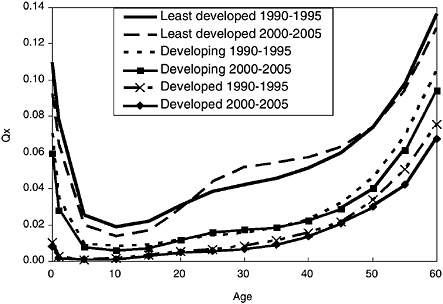
FIGURE 4-1 Probability of dying by age, according to type of country, 1990-1995 and 2000-2005.
SOURCE: United Nations (2001).
larly evident when the 48 least developed countries are examined separately; this is due primarily to the effect of the HIV/AIDS pandemic. The United Nations projects that the improvements over the 1990s among 10-25-year-olds will continue over the coming decade with mortality rates in developing countries moving downward at about the same pace although staying above the rates for developed regions. The AIDS pandemic, however, increases the usual level of uncertainty of these projections.
For developing countries as a whole, the risk of death between ages 10 and 25 is similar for both sexes, with a slightly lower risk for females (Table 4-1). This contrasts with the more developed countries where, while overall mortality risk is much lower, females have a strong survival advantage. In these regions, the female probability of dying between ages 10 and 25 is less than half that for males. This difference in the male-female ratio is due to relatively high levels of maternal and HIV-related mortality among young women in developing countries.
Reliable data on causes of death are rare for developing countries and, internationally comparable data are virtually unavailable for the specific age group of primary interest here (10-24). Nevertheless, the World Health Organization’s (WHO) Global Burden of Disease project provides estimates based on existing data and various modeling techniques that illus-
TABLE 4-1 Probability of Dying Between Age 10 and Age 25 by Country Group, Years, and Sex
|
Region |
1990-1995 |
2000-2005 |
||
|
Males |
Females |
Males |
Females |
|
|
WORLD |
0.028 |
0.024 |
0.025 |
0.021 |
|
Developed regions |
0.014 |
0.005 |
0.012 |
0.005 |
|
Developing regions |
0.031 |
0.028 |
0.027 |
0.024 |
|
Least developed countries |
0.074 |
0.070 |
0.064 |
0.059 |
|
Sub-Saharan Africa |
0.079 |
0.070 |
0.075 |
0.068 |
|
SOURCE: Estimated from United Nations (2003a). |
||||
trate broadly the major causes of mortality in early adulthood (ages 15-29).4 The World Health Organization divides countries by region and level of mortality into groupings that are not exactly comparable to those used above, but countries classified as “low mortality” are roughly equivalent to the developed world, while the “medium” and “high” categories divide the developing countries by level of overall mortality (Figure 4-2).
Table 4-2 demonstrates the extent to which HIV/AIDS has come to dominate the mortality profile of young people in sub-Saharan Africa. By extension, because of the heavy weight of deaths in Africa at these ages, it also dominates the distribution of deaths in this age group for high-mortality countries as a group5 as well as for the world as a whole (bottom panel of Figure 4-2). As many as 58 percent of deaths among 15-29-year-olds in sub-Saharan Africa can be attributed to HIV for young women and 43 percent for young men. By contrast, slightly over 10 percent of deaths among young people are due to HIV in Southeast and Southwest Asia. In North Africa, the Middle East, Latin America, and East Asia, HIV is among the least important or the least important cause of death.
Among females ages 15-29 in high-mortality countries, almost 40 per-
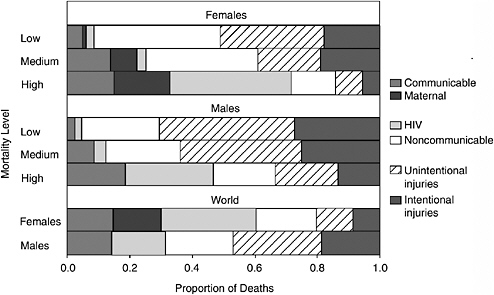
FIGURE 4-2 Percentage distribution of deaths at ages 15-29 by cause for the world as a whole, according to sex and mortality.
NOTES: Low = all developed countries (exclusively); medium = mixture of developed and developing countries; high = all developing countries.
SOURCE: World Health Organization (2001c).
cent of deaths are the result of HIV/AIDS (Figure 4-2). Close to 20 percent are due to maternal conditions, a category that includes pregnancy and delivery complications and the complications of abortion. In medium- and low-mortality countries, where the mortality rate is much lower, deaths due to these causes comprise a much smaller percentage of overall female mortality, while noncommunicable diseases (mostly cardiovascular disease and cancer) and unintentional injuries (mostly road traffic accidents) are much more important.
For young adult males in high-mortality countries, almost half of the deaths are the result of communicable diseases, the most important of which is HIV/AIDS. About one-third of deaths are attributable to either unintentional or intentional injuries. The deaths due to unintentional injuries are most commonly road traffic accidents. The intentional injury category includes violence, war, and suicide. The two injury categories predominate among male deaths in the medium- and low-mortality countries.
Estimates are also available of a measure that summarizes the loss of healthy life due to both death and ill health. This measure is called disability-adjusted life years (DALYs), and estimates are available for the
TABLE 4-2 Percentage Distribution of Deaths at Ages 15-29 by Cause, According to Sex and Region
|
Region |
Sex |
Cause of Death |
|
|
Communicable Diseases |
Maternal Mortality |
||
|
WORLD |
Females |
14.6 |
15.4 |
|
|
Males |
14.1 |
0.0 |
|
Sub-Saharan Africa |
Females |
12.0 |
16.6 |
|
|
Males |
19.8 |
0.0 |
|
Southeast/Southwest Asia |
Females |
20.3 |
16.7 |
|
|
Males |
15.6 |
0.0 |
|
North Africa and Middle East |
Females |
16.2 |
25.4 |
|
|
Males |
20.2 |
0.0 |
|
Latin America |
Females |
14.0 |
16.4 |
|
|
Males |
8.7 |
0.0 |
|
East Asia |
Females |
11.3 |
6.1 |
|
|
Males |
7.5 |
0.0 |
|
SOURCE: World Health Organization (2001a). |
|||
age group 15-29, for two categories of developing countries, and for each of the major categories of diseases and conditions. These data support the findings presented above based on mortality alone and in addition reveal an additional important cause of ill health among young people: neuropsychiatric or mental health illnesses and conditions, which account for about 20 percent of all DALYs lost in high-mortality developing countries and almost 40 percent of all DALYs in low-mortality developing countries (World Health Organization, 2002, 2003). In high-mortality developing countries, HIV/AIDS represents 17 percent of DALYs lost and in low-mortality developing countries 2 percent of DALYs lost. While HIV/AIDS is of considerable concern in the higher mortality developing countries, other causes of death and disability surpass it for all young people in developing countries as a whole.
Depression, anxiety disorders, and other mood disorders are among the most common mental health problems among young people with diagnoses typically peaking during the 20s (Schulenberg and Zarrett, forthcoming; World Health Organization, 2003). A number of researchers would suggest that in fact young women are more likely to suffer from depression than
|
HIV |
Noncommunicable Diseases |
Unintentional Injuries |
Intentional Injuries |
|
30.3 |
19.4 |
11.6 |
8.8 |
|
17.3 |
21.7 |
28.2 |
18.6 |
|
57.8 |
6.9 |
2.6 |
4.1 |
|
43.1 |
12.7 |
10.7 |
13.8 |
|
11.8 |
25.4 |
18.3 |
7.5 |
|
13.2 |
25.9 |
32.6 |
12.7 |
|
7.2 |
29.5 |
12.0 |
9.7 |
|
5.0 |
28.7 |
30.8 |
15.3 |
|
7.1 |
35.2 |
14.7 |
12.6 |
|
6.0 |
16.8 |
27.0 |
41.5 |
|
1.8 |
33.7 |
22.4 |
24.6 |
|
3.0 |
31.0 |
41.6 |
16.8 |
young men (Gureje, 1991; Lewinsohn et al., 1993; Sorenson, Rutter, and Aneshensel, 1991). Mental health problems are important not only because of the suffering they cause, but also because they are known to be linked to other health outcomes and behaviors. For example, a study in New Zealand has documented links among 21-year-olds between neuropsychiatric disorders and risky sexual behavior, as well as sexually transmitted disease (Ramrakha et al., 2000). How such findings apply to young people in developing countries is not yet known due to lack of research. The impact of war on the mental health of young people in affected countries and the effect of HIV/AIDS stigma have both received increased attention in recent years (e.g., Booth, 2002; Joint United Nations Programme on HIV/AIDS [UNAIDS], 2002; UNICEF, 2005).
Nevertheless, when young people in developing countries are asked about their lives, they appear generally content. Two questions on this subject were part of the World Values Survey (2003), which covered 21 developing countries between 1990 and 1996 (including such major countries as Brazil, China, India, and Nigeria). Males and females ages 18-24 rated their level of unhappiness at 1.9 on a scale from 1 to 4, for which a
score of 4 represents “quite unhappy” and a score of 2 represents “quite happy.” This was not as positive a rating as that of their counterparts in 21 countries covering Australia, Canada, Japan, the United States, and Western Europe, but clearly more positive than ratings in 24 Eastern European countries. In a recent study of nine Caribbean countries, 83 percent of in-school young people attending school reported being generally happy and 88 percent were satisfied with their appearance (Halcón et al., 2003).
Young people also tend to assess the status of their own health positively. In the World Values Survey, young people ages 18-24 rated their own health as “good” (a mean score of 2.0 on a scale that goes up to 5 for very poor health). This rating is more positive than that of any older age group (Figure 4-3). It is not as high as ratings by young people in major industrial countries, but somewhat better than ratings by young people in Eastern Europe.
A series of opinion polls conducted in 2000-2001 corroborate this generally positive outlook. On average across 17 countries in East Asia and the Pacific, 83 percent of 14-17-year-olds thought that their lives would be
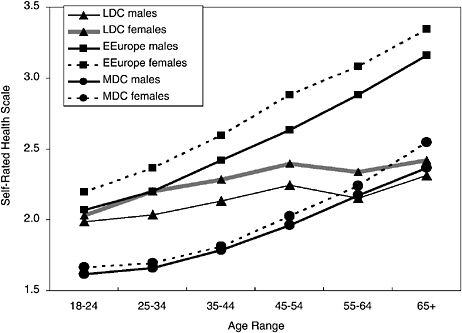
FIGURE 4-3 Self-rated health by age, sex, and country group, 1990-1996.
NOTES: 1 = very good health, 5 = very poor health. LDC = developing countries and MDC = developed countries, which in this figure exclude Eastern Europe.
SOURCE: World Values Survey (2003).
better or much better than their parents’ lives (UNICEF, 2001a). Similarly, approximately three-quarters of 14-18-year-olds in 20 countries of Latin America and the Caribbean believed that they would have better lives than their parents (UNICEF, 2000).
With HIV/AIDS now the dominant cause of death among young people in sub-Saharan Africa and with other newly emerging infectious diseases, the concept of one common epidemiological transition, in which all societies evolve toward declining importance of infectious diseases and increasing importance of chronic conditions, may reflect too simple a view of long-term trends. Extensions of transition stages to accommodate further mortality declines, as well as critical exceptions to transition, notably in Africa, but also in Eastern Europe, have increasingly been noted (Caselli, Meslé, and Vallin, 2002). The health of young people in developing countries still contrasts strongly with the health of young people in developed countries, and even among developed countries, enough contrasts exist, for example, between Western and Eastern Europe, to illustrate that homogenization is far from being achieved.
HIV/AIDS and Other Sexually Transmitted Infections
Globally, almost 12 million people ages 15-24 were estimated to be living with HIV/AIDS in 2002. About three-quarters of these live in sub-Saharan Africa. The young age structure of countries hardest hit by the pandemic means that about half of all new infections are now occurring among this age group (Summers, Kates, and Murphy, 2002; Joint United Nations Programme on HIV/AIDS [UNAIDS], 2002). Since the vast majority of HIV infections are sexually transmitted, the vulnerability of young people is strongly influenced by their sexual behavior. Thus, early age at sexual initiation, early marriage, risky sexual practices, and commercial sex work are all contributing factors. In places where HIV is linked primarily to injecting drug use, young people, who tend to be the main users, are most affected. The injection of drugs among young people has apparently increased in some countries in recent years, most dramatically among young men in Eastern Europe and Central Asia (UNICEF, 2002; United Nations, 2000b).
Table 4-3 shows estimates by the Joint United Nations Programme on HIV/AIDS (UNAIDS) of the proportions of young people infected at the end of 2001. On average, prevalence is extremely high in countries of Eastern and Southern Africa. HIV prevalence in 2001 averaged 14 percent among females ages 15-24, 6 percent among males, and 12 percent among all adults ages 15-49. Prevalence is also very high in Western and Middle Africa. In a few countries in this region, such as the Central African Republic and Cameroon, levels resemble those in Eastern and Southern Africa.
TABLE 4-3 HIV Prevalence at Ages 15-24 and 15-49, by World Region
Prevalence drops sharply as one moves farther north on the African continent; prevalence in North Africa and the Middle East is a fraction of that in sub-Saharan Africa. However, data are particularly sparse for countries in this region.
The Caribbean is notable for its very high prevalence of HIV. Rates in Haiti, for example, average 5 percent for females ages 15-24 and 4 percent for males. The regional average is 2.5 percent for females and 1.9 percent for males. Rates in the remaining developing regions are lower and in line with or slightly higher than prevalence rates in developed countries, but the absolute numbers of young people infected are large. Excluding sub-Saharan Africa, two-thirds of all remaining infected females ages 15-24 and one-third of all remaining infected males of that age reside in South and South-eastern Asia (Kiragu, 2001).
Most developing regions show considerably higher HIV prevalence among females ages 15-24 than among males. This is especially true in Africa, where prevalence rates among females are more than double those of males. Community studies confirm this pattern for sub-Saharan Africa (e.g., Glynn et al., 2001). Higher infection rates among females also hold, though to a lesser extent, for South and South-eastern Asia. In Latin America and the East Asia and Pacific region, higher prevalence rates appear among
males, as they also do in developed regions. The ratio of female to male prevalence generally rose in 2000-2001 worldwide (the major exception being Eastern Europe and Central Asia).
Women, particularly girls and young women, face a higher risk of infection with HIV for physiological, social, and cultural reasons. The risk of infection during unprotected sex is two to four times higher for women than for men (UNFPA, 2003). There are several reasons for this disparity; the viral load is generally higher in semen than in vaginal secretions; in vaginal intercourse a larger surface area is exposed to sexual secretions for a woman than for a man; and the vagina and cervix of adolescent women are less mature, with a thinner cell structure that allows the virus to pass more easily (Berman and Hein, 1999; Watstein and Laurich, 1991).
Variation in the female-male ratio across countries among those infected is also related to differences in patterns of heterosexual relations, such as differences in the number of partners, age differences between partners, and the use of commercial sex workers, as well as to variations in the importance of other modes of HIV transmission. In sub-Saharan Africa, for example, where most infections are transmitted by heterosexual relations, young women generally face higher risks because they tend to have sex with and marry older men, who are more likely to be infected than younger men. Some of these relationships are based on economic gain, that is, they involve the exchange of gifts or money for sex. There is now a great deal of research showing that the power differentials inherent in such relationships make it difficult for young women to negotiate the use of condoms (Blanc, 2001; Luke, 2003; Weiss, Whelan, and Gupta, 1996). Furthermore, in high HIV areas, early marriage does not protect young women from risk. While marriage reduces the number of sexual partners, it increases frequency of sex, decreases condom use, and virtually eliminates a girl’s ability to abstain from sex, except possibly during the postpartum period (Clark, 2004).
Sex between men accounts for at least 5-10 percent of HIV cases at all ages worldwide, and it is a predominant risk factor in some developing countries, including Brazil, Costa Rica, and Mexico (Summers, Kates, and Murphy, 2002). Young people comprise a large proportion of this population (Joint United Nations Programme on HIV/AIDS [UNAIDS], 1998, 2000a). Injecting drugs, again a particular problem among young men, accounted for over half of new cases in 1998-1999 in China, Malaysia, Russia, and Vietnam (Joint United Nations Programme on HIV/AIDS [UNAIDS], 2000b). This is a doubly disturbing trend because, in addition to the risks of transmission through injections, the use of drugs is also associated with an increased likelihood of engaging in risky sexual behavior (Summers, Kates, and Murphy, 2002).
The presence of certain other sexually transmitted infections greatly
enhances the probability that HIV infection will be passed between sexual partners (Cohen, 1998). Data on the prevalence of other STIs among young people are scarce, and trends are virtually impossible to discern. Existing studies, however, give the impression that a substantial minority of young people may contract STIs. For example, studies in eight countries of various populations ranging in age from 12 to 24 show that between 3 and 12 percent of males and 1 to 14 percent of females had ever experienced an STI (Brown et al., 2001). Furthermore, WHO estimates that, globally, one in three new infections occur in people under the age of 25 (World Health Organization, 1999a).
Trends in the proportion of young people with HIV/AIDS are not available for most countries.6 For some countries in sub-Saharan Africa (plus Haiti), however, there are now sufficient surveillance data gathered from young women attending antenatal care to begin to see some positive changes taking place. Of the 18 countries for which there are adequate data, there is evidence of stability in HIV prevalence in seven countries and of falling prevalence in eight countries (Joint United Nations Programme on HIV/AIDS [UNAIDS], 2004; personal communication, 2004). The current estimates of HIV prevalence among pregnant women ages 15-24 in these countries ranges from around 3 percent in Haiti to 33 percent in Botswana. In three countries—Lesotho, Mozambique, and Swaziland—the available evidence suggests that prevalence continues to rise.
Future trends in HIV/AIDS among young people depend on a range of factors, but basic knowledge about the disease and ways to prevent it are among the most crucial (see Box 4-1 for further discussion of the future impact of HIV/AIDS on today’s young people). The proportion of females ages 15-24 who are unaware that a healthy-looking person can be infected with HIV/AIDS averages 46 percent in 73 developing countries with appropriate surveys, mostly surveys taken as recently as 2000. The level of misinformation is higher than average in sub-Saharan Africa (51 percent across 39 separate surveys), and still higher in Central Asia and the Caucasus (60 percent across 7 surveys). Only in the Caribbean does the lack of awareness fall below 10 percent (Joint United Nations Programme on HIV/AIDS [UNAIDS], 2002). In virtually every country in which comparable data on young men are available, the percentages who are unaware are lower for males than females (UNICEF, 2002). While young people may be unaware of certain dangers, they also see dangers where they do not exist. In surveys
in 55 countries, only 40 percent on average are aware that mosquitoes cannot transmit HIV (UNICEF, 2002).
Knowledge of ways to prevent the transmission of infection is also low among young people in many countries. In 17 national surveys conducted between 1994 and 1999, 40 percent of females ages 15-19 on average could not identify any preventive measure—abstaining from sex, being faithful to one partner, avoiding multiple partners, or condom use. Males of the same age were somewhat more knowledgeable, with 27 percent not knowing how to protect themselves. Across countries, however, the level of knowledge is quite variable but nonetheless consistent with the prevailing level of risk. For example, the percentage not knowing any preventive measures was 96 percent for females and 88 percent for males in Bangladesh, where HIV represents a relatively modest risk for young people, compared with 11 and 16 percent, respectively, in Uganda, where the risks are very high (Kiragu, 2001). It is also worth noting that only a small percentage of young people who are infected report in surveys being aware that they are HIV positive (UNICEF, 2002).
The extent to which young people are able to judge accurately the risks associated with health behavior is still poorly understood overall (Blum, McNeely, and Nonnemaker, 2002), but there is some evidence that they underestimate their own risk of becoming infected with HIV/AIDS. In part this underestimation is due to a lack of accurate information, such as misconceptions about modes of transmission as well as a sense that “this cannot happen to me.” But (as is true among adults generally) it is also related to a desire to be accepted, to trust one’s partner, and to believe that he or she is “clean” (Brown et al., 2001). Moreover, since infection with HIV does not have immediately apparent effects, young people may find it difficult to make choices with consequences that seem very removed from their immediate situation (Weiss, Whelan, and Gupta, 1996).
Nevertheless, trends in the use of condoms by young people suggest that behavior is changing in sub-Saharan Africa and Latin America, where data on condom use have been collected for young people (see also the section below on sexual initiation). Condom use among sexually active young women is still relatively low, but increases are evident when Demographic and Health Surveys (DHS) from the late 1980s are compared with surveys about 10 years later (Table 4-4). Among young women who presumably are most likely to have high-risk sex—never married, sexually active females—the (unweighted) average increases among 15-19-year-olds from 0.3 to 8.0 percent and among 20-24-year-olds from 0.2 to 5.5 percent. The often-cited case of Uganda and its success in promoting behavior change is evident here; virtually no women ages 15-24 were recorded as using condoms in 1988-1989, whereas about 10 years later the proportions among never married, sexually active women exceed one in three and are
|
BOX 4-1 The HIV/AIDS pandemic has profoundly affected the world for over two decades and its continued and rapid progress will have far-reaching impacts on the kind of world young people inherit. The United Nations (2003b) estimates that between 2000 and 2050, there will be 178 million fewer births due to AIDS-related deaths of women of childbearing age. While sub-Saharan Africa currently has the highest prevalence rates, epidemics are already growing rapidly in parts of Asia, Eastern Europe, and North Africa (Joint United Nations Programme on HIV/AIDS [UNAIDS] and World Health Organization, 2003). How will this deficit in human life impact the lives of young people who survive to adulthood? The economic impacts of HIV/AIDS are difficult to predict and may not be apparent until the pandemic peaks, but they will probably include falling gross domestic product, decreased productivity and profits for businesses, and increased poverty and wealth disparities. A review of 14 studies of the economic impact of HIV/AIDS (mostly in African countries) reports the estimated effects on gross domestic product could range from “small” to 2-3 percent lower than in the absence of AIDS (United Nations, 2003c). Bell and colleagues (2003:95) conclude that unless certain measures are taken, “economic collapse is in the cards” for Southern Africa. Future generations will surely be faced with economies severely debilitated by HIV/AIDS. The AIDS pandemic is likely to widen the gap between the rich and poor and increase poverty, especially among those households directly affected by HIV/AIDS. Early epidemiological studies showed a link between higher socioeconomic status and HIV infection; however, researchers believe that HIV infection is higher among poorer individuals as the pandemic progresses (Barnett and Whiteside, 2002; Over and Piot, 1993). Socioeconomic disparities exacerbated by HIV/AIDS could heighten political and social conflict among those who survive. Military and national police forces also expected to be affected by the pandemic, being less prepared to maintain the peace. By the mid-1990s, 21 percent of soldiers in one province in Cambodia tested HIV positive, and HIV prevalence rates among South African soldiers were estimated at double or more than civilian rates (United Nations Population Fund, 2003). Future generations will face increased demand for health care and diminished quality of care. Studies from Southern Africa estimate that approximately 60 percent of hospital beds are occupied by HIV/AIDS patients, crowding out other patients. In Zambia, hospital bed occupancy by AIDS patients is projected to rise from 6 to 43 percent between 1990 and 2005 (Cornia, Patel, and Zagonari, 2002:7). The World Bank estimates that a country with a stable 30 percent prevalence rate could lose 3 to 7 percent of its health care workers each year due to AIDS (Cornia, Patel, and Zagonari, 2002:9). Rising health expenditures on HIV/AIDS and mounting strains on the public health systems may lead to future shortages that force people into private health services, which cost more. In the agricultural sector, fewer people with less farming knowledge will be tasked with sustaining people’s food needs. The U.S. Department of Agriculture predicts a substantial gap between agricultural production and food needs by 2010 in Eastern and Southern Africa (United Nations, 2003c:5-4). Grain production in |
|
Kenya is expected to be 12.1 percent less than required to meet food needs in 2010. Food shortages, more malnutrition, and increased dependence on food imports are expected. HIV/AIDS is already having significant impacts on education, which will compromise human development for generations. An estimated 860,000 African children have lost their teachers to AIDS (United Nations Development Programme, 2001). More than 100 schools have already closed in the Central African Republic because of AIDS-related teacher shortages (Kiragu, 2001). Teacher shortages are expected in Kenya, Uganda, Zambia, and Zimbabwe at least through 2010, especially in rural areas (Kiragu, 2001). More and more families will take children out of school because they cannot afford to pay their education costs and need their children’s labor and because of HIV/AIDS-related stigma. In Thailand, 15 percent of rural families affected by AIDS took a child out of school (Kiragu, 2001). In the Central African Republic and Swaziland, AIDS and orphanhood is responsible for a 20-30 percent fall in school enrollment rates (United Nations Development Programme, 2001). Household composition and structure are affected by the AIDS pandemic in numerous ways. A longitudinal study of AIDS-affected families in Haiti found that the number of household dependents decreased and unemployment, borrowing, and the sale of possessions increased as the disease progressed over time (United Nations, 2003c:3-3). In Sri Lanka, one study found that medical costs ranged from US$5,454 to 18,680 per HIV/AIDS-related case (Bloom et al., 1997, cited in United Nations, 2003c:3-5). It is estimated that, as of 2001, approximately 14 million children under age 15 had been orphaned because of AIDS, 11 million of whom lived in sub-Saharan Africa (United Nations, 2003c). By 2010, the number of AIDS orphans is projected to rise to 20 million in sub-Saharan Africa (United Nations Population Fund, 2003). Studies have found that orphans are more likely than other children to live in poor and female-headed households, to be malnourished, to be educationally disadvantaged, and are at an increased risk of getting involved in crime, drugs, and being recruited into military activities (Bicego, Rutstein, and Johnson, 2003; United Nations, 2003c; United Nations Population Fund, 2003). In taking the lives of millions of parents, AIDS also deprives children of their parents’ loving care, knowledge, and emotional support, the effects of which are impossible to know. The consequences of living in a state of nearly constant mourning for extended periods of time, as deaths to family and friends accumulate, are also impossible to predict. It is difficult to predict what the world will be like for future generations because of HIV/AIDS. What can be surmised from the estimates and projections discussed above is grim. AIDS may, however, create unexpected opportunities in the future. In Uganda, national-level programs have galvanized people and communities around HIV/AIDS (United Nations Development Programme, 2001). The pandemic could foster increased social cohesion, especially in communities affected by AIDS. As the illness becomes more prevalent, stigma could decline significantly, leading to better treatment and prevention of further infections. While those who survive will certainly face greater burdens, they will also encounter more opportunities to lead their communities and pave the way for future development. It is critical that now, while the pandemic rages in many parts of the globe, the current generation of young people consider and prepare for the future of a world affected by AIDS. |
TABLE 4-4 Percentage of Young Women Currently Using Condoms in Successive Demographic and Health Surveys About Ten Years Apart
|
Age Group and Country |
Year of Survey |
All Sexually Active |
Never Married and Sexually Active |
|||
|
1st |
2nd |
1st |
2nd |
1st |
2nd |
|
|
15-19-Year-Olds |
||||||
|
Ghana |
1988 |
1998-1999 |
0.4 |
12.1 |
0.4 |
8.6 |
|
Kenya |
1989 |
1998 |
0.3 |
5.5 |
0.3 |
4.3 |
|
Senegal |
1986 |
1997 |
0.0 |
3.2 |
0.0 |
2.5 |
|
Togo |
1988 |
1998 |
1.8 |
14.4 |
1.8 |
13.6 |
|
Uganda |
1998-1999 |
2000-2001 |
0.0 |
11.8 |
0.0 |
36.7 |
|
Zimbabwe |
1988 |
1999 |
0.8 |
6.5 |
0.8 |
4.4 |
|
Bolivia |
1989 |
1998 |
0.1 |
4.3 |
0.0 |
2.9 |
|
Brazil |
1986 |
1996 |
1.1 |
12.0 |
0.0 |
7.9 |
|
Colombia |
1990 |
2000 |
1.5 |
12.7 |
0.6 |
10.0 |
|
Dominican Republic |
1986 |
1996 |
0.0 |
2.2 |
0.0 |
1.2 |
|
Guatemala |
1987 |
1998 |
0.9 |
3.6 |
0.0 |
0.2 |
|
Peru |
1986 |
1996 |
0.0 |
6.6 |
0.0 |
3.3 |
|
20-24-Year-Olds |
||||||
|
Ghana |
1988 |
1998-1999 |
1.2 |
7.1 |
0.2 |
3.6 |
|
Kenya |
1989 |
1998 |
1.2 |
2.2 |
0.1 |
0.8 |
|
Senegal |
1986 |
1997 |
0.0 |
2.7 |
0.0 |
2.1 |
|
Togo |
1988 |
1998 |
1.5 |
9.6 |
0.9 |
7.2 |
|
Uganda |
1998-1999 |
2000-2001 |
0.0 |
4.5 |
0.0 |
34.9 |
|
Zimbabwe |
1988 |
1999 |
1.8 |
3.8 |
0.4 |
1.7 |
|
Bolivia |
1989 |
1998 |
0.4 |
5.1 |
0.0 |
1.4 |
|
Brazil |
1986 |
1996 |
0.8 |
8.2 |
0.3 |
4.1 |
|
Colombia |
1990 |
2000 |
2.0 |
14.2 |
0.5 |
7.7 |
|
Dominican Republic |
1986 |
1996 |
0.0 |
2.0 |
0.0 |
0.3 |
|
Guatemala |
1987 |
1998 |
1.5 |
1.8 |
0.0 |
0.1 |
|
Peru |
1986 |
1996 |
0.0 |
6.1 |
0.0 |
2.0 |
|
SOURCE: DHS data. |
||||||
far higher than in any other country in the table. Although the magnitude of the change varies, increases over time appear in all countries surveyed. In many countries, condom use is higher among teenagers than among women in their early 20s. This pattern has been interpreted by some as reflecting a greater willingness among those just starting their sexual lives to accept the use of condoms (Joint United Nations Programme on HIV/AIDS [UNAIDS], 2000b). It may also be partially explained by the fact that condom use tends to decline with the duration of relationships (Bankole, Darroch, and Singh, 1999; Norris and Ford, 1999), and young people in their early 20s may be more likely to be involved in long-term relationships.
In contrast to earlier studies, which tended to show higher HIV prevalence among educated individuals, recent studies based on cross-sectional data suggest that this relationship is beginning to disappear or even be reversed (Glynn et al., 2004; Hargreaves and Glynn, 2002). This is probably due to the greater ability of educated people to both access information on HIV prevention and to act on it. There is some recent evidence that more educated people are less likely to engage in various types of risky sexual behavior and more likely to use condoms when they do (Lagarde et al., 2001).7 One study using 12 years of longitudinal data from Uganda demonstrates convincingly the evolving relationship between HIV and education (de Walque, 2002). The study found no relationship between education and HIV prevalence among young people (ages 18-29) in the early 1990s. However, 10 years later, HIV prevalence had decreased substantially more among those with secondary school education than among those with no or primary education (Figure 4-4). Based on the available evidence, trends toward improvements in education thus imply progress in the reduction of HIV, but the results of these studies also suggest that HIV/AIDS prevention campaigns may need to be targeted more effectively at those with no or low levels of education.
Injuries
For young people, particularly for young men, injuries—mostly due to road traffic accidents, violence, war, and suicide—contribute substantially to mortality and morbidity. According to WHO data (World Health Organization, 2001a), injuries (unintentional and intentional combined) in sub-Saharan Africa make up a larger share of all deaths among males ages 15-
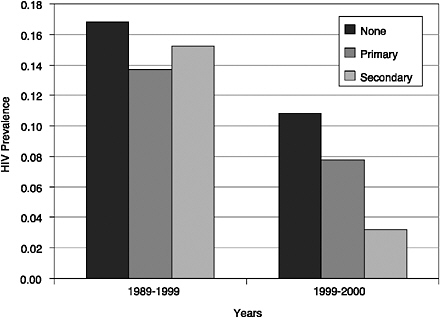
FIGURE 4-4 HIV prevalence among individuals ages 18-29 by level of education, rural Uganda (MRC General Population Cohort).
SOURCE: de Walque (2002).
29 (25 percent) than maternal deaths make up a share of all deaths among females of the same age (see Table 4-2). In other developing regions, deaths to young males attributable to injury are a relatively more important cause of death ranging from 45 to 68 percent of all deaths for young men. Injury, including injury due to domestic violence and/or gender-based violence, is also a major cause of death among females, explaining the largest share of deaths in East Asia.
The most common fatal injuries involve road traffic accidents. Road deaths per registered vehicle tend to be more numerous in the poorest countries. However, death rates from road accidents among young people tend to be highest in upper middle-income countries (Ahmed and Andersson, 2002). Regionally, some parts of South-eastern Asia, including Indonesia, Sri Lanka, and Thailand, and the Eastern Mediterranean, which includes the Gulf states, Iran, Libya, and Saudi Arabia, have higher than average death rates from road accidents among young people, a pattern that may be linked to rising affluence in these countries (World Health Organization, 2001a). In the developed countries that make up the Organisation for Economic Co-operation and Development (OECD), 48 percent of traffic fatalities in 2000 involved drivers or occupants in passenger cars or station wagons (International Road Traffic and Accident Database, 2002). In de-
veloping countries, by contrast, a much higher proportion of fatalities involve pedestrians, bicyclists, motorcyclists, and moped riders or passengers on buses and trucks (Nantulya and Reich, 2002).
As motorized transport has grown, death rates due to traffic accidents also appear to have risen over the last 20 years in developing countries as a whole, although available reports are not entirely consistent (Nantulya and Reich, 2002; Nordberg, 2000). For example, road deaths among young people are reported in one study to have risen substantially over two decades in Chile, Mexico, and Venezuela (Maddaleno and Silber, 1993), but another study asserts that death rates have fallen in the majority of countries in the Americas (Yunes and Rajs, 1994). A rise in fatalities as motor vehicle use increases in developing countries is not inevitable; the development of preventive and safety measures—safety belt and helmet use, air bags, cameras at intersections, speed reductions, enforcement of drunk driving laws8—have led to improvements in high-income countries and in some developing countries in which they have been introduced (Mohan, 2003; World Health Organization, 1995). For example, in Thailand, introduction of a motorcycle helmet law reduced fatalities by 56 percent (World Health Organization, 2002:72).
Violence and war account for about a fourth of male deaths due to injury at ages 15-29 (World Health Organization, 2001a). United Nations Children’s Fund (UNICEF) estimates that there are approximately 300,000 soldiers under the age of 18 involved in armed conflicts globally. Some of them become soldiers voluntarily, while others are forcibly recruited. Not only may young people be involved in war as combatants, but they may also be affected as civilians. Noncombatant male young people tend to be at higher risk than females for war-related deaths. Civilian young males are often targeted by soldiers who suspect they may become future war combatants. In addition, during times of civil unrest, young males are often sent out of the security of the home environment to get food and supplies, to tend to animal herds, or to earn money. Of course, in addition to deaths caused directly by armed conflict, young people are subject to other consequences of armed conflict that affect health both in the short and the long term, including nonfatal injuries, the loss of parents and other family members, displacement, abuse in various forms, and the disruption of school and other routines.
Young males are also disproportionately affected by homicide, with male death rates (among 10-29-year-olds) exceeding those among females
in virtually every country with reasonable data (Krug et al., 2002). Regional differences in mortality—due to homicide among young people—show Latin America, the Caribbean, the Russian Federation, and some countries of Southeastern Europe having the highest rates. In a recent study of 24 developing countries in the mid-1990s, several in Latin America were distinguished by exceptionally high rates of mortality due to homicide for males ages 10-29: Brazil, Colombia, El Salvador, and Venezuela. The rates for these countries ranged from 1.56 per thousand (Colombia) to 0.46 per thousand (Venezuela) compared with no higher than 0.3 in the remaining 20 countries (Krug et al., 2002). At least some of these deaths are the result of violence associated with youth gangs (Rodgers, 1999), and the vast majority involve the use of guns. High and rising rates of homicide among young people in Latin America are thought to be linked to increasing income inequality, although the evidence for this assertion appears to be based mainly on associations in aggregate cross-sectional statistics (Butchart and Engstrom, 2002; Szwarcwald et al., 1999).
The share of deaths due to injury that are intentional varies by region. In some regions, including sub-Saharan Africa, young men in Latin America, and young women in East Asia, the majority of deaths due to injury are intentional. Suicide rates among young males have been increasing since the 1950s in most developed countries, but the trend in most developing countries is far less certain because reliable trend data are generally unavailable (Cantor and Neulinger, 2000; Eckersley and Dear, 2002). Although suicide rates among young males are far higher than among young females (in part because females who attempt suicide are less likely to succeed), death rates among younger males tend to be consistently lower than among older males. Among females in developing regions, however, ages 15-29 appear to be times of particular peril, with death rates 24 percent higher than at ages 30-44 (World Health Organization, 2001a).
China is notable for comparatively high rates of suicide, especially in rural areas and especially among young women (see data on East Asia in Table 4-2). Estimates for 1992 are 0.28 suicides per thousand males and 0.46 per thousand females ages 20-24, the peak age for suicide (Ji, 1999). Suicides may have declined since then, but statistics are contradictory (Hannum and Liu, 2005). The primary reasons for suicide in rural China are not entirely clear but seem to be associated with marital and family pressures and education and employment problems (Hannum and Liu, 2005; Ji, Kleinman, and Becker, 2001).
In general, little is known about the reasons that young people commit suicide in developing countries, but some research suggests that they are not substantially different from those in the developed world. Reasons linked to rapid social and economic transitions, such as loss of tradition, social cohesion, and spontaneous social support, and associated risk factors, such as
alcohol and drug abuse and mental illness, have been cited as important factors (Brown, 2001). While such issues affect older adults as well, they are particularly relevant among the young because the individual developmental transitions experienced during this phase of life can be full of stress and uncertainty. Increased access to the means to commit suicide may also be a factor in rising rates in some countries (Brown, 2001; Eckersley and Dear, 2002). For example, the ingestion of powerful and readily available pesticides is the most common method used by rural Chinese women (Hannum and Liu, 2005).
Maternal Mortality and Morbidity
Maternal mortality and morbidity are among the most significant threats to the health of young women in developing countries. Maternal mortality comprises a substantial proportion of deaths to young women in all developing country regions except East Asia (see Table 4-2). The proportion of deaths attributable to maternal causes ranges from 25 percent in Northern Africa and the Middle East to 16 percent in Africa, Latin America, and South Asia, to 6 percent in East Asia. In addition, nonfatal complications associated with pregnancy and childbirth are common and not only affect health in the short term, but they can cause or make worse some long-term morbidities, such as obstetric fistula, uterine prolapse, anemia, reproductive tract infections, and infertility (National Research Council, 1997a).
The most recent global estimates put the maternal mortality ratio (i.e., maternal deaths per 100,000 live births) in developing countries at 440. Another measure, the lifetime risk of maternal death, shows that the chance that a woman in a developing country will die of maternal causes is 1 in 61 in developing regions compared with 1 in 2,800 in developed regions. There is also enormous variation across the developing regions, with the lifetime risk reaching 1 in 16 in sub-Saharan Africa and 1 in 840 in East Asia (World Health Organization, 2003). Maternal deaths are those that occur during pregnancy and up to 42 days after birth. About 80 percent of these deaths are due directly to maternity; the most common cause is hemorrhage, followed by sepsis and complications of unsafe abortion, hypertensive disorders, and obstructed labor. The remaining 20 percent of deaths are due to conditions that are aggravated by pregnancy but may be present prior to pregnancy, such as diabetes, anemia, malaria, and increasingly HIV/AIDS.
As in the case of other cause-specific mortality data, estimates of maternal mortality are often based on partial information of variable quality, so trends can be inferred only cautiously and at the most general level. Trends related specifically to young women are not available, but a United Nations
report released in 2003 states that “it does appear that globally, levels of maternal mortality remained stable between 1995 and 2000” (World Health Organization/UNICEF/United Nations Population Fund, 2003:15).
The evidence on the age pattern of maternal mortality is conflicting. Most studies suggest that the per-pregnancy risk of dying of maternal causes is higher below age 20 than among women in their 20s and 30s; there seems to be universal consensus that risks rise dramatically above age 40. A study published by WHO in 1989 (cited in Senderowitiz, 1995) asserted that the risk of dying during pregnancy or delivery is 20 to 200 percent greater for women ages 15-19 than for older women. In a later study, WHO (1995) provided data from subnational community studies or official statistics for seven developing countries. In six of seven cases, the maternal mortality ratio was higher at ages 15-19 than at ages 20-24, sometimes slightly higher, but sometimes substantially so. The results for the only national survey in this study (Egypt, 1992-1993) showed a ratio at ages 20-24 that was about a third of the ratio at ages 15-19. A surveillance study conducted over four years in one department in Guatemala showed almost identical ratios for women ages 15-19 and 20-24 (Kestler and Ramirez, 2000). Similarly, a six-year population-based study in rural Guineau-Bissau found no difference in maternal mortality by age once other factors were controlled (Hoj et al., 2002).
Two recent national surveys, however, show a different pattern. A 2001 national survey in Bangladesh examined household deaths that occurred in the three preceding years during pregnancy, delivery, or two months postpartum and related these to numbers of pregnancies (rather than live births). The resulting mortality ratios were 221 at ages 15-19 and 253 at ages 20-24 (National Institute of Population Research and Training and ORC Macro, 2002). Similarly, a reproductive age mortality survey for Egypt in 2000 gave maternal mortality ratios of 31 at ages 15-19 and 41 at ages 20-24 (Egypt Ministry of Health and Population, 2001).
The inconsistencies in these studies may reflect the fact that the number of births among young mothers (those under age 20) is relatively small, so age-specific maternal mortality ratios have high standard errors and consistent patterns are difficult to detect. Nevertheless, the dangers of childbearing among very young women, whose bodies are not yet fully grown, are well known. Preeclamptic toxemia and cephalopelvic disproportion, pregnancy-induced hypertension, vesicovaginal fistulae, and anemia pose serious problems for young mothers (Institute of Medicine, 1996; Senderowitz, 1995). Indeed, one study of Chilean data showed that young people under age 15 had a significantly higher rate of maternal mortality than those ages 15-19 (Sińa, Valdivieso, and del Pinto, 2003). In addition, it is difficult to separate the effects of age from the effects of parity and other factors on maternal mortality. Young mothers are also less likely to
be well nourished than older mothers. In spite of a widespread assumption that young mothers are less likely to get adequate prenatal and obstetric care, recent evidence suggests that this is not the case (Abou-Zahr and Wardlaw, 2003). However, evidence from some sub-Saharan African countries suggests that young mothers may be less likely to deliver with a skilled attendant (Magadi, Agwanda, Obare, and Raffa, 2004). Regardless of whether there is an intrinsically higher risk of death associated with young age, the physical toll of early parenthood can have significant consequences later in life, including infertility and complications in later pregnancies.
Female genital cutting is one factor that contributes to the level of maternal morbidity and mortality in a number of countries. Female genital cutting—an operation that involves the partial or total removal of female external genitalia—is a rite of passage that is traditionally carried out during childhood in some societies and during adolescence in others. In either case, the consequences continue during adolescence and adulthood. Female genital cutting is not a worldwide practice, but is confined largely to a band of countries stretching across the upper half of Africa also including some countries of the Middle East. Prevalence of the practice is as high as 97 percent in Egypt and 98 percent in Somalia and Djibouti, and it falls to 5 percent in Uganda and the Democratic Republic of Congo (Carr, 1997; Creel, 2001; Toubia and Izett, 1998). (We are not aware of regional or global estimates of female genital cutting.) The practice can have immediate health consequences (such as infection and hemorrhage) and, particularly for those who have the more extreme forms, can lead to later obstetrical complications and eventual reduced fertility as well as psychological difficulties and reduced sexual pleasure (Shell-Duncan and Hernlund, 2001).
A gradual recognition of the magnitude and consequences of this practice, a redefinition of it as a human rights issue, and a strong policy push for elimination followed the 1994 International Conference on Population and Development and the 1995 Fourth World Conference on Women. Declines in the practice are now apparent in a few countries, and there are some indications that its harmful effects are increasingly being recognized by affected populations and that disapproval of the practice is increasing. In a study based on DHS data from eight countries, women ages 20-24 in six of the countries were more likely to oppose female genital cutting than women ages 45-49 (Creel, 2001). Another study in Egypt suggests a 10 percentage point decline in prevalence from one generation to the next, around the time of the International Conference on Population and Development (El-Gibaly et al., 2002).
Despite an emerging international consensus on the issue, few sustained national-level policy initiatives have been implemented to date. However, nongovernmental organizations and community-led efforts appear to have made some progress, by breaking the silence around the issue and mobiliz-
ing local support for ending the practice (Masterson and Swanson, 2000). Mostly anecdotal evidence from some of the small-scale efforts that have been undertaken to date suggest that providing alternative rites of passage in the form of ceremonies to mark this traditional moment of transition for young females may be crucial in efforts to end female genital cutting.
SEXUAL AND REPRODUCTIVE HEALTH BEHAVIOR
After puberty and during the teenage or early adult years, most young people normally have their first sexual experience and begin to form sexual relationship(s); in terms of development, these early sexual experiences signal an important dimension of the transition from childhood to adulthood, either because they occur at the time of marriage or because they bring with them opportunities for further emotional and relational development as well as the possibilities of marriage and/or parenthood. The negative health consequences of sexual behavior among young people—unwanted pregnancies, sexually transmitted diseases and premature parenthood—have been emphasized in the literature, yet sexual initiation can also indicate a process of increasing awareness and appreciation of one’s body, consolidation of personal and sexual identity, the establishment of mature intimate relationships with others, and the development of negotiation skills (Schutt-Aine and Maddaleno, 2003).
A growing body of evidence from various parts of the developing world indicates that the age at puberty has been falling slowly over decades for both boys and girls due primarily to improvements in nutrition (e.g., Du Toit, 1987; Kac, de Santa Cruz Coel, and Velasquez-Melendez, 2000; Onat and Erten, 1995; Wong et al., 1996; Wright, 1990). For example, the decline in the mean age at menarche for girls in urban Cameroon has been estimated at roughly 2.5 to 3.2 months per decade (Pasquet et al., 1999), a decline of roughly the same pace as the long-term decline in the mean age of puberty for girls in Western industrial countries from 1850 to 1950 (Parent et al., 2003). A nationally representative survey of girls in the United States ages 8-20 (Chumlea et al., 2003) estimated a median age of puberty of 12.4 years in 1994 while a nationally representative survey of relatively well-nourished Egyptian girls ages 10-19 in 1997 estimated a median age of puberty of 13.7 years (El-Tawila et al., 1999). A compilation of recent estimates of ages of menarche for girls from around the world shows substantial differentials as wide as 2 years between the age of puberty among the better off and poorer segments of a population. Estimates vary from as low as 12.1 among the well off in India to 16.1 among the underprivileged in Senegal (Parent et al., 2003). Ages of puberty remain higher in developing countries, particularly in the poorest countries, than in the West but gaps are likely to be narrowing. Differences in patterns and trends in pu-
berty provide an important context in which to assess changes in sexual and reproductive behavior.
The literature on young people’s sexual and reproductive behavior in developing countries is vast. The HIV/AIDS pandemic has added a sense of urgency to understanding its various dimensions and determinants, and the volume of research has expanded rapidly over the last several years. What we know about sexual behavior among young people, however, is derived primarily from self-reports on interviewer-administered surveys. In settings in which privacy is rare, the responses to such sensitive and intimate questions are likely to be strongly affected by prevailing social norms and values leading in some cases to underreporting and in some cases to overreporting of sex behaviors. These limitations should be kept in mind when assessing the findings reported below. Current efforts to improve the reporting of sexual behavior among young people are described in Box 4-2.
Given the magnitude of the literature on this topic and its comprehensive treatment in a number of recent publications, the discussion here is confined to a set of key sexual and reproductive health behaviors that are likely to have the most decisive effects on a successful transition to adulthood: age at sexual initiation, risky sexual behavior, sexual violence and coercion, the use of contraception, and abortion. Information on marriage is covered in Chapter 7 and on childbearing in Chapter 8.
Sexual Initiation
Dual social norms surrounding the sexual initiation of boys and girls persist almost everywhere in the developing world. While young women are expected to marry at a younger age than young men, they are typically discouraged from premarital sex, particularly if under a socially recognized age of maturity or with a partner that is not seen as a likely spouse or partner. These norms influence the context in which the first sexual experience takes place, which for many young women still occurs at the time of marriage and for the majority of men occurs prior to marriage. Among young people reporting premarital sex regardless of setting, it appears that females are more likely to report sexual debut with a steady partner, while males are far less likely to report this and much more likely to report that their first sexual experience was with a friend, casual contact, or sex worker (Brown et al., 2001; Choe and Lin, 2001; Rani, Figueroa, and Ainsle, 2003; Xenos, 1997). Boys are also much more likely to report satisfaction or pleasure after their first premarital sexual experience, while girls whose first sexual experience is premarital are more likely to experience shame, guilt, or pain (Rani et al., 2003). These gender differences in sexual initiation are important to keep in mind when interpreting demographic data on the timing of sexual initiation.
|
BOX 4-2 Obtaining accurate information on sexual activity and risk behaviors among young people, particularly teens, is crucial for monitoring exposure to sexually transmitted infections and effectively addressing the reproductive health needs of young people. Reliable estimates of sexual behavior among teens are particularly important given rising rates of HIV infection and STIs in many developing countries. However, obtaining accurate reports from young people on surveys containing sensitive topics, such as alcohol and drug use, premarital sexual activity, coerced sex, and pregnancies is challenging, particularly for girls, since such behaviors are often contrary to social norms and stigmatizing (Dare and Cleland, 1994). Moreover, young people are likely to be embarrassed and uncomfortable when questioned directly by adults on sexual issues. Studies from Africa indicate that when conventional survey methods are used to obtain information, such as face-to-face interviewing, young unmarried women tend to underreport their sexual activity. The most striking evidence that reporting of sexual activity is problematic comes from a study in Kenya that collected both survey data and blood and urine samples. This study found that among women ages 15-24 who claimed never to have had sex, STI/HIV rates ranged from 6 to 18 percent (Buvé et al., 2001). These so-called virgin infections are clear evidence of the underreporting of sexual activity by young women. The reporting for young men is no less problematic, with indications that young men overreport some sexual behaviors—because sex is considered a badge of honor and rite of passage to adulthood in many places (Erulkar and Mensch, 1997b)—while underreporting other potentially stigmatizing sexual behaviors (Mensch, Hewett, and Erulkar, 2003). Alternative interview techniques, such as audio computer-assisted self-interviewing, potentially provide a more effective method for eliciting accurate reporting, since they offer respondents a greater degree of privacy and confidentiality when divulging sensitive information. Computerized interviewing allows the respondent to hear recorded questions through audio headphones, while entering responses directly into the computer keyboard or numeric keypad. These methodologies have also been adapted for household-based surveys and populations for which literacy is not universal (Hewett, Mensch, and Erulkar, 2003, 2004). In a study conducted in two districts in Kenya, Mensch, Hewett, and Erulkar (2003) experimentally tested different interview modes to assess whether audio computer-assisted self-interviewing improves reporting of sexual behaviors by young people. The authors found that for both sexes, the reporting of certain activities, such as having multiple sexual partners, having sex with a stranger, and having coerced sex, was higher using computerized administration, significantly so for all three behaviors for girls and for two of the three behaviors for boys. However, contrary to expectations, reporting of ever having had premarital sex and alcohol use was higher among girls in the face-to-face interviews. There is a general consensus that researchers and program evaluators should be circumspect regarding estimates of sexual behavior generated from survey data. Given that young people in developing countries are likely to be influenced by the context in which interviews are administered and given that truthful answers to questions regarding sexual and illegal and stigmatized behaviors may put the young person in an uncomfortable position, additional research and evaluation of the response effects in surveys is warranted. |
The age at which the sexual initiation of young women and men is reported to occur varies widely across regions in which recent survey data are available (Table 4-5). Early sexual initiation is particularly variable; among females ages 20-24, the percentage who report having had sex by age 15 varies from around 1 percent in the former Soviet Asia to more than 20 percent in Western and Middle Africa. These variations in early sexual debut are due largely to differences in age at marriage. Among young men, the highest percentages reporting having sex by age 15 are found in Latin America and the Caribbean. In contrast to women, few young men are married by age 15; differences among regions are mostly a result of differences in premarital sexual activity. By age 18, more than 40 percent of young women report having had sex in Latin America and the Caribbean, close to 60 percent in sub-Saharan Africa, and about 20 percent in the former Soviet Asia. More young men than women report having had sex by age 18 in Latin America and the Caribbean, while the opposite is true in sub-Saharan Africa.
Relatively little comparable information is available from Asian countries, mainly because there are few DHS surveys conducted in the region and those that are conducted tend to exclude never married women. Nevertheless, recent data for both women and men have been collected in four countries under the Asian Young Adult Reproductive Risk project. These data show that the proportion of females reporting sex by age 20 is 54-66 percent in Indonesia and Nepal compared with 28-39 percent in the Philippines and Thailand. These differences are due primarily to earlier marriage in the former countries. In Indonesia and Nepal, lower proportions of young men than women report having initiated sexual activity by age 20, while the proportions reporting sexual initiation are higher for men in the Philippines and Thailand. This pattern is related to the differential pattern of premarital sexual activity among young men and the timing of marriage among young women in the two sets of countries (Xenos et al., 2001).
Various factors suggest that sexual initiation may be occurring at a progressively younger age. Not only is the age of puberty falling, but also various global changes discussed above, such as the penetration of Western mass media and entertainment, as well as increasingly common ideas about individualism and the erosion of traditional social controls, might be seen to favor earlier sexual experimentation outside marriage (Caldwell et al., 1998). Indeed, the median age at reported first intercourse has generally fallen in Latin America and the Caribbean while increasing somewhat in sub-Saharan Africa, but not as much as the increases in age at marriage (Zlidar et al., 2003). The increasing age at marriage observed in many developing countries also signifies a lengthening of the amount of time that women are exposed to the possibility of premarital sex.
An analysis based on data from 41 DHS surveys (see Table 4-6), including 27 in sub-Saharan Africa, 9 in Latin America and 5 in Asia, primarily
TABLE 4-5 Percentage of Females and Males Ages 20-24 Who First Had Sex by Specific Ages, Demographic and Health Surveys 1996-2001 and Young Adult Reproductive Health Surveys (YARHS)
|
Region (Number of Countries for Females/Males) |
Females First Had Sex by Age |
Males First Had Sex by Age |
||||
|
15 |
18 |
20 |
15 |
18 |
20 |
|
|
DHS Surveys |
||||||
|
Eastern and Southern Africa (13/9) |
16.6 |
57.1 |
76.9 |
14.1 |
45.2 |
65.2 |
|
Western and Middle Africa (12/11) |
21.4 |
59.3 |
76.5 |
11.5 |
40.3 |
60.6 |
|
Former Soviet Asia (4) |
0.9 |
19.5 |
53.1 |
n.a.a |
n.a.a |
n.a.a |
|
Caribbean/Central America (4/3) |
12.7 |
44.1 |
62.4 |
31.0 |
69.6 |
84.0 |
|
South America (5/3) |
9.1 |
41.4 |
61.3 |
30.9 |
72.7 |
86.6 |
|
YARH Surveys |
||||||
|
Indonesia 1999 |
n.a. |
n.a. |
54.0 |
n.a. |
n.a. |
7.0 |
|
Philippines 1994 |
n.a. |
n.a. |
28.0 |
n.a. |
n.a. |
33.0 |
|
Thailand 1994 |
n.a. |
n.a. |
39.0 |
n.a. |
n.a. |
57.0 |
|
Nepal 2000 |
n.a. |
n.a. |
66.0 |
n.a. |
n.a. |
43.0 |
|
aToo few countries with sufficient cases to calculate regional average. NOTE: n.a. = not available. SOURCES: DHS data, 1996-2001; Xenos et al. (2001:Tables 1 and 2). |
||||||
former Soviet Asia (Armenia, Kazakhstan, Kyrgyzstan, the Philippines, and Uzbekistan) reveals that in only 9 of 41 countries (roughly one-fifth of the sample countries) has there been an increase in the reported probability of having had sex before the age of 18 over the past 20 years (Mensch et al., 2005).9 This is based on a comparison of the experiences reported by older women (40-44) and by younger women (20-24) before they reached age 18. In 19 countries (a little less than one-half of sample countries) there has been no change in the probability of sexual initiation before the age of 18, and in 13 countries (roughly a third of sample countries), there has actually been a decrease in the probability of reported sex by the age of 18. This can be explained by the fact that, in three-quarters of the countries included in this analysis (31 of the sample of 41 countries), there are fewer young
TABLE 4-6 Direction of Change in the Probability of Females Marrying, Having Premarital Sex, and Having Sex by Age 18: A Comparison of 20-24-Year-Olds and 40-44-Year-Olds, Demographic and Health Surveys (1990-2003)
women married before the age of 18 (see further discussion in Chapter 7), counteracting the effect of a rise in the percentage reporting premarital sex by the age of 18. Indeed, 24 of the 41 countries (roughly three-fifths) report a rise in the probability of having premarital sex before the age of 18.
Thus, contrary to widespread belief, sex is not being initiated at an earlier age relative to the past in most countries. While there has been an increase in premarital sex before age 18 in many countries over the past 20 years, delays in the age of marriage in most countries have meant that, relative to 20 years ago, fewer young women report themselves to have been sexually active before the age of 18. Thus while sex is being delayed, the context of first sexual experience is changing, with a greater likelihood relative to the past that first sex will be experienced prior to marriage. Zaba and colleagues (2002) note that in countries in which HIV-related mortality has started to deplete cohorts before they reach their mid-20s, the median age at first sex would increase as cohorts age because those who initiated
sex early would be those most likely to develop AIDS. It is also worth noting that results from a study of Colombia and Peru using the same data sets but different methodology show the same patterns as this analysis (Ali, Cleland, and Shah, 2003).
A review of the recent literature on the determinants of age at sexual initiation yielded a multitude of studies that have attempted to explore the potential role of risk and protective factors. Many of the studies that seek to explain variations in the reported age at first sex at the individual level using data on peer, family, and community influences, however, suffer from various methodological flaws, the most common of which is the failure to consider the endogeneity of independent variables. This is unfortunately because the richness of analysis that is possible with longitudinal data available in the United States and other developed countries, where the importance of family, peer, and community influences have been ably explored, is not possible with single point-in-time cross-sectional data (Baumer and South, 2001; Costa et al., 1995). For example, virtually all of the studies examined are based on cross-sectional data, and many incorporate variables related to the individual’s perception of the sexual experience of his or her friends. While it is certainly plausible that friends influence each other’s sexual behavior, it is also possible that young people choose friends whom they perceive to be similar to themselves in terms of sexual and other behavior and attitudes; it is impossible to sort out this relationship using cross-sectional data. Another example is the inclusion of contraceptive knowledge as a predictor variable. As a result, many potentially important family and peer influences remain poorly documented because of the limitations imposed on data analysis by the types of data currently available. A number of more methodologically rigorous studies, however, have produced some statistically significant findings on the determinants of sexual initiation, many of which are referenced below.
For example, earlier reported age at sexual debut is significantly associated with urban residence in the northeast region of Brazil (Gupta, 2000), in KwaZulu-Natal, South Africa (Kaufman et al., 2002), and in five of eight countries in sub-Saharan Africa (Mahy and Gupta, 2002). A study of 11 mostly sub-Saharan African countries found a positive relationship in some and a negative relationship in others between urban residence and the probability of reporting having had sex among 15-19-year-olds (Filmer, 1998). While Mahy and Gupta (2002) found that the effect of urban residence had not changed over time, a study in Cameroon found that the influence of urban residence had increased (Kuate-Defo, 1998). Oddly, a study by Zaba and colleagues (2002) found that urban residence was associated with later age at first sex in six countries in sub-Saharan Africa. Some studies have also shown significant religious differences in sexual initiation. For example, Zulu, Dodoo, and Chicka-Ezeh (2002) found that in the
slums of Nairobi, Christian women started sexual activity significantly earlier than Muslim women or those who practice traditional religions. Gupta (2000) found that young women who regularly attend religious services, regardless of the religion they practice, are significantly less likely to engage in sexual activity, premarital or otherwise.
Educational attainment is shown to have an inverse relationship with the probability of initiating sex in the vast majority of studies reviewed and mentioned above that were considered to be more methodologically rigorous. Again, however, problems of endogeneity plague such studies. Since pregnancy and parenthood are often a reason for discontinuing schooling, what appears to be the preventive effect of educational attainment on sexual initiation may instead be the effect of sexual activity on the likelihood of continuing schooling. There may also be some unknown factors that affect both the likelihood of reporting sexual initiation and the propensity to continue schooling. Nevertheless, the statistical association between the two is so strong and pervasive that it is worth looking at more closely.
Figure 4-5, based on DHS data drawn from Latin America and sub-Saharan Africa, demonstrates that reported sexual initiation is later among young unmarried women enrolled in school than among those not enrolled in school at all levels of enrollment. In this figure, the proportion who ever had sex among unmarried 15-17-year-olds in each country is standardized by the mean age distribution by single years of age of unmarried women in this age group across all countries. The standardization effectively controls for differences in the age distributions of those enrolled and not enrolled as well as differences in age at marriage across countries. The ratio of the proportions who have ever had sex among those not enrolled to those enrolled averages 1.7,10 exceeding 1.0 in 24 of 28 countries with sufficient samples sizes to make the calculations. Thus, in the vast majority of countries, young women who are currently enrolled in school are less likely to report having had sex than their unmarried age peers who are no longer currently enrolled. There is a slight tendency for the ratio to increase as overall enrollment of young women increases. A few countries—Bolivia, Guatemala, and Zimbabwe—are clear outliers. In Bolivia and Zimbabwe, the ratio is unusually high because very few of those in school reported that they had initiated sex.11 In Guatemala, few of those in either group reported ever having sex.12 The fact that the strong association of delayed sexual
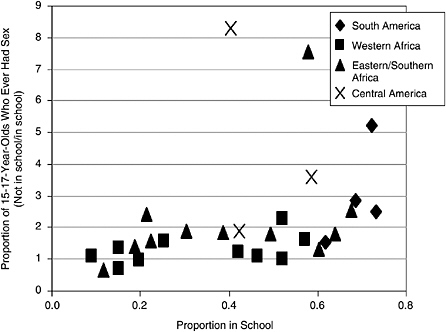
FIGURE 4-5 Ratio of proportion of unmarried women ages 15-17 who ever had sex among those not currently enrolled vs. enrolled, by overall proportion in school.
SOURCE: DHS data, 1995-2001.
initiation with current enrollment persists across levels of enrollment suggests that the relationship is not the result of selectivity among either the enrolled population (at low levels of enrollment) or the nonenrolled population (at high levels of enrollment). Rather, it suggests that whether unmarried women are attending school in an environment in which most are in school or few are, being enrolled is associated with a lower likelihood of reporting ever having had sex. The reasons underlying this association, however, will need to be the focus of future research as DHS data are not sufficiently rich to provide causal explanations.
There are fewer DHS data available for unmarried men, and the sample sizes are generally too small to permit standardization by single years of age. Nevertheless, the (unstandardized) ratio of nonenrolled to enrolled is greater than 1.0 for 20 of the 28 countries. In the 24 countries for which there are data for both unmarried young men and women, the ratio is higher for women in 19 of them. Thus, enrollment in school is less strongly associated with reported sexual initiation among young men than among young women.
These descriptive findings raise further questions about the possible factors in the environment that might be protective for young people in terms of the timing of sexual initiation—factors that may be present to a
greater or lesser extent in different families, different schools, and different communities. This is a relatively underresearched area, one that holds future promise given the descriptive findings highlighted above. In particular, an exploratory study in Kenya has identified some potentially important elements of school quality that merit further investigation (Mensch, Clark, Lloyd, and Erulkar, 2001). In this study, a community-based survey of young people ages 12 to 19 in three districts of rural Kenya was linked in a multivariate analysis with data collected from the schools these young people attended. The school data included interview data from students, teachers, and head teachers as well as systematic observations in classrooms and schoolyards to identify important factors affecting the likelihood of reported premarital sex and, for those who were sexually active, reported contraceptive use. Controlling for other factors, girls were found to be significantly less likely to report having engaged in premarital sex if they had attended schools in which female students reported that they were being treated equitably, and these findings were robust to many alternative specifications. This effect was not found for boys.
The rapid rise in the percentage of young people who remain in school during the later teenage years suggests that schools are becoming an increasingly important institutional environment for young people at a phase of the transition when sexual activity becomes more prevalent. Indeed, it is a possibility that increasing school enrollment may have played a role in limiting the consequences of delayed marriage for the timing and incidence of premarital sex.
Risky Sex
Unsafe sex involves having many sexual partners, changing partners often, selecting riskier partners (such as commercial sex workers), and engaging in riskier sex acts, especially not using condoms. Despite the importance of such aspects of sexual behavior, collecting information on them is so socially sensitive that representative data are seldom available.
An analysis by Singh and Bankole (2001) provides some information on the number of reported sexual partners in the past year for men in 17 countries and for women in 12 countries (based on DHS surveys). Among unmarried men who were sexually active in the past year, a substantial proportion of those ages 15-19 reported having had two or more sexual partners during the past year: 20 to 39 percent in 5 of the 17 countries with this information, and 40 to 61 percent in the remaining 12 countries. The proportion reporting three or more partners in the past year is also substantial: 20 to 42 percent in all but 2 of these 17 countries. Unmarried young men in their 20s report similar levels of multiple sexual partnering. In all of the limited number of countries with data on sexual partners for women,
the proportion reporting multiple partners is much lower among women than among men. However, in these 12 countries, 10-30 percent of unmarried women ages 15-19, who have been sexually active in the past year, report having two or more sexual partners over the recent one-year period.
Girls in sub-Saharan Africa are of particular concern because an increasing number of studies from this region document the widespread practice of sexual partnerships of girls with much older men who provide them with money, school fees, and gifts. The young girls who participate in such relationships are strongly motivated by immediate economic considerations as well as by a desire to increase their future life chances by staying in school or establishing a career. In addition, older men prefer younger sexual partners because they are believed to be less likely to be infected with HIV (Luke, 2003). While the evidence that these relationships lead to higher rates of HIV infection or lower rates of condom use is mixed, it is clear that girls have relatively little power to negotiate safe sex or condom use or to control violence in them (Blanc, 2001; Luke, 2003). In addition to the consequences for physical health, such relationships presumably promote a view of sexual relationships that emphasizes their functional rather than emotional aspects, although there is little, if any, research on this topic.
In some cultures, it is normal and acceptable for boys to experience sex for the first time with a sex worker. For example, a study of young men in Gujarat, India, found that almost 80 percent reported having had their first sexual experience with a prostitute (Sharma and Sharma, 1995). Similarly, visits to sex workers were reported to be a normal activity for peer group socializing among Cambodian young men (Tarr and Aggleton, 1999). However, there is now some evidence that the changing sexual environment and fear of HIV/AIDS may be inhibiting this practice in countries in which HIV is prevalent (e.g., VanLandingham and Trujillo, 2002).
Risky sexual behaviors are more likely to occur among young people who are in a position of economic disadvantage. In a recent study based on survey data on young people ages 14 to 24 in KwaZulu-Natal Province, South Africa, a high HIV prevalence area, Hallman (2004) found that relative economic disadvantage was positively associated with an increased likelihood of a variety of unsafe sexual behaviors, particularly for young women. These risky behaviors include multiple sexual partners, coerced sex, exchanging sex, and lower age of sexual debut, among others. Low socioeconomic status has more consistent negative effects on female than on male sexual behaviors.
Sexual Violence and Coercion
While there is a substantial body of evidence suggesting that considerable proportions of young people report engaging in unsafe sexual rela-
tions, evidence on the wantedness of sexual activity among them is sparse. There is some evidence, however, based on findings from a few small-scale studies and from anecdotal evidence, that coercion plays a considerable role in the sexual relations of young people—not only young women but also young men. A recent review by Jeejebhoy and Bott (2003) is the most comprehensive examination to date of what is known about the reporting of sexual coercion among young people in developing countries, including the magnitude, correlates, and consequences of sexual coercion, and this section relies largely on that review. So little research had been done on this topic—until recently—that trends are virtually impossible to determine.
Sexual coercion has been defined as the “act of forcing (or attempting to force) another individual through violence, threats, verbal insistence, deception, cultural expectations, or economic circumstances to engage in sexual behavior against her/his will. As such, it includes a wide range of behaviors from violent forcible rape to more contested areas that require young women to marry and sexually service men not of their choosing” (Heise, Moore, and Toubia, 1995). In practice, sexual coercion exists along a continuum. The important point is that the victim lacks choice and may face severe physical or social consequences if she or he resists.
Jeejebhoy and Bott (2003) caution readers about the heterogeneity of definitions used in different studies, warning that cross-cultural comparisons must be interpreted cautiously. At the same time, caution must be exercised in interpreting findings. There is concern on one hand that reluctance to reveal consensual sexual relations may lead young women to report the encounter as undesired. On the other hand, sexual abuse may go unreported because of fear of stigmatization and shame among females, but also among males. The strength of each of these influences on reported experience of sexual coercion may vary from culture to culture, and between females and males, making comparisons difficult.
The magnitude of sexual coercion appears to vary widely across countries. Rates appear to be somewhat lower in studies conducted in Asia compared with those in sub-Saharan Africa and Latin America. Disturbingly high rates come from studies in South Africa that report a consistent picture of high rates of sexual coercion in adolescence. For example, results of a study in Cape Town showed that 72 percent of young women who were pregnant and 60 percent of those who had never been pregnant had reported experiencing coerced sex (Jewkes et al., 2001). In another study, 28 percent of young women reported forced sex at debut, and 20 percent reported that debut occurred as a result of peer pressure (Wood, Maforah, and Jewkes, 1998). In the South Africa DHS, 1.6 percent of women ages 15-49 reported retrospectively the experience of rape by the age of 15 (Jewkes, Levin, and Mbananga, 2002); results may well be underestimates, subject to possible recall problems among older women and to questions
concerning reliability of responses. Studies from other settings in Africa report considerable variation in the prevalence of reported coerced sexual relations of young women.
Table 4-7 shows results from a range of studies in different regions on the experience of forced sexual initiation among young people. A high proportion of young women report forced initiation: 15 to 40 percent in 10 sub-Saharan Africa surveys, 20-40 percent in Peru, and 48 percent across nine Caribbean countries. Males are also affected, the rates being roughly a quarter to three-quarters as high as for females.
Perpetrators of sexual coercion and force are infrequently complete strangers. Studies in every region confirm that coercion of young people is perpetrated largely by those with whom the young person is acquainted. For example, a review of several studies reports that perpetrators were often reported to be familiar adults, often those in authority–workplace supervisors (Republic of Korea), “sugar daddies,” and older male teachers, policemen, priests, and relatives (Botswana, United Republic of Tanzania) (Brown et al., 2001). A study of young people seeking counseling in clinics in Colombia and Peru suggests, likewise, that reported perpetrators were usually relatives and friends, and the coercive incident was most likely to occur in the home (Stewart et al., 1996). A study in Goa, India, reported that the most common perpetrators of forced sex reported by both young men and women were other students or friends (Patel and Gracy, 2001), and a study in Tanzania of primary school girls found that 75 percent reported being sexually harassed by a school boy, 46 percent by adult men, and 9 percent by teachers (Mgalla, Schapink, and Boerma, 1998). In Kenya, a study using trained observers noted through direct observation the sexual harassment of girls in 14-17 percent of schools (Mensch and Lloyd, 1998). While such reported sexual activity in the school environment is reported widely, it is nonetheless true that those who remain enrolled are much less likely to report ever having had sex, even coerced sex, than those of the same age who are no longer enrolled (see the discussion above under sexual initiation).
The adverse consequences of sexual coercion are multifaceted and extend from sexual and reproductive health to emotional damage to adverse school outcomes (see Heise, Ellsberg, and Gottemoeller, 1999, for a review). Several studies have suggested that young people who report experiencing coercive sex are subsequently more likely than other young people to engage in high-risk consensual sexual behavior, including early debut, multiple partners, nonuse of condoms, and even prostitution (Boyer and Fine, 1992; Handwerker, 1993; Heise, Moore, and Toubia, 1995; Stewart et al., 1996). Young people who have experienced coercion also suffer emotional and behavioral consequences. Depression, low self-esteem, posttraumatic stress, and serious consideration of suicide are more likely to characterize
TABLE 4-7 Percentage of Young People Reporting Forced Sexual Initiation in Selected Developing Countries
|
Country |
Study Site |
Yeara |
Age Group |
Sample Size |
Females |
Males |
|
Studies Reported in Krug et al. (2002) |
||||||
|
Cameroon |
Bamenda |
1995 |
12-25 |
646 |
37 |
30 |
|
Ghana |
Three urban towns |
1996 |
12-24 |
750 |
21 |
5 |
|
Mozambique |
Maputo |
1999 |
13-18 |
1,659 |
19 |
7 |
|
South Africa |
Transkei |
1994-1995 |
15-18 |
1,975 |
28 |
6 |
|
Tanzania |
Mwanza |
1996 |
12-19 |
892 |
29 |
7 |
|
Caribbean |
Nine countries |
1997-1998 |
10-18 |
15,695 |
48 |
32 |
|
Peru |
Lima |
1995 |
16-17 |
611 |
40 |
11 |
|
Studies Reported in Jejeebhoy and Bott (2003) |
||||||
|
Ghana |
Six districts |
1999 |
15+ |
n.a. |
15 |
n.a. |
|
South Africa |
Transkei |
1996 |
13-17 |
n.a. |
28 |
n.a. |
|
South Africa |
Cape Town |
2001 |
< 19 |
n.a. |
18-32 |
n.a. |
|
Central African Rep. |
National |
1999 |
15-19 |
n.a. |
24 |
n.a. |
|
Kenya |
National |
1994 |
12-24 |
n.a. |
40 |
n.a. |
|
Philippines |
Duaguete city |
1998 |
15-24 |
n.a. |
5 |
n.a. |
|
Argentina |
Buenos Aires |
1991 |
13-19 |
n.a. |
5 |
n.a. |
|
Peru |
Three cities |
1996 |
13-19 |
n.a. |
2-20 |
n.a. |
|
aIn bottom panel, “year” corresponds to the year the study was published. NOTES: n.a. = not available. Sample populations and questions asked in surveys varied so results are illustrative, not directly comparable. SOURCES: Top panel—Krug et al. (2002:151-153); bottom panel—Jejeebhoy and Bott (2003:40). |
||||||
them than other young people (Heise, Moore, and Toubia, 1995; Luster and Small, 1997; Stewart et al., 1996; Stock et al., 1997).
A widely held norm in many settings argues that young men’s sexual needs are beyond their control and demand immediate satisfaction. Sexual conquest and potency appear as related themes in many cultural definitions of masculinity, placing women at increased risk of coerced sex (Heise, Ellsberg, and Gottemoeller, 1999). Young men are perceived to have uncontrollable sexual urges, and forced sex becomes an acceptable option (see Varga, 1997, 2001). As studies of young people in Africa (Ajuwon, Akin-Jimoh, Olley, and Akintola, 2001), and India (Sodhi and Verma, 2003) show, boys are socialized in some settings into a sense of entitlement to sex—for example, as fair exchange for gifts or attention given to the girl. Case studies undertaken in Ghana, Malawi, and Zimbabwe document the predatory behavior of male students and teachers in schools in which sexual aggression goes largely unpunished and there are strong social supports for conforming to traditional gender roles (Leach et al., 2003). As a result, as several studies suggest, female victims are perceived to have invited the coercive incident. These gender double standards condone premarital and extramarital sexual relations for men but ostracize and stigmatize sexual activity among unmarried young women.
Studies of sexual coercion among young people suggest that they often fail to perceive the environments in which they live as supportive and nonjudgmental with regard to their sexual health needs in general. As a study in Kenya revealed, young females reporting coercion were reluctant to confide in parents for fear that they would blame the girl for inciting the incident or violate her privacy by discussing it in the community. Teachers and health providers are similarly perceived to be no more supportive. In one study in Goa, India, for example, only 15 percent of female victims and not a single male victim shared the experience with friends or parents (Patel and Gracy, 2001). In a similar vein, young people in Uganda report that telling family about rape leads to misunderstanding or being sent away from home (Bohmer and Kirumira, 1997). In Bohmer and Kirumira’s (1997) study in Kenya, girls feel there is no avenue for recourse: parents accused them of collusion, police of prostitution. Narratives in Nigeria suggest that victims are afraid to draw attention to themselves for fear of being blamed by family and society for the incident (Ajuwon et al., 2001). Similarly, a study of young people seeking counseling in clinics in Colombia and Peru reports that as many as two-thirds of those seeking counseling had never told anyone about the coercive experience, for reasons of shame, fear, and threats from the perpetrator (Stewart et al., 1996).
Contraceptive Knowledge and Use
The current generation of young people in the developing world is the first to grow up with nearly universal knowledge of modern contraceptive methods, at least partly as a result of the efforts of organized family planning programs. DHS data show that, in the vast majority of surveys conducted in the last five years or so, more than 9 in 10 women ages 15-24 know about at least one contraceptive method and most know more than one (ORC Macro, 2004).
The use of contraception among young people has also been increasing. In the last 20 years, there has been a substantial improvement in overall access to family planning services of reasonable quality; it is not known the extent to which young people, particularly those who are unmarried, have experienced the same increase in access. Figures 4-6a through 4-6d show how the use of contraceptive methods among women ages 15-19 changed over roughly the last decade in developing countries in which comparable DHS surveys were conducted. Some increase in contraceptive use is evident in most countries, whatever the initial level of contraceptive prevalence. Increases tend to be smaller in surveys in sub-Saharan Africa, whereas some countries in Latin America, for example, Colombia and Bolivia, have seen a very rapid rise in contraception in this age group. Among North African and Middle Eastern and Asian countries, survey data are available only for married women. With the exception of India and the Philippines, these countries also demonstrate substantial increases in contraceptive use during the 1990s.
Levels of contraceptive use are still quite low among younger females; regional averages range from 4 to 10 percent of 15-19-year-olds (Table 4-8). This is partly because of lower levels of sexual activity among the unmarried women. Indeed, when one considers only sexually active females, the proportion using contraception at ages 15-19 doubles or triples in the regions with data. Among the never married sexually active women, prevalence rates are still higher, reaching 38 percent in South America. The use of contraception is much higher among women in their early 20s than among young people. The regional averages for Eastern and Southern Africa and Latin America and the Caribbean are around 24 percent, with higher levels of use in the former Soviet Asia and lower levels in Western and Middle Africa. In broad terms, contraceptive use increases as income level increases, although there are only two countries in the upper middle-income category, so it is not possible to draw firm conclusions.
Within regions, there are large differentials in contraceptive use by level of education (Table 4-9). These differentials are largest in sub-Saharan Africa, where contraceptive use among sexually active 20-24-year-olds with secondary or higher education is 4-5 times that among those with no educa-
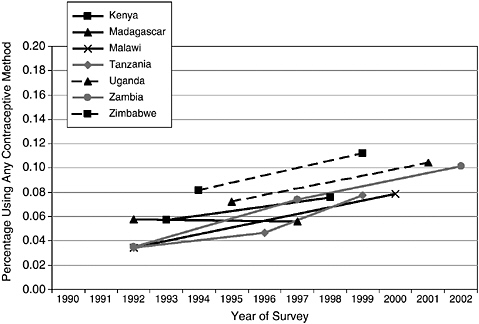
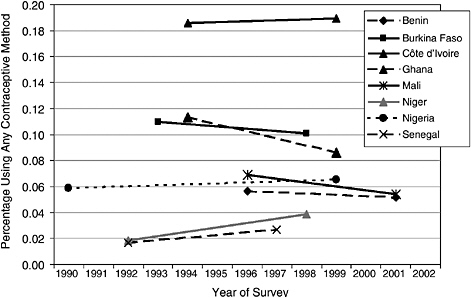
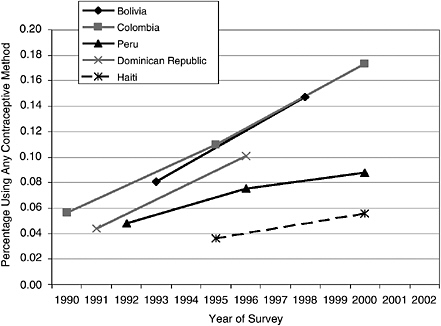
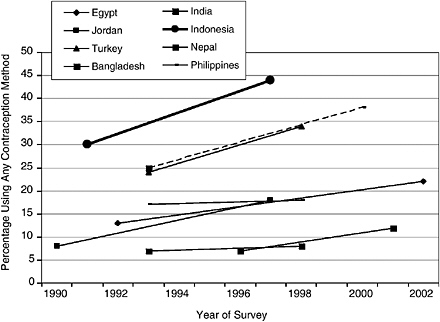
TABLE 4-8 Percentage of Women Ages 15-19 and 20-24 Currently Using Contraception by Region (Weighted Averages), Demographic and Health Surveys
|
Region or Income Level (Number of countries) |
Ages 15-19 |
|||
|
All |
Sexually Active |
Never Married |
Never Active, Sexually Married |
|
|
Region |
||||
|
Eastern and Southern Africa (13) |
9.4 |
21.1 |
7.7 |
27.7a |
|
Western and Middle Africa (13) |
8.7 |
20.4 |
9.2 |
25.8b |
|
Former Soviet Asia (4) |
3.6 |
24.5 |
1.0 |
n.a.c |
|
Caribbean/Central America (4) |
7.0 |
23.5 |
1.3 |
n.a.c |
|
South America (5) |
9.7 |
27.8 |
7.7 |
38.3 |
|
Income Level |
||||
|
Low (29) |
7.0 |
17.7 |
6.1 |
29.2 |
|
Lower middle (8) |
10.1 |
39.8 |
4.6 |
35.7 |
|
Upper middle (2) |
12.4 |
27.8 |
12.3 |
43.2 |
|
aDue to insufficient sample size, average for sexually active never married includes 12 countries. bDue to insufficient sample size, average for sexually active never married includes 11 countries. |
||||
tion. Similarly large differences in use are evident among 15-19-year-olds. Education differentials are smaller but still substantial in Latin America and the Caribbean.
Most studies of the determinants of contraceptive use do not focus specifically on young people. Those that do show that age, education (or school attendance or literacy), and urban residence are consistently positively associated with use (Ali et al., 2003; Gueye, Castle, and Konate, 2001; Gupta, 2000; Kuate-Defo, 1998). Some studies also identify various influences of religion. For example, in Cameroon, being Christian increases the likelihood of contraceptive use among women ages 15-27 (Kuate-Defo, 1998). In northeast Brazil, women ages 15-24 who regularly attended religious services (regardless of religion) were more likely to use contraception (Gupta, 2000).
Few young people, male or female, report using contraception at the time of their first sexual intercourse, although there are some exceptions; in a 1993 survey in Jamaica, for example, 43 percent of females reported using contraception the first time they had sex. The likelihood of using a method the first time increases with age at first sex (Blanc and Way, 1998). Young people often report failing to use contraception because they were
|
Ages 20-24 |
|||
|
All |
Sexually Active |
Never Married |
Sexually Active, Never Married |
|
24.7 |
29.9 |
22.7 |
42.2a |
|
17.3 |
23.3 |
28.4 |
35.4b |
|
30.2 |
43.0 |
3.8 |
n.a.c |
|
24.0 |
35.8 |
4.1 |
n.a.c |
|
23.7 |
33.3 |
31.1 |
58.6 |
|
18.9 |
24.8 |
20.6 |
43.6 |
|
35.5 |
55.0 |
15.1 |
49.3 |
|
24.1 |
29.6 |
40.4 |
64.1 |
|
cToo few countries with sufficient cases to calculate regional average. NOTE: n.a. = not available. |
|||
not expecting to have sex. Once they start to use contraception, girls are more likely to discontinue contraceptive use than older women and more likely to experience a contraceptive failure (Blanc and Way, 1998).
The proportion of young women who are not using contraception in spite of being exposed to the risk of pregnancy and not wanting to have a child ranged from 17 to 47 percent of married women ages 15-19 and 16 to 40 percent of women ages 20-24 in 26 developing countries in the early to mid-1990s (Westoff and Bankole, 1995). Young married women are about as likely as older women to have an unmet need for contraception. This is because younger women tend to want to space their births rather than stop childbearing, while older women increasingly prefer to stop childbearing; the net effect of the two tendencies is a roughly equal level of unmet need (Westoff and Bankole, 1995). Unmet need among never married women is much more difficult to assess and can vary widely depending on how it is calculated, because their exposure to the risk of pregnancy is complicated to measure accurately (Westoff, 2001).
Why young people do not use contraception, even when they are sexually active but do not intend a pregnancy, is a complex question. Lack of proper information is one possibility. While most young women have some
TABLE 4-9 Percentage of Women Ages 15-19 and 20-24 Currently Using Contraception by Region and Years of Education (Weighted Averages), Demographic and Health Surveys
|
Region/Years of Education (# of Countries) |
Ages 15-19 |
Ages 20-24 |
||
|
All |
Sexually Active |
All |
Sexually Active |
|
|
Eastern and Southern Africa (13)a |
||||
|
0-3 years |
8.2 |
7.2 |
16.1 |
11.5 |
|
4-7 years |
9.5 |
17.5 |
26.9 |
28.6 |
|
8+ years |
13.6 |
29.2 |
36.3 |
48.9 |
|
Western and Middle Africa (13)b |
||||
|
0-3 years |
3.8 |
7.4 |
7.1 |
8.6 |
|
4-7 years |
9.3 |
27.1 |
18.4 |
24.7 |
|
8+ years |
16.3 |
45.1 |
31.5 |
46.3 |
|
Caribbean/Central America (4)c |
||||
|
0-3 years |
6.5 |
19.5 |
19.5 |
30.1 |
|
4-7 years |
9.9 |
27.0 |
30.7 |
43.3 |
|
8+ years |
5.8 |
35.4 |
25.9 |
44.6 |
|
South America (5) |
||||
|
0-3 years |
9.5 |
23.3 |
21.7 |
26.3 |
|
4-7 years |
13.1 |
39.3 |
31.1 |
42.7 |
|
8+ years |
20.1 |
57.6 |
47.9 |
68.6 |
|
aDue to insufficient sample size, average for sexually active includes 9 countries. bDue to insufficient sample size, average for sexually active includes 10 countries. cDue to insufficient sample size, average for sexually active includes 3 countries. NOTE: Former Soviet Asia is excluded because virtually all women have 8+ years of education. |
||||
level of knowledge about one or more methods of contraception, knowledge of basic sexual and reproductive information is inadequate in many settings. Moreover, their knowledge of contraceptive methods may include inaccurate or exaggerated information about the risks involved. When it is considered inappropriate for children to learn about sex from their parents—as shown for example in studies in Uganda, South Africa, and India (Jejeebhoy, 1998; Nyanzi, Pool, and Kinsman, 2001; Wood, Maforah, and Jewkes, 1998)—and when schools do not provide forthright sex education (e.g., Balmer et al., 1997; Jejeebhoy, 1998), young people can be expected to enter marriage or their initial sexual relationship with various misconceptions. In contrast, when they have good initial knowledge about such issues as HIV/AIDS, research in Zambia shows their subsequent sexual behavior is more responsible, involving fewer lifetime sexual partners and more use, including more consistent use, of condoms (Magnani et al., 2004).
Abortion
Performed in safe conditions with modern methods, induced abortion carries little risk to women’s health or mortality. In representative developed countries, the risk of dying is no more than 1 in 100,000 procedures, lower than the relatively low risks associated with pregnancy and childbirth in these countries (The Alan Guttmacher Institute, 1999). Conditions are not necessarily safe, however, for women in developing countries (for further discussion, see the section under changes in the health service environment in Chapter 2) and are particularly hazardous for young women because of the circumstances under which abortions among them are likely to occur. Research suggests that while young women are not disproportionately likely to have abortions, they are more likely to delay seeking them and more likely to use an unskilled abortion provider.
National vital statistics on abortion are incomplete for all but a handful of developing countries. Even when data are available, they are often not broken down by age. Official statistics, even when they are reasonably complete, exclude abortions that take place outside the health care system. Survey data, in which women are interviewed concerning their experience of abortion, are available for some countries. However, collecting data on induced abortion through surveys is notoriously difficult, often because abortion is legally restricted, but also because, regardless of its legal status, abortion is an extremely sensitive issue (Barreto et al., 1992; Malhotra et al., 2003; Singh, Henshaw, and Berentsen, 2003). As a result, data on the incidence of abortion among young women in developing countries are largely unavailable, and the data that are available probably underreport its incidence. The available body of research on other aspects of abortion in general, and among young women in particular, is also relatively limited. Many studies are based on samples drawn from hospitals, reflecting the population of women who obtain unsafe abortions but not those who succeed in obtaining a safe procedure; many of the available studies are small scale, and many are qualitative, with few providing quantitative information on numbers, prevalence, or rates of abortion.
There were only five developing countries with national data on abortion prevalence among young women in the mid- to late 1990s: Cuba, Kazakhstan, Kyrgyzstan, Turkey, and Uzbekistan. Among these, the abortion rate (per 1,000 women) among women under age 20 ranged from virtually zero in Uzbekistan to 91 in Cuba. For women ages 20-24, the range was from 18 to 88. Cuba is noteworthy for its extremely high abortion rate among women younger than age 20; at 91 per 1,000, it exceeds that of the 19 other developed and developing countries in this study (Bankole, Singh, and Haas, 1999). Information based on other types of data is also available from a few countries. A large-scale survey of young
people in Uganda reported that 17 percent of 15-19-year-olds previously had an abortion and 53 percent of 20-24-year-olds had done so (Agyei and Epema, 1992). A study among 20-29-year-olds in Yaoundé, Cameroon, found that 21 percent of women reported ever having an abortion and 29 percent of young men reported ever having a girlfriend who terminated a pregnancy for which they were responsible (Calvès, 2002). Indirect estimates of the abortion rate in the early 1990s for young people in six Latin American countries showed that this rate (the number of abortions per 1,000 15-19-year-olds per year) ranged from 13 in Mexico to 36 in the Dominican Republic (The Alan Guttmacher Institute, 1999).
For the five countries included in the Bankole, Singh, and Haas (1999) study, the number of abortions per pregnancy rises consistently with age in all countries except one (Cuba). In contrast, population-based estimates in India for married women suggest higher abortion ratios for teenagers—1.7 percent of all pregnancies at ages 15-19 versus 1.3 percent for older women (Jejeebhoy, 1998), but these ratios are quite low in comparison to other countries, most likely because of underreporting of abortions. Based on the extremely limited data, it would appear that younger women obtain abortions less often than older women, but they nevertheless may be at greater risk when they do.
Among young pregnant women observed at a public hospital in Mexico City, 72 percent of young women who had an unwanted pregnancy that was ultimately carried to full term reported an average of 2.3 unsuccessful attempts at abortion (Ehrenfeld, 1999). For the members of the group who did abort the pregnancy, one to four abortion attempts were made before success. Many of these attempts were self-induced: typically “strong injections” of unknown drugs, the consumption of infusions of various types, and even deliberately falling down stairs. This is a common pattern followed by women of all ages seeking abortion; several attempts are usually made before succeeding in obtaining an abortion, safe or unsafe.
Furthermore, although the evidence is scattered, it suggests that young women—and particularly those who are unmarried—are considerably more likely than married adult women to delay seeking abortion and hence to undergo second trimester abortions. In India, where abortion is not restricted, a study reports that while three in five unmarried young women who had a medical termination of pregnancy at a municipal general hospital from 1978 to 1983 sought second trimester abortions, only a quarter of all married young women did so (Aras, Pai, and Jain, 1987). A more recent study in rural Maharashtra observes that, while married women regardless of age sought abortion at an average of 10.9 and 10.8 weeks of gestation, respectively, unmarried young women sought it at 12.7 weeks (Ganatra and Hirve, 2002). In Tanzania, where abortion is legally restricted, a study of young women seeking postabortion care reports that, while about half
(52 percent) sought abortion in the first 10 weeks, 37 percent sought it between 10 and 16 weeks of pregnancy and 11 percent sought it between 16 and 20 weeks (Mpangile, Leshabari, and Kihwele, 1999).
Unmarried young women, are, moreover, considerably more likely to resort to clandestine abortions and unskilled providers (Ehrenfeld, 1999; FOCUS on Young Adults, 2001; Ganatra and Hirve, 2002; Mpangile, Leshabari, and Kihwele, 1999; The Alan Guttmacher Institute, 1998; Varga, 1997). The need for confidentiality is a leading reason underlying this preference. For example, studies in India report that confidentiality was the leading criterion in the selection of a provider—outranking safety and convenience criteria. One such study observed that young women, whether married or not, were more likely to seek abortion from untrained providers, traditional birth attendants, paramedical workers, as well as medical practitioners unlicensed in providing abortion: while 22 percent of older women underwent abortion from an untrained provider, this proportion reaches almost one-third among young women who were married, and almost one-half among young women who were unmarried (Ganatra, forthcoming; Ganatra and Hirve, 2002). A study in Dar es Salaam, Tanzania, reports similarly that, of the abortion providers reported by young women who had undergone abortion, only 22 percent were identified as doctors; 65 percent were described as “other health workers” and 13 percent as “quacks” (Mpangile, Leshabari, and Kihwele, 1999). In urban Cameroon, abortions obtained before age 20 were more likely to be reported as self-induced or performed by an untrained person than were abortions performed after age 20 (Calvès, 2002).
In the study in India, while cost was cited as the leading motive for this choice among young married women, confidentiality was the leading reason reported by the unmarried; in general, young women were more likely to report, moreover, that the provider had not explained the abortion procedure (Ganatra and Hirve, 2002). The case study in Dar es Salaam also reports that cost considerations prompted provider selection, and that providers neither counseled nor gave them information or contraceptive supplies (Mpangile, Leshabari, and Kihwele, 1999).
An ethnographic study in Lombok, Indonesia, reported similarly that even though providers were willing to provide abortions to unmarried women, they remained highly critical of unmarried pregnant women and as a result the quality of services provided to them was compromised: no attempt was made to explain the abortion procedure or postabortion contraception, provider attitudes were judgmental, and no counseling was provided. Doctors themselves corroborated these attitudes, labeling unmarried young abortion seekers as immoral and bad (Bennett, 2001).
And in China, where abortion is legally available in the first trimester, a large number of migrant young women in urban areas sought abortion
from private facilities because they felt their privacy would be better protected there (Zheng et al., 2001). Likewise, in Cuba, where abortion services are widely available, in order to ensure anonymity young people frequently seek services outside their local clinic (Peláez Mendoz et al., 1999). However, a study of induced abortion among single women in Sichuan province suggested that providers were well trained and abortions were performed under generally safe conditions (Luo et al., 1995). In the Republic of Korea too, single women cited privacy as an important criterion in the selection of an abortion facility (Tai-Hwan, Kwang Hee, and Sung-nam, 1999).
Reasons frequently cited by young women for obtaining abortion are to continue to attend school, a lack of commitment by their partner, and being unmarried. In a review by Bankole, Darroch, and Singh (1999), between 30 and 55 percent of women who had an abortion in four studies in sub-Saharan Africa reported that their main reason for having the abortion was concern that childbearing and rearing would disrupt their education or their employment. In urban Cameroon, being in school increased the odds that a pregnancy would result in abortion sevenfold, after controlling for other factors (Calvès, 2002). This reason was less common but still significant in studies in three Latin American countries included in the Bankole, Darroch, and Singh (1999) review, with 15 percent of women reporting it. In addition to this category of reasons, a substantial proportion (14 to 37 percent of women) in all but one of the sub-Saharan and Latin American countries reported that their main reason for seeking the abortion was that they were too young or that their parents or someone else objected to the pregnancy.
Recent studies have documented the impact of rising rates of contraceptive use on abortion rates among women in a few developing countries (Marston and Cleland, 2003; Senlet et al., 2001; Singh and Sedgh, 1997; Westoff et al., 1998). The relationship between the two is complex and a number of factors come into play, but these studies generally demonstrate that a trade-off eventually occurs between contraception and abortion, as more women use contraception and as they use it more effectively. Where the use of contraception has grown among young women, particularly among sexually active unmarried women, the last decade may have seen reduced reliance on abortion or may signal an impending decrease in the demand for abortion. In many countries, however, it will most likely be several years before abortion rates decline; increases in exposure to the risk of premarital pregnancy, reductions in the number of children desired, and the increasing competition of educational and work aspirations with motherhood suggest that, unless young women adopt family planning in rising proportions, they will increasingly resort to abortion.
OTHER RISK BEHAVIORS AND THEIR HEALTH CONSEQUENCES
Some health behaviors that typically are initiated during the transition to adulthood can compromise current health and reduce life expectancy and well-being. WHO estimates that 70 percent of premature deaths among adults are largely due to behavior initiated during adolescence (World Health Organization, 1995). Cigarette smoking, the consumption of alcohol, and the use of illicit drugs are among behaviors that can have the most damaging effects on long-term health. These behaviors often occur together and appear to have some common underlying causes. The development of a global youth subculture that underestimates the dangers of smoking and drug use is thought to be an important factor in the growth of smoking and substance abuse in developing countries. Trends toward easier access to drugs and increasing urbanization, the influence of Western media, the relaxation of traditional social controls on young people (Mugisha et al., 2003), and the resulting “ambivalences and contradictions of a confusing cultural braid” (Nsamenang, 2002:65) are also implicated. While not further discussed due to lack of comparative data, increasing obesity and overweight among young people is another concern that is emerging in the context of rapid global change (see Box 4-3).
Smoking
According to one estimate, between 68,000 and 84,000 people under the age of 20 in low- and middle-income countries take up smoking every day (Gajalakshmi et al., 2000). Smoking usually starts early in life. In developed countries, the majority of smokers start in their teens. In developing countries, the starting age may be slightly later, on average, perhaps in the early 20s, but the trend is toward younger ages (Jha and Chaloupka, 1999; Yang et al., 1999, cited in Hannum and Liu, 2005). Once a smoker starts, symptoms of dependence develop quickly, particularly for those who start young. A study of 12-13-year-olds indicates that two cigarettes once a week for six months are on average enough to develop 11 specifically defined symptoms of dependence in boys. In girls, it takes on average only three weeks. The development of any symptom of dependence strongly predicts continued smoking and, as is the case with other health-related behavior, there is some evidence that young people tend to underestimate the risk of becoming addicted to nicotine and the probability that they will continue to smoke into adulthood (DiFranza et al., 2002; Gruber and Zinman, 2000; Jha and Chaloupka, 1999).
More than 100 surveys on smoking among young people have been conducted since 1999 by the Global Youth Tobacco Survey (GYTS) program (World Health Organization and Centers for Disease Control and
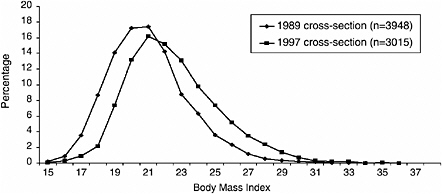
Prevention, 2002). The surveys use self-administered questionnaires and are nationally or subnationally representative samples of in-school students who are primarily ages 13-15 (GYTS Collaborating Group, 2002).13 The data are limited to in-school young people attending school. Thus samples are highly selective of those populations most likely to be exposed to global youth culture and Western media and unrepresentative of the populations of these ages in settings in which the majority of young people or of girls are not attending school at this age.
The percentages currently smoking by region based on 126 GYTS surveys are shown in Table 4-10 (individual survey results are in Appendix Table 4-1). Across the developing country surveys, 15 percent of male students on average and 7 percent of females students are currently smoking cigarettes. There is substantial variation among regions, with current smoking among male students varying from 41 percent in the Russian Federation and the former Soviet Asia to less than 10 percent in Southern and Eastern Asia. Among the 23 state-level surveys conducted in India, smoking prevalence among boys ranged from 1 to 33 percent and among girls from 1 to 13 percent. The regional medians are lower for girls than boys in every developing region. Substantial proportions of young people attending school in some countries use forms of tobacco other than cigarettes (GYTS Collaborating Group, 2002).
Survey data on smoking among young people ages 15-19 have been collected recently for five Asian countries—Indonesia (1998), Nepal (2000), the Philippines (1994), Taiwan (1994), and Thailand (1994)—under the Asian Young Adult Reproductive Risk (AYARR) project and a handful of other countries under the DHS program. Among these countries, gender differences are even greater with no more than 5 percent of females reporting current smoking in any of these surveys (Choe, Westley, and Retherford, 2002; ORC Macro, 2004). It is not surprising that gender differences in smoking are reported to be smaller in student populations than in the general population, because it is by being a student that boys’ and girls’ exposure and experiences during these years become more similar. Nonetheless, smoking rates remain lower among girls in most places where data are limited to student populations, and this could be due to the fact that smoking is not considered ladylike or attractive for girls by young people in
TABLE 4-10 Percentage of Young People Currently Smoking by Sex
|
Age Group and Region or Country |
% Currently Smoking |
|
|
Males |
Females |
|
|
In-School Ages 13-15 (GYTS), 1999-2003 |
||
|
Eastern and Southern Africa (16) |
12 |
5 |
|
Western/Central Africa (10) |
24 |
6 |
|
South-eastern/South-central Asia (31) |
8 |
3 |
|
East Asia (5) |
9 |
2 |
|
Russia/Former Soviet Asia (3) |
41 |
29 |
|
West Asia/Northern Africa (19) |
14 |
4 |
|
Caribbean/Central America (24) |
14 |
11 |
|
South America (34) |
20 |
15 |
|
Europe (14) |
24 |
20 |
|
Oceania (3) |
23 |
20 |
|
USA (1) |
18 |
18 |
|
All, Excluding Europe and USA |
15 |
7 |
|
All Ages 15-19 (DHS), 1999-2002 |
||
|
Benin 2001 |
n.a. |
1 |
|
Malawi 2000 |
n.a. |
<1 |
|
Rwanda 2000 |
n.a. |
1 |
|
Uganda 2000-2001 |
n.a. |
1 |
|
Zambia 2001-2002 |
2 |
<1 |
|
Zimbabwe 1999 |
n.a. |
<1 |
|
Egypt 2000 |
n.a. |
<1 |
|
Cambodia 2000 |
n.a. |
1 |
|
Haiti 2000 |
1 |
1 |
|
All Ages 15-19 (YARHS), 1994-2000 |
||
|
Indonesia 1998a |
38 |
1 |
|
Nepal 2000b |
12 |
4 |
|
Philippines 1994 |
28 |
3 |
|
Taiwan 1994 |
30 |
5 |
|
Thailand 1994 |
33 |
2 |
|
aIncludes nonmetropolitan provinces in Java. bExcludes the mountain ecological region. Includes cigarettes/bidis. NOTES: n.a. = not available. Global Youth Tobacco Survey (GYTS) regional percentages are unweighted medians of all sites (both national and subnational). SOURCES: Demographic and Health Survey tabulations from 1999-2002; Choe, Westley, and Retherford (2002); and GYTS (2003). |
||
some places (e.g., Morrow et al., 2002). For example, in almost every GYTS survey in a developing country, a larger percentage of respondents said that smoking makes boys look more attractive than said it makes girls look more attractive (GYTS Collaborating Group, 2002). In comparison to the volume of research on the determinants of such risk behaviors as smoking among young people in Western countries, little is known about devel-
oping countries. We found only a few examples of multivariate studies of the determinants of smoking and even fewer that were methodologically sound. These studies and other descriptive information tend to confirm that both individual factors as well as factors present in young people’s social environment “protect” them from smoking (see Box 4-4). For example, one study on the initiation of smoking among Filipino youth ages 15-19 shows that being strongly religious reduced the odds of initiating smoking, while living away from parents increased the odds (Choe and Raymundo, 2001). Among Chinese young people, problem behavior (including smoking) was reduced in the presence of support from teachers, disapproval of such behavior by adults in the neighborhood, and control of the family as well as individual intolerance of deviant behavior (Jessor et al., 2003). As in the case of studies of sexual behavior among young people, many studies of smoking and other health-related behaviors have found a strong association between the likelihood of smoking and the perceived behavior of peers (e.g., whether or not friends smoke). In cross-sectional statistical studies, these variables are most likely to be endogenous, and their introduction in the analysis may bias the results of the study.
Young smokers are not necessarily content with their habit. Across countries participating in the GYTS, approximately 70 percent want to stop smoking, and two-thirds have actually tried to stop. The desire to stop is particularly strong in low-income countries, where 80-90 percent often want to stop (Figure 4-7). Young people obtain cigarettes more often by purchasing them in a store than from any other source (Warren et al., 2000), so their cost may be a factor if incomes are particularly low. Indeed, some studies of European young people have shown that the likelihood of smoking is positively associated with increased personal income (Griesbach, Amos, and Currie, 2003; Pavis et al., 1998; also see discussion below on taxation policies under policy recommendations).
Smoking has declined in the general population in various developed countries (Cutler, 2004; Gruber and Zinman, 2000; Johnston, O’Malley, and Bachman, 2003). The trend among the adult population in developing countries, in contrast, has been upward since the 1970s, although possibly more moderate in the 1990s. Data on trends in smoking among teens and young adults are not available as yet for most developing countries, but the consensus based on the limited information available is that smoking among this group increased during the 1990s in many countries, and that the increases were particularly steep among young women (Jha and Chaloupka, 1999; Shafey, Dolwick, and Guindon, 2003). Even if this trend turns downward, however, rising numbers of deaths attributable to tobacco are expected for decades to come. In the 40 years subsequent to the peak of the tobacco epidemic in the United States in the 1950s, for example, deaths in middle age attributable to tobacco rose from 1 in 8 to 1 in 3 (Jha and
|
BOX 4-4 Experimenting with tobacco, alcohol, and illicit drugs would seem to involve interdependent decisions. A syndrome of risk may exist, with young people who are inclined to try one hazardous substance also likely to try another. Such a syndrome need not involve a psychological predisposition to addiction. It may instead be related to social context: circumstances in which one substance is available and considered acceptable may also provide opportunities to sample another. Arguably, such a syndrome could extend to other behaviors that pose immediate or delayed health risks, including early sexual activity. Research in developed countries appears to provide confirmation of such a syndrome. Among young people living in the United States, alcohol abuse, smoking, and use of illicit drugs tend to go together, and these behaviors have been shown in some studies to correlate with precocious sexual activity. Studies in Finland and Israel show parallel interdependencies. Importantly, these problem behaviors also appear to have similar psychosocial and environmental correlates (Jessor, 1984, 1991). It is not clear at this time, however, whether a syndrome of problem behavior extends to young people in developing countries. One indication is a recent study that assesses problem behavior (delinquency, smoking, and problem drinking) among young people ages 13-15 in Beijing schools and compares them with young people in urban U.S. schools in the Rocky Mountain area (Jessor et al., 2003). In spite of marked differences in the social context of young people at the two sites, the researchers found similar factors at work in both settings, notably the influence of peers or schoolmates on such behavior and the protective effect of personal intolerance for deviance. In the Beijing sample but not in the U.S. sample, problem behavior was also lower among those who reported stronger family controls and neighborhood disapproval of such behavior. These factors—peer influence and the protective influence of personal and social disapproval—had roughly equal, though opposite, effects. With somewhat similar dynamics across cultures, despite the variation in the effect of family controls, the existence of a similar syndrome seems plausible, but considerably more research confirmation is needed. Could a syndrome cover such other health risk behaviors as poor diet and limited exercise? These factors appear somewhat less strongly linked to cigarette smoking and alcohol abuse, forming a separate though related class of behaviors among U.S. teens (Turbin, Jessor, and Costa, 2000). Extending the idea of a syndrome further to cover other problem behaviors, such as those mainly involving legal or normative transgressions, may be problematic. The research consensus for developed countries appears to be that, when problem behaviors are defined broadly, separate factors are identifiable for externalizing problems, such as physical aggression, and internalizing problems, such as shyness or depressed mood (Loeber et al., 1998)—suggesting two syndromes rather than one. Perhaps more critical, what is considered a normative transgression may vary across developing countries, and what is normative in a given culture is not necessarily healthy. Where social or even legal norms restrict various forms of sexual behavior, such as contraceptive use among young people, nonnormative behavior may in fact be the healthier choice. |

FIGURE 4-7 Percentage of student smokers ages 13-15 wanting to stop, by per capita national income and region.
SOURCES: Global Youth Tobacco Survey Collaborating Group (2002) and World Bank (2001).
Chaloupka, 1999). The health effects of a continued rise in smoking among young people in developing countries could be felt for even longer (Gajalakshmi et al., 2000).
Drug and Alcohol Use
Not surprisingly, comparable data on illicit drug use among young people in developing countries are scarce and often of dubious quality. Nevertheless, international comparisons that provide a general picture of levels and trends are periodically compiled by the United Nations (e.g., United Nations, 1999b, 2000b). There is an enormous research literature on the correlates of alcohol and drug use among young people, although a great deal more is known about young people in developed than developing countries. A comprehensive review of this literature is beyond the scope of this chapter, but a summary of significant trends and issues is given below.
The data compiled by the United Nations show that the prevalence of drug use tends to be lower on average in developing countries than in developed countries although the gap may have decreased since the early to mid-1990s due to both stable or declining prevalence in developed regions combined with increases in developing regions. For most drugs except mari-
juana, however, the prevalence of drug use in the developing regions is still mostly well below Europe, North America, Australia, and New Zealand.
Research suggests that, unlike smoking, many young people who experiment with illicit drugs do not become addicted and do not continue to use when they become adults (United Nations, 1999b). This pattern is manifested in higher reported prevalence rates among young people than among the general population. It is worth noting, however, that the younger the age at first experimentation, the more likely that a serious addiction will develop; there are indications that the initiation into drug use has become earlier, especially in places where amphetamine-type stimulants (such as Ecstasy) are popular. In the developing world, these places include some countries in South-eastern Asia and Africa (United Nations, 1999b). At the same time, even short-term experimental drug and alcohol use can have detrimental effects on progress in school, and the impaired judgment that results can increase the likelihood of engaging in other risky behavior, such as unprotected sex, drunk driving, and violence (Call et al., 2002).
In 1990, alcohol use was responsible for 5 percent of all deaths of young people ages 5 to 29 worldwide (Jernigan, 2001). The link between alcohol use among young people and adult alcohol dependence has also been documented in at least one developing country—Costa Rica—where a 1995 study showed that 55 percent of those identified as alcoholic and 40 percent of those drinking “excessively” began drinking before age 15 compared with 31 percent of those drinking at lower levels (Jernigan, 2001). Compared with developed countries, studies on alcohol consumption among young people in developing countries are scarce and rarely comparable in terms of age groups or categories of use (lifetime, current, or heavy use). Overall, rates of alcohol use among young people tend to be lower in developing countries than developed countries. However, as corporations intensify marketing campaigns and increase the sale of new types of alcohol products in developing countries, alcohol consumption patterns are predicted to rise. In Mexico, new types of sweeter alcoholic beverages, combining cola and liquor, are appearing on the market and are consumed more among young people in urban areas who are under the age of 18 (World Health Organization, 2001b). Data from Brazil, Chile, and Mexico already indicate an increase in drinking among all young people, especially girls.
Generally speaking, boys are more likely to drink and drink heavily than girls, and alcohol consumption tends to become more prevalent with age. Surveys conducted in Africa, Latin America, and China consistently show higher rate of alcohol use among boys than girls (Jernigan, 2001).
At-risk young people may initiate drinking earlier and drink more than other young people. For example, a study of Brazilian street youth found that 33 percent of young people ages 9-11 and 77 percent of those ages 15-
18 reported heavy use of alcohol (Jernigan, 2001). Young people in developing countries are increasingly engaging in binge drinking, which until now has been a type of drinking associated only with developed countries.
It is difficult to link trends in alcohol use among young people in developing countries with other global trends, given data limitations. For example, since most data on drinking among young people comes from surveys of students, little is known about nonstudent alcohol consumption and what the impact will be of worldwide rising school enrollment rates. However, it is clear that as developing countries become more urban and as the marketing and proliferation of alcohol products intensifies, patterns of drinking among young people in developing countries will become more similar to those of developed countries.
POLICIES AND PROGRAMS AIMED AT YOUNG PEOPLE’S HEALTH
Young people become increasingly important actors in shaping their own health during adolescence. As described above, adolescence entails making choices concerning lifestyles and actions that have significant short-term and long-term health implications—for example, choosing health-promoting activities such as regular school attendance, participation in sports, participation in community-based youth groups or activities, and abstinence or contraceptive use or choosing health-compromising activities such as smoking, alcohol and drug use, joining gangs, or unprotected sex. Other challenges entail contending with adverse circumstances not of their own making—for example, exposure to infectious disease (especially tuberculosis and malaria) and parasites, exposure to environmental contaminants, and malnutrition related to poverty.
At the same time, young people increasingly become “clients” for policies and programs aimed at protecting their health, gradually eliminating the fiduciary role that parents and guardians play. It should be noted, however, that although many relevant policies and programs aim to directly influence young people as primary decision-makers on matters related to health, others recognize the important role that the context or environment in which young people are raised play in influencing their behaviors; these programs thus seek positive health outcomes indirectly by influencing environmental factors.
Numerous health-related policies and programs directed toward protecting the health of young people have been implemented in developing country settings over the years. To what extent have these policies and programs increased the likelihood of a healthy transition to adulthood? Despite the emergence of a global consensus that young people are a population subgroup having special needs and warranting special attention, the
empirical evidence on the impact of relevant health policy and program initiatives remains thin. Careful studies of the impact of health-related policies are particularly lacking, and cost-effectiveness studies are virtually nonexistent. The existing body of evidence supports only the most tentative conclusions as to the effectiveness of health policy and program efforts undertaken to date, and it is insufficient to make meaningful comparisons as to the relative effectiveness of many promising policy and program approaches. One tentative conclusion that can be reached, however, is that a more recent generation of programs with multiple components appears to be more effective in changing behavior than single-strategy interventions, particularly if drawn on local institutions and are designed to be culturally appropriate to the local context.
In this section we review the available evidence on the impact of policies and programs in two areas: reproductive and sexual health and smoking. These were chosen because they are areas in which the choices made by young people can have an enormous impact on both their current and future health. Moreover, they are areas in which global trends, such as increasing education, the rise of market economies, and the diffusion of a global youth culture, are likely to play a major role. In addition, in both areas, one or more comprehensive reviews of the evidence on the effectiveness of interventions has recently been carried out. The discussion of reproductive and sexual health interventions is based largely on a review prepared as part of the final project activities of the U.S. Agency for International Development (USAID)-funded FOCUS on Young Adults project (Speizer, Heller, and Brieger, 2000) as well as on a summary of 10 subsequent studies conducted primarily under the FRONTIERS and Horizons projects (YouthNet/Family Health International, 2003).14 The discussion of smoking interventions draws heavily on the World Bank’s 1999-2000 work on the economics of tobacco control.
Policies and Programs Directed Toward Improving Sexual and Reproductive Health Outcomes
The number of small-scale programs and interventions addressed to adolescent reproductive health needs that have been implemented has greatly increased since the U.N. International Conference on Population and Development in 1994, when member states agreed that young people have special reproductive health needs and recommended that special pro-
grams be developed to address those needs (United Nations, 1994). As experience with programming has evolved, it appears that multicomponent programming is becoming more common. At the same time, the level of attention to assessing the impact of reproductive health programs for young people has also increased in the 1990s, although the proportion of programs that are subjected to rigorous evaluation remains small.
Many reproductive and sexual health programs have been evaluated using designs that are methodologically flawed and preclude drawing strong conclusions about the impact of the program being evaluated. This situation has improved over the last several years, however; much of the available evidence as to the impact of reproductive health interventions for young people in developing country settings now comes from matched quasi-experimental evaluations of small- to modest-scale programs and, in a few cases noted below, from randomized trials.15 Unfortunately, however, it is not known how well the distribution of intervention studies in terms of type of program evaluated mirrors the underlying distribution of programs that have been developed over the last 10 years.
While these studies represent a substantial improvement in rigor, they are nevertheless subject to a number of important limitations. Generally, the available studies have measured only short-term effects, within 6 to 18 months after the intervention, and many of the interventions themselves have had very short durations. This is a potentially important limitation because some studies have suggested that the impact of such programs, school-based sexual and reproductive health education for example, may be transitory in nature (Eggleston et al., 2000; Jackson et al., 1998; Kirby, 1997). In addition, many of the matched quasi-experimental studies undertaken to date have failed to adequately account for possible endogeneity with regard to selectivity of program exposure. Also, the outcomes of most existing studies have been (self-reported) knowledge, attitudes, or behaviors that put young people at risk for adverse reproductive health outcomes (early sexual debut, unprotected sex, multiple sexual partners) rather than ultimate outcomes (pregnancy, HIV infection). The most common outcomes measured are knowledge or attitudes, intended behavior, condom use, any type of contraceptive use, initiation of sex, and frequency of sex.
All of the evidence discussed below comes from studies with random-
ized or matched control designs, some with pretest and posttest measurements and some with posttest-only measurements. Studies with less rigorous designs are not included in the discussion. The first part of the review focuses on the more traditional single-component programs, whereas the second part of the review focuses on the newer multicomponent programs.16
Sexual and Reproductive Health Education in Schools
Undertaking sexual and reproductive health education programs in schools has the potential to reach a large number of young people in countries in which school enrollment rates are high. Although the reach of school-based programs is not universal, enrollment rates among adolescents are now relatively high in many developing country settings, and recent data indicate that they are rising more or less throughout the developing world, particularly among females. The curricula, content, duration, and format of these interventions varies. Overall, the programs attempt to impart information on one or more of the following areas: sexuality, HIV/AIDS transmission and prevention, family planning, condoms, sexually transmitted diseases, and decision-making and refusal skills.
Findings from studies in developing country settings suggest somewhat higher levels of intervention success in comparison to school-based programs in the United States and Canada, where a recent review has found minimal impact (DiCenso et al., 2002). A review of 22 evaluation studies by Speizer, Heller, and Brieger (2000) found that a large majority of the programs reviewed (17 of 21) were able to demonstrate impact on knowledge and attitudes. However, only 4 of 11 programs that sought to delay age at first sex and 3 of 6 seeking to reduce numbers of sexual partners were able to demonstrate impact. As with U.S. and Canadian programs, programs in developing countries in the aggregate appear to have been somewhat more successful in increasing contraceptive or condom use (impact was observed in 6 of 10 programs seeking this outcome). However, among the programs that were able to demonstrate behavioral impact, the magni-
tude of impact has generally been modest and limited to a subset of the behavioral outcomes targeted.
Examples of the results achieved by some of these school-based interventions include:
-
A randomized control trial of an after-school intervention (14 sessions) undertaken in Namibia found that young women who had never had sex (at baseline) in the intervention group were more likely to have remained celibate at the 12-month follow-up (Fitzgerald et al., 1999; Stanton et al., 1998).
-
A randomized control trial of a “drama-in-education” program in KwaZulu-Natal Province, South Africa, found that at the 6-month follow-up sexually active participants from project schools reported an increase in condom use compared with sexually active participants from control schools (Harvey, Stuart, and Swan, 2000).
-
A randomized control trial of a skills-based, 90-minute intervention in Zimbabwe found that at 4-months’ follow-up, students in the intervention group reported fewer sexual partners and fewer episodes of unprotected sex in the last month than control students (Wilson, Mparadzi, and Lavelle, 1991).
-
A randomized control trial of a program for young people (ages 18-25) who worked full time and attended junior high or high school in the evening in Sao Paulo, Brazil, found that at 1-year follow-up female participants reported improved communication with partners and a decrease in unprotected sex (Antunes et al., 1997). No impact was observed, however, among the male participants.
Two linked school- and health facility-based programs are also among those that reported behavioral impact. For example, an intervention in Benin City, Nigeria, was implemented in 1998 to teach young people attending school about STIs and encourage them to receive treatment from trained private medical doctors (Coplan et al., forthcoming). At the 12-month follow-up, students in the intervention schools reported significant increases in the use of condoms and knowledge of the correct treatment-seeking behavior for STIs compared with students in the control schools. Moreover, prevalence of self-reported symptoms of STIs in the prior 6 months was lower in intervention than control schools, the use of private physicians increased, and the use of patent medicine dealers or pharmacists decreased. The Integrated Adolescent Development Program in Chile, an integrated school- and health facility-based reproductive health intervention implemented over three school years for urban teenagers in Santiago, reported an increase in age at sexual debut among intervention males compared with no change among control males (Murray et al., 2000). The
intervention resulted in a greater increase in contraceptive use among girls from program schools than among those from nonprogram schools. Overall, however, use of contraceptives at last sex remained low in both groups, and no significant increase in the volume of young clients at health facilities over the 2-year follow-up period was observed.
Three studies published after the Speizer, Heller, and Brieger (2000) review reported findings consistent with the above summary. A randomized trial of a 1.75-hour in-class peer education program implemented in secondary schools in Zambia indicated significant effects on knowledge, attitudes, and beliefs toward abstinence and condom use and higher levels of perceived risk, but it did not measure impact on behaviors (Agha, 2002). An assessment of the South African national Life Skills Program undertaken in KwaZulu-Natal Province indicated statistically significant but modest program effects on some areas of knowledge and perceived condom self-efficacy and larger effects on condom use, but no consistent effects on age at sexual debut, secondary abstinence, or numbers of sexual partners (Magnani et al., 2003). Finally, a randomized trial of an extracurricular school-based program in Masaka, Uganda, failed to detect any significant program effects (Kinsman, Nakiyingi, and Kamali, 2001).
Although behavioral impact was not always achieved in school-based sexual and reproductive health programs, no developing country study to date has found evidence that providing young people with sexual or reproductive health information results in increased sexual risk-taking.
Mass Media and Social Marketing Programs
The use of mass media is an appealing strategy for reproductive health programs for young people because of its potential to reach large numbers of young people and the opportunity to introduce new ideas and topics. Although less research has been undertaken on mass media-based sexual and reproductive health interventions directed specifically to young audiences, communications research indicates that the media can be an effective strategy for influencing adult behaviors (Rogers, 1995).
Six quasi-experimental studies of mass media-based interventions aimed at influencing knowledge, attitudes, and behaviors among young people are reported in the research literature. All but one was successful in improving knowledge or attitudes in the intervention community, and all five of the evaluations that measured behavioral impacts found impact on at least one behavioral outcome.
One project, the Arte y Parte project in Paraguay, which had as explicit goals to increase sexual and reproductive health knowledge and communication skills among young people, used various mass media products and activities to disseminate information to young people on adolescent health
issues, as well as workshops conducted in schools (Magnani et al., 2000). The program trained peer educators, who assisted in the development of media products and interacted regularly with their peers. After 30 months, nearly 44 percent of young people were exposed to at least one project activity, with radio programming having the greatest reach. Exposure to the program was found to be associated with changes in relevant knowledge and attitudes, but not with sexual or contraceptive behaviors, although the program probably contributed to an observed increase in the proportion of young people reporting condom use at first sex.
Four mass media projects with social marketing were undertaken in Africa by Population Services International (PSI) in Botswana (Meekers, Stallworthy, and Harris, 1997), Cameroon (Van Rossem and Meekers, 1999a), Guinea (Van Rossem and Meekers, 1999b), and South Africa (Meekers, 1998). All had similar intervention and evaluation designs (see Agha, 2000). The projects included a mass media component (radio and print media in Botswana and Cameroon; print media in Guinea; radio, television, and print media in South Africa), as well as social marketing of condoms and peer educators who sold condoms. In addition, the Botswana Tsa Banana Program referred young people to the Tsa clinics and included education sessions in schools, the program in Cameroon worked with clubs in schools to increase their reach, and the program in Guinea had a small “youth-friendly services” component that involved providing special hours for young people at selected clinics linked to the program.
The evaluation findings indicate that these mass media strategies achieved high coverage, especially of radio messages. The media campaigns also increased recognition of the brand of condoms being promoted in Guinea (Van Rossem and Meekers, 1999b) and Cameroon (Van Rossem and Meekers, 1999a). The primary behavioral impact of these programs was on condom use (ever use and recent use). In Guinea, women and men in the intervention group reported greater use of condoms at last sex than young people in the comparison group (Van Rossem and Meekers, 1999b). In Cameroon and South Africa, women in the intervention group reported greater experience with condoms at follow-up; however, this did not translate into greater recent condom use (Meekers, 1998; Van Rossem and Meekers, 1999a). Finally, the project in Cameroon found that women in the intervention group reported delayed sexual initiation, and significantly fewer men in the intervention group reported having multiple partners in the last 12 months (Van Rossem and Meekers, 1999a).
The sixth mass media project, the Promotion of Youth Responsibility Project in Zimbabwe, had both individual and community-level objectives (Kim et al., 1998, 2001). The project employed two strategies: a 6-month multimedia campaign directed toward young people and training of providers in interpersonal communication and counseling skills. Evaluation find-
ings indicated broad reach of the radio program, especially in rural areas. Young people exposed to the intervention also reported being more likely to abstain from sex and have fewer recent sexual partners, and use of contraceptives and clinic services increased significantly in campaign sites between the surveys. Comparable increases were not found in comparison sites. The campaign had the greatest impact on clinic attendance among some of the groups least likely to seek services: males, single young people who are unmarried, and sexually inexperienced young people (Kim et al., 2001).
Youth-Friendly Health Services
Youth-friendly service initiatives are geared toward making the use of existing reproductive health services more acceptable and less traumatizing to young people. Youth-friendly services placed in existing facilities can also provide a wide range of services for young people in a single setting.
To date, only a small number of youth-friendly service programs in developing country settings have been rigorously evaluated. Among the three with reported evaluation results, one found solid evidence of positive impact on service utilization by young people, one nominal impact, and one no impact. The strongest impact was observed in connection with the Zimbabwe mass-media-based program discussed above that also included training of health service providers in youth counseling skills (Kim et al., 2001).
The second study, which yielded mixed results, was undertaken in Ecuador. This intervention combined education, counseling, and clinical services provided by trained clinic personnel in service delivery and reproductive health issues for young people (i.e., a “reproductive health awareness” approach) (Institute for Reproductive Health, 2001). The evaluation findings indicate that the program did not increase the number of new clients visiting the project clinics, but it did increase the number of young people who returned, thus improving continuity of care at intervention facilities.
The third program involved the testing of three separate youth-friendly service pilot projects in Lusaka, Zambia, in the late 1990s (Mmari and Magnani, 2003). No statistical relationship between the degree of clinic youth-friendliness and trends in service utilization was found. Instead, rank-order correlation tests indicated that service utilization by young people was more closely related to community attitudes toward the provision of reproductive health services to young people.
Although the available evidence is thin, it suggests that some form of community outreach might be necessary in conjunction with health facility-based programs in order to attract young people to health facilities. For example, an evaluation of a community-based program implemented by
family planning workers, village doctors, and women’s leaders in 20 townships in Jiangsu Province, China, observed significant increases at the 12-month follow-up in condom use at last sex among villages participating in the project versus no change in condom use in control villages (Xiaoming et al., 2000).
Peer Promotion Programs
Peer programs take advantage of the fact that young people spend a large amount of time interacting with other young people similar to themselves in school, at work, or in the community. These programs recruit and train a core group of young people to serve as role models and sources of information for their peers. In some settings, peers have been able to distribute or sell certain types of contraceptives, thus increasing access to nonclinical contraceptives in a nonthreatening environment. Peer educators (or promoters) have been deployed in combination with other intervention strategies (e.g., some school-based programs), and many mass media programs use peer educators.
Peer promotion strategies have been associated with positive behavioral outcomes in several studies. Evaluation findings from a matched quasi-experimental study of a peer-promotion program in secondary schools in six cities in Peru demonstrated a positive association with age at sexual initiation and use of a contraceptive method at last sexual encounter over an 18-month observation period (Magnani et al., 2001). A peer-based program worked with youth-serving organizations in Nigeria and Ghana in three types of sites: secondary schools, postsecondary schools, and out-of-school sites (Brieger et al., 2001; Speizer, Tambashe, and Tegang, 2001). The only behavioral change associated with the program was that young people attending intervention schools reported greater recent use of protective methods against STIs than comparable young people from nonintervention schools. The program was not associated with any behavioral change for out-of-school young people who do not attend school. A third peer program used a community-based peer education strategy in one city of Cameroon to promote contraceptive use and reduce the prevalence of STIs/HIV and unintended pregnancies among young people (Speizer, Tambashe, and Tegang, 2001). At the 16-month follow-up, having had an encounter with a peer educator was associated with current contraceptive use and use of condoms at last sex.
It should be noted that the recurring costs of peer programs are high, and several studies in the United States suggest that the largest program impacts are on the peer educators themselves (Barnett, 2000; Flanagan, Williams, and Mahler, 1996; Philliber, 1999; Randolph, 1996).
STI/HIV Counseling and Testing
Evidence from the United States indicates that HIV counseling and testing can be effective in changing high-risk sexual behaviors and reducing new STIs among both adults and young people (Bolu et al., 2002; Kamb et al., 1998). The evidence from developing country settings is sparse. However, the findings from a randomized control trial of a program for unmarried young adults in northern Thailand indicated a significant effect on the proportion of young people seeking HIV testing. The magnitude of the effect (8 percent) was modest, and no increases in other risk-reduction behaviors (e.g., condom use) were observed (Jiraphongsa et al., 2002).
Youth Centers
In recent years the use of youth centers to reduce barriers to reproductive health information and services for young people has been largely limited to Africa. Youth centers generally have recreational and educational components, as well as reproductive health counseling and clinical components. Most youth centers also include peer educators who refer young people to the center for both recreational and health service visits.
The evidence on the impact of youth centers on service utilization is limited. The only rigorous study currently available is an evaluation of the Association Togolaise pour le Bien-Etre Familiale youth center in Lomé, Togo (Speizer et al., forthcoming). The study found that, while awareness of the youth center increased from 6 percent in 1998 to 42 percent in 2000 among young people in Lomé, actual use only rose moderately, from 3 percent in 1998 to 8 percent in 2000 and 10 percent in 2001. Multivariate analyses demonstrated an association between youth center use and both reproductive health knowledge and contraceptive use. However, the study was unable to rule out selection effects, that is, the possibility that young people who were predisposed to use contraception were also more likely to visit a youth center.
Situation analysis studies in other African youth centers have also demonstrated that the majority of youth center use is for recreation rather than for health services (Erulkar and Mensch, 1997a; Glover, Erulkar, and Nerquaye-Tettah, 1998; Kouwonou and Mukahirwa, 2000; Phiri and Erulkar, 1997). Several studies have observed that young people coming for clinical services tend to be older than the target age range for programs focused on teenagers (Erulkar and Mensch, 1997b; Glover, Erulkar, and Nerquaye-Tetteh, 1998; Phiri and Erulkar, 1997).
Programs Targeting Parents
Recognizing that parents play a key role in shaping young people’s behaviors and that parents in many settings are uncomfortable counseling their children on matters related to sex and contraception, a number of sexual and reproductive health and HIV/AIDS education programs for parents have been designed both as stand-alone efforts and as components of larger programs directed to young people. The impact of such programs in developing country settings has yet to be rigorously measured. In the United States, the available evidence suggests that parents are often unwilling to participate in such programs (Kirby, 2001). When they do, however, it appears that parent-child communication about sexuality increases. However, in the only two rigorous studies available, neither of the programs evaluated were able to demonstrate an effect on the likelihood of initiating sex during the teen years, the primary objective of both programs (Miller et al., 1998; Nicholson and Postrado, 1991).
Workplace-Based Programs
Reaching young people with sexual and reproductive health information in out-of-school sites is essential in places in which large numbers of young people do not attend school. Placing reproductive health activities in workplaces that attract large numbers of young people is a logical strategy in such places.
Four evaluations of workplace-based reproductive health programs for young people appear in the research literature, only two of which measured impact on behaviors, and both reported significant impact.17 The first program was the government of Thailand’s national 100 percent condom promotion program to increase condom use among visitors to brothels (Celentano et al., 1998, 2000). One aspect of the project emphasized conscripts into the Thai army (ages 19-23). The activities aimed at conscripts included a communications strategy, free condom distribution in brothels, and promotion of condom use at brothels, especially among men previously treated for STIs. Over the follow-up period, there was a tenfold decline in STI incidence observed among conscripts between 1991-1993 and 1993-1995. Moreover, HIV incidence declined in successive cohorts of recruits over the same period, from 2.48 per 100 person-years to 0.55 per 100 person-years. Note, however, that it is difficult to separate
the impact of the Thai army program from other activities under way in Thailand given the intensity of efforts to reduce STI/HIV at the national level in Thailand in the early 1990s.
The second was an STI/HIV intervention undertaken among commercial sex workers and madams in the red light district of Bombay (Bhave et al., 1995). The intervention involved group sessions in which the sex workers watched motivational and educational videos about HIV, participated in small group discussions about HIV, and were exposed to visual materials about HIV. Of the sex workers included in this study, more than 80 percent were between the ages of 15 and 25. Evaluation findings indicated that, although higher HIV prevalence was observed among both intervention and control groups at follow-up, the increase was significantly smaller in the intervention group. Moreover, the intervention group had significantly higher levels of knowledge regarding HIV and was more likely to say that they would insist on condom use postintervention.
Multicomponent Community-Based Programs
In response to the limited success of narrowly focused programs, typically relying on one programmatic modality and in recognition of the multiple risk and protective factors present in the environment, multiple-component community-based reproductive health programs for young people are increasingly being tried. The integrated school- and health-based facility programs in Chile, Nigeria, and Zimbabwe described earlier are steps in the direction of integrated efforts. There are four recent studies of multicomponent interventions conducted in the late 1990s in Bangladesh, Kenya, Mexico, and Senegal. These studies included three types of interventions: a community sensitization program for community leaders, parents, and out-of-school youth; youth-friendly clinic services; and a school-based reproductive health information program (YouthNet/Family Health International, 2003). In all four countries, the study design included one or more sites that received only the community and clinic interventions and one or more sites that also included the school-based intervention as well as control sites. The results were mixed. In some sites, positive changes were observed in behavior, but these changes tended to be small and mostly statistically insignificant. Knowledge and attitudes did change in many of the sites. Increases were observed in knowledge of several aspects of reproductive health, such as family planning methods, women’s fertile period, and transmission modes for HIV. There was no consistent evidence that the three-component intervention achieved better results than the two-component intervention (YouthNet/Family Health International, 2003).
Another multicomponent community-based intervention in the
Mwanza region of Tanzania is unique because the evaluation incorporated the measurement of biological markers as outcome measures: HIV incidence, genital herpes, other STIs, and pregnancy rates (YouthNet/Family Health International, 2003). This randomized trial intervention had four components: community activities, sexual and reproductive health education in schools, youth-friendly reproductive health services, and community-based condom promotion and social marketing by young people. Comparing intervention with control sites showed significantly greater changes in knowledge and attitudes, greater delays in sexual initiation and reduced numbers of sexual partners among males but not females, and more condom use among both males and females. The intervention did not have any effect, however, on any of the biological outcomes.
A careful evaluation of behavioral change over three years in response to the Nyeri Youth Health project in Kenya provides a promising example of a multicomponent community-based model of youth services designed with input from the local community (Erulka et al., 2004). The project had at its core trained community-based counselors who drew on existing community structures to meet with young people and provide educational and motivational activities at the same time that they worked with parents, schools, teachers, and service providers. The design of the project emerged from a year-long research and planning phase in the community. It drew on several principles of youth programming: “begin with what young people want and what they are already doing to obtain sexual and reproductive health information and services; include skills building; engage adults to create a safe and supportive environment; use a variety of settings and providers and make the most of existing infrastructure” (Erulkar et al., 2004:59). Using a quasi-experimental design with one control and one intervention municipality and a 3-year follow-up period, baseline and end-line surveys were based on random samples of young people in each community, selected regardless of program participation. Controlling for differences between the intervention and control sites, the researchers found that females at the project site were significantly more likely than those at the control site to adopt secondary abstinence and less likely to have had three or more sex partners. Males at the project site were more likely to use condoms than those at the control site. Thus, the program achieved significant behavioral change but that change differed by gender. Furthermore, there was no evidence that the project resulted in increased experimentation with sex or promiscuity, as many had feared.
Comprehensive Youth Development Programs
Another type of comprehensive program, youth development programs or livelihood programs (discussed further in Chapter 6) consist of the pro-
vision of a range of development activities in one program that address a wide range of needs of young people during the transition from adolescence to adulthood. These projects go beyond simply providing sexual and reproductive health education to also focusing on life options, educational aspirations, employment considerations, and psychosocial development needs. They also promote a safe environment in which young people can develop and are often focused on vulnerable populations, those who have missed the opportunity to go to school or dropped out prematurely (Kirby and Coyle, 1997). The only youth development program in a developing country for which evaluation data are currently available is the Better Life Options Project designed by the Centre for Development and Population Activities and initially implemented in India in 1987 (Levitt-Dayal and Motihar, 2000).18 This program included nonformal education (literacy, postliteracy, and linkages with formal education), family life education, vocational skills training, health education and services, public awareness creation, and advocacy. The evaluation study found that females (ages 15-26) who had participated in the program had a higher age at marriage and fewer children; were more likely to have participated in formal schooling; were more likely to be employed and earning cash; had greater confidence and self-efficacy; and had higher rates of contraceptive use, antenatal care, hospital deliveries, and use of oral rehydration solutions compared with girls with no program exposure. While these results are promising, it should be noted that the extent to which the program evaluation effectively controlled for participation (i.e., selection) bias is questionable.
Policies and Programs to Reduce Smoking Among Young People
As cigarette consumption in Europe and the United States declines, the tobacco industry is increasingly directing its attention to untapped markets in developing countries, especially the female youth market (Global Youth Tobacco Survey Collaborating Group, 2003). According to the Global Youth Tobacco Survey Collaborating Group (2003), “selling tobacco products to women and girls currently represents the single largest product marketing opportunity in the world (p. 215).” Documents released from
the tobacco litigation trials in the United States show that the tobacco industry is intensely interested in trends in the attitudes and smoking habits of young people (World Health Organization, 1999b).
The literature that addresses the effect of programs and policies on smoking among young people tends to focus on a few antismoking strategies: the provision of information, media campaigns, price increases, and restrictions on access and smoking in public places. Few rigorous evaluations of the impact of these strategies have been carried out for developing countries, and this lack of evidence has hampered efforts to develop appropriate interventions (Baris et al., 2000).
The strategy that has been shown to be most effective in deterring young people from initiating smoking and cutting down on consumption in developed countries is increasing the price of cigarettes through taxes. Young people in developed countries have been shown to be more price-responsive than older people, presumably because they have less disposable income and are likely to be less heavily addicted (Jha and Chaloupka, 1999; Gruber and Zinman, 2000).
According to the World Bank, most measures intended to reduce tobacco supply are ineffective as well as difficult and costly to enforce, including banning tobacco sales to young people (World Bank, 2004). Whether advertising has an effect on the initiation of smoking among young people is a hotly debated question. The tobacco industry consistently claims that it does not market its products to children and young people and that the purpose of advertising is to encourage current smokers to switch brands (World Health Organization, 1999b). A recent comprehensive review of both econometric and noneconomic studies of the effects of tobacco advertising concluded that a complete ban on smoking advertising reduces tobacco use more quickly and to lower levels than a partial ban and that counteradvertising is generally associated with a decline in smoking prevalence among the general population (Saffer, 2000). Antismoking messages that emphasize identity and empowerment may be most effective among young people who tend to misunderstand and underestimate the health effects of tobacco use (World Health Organization, 1999b).
CONCLUSIONS AND RECOMMENDATIONS
Key Findings
The health of young people in developing countries is improving overall. Young people are entering the transition to adulthood healthier and with improved chances of surviving to old age. While slight declines in mortality rates among young people are evident in the aggregate for developing coun-
tries in recent years, increases in mortality among 25-35-year-olds are evident in the least developed countries, raising cause for some concern.
Continued reductions in mortality seem likely, with the major exception of countries strongly affected by the HIV/AIDS pandemic. The HIV/AIDS pandemic has already taken a huge toll on the population of young people in sub-Saharan Africa and a few other places. It poses a serious and imminent threat in many other places, including countries with the largest populations of young people, China and India.
Most developing regions show considerably higher HIV prevalence among females ages 15-24 than among males. This is especially true in Africa, where prevalence rates among females are more than double those of males. Globally, almost 12 million people ages 15-24 were estimated to be living with HIV/AIDS in 2002. About three-quarters of these live in sub-Saharan Africa. The young age structure of countries hardest hit by the pandemic means that about half of all new infections are now occurring among this age group.
Mortality and morbidity related to pregnancy and childbirth, a substantial proportion of which is a direct consequence of unsafe abortion, are one of the most significant risks to the health of girls and young women. The lifetime risk of dying from maternal causes is more than 40 times greater among women in developing than developed countries. This disparity in risk indicates that the vast majority of these deaths are preventable.19
Compared with young women, young men in developing countries are disproportionately likely to be affected by road traffic accidents, violence, war, and suicide. There are some striking geographic patterns in these health risks that appear to be linked to other regional trends. For example, comparatively high and rising rates of homicide among young people in Latin America have been linked to rising income inequality, and high rates of road traffic fatalities in South-eastern Asia to increasing affluence. In some countries, for example, Liberia, Sierra Leone, and Sudan, violence caused by civil war has characterized the experience of an entire generation of young men.
Mental health problems account for a substantial and possibly increasing share of illness among young people. This finding is significant not only because it directs increasing attention to the problems of young people who suffer from mental health problems but also because mental health problems are associated with various other behaviors, including alcohol and drug use and risky sexual behavior.
Substantial proportions of young people are sexually active at a young age in some parts of the world, most notably sub-Saharan Africa. The HIV/AIDS pandemic has made it inescapably clear that young people are sexually active. While most young women first have sex in a marital relationship, substantial proportions do not. Moreover, in areas with high HIV prevalence, marriage does not protect young women from risk. While marriage reduces the number of sexual partners, it increases the frequency of sex, decreases condom use, and virtually eliminates a girl’s ability to abstain from sex.
There has been an increase in the percentage of women having premarital sex before age 18 in many countries over the past 20 years. However, delays in the age of marriage in most countries have meant that, relative to 20 years ago, fewer young women report themselves to have been sexually active before age 18. Thus, while sex is being delayed, the context of first sexual experience is changing, with a greater likelihood relative to the past that first sex will be experienced prior to marriage.
There is increasing evidence that coercive sexual initiation is not uncommon among young people. The individuals responsible for this coercion are likely to be known to the young person and are sometimes people in authority, such as teachers. Studies suggest that those who experience coercive sex are subsequently more likely than others to engage in higher risk consensual sexual behavior.
Contraceptive use is increasing among sexually active young women, especially those who are unmarried. Rising contraceptive prevalence is most evident in Latin America and the Caribbean and in Eastern and Southern Africa. In Western and Middle Africa, the trends are variable. In other regions—the Middle East and Asia—data on contraceptive use are available only for married women in a limited number of countries. When data are available, they also indicate increases in contraception among married young people in most countries.
Condom use among sexually active young women is still relatively low but increasing rapidly in some places. Although the magnitude of the increases
in condom use varies, increasing trends are evidenced in all countries with data.
Although young women are generally less likely than older women to obtain an abortion, they are more likely to have the abortion later in pregnancy and to choose an unsafe provider, thus putting themselves at greater risk. Reliable data on induced abortion are severely lacking. It appears, however, that young people are more likely to delay seeking an abortion even in settings in which abortion is not restricted. The need for confidentiality and privacy is the main reason that young women choose unskilled providers.
The use of tobacco among young people in developing countries is high, and the gap in smoking prevalence between young men and women small. Although few data exist on trends in smoking among young people in developing countries, indications are that smoking is increasing generally and perhaps more rapidly among young women. The marketing of tobacco to young people in developing countries, rising affluence in some countries, and the relaxation of traditional social controls, particularly on girls’ behavior are all factors implicated in these trends. The negative consequences of increasing prevalence of smoking for the future health of the current generation are considerable.
Trends in the use of illicit drugs are difficult to characterize, but it appears that incidence in much of the developing world is rising slowly. In contrast to the rest of the developing world, trends in Eastern Europe and Central Asia show rapid increases. The increase in injecting drug use among young males in Eastern and South-eastern Asia and the Russian Federation does not bode well for the health of these populations, particularly because of the double risk of the drug use itself and the transmission of HIV/AIDS.
The consumption of alcohol is greater among young males than young females, among the affluent, and among those living in urban areas. Some evidence suggests that young people in developing countries are initiating drinking earlier and are increasingly engaging in binge drinking. Marketing campaigns aimed at young people and the promotion of new types of sweeter alcoholic beverages directed at the under age 18 market, suggest the continuation of these trends.
School participation and attainment have important and mostly positive connections to young people’s health. It is expected that rising school enrollment rates should contribute to further improvements in reproductive health among young people. Grades attained as well as current enrollment
status are associated with delayed sexual initiation among young women and men and a greater likelihood of contraceptive use. Recent evidence shows that, in contrast to earlier patterns, progressively higher levels of schooling completed are linked with higher rates of condom use and lower rates of HIV infection. However, the effect of schooling on health can vary with school quality. For example, young women and men in some settings experience sexual coercion and harassment at the hands of teachers and classmates, which may lead to earlier sexual initiation. Others may attend schools in which teachers show girls respect and provide equitable treatment in the classroom, which may lead to delayed sexual initiation and the avoidance of risky behaviors.
Young people whose families are poor suffer from higher rates of mortality and morbidity wherever they live. This is because they are less able to pursue a healthy lifestyle, are more likely to be exposed to health risks, to have families with fewer resources to pay for preventative and curative health services, and to have less access to health, family planning, and safe delivery services. Economic vulnerability and risky sexual behavior interact in many and complex ways, including, for example, the exchange of sex for money, housing, food, or education, as well as exposure to a greater number of sexual partners.
Most sexual and reproductive health interventions have not been rigorously evaluated, but the quality of evaluation is beginning to improve. Recently published and ongoing evaluations are using more rigorous evaluation designs and more appropriate statistical methods. To date, insufficient data exist to evaluate the relative effectiveness of different approaches. Furthermore, the cost-effectiveness of various approaches has not been assessed.
To date, sexual and reproductive health interventions have generally been more successful at influencing knowledge and attitudes than at changing behavior. There is no evidence that these interventions contribute to greater sexual experimentation among young people. Among those programs that were able to demonstrate behavioral impact, the magnitude of the effect has generally been modest. Multiple-component community-based strategies appear more promising than single-component strategies, particularly when designed to be culturally sensitive and to make use of the traditional strengths of local institutions.
Policy Recommendations
The rising proportions of young people attending school provide opportunities to reach more people with school-based sex education classes and
health interventions. The years between roughly ages 10 and 14 are a window of opportunity to reach young people before they become sexually active (or start injecting drugs or become involved in sex work). Antismoking and drug use programs can also form part of school-based health education.
Sexual activity among young people is unlikely to decline, so programs should focus on improving negotiating skills and making sex, among those who do engage in it, wanted and safe. Coercion appears to play a substantial role in the sexual experience of young people. Among the factors that need to be addressed are gender double standards, the perception that the victim is responsible, lack of negotiation skills, and unsupportive family and institutional environments.
Special attention needs to be paid to the provision of appropriate family planning services for young women and men, including both the married and unmarried populations. The overall success of family planning programs in developing countries, the demands made by the HIV/AIDS pandemic on health services and donor funding, and the absence of specific reproductive and sexual health goals in the Millennium Development Goals have reduced the international attention paid to family planning programs in the last several years. Yet there are still large proportions of young women in some countries who are not using contraception in spite of a preference to delay or avoid pregnancy. Moreover, due to the very large cohorts of young people in developing countries, the absolute numbers of contraceptive users needed to simply maintain current rates of contraceptive use will rise. Where appropriate, family planning services for young people should be integrated in HIV/AIDS programs.
No program strategy can work for all young people. Some young people attend school while others do not; some live with parents while others do not; some work outside the home while others do not; some are married while others are not; some are HIV positive while others are not; some are parents while others are not. Programming for young people must recognize this diversity.
Multiple component community-based reproductive health programs for young people appear to be a promising approach to addressing reproductive health needs, particularly if they are designed to be culturally appropriate in the local context, sensitive to the expressed needs of young people, and built on the strength of local institutions. Now that the magnitude and scope of the interventions that will be needed to both prevent and treat
HIV/AIDS are becoming apparent, many national governments and international organizations have turned their attention to young people as key to defeating the pandemic. Because the issues surrounding HIV/AIDS deal with sensitive issues about what is appropriate for young people to know and to do, interventions are often highly controversial. Yet the effectiveness of various prevention strategies is not a political or moral question, but an empirical one. The evidence suggests that a combination of strategies—increasing knowledge of mechanisms of transmission and of the three principal means of preventing infection (abstinence, monogamy, and the use of condoms), providing youth-friendly services, promoting voluntary counseling and testing, providing diagnosis and treatment of sexually transmitted infections, implementing public education campaigns to reduce stigma, and creating safe and supportive environments—is more effective than any single strategy for reducing risky sexual behavior, the most important transmission mechanism in developing countries. Clearly, national policy strategies to reduce HIV/AIDS must have as an essential component a sustained information and prevention program that begins before puberty and continues through the transition to adulthood.
Some of the most important interventions to improve the reproductive health of young people may lie outside the health sector. For example, improvements in school quality, particularly those elements relating to the treatment of girls by their teachers, can have important reproductive health benefits.
The prevention of tobacco use among young people must be a priority for developing countries. This is an area in which much research in developed countries has been done and in which lessons learned could usefully be applied in developing countries. For example, increasing the price of cigarettes through taxes has been shown to be the most effective strategy for deterring young people from smoking.
The disparity in maternal risk between developing and developed countries can be reduced with appropriate interventions. The use of skilled attendants at delivery and access to emergency obstetric care for the treatment of pregnancy, delivery, and postpartum complications are key actions to reduce maternal health risks. Safe abortion in countries where it is legal and postabortion care everywhere are also essential components of maternal health programs. The provision of contraceptive services in the context of postpartum and postabortion care is an important means of increasing young women’s ability to space births and to avoid unwanted pregnancies.
Research Recommendations
Throughout this chapter, the lack of data on some topics has hampered our ability to describe the current health situation of young people and, more often, trends in health indicators. A key recommendation is therefore that improvements need to be made in both the coverage and quality of data collection on health among young people. Many of the areas in which data on young people are deficient apply to all age groups. For example, data on causes of death are inadequate, as are reliable data on induced abortion, mental illness, and illicit drug use. While the available information on sexual behavior among young people has greatly improved and expanded over the last decade or so, many questions remain about the quality of the data and their comparability across settings and over time. Methodological research that would help to improve data collection methods in this area is urgently needed. Data from Northern Africa, the Middle East, and Asia are particularly lacking. Aside from the data needed simply for monitoring the health of young people, the deficiencies of the available data for answering research questions on the factors affecting health outcomes are clear. Suitable data collection strategies, which probably require longitudinal data and more data from carefully constructed experiments with random assignment of treatment, are necessary to sort out these questions.
Unanswered research questions span all of the topics covered in this chapter. Some of the most urgent are:
-
What are the factors that predict a healthy transition to adulthood among young people? Do these differ between developing and developed countries and among regions in the developing world?
-
Are dual social norms relating to the sexual behavior of boys and girls changing? What implication do such changes have, if occurring, for gender differences in healthy development during this phase of the life cycle?
-
What are the factors that inhibit or facilitate safe sexual behavior among young females and males? And how do these differ by sex and marital status?
-
What are the implications of rising school enrollment during the later teen years for young people’s reproductive health? In particular, what are the factors in the school environment that are protective of young people’s reproductive health?
-
What are the consequences of the HIV/AIDS pandemic for the future life course of the current generation of young people?
-
What are the risk factors associated with road traffic accidents among young people? Under what circumstances do most accidents happen?
-
What is the abortion rate among young women, and what factors determine their decision to terminate a pregnancy and their choice of provider? What are the consequences of unsafe abortion?
-
What factors increase or decrease the probability that a young person will commit suicide?
-
What are the most common mental health problems among young people in developing countries? What is the status of diagnosis and treatment of mental illnesses? What is the relationship between mental illness and risky behaviors?
-
What has been the effect on young people in countries in which prolonged wars have occurred? What are the physical, psychological, and emotional consequences of making the transition to adulthood in such an environment?
-
What are the factors that prevent young people from using contraceptive methods even when they do not want to become pregnant?
-
Are younger women more or less likely to die of maternal causes than older women? How do the risk factors for maternal mortality and morbidity differ between younger and older women?
-
What explains the rise in drug use among young people in developing countries? What specific factors explain the recent rapid increases in injecting drug use in some countries?
Further study is also needed of health among young people in the context of the life course. Some early life events, possibly even in the womb (Barker, 1998, 2003), have consequences for young people, and events during the transition to adulthood have consequences for health later in life. In general, the contribution of events during this phase of the life cycle—intermediate between infancy and old age—to later health needs clarification. As countries progress through a nutritional transition toward a better fed, sometimes overfed, populace, the contribution of youthful diet and exercise patterns to late life chronic conditions will become of increasing concern.
The systematic evaluation of interventions has been limited mostly to sexual and reproductive health, and many studies are largely inconclusive. These inconclusive results are sometimes due to flawed evaluation designs. There is a clear need to improve the level of methodological rigor in the evaluation of reproductive health interventions. Interventions in other areas, such as smoking and drug use, are largely untested and require basic research. Some of the most significant questions about interventions include:
-
What is the most effective way to transform knowledge about sexually transmitted infections into behavior change among young people?
-
Which combination of interventions is most cost-effective and sustainable for delaying the age at sexual initiation?
-
What aspects of school quality are most salient for young people’s reproductive health?
-
Which combination of interventions is most cost-effective and sustainable for promoting the use of condoms, as well as other contraceptive methods, among young people? How can the use of condoms be sustained at high levels among young people, and how can the effectiveness and consistency of use be increased?
-
How can girls and young women best be protected from sexual violence and coercion? How can boys and young men best be brought up and taught to reject sexual violence and coercion?
-
What is the best way to introduce and sustain reproductive and sexual health services for young people? How should providers be trained to deal with young clients? How can both married and unmarried young people be served?
-
What are the most effective interventions for reducing maternal mortality and morbidity, and do these differ depending on the age of the mother?
-
Which interventions are most likely to prevent the adoption of smoking among young people? Do interventions need to be gender-specific? How can cessation of smoking among young smokers be promoted?
APPENDIX TABLE 4-1 Smoking Among Students Ages 13-15, Global Youth Tobacco Survey, 1999-2003 (Percentage)
|
Region and Country |
Ever Smoked Cigarettes |
Currently Smoke Cigarettes |
|||
|
Male |
Female |
Male |
Female |
||
|
Eastern and Southern Africa |
|||||
|
Botswana |
2001 |
24.1 |
10.0 |
8.7 |
2.6 |
|
Kenya |
2001 |
21.0 |
8.5 |
10.1 |
4.2 |
|
Lesotho |
2002 |
40.0 |
15.1 |
23.0 |
6.0 |
|
Seychelles |
2002 |
56.4 |
42.9 |
31.3 |
21.7 |
|
Swaziland |
2001 |
27.5 |
10.6 |
14.6 |
4.6 |
|
Malawi: Blantyre |
2001 |
22.3 |
7.8 |
4.1 |
1.6 |
|
Malawi: Lilongwe |
2001 |
28.6 |
10.1 |
9.1 |
2.8 |
|
Mozambique: Gaza Inhambe |
2002 |
12.7 |
7.2 |
4.3 |
3.3 |
|
Mozambique: Maputo City |
2002 |
23.9 |
10.7 |
5.9 |
2.6 |
|
Uganda: Arua |
2002 |
38.2 |
21.7 |
24.3 |
15.7 |
|
Uganda: Kampala |
2002 |
22.8 |
11.5 |
6.7 |
3.3 |
|
Uganda: Mpigi |
2002 |
23.7 |
14.2 |
11.5 |
3.3 |
|
Zambia: Chongwe / Luangwa |
2002 |
30.5 |
28.1 |
14.9 |
12.4 |
|
Zambia: Kafue |
2002 |
23.4 |
15.3 |
12.2 |
8.2 |
|
Zambia: Lusaka |
2002 |
36.0 |
22.3 |
10.8 |
8.3 |
|
Zimbabwe: Harare |
1999 |
30.1 |
21.5 |
11.4 |
10.1 |
|
Zimbabwe: Manicaland |
1999 |
29.0 |
16.3 |
12.6 |
9.7 |
|
Central and Western Africa |
|||||
|
Ghana |
2000 |
14.7 |
13.0 |
5.3 |
3.8 |
|
Mauritania |
2001 |
38.9 |
22.9 |
24.1 |
10.6 |
|
Niger |
2002 |
43.2 |
11.9 |
24.8 |
6.5 |
|
Togo |
2002 |
31.8 |
10.0 |
14.9 |
4.0 |
|
Burkina Faso: B. Dioulasso |
2001 |
58.4 |
23.5 |
31.2 |
8.3 |
|
Burkina Faso: Ouagadougou |
2001 |
61.9 |
27.4 |
30.9 |
9.1 |
|
Mali: Bamako |
2001 |
59.0 |
14.7 |
43.7 |
7.6 |
|
Nigeria: Cross River State |
2001 |
20.4 |
13.7 |
9.7 |
5.7 |
|
Senegal: Dakar |
2002 |
36.0 |
6.8 |
20.8 |
5.6 |
|
Senegal: Diourbal |
2002 |
35.8 |
3.7 |
23.0 |
1.8 |
|
South-eastern/Southern-central Asia |
|||||
|
Cambodia |
2002 |
11.3 |
1.2 |
7.9 |
1.0 |
|
Iran |
2003 |
19.1 |
9.4 |
4.2 |
0.4 |
|
Myanmar |
2001 |
n.a. |
n.a. |
29.1 |
3.1 |
|
Nepal |
2001 |
12.0 |
3.8 |
6.3 |
0.6 |
|
Philippines |
2000 |
57.0 |
32.0 |
32.6 |
12.9 |
|
Singapore |
2000 |
29.5 |
21.9 |
13.4 |
8.8 |
|
Sri Lanka |
1999 |
17.5 |
6.8 |
6.8 |
1.7 |
|
India: Andara Pradesh |
2002 |
14.9 |
9.6 |
3.5 |
1.4 |
|
India: Arunachal Pradesh |
2001 |
29.8 |
8.4 |
21.9 |
3.0 |
|
India: Assam |
2001 |
23.5 |
9.3 |
14.6 |
4.4 |
|
Currently Use Any Tobacco Products |
Never Smokers Likely to Initiate Smoking Next Year |
Smokers Wanting to Stop |
Smokers Who Have Tried to Stop |
|
|
Male |
Female |
|||
|
17.0 |
11.6 |
8.1 |
63.5 |
68.3 |
|
15.8 |
10.0 |
19.7 |
73.5 |
70.2 |
|
31.6 |
19.7 |
35.1 |
80.1 |
73.5 |
|
36.0 |
24.5 |
16.4 |
76.1 |
76.4 |
|
20.7 |
10.0 |
17.4 |
76.3 |
75.3 |
|
17.9 |
15.3 |
15.3 |
91.4 |
61.0 |
|
21.1 |
14.7 |
17.1 |
82.0 |
92.1 |
|
10.0 |
10.5 |
28.6 |
n.a. |
n.a. |
|
12.8 |
9.7 |
28.6 |
n.a. |
n.a. |
|
35.0 |
27.7 |
11.0 |
80.7 |
71.8 |
|
15.2 |
12.2 |
5.8 |
77.9 |
76.9 |
|
23.0 |
12.1 |
9.1 |
68.7 |
70.7 |
|
27.1 |
27.9 |
36.0 |
75.7 |
67.8 |
|
22.7 |
21.6 |
34.0 |
77.5 |
67.9 |
|
25.7 |
23.7 |
34.9 |
70.2 |
61.7 |
|
21.5 |
17.2 |
29.8 |
66.2 |
49.1 |
|
23.0 |
20.0 |
36.6 |
70.6 |
60.3 |
|
19.5 |
18.8 |
16.5 |
87.4 |
78.4 |
|
33.7 |
22.7 |
17.6 |
78.8 |
73.7 |
|
27.3 |
14.2 |
12.5 |
71.8 |
75.9 |
|
19.5 |
9.7 |
6.7 |
91.7 |
82.8 |
|
31.5 |
11.3 |
14.6 |
87.3 |
86.9 |
|
32.1 |
12.1 |
16.8 |
87.8 |
82.1 |
|
44.9 |
12.6 |
8.6 |
83.2 |
78.2 |
|
23.9 |
17.0 |
20.4 |
81.7 |
66.4 |
|
25.1 |
7.7 |
n.a. |
86.6 |
84.8 |
|
25.6 |
3.5 |
n.a. |
86.1 |
79.2 |
|
11.4 |
3.2 |
12.0 |
n.a. |
87.0 |
|
14.0 |
4.5 |
13.6 |
n.a. |
n.a. |
|
37.3 |
4.7 |
n.a. |
86.5 |
83.2 |
|
15.3 |
6.4 |
10.6 |
81.9 |
69.7 |
|
37.3 |
18.4 |
26.5 |
84.8 |
84.0 |
|
n.a. |
n.a. |
9.0 |
63.3 |
79.6 |
|
14.5 |
6.1 |
4.9 |
80.0 |
40.5 |
|
11.3 |
6.3 |
8.0 |
82.2 |
57.8 |
|
54.2 |
43.9 |
23.1 |
60.3 |
34.7 |
|
45.2 |
25.0 |
22.5 |
67.3 |
21.0 |
|
Region and Country |
Ever Smoked Cigarettes |
Currently Smoke Cigarettes |
|||
|
Male |
Female |
Male |
Female |
||
|
India: Bihar |
2000 |
23.3 |
8.1 |
16.5 |
4.6 |
|
India: Calcutta |
2000 |
15.4 |
9.5 |
8.8 |
2.6 |
|
India: Central Bihar |
2001 |
9.6 |
3.1 |
4.6 |
1.1 |
|
India: Delhi |
2001 |
5.7 |
2.2 |
1.5 |
0.7 |
|
India: Goa |
2000 |
5.0 |
2.5 |
1.0 |
0.6 |
|
India: Hyderabad |
2001 |
6.2 |
5.8 |
2.4 |
0.2 |
|
India: Maharashtra |
2000 |
10.2 |
9.6 |
3.0 |
4.2 |
|
India: Manipur |
2001 |
31.8 |
9.8 |
24.9 |
5.6 |
|
India: Meghalay |
2001 |
22.8 |
14.2 |
16.5 |
6.5 |
|
India: Mizoram |
2001 |
38.9 |
21.5 |
32.8 |
13.4 |
|
India: Mumbai |
2000 |
5.9 |
1.7 |
2.4 |
0.2 |
|
India: Nagaland |
2001 |
37.0 |
20.3 |
25.7 |
12.9 |
|
India: Navoday |
2001 |
8.2 |
2.0 |
1.0 |
0.2 |
|
India: Orissa |
2002 |
8.4 |
3.5 |
2.8 |
0.6 |
|
India: Rajasthan |
2002 |
18.1 |
7.7 |
3.9 |
1.8 |
|
India: Sikkim |
2001 |
31.9 |
15.5 |
24.1 |
10.5 |
|
India: Tamil Nadu |
2000 |
6.3 |
4.1 |
2.3 |
1.0 |
|
India: Tripura |
2001 |
16.0 |
8.0 |
13.4 |
6.6 |
|
India: Uttar Pradesh |
2002 |
14.8 |
10.2 |
8.3 |
6.4 |
|
India: West Bengal |
2000 |
14.1 |
6.3 |
6.1 |
1.4 |
|
Indonesia: Jakarta |
2000 |
69.3 |
18.8 |
37.1 |
4.4 |
|
Eastern Asia |
|||||
|
China: Chongqing |
1999 |
42.4 |
18.5 |
11.5 |
1.8 |
|
China: Guangdong |
1999 |
27.1 |
17.4 |
7.3 |
2.3 |
|
China: Shandong |
1999 |
26.5 |
7.6 |
4.9 |
0.2 |
|
China: Tianjin |
1999 |
36.5 |
11.0 |
12.0 |
1.5 |
|
Macau |
2001 |
33.0 |
23.4 |
8.5 |
6.0 |
|
Russia/Former Soviet Asia |
|||||
|
Russian Fed.: Moscow |
1999 |
71.4 |
61.7 |
38.3 |
28.7 |
|
Russian Fed.: Sarov |
2002 |
70.1 |
51.7 |
40.8 |
25.0 |
|
Ukraine: Kiev City |
1999 |
84.0 |
69.1 |
46.8 |
33.8 |
|
Western Asia/Northern Africa |
|||||
|
Bahrain |
2001 |
41.5 |
14.1 |
23.1 |
4.6 |
|
Gaza Strip |
2001 |
56.2 |
24.4 |
18.5 |
3.8 |
|
Georgia |
2002 |
55.5 |
32.7 |
32.6 |
12.1 |
|
Jordan |
1999 |
44.1 |
25.8 |
22.6 |
11.4 |
|
Kuwait |
2002 |
37.6 |
17.6 |
21.1 |
6.7 |
|
Lebanon |
2001 |
39.9 |
27.1 |
16.1 |
7.4 |
|
Libya |
2003 |
22.0 |
6.7 |
9.4 |
1.7 |
|
Morocco |
2001 |
19.4 |
5.9 |
6.3 |
1.5 |
|
Oman |
2003 |
31.4 |
6.8 |
16.2 |
1.8 |
|
Currently Use Any Tobacco Products |
Never Smokers Likely to Initiate Smoking Next Year |
Smokers Wanting to Stop |
Smokers Who Have Tried to Stop |
|
|
Male |
Female |
|||
|
61.4 |
51.2 |
22.7 |
66.7 |
56.7 |
|
18.6 |
14.6 |
29.3 |
48.0 |
51.8 |
|
12.2 |
9.4 |
9.1 |
67.2 |
60.4 |
|
5.5 |
3.1 |
8.3 |
n.a. |
n.a. |
|
5.5 |
3.2 |
9.4 |
n.a. |
n.a. |
|
9.4 |
3.3 |
8.5 |
n.a. |
n.a. |
|
13.2 |
11.1 |
13.7 |
n.a. |
n.a. |
|
74.4 |
47.2 |
38.4 |
21.6 |
12.0 |
|
54.7 |
32.0 |
22.2 |
59.3 |
45.1 |
|
58.4 |
48.7 |
45.9 |
85.3 |
79.3 |
|
5.9 |
1.6 |
6.3 |
80.9 |
72.8 |
|
69.1 |
56.4 |
26.7 |
81.3 |
55.3 |
|
13.0 |
7.5 |
9.5 |
92.1 |
92.2 |
|
16.8 |
10.3 |
23.4 |
n.a. |
n.a. |
|
21.7 |
10.3 |
13.3 |
70.9 |
64.7 |
|
68.1 |
38.3 |
46.1 |
27.2 |
8.3 |
|
8.0 |
5.3 |
5.6 |
72.9 |
76.5 |
|
50.4 |
36.9 |
20.1 |
32.9 |
10.7 |
|
23.2 |
16.1 |
12.0 |
n.a |
97.8 |
|
16.5 |
8.1 |
26.9 |
76.1 |
65.8 |
|
36.7 |
5.0 |
13.6 |
82.7 |
91.2 |
|
19.8 |
9.8 |
5.4 |
73.2 |
64.5 |
|
13.9 |
7.6 |
4.7 |
64.5 |
62.8 |
|
11.1 |
6.4 |
4.3 |
86.2 |
81.6 |
|
16.0 |
5.5 |
4.9 |
82.1 |
70.3 |
|
9.4 |
6.2 |
11.4 |
58.3 |
64.1 |
|
40.6 |
29.8 |
31.1 |
69.8 |
74.8 |
|
42.5 |
25.5 |
34.5 |
69.5 |
73.1 |
|
46.1 |
34.6 |
26.3 |
58.0 |
62.3 |
|
33.5 |
11.9 |
n.a. |
65.3 |
62.8 |
|
24.3 |
6.6 |
8.1 |
60.5 |
64.8 |
|
33.8 |
13.0 |
22.7 |
41.2 |
49.0 |
|
27.5 |
15.2 |
13.9 |
40.2 |
79.3 |
|
33.3 |
18.4 |
20.0 |
63.9 |
27.6 |
|
45.5 |
39.6 |
16.9 |
52.7 |
49.6 |
|
18.7 |
9.4 |
19.8 |
80.0 |
85.3 |
|
17.4 |
9.3 |
12.5 |
76.3 |
62.8 |
|
27.3 |
8.9 |
14.3 |
77.7 |
67.3 |
|
Region and Country |
Ever Smoked Cigarettes |
Currently Smoke Cigarettes |
|||
|
Male |
Female |
Male |
Female |
||
|
Sudan |
2001 |
30.0 |
10.0 |
14.1 |
2.1 |
|
Syrian Arab Republic |
2002 |
15.4 |
6.1 |
8.4 |
3.8 |
|
Tunisia |
2001 |
39.0 |
11.8 |
23.1 |
4.2 |
|
United Arab Emirates |
2002 |
29.5 |
10.9 |
14.3 |
2.9 |
|
West Bank |
2001 |
70.4 |
41.4 |
29.4 |
5.9 |
|
Saudi Arabia: Riyadh |
2001 |
34.5 |
n.a. |
10.8 |
n.a. |
|
Yemen: Aden |
2002 |
16.4 |
6.3 |
6.4 |
0.9 |
|
Yemen: Hadhramout |
2002 |
16.1 |
4.6 |
7.5 |
1.6 |
|
Yemen: Sanaa |
2002 |
21.3 |
13.9 |
7.5 |
4.5 |
|
Egypt |
2001 |
16.2 |
10.7 |
4.4 |
3.4 |
|
Caribbean/Central America |
|||||
|
Antigua/Barbuda |
2000 |
29.2 |
18.2 |
5.9 |
4.2 |
|
Bahamas |
2000 |
33.6 |
27.5 |
9.0 |
6.0 |
|
Barbados |
2002 |
35.0 |
30.0 |
7.0 |
7.0 |
|
Belize |
2003 |
48.1 |
28.9 |
20.2 |
11.1 |
|
British Virgin Islands |
2001 |
28.6 |
19.0 |
4.9 |
2.6 |
|
Costa Rica |
2002 |
44.7 |
41.9 |
16.6 |
17.4 |
|
Cuba |
2001 |
27.7 |
32.3 |
13.0 |
11.9 |
|
Dominica |
2000 |
42.7 |
30.9 |
13.7 |
11.4 |
|
El Salvador |
2003 |
45.1 |
27.4 |
18.8 |
11.3 |
|
Grenada |
2000 |
34.0 |
20.9 |
9.7 |
6.8 |
|
Haiti |
2001 |
22.6 |
24.6 |
11.0 |
12.1 |
|
Jamaica |
2001 |
39.3 |
28.9 |
19.3 |
11.7 |
|
Montserrat |
2000 |
21.1 |
23.1 |
4.0 |
5.3 |
|
Panama |
2002 |
35.1 |
26.5 |
13.2 |
10.7 |
|
St. Kitts/Nevis |
2002 |
25.4 |
12.1 |
8.0 |
2.5 |
|
St. Lucia |
2001 |
45.3 |
27.7 |
13.5 |
6.5 |
|
St. Vincent/Grenadines |
2001 |
43.0 |
27.7 |
17.6 |
11.5 |
|
Trinidad/Tobago |
2000 |
46.5 |
32.6 |
17.6 |
9.5 |
|
Guatemala: Chimaltenango |
2002 |
38.6 |
26.8 |
9.5 |
7.6 |
|
Guatemala: Guatemala City |
2002 |
52.7 |
44.5 |
18.1 |
11.3 |
|
Honduras: San Pedru Sula La Ceiba |
2003 |
48.5 |
37.6 |
17.9 |
9.2 |
|
Honduras: Tegucigalpa |
2003 |
51.3 |
46.7 |
17.4 |
15.0 |
|
Mexico: Guadalajara |
2003 |
52.2 |
51.4 |
17.9 |
20.3 |
|
Mexico: Monterrey |
2000 |
57.3 |
43.7 |
22.3 |
14.6 |
|
South America |
|||||
|
Guyana |
2000 |
36.7 |
22.2 |
11.1 |
5.5 |
|
Suriname |
2000 |
62.8 |
46.0 |
23.4 |
10.0 |
|
Venezuela |
1999 |
22.6 |
18.0 |
6.1 |
7.0 |
|
Argentina: Buenos Aires |
2000 |
57.3 |
62.6 |
27.8 |
31.8 |
|
Currently Use Any Tobacco Products |
Never Smokers Likely to Initiate Smoking Next Year |
Smokers Wanting to Stop |
Smokers Who Have Tried to Stop |
|
|
Male |
Female |
|||
|
20.3 |
12.9 |
24.6 |
73.9 |
79.2 |
|
23.7 |
15.2 |
9.6 |
71.6 |
67.2 |
|
28.7 |
7.2 |
20.6 |
80.6 |
69.7 |
|
29.7 |
12.6 |
11.1 |
66.8 |
64.2 |
|
31.8 |
8.3 |
10.9 |
59.8 |
66.8 |
|
20.2 |
n.a. |
n.a. |
72.8 |
54.8 |
|
19.4 |
11.7 |
31.3 |
91.8 |
77.0 |
|
21.8 |
11.2 |
29.4 |
83.4 |
66.8 |
|
22.4 |
17.7 |
39.6 |
79.7 |
65.9 |
|
22.8 |
15.8 |
n.a. |
61.9 |
63.5 |
|
15.5 |
11.3 |
8.6 |
n.a. |
n.a. |
|
22.5 |
14.3 |
15.8 |
75.2 |
77.3 |
|
16.0 |
13.0 |
15.0 |
45.0 |
53.0 |
|
23.9 |
13.9 |
19.9 |
75.3 |
67.8 |
|
18.0 |
10.1 |
8.5 |
47.5 |
40.6 |
|
19.5 |
19.3 |
18.7 |
52.2 |
59.4 |
|
16.8 |
18.3 |
11.9 |
58.8 |
65.6 |
|
23.8 |
16.0 |
n.a |
54.8 |
52.4 |
|
25.1 |
15.3 |
11.5 |
97.1 |
74.0 |
|
17.9 |
13.8 |
11.3 |
72.1 |
69.8 |
|
18.1 |
18.4 |
22.3 |
83.1 |
81.4 |
|
24.1 |
14.7 |
14.8 |
73.3 |
68.1 |
|
14.3 |
13.9 |
12.8 |
n.a. |
n.a. |
|
19.4 |
15.5 |
13.2 |
57.5 |
68.6 |
|
20.4 |
15.7 |
15.2 |
64.7 |
n.a. |
|
18.5 |
10.1 |
13.0 |
75.7 |
n.a. |
|
27.3 |
19.9 |
12.8 |
77.8 |
83.9 |
|
19.5 |
11.7 |
12.4 |
69.4 |
76.5 |
|
12.6 |
12.3 |
9.9 |
77.0 |
74.0 |
|
20.8 |
12.6 |
15.2 |
60.9 |
66.5 |
|
28.7 |
17.4 |
24.9 |
60.0 |
63.3 |
|
26.0 |
19.4 |
25.4 |
60.4 |
67.5 |
|
21.4 |
22.8 |
28.1 |
52.7 |
62.0 |
|
26.7 |
16.2 |
25.0 |
54.4 |
58.5 |
|
21.1 |
10.8 |
14.2 |
n.a. |
n.a. |
|
28.3 |
13.5 |
18.8 |
75.0 |
68.3 |
|
15.4 |
12.3 |
11.6 |
69.6 |
69.4 |
|
30.9 |
33.8 |
25.1 |
47.4 |
51.6 |
|
Region and Country |
Ever Smoked Cigarettes |
Currently Smoke Cigarettes |
|||
|
Male |
Female |
Male |
Female |
||
|
Bolivia: Cochabamba |
2000 |
61.2 |
45.7 |
29.7 |
17.7 |
|
Bolivia: La Paz |
2000 |
63.5 |
47.5 |
32.2 |
22.4 |
|
Bolivia: Santa Cruz |
2000 |
60.7 |
49.7 |
29.5 |
20.8 |
|
Brazil: Goiania |
2002 |
48.2 |
46.5 |
16.0 |
23.5 |
|
Brazil: Matto Grosso do Sul |
2002 |
48.9 |
48.1 |
20.6 |
18.3 |
|
Brazil: Paraiba |
2002 |
45.3 |
42.2 |
14.4 |
12.4 |
|
Brazil: Rio Grande do Norte |
2002 |
40.1 |
38.7 |
14.5 |
13.1 |
|
Chile: Coquimbo |
2000 |
65.1 |
69.7 |
35.4 |
40.8 |
|
Chile: Santiago |
2000 |
67.4 |
74.7 |
30.9 |
43.8 |
|
Chile: Valparaiso V. del Mar |
2000 |
61.7 |
71.6 |
31.3 |
40.6 |
|
Colombia: Bogota |
2001 |
63.4 |
58.7 |
28.4 |
27.2 |
|
Ecuador: Guayaquil |
2001 |
31.1 |
26.9 |
9.2 |
7.5 |
|
Ecuador: Quito |
2001 |
62.1 |
40.4 |
23.8 |
11.1 |
|
Ecuador: Zamora |
2002 |
64.0 |
46.8 |
26.6 |
17.4 |
|
Paraguay: Altoparana Ituapua |
2003 |
36.8 |
30.1 |
15.4 |
12.3 |
|
Paraguay: Amambay Caaguazu |
2003 |
30.0 |
27.1 |
14.1 |
13.3 |
|
Paraguay: Asuncion |
2003 |
36.0 |
37.0 |
18.4 |
17.0 |
|
Paraguay: Central |
2003 |
26.0 |
25.1 |
11.7 |
12.2 |
|
Peru: Huancayo |
2000 |
60.0 |
37.9 |
22.7 |
10.8 |
|
Peru: Ica City |
2002 |
48.6 |
37.5 |
19.6 |
11.8 |
|
Peru: Lima |
2000 |
63.1 |
48.9 |
23.6 |
17.4 |
|
Peru: Tarapoto |
2000 |
56.2 |
32.2 |
21.7 |
10.1 |
|
Peru: Trujillo |
2000 |
59.9 |
38.2 |
27.1 |
10.5 |
|
Uruguay: Colonia |
2001 |
32.4 |
41.2 |
15.1 |
17.1 |
|
Uruguay: Maldonado |
2001 |
49.4 |
51.8 |
15.7 |
24.6 |
|
Uruguay: Montevideo |
2001 |
52.2 |
52.3 |
20.5 |
26.5 |
|
Uruguay: Rivera |
2001 |
42.7 |
48.7 |
18.1 |
21.0 |
|
Venezuela: Tachira State |
2001 |
23.8 |
21.2 |
7.8 |
6.5 |
|
Venezuela: Yaracuy State |
2001 |
14.5 |
10.0 |
4.4 |
3.5 |
|
Venezuela: Zulia State |
2001 |
24.2 |
17.2 |
11.3 |
5.9 |
|
Oceania |
|||||
|
Fiji |
1999 |
47.4 |
27.2 |
18.8 |
9.6 |
|
Northern Marianas |
2000 |
78.2 |
81.3 |
37.5 |
40.7 |
|
Palau |
2000 |
63.0 |
60.1 |
23.3 |
20.0 |
|
Europe |
|||||
|
Bosnia and Herzegovina |
2003 |
45.5 |
38.5 |
16.8 |
10.0 |
|
Bulgaria |
2002 |
64.4 |
73.4 |
31.3 |
42.7 |
|
Croatia |
2002 |
62.5 |
56.3 |
18.5 |
14.3 |
|
Czech Republic |
2002 |
75.0 |
71.2 |
34.4 |
34.9 |
|
Estonia |
2002 |
82.4 |
73.8 |
33.9 |
29.8 |
|
FYR Macedonia |
2002 |
25.8 |
19.5 |
9.3 |
6.7 |
|
Currently Use Any Tobacco Products |
Never Smokers Likely to Initiate Smoking Next Year |
Smokers Wanting to Stop |
Smokers Who Have Tried to Stop |
|
|
Male |
Female |
|||
|
33.2 |
21.7 |
25.8 |
56.3 |
59.8 |
|
36.8 |
25.9 |
28.0 |
64.7 |
66.9 |
|
34.3 |
25.3 |
24.1 |
69.8 |
63.7 |
|
21.8 |
17.5 |
12.5 |
69.9 |
64.1 |
|
26.2 |
21.0 |
15.9 |
67.4 |
75.9 |
|
18.1 |
16.6 |
14.1 |
83.2 |
82.0 |
|
18.4 |
16.3 |
13.6 |
72.0 |
70.0 |
|
36.3 |
41.3 |
27.5 |
51.7 |
61.2 |
|
32.6 |
43.0 |
28.4 |
44.3 |
59.7 |
|
31.8 |
39.9 |
21.9 |
50.8 |
61.3 |
|
30.2 |
28.7 |
22.9 |
69.5 |
69.8 |
|
14.4 |
13.7 |
14.0 |
67.2 |
65.6 |
|
23.1 |
15.5 |
16.7 |
72.5 |
65.6 |
|
32.5 |
28.6 |
21.0 |
79.0 |
66.1 |
|
24.3 |
22.5 |
18.3 |
61.8 |
69.3 |
|
24.8 |
24.0 |
17.8 |
74.1 |
73.2 |
|
27.2 |
24.5 |
22.7 |
49.8 |
62.2 |
|
21.6 |
19.5 |
15.0 |
59.5 |
67.5 |
|
27.7 |
13.7 |
31.4 |
75.1 |
68.0 |
|
21.6 |
13.8 |
24.5 |
82.9 |
76.7 |
|
26.9 |
20.1 |
24.4 |
67.7 |
63.4 |
|
23.4 |
13.2 |
20.1 |
86.3 |
80.3 |
|
28.0 |
14.1 |
25.9 |
78.3 |
76.5 |
|
17.1 |
19.8 |
19.4 |
46.0 |
50.4 |
|
19.9 |
26.9 |
18.9 |
52.1 |
58.2 |
|
26.2 |
28.8 |
23.0 |
58.7 |
63.6 |
|
22.1 |
22.8 |
16.8 |
65.5 |
60.6 |
|
14.1 |
11.5 |
14.1 |
53.1 |
58.4 |
|
14.6 |
7.8 |
11.0 |
74.2 |
69.9 |
|
19.0 |
25.4 |
16.6 |
67.7 |
64.3 |
|
24.1 |
13.4 |
21.4 |
79.7 |
82.3 |
|
68.4 |
57.1 |
35.9 |
80.7 |
76.8 |
|
54.8 |
62.3 |
16.8 |
76.8 |
n.a. |
|
18.8 |
12.2 |
24.6 |
58.4 |
69.9 |
|
33.0 |
42.4 |
30.5 |
63.6 |
71.0 |
|
19.3 |
14.8 |
17.0 |
49.9 |
73.5 |
|
35.8 |
33.4 |
n.a. |
48.8 |
69.1 |
|
34.9 |
29.8 |
35.5 |
60.9 |
69.0 |
|
11.7 |
7.9 |
15.9 |
59.9 |
77.3 |
|
Currently Use Any Tobacco Products |
Never Smokers Likely to Initiate Smoking Next Year |
Smokers Wanting to Stop |
Smokers Who Have Tried to Stop |
|
|
Male |
Female |
|||
|
41.4 |
33.0 |
n.a. |
75.0 |
71.6 |
|
4.9 |
5.0 |
15.2 |
n.a. |
83.0 |
|
14.5 |
12.2 |
23.0 |
53.9 |
73.2 |
|
16.2 |
17.2 |
19.1 |
54.4 |
77.8 |
|
26.6 |
23.3 |
22.9 |
64.0 |
80.8 |
|
27.1 |
29.3 |
27.3 |
41.6 |
68.5 |
|
25.2 |
14.5 |
21.6 |
79.5 |
79.1 |
|
37.2 |
30.3 |
23.7 |
74.6 |
73.5 |
|
26.0 |
20.1 |
n.a. |
55.8 |
58.2 |


