
5
The Transition to Work
INTRODUCTION
One of the most important transitions young people make as they grow older is the transition from being dependent on the economic support of their parents or other adults to being economically productive in their own right with the ability to support themselves and others. This productivity can take many forms, for example, working on the family farm, caring for children at home, working for wages in a factory, or running an independent business. Whatever form this work takes, the transition to becoming a productive member of society depends for its success, at least in part, on the achievement and maintenance of good health and the acquisition of marketable skills as well as capabilities for lifelong learning (topics covered in the previous two chapters). This transition differs significantly across regions of the world, and it has been affected in important ways by global demographic, social, and economic changes.
In response to global economic change, the reward structures of many labor markets are changing to favor those with secondary education or beyond. Perhaps in part as a result, there has been an enormous shift in the use of children’s time from work (mostly in family enterprises and in noneconomic household work1) to schooling. Nevertheless, in many develop-
ing countries experiencing economic growth, low-cost child labor still can give producers a competitive edge. The heightened concern about child labor in developing countries reflects these two contradictory realities. When children take up full-time work responsibilities in the home or labor market too soon, their future productive potential can be comprised.
Throughout history, much learning has been acquired in the context of work through formal or informal apprenticeships. However, certain important skills that are increasingly required in today’s job market are rarely acquired on the job, but are more typically acquired in school. These include proficiency in reading, writing, mathematics, abstract reasoning, critical thinking, and computer literacy as well as skills in lifelong learning. Given the early and rapid development of the brain, children benefit most when these skills are acquired at a young age. For these reasons, successful transitions to adult work roles in today’s workplace are likely to be completed later, involve more formal schooling, and possibly play out more gradually than in the past.
The pathways of young men and women typically diverge as they prepare for adult work roles. The socialization of young people for adulthood starts in the family and is usually modeled on the norms and values of adult family members, as colored by their own life experiences. The traditional division of labor between the sexes—which has been reinforced over the generations through this socialization process—stems from a universal concern with the protection, feeding, and rearing of the young and a recognition of the importance of maintaining physical proximity between mother and child. Women’s productive activities have traditionally remained close to home and have been less likely than men’s to yield direct personal remuneration in the form of cash income. As a result, young women have been trained for and aspired to adult work roles and livelihoods that are compatible with mothering, whereas young men have pursued a wider set of potentially more remunerative options.
The growing importance of a cash economy brings with it both opportunities and pitfalls for a current generation of young women who are anticipating and planning for adult lives that are likely to be quite different from their mothers’. On one hand, the growth in remunerative market job opportunities, particularly for those with secondary schooling, has the potential to attract young women into the labor force, put cash in their hands, and give them opportunities for greater agency in their lives, whether it is a better choice of spouse, an opportunity to save, a greater say in the family, or more money for personal consumption. On the other hand, the growing importance of a cash economy can also ultimately reinforce existing intrahousehold inequalities, if young women revert to traditional roles after marriage and childbearing while young men gain increasing control of the
disposition of their family’s financial resources as they age.2 Furthermore, rising rates of female household headship around the world suggest that women who have the ability to generate income through their work will be better prepared to face future uncertainties.3 Thus, our definition of a successful work transition for young women today has to include, as it does for young men, the opportunity or potential to earn cash.
Probably the most dramatic social transformations that have occurred in developed countries over the last 30 years have been the growing labor force participation of women, accompanied by a rising percentage of women working outside their homes or farms for cash—first young unmarried women, then older married women, and most recently young mothers in the labor force—and the narrowing gap between men’s and women’s pay.4 These changes permit young women greater agency in all aspects of their lives both over the course of the transition to adulthood and beyond (Blau, 1997; Goldin, 1990). These changes have been very much supported and reinforced by women’s ability, for the first time in history, to limit their fertility and control the timing of their children’s births so as to enhance their career building over the life cycle—a possibility that now potentially exists for all women thanks to dramatic improvements in birth control technology (Birdsall and Chester, 1987). The experience of women in the
world of work in the developed world over the last 30 years suggests a further prerequisite for successful work transitions—the opportunity to earn cash in the labor force before marriage—a possibility that has always been available to men.
Due to changing family circumstances, rising educational attainment, greater mobility, and rapid economic changes, one can confidently predict that the transition to work in developing countries today will be different from that in the past and is increasingly likely to be multistaged. The type of part-time work that is appropriate while one is still a student during the teen years will be different from the type of full-time work that may be desired if one is planning for and saving for marriage. Furthermore, the type of work undertaken if one is still living at home with one’s parents may be different from the type of work desired if one is managing one’s own home. Increasingly, a successful transition to adult work roles will be one that accommodates these stages and allows greater flexibility and mobility over time for both young men and young women.
Given all these considerations, a successful transition depends not only on appropriate preparation, but also, equally importantly, on a healthy and growing economy that generates a diversity of adequate jobs or other forms of livelihood for each new cohort as it approaches adulthood as well as equal opportunities, regardless of gender, race, or class. Young people and their parents respond to the incentives that surround them and cannot be expected to carry the responsibilities of success on their shoulders alone. Thus, in this chapter, as we review trends in work participation among young people in developing countries, we are interested not only in explaining current trends, but also in drawing lessons from current policies and programs that may hold promise for the future.
As in other chapters, we begin with a discussion of current patterns and recent changes in the transition to work, including some of the links between this transition and other transitions previously discussed, while drawing on available data from household surveys and censuses. The determinants of these changes are discussed next, using as a guide the conceptual framework laid out in Chapter 2. We conclude with a discussion of policies and programs operating at the international, national, and local levels that directly or indirectly have implications for preparation for and acquisition of adult work roles.
The panel was unable to explore some potentially important aspects of the transition to adult work roles due to lack of data. These include the links between work experience during the transition to adulthood and the development of a sense of identity, agency, competence, and decision-making skills and the implications of these potential benefits of labor market work during the transition for successful transitions in other domains. We address this gap in our research recommendations.
The chapter focuses primarily on formal or informal work in the labor market, the kind of work that is typically measured in labor market surveys.5 This is in part because the data are more complete for labor market work than they are for noneconomic household work. But more importantly, it is because of the particular importance we have attached to paid work, which represents a growing share of labor market work everywhere, in our definition of successful work transitions. Special topical themes covered in the chapter include child labor, the changing roles of young women in the labor market, youth unemployment, and migration for work. Because comparable data on many of these topics are lacking, we often rely on case studies to illustrate key points that, in our view, have the potential for wider applicability. The chapter begins with an introductory discussion of work defined in its broadest sense to include noneconomic household work, drawing on time use data among adolescents in order to provide a context for the subsequent discussion of recent trends and determinants of labor force participation.
PATTERNS AND TRENDS IN WORK PARTICIPATION AMONG YOUNG PEOPLE
This section presents empirical evidence on patterns of work by age and sex as derived from recently collected time use data as well as on trends in the labor force participation of young people as measured in conventional survey and census data. The distinction between the terms “work” and “labor force participation” is an important one for our purposes. Standard labor force statistics typically divide the population into three groups based on responses given in censuses or household surveys to questions about economic activity in the week, month, or year prior to the survey. Those who report that they did any work for pay, or a certain number of hours of self-employed work or unpaid work in a family farm or business working during the reporting period, are considered employed. This group includes both formal and informal employment. The second group—the unemployed—are generally defined as those who report that they were not doing any of the specified types of work during the reporting period, but were looking for a job. The employed and unemployed groups are both considered to be economically active and together make up the labor force. The
third group is those who are neither employed nor unemployed. This group is considered out of the labor force or “not economically active.” However, many young people who are defined as out of the labor force or not economically active are actually working in areas not well covered by labor force surveys and censuses. The types of work rarely measured include noneconomic household work or domestic work (which falls outside the definition of economic activity) as well as various forms of remunerative but informal, episodic, or casual work, as well as illegal or socially sanctioned work (which fall within the definition of economic activity).
Time use data, when available, can provide an alternative and more comprehensive perspective on patterns of work over the transition to adulthood as well as on gender differences in work burdens by age. This is because typically these include not only time doing labor market work but also time spent in noneconomic household work. Because most reported labor force participation data do not distinguish part-time from full-time employment and do not include participation in noneconomic household work, it is difficult to get a complete sense of the number of hours worked overall or the extent to which young people combine school with various types of work. However, data on trends in time use are not available. Thus, time use data are mainly useful in setting the context in which to interpret the more available data on labor force participation, because they include various categories of work time, including unpaid work and noneconomic household work, that are not captured in labor force surveys.
Patterns of Time Use
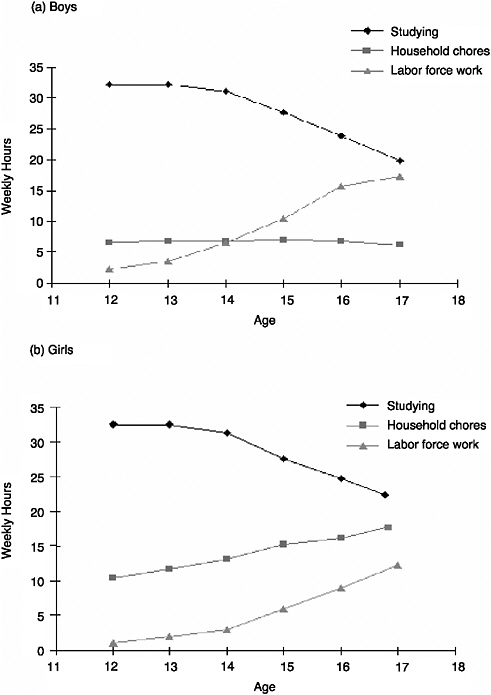
From an overall review of the literature on the time use of adolescents and youth, three fairly universal patterns emerge: (1) There are significant differences in the way boys and girls spend their work time, regardless of age, with boys more likely to work for pay or family economic gain and girls more likely to do noneconomic household work (i.e., domestic chores); (2) The total amount of time devoted to all work activities (labor market activities and noneconomic household activities combined) rises with age for both boys and girls; (3) Girls tend to work longer hours in total than boys, leaving boys more time for leisure activities (Ritchie, Lloyd, and Grant, 2004). Levison, Moe, and Knaul’s (2001) analysis of time use data for 12-17-year-olds in urban Mexico illustrates these points well (Figure 5-1).6
Rising rates of school attendance during the adolescent years have
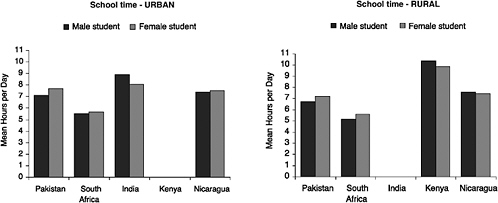
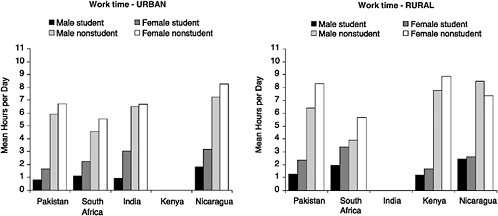
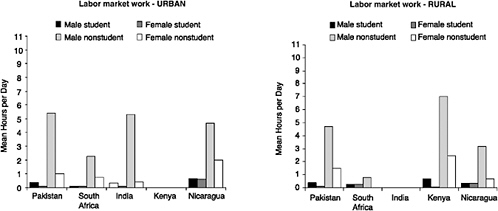
implications for time use among young people. A recent comparative analysis of time use data for young people ages 15-19 from an eclectic group of developing countries, including Kenya, India, Nicaragua, Pakistan, and South Africa, allows comparisons of time use between students and nonstudents (Ritchie, Lloyd, and Grant, 2004). Figure 5-2 shows gender differences in mean hours per day spent in school as well as gender differences in mean hours per day spent in all types of work (labor market work and noneconomic household work combined). The patterns shown in the figure describe associations that are similar across countries representing a wide range of school attendance patterns among 15-19-year-olds.
Figure 5-2 shows that there are large variations across countries in the average time currently enrolled students spend attending school and doing schoolwork, variations that largely reflect variations in the length of the school day. For example, the average time devoted to school is almost twice as high in rural Kenya as it is in rural South Africa. The longer the school day, the shorter the time students have available for any type of work. One of the major concerns about child labor is that it interferes with the ability of young people to attend and learn effectively in school (Anker, 2000). These data suggest that the extent to which this may be true varies across countries in accordance with school schedules.
As far as the overall distribution of total work burdens (combining time spent in paid work, unpaid work, and domestic work) is concerned, Figure 5-2 shows that in every case, those who are not enrolled in school report substantially more total work hours than enrolled students, regardless of the reference period. This is not surprising given that school takes up a significant portion of the day. It is also true that, in every case but rural Nicaragua, girls report more total work hours than boys, whether or not they are students. Among students, gender disparities in total work time are greatest for urban India, with girls reporting on average 2 more hours of work on days when school is in session than boys. Gender differences in students’ total work time on a school day are typically about an hour. Among nonenrolled adolescents as well, gender differences in total work time are typically about an hour. Thus, while those who attend school have less total work demands, female students still work longer total hours than male students.
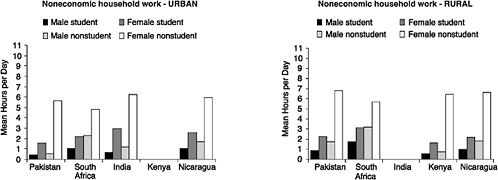
Figure 5-3 provides a further breakdown of daily time use into noneconomic household work and labor market work. Here we can see that the gender division of labor in this phase of the life cycle is most sharply etched among those who are not attending school. While boys who are students share noneconomic household work roles with girls, boys who are not in school spend the majority of their work day in economic activity, while girls who are not in school are largely limited to noneconomic household work. Indeed, boys contribute more to the household in terms of noneco-
nomic household work than economic activities when they are enrolled. Female students, however, still do more noneconomic household work than male adolescents who are not enrolled in school.
These data provide suggestive evidence that the sharp increases in school participation and attainment that have occurred around the world in the last 20 years are likely to be associated with simultaneous declines in overall work burdens as well as declines in labor force participation rates among adolescents (Ritchie, Lloyd, and Grant, 2004). As these data are very recent and gender gaps in enrollment are closing rapidly, these findings also imply that the time use of male and female adolescents, at least during the early and middle phases of the transition to adulthood, is becoming more similar despite the fact that the work burdens that accompany school attendance are still greater for girls.
Trends in Labor Force Participation
This section presents empirical evidence on recent trends in the labor force participation of young people ages 15-24 as measured in conventional surveys and censuses.7 As defined above, the labor force participation rate is the proportion of the population that is economically active and includes both the employed and the unemployed. The International Labour Organization (ILO) plays an important role in developing standards for the collection of labor force statistics at the national level, compiling these national statistics in a variety of publications and data bases. We restrict our analysis to those data provided by the ILO that are the direct result of dedicated data collection exercises and choose not to present estimated participation rates, whether prepared by the ILO or by national statistical offices.8 While it is important to keep in mind that the data are not necessarily perfectly comparable across countries because of differences in the wording of questions, the length of the reference periods, definitions of work or unemployment, and the design of household surveys, these compilations provide the best available international source of information on labor force statistics and, therefore, the best place to begin. Under the assumption that individual countries typically apply internally consistent definitions of labor force participation over time, these data are particularly appropriate for the comparison of trends across countries.
Tables 5-1 and 5-2 summarize trends in labor force participation rates for 15-19-year-olds and 20-24-year-olds, respectively, by five-year age groups over the last 20 years for all countries for which we could compile, at a minimum, data for the most recent time period (1995-present) and at least one five-year period in the recent past (1980-1984 or 1985-1989). Because of the heavy influence of the business cycle on year-to-year trends, we did not want business cycle fluctuations to obscure longer term trends. For this reason, we chose to present data for longer time intervals: 1980-1984, 1985-1989, 1990-1994, and 1995+. The rates presented for each five-year time period represent an average of available data for that time period.9 Some countries from all regions but Africa are represented in these data (25 countries in all) but not a sufficient number to present regional averages.
Among boys in the later teens (ages 15-19), participation rates are highly variable, from 18 percent in Suriname to 65 percent in Bangladesh and Brazil in the most recent period (Table 5-1), reflecting a huge variation in timing across countries in the acquisition of adult work roles among young men.10 The overall tendency is one of decline in participation rates for young men over the last two decades, mirroring the rising percentage of this age group that is enrolled in school. Some countries have experienced a much sharper drop than others, however, and some have not shown any decline despite rising enrollment rates in this age group (Bangladesh and Mexico, among others). Among 15-19-year-old women, rates tend to be much lower than those of men, but trends are less consistent. In 10 of the 26 countries, participation rates for women have risen despite rising enrollments. However, given much lower levels of participation, there is less likely to be a direct trade-off between school enrollment and labor force participation. In several countries, including Bangladesh, Ecuador, and Egypt, female participation rates went up at the same time that participation rates for men went down.
Typically by the age of 20-24, participation rates for young men come close to or exceed 80 percent (Table 5-2). This is universally true in Asia and Central America. Exceptions include Chile, Egypt, Peru, Suriname, and Tunisia.11 In most cases, trends over the last two decades are less dramatic,
|
9 |
Data for at least two of the five years covered in each time period were required for an average to be presented for that period for a particular country. |
|
10 |
While Standing (1999) notes a long-term decline in the labor force participation rates of adult men in most developing countries since 1975, we would still expect labor force participation rates to peak by the late 20s at well over 80 percent. |
|
11 |
In some cases, military service during these ages can be a factor explaining unusually low recorded labor force participation. Egypt is a prime example (for further discussion of military service, see Chapter 6). |
with some ups and downs. Female participation rates, which were at considerably lower levels than those of men in this age group in the early 1980s, have tended to increase over time. Most countries have shown a rise in participation rates among young women over the last two decades, suggesting that transitions to adulthood in the domain of labor force participation are undergoing significant transformation.
Table 5-3 presents trends in the female-male ratio in participation rates for the same age groups. A pattern of steadily rising ratios is readily apparent. Except in a few countries, in which the female-male ratio was already quite high in the early 1980s (e.g., Malaysia, the Philippines, and Turkey), one can see a consistent rise in the ratio over time, both among the 15-19-year-olds and the 20-24-year-olds, signaling an important change in work roles among younger cohorts of women. Nonetheless, the persistence of substantial diversity across countries is apparent in the range of recent ratios (from 0.2 for Pakistan to over 0.8 in Colombia, Peru, and Thailand).
China and India together represent 42 percent of the population of young people in the developing world. While data on trends in labor force participation rates for these two important countries were not available from the ILO database, data from alternative sources show similar patterns (see Table 5-4 for China and Figure 5-4 for India). For China there are data on employment by single years of age for 1989 and 1997 (Hannum and Liu, 2005). Substantial declines in employment rates are evident through age 20 for both sexes and through age 22 for boys. Gender differences in employment rates are relatively small. In India, there is a slight decline in labor force participation rates for men ages 15-19 and 20-24 from 1987-1988 to 1993-1994, as well as a slight rise in labor force participation rates for women of the same ages. While the gender gap in labor force participation in India remains huge, it is narrowing.
Youth Employment: Measurement Issues
In many developing country settings, the terms “labor,” “employment,” and “paid work” are used interchangeably. The status of being unemployed or looking for work is a refinement of measurement that emerges with development, as the formal sector of the labor force grows. Most poor people are engaged in subsistence economic activities that do not require an application or an interview. Thus, in the poorest and most underdeveloped economies, unemployment is a luxury that few young people can afford.12
Nonetheless, it is important to know what is included in the definition
TABLE 5-1 Trends in Labor Force Participation Rates (Ages 15-19), Selected Developing Countries
|
Region and Country |
Male |
Female |
||||||
|
1980-1984 |
1985-1989 |
1990-1994 |
1995+ |
1980-1984 |
1985-1989 |
1990-1994 |
1995+ |
|
|
Middle East |
||||||||
|
Egypt |
44.5 |
38.0 |
33.2 |
33.3 |
9.8 |
11.5 |
12.2 |
12.1 |
|
Syria |
50.8 |
n.a. |
n.a. |
54.3 |
9.7 |
n.a. |
n.a. |
18.5 |
|
Tunisia |
56.8 |
45.3 |
44.5 |
37.1 |
24.4 |
22.6 |
24.9 |
21.1 |
|
Turkey |
69.4 |
64.8 |
56.6 |
48.5 |
51.8 |
45.5 |
38.3 |
29.2 |
|
South America |
||||||||
|
Argentina |
51.6 |
n.a. |
n.a. |
36.9 |
27.8 |
n.a. |
n.a. |
24.2 |
|
Brazil |
64.8 |
73.3 |
72.4 |
64.9 |
31.2 |
41.3 |
44.4 |
42.2 |
|
Chile |
28.2 |
30.2 |
28.7 |
20.5 |
12.0 |
12.1 |
12.5 |
10.1 |
|
Colombia |
38.2 |
39.7 |
38.5 |
38.2 |
19.0 |
29.6 |
29.4 |
30.7 |
|
Ecuador |
47.8 |
n.a. |
52.4 |
44.2 |
14.6 |
n.a. |
19.0 |
29.4 |
|
Peru |
34.0 |
36.7 |
32.9 |
41.9 |
22.0 |
32.7 |
25.3 |
34.5 |
|
Suriname |
13.3 |
n.a. |
22.5 |
18.3 |
3.8 |
n.a. |
10.3 |
5.7 |
TABLE 5-2 Trends in Labor Force Participation Rates (Ages 20-24), Selected Developing Countries
|
Region and Country |
Male |
Female |
||||||
|
1980-1984 |
1985-1989 |
1990-1994 |
1995+ |
1980-1984 |
1985-1989 |
1990-1994 |
1995+ |
|
|
Middle East |
||||||||
|
Egypt |
67.5 |
65.4 |
53.2 |
60.7 |
19.9 |
28.7 |
32.9 |
28.2 |
|
Syria |
72.3 |
n.a. |
n.a. |
81.5 |
15.3 |
n.a. |
n.a. |
25.7 |
|
Tunisia |
82.6 |
69.7 |
65.0 |
64.8 |
31.8 |
30.1 |
34.5 |
34.2 |
|
Turkey |
90.6 |
88.2 |
85.5 |
78.2 |
49.5 |
44.3 |
41.7 |
36.2 |
|
South America |
||||||||
|
Argentina |
85.5 |
n.a. |
82.9 |
78.9 |
42.2 |
n.a. |
52.4 |
53.4 |
|
Brazil |
90.0 |
92.6 |
91.6 |
89.5 |
39.1 |
51.9 |
57.5 |
61.4 |
|
Chile |
77.0 |
79.2 |
77.9 |
71.8 |
40.2 |
39.3 |
41.2 |
41.3 |
|
Colombia |
||||||||
|
Ecuador |
75.3 |
n.a. |
79.3 |
81.2 |
22.7 |
n.a. |
29.3 |
56.1 |
|
Peru |
69.2 |
72.8 |
73.8 |
73.5 |
39.9 |
55.1 |
54.2 |
56.1 |
|
Suriname |
57.7 |
74.4 |
67.8 |
62.6 |
25.3 |
44.8 |
38.9 |
28.1 |
|
Uruguay |
91.2 |
88.0 |
88.0 |
88.8 |
65.6 |
48.1 |
65.5 |
70.7 |
TABLE 5-3 Trends in Female/Male Ratio in Participation Rates, Selected Developing Countries
|
Region and Country |
Ages 15-19 |
Ages 20-24 |
||||||
|
1980-1984 |
1985-1989 |
1990-1994 |
1995+ |
1980-1984 |
1985-1989 |
1990-1994 |
1995+ |
|
|
Middle East |
||||||||
|
Egypt |
0.22 |
0.30 |
0.37 |
0.36 |
0.29 |
0.44 |
0.62 |
0.46 |
|
Syria |
0.19 |
n.a. |
n.a. |
0.34 |
0.21 |
n.a. |
n.a. |
0.31 |
|
Tunisia |
0.43 |
0.50 |
0.56 |
0.57 |
0.38 |
0.43 |
0.53 |
0.53 |
|
Turkey |
0.75 |
0.70 |
0.68 |
0.60 |
0.55 |
0.50 |
0.49 |
0.46 |
|
South America |
||||||||
|
Argentina |
0.54 |
n.a. |
n.a. |
0.65 |
0.49 |
n.a. |
0.63 |
0.68 |
|
Brazil |
0.48 |
0.56 |
0.61 |
0.65 |
0.43 |
0.56 |
0.63 |
0.69 |
|
Chile |
0.43 |
0.40 |
0.44 |
0.50 |
0.52 |
0.50 |
0.53 |
0.58 |
|
Colombia |
0.50 |
0.75 |
0.76 |
0.80 |
n.a. |
n.a. |
n.a. |
n.a. |
|
Ecuador |
0.31 |
n.a. |
0.36 |
0.66 |
0.30 |
n.a. |
0.37 |
0.69 |
|
Peru |
0.65 |
0.89 |
0.77 |
0.82 |
0.58 |
0.76 |
0.73 |
0.76 |
|
Suriname |
0.29 |
n.a. |
0.46 |
0.31 |
0.44 |
0.60 |
0.57 |
0.45 |
|
Uruguay |
n.a. |
n.a. |
n.a. |
n.a. |
0.72 |
0.55 |
0.74 |
0.80 |
TABLE 5-4 Trends in Employment Rates Among Youth in China
|
Age |
Men |
Women |
||
|
1989 |
1997 |
1989 |
1997 |
|
|
16 |
43.5 |
20.4 |
55.2 |
24.1 |
|
17 |
63.6 |
31.3 |
61.1 |
55.6 |
|
18 |
75.2 |
59.7 |
76.3 |
52.7 |
|
19 |
79.6 |
70.1 |
80.9 |
66.3 |
|
20 |
90.4 |
72.3 |
86.4 |
79.2 |
|
21 |
87.5 |
79.2 |
86.2 |
85.4 |
|
22 |
94.1 |
80.0 |
87.5 |
83.3 |
|
23 |
93.5 |
89.6 |
87.5 |
86.6 |
|
24 |
94.4 |
86.8 |
93.6 |
89.0 |
|
25 |
92.4 |
91.5 |
93.9 |
89.1 |
|
SOURCE: Hannum and Liu (2005). |
||||
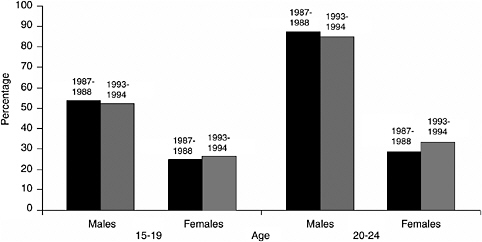
FIGURE 5-4 Trends in labor force participation rates among youth in India (ages 15-24).
NOTE: Based on weekly status.
SOURCE: Visaria (1998).
of work in order to understand the employment patterns of young people. Because they are among the least likely to be employed at a steady formal job, their work patterns are particularly challenging to measure. Using comparisons from a special survey conducted in South Africa on work among children, Box 5-1 illustrates what a difference definitions can make. Several conclusions from this illustration have potential generalizability.
|
BOX 5-1 As part of the ILO’s International Programme on the Elimination of Child Labour, member countries have undertaken, with ILO assistance, dedicated surveys on child labor called the Statistical and Information Monitoring Programme on Children (SIMPOC). Using the South African SIMPOC survey that was fielded in 1999 as an illustration, one can compare estimated employment rates for 15-17-year-old black South Africans using three alternative definitions of work that are based on activity in the seven days before the survey and are successively more inclusive: (1) any work for wage or payment, (2) work 1 plus self-employment, unpaid work for family business, and/or catch fish or other animals for sale or family food, (3) work 2 plus help on family plot, garden, or cattle post. In this age group, 90 percent of boys and 88 percent of girls were currently enrolled in school.
SOURCE: Tabulations courtesy of David Lam, 1999 Survey of Activities of Young People in South Africa, Statistics South Africa. |
||||||||||||||||||||||||||||||||||||||||||||||||
First, work for cash is relatively rare even among older children. Second, most children engage in some form of economic activity while enrolled in school.
Changes in the Timing and Sequencing of Transitions to Labor Market Work
In order to study how the timing and sequencing of labor market work have been changing over the last decade in relationship to school departure, one would ideally like to compare the experiences of successive birth cohorts over the transition by using either a panel design and successive samples of children at the eve of adolescence or successive cross-sectional surveys of young adults who are taken through a life event history to trace their adolescent experience retrospectively. Neither type of data is currently available. However, a partial picture of the transition to labor market work can be obtained from microdata using several large surveys or census
samples to look at recent changes in economic activity in relationship to changes in school enrollment by single years of age. In this section we present results from seven countries that have large surveys and census extracts available for two points roughly 10 years apart.13 These include Brazil, China, Iran, Kenya, Mexico, South Africa, and Vietnam. Such data must be interpreted with caution, however, given the rapidity with which enrollment rates and employment rates are changing in some settings. These data combine different cohorts, each of which is at a different phase of its own transition to adulthood.
Figure 5-5 first compares transitions out of school and into labor market work from ages 10-29 for boys and girls separately for the most recent date available—typically around the year 2000. To facilitate comparisons across countries, we divide each transition into three phases: early (10-14), middle (15-19), and late (20 and older). During the early phase of the transition, the proportion working in the labor market never exceeds the proportion out of school at any age except in Brazil. The percentage currently reported to be working in the labor market at age 15 is quite low in some countries (less than 10 percent in Kenya and South Africa, less than 20 percent in Iran), but much higher in others (between 20 and 35 percent in Brazil, Mexico, and Vietnam). In Vietnam, a higher percentage of girls are reported to be working in the labor market than boys at age 15. Over the course of the middle phase of the transition, labor market work transitions become highly variable across countries. At age 20, 65 to 70 percent of young men are reported to be working in the labor market in Brazil, China, Mexico, and Vietnam and a similar number of young women in China and Vietnam. At the other extreme, no more than about 35 percent of men are working in the labor market in Kenya and South Africa, with 45 percent reported working in Iran. While school enrollment is still high at this age in South Africa, the same cannot be said for Iran or Kenya. By age 20, not more than 10 percent of young women in Iran and Kenya are working in the labor market. In contrast, rates are 30 to 45 percent in Mexico and Brazil and as high as 70 percent in China and Vietnam.
|
13 |
Large public use samples from the two most recent censuses for Mexico (1990 and 2000), Kenya (1989 and 1999), and Vietnam (1989 and 1999) are available from the Integrated Public Use Microdata Series (IPUMS) International web site at the University of Minnesota (www.ipums.umn.edu). We also use the 1992 and 1999 surveys of Brazil’s Pesquisa Nacional por Amostra de Domicilios (PNAD); the 1993 South Africa Integrated Household Survey, SALDRU/World Bank, and September 2000 South Africa Labour Force Survey, Statistics South Africa, courtesy of David Lam (University of Michigan); the Child Health and Nutrition Survey in China from 1989 and 1997, courtesy of Emily Hannum (University of Pennsylvania); the 1987 Social and Economic Survey of Households, Statistical Center of Iran, and 1998 Household Expenditure and Income Survey, Statistical Center of Iran, courtesy of Djavad Salehi-Isfahani (Virginia Polytechnic University). |
As a crude indicator of the lag between school leaving and employment, we look at the gap in years between the age at which 50 percent are out of school and 50 percent are working in the labor market. In every case but Brazil, the gap for boys is positive, meaning that the age at which half the youth are out of school is generally lower than the age at which half the youth are employed. In some countries the gap is relatively short—about a year in China, Mexico, and Vietnam—but in others it is much longer. In Iran it is about three years, in South Africa about five years, and in Kenya, the gap is too long to be measured because less than 50 percent of young men are estimated to be employed in the labor market by the age of 29.
The transition to labor market work for girls is highly variable. While all young women take up adult work roles, the degree to which this involves entry into the labor market differs enormously across countries. In China and Vietnam, the transitions to labor market work for men and women look very similar at least up to the age of 20, with the overwhelming majority of women working in the labor market by that age in both societies. The only other country, among those considered here, in which labor market work rates for young women exceed 50 percent in the latter phase of the transition is Brazil. South Africa also comes close to 50 percent by age 29. It is interesting to note that in no country does the percentage working among women under 30 decline in contrast to typical labor force participation profiles of young women in the West 30 years ago.
Figure 5-6 shows changes in these transitions from school to work in the same seven countries over the decade of the 1990s. In most cases, transition profiles for enrollment and labor market work have been shifting to the right. This means that the percentage not enrolled at each age has been falling, as has the percentage currently working in the labor market. The one exception to this is Kenya, where the percentage not currently enrolled rose from 1989 to 1999 for both men and women, while the lag between school exit and labor force entry increased.14 In Mexico and Vietnam the shift in enrollment transitions for men has been more significant than the shift in work transitions, a fact that may be particularly surprising in Vietnam, where dramatic economic growth occurred in the 1990s. In China, the shifts for men have been of about the same magnitude, whereas in Iran and South Africa, the wait for employment for men seems to be growing if measured by the changing gap between the profiles. In Iran and Mexico, women’s employment rates are rising at each age, but in Brazil and South Africa they have remained about the same, and in Kenya employment rates for women seem to be falling slightly.
While the operational definition of labor market work varies across
|
14 |
This is consistent with trends in school attendance by age presented in Chapter 3. |
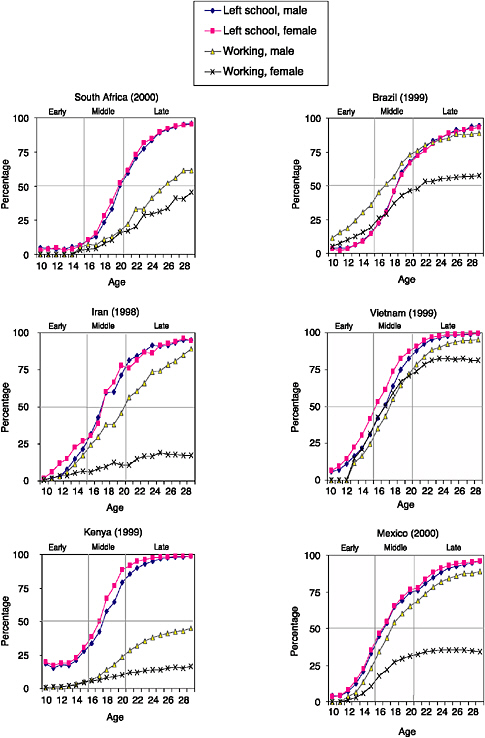
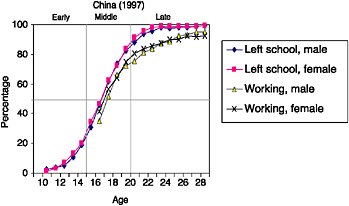
FIGURE 5-5 School and employment status by single years of age, most recent year (ages 10-29).
SOURCE: See text, footnote 13.
countries, the direction and pace of trends within countries can be compared. These examples depict the highly variable transitions to labor market work currently being experienced by young people across societies. Not only does the timing vary, but so does the sequencing of work and schooling (e.g., Brazil) as well as the length of the lag between school exit and labor market employment.
Without comparing transitions over a longer period of time, it is difficult to see the kind of shift that is taking place in women’s work roles. One of the common patterns of change for young women is a decline in the proportion of time spent working in the labor market in adolescence and an increase in the proportion of time spent working in the labor market during their 20s. This pattern can be illustrated in the case of Brazil by taking advantage of the large annual household surveys called Pesquisa Nacional por Amostra de Domicilios (PNAD) (Figure 5-7). The figure shows the clear rotation in the age profile of labor force participation for young women between 1977 and 2001. The teenage years are characterized by a decline in the proportion of time spent in the labor force working, corresponding to an associated increase in the proportion of time spent enrolled in school. Employment rates above age 20 have increased, indicative of the increased labor force participation of Brazilian women in recent decades. The proportion of women employed at age 20 remained roughly constant over this period, with rates falling at all ages below 20 and rising at ages above 20. The transition to adulthood for young women in Brazil has clearly shifted, so that the teenage years are now primarily a period for acquiring human capital, with the returns on this human capital being realized in the early 20s in the form of increased labor force participation.
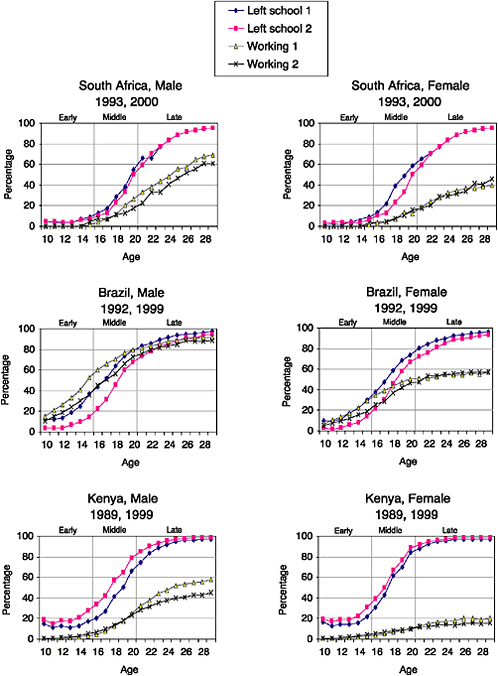
FIGURE 5-6 Recent changes in school and employment status by single years of age (ages 10-29); South Africa, Brazil, Kenya, Iran, Vietnam, Mexico, and China.
SOURCE: See text, footnote 13.
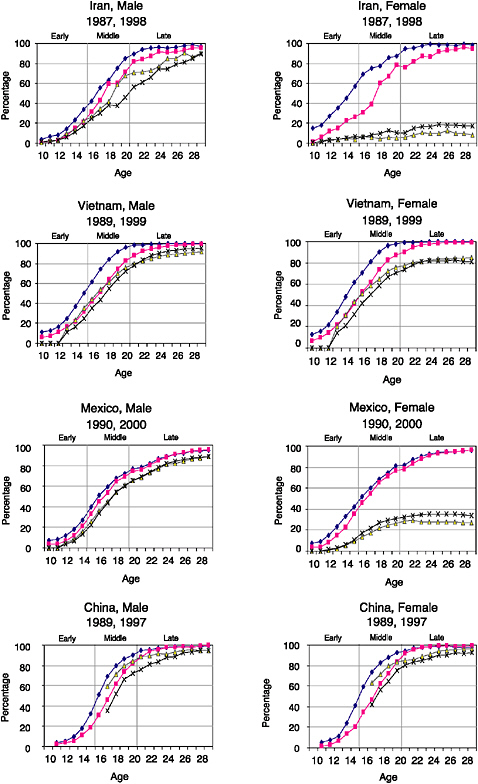
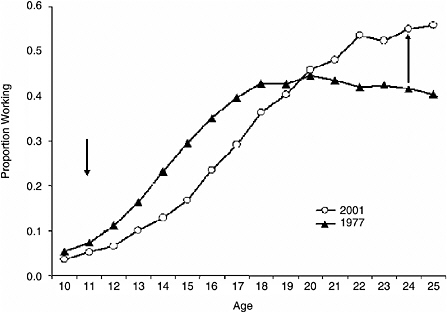
FIGURE 5-7 Female employment rate by age, Brazil, 1977 and 2001 (ages 10-25).
SOURCES: Brazil Pesquisa Nacional por Amostra de Domicilios, 1977 and 2001. Tabulations courtesy of David Lam.
SPECIAL ISSUES OF RELEVANCE TO YOUTH EMPLOYMENT
There are several employment-related topics that merit some discussion here because they have been the subject of much debate and media attention and have important implications for the ways in which young people first experience gainful employment as well as for their likelihood of a successful transition to adult work roles. These are child labor, the growing presence of young women in the workplace, youth unemployment, and migration for work.
Child Labor
Despite the enormous international attention and concern about child labor issues, it is amazing to discover that there are actually no data collected on a fully comparable basis that can be used to measure recent trends in child labor in developing countries. Instead there are recent counts produced by the ILO of the number of child laborers in different categories. This lack of trend data can be explained by recent changes in the definition of child labor. Difficulties of measurement also play an important role.
The changing definitions of child labor reflect an evolution of interna-
tional norms and standards, beginning with the ILO Minimum Age Convention of 1973 (No. 138) and continuing with the U.N. Convention on the Rights of the Child (1989) and the ILO Convention on the Worst Forms of Child Labour (No. 182) adopted in 1999 (Myers, 2001). The ILO Minimum Age Convention of 1973 (No. 138) established a general minimum age for work of 15 but did allow some exceptions for “light work,” defined as safe part-time work starting at age 13 that did not interfere with schooling.15 The U.N. Convention on the Rights of the Child (1989) does not prohibit all types of work below a certain age, but it does seek to protect children from harmful types of work (United Nations, 1989). The ILO Worst Forms of Child Labour Convention No. 182, which was adopted in 1999, enumerated various categories of the worst forms of work that should be prohibited and eliminated, including hazardous work,16 and unconditional worst forms of child labor, including trafficking, forced or bonded labor, armed conflict, prostitution and pornography, and illicit work (Myers, 2001).
Formerly, estimates of children’s economic activity rates were used as a proxy for the prevalence of child labor (Ritualo, Castro, and Gormly, 2003). As of 2000, the ILO estimated that economic activity rates among children ages 10-14 ranged from 35 percent in sub-Saharan Africa to 20 percent in the Middle East and North Africa. Estimated rates for Asia are 27 percent and for Latin America and the Caribbean, 22 percent (International Labour Office, 2002a).
Currently, however, the ILO’s definition of a child laborer varies according to the age of the child and the type of work. All children, regardless of age, who are involved in the worst forms of work are counted as child laborers. In addition, all economically active children under age 11 are counted as child laborers, as are children ages 12-14 who spend more than 14 hours a week in economic activity. Thus, the percentage of children ages 12-17 who are defined as child laborers according to this definition form a subset of all children who are economically active because of the additional qualifications required to be defined as child laborers. The ILO estimates
that in 2000 there were 211 million children ages 5-14 engaged in economic activity of which 186 million were child laborers.17 If one includes all children ages 5-17, the estimates are 351 million children engaged in economic activity of whom 245 million were child laborers (International Labour Office, 2002a)
Trends in the Economic Activity of Children
While the ILO’s international data base provides estimates and projections of economic activity rates for 10-14-year-olds, these estimates are known to be biased substantially downward, particularly for girls, at least for the most recent period (Basu and Tzannatos, 2003; Ritualo, Castro, and Gormly, 2003). This is because earlier labor force surveys and censuses on which these data rely did not use probing techniques to elicit information on economic activity. Furthermore, if reference periods are too short, much of children’s work may be missed because of its intermittent nature (Duryea et al., in press). When comparisons are possible between more recent surveys sponsored under SIMPOC and other data sources for the same country, the differences can be substantial.18 Data on economic activity rates among children have become more inclusive, with growing sensitization to measurement issues in many country statistical offices.
Even though changes in estimation techniques compromise the assessment of trends, it is nonetheless striking that the ILO estimated that there were 206 million economically active children ages 5-14 in developing countries in 2000, down from its 1995 estimate of 250 million. Given that current estimates are based on a much more inclusive approach to measurement and that the overall population of children ages 5-14 in developing countries is estimated to have risen by almost 50 million from 1995 to 2000,19 it is undoubtedly true that the overall percentage of children who are economically active has indeed declined, and it is therefore likely to be true that the percentage of children counted as child laborers has also declined. This conclusion appears consistent with trends in economic activ-
|
17 |
To derive these estimates, the ILO has relied on the results of the SIMPOC series of recent surveys (see Box 5-1) as well as other recent suitable national household surveys. |
|
18 |
Another potential source of bias seems to be less important. In most labor force surveys and censuses, a responsible adult or household responds to all questions on behalf of the household, whereas in the SIMPOC surveys, both parents and children are asked separately about children’s participation to see whether or not levels of reporting differ. A recent study comparing these responses for nine recent surveys finds a reasonable consistency between these two sources of information (Ray and Lancaster, 2003). |
|
19 |
The more precise estimate is 48.7 million (United Nations, 2003b). |
ity rates among 15-19-year-olds, considering the rapid rise in school participation during this same period.20
While some insights are available into trends in economic activity rates, there is almost no knowledge about trends in mean hours of work among working children or trends in the intermittent nature of work and therefore about whether or not there has been a change in the context of work with implications for the compatibility of child labor and schooling.21
Consequences for Health
Given the enormous international concern about this issue, it may be surprising that evidence on the link between child labor and health and mortality is lacking. This is because health and mortality data are never linked with young people’s work status or work history, so there is no way of investigating the context or the cause. In reviewing the scant evidence on the subject, Boyden, Ling, and Myers (1998) based their conclusions about the health-compromising nature of child labor on three key observations: (1) children are more susceptible to environmental hazards than adults, (2) excessive work compromises the healthy physical development of children because they expend more energy than adults for the same level of activity, and (3) children are more susceptible than adults to accidents and injury. Unstated assumptions underlie these observations: that working children are more exposed to environmental hazards than nonworking children, that working children expend more energy per hour than nonworking children, and that working children are more likely to face the risk of accidents and injury than nonworking children. However, relatively little is known about the risks poor children face in their home or school environment or the risks that all children face regardless of work or enrollment status. This is clearly an area in which more research is needed.
Consequences for Learning
A principal social concern with child labor is that it competes with schooling either directly or indirectly (Anker, 2000; Basu, 1999; Emerson
TABLE 5-5 Percentage Combining Work and Schooling by Single Years of Age, Weighted Average for All Sub-Saharan Africa Countries Participating in UNICEF Surveys, 1995
|
Age |
All in School |
School Only |
% School Only |
% Work Combined with School |
|
5 |
7.5 |
6.5 |
86.7 |
13.3 |
|
6 |
23.4 |
19.8 |
84.6 |
15.4 |
|
7 |
42.3 |
33.8 |
79.9 |
20.1 |
|
8 |
54.3 |
40.3 |
74.2 |
25.8 |
|
9 |
60.4 |
41.7 |
69.0 |
31.0 |
|
10 |
64.1 |
36.5 |
57.0 |
43.0 |
|
11 |
68.5 |
37.1 |
54.2 |
45.8 |
|
12 |
68.0 |
32.6 |
47.9 |
52.1 |
|
13 |
66.9 |
31.1 |
46.5 |
53.5 |
|
14 |
65.1 |
31.0 |
47.6 |
52.4 |
|
SOURCE: Huebler and Loaiza (2002). |
||||
and Souza, 2003). It competes directly if work takes place during school hours and precludes school attendance. It competes indirectly if it is combined with school attendance, but affects academic performance and school progress either because of poor attendance or inadequate time or energy for school work. As the school day is short in many countries, it is not difficult to combine work with school attendance, and school holidays and weekends allow additional opportunities for work. Indeed, estimates based on 15 UNICEF household surveys fielded in Africa in 1995 suggest that the percentage of enrolled students combining work with schooling rises with age (see Table 5-5), reaching a majority by age 12 (Huebler and Loaiza, 2002). This may suggest that, with later ages of school exit, there is an increasing tendency for children to combine work with schooling. Furthermore, for some students, taking up cash work may provide the money for school fees that support continuing enrollment. Box 5-2 describes the kind of trade-offs that children face in managing work and schooling, drawing on an anthropological study from Northeastern Tanzania.
Child laborers are not the only children who spend significant hours working. As mentioned in the discussion of children’s time use, girls spend a significant amount of time doing domestic chores. Indeed, if all types of work are counted, they work more total hours than boys. This nonmarket work time also has opportunity costs in terms of schooling. Long hours of domestic work are often required in settings in which basic amenities such as clean water, electricity, and fuel are lacking. Girls’ ability to attend
|
BOX 5-2 Anthropologist Karen Porter (1996) explores the agency of children, work, and social change in the South Pare Mountains of Tanzania. She challenges various assumptions in the literature, including that children’s involvement in the cash economy is always exploitative and that households act as homogenous decision-making units. Porter provides a case study of 14-year-old Stefano to illustrate the importance of work for school attendance and the degree of agency children can have, particularly boys, in juggling work-school trade-offs: Stefano is a fourteen-year-old boy born out-of-wedlock. He and his younger brothers and sisters have few clothes and a relatively poor diet; their mother has great difficulty paying school fees. With no social father, Stefan stands little if any chance of inheriting land or being assisted with bride-wealth payments when he is old enough to marry. To offset his vulnerable position, Stefano willingly works for his grandmother’s patri-lineal kinsmen, distant relatives, but close neighbors. He runs errands, works on their farms, and generally does their bidding. Though he received no cash payment for such work, his strategy for securing attention and support succeeds; his school fees are paid and the household receives intermittent gifts of food. Porter’s observations lead her to conclude that, with the rise in the market economy, children’s agency increases along with conflicts in the household. |
school and women’s ability to participate in the labor force can be compromised when basic infrastructure is lacking (e.g., Desai and Jain, 1994). Data from Mexico and Peru document the strong negative association between hours spent in household chores and school attendance and participation (Levison and Moe, 1998; Levison, Moe, and Knaul, 2001).
Because decisions about children’s work and schooling are joint decisions, it is difficult to assess, without a randomized experiment or longitudinal data with specified instrumental variables, whether the elimination of child labor would increase school attendance and improve learning outcomes. The parents of children who work are a selective group; they might be less likely to send their children to school even if no work were available. Furthermore, the children themselves may also be selective, with parents more likely to send those children to work who have greater earning capabilities or lesser academic promise. While all empirical studies of the association between children’s work and schooling attendance or learning out-
comes show a negative relationship, in most cases, the reported empirical associations cannot be interpreted as causal.22
Recent empirical analyses by Rosati and Rossi (2003) and Canals-Cerda and Ridao-Cano (2003) illustrate this estimation problem clearly. Rosati and Rossi (2003) present maximum likelihood estimates of the determinants of hours spent in child labor and enrollment for Nicaragua and Pakistan that allow correlations between the unobserved characteristics that determine these two forms of time use. Their estimates suggest that these unobserved characteristics are significantly negatively correlated across these two forms of time use, that failure to control for the simultaneous determination of the two types of time use results in biases, and that the estimated impact of marginal effects of household background variables on these two forms of child time use differs depending on a child’s latent propensity to enroll. Similarly, Canals-Cerda and Ridao-Cano (2003), using retrospective schooling and work histories in Bangladesh, found that the measured effect of work on schooling differs among those with a propensity to work from those who do not have such a propensity.
A recent study, using panel data in Vietnam and a set of plausible instrumental variables, provides the most persuasive evidence to date of the negative effects of child labor on school participation and attainment (Beegle, Dehejia, and Gatti, 2004). Focusing on children ages 8-13 who were enrolled in school during the first wave of the data collection (1992-1993), they found that having worked during the first period of observation, controlling for the selectivity of children who worked, had a negative and significant impact on enrollment and attainment during the second period of observation (1997-1998).23 Furthermore, the negative effects are much greater for girls than boys.
Further evidence of these trade-offs comes from the experience of the Food for Education program in Bangladesh. Ravallion and Wodon (2000) used a 1995-1996 rural sample of the Household Economic Survey to test whether a discount on the price of primary school, created by the food subsidy, might lead children who were previously working to attend school. Given that school subsidies are targeted to the poor, however, program placement had to be controlled for in the model. They found that school subsidies led to higher enrollment rates and lower work participation rates among program participants, but the decline in recorded work was only a
quarter of the increase in enrollment. This finding suggests that much of the increase in school enrollment was drawn from the pool of children who were not previously reporting work (including household work) as their “normal” activity.24 These findings led the authors to conclude that work does not necessarily compromise school attendance.
For currently enrolled students who combine work with schooling, an added question of interest is whether or not time spent working affects learning outcomes. This is a difficult question to answer not only because it requires data on standardized tests, but also because of the difficulties of teasing out causality when one has a selective sample of students. Taking advantage of the unusual opportunity provided by the first comparative study of language and mathematics achievement for 3rd and 4th graders in Latin America (see discussion in Chapter 3), Gunnarsson, Orazem, and Sanchez (2003) were able to use information on the policy environment in each country25 to create instruments for predicting the likelihood of child labor and thus to at least partially correct for the problem of mutual causation, using a sample of students ages 8-15. By pooling data from 11 countries and controlling for individual, family, teacher, and school characteristics, the authors estimate that working outside the home has a strong negative and significant effect on performance on standardized mathematics and language tests—in fact a stronger effect than would have been estimated without using proper statistical techniques to control for mutual causation. Furthermore, the greater the time spent working, the larger the negative effects. The students in this sample ranged in age from 8 to 15.
The long-term consequences of child labor for later success in the labor market in adulthood are difficult to assess for the reasons discussed above as well as because data demands become even greater when data are needed over a substantial period of time.26 Taking a shorter term time horizon over five years, Beegle, Dehejia, and Gatti (2004) found that children in
Vietnam who had worked when they were ages 8-13 in 1992-1993 were twice as likely to be working five years later as those who had not previously worked and were earning significantly higher wages, despite their lower levels of education, than children who started work for the first time in the intervening period. Again, the effects are larger for girls than boys. The authors use these results to underscore the policy challenge of eliminating child labor given its economic benefits to families at least in the short to medium term.
The Growing Presence of Young Women in the Workplace
The data presented above document the growing presence of young women in the labor force. However, these data are silent with respect to the motivations for and the implications of these trends for young women’s transitions to adulthood. For men, the transition into the labor force that occurs during these years is presumably a permanent role shift that will last until retirement, disability, or death. For women, however, it is not clear whether the recent changes observed during the young adult years presage a more fundamental shift in adult work roles for women, or whether these changes represent the increasing prevalence of a temporary phase in the work lives of young women, preceding marriage or childbearing.
The experience of the developed countries over the last 30 years may suggest that the rise in young women’s participation in wage work is likely to be part of a more fundamental shift in work and family roles. In the United States, for example, there has been a substantial rise in the participation of young women in the formal labor market in the last 25 years (Blau, 1997). This can be partially attributed to a decline in fertility and a rise in the divorce rate, because divorced women and those with fewer children have higher participation rates, but it is also due to the fact that young mothers are much more inclined than they were in the past to work for pay outside the home. Thus it would appear that women’s participation in the United States, as in most of the rest of the developed world, is increasingly determined by their own opportunities and less by their family circumstances (Blau, 1997).27
In developing countries, the long-term rise in young women’s labor force participation rates, which is linked to a shift from agriculture to industry and services, implies a change in adult work roles as well. Indeed,
Standing (1999) suggests that the labor force is actually becoming more “feminine” in its characteristics, partly as a result of the rise in women’s labor force participation, but more importantly because of the changing nature of work. Due to growth in international trade and stiffening international competition, markets for wage work have been increasingly deregulated and thus become more informal. At the same time, the female share of nonagricultural employment has been rising, despite a decline in the share of employment represented by the public sector—a sector in which women typically had a higher share of employment than in other sectors. These trends have also been accompanied by a small decline in the extent of sex-based occupational segregation in many parts of the world in which such data are available to document trends. Occupational segregation nonetheless continues to be extensive and persistent, particularly in China, the Middle East, and North Africa (Anker, 1998).
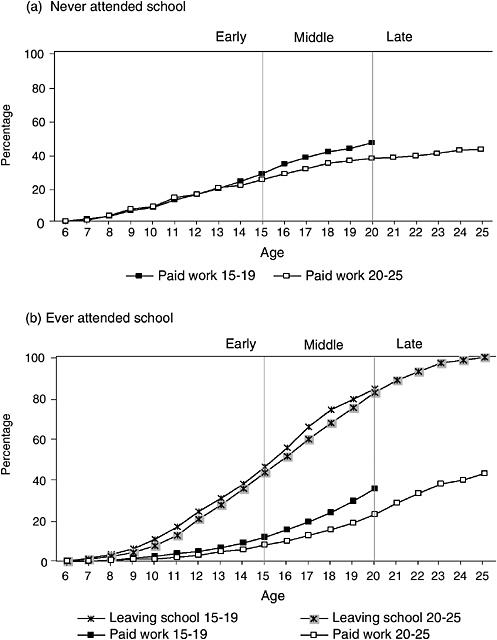
In many settings better educated women are more likely to report economic activity in the middle to later phases of the transition to adulthood than their less educated peers (Celli and Obuchi, 2003). And in some settings, they are also more likely to report work before marriage despite later ages of school leaving (Malhotra and deGraff, 1997). The rise in labor force participation of young women can transcend their changing educational distribution. An in-depth exploration of recent changes in the Egyptian labor market concludes that the small rise in women’s overall labor force participation rates during the 1990s can be explained largely by a rise among the least educated women; labor force participation rates among women with intermediate levels of education actually fell (Assaad, 2002). In Pakistan, a rise in the percentage of young women entering the paid labor force has been coincident with a rise in girls’ primary school completion rates. One might conclude that these two trends are associated. However, Lloyd and Grant (2005) use life history data from a recent national survey of youth (2001-2002) to show that the recent rise in labor force participation among young women during the middle phase of the transition (ages 15-19) has occurred among those who have ever been to school as well as those who have not (see Figure 5-8). In both cases, these changes are statistically significant. During the same period, there was no change in the pace of labor force entry for young men. These data cannot indicate, however, whether these changes will persist as these young women age or whether this is a temporary phenomenon that may be linked to changes in the timing and context of marriage (for further discussion see Chapter 7).
The very rapid rise in the factory employment of young women in Bangladesh provides an interesting case study of the implications of improved opportunities for private-sector wage employment on the transition to adulthood in a very traditional setting. Bangladesh has experienced a significant increase in employment in the garment industry; by 1995 the
sector employed about 1.2 million, of whom 90 percent were women. Bangladesh is a society in which girls are typically confined to the home after puberty and marriage for girls typically occurs before the age of 18. The rapid rise in factory employment occurred during the 1990s as Bangladeshi factory owners were able to gain a global competitive edge in the mass production of clothing for export.
In 1996, Amin and her colleagues (1998) conducted a survey of garment workers with both qualitative and quantitative elements. By listening to their life stories the researchers were able to learn more about how and why they sought factory employment, how their work lives have changed as they have aged, and how their perceptions and aspirations differ from their nonworking peers. While most young women report that their decision to work was part of a household strategy, there were some exceptional cases of young women who made the decision on their own. Most factory workers in Dhaka come from rural areas; in some cases the migration to work represented a move on the part of the whole family; in other cases young women moved to the city where they live with or have connections with local family members. Most workers experienced rapid wage growth in the first year of work, which is typically the result of job mobility between factories, and reported this mobility as a positive feature of their work experience. Despite the stigma and physical stress associated with garment work, most young women reported that they value the work and the independence associated with it and feel that it is less of a hardship than agricultural work. Indeed, Amin and her colleagues (1998) conclude that this new opportunity for work has created a period of adolescence for young girls that did not previously exist as a life cycle phase. Nonetheless, almost all of these unmarried workers pool some or all of their income with their households, whether they live with their family or not and do not express any particular desire to retain control over the dispensation of their income. It is not known what percentage of these women leave factory work when they marry or give birth.
In contrast to Bangladesh, there has been a decline in the labor force participation of young unmarried women in Egypt in the last 10 years, which corresponds to a significant rise in school leaving ages (Assaad, 2002). This has occurred despite the implementation of structural economic reforms that were expected to create new wage work opportunities for young women. In a qualitative study of young female wage workers and their mothers, Amin and Al-Bassusi (2003) found that, among the minority of young women who work, the primary reason reported for working is to save for marriage. Being a wage worker is seen by young women themselves as a temporary role and not as an appropriate role for married women or mothers (see Box 5-3). In order to allow a couple to realize their aspiration to start married life in their own home and to
|
BOX 5-3 As a result of increasing consumerism and rising material expectations in Egypt, young couples are now less likely to join an extended household upon marrying and instead must accumulate considerable resources before they marry to establish their own household. In a study of young women’s perceptions of marriage and work in Egypt, Amin and Al-Bassusi (2003) analyzed national labor survey data and conducted in-depth interviews with young women working for pay in industrial, periurban, and rural areas. The women interviewed consistently reported that their primary reason for working was to save money and prepare for marriage. Their desire to earn money reflects not only the rising expectations regarding the possessions and assets that one brings to marriage, but also economic realities of raising a family. As the mother of a young, working woman explained: Men like to marry girls who are rich or at least prepared well. I will tell you why: after one year of a marriage, they will get a child. The new child needs a budget for him only (clothes, diapers, doctors, milk, medicine, and so on). Also a couple needs a budget for food, clothes, doctors, medicine, rent, compliments [gifts], and so forth. In the second year, they may receive their second child who needs another budget. Some years later the children will go to school and need a new budget. The wife has to stay home in order to take care of the children. Do you think the salary of whatever type of earnings that the husband makes will enable him to do all that and more? This means the couple will not have a chance to prepare themselves after they are married. They have to start as perfect as possible, because there is no other chance to improve their living standard later. Women are also motivated to work to provide a greater gehaz (trousseau) to enhance their status and improve their bargaining position in their new marital family. They often set aside earnings that are put into traditional savings pools until they are married. Aisha of Helwan pays 45 pounds a month from her salary for transportation and saves the rest for her marriage trousseau. She explained that the gehaz is an expensive undertaking for her parents, so she works to save in order that her marriage will not be a burden to them. Another respondent, Abeer, a factory worker in the investment zone who was recently married, reported that she contributed 3,000 out of the 8,000 pounds required for her marriage. One of the items she acquired and was proud to show was an ornate sideboard for the dining room. In general, working for pay does not interfere with being a wife and mother, because women are expected to stop working once they are married. The interviews with young women indicated that none was postponing marriage due to work. Several working women did, however, describe making a trade-off between working and pursuing an education in preparation for marriage. These women considered education a potential barrier to saving money for their marriages and thus opted to work instead. |
preserve traditional gender roles in the family after marriage, work before marriage is seen as a means to an end rather than as preparation for an adult work role in the labor force.
Earlier studies of the motivations for young women’s work in export-oriented industries in Taiwan (Greenhalgh, 1988) and Hong Kong (Salaff, 1981) also depict this as a temporary phase of life during which parents were able to exploit the earnings of their more educated daughters for their own ends by sending them to work before marriage. The question remains as to whether this experience of earning money in one’s own right early in life is transformative for young women in terms of self-esteem and agency or predictive of labor force participation later in adult life. A very preliminary answer can be found in the case of Argentina from the results of a small study of the views of young people in their mid 20s on the criteria for defining adulthood (Facio and Micocci, 2003). The study found that young women were more likely than young men (90 versus 65 percent) to view women’s capability of supporting a family financially as a marker of adulthood.
Indeed, the process of social change is complex. In a period of rapid change, it is difficult for young people to make decisions about educational investments and labor force participation by modeling their behavior on the experiences of the older generation. They are expecting to have more education, marry later, and have fewer children than the older generation. As Goldin said in reviewing the historical experience in the United States (1990:154): “Each generation passes its norms and expectations to the next in a manner than often impedes social progress.” Taking the example of the Egyptian mother’s view of work and marriage above, we might expect that her daughter will stay home after marriage and not return to the labor force. However, recent trends in women’s labor force participation in Egypt may suggest otherwise. For every age group beyond the early 20s, women’s labor force participation rates have been rising in both rural and urban areas, suggesting that the persistence of labor force participation after marriage is rising as well, although slowly (Assaad, 2002).
An additional important factor to consider is that young women in developing countries can model their behavior not only on their peers and their parents in their own country, but also potentially on the behavior of younger women in other parts of the world. Relative to the historical experience of the West, this creates the possibility of more rapid social change.28 Indeed, the very rapid decline in marital fertility that has oc-
curred in many parts of the developing world may bring with it the seeds of change in gender work roles in the family, as family size diminishes and women’s childrearing responsibilities occupy fewer years of their productive lifetime (Amin and Lloyd, 2002). The very recent and rapid rise in the number of young women working in the export sector in Bangladesh is an example of this possibility in a poor country that has experienced a very rapid fall in family size over the last 30 years.
Youth Unemployment
Unemployment rates among youth are typically higher than unemployment rates among adults. This is a common pattern in both developed and developing countries. This is not surprising given that the process of entering the labor force requires some time without a job before the first job is obtained, and there may be employment lapses between jobs as youth and their employers each search for mutually good matches. It is also well established that trends in youth unemployment tend to follow trends in adult unemployment. In countries in which overall unemployment rates are high, youth unemployment rates also tend to be relatively high (O’Higgins, 2001). A growing concern with youth unemployment in developing countries can be explained in part by the growth in the size of the youth population, by the growth of the share of that population searching for wage employment instead of working in family enterprises, and in part by recent declines in economic growth in many countries.
It can be a challenge to measure unemployment in many developing countries. Much work takes place in the agricultural sector, which is subject to day-to-day and seasonal volatility in activity rates, and poverty, even in urban areas, often precludes waiting for a formal job. Instead in very poor settings, people have to make do with whatever casual or part-time work they can find. Thus, for measurement purposes, they are counted as employed, despite the fact that they are actually underemployed, or as out of the labor force when they are actually willing to work but discouraged from looking for work. As a result, measured unemployment in developing countries is typically higher in urban than rural areas (O’Higgins, 2001).
These points are well illustrated in Table 5-6 with data from India on youth employment measured according to three different reference periods: (1) the last day, (2) the last week, or (3) a “usual” week (Visaria, 1998). First, the longer the reference period, the lower the estimated rates of unemployment, suggesting that many of those included among the employed (if usual status is used as the reference period) are not employed on a steady basis and that many of those usually classified as unemployed are not unemployed on a steady basis. Second, we can see that estimates of urban unemployment can be as much as three times rural unemployment
TABLE 5-6 Recent Patterns and Trends in Youth Unemployment in India
|
Location, Type of Work, and Time Period |
Ages 15-19 |
Ages 20-24 |
||||
|
Male |
Female |
Female/Male |
Male |
Female |
Female/Male |
|
|
Rural |
||||||
|
Usual |
||||||
|
1987-1988 |
4.6 |
3.6 |
0.8 |
5.0 |
3.9 |
0.8 |
|
1993-1994 |
3.3 |
1.9 |
0.6 |
4.9 |
2.8 |
0.6 |
|
Weekly |
||||||
|
1987-1988 |
8.7 |
7.6 |
0.9 |
8.8 |
6.5 |
0.7 |
|
1993-1994 |
5.7 |
5.1 |
0.9 |
7.2 |
5.9 |
0.8 |
|
Daily |
||||||
|
1987-1988 |
9.0 |
9.2 |
1.0 |
9.2 |
9.8 |
1.1 |
|
1993-1994 |
9.0 |
8.3 |
0.9 |
10.3 |
8.2 |
0.8 |
|
Urban |
||||||
|
Usual |
||||||
|
1987-1988 |
17.2 |
13.6 |
0.8 |
14.9 |
17.8 |
1.2 |
|
1993-1994 |
11.9 |
12.8 |
1.1 |
12.6 |
21.7 |
1.7 |
|
Weekly |
||||||
|
1987-1988 |
20.4 |
19.3 |
0.9 |
17.7 |
24.4 |
1.4 |
|
1993-1994 |
13.4 |
15.7 |
1.2 |
14.7 |
25.8 |
1.7 |
|
Daily |
||||||
|
1987-1988 |
23.3 |
24.0 |
1.0 |
20.3 |
27.2 |
1.3 |
|
1993-1994 |
16.2 |
18.6 |
1.1 |
17.0 |
28.5 |
1.7 |
|
SOURCE: Visaria (1998). |
||||||
estimates, with even higher multiples in the case of female “usual” unemployment.
Given the recent rise in labor force participation rates among young women, it is interesting to see how gender differences in unemployment rates may be changing. Again, using India as an example (Table 5-6), we can see that from 1987-1988 to 1993-1994, urban unemployment rates have been rising for young women (20-24) at the same time that unemployment rates for young men have been falling, regardless of which reference period is used. Such relative shifts in the distribution of unemployment can be expected if the growth in new female labor force entrants exceeds the growth of young male entrants. While urban unemployment rates among those ages 15-19 have been falling for both young men and women, the decline for men has been greater than for women, with the result that unemployment rates for young women in this age group now exceed those of young men. In rural areas, in contrast, gender differences in unemployment rates according to most measures are to the advantage of women.
It is often claimed that youth unemployment rates are highest among the most educated (O’Higgins, 2001). However, a strict comparison between the unemployment rates of more and less educated people may overstate the significance of the problem. First, the more educated have spent less time in the labor market at a comparable age than the less educated, given later ages of school leaving, and therefore have had less time to find work. Second, the labor force participation rates of the less educated tend to be lower than the labor force participation rates of the more educated, suggesting the possibility that there may be a problem of discouraged workers among the uneducated who are not recorded as in the labor force (O’Higgins, 2001). Third, the more schooled generally come from more advantaged families and generally have better support networks for financing longer job searches for better job matches. Thus, higher unemployment rates for those with more schooling may not reflect a problem for them but rather a problem for those with less schooling who have much more limited support networks.
In South Africa, where the black population has suffered a historic disadvantage due to apartheid, the discouragement factor has a substantial effect on estimates of unemployment. Using data from the 2000 South African Labour Force survey, we compared the official unemployment rates for blacks and whites with an expanded definition of unemployment that includes those out of the labor force who would accept work if a suitable job were offered (Table 5-7). The first two columns contrast the official unemployment rates for blacks and whites. These unemployment rates are very high for young black South Africans (47 percent for men and 55 percent for women ages 20-24). The second two columns present unemployment rates using the broader definition that is often used in labor
TABLE 5-7 Unemployment Rates According to Alternative Definitions, South Africa, 2000
|
Sex and Age Group |
Unemployment Official |
Unemployment Expanded |
||
|
African |
White |
African |
White |
|
|
Male |
||||
|
15-19 |
49.4 |
33.8 |
64.5 |
43.5 |
|
20-24 |
47.1 |
10.1 |
61.1 |
14.5 |
|
25-29 |
30.8 |
1.6 |
41.5 |
3.7 |
|
30-34 |
23.8 |
0.8 |
32.8 |
1.0 |
|
N |
8,309 |
854 |
9,409 |
861 |
|
Female |
||||
|
15-19 |
58.0 |
38.5 |
74.4 |
43.3 |
|
20-24 |
55.5 |
6.0 |
71.1 |
10.6 |
|
25-29 |
42.3 |
4.9 |
55.7 |
10.8 |
|
30-34 |
31.2 |
3.0 |
45.0 |
6.9 |
|
N |
7,459 |
694 |
9,100 |
722 |
|
SOURCES: September 2000, South African Labour Force Survey (Statistics South Africa). Tabulations courtesy of David Lam. |
||||
market debates. Unemployment rates by this measure rise substantially, to over 60 percent for 20-24-year-old black men and over 70 percent for 20-24-year-old black women. It is worth noting that even at ages 30-34, an age at which male unemployment rates are usually low in most countries, unemployment by the narrower definition is 24 percent, and unemployment by the broader definition is 33 percent, with only 62 percent of men reporting labor force participation.
The best data on recent unemployment trends come from Latin America. In a review of recent trends in Latin American labor markets during the 1990s, Duryea, Jaramillo, and Pagés (2003) conclude that, in the context of an overall rise in unemployment rates from 5.3 to 7.5 percent in the region as a whole, youth unemployment rates rose but at a slower rate. As a result, the ratio of youth to adult unemployment rates declined (see Figure 5-9). The youngest workers have the highest unemployment rates. Ratios have declined in the 1990s in all countries shown except Panama.
Migration for Work
One of the important transitions that many young people make in all parts of the world is leaving their place of birth to migrate to a different village, city, or country. This migration is frequently motivated by search
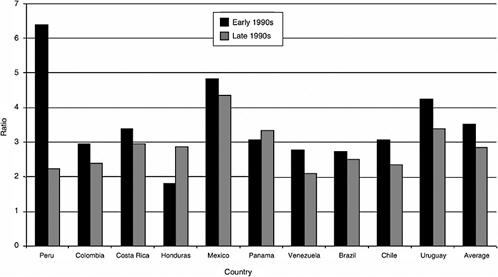
for employment, although other considerations, especially education and marriage, can also play a role. Researchers who study migration have long recognized the almost universal pattern that probabilities of migration are much higher for individuals in the 15-30 age range than for those in other age groups. Dorothy Thomas concluded from her broad study of migration in 1938 that “the one generalization about migration differentials which can be considered definitively established” is that “there is an excess of adolescents and young adults among migrants, particularly migrants from rural areas to towns, compared with the … general population” (Thomas, 1938:11). The age pattern of migration observed by Thomas for the United States and Europe in the early twentieth century has also been widely documented in developing countries.29 These age patterns of migration continue to be evident in developing countries today.
Like formal schooling and vocational training programs, migration can be viewed as an investment that individuals make with the expectation that the discounted lifetime benefits will exceed the discounted lifetime costs.30 The costs and benefits of migration include both direct economic considerations, such as wages and employment prospects, and nonpecuniary considerations, such as social amenities, the psychic costs of leaving family, and potential marriage opportunities. Economists have used this human capital approach to migration to consider why migration probabilities are so much higher in the 15-29 age group than they are in older age groups. One potential explanation is that young people have more years in which to reap the benefits from investing in a new location. As noted by such economists as Sjaastad (1962), however, a more important factor is probably that young people face lower opportunity costs of migration, having not yet become firmly established in jobs that compete with migration and having not yet married or had children.
One common source of basic information on migration is census data. Figure 5-10 shows the age profile of migration for Brazil and Kenya using the two most recent censuses for each country.31 The top panel of the figure
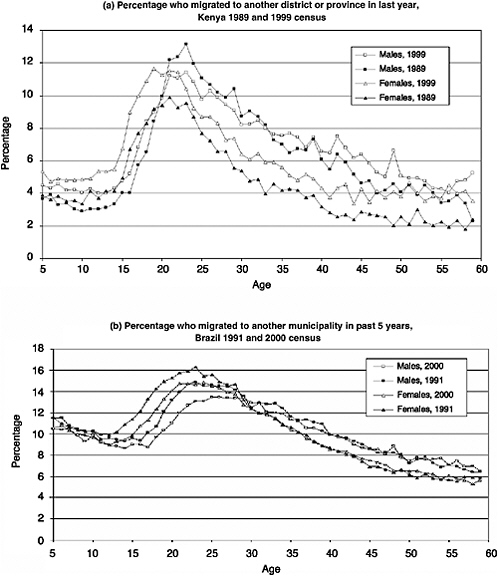
FIGURE 5-10 Migration rates by age for Kenya and Brazil, males and females (ages 5-59).
SOURCES: Kenya 1989, 1999 Census and Brazil 1991, 2000 Census. Tabulations courtesy of David Lam.
shows the proportion of Kenyan men and women at each age who had migrated during the previous year. The probability of migrating rises sharply beginning around age 15 for both young men and women, with young women migrating at higher rates than men during the period from age 15 to age 20. The fact that over 10 percent of Kenyan men and women in their
late teens and early 20s moved across district boundaries in a single year is an impressive indicator of the mobility of young Kenyans. Migration rates fall rapidly as individuals age into their late 20s and early 30s. For women, the probability of migrating at age 20 is more than double the probability at age 10 and almost double the probability at age 30. While migration is observed at all ages, migration is clearly a phenomenon that is especially important during the transition to adulthood.
The bottom panel of Figure 5-10 shows migration rates by age for men and women in Brazil, measured according to whether individuals changed their municipality of residence during the five years preceding the census. While the Brazilian data are not strictly comparable to the Kenyan data, the overall age patterns of migration are very similar. The highest migration rates are observed in the 15-29 age range, with female migration rates rising at a faster rate than those of young men beginning around age 15. Women peak at higher migration rates than men in both 1991 and 2000. As in Kenya, the continuity in the age profile of migration in Brazil over the 1990s is probably more noteworthy than any recent changes.
Relatively few surveys or censuses collect data on the reasons for migration. The Mexican census is one example that does (Table 5-8). Combining the first two labor market related categories (looking for work and changing place of work), about 53 percent of men and 34 percent of women ages 20-24 gave work-related reasons for migration. About 23 percent of women ages 20-24 said they migrated to get married or form a union, compared with only 5 percent of men. Similar proportions—about 9 percent of women and 11 percent of men in the 20-24 age group—migrated to study. While these results indicate that in Mexico women are much more likely than men to migrate because of marriage, it is important to note that, even among women, work-related migration is more common than migration to marry. In a very different context—rural Burkina Faso—where child labor is likely to be more prevalent, households with a child migrant ages 6-17 were asked the reasons for migration. A surprisingly high 41 percent of boys were reported as having migrated for work (Kielland and Sanogo, 2002). Only 16 percent of girls the same age had migrated for work. Thus, even at a younger age, work can be an important reason for migration for younger boys.
Migration from rural to urban areas continues to be one of the most important components of migration in developing countries. Due to data limitations, the results reported above show migration only as defined by moving across municipality or state boundaries, without indicating whether migration is from rural to urban areas. In the case of the 2000 Brazilian census, however, it is possible to identify the rural-urban location of both the previous and current residence of individuals who migrated across municipal boundaries during the five years before the census. Table 5-9 shows
TABLE 5-8 Reasons for Migration by Age and Sex, Mexico 2000
|
Reason |
Ages 10-14 |
Ages 15-19 |
Ages 20-24 |
Ages 25-29 |
||||
|
Male |
Female |
Male |
Female |
Male |
Female |
Male |
Female |
|
|
Look for work |
6.8 |
6.9 |
31.0 |
29.1 |
42.6 |
27.2 |
37.3 |
21.3 |
|
Change workplace |
4.2 |
4.5 |
5.9 |
4.4 |
10.9 |
6.4 |
18.7 |
10.4 |
|
Study |
6.4 |
6.4 |
12.6 |
10.6 |
10.8 |
8.9 |
4.1 |
2.9 |
|
Reunite with family |
46.8 |
47.1 |
28.6 |
27.5 |
18.2 |
21.8 |
17.4 |
25.1 |
|
Get married |
0.1 |
0.4 |
1.0 |
11.4 |
5.3 |
22.8 |
8.1 |
20.7 |
|
Health reasons |
2.4 |
2.0 |
1.3 |
1.1 |
0.9 |
1.1 |
1.3 |
1.6 |
|
Violence or safety |
4.0 |
3.7 |
2.7 |
1.7 |
1.3 |
1.2 |
1.3 |
1.9 |
|
Other reason |
29.4 |
29.0 |
17.0 |
14.3 |
10.2 |
10.6 |
11.9 |
16.0 |
|
SOURCES: 2000 Mexico Census. Tabulations courtesy of David Lam. |
||||||||
TABLE 5-9 Percentage of Migrants Migrating to an Urban Area by Previous Residence, Brazil 2000
|
Age Group |
Previous Residence (1995) |
|
|
Urban |
Rural |
|
|
5-9 |
89.2 |
61.3 |
|
10-14 |
90.4 |
63.7 |
|
15-19 |
91.4 |
72.6 |
|
20-24 |
91.7 |
73.8 |
|
25-29 |
90.9 |
68.2 |
|
30-34 |
91.0 |
65.0 |
|
35-39 |
91.8 |
64.6 |
|
40-44 |
91.1 |
62.8 |
|
45-49 |
90.6 |
64.9 |
|
50-54 |
88.9 |
62.0 |
|
55-59 |
89.3 |
63.9 |
|
SOURCES: 2000 Brazil Census. Tabulations courtesy of David Lam. |
||
the percentage of Brazilian migrants who migrated to an urban area. Migrants from both rural and urban areas tend predominantly to migrate to urban areas. Among 10-14-year-olds, 90 percent of migrants who were previously in an urban area migrated to another urban area, while 64 percent of migrants who were previously in a rural area migrated to an urban area. While over 60 percent of migrants from rural areas move to urban areas at all ages, the probability that migrants from rural areas move to urban areas is highest in the 15-19 and 20-24 age groups. Almost 75 percent of migrants from rural areas in these age groups migrate to an urban area. Since these are also the age groups with the highest migration rates, the migration of young adults is clearly a major driving force for rural-urban migration.
Finally, young people are more likely to cross international borders in search of work than older adults. Data on the age composition of U.S. immigrants shows the predominance of youth in immigrations flows. Immigrants entering the United States between 1992 and 1994, for example, were much younger in age than the U.S. population, with significantly higher percentages among 15-34-year-olds (National Research Council, 1997b). The age distribution of immigrants peaks in the early to mid-20s. The age distribution of an earlier wave of immigration in 1907-1910 was even more strongly skewed.32
DETERMINANTS OF CHANGING WORK TRANSITIONS AMONG YOUNG PEOPLE
In Chapter 3, we discussed some of the factors affecting changes in the demand for schooling as well as some of the most notable features in the changing landscape of educational service provision. In many ways, a discussion of the determinants of changing work transitions should mirror our previous discussion. Clearly many of the same determinants feature in an explanation of the rising age of school exit as feature in an explanation of the rising age of labor force entry. Furthermore, rising levels of educational attainment are usually explained by increases in the rates of return to secondary and higher levels of schooling; increases that are manifest in rising wage rates among young people as well as shifts in the occupational distribution of younger workers toward employment sectors with higher entry-level skill requirements.
However, there are other features of changing work transitions whose determinants have not been fully discussed and, as a result, questions remain. For example, what are the implications of rising cohort size for successful labor market absorption, particularly given evidence of rising labor force participation rates for young women? Behrman and Birdsall (1983), for example, reported inverse associations between earnings and cohort size in Brazil. Is the economics of the family changing in ways that may have implications for the supply and distribution of entry-level workers as well as for the distribution of skills that they bring with them? What are the major factors affecting the demand for entry-level workers, and how are they changing? These may include shifts in the composition of production, technological change, the pace and stability of economic growth, and changes in patterns of employment discrimination.
Some of these changes are occurring in the household, some in the community, and others at a national level. They include changes in family size, shifts in the size and age composition of the labor force, urbanization, trends in poverty, the growth in the share of employment in the private sector, a decline in trade barriers, and growth in the relative economic importance of the export sector. They also include changes in the availability, cost, and quality of schooling—all factors discussed in Chapter 3. Finally globalization means a tighter link between the economies of developed and developing countries through trade and international financial flows, creating both opportunities and vulnerabilities. While human capital investments are made with long-term returns in mind, the success of young people’s labor market transitions are not only a function of the training and skills that they bring to the market but also of the labor market conditions at the time they seek to make those transitions.
In the discussion that follows we explore successively some of the
factors on the supply and demand sides of the labor market that may play a role in explaining the patterns and trends observed. On the supply side, we explore first the changing demography of the labor force and then look at some of the factors at the household level that may be affecting changes in the composition of new labor market entrants, including family size and the incidence of poverty. On the demand side, we explore the size of the economy and the composition of production, opportunities for decent and productive work, employment discrimination, and technological change. We save, for the next section on policies and programs, a discussion of existing evidence on the effectiveness of a range of policy interventions on smoothing transitions to work and enhancing their success.
Factors Affecting the Supply of Entry-Level Workers
Changes in the Demography of the Labor Force
Many developing countries, especially those in Latin America and Asia, are moving into a period in which the age structure will be characterized by high proportions of the population in the working ages. This so-called demographic dividend (Bloom, Canning, and Sevilla, 2002), characterized by several decades in which both children and the elderly will be relatively small proportions of the population, will be a dividend for the growth of the economy only to the extent that the working-age population succeeds in finding productive employment. This demographic “dividend” comes bundled with a demographic and economic challenge: the provision of jobs for the largest labor force in history. Evidence from a comparative analysis of labor force trends in 15 advanced economies over the last 25 years (Korenman and Neumark, 1997) provides evidence that relative cohort size is positively correlated with youth unemployment rates, suggesting that relative cohort size will also be a factor in developing country labor markets.
Following the themes set out in Chapter 2, it is important to begin a discussion of youth labor markets with a look at the sheer numbers involved. The increase in the absolute numbers of young workers in developing countries can seem staggering, even overwhelming. In order to put these numbers in perspective and to consider how the growth of the youth labor force will differ across regions, it is instructive to look at estimates of the actual and projected numbers of young people ages 15-24, looking back 50 years and looking forward 50 years. Figure 5-11 shows the changes in the absolute number of 15-24-year-olds based on an index of 1950 = 100 using five countries as examples: Brazil, Kenya, Mexico, Pakistan, and Thailand, representing different regions and phases of the demographic transition (United Nations, 2003d). One type of pattern is demonstrated by Brazil,
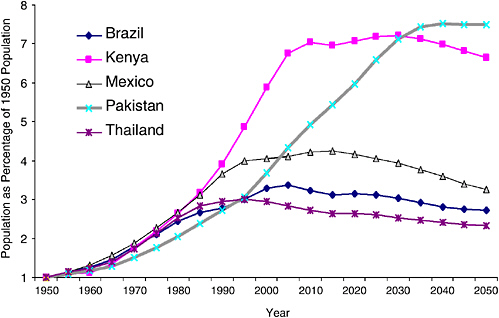
FIGURE 5-11 Size of population 1950-2050, ages 15-24.
SOURCE: United Nations (2003d).
Mexico, and Thailand, where rapid fertility decline has occurred in recent decades. In these three countries, the potential numbers of new labor force entrants peaked around 1990-1995 and have now stabilized. Growth patterns in Kenya and Pakistan are strikingly different. While the growth of the 15-24 age group, between 1950 and 2000 in Kenya, was roughly similar to the growth observed in three other countries until 1985, it has diverged sharply since. In Kenya, where fertility was historically high and has come down rapidly in the last 15 years, the size of the youth population will level off in 2010 at about seven times its level in 1950. In the meantime, the size of the youth population in Pakistan will continue to grow steadily until 2040, reaching nearly eight times its size in 1950. In Pakistan, fertility decline has begun much more recently and taken off much more slowly than in Kenya.
To put the absolute numbers in further perspective, Figure 5-12 plots the annual growth rates for five-year periods for the same set of countries, beginning with the 1950-1955 period. The growth rate of this age group peaked at rates of 4 percent and above around 1970 for all countries except Pakistan. In Kenya, growth rates peaked at over 6 percent, nearly double the growth rates in Pakistan in the same year. Growth rates in Pakistan peaked in 2000 at around 4 percent, roughly the same growth rate as that of Kenya in 2000. In almost all developing countries, the growth rate of the
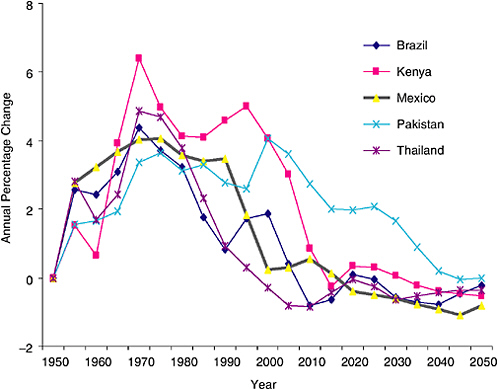
FIGURE 5-12 Annual growth rates of population, ages 15-24.
SOURCE: United Nations (2003d).
youth labor force has been higher in recent decades than it will be in the coming decades. So while the challenge for youth employment will be substantial in countries, like Kenya and Pakistan, that have experienced unprecedented growth in the size of their youth population, the problem in proportional terms will be somewhat smaller in the future than it has been in the past, particularly for Brazil, Mexico, and Thailand, where growth rates are now near zero or negative.
While it is tempting to attribute recent increases in youth unemployment rates to the increasing size of the youth cohorts, it is important to recognize that in many of these countries the absolute numbers of young people were increasing much more rapidly in the 1970s and 1980s than they were in the 1990s. In Brazil, for example, the 15-24 age group grew at over 3 percent per year in the early 1980s, an increase of almost 1 million new young people every year, but the youth unemployment rate stayed at the relatively low levels of 6-7 percent. In the 1990s, the 15-24 age group grew only half as fast as it did in the 1980s, but the youth unemployment rate rose to over 20 percent (Inter-American Development Bank, 2003a).
While the entry into the labor market of the large youth cohorts will create a need for millions of new jobs in developing countries, it is important to recognize that many Asian and Latin American countries successfully absorbed increases in the numbers of young workers in the 1970s and 1980s of similar proportions.
Sustained economic growth, much of it concentrated in the urban economy, clearly played an important role in the historically unprecedented job creation that took place in many developing countries in the 1970s and 1980s. Whether economic growth of a similar magnitude will enable the countries of Southern Asia and sub-Saharan Africa to create jobs for the large cohorts of young people that will enter the labor market in the coming decades is clearly an open question. Later we discuss some issues in international economic policy that may have an important impact on this question.
Poverty
In the very extensive literature that has analyzed the determinants of child labor, poverty, often associated with capital market failure and liquidity constraints, features as the most prominent explanation. Basu and Van (1998) hypothesize that in many poor settings, parents may actually be caught in a low-level equilibrium trap in which they have no choice but to send the children to work because their own low wages are not sufficient to provide subsistence consumption.33 This implies a backward-bending supply curve for child labor, with more child labor provided at lower wages. As a result, there may be multiple equilibria, with a “good” equilibrium at high wages (with no child labor) and a “bad” equilibrium at low wages (with considerable child labor).34 If there are multiple equilibria, legal prohibitions on child labor may move the economy from the bad to the good equilibrium. However, in very poor countries there may not be a good
equilibrium, and in such cases, a ban, if effective, may leave poor families and their children impoverished.
A recent empirical test of this hypothesis in Vietnam provides strong empirical support (Edmonds, 2003). Using data from a panel survey of households, Edmonds (2003) is able to observe changes in economic circumstances and children’s labor force participation in the same households over time. He found that households whose per capita expenditure rose sufficiently to push them above the poverty threshold between 1993 and 1998 experienced an 80 percent decline in child labor. While he found per capita household expenditures to be negatively associated with child labor throughout the income range, improvements in household economic status had more power in explaining declines in child labor over the five-year period of observation among low-income families than did improvements in household economic status in other groups.
Another way to explore the relationship between poverty and the incidence of child labor is to look at the impact of economic shocks, such as job loss, family disruption, and bad agricultural harvests on the work activity of young people. Poor families, because they lack access to credit or risk insurance, are much less likely than other families to be able to weather an economic shock without calling on other family members to increase their work effort to compensate for the loss. Concern about the impact of economic shocks (including the consequences of structural adjustment) on young people has been an important focus of attention in the international community (see, for example, Jolly, 1991).
While some studies have found positive statistical associations between work rates among children and adolescents in response to adverse shocks (e.g., Rucci, 2003, for Argentina from 1998-2002 in response to currency fluctuations; Beegle, Dehejia, and Gatti, 2003, for Tanzania in the early 1990s due to crop loss; Cunningham and Maloney, 2000, for Mexico from 1987 to 1997 due to parental job loss), others have found little relationship (e.g., Skoufias and Parker, 2002, for Mexico from 1995-1997 due to parental job loss, divorce, and marriage or Duryea, Lam, and Levison, 2003, for Brazil due to male job loss) or a negative association (e.g., Behrman et al., 2000, for Thailand after the 1997 financial crisis; Duryea and Arends-Kuenning, 2003, for Brazil from 1977 to 1998 due to labor market fluctuations). When shocks affect the supply of jobs in the market, the increased need for family income is counterbalanced by a decline in labor market opportunities. In comparisons of the effects of shocks on the poor and nonpoor, children in poor families appear more likely than others to increase their work rates in response to adverse shocks (e.g., Beegle, Dehejia, and Gatti, 2003, for Tanzania; and Neri et al., forthcoming, for Brazil). These results provide further support for the notion of a backward bending supply of labor in very poor settings or among poor families.
In most parts of the world, the percentage of the population living on less than $1 per day has declined over the last decade (Chen and Ravallion, 2001). However in sub-Saharan Africa it is rising. Given long-term trends in the incidence of poverty, one would expect to see declines in the incidence of child labor in countries in which the percentage living in poverty has declined, but increases in countries in which that percentage has increased. At the same time, changes in the structure and function of labor markets (see discussion below) as well as changes in the accessibility of credit and risk insurance can affect families’ ability to absorb temporary economic shocks due to a bad harvest, a business failure, or a job loss, with attendant implications for the timing of young people’s transitions to work.
Family Size
Throughout the developing world, except possibly in some parts of sub-Saharan Africa, family size is declining rapidly and the educational levels of parents are substantially higher than they were in previous generations. At the same time, the burdens of domestic work that depend to a large extent on the availability of electricity, cooking fuel, and water are likely to be declining as countries become more fully electrified, as public services become more widely accessible, and as a growing proportion of the population lives in cities in which services are much more accessible (National Research Council, 2003). These trends that are associated with positive demographic and economic changes might be expected to free young people up from domestic responsibilities as well as from the need to contribute to family income at a young age or while still a student, thus allowing time for longer and more effective learning in school.
At the same time, female household headship is rising throughout the developing world, and mothers are more likely to work outside the home than in the past (Bruce, Lloyd, and Leonard, 1995). Rising female headship means fewer adult earners in the household, possibly increasing the need for young people to contribute to household income. Lloyd and Blanc (1996) found in sub-Saharan Africa that children living in female-headed households actually had an educational advantage over children in male-headed households once income was controlled, because of the tendency of these households to be more child-oriented in the allocation of family resources. However, female-headed households are more likely to be poor; the net effect of rising female headship on the incidence of child labor should depend on trends in the relative incidence of poverty in these households. Increasing rates of female labor force participation also lead to a reduction in the number of adults in the household available to take up domestic responsibilities, with possible implications for children’s domestic work responsibilities. Unless the family is poor, the increased family income
resulting from women’s labor force participation should reduce children’s work requirements, if that increased income can be applied to the purchase of child care and domestic help, thus freeing children to go to school and to stay in school longer.
A rich literature on the relationship between family size and children’s school has shown how key elements of context (e.g., level of economic development, government expenditure on education, family systems and gender role ideology, and phase of the demographic transition) mediate that relationship and explain its direction and strength across countries. The same is true of estimated relationships between family size and patterns of child labor (e.g., DeGraff, Bilsborrow, and Herrin, 1993; Jejeebhoy, 1993). Because of differences in gender roles in the family, the consequences of having fewer siblings may play out differently for the work roles of boys and girls. In the case of girls, the greater likelihood that their mothers are working for pay may increase the need for help at home (e.g., Basu, 1995, for the case of poor urban slums in India; Ray, 2002, for Pakistan) but fewer siblings at home may reduce the need for child care. For boys, fewer siblings at home may reduce the need to supplement family income in some settings but may increase it in rural areas in which families have large land holdings or in settings in which family enterprises are important. Edmonds (2003), using panel data from Vietnam, found that per capita expenditure improvements predicted declines in child labor better for boys than for girls; they also predicted changes in large households better than changes in smaller households.
Factors Affecting the Demand for Entry-Level Workers
Size of the Economy and Composition of Production
Over the last few decades, the economies of Eastern and Southern Asia, where the majority of young people in developing countries live, have been growing more rapidly than the economies of the developed countries. As a result, the very large gap between these economies has narrowed slightly (Behrman and Sengupta, 2005). In other parts of the developing world, per capita income levels, which were previously much higher than levels in Eastern and Southern Asia have been diverging from per capita income levels in the developed world, most dramatically in the Middle East and the transition economies of Europe and Central Asia, but to some extent in Latin America as well. Per capita income levels in sub-Saharan Africa, which were always among the lowest in the world, have been diverging further from developed country levels. Thus, the overall economic contexts in which most young people in the developing world have been making their transitions to adulthood have changed, and these changes have varied
substantially among regions, with much more positive aggregate economic experiences in Asia, where the majority of young people in developing countries live, than elsewhere.
The composition of production across economic sectors substantially shapes the employment options for young people. Conventional wisdom is that production shares of agriculture decline steadily in the process of development from about half or more to levels of about 5 percent, industrial shares increase initially and then peak and decline somewhat, after which service shares tend to increase. As noted in Chapter 2, recent patterns for most developing regions are mostly consistent with these characterizations. However the relatively large movements toward developed country service shares for Latin American and the Caribbean, Southern Asia, and sub-Saharan Africa—given their respective levels of development—raise some concerns that the service sector in these regions may be absorbing labor at too rapid a rate given more limited job expansion in goods-producing sectors, leading to lower average levels of productivity. These rapid changes in the growth of different sectors have implications for returns to different forms of human capital (e.g., increased returns to formal schooling in comparison to informal learning in family enterprises) and have involved some dislocation (including physical migration) to adjust to the changes.
Another factor that shapes economic growth and employment options for young people is the extent of engagement in international markets. Four of the six developing country regions have converged toward the developed countries in a standard measure of openness—the share of exports plus imports in national product (Behrman and Sengupta, 2005). The exceptions are Eastern Asia and the Pacific and, to a much lesser extent, Southern Asia. For Eastern Asia and the Pacific (but not for Southern Asia), the divergence has been more rapid increases in openness than in developed countries—a trend that has often been interpreted as being an important causal factor in the relatively successful recent economic progress of this region.
The 1980s and 1990s have been a period of structural reforms implemented in concert with international development-oriented agencies in many developing countries, particularly in sub-Saharan Africa and Latin America and the Caribbean.35 The stated objective of adjustment lending programs,
initiated in the late 1970s and early 1980s by the International Monetary Fund and the World Bank, was the promotion of long-term economic growth (Haddad et al., 1995). These structural reforms include the lifting of restrictions on international trade, privatization, and tax reform, which were expected to improve economic efficiency and promote economic growth. In Latin America these adjustments often included various labor market reforms as well, such as the loosening of various regulations designed to make the labor market more flexible.
While poverty provides a persuasive explanation for child labor in rural areas, job opportunities for children could be a factor pulling them into the labor market in urban areas. This is the conclusion of a comparative study of the determinants of child labor and schooling using cross-sectional survey data from Nepal, Peru, and Zimbabwe that estimated the effects of wages on child labor separately in urban and rural areas (Ersado, 2002). Other studies of the determinants of child labor that are confined to urban populations also have found evidence of a significant demand effect on child labor. For example, using an urban sample in Mexico, Levison, Moe, and Knaul (2001) found that a rise in the urban wage for girls did increase their likelihood of combining work and school; the same was not true for boys. Using a sample of urban schoolchildren in Mexico, Binder and Scrogin (1999) found that the likelihood of combining work with school was significantly and positively related to children’s wage opportunities. Finally, Duryea and Arends-Kuenning (2003), using a series of household surveys from 1977 to 1998 representing urban populations in Brazil, found employment rates for 14-16-year-old boys and girls increase as local labor market conditions improve (see further discussion in the section on factors affecting the supply of entry-level workers).
With population growth primarily concentrated in urban areas in developing countries, it is important to understand the implications of these trends for work transitions. Family farms and enterprises have traditionally been an important source of employment for children. With the shift of employment from agricultural to industry with development, one would expect that family farms would be less of a source of demand than in the past for child workers, but not much is known about trends in the prevalence of other types of family enterprises and wage employment opportunities that may be prevalent in urban areas. Thus, little is known about how the demand for child labor may be changing with development and urbanization.
Opportunities for Decent and Productive Work
One of the targets agreed to as part of the Millennium Development Goals is “to develop and implement strategies for decent and productive
work for youth” (United Nations General Assembly, 2003). While the term “decent” is not defined, we assume that it relates to various job characteristics, such as pay, hours, benefits, and security. We understand the term “productive” to mean that jobs are well matched with workers’ skills in addition to possibly providing on-the-job training. These targets, however, need to be understood in the context of rapidly changing labor market structures in many developing countries.
Around the world as labor markets are being deregulated, the public sector as a share of total employment is declining and the share of nonagricultural employment in the informal sector is growing. A key feature of informal markets is wage flexibility. Furthermore, most working children are employed in the informal sector. Data from case studies suggest that children who work are typically paid less than adults even when they do the same task (Grootaert and Kanbur, 1995). It is unknown whether the growth in the informal sector has led to an increased demand for child labor. A careful study of children working in the carpet industry in India found that adult workers are entirely substitutable for child workers and have similar productivity, yet for many smaller weaving establishments there can be a cost advantage to hiring child labor because of their lower pay (Levison et al., 1996).
As part of this tendency toward deregulation and privatization, the informal sector is becoming increasingly diverse and contains a growing number of high-wage job opportunities that lack job protection and often benefits. The high-wage part of the informal sector represents the most dynamic sector of the economy. At the same time, even conditions of employment in the formal sector are becoming “informalized,” and thus the distinctions between the formal and informal sectors are becoming increasingly blurred (Roberts, 1991; Vandemoortele, 1991).
For example, in Egypt, an increasing number of government employees are being hired on a temporary basis (El Mahdi, 2002). In Latin America, there appears to be a high degree of mobility between sectors, with 32 percent of workers in Mexico and 22 percent of workers in Argentina estimated to move either in or out of an informal job in a 6-month period (Inter-American Development Bank, 2003b). What implications does this growing informalization of the labor market have for new labor market entrants?
China is a dramatic example of these changes and their implications. A series of reforms was adopted in the late 1980s that have abolished the former system of work units organized by the public sector, which provided housing as well as cradle-to-grave job security. This allowed a labor market to emerge in which worker skills can be better matched with jobs (Hanuum and Liu, 2005). The results have been a rapid rise in the private sector as well as a rise in rates of return to higher levels of schooling. Both public-
sector and private-sector jobs have less stability and fewer benefits than past jobs, but compared with earlier cohorts, young people in China today enjoy substantially higher incomes.
Egypt is another interesting case. In Egypt all graduates of secondary or postsecondary institutions are guaranteed, at least in principle, employment in the public sector. Over time, real wages have eroded, but the queue for government jobs has lengthened as the growth in secondary and university graduates has outpaced the growth in government jobs, in the absence of sufficient growth in the private sector (Assaad, 1997a, 2002). Thus, graduates today have a choice of queuing for public-sector jobs that still provide pay and benefits that compare favorably to the private sector or entering the private sector, where they have a greater likelihood of finding a job as a result of recent growth in that sector. Furthermore, with the increasing informalization of both the public and private sectors, the informal sector has become the most important source of labor absorption in the last decade (Assaad, 1997b, as cited in Ahlburg and Amer, 2004; El Mahdi, 2002). In exploring the labor market mobility of young Egyptians, Ahlburg and Amer (2004) found that students who left school in the 1990s were more likely to be employed than students in the 1980s, but at the same time, among those employed, they were more likely to work in the private (and often informal) sector. Indeed, rates of employment in the informal sector have risen more rapidly for young men and women in Egypt than for any other age group (Moktar and Wahba, 2002).
Most importantly, Ahlburg and Amer (2004) also found that the more educated had greater upward mobility in the labor market over time. For the purposes of their study, they created a hierarchy of types of mobility starting with a move from out of the labor force into it, from unemployment to employment, from nonwage to wage employment, from irregular to regular employment, from unprotected to protected employment, and from protected private- to protected public-sector employment, with the assumption that these options are successively more desirable from the point of view of a potential employee. Using this hierarchy, they found that education is important to long-term job mobility, with the more educated the most likely to upgrade their employment status over time. They also concluded that labor market mobility for young graduates has increased in the last 10 years.
A potentially important aspect of “decent and productive” work is on-the-job training. A recent comparison of job stability for men of prime working age in private-sector wage employment in urban Colombia and the United States confirms anecdotal and case study evidence that jobs may be less stable in developing than in developed countries. Schaffner (2001) found, after controlling for differences in employment growth rates between Colombia and United States, that four-year job retention probabili-
ties are substantially higher in the United States than in Colombia, particularly in the first few years of a job, when on-the-job training should be most cost-effective. Even after further controlling for the fact that the occupational and industrial distribution of the workforce in the two settings differs in ways that would predict such differences, jobs in Colombia remain on average shorter in duration. These results suggest that young workers entering the private wage sector in Colombia will have substantially less opportunity for on-the-job training than their U.S. peers, with long-term consequences for productivity and wage growth over time.36 Various hypotheses to explain these differences between the United States and Colombia, including lower levels of development, greater volatility in the lives of workers and firms, financial constraints faced by employers and workers, and the inferior quality of formal schooling, remain untested.
Employment Discrimination
We are unaware of any studies specifically focusing on the role of employment discrimination according to gender, race, ethnicity, caste, or religion in transitions to work among young people. There is an entire literature on occupational stratification that the panel did not explore, but a cursory glance at materials focusing on labor market issues specific to young people in developing countries revealed little on this topic that would address our concerns with the occupational barriers that might affect new labor force entrants in the context of recent change.
While rising private rates of return to secondary schooling for girls in the labor market as well as growing opportunities for young women in factories around the world may be factors contributing in some countries to the breaking down of traditional employment barriers to women, patterns of occupational segregation by gender are pervasive. Indeed, according to Anker (1998), approximately half of all workers in the world are in occupations in which at least 80 percent of workers are of the same sex, with the least educated being the most segregated by occupation (Deutsch et al., 2002). Furthermore, in the cases of Costa Rica, Ecuador, and Uruguay, there appears to be no evidence that occupational segregation has decreased during the decade of the 1990s (Deutsch et al., 2002). Indeed, the degree of occupational segregation in these three countries is similar despite very different economic conditions.
One question that remains is what implications the trend toward privatization and informalization of the labor market may have for patterns
of employment discrimination for new labor force entrants. In Egypt, for example, the private sector appears to be virtually closed to women outside manufacturing and finance. Assaad (2002) found that, in the last decade, women’s share of employment in nonagricultural wage employment has actually declined. If it had not been for growth of jobs in the public sector for women, female unemployment rates might have risen sharply.
Technological Change
An additional factor that may affect changes in the demand for labor is technology. The introduction of labor-saving technology can cut down on the demand for low-cost child labor. There are many examples of this in the literature. In Egypt, the mechanization of agriculture, in particular the expanded use of tractors and irrigation pumps, reduced the demand for child labor, such as picking cotton or driving animals to power waterwheels or haul freight (Levy, 1985). In Ethiopia, the availability of labor-saving agricultural machinery was found to reduce child labor (Admassie and Singh Bedi, 2003). In the Philippines, having electricity in the community reduced both market and domestic work by children (deGraff, Bilsborrow, and Herrin, 1993). However, not all technological change is labor saving. Take for example the case of higher yield seeds that increase the productivity of the land. In Ethiopia, Admassie and Singh Bedi (2003) found that the introduction of higher yield seeds, in the absence of other labor-saving technology, actually led to an increase in the prevalence of child labor, at least in the short run.
Technological change can also contribute to changing rates of return to different levels of schooling, benefiting some young people and disadvantaging others in the search for remunerative work. Much evidence from developing countries suggests that technology can contribute to rising rates of return to higher levels of schooling (Montgomery et al., 2001). However, directions of causation can be difficult to establish, because a labor force with higher levels of education is more likely to generate innovations than one with lower levels of education. In many developing countries, in which technologies have been imported and are not the result of indigenous invention, this is less of a problem. The case of the green revolution, which initially relied on research and technology developed in international agricultural research stations, is a good example. Foster and Rosenzweig (1996) found evidence for such an effect in India in connection with the importation of high-yielding variety seeds. Their results indicate a rise in the returns to schooling during the period of rapid technological change, particularly in the states experiencing the most rapid growth rate. They conclude that the more educated are better able to manage the new technologies or to access information about them sooner. They further conjectured that the relationship between technological change and schooling is synergistic, with tech-
nological change having the biggest payoff in settings in which the labor force is more educated.
In the context of recent experience in Asia, Montgomery et al. (2001) pose the question as to why the increase in the supply of educated young labor has not brought with it a decline in rates of return to schooling. In the absence of other changes, such a result would be expected. Evidence of rising rates of return to secondary and tertiary education might appear counterintuitive. The authors raise the possibility of technological change as an explanation. In their cross-country regression analysis of factors associated with rates of return to schooling at the primary, secondary, and tertiary levels, the variable measuring trade openness was found to be significant. The authors speculate about the possibility that trade may serve as a conduit for technological transfer. Estimates by Wood and Calandrino (2000) project that greater trade openness in India will raise the demand for education in India, partly by shifting employment toward more skill-intensive sectors, but mainly by increasing the need for more educated workers in each sector, because of more technologically sophisticated methods of production. However, Behrman, Birdsall, and Szekely (2003b) did not find that trade openness was an important factor in Latin America in explaining the widening of wage differentials between the more and less educated; instead they identified other factors, such as tax and financial market reform, as being important.
POLICIES AND PROGRAMS
One challenge in designing effective policies to support successful transitions to adult work roles is to make sure that these transitions do not take place too early or too late. Another is that those making the transition have the skills and the information necessary to find decent and productive work in a very diverse and rapidly changing marketplace. Yet another is ensuring equal opportunities. While much is written about the prevention of child labor and the promotion of jobs for young people, there has been almost no sound scientific evaluation of policies and programs designed to support these goals. This is in sharp contrast to the field of education, in which policy evaluation is increasingly recognized as an essential element of proper policy formulation. Indeed, the one area in which there is some evidence of program effects is child labor, and this evidence is derived largely from evaluations of various antipoverty schemes that promote school attendance.
In the overview of relevant policies and programs that follows, we explore several domains of action, some with intended consequences for youth employment and some with objectives not specific to youth employment but with consequences for youth. First, there are policy actions at the international or national level that take place outside the country in ques-
tion but are intended to discourage child labor or to limit competition and thereby protect workers in developed countries. These include international labor standards and trade sanctions against countries with labor practices that are seen to be deleterious to children as well as certain features of macroeconomic policy.
Second, there are actions taken by developing country governments, which fall into three major categories: (1) laws and regulations governing employment practices, including the employment of children and youth, (2) programs designed and directed to the promotion of youth employment, and (3) poverty reduction programs targeted to poor families with school-age children. This list, however, neglects policies and programs that may have beneficial effects for young people, particularly girls and young women, whose work is hidden but who labor for long hours on unnecessarily time-consuming domestic chores, because many poor households still lack access to certain shared amenities of development, such as electricity, water, fuel, and transportation. Public works projects designed to free poor families from these burdens would lead to greater possibilities for schooling as well as remunerative work, particularly for girls and young women. However, such projects are rarely discussed alongside youth employment promotion schemes, despite their obvious benefits for young women.
International Policies
The International Labour Organization, in the early years after its founding in 1919, was focused primarily on labor policies in the industrialized north, in particular the needs and concerns of organized labor. In more recent years, the ILO has shifted its emphasis to improving working conditions in developing countries through the adoption of various international agreements and conventions that, at least in theory, bind their signatories to the enforcement of national labor standards. Among those of particular salience to our discussion are (1) the elimination of all forms of forced or compulsory labor, (2) the effective abolition of child labor, and (3) the elimination of discrimination in employment (Engerman, 2003). The ILO has no powers of enforcement, but it plays a useful role in developing consensus around an internationally shared set of norms and in educating the international community about basic human rights in the areas of labor and employment.
In recent years, trade policy has become a new tool being used in the international arena to “enforce” labor standards through product-labeling or trade sanctions against trading partners who are known to violate international labor standards relating to child labor. There has been much re-
cent debate about the motives as well as the effects of unilateral actions by developed countries to ban imports of products produced by child labor. First, while there is some evidence that the use of child labor in unskilled-labor-intensive export industries can have some modest positive effect on a country’s comparative advantage, these effects are far outweighed by the importance of a country’s labor endowment and the overall educational level of the working-age population in determining comparative advantage in a particular industry (Busse, 2002). Second, while many assume that the motivation for trade sanctions is primarily protectionist, Krueger (1997) has done some interesting analysis of voting patterns in the United States that may suggest that humanitarian concerns play an important role in the adoption of these policies as well. Third, as stated by Brown, Deardorff, and Stern (2003:240) “trade sanctions do little to address the underlying market failure that gives rise to offending child labor practices.”
As discussed earlier, poverty is the primary cause of child labor. A loss of jobs in the export sector in a country that has many families living in poverty with little access to credit and where labor standards are weak or poorly enforced will lead poor children to seek work in other informal, less remunerative, and potentially more hazardous conditions. Indeed, there is evidence that this actually happened in Bangladesh after children were dismissed from factories in 1993 (Boyden, Ling, and Myers, 1998). Furthermore, sudden loss of jobs for children may also further exacerbate the incidence of poverty among families if such actions lead to a decline in the overall demand for labor (Basu, 1999; Basu and Van, 1998; Jafarey and Lahiri, 2002). Indeed, a country’s openness to trade (as measured by the sum of imports over gross national product) has been shown empirically to be negatively associated with the incidence of child labor (Edmonds and Pavcnik, 2002; Shelburne, 2001). Furthermore, the majority of working children in developing countries remain outside the reach of labor regulations because they work in the informal economy or at home. Thus, policy makers motivated by humanitarian concerns for children will be more likely to succeed if they shift their energies to policies designed to attack the root causes of poverty.
Many other aspects of macro policy in developed countries influence the job prospects of young people in developing countries. While talking about increasing aid to the Third World, industrialized nations often follow trade policies and fiscal subsidy strategies in their own nations that may far outdo the good of the increased aid. Yet too often decisions made by foreign aid agencies in industrialized countries are not coordinated with trade policy.
Consider farm subsidies in developed nations as an example. By using taxpayer money to subsidize their farmers, rich countries tend to outcompete poor farmers in poor nations and also their export prospects.
This policy alone can have huge consequences for poverty in rural regions of developing nations, causing agricultural wages to be low, contributing to underemployment, and diminishing young people’s opportunity for work in rural areas.37
National Labor Policies and Programs
Laws and Regulations
Some labor laws and regulations, such as minimum ages of employment and youth-specific minimum wages, are specifically adopted with young people in mind. Others, such as rules governing employment contracts, conditions of employment including hours and wages, and job security or antidiscrimination legislation, are more general but may have particular consequences for new labor market entrants. Typically, these laws or regulations, while commonly adopted in developing countries, apply only in the formal sector, which, in many settings, appears to be declining in relative importance even as economies are growing.
There have been few studies of the effects of minimum wage legislation on youth employment in developing countries. This is probably because so few youth work in the formal sector and because, even in the formal sector, enforcement of minimum wage laws, where they exist, tends to be weak. Furthermore, minimum wages are typically set very low and, even if set at a relevant rate, are often quickly eroded by inflation. A recent review of the literature (Ghellab, 1998) found only one study of the specific effects of the minimum wage on youth employment in urban Indonesia, where its effects were found to be statistically insignificant (Rama, 1996, as cited in Ghellab, 1998).
The story of the enforcement of stricter child labor standards in Nepal (see Box 5-4) is a particularly poignant example of the complexity of applying labor standards in a poor country in which many children work outside the reach of the government’s potential enforcement capacities (Baker and
|
BOX 5-4 Through the enforcement of child labor laws, children working in large and highly visible carpet factories in Nepal, which were deemed to have hazardous work conditions, were expelled from their workplaces and disallowed from income-generating activities (Baker and Hinton, 2001). In the mid-1990s, these expelled child workers were then enrolled in a rehabilitation program funded by the Nepal Rugmark Foundation, which was funded by contributions from factory owners and set up to enable them to attach “child labor free” labels to their carpets. Children were placed in residential hostels; provided with health care, nonformal education, and counseling; and, ultimately reunited, if possible, with their families in rural areas. However, many children worked alongside other family members and being reunited with their family meant being allowed to remain near them in their factory environments. Thus, there has been increasing attention to the need to provide day nurseries, nonformal education, and health facilities in the factory environment. The authors of the study point to the need for protective policies that will allow children to combine work with schooling. |
Hinton, 2001). While children under the age of 16 no longer work in the largest carpet factories, which have been subject to government inspections and extensive media attention, employers in the smaller and medium-sized factories remain ignorant of the law or able to circumvent it.
In a recent comparative study of the employment effects of labor regulations in 85 countries that included over 50 developing countries, Botero and colleagues (2003) found no evidence that the regulation of labor, while more extensively practiced in poorer than richer countries, is beneficial. Indeed, they found that young people suffer differentially from labor regulations. For this analysis, they developed an index of employment laws related to conditions of employment, job security, and alternative employment contracts that ranges in value from 0.87 to 2.40, with higher values reflecting a greater degree of regulation. Developing countries, which have tended to adopt legal traditions from former colonial powers, are distributed through the range. An increase of the employment laws index by 1 point raises the average unemployment rate for young men by 6 percent and of young women by nearly 10 percentage points. More extensive labor regulations are also associated with a relatively greater share of the economy being situated in the informal sector.
Policies and Programs Promoting Youth Employment
Policies and programs designed to promote youth employment or livelihoods can be grouped in four categories: (1) vocational education and
training, (2) information sharing, (3) direct job creation, and (4) support for self-employment and enterprise creation, including various livelihood schemes promoted by nongovernmental organizations (NGOs). We also include military or national service here. While military service is rarely discussed in this context, it should be recognized that it often provides employment and training for young people, mainly young men. For those who do not make a long-term career in the military, it also provides a transition back into the regular labor market with marketable skills (see further discussion of military service and its role in citizenship formation in Chapter 6).
A recent report of the secretary general of the ILO stated that “training is in crisis everywhere in the developing world” (International Labour Office, 2003:38). In many developing countries, a large part of vocational training has traditionally taken place in the schooling system in the form of a specialized track at the secondary level, with per-student costs that can be as much as twice those of general secondary schooling (Gill and Fluitman, 1997). Employers, unions, and other government agencies often play a role as well. Typically the types of skills provided are geared to jobs in the formal sector. However, bureaucratic rigidities and outdated curricula have combined to raise questions about the cost-effectiveness of an approach that is slow to respond to rapidly changing skill requirements in the marketplace. Nonetheless, many countries continue to focus employment policies for young people around vocational education.
For example, in the 1992 revision of the National Policy on Education in India, high priority was assigned to the “vocationalisation” of secondary education, but subsequent follow-up suggests that progress was sluggish and the links between the schools and industry were weak (Visaria, 1998). In Mexico, the National College of Vocation Studies—a decentralized federal institution that provides mid-level technical training at the postsecondary level—has been criticized for its inflexibility and its inability to build an adequate relationship with the private sector (Lugo, 1999). This is made all the more challenging by the fact that most firms in the formal sector have relatively few employees and a growing number of young people work in the informal sector.
Egypt is well known for its large system of technical secondary schooling. Two-thirds of graduates from basic schools go to technical secondary schools rather than academic secondary schools. However, many of the concerns raised above have stimulated thinking about alternative approaches. The Mubarak-Kohl initiative conceived in 1991 and piloted in some of Egypt’s new cities in 1995 hoped to create a cooperative system of internship training using public-private partnerships (van Eekelen, de Luca, and Ismail, 2001). So far this initiative has not taken off and is unlikely to spread beyond the internationally competitive sector of the economy be-
cause of its costs (Gill and Fluitman, 1997). Furthermore, concerns have been expressed that vocational training that was previously open to young men and women equally would begin to favor young men, because students in the program would be selected by private companies and the private sector is largely closed to women in Egypt (Assaad, 2002).
Vocational training is distinguished from vocational education by being outside the formal school system, but also outside the workplace, while in-service training occurs in firms. The Chile Joven program represents a model combining both approaches, which has now been replicated in three other Latin American countries (Gallart, 2001). Aedo and Nuńnez (2001) evaluate the effectiveness of Programa Joven in Argentina, a program targeted to young people from poor households with low levels of school and no work experience. The training combines a classroom and an internship phase lasting from 14 to 20 weeks. The program showed statistically significant positive wage effects for young men and adult women as well as statistically significant positive employment effects for adult women only, controlling for selection into the program.38
The authors interpret these results as reflecting the different market conditions faced by different groups rather than differences in their training experiences. Using data on program costs and estimated benefits, the authors conclude that it would take 9-12 years for the net present value of the program to become positive. Given evidence of the relatively modest returns associated with job training, the Inter-American Development Bank in its latest report on the Latin American labor market recommends that governments “should move away from the direct provision of training and improve the incentives of firms, workers and training providers to fund, seek and provide high quality training” (Inter-American Development Bank, 2003a).
Job counseling and job registries do not create jobs or provide training, but they can improve the effectiveness of the search process through information sharing and better matching of jobs with potential applicants. In India, the national employment service operates over 900 employment exchanges, primarily in large towns and cities, and the overwhelming majority of registrants are young people ages 15-29 in search of their first jobs (Visaria, 1998). However, employers do not find that they meet their needs and, as a result during 1995, there were 5.9 million job seekers registered but only 386,000 vacancies listed. Evidence from evaluations in member
countries of the Organisation for Economic Co-operation and Development suggests that job registries can be cost-effective if properly managed, however (Inter-American Development Bank, 2003a).
Labor-intensive public works projects have been a long-standing approach to job creation. For example, the Public Works Programme (PWP) in Egypt was set up in 1991 to apply and institutionalize, at the national level, labor-intensive techniques in infrastructure projects to create employment in rural areas. While young people have not been specifically targeted, young men have been the principal beneficiaries (van Eekelen, de Luca, and Ismail, 2001). The long-term success of such programs is significantly enhanced if there are spillover effects in the local economy that encourage sustained employment and growth. Furthermore, since these projects are likely to lighten domestic work burdens, they may free many young women for participation in the nonagricultural wage sector—a sector that has traditionally been closed to them.
A final approach to youth employment is the promotion of self-employment and entrepreneurship through various livelihood schemes. Livelihood schemes have as their objective the promotion of self-employment and entrepreneurship among traditionally disadvantaged groups and have recently been promoted as a promising approach to the integration of girls and young women into an increasingly informal labor market. Livelihood schemes can encompass the development of capabilities, resources, and opportunities (Population Council and International Center for Research on Women, 2000). This has been a fertile arena for NGOs in many settings and goes beyond training to encompass access to financial services, access to markets, the creation of safe spaces, the empowerment of young women, and the protection and promotion of rights, among other goals (see further discussion of the role of livelihood interventions in the acquisition of citizenship in Chapter 6). While there is strong evidence that young women’s labor force participation rates are on the rise, there is no comparable evidence about trends in domestic work burdens or patterns of labor market discrimination. By adopting an integrated approach to addressing the needs of young women, these programs are trying to address simultaneously many of the traditional disadvantages that these women have faced in making the transition to adult work roles and responsibilities. Evaluations of some of these programs are currently under way.
Antipoverty Programs Promoting Children’s Schooling
In Chapter 3, grants to poor families conditional on their children’s school attendance were featured as a promising new approach to increasing school participation and attainment among the poor. In most cases these same evaluations, which have been heavily concentrated in Latin America,
have documented program effects on children’s work participation as well. Variations in key features of program design, as well as in the contexts in which these programs have been applied (e.g., prevalence and depth of poverty, previous school participation, school quality, opportunities for children to work for pay), will clearly lead to differences in outcomes.
The most comprehensive assessment of time-use impacts on children of conditional grants for school has been done in connection with the evaluation of PROGRESA: poor families were eligible to receive monthly grants on a per-child basis as long as the child maintains an 85 percent attendance record in school (Skoufias and Parker, forthcoming). The percentage decline in labor force participation rates for boys was roughly in balance with the rise in school enrollment, except among boys ages 16-17 who showed no significant reduction in the probability of working. For girls, however, the decline in their labor force participation was much lower than the recorded rise in their enrollment rates, because they had much lower levels of labor force participation to begin with. However, by looking more comprehensively at all aspects of time use, the researchers were able to document that PROGRESA also lowered the time girls spend on domestic chores, which can also be an important barrier to school attendance. Thus it appears that PROGRESA has the promise of contributing to a more successful transition to adult work roles for many poor Mexican youth.
A pilot project in Nicaragua with a similar design but with a slightly younger group of children targeted for education support (ages 7-13) also found that the percentage of children working after the program had been in operation for a year was lower in every age group, but only significantly so in the case of children ages 12-13 (Maluccio, forthcoming). Because of the younger ages of the children, their participation rates were lower than in Mexico, where children enrolled in secondary school were also included. This is likely to explain the less significant effects.
The experience of the Program to Eradicate Child Labor (PETI) in rural Brazil is of particular interest because its primary goal was to eliminate child labor. This program provides a per-child stipend to poor households conditional on the school attendance of those children that households designate as participants; it is also conditional on the attendance of participating children in an after-school program (Jornada Ampliada), which effectively doubles the length of the school day. In addition, it includes a contract signed by the parents agreeing that their participating children will not work. The evaluation was based on a cross-sectional survey conducted in participating and nonparticipating communities (matched on socioeconomic status) three years after the initiation of the program (Yap, Sedlacek, and Orazem, forthcoming). In the statistical analysis, PETI was found to be more successful in removing children who were working part time from the labor force than removing children working full time. This result was seen
to be due to the availability of the after-school program, particular in Bahia—an region with high rates of child labor—where nonprogram children were also allowed to participate in the after-school program. PETI participants were also more likely than nonparticipants to progress to the next grade and less likely to engage in various types of hazardous work. It is not known whether the after-school program had a direct effect on better grade progression rates through the provision of more educational inputs or an indirect effect through the reduction of work hours.
CONCLUSIONS AND RECOMMENDATIONS
Key Findings
The rise in school enrollment and the delay in the timing of school exit have resulted in a delay in the timing of labor force entry and a concomitant decline in the prevalence of child labor. Not only is the average educational attainment of new labor force entrants rising, but so are the earnings of secondary and university graduates compared with those who lack an education or have only completed primary school. As a result, working children in developing countries are experiencing a growing disadvantage relative to their more educated peers.
The rapidly closing gender gap in school attendance and participation implies a growing equalization of work burdens between young men and women as their daily lives become more similar to each other. These changes in gender roles during a critical phase of the transition to adulthood are creating opportunities for greater gender equity in adulthood. Nonetheless, young women’s work burdens still exceed those of young men even when they are students, because they spend relatively more time than young men on noneconomic household work.
The longer young people stay in school, the more likely they are to combine schooling and work. Indeed, part-time or intermittent work can provide the means to make continued enrollment possible in many poor settings. Unambiguous evidence of the negative effects of child labor on learning outcomes is limited but is most persuasive in the case of children of primary school age who combine work and schooling.
In many parts of Asia and Latin America, increased numbers of young people have been absorbed into the labor market without any large increase in unemployment rates among youth, despite a rapid rise in the size of cohorts entering the labor force. However, the challenge for youth employment remains substantial in some of the poorer countries of Asia, sub-
Saharan Africa, and the Middle East, which are currently experiencing unprecedented growth in the size of their youth populations. Rates of growth in the size of the potential youth labor force (ages 15-24) have now peaked in most countries even though the absolute numbers continue to grow. Because youth opportunities for employment depend on broader economic trends that can vary greatly over time and across countries, significant fluctuations are likely to occur in how well youth are integrated into the labor market in the future.
Household poverty is strongly associated with child labor; trends in poverty are an important explanation for trends in child labor. While most young people live in parts of the world in which poverty rates are falling, a rising proportion of young people in sub-Saharan Africa are growing up in poor households. And it is in sub-Saharan Africa where there is evidence that rates of child labor are growing. These trends in sub-Saharan Africa widen the gulf between young Africans and their peers in other parts of the developing world, raising further concerns about Africa’s future prospects.
A rising proportion of young women are entering the labor market, particularly in paid employment, but rates of participation among young women still vary widely across the developing world. Thus, for more and more women, adult work roles will include paid employment in the labor market. For an increasing number of young women who have the opportunity to earn money in the labor market before marriage, paid work is likely to mean that they can have greater control in meeting their own needs as well as contributing to family income and, through these changes, they may have greater say in decision-making in the family.
More educated young workers have higher earnings, greater job stability, and greater upward mobility over time compared with their less educated peers. These patterns, however, coexist with strong labor market trends toward deregulation and privatization that may have made labor markets more unstable relative to the past.
Policy Recommendations
Policies and programs with implications for young people’s successful transitions to work in developing countries exist at all levels of action: international, national (both developed and developing country policies), and local. Policies that enhance successful transitions to work include those that attack the root causes of poverty, enhance economic growth, improve learning outcomes in school and on the job, ensure equity of opportunity and pay regardless of race, gender, or class, and prevent harmful and unfair
practices. Relatively few of these have been evaluated for their effectiveness. However, basic labor force trends direct attention to various fruitful avenues for intervention.
The panel supports the United Nations (UN) Millennium Development Goals relating to the reduction of extreme poverty and the fostering of a global partnership for development. The achievement of these goals will foster a climate in which a higher percentage of youth will be able to attend school into late adolescence, thus avoiding premature work responsibilities and ensuring a more successful transition to adult work roles.
Antipoverty programs providing financial assistance to poor families that keep their children in school have been successful in reducing child labor by increasing enrollment. Their cost-effectiveness depends primarily on careful targeting of benefits. The success of these programs in the longer run will need to be judged by whether improvements in education stimulated by these programs lead to declines in poverty in the next generation so that the conditions that fostered child labor are alleviated.
Tax, trade, and aid policies in developed countries need to be coordinated so that tax and trade policies do not take away with one hand what is given with the other hand in the form of development assistance. Otherwise, rather than providing value added in addressing issues of poverty and productivity, development assistance can do no more than mitigate the harmful effects of agricultural subsidies and restrictive trade policies on developing country economies and, by extension, on decent and productive job opportunities for youth.
Labor market regulations that are commonly enacted in developing countries for the purpose of improving the terms and conditions of employment put youth at a disadvantage in competing for jobs in the formal labor market and encourage the growth of the informal sector. Youth are likely to fare better in a labor market in which employers do not face excessive constraints governing employment contracts.
Trade sanctions against products produced with child labor or against countries known to violate international labor standards relating to child labor are likely to do more harm than good in contexts in which poverty is persistent and the family economy still relies on child labor. In the presence of such sanctions, children who need to work have often been forced to find more hazardous work in the unprotected sectors of the economy, with risks to their health and safety.
Government incentives for firms to invest in training, for training providers to provide high quality and relevant training, and for workers to invest in training have been identified as promising alternatives to the direct government provision of training. Evidence suggests that government-sponsored vocational education and training are often relatively expensive and inefficient at matching training curricula and training opportunities with job demands.
Research Recommendations
Important research questions remain unanswered:
-
Is globalization changing the types of jobs that child laborers do and the extent of such work?
-
How prevalent are the “unconditionally worst forms of child labor,” including trafficking, forced or bonded labor, armed conflict, prostitution, pornography, and illegal activities? How is their prevalence changing?
-
What are the long-run consequences of child labor for children’s health, education, and well-being?
-
How does combining school attendance with work affect learning outcomes among adolescents attending secondary school?
-
What are the trends in time spent working by age, including domestic work and economic activity? Is the distribution of work by gender being spread more evenly than in the past?
-
How will opportunities for young women to work before marriage affect their timing of marriage, their marital relationship, their agency in marriage, and their probability of working after marriage?
-
With the delay in labor force entry, young people are more mature and more educated when they start to work. As labor force choices become more their own and less those of their parents, what implications will this have for the types of choices they make?
-
Why do better educated women in different settings make such different choices with respect to labor market participation? How are these choices changing?
-
Has the growing tendency toward deregulation and privatization in many labor markets contributed in a positive or negative way to the effective absorption of growing cohorts of young people into the labor force?
-
Do young women, the poor, ethnic minorities, and other disadvantaged groups face more or less discrimination in the labor market than in the past?
-
How can labor market policies encourage employers to invest in on-the-job training for young workers?
-
How do national educational and labor market policies in developed countries affect international labor migration among youth?
-
How do labor market regulations affect the migration of youth to urban areas?
-
How are rates of unemployment and underemployment changing among youth? Do these trends differ by educational attainment?


