
3
Home Production
Early national income accountants acknowledged that household services represented productive work. A landmark National Bureau of Economic Research study of income in the United States (King, 1923) calculated the value of household services based on estimates of the number of women age 16 and over primarily engaged in housework without monetary remuneration. Assuming that the proportion of “housewives” to the total population of women not employed for pay remained constant and that the average value of their services in 1909 was about equal to the average income of persons engaged in the paid occupation of “domestic and personal service,” the value of housewives’ services amounted to 30.7 percent of market national income in 1909 and 25 percent in 1918.
Despite this initial interest in home production, national income accounting moved in a different direction. Pigou (1920, p. 11) insisted that national income should be defined only in terms of goods and services that could be brought “directly or indirectly into relation with the measuring rod of money” and discouraged the application of such a measuring rod to household work. A national income estimate prepared in 1926 under the direction of Francis Walker, chief economist of the Federal Trade Commission, explicitly excluded the value of housewives’ services (Carson, 1975). In 1929 Simon Kuznets joined the National Bureau of Economic Research and continued the work that eventually formed the underpinnings of the National Income and Product Accounts (NIPAs) that we know today. He conformed to immediate precedent, declining to include any imputations of the value of household production, but offered eloquent warning of the limitations of the resulting estimates of national income: “The welfare of a
nation can scarcely be inferred from a measurement of national income as defined [by the GDP]” (Kuznets, 1934, report to Congress).
More recently, there has been a renewal of interest in the development of satellite household production accounts. A number of individual scholars have made serious efforts to lay out a framework for such accounts (see, e.g., Ironmonger, 1996; Landefeld and McCulla, 2000). Several national statistical agencies are in the early stages of developing satellite household production accounts. Among other efforts, Eurostat is funding several country-specific projects, and the Office for National Statistics in the United Kingdom has developed an account that estimates a value for that country’s household production (see Holloway et al., 2002). A major catalyst for this activity—and for prospects of future progress—is the development of time-use surveys in a number of countries.
In this chapter we analyze the nature of household production and discuss the issues involved in measuring its contributions to an expanded notion of gross domestic product (GDP) and to the construction of satellite national accounts. In keeping with the purpose of developing a framework for satellite accounts, we consider how to measure the quantities of the various inputs used by households to generate their products and how to assign values to those inputs. We then turn to issues of classifying and valuing the outputs from home production, which we argue should be done independently from the measurement and valuation of input quantities so as to maintain the double-entry bookkeeping that is the foundation of all accounting.
Accounting for the value of what is produced in households always has been conceptually necessary for obtaining a complete picture of what society produces. Indeed, in a prehistoric or undeveloped society, most of what was produced would have been outside the market; the only sensible “national” accounts would consist almost entirely of household production. With the growth of markets and of trading states and the subsequent development of expanded trade in manufactured goods and then in services, the relative importance of home production in total final output clearly diminished. Researchers, typically working with data from European countries, Australia, or Canada, have produced varying estimates of the magnitude of output from the household sector. Niemi and Hamunen (1999) estimate that the value of household output ranges from about 35 to 55 percent of GDP.1 All of these estimates are rough since neither the physical magnitude of the output nor its value have been precisely measured.
Basic demographic information allows another way to get a rough indication of the amount of household output relative to the market output of the nation About two-thirds of the U.S. population over age 16 is in the labor force (U.S.
Census Bureau, 1999). If we assume that an adult spends 10 hours each day in sleep and basic personal care, then those who are in the labor force, if they devote 40 hours each week to “work,” expend only about 40 percent of their waking hours “at work.” The other one-third of the population spends none of its time in the labor market producing output that is captured by GDP. So, overall, the adult population spends only about 25 percent of its waking hours “at work.” Depending on what one chooses to define as productive output in the nonmarket sector, how productive those nonmarket hours are in comparison with those spent “at work,” and how one values the resulting output, the nonmarket product could easily be greater than the whole of GDP! We do not make the case so strongly, but we note the potential magnitude of this nonmarket product and stress that the difficulty in measuring it does not imply that it is not important in magnitude or in policy significance. Indeed, we argue that, in judging the level and composition of national output, anyone who disregards nonmarket product misses a significant part of the picture.
Estimates of the value of household production are relevant not only to measures of the level of economic activity and productivity, but also to their trend rates of growth and to their fluctuations over the business cycle. Many historical estimates of growth in the output of the U.S. economy during the nineteenth and early twentieth centuries were constructed rather crudely, using information on relative rates of growth in employment in different sectors. When the output of the nonmarket household sector of the economy is imputed using a similar methodology, the estimated trend growth rate of overall output may be substantially modified (Folbre and Wagman, 1993). Time and energy devoted to nonmarket work vary less over the business cycle than the corresponding inputs to market work, and may even move countercyclically as unemployed workers choose to devote more time to home-based activities (Greenwood et al., 1995). Thus, if household production is omitted from measures of total output, it may lead to misleading conclusions about patterns of economic growth.
The productivity of nonmarket work is modified by technological changes, such as the growing availability of consumer durables. The development of microwave ovens, for example, reduced the time necessary to produce meals at home. Increases in the efficiency of home meal production need not mean that time devoted to home meal preparation will decline—increases in efficiency may encourage more meal preparation at home than would otherwise have taken place. More recently, home computers and the flourishing of the Internet now allow households to perform a range of tasks—pay bills online, communicate by e-mail, shop on the Web, produce photos for distant relatives—either more quickly or better. While the productivity of time devoted to household work has risen, wages—the returns to market work—also have grown, possibly even faster. All else the same, relatively more rapid growth in market as compared to household productivity implies a price effect that would lead to substitution of time toward market production.
A dramatic recent historical trend related to household production has been the increase in women’s participation in wage employment—a shift of women’s efforts from the unmeasured realm of nonmarket output to activities that are valued in GDP. Accounting for this shift and the resulting reduction in the time available for nonmarket work would change measures of the growth of aggregate output over time (see Goldin, 1986, for documentation of these trends). From a cross-sectional perspective, taking the value of nonmarket work into account in calculating household income might reduce measured inequality. The valuation of household time also has implications for the construction of poverty rates and other measures of relative welfare.
Bringing household activities into satellite accounts raises significant classification problems. Measuring quantities produced, as opposed to consumed, is one challenge. For example, expenditures on food at McDonald’s are included in GDP, the cost of which includes the wages paid to McDonald’s employees; however, the value of time customers spend eating McDonald’s meals is not—and should not—be included because we are interested in measuring the production of output that may contribute to consumers’ welfare, rather than in measuring welfare itself. An analogous distinction needs to be made when attempting to measure the quantities of output produced at home. Deriving meaningful valuations of nonmarket inputs is another challenge. The value of market inputs is measured by their prices, which presumably reflect society’s valuation of them at the margin. By their nature, however, many of the inputs into household production, particularly the time household members devote to such production, are not purchased. The inherently nonmarket nature of home production means that the value of these inputs must somehow be imputed rather than measured directly.
Beyond the distinction between household production and household consumption, productive activity may be defined more or less broadly. This chapter focuses on household production of tangible goods and services produced for immediate consumption, together with household production of tangible investment goods, such as the building of a home addition. At one level, care of children should be considered a component of home production. If parents wished to do so, they could hire someone else to change their infants’ diapers, make their children’s meals or help their children with their homework, so the production of these services could be assigned a market value. The services of hired child care providers may be, at least beyond some point, a highly imperfect substitute for parental time devoted to the same set of tasks. There is, moreover, an investment dimension to the care of children that the valuation methods advocated in this chapter simply do not capture. The issues surrounding family care, especially family care of children, are discussed at greater length in Chapter 4. Similarly, although the time-use estimates reported later in the chapter include time devoted to educational activities, the methods we advocate for measuring home production of tangible goods and services are not applicable to measuring the production of
human capital assets. Time devoted to educational activities and the production of human capital should be accounted for in a separate satellite.
On balance, the availability of relevant data and the relative simplicity of underlying concepts make the household production account a leading candidate for immediate development. Despite the difficulties outlined here, the theoretical and empirical bases for the inclusion of household production in satellite national accounts on a continuing basis are surely far sounder than was the understanding of accounting for market transactions when the United States made the leap into creating consistent sets of national accounts beginning with data from the 1920s and 1930s.
Recommendation 3.1: The Bureau of Economic Analysis should create satellite accounts reflecting the quantity and value of inputs and outputs in home production.
THE HOUSEHOLD AS A FACTORY
Individuals do not simply consume purchased goods: they combine these goods with inputs of their own time to generate what Becker (1965) referred to as commodities. Thus, a commodity, “lodging” for example, is produced using a purchased (or rented) housing stock and family members’ inputs of time into its maintenance and improvement. Meals are produced mainly at home, using purchased materials—raw food together with the services of kitchen appliances, tableware, napkins, and so on—and also the time of those who prepare the meals and clean up afterwards; inputs and output for this simple example are listed in Table 3-1.
As with any good that is produced in the market, there are a variety of ways of generating a given amount of any home-produced commodity. One could generate meals entirely through market purchases, by employing cooks who prepare meals using the purchased inputs noted above and cleaning persons to clear and wash the dishes. At the other extreme, one could grow one’s own vegetables, feed and slaughter one’s own animals, and use one’s own time to prepare the meals and to clean up afterwards. As another example, one could generate lodging by buying a house, then employing a butler to coordinate and effect all repairs. Alternatively, one could build the house and do all repairs and maintenance oneself, perhaps using some purchased materials. In each case, there is a large range of choices between the extremes. As with a market-based production technology, the household production function indicates for each commodity the tradeoffs between efficient uses of different methods to generate any given amount of the commodity.
The choices that individuals within a household make about how to produce commodities depend on their preferences, the relative prices of the goods and household members’ time that might be used to generate the commodities, their
TABLE 3-1 Stylized Account for Home-Produced Meals in a Household Production Account
|
Inputs |
Output |
|
Family members’ time |
Home-cooked meal |
|
Food shopping |
|
|
Meal preparation |
|
|
Meal clean-up |
|
|
Purchased materials |
|
|
Food |
|
|
Dishwashing detergent, etc. |
|
|
Services from consumer durables |
|
|
Stove |
|
|
Refrigerator |
|
|
Microwave |
|
|
Dishwasher |
|
|
Housing (perhaps) |
comparative advantages (which are linked to personal skills and abilities), and their production technologies. Otherwise identical households in which household members have higher opportunity costs of time, typically reflected in higher market wages, will be less likely to produce commodities at home and more likely to purchase market substitutes. Transaction costs contribute to cross-household variation as well. People who live far from towns incur higher transaction costs to eat in restaurants and should, all else equal, be more likely to eat at home than those who live in town. Similarly, the transaction costs of going out for breakfast or a morning cup of coffee may be high for someone who is typically at home in the mornings, and comparatively low for lunch if the person works during the day at a location convenient to restaurants. Other characteristics of a household, such as its size, may affect the choice between home production and market alternatives. Continuing with the meals example, larger families will benefit from economies of scale in converting time spent shopping and preparing meals, together with needed ingredients, to produce home-cooked meals.
The relative bargaining power of individual members over household decisions also may influence time allocation. When married mothers increase their hours of market work, husbands may not increase their hours of nonmarket work commensurately. Widespread awareness of this pattern has contributed to a proliferation of studies of how men and women bargain over the allocation of time and responsibility, as well as money, in the household (Lundberg and Pollak, 1996).
A household’s preferences and its choice of technology generate the combination of home-produced and market-purchased commodities that make it as well off as possible. The choice of household technology can be seen in Figure 3-1,
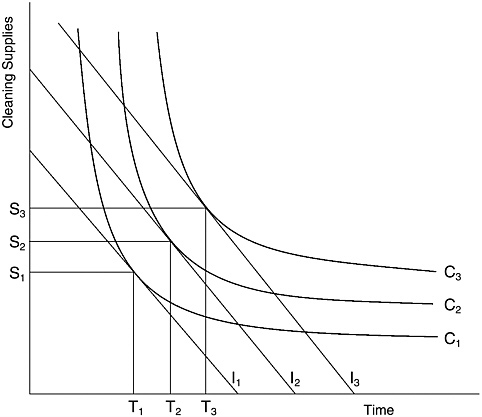
FIGURE 3-1 Production function for home cleanliness.
which shows a household’s production of the commodity home cleanliness, obtained through the combination of adults’ time and purchased goods, summarized as cleaning supplies. Various outputs of cleanliness, denoted by isoquants C1, C2, and C3, can be produced, with each amount generated by various combinations of cleaning supplies and adult time. Increases in either input raise the amount of cleaning produced. The lines I1, I2, and I3 indicate the relative prices of cleaning supplies and adults’ time, with the lines being flatter if cleaning supplies are relatively more expensive, and steeper if the opportunity cost of the adults’ time is higher. Each tangency of these price lines with an isoquant curve shows the best possible combination of cleaning supplies and time to produce that output of cleanliness.
Decisionmakers may derive pleasure from having cleaner homes, but they must weigh the extra pleasure against the fact that, in generating a cleaner house, they reduce the time available for the production of other commodities that they enjoy consuming, for consuming directly in the market, or for leisure, which is also enjoyable. If they produce C1, they leave a lot of their resources for the
production of other commodities; if they produce C3, they leave very little. They will produce that amount, perhaps C2, which is consistent with their preferences between home cleanliness and all other commodities they might produce. The household will choose to produce/consume an amount of cleanliness indicated by C2, using inputs of cleaning supplies S2 and adult time T2. Clearly, as cleaning supplies become less expensive or adult time more valuable, home cleaning will be produced with more cleaning supplies and less adult time. Of course, there are some constraints on the extent to which such tradeoffs can be exploited; some minimum levels of time and supplies are needed to do the job, as indicated by the nearly vertical and horizontal portions of the isoquants. Whether the home becomes more or less clean (whether the household moves outward or inward from C2) as household members’ value of time increases depends on how much time cleaning the house takes relative to other household-produced commodities and on household members’ preferences for cleanliness versus other home-produced or purchased commodities.
Economic theory posits that efficiency is served, or waste is minimized, when people allocate their time to its most valuable use. That use depends on the technology at home and in the market, their skills in each, and the value placed on the products they get from these alternative ways of using their time. As productivity in the labor market rises, through their (or their firm’s) efforts, they have greater incentive to spend more time in the labor market. This implies that, all else equal, as society becomes richer due to higher market labor productivity (and thus a higher value of time), people who work for pay will substitute away from home production, which is relatively time intensive, and toward market production. There may be a counterbalancing effect on market labor supply in developed economies if greater longevity and higher lifetime incomes translate into a relatively higher fraction of the population that has retired from market production.2 Still, we would expect home production performed in high-income societies to be relatively goods-intensive—time spent in home production will be combined with ever-increasing amounts of market-purchased goods.
The key point in this discussion is that economic growth can alter the relative importance of home and market production. That in turn may lead to incorrect inferences about how fast average economic well-being is growing if only market GDP is measured. Since changes in the scope of home production will differ across income groups as their opportunities change, ignoring it in measuring incomes also will bias conclusions about how inequality is changing.
MEASURING INPUTS
The first step toward measuring inputs to household production—especially the time devoted to household production—is to define what is meant by home production, distinguishing productive activities from those that must be viewed as purely consumption. As with any accounting scheme, the decisions are necessarily arbitrary. At one extreme, one could argue, for example, that the sex act is an investment activity—in a few rare instances it generates children who can be viewed as yielding future streams of services, and it may more frequently enhance the participants’ subsequent market and nonmarket productivity. Time spent sleeping, the single largest activity in almost any weekly time budget, might also, at least in part, be viewed as an investment in one’s human capital—without sufficient sleep, just as without sufficient investment in skill, one cannot produce. But including these activities as household production (even in the investment-focused human capital account described in Chapter 4) would seem a very long stretch.
At the other extreme, the time devoted to replacing one’s roof would justifiably be included as household production. Similarly, time spent taking a sick infant to the pediatrician’s office is a good candidate for inclusion in a satellite account for household production (or health).3 Even these activities, however, contain some consumption aspects: the person who chooses to repair her roof may derive some pleasure from the creative aspects of the job; likewise, the parent who spends time helping a child get well feels substantial satisfaction from that activity. These caveats, however, are no different from problems one finds in measuring the use of time in market activities: although the conventional assumption is that people dislike having to work, many people report that they enjoy their jobs (Juster and Dow, 1985). Yet, nobody objects to valuing their labor-market activity and including the result (their compensation) in the NIPAs. In this sense, paid employment is not particularly different from nonmarket work.
The issue, then, is to decide which home activities are production, and thus merit inclusion in satellite accounts, and which are not. In her discussion of household production, Margaret Reid (1934, pp. 8-10) wrote:
In separating production and consumption perhaps the first thing which needs to be made clear is that consumption activities are personal. They are activities which the individual carries on to meet his own needs. No person can consume
for another … if the person to satisfy his own need must carry on the activity, that activity is consumption, not production.
These distinctions between production and consumption, and between substitutable and nonsubstitutable services, are necessarily somewhat arbitrary, relying to some extent on social norms. The third-person criterion nonetheless remains a reasonable guideline, and it would be useful to have a home production account that focuses on activities that follow the Reid distinction.
Recommendation 3.2: A household production satellite account, focused on the production of goods and services for consumption, should include only those household activities that could be readily accomplished using market substitutes for household members’ time.
This criterion obviously includes such things as meal production, production of clothing services (e.g., doing the laundry and mending), and production of shelter services (e.g., cleaning and home maintenance). Child care and home schooling might also be included as home production under the third-party criterion, though purchased services may be an especially imperfect substitute for time parents spend with their children, and standard methods of valuing home production are poorly suited to capturing the value of investment activities.
The third-party criterion excludes such activities as sex, sleep, travel, volunteering, studying, and exercise. This does not mean, of course, that these activities are not productive. Studying and exercise, in particular, may be critical inputs to the production of skill capital and health capital, respectively. We consider these activities to be outside the sphere of the (limited scope) home production account contemplated here and discuss them in other chapters. We also stress that home production activities fall across a continuum that spans the Reid criterion and, in some cases judgment is required as to how to categorize an activity.
How should household members’ inputs into nonmarket production be measured? Time diaries are the preferred methodology for examining time use (see Chapter 2). The diaries yield responses that are more reliable than answers to stylized questions such as, “How much time did you spend providing child care last week?,” which require recall over a longer period and also suffer from considerable variation in personal definitions of child care. Another problem with stylized questions is the temptation for respondents to report what they would like to believe about their own activities or what they think interviewers would like to hear. Selective reporting can occur with time diaries as well but, because of the episodic nature of the reporting, the problem should be less severe.
In Table 3-2 we list activities that seem to meet the criterion for inclusion in a household production satellite account—activities that one could readily envision being performed by market substitutes—and provide estimates of time devoted to them. The time inputs are averages over all individuals (adults only were included) in the 1985 U.S. time-use sample and over all days of the week. They
TABLE 3-2 Time Spent in Home Production, by Sex, Marital Status, and Presence of Children, Americans Aged 18 and Older: 1985, in Minutes per Day
|
Activity |
Married |
|
Single |
|||
|
Female |
Male |
|||||
|
Childrena |
No Children |
Children |
No Children |
Female |
Male |
|
|
Household Work |
||||||
|
Food preparation |
70.22 |
68.63 |
16.09 |
18.43 |
43.46 |
17.57 |
|
Meal cleanup |
18.48 |
21.84 |
3.84 |
4.32 |
11.77 |
3.48 |
|
Cleaning house |
53.67 |
42.91 |
12.82 |
13.08 |
31.93 |
9.03 |
|
Outdoor cleaning |
3.64 |
4.40 |
11.77 |
18.65 |
4.98 |
8.91 |
|
Clothes care |
24.76 |
20.36 |
2.94 |
1.99 |
12.92 |
3.32 |
|
Repairs |
3.71 |
4.98 |
20.00 |
17.40 |
2.61 |
10.74 |
|
Plant, pet care |
6.01 |
8.41 |
8.37 |
12.71 |
5.23 |
3.76 |
|
Other household |
14.05 |
15.03 |
16.80 |
15.57 |
12.15 |
12.50 |
|
Total |
194.54 |
186.56 |
92.63 |
102.15 |
125.05 |
69.31 |
|
Child Care |
||||||
|
Baby care |
25.98 |
4.10 |
3.93 |
0.78 |
3.01 |
0.34 |
|
Child care |
21.19 |
4.74 |
6.30 |
0.69 |
6.52 |
0.69 |
|
Helping/teaching |
4.22 |
1.23 |
1.37 |
0.06 |
1.31 |
0.14 |
|
Talking/reading |
3.39 |
0.76 |
1.08 |
0.63 |
1.13 |
0.29 |
|
Indoor playing |
8.59 |
2.69 |
5.30 |
1.10 |
1.43 |
0.82 |
|
Outdoor playing |
1.22 |
0.75 |
1.11 |
0.94 |
0.48 |
0.16 |
|
Medical care, child |
1.70 |
0.40 |
0.29 |
0.00 |
0.24 |
0.00 |
|
Other child care |
2.66 |
2.62 |
0.70 |
0.80 |
1.86 |
1.10 |
|
Travel/child care |
12.75 |
3.19 |
5.87 |
1.26 |
3.10 |
0.44 |
|
Total |
81.70 |
20.48 |
25.95 |
6.26 |
19.08 |
3.98 |
|
Obtaining Goods and Services |
||||||
|
Everyday shopping |
31.56 |
30.89 |
15.86 |
17.21 |
27.69 |
15.50 |
|
Durable/house shopping |
1.26 |
0.66 |
1.15 |
0.44 |
0.62 |
0.44 |
|
Medical appointments |
4.27 |
2.05 |
2.54 |
1.78 |
0.83 |
0.87 |
|
Gov./financial services |
1.68 |
1.83 |
1.10 |
1.86 |
1.54 |
1.13 |
|
Repair services |
1.42 |
0.86 |
1.69 |
1.05 |
1.07 |
1.83 |
|
Other services |
2.14 |
1.89 |
2.98 |
1.47 |
1.90 |
2.91 |
|
Errands |
1.99 |
1.19 |
2.59 |
1.22 |
1.04 |
1.34 |
|
Total |
44.32 |
39.37 |
27.91 |
25.03 |
34.69 |
24.02 |
|
Education |
||||||
|
Students’ classes |
1.29 |
1.02 |
0.32 |
1.33 |
12.04 |
21.78 |
|
Other classes |
2.02 |
1.49 |
1.56 |
1.51 |
2.16 |
3.27 |
|
Homework |
1.83 |
3.29 |
1.72 |
1.41 |
9.06 |
21.86 |
|
Other education |
0.33 |
0.13 |
0.00 |
0.13 |
0.50 |
1.03 |
|
Travel/education |
8.62 |
15.86 |
3.34 |
3.78 |
10.52 |
1.69 |
|
Total |
14.09 |
21.79 |
6.94 |
8.16 |
34.28 |
49.63 |
|
Domestic Crafts |
8.62 |
16.86 |
3.34 |
3.79 |
10.53 |
1.69 |
|
Total, hours per day |
5.72 |
4.75 |
2.61 |
2.42 |
3.73 |
2.48 |
|
aUnder 18 years old. NOTE: Sample size = 5,358. |
||||||
thus represent typical activities on an average day in that year by people in the identified demographic groups. The survey from which these estimates are derived, funded by the National Science Foundation and conducted by the University of Maryland, had a sample size of 5,358 respondents, 1,612 of whom were parents. Interviews were conducted by mail, telephone, and in person; response rates for the three modes were 51 percent, 67 percent, and 60 percent, respectively. For comparison, we also include similar statistics based on pooled data from surveys conducted in 1998, 2000, and 2001; see Table 3-3. Though more recent, the sample sizes are smaller and there are no 2000 data for single persons. It should be noted as well that the time-use categories are not fully comparable between the two tables.4
Clearly, under the definitions employed in these tables, inputs into household production form a substantial fraction of adults’ time, ranging from 10 percent for married men with no children in the home to nearly 25 percent for married mothers with children present. Even excluding child care, household production amounts to more than 2 hours per day for the average American in all six demographic groups. The statistics demonstrate that, independent of marital status or the presence of children, household production, as measured here, is disproportionately done by women. Child care activities may be performed by women more than men at least partly for biological reasons but, even among single individuals without child-care responsibilities, women spend substantially more time on household work and the procurement of goods and services than do men. The observation at the beginning of this chapter that accounting for household production is especially important in measuring total productive activity because of women’s changing labor force participation is underscored by the clear dominance of women’s time in the set of activities that are candidates for inclusion in a household production satellite account.
As more detailed, extensive and timely data become available, the measurement of time devoted to home production can be fine tuned. Even with more detail, however, measurement problems remain. Perhaps the most serious is that productive activity may occur during periods of time that are categorized as personal consumption or leisure. For example, if a woman lists in her time dairy a 30-minute segment spent watching television, but she was also keeping an eye on her young child’s activity, this accounting would ignore what might be included as her time input into household production (caring for her children). Some time-use studies collect information regarding “secondary” as well as “primary” activities. Analyses show that many secondary activities are child-care related.
In cases where both primary and secondary activities are classified as productive, the particular input of time should be counted only once. For example, over the course of a given interval—say an hour—time input should add up to 60 minutes, even if that time was spent in multiple activities. The panel recognizes
TABLE 3-3 Time Spent in Home Production, by Sex, Marital Status, and Presence of Children, Americans Aged 18 and Older: 1998, 2000, and 2001, in Minutes per Day
|
Activity |
Married |
|
Single |
|||
|
Female |
Male |
|||||
|
Childrena |
No Children |
Children |
No Children |
Female |
Male |
|
|
Household Work |
||||||
|
Food preparation |
49.44 |
40.52 |
17.94 |
19.08 |
25.59 |
15.68 |
|
Meal cleanup |
11.47 |
9.15 |
3.28 |
3.82 |
5.21 |
1.83 |
|
Cleaning house |
44.07 |
31.27 |
17.40 |
17.35 |
19.12 |
10.99 |
|
Outdoor cleaning |
6.60 |
11.00 |
15.73 |
28.13 |
5.39 |
8.59 |
|
Clothes care |
28.73 |
18.12 |
3.01 |
4.75 |
13.61 |
6.40 |
|
Repairs |
7.19 |
4.65 |
14.77 |
21.41 |
4.30 |
9.68 |
|
Plant, pet care |
6.13 |
7.12 |
3.91 |
11.48 |
4.77 |
3.38 |
|
Other household |
12.88 |
19.70 |
8.58 |
8.33 |
7.93 |
10.82 |
|
Total |
166.51 |
141.53 |
84.62 |
114.35 |
85.92 |
67.37 |
|
Child Care |
||||||
|
Baby care |
15.60 |
0.00 |
4.27 |
0.00 |
3.54 |
0.09 |
|
Child care |
40.56 |
3.13 |
20.89 |
1.40 |
11.17 |
2.28 |
|
Helping/teaching |
9.55 |
0.67 |
3.39 |
0.28 |
1.63 |
1.43 |
|
Talking/reading |
5.71 |
5.16 |
4.49 |
0.74 |
3.61 |
0.43 |
|
Indoor playing |
9.20 |
1.00 |
10.12 |
2.75 |
8.39 |
1.08 |
|
Outdoor playing |
3.76 |
0.14 |
1.97 |
1.25 |
1.74 |
0.00 |
|
Medical care, child |
1.20 |
0.00 |
0.52 |
0.00 |
0.69 |
0.24 |
|
Other child care |
8.79 |
0.80 |
3.86 |
1.64 |
3.83 |
1.08 |
|
Travel/child care |
14.41 |
0.55 |
7.65 |
1.46 |
4.54 |
1.08 |
|
Total |
108.78 |
11.45 |
57.16 |
9.52 |
39.14 |
7.71 |
|
Obtaining Goods and Services |
||||||
|
Everyday shopping |
9.83 |
11.15 |
5.52 |
3.19 |
6.78 |
5.33 |
|
Durable/house shopping |
22.33 |
24.82 |
18.29 |
10.07 |
19.15 |
7.84 |
|
Medical appointments |
10.34 |
0.98 |
1.71 |
2.47 |
2.86 |
1.01 |
|
Gov./financial services |
1.40 |
0.88 |
0.56 |
0.72 |
0.70 |
0.77 |
|
Repair services |
2.38 |
0.38 |
2.67 |
0.84 |
0.97 |
0.47 |
|
Other services |
0.48 |
5.90 |
1.38 |
0.06 |
2.27 |
4.55 |
|
Errands |
1.17 |
0.87 |
0.45 |
0.31 |
2.17 |
1.34 |
|
Travel/shopping |
25.58 |
23.58 |
17.94 |
14.52 |
19.28 |
14.47 |
|
Total |
73.51 |
68.56 |
48.52 |
32.18 |
54.18 |
35.78 |
|
Education |
||||||
|
Students’ classes |
1.38 |
0.36 |
1.44 |
0.26 |
10.45 |
14.76 |
|
Other classes |
3.00 |
1.10 |
3.29 |
1.63 |
4.24 |
9.78 |
|
Homework |
12.13 |
12.34 |
18.59 |
25.04 |
27.93 |
32.19 |
|
Other education |
0.24 |
0.26 |
1.36 |
0.00 |
0.37 |
0.00 |
|
Travel/education |
1.68 |
0.50 |
1.23 |
0.30 |
3.11 |
4.35 |
|
Total |
18.43 |
14.56 |
25.91 |
27.23 |
46.10 |
61.08 |
|
Domestic Crafts |
5.34 |
10.16 |
0.98 |
0.00 |
1.26 |
0.08 |
|
Total, hours per day |
6.21 |
4.11 |
3.62 |
3.05 |
3.78 |
2.87 |
|
aUnder 18 years old. NOTE: Sample size = 2,696. |
||||||
that single counting a period of time that may be doubly productive (e.g., a primary activity of preparing dinner and a secondary activity of child care) may offend some observers’ notions of the contributions of productive household activities. A central principle of national income accounting, however, is to avoid double counting. Suppose, for example, that a mother spends 15 minutes cooking and simultaneously caring for a child. Both the meal produced and the care provided to the child are valuable outputs, but satellite accounts should include only a total of 15 minutes of the mother’s time as an input to that home production.
Recommendation 3.3: Quantities of time inputs should be included only once, regardless of how many different productive activities may be accomplished during the particular intervals. If more detailed disaggregion is called for, time devoted simultaneously to multiple productive activities should be divided into parts attributable to each.
If division of time units is desired to account for multitasking, a “value-theoretic” approach might be used. Under this approach, suggested by Nordhaus (2004, p. 19), time in the activities is divided proportionately to their value. So if a parent is monitoring a child and doing laundry for an hour, and the value of the time for monitoring a child is twice that of doing laundry, one would attribute 40 minutes to child care and 20 minutes to laundering. As an alternative to dividing time units more finely, new combined activities—child care and doing laundry—could be defined and valued.
Measuring the quantities of household inputs that generate value added is not easy. It requires obtaining good information on how household members spend their time and making some difficult decisions about which activities are to be counted as production and which are not. Nonetheless, the decisions to be made regarding measurement of time inputs may be the easiest of those required before a set of satellite accounts that includes household production can be constructed.
VALUING INPUTS
Valuation of the time that household members devote to home production raises further conceptual and practical difficulties. The appropriate solutions to these problems, unlike some of those involved in measuring inputs, will not result simply from additional and better quality data. Instead, they will require substantially more conceptual work than has yet been done. Several methods exist for valuing household members’ time in production. This section discusses these options, each of which will give a substantially different answer.
The Price of Market Substitutes
By virtue of using the third-party criterion to define what is considered to be home production, it is close to a tautology to say that market substitutes generally
are available for the resulting outputs. The wage rates of the workers who contribute the labor component of these market services provide one basis for attaching a price to the time used in household production. Under a specialist wage approach, for example, the productive time spent repairing one’s roof would be valued at the hourly wages paid to roofers; the productive time spent gardening would be measured at a gardener’s wage; the productive time spent changing diapers would be measured at a nanny’s hourly salary; and the productive time input into doing laundry would be valued at the hourly wage of a laundry service worker hired to work in the home. Under a generalist wage approach, the wage for a handyman or a domestic servant might be used to value time devoted to a variety of activities.
The logic of using the market approach is clear: it reflects the hourly value of skills applied to particular activities. As such, it provides a market measurement of the contribution of the activity to aggregate production, independent of the consumption and production choices made by the household. The difficulty with both the specialist and generalist approaches is that they ignore factors relating to the efficiency and quality of time that individuals spend in the productive task in the household. This issue is not much of a problem if the productive activity in question is making toast; if it is plumbing, however, an inexperienced homeowner would spend far more time on the task than would an experienced specialist. Using the specialist wage rate thus would overstate the value of the input.
Household Members’ Wage Rates
Another approach is to value each household member’s time at his or her market wage rate. The argument is that he or she is presumably foregoing some earnings in order to produce at home, so that the opportunity cost of the home production is the foregone earnings. These foregone earnings may be proxied by the person’s average wage rate. One benefit of this approach is that it is easy to apply. There is no need to decide on specific market substitutes for each different household production activity and to measure their prices. All quantities of productive household time can be summed and valued at the wage rates of the household members engaged in home production. Indeed, the aggregate amount of time spent in what have been determined to be household production activities could be valued at something close to the national average wage rate.5
One of the several problems with this approach is that some home production is generated by individuals who do not have a market wage—housewives and househusbands, retirees, some teenagers, and others. This difficulty can be overcome by imputing market wage rates of such individuals as equal to those of
otherwise identical workers, adjusted using now-standard techniques (Heckman, 1976) to account for the selection of workers with relatively more attractive labor-market opportunities into paid employment.
A significant difficulty with using the household producer’s market wage rate is that it fails to reflect the value of time spent in specific, and varied, home production activities. Using a professor’s hourly salary to value his time in grilling steak, for example, imputes a high price to an activity that is fairly low skilled. Similarly, valuing the time that any chief executive of a large corporation spends in child care by the wage associated with that position surely would overstate the resulting contributions to the output of the household sector. Even if the household activity is similar to that which an individual performs in the market, absent the pressure to meet production goals and possibly the capital stock in the home to accomplish the task efficiently, that individual may require more time at home performing the activity. Moreover, as discussed in Chapter 1, there is the further complication that an individual’s average wage rate may be a poor proxy for the opportunity cost of an hour devoted at the margin to nonmarket production.
An Alternative Approach—Quality-Adjusted Replacement Cost
It should be clear that neither the replacement cost method nor the use of household members’ market wage rates are fully satisfactory for valuing time inputs to home production in a satellite account. An alternative approach that addresses the problems with both the replacement cost method and the own market wage method values the time of the individual performing the activity at his or her productivity-adjusted replacement wage,  . As described in Chapter 1, this modified replacement method also establishes a logical bridge between the standard replacement cost and the opportunity cost approaches. This measure of value is
(3.1)

where WS is the specialist wage for the task and b is a number, typically between zero and one, that indicates the shortfall (or in rare cases excess) of the household member’s productivity in comparison with the specialist’s productivity in the activity. In the case of toast-making, b is probably close to one. In the case of plumbing, b may be very small, so that is nearly zero. (In the case of the professor who, while fixing his toilet, got the snake caught and had to call a plumber, clearly was no bigger than zero and arguably negative!) We believe
that such a modified replacement approach represents the conceptually ideal method for valuing time inputs to nonmarket production.
Recommendation 3.4: Time inputs to home production should be valued at their replacement cost, ideally adjusted to reflect skill and effort differences between home and market production.
Implementing this recommendation will require that methods be developed to estimate the productivity of the typical household member in different activities and to adjust replacement wage rates accordingly. Specifically, one would like to be able to identify when the skill and effort of people performing nonmarket tasks diverges sharply from the market-based alternatives. Nonmarket accounting of home production—as well as volunteer labor, health care, and other activities—would benefit from research and data that allow estimation of the relative efficiency of nonmarket and market labor. This would require details on the amount (and quality) of work performed in nonmarket environments that goes beyond what is captured in the American Time Use Survey (ATUS).
In thinking about the various possible approaches to the valuation of time devoted to home production, it is interesting to note that individuals frequently undertake household production tasks in situations where their market wage exceeds the amount they would need to pay someone else to do the job. This means that the market value of the individual’s time input is less than the amount he or she could have earned by devoting the time to market work. We interpret the difference between the family member’s market wage and the replacement cost of the market-based service as an estimate of the consumption value (enjoyment) that the individual receives from supplying the service personally rather than through the market. We do not recommend that this consumption value be included as output in the nonmarket household production account. There are a whole range of activities, including market work, that provide different levels of satisfaction across individuals.6 As is discussed elsewhere in this report, one could envision a separate account designed to quantify and value the recreational component of activities such as jogging or woodworking that might also appear in other accounts (e.g., health or home production). The goal of the household production account we are proposing is to quantify and value market-replaceable goods and services produced by the household for consumption. Satisfaction derived in the process does not belong in this account.
An Example
A brief illustration may help to clarify the distinctions among the concepts described above. Any one of the activities listed in Table 3-2 could serve as our example, but a simple one is outdoor cleaning—chiefly yard work, lawn mowing, and so on. Assume that the time devoted to this activity on a typical day in 2002 was the same as listed in Table 3-2 for 1985. In 2002, the average earnings of groundskeepers and gardeners (the occupation that probably provides the closest market substitute for the time that the household provides) was $10.48 per hour.7 The weighted (by the relative sizes of the six demographic groups shown in Table 3-2) average earnings of the population of adults in 2002 was $20.87, practically double the average gardener’s wage. Multiplying the weighted average of daily minutes of outdoor cleaning by (365/60) yields an estimate of annual hours of outdoor cleaning per adult. Multiplying this by the number of adults in the United States in 2002, roughly 214 million, yields an estimate of the total time spent by adult household members in the United States in 2002 on outdoor cleaning, 10.78 billion hours.8
If one values this time input at the cost of a gardener’s time (the specialist approach), the implied value of household production in this single category was $113 billion in 2002. Similar calculations could be made using the replacement wage rate for a generalist (e.g., housekeeper) occupational category. Using the average wage rate method (the opportunity cost approach), the implied value of household production in this single category was $225 billion in 2002. To implement our preferred method, the quality-adjusted replacement cost approach, one would need to know how efficient the average household member is in performing the chores that he or she includes under the rubric “outdoor cleaning” in a time diary as compared to a hired gardener. It is unlikely that the average household member is twice as efficient as the typical hired gardener. Indeed, it is more likely that the average household member is less efficient than the typical gardener, so that b in equation 3.1 is positive but less than one, and the person’s time input should be valued at less than that of the gardener. This approach implies a value of time devoted to outdoor cleaning of something less than $113 billion. Depending on the method used to value household time in home production, a set of satellite accounts would value home inputs of labor in outdoor cleaning in the United States in 2002 at some positive amount that is less than $225 billion.
It is worth pointing out also that variation in skill and effort on the input side can translate into variation on the output side. The quality of home-produced output may differ predictably from the alternative produced commercially. A
|
7 |
This and the other calculations are based on information in the 2002 outgoing rotation groups of the Current Population Survey (http://www.bls.census.gov/cps/cpsmain.htm). |
|
8 |
Such calculations illustrate why a demographics account is needed to supplement the satellite nonmarket accounts. |
restaurant meal, for example, might be of higher or lower quality than one produced at home and, in principle, this should be taken into account.
Valuing Nonlabor Inputs
While the time of household members constitutes the major input into household production, purchases of materials also are important, as are the services provided by capital inputs.9 Purchases of materials used in home production already are included in the NIPAs, as consumer goods on the production side and as returns to capital, labor, and other inputs on the income side. The NIPAs also include spending on consumer durables, such as refrigerators and washing machines, though the annual flow of services associated with the stock of consumer durables need not correspond on a year-by-year basis with spending on purchases of consumer durables in the same year (Fraumeni and Okubo, 2001). In accounting for household production, it is the flow of services from these durables that is relevant. For housing, the NIPAs incorporate an imputed measure of the flow of housing services, which is conceptually also appropriate for a household production satellite account.
If household production is ever integrated into the NIPAs, it would be important not to double count the contributions of purchased materials or the flows of housing services to the output of the household sector. These are counted now as part of final output. In an integrated account, they would be treated as intermediate inputs to (final) home production output. The main effect of bringing the household sector into the NIPA framework would be to increase GDP by an amount equal to the value of the time devoted by household members to home production, although the service flow imputed for consumer durables would also yield a different number from the purchase price used in the NIPAs. For the purpose of providing a complete and unified picture of the home production activities of the household sector, all inputs (market and nonmarket) should be included.
Recommendation 3.5: In addition to labor inputs, satellite accounts describing household production should include on the cost side the value of capital services (including those of consumer durables), other services, materials, and energy used in generating home-produced outputs.
MEASURING AND VALUING OUTPUT
As noted above, one of the strengths of national income accounting is that independent estimates of input costs and output valuations provide a useful cross-check on each other. These independent estimates do not play quite the same role in the nonmarket context, where, for the reasons discussed earlier, it need not be the case that, even in concept, the value of the inputs to home production equal the value of the resulting output. We return to this point below, but first address a simpler question, that of distinguishing between classifying commodities produced in the household as consumption or investment. Then we address the issue of generating an independent measure of the output of the household, and lastly return to the relationship between estimated input and output valuations.
The first difficulty in thinking about the output of home production is that the distinction between the main expenditure flows in household production—consumption and investment—is unclear. This is not a matter of distinguishing between time spent consuming and time spent producing. In the discussion above we concluded that only time inputs that are obviously devoted to production—activities for which market substitutes are readily available—should be included in a basic household production account. Rather, the issue here is whether a particular productive household activity contributes to the household’s consumption or should instead be treated as an investment activity.
The distinctions between consumption goods and investment goods in the GDP accounts are somewhat arbitrary, but in the interest of simplicity it would make sense for the household production satellite account generally to follow the GDP conventions. This means that the production of housing should be treated as investment, with all other household production outputs treated as consumption goods. One exception might be consumer durables. If we accept that the value of purchased inputs (such as washing machines) should be capitalized, so that the service flow associated with such goods rather than their single period purchase price is registered, then home production of durable items (which would not seem to be a common activity) might be categorized as an investment activity and valued as such. In practice, it is unlikely that an account will be able to separate home time accurately into production of durable and nondurable commodities. The NIPA treatment of different goods and services that are purchased by the household sector provides a good guideline for classifying goods and services produced and implicitly purchased by households on the expenditure side of any satellite account. Thus:
Recommendation 3.6: Household production, and whether to classify activities as consumption or investment, should be treated consistently with their market analogs in the NIPAs. One exception relates to consumer durables, which should be treated as a capital investment, with the value of the resulting service flows treated as an input into home production.
The next important question is what units should be used to measure household production of consumption and investment commodities. The answer parallels the answer to the question of how the quantities and prices that generate value added in home production on the input side should be measured. Once it has been determined that an activity belongs in the home production satellite account, the nature of the good or service produced should be defined in such a way that it has an identifiable analog that is sold in the market. The national income accountant then should obtain market prices for the particular goods and services that have been identified as analogs. At least in concept, measuring the prices of these market analogs should be relatively straightforward, once the difficult problems of identifying the goods and services to be included in the home production account and determining the comparison good have been solved.
Let us return to the laundry example. The input-side calculation tallies the number of hours devoted to laundry and multiplies these by the quality-adjusted replacement cost (or some other measure of the value of the household producers’ time). The output-side calculation measures the total quantity of laundry done, estimates what it would cost to have it done commercially, and assigns that value to the household’s production of the consumption item, laundry services. This value is assumed to be the product of the services of the household’s capital (i.e., the services of a washing machine and dryer), purchased raw materials (i.e., electricity, soap) and labor hours.
Recommendation 3.7: Any satellite account for household production should include an output-based measure that is derived independently of the input-based measure of the value of household production.
As noted above, depending on how they are valued, the cost of inputs devoted to home production will not necessarily equal the value of the resulting outputs. If individuals derive intrinsic satisfaction from engaging in home production activities, they may do things that could have been done more cheaply, relative to foregone earnings, by someone else. Were time inputs to home production to be valued using opportunity costs, the inputs to home production could be assigned a value that far exceeds the value of the outputs, with the difference reflecting the pleasure derived from performing the task in question. This consequence limits the usefulness of opportunity costs for valuing time devoted to home production. Using productivity-adjusted replacement costs instead to value time inputs to home production will tend to push input and output valuations toward one another; because of technology, scale, and transaction cost differences between home and market production, however, they still need not be equal. The extent to which these factors lead to divergent input and output valuation estimates will depend on precisely how productivity adjustment is specified (e.g., average home technology levels could be incorporated into the adjustment and reflected in market and home productivity comparisons).
A great deal of historical evidence suggests that differences and changes in
household capital, and also in other aspects of household technology, such as economies of scale, are quite significant. Hence an output-based approach may yield substantially different results from an input-based approach, especially for comparisons across societies or over time. While the statistical offices of Australia and Canada largely rely on valuations based on labor inputs and wages, the statistical office of the United Kingdom has adopted an output-based approach. There is no a priori reason for the value of an output-based measure of a household’s expenditure on home-produced nonmarket items to equal the value of an input-based measure. Although discrepancies also may exist in the NIPAs for market-produced goods, the source of discrepancies in the nonmarket context is different. In the market case, the two should in principle be equal; that they are not can be attributed to the fact that data sources on the income and product sides differ and to measurement error. In the nonmarket case, there is no conceptual reason that the two valuations should be the same.
By suggesting that satellite accounts for household production include independent output- and input-based measures, each based on measures of quantities and prices, we are recommending an approach that allows a more accurate understanding of the value of home production to be obtained than is possible in systems that rely on one of these two approaches alone. As discussed in Chapter 1, national income accounting methods emphasize the importance of double-entry accounts that estimate the value of inputs and outputs, costs and expenditure. Although we think that measuring quantities and values of inputs and outputs separately is the right way to structure this endeavor, we do not know enough or have the information necessary to implement this principle fully at the present time. Thus, while we believe it is clear conceptually what ought to be done, further research undoubtedly will be needed to make the preferred approach practical.
DATA REQUIREMENTS
Input Quantities and Prices—Time Use
The data appropriate to constructing measures of hours devoted to household production must necessarily come directly from recording people’s activities in their homes. The activities listed in Table 3-2, for example, are some of the 87 categories into which all activities were coded in the 1985 time-use survey. One of the many crucial benefits of time-budget surveys is that they force the aggregate of time devoted to all activities to equal 1,440 minutes per day for each person. Until recently, time-diary data for the United States were not routinely available. Fortunately for purposes of constructing satellite accounts during this decade, this situation is changing with the introduction of the American Time Use Survey in January 2003 (discussed in Chapter 2).
Recommendation 3.8: The new American Time Use Survey should form the basis for measuring the labor inputs into household production in any continuing set of satellite accounts measuring household production.
While the ATUS provides the first vehicle for constructing continuing satellite accounts that reflect the quantity of labor inputs used in household production, its existence does not obviate the difficulty of measuring the quality-adjusted replacement cost of these labor inputs and thus of valuing the labor inputs. Ideally, whatever approach is chosen for measuring these costs, it should be adhered to for some years, allowing, of course, for occasional reviews and revisions as the nature of household technology changes. Considerable data on market wage rates for different types of market work are available; the difficulty lies with determining the relative efficiency of home and market producers for each activity in the ATUS that can be viewed as productive. The problem is difficult, but no more so than many others that have been handled satisfactorily in creating and updating the NIPAs. The importance of maintaining comparable definitions over time is one that cuts across all accounts.
Output Quantities and Prices
Problems analogous to those of measuring input prices arise when one attempts to measure the value of output produced in the home, although for output, measuring quantities is more difficult than measuring prices. On the quantity side, one must first select an appropriate market analog to what is produced at home. The more difficult issue is to construct measures of the quantities of the specific items that are produced. Returning to the laundry example above, one needs to determine how many pairs of pants, underwear, etc., are cleaned by the typical household during each accounting period to generate a measure of the market-equivalent output of home production of laundry. In addition, one must recognize that the quality of nonmarket products, as well as their quantity, is a big challenge in measurement. Even for a reasonably standardized item, such as a lunch of soup and sandwich, there are many attributes of the product, including the convenience of location and service, the variety of choices, and the freshness of ingredients. Coming up with quantity and quality estimates will require new efforts by statistical agencies; the experience of the United Kingdom suggests that, at least for the quantity question, it can be done successfully.
Having determined the particular quantity analog to a home-produced item, its market price should be obtainable, though new data collection again could be required. Existing sources of information that might be useful include the Consumer Price Index (CPI) research database maintained by the Bureau of Labor Statistics (BLS) and the Personal Consumption Expenditure report, published by the Bureau of Economic Analysis (and which uses the BLS data). Although the CPI is designed to measure price change, not the price level, tens of thousands of
prices for individual items are collected every month to support production of the index. Items are selected on the basis of local purchasing patterns, which means that different products and services may be priced in different areas. With some effort, these data could be used to compute average prices for selected specific services that are priced in multiple areas.
Clearly, there are data problems with both input- and output-based approaches to the construction of a satellite account that reflects household production. Again, however, we believe these are no more difficult to surmount than were the problems that faced those who constructed the initial versions of the NIPAs. Moreover, undertaking both would provide an illuminating check on the accuracy of the household production satellite account.


