
National Academy of Sciences | 150 Year Anniversary

Questions? Call 800-624-6242

| Items in cart [0]

The National Academies Press

Rights & Permissions

topleft topright

Understanding the Sun and Solar System Plasmas: Future Directions in Solar and Space Physics (2004)
Space Studies Board (SSB)

Citation Manager

. "Technology: Enabling the Future." Understanding the Sun and Solar System Plasmas: Future Directions in Solar and Space Physics. Washington, DC: The National Academies Press, 2004.

Please select a format:

BibTeX EndNote RefMan


Page
35
bottomleft bottomright

The following HTML text is provided to enhance online readability. Many aspects of typography translate only awkwardly to HTML. Please use the page image as the authoritative form to ensure accuracy.


Understanding the Sun and Solar System Plasmas: Future Directions in Solar and Space Physics

TECHNOLOGY

ENABLING THE FUTURE

Advances in solar and space physics result either from visiting new places, or from revisiting old places with new, improved observational capabilities. To these should be added revisiting old problems with new computational techniques and improved computational resources. Examples of missions that will advance our knowledge by visiting “new places” are Solar Probe and Interstellar Probe, which will visit the innermost and outermost unexplored regions of the heliosphere. Examples of missions that will bring new observational capabilities to bear on previously surveyed regions are the MMS mission, which will make measurements of unprecedently high time resolution from multiple spacecraft, and MagCon, which will deploy some 50 to 100 nanosatellites to capture the large-scale dynamics of the magnetosphere.
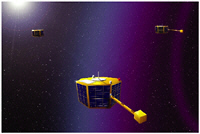
The New Millennium Program’s Space Technology 5 mission (launch in 2005) will test advanced spacecraft technologies required for future space physics missions involving constellations of miniaturized satellites.
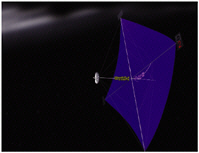
Artist’s concept of a solar-sail-powered spacecraft. Solar sails are being considered for an Interstellar Probe and for a multispacecraft “sentinel” mission to study the propagation of heliospheric disturbances from the Sun to Earth.

Whether it is exploring new regions, revisiting previously explored regions with enhanced observational capabilities, or addressing old problems with new computing resources—in each case improvements in technology are required. The Survey Committee identifies seven main areas in which focused technology development, based on both the immediate and the projected needs of solar and space physics research, is required to support future advances in our knowledge and understanding of solar system plasmas:

  • Developing new propulsion technologies to send spacecraft to the planets and beyond as efficiently as possible

  • Developing highly miniaturized sensors of charged and neutral particles and photons

  • Developing highly miniaturized spacecraft and advanced spacecraft subsystems for missions involving constellations of multiple spacecraft

  • Gathering and assimilating the data from multiple platforms

  • Integrating large space-physics databases into physics-based numerical models

  • Deploying reliable, unmanned, ground-based ionospheric and geomagnetic measurement stations

  • Developing a high-resolution, ground-based solar imager

Page
35

Below are the first 10 and last 10 pages of uncorrected machine-read text (when available) of this chapter, followed by the top 30 algorithmically extracted key phrases from the chapter as a whole.
Intended to provide our own search engines and external engines with highly rich, chapter-representative searchable text on the opening pages of each chapter. Because it is UNCORRECTED material, please consider the following text as a useful but insufficient proxy for the authoritative book pages.

Do not use for reproduction, copying, pasting, or reading; exclusively for search engines.

OCR for page 35
Understanding the Sun and Solar System Plasmas: Future Directions in Solar and Space Physics TECHNOLOGY ENABLING THE FUTURE Advances in solar and space physics result either from visiting new places, or from revisiting old places with new, improved observational capabilities. To these should be added revisiting old problems with new computational techniques and improved computational resources. Examples of missions that will advance our knowledge by visiting “new places” are Solar Probe and Interstellar Probe, which will visit the innermost and outermost unexplored regions of the heliosphere. Examples of missions that will bring new observational capabilities to bear on previously surveyed regions are the MMS mission, which will make measurements of unprecedently high time resolution from multiple spacecraft, and MagCon, which will deploy some 50 to 100 nanosatellites to capture the large-scale dynamics of the magnetosphere. The New Millennium Program’s Space Technology 5 mission (launch in 2005) will test advanced spacecraft technologies required for future space physics missions involving constellations of miniaturized satellites. Artist’s concept of a solar-sail-powered spacecraft. Solar sails are being considered for an Interstellar Probe and for a multispacecraft “sentinel” mission to study the propagation of heliospheric disturbances from the Sun to Earth. Whether it is exploring new regions, revisiting previously explored regions with enhanced observational capabilities, or addressing old problems with new computing resources—in each case improvements in technology are required. The Survey Committee identifies seven main areas in which focused technology development, based on both the immediate and the projected needs of solar and space physics research, is required to support future advances in our knowledge and understanding of solar system plasmas: Developing new propulsion technologies to send spacecraft to the planets and beyond as efficiently as possible Developing highly miniaturized sensors of charged and neutral particles and photons Developing highly miniaturized spacecraft and advanced spacecraft subsystems for missions involving constellations of multiple spacecraft Gathering and assimilating the data from multiple platforms Integrating large space-physics databases into physics-based numerical models Deploying reliable, unmanned, ground-based ionospheric and geomagnetic measurement stations Developing a high-resolution, ground-based solar imager