
Prospects for Distributed Combined Cooling, Heating, and Power Systems in China
LIWEN FENG
Falcon Group Inc.
YINGSHI WANG
Institute of Engineering Thermophysics
Chinese Academy of Sciences
Distributed energy systems can complement large thermal power plants and large steam generators. A distributed-energy power-generating system is generally modular, can provide anywhere from several thousand kilowatts (kW) to 50 megawatts (MW) of power, and is located near its customers. It requires almost no public power or steam network, and, because it is located near customers, transmission losses are significantly reduced.
The concept of distributed energy was initiated and promoted in the United States and was subsequently accepted by other industrialized countries. Active research in the technology for distributed energy began after the energy crisis of 1973. In recent years, as a result of the serious ecological and environmental challenges facing traditional power sources (e.g., global warming), the pace of the development of conventional plants in industrialized countries has slowed. At the same time, the development of nuclear power is being restricted because of safety concerns. For all of these reasons, developed countries are now actively pursuing research and development of distributed energy technology.
Although distributed energy technology has been researched for decades, rapid development has occurred only in the past few years. Many experts and scholars now consider distributed power to be the “energy for the 21st century.” As energy infrastructure is restructured and new technologies are developed, and as the demand for high-quality energy increases, distributed energy will become increasingly attractive. Distributed energy systems are environmentally friendly, highly efficient, and highly flexible, and they can be combined with the traditional energy grid to improve energy services for all people.
The power-generating equipment in a distributed system can be a small
(micro) gas turbine, a heat pump, or a fuel cell. Energy can be produced from solar (electric or thermal), geothermal, wind, natural gas, and methane resources. Second-generation distributed energy systems are characterized by five features: many possible fuel sources; small or micro equipment; combined cooling, heating, and power (CCHP) generation; intelligent management; and a high standard of environmental protection. Distributed energy systems are not likely to replace traditional energy systems. However, when combined with traditional systems, they can make overall systems more efficient and more robust.
ADVANTAGES OF DISTRIBUTED ENERGY
Although distributed energy technologies are still in their infancy, they have numerous advantages over traditional energy technologies: reduced emissions; increased efficiency; flexibility; improved safety; and load balance.
Lower Emissions
Because distributed energy systems use renewable energy sources and gas turbine engines with extremely efficient combustion chamber technology, emissions of nitrogen oxides (NOx) can be reduced to less than 25 parts per million (ppm). Emissions of carbon dioxide (CO2), sulfide, and dust can also be reduced significantly compared with emissions from large thermal power plants.
Efficient, Comprehensive Energy Consumption
CCHP systems are small scale and flexible. These systems can effectively integrate electricity, heating, and cooling requirements, supply enough energy to meet demand without waste, and eliminate the need to transmit cooling and heating energy over long distances. The efficiency of a distributed energy system can be higher than 75 percent.
Intelligence and Flexibility
Because the overall capacity of a CCHP system is relatively small, and because start-up, shutdown, and regulatory requirements can be met quickly, a distributed system can operate automatically, without personnel on duty, and operation is flexible and easy.
Safety
As recent power blackouts have shown, the traditional electricity grid is still heavily dependent on a stable exterior environment, and the political and economical effects of damage to transmission lines are becoming more and more
serious. However, if a large grid is combined with distributed energy located near its customers, it can maintain the power supply even if the grid collapses or there is an accident, such as an earthquake, snow storm, or even a war. In addition to standard power, distributed energy can supply emergency standby power and, if necessary, extra power during peak times, thus greatly improving the reliability of the power supply.
Supply Balance
To reduce adverse effects on the environment, natural gas is replacing coal. But with the increased use of air conditioning, imbalances in the electricity load between winter and summer are becoming common in large cities, including Beijing. The supply of natural gas is high in winter and low in summer. Distributed energy systems can balance the power supply to some extent, because they use natural gas in summer to generate power for air conditioning. Thus they improve the utilization rate of grid equipment and natural gas pipelines.
THE INEVITABILITY OF DISTRIBUTED ENERGY SYSTEMS IN CHINA
China is developing rapidly; however, the relative shortage of energy resources and the waste caused by the inefficient use of existing resources could keep China from sustaining that rate of development. In terms of per capita resources, China has a serious shortfall in primary energy. China has approximately 21 percent of the world’s population, but only 11 percent of the world’s known coal reserves. Global coal reserves are expected to last for 230 years, but China’s reserves are expected to last for only 90 years. China’s reserves of crude oil account for only 2.4 percent of total global reserves. Global crude oil reserves are expected to last for 48 years, but according to the Chinese Statistical Bureau, China’s reserves will last for only 22 years. Therefore, more complete combustion and more efficient energy use will be absolutely essential to continued modernization in China.
The emission of greenhouse gases is a particularly serious problem, and China ranks second in the world in greenhouse gas emissions. The Chinese government has decided to participate in the Kyoto Agreement and to undertake the obligations stipulated therein, which means that from 2008 to 2012, China has agreed to reduce greenhouse gas emissions to the level of 1990. To realize this goal, the use of coal will have to be considerably reduced and the development of, and exploration for, natural gas will have to be considerably increased. The development and use of solar, wind, and other renewable energies are becoming inevitable.
The use of natural gas will become a significant issue for the Chinese energy industry in the next 10 years. But simply replacing coal with natural gas for
power and heating will not reduce greenhouse gas emissions significantly. In addition, it will increase fuel prices significantly and cause a huge loss of revenue to the state and private industry.
Economic development calls for a safe, stable power system. Recent blackouts in the northeastern United States, Canada, London, and Taiwan should remind us to take the issue seriously. As China’s economy develops rapidly, the centralized power supply grid, along with its inevitable safety problems, will also expand rapidly. Reasonable development of a safer power supply structure would combine distributed power with the centralized power supply.
DEVELOPMENT OF DISTRIBUTED ENERGY
Table 1 shows the status of distributed energy projects in China in 2003. To meet environmental protection standards, remain competitive, and incorporate technological advances, a long-term energy plan must be both flexible and practical. The plan should include a reasonable layout of the large grid and the development of distributed energy.
TABLE 1 Status of Current Distributed Energy Projects in China
|
Project Location |
Equipment Status |
Remarks |
|
Shanghai Huangpu Center |
1 × 1000 kW Solar Saturn 20 diesel gas turbine; 1 × 3.5 t/h HRSG |
Operating |
|
Shanghai Pudong Airport |
1 × 4000 kW Solar natural gas turbine |
Operating |
|
Shanghai Minhang Hospital |
1 × 400 kW Jiantai gas engine; 1 x 350 kg/h HRSG |
Operating |
|
Guangdong Dongguan Shoe Plant |
11 × 1020 kW diesel gas engine; 11 x 0.5 t/h steam boilers |
Operating |
|
Guangzhou Aluminum Group |
1 × 725 kW heavy oil gas engine; 1 × BZ200 waste heat direct engine |
Operating |
|
Shanghai Engineering University |
1× 60 kW Capstone micro-engine; 1 × 150,000 Mega Pascal waste heat direct engine |
Under development |
|
Beijing Gas Group |
1 × 480 kW, 1 × 725 kW gas engine |
Installed |
|
Beijing Ci Chumen Station |
1 × 80 kW Bowman gas micro-engine |
Installed |
|
Beijing International Trading Building |
1 × 4000 kW Solar Centaur 40 gas turbine |
Under development |
|
Beijing International Shopping Mall |
1 × 4000 kW Solar Centaur 40 gas turbine |
Under development |
|
Soft Ware Square |
1 set of 1200 kW Solar gas turbine |
Tendered |
-
For the remote, less-developed areas of western China, distributed energy systems can provide strong support during the period of economic development in a short period of time and at a relatively small cost because they can make use of the rich natural resources of these areas and diverse forms of renewable energy.
-
For the economically developed southeastern coastal areas, the requirements for environmental protection are becoming more stringent, and demands for energy products, such as cooling, heating, and electricity, are becoming more diversified. The development of distributed energy along with traditional power generating systems will improve the comprehensive use of energy sources, reduce energy supply costs, and improve the safety of the power supply to urban areas. At the same time, a distributed energy system will improve environmental protection. Distributed energy is the optimum choice.
POWER GENERATION BASED ON NATURAL GAS
Known global natural gas reserves exceed 140 trillion cubic meters (m3) and are expected to last for about 68 years if they are consumed at a rate of 2 trillion m3 annually. The exploration and use of natural gas in China are relatively underdeveloped; the known reserve is only 1.2 percent of the global reserve, and the current annual output is about 22.5 billion m3 per year. Geologically, the natural gas reserves in China are estimated at more than 30.8 trillion m3. According to international general practice, about 1.02 trillion m3 can be excavated for 45 years, and improvements in transporting gas from west to east in China will lead to an unprecedented change in the Chinese energy structure.
Natural gas will be used primarily to alleviate serious pollution in cities. There will, however, be negative consequences if natural gas is not used appropriately. China must improve the utilization rate of energy as it addresses environmental contamination. Distributed energy can provide a new, realistic method of using natural gas that will increase energy efficiency, offer economic benefits, and improve safety. An example of the use of distributed natural gas power is shown in Figure 1.
DISTRIBUTED ENERGY SYSTEMS BASED ON RENEWABLE ENERGY
According to documents provided by the expert committee of the “863 Program,” China is rich in renewable energies—both in quality and quantity. For example, the annual radiation of solar energy for more than two-thirds of China exceeds 600 MJ/cm2; the annual solar energy radiation absorbed by the Earth’s surface is equivalent to 17 trillion tons of standard coal. The prospective reserve of geothermal energy in China is about 135 billion tons of standard coal (the explored coal reserve is about 3.16 billion tons).
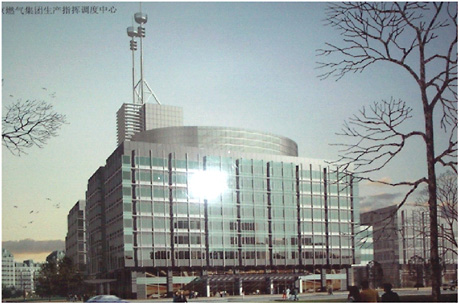
FIGURE 1 The Beijing Gas Group Office Building (23,000 m2) is already built and is being commissioned. Major energy equipment includes: 1 set of 480 kW + 1 set of 72 kW Caterpillar gas engines; and 1 set of BZ100 + 1 set of BZ200 waste-heat direct-absorption gas turbines. The system guarantees basic power needs. Any shortfall for heating, cooling, or hot water is supplied by the grid.
The main obstacles to the use of renewable energies are low efficiency, low density, and instability of the power supply; all of these make it difficult to integrate renewable energies into the centralized power supply. By integrating with distributed energy, renewable energy can significantly improve the efficiency of the power supply on the basis of cascade utilization. The energy density for distributed energy is far lower than for the centralized power supply. Moreover, by using modern, energy-saving technologies, distributed energy can overcome the instability of renewable energy supplies to a great extent. In fact, distributed energy has provided a new impetus for the development and use of renewable energy and can significantly improve the efficiency of the power supply, provide economic benefits, and improve safety.
PROBLEMS ENCOUNTERED
Problems encountered in the promotion of natural gas to supply power include: interconnection; sales; fire regulations; pricing; and project operation and taxes.
Interconnection
CCHP systems can produce three types of energy—cooling, heating, and electricity. Cooling and heating demands can be met directly, but the electricity supply must be interconnected with the city grid for economic and safety reasons. At present, the electric power authorities in Beijing are resistant to the idea of interconnecting the main power system to other power generating sources, because the department believes that the interconnection of small power sources in large quantity will affect the operational safety of the grid. However, small generators that satisfy national standards are mature enough for interconnection with the grid. There may be some problems in terms of dispatching and managing energy, but, extrapolating from broad experience, these difficulties can be overcome. In addition, there are some examples of successful interconnections, such as Shanghai Pudong Airport and Minhang Hospital.
The power department in Beijing has invested economically in most power supply facilities. When customers build their own CCHP systems, their power generating costs will be lower than the cost of power generated by the city grid, and customers will naturally use the lower cost power, which will negatively affect the power department’s revenues. This issue can be resolved by compensating the large grid with a portion of the revenue received by the owners of small power sources.
Chinese laws stipulate clear rules for the interconnection and construction of power sources. If we combine foreign experience with these standards, we can formulate guidelines for interconnecting small power sources that are suitable to the Chinese situation and take into account the interests of the power department and the technical issues surrounding interconnection.
Sales
Chinese laws stipulate that unless the power supply enterprises agree, no other entity is allowed to supply power. This inhibits the range and economics of distributed power sources. For example, if several different entities wish to invest jointly in a small power supply center to save money and improve the energy utilization rate, under the current rules they cannot. Thus, current regulations inhibit the development of small power suppliers.
In addition, the current grid system charges one tariff for all power, regardless of how the power is generated. This is unfair to both gas cogeneration and small power suppliers because the price of natural gas is much higher than the cost of coal, and therefore the cost of gas generation is much higher than the cost of coal generation. However, coal generation does not have the environmental benefits of gas generation. To address these issues fairly, the government could subsidize gas generation.
Fire Regulations
Current fire regulations in China stipulate that the pressure of gas entering each home shall be at moderate levels. However, gas turbines generally require much higher pressure. Thus, current rules inhibit the development of gas-generated CCHP systems in cities. In Japan, the United States, and other countries, the pressure of the gas entering each home can be higher than in China. Instead of limiting the use of high-pressure gas in those countries, management and technical measures have been developed to solve possible problems arising from high-pressure gas.
Energy Pricing
The high price of gas in China has been the main factor inhibiting the development of gas generation. The price of natural gas in China is double the price in Russia and the United States. Aside from its environmental benefits, gas-generated CCHP systems would increase the quantity of gas used in Beijing and balance gas utilization in winter and summer. Therefore, the government and Beijing Gas Group should offer policies that encourage the use of gas-generated CCHP systems.
Project Operation and Taxation
The state encourages the development of gas generation and has listed cogeneration in its catalogue of “Industries, Products, and Technologies.”
In general, gas generation is an energy-saving, environmentally beneficial tool that uses new technologies. But if all of the economical and technical risks of such projects must be borne by customers, the projects will certainly be negatively affected. For this reason, the economic and trading commission has introduced energy management company (EMC) energy-saving operating methodologies from abroad.
The World Bank offers loans for Chinese companies that use EMCs. In the initial loan phase, these companies enjoy reductions in and exemptions from import duties, as well as favorable polices regarding the value-added tax on imported equipment. However, companies using EMCs are no longer allowed to receive World Bank loans directly, and so are required to pay the regular customs duty and value-added tax for imported equipment. Because gas-generation technology is relatively new, most of the equipment is imported. For example, Zhong Guancun Software Park requires about 10 million yuan to import a 1,200 kW gas turbine, of which about 2.3 million yuan is for customs duty and value-added tax. This significantly increases the cost of the project.
ASSESSING PROJECTS
Difficulties have been encountered in promoting the use of gas-fueled CCHP systems. Because gas generation is not only beneficial to the environment, but would also save energy and balance the peaks and valleys of the gas and power supply in Beijing, it is essential that we try to elicit more favorable policies from the government.
Although distributed energy systems have a number of advantages and are relatively well established internationally, these technologies are still in the beginning stages of use in China. In fact, only CCHP is mature and can be put into market operation. CCHP is being used in the newly built Pudong Airport in Shanghai and at Minhang Hospital in Xinzhuang Shanghai. In Beijing, CCHP projects include Beijing Gas Monitor and Control Center, which uses a gas engine, and Ciqumen Station, which uses a micro gas turbine.
The key to the success of CCHP systems, illustrated by examples in both China and abroad, is selecting equipment and formulating a plan of operation that satisfies customers’ requirements for a sufficient supply of natural gas. CCHP projects must therefore be based upon system capacity and local energy pricing. We have already investigated several projects. For example, the owner of a supermarket in Wuhan, in Hubei Province, who is very interested in CCHP, hired us to develop a plan. However, after familiarizing ourselves with energy prices in Wuhan, we found that the investment would not be returned and that CCHP is not suitable for the area.
Once a project is verified as feasible, the issues of load analysis and system capacity must be faced. Based on our experience, this step is critical to the project’s success. An example of a failed project was a CCHP system for a hospital in Shanghai, which failed because the unit capacity far exceeded the actual load of the project. Load analysis is as basic to each project as laying the foundation of a house. Analysis involves collecting statistics of the annual operation of office buildings, hotels, and apartments in Beijing, sorting the relevant cogeneration load rule, and making load forecasts as close as possible to the actual operation of the conditions of potential customers.
Selecting the unit is also essential. There are many differences between a CCHP project and a traditional plan. First, the energy supply source is relatively independent, which means that it does not depend on the larger grid network in most cases. It is not economical to purchase all the power from the city grid, so there is a difference between the unit capacity of the CCHP system electrical load and the unit capacity of economical operation. If the guiding principle of “the quantity of interconnected power depends on the quantity of supplied cool and thermal, interconnected but not on grid, and the shortage of power shall be supplemented by the power of city grid” is applied in a simple way, the CCHP unit selected will produce a scenario in which a small cart is pulled by a large horse, which will not yield an economic benefit. Therefore, the economic
operation load, rather than the peak load, should be the reference point in selecting a CCHP unit.
There are various kinds of generators for CCHP projects: gas turbine, gas engine, gas exterior engine, and micro gas turbine. There are mainly two types of waste-heat recovery units: waste-heat recovery boilers and waste-heat, direct-fire absorption engines. Generally speaking, the generation capacity is usually below 1,000 kW, for which a gas engine, micro gas turbine, or gas turbine is most appropriate. Although, the most widely used and most mature product is the waste-heat recovery boiler, the waste-heat direct absorption engine is a focal point of CCHP research. With the support of the U.S. Department of Energy, the state of Texas plans to build a distributed CCHP (DCCHP) project that uses a waste-heat, direct-absorption engine. The Texas DCCHP project will be the largest in the world; it will involve seven companies, including the Yuan Da Group from China. However, the generator and waste-heat recovery method are still to be decided based on comparisons of several plans.
A CCHP system is different from the single operation of a generator, as well as from the traditional cogeneration power plant. In most cases, cooling and heating are supplied independently, and the load is rarely stable. Each season of the year has a unique power load. Weekend and weekday loads differ, as do day and night loads. Because the system is not buffered by support from the city grid, it has to follow changes in customer load closely to adjust the supply of cooling and heating to maximize the utilization rate of the energies. A CCHP system does not require manpower on duty.
SUPPORTING THE DEVELOPMENT OF DISTRIBUTED ENERGY
The main obstacle to the development of distributed energy in China is not the lack of technology or capital, but the rules and policies of the state that are at odds with the effective use of technology and the lack of an effective supervisory mechanism. The measures suggested below are critical to the development of distributed energy in China. In all cases, the power grid must provide standby power security to customers who use distributed energy facilities.
First, when customers who use distributed energy facilities require emergency power, the tariff may be higher than for other customers. This capacity tariff, or “power source standby fee,” should not be allowed because the capacity for distributed energy customers is so small that the power grid does not have to maintain the equivalent standby capacity.
Second, distributed energy facilities may sell extra power to the grid, and the grid may be obliged to off-take such power. In that case, the tariff should be 90 percent of the tariff paid by customers; this will reduce transmission loss and wasted energy.
Third, distributed energy facilities should be permitted to interconnect to the main power system. To ensure the safe use of power by customers, the distributed
power should be connected to the power supply terminal or customer terminal of the customer transformers. Because the capacities of distributed facilities are not sufficient to affect the safety of the grid, the grid should be able to address this issue if safety of the system is affected.
Fourth, the distribution of natural-gas-generated energy should be optimized to reduce adverse environmental impacts. This optimization should be a priority, regardless of industry barriers, and should provide natural gas to the places most in need to reduce the price of energy. The use of natural gas by power enterprises should be strictly minimized. CCHP systems should be used to satisfy peak demand for power and balance the cost during off-peak times to improve the peaking capability of the power plant.
DISTRIBUTED ENERGY SYSTEMS AND THE BEIJING OLYMPICS
Energy has long been closely related to the quality of life and has played an important role in large gatherings of people. The Beijing Olympics in 2008, which will be viewed by the whole world, will be the largest gathering ever held in China. The world has high expectations for the Beijing Olympics, and this is an opportunity for China take pride in its accomplishments. The Olympics will be a large, complicated project, and energy construction will be an important part of it. The “Energy Construction and Structure Adjustment of Beijing Olympics Action Plan” proposes using distributed energy, including thermal pumps, photovoltaics, solar thermal energy, and wind technologies. This is the first time new energy would be used for the Olympics.
“Green Olympics, Scientific Olympics” is China’s commitment to the world and to ourselves. Criteria for defining “green” include how energy is produced and how it is used. For a long time, we have automatically relied on electricity and heat supplied by the city grid and networks. However, a key issue for China is avoiding, or at lease reducing, electricity loss resulting from long-distance transmission and heat loss from long-distance pipelines. Another is assessing environmental contamination caused by emissions from large thermal power plants. Of course, electricity supplied by city grids has advantages—it is stable and reliable, and unit costs are low. But as new energy technologies are developed and paired with distributed energy, these advantages will be less striking.
The Beijing municipal government and the Beijing Olympic Committee have supported the building of a green energy center near the Olympic Park that will use various kinds of distributed energy technologies. A CCHP network will be built near the park, and various kinds of energy facilities will be connected with this network from different locations. Those facilities will include natural gas heating, electricity, and cooling, fuel cells, solar electric and thermal energy, and wind energy. A control center will be built to monitor and supervise the operation of each type of facility, load requirements, energy supplies, and the use of renewable and green energies to optimize their comprehensive benefits.
SUMMARY
Distributed energy is only one direction in energy technology development, but it is especially important to the current stage of energy restructuring in China. Although our economy is accelerating rapidly, many aspects of it are still in the transition stage, and the energy industry is adapting to economic developments. Distributed energy development not only embodies technological progress but also represents a transformation in the way we think about energy use.
Of course, there are still many difficulties to overcome in the development of distributed energy in China. Some of those difficulties are related to policies and technologies, but most of them are related to interconnection, energy prices, and supporting policies. Despite these challenges, distributed energy technology development is an inevitable trend that will help meet the needs of our country’s economic future together with traditional energy methods.
BIBLIOGRAPHY
Beijing Natural Gas Utilization Research Institute. 2003–2004. BCCHP System vs. Natural Gas Utilization: Research and Pilot Project. Beijing: Natural Gas Utilization Research Institute.
Chen, H. 2001. Improving Efficiency to Support Sustainable Utilization of Energy. Beijing: Department of CHP and Energy Saving, State Planning Commission of China.
China Energy Conservation Corp and China SDPC. 2003. China Micro (Small) CCHP Technology Potential Market Analysis. Beijing: SDPC.
Chinese Statistical Bureau. Multiple years. Chinese State Year Books. Beijing: China Statistical Publishing House.
IEA (International Energy Agency). 2003. World Energy Investment Outlook. Paris: IEA.
IEA, in cooperation with the Energy Research Institute of the China State Development Planning Commission (SDPC). 2002. China Energy Outlook. Paris: IEA.
Wang, J. 2002. China Energy Development Report. Beijing: Beijing Market Economic Development Research Institute.


