
2
Decision Context
INTRODUCTION
The Tropical Rainfall Measuring Mission (TRMM) case exemplifies a broader challenge faced by the National Aeronautics and Space Administration (NASA) and other federal agencies that operate research satellites and sensors that work superbly past completion of their primary scientific mission and hold impressive possibilities for both scientific and operational advances.1 Extending TRMM is also part of the larger question of how the United States manages the transition from research to operations, and from one agency to others. Earlier reports (e.g., NRC, 2003) have tackled aspects of this issue and the subsequent phase of this committee’s work will step back and examine the broader challenges of research to operations in the context of precipitation missions. This chapter covers the elements of the TRMM decision in this broader context.
ELEMENTS OF THE TRMM DECISION CONTEXT
There are three elements to be weighed in the TRMM decision context:
-
Research and Operations Benefits
-
Cost
-
Risk
Chapter 4 of this report highlights the research and operational benefits of mission extension. Cost refers to the cost of mission operations, controlled reentry, and science data processing. Risk refers to the risk to lives and property from spacecraft debris in the event of uncontrolled reentry.
COST
The mission cost of TRMM to date is at least $750 million.2 Even if NASA terminates TRMM in December 2004, there will be more than $13 million in additional costs for operating the satellite until 2007 when controlled reentry would occur.3 There is no question that NASA and the Japan Aerospace Exploration Agency have invested large sums in TRMM beyond the spacecraft’s original planned five-year life and they should be commended for this.
The cost of mission extension beyond 2004 is illustrated in Table 2-1. These calculations are for extension of operations to November 2005 and controlled reentry in the first quarter of 2008 after roughly two years of driftdown. NASA has approached other agencies for their help in supporting the cost of extending the mission beyond 2004 but without success to date.4 Current NASA policy regarding mission extensions puts the burden on research programs to underwrite costs incurred by NASA.5 The current NASA precipitation research budget is around $16 million per year.
The key budget number in Table 2-1 is the combined cost of mission operations and controlled reentry in fiscal year 2005, that is, $4.3 million. This is the approximate additional cost of operating TRMM until November 2005 instead of December 2004.6 NASA separates the total cost into three components: mission operations, controlled reentry, and science data processing. The first and last of these are approximately equal and collectively contribute 90 percent or more to the overall annual cost in Table 2-1. Science data processing includes TRMM-related, Global Precipitation Measurement (GPM)-related, and general precipitation data processing costs and is not uniquely tied to the TRMM mis-
TABLE 2-1 Cost Breakdown (in millions of dollars) for Extending TRMM Mission to November 2005 (official end of the 2005 hurricane season) with Controlled Reentry in the First Quarter of Fiscal Year (FY) 2008
|
|
FY04 |
FY05 |
FY06 |
FY07 |
FY08 |
Total |
|
Mission Operationsa |
6.4 |
3.8 |
3.6 |
4.0 |
2.5 |
20.3 |
|
Controlled Reentryb |
1.0 |
0.5 |
0.5 |
0.6 |
0.5 |
3.1 |
|
Science Data Processingc |
4.8 |
3.6 |
3.4 |
3.5 |
1.8 |
17.1 |
|
Total |
12.2 |
7.9 |
7.5 |
8.1 |
4.8 |
40.5 |
|
Guidelined |
12.2 |
4.7 |
4.7 |
4.9 |
1.5 |
28.0 |
|
Shortfalle |
0.0 |
−3.2 |
−2.8 |
−3.2 |
−3.3 |
−12.5 |
|
NOTE: There are two caveats to this table. First, operating costs are projected to be lower than current values in fiscal year 2005 and beyond because of current efforts to increase automation within flight operations, thereby reducing staffing levels. No reserves are included in the estimates to mitigate the risks of not achieving these reductions or from risks due to other factors (e.g., NASA’s Goddard Space Flight Center manpower and other annual rate fluctuations). Second, the estimates reflect the “most probable” timing for reaching controlled reentry fuel threshold of 138 kg and a fiscal year 2004 Program Operating Plan guideline. aCost of maintaining staffing of flight control. bCost of analysis, training, and staffing for reentry maneuvers. cCost of (1) reprocessing existing data, (2) transition to a new precipitation processing system for GPM, and (3) development of multisatellite three-hour precipitation products (these three items are not always clearly separable). dFunds in NASA Goddard’s May 2004 budget to cover TRMM operations. eDifference between estimated total cost and funds in the NASA Goddard budget for this activity. SOURCE: Steven Neeck, NASA. |
||||||
sion or its extension.7 For example, the budget line covers the cost of (1) reprocessing existing TRMM datasets for improved rainfall algorithms, (2) the transition to a new precipitation processing system that is part of GPM preparations, and (3) the development of multisatellite three-hour precipitation products that will be produced regardless of the availability of new TRMM data. The distinction between these functions is not always exact, which makes it difficult to give a precise figure for the portion of the data processing budget that is directly
attributable to TRMM extension. The drop of the data processing budget line in fiscal year 2008 reflects winding down of the TRMM Scientific Data and Information System, which will be replaced by the GPM system as that mission prepares for launch. Overall, the actual cost of a mission extension is dominated by the mission operations budget line. And the shortfall line in Table 2-1 indicates that a significant fraction of that cost is not covered in the current NASA Goddard budget.
RISK
The TRMM spacecraft has sufficient mass to prevent it from entirely burning up when it reenters Earth’s atmosphere. To date, the spacecraft’s propulsion system has been used to maintain the craft’s orbit. Orbital adjustments every few weeks use some of the fuel on board. The propulsion system can also be used to conduct a controlled reentry whereby the satellite is guided into the ocean. NASA estimates that a controlled reentry of the satellite requires 138 kg of fuel. At the current rate of fuel usage the fuel would be depleted to 138 kg in late 2005 to early 2006 (Figure 2-1).8 If all the remaining fuel were to be used for orbit adjustments, NASA estimates that TRMM could continue operating until 2010 or 2011 and then drift down for an uncontrolled reentry.
NASA is responsible for a handful of uncontrolled reentries each year. For example, in 1999, 111 large objects reentered Earth’s atmosphere in an uncontrolled way. 21 of the objects were satellites and the remainder was primarily rocket bodies used to boost satellites and platforms. 29 of the 111 objects originated from the United States and NASA was responsible for 6 of these 29 objects (Martin, 2002).
NASA guidelines state that an orbital reentry risk level of 1 in 10,000 is acceptable.9 Other U.S. government agencies have also accepted this risk level as a standard guideline (Martin, 2002). In a 2002 TRMM Disposal Risk Review (Martin, 2002), NASA’s Office of Safety and Mission Assurance estimates that there is a 2 in 10,000 casualty risk associated with an uncontrolled reentry of TRMM. The review states that the TRMM uncontrolled reentry casualty risk is in an “intermediate, or tolerability zone, where the risk may be tolerated in return for other (public safety) benefits” (Box 2-1). The broader context of benefits and risks associated with TRMM extension was discussed at a 2001 NASA-supported workshop (Box 2-2). The basic conclusions of the 2001 workshop remain current.10
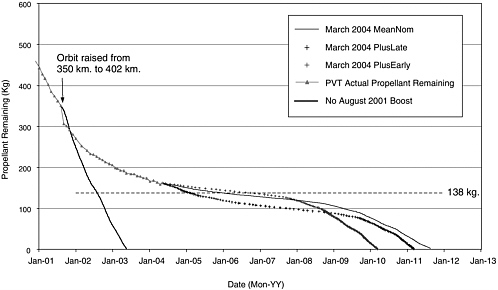
FIGURE 2-1 Fuel (“propellant”) levels aboard the TRMM satellite and projected rate of decrease (March 2004 projections). The ho marked “138 kg” indicates the critical fuel level below which reentry cannot be controlled. When the fuel level reaches zero, t orbital adjustments is lost, the TRMM data stream degrades, and driftdown begins. The extension of the lifetime of TRMM due to boost in 2001 is evident from the difference between the original projected zero fuel point in 2003 and the various options in three curves that intercept the horizontal axis in 2010-2011 are for three different solar flux forecast scenarios: (1) mean ex nominal phase of the solar cycle (the line with the latest intercept on the X-axis); (2) sigma plus flux and late phase (the li January 2011); and (3) 2 sigma plus flux and early phase (the line intercepting near January 2010). The mean nominal curve is c most likely fuel expenditure scenario. SOURCE: Presentation by Robert Adler, NASA, at November 8 workshop.
|
BOX 2-1 Conclusions from 2002 TRMM Disposal Risk Review by NASA Office of Safety and Mission Assurance (Martin, 2002) “In the case of a TRMM uncontrolled reentry, the casualty risk of 2/10,000 events appears to fall into an intermediate, or tolerability zone, where the risk may be tolerated in return for other (public safety) benefits. A (defendable) quantitative estimate of the benefits derived from up to five extra years of TRMM data on improvement of storm analysis, forecasting, and public safety could not be developed. As a result NASA will need to rely on subjective estimates based on expert judgment. There are other factors that decision makers should consider in making an informed decision including: possible legal considerations, policy considerations, and international considerations. Barring any impediments from NASA Legal Council, it is concluded that a decision to accept the uncontrolled reentry public safety risk of TRMM, in exchange for extending the mission and potentially benefiting from the improvement in storm analysis and forecasting capabilities, is reasonable and within the discretion of the Earth Science Enterprise and the NASA Administrator. Note: If the decision is made to extend the TRMM mission, consideration should be given to maintaining the controlled reentry capability as long as possible in case the critical TRMM instruments fail or a replacement capability becomes operational prior to fuel levels reaching the critical 156 kg level.” |
FINDINGS
FINDING 2.1:11 NASA will incur costs for operating the TRMM satellite through 2007 even if the mission is terminated in December 2004, because of the time it takes for the spacecraft to drift down to an appropriate altitude for controlled reentry. These costs exceed the amount currently in NASA’s budget for TRMM. The additional cost of extending TRMM from December 2004 to November 2005 is approximately $4 million. It is NASA’s practiced policy to try to recover its costs of mission extension from related research programs. In the case of TRMM, these extra costs would likely have to be borne by NASA’s precipitation research budget, which is around $16 million per year. However, it is outside this committee’s charge to assess the effects on other satellite operations, missions, and research budgets of NASA bearing the entire cost of extending TRMM, though such an assessment is part of the overall decision context.
FINDING 2.2: The most recent analyses of the risks from uncontrolled reentry are those reported in 2001 (Pielke et al., 2001) and 2002 (Martin, 2002), and the committee is unaware of any subsequent changes to the conclusions. Although the risk from uncontrolled reentry is part of the overall decision context, the committee is neither tasked to assess this risk nor does it have the expertise to do so.
|
BOX 2-2 Outcomes of 2001 NASA Workshop on Risk-Benefit Assessment of Observing System Decision Alternatives The workshop was held at the University Corporation for Atmospheric Research in Boulder, Colorado in June 2001. The four workshop goals are quoted below, along with the related findings and recommendations.
Recommendation 1.1: If NASA wishes to use risk assessments as a basis for deorbiting assessments, the agency must consider such risks and benefits more comprehensively than it presently does. Recommendation 1.2: Given the material presented at the workshop, we recommend that NASA should not base its decision to extend the TRMM mission primarily on quantitative comparisons between “lives potentially saved” through operational exploitation of TRMM data and “potential hazard” associated with uncontrolled reentry.
Recommendation 2.1: During the approximately 3 years of additional onorbit operations that would be provided by boosting TRMM, NASA should (a) reevaluate its deorbiting decision guidelines, (b) conduct that research necessary to more comprehensively and better understand risks and benefits associated with deorbiting decision alternatives, and (c) with the reevaluated decision criteria and results of research related to risks and benefits, revisit the TRMM deorbiting decision in late 2004. |
Recommendation 3.1: NASA should consider (a) making its reentry risk calculation more transparent, rigorous, and meaningful and (b) placing its reentry risk calculations into a more comprehensive framework.
Recommendation 4.1: Decision makers would benefit from an ongoing effort devoted to the “technology assessment of observing systems” that would seek to evaluate the broad costs and benefits of alternative observing strategies for both science and society. Recommendation 4.2: NASA and its operational partners would benefit from a more systematic approach to the “transition of research to operations.” The full workshop report can be viewed at http://sciencepolicy.colorado.edu/pielke/workshops/trmm/index.html. |


